

Glycosylphosphatidylinositol-anchored Proteases of Candida albicans Target Proteins Necessary for Both Cellular Processes and Host-Pathogen Interactions
Open accessThe DOI matches its Crossref record; 51 of the 52 references it cites were found in a registry or an index.
Abstract
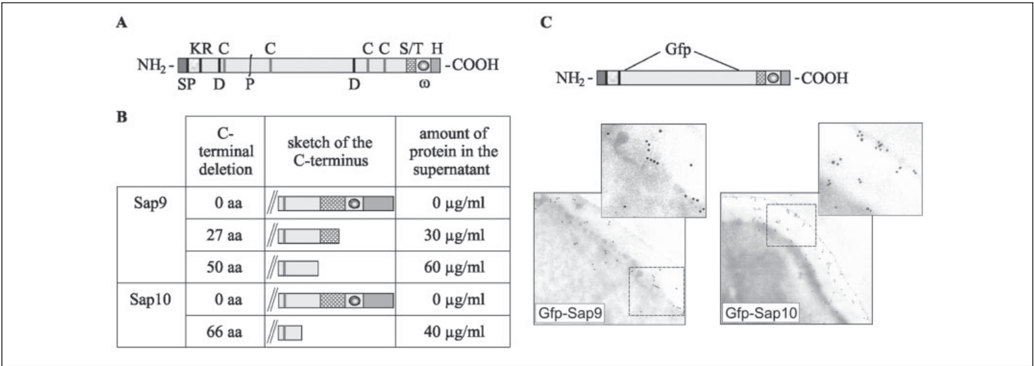
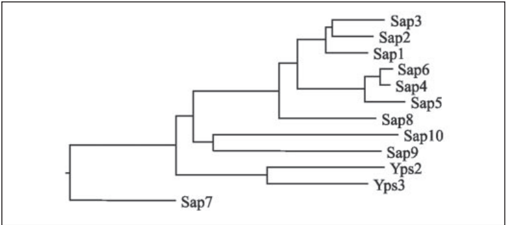
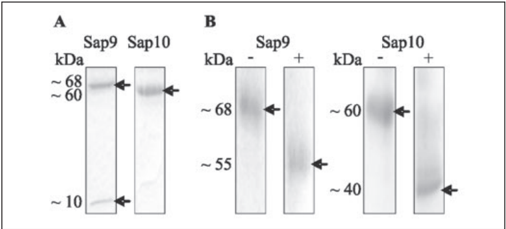
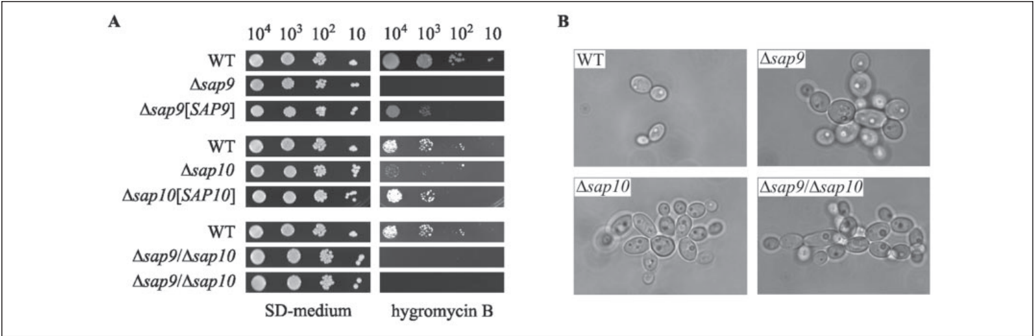
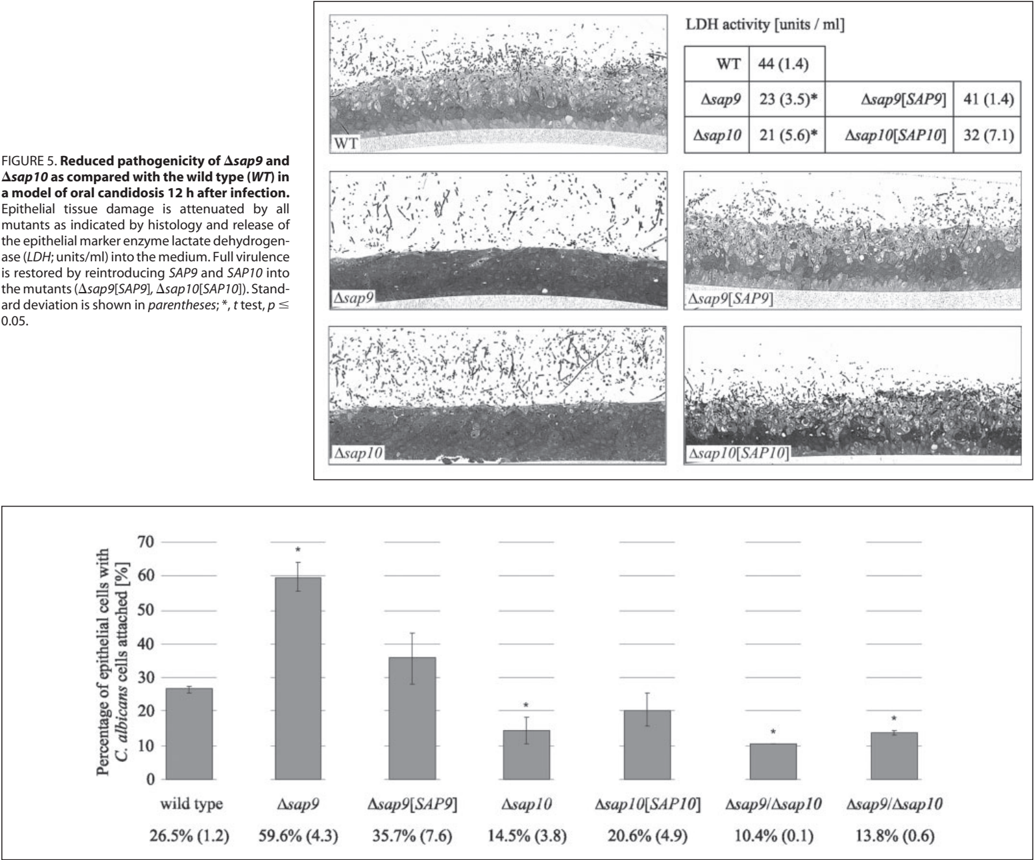
Intracellular and secreted proteases fulfill multiple functions in microorganisms. In pathogenic microorganisms extracellular proteases may be adapted to interactions with host cells. Here we describe two cell surface-associated aspartic proteases, Sap9 and Sap10, which have structural similarities to yapsins of Saccharomyces cerevisiae and are produced by the human pathogenic yeast Candida albicans. Sap9 and Sap10 are glycosylphosphatidylinositol-anchored and located in the cell membrane or the cell wall. Both proteases are glycosylated, cleave at dibasic or basic processing sites similar to yapsins and Kex2-like proteases, and have functions in cell surface integrity and cell separation during budding. Overexpression of SAP9 in mutants lacking KEX2 or SAP10, or of SAP10 in mutants lacking KEX2 or SAP9, only partially restored these phenotypes, suggesting distinct target proteins of fungal origin for each of the three proteases. In addition, deletion of SAP9 and SAP10 modified the adhesion properties of C. albicans to epithelial cells and caused attenuated epithelial cell damage during experimental oral infection suggesting a unique role for these proteases in both cellular processes and host-pathogen interactions.
Overview
The claims and statistics of this paper haven’t been checked yet.
Free: it reads the open-access text and checks the first 5 claims that cite a source we can check. Create a free account to check every claim.
Integrity signals
Registry
Cites
Statistics
Figures
Verification
Claims the paper makes
The claims and statistics of this paper haven’t been checked yet.
Free: it reads the open-access text and checks the first 5 claims that cite a source we can check. Create a free account to check every claim.
Claims other papers make about this one
Each is checked against this paper’s own text: does it say what the citing paper says it does?
The source backs part of the claim, not all of it — or backs it for a different population, condition or comparison.
In the citing paper
“Sap9 is a GPI-anchored member of the secreted aspartyl protease family involved in the proteolytic cleavage and maturation of cell wall and secreted proteins in C. albicans [62–64].”
From Carbon source‐induced reprogramming of the cell wall proteome and secretome modulates the adherence and drug resistance of the fungal pathogen C andida albicans (2012) · cites this paper as [62]
Experimental — accuracy not yet measuredThe cited source says what the claim attributes to it.
In the citing paper
“Increased Sap9 expression has been associated with adhesion to epithelial cells and epithelial damage during oral infection [62], making it an important mediator of host-pathogen interactions [65].”
The cited source says what the claim attributes to it.
In the citing paper
“Both Phr1 and Sap9 are known to contribute to adherence: phr1 null mutants display a reduction in adhesion to abiotic surfaces [66], while Sap9 modulates the adhesion to epithelial cells [62].”
Self-check
Percentages, sums and reported differences re-computed from the paper’s own numbers.
The self-check needs the paper’s full text.
Citations
Cites
Isogenic strain construction and gene mapping in Candida albicans.
Fonzi, W. A., & Irwin, M. Y. (1993) · Genetics · doi:10.1093/genetics/134.3.717 · Cited by 1,687
Virulence factors of Candida albicans
Calderone, R. A., & Fonzi, W. A. (2001) · Trends in Microbiology · doi:10.1016/s0966-842x(01)02094-7 · Cited by 1,331
Gillum, A. M., Tsay, E. Y. H., & Kirsch, D. R. (1984) · Molecular and General Genetics MGG · doi:10.1007/bf00328721 · Cited by 1,251
Candida albicans Secreted Aspartyl Proteinases in Virulence and Pathogenesis
Naglik, J. R., Challacombe, S. J., & Hube, B. (2003) · Microbiology and Molecular Biology Reviews · doi:10.1128/mmbr.67.3.400-428.2003 · Cited by 1,179
Self-citationJulius, D., Brake, A., Blair, L., Kunisawa, R., & Thorner, J. (1984) · Cell · doi:10.1016/0092-8674(84)90442-2 · Cited by 699
Fradin, C., De Groot, P., MacCallum, D., Schaller, M., Klis, F., Odds, F. C., & Hube, B. (2005) · Molecular Microbiology · doi:10.1111/j.1365-2958.2005.04557.x · Cited by 455
Self-citationMayor, S., & Riezman, H. (2004) · Nature Reviews Molecular Cell Biology · doi:10.1038/nrm1309 · Cited by 428
Intracellular Targeting and Structural Conservation of a Prohormone-Processing Endoprotease
Fuller, R. S., Brake, A. J., & Thorner, J. (1989) · Science · doi:10.1126/science.2683070 · Cited by 395
Yeast prohormone processing enzyme (KEX2 gene product) is a Ca2+-dependent serine protease.
Fuller, R. S., Brake, A., & Thorner, J. (1989) · Proceedings of the National Academy of Sciences · doi:10.1073/pnas.86.5.1434 · Cited by 392
Hube, B., Monod, M., Schofield, D. A., Brown, A. J. P., & Gow, N. A. R. (1994) · Molecular Microbiology · doi:10.1111/j.1365-2958.1994.tb01269.x · Cited by 372
Self-citation
Research works printed but not linked: 2
- Kinal, H., Park, C. M., Berry, J. O., Koltin, Y., and Bruenn, J. A. (1995) Plant Cell 7, 677-688
- Olsen, V., Cawley, N. X., Brandt, J., Egel-Mitani, M., and Loh, Y. P. (1999) Biochem. J. 339, 407-411 · doi:10.1042/bj3390407 · Paper page
Cited by
Candida albicans pathogenicity mechanisms
Mayer, F. L., Wilson, D., & Hube, B. (2013) · Virulence · doi:10.4161/viru.22913 · Cited by 1,848
Self-citationThe Fungal Cell Wall: Structure, Biosynthesis, and Function
Gow, N. A. R., Latge, J.-P., & Munro, C. A. (2017) · Microbiology Spectrum · doi:10.1128/microbiolspec.funk-0035-2016 · Cited by 1,423
Pathogenesis and virulence of Candida albicans
Lopes, J. P., & Lionakis, M. S. (2022) · Virulence · doi:10.1080/21505594.2021.2019950 · Cited by 477
Candida albicans Cell Wall Proteins
Chaffin, W. L. (2008) · Microbiology and Molecular Biology Reviews · doi:10.1128/mmbr.00032-07 · Cited by 515
The Spectrum of Fungi That Infects Humans
Kohler, J. R., Casadevall, A., & Perfect, J. (2015) · Cold Spring Harbor Perspectives in Medicine · doi:10.1101/cshperspect.a019273 · Cited by 364
“An array of lytic enzymes suitable for digesting human macromolecules is induced during tissue invasion (Ghannoum 2000; Staib et al. 2000; Calderone and Fonzi 2001; Schaller et al. 2005; Albrecht et al. 2006; Trofa et al. 2011), and transporters are regulated coordinately to absorb the released monomers into the funga…”
Background
Metadata
- Authors
- Albrecht, A., Felk, A., Pichova, I., Naglik, J. R., Schaller, M., de Groot, P., MacCallum, D., Odds, F. C., Schäfer, W., Klis, F., Monod, M., & Hube, B.
- Affiliations
- Robert Koch Institute (DE)
- Universität Hamburg (DE)
- King's College London (GB)
- University of Tübingen (DE)
- University of Aberdeen (GB)
- University of Amsterdam (NL)
- Centre Hospitalier Universitaire Vaudois (CH)
- Corresponding author
- Hube, Bernhard
- Venue
- Journal of Biological Chemistry
- Publisher
- Elsevier BV
- Published
- 2006-01
- Volume
- 281
- Issue
- 2
- Pages
- 688-694
- ISSN
- 0021-9258 (ISSN-L)
- OpenAlex
- W2106860332
- Cited by
- 270
- References
- 52
- Citations by year
- 2026: 7 · 2025: 6 · 2024: 10 · 2023: 11 · 2022: 6 · 2021: 8 · 2020: 11 · 2019: 11 · 2018: 9 · 2017: 11 · 2016: 14 · 2015: 13 · 2014: 18 · 2013: 18 · 2012: 21
- FWCI
- 4.77
- Type
- journal article
- Language
- en
- Open access
- hybrid
- doi.org
- Licence
- cc-by
- www.elsevier.com/tdm/userlicense/1.0/ (tdm)
- creativecommons.org/licenses/by/4.0/ (vor, 5388 d)
- Locations
- Journal of Biological Chemistry (publishedVersion, cc-by)
- PubMed (publishedVersion)
- UvA-DARE (University of Amsterdam) (publishedVersion)
- IRIS (submittedVersion)
- Research Portal (King's College London) (submittedVersion)
- SERVAL (Université de Lausanne) (submittedVersion)
- Data Archiving and Networked Services (DANS) (submittedVersion)
- Funders
- European Commission
- Deutsche Forschungsgemeinschaft
- Grantová Agentura České Republiky
- Centre Hospitalier Universitaire Vaudois
- Robert Koch Institut
- University of California, San Francisco
- Topics
- Life Sciences › Biochemistry, Genetics and Molecular Biology › Molecular Biology › Fungal and yeast genetics research
- Health Sciences › Medicine › Infectious Diseases › Antifungal resistance and susceptibility
- Health Sciences › Medicine › Infectious Diseases › Fungal Infections and Studies
- Keywords
- Candida albicans, aspartic protease, Kex2, epithelial cell adhesion, host-pathogen interaction, oral infection, extracellular protease
- MeSH terms
- Animals, Candida albicans, Candidiasis, Cell Adhesion, Cell Membrane, Cell Wall, Chitin, Epithelial Cells, Fungal Proteins, Glycosylation, Humans, Mutation, Peptides, Phenotype, Phylogeny, Plasmids, Protein Binding, Protein Processing, Post-Translational, Recombinant Proteins, Saccharomyces cerevisiae, Saliva, Substrate Specificity, Gene Expression Regulation, Fungal, Microscopy, Immunoelectron, Aspartic Acid Endopeptidases, Glycosylphosphatidylinositols, Protein Structure, Tertiary, Reverse Transcriptase Polymerase Chain Reaction, Peptide-N4-(N-acetyl-beta-glucosaminyl) Asparagine Amidase, Green Fluorescent Proteins, Mice
About these checks
Registry, retraction, Cites and statistics results are computed, not judged, with one exception: a printed reference that no index lists is read once by a model before it counts as a citation error. Claims are extracted by a model and kept only when their quote appears verbatim in the text; each cited source is then checked, with a model’s help, for whether it says what the claim relies on. Those verdicts can be wrong — read the claim’s quote and the cited source before relying on one.
Statistics and arithmetic are recomputed, not judged.
Confidence bands are shown only for fields calibrated on our annotated test set. None is calibrated yet, so no band is shown.
What counts as a claim ›How we measure confidence ›How we check this ›
Are you an author, or do you see a problem with this page? Request a review
How to cite
Cite CoChat for the checks on this page, and the paper for its own findings.
- This page
- CoChat. (2026). Citation check: Glycosylphosphatidylinositol-anchored Proteases of Candida albicans Target Proteins Necessary for Both Cellular Processes and Host-Pathogen Interactions. https://app.cochat.ai/papers/10.1074/jbc.m509297200
- The paper
- Albrecht, A., Felk, A., Pichova, I., Naglik, J. R., Schaller, M., de Groot, P., MacCallum, D., Odds, F. C., Schäfer, W., Klis, F., Monod, M., & Hube, B. (2006). Glycosylphosphatidylinositol-anchored Proteases of Candida albicans Target Proteins Necessary for Both Cellular Processes and Host-Pathogen Interactions. Journal of Biological Chemistry. https://doi.org/10.1074/jbc.m509297200
Data sources
Bibliographic data: Semantic Scholar, OpenAlex, Crossref.
Contains information from the Semantic Scholar Academic Graph Datasets, made available under the ODC Attribution License (ODC-BY 1.0).
Semantic Scholar’s data is described in: Kinney, R., et al. (2023). The Semantic Scholar Open Data Platform. arXiv:2301.10140.
