

Glycosylphosphatidylinositol-anchored Proteases of Candida albicans Target Proteins Necessary for Both Cellular Processes and Host-Pathogen Interactions
Open accessThe DOI matches its Crossref record; 51 of the 52 references it cites were found in a registry or an index.
Abstract
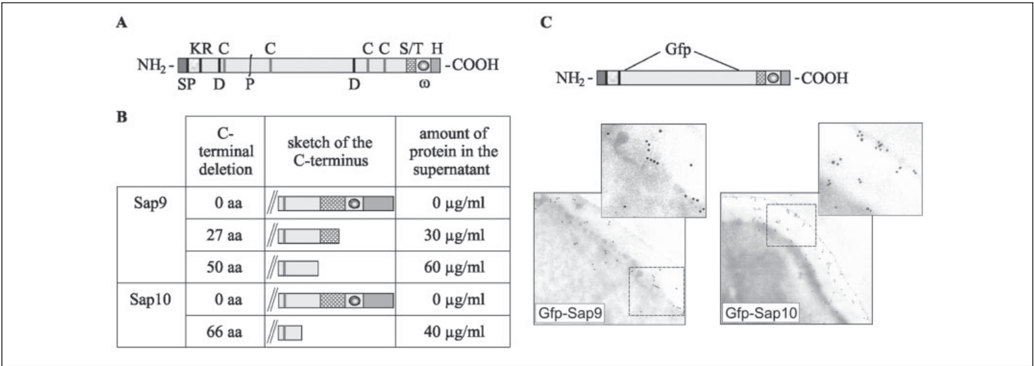
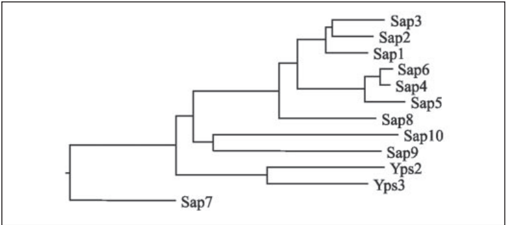
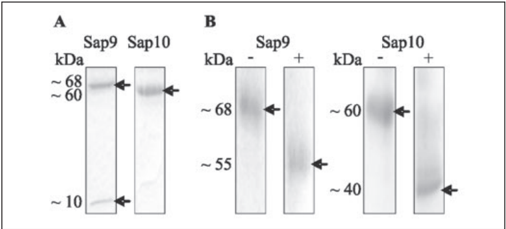
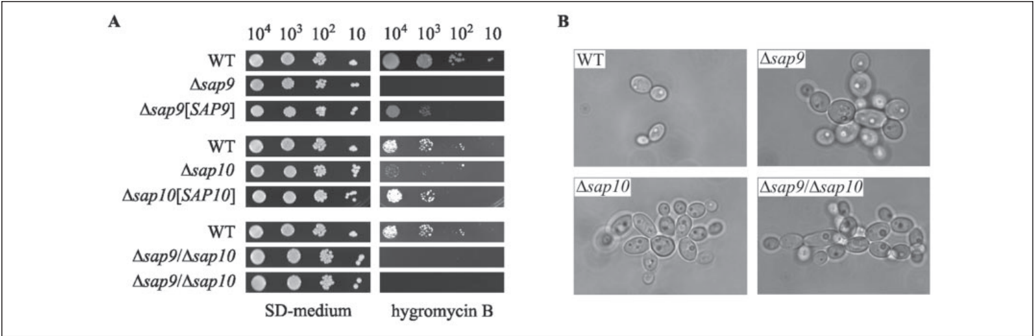
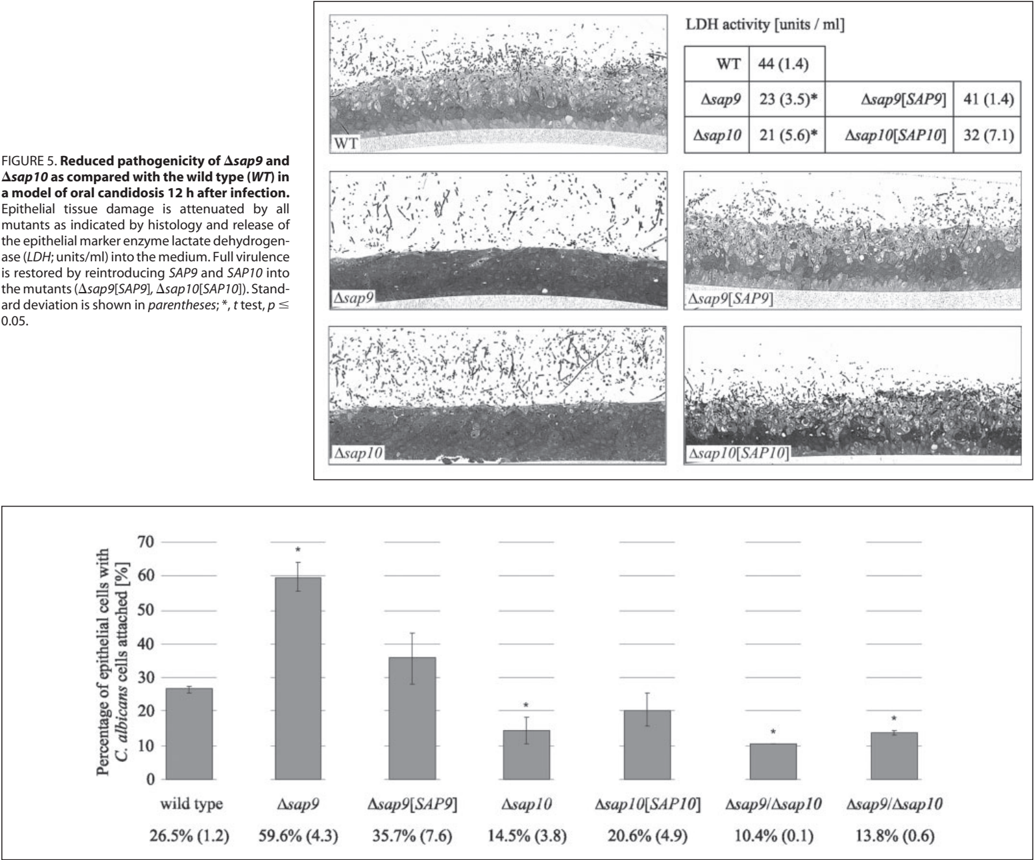
Intracellular and secreted proteases fulfill multiple functions in microorganisms. In pathogenic microorganisms extracellular proteases may be adapted to interactions with host cells. Here we describe two cell surface-associated aspartic proteases, Sap9 and Sap10, which have structural similarities to yapsins of Saccharomyces cerevisiae and are produced by the human pathogenic yeast Candida albicans. Sap9 and Sap10 are glycosylphosphatidylinositol-anchored and located in the cell membrane or the cell wall. Both proteases are glycosylated, cleave at dibasic or basic processing sites similar to yapsins and Kex2-like proteases, and have functions in cell surface integrity and cell separation during budding. Overexpression of SAP9 in mutants lacking KEX2 or SAP10, or of SAP10 in mutants lacking KEX2 or SAP9, only partially restored these phenotypes, suggesting distinct target proteins of fungal origin for each of the three proteases. In addition, deletion of SAP9 and SAP10 modified the adhesion properties of C. albicans to epithelial cells and caused attenuated epithelial cell damage during experimental oral infection suggesting a unique role for these proteases in both cellular processes and host-pathogen interactions.
Overview
The claims and statistics of this paper haven’t been checked yet.
Free: it reads the open-access text and checks the first 5 claims that cite a source we can check. Create a free account to check every claim.
Integrity signals
Registry
Cites
Statistics
Figures
Verification
Claims the paper makes
The claims and statistics of this paper haven’t been checked yet.
Free: it reads the open-access text and checks the first 5 claims that cite a source we can check. Create a free account to check every claim.
Claims other papers make about this one
Each is checked against this paper’s own text: does it say what the citing paper says it does?
The source backs part of the claim, not all of it — or backs it for a different population, condition or comparison.
In the citing paper
“Sap9 is a GPI-anchored member of the secreted aspartyl protease family involved in the proteolytic cleavage and maturation of cell wall and secreted proteins in C. albicans [62–64].”
From Carbon source‐induced reprogramming of the cell wall proteome and secretome modulates the adherence and drug resistance of the fungal pathogen C andida albicans (2012) · cites this paper as [62]
Experimental — accuracy not yet measuredThe cited source says what the claim attributes to it.
In the citing paper
“Increased Sap9 expression has been associated with adhesion to epithelial cells and epithelial damage during oral infection [62], making it an important mediator of host-pathogen interactions [65].”
The cited source says what the claim attributes to it.
In the citing paper
“Both Phr1 and Sap9 are known to contribute to adherence: phr1 null mutants display a reduction in adhesion to abiotic surfaces [66], while Sap9 modulates the adhesion to epithelial cells [62].”
Self-check
Percentages, sums and reported differences re-computed from the paper’s own numbers.
The self-check needs the paper’s full text.
Citations
Cites
Isogenic strain construction and gene mapping in Candida albicans.
Fonzi, W. A., & Irwin, M. Y. (1993) · Genetics · doi:10.1093/genetics/134.3.717 · Cited by 1,687
Virulence factors of Candida albicans
Calderone, R. A., & Fonzi, W. A. (2001) · Trends in Microbiology · doi:10.1016/s0966-842x(01)02094-7 · Cited by 1,331
Gillum, A. M., Tsay, E. Y. H., & Kirsch, D. R. (1984) · Molecular and General Genetics MGG · doi:10.1007/bf00328721 · Cited by 1,251
Candida albicans Secreted Aspartyl Proteinases in Virulence and Pathogenesis
Naglik, J. R., Challacombe, S. J., & Hube, B. (2003) · Microbiology and Molecular Biology Reviews · doi:10.1128/mmbr.67.3.400-428.2003 · Cited by 1,179
Self-citationJulius, D., Brake, A., Blair, L., Kunisawa, R., & Thorner, J. (1984) · Cell · doi:10.1016/0092-8674(84)90442-2 · Cited by 699
Fradin, C., De Groot, P., MacCallum, D., Schaller, M., Klis, F., Odds, F. C., & Hube, B. (2005) · Molecular Microbiology · doi:10.1111/j.1365-2958.2005.04557.x · Cited by 455
Self-citationMayor, S., & Riezman, H. (2004) · Nature Reviews Molecular Cell Biology · doi:10.1038/nrm1309 · Cited by 428
Intracellular Targeting and Structural Conservation of a Prohormone-Processing Endoprotease
Fuller, R. S., Brake, A. J., & Thorner, J. (1989) · Science · doi:10.1126/science.2683070 · Cited by 395
Yeast prohormone processing enzyme (KEX2 gene product) is a Ca2+-dependent serine protease.
Fuller, R. S., Brake, A., & Thorner, J. (1989) · Proceedings of the National Academy of Sciences · doi:10.1073/pnas.86.5.1434 · Cited by 392
Hube, B., Monod, M., Schofield, D. A., Brown, A. J. P., & Gow, N. A. R. (1994) · Molecular Microbiology · doi:10.1111/j.1365-2958.1994.tb01269.x · Cited by 372
Self-citation
Research works printed but not linked: 2
- Kinal, H., Park, C. M., Berry, J. O., Koltin, Y., and Bruenn, J. A. (1995) Plant Cell 7, 677-688
- Olsen, V., Cawley, N. X., Brandt, J., Egel-Mitani, M., and Loh, Y. P. (1999) Biochem. J. 339, 407-411 · doi:10.1042/bj3390407 · Paper page
Cited by
Candida albicans pathogenicity mechanisms
Mayer, F. L., Wilson, D., & Hube, B. (2013) · Virulence · doi:10.4161/viru.22913 · Cited by 1,848
Self-citationThe Fungal Cell Wall: Structure, Biosynthesis, and Function
Gow, N. A. R., Latge, J.-P., & Munro, C. A. (2017) · Microbiology Spectrum · doi:10.1128/microbiolspec.funk-0035-2016 · Cited by 1,423
Pathogenesis and virulence of Candida albicans
Lopes, J. P., & Lionakis, M. S. (2022) · Virulence · doi:10.1080/21505594.2021.2019950 · Cited by 477
Candida albicans Cell Wall Proteins
Chaffin, W. L. (2008) · Microbiology and Molecular Biology Reviews · doi:10.1128/mmbr.00032-07 · Cited by 515
The Spectrum of Fungi That Infects Humans
Kohler, J. R., Casadevall, A., & Perfect, J. (2015) · Cold Spring Harbor Perspectives in Medicine · doi:10.1101/cshperspect.a019273 · Cited by 364
“An array of lytic enzymes suitable for digesting human macromolecules is induced during tissue invasion (Ghannoum 2000; Staib et al. 2000; Calderone and Fonzi 2001; Schaller et al. 2005; Albrecht et al. 2006; Trofa et al. 2011), and transporters are regulated coordinately to absorb the released monomers into the funga…”
BackgroundAdhesins in human fungal pathogens: glue with plenty of stick.
de Groot, P. W. J., Bader, O., de Boer, A. D., Weig, M., & Chauhan, N. (2013) · Eukaryotic Cell · doi:10.1128/ec.00364-12 · Cited by 319
Kaur, R., Ma, B., & Cormack, B. P. (2007) · Proceedings of the National Academy of Sciences · doi:10.1073/pnas.0611195104 · Cited by 284
Candida albicans interactions with epithelial cells and mucosal immunity
Naglik, J. R., Moyes, D. L., Wächtler, B., & Hube, B. (2011) · Microbes and Infection · doi:10.1016/j.micinf.2011.06.009 · Cited by 277
Self-citationKarkowska-Kuleta, J., Rapala-Kozik, M., & Kozik, A. (2009) · Acta Biochimica Polonica · doi:10.18388/abp.2009_2452 · Cited by 253
Naglik, J. R., Moyes, D., Makwana, J., Kanzaria, P., Tsichlaki, E., Weindl, G., Tappuni, A. R., Rodgers, C. A., Woodman, A. J., Challacombe, S. J., et al. (2008) · Microbiology · doi:10.1099/mic.0.2008/022293-0 · Cited by 253
“We have previously shown that SAP9 is frequently expressed both in the commensal stage and during infection in vivo and that (together with its homologous counterpart Sap10) Sap9 is linked to regulatory processes on the fungal cell surface that contribute to cell surface integrity and adhesion to oral epithelial cells…”
InfluentialSelf-citationPlaine, A., Walker, L., Da Costa, G., Mora-Montes, H. M., McKinnon, A., Gow, N. A. R., Gaillardin, C., Munro, C. A., & Richard, M. L. (2008) · Fungal Genetics and Biology · doi:10.1016/j.fgb.2008.08.003 · Cited by 238
de Groot, P. W. J., Kraneveld, E. A., Yin, Q. Y., Dekker, H. L., Groß, U., Crielaard, W., de Koster, C. G., Bader, O., Klis, F. M., & Weig, M. (2008) · Eukaryotic Cell · doi:10.1128/ec.00284-08 · Cited by 232
“A limited number of fungal cell wall proteins (CWPs) have already been shown or suggested to be instrumental in adhesion to human tissues (e.g., Als proteins, Eap1, and Hwp1 in C. albicans and Epa1 in C. glabrata) (8, 25, 35, 59) and in other infection-related processes, such as invasion, biofilm formation, iron acqui…”
BackgroundSelf-citationSchwarzmüller, T., Ma, B., Hiller, E., Istel, F., Tscherner, M., Brunke, S., Ames, L., Firon, A., Green, B., Cabral, V., et al. (2014) · PLoS Pathogens · doi:10.1371/journal.ppat.1004211 · Cited by 191
“It also lacks several attributes considered key mediators of fungal pathogenicity in other Candida spp, such as secretion of proteases and lipases [6,7].”
BackgroundSelf-citationThe yeast Candida albicans evades human complement attack by secretion of aspartic proteases
Gropp, K., Schild, L., Schindler, S., Hube, B., Zipfel, P. F., & Skerka, C. (2009) · Molecular Immunology · doi:10.1016/j.molimm.2009.08.019 · Cited by 178
Self-citationTargeting virulence: A new paradigm for antifungals
Gauwerky, K., Borelli, C., & Korting, H. C. (2009) · Drug Discovery Today · doi:10.1016/j.drudis.2008.11.013 · Cited by 174
“Sap 9 and Sap10 play a role in adhesion, cell separation and cell surface integrity, while almost nothing is known about Sap 7 and Sap 8 [ 37 ].”
BackgroundCandida albicans and Candida glabrata : global priority pathogens
Katsipoulaki, M., Stappers, M. H. T., Malavia-Jones, D., Brunke, S., Hube, B., & Gow, N. A. R. (2024) · Microbiology and Molecular Biology Reviews · doi:10.1128/mmbr.00021-23 · Cited by 180
“The Saps family comprises ten members (Sap1-Sap10) and is probably the best studied among these hydrolases (458, 459).”
BackgroundSelf-citationParallels in Fungal Pathogenesis on Plant and Animal Hosts
Sexton, A. C., & Howlett, B. J. (2006) · Eukaryotic Cell · doi:10.1128/ec.00277-06 · Cited by 174
“Two of these, Sap9 and Sap10, are cell surface associated and involved in adhesion to epithelial cells (1).”
BackgroundWatanabe, N.-A., Miyazaki, M., Horii, T., Sagane, K., Tsukahara, K., & Hata, K. (2012) · Antimicrobial Agents and Chemotherapy · doi:10.1128/aac.00731-11 · Cited by 169
“Examples of GPI-anchored virulence factors are the Als protein family, adhesins with broad substrate specificity (15, 23, 55); Hwp1p, an epithelial adhesin and biofilm promoter (40); Eap1p, an adhesin to epithelial cells and polystyrene surfaces (30); secreted aspartyl proteinases Sap9p and Sap10p, phospholipase B Plb…”
BackgroundCovalently linked cell wall proteins of Candida albicans and their role in fitness and virulence
Klis, F. M., Sosinska, G. J., de Groot, P. W. J., & Brul, S. (2009) · FEMS Yeast Research · doi:10.1111/j.1567-1364.2009.00541.x · Cited by 165
“The yapsin-like proteins Sap 9 and 10 possess proteolytic activity, and in their absence, normal cell wall construction is affected, but their specific substrates are still largely elusive (Albrecht et al., 2006; reviewed in Gagnon-Arsenault et al., 2006).”
BackgroundSelf-citationEne, I. V., Heilmann, C. J., Sorgo, A. G., Walker, L. A., de Koster, C. G., Munro, C. A., Klis, F. M., & Brown, A. J. P. (2012) · Proteomics · doi:10.1002/pmic.201200228 · Cited by 159
“Increased Sap9 expression has been associated with adhesion to epithelial cells and epithelial damage during oral infection [62], making it an important mediator of host-pathogen interactions [65].”
BackgroundSelf-citationComprehensive Analysis of Glycosylphosphatidylinositol-Anchored Proteins in Candida albicans
Richard, M. L., & Plaine, A. (2007) · Eukaryotic Cell · doi:10.1128/ec.00297-06 · Cited by 159
“While a mutant lacking gpi7 secretes GpiPs into the medium, mutants lacking SAP9 and SAP10 do not process essential proteins and thus block the functions of these proteins, but the consequences are the same: a defect in cytokinesis and a disorganized cell wall network (2).”
BackgroundNailis, H., Kucharíková, S., Řičicová, M., Van Dijck, P., Deforce, D., Nelis, H., & Coenye, T. (2010) · BMC Microbiology · doi:10.1186/1471-2180-10-114 · Cited by 157
“It is known that Sap9 and Sap10 are not secreted by the fungus, but are GPI anchored proteins that play a role in cell-surface integrity [ 42 ].”
BackgroundMeiller, T. F., Hube, B., Schild, L., Shirtliff, M. E., Scheper, M. A., Winkler, R., Ton, A., & Jabra-Rizk, M. A. (2009) · PLoS ONE · doi:10.1371/journal.pone.0005039 · Cited by 140
Self-citationReverse genetics screen identifies six proteins important for malaria development in the mosquito
Ecker, A., Bushell, E., Tewari, R., & Sinden, R. E. (2008) · Molecular Microbiology · doi:10.1111/j.1365-2958.2008.06407.x · Cited by 143
“In Candida albicans, GPI-anchored secretory aspartic proteases have been reported to be involved in maintenance of cell surface integrity, cell separation during budding, and host–pathogen interactions, particularly adhesion (Albrecht et al., 2006).”
BackgroundJain, R., Valiante, V., Remme, N., Docimo, T., Heinekamp, T., Hertweck, C., Gershenzon, J., Haas, H., & Brakhage, A. A. (2011) · Molecular Microbiology · doi:10.1111/j.1365-2958.2011.07778.x · Cited by 140
“Its orthologues in Saccharomyces cerevisiae and Candida albicans have been implicated in maintaining cell-wall assembly by regulating b-glucan synthesis (Krysan et al., 2005; Albrecht et al., 2006).”
BackgroundScrimale, T., Didone, L., de Mesy Bentley, K. L., & Krysan, D. J. (2009) · Molecular Biology of the Cell · doi:10.1091/mbc.e08-08-0809 · Cited by 130
Fernández-Arenas, E., Cabezón, V., Bermejo, C., Arroyo, J., Nombela, C., Diez-Orejas, R., & Gil, C. (2007) · Molecular & Cellular Proteomics · doi:10.1074/mcp.m600210-mcp200 · Cited by 131
Heilmann, C. J., Sorgo, A. G., Mohammadi, S., Sosinska, G. J., de Koster, C. G., Brul, S., de Koning, L. J., & Klis, F. M. (2013) · Eukaryotic Cell · doi:10.1128/ec.00278-12 · Cited by 122
“At both pHs the wall levels of Sap9, involved in maintaining wall integrity (46), increased.”
BackgroundSelf-citationSorgo, A. G., Heilmann, C. J., Dekker, H. L., Bekker, M., Brul, S., de Koster, C. G., de Koning, L. J., & Klis, F. M. (2011) · Eukaryotic Cell · doi:10.1128/ec.05011-11 · Cited by 120
“Both FCZ- and Congo red-induced stress resulted in increased levels of Sap9, a GPI-modified yapsin-like aspartyl protease that participates in maintaining cell wall integrity (2, 55).”
BackgroundSelf-citationThriving within the host: Candida spp. interactions with phagocytic cells
Miramón, P., Kasper, L., & Hube, B. (2013) · Medical Microbiology and Immunology · doi:10.1007/s00430-013-0288-z · Cited by 126
“glabrata [91, 151, 152], a feature that itself interferes with immune recognition.”
Self-citationPericolini, E., Gabrielli, E., Amacker, M., Kasper, L., Roselletti, E., Luciano, E., Sabbatini, S., Kaeser, M., Moser, C., Hube, B., et al. (2015) · mBio · doi:10.1128/mbio.00724-15 · Cited by 109
“rSap5 was purified via ultrafiltration (46, 47).”
Self-citationSecreted fungal aspartic proteases: A review
Mandujano-González, V., Villa‐Tanaca, L., Anducho-Reyes, M. Á., & Mercado-Flores, Y. (2016) · Revista Iberoamericana de Micología · doi:10.1016/j.riam.2015.10.003 · Cited by 129
Models of oral and vaginal candidiasis based on in vitro reconstituted human epithelia
Schaller, M., Zakikhany, K., Naglik, J. R., Weindl, G., & Hube, B. (2006) · Nature Protocols · doi:10.1038/nprot.2006.474 · Cited by 110
Self-citationCandida–Epithelial Interactions
Richardson, J., Ho, J., & Naglik, J. (2018) · Journal of Fungi · doi:10.3390/jof4010022 · Cited by 98
“SAP10 Aspartic proteinase Decreased Buccal [36]”
BackgroundInfluentialSelf-citationProteolytic Cleavage of Covalently Linked Cell Wall Proteins by Candida albicans Sap9 and Sap10
Schild, L., Heyken, A., de Groot, P. W. J., Hiller, E., Mock, M., de Koster, C., Horn, U., Rupp, S., & Hube, B. (2011) · Eukaryotic Cell · doi:10.1128/ec.00210-10 · Cited by 104
“In agreement with such regulatory functions, mutants lacking SAP9 or SAP10 exhibit profound cell wall and cell separation defects and are modified in their interaction with epithelial cells and neutrophils (1, 26).”
BackgroundResultInfluentialSelf-citationCandida albicans Interactions with Mucosal Surfaces during Health and Disease
Nikou, S.-A., Kichik, N., Brown, R., Ponde, N., Ho, J., Naglik, J., & Richardson, J. (2019) · Pathogens · doi:10.3390/pathogens8020053 · Cited by 103
“while Sap9p and Sap10p remain anchored on the cell membrane [141].”
BackgroundSelf-citationSosinska, G. J., de Groot, P. W. J., Teixeira de Mattos, M. J., Dekker, H. L., de Koster, C. G., Hellingwerf, K. J., & Klis, F. M. (2008) · Microbiology · doi:10.1099/mic.0.2007/012617-0 · Cited by 102
Self-citationPellón, A., Nasab, S. D. S., & Moyes, D. L. (2020) · Frontiers in Cellular and Infection Microbiology · doi:10.3389/fcimb.2020.00081 · Cited by 113
“This group of enzymes is formed of ten members that are either secreted (Sap1-8p) or kept anchored to the cell wall (Sap9-10p) (Albrecht et al., 2006).”
BackgroundAoki, W., Kitahara, N., Miura, N., Morisaka, H., Yamamoto, Y., Kuroda, K., & Ueda, M. (2011) · The Journal of Biochemistry · doi:10.1093/jb/mvr073 · Cited by 93
Bader, O., Krauke, Y., & Hube, B. (2008) · BMC Microbiology · doi:10.1186/1471-2180-8-116 · Cited by 95
“Furthermore, missing Kex2-processing events may well be covered up by processing through other proteinases, such as the yapsins, a family of glycosylphosphatidylinositol (GPI) anchored aspartic proteinases [19,20].”
BackgroundSelf-citationExtracellular proteinases of Candida species pathogenic yeasts
Rapala‐Kozik, M., Bochenska, O., Zajac, D., Karkowska‐Kuleta, J., Gogol, M., Zawrotniak, M., & Kozik, A. (2018) · Molecular Oral Microbiology · doi:10.1111/omi.12206 · Cited by 94
Msb2 Shedding Protects Candida albicans against Antimicrobial Peptides
Szafranski-Schneider, E., Swidergall, M., Cottier, F., Tielker, D., Román, E., Pla, J., & Ernst, J. F. (2012) · PLoS Pathogens · doi:10.1371/journal.ppat.1002501 · Cited by 88
“Dsap10 as CAI4 but sap10::hisG/sap10::hisG [29]”
InfluentialPuri, S., Kumar, R., Chadha, S., Tati, S., Conti, H. R., Hube, B., Cullen, P. J., & Edgerton, M. (2012) · PLoS ONE · doi:10.1371/journal.pone.0046020 · Cited by 87
“sapD/D9/10 sap10D::hisG/sap10D::hisG sap9D::hisG/ sap9D::hisG [45]”
Self-citationThe Fungal Cell Wall: Structure, Biosynthesis, and Function
Gow, N. A. R., Latge, J.-P., & Munro, C. A. (2017) · The Fungal Kingdom · doi:10.1128/9781555819583.ch12 · Cited by 86
Frank, C. F., & Hostetter, M. K. (2007) · Translational research · doi:10.1016/j.trsl.2006.11.006 · Cited by 97
Semlali, A., Killer, K., Alanazi, H., Chmielewski, W., & Rouabhia, M. (2014) · BMC Microbiology · doi:10.1186/1471-2180-14-61 · Cited by 87
“SAP9 and SAP10 are involved in the mechanism of adhesion to host cells [21].”
BackgroundEigenheer, R. A., Lee, Y. J., Blumwald, E., Phinney, B. S., & Gelli, A. (2007) · FEMS Yeast Research · doi:10.1111/j.1567-1364.2006.00198.x · Cited by 88
“albicans lacking Sap9 and Sap10 displayed modified adhesion properties, thus linking both proteases to the infection process (Albrecht et al., 2006).”
BackgroundInfluentialCorreia, A., Lermann, U., Teixeira, L., Cerca, F., Botelho, S., Gil da Costa, R. M., Sampaio, P., Gärtner, F., Morschhäuser, J., Vilanova, M., et al. (2010) · Infection and Immunity · doi:10.1128/iai.00248-10 · Cited by 86
Fungal Cell Wall Proteins and Signaling Pathways Form a Cytoprotective Network to Combat Stresses
Ibe, C., & Munro, C. A. (2021) · Journal of Fungi · doi:10.3390/jof7090739 · Cited by 85
Borelli, C., Ruge, E., Lee, J. H., Schaller, M., Vogelsang, A., Monod, M., Korting, H. C., Huber, R., & Maskos, K. (2008) · Proteins: Structure, Function, and Bioinformatics · doi:10.1002/prot.22021 · Cited by 85
Self-citationCandida spp. in periodontal disease: a brief review
Sardi, J. D. C. O., Duque, C., Mariano, F. S., Peixoto, I. T. A., Höfling, J. F., & Gonçalves, R. B. (2010) · Journal of Oral Science · doi:10.2334/josnusd.52.177 · Cited by 97
Zawrotniak, M., Bochenska, O., Karkowska-Kuleta, J., Seweryn-Ozog, K., Aoki, W., Ueda, M., Kozik, A., & Rapala-Kozik, M. (2017) · Frontiers in Cellular and Infection Microbiology · doi:10.3389/fcimb.2017.00414 · Cited by 81
“…enzyme from the Sap Frontiers in Cellular and Infection Microbiology | www.frontiersin.org 15 September 2017 | Volume 7 | Article 414 family can be compensated for by the increased expression of another Sap to rescue virulence deficiencies (Naglik et al., 2003a, 2004, 2008; Albrecht et al., 2006).”
BackgroundSecreted Aspartic Proteinases: Key Factors in Candida Infections and Host-Pathogen Interactions
Braś, G., Satała, D., Juszczak, M., Kulig, K., Wronowska, E., Bednarek, A., Zawrotniak, M., Rąpała‐Kozik, M., & Karkowska‐Kuleta, J. (2024) · International Journal of Molecular Sciences · doi:10.3390/ijms25094775 · Cited by 86
“Members of the Sap family contain four conserved cysteine residues responsible for the maintenance of three-dimensional structure and two conserved aspartate residues essential for proteolytic activity [37].”
BackgroundTeixeira, P. A. C., Castro, R. A., Nascimento, R. C., Tronchin, G., Torres, A. P., Lazéra, M., de Almeida, S. R., Bouchara, J., y Penha, C. V. L., & Lopes-Bezerra, L. M. (2009) · Microbiology · doi:10.1099/mic.0.029439-0 · Cited by 78
“…protein hydrolysis or immune response modulation, such as BAD-1 from Blastomyces dermatitidis (Brandhorst et al., 1999), the secreted aspartyl proteinases from Candida albicans (Albrecht et al., 2006) and the melanin (Rosas et al., 2001) and capsule (Idnurm et al., 2005) of Cryptococcus neoformans.”
BackgroundSamaranayake, Y. H., Cheung, B. P. K., Yau, J. Y. Y., Yeung, S. K. W., & Samaranayake, L. P. (2013) · PLoS ONE · doi:10.1371/journal.pone.0062902 · Cited by 83
Chayakulkeeree, M., Sorrell, T. C., Siafakas, A. R., Wilson, C. F., Pantarat, N., Gerik, K. J., Boadle, R., & Djordjevic, J. T. (2008) · Molecular Microbiology · doi:10.1111/j.1365-2958.2008.06310.x · Cited by 72
“…a viable double deletion mutant in C. albicans, together with the observation that secretion of aspartic proteases implicated in virulence (Albrecht et al., 2006) was normal in a heterozygous deletion mutant, led to the conclusion that CaPLC1 was involved in cellular processes but had no…”
BackgroundO -Mannosylation in Candida albicans Enables Development of Interkingdom Biofilm Communities
Dutton, L. C., Nobbs, A. H., Jepson, K., Jepson, M. A., Vickerman, M. M., Aqeel Alawfi, S., Munro, C. A., Lamont, R. J., & Jenkinson, H. F. (2014) · mBio · doi:10.1128/mbio.00911-14 · Cited by 75
“The main effects of SAP9 deletion are reduced chitinase activity and increased adhesion to epithelial cells (53).”
BackgroundVirulence and Pathogenicity of Fungal Pathogens with Special Reference to Candida albicans
Khan, M. S., Ahmad, I., Aqil, F., Owais, M., Shahid, M., & Musarrat, J. (2010) · Springer eBooks · doi:10.1007/978-3-642-12173-9_2 · Cited by 94
“Structural analysis revealed that SAPs 1–8 are secreted extracellularly, but that SAPs 9 and 10 are anchored to the cell wall by glycophosphotidyinositol (GPI) protein (Naglik et al. 2003; Albrecht et al. 2006).”
BackgroundBeyond the wall:Candida albicans secret(e)s to survive
Sorgo, A. G., Heilmann, C. J., Brul, S., de Koster, C. G., & Klis, F. M. (2013) · FEMS Microbiology Letters · doi:10.1111/1574-6968.12049 · Cited by 74
“Sap1 to Sap8 are secreted into the extracellular environment, while Sap9 and Sap10 are retained at the cell surface via a (modified) GPI anchor (Albrecht et al., 2006).”
BackgroundSelf-citationAspartic proteinases of Candida spp.: role in pathogenicity and antifungal resistance
Silva, N. C., Nery, J. M., & Dias, A. L. T. (2014) · Mycoses · doi:10.1111/myc.12095 · Cited by 65
Rapala-Kozik, M., Bochenska, O., Zawrotniak, M., Wolak, N., Trebacz, G., Gogol, M., Ostrowska, D., Aoki, W., Ueda, M., & Kozik, A. (2015) · Infection and Immunity · doi:10.1128/iai.00023-15 · Cited by 71
“Because these proteases are glycosylphosphatidylinositol (GPI) anchored to the cell surface, these changes could possibly be indirect consequences of gene manipulation.”
BackgroundCandida innate immunity at the mucosa
Richardson, J. P., Moyes, D. L., Ho, J., & Naglik, J. R. (2019) · Seminars in Cell & Developmental Biology · doi:10.1016/j.semcdb.2018.02.026 · Cited by 71
Self-citationPietrella, D., Rachini, A., Pandey, N., Schild, L., Netea, M., Bistoni, F., Hube, B., & Vecchiarelli, A. (2010) · Infection and Immunity · doi:10.1128/iai.00789-10 · Cited by 66
“Sap9 and Sap10 have been identified as glycosylphosphatidylinositol (GPI)-anchored proteases which target proteins necessary for both cellular processes and host-pathogen interactions (1).”
BackgroundSelf-citationMass spectrometry-based proteomics of fungal wall glycoproteins
Yin, Q. Y., de Groot, P. W. J., de Koster, C. G., & Klis, F. M. (2007) · Trends in Microbiology · doi:10.1016/j.tim.2007.10.011 · Cited by 75
“Phospholipase B S. cerevisiae Plb2 [8] Protease C. albicans Sap9 and 10 [ 22 ]”
BackgroundSelf-citationGagnon-Arsenault, I., Tremblay, J., & Bourbonnais, Y. (2006) · FEMS Yeast Research · doi:10.1111/j.1567-1364.2006.00129.x · Cited by 66
“For example, ScYps1/2/3p possess 10, 9 and 11 putative N-glycosylation sites, respectively (Ash et al., 1995; Komano & Fuller, 1995), and CaYps1/3p possess five and eight of these sites (Albrecht et al., 2006).”
BackgroundInfluentialThe GPI-modified proteins Pga59 and Pga62 of Candida albicans are required for cell wall integrity
Moreno-Ruiz, E., Ortu, G., de Groot, P. W. J., Cottier, F., Loussert, C., Prévost, M.-C., de Koster, C., Klis, F. M., Goyard, S., & d'Enfert, C. (2009) · Microbiology · doi:10.1099/mic.0.028902-0 · Cited by 63
Self-citationWu, Y., Du, S., Bimler, L. H., Mauk, K. E., Lortal, L., Kichik, N., Griffiths, J. S., Osicka, R., Song, L., Polsky, K., et al. (2023) · Cell Reports · doi:10.1016/j.celrep.2023.113240 · Cited by 67
Self-citationWu, H., Downs, D., Ghosh, K., Ghosh, A. K., Staib, P., Monod, M., & Tang, J. (2013) · The FASEB Journal · doi:10.1096/fj.12-214353 · Cited by 65
Self-citationPathogenesis and Antifungal Drug Resistance of the Human Fungal Pathogen Candida glabrata
Tscherner, M., Schwarzmüller, T., & Kuchler, K. (2011) · Pharmaceuticals · doi:10.3390/ph4010169 · Cited by 59
Role of the Fungal Cell Wall in Pathogenesis and Antifungal Resistance
Díaz-Jiménez, D. F., Pérez-García, L. A., Martínez-Álvarez, J. A., & Mora-Montes, H. M. (2012) · Current Fungal Infection Reports · doi:10.1007/s12281-012-0109-7 · Cited by 70
Chen, Y. Y., Chao, C., Liu, F., Hsu, P., Chen, H.-F., Peng, S.-C., Chuang, Y., Lan, C., Hsieh, W., & Wong, D. S. (2013) · PLoS ONE · doi:10.1371/journal.pone.0072483 · Cited by 69
“Conducting searches for possible previously identified iron-induced genes, iron phenotypes genes, predicted iron-related genes [18,46,50-55], iron-responsive regulators [56-58], iron uptake genes [42], iron utilization genes [45,47-49] and iron-modulated genes [28] obtained 238 genes, which were named iron-related gen…”
BackgroundDiscovery of a Small-Molecule Inhibitor of β-1,6-Glucan Synthesis
Kitamura, A., Someya, K., Hata, M., Nakajima, R., & Takemura, M. (2009) · Antimicrobial Agents and Chemotherapy · doi:10.1128/aac.00844-08 · Cited by 65
“Cell wall proteins, such as Hwp1p and Als1p, are thought to play important roles in the process of fungal pathogenesis, such as adhesion, hyphal elongation, and biofilm production (1, 12, 33, 41).”
BackgroundBraga-Silva, L. A., & dos Santos, A. L. S. (2011) · Current Medicinal Chemistry · doi:10.2174/092986711795843182 · Cited by 66
“growth and fitness [83].”
BackgroundInfluentialMartínez‐López, R., Hernáez, M. L., Redondo, E., Calvo, G., Radau, S., Pardo, M., Gil, C., & Monteoliva, L. (2022) · Microbiology Spectrum · doi:10.1128/spectrum.00698-22 · Cited by 65
“, Sap9 and Sap10 are retained at the cell surface via a modified GPI anchor (60).”
BackgroundLaskay, Ü. A., Lobas, A. A., Srzentić, K., Gorshkov, M. V., & Tsybin, Y. O. (2013) · Journal of Proteome Research · doi:10.1021/pr400522h · Cited by 58
Gil-Bona, A., Amador-García, A., Gil, C., & Monteoliva, L. (2017) · Journal of Proteomics · doi:10.1016/j.jprot.2017.12.002 · Cited by 69
Alanazi, H., Semlali, A., Chmielewski, W., & Rouabhia, M. (2019) · International Journal of Environmental Research and Public Health · doi:10.3390/ijerph16020294 · Cited by 67
A review on antimicrobial strategies in mitigating biofilm-associated infections on medical implants
Kadirvelu, L., Sivaramalingam, S. S., Jothivel, D., Chithiraiselvan, D. D., Karaiyagowder Govindarajan, D., & Kandaswamy, K. (2024) · Current Research in Microbial Sciences · doi:10.1016/j.crmicr.2024.100231 · Cited by 60
“Adhesins like Hwp1p, Saps, and the Als family of proteins have been identified as mediators for the binding of C. albicans to Buccal Epithelial Cells (BECs) (Albrecht et al., 2006; Chandra et al., 2001).”
BackgroundAdvantages of Extended Bottom-Up Proteomics Using Sap9 for Analysis of Monoclonal Antibodies
Srzentić, K., Fornelli, L., Laskay, Ü. A., Monod, M., Beck, A., Ayoub, D., & Tsybin, Y. O. (2014) · Analytical Chemistry · doi:10.1021/ac502766n · Cited by 64
Self-citationThe Role of Secreted Aspartyl Proteinases in Candida albicans Keratitis
Jackson, B. E., Wilhelmus, K. R., & Hube, B. (2007) · Investigative Opthalmology & Visual Science · doi:10.1167/iovs.07-0114 · Cited by 58
Self-citationTheberge, S., Semlali, A., Alamri, A. M., Leung, K. P., & Rouabhia, M. (2013) · BMC Microbiology · doi:10.1186/1471-2180-13-246 · Cited by 62
“SAP1 and SAP3 are expressed during phenotypic switching [12,13], while SAP4, SAP5, and SAP6 are expressed upon hyphal formation [14], and SAPs 1-6 and 9-10 are involved in the adhesion mechanism to host cells [15].”
BackgroundRole of Candida albicans secreted aspartyl protease Sap9 in interkingdom biofilm formation
Dutton, L. C., Jenkinson, H. F., Lamont, R. J., & Nobbs, A. H. (2016) · Pathogens and Disease · doi:10.1093/femspd/ftw005 · Cited by 53
“To test this, we examined a sap9 mutant (Albrecht et al. 2006) for ability to form biofilms and to support adhesion of S. gordonii.”
BackgroundMethodInfluentialChoo, J. H., Hong, C. P., Lim, J. Y., Seo, J.-A., Kim, Y. S., Lee, D. W., Park, S.-G., Lee, G.-W., Carroll, E., Lee, Y., et al. (2016) · Biotechnology for Biofuels · doi:10.1186/s13068-016-0653-4 · Cited by 54
“cerevisiae yapsin and Candida albicans sap proteases, which are mostly localized at the cell surface [57].”
Generating cell surface diversity in Candida albicans and other fungal pathogens
Nather, K., & Munro, C. A. (2008) · FEMS Microbiology Letters · doi:10.1111/j.1574-6968.2008.01263.x · Cited by 52
“GPI-anchored aspartyl proteinases or yapsins Sap9 and Sap10 also contribute to cell wall integrity (Albrecht et al., 2006).”
BackgroundStudy of Candida albicans and its interactions with the host: A mini review
Tsai, P.-W., Chen, Y.-T., Hsu, P., & Lan, C. (2013) · Biomedicine · doi:10.1016/j.biomed.2012.12.004 · Cited by 71
Functional Characterization of Secreted Aspartyl Proteases in Candida parapsilosis
Singh, D. K., Németh, T., Papp, A., Tóth, R., Lukácsi, S., Hrušková‐Heidingsfeldová, O., Dostál, J., Vágvölgyi, C., Bajtay, Z., Józsi, M., et al. (2019) · mSphere · doi:10.1128/msphere.00484-19 · Cited by 60
“albicans Sap1p, Sap2p, Sap3p, and Sap9p were previously reported to be involved in adherence to epithelial cells (10, 38, 39).”
BackgroundKämmer, P., McNamara, S., Wolf, T., Conrad, T., Allert, S., Gerwien, F., Hünniger, K., Kurzai, O., Guthke, R., Hube, B., et al. (2020) · mBio · doi:10.1128/mbio.02435-20 · Cited by 47
Self-citationUnexpected Role for a Serine/Threonine-Rich Domain in the Candida albicans Iff Protein Family
Boisramé, A., Cornu, A., Da Costa, G., & Richard, M. L. (2011) · Eukaryotic Cell · doi:10.1128/ec.05044-11 · Cited by 47
“Sap9 and -10 (1, 54), the glucanosyltranferases Phr1 and -2 (7,”
Insight into the Antiadhesive Effect of Yeast Wall Protein 1 of Candida albicans
Granger, B. L. (2012) · Eukaryotic Cell · doi:10.1128/ec.00026-12 · Cited by 48
“albicans, Sap9 and Sap10 are surface GPI-anchored proteins whose proteolytic functions may overlap those of intracellular Kex2 (1, 52).”
BackgroundInfluentialSecreted proteins of Candida albicans
Hrušková‐Heidingsfeldová, O. (2008) · Frontiers in bioscience · doi:10.2741/3224 · Cited by 52
Bairwa, G., & Kaur, R. (2011) · Molecular Microbiology · doi:10.1111/j.1365-2958.2010.07496.x · Cited by 47
“Sap9–10, the cell surface-associated aspartyl proteases, show similarity to S. cerevisiae GPIanchored Yapsins (Yeast Aspartic Proteases) and have recently been shown to be responsible for epithelial cell damage in an experimental oral infection model (Albrecht et al., 2006).”
BackgroundHornbach, A., Heyken, A., Schild, L., Hube, B., Löffler, J., & Kurzai, O. (2009) · Infection and Immunity · doi:10.1128/iai.00723-09 · Cited by 47
“In addition, the budding dysfunction that can be observed for all three mutants in liquid synthetic dropout (SD) medium (3) was not evident in RPMI 1640 under the conditions used in the present study.”
BackgroundMethodSelf-citationZnaidi, S., van Wijlick, L., Hernández-Cervantes, A., Sertour, N., Desseyn, J.-L., Vincent, F., Atanassova, R., Gouyer, V., Munro, C. A., Bachellier-Bassi, S., et al. (2018) · Cellular Microbiology · doi:10.1111/cmi.12890 · Cited by 46
Wu, J., Wu, D., Zhao, Y., Si, Y., Mei, L., Shao, J., Wang, T., Yan, G., & Wang, C. (2020) · Frontiers in Microbiology · doi:10.3389/fmicb.2020.02075 · Cited by 45
Candida albicans SUR7 contributes to secretion, biofilm formation, and macrophage killing
Bernardo, S. M., & Lee, S. A. (2010) · BMC Microbiology · doi:10.1186/1471-2180-10-133 · Cited by 46
“When compared with the dataset of predicted secretion pathway ORFs, a number of virulencerelated genes were concordant, including Hwp1p and the Als family of adhesins [6,7], Phr1p [8], Sap9p [ 16 ], Sod5p [17,18], and Sun41p [19-21].”
ResultSecreted Aspartyl Proteases Family: A Perspective Review on the Regulation Of Fungal Pathogenesis
Kulshrestha, A., & Gupta, P. (2023) · Future Microbiology · doi:10.2217/fmb-2022-0143 · Cited by 48
Cheng, K.-T., Wu, C., Yip, B., Chih, Y., Peng, K.-L., Hsu, S.-Y., Yu, H., & Cheng, J. (2020) · International Journal of Molecular Sciences · doi:10.3390/ijms21072654 · Cited by 45
“Sap1 to Sap8 are secreted to the extracellular environment, while Sap9 and Sap10, which play roles in cell surface integrity and cell separation, are located in the cell membrane/wall via a glycosylphosphatidylinositol (GPI) anchor [14].”
BackgroundFradin, C., Slomianny, M. C., Mille, C., Masset, A., Robert, R., Sendid, B., Ernst, J. F., Michalski, J. C., & Poulain, D. (2008) · Infection and Immunity · doi:10.1128/iai.00368-08 · Cited by 40
“ConA, a lectin specific for terminal -D-mannosyl and -D-glucosyl residues and widely used to detect CWMPs (1, 26, 39), served as a systematic control in this study.”
MethodReid, V. J., Theron, L. W., du Toit, M., & Divol, B. (2012) · Applied and Environmental Microbiology · doi:10.1128/aem.00505-12 · Cited by 50
“At the end of the secretory pathway, Saps are either incorporated to the cell wall via a glycosylphosphatidylinositol (GPI) anchor or released into the extracellular space (1).”
BackgroundOpportunistic yeast pathogen Candida spp.: Secreted and membrane-bound virulence factors
Lim, S. J., Ali, M. S. M., Sabri, S., Noor, N. D. M., Salleh, A. B., & Oslan, S. N. (2021) · Medical Mycology · doi:10.1093/mmy/myab053 · Cited by 50
Metadata
- Authors
- Albrecht, A., Felk, A., Pichova, I., Naglik, J. R., Schaller, M., de Groot, P., MacCallum, D., Odds, F. C., Schäfer, W., Klis, F., Monod, M., & Hube, B.
- Affiliations
- Robert Koch Institute (DE)
- Universität Hamburg (DE)
- King's College London (GB)
- University of Tübingen (DE)
- University of Aberdeen (GB)
- University of Amsterdam (NL)
- Centre Hospitalier Universitaire Vaudois (CH)
- Corresponding author
- Hube, Bernhard
- Venue
- Journal of Biological Chemistry
- Publisher
- Elsevier BV
- Published
- 2006-01
- Volume
- 281
- Issue
- 2
- Pages
- 688-694
- ISSN
- 0021-9258 (ISSN-L)
- OpenAlex
- W2106860332
- Cited by
- 270
- References
- 52
- Citations by year
- 2026: 7 · 2025: 6 · 2024: 10 · 2023: 11 · 2022: 6 · 2021: 8 · 2020: 11 · 2019: 11 · 2018: 9 · 2017: 11 · 2016: 14 · 2015: 13 · 2014: 18 · 2013: 18 · 2012: 21
- FWCI
- 4.77
- Type
- journal article
- Language
- en
- Open access
- hybrid
- doi.org
- Licence
- cc-by
- www.elsevier.com/tdm/userlicense/1.0/ (tdm)
- creativecommons.org/licenses/by/4.0/ (vor, 5388 d)
- Locations
- Journal of Biological Chemistry (publishedVersion, cc-by)
- PubMed (publishedVersion)
- UvA-DARE (University of Amsterdam) (publishedVersion)
- IRIS (submittedVersion)
- Research Portal (King's College London) (submittedVersion)
- SERVAL (Université de Lausanne) (submittedVersion)
- Data Archiving and Networked Services (DANS) (submittedVersion)
- Funders
- European Commission
- Deutsche Forschungsgemeinschaft
- Grantová Agentura České Republiky
- Centre Hospitalier Universitaire Vaudois
- Robert Koch Institut
- University of California, San Francisco
- Topics
- Life Sciences › Biochemistry, Genetics and Molecular Biology › Molecular Biology › Fungal and yeast genetics research
- Health Sciences › Medicine › Infectious Diseases › Antifungal resistance and susceptibility
- Health Sciences › Medicine › Infectious Diseases › Fungal Infections and Studies
- Keywords
- Candida albicans, aspartic protease, Kex2, epithelial cell adhesion, host-pathogen interaction, oral infection, extracellular protease
- MeSH terms
- Animals, Candida albicans, Candidiasis, Cell Adhesion, Cell Membrane, Cell Wall, Chitin, Epithelial Cells, Fungal Proteins, Glycosylation, Humans, Mutation, Peptides, Phenotype, Phylogeny, Plasmids, Protein Binding, Protein Processing, Post-Translational, Recombinant Proteins, Saccharomyces cerevisiae, Saliva, Substrate Specificity, Gene Expression Regulation, Fungal, Microscopy, Immunoelectron, Aspartic Acid Endopeptidases, Glycosylphosphatidylinositols, Protein Structure, Tertiary, Reverse Transcriptase Polymerase Chain Reaction, Peptide-N4-(N-acetyl-beta-glucosaminyl) Asparagine Amidase, Green Fluorescent Proteins, Mice
About these checks
Registry, retraction, Cites and statistics results are computed, not judged, with one exception: a printed reference that no index lists is read once by a model before it counts as a citation error. Claims are extracted by a model and kept only when their quote appears verbatim in the text; each cited source is then checked, with a model’s help, for whether it says what the claim relies on. Those verdicts can be wrong — read the claim’s quote and the cited source before relying on one.
Statistics and arithmetic are recomputed, not judged.
Confidence bands are shown only for fields calibrated on our annotated test set. None is calibrated yet, so no band is shown.
What counts as a claim ›How we measure confidence ›How we check this ›
Are you an author, or do you see a problem with this page? Request a review
Data sources
Bibliographic data: Semantic Scholar, OpenAlex, Crossref.
Contains information from the Semantic Scholar Academic Graph Datasets, made available under the ODC Attribution License (ODC-BY 1.0).
Semantic Scholar’s data is described in: Kinney, R., et al. (2023). The Semantic Scholar Open Data Platform. arXiv:2301.10140.
