

Norwalk Virus Assembly and Stability Monitored by Mass Spectrometry
Open accessThe DOI matches its Crossref record; 46 of the 46 references it cites were found in a registry or an index.
Abstract
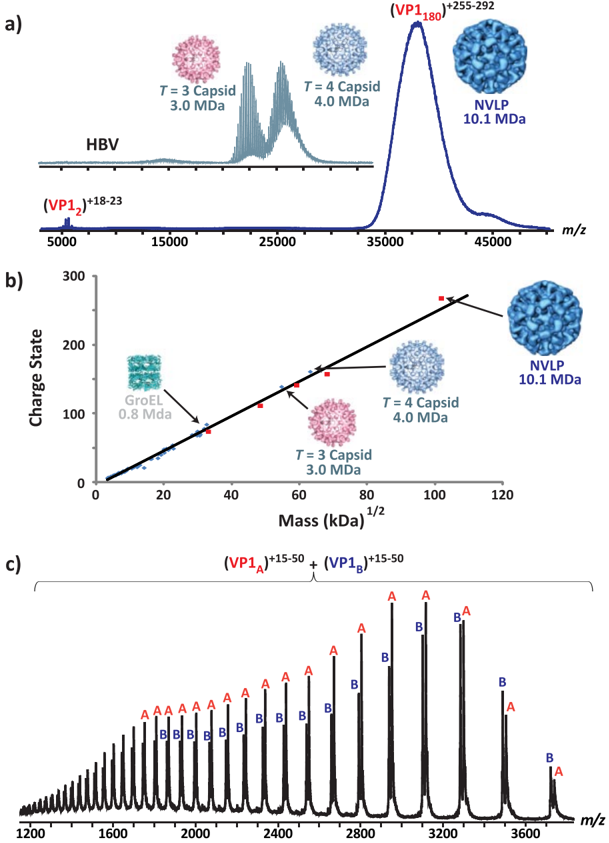
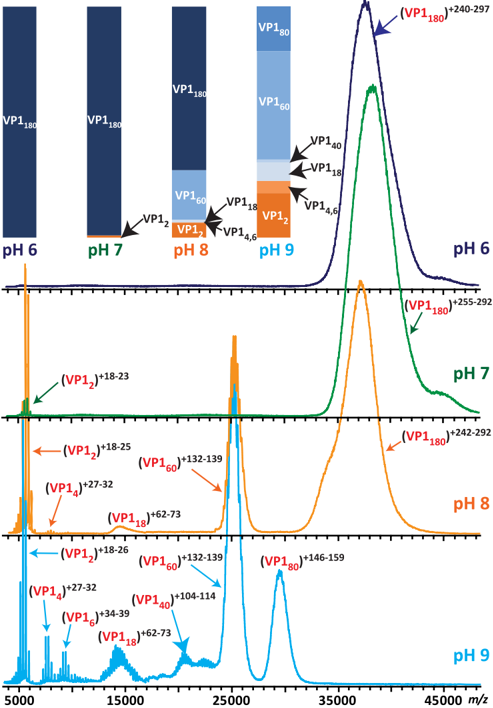
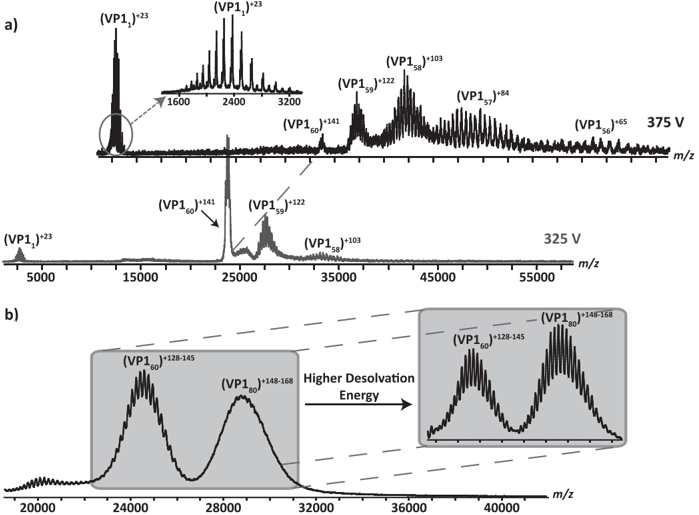
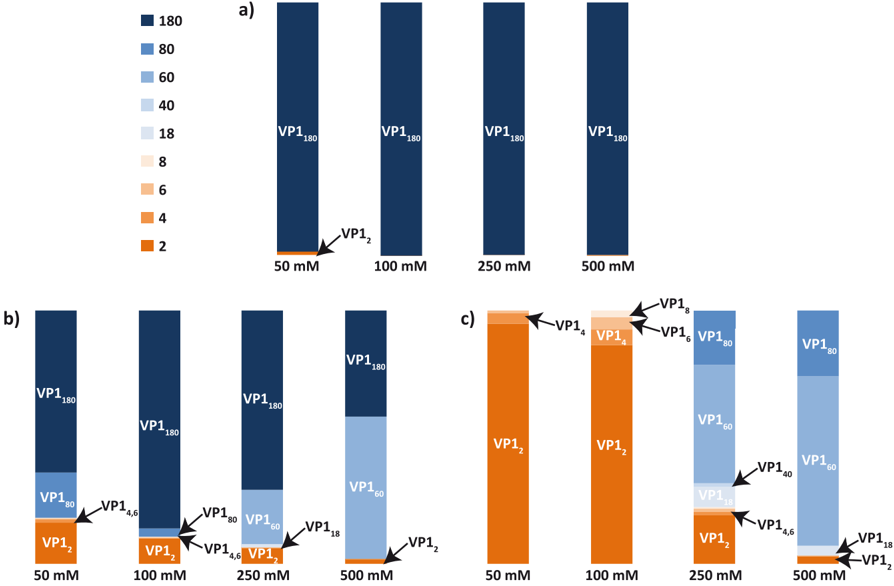
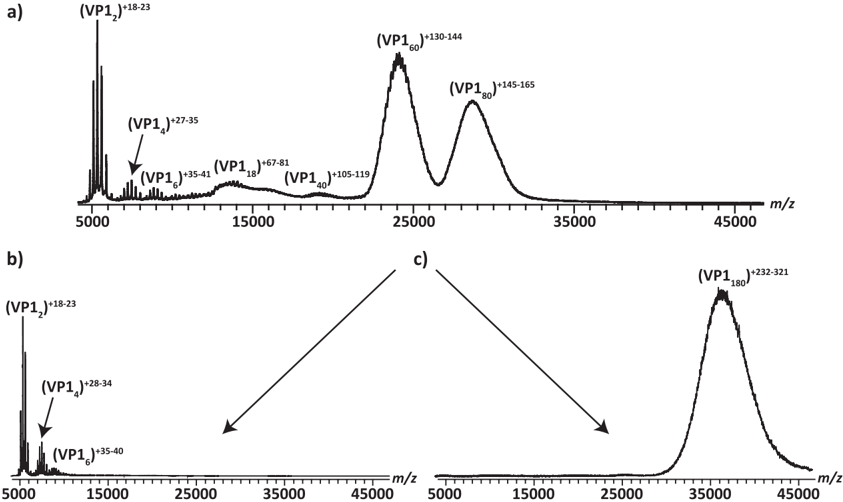
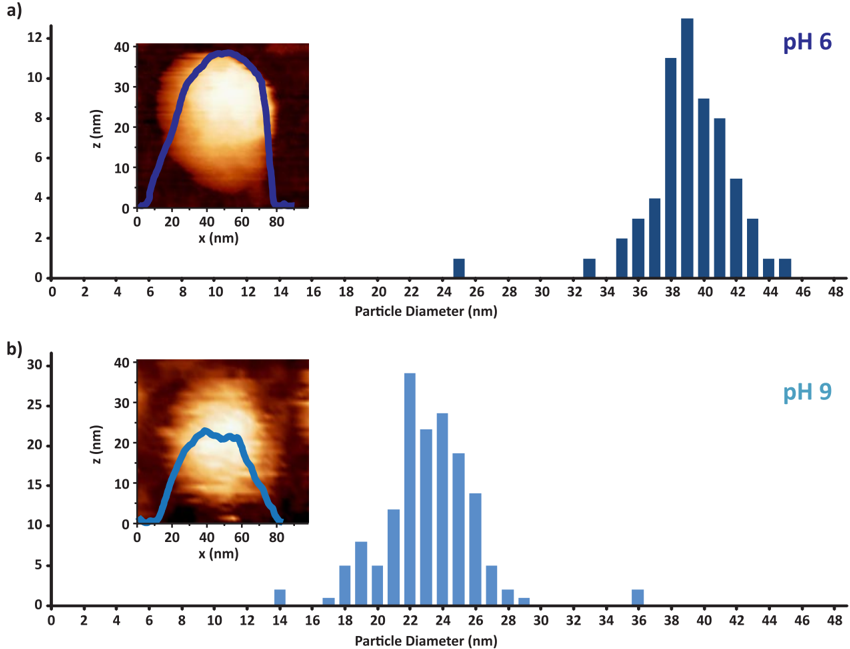
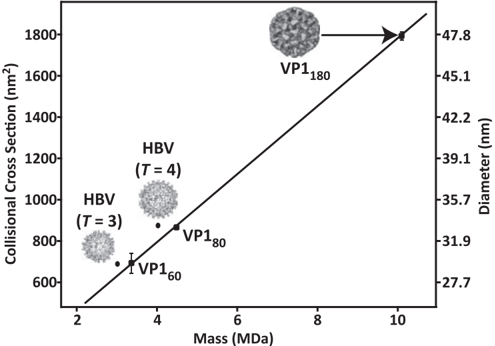
Viral capsid assembly, in which viral proteins self-assemble into complexes of well defined architecture, is a fascinating biological process. Although viral structure and assembly processes have been the subject of many excellent structural biology studies in the past, questions still remain regarding the intricate mechanisms that underlie viral structure, stability, and assembly. Here we used native mass spectrometry-based techniques to study the structure, stability, and assembly of Norwalk virus-like particles. Although detailed structural information on the fully assembled capsid exists, less information is available on potential capsid (dis)assembly intermediates, largely because of the inherent heterogeneity and complexity of the disassembly pathways. We used native mass spectrometry and atomic force microscopy to investigate the (dis)assembly of the Norwalk virus-like particles as a function of solution pH, ionic strength, and VP1 protein concentration. Native MS analysis at physiological pH revealed the presence of the complete capsid (T = 3) consisting of 180 copies of VP1. The mass of these capsid particles extends over 10 million Da, ranking them among the largest protein complexes ever analyzed by native MS. Although very stable under acidic conditions, the capsid was found to be sensitive to alkaline treatment. At elevated pH, intermediate structures consisting of 2, 4, 6, 18, 40, 60, and 80 copies of VP1 were observed with the VP1(60) (3.36-MDa) and VP1(80) (4.48-MDa) species being most abundant. Atomic force microscopy imaging and ion mobility mass spectrometry confirmed the formation of these latter midsize spherical particles at elevated pH. All these VP1 oligomers could be reversely assembled into the original capsid (VP1(180)). From the MS data collected over a range of experimental conditions, we suggest a disassembly model in which the T = 3 VP1(180) particles dissociate into smaller oligomers, predominantly dimers, upon alkaline treatment prior to reassembly into VP1(60) and VP1(80) species.
Overview
The claims and statistics of this paper haven’t been checked yet.
Free: it reads the open-access text and checks the first 5 claims that cite a source we can check. Create a free account to check every claim.
Integrity signals
Registry
Cites
Statistics
Figures
Verification
Claims the paper makes
The claims and statistics of this paper haven’t been checked yet.
Free: it reads the open-access text and checks the first 5 claims that cite a source we can check. Create a free account to check every claim.
Claims other papers make about this one
Each is checked against this paper’s own text: does it say what the citing paper says it does?
In the citing paper
“As many capsid proteins self-assemble in vitro, native ion mobility MS can monitor the dynamics of capsid morphology and stability as a function of pH and ionic strength (28, 29).”
From The Impact of Mass Spectrometry–Based Proteomics on Fundamental Discoveries in Virology (2014) · cites this paper as [28]
Self-check
Percentages, sums and reported differences re-computed from the paper’s own numbers.
The self-check needs the paper’s full text.
Citations
Cites
Calibration of rectangular atomic force microscope cantilevers
Sader, J. E., Chon, J. W. M., & Mulvaney, P. (1999) · Review of Scientific Instruments · doi:10.1063/1.1150021 · Cited by 2,145 · cited 1×
“The cantilevers were calibrated as described previously (35) and were found to have a spring constant of 0.”
MethodIon mobility–mass spectrometry analysis of large protein complexes
Ruotolo, B. T., Benesch, J. L. P., Sandercock, A. M., Hyung, S.-J., & Robinson, C. V. (2008) · Nature Protocols · doi:10.1038/nprot.2008.78 · Cited by 1,092 · cited 1×
“Collision crosssections (ccs) were determined from the measured drift times through calibration using proteins of known cross-sections as described previously (17, 32, 33).”
MethodX-ray Crystallographic Structure of the Norwalk Virus Capsid
Prasad, B. V. V., Hardy, M. E., Dokland, T., Bella, J., Rossmann, M. G., & Estes, M. K. (1999) · Science · doi:10.1126/science.286.5438.287 · Cited by 946
Self-citationExpression, self-assembly, and antigenicity of the Norwalk virus capsid protein
Jiang, X., Wang, M., Graham, D. Y., & Estes, M. K. (1992) · Journal of Virology · doi:10.1128/jvi.66.11.6527-6532.1992 · Cited by 860 · cited 3×
“ESI-MS Analysis of rNVLPs—To first investigate whether the intact capsid can be detected using ESI-MS, the rNVLPs were analyzed at neutral pH, a condition that is known from previous EM studies to be favorable for the formation of intact capsid (7, 9).”
BackgroundMethodSelf-citationPringle, S. D., Giles, K., Wildgoose, J. L., Williams, J. P., Slade, S. E., Thalassinos, K., Bateman, R. H., Bowers, M. T., & Scrivens, J. H. (2007) · International Journal of Mass Spectrometry · doi:10.1016/j.ijms.2006.07.021 · Cited by 808 · cited 1×
“Ion mobility measurements were performed on a Synapt HDMS (Waters) (31).”
MethodNative mass spectrometry: a bridge between interactomics and structural biology
Heck, A. J. R. (2008) · Nature Methods · doi:10.1038/nmeth.1265 · Cited by 766
Self-citationSequence and Genomic Organization of Norwalk Virus
Jiang, X., Wang, M., Wang, K., & Estes, M. K. (1993) · Virology · doi:10.1006/viro.1993.1345 · Cited by 632 · cited 1×
“Its genome contains three open reading frames, encoding for the major capsid protein (VP1), the minor capsid protein (VP2), and a non-structural polyprotein (4, 5).”
BackgroundSelf-citationEvidence for Macromolecular Protein Rings in the Absence of Bulk Water
Ruotolo, B. T., Giles, K., Campuzano, I., Sandercock, A. M., Bateman, R. H., & Robinson, C. V. (2005) · Science · doi:10.1126/science.1120177 · Cited by 596 · cited 1×
“rated based on their size and shape (13, 24).”
BackgroundInvestigation of intact protein complexes by mass spectrometry
Heck, A. J. R., & van den Heuvel, R. H. H. (2004) · Mass Spectrometry Reviews · doi:10.1002/mas.10081 · Cited by 583
Self-citationNorwalk Virus Genome Cloning and Characterization
Jiang, X., Graham, D. Y., Wang, K., & Estes, M. K. (1990) · Science · doi:10.1126/science.2177224 · Cited by 581 · cited 2×
“Its genome contains three open reading frames, encoding for the major capsid protein (VP1), the minor capsid protein (VP2), and a non-structural polyprotein (4, 5).”
BackgroundSelf-citation
Cited by
High-Resolution Native Mass Spectrometry
Tamara, S., den Boer, M. A., & Heck, A. J. R. (2022) · Chemical Reviews · doi:10.1021/acs.chemrev.1c00212 · Cited by 511
Self-citationHigh-sensitivity Orbitrap mass analysis of intact macromolecular assemblies
Rose, R. J., Damoc, E., Denisov, E., Makarov, A., & Heck, A. J. R. (2012) · Nature Methods · doi:10.1038/nmeth.2208 · Cited by 392
Self-citationIon Mobility Mass Spectrometry of Peptide Ions: Effects of Drift Gas and Calibration Strategies
Bush, M. F., Campuzano, I. D. G., & Robinson, C. V. (2012) · Analytical Chemistry · doi:10.1021/ac3014498 · Cited by 315
Interrogating viral capsid assembly with ion mobility–mass spectrometry
Uetrecht, C., Barbu, I. M., Shoemaker, G. K., van Duijn, E., & Heck, A. J. R. (2011) · Nature Chemistry · doi:10.1038/nchem.947 · Cited by 267
“We have recently demonstrated the strength of this technique in evaluating the exact mass, stoichiometry and gas-phase structure of HBV capsids, as well as the morphological variation present within in vitro reconstituted norovirus-like particles (NVLPs”
MethodSelf-citationJean Beltran, P. M., Federspiel, J. D., Sheng, X., & Cristea, I. M. (2017) · Molecular Systems Biology · doi:10.15252/msb.20167062 · Cited by 212
“…context of infectious disease, this technique has been applied primarily to individual pathogen proteins, such as the hepatitis C virus pore protein p7 (Konijnenberg et al , 2015), and pathogenic complexes reconstituted in vitro , such as the Norwalk virus-like particles (Shoemaker et al , 2010).”
Metadata
- Authors
- Shoemaker, G. K., van Duijn, E., Crawford, S. E., Uetrecht, C., Baclayon, M., Roos, W. H., Wuite, G. J. L., Estes, M. K., Prasad, B. V. V., & Heck, A. J. R.
- Affiliations
- Baylor College of Medicine (US)
- Vrije Universiteit Amsterdam (NL)
- Corresponding author
- Heck, Albert J.R.
- ORCID
- Venue
- Molecular & Cellular Proteomics
- Publisher
- Elsevier BV
- Published
- 2010-08
- Volume
- 9
- Issue
- 8
- Pages
- 1742-1751
- ISSN
- 1535-9476 (ISSN-L)
- PMC
- PMC2938053
- OpenAlex
- W2170064548
- Cited by
- 140
- References
- 46
- Citations by year
- 2026: 3 · 2025: 7 · 2024: 6 · 2023: 7 · 2022: 6 · 2021: 11 · 2020: 13 · 2019: 10 · 2018: 4 · 2017: 4 · 2016: 7 · 2015: 7 · 2014: 10 · 2013: 20 · 2012: 11
- FWCI
- 6.61
- Type
- journal article
- Language
- en
- Open access
- hybrid
- doi.org
- Licence
- cc-by
- www.elsevier.com/tdm/userlicense/1.0/ (tdm)
- www.elsevier.com/legal/tdmrep-license (tdm)
- creativecommons.org/licenses/by/4.0/ (vor, 3683 d)
- Locations
- Molecular & Cellular Proteomics (publishedVersion, cc-by)
- PubMed Central (publishedVersion)
- PubMed (publishedVersion)
- University of Groningen research database (University of Groningen / Centre for Information Technology) (publishedVersion, other-oa)
- VU Research Portal (publishedVersion, other-oa)
- University of Groningen research database (University of Groningen / Centre for Information Technology) (submittedVersion, other-oa)
- Data Archiving and Networked Services (DANS) (submittedVersion, other-oa)
- Funders
- Nederlandse Organisatie voor Wetenschappelijk Onderzoek (700.58.402, 819.02.10)
- National Institute of Allergy and Infectious Diseases (P01AI057788)
- Topics
- Physical Sciences › Chemistry › Spectroscopy › Mass Spectrometry Techniques and Applications
- Health Sciences › Medicine › Infectious Diseases › Viral gastroenteritis research and epidemiology
- Life Sciences › Biochemistry, Genetics and Molecular Biology › Structural Biology › Enzyme Structure and Function
- Keywords
- Norwalk virus, virus-like particles, capsid assembly, capsid disassembly, VP1, pH-dependent stability, ionic strength, reassembly, native mass spectrometry, ion mobility mass spectrometry, atomic force microscopy
- MeSH terms
- Capsid, Norwalk virus, Osmolar Concentration, Particle Size, Microscopy, Atomic Force, Virus Assembly, Spectrometry, Mass, Electrospray Ionization
About these checks
Registry, retraction, Cites and statistics results are computed, not judged, with one exception: a printed reference that no index lists is read once by a model before it counts as a citation error. Claims are extracted by a model and kept only when their quote appears verbatim in the text; each cited source is then checked, with a model’s help, for whether it says what the claim relies on. Those verdicts can be wrong — read the claim’s quote and the cited source before relying on one.
Statistics and arithmetic are recomputed, not judged.
Confidence bands are shown only for fields calibrated on our annotated test set. None is calibrated yet, so no band is shown.
What counts as a claim ›How we measure confidence ›How we check this ›
Are you an author, or do you see a problem with this page? Request a review
Data sources
Bibliographic data: Semantic Scholar, OpenAlex, Crossref.
Contains information from the Semantic Scholar Academic Graph Datasets, made available under the ODC Attribution License (ODC-BY 1.0).
Semantic Scholar’s data is described in: Kinney, R., et al. (2023). The Semantic Scholar Open Data Platform. arXiv:2301.10140.
