

The influence of teacher-guided mindfulness practice on inter and intra-personal abilities among Israeli Arab students
Open accessThe DOI matches its Crossref record; 51 of the 51 references it cites were found in a registry or an index; 10 of the 39 sources its claims cite were checked for support.
Abstract
This study investigates the effects of a mindfulness-based program implemented by teachers for their primary school students in the Arab sector of Israel. The study included 958 fourth, fifth, and sixth-grade students, with 659 completing the program and 299 students serving as controls. The effectiveness of the program was assessed through interpersonal and intrapersonal questionnaires, measuring anxiety, perceived stress, mindfulness, tolerance towards an outgroup, and teachers’ availability and acceptance. Students completed the questionnaires before and after the program. Significant interactions between time and group were observed in all measured outcomes, indicating the program’s positive effects. The findings suggest that mindfulness practices, known to be effective for primary school students in Western societies, can also be effective in collectivist cultures, such as the Arab society in Israel. © 2024 The Author(s). Published by Informa UK Limited, trading as Taylor & Francis Group.
Overview
CoChat Summary
TL;DR
A teacher-delivered mindfulness and compassion program (call to care–Israel, c2c-I) was evaluated among 4th–6th grade students in Israel’s Arab sector. Compared with controls, c2c-I students showed greater reductions in anxiety, stress, negative thoughts about Jews, and emotional prejudice, and greater increases in readiness for social contact, perceived teacher availability/acceptance, and mindfulness.
Key findings
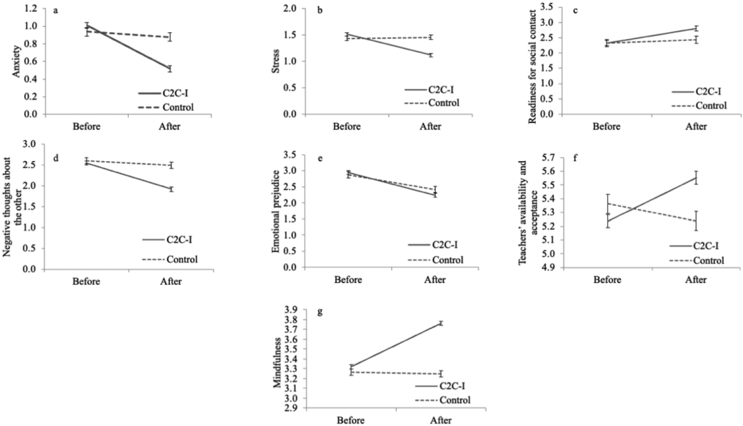
- Mixed linear models found significant time × group interactions for all assessed outcomes: anxiety, stress, readiness for social contact, negative thoughts about the other, emotional prejudice, teachers’ availability and acceptance, and mindfulness (all *p* < .001).
- Post-hoc comparisons showed stronger anxiety reduction in c2c-I (m.d. = −0.495, *p* < .001) than controls (m.d. = −0.061, *p* = .001); stress decreased significantly only in c2c-I (m.d. = −0.391, *p* < .001), not controls (m.d. = 0.023, n.s.).
- c2c-I showed larger increases in readiness for social contact (m.d. = 0.479, *p* < .001 vs. control m.d. = 0.116, *p* < .01), larger decreases in negative thoughts about others (m.d. = −0.629, *p* < .001 vs. control m.d. = −0.105, *p* < .01), and larger reductions in emotional prejudice (m.d. = −0.702, *p* < .001 vs. control m.d. = −0.45, *p* < .001).
- Teachers’ availability and acceptance decreased in controls (m.d. = −0.124, *p* < .001) but increased in c2c-I (m.d. = 0.315, *p* < .001); mindfulness increased significantly only in c2c-I (m.d. = 0.441, *p* < .001).
Methods
- Quasi-experimental pre/post design: 958 fourth-, fifth-, and sixth-grade students in the Arab sector of Israel; 659 in the c2c-I group and 299 controls. Teachers: 132 total, 80% female, mean seniority 16.6 years (SD = 8.12), mean age 40.24 years (SD = 7.51).
- Intervention: c2c-I consisted of twelve weekly 2.5-hour meetings over three months for teachers, focused on mindfulness and three modes of care (receiving care, self-care, extending care); control teachers attended a two-month weekly 2.5-hour workshop on “The class as a Learning community” (20 h vs. c2c-I’s 30 h).
- Measures: Spence Children’s Anxiety Scale, Perceived Stress Scale for children, Tolerance Questionnaire (readiness for social contact, negative thoughts about the other, emotional prejudice), Children’s Appraisal of Teacher as a Secure Base, and Five Facet Mindfulness Questionnaire. Analysis used mixed linear models with time, group, and time × group interaction; random effects of class nested within grade, school, and manipulation; gender covariate; alpha set at .001; Bonferroni-corrected post-hoc tests.
Limitations
- The paper states allocation to groups was not randomized because classes were predetermined by principals, and the design could not separate direct effects of students’ practice from indirect effects of teachers’ practice.
- The paper states there was no monitoring of teachers’ practice with students, so implementation consistency and specific practices are unclear; the control group also received a shorter intervention (20 h vs. 30 h).
- The paper reports low reliability for the child stress scale at pre- and post-measures (α = 0.41 and 0.52), and notes it did not evaluate practice quality, dosage, or tailoring to individual student needs; evident from the text, all outcomes rely on self-report questionnaires, and the c2c-I group had significantly higher anxiety and stress at pre-test.
Model-written summary. Check it against the paper before relying on it.
Integrity signals
Registry
Cites
Statistics
Figures


Verification
Claims the paper makes
8 Valid · 2 Not valid · 22 Not checked · 52 Own results and interpretations
The cited sources support only part of this claim — read each source’s verdict below.
In the paper
“Hoge et al. (2018) have shown that anxiety reduction is associated with improved emotional resilience and concentration.”
§ The influence of teacher-guided mindfulness practice on inter and intra-personal abilities among Israeli Arab students > Reductions in stress and anxiety
What the sources say
- Partly supportedcites Hoge et al., 2018 matched to “The effect of mindfulness meditation training on biological acute stress responses in generalized anxiety disorder” (2018) sourceExperimental — accuracy not yet measured
The Introduction (page unavailable) reports a greater drop in anxiety ratings with mindfulness training, and the Discussion (page unavailable) says the findings suggest improved resilience to stress in patients with generalized anxiety disorder. The paper does not report improved concentration or establish that individual reductions in anxiety were associated with improved resilience. (LLM, conf=0.86)
boostedstates an association- Asserted: passes — The authors put it forward as true.
- Checkable: passes — It can be checked against evidence.
- Load-bearing: unclear — It is unclear whether the paper’s conclusions depend on it.
- Based: passes — The paper gives a reason why it holds.
- Partly supported
The cited sources support only part of this claim — read each source’s verdict below.
In the paper
“previous research showing that teachers can successfully become mindfulness instructors after appropriate training (crane et al., 2010).”
§ The influence of teacher-guided mindfulness practice on inter and intra-personal abilities among Israeli Arab students > Theoretical and practical contributions
What the sources say
- Partly supportedcites crane et al., 2010 matched to “Training Teachers to Deliver Mindfulness-Based Interventions: Learning from the UK Experience” (2010) sourceExperimental — accuracy not yet measured
The Framework for a Mindfulness-Based Teacher Training Program describes training through which trainees develop the skills to teach MBSR/MBCT and identifies a recommended minimum level for teaching. But the section on the teacher’s personal practice says there has been little empirical research on mindfulness-teacher training and no clear evidence base linking teacher competence to participant outcomes. The paper therefore supports the possibility of becoming an instructor through appropriate training, not the claim that research has demonstrated successful outcomes. (LLM, conf=0.86)
plainstates a cause- Asserted: passes — The authors put it forward as true.
- Checkable: passes — It can be checked against evidence.
- Load-bearing: passes — The paper’s conclusions depend on it.
- Based: passes — The paper gives a reason why it holds.
- Partly supported
The cited sources support only part of this claim — read each source’s verdict below.
In the paper
“Studies have shown that mindfulness practice among students has improved their interpersonal relationships (Mendelson et al., 2010), fostered pro-social behaviour (Harpin et al., 2016), enhanced consideration for others, including minority groups (Black & Fernando, 2014), reduced prejudice, and promoted positive thoughts towards minorities (Berger et al., 2018).”
§ The influence of teacher-guided mindfulness practice on inter and intra-personal abilities among Israeli Arab students > Effects on tolerance and prejudice
What the sources say
- Partly supportedcites Black & Fernando, 2014 matched to “Mindfulness Training and Classroom Behavior Among Lower-Income and Ethnic Minority Elementary School Children” (2014) sourceExperimental — accuracy not yet measured
The Abstract and Discussion report improved teacher ratings of students’ caring and respect for others after mindfulness training. The students were predominantly ethnic-minority children, but the paper does not report whether their increased consideration was directed toward minority groups specifically; it also notes the lack of a mindfulness-naïve control group. (LLM, conf=0.87)
boostedstates a cause- Asserted: passes — The authors put it forward as true.
- Checkable: passes — It can be checked against evidence.
- Load-bearing: passes — The paper’s conclusions depend on it.
- Based: passes — The paper gives a reason why it holds.
- Partly supported
None of the sources cited for this claim have been checked yet.
In the paper
“the decrease in stress observed in the c2c-I group aligns with findings from prior studies”
§ The influence of teacher-guided mindfulness practice on inter and intra-personal abilities among Israeli Arab students > Reductions in stress and anxiety
hedged- Asserted: passes — The authors put it forward as true.
- Checkable: passes — It can be checked against evidence.
- Load-bearing: passes — The paper’s conclusions depend on it.
- Based: passes — The paper gives a reason why it holds.
A result the paper reports from its own data — it cites no other source for it, so there is none to check. The quote shows it is in the paper.
In the paper
“Additionally, emotional prejudice and negative thoughts about Jews showed a decline, highlighting positive changes in attitudes.”
§ The influence of teacher-guided mindfulness practice on inter and intra-personal abilities among Israeli Arab students > Effects on tolerance and prejudice
plain- Asserted: passes — The authors put it forward as true.
- Checkable: passes — It can be checked against evidence.
- Load-bearing: passes — The paper’s conclusions depend on it.
- Based: passes — The paper gives a reason why it holds.
42 more claims
Create a free account to see all 84 claims and to verify the 3 references still open.
- Probably not a substantial claim. 23
- It may state two separate claims as one. 24
- The quote only partly states this claim. 2
Statistics recomputed
Every reported test result, recomputed from its test statistic and degrees of freedom. A result shows as not adding up only once an independent check has confirmed it.
- Consistentt(956) = -2.21reported p < .05 · recomputed p = .027
“t(956) = -2.21,p < .05”
- Consistentt(956) = -2.24reported p < .05 · recomputed p = .025
“t(956) = -2.24,p < .05”
Self-check
Percentages, sums and reported differences re-computed from the paper’s own numbers.
Each contradiction between two passages listed here was confirmed by an independent check.
Rated minor: it would not touch a result — a value no result rests on, a p-value that stays on the same side of the significance level, or a conflict that is clerical, resolved elsewhere in the paper, or outside its own findings.
In the paper
§ The influence of teacher-guided mindfulness practice on inter and intra-personal abilities among Israeli Arab students > Limitations and directions for future research
“Thirdly, there was no monitoring of teachers' practice with their students, making it unclear whether teachers implemented the program consistently or what specific practices they employed.”
§ The influence of teacher-guided mindfulness practice on inter and intra-personal abilities among Israeli Arab students > Intervention: the mindfulness and compassion-based workshop for teachers -a call to care-Israel (C2C-I)
“The facilitator also observed some of the teachers while they worked with their students and provided them with off-site supervision as well.”
Citations
Cites
Durlak, J. A., Weissberg, R. P., Dymnicki, A. B., Taylor, R. D., & Schellinger, K. B. (2011) · Child Development · doi:10.1111/j.1467-8624.2010.01564.x · Cited by 10,854 · cited 1×
“Factors such as dosage, program implementation quality, fidelity to the curriculum, responsiveness to individual needs, and differentiation between program approaches play a crucial role in understanding the outcomes of mindfulness interventions (durlak et al., 2011).”
Mindfulness-based interventions in context: Past, present, and future
Kabat-Zinn, J. (2003) · Clinical Psychology: Science and Practice · doi:10.1093/clipsy.bpg016 · Cited by 8,615
Mindfulness-based interventions in context: Past, present, and future.
Kabat-Zinn, J. (2003) · Clinical Psychology: Science and Practice · doi:10.1093/clipsy/bpg016 · Cited by 8,612
Using Self-Report Assessment Methods to Explore Facets of Mindfulness
Baer, R. A., Smith, G. T., Hopkins, J., Krietemeyer, J., & Toney, L. (2006) · Assessment · doi:10.1177/1073191105283504 · Cited by 7,511 · cited 1×
“Mindfulness was assessed utilising the Five Facet Mindfulness Questionnaire, initially developed by Baer et al. (2006) and modified for children by Ginesin (2013).”
Jennings, P. A., & Greenberg, M. T. (2009) · Review of Educational Research · doi:10.3102/0034654308325693 · Cited by 3,686 · cited 1×
“Moreover, teachers’ emotional and social competence, also enhanced through mindfulness practice, have been identified as mediators in generating these same effects on their students (Jennings & Greenberg, 2009).”
Hölzel, B. K., Lazar, S. W., Gard, T., Schuman-Olivier, Z., Vago, D. R., & Ott, U. (2011) · Perspectives on Psychological Science · doi:10.1177/1745691611419671 · Cited by 3,024 · cited 2×
“…has been found to enhance various qualities including empathy and self-compassion (Birnie et al., 2009), wellbeing and positive emotions (Sin & Lyubomirsky, 2009), emotional self-regulation and cognitive flexibility, and reduce stress and anxiety (Hölzel et al., 2011; Meiklejohn et al., 2012).”
Sin, N. L., & Lyubomirsky, S. (2009) · Journal of Clinical Psychology · doi:10.1002/jclp.20593 · Cited by 2,955 · cited 1×
“…has been found to enhance various qualities including empathy and self-compassion (Birnie et al., 2009), wellbeing and positive emotions (Sin & Lyubomirsky, 2009), emotional self-regulation and cognitive flexibility, and reduce stress and anxiety (Hölzel et al., 2011; Meiklejohn et al.,…”
A measure of anxiety symptoms among children
Spence, S. H. (1998) · Behaviour Research and Therapy · doi:10.1016/s0005-7967(98)00034-5 · Cited by 1,928 · cited 1×
“Anxiety levels were measured using the short version of the Spence children’s Anxiety Scale (ScAS), which was developed by Spence (1998).”
Meiklejohn, J., Phillips, C., Freedman, M. L., Griffin, M. L., Biegel, G., Roach, A., Frank, J., Burke, C., Pinger, L., Soloway, G., et al. (2012) · Mindfulness · doi:10.1007/s12671-012-0094-5 · Cited by 778 · cited 3×
“Previous studies have demonstrated that mindfulness practices among primary school students improve their overall well-being and reduce anxiety (Meiklejohn et al., 2012) and stress.”
Jennings, P. A., Frank, J. L., Snowberg, K. E., Coccia, M. A., & Greenberg, M. T. (2013) · School Psychology Quarterly · doi:10.1037/spq0000035 · Cited by 672 · cited 1×
“The cultivating Awareness and Resilience in Education (cARE) program (Jennings et al., 2013) focuses on enhancing teachers’ emotional awareness and regulation skills to better respond to student needs.”
Exploring self compassion and empathy in the context of mindfulness-based stress reduction (MBSR)
Birnie, K., Speca, M., & Carlson, L. E. (2010) · Stress and Health · doi:10.1002/smi.1305 · Cited by 600 · cited 2×
“The practice of mindfulness has been found to enhance various qualities including empathy and self-compassion (Birnie et al., 2009), wellbeing and positive emotions (Sin & Lyubomirsky, 2009), emotional self-regulation and cognitive flexibility, and reduce stress and anxiety (Hölzel et al., 2011;…”
McCoy, J., & Somer, M. (2019) · The ANNALS of the American Academy of Political and Social Science · doi:10.1177/0002716218818782 · Cited by 595 · cited 1×
“These findings hold particular significance in present times, especially in societies like Israel, where intercultural divisions and polarisation are escalating, posing challenges to the future of coexistence, cooperation, and democracy (Mccoy & Somer, 2019).”
Feasibility and Preliminary Outcomes of a School-Based Mindfulness Intervention for Urban Youth
Mendelson, T., Greenberg, M. T., Dariotis, J. K., Gould, L. F., Rhoades, B. L., & Leaf, P. J. (2010) · Journal of Abnormal Child Psychology · doi:10.1007/s10802-010-9418-x · Cited by 538 · cited 3×
“Additionally, mindfulness-based interventions among primary school students can support positive inter-personal effects, such as improving students’ relationships with peers and teachers (Mendelson et al., 2010) and enhancing pro-social behaviour (Felver et al., 2017).”
Oberle, E., & Schonert-Reichl, K. A. (2016) · Social Science & Medicine · doi:10.1016/j.socscimed.2016.04.031 · Cited by 524 · cited 1×
“This is also supported by a study indicating that teachers’ occupational stress levels, as indicated by their burnout levels, were observed to be predictive of students’ stress levels, as measured by their morning cortisol variability (oberle & Schonert-Reichl, 2016).”
Conversano, C., Ciacchini, R., Orrù, G., Di Giuseppe, M., Gemignani, A., & Poli, A. (2020) · Frontiers in Psychology · doi:10.3389/fpsyg.2020.01683 · Cited by 243 · cited 1×
“According to these evolving perceptions, there has been a growing trend of combining both approaches in various programs (conversano et al., 2020).”
Exploring the Psychometric Properties of the Five Facet Mindfulness Questionnaire
Christopher, M. S., Neuser, N. J., Michael, P. G., & Baitmangalkar, A. (2012) · Mindfulness · doi:10.1007/s12671-011-0086-x · Cited by 234 · cited 1×
“The overall scale reliability was reported as 0.93 (christopher et al., 2012).”
InfluentialBlack, D. S., & Fernando, R. (2014) · Journal of Child and Family Studies · doi:10.1007/s10826-013-9784-4 · Cited by 225 · cited 2×
“…their interpersonal relationships (Mendelson et al., 2010), fostered pro-social behaviour (Harpin et al., 2016), enhanced consideration for others, including minority groups (Black & Fernando, 2014), reduced prejudice, and promoted positive thoughts towards minorities (Berger et al., 2018).”
Training Teachers to Deliver Mindfulness-Based Interventions: Learning from the UK Experience
Crane, R. S., Kuyken, W., Hastings, R. P., Rothwell, N., & Williams, J. M. G. (2010) · Mindfulness · doi:10.1007/s12671-010-0010-9 · Cited by 202 · cited 2×
“This finding may support previous research showing that teachers can successfully become mind-fulness instructors after appropriate training (crane et al., 2010). our study makes a notable contribution to the field by highlighting the potential of mindfulness and compassion practices in reducing…”
Hoge, E. A., Bui, E., Palitz, S. A., Schwarz, N. R., Owens, M. E., Johnston, J. M., Pollack, M. H., & Simon, N. M. (2018) · Psychiatry Research · doi:10.1016/j.psychres.2017.01.006 · Cited by 193 · cited 1×
“For instance, Hoge et al. (2018) have shown that anxiety reduction is associated with improved emotional resilience and concentration.”
Student‐teacher relationships and bullying: The role of student social status
Longobardi, C., Iotti, N. O., Jungert, T., & Settanni, M. (2018) · Journal of Adolescence · doi:10.1016/j.adolescence.2017.12.001 · Cited by 144 · cited 2×
“…of teachers’ availability and acceptance holds great significance as positive student-teacher relationships and understanding are known to contribute to enhanced academic achievements (Thijs & Fleischmann, 2015), improved behaviour and reduced bullying incidents (Longobardi et al., 2018).”
The Perceived Stress Scale for Children: A Pilot Study in a Sample of 153 Children
White, B. P. (2014) · International Journal of Pediatrics and Child Health · doi:10.12974/2311-8687.2014.02.02.4 · Cited by 118 · cited 1×
“The Perceived Stress Scale for children, adapted for children by White (2014), was used to assess the stress levels.”
Mindfulness interventions in schools: Integrity and feasibility of implementation
Emerson, L.-M., de Diaz, N. N., Sherwood, A., Waters, A., & Farrell, L. (2020) · International Journal of Behavioral Development · doi:10.1177/0165025419866906 · Cited by 117 · cited 1×
“…and feasibility of program delivery, ongoing professional development and support for teachers, and the alignment of mindfulness practices with curriculum objectives all contribute to the efficacy and sustainability of mind-fulness interventions in educational settings (Emerson et al., 2020).”
Mindfulness and Compassion as Key Factors in Improving teacher’s Well Being
Tarrasch, R., Berger, R., & Grossman, D. (2020) · Mindfulness · doi:10.1007/s12671-020-01304-x · Cited by 111 · cited 2×
“However, in recent years, there has been a shift in mindfulness programs designed for teachers, with an increasing emphasis on incorporating compassion into their curriculum (e.g. Roeser et al., 2022; Tarrasch et al., 2020).”
Self-citationRoeser, R. W., Mashburn, A. J., Skinner, E. A., Choles, J. R., Taylor, C., Rickert, N. P., Pinela, C., Robbeloth, J., Saxton, E., Weiss, E., et al. (2022) · Journal of Educational Psychology · doi:10.1037/edu0000675 · Cited by 103 · cited 3×
“Roeser et al. (2022) proposed moving beyond the division between research on mindfulness and compassion in schools and instead advocating for an integrated approach to studying mindfulness and compassion.”
DeLuca, S. M., Kelman, A. R., & Waelde, L. C. (2018) · Psychological Studies · doi:10.1007/s12646-018-0452-z · Cited by 95 · cited 1×
“Moreover, student characteristics, such as cultural background, can significantly impact their receptivity and engagement with these programs (deLuca et al., 2018)).”
Rayan, A., & Ahmad, M. (2017) · Mindfulness · doi:10.1007/s12671-016-0595-8 · Cited by 86 · cited 1×
“In a recent study conducted by Rayan and Ahmad (2017), mindfulness-based interventions have been observed to reduce stress, anxiety, and depression symptoms among parents in Arab society.”
Roeser, R. W., Greenberg, M. T., Frazier, T., Galla, B. M., Semenov, A. D., & Warren, M. T. (2023) · Mindfulness · doi:10.1007/s12671-022-02017-z · Cited by 70 · cited 2×
“Roeser et al. (2022) proposed moving beyond the division between research on mindfulness and compassion in schools and instead advocating for an integrated approach to studying mindfulness and compassion.”
Levit‐Binnun, N., Arbel, K., & Dorjee, D. (2021) · Frontiers in Psychology · doi:10.3389/fpsyg.2021.727857 · Cited by 67 · cited 1×
“Mindfulness training may have different approaches based on the intentions behind them and the experiential understandings the practices may aim to develop (Levit-Binnun et al., 2021).”
Roca, P., Vazquez, C., Diez, G., Brito-Pons, G., & McNally, R. J. (2021) · Journal of Affective Disorders · doi:10.1016/j.jad.2021.01.070 · Cited by 63 · cited 1×
“Whereas mindfulness trains a non-judgemental acceptance of one’s experience, compassion practice trains states of empathy, warmth, and kindness towards oneself and others and has a more prominent ethical component (Roca et al., 2021).”
Molloy Elreda, L., Jennings, P. A., DeMauro, A. A., Mischenko, P. P., & Brown, J. L. (2019) · Mindfulness · doi:10.1007/s12671-018-0996-y · Cited by 62 · cited 1×
“Additionally, teachers’ level of mindfulness play a role in mitigating the negative impact of stress on teachers ability to provide emotional support to students in the classroom (Molloy Elreda et al., 2019).”
Berger, R., Brenick, A., & Tarrasch, R. (2018) · Mindfulness · doi:10.1007/s12671-018-0919-y · Cited by 60 · cited 1×
“…their interpersonal relationships (Mendelson et al., 2010), fostered pro-social behaviour (Harpin et al., 2016), enhanced consideration for others, including minority groups (Black & Fernando, 2014), reduced prejudice, and promoted positive thoughts towards minorities (Berger et al., 2018).”
Self-citationJazaieri, H. (2018) · Journal of Research in Innovative Teaching & Learning · doi:10.1108/jrit-08-2017-0017 · Cited by 58 · cited 1×
“As a part of mindfulness practice or separately, compassion can be cultivated in schools, modelled for students within the classroom, starting from pre-school and continuing through graduate school (Jazaieri, 2018).”
Ager, K., Albrecht, N. J., & Cohen, P. M. (2015) · Psychology · doi:10.4236/psych.2015.67088 · Cited by 57 · cited 1×
“The observed increase in mindfulness in the experimental group aligns with previous research demonstrating that mindfulness practice leads to higher reported levels of mindfulness (Ager et al., 2015; Felver et al., 2017), and may serve as a manipulation check.”
Al-Yagon, M., & Mikulincer, M. (2006) · Research in Education · doi:10.7227/rie.75.1 · Cited by 57 · cited 1×
“Teachers’ availability was assessed using the Teachers’ Availability and Acceptance factor from the children’s Appraisal of Teacher as a Secure Base (cATSB) scale developed by Al-yagon and Mikulincer (2006).”
Thijs, J., & Fleischmann, F. (2015) · Learning and Individual Differences · doi:10.1016/j.lindif.2015.08.014 · Cited by 56 · cited 1×
“…of teachers’ availability and acceptance holds great significance as positive student-teacher relationships and understanding are known to contribute to enhanced academic achievements (Thijs & Fleischmann, 2015), improved behaviour and reduced bullying incidents (Longobardi et al., 2018).”
School-based management: Arab education system in Israel
Arar, K., & Abu-Romi, A. (2016) · Journal of Educational Administration · doi:10.1108/jea-09-2014-0118 · Cited by 53 · cited 1×
“These perceptions and practices include also traditional learning programs and teaching methods (Arar & Abu Romi, 2017).”
Intergroup biases in conflict: Reexamination with Arab pre-adolescents and adolescents
Teichman, Y., Bar‐Tal, D., & Abdolrazeq, Y. (2007) · International Journal of Behavioral Development · doi:10.1177/0165025407081470 · Cited by 45 · cited 1×
“The second part of the Tolerance Questionnaire assessed children’s negative thoughts about others, specifically related to Arab-Jewish stereotypes (Teichman et al., 2007).”
Berger, R., Abu‐Raiya, H., & Gelkopf, M. (2014) · Journal of Educational Psychology · doi:10.1037/edu0000015 · Cited by 44 · cited 4×
“The internal consistency reliability of the sub-scale has been reported to range between 0.82 and 0.86 in previous studies (Berger et al., 2015).”
Influentialvan Dijk, W., Gage, N. A., & Grasley‐Boy, N. (2019) · Psychology in the Schools · doi:10.1002/pits.22254 · Cited by 44 · cited 1×
“In this regard, research has shown that teachers’ ability to effectively manage classrooms directly impacts students’ motivation and indirectly influences students’ academic achievements (van dijk et al., 2019).”
(2016) · Cited by 27
Felver, J. C., Felver, S. L., Margolis, K. L., Kathryn Ravitch, N., Romer, N., & Horner, R. H. (2017) · Contemporary School Psychology · doi:10.1007/s40688-017-0133-2 · Cited by 25 · cited 2×
“Additionally, mindfulness-based interventions among primary school students can support positive inter-personal effects, such as improving students’ relationships with peers and teachers (Mendelson et al., 2010) and enhancing pro-social behaviour (Felver et al., 2017).”
(2010) · Cited by 25
Alternative education in Palestinian-Arab society in Israel: Rationale and characteristics
Magadley, W., Amara, M. H., & Jabareen, Y. T. (2019) · International Journal of Educational Development · doi:10.1016/j.ijedudev.2019.04.002 · Cited by 20 · cited 1×
“Although attempts have been made to introduce alternative teaching methods, such as individual instruction, active learning, and group learning, the success of these attempts has been limited (Abu ʽ Asba, 2007; Magadley et al., 2019).”
Roberts, R. (2011) · International Journal of Children s Spirituality · doi:10.1080/1364436x.2011.580996 · Cited by 17 · cited 1×
“Additionally, mindfulness training has been shown to enhance individuals’ ability to cope with stressful situations (coholic, 2010). due to our study design, we are unable to distinguish between the direct effects of student practice and the indirect effects through their teachers’ practice.”
Kielty, M. L., Gilligan, T. D., & Staton, A. R. (2017) · Childhood Education · doi:10.1080/00094056.2017.1300491 · Cited by 16 · cited 1×
“However, from a practical standpoint, our methodology, which closely aligns with the whole-school approach (Kielty et al., 2017), was found to be effective among children. our results suggest that the effects observed were likely a result of the teachers’ involvement, either through their own…”
Birnbaum, L. (2005) · The Scientific World JOURNAL · doi:10.1100/tsw.2005.59 · Cited by 15 · cited 1×
“Furthermore, in a study conducted within the Jewish-Israeli society, Birnbaum (2005) proposed that mindfulness practice may reduce aggressive behaviours among students.”
Tarrasch, R., & Berger, R. (2022) · Mindfulness · doi:10.1007/s12671-022-01955-y · Cited by 13 · cited 2×
“Equally important is the recognition that teachers’ own mindfulness practice can enhance their ability to manage the classroom, thereby affecting students even without formal practice together (Tarrasch & Berger, 2022).”
Self-citationKenwright, D., McLaughlin, T., & Hansen, S. (2023) · International Journal of Inclusive Education · doi:10.1080/13603116.2020.1867382 · Cited by 12 · cited 1×
“These include the teacher’s own understanding and beliefs regarding mindfulness, and their instructional strategies for incorporating mindfulness within the classroom setting (Kenwright et al., 2023).”
The ERASE-STRESS (ES) programmes
Berger, R. (2018) · Routledge eBooks · doi:10.4324/9780203069943-13 · Cited by 11 · cited 1×
“It drew inspiration from contemplative approaches such as Sustainable compassion Training (Makransky, 2007) and social-emotional learning approaches like the Erase Stress Prosocial program (ESPS; Berger, 2014).”
A First-Person Account of Using Mindfulness as a Therapeutic Tool in the Palestinian Territories
Pigni, A. (2009) · Journal of Child and Family Studies · doi:10.1007/s10826-009-9328-0 · Cited by 7 · cited 1×
“These cultural differences may have potential implications for the implementation of mindfulness training programs (Pigni, 2010), although the specific extent and impact of these differences have not been extensively researched.”
Validity of Majority-Minority Performance Gaps Measurements on PISA TestsPreprint
Ofek-Shanny, Y. (2020) · SSRN Electronic Journal · doi:10.2139/ssrn.3670091 · Cited by 2 · cited 1×
“However, despite these positive trends, substantial educational gaps still exist when comparing the Arab and Jewish populations in Israel (ofek-Shanny, 2020).”
Research works printed but not linked: 7
- 1. AbuʽAsba, H. (2007). Arabic education in Israel: Dilemmas of national minority (in Hebrew). Floersheimer Institute for Policy Studies.
- 16. cullen, M., & Wallace, L. (2010). Stress management and relaxation techniques in education (SMART) training manual. unpublished manual. Impact Foundation.
- 21. Gilbert, P., & choden. (2013). Mindful compassion: Using the power of mindfulness and compassion to transform our lives. constable-Robinson.
- 22. Ginesin, E. (2013). The influence of the mindfulness-based 'language of mindfulness' program on attentiveness, anxiety and positive emotions among primary school students (in Hebrew). Tel Aviv university.
- 32. Lama, d., & cutler, H. c. (1998). The art of happiness. Hodder & Stoughton.
- 36. Makransky, J. (2007). Awakening through love: Unveiling your deepest goodness. Wisdom publications.
- 45. Reches, E., & Rudnicki, A. (2009). The Arab society in Israel: An information file (in Hebrew). The Abraham Fund Initiatives.
Cited by
Khalifa, G., Massarwa, Z., Krayem, M., & Hosni, L. (2026) · Art Therapy · doi:10.1080/07421656.2026.2622757 · Cited by 2
Self-citationKhalifa, G., Engdau‐Vanda, S., Massarwa, Z., Mukh, Y. N. A., Nasralla, A., Hosni, L., Aghbariah, A., Alhouf, N. A., Khateeb, F., Wattad, H., et al. (2026) · The Arts in Psychotherapy · doi:10.1016/j.aip.2026.102503 · Cited by 1
Self-citation
Metadata
- Authors
- Khalifa, G., & Tarrasch, R.
- Affiliations
- Tel Aviv University (IL)
- Corresponding author
- Tarrasch, Ricardo
- Venue
- Educational Psychology
- Publisher
- Informa UK Limited
- Published
- 2024-04-20
- Volume
- 44
- Issue
- 4
- Pages
- 494-512
- ISSN
- 0144-3410 (ISSN-L)
- 1469-5820
- OpenAlex
- W4400177659
- Cited by
- 3
- References
- 50
- Citations by year
- 2026: 3
- FWCI
- 1.51
- Type
- journal article
- Language
- en
- Open access
- hybrid
- dx.doi.org
- Licence
- Locations
- Educational Psychology (publishedVersion, cc-by-nc-nd)
- Topics
- Social Sciences › Psychology › Clinical Psychology › Mindfulness and Compassion Interventions
- Social Sciences › Education › Early Childhood Education and Development
- Social Sciences › Education › Social Skills and Education
- Keywords
- mindfulness-based interventions, Arab students, elementary school students, social skills, anxiety, perceived stress, teacher availability, collectivist culture
About these checks
Registry, retraction, Cites and statistics results are computed, not judged, with one exception: a printed reference that no index lists is read once by a model before it counts as a citation error. Claims are extracted by a model and kept only when their quote appears verbatim in the text; each cited source is then checked, with a model’s help, for whether it says what the claim relies on. Those verdicts can be wrong — read the claim’s quote and the cited source before relying on one.
The claim verdicts this report counts are experimental: their accuracy is not yet measured.
A language model drew the claims from the paper on 2026-10-11, under version 3 of the claim definition (model deepseek-v4.1-flash, prompt extract-v3).
A second model labelled each claim on 2026-10-11 (model jev-1.13-20260917, definition revision gold-guideline-v0.2).
Cited sources are checked with a language model’s help (gpt-6-sol).
Statistics and arithmetic are recomputed, not judged.
Confidence bands are shown only for fields calibrated on our annotated test set. None is calibrated yet, so no band is shown.
What counts as a claim ›How we measure confidence ›How we check this ›
Are you an author, or do you see a problem with this page? Request a review
Data sources
Bibliographic data: Semantic Scholar, OpenAlex, Crossref.
Contains information from the Semantic Scholar Academic Graph Datasets, made available under the ODC Attribution License (ODC-BY 1.0).
Semantic Scholar’s data is described in: Kinney, R., et al. (2023). The Semantic Scholar Open Data Platform. arXiv:2301.10140.
