

The relationships between school belonging and students’ motivational, social-emotional, behavioural, and academic outcomes in secondary education: a meta-analytic review
Open accessThe DOI matches its Crossref record; 182 of the 185 references it cites were found in a registry or an index, and 1 are not checked yet; none of the 57 sources its claims cite is checked for support yet.
Abstract
This meta-analytic review examines the relationships between students’ sense of school belonging and students’ motivational, social-emotional, behavioural, and academic functioning in secondary education. Moreover, it examines to what extent these relationships differ between different student groups (grade level, SES), measurement instruments, and region. The meta-analysis included 82 correlational studies, published in peer-reviewed journals between 2000 and 2018. Results revealed, on average, a small positive correlation with academic achievement, and small to moderate positive correlations with motivational outcomes such as mastery goal orientations; with social-emotional outcomes such as self-concept and self-efficacy; and with behavioural outcomes such as behavioural, cognitive, and agentic engagement. A small negative correlation is observed with absence and dropout rates. Similar results are found across different student groups (grade level, SES). Although the results vary to some extent across measurement instruments and region, generally, the results reveal that school belonging plays an important role in students’ school life.
Checked 2026-11-25 · 1 reference not checked yet
Overview
CoChat Summary
TL;DR
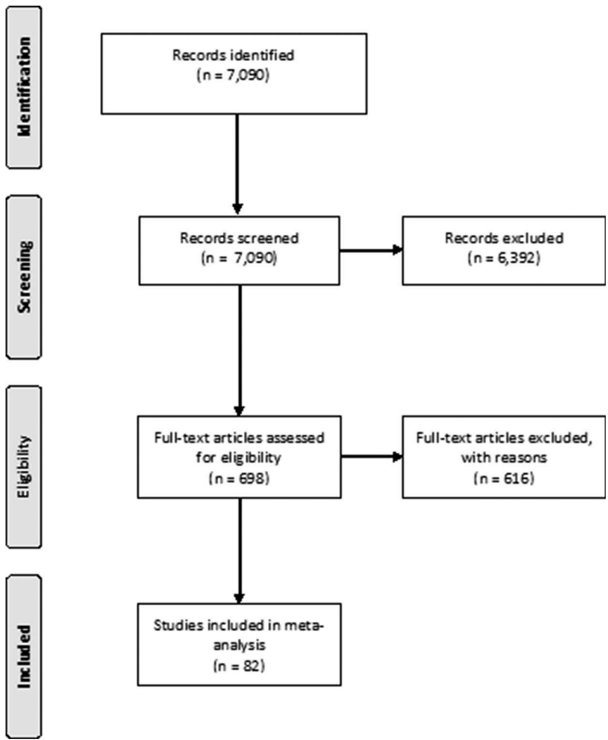
This meta-analysis synthesizes 82 studies (208,796 secondary students) on school belonging and finds consistent positive associations with motivational, social-emotional, behavioural, and academic outcomes, and a negative association with absence/dropout. Associations are generally small to moderate, with some variation by measurement instrument and region but not by grade level or SES.
Key findings
- Across 82 studies (208,796 students), school belonging was positively related to most outcomes: academic achievement averaged r = .18, absence/dropout averaged r = -.16, and other motivational, social-emotional, and behavioural outcomes averaged r = .30 to .39.
- Specific outcomes included school grades r = .18 (67 tests), standardised test scores r = .12 (19 tests), perceived classroom climate r = .40, and mastery-oriented classroom goal structure r = .44; performance approach goals, extrinsic motivation, and social motivation were small and non-significant.
- Moderator analyses found differences by measurement instrument for academic achievement, motivational outcomes, behavioural engagement, and self-perceptions, and by region for perceived learning environment and behavioural engagement; no significant differences were found for grade level or SES.
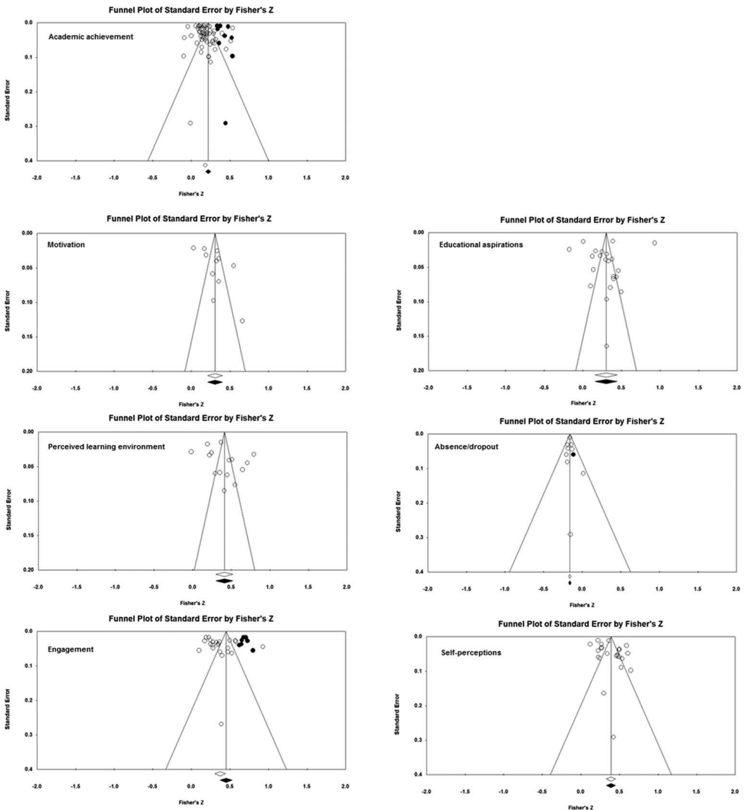
- Publication bias was indicated for academic outcomes and engagement: adjusted summary effects were r = .22 instead of .18 and r = .42 instead of .36, respectively.
Methods
- Meta-analysis of peer-reviewed English-language journal studies published January 2000–December 2018, identified through ERIC and PsycINFO plus reference screening; inclusion required regular secondary education, quantitative methods, samples of at least 30 students, and dependent/independent variables not from the same measurement instrument.
- The final sample comprised 82 studies and 208,796 students; correlations between school belonging and seven outcome domains were transformed into Fisher’s Z, weighted by inverse variance, and converted back to correlations, with multiple similar outcomes averaged within studies.
- Analyses used Comprehensive Meta-Analysis software; meta-ANOVA tests examined group differences by measurement instrument, region, grade level, and SES.
Limitations
- The paper states that findings are based on a relatively small number of primary studies for some specific outcomes and relatively few studies from Europe or Asia; construct validity of school belonging instruments was often unclear; publication bias was found for academic outcomes and engagement; and cross-sectional designs prevent causal conclusions, with reciprocal and cumulative effects likely.
- The paper also notes that students who already dropped out may not have been included in cross-sectional studies, and that samples of Asian, European, and Australian studies were small, so region-specific results need cautious interpretation.
Model-written summary. Check it against the paper before relying on it.
Integrity signals
Registry
Cites
Statistics
Figures


Verification
Claims the paper makes
0 Valid · 1 Not valid · 38 Not checked · 91 Own results and interpretations
A result the paper reports from its own data — it cites no other source for it, so there is none to check. The quote shows it is in the paper.
In the paper
“However, we did find some publication bias for the other outcome types.”
§ The relationships between school belonging and students' motivational, social-emotional, behavioural, and academic outcomes in secondary education: a meta-analytic review > Results for research question 1
plain- Asserted: passes — The authors put it forward as true.
- Checkable: passes — It can be checked against evidence.
- Load-bearing: unclear — It is unclear whether the paper’s conclusions depend on it.
- Based: passes — The paper gives a reason why it holds.
A result the paper reports from its own data — it cites no other source for it, so there is none to check. The quote shows it is in the paper.
In the paper
“The correlations between school belonging and academic achievement and school belonging and absence/dropout rates were small 3 (r = .18and r = -.16,respectively)”
§ The relationships between school belonging and students' motivational, social-emotional, behavioural, and academic outcomes in secondary education: a meta-analytic review > Results for research question 1
plainstates an association- Asserted: passes — The authors put it forward as true.
- Checkable: passes — It can be checked against evidence.
- Load-bearing: unclear — It is unclear whether the paper’s conclusions depend on it.
- Based: passes — The paper gives a reason why it holds.
A result the paper reports from its own data — it cites no other source for it, so there is none to check. The quote shows it is in the paper.
In the paper
“In summary, Table 4 shows that the reported correlations differed per measurement instrument for several student outcomes, namely for academic achievement, motivational outcomes, behavioural engagement, and self-perceptions.”
§ The relationships between school belonging and students' motivational, social-emotional, behavioural, and academic outcomes in secondary education: a meta-analytic review > Results for research question 2
plainstates an association- Asserted: passes — The authors put it forward as true.
- Checkable: passes — It can be checked against evidence.
- Load-bearing: unclear — It is unclear whether the paper’s conclusions depend on it.
- Based: passes — The paper gives a reason why it holds.
A result the paper reports from its own data — it cites no other source for it, so there is none to check. The quote shows it is in the paper.
In the paper
“Additionally, students' sense of school belonging was positively related to their perceived learning environment, such as the perceived classroom climate (r = .40)and a more mastery-oriented classroom goal structure (r = .44),indicating that students with high levels of school belonging perceived their learning environment as more mastery oriented and generally as a more favourable classroom clima”
§ The relationships between school belonging and students' motivational, social-emotional, behavioural, and academic outcomes in secondary education: a meta-analytic review > Results for research question 1
plainstates an association- Asserted: passes — The authors put it forward as true.
- Checkable: passes — It can be checked against evidence.
- Load-bearing: unclear — It is unclear whether the paper’s conclusions depend on it.
- Based: passes — The paper gives a reason why it holds.
A result the paper reports from its own data — it cites no other source for it, so there is none to check. The quote shows it is in the paper.
In the paper
“whereas the correlations with the other motivational, social-emotional, and behavioural outcomes were medium to moderately large (varying between r = .30and .39).”
§ The relationships between school belonging and students' motivational, social-emotional, behavioural, and academic outcomes in secondary education: a meta-analytic review > Results for research question 1
plainstates an association- Asserted: passes — The authors put it forward as true.
- Checkable: passes — It can be checked against evidence.
- Load-bearing: passes — The paper’s conclusions depend on it.
- Based: passes — The paper gives a reason why it holds.
42 more claims
Create a free account to see all 130 claims and to verify the 6 references still open.
- It may state two separate claims as one. 52
- Probably not a substantial claim. 51
Self-check
Percentages, sums and reported differences re-computed from the paper’s own numbers.
Each contradiction between two passages listed here was confirmed by an independent check.
Rated minor: it would not touch a result — a value no result rests on, a p-value that stays on the same side of the significance level, or a conflict that is clerical, resolved elsewhere in the paper, or outside its own findings.
In the paper
§ The relationships between school belonging and students' motivational, social-emotional, behavioural, and academic outcomes in secondary education: a meta-analytic review > Limitations and directions for future research
“Another issue is that we found indicators of publication bias for two of our outcome categories.”
§ The relationships between school belonging and students' motivational, social-emotional, behavioural, and academic outcomes in secondary education: a meta-analytic review > Results for research question 1
“However, we did find some publication bias for the other outcome types.The estimated adjusted effect sizes for these outcomes are: academic outcomes r = 0.215 (LL = 0.182; UL = 0.247), engagement r = 0.421 (LL = 0.353; UL = 0.485), and absence/dropout r = -0.158(LL = -0.174;UL = -0.141).”
Citations
Cites
The "what" and "why" of goal pursuits: Human needs and the self-determination of behavior
Deci, E. L., & Ryan, R. M. (2000) · Psychological Inquiry · doi:10.1207/s15327965pli1104_01 · Cited by 34,210 · cited 2×
“The need for relatedness is not necessarily a prerequisite for intrinsic motivation, but a ‘needed backdrop’ that makes expression of the innate growth tendency of intrinsic motivation more likely (Deci and Ryan 2000, 235).”
BackgroundIntrinsic Motivation and Self-Determination in Human Behavior
Deci, E. L., & Ryan, R. M. (1985) · doi:10.1007/978-1-4899-2271-7 · Cited by 26,772
The need to belong: Desire for interpersonal attachments as a fundamental human motivation.
Baumeister, R. F., & Leary, M. R. (1995) · Psychological Bulletin · doi:10.1037//0033-2909.117.3.497 · Cited by 23,245
(2010) · Intellectum (Universidad de La Sabana) · doi:10.1111/j.1467- · Cited by 16,131
Intrinsic Motivation and Self-Determination in Human Behavior
Miller, K. A., Deci, E. L., & Ryan, R. M. (1988) · Contemporary Sociology · doi:10.2307/2070638 · Cited by 15,312
Borenstein, M., Hedges, L. V., Higgins, J. P. T., & Rothstein, H. R. (2009) · doi:10.1002/9780470743386 · Cited by 14,225 · cited 2×
“ComprehensiveMeta-Analysis software of Biostat was used to carry out all statistical analyses (Borenstein et al. 2009).”
MethodSchool Engagement: Potential of the Concept, State of the Evidence
Fredricks, J. A., Blumenfeld, P. C., & Paris, A. H. (2004) · Review of Educational Research · doi:10.3102/00346543074001059 · Cited by 12,581 · cited 8×
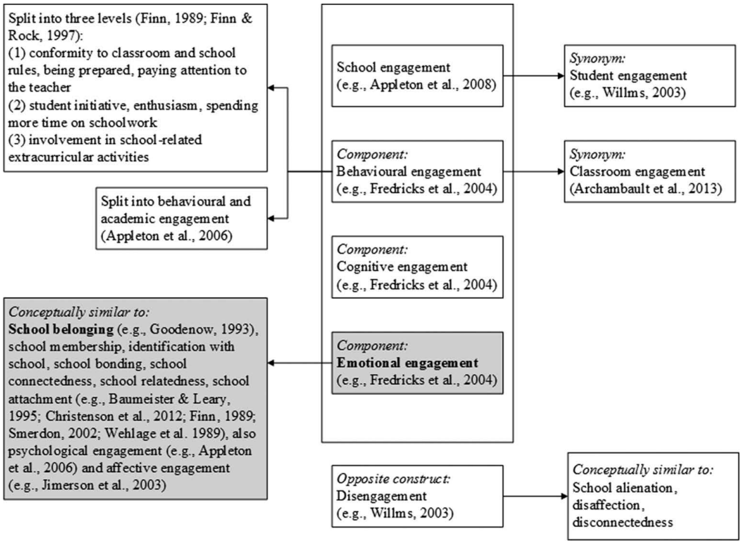
“In addition to the three types of engagement used by Fredricks et al. (2004), other scholars have also studied disengagement, mainly to characterise students who ‘do not feel they belong at school and have withdrawn from school activities in a significant way’ (Willms 2003, 8).”
BackgroundInfluentialBorenstein, M., Hedges, L. V., Higgins, J. P. T., & Rothstein, H. R. (2021) · doi:10.1002/9781119558378 · Cited by 9,799
(2000) · Cited by 9,198
Maslow, A. (1962) · D Van Nostrand eBooks · doi:10.1037/10793-000 · Cited by 7,192
Research works printed but not linked: 9
- 28. Corno, L., and E. B. Mandinach. 2004. "What We Have Learned about Student Engagement in the past Twenty Years." In Big Theories Revisited, edited by D. M. McInerney and S. Van Etten, 299-328. Greenwich, CT: Information Age.
- 34. Deci, E. L., and R. M. Ryan, Eds. 2002. Handbook of Self-Determination Theory Research. Rochester, NY: University of Rochester Press.
- 41. Finn, J. D., and K. A. Kasza. 2009. "Disengagement from School" In Engaging Young People in Learning: Why Does It Matter and What Can We Do? edited by J. Morton, 4-35. Wellington, New Zealand: New Zealand Council for Educational Research.
- 45. Fokkens-Bruinsma, M., E. T. C. Canrinus, M. Ten Hove, and L. Rietveld. 2018. "The Relationship between Teacher's Work Motivation and Classroom Goal Orientation." Pedagogische Studiën 95: 86-100.
- 55. Gottfredson, G. 1984. Effective School Battery. Odessa, FL: Psychological Assessment Resources.
- 97. Li, Y. B., and R. M. Lerner. 2013. "Interrelations of Behavioral, Emotional, and Cognitive School Engagement in High School Students." Journal of Youth and Adolescence 42: 20-32. doi:10.1007/s10964-012-9857-5. · DOI · Paper page
- 10.1007/s10964-005-8950-4 · DOI · Paper page
- 148. Udry, J. R. 1998. The National Longitudinal Study of Adolescent Health (Add Health), Waves I & II, 1994-1996. Chapel Hill, NC: Carolina Population Center, University of North Carolina at Chapel Hill (Producer).Los Altos, CA: Sociometrics Corporation, American Family Data Archive (Producer & Distributor)
- 166. WestEd. 2008. California Healthy Kids Survey: California School District Secondary School Survey Results Fall 07/Spring 08. Los Alamitos, CA: Author.
Cited by
Items 501–600 of 637
Learning Environments Research, Trauma, and Trauma-Informed Education: Synergies and Opportunities
McChesney, K., Martinussen, M., & Aldridge, J. M. (2026) · Springer international handbooks of education · doi:10.1007/978-981-95-2591-1_34-1
Han, Z., & Xu, T. (2026) · Frontiers in Public Health · doi:10.3389/fpubh.2026.1872650
Gutierrez, N. M., Mills, L., Tucker, A. R., Newman, T. J., Gass, M. A., & Thompson, J. (2026) · Child and Adolescent Social Work Journal · doi:10.1007/s10560-026-01144-z
Individual and In-Session Strategies
Rodrigues, S. (2026) · Oxford University Press eBooks · doi:10.1093/9780197843413.003.0046
Reimagining Family Engagement Through a Neurodiversity Lens
Rodrigues, S. (2026) · Oxford University Press eBooks · doi:10.1093/9780197843413.003.0044
Rodrigues, S. (2026) · Oxford University Press eBooks · doi:10.1093/9780197843413.002.0008
Restorative Practices and Regulation-Informed Discipline
Rodrigues, S. (2026) · Oxford University Press eBooks · doi:10.1093/9780197843413.003.0043
Neurodivergence and Socioeconomic Class
Rodrigues, S. (2026) · Oxford University Press eBooks · doi:10.1093/9780197843413.003.0020
Performative Inclusion and the Burden of Adaptation
Rodrigues, S. (2026) · Oxford University Press eBooks · doi:10.1093/9780197843413.003.0038
Reorienting the System: Unpacking Bias
Rodrigues, S. (2026) · Oxford University Press eBooks · doi:10.1093/9780197843413.003.0024
Designing Accessible and Inclusive Social Emotional Learning
Rodrigues, S. (2026) · Oxford University Press eBooks · doi:10.1093/9780197843413.003.0031
The Ethical Imperative of Action
Rodrigues, S. (2026) · Oxford University Press eBooks · doi:10.1093/9780197843413.003.0058
Rodrigues, S. (2026) · Oxford University Press eBooks · doi:10.1093/9780197843413.003.0001
Sustaining the Work: Burnout, Compassion Fatigue, and Systemic Support
Rodrigues, S. (2026) · Oxford University Press eBooks · doi:10.1093/9780197843413.003.0034
Rodrigues, S. (2026) · Oxford University Press eBooks · doi:10.1093/9780197843413.003.0053
Rodrigues, S. (2026) · Oxford University Press eBooks · doi:10.1093/9780197843413.003.0049
Rodrigues, S. (2026) · Oxford University Press eBooks · doi:10.1093/9780197843413.005.0002
Glossary of Key Terms and Concepts
Rodrigues, S. (2026) · Oxford University Press eBooks · doi:10.1093/9780197843413.005.0001
Transformative Social Emotional Learning
Rodrigues, S. (2026) · Oxford University Press eBooks · doi:10.1093/9780197843413.003.0032
Rodrigues, S. (2026) · Oxford University Press eBooks · doi:10.1093/9780197843413.003.0050
Applying the Person-In-Environment Framework
Rodrigues, S. (2026) · Oxford University Press eBooks · doi:10.1093/9780197843413.003.0008
Cultural Humility in Neurodiversity Affirming Practice
Rodrigues, S. (2026) · Oxford University Press eBooks · doi:10.1093/9780197843413.003.0009
Rodrigues, S. (2026) · Oxford University Press eBooks · doi:10.1093/9780197843413.003.0036
Peer Relationships and Dedicated Interests
Rodrigues, S. (2026) · Oxford University Press eBooks · doi:10.1093/9780197843413.003.0040
Rodrigues, S. (2026) · Oxford University Press eBooks · doi:10.1093/9780197843413.002.0002
Communication Justice as a Social Work Imperative
Rodrigues, S. (2026) · Oxford University Press eBooks · doi:10.1093/9780197843413.003.0011
Rodrigues, S. (2026) · Oxford University Press eBooks · doi:10.1093/9780197843413.003.0051
Rodrigues, S. (2026) · Oxford University Press eBooks · doi:10.1093/9780197843413.003.0002
Rodrigues, S. (2026) · Oxford University Press eBooks · doi:10.1093/9780197843413.003.0042
School Social Workers as Policy Advocates
Rodrigues, S. (2026) · Oxford University Press eBooks · doi:10.1093/9780197843413.003.0055
Rodrigues, S. (2026) · Oxford University Press eBooks · doi:10.1093/9780197843413.003.0035
Narrative Theory and the Reclamation of Neurodivergent Identity
Rodrigues, S. (2026) · Oxford University Press eBooks · doi:10.1093/9780197843413.003.0016
Advocacy in a Shifting Political Landscape
Rodrigues, S. (2026) · Oxford University Press eBooks · doi:10.1093/9780197843413.003.0057
Rodrigues, S. (2026) · Oxford University Press eBooks · doi:10.1093/9780197843413.005.0006
Rethinking Social Intelligence
Rodrigues, S. (2026) · Oxford University Press eBooks · doi:10.1093/9780197843413.003.0027
Rodrigues, S. (2026) · Oxford University Press eBooks · doi:10.1093/9780197843413.003.0048
Rodrigues, S. (2026) · Oxford University Press eBooks · doi:10.1093/9780197843413.003.0004
Culturally Responsive and Sustaining Practice
Rodrigues, S. (2026) · Oxford University Press eBooks · doi:10.1093/9780197843413.003.0030
Neurodivergent Cultural Communication at the Intersection of Race
Rodrigues, S. (2026) · Oxford University Press eBooks · doi:10.1093/9780197843413.003.0021
Applying Critical Disability Studies in Practice
Rodrigues, S. (2026) · Oxford University Press eBooks · doi:10.1093/9780197843413.003.0014
Intersectionality as Praxis in Inclusive Social Work
Rodrigues, S. (2026) · Oxford University Press eBooks · doi:10.1093/9780197843413.003.0018
Building Coalitions and Cross-System Partnerships
Rodrigues, S. (2026) · Oxford University Press eBooks · doi:10.1093/9780197843413.003.0056
Rodrigues, S. (2026) · Oxford University Press eBooks · doi:10.1093/9780197843413.002.0005
Spotlighting Communication Diversity as a Strategy
Rodrigues, S. (2026) · Oxford University Press eBooks · doi:10.1093/9780197843413.003.0047
Rodrigues, S. (2026) · Oxford University Press eBooks · doi:10.1093/9780197843413.003.0025
Modeling Youth-Adult Relationships
Rodrigues, S. (2026) · Oxford University Press eBooks · doi:10.1093/9780197843413.003.0028
Bridging Individual Work to Systemic Change
Rodrigues, S. (2026) · Oxford University Press eBooks · doi:10.1093/9780197843413.003.0054
Crisis Intervention through a Neurodiversity-Affirming Lens
Rodrigues, S. (2026) · Oxford University Press eBooks · doi:10.1093/9780197843413.003.0052
Rodrigues, S. (2026) · Oxford University Press eBooks · doi:10.1093/9780197843413.002.0007
Rodrigues, S. (2026) · Oxford University Press eBooks · doi:10.1093/9780197843413.003.0013
Rodrigues, S. (2026) · Oxford University Press eBooks · doi:10.1093/9780197843413.003.0037
Revisiting the Theory of Mind Narrative
Rodrigues, S. (2026) · Oxford University Press eBooks · doi:10.1093/9780197843413.003.0006
Rodrigues, S. (2026) · Oxford University Press eBooks · doi:10.1093/9780197843413.003.0039
Cultural Humility and Reflexivity in Practice
Rodrigues, S. (2026) · Oxford University Press eBooks · doi:10.1093/9780197843413.003.0022
Centering Dignity, Strength, and Self-Determination
Rodrigues, S. (2026) · Oxford University Press eBooks · doi:10.1093/9780197843413.003.0007
Reimagining Behavior Support in Schools
Rodrigues, S. (2026) · Oxford University Press eBooks · doi:10.1093/9780197843413.003.0026
Rodrigues, S. (2026) · Oxford University Press eBooks · doi:10.1093/9780197843413.003.0003
Environmental Fit and the Ecology of Inclusion
Rodrigues, S. (2026) · Oxford University Press eBooks · doi:10.1093/9780197843413.003.0015
Rodrigues, S. (2026) · Oxford University Press eBooks · doi:10.1093/9780197843413.003.0012
Rodrigues, S. (2026) · Oxford University Press eBooks · doi:10.1093/9780197843413.005.0007
Rodrigues, S. (2026) · Oxford University Press eBooks · doi:10.1093/9780197843413.005.0005
Gender, Masking, and the Performance of Acceptability
Rodrigues, S. (2026) · Oxford University Press eBooks · doi:10.1093/9780197843413.003.0019
Recognizing Strengths and Challenges Across Neurodivergent Profiles
Rodrigues, S. (2026) · Oxford University Press eBooks · doi:10.1093/9780197843413.003.0005
Centering Sensory Inclusivity and Student Voice in Neurodiversity-Affirming SEL
Rodrigues, S. (2026) · Oxford University Press eBooks · doi:10.1093/9780197843413.003.0033
Advocacy in Special Education Systems
Rodrigues, S. (2026) · Oxford University Press eBooks · doi:10.1093/9780197843413.003.0023
Rodrigues, S. (2026) · Oxford University Press eBooks · doi:10.1093/9780197843413.005.0003
Supporting Neurodivergent Caregivers
Rodrigues, S. (2026) · Oxford University Press eBooks · doi:10.1093/9780197843413.003.0045
Accessible Design for Learning
Rodrigues, S. (2026) · Oxford University Press eBooks · doi:10.1093/9780197843413.003.0029
Rodrigues, S. (2026) · Oxford University Press eBooks · doi:10.1093/9780197843413.005.0004
Rodrigues, S. (2026) · Oxford University Press eBooks · doi:10.1093/9780197843413.003.0017
Honoring Dedicated Interests as Pathways to Learning and Connection
Rodrigues, S. (2026) · Oxford University Press eBooks · doi:10.1093/9780197843413.003.0041
Accessible Design for Learning
Rodrigues, S. (2026) · Oxford University Press eBooks · doi:10.1093/9780197843413.003.0010
Rodrigues, S. (2026) · Oxford University Press eBooks · doi:10.1093/9780197843413.002.0006
Bokelmann, L. (2026) · Absentismus und Dropout · doi:10.1007/978-3-658-51711-3_7
Goodfellow, C., Bate, C., Shetty, J. R., Allen, J., Letina, S., Long, E., Ncube, N., Riddell, J., Obazee, R. S., Benjamin, M., et al. (2026) · SSM - Mental Health · doi:10.1016/j.ssmmh.2026.100679 · Cited by 1
“When schools create conditions which allow for a greater sense of agency, wellbeing and engagement can improve (Korpershoek et al., 2020; Schaefer et al., 2024).”
Flourishing through adventure learning: A (semi)cautionary tale
Willis, B. T., & Reaney-Wood, S. (2026) · British Educational Research Journal · doi:10.1002/berj.70246
Wei, Y., & Wang, X. (2026) · PLoS ONE · doi:10.1371/journal.pone.0353972
“In contrast, successful emotion management is linked to higher life satisfaction and more frequent positive emotional experiences [25].”
Llorent, V. J., Núñez-Flores, M., Obsuth, I., Ribeaud, D., & Eisner, M. (2026) · European Journal of Education · doi:10.1111/ejed.70781
Li, W., Xiang, J., & Guo, Y. (2026) · Frontiers in Psychology · doi:10.3389/fpsyg.2026.1810232
Bienestar socioemocional y rendimiento académico en estudiantes de secundaria
Zambrano-Molina, J. D., Barban-Forte, Y., Calero-Mieles, V. M., & Bermúdez, Á. E. G. (2026) · Revista de Investigación y Liderazgo · doi:10.63618/omd/revinvlid/v3/n2/2
“Asimismo, los indicadores de rendimiento académico varían entre calificaciones escolares, pruebas estandarizadas, promoción, asistencia o percepción docente, lo que genera dificultades para integrar hallazgos y formular conclusiones sólidas (Bücker et al., 2018; Korpershoek et al., 2020).”
InfluentialMultidimensional profiles of adolescent functioning: academic, emotional, and relational patterns
Aziku, M., Huang, X., & Djekourmane, D. (2026) · Frontiers in Psychology · doi:10.3389/fpsyg.2026.1907030 · Cited by 1
“The present study considers constructs such as school belonging, which refers to students’ perceived acceptance, value, and inclusion within their school or classroom environment (Canrinus et al., 2019; Goodenow, 1993; Wang, 2024).”
Kahraman, N., Teig, N., & Ding, Y. (2026) · British Journal of Educational Psychology · doi:10.1111/bjep.70111
Tan, Y. (2026) · Instructional Science · doi:10.1007/s11251-026-09811-5
Dinsmore-Tuli, U., Beynon, L., & Hartwell, B. K. (2026) · Pastoral Care in Education · doi:10.1080/02643944.2026.2710989
Rizqullah, M. R., & Ekafitrianda, J. M. (2026) · Women Education and Social Welfare · doi:10.70211/wesw.v3i2.579 · Cited by 2
Cassà, È. L., Berastegui-Martínez, J., & Justel, J. Á. (2026) · SSRN Electronic Journal · doi:10.2139/ssrn.7237139
Indriana, D., Firdaos, R., Ngaisah, S., Imroatun, & Ahmad, Z. B. M. (2026) · Women Education and Social Welfare · doi:10.70211/wesw.v3i3.565
Li, Y., Li, Y., & Xu, B. (2026) · BMC Medical Education · doi:10.21203/rs.3.rs-10543731/v1
Wang, M., Yin, X., Zhao, Y., Teng, S., & Ji, X. (2026) · Frontiers in Psychology · doi:10.3389/fpsyg.2026.1832439
Schlesier, J., & Obermeier, R. (2026) · British Journal of Educational Psychology · doi:10.1111/bjep.70116
Mining Communities for Resources: Capital, AP and Partnership Working
Johnston, C. (2026) · Palgrave Studies in Risk, Crime and Society · doi:10.1007/978-3-032-25989-9_5
Stereotypes concerning first-generation university students and correlates in higher education
Swietlik, M., Pohlmann, A., Schwinger, M., & Trautner, M. (2026) · Social Psychology of Education · doi:10.1007/s11218-026-10271-5
“Finally, we expect sense of belonging to positively predict study satisfaction for all students (for a review see e.g. Korpershoek et al., 2020).”
Skinner, E. A. (2026) · Emerald Group Publishing Limited eBooks · doi:10.1108/978-1-80686-869-820261001
Piderit-Moreno, M. B., Benavente, M., & Pérez-Fargallo, A. (2026) · Buildings · doi:10.3390/buildings16163292
Gümüşçağlayan, G., Kıymık, G., & Arslan, G. (2026) · Children · doi:10.3390/children13081113
“…that supportive relationships enhance school belonging by reinforcing the adolescent’s perception of being accepted and valued at school [18,41], that school belonging encourages prosocial behavior [45], and that prosocial behavior supports both perceived and objective academic achievement [47].”
Yin, S., Wu, R., Ma, W., & Ou, Y. (2026) · Frontiers in Psychology · doi:10.3389/fpsyg.2026.1904847
A meta-analysis of suicidality, depression and sense of school belonging in adolescence
Tesolin, J., & Konishi, C. (2026) · Educational Research Review · doi:10.1016/j.edurev.2026.100844
Özalp, C., Tuncer, M., Kaya, A., & Şahin, F. (2026) · Nurse Education Today · doi:10.1016/j.nedt.2026.107366
Metadata
- Authors
- Korpershoek, H., Canrinus, E. T., Fokkens-Bruinsma, M., & de Boer, H.
- Affiliations
- University of Groningen (NL)
- University of Agder (NO)
- GION Education/Research, University of Groningen, Groningen, the Netherlands
- Corresponding author
- Korpershoek, H.
- Venue
- Research Papers in Education
- Publisher
- Informa UK Limited
- Published
- 2019-05-27
- Volume
- 35
- Issue
- 6
- Pages
- 641-680
- ISSN
- 0267-1522 (ISSN-L)
- 1470-1146
- OpenAlex
- W2947655140
- Semantic Scholar
- 35ecbf9488c93b1b390c210affb07d3204d06aad
- Cited by
- 648
- References
- 182
- Citations by year
- 2026: 228 · 2025: 119 · 2024: 100 · 2023: 78 · 2022: 70 · 2021: 42 · 2020: 10 · 2019: 1
- FWCI
- 82.86
- Type
- journal article
- Language
- en
- Open access
- hybrid
- doi.org
- Licence
- Locations
- Research Papers in Education (publishedVersion, cc-by-nc-nd)
- University of Groningen research database (University of Groningen / Centre for Information Technology) (acceptedVersion, cc-by-nc-nd)
- NORA - Norwegian Open Research Archives (submittedVersion, cc-by-nc-nd)
- University of Groningen research database (University of Groningen / Centre for Information Technology) (submittedVersion, cc-by-nc-nd)
- Topics
- Social Sciences › Education › Early Childhood Education and Development
- Social Sciences › Psychology › Developmental and Educational Psychology › Education, Achievement, and Giftedness
- Social Sciences › Education › Educational Environments and Student Outcomes
- Keywords
- school belonging, secondary education, academic performance, student motivation, mastery orientation, self-concept, self-efficacy, student engagement, school absenteeism, school dropout, social-emotional outcomes, behavioural outcomes, socioeconomic status, grade level differences
About these checks
Registry, retraction, Cites and statistics results are computed, not judged, with one exception: a printed reference that no index lists is read once by a model before it counts as a citation error. Claims are extracted by a model and kept only when their quote appears verbatim in the text; each cited source is then checked, with a model’s help, for whether it says what the claim relies on. Those verdicts can be wrong — read the claim’s quote and the cited source before relying on one.
A language model drew the claims from the paper on 2026-09-28, under version 3 of the claim definition (model deepseek-v4.1-flash, prompt extract-v3).
A second model labelled each claim on 2026-09-28 (model jev-1.13-20260917, definition revision gold-guideline-v0.2).
Statistics and arithmetic are recomputed, not judged.
Confidence bands are shown only for fields calibrated on our annotated test set. None is calibrated yet, so no band is shown.
What counts as a claim ›How we measure confidence ›How we check this ›
Are you an author, or do you see a problem with this page? Request a review
Data sources
Bibliographic data: Semantic Scholar, OpenAlex, Crossref.
Contains information from the Semantic Scholar Academic Graph Datasets, made available under the ODC Attribution License (ODC-BY 1.0).
Semantic Scholar’s data is described in: Kinney, R., et al. (2023). The Semantic Scholar Open Data Platform. arXiv:2301.10140.
