

The relationships between school belonging and students’ motivational, social-emotional, behavioural, and academic outcomes in secondary education: a meta-analytic review
Open accessThe DOI matches its Crossref record; 182 of the 185 references it cites were found in a registry or an index, and 3 are not checked yet; none of the 57 sources its claims cite is checked for support yet.
Abstract
This meta-analytic review examines the relationships between students’ sense of school belonging and students’ motivational, social-emotional, behavioural, and academic functioning in secondary education. Moreover, it examines to what extent these relationships differ between different student groups (grade level, SES), measurement instruments, and region. The meta-analysis included 82 correlational studies, published in peer-reviewed journals between 2000 and 2018. Results revealed, on average, a small positive correlation with academic achievement, and small to moderate positive correlations with motivational outcomes such as mastery goal orientations; with social-emotional outcomes such as self-concept and self-efficacy; and with behavioural outcomes such as behavioural, cognitive, and agentic engagement. A small negative correlation is observed with absence and dropout rates. Similar results are found across different student groups (grade level, SES). Although the results vary to some extent across measurement instruments and region, generally, the results reveal that school belonging plays an important role in students’ school life.
Checked 2026-11-22 · 3 references not checked yet
Overview
CoChat Summary
TL;DR
This meta-analysis synthesizes 82 studies (208,796 secondary students) on school belonging and finds consistent positive associations with motivational, social-emotional, behavioural, and academic outcomes, and a negative association with absence/dropout. Associations are generally small to moderate, with some variation by measurement instrument and region but not by grade level or SES.
Key findings
- Across 82 studies (208,796 students), school belonging was positively related to most outcomes: academic achievement averaged r = .18, absence/dropout averaged r = -.16, and other motivational, social-emotional, and behavioural outcomes averaged r = .30 to .39.
- Specific outcomes included school grades r = .18 (67 tests), standardised test scores r = .12 (19 tests), perceived classroom climate r = .40, and mastery-oriented classroom goal structure r = .44; performance approach goals, extrinsic motivation, and social motivation were small and non-significant.
- Moderator analyses found differences by measurement instrument for academic achievement, motivational outcomes, behavioural engagement, and self-perceptions, and by region for perceived learning environment and behavioural engagement; no significant differences were found for grade level or SES.
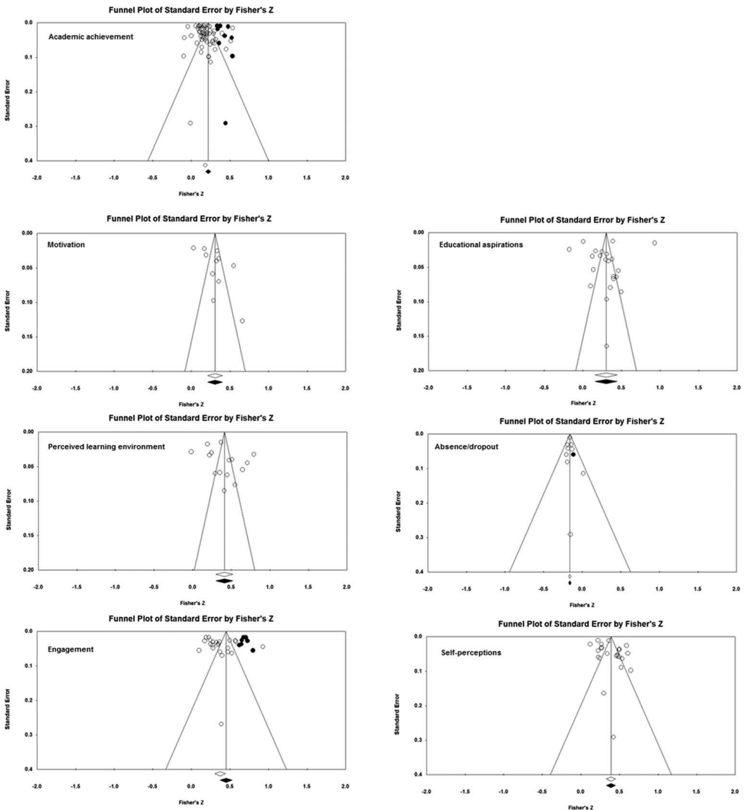
- Publication bias was indicated for academic outcomes and engagement: adjusted summary effects were r = .22 instead of .18 and r = .42 instead of .36, respectively.
Methods
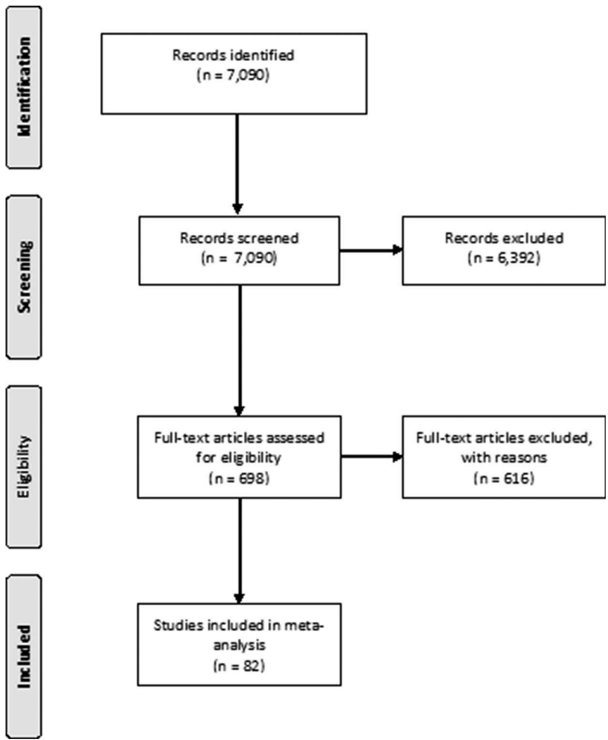
- Meta-analysis of peer-reviewed English-language journal studies published January 2000–December 2018, identified through ERIC and PsycINFO plus reference screening; inclusion required regular secondary education, quantitative methods, samples of at least 30 students, and dependent/independent variables not from the same measurement instrument.
- The final sample comprised 82 studies and 208,796 students; correlations between school belonging and seven outcome domains were transformed into Fisher’s Z, weighted by inverse variance, and converted back to correlations, with multiple similar outcomes averaged within studies.
- Analyses used Comprehensive Meta-Analysis software; meta-ANOVA tests examined group differences by measurement instrument, region, grade level, and SES.
Limitations
- The paper states that findings are based on a relatively small number of primary studies for some specific outcomes and relatively few studies from Europe or Asia; construct validity of school belonging instruments was often unclear; publication bias was found for academic outcomes and engagement; and cross-sectional designs prevent causal conclusions, with reciprocal and cumulative effects likely.
- The paper also notes that students who already dropped out may not have been included in cross-sectional studies, and that samples of Asian, European, and Australian studies were small, so region-specific results need cautious interpretation.
Model-written summary. Check it against the paper before relying on it.
Integrity signals
Registry
Cites
Statistics
Figures


Verification
Claims the paper makes
0 Valid · 1 Not valid · 38 Not checked · 91 Own results and interpretations
A result the paper reports from its own data — it cites no other source for it, so there is none to check. The quote shows it is in the paper.
In the paper
“However, we did find some publication bias for the other outcome types.”
§ The relationships between school belonging and students' motivational, social-emotional, behavioural, and academic outcomes in secondary education: a meta-analytic review > Results for research question 1
plain- Asserted: passes — The authors put it forward as true.
- Checkable: passes — It can be checked against evidence.
- Load-bearing: unclear — It is unclear whether the paper’s conclusions depend on it.
- Based: passes — The paper gives a reason why it holds.
A result the paper reports from its own data — it cites no other source for it, so there is none to check. The quote shows it is in the paper.
In the paper
“The correlations between school belonging and academic achievement and school belonging and absence/dropout rates were small 3 (r = .18and r = -.16,respectively)”
§ The relationships between school belonging and students' motivational, social-emotional, behavioural, and academic outcomes in secondary education: a meta-analytic review > Results for research question 1
plainstates an association- Asserted: passes — The authors put it forward as true.
- Checkable: passes — It can be checked against evidence.
- Load-bearing: unclear — It is unclear whether the paper’s conclusions depend on it.
- Based: passes — The paper gives a reason why it holds.
A result the paper reports from its own data — it cites no other source for it, so there is none to check. The quote shows it is in the paper.
In the paper
“In summary, Table 4 shows that the reported correlations differed per measurement instrument for several student outcomes, namely for academic achievement, motivational outcomes, behavioural engagement, and self-perceptions.”
§ The relationships between school belonging and students' motivational, social-emotional, behavioural, and academic outcomes in secondary education: a meta-analytic review > Results for research question 2
plainstates an association- Asserted: passes — The authors put it forward as true.
- Checkable: passes — It can be checked against evidence.
- Load-bearing: unclear — It is unclear whether the paper’s conclusions depend on it.
- Based: passes — The paper gives a reason why it holds.
A result the paper reports from its own data — it cites no other source for it, so there is none to check. The quote shows it is in the paper.
In the paper
“Additionally, students' sense of school belonging was positively related to their perceived learning environment, such as the perceived classroom climate (r = .40)and a more mastery-oriented classroom goal structure (r = .44),indicating that students with high levels of school belonging perceived their learning environment as more mastery oriented and generally as a more favourable classroom clima”
§ The relationships between school belonging and students' motivational, social-emotional, behavioural, and academic outcomes in secondary education: a meta-analytic review > Results for research question 1
plainstates an association- Asserted: passes — The authors put it forward as true.
- Checkable: passes — It can be checked against evidence.
- Load-bearing: unclear — It is unclear whether the paper’s conclusions depend on it.
- Based: passes — The paper gives a reason why it holds.
A result the paper reports from its own data — it cites no other source for it, so there is none to check. The quote shows it is in the paper.
In the paper
“whereas the correlations with the other motivational, social-emotional, and behavioural outcomes were medium to moderately large (varying between r = .30and .39).”
§ The relationships between school belonging and students' motivational, social-emotional, behavioural, and academic outcomes in secondary education: a meta-analytic review > Results for research question 1
plainstates an association- Asserted: passes — The authors put it forward as true.
- Checkable: passes — It can be checked against evidence.
- Load-bearing: passes — The paper’s conclusions depend on it.
- Based: passes — The paper gives a reason why it holds.
42 more claims
Create a free account to see all 130 claims and to verify the 4 references still open.
- It may state two separate claims as one. 52
- Probably not a substantial claim. 51
Self-check
Percentages, sums and reported differences re-computed from the paper’s own numbers.
Each contradiction between two passages listed here was confirmed by an independent check.
Rated minor: it would not touch a result — a value no result rests on, a p-value that stays on the same side of the significance level, or a conflict that is clerical, resolved elsewhere in the paper, or outside its own findings.
In the paper
§ The relationships between school belonging and students' motivational, social-emotional, behavioural, and academic outcomes in secondary education: a meta-analytic review > Limitations and directions for future research
“Another issue is that we found indicators of publication bias for two of our outcome categories.”
§ The relationships between school belonging and students' motivational, social-emotional, behavioural, and academic outcomes in secondary education: a meta-analytic review > Results for research question 1
“However, we did find some publication bias for the other outcome types.The estimated adjusted effect sizes for these outcomes are: academic outcomes r = 0.215 (LL = 0.182; UL = 0.247), engagement r = 0.421 (LL = 0.353; UL = 0.485), and absence/dropout r = -0.158(LL = -0.174;UL = -0.141).”
Citations
Cites
The "what" and "why" of goal pursuits: Human needs and the self-determination of behavior
Deci, E. L., & Ryan, R. M. (2000) · Psychological Inquiry · doi:10.1207/s15327965pli1104_01 · Cited by 34,210 · cited 2×
“The need for relatedness is not necessarily a prerequisite for intrinsic motivation, but a ‘needed backdrop’ that makes expression of the innate growth tendency of intrinsic motivation more likely (Deci and Ryan 2000, 235).”
BackgroundIntrinsic Motivation and Self-Determination in Human Behavior
Deci, E. L., & Ryan, R. M. (1985) · doi:10.1007/978-1-4899-2271-7 · Cited by 26,772
The need to belong: Desire for interpersonal attachments as a fundamental human motivation.
Baumeister, R. F., & Leary, M. R. (1995) · Psychological Bulletin · doi:10.1037//0033-2909.117.3.497 · Cited by 23,245
(2010) · Intellectum (Universidad de La Sabana) · doi:10.1111/j.1467- · Cited by 16,131
Intrinsic Motivation and Self-Determination in Human Behavior
Miller, K. A., Deci, E. L., & Ryan, R. M. (1988) · Contemporary Sociology · doi:10.2307/2070638 · Cited by 15,312
Borenstein, M., Hedges, L. V., Higgins, J. P. T., & Rothstein, H. R. (2009) · doi:10.1002/9780470743386 · Cited by 14,225 · cited 2×
“ComprehensiveMeta-Analysis software of Biostat was used to carry out all statistical analyses (Borenstein et al. 2009).”
MethodSchool Engagement: Potential of the Concept, State of the Evidence
Fredricks, J. A., Blumenfeld, P. C., & Paris, A. H. (2004) · Review of Educational Research · doi:10.3102/00346543074001059 · Cited by 12,581 · cited 8×
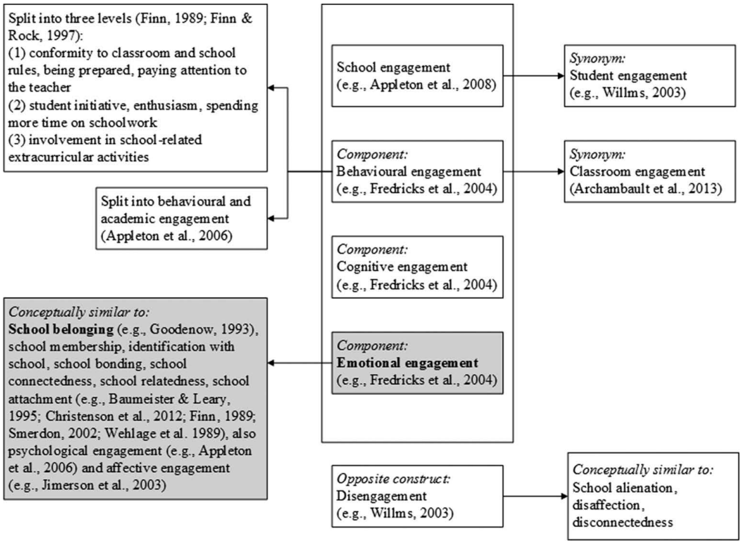
“In addition to the three types of engagement used by Fredricks et al. (2004), other scholars have also studied disengagement, mainly to characterise students who ‘do not feel they belong at school and have withdrawn from school activities in a significant way’ (Willms 2003, 8).”
BackgroundInfluentialBorenstein, M., Hedges, L. V., Higgins, J. P. T., & Rothstein, H. R. (2021) · doi:10.1002/9781119558378 · Cited by 9,799
(2000) · Cited by 9,198
Maslow, A. (1962) · D Van Nostrand eBooks · doi:10.1037/10793-000 · Cited by 7,192
Handbook of educational psychology
(1997) · Choice Reviews Online · doi:10.5860/choice.34-3084 · Cited by 4,825
(2007) · Wiley eBooks · doi:10.1002/9780470147658 · Cited by 3,845
Skinner, E. A., & Belmont, M. J. (1993) · Journal of Educational Psychology · doi:10.1037/0022-0663.85.4.571 · Cited by 3,428 · cited 1×
“The ‘reverse’ direction of effects, for example, academic achievement predicting school belonging, or reciprocal effects (e.g. Skinner and Belmont 1993), are rarely considered (Juvonen 2006).”
BackgroundHamre, B. K., & Pianta, R. C. (2001) · Child Development · doi:10.1111/1467-8624.00301 · Cited by 3,307 · cited 2×
“For socioeconomic background (SES), no significant between-group differences were found, although stronger associations were expected among low SES students (Hamre and Pianta 2001; Roorda et al. 2011).”
BackgroundHandbook of Research on Student Engagement
(2012) · doi:10.1007/978-1-4614-2018-7 · Cited by 3,050 · cited 7×
“School engagement is a multidimensional construct (Appleton, Christenson, and Furlong 2008; Christenson, Reschly, and Wylie 2012; Finn RESEARCH PAPERS IN EDUCATION 645 and Zimmer 2012; Skinner, Kindermann, and Furrer 2009; Wang, Willett, and Eccles 2011), that can be defined as the quality of a…”
BackgroundMethodInfluentialProtecting Adolescents From Harm: Findings From the National Longitudinal Study on Adolescent Health
Resnick, M. D. (1997) · JAMA · doi:10.1001/jama.1997.03550100049038 · Cited by 2,846
Motivation and Education: The Self-Determination Perspective
Deci, E. L., Vallerand, R. J., Pelletier, L. G., & Ryan, R. M. (1991) · Educational Psychologist · doi:10.1080/00461520.1991.9653137 · Cited by 2,731
Finn, J. D. (1989) · Review of Educational Research · doi:10.2307/1170412 · Cited by 2,702 · cited 3×
“It can be split into three levels of observable engagement (Finn 1989; Finn and Rock 1997).”
BackgroundMethodEccles, J. S., Midgley, C., Wigfield, A., Buchanan, C. M., Reuman, D., Flanagan, C., & Mac Iver, D. (1993) · American Psychologist · doi:10.1037/0003-066x.48.2.90 · Cited by 2,616
Niemiec, C. P., & Ryan, R. M. (2009) · Theory and Research in Education · doi:10.1177/1477878509104318 · Cited by 2,542
Students' Need for Belonging in the School Community
Osterman, K. F. (2000) · Review of Educational Research · doi:10.3102/00346543070003323 · Cited by 2,498
Handbook of Motivation at School
(2009) · Routledge eBooks · doi:10.4324/9780203879498 · Cited by 2,449
Roorda, D. L., Koomen, H. M. Y., Spilt, J. L., & Oort, F. J. (2011) · Review of Educational Research · doi:10.3102/0034654311421793 · Cited by 2,370 · cited 7×
“For socioeconomic background (SES), no significant between-group differences were found, although stronger associations were expected among low SES students (Hamre and Pianta 2001; Roorda et al. 2011).”
BackgroundMethodInfluentialEngagement and disaffection in the classroom: Part of a larger motivational dynamic?
Skinner, E., Furrer, C., Marchand, G., & Kindermann, T. (2008) · Journal of Educational Psychology · doi:10.1037/a0012840 · Cited by 2,037 · cited 1×
“For example, Skinner and Belmont (1993; see also Skinner, Wellborn, & Connell, 1990; Skinner et al., 2009; Skinner, Marchand, Furrer, & Kindermann, 2008) considered students’ behavioural engagement in terms of students’ effort, attention, and persistence during the initiation and execution of…”
BackgroundGoodenow, C. (1993) · Psychology in the Schools · doi:10.1002/1520-6807(199301)30:1<79::aid-pits2310300113>3.0.co;2-x · Cited by 2,008
Student engagement with school: Critical conceptual and methodological issues of the construct
Appleton, J. J., Christenson, S. L., & Furlong, M. J. (2008) · Psychology in the Schools · doi:10.1002/pits.20303 · Cited by 1,956 · cited 2×
“School engagement is a multidimensional construct (Appleton, Christenson, and Furlong 2008; Christenson, Reschly, and Wylie 2012; Finn RESEARCH PAPERS IN EDUCATION 645 and Zimmer 2012; Skinner, Kindermann, and Furrer 2009; Wang, Willett, and Eccles 2011), that can be defined as the quality of a…”
BackgroundMeasuring cognitive and psychological engagement: Validation of the Student Engagement Instrument
Appleton, J. J., Christenson, S. L., Kim, D., & Reschly, A. L. (2006) · Journal of School Psychology · doi:10.1016/j.jsp.2006.04.002 · Cited by 1,858 · cited 9×
“Appleton et al. 2006; Fredricks et al., 2004). Fredricks et al. (2004) further stress that engagement can vary in intensity and duration; it can be short term and situation specific or long term and stable.”
BackgroundMethodInfluentialDevelopment of Achievement Motivation
Wigfield, A., Eccles, J. S., Schiefele, U., Roeser, R. W., & Davis‐Kean, P. (2007) · Handbook of Child Psychology · doi:10.1002/9780470147658.chpsy0315 · Cited by 1,735
What Schools Need to Know About Fostering School Belonging: a Meta-analysis
Allen, K., Kern, M. L., Vella-Brodrick, D., Hattie, J., & Waters, L. (2018) · Educational Psychology Review · doi:10.1007/s10648-016-9389-8 · Cited by 1,637 · cited 9×
“Anderman 2003; Ma 2003; Niemiec and Ryan 2009; Pittman, Richmond, and Richmond 2007; Zimmer-Gembeck et al. 2006) but negatively related to school dropout (e.g. Hascher and Hagenauer 2010; Ream and Rumberger 2008). The meta-analysis presented here gives estimates of the strength of the suggested relationships between s…”
BackgroundMethodInfluentialAgency as a fourth aspect of students’ engagement during learning activities
Reeve, J., & Tseng, C.-M. (2011) · Contemporary Educational Psychology · doi:10.1016/j.cedpsych.2011.05.002 · Cited by 1,618
Skinner, E. A., Kindermann, T. A., & Furrer, C. J. (2009) · Educational and Psychological Measurement · doi:10.1177/0013164408323233 · Cited by 1,587 · cited 5×
“Skinner et al. (2009) explain that the quality of students’ participation includes engaged behaviour Figure 1.”
BackgroundInfluentialAcademic success among students at risk for school failure
Finn, J. D., & Rock, D. A. (1997) · Journal of Applied Psychology · doi:10.1037/0021-9010.82.2.221 · Cited by 1,397 · cited 2×
“In addition to the three types of engagement used by Fredricks et al. (2004), other scholars have also studied disengagement, mainly to characterise students who ‘do not feel they belong at school and have withdrawn from school activities in a significant way’ (Willms 2003, 8).”
BackgroundGoodenow, C., & Grady, K. E. (1993) · The Journal of Experimental Education · doi:10.1080/00220973.1993.9943831 · Cited by 1,357 · cited 1×
“Belonging is defined as ‘an individual’s sense of being accepted, valued, included, and encouraged by others’ (Baumeister and Leary 1995), strongly in line with the definition provided by Goodenow (1993; see also Goodenow and Grady, 1993), presented in the introduction.”
Wang, M.-T., & Holcombe, R. (2010) · American Educational Research Journal · doi:10.3102/0002831209361209 · Cited by 1,166
Student Engagement: What Is It? Why Does It Matter?
Finn, J. D., & Zimmer, K. S. (2012) · Handbook of Research on Student Engagement · doi:10.1007/978-1-4614-2018-7_5 · Cited by 1,139 · cited 1×
“The often referred to review study of Fredricks et al. (2004) distinguishes three domains, namely between behavioural, emotional, and cognitive engagement (see also Finn and Zimmer 2012; Furlong et al. 2003; Lawson and Lawson 2013; Wang, Willett, and Eccles 2011).”
BackgroundMeasuring Student Relationships to School: Attachment, Bonding, Connectedness, and Engagement
Libbey, H. P. (2004) · Journal of School Health · doi:10.1111/j.1746-1561.2004.tb08284.x · Cited by 1,029
Motivation and Education: The Self-Determination Perspective
Deci, E. L., Vallerand, R. J., Pelletier, L. G., et al. (1991) · Educational Psychologist · doi:10.1207/s15326985ep2603&4_6 · Cited by 952
Skinner, E. A., Wellborn, J. G., & Connell, J. P. (1990) · Journal of Educational Psychology · doi:10.1037/0022-0663.82.1.22 · Cited by 891
Protecting Adolescents From Harm
Hojat, M. (1998) · JAMA · doi:10.1001/jama.279.5.353 · Cited by 839
Toward an Understanding of Definitions and Measures of School Engagement and Related Terms
Jimerson, S. R., Campos, E., & Greif, J. L. (2003) · The California School Psychologist · doi:10.1007/bf03340893 · Cited by 811 · cited 1×
“Appleton et al. (2006) use the label ‘psychological engagement’ for this component, while Jimerson, Campos, and Greif (2003) utilise the label ‘affective engagement’.”
MethodSchool Burnout Inventory (SBI): Reliability and Validity
Salmela-Aro, K., Kiuru, N., Leskinen, E., & Nurmi, J.-E. (2009) · European Journal of Psychological Assessment · doi:10.1027/1015-5759.25.1.48 · Cited by 807 · cited 1×
“Salmela-Aro et al. (2009) use the term school burnout when they refer to feelings of disengagement, although their definition refers to a broader set of feelings such as exhaustion because of school demands, cynical and detached attitude towards one’s school, and feelings of inadequacy as a student…”
BackgroundBlanshard, B., & The Hegeler Institute (1968) · Monist · doi:10.5840/monist196852112 · Cited by 775
Wang, M.-T., & Fredricks, J. A. (2014) · Child Development · doi:10.1111/cdev.12138 · Cited by 753
Dropping Out of High School: The Role of School Organization and Structure
Lee, V. E., & Burkam, D. T. (2003) · American Educational Research Journal · doi:10.3102/00028312040002353 · Cited by 738
Walker, C. O., Greene, B. A., & Mansell, R. A. (2006) · Learning and Individual Differences · doi:10.1016/j.lindif.2005.06.004 · Cited by 737 · cited 1×
“Cognitive engagement incorporates ‘thoughtfulness and willingness to exert the effort necessary to comprehend complex ideas and master difficult skills’ (60; see also Greene and Miller 1996; Walker, Greene, and Mansell 2006).”
BackgroundLi, Y., & Lerner, R. M. (2011) · Developmental Psychology · doi:10.1037/a0021307 · Cited by 733
Shochet, I. M., Dadds, M. R., Ham, D., & Montague, R. (2006) · Journal of Clinical Child & Adolescent Psychology · doi:10.1207/s15374424jccp3502_1 · Cited by 721 · cited 2×
“…that school bonding (e.g. Maddox and Prinz 2003), school relatedness (e.g. Deci and Ryan 2000) and school connectedness (e.g. Resnick et al. 1997; Shochet et al. 2006; see also Lohmeier and Lee 2011) are negatively associated with unfavourable characteristics such as anxiety, low self-esteem,…”
BackgroundBattistich, V., Solomon, D., Watson, M., & Schaps, E. (1997) · Educational Psychologist · doi:10.1207/s15326985ep3203_1 · Cited by 694 · cited 4×
“This hypothesis states that human beings ‘have a pervasive drive to form and maintain at least a minimum quantity of lasting, positive, and significant interpersonal relationships’ (Baumeister and Leary 1995, 497). Belonging is defined as ‘an individual’s sense of being accepted, valued, included, and encouraged by ot…”
BackgroundMethodInfluentialNew Conceptual Frameworks for Student Engagement Research, Policy, and Practice
Lawson, M. A., & Lawson, H. A. (2013) · Review of Educational Research · doi:10.3102/0034654313480891 · Cited by 681 · cited 2×
“The often referred to review study of Fredricks et al. (2004) distinguishes three domains, namely between behavioural, emotional, and cognitive engagement (see also Finn and Zimmer 2012; Furlong et al. 2003; Lawson and Lawson 2013; Wang, Willett, and Eccles 2011).”
BackgroundReducing the Risk: Schools as Communities of Support
(1989) · NASSP Bulletin · doi:10.1177/019263658907351311 · Cited by 677
McInerney, D. M., & Etten, S. V. (2018) · Medical Entomology and Zoology · Cited by 667
Wang, M., & Eccles, J. S. (2012) · Journal of Research on Adolescence · doi:10.1111/j.1532-7795.2011.00753.x · Cited by 667
Korpershoek, H., Harms, T., de Boer, H., van Kuijk, M., & Doolaard, S. (2016) · Review of Educational Research · doi:10.3102/0034654315626799 · Cited by 633
Self-citationStudents' Attachment and Academic Engagement: The Role of Race and Ethnicity
Johnson, M. K., Crosnoe, R., & Elder, G. H. (2001) · Sociology of Education · doi:10.2307/2673138 · Cited by 627
Roorda, D. L., Jak, S., Zee, M., Oort, F. J., & Koomen, H. M. Y. (2017) · School Psychology Review · doi:10.17105/spr-2017-0035.v46-3 · Cited by 612 · cited 2×
“(2011), the mediating effect of school engagement on the relationship between teacher– student relations and achievement was studied by (Roorda et al. 2017).”
BackgroundMotivation Interventions in Education: A Meta-Analytic Review
Lazowski, R. A., & Hulleman, C. S. (2016) · Review of Educational Research · doi:10.3102/0034654315617832 · Cited by 607 · cited 1×
“School engagement (and the narrower construct of school belonging) is a potentially malleable target for intervention (Lazowski and Hulleman 2016; see also Christenson et al. 2001; Lawson and Lawson 2013; Maddox and Prinz 2003).”
BackgroundDoes Parental Involvement Matter for Student Achievement and Mental Health in High School?
Wang, M.-T., & Sheikh-Khalil, S. (2014) · Child Development · doi:10.1111/cdev.12153 · Cited by 587
Influences on Achievement: Goals, Perceived Ability, and Cognitive Engagement
Greene, B. A., & Miller, R. B. (1996) · Contemporary Educational Psychology · doi:10.1006/ceps.1996.0015 · Cited by 578 · cited 1×
“Cognitive engagement incorporates ‘thoughtfulness and willingness to exert the effort necessary to comprehend complex ideas and master difficult skills’ (60; see also Greene and Miller 1996; Walker, Greene, and Mansell 2006).”
BackgroundSchool burnout and engagement in the context of demands-resources model.
Salmela‐Aro, K., & Upadyaya, K. (2014) · British Journal of Educational Psychology · doi:10.1111/bjep.12018 · Cited by 562
Voelkl, K. E. (1997) · American Journal of Education · doi:10.1086/444158 · Cited by 523 · cited 1×
“As stated previously, the social context determines whether students identify with the school, since teacher–student relations and support from teachers and peers are the basis of students’ perception of school belonging (see also Allen et al. 2018; Roorda et al. 2011; Voelkl 1996, 1997, 2012).”
BackgroundDevelopmental Assets: Measurement and Prediction of Risk Behaviors Among Adolescents
Leffert, N., Benson, P. L., Scales, P. C., Sharma, A. R., Drake, D. R., & Blyth, D. A. (1998) · Applied Developmental Science · doi:10.1207/s1532480xads0204_4 · Cited by 521
Anderman, L. H. (2003) · The Journal of Experimental Education · doi:10.1080/00220970309600877 · Cited by 503 · cited 1×
“…(e.g. Dotterer and Wehrspann 2016), their classroom behaviour (e.g. Kiefer, Alley, and Ellerbrock 2015), and their academic achievement (e.g. Anderman 2003; Ma 2003; Niemiec and Ryan 2009; Pittman, Richmond, and Richmond 2007; Zimmer-Gembeck et al. 2006) but negatively related to school…”
BackgroundAcademic and Psychological Functioning in Late Adolescence: The Importance of School Belonging
Pittman, L. D., & Richmond, A. (2007) · The Journal of Experimental Education · doi:10.3200/jexe.75.4.270-292 · Cited by 493
Tyler, T. R., & Degoey, P. (1995) · Journal of Personality and Social Psychology · doi:10.1037/0022-3514.69.3.482 · Cited by 456
Wang, M.-T., Willett, J. B., & Eccles, J. S. (2011) · Journal of School Psychology · doi:10.1016/j.jsp.2011.04.001 · Cited by 431 · cited 2×
“The often referred to review study of Fredricks et al. (2004) distinguishes three domains, namely between behavioural, emotional, and cognitive engagement (see also Finn and Zimmer 2012; Furlong et al. 2003; Lawson and Lawson 2013; Wang, Willett, and Eccles 2011).”
Background(2003) · Medical Entomology and Zoology · Cited by 420
The Relationship Between Student Engagement and Academic Performance: Is It a Myth or Reality?
Lee, J.-S. (2014) · The Journal of Educational Research · doi:10.1080/00220671.2013.807491 · Cited by 406
The role of sense of school belonging and gender in the academic adjustment of latino adolescents
Sánchez, B., Colón, Y., & Esparza, P. (2005) · Journal of Youth and Adolescence · doi:10.1007/s10964-005-8950-4 · Cited by 376
Sense of Belonging to School: Can Schools Make a Difference?
Ma, X. (2003) · The Journal of Educational Research · doi:10.1080/00220670309596617 · Cited by 375 · cited 1×
“…and Wehrspann 2016), their classroom behaviour (e.g. Kiefer, Alley, and Ellerbrock 2015), and their academic achievement (e.g. Anderman 2003; Ma 2003; Niemiec and Ryan 2009; Pittman, Richmond, and Richmond 2007; Zimmer-Gembeck et al. 2006) but negatively related to school dropout (e.g.…”
BackgroundA Longitudinal Study of School Belonging and Academic Motivation Across High School
Neel, C. G.-O., & Fuligni, A. (2013) · Child Development · doi:10.1111/j.1467-8624.2012.01862.x · Cited by 366
School Bonding in Children and Adolescents: Conceptualization, Assessment, and Associated Variables
Maddox, S. J., & Prinz, R. J. (2003) · Clinical Child and Family Psychology Review · doi:10.1023/a:1022214022478 · Cited by 364 · cited 2×
“Several studies have indicated that school bonding (e.g. Maddox and Prinz 2003), school relatedness (e.g. Deci and Ryan 2000) and school connectedness (e.g. Resnick et al. 1997; Shochet et al. 2006; see also Lohmeier and Lee 2011) are negatively associated with unfavourable characteristics such as…”
BackgroundFall, A., & Roberts, G. (2012) · Journal of Adolescence · doi:10.1016/j.adolescence.2011.11.004 · Cited by 364
Ream, R. K., & Rumberger, R. W. (2008) · Sociology of Education · doi:10.1177/003804070808100201 · Cited by 329 · cited 3×
“…few review studies have incorporated unfavourable student outcomes in their search terms, such as early school dropout, despite the fact that several studies emphasise the importance of engagement to prevent students from dropping out of school (Hascher and Hagenauer 2010; Ream and Rumberger 2008).”
BackgroundInterrelations of Behavioral, Emotional, and Cognitive School Engagement in High School Students
Li, Y., & Lerner, R. M. (2013) · Journal of Youth and Adolescence · doi:10.1007/s10964-012-9857-5 · Cited by 316
Blatchford, P., Bassett, P., & Brown, P. (2011) · Learning and Instruction · doi:10.1016/j.learninstruc.2011.04.001 · Cited by 315
Adolescent educational success and mental health vary across school engagement profiles.
Wang, M.-T., & Peck, S. C. (2013) · Developmental Psychology · doi:10.1037/a0030028 · Cited by 310
Self-Perception Profile for Adolescents
Harter, S. (2017) · PsycTESTS Dataset · doi:10.1037/t05703-000 · Cited by 308
Lam, S.-F., Jimerson, S., Wong, B. P. H., Kikas, E., Shin, H., Veiga, F. H., Hatzichristou, C., Polychroni, F., Cefai, C., Negovan, V., et al. (2014) · School Psychology Quarterly · doi:10.1037/spq0000057 · Cited by 306
In the Context of Risk: Supportive Adults and the School Engagement of Middle School Students*
Woolley, M. E., & Bowen, G. L. (2007) · Family Relations · doi:10.1111/j.1741-3729.2007.00442.x · Cited by 277 · cited 1×
“Woolley and Bowen (2007) stress the importance of significant others (parents, people from school) to stimulate feelings of school belonging among adolescents.”
BackgroundZimmer‐Gembeck, M. J., Chipuer, H. M., Hanisch, M., Creed, P. A., & McGregor, L. (2006) · Journal of Adolescence · doi:10.1016/j.adolescence.2006.04.008 · Cited by 266 · cited 2×
“…(e.g. Kiefer, Alley, and Ellerbrock 2015), and their academic achievement (e.g. Anderman 2003; Ma 2003; Niemiec and Ryan 2009; Pittman, Richmond, and Richmond 2007; Zimmer-Gembeck et al. 2006) but negatively related to school dropout (e.g. Hascher and Hagenauer 2010; Ream and Rumberger 2008).”
BackgroundFurlong, M. J., Whipple, A. D., St. Jean, G., Simental, J., Soliz, A., & Punthuna, S. (2003) · The California School Psychologist · doi:10.1007/bf03340899 · Cited by 262 · cited 2×
“The often referred to review study of Fredricks et al. (2004) distinguishes three domains, namely between behavioural, emotional, and cognitive engagement (see also Finn and Zimmer 2012; Furlong et al. 2003; Lawson and Lawson 2013; Wang, Willett, and Eccles 2011).”
BackgroundTeacher and Peer Support for Young Adolescents’ Motivation, Engagement, and School Belonging
Kiefer, S. M., Alley, K. M., & Ellerbrock, C. R. (2015) · RMLE Online · doi:10.1080/19404476.2015.11641184 · Cited by 256 · cited 1×
“…and Greene 2009), their socialemotional functioning such as their self-esteem (e.g. Dotterer and Wehrspann 2016), their classroom behaviour (e.g. Kiefer, Alley, and Ellerbrock 2015), and their academic achievement (e.g. Anderman 2003; Ma 2003; Niemiec and Ryan 2009; Pittman, Richmond, and…”
BackgroundUnderstanding Student Engagement with a Contextual Model
Lam, S.-F., Wong, B. P. H., Yang, H., & Liu, Y. (2012) · Handbook of Research on Student Engagement · doi:10.1007/978-1-4614-2018-7_19 · Cited by 250 · cited 1×
“A positive relation with teachers and peers is vital for students’ engagement and achievement in school (Lam et al. 2012; Roorda et al. 2011) and students are less likely to drop out of high schools where these relationships are positive (Lee and Burkam 2003).”
BackgroundKnifsend, C. A., & Graham, S. (2011) · Journal of Youth and Adolescence · doi:10.1007/s10964-011-9737-4 · Cited by 241 · cited 2×
“Citation for published version (APA): Korpershoek, H., Canrinus, E. T., Fokkens-Bruinsma, M., & de Boer, H. (2020). The relationships between school belonging and students' motivational, social-emotional, behavioural, and academic outcomes in secondary education: a meta-analytic review.”
BackgroundMeasuring Students' Identification with School
Voelkl, K. E. (1996) · Educational and Psychological Measurement · doi:10.1177/0013164496056005003 · Cited by 225 · cited 2×
“As stated previously, the social context determines whether students identify with the school, since teacher–student relations and support from teachers and peers are the basis of students’ perception of school belonging (see also Allen et al. 2018; Roorda et al. 2011; Voelkl 1996, 1997, 2012).”
BackgroundMethodMotivation and Self-Regulated Learning Influences on Middle School Mathematics Achievement
Cleary, T. J., & Kitsantas, A. (2017) · School Psychology Review · doi:10.1080/02796015.2017.12087607 · Cited by 222
School Delinquency and School Commitment
Jenkins, P. H. (1995) · Sociology of Education · doi:10.2307/2112686 · Cited by 213
Uwah, C., McMahon, H., & Furlow, C. F. (2008) · Professional School Counseling · doi:10.5330/psc.n.2010-11.296 · Cited by 212
Relationship of School Context to Rural Youth’s Educational Achievement and Aspirations
Irvin, M. J., Meece, J. L., Byun, S., Farmer, T. W., & Hutchins, B. C. (2011) · Journal of Youth and Adolescence · doi:10.1007/s10964-011-9628-8 · Cited by 212
Sense of Belonging, Social Bonds, and School Functioning
Juvonen, J. (2015) · Handbook of Educational Psychology · doi:10.4324/9780203874790.ch28 · Cited by 205
Gonida, E. N., Voulala, K., & Kiosseoglou, G. (2009) · Learning and Individual Differences · doi:10.1016/j.lindif.2008.04.002 · Cited by 194 · cited 1×
“…last decade have shown that having a sense of school belonging is positively related to student functioning such as students’ school motivation (e.g. Gonida, Voulala, and Kiosseoglou 2009; Walker and Greene 2009), their socialemotional functioning such as their self-esteem (e.g. Dotterer and…”
BackgroundPerry, J. C., Liu, X., & Pabian, Y. (2010) · The Counseling Psychologist · doi:10.1177/0011000009349272 · Cited by 191
Kuperminc, G. P., Darnell, A. J., & Alvarez‐Jimenez, A. (2008) · Journal of Adolescence · doi:10.1016/j.adolescence.2007.09.003 · Cited by 191
Galliher, R. V., Rostosky, S. S., & Hughes, H. K. (2004) · Journal of Youth and Adolescence · doi:10.1023/b:joyo.0000025322.11510.9d · Cited by 186
Identity formation in educational settings: A contextualized view of theory and research in practice
Flum, H., & Kaplan, A. (2012) · Contemporary Educational Psychology · doi:10.1016/j.cedpsych.2012.01.003 · Cited by 180 · cited 2×
“Students in the lower grades may not (yet) have developed a strong connection to their new school, still being in the early phase of their identity formation process (Flum and Kaplan 2012).”
BackgroundPromoting successful school completion: Critical conceptual and methodological guidelines.
Christenson, S. L., Sinclair, M. F., Lehr, C. A., & Godber, Y. (2001) · School Psychology Quarterly · doi:10.1521/scpq.16.4.468.19898 · Cited by 179 · cited 1×
“School engagement (and the narrower construct of school belonging) is a potentially malleable target for intervention (Lazowski and Hulleman 2016; see also Christenson et al. 2001; Lawson and Lawson 2013; Maddox and Prinz 2003).”
BackgroundThe Relations Between Student Motivational Beliefs and Cognitive Engagement in High School
Walker, C. O., & Greene, B. A. (2009) · The Journal of Educational Research · doi:10.3200/joer.102.6.463-472 · Cited by 175 · cited 2×
“Particularly the PSSM questionnaire (Goodenow 1993) yields promising results across all student characteristics (e.g. Van Houtte and Van Maele 2012; Walker and Greene 2009).”
BackgroundAn investigation of a brief measure of school membership.
Hagborg, W. J. (1998) · PubMed · Cited by 175
Parents’ Relationships and Involvement: Effects on Students’ School Engagement and Performance
Mo, Y., & Singh, K. (2008) · RMLE Online · doi:10.1080/19404476.2008.11462053 · Cited by 172
Hill, N. E., & Wang, M.-T. (2015) · Developmental Psychology · doi:10.1037/a0038367 · Cited by 167
How does school climate impact academic achievement? An examination of social identity processes
Reynolds, K. J., Lee, E., Turner, I., Bromhead, D., & Subasic, E. (2017) · School Psychology International · doi:10.1177/0143034316682295 · Cited by 165
Benner, A. D., Graham, S., & Mistry, R. S. (2008) · Developmental Psychology · doi:10.1037/0012-1649.44.3.840 · Cited by 161
Thompson, D. R., Iachan, R., Overpeck, M., Ross, J. G., & Gross, L. A. (2006) · Journal of School Health · doi:10.1111/j.1746-1561.2006.00129.x · Cited by 161
Kaminski, J. W., Puddy, R. W., Hall, D. M., Cashman, S. Y., Crosby, A. E., & Ortega, L. (2009) · Journal of Youth and Adolescence · doi:10.1007/s10964-009-9472-2 · Cited by 154
Cultural Attributes and Adaptations Linked to Achievement Motivation Among Latino Adolescents
Ibañez, G. E., Kuperminc, G., Jurkovic, G., & Perilla, J. (2004) · Journal of Youth and Adolescence · doi:10.1023/b:joyo.0000048069.22681.2c · Cited by 153
Roeser, R. W., Strobel, K. R., & Quihuis, G. (2002) · Anxiety, Stress & Coping · doi:10.1080/1061580021000056519 · Cited by 149 · cited 1×
“This includes emotions such as interest versus boredom, happiness versus sadness, anxiety, and anger (see also Roeser, Strobel, and Quihuis 2002).”
BackgroundLei, H., Cui, Y., & Chiu, M. M. (2016) · Frontiers in Psychology · doi:10.3389/fpsyg.2016.01311 · Cited by 146
An Exploration of School Membership among Middle- and High-School Students
Hagborg, W. J. (1994) · Journal of Psychoeducational Assessment · doi:10.1177/073428299401200401 · Cited by 144
Fong Lam, U., Chen, W.-W., Zhang, J., & Liang, T. (2015) · School Psychology International · doi:10.1177/0143034315589649 · Cited by 143
The Multidimensionality of School Engagement and Math Achievement Among Racial Groups
Sciarra, D. T., & Seirup, H. J. (2008) · Professional School Counseling · doi:10.5330/psc.n.2010-11.218 · Cited by 142 · cited 1×
“…students’ relationship with their teachers and peers (Appleton, Christenson, and Furlong 2008) and has to do with ‘students’ feelings about school and the degree to which they care about their school’ (Sciarra and Seirup 2008, 218), thus with students’ feelings of belongingness (Osterman 2000).”
BackgroundVoelkl, K. E. (2012) · Springer eBooks · doi:10.1007/978-1-4614-2018-7_9 · Cited by 141
Givens Rolland, R. (2012) · Review of Educational Research · doi:10.3102/0034654312464909 · Cited by 138 · cited 1×
“The importance of mastery goal oriented classrooms (instead of performance goal oriented classrooms) was also presented by Rolland (2012) in her meta-analysis on classroom goal structures (see also Fokkens-Bruinsma et al. 2018).”
BackgroundHascher, T., & Hagenauer, G. (2010) · International Journal of Educational Research · doi:10.1016/j.ijer.2011.03.002 · Cited by 136 · cited 3×
“…few review studies have incorporated unfavourable student outcomes in their search terms, such as early school dropout, despite the fact that several studies emphasise the importance of engagement to prevent students from dropping out of school (Hascher and Hagenauer 2010; Ream and Rumberger 2008).”
BackgroundAdolescent Behavior and Society: A Book of Readings
Phelan, G. K., & Muuss, R. E. (1973) · The Family Coordinator · doi:10.2307/582987 · Cited by 134
Datu, J. A. D., Yuen, M., & Chen, G. (2018) · School Psychology Quarterly · doi:10.1037/spq0000234 · Cited by 132
Wellborn, J. G. (1992) · Cited by 130
Are perceived school climate dimensions predictive of students’ engagement?
Fatou, N., & Kubiszewski, V. (2017) · Social Psychology of Education · doi:10.1007/s11218-017-9422-x · Cited by 130 · cited 3×
“Finn and Kasza (2009) define disengagement as ‘the failure to develop a sense of school membership, failure to participate actively in class and school activities or failure to become cognitively involved in learning’ (8). Other terms for this are school alienation, disaffection, and disconnectedness. Like the engagem…”
BackgroundFroiland, J. M., Davison, M. L., & Worrell, F. C. (2016) · Social Psychology of Education · doi:10.1007/s11218-016-9355-9 · Cited by 128
The Effects of School Bonding on High School Seniors’ Academic Achievement
Bryan, J., Moore‐Thomas, C., Gaenzle, S., Kim, J., Lin, C., & Na, G. (2012) · Journal of Counseling & Development · doi:10.1002/j.1556-6676.2012.00058.x · Cited by 123
Relations Among Personal Agency, Motivation, and School Adjustment in Early Adolescence.
Walls, T. A., & Little, T. D. (2005) · Journal of Educational Psychology · doi:10.1037/0022-0663.97.1.23 · Cited by 122
Motivation and Self-Regulated Learning Influences on Middle School Mathematics Achievement
Cleary, T. J., & Kitsantas, A. (2017) · School Psychology Review · doi:10.17105/spr46-1.88-107 · Cited by 121
Rostosky, S. S., Owens, G. P., Zimmerman, R. S., & Riggle, E. D. B. (2003) · Journal of Adolescence · doi:10.1016/j.adolescence.2003.09.002 · Cited by 120
Adelabu, D. H. (2007) · PubMed · Cited by 120
Studying for the sake of others: the role of social goals on academic engagement
King, R. B., McInerney, D. M., & Watkins, D. (2012) · Educational Psychology · doi:10.1080/01443410.2012.730479 · Cited by 120
Dotterer, A. M., & Wehrspann, E. (2016) · Educational Psychology · doi:10.1080/01443410.2015.1099617 · Cited by 113
Archambault, I., Pagani, L. S., & Fitzpatrick, C. (2012) · Learning and Instruction · doi:10.1016/j.learninstruc.2012.09.003 · Cited by 113 · cited 1×
“Behavioural engagement (or classroom engagement; Archambault, Pagani, and Fitzpatrick 2013; Blatchford, Bassett, and Brown 2011) represents students’ active involvement and participation in academic or extracurricular activities.”
BackgroundEthnicity, self-concept, and school belonging: effects on school engagement
Singh, K., Chang, M., & Dika, S. L. (2010) · Educational Research for Policy and Practice · doi:10.1007/s10671-010-9087-0 · Cited by 110
A Psychoecological Model of Academic Performance Among Hispanic Adolescents
Chun, H., & Dickson, G. L. (2011) · Journal of Youth and Adolescence · doi:10.1007/s10964-011-9640-z · Cited by 107 · cited 3×
“This meta-analysis focuses on studies published in English in peer-reviewed journals between January 2000(2) and December 2018. Online database searches included ERIC and PsycINFO, focusing on peer-reviewed journal articles. The following combination of terms was used: (school OR education) AND (engagement OR belongin…”
BackgroundMethodInfluentialStudents' Perceptions of Membership in Their High Schools
Smerdon, B. A. (2002) · Sociology of Education · doi:10.2307/3090280 · Cited by 105 · cited 1×
“For example, Wehlage et al. (1989) and Smerdon (2002) used a broader definition of school membership, including three interrelated dimensions, namely (a) students’ feeling of belonging (based on Baumeister and Leary 1995), (b) students’ 644 H. KORPERSHOEK ET AL. commitment to school (regarding the…”
MethodLewis, K. M., Sullivan, C. M., & Bybee, D. I. (2006) · Journal of Black Psychology · doi:10.1177/0095798405283229 · Cited by 104
Sense of belonging and transition to high schools in Peru
Cueto, S., Guerrero, G., Sugimaru, C., & Zevallos, Á. (2009) · International Journal of Educational Development · doi:10.1016/j.ijedudev.2009.02.002 · Cited by 103
Ahmavaara, A., & Houston, D. M. (2007) · British Journal of Educational Psychology · doi:10.1348/000709906x120132 · Cited by 100
Basic psychological needs and school engagement: a focus on justice and agency
Molinari, L., & Mameli, C. (2017) · Social Psychology of Education · doi:10.1007/s11218-017-9410-1 · Cited by 99
Predictors of Academic Achievement and School Attachment among Hispanic Adolescents
LeCroy, C. W., & Krysik, J. (2008) · Children & Schools · doi:10.1093/cs/30.4.197 · Cited by 99
Effect of school belonging trajectories in grades 6–8 on achievement: Gender and ethnic differences
Hughes, J. N., Im, M. H., & Allee, P. J. (2015) · Journal of School Psychology · doi:10.1016/j.jsp.2015.08.001 · Cited by 97 · cited 1×
“Using a longitudinal design, evaluating the effect of interventions aiming to enhance students’ sense of school belonging and overall school functioning would further increase our understanding of the variability and stability of students’ sense of school belonging (e.g. Hughes, Im, and Allee 2015).”
MethodComponents of School Engagement Among African American Adolescents
Sirin, S. R., & Rogers-Sirin, L. (2005) · Applied Developmental Science · doi:10.1207/s1532480xads0901_2 · Cited by 96
Facilitating Conditions for School Motivation: Construct Validity and Applicability
McInerney, D. M., Dowson, M. N., & Yeung, A. S. (2005) · Educational and Psychological Measurement · doi:10.1177/0013164405278561 · Cited by 94
Uwah, C. J., McMahon, H. G., & Furlow, C. F. (2008) · Professional School Counseling · doi:10.1177/2156759x0801100503 · Cited by 90
Tyler, K. M., & Boelter, C. M. (2008) · The Negro educational review · Cited by 89
Shochet, I. M., Smyth, T., & Homel, R. (2007) · Australian and New Zealand Journal of Family Therapy · doi:10.1375/anft.28.2.109 · Cited by 89
Predicting Educational and Vocational Attitudes Among Rural High School Students.
Wettersten, K. B., Guilmino, A., Herrick, C. G., Hunter, P. J., Kim, G., Jagow-France, D., Beecher, T., Faul, K., Baker, A., Rudolph, S. E., et al. (2005) · Journal of Counseling Psychology · doi:10.1037/0022-0167.52.4.658 · Cited by 83
Gendered Patterns in Adolescents' School Attachment
Johnson, M. K., Crosnoe, R. L., & Thaden, L. L. (2006) · Social Psychology Quarterly · doi:10.1177/019027250606900305 · Cited by 83
Motivation Gap and Achievement Gap Between Public and Private High Schools in the Philippines
Bernardo, A. B. I., Ganotice, F. A., & King, R. B. (2014) · The Asia-Pacific Education Researcher · doi:10.1007/s40299-014-0213-2 · Cited by 80
Social Bonds and the Role of School-Based Victimization
Popp, A. M., & Peguero, A. A. (2012) · Journal of Interpersonal Violence · doi:10.1177/0886260512445386 · Cited by 80
The relational health indices for youth: An examination of reliability and validity aspects
Liang, B., Tracy, A. J., Kenny, M. E., Brogan, D., & Gatha, R. (2010) · Measurement and Evaluation in Counseling and Development · doi:10.1177/0748175609354596 · Cited by 80
Ethnic pride, self-esteem, and school belonging: A reciprocal analysis over time.
Hernández, M. M., Robins, R. W., Widaman, K. F., & Conger, R. D. (2017) · Developmental Psychology · doi:10.1037/dev0000434 · Cited by 80
Academic adjustment across middle school: The role of public regard and parenting.
McGill, R. K., Hughes, D., Alicea, S., & Way, N. (2012) · Developmental Psychology · doi:10.1037/a0026006 · Cited by 79
Shochet, I. M., & Smith, C. L. (2014) · Psychology in the Schools · doi:10.1002/pits.21759 · Cited by 77
Griffin, C. B., Cooper, S. M., Metzger, I. W., Golden, A. R., & White, C. N. (2017) · Psychology in the Schools · doi:10.1002/pits.22026 · Cited by 76
Peer Victimization and Adolescent Adjustment: Does School Belonging Matter?
Wormington, S. V., Anderson, K. G., Schneider, A., Tomlinson, K. L., & Brown, S. A. (2016) · Journal of School Violence · doi:10.1080/15388220.2014.922472 · Cited by 76
Van Houtte, M., & Van Maele, D. (2012) · Teachers College Record: The Voice of Scholarship in Education · doi:10.1177/016146811211400706 · Cited by 75
Playing With Science: An Investigation of Young Children's Science Conceptions and Misconceptions
Smolleck, L. A. (2011) · Current Issues in Education · Cited by 74
Wellbeing and retention: A senior secondary student perspective
Gray, J., & Hackling, M. (2009) · The Australian Educational Researcher · doi:10.1007/bf03216902 · Cited by 70
Eccles, J. S., Midgley, C., Wigfield, A., Buchanan, C. M., Reuman, D. A., Flanagan, C. A., & Iver, D. M. (1997) · American Psychological Association eBooks · doi:10.1037/10254-034 · Cited by 69
Booth, M. Z., & Gerard, J. M. (2014) · Youth & Society · doi:10.1177/0044118x12451276 · Cited by 68
A school connectedness scale for use with adolescents
Lohmeier, J. H., & Lee, S. W. (2011) · Educational Research and Evaluation · doi:10.1080/13803611.2011.597108 · Cited by 62 · cited 1×
“…and Prinz 2003), school relatedness (e.g. Deci and Ryan 2000) and school connectedness (e.g. Resnick et al. 1997; Shochet et al. 2006; see also Lohmeier and Lee 2011) are negatively associated with unfavourable characteristics such as anxiety, low self-esteem, depression, substance use,…”
BackgroundFactors Associated with Absenteeism in High Schools
Demir, K., & Karabeyoğlu, Y. (2016) · Eurasian Journal of Educational Research · doi:10.14689/ejer.2016.62.4 · Cited by 61
Walker, C. O. (2011) · Social Psychology of Education · doi:10.1007/s11218-011-9165-z · Cited by 56
Liu, Y., & Lu, Z. (2011) · Learning and Individual Differences · doi:10.1016/j.lindif.2010.12.007 · Cited by 54 · cited 1×
“…2003), school relatedness (e.g. Deci and Ryan 2000) and school connectedness (e.g. Resnick et al. 1997; Shochet et al. 2006; see also Lohmeier and Lee 2011) are negatively associated with unfavourable characteristics such as anxiety, low self-esteem, depression, substance use, delinquency, and…”
BackgroundPrelow, H. M., Bowman, M. A., & Weaver, S. R. (2006) · Journal of Youth and Adolescence · doi:10.1007/s10964-006-9038-5 · Cited by 53
Stefánsson, K. K., Gestsdóttir, S., Geldhof, G. J., Skúlason, S., & Lerner, R. M. (2016) · International Journal of Behavioral Development · doi:10.1177/0165025415604056 · Cited by 52
Factors Predicting Turkish and Korean Students’ Science and Mathematics Achievement in TIMSS 2011
Topçu, M. S., Erbilgin, E., & Arıkan, S. (2016) · Eurasia Journal of Mathematics Science and Technology Education · doi:10.12973/eurasia.2016.1530a · Cited by 49
Sense of Belonging in Secondary Schools: A Survey of LGB and Heterosexual Students in Flanders
Aerts, S., Van Houtte, M., Dewaele, A., Cox, N., & Vincke, J. (2012) · Journal of Homosexuality · doi:10.1080/00918369.2012.638548 · Cited by 46
What Predicts Fear of School Violence among U.S. Adolescents?
Akiba, M. (2010) · Teachers College Record: The Voice of Scholarship in Education · doi:10.1177/016146811011200110 · Cited by 44
Hill, N. E., Liang, B., Price, M. A., Polk, W., Perella, J., & Savitz‐Romer, M. (2018) · Psychology in the Schools · doi:10.1002/pits.22146 · Cited by 44
Cavendish, W. M. (2013) · Social Psychology of Education · doi:10.1007/s11218-013-9212-z · Cited by 41 · cited 2×
“and Zimmer 2012; Skinner, Kindermann, and Furrer 2009; Wang, Willett, and Eccles 2011), that can be defined as the quality of a student’s connection or involvement with the endeavour of schooling and hence with the people, activities, goals, values, and place that compose it (Skinner, Kindermann, and Furrer 2009, 494)…”
A Brazilian Portuguese survey of school climate: Evidence of validity and reliability
Bear, G. G., Holst, B., Lisbôa, C. S. D. M., Chen, D., Yang, C., & Chen, F. (2015) · International Journal of School & Educational Psychology · doi:10.1080/21683603.2015.1094430 · Cited by 40
Hurd, N. M., Hussain, S. B., & Bradshaw, C. P. (2015) · Youth & Society · doi:10.1177/0044118x15598029 · Cited by 37
Korpershoek, H. (2016) · Frontline Learning Research · doi:10.14786/flr.v4i3.182 · Cited by 37 · cited 1×
“Within the school context, as explained in Korpershoek (2016), following both the belongingness hypothesis as well as SDT, students generally have a pervasive drive (or in SDT an innate need) to form and maintain significant interpersonal relationships (e.g. with their teachers and peers) and a…”
MethodSelf-citationHo, E. S. C. (2005) · Educational Research for Policy and Practice · doi:10.1007/s10671-005-1546-7 · Cited by 32
Boston, C. M., & Warren, S. R. (2017) · Journal of Urban Learning Teaching and Research · Cited by 29
Abubakar, A., van de Vijver, F. J. R., Alonso-Arbiol, I., Suryani, A. O., Pandia, W. S., Handani, P., Arasa, J., Mazrui, L., & Murugumi, M. (2016) · Journal of Psychoeducational Assessment · doi:10.1177/0734282915607161 · Cited by 28 · cited 1×
“A recent study of Abubakar et al. (2016) examined the validity of the frequently used PSSM (Goodenow 1993) instrument.”
MethodThe Impact of Middle School Connectedness on Future High School Outcomes in a Black American Sample
Tomek, S. E., Bolland, A. C., Hooper, L. M., Hitchcock, S. M., & Bolland, J. M. (2017) · Middle Grades Research Journal · doi:10.1108/mgrj-06-2017-0001 · Cited by 24
Student- and school-level belonging and commitment and student smoking, drinking and misbehaviour
Bonell, C. P., Shackleton, N., Fletcher, A., Jamal, F., Allen, E., Mathiot, A., Markham, W. A., Aveyard, P. N., & Viner, R. (2016) · Health Education Journal · doi:10.1177/0017896916657843 · Cited by 22
Okilwa, N. S. A. (2016) · The Journal of at-risk issues · Cited by 17
Liu, R. X. (2013) · Youth & Society · doi:10.1177/0044118x13496825 · Cited by 13 · cited 1×
“Therefore, we did not find support for the idea that the relationships between school belonging and the various student outcomes were systematically stronger in Western studies compared to studies conducted in, for example, Asian studies (see Liu 2016).”
ResultSchool Motivation in Secondary Schools: A Survey of LGB and Heterosexual Students in Flanders
Aerts, S., Houtte, M. V., Dewaele, A., Cox, N., & Vincke, J. (2012) · Youth & Society · doi:10.1177/0044118x12467657 · Cited by 11
Giano, Z. D., Tuttle, B. M., Merten, M. J., et al. (2018) · Hispanic Journal of Behavioral Sciences · doi:10.1177/0739986318770377 · Cited by 6
(2017) · University of Groningen research database (University of Groningen / Centre for Information Technology) · Cited by 5
Self-citationLee, G., & Kim, Y. A. (2016) · Journal of International Education Research (JIER) · doi:10.19030/jier.v12i4.9798 · Cited by 4
Houston, D. M. (2000) · Kent Academic Repository (University of Kent) · Cited by 2
Studying for the sake of others
龔仁崇 (2012) · 香港大學學位論文 · Cited by 1
Barbero (2014) · doi:10.1016/j · Cited by 1
Delaware School Climate Survey--Home
Bear, G. G., Yang, C., & Pasipanodya, E. (2015) · PsycTESTS Dataset · doi:10.1037/t40857-000
The Multidimensionality of School Engagement and Math Achievement among Racial Groups
Sciarra, D. T., & Seirup, H. J. (2008) · Professional School Counseling · doi:10.1177/2156759x0801100402
Research works printed but not linked: 9
- 28. Corno, L., and E. B. Mandinach. 2004. "What We Have Learned about Student Engagement in the past Twenty Years." In Big Theories Revisited, edited by D. M. McInerney and S. Van Etten, 299-328. Greenwich, CT: Information Age.
- 34. Deci, E. L., and R. M. Ryan, Eds. 2002. Handbook of Self-Determination Theory Research. Rochester, NY: University of Rochester Press.
- 41. Finn, J. D., and K. A. Kasza. 2009. "Disengagement from School" In Engaging Young People in Learning: Why Does It Matter and What Can We Do? edited by J. Morton, 4-35. Wellington, New Zealand: New Zealand Council for Educational Research.
- 45. Fokkens-Bruinsma, M., E. T. C. Canrinus, M. Ten Hove, and L. Rietveld. 2018. "The Relationship between Teacher's Work Motivation and Classroom Goal Orientation." Pedagogische Studiën 95: 86-100.
- 55. Gottfredson, G. 1984. Effective School Battery. Odessa, FL: Psychological Assessment Resources.
- 97. Li, Y. B., and R. M. Lerner. 2013. "Interrelations of Behavioral, Emotional, and Cognitive School Engagement in High School Students." Journal of Youth and Adolescence 42: 20-32. doi:10.1007/s10964-012-9857-5. · DOI · Paper page
- 10.1007/s10964-005-8950-4 · DOI · Paper page
- 148. Udry, J. R. 1998. The National Longitudinal Study of Adolescent Health (Add Health), Waves I & II, 1994-1996. Chapel Hill, NC: Carolina Population Center, University of North Carolina at Chapel Hill (Producer).Los Altos, CA: Sociometrics Corporation, American Family Data Archive (Producer & Distributor)
- 166. WestEd. 2008. California Healthy Kids Survey: California School District Secondary School Survey Results Fall 07/Spring 08. Los Alamitos, CA: Author.
Cited by
Allen, K.-A., Gray, D. L., Baumeister, R. F., & Leary, M. R. (2022) · Educational Psychology Review · doi:10.1007/s10648-021-09633-6 · Cited by 311
Cents-Boonstra, M., Lichtwarck-Aschoff, A., Denessen, E., Aelterman, N., & Haerens, L. (2021) · Research Papers in Education · doi:10.1080/02671522.2020.1767184 · Cited by 216
El Zaatari, W., & Maalouf, I. (2022) · Sage Open · doi:10.1177/21582440221134089 · Cited by 182
“Several studies consistently underline the key role that various school climate factors play in enhancing students’ sense of belonging (Bakır-Ayğar & Kaya, 2017; Günalan, 2018; Huang et al., 2013; Kalkan & Dağlı, 2021; Korpershoek et al., 2020).”
BackgroundInfluentialBang, H., Won, D., & Park, S. (2020) · Children and Youth Services Review · doi:10.1016/j.childyouth.2020.105012 · Cited by 189
Allen, K., Jamshidi, N., Berger, E., Reupert, A., Wurf, G., & May, F. (2021) · Educational Psychology Review · doi:10.1007/s10648-021-09621-w · Cited by 209
“As a result, it has been unclear as to what interventions are available to schools for increasing students’ sense of school belonging (Korpershoek et al., 2020).”
BackgroundInfluential
Metadata
- Authors
- Korpershoek, H., Canrinus, E. T., Fokkens-Bruinsma, M., & de Boer, H.
- Affiliations
- University of Groningen (NL)
- University of Agder (NO)
- GION Education/Research, University of Groningen, Groningen, the Netherlands
- Corresponding author
- Korpershoek, H.
- Venue
- Research Papers in Education
- Publisher
- Informa UK Limited
- Published
- 2019-05-27
- Volume
- 35
- Issue
- 6
- Pages
- 641-680
- ISSN
- 0267-1522 (ISSN-L)
- 1470-1146
- OpenAlex
- W2947655140
- Semantic Scholar
- 35ecbf9488c93b1b390c210affb07d3204d06aad
- Cited by
- 648
- References
- 182
- Citations by year
- 2026: 228 · 2025: 119 · 2024: 100 · 2023: 78 · 2022: 70 · 2021: 42 · 2020: 10 · 2019: 1
- FWCI
- 82.86
- Type
- journal article
- Language
- en
- Open access
- hybrid
- doi.org
- Licence
- Locations
- Research Papers in Education (publishedVersion, cc-by-nc-nd)
- University of Groningen research database (University of Groningen / Centre for Information Technology) (acceptedVersion, cc-by-nc-nd)
- NORA - Norwegian Open Research Archives (submittedVersion, cc-by-nc-nd)
- University of Groningen research database (University of Groningen / Centre for Information Technology) (submittedVersion, cc-by-nc-nd)
- Topics
- Social Sciences › Education › Early Childhood Education and Development
- Social Sciences › Psychology › Developmental and Educational Psychology › Education, Achievement, and Giftedness
- Social Sciences › Education › Educational Environments and Student Outcomes
- Keywords
- school belonging, secondary education, academic performance, student motivation, mastery orientation, self-concept, self-efficacy, student engagement, school absenteeism, school dropout, social-emotional outcomes, behavioural outcomes, socioeconomic status, grade level differences
About these checks
Registry, retraction, Cites and statistics results are computed, not judged, with one exception: a printed reference that no index lists is read once by a model before it counts as a citation error. Claims are extracted by a model and kept only when their quote appears verbatim in the text; each cited source is then checked, with a model’s help, for whether it says what the claim relies on. Those verdicts can be wrong — read the claim’s quote and the cited source before relying on one.
A language model drew the claims from the paper on 2026-09-28, under version 3 of the claim definition (model deepseek-v4.1-flash, prompt extract-v3).
A second model labelled each claim on 2026-09-28 (model jev-1.13-20260917, definition revision gold-guideline-v0.2).
Statistics and arithmetic are recomputed, not judged.
Confidence bands are shown only for fields calibrated on our annotated test set. None is calibrated yet, so no band is shown.
What counts as a claim ›How we measure confidence ›How we check this ›
Are you an author, or do you see a problem with this page? Request a review
Data sources
Bibliographic data: Semantic Scholar, OpenAlex, Crossref.
Contains information from the Semantic Scholar Academic Graph Datasets, made available under the ODC Attribution License (ODC-BY 1.0).
Semantic Scholar’s data is described in: Kinney, R., et al. (2023). The Semantic Scholar Open Data Platform. arXiv:2301.10140.
