

The DOI matches its Crossref record; 70 of the 70 references it cites were found in a registry or an index; 9 of the 45 sources its claims cite were checked for support.
Job demands–resources model in the context of recovery: Testing recovery experiences as mediators
Abstract
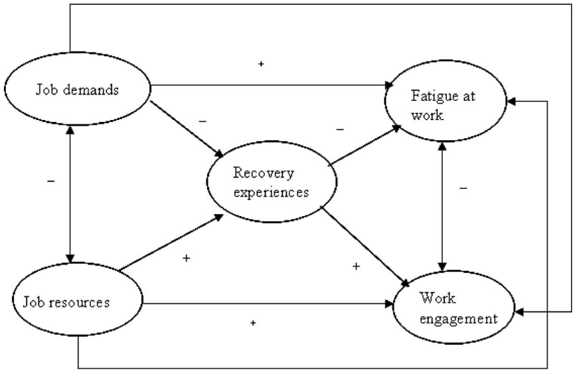
The aim of the present study was to extend the original Job Demands–Resources (JD-R) model by taking into account recovery as an important mediation mechanism between work characteristics and well-being/ill-health. Specifically, we examined whether recovery experiences—strategies promoting recovery—might have a mediating role in the JD-R model among 527 employees from a variety of different jobs. The results showed that psychological detachment fully mediated the effects of job demands on fatigue at work and mastery partially mediated the effects of job resources on work engagement. Altogether, the results suggest that recovery merits consideration as a mediating mechanism in the JD-R model.
Overview
AI snapshot
Written from the paper’s full text.
TL;DR
Kinnunen et al. (2011) extend the Job Demands–Resources model by testing recovery experiences as mediators between work characteristics and employee well-being/ill-health. In a cross-sectional sample of 527 Finnish employees, psychological detachment fully mediated the job demands–fatigue link, while mastery partially mediated the job resources–work engagement link.
Key findings
- The Finnish Recovery Experience Questionnaire supported a four-factor structure: psychological detachment, relaxation, mastery, and control (Hypothesis 1 supported).
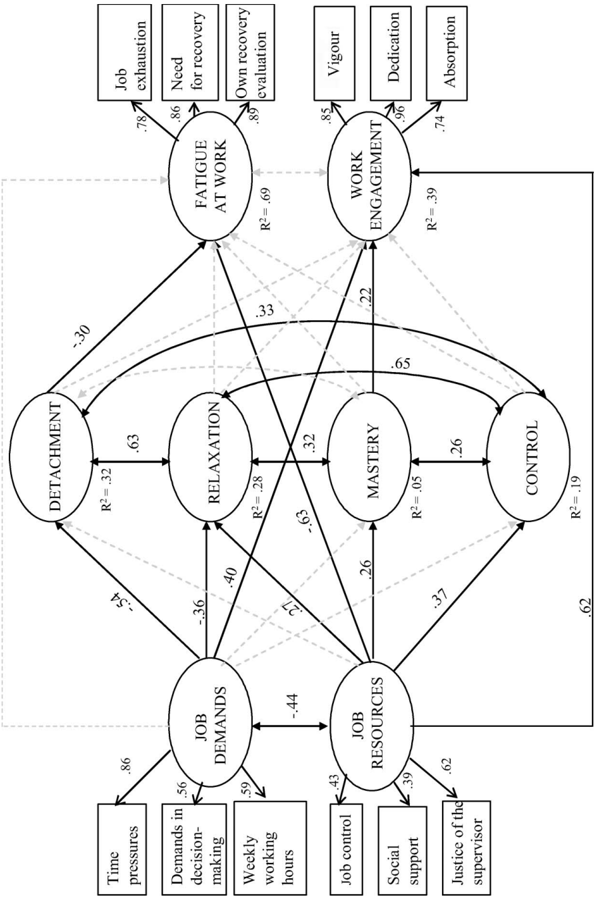
- Psychological detachment fully mediated the effect of job demands on fatigue at work (standardized indirect effect 0.16, 95% CI = .030 to .295); the direct job demands–fatigue path was nonsignificant.
- Mastery partially mediated the effect of job resources on work engagement (standardized indirect effect 0.16, 95% CI = .016 to .095), with job resources also directly associated with work engagement.
- The hypothesized partial mediation model explained 69% of the variance in fatigue at work and 39% of the variance in work engagement; contrary to Hypothesis 5, job demands had a positive direct link to work engagement.
Methods
- Cross-sectional questionnaire study conducted in spring 2007 among employees of five Finnish organizations from business, telecommunications/IT, hotel/catering, travel services, and education; 527 employees returned completed questionnaires (51% response rate from 1042 contacted).
- Measures included QPSNordic job demands and resources, the 16-item Recovery Experience Questionnaire, need for recovery, job exhaustion from the MBI-GS, and the 9-item Utrecht Work Engagement Scale.
- Analyses used confirmatory factor analysis for the Finnish REQ and structural equation modeling with latent factors; mediation significance was assessed with 1000 bootstrap samples.
Limitations
- The paper states all data were self-reports, risking common method variance; the cross-sectional design prevents causal conclusions; the response rate was relatively low at 51%; participants were nested within five organizations but multilevel analysis was not possible; and some measures had low reliability or were single-item.
- The paper also notes the sample was a convenience sample and should be replicated in other samples; the text makes evident that the mostly well-educated sample may limit generalizability, especially for the unexpected positive job demands–work engagement finding.
Model-written summary. Check it against the paper before relying on it.
Integrity signals
Registry
Cites
Statistics
Figures
Verification
Claims the paper makes
33 Own result · 20 Own method · 14 Own interpretation · 13 No full text of the sources · 10 Sources not found · 9 Not checked yet · 8 Supported · 6 No basis given · 1 Supported so far
Every source the paper cites for this claim was checked and supports it.
In the paper
“Sonnentag, Kuttler, and Fritz (2010) recently showed that psychological detachment was a partial mediator between job stressors and strain reactions among a sample of protestant pastors.”
What the sources say
- Supportedcites Sonnentag, Kuttler, and Fritz (2010) source
The Results (section 7; page not available) report partial mediation by psychological detachment between job stressors and emotional exhaustion or need for recovery. The paper identifies its study population as Protestant pastors. (LLM, conf=0.93)
plaindirect- Asserted: passes — The authors put it forward as true.
- Checkable: passes — It can be checked against evidence.
- Load-bearing: passes — The paper’s conclusions depend on it.
- Based: passes — The paper gives a reason why it holds.
- Supported
The sources with a verdict support this claim; the rest weren’t checked yet, have no full text we could read, or their verdicts aren’t rated yet.
In the paper
“Empirical evidence suggests that psychological detachment is helpful in recovering from job strain.”
What the sources say
- Supportedcites Sonnentag & Fritz, 2007 source
The Psychological Detachment section says empirical evidence links detachment to recovery from job stress and explains why detaching may allow recovery. The claim’s tentative wording is consistent with that account. (LLM, conf=0.91)
- Not checked yetcites Sonnentag & Bayer, 2005 source
Checked before — its earlier verdict is held back until a new check runs.
- Not matchedcites Sonnentag, Binnewies, & Mojza, 2008
Couldn’t be matched to a paper in Crossref, so it can’t be checked.
hedgeddirect- Asserted: passes — The authors put it forward as true.
- Checkable: passes — It can be checked against evidence.
- Load-bearing: passes — The paper’s conclusions depend on it.
- Based: passes — The paper gives a reason why it holds.
- Supported
A result the paper reports from its own data — it cites no other source for it, so there is none to check. The quote shows it is in the paper.
In the paper
“First, the mediation of psychological detachment was present in the relationship between job demands and fatigue at work (standardized estimate for specific indirect effect 0.16, 95% CI ¼ .030 to .295)”
plaindirect- Asserted: passes — The authors put it forward as true.
- Checkable: passes — It can be checked against evidence.
- Load-bearing: passes — The paper’s conclusions depend on it.
- Based: passes — The paper gives a reason why it holds.
- Rests on an assumption: The mediation model's causal ordering (job demands/resources -> recovery experiences -> occupational ill-health/well-being) is valid.
A result the paper reports from its own data — it cites no other source for it, so there is none to check. The quote shows it is in the paper.
In the paper
“The results showed that psychological detachment fully mediated the effects of job demands on fatigue at work and mastery partially mediated the effects of job resources on work engagement.”
plaindirect- Asserted: passes — The authors put it forward as true.
- Checkable: passes — It can be checked against evidence.
- Load-bearing: passes — The paper’s conclusions depend on it.
- Based: passes — The paper gives a reason why it holds.
A result the paper reports from its own data — it cites no other source for it, so there is none to check. The quote shows it is in the paper.
In the paper
“the standardized factor loadings were acceptably high in all four factors (ranging from .54 to .91).”
plain- Asserted: passes — The authors put it forward as true.
- Checkable: passes — It can be checked against evidence.
- Load-bearing: passes — The paper’s conclusions depend on it.
- Based: passes — The paper gives a reason why it holds.
- The authors state this as an assumption: Missing values in the CFA were missing at random.
A result the paper reports from its own data — it cites no other source for it, so there is none to check. The quote shows it is in the paper.
In the paper
“The link between job resources and fatigue at work was negative and in line with our Hypothesis 4.”
plaincorrelational- Asserted: passes — The authors put it forward as true.
- Checkable: passes — It can be checked against evidence.
- Load-bearing: passes — The paper’s conclusions depend on it.
- Based: passes — The paper gives a reason why it holds.
A result the paper reports from its own data — it cites no other source for it, so there is none to check. The quote shows it is in the paper.
In the paper
“The direct link from job demands to fatigue at work was nonsignificant.”
plain- Asserted: passes — The authors put it forward as true.
- Checkable: passes — It can be checked against evidence.
- Load-bearing: passes — The paper’s conclusions depend on it.
- Based: passes — The paper gives a reason why it holds.
A result the paper reports from its own data — it cites no other source for it, so there is none to check. The quote shows it is in the paper.
In the paper
“and, second, the partial mediation of mastery was present in the relationship between job resources and work engagement (standardized estimate 0.16, 95% CI ¼ .016 to .095).”
plaincorrelational- Asserted: passes — The authors put it forward as true.
- Checkable: passes — It can be checked against evidence.
- Load-bearing: passes — The paper’s conclusions depend on it.
- Based: passes — The paper gives a reason why it holds.
- Rests on an assumption: The mediation model's causal ordering (job demands/resources -> recovery experiences -> occupational ill-health/well-being) is valid.
A result the paper reports from its own data — it cites no other source for it, so there is none to check. The quote shows it is in the paper.
In the paper
“Thus, our hypothesized model was supported.”
plaindirect- Asserted: passes — The authors put it forward as true.
- Checkable: passes — It can be checked against evidence.
- Load-bearing: passes — The paper’s conclusions depend on it.
- Based: passes — The paper gives a reason why it holds.
A result the paper reports from its own data — it cites no other source for it, so there is none to check. The quote shows it is in the paper.
In the paper
“Relaxation and control did not have direct links to either fatigue or work engagement.”
plain- Asserted: passes — The authors put it forward as true.
- Checkable: passes — It can be checked against evidence.
- Load-bearing: passes — The paper’s conclusions depend on it.
- Based: passes — The paper gives a reason why it holds.
- Probably not a substantial claim. 46
- It may state two separate claims as one. 37
- The quote only partly states this claim. 1
Every source the paper cites for this claim was checked and supports it.
In the paper
“They have proposed four such mechanisms; psychological detachment from work, relaxation, mastery, and control during leisure time.”
What the sources say
- Supportedcites Sonnentag & Fritz, 2007 source
The Overall Discussion identifies four distinct recovery experiences: psychological detachment, relaxation, mastery, and control. The Recovery Experiences section also proposes control as an important recovery experience alongside the other three. The copy does not provide page numbers for these passages. (LLM, conf=0.94)
plain- Asserted: passes — The authors put it forward as true.
- Checkable: passes — It can be checked against evidence.
- Load-bearing: passes — The paper’s conclusions depend on it.
- Based: passes — The paper gives a reason why it holds.
Probably not a substantial claim.
- Supported
Every source the paper cites for this claim was checked and supports it.
In the paper
“First, Sonnentag and Fritz (2007) showed that psychological detachment was negatively related to health complaints, emotional exhaustion, depressive symptoms, need for recovery, and sleep problems.”
What the sources say
- Supportedcites Sonnentag and Fritz (2007) source
The Results section explicitly reports that psychological detachment showed negative relations with all five listed measures: health complaints, emotional exhaustion, depressive symptoms, need for recovery, and sleep problems. The claim describes associations, not causation, consistent with the paper's cross-sectional findings. (LLM, conf=0.95)
plaincorrelational- Asserted: passes — The authors put it forward as true.
- Checkable: passes — It can be checked against evidence.
- Load-bearing: passes — The paper’s conclusions depend on it.
- Based: passes — The paper gives a reason why it holds.
It may state two separate claims as one.
- Supported
Every source the paper cites for this claim was checked and supports it.
In the paper
“In the study by Sonnentag and Fritz (2007), relaxation was negatively related to health problems, emotional exhaustion, need for recovery, and sleep problems.”
What the sources say
- Supportedcites Sonnentag and Fritz (2007) source
The Results section states that relaxation showed negative relations with health problems, emotional exhaustion, need for recovery, and sleep problems. This directly matches the citing sentence. (LLM, conf=0.95)
plaincorrelational- Asserted: passes — The authors put it forward as true.
- Checkable: passes — It can be checked against evidence.
- Load-bearing: passes — The paper’s conclusions depend on it.
- Based: passes — The paper gives a reason why it holds.
Probably not a substantial claim. It may state two separate claims as one.
- Supported
Every source the paper cites for this claim was checked and supports it.
In the paper
“Altogether, our Hypothesis 1 expecting four dimensions received support.”
- Also stated in: § The construct validity of the Finnish REQ · p. 15 · plain
“the hypothesized four-factor model (Model 1) provided the best approximation with the given data compared with the other CFA models (Models 2-5).”
What the sources say
- Supportedcites Sonnentag & Fritz, 2007 source
The Results report that the REQ’s four-factor model fit better than alternative models, and the Overall Discussion names psychological detachment, relaxation, mastery, and control as the four distinct experiences. The printed citing sentence describes the citing authors’ own support for their hypothesis; it does not attribute their Finnish-sample result to this source. (LLM, conf=0.90)
plain- Asserted: passes — The authors put it forward as true.
- Checkable: passes — It can be checked against evidence.
- Load-bearing: passes — The paper’s conclusions depend on it.
- Based: passes — The paper gives a reason why it holds.
The quote only partly states this claim.
- The authors state this as an assumption: Missing values in the CFA were missing at random.
- Also stated in: § The construct validity of the Finnish REQ · p. 15 · plain
Every source the paper cites for this claim was checked and supports it.
In the paper
“Sonnentag and Fritz (2007) found that control was negatively related to health complaints, emotional exhaustion, depressive symptoms, need for recovery, and sleep problems, and positively related to life satisfaction.”
What the sources say
- Supportedcites Sonnentag and Fritz (2007) source
The Results section reports that control was negatively related to all five listed outcomes and that all recovery experience measures, including control, were positively related to life satisfaction. (LLM, conf=0.95)
plaincorrelational- Asserted: passes — The authors put it forward as true.
- Checkable: passes — It can be checked against evidence.
- Load-bearing: passes — The paper’s conclusions depend on it.
- Based: passes — The paper gives a reason why it holds.
Probably not a substantial claim. It may state two separate claims as one.
- Supported
Every source the paper cites for this claim was checked and supports it.
In the paper
“However, none of the job demands were significantly related to mastery experiences.”
What the sources say
- Supportedcites Sonnentag and Fritz (2007) source
The Overall Discussion states that job stressors were not related to mastery experiences. The Results and Table 5 likewise show no significant relationship between the measured job demands and mastery. (LLM, conf=0.94)
plain- Asserted: passes — The authors put it forward as true.
- Checkable: passes — It can be checked against evidence.
- Load-bearing: fails — The paper’s conclusions may not depend on it.
- Based: passes — The paper gives a reason why it holds.
Probably not a substantial claim. The paper’s conclusions may not depend on it.
- Supported
Every source the paper cites for this claim was checked and supports it.
In the paper
“According to Sonnentag and Fritz (2007), the experience of control during leisure time may increase self-efficacy and feelings of competence; therefore, it may be an external resource that promotes recovery from job strain and well-being.”
What the sources say
- Supportedcites Sonnentag and Fritz (2007) source
The “Control During Leisure Time” section says that leisure-time control may increase self-efficacy and feelings of competence, promoting well-being. It also describes control as an external resource that enhances recovery from work during off-job time. (LLM, conf=0.95)
hedgedconditional- Asserted: passes — The authors put it forward as true.
- Checkable: passes — It can be checked against evidence.
- Load-bearing: passes — The paper’s conclusions depend on it.
- Based: passes — The paper gives a reason why it holds.
Probably not a substantial claim. It may state two separate claims as one.
- Supported
A result the paper reports from its own data — it cites no other source for it, so there is none to check. The quote shows it is in the paper.
In the paper
“the null model was rejected in relation to the full mediation model which, in turn, was rejected in relation to the hypothesized partial mediation model.”
plain- Asserted: passes — The authors put it forward as true.
- Checkable: passes — It can be checked against evidence.
- Load-bearing: passes — The paper’s conclusions depend on it.
- Based: passes — The paper gives a reason why it holds.
It may state two separate claims as one.
A result the paper reports from its own data — it cites no other source for it, so there is none to check. The quote shows it is in the paper.
In the paper
“It seemed that job demands were negatively linked to detachment and relaxation, whereas job resources were positively related to control, mastery, and relaxation.”
hedgedcorrelational- Asserted: passes — The authors put it forward as true.
- Checkable: passes — It can be checked against evidence.
- Load-bearing: passes — The paper’s conclusions depend on it.
- Based: passes — The paper gives a reason why it holds.
It may state two separate claims as one.
A result the paper reports from its own data — it cites no other source for it, so there is none to check. The quote shows it is in the paper.
In the paper
“Second, mastery was found to mediate the association between job resources and work engagement: High job resources were associated with high mastery experiences in leisure time ( b ¼ .26), which were, in turn, associated with a high level of work engagement ( b ¼ .22)”
plaincorrelational- Asserted: passes — The authors put it forward as true.
- Checkable: passes — It can be checked against evidence.
- Load-bearing: passes — The paper’s conclusions depend on it.
- Based: passes — The paper gives a reason why it holds.
It may state two separate claims as one.
- Rests on an assumption: The mediation model's causal ordering (job demands/resources -> recovery experiences -> occupational ill-health/well-being) is valid.
A result the paper reports from its own data — it cites no other source for it, so there is none to check. The quote shows it is in the paper.
In the paper
“Contrary to our Hypothesis 5, the direct link between job demands and work engagement was positive; thus, the higher the level of job demands, the higher the level of work engagement.”
plaincorrelational- Asserted: passes — The authors put it forward as true.
- Checkable: passes — It can be checked against evidence.
- Load-bearing: unclear — It is unclear whether the paper’s conclusions depend on it.
- Based: passes — The paper gives a reason why it holds.
It may state two separate claims as one.
A result the paper reports from its own data — it cites no other source for it, so there is none to check. The quote shows it is in the paper.
In the paper
“The highest correlation was found between the relaxation and control factors (.71) and the lowest between the psychological detachment and mastery factors (-.02, ns ).”
plaincorrelational- Asserted: passes — The authors put it forward as true.
- Checkable: passes — It can be checked against evidence.
- Load-bearing: unclear — It is unclear whether the paper’s conclusions depend on it.
- Based: passes — The paper gives a reason why it holds.
It may state two separate claims as one.
- The authors state this as an assumption: Missing values in the CFA were missing at random.
A result the paper reports from its own data — it cites no other source for it, so there is none to check. The quote shows it is in the paper.
In the paper
“First, psychological detachment seemed to mediate the effects of job demands on fatigue: High demands at work were associated with poor psychological detachment from work ( b ¼ -.54), which, in turn, was associated with a high level of fatigue ( b ¼ -.33).”
hedgedcorrelational- Asserted: passes — The authors put it forward as true.
- Checkable: passes — It can be checked against evidence.
- Load-bearing: passes — The paper’s conclusions depend on it.
- Based: passes — The paper gives a reason why it holds.
It may state two separate claims as one.
- Rests on an assumption: The mediation model's causal ordering (job demands/resources -> recovery experiences -> occupational ill-health/well-being) is valid.
A result the paper reports from its own data — it cites no other source for it, so there is none to check. The quote shows it is in the paper.
In the paper
“Our hypothesized model explained 69% of the variance in fatigue at work and 39% of the variance in work engagement.”
plaincorrelational- Asserted: passes — The authors put it forward as true.
- Checkable: passes — It can be checked against evidence.
- Load-bearing: passes — The paper’s conclusions depend on it.
- Based: passes — The paper gives a reason why it holds.
It may state two separate claims as one.
A result the paper reports from its own data — it cites no other source for it, so there is none to check. The quote shows it is in the paper.
In the paper
“The results indicated that the confidence intervals for the two indirect effects in the partial mediation model excluded zero and therefore these two effects were statistically significant ( p 5 .05).”
hedgedcorrelational- Asserted: passes — The authors put it forward as true.
- Checkable: passes — It can be checked against evidence.
- Load-bearing: passes — The paper’s conclusions depend on it.
- Based: passes — The paper gives a reason why it holds.
It may state two separate claims as one.
A result the paper reports from its own data — it cites no other source for it, so there is none to check. The quote shows it is in the paper.
In the paper
“The observed mediating effect was partial, as job resources showed a direct association with work engagement; the higher the level of job resources, the higher the level of work engagement.”
plaincorrelational- Asserted: passes — The authors put it forward as true.
- Checkable: passes — It can be checked against evidence.
- Load-bearing: passes — The paper’s conclusions depend on it.
- Based: passes — The paper gives a reason why it holds.
It may state two separate claims as one.
The paper states this without a source or data behind it here, so there is nothing to check it against. The quote shows it is in the paper.
In the paper
“Neither mastery nor control functioned as mediators in the health impairment process.”
plain- Asserted: passes — The authors put it forward as true.
- Checkable: passes — It can be checked against evidence.
- Load-bearing: passes — The paper’s conclusions depend on it.
- Based: passes — The paper gives a reason why it holds.
It may state two separate claims as one.
In the paper
“Second, high job demands (e.g., work pressure) were positively related to each work engagement scale in the study by Schaufeli and colleagues (2008) among managers.”
What the sources say
- Not matchedcites Schaufeli and colleagues (2008)
Couldn’t be matched to a paper in Crossref, so it can’t be checked.
plaincorrelational- Asserted: passes — The authors put it forward as true.
- Checkable: passes — It can be checked against evidence.
- Load-bearing: fails — The paper’s conclusions may not depend on it.
- Based: passes — The paper gives a reason why it holds.
Probably not a substantial claim. The paper’s conclusions may not depend on it.
- Not matched
In the paper
“In general, individual well-being is increased when one feels in control of important life domains (Bandura, 1997).”
What the sources say
- Not matchedcites Bandura, 1997
Couldn’t be matched to a paper in Crossref, so it can’t be checked.
plaindirect- Asserted: passes — The authors put it forward as true.
- Checkable: passes — It can be checked against evidence.
- Load-bearing: fails — The paper’s conclusions may not depend on it.
- Based: passes — The paper gives a reason why it holds.
Probably not a substantial claim. The paper’s conclusions may not depend on it.
- Not matched
In the paper
“According to the E-R model, effort at work leads to load reactions (e.g., excretion of stress hormones, feelings of fatigue), and when an individual is no longer confronted with work demands, load reactions are released and recovery occurs.”
What the sources say
- Not matchedcites Meijman & Mulder, 1998
Couldn’t be matched to a paper in Crossref, so it can’t be checked.
plaindirect- Asserted: passes — The authors put it forward as true.
- Checkable: passes — It can be checked against evidence.
- Load-bearing: passes — The paper’s conclusions depend on it.
- Based: passes — The paper gives a reason why it holds.
Probably not a substantial claim. It may state two separate claims as one.
- Not matched
What the paper did — it cites no source for this, so there is none to check. The quote shows it is in the paper.
In the paper
“So, the sample is a convenience sample.”
plain- Asserted: passes — The authors put it forward as true.
- Checkable: passes — It can be checked against evidence.
- Load-bearing: fails — The paper’s conclusions may not depend on it.
- Based: passes — The paper gives a reason why it holds.
Probably not a substantial claim. The paper’s conclusions may not depend on it.
In the paper
“Further, the one-week diary study by Sonnentag, Binnewies, and Mojza (2008) showed that relaxation in the evening had a positive effect on mood next morning.”
What the sources say
- Not matchedcites Sonnentag, Binnewies, and Mojza (2008)
Couldn’t be matched to a paper in Crossref, so it can’t be checked.
plaindirect- Asserted: passes — The authors put it forward as true.
- Checkable: passes — It can be checked against evidence.
- Load-bearing: fails — The paper’s conclusions may not depend on it.
- Based: passes — The paper gives a reason why it holds.
Probably not a substantial claim. The paper’s conclusions may not depend on it.
- Not matched
What the paper did — it cites no source for this, so there is none to check. The quote shows it is in the paper.
In the paper
“Of the employees contacted, 527 returned the completed questionnaire after a reminder, yielding a response rate of 51%.”
plain- Asserted: passes — The authors put it forward as true.
- Checkable: passes — It can be checked against evidence.
- Load-bearing: fails — The paper’s conclusions may not depend on it.
- Based: passes — The paper gives a reason why it holds.
Probably not a substantial claim. The paper’s conclusions may not depend on it. It may state two separate claims as one.
In the paper
“However, according to a recent meta-analysis, job demands (across 111 unique samples) have been related to work engagement more often negatively than positively (Halbesleben, 2010).”
What the sources say
- Not matchedcites Halbesleben, 2010
Couldn’t be matched to a paper in Crossref, so it can’t be checked.
plaincorrelationaln = 111- Asserted: passes — The authors put it forward as true.
- Checkable: passes — It can be checked against evidence.
- Load-bearing: fails — The paper’s conclusions may not depend on it.
- Based: passes — The paper gives a reason why it holds.
Probably not a substantial claim. The paper’s conclusions may not depend on it.
- Not matched
A conclusion the paper draws from its own results — it cites no other source for it, so there is none to check. The quote shows it is in the paper.
In the paper
“Recovery experiences can be considered as processes that protect and foster such personal resources, as they have the potential to attenuate the threats related to well-being and the associated physiological and psychological costs.”
plainconditional- Asserted: passes — The authors put it forward as true.
- Checkable: passes — It can be checked against evidence.
- Load-bearing: passes — The paper’s conclusions depend on it.
- Based: fails — The paper may give no reason why it holds.
Probably not a substantial claim. The paper may give no reason why it holds. It may state two separate claims as one.
In the paper
“Job demands can be seen as factors that inhibit recovery, whereas job resources facilitate recovery (see Demerouti et al., 2009).”
What the sources say
- Not checked — no full text of the sourcecites Demerouti et al., 2009 source
plaindirect- Asserted: passes — The authors put it forward as true.
- Checkable: passes — It can be checked against evidence.
- Load-bearing: passes — The paper’s conclusions depend on it.
- Based: passes — The paper gives a reason why it holds.
It may state two separate claims as one.
A conclusion the paper draws from its own results — it cites no other source for it, so there is none to check. The quote shows it is in the paper.
In the paper
“Thus, to recover from stress an individual has to gain new resources or restore threatened or lost resources.”
plaindirect- Asserted: passes — The authors put it forward as true.
- Checkable: passes — It can be checked against evidence.
- Load-bearing: passes — The paper’s conclusions depend on it.
- Based: passes — The paper gives a reason why it holds.
Probably not a substantial claim.
In the paper
“First, Sonnentag and Fritz (2007) showed that mastery was negatively related to emotional exhaustion, depressive symptoms, and need for recovery.”
What the sources say
- Not checked yetcites Sonnentag and Fritz (2007) source
plaincorrelational- Asserted: passes — The authors put it forward as true.
- Checkable: passes — It can be checked against evidence.
- Load-bearing: fails — The paper’s conclusions may not depend on it.
- Based: passes — The paper gives a reason why it holds.
Probably not a substantial claim. The paper’s conclusions may not depend on it. It may state two separate claims as one.
What the paper did — it cites no source for this, so there is none to check. The quote shows it is in the paper.
In the paper
“The 16 chisquare difference tests performed, using the Satorra-Bentler scaled w 2 , supported all the two-factor models compared to the corresponding onefactor models. Thus, the constructs turned out to be separate and the further model estimation was justified.”
plain- Asserted: passes — The authors put it forward as true.
- Checkable: passes — It can be checked against evidence.
- Load-bearing: passes — The paper’s conclusions depend on it.
- Based: passes — The paper gives a reason why it holds.
It may state two separate claims as one.
- The authors state this as an assumption: Missing values in the CFA were missing at random.
In the paper
“The only job resource examined was job control, which was positively associated only with control during leisure time.”
What the sources say
- Not checked yetcites Sonnentag and Fritz (2007) source
plaincorrelational- Asserted: passes — The authors put it forward as true.
- Checkable: passes — It can be checked against evidence.
- Load-bearing: fails — The paper’s conclusions may not depend on it.
- Based: passes — The paper gives a reason why it holds.
Probably not a substantial claim. The paper’s conclusions may not depend on it.
A conclusion the paper draws from its own results — it cites no other source for it, so there is none to check. The quote shows it is in the paper.
In the paper
“Consequently, job exhaustion can be considered a more serious sign of the long-term strain process than need for recovery; however, fatigue is a shared symptom in both concepts.”
plaincorrelational- Asserted: passes — The authors put it forward as true.
- Checkable: passes — It can be checked against evidence.
- Load-bearing: fails — The paper’s conclusions may not depend on it.
- Based: passes — The paper gives a reason why it holds.
Probably not a substantial claim. The paper’s conclusions may not depend on it. It may state two separate claims as one.
In the paper
“Further evidence concerning the relationships comes from the study by Sonnentag and Bayer (2005), which showed that high demands on a specific day increased the risk of not being able to detach from work, and from the study by Rau (2006), which also indicated that job demands were related to impaired ability to relax at home.”
What the sources say
- Not checked — no full text of the sourcecites Rau (2006) source
hedgedcorrelational- Asserted: passes — The authors put it forward as true.
- Checkable: passes — It can be checked against evidence.
- Load-bearing: fails — The paper’s conclusions may not depend on it.
- Based: passes — The paper gives a reason why it holds.
Probably not a substantial claim. The paper’s conclusions may not depend on it.
A conclusion the paper draws from its own results — it cites no other source for it, so there is none to check. The quote shows it is in the paper.
In the paper
“Consequently, masteryoriented strategies-mastery and control-may aid recovery because they build up resources such as energy or feelings of control, which help to restore threatened resources.”
hedgedconditional- Asserted: passes — The authors put it forward as true.
- Checkable: passes — It can be checked against evidence.
- Load-bearing: passes — The paper’s conclusions depend on it.
- Based: passes — The paper gives a reason why it holds.
Probably not a substantial claim.
In the paper
“On the basis of the COR theory, stress occurs when an individual's valued resources (e.g., energy) are threatened or lost or when no resources are gained after resource investment.”
What the sources say
- Not checked — no full text of the sourcecites Hobfoll, 1998 source
plaindirect- Asserted: passes — The authors put it forward as true.
- Checkable: passes — It can be checked against evidence.
- Load-bearing: passes — The paper’s conclusions depend on it.
- Based: passes — The paper gives a reason why it holds.
Probably not a substantial claim. It may state two separate claims as one.
In the paper
“In addition, time pressure inhibited relaxation.”
What the sources say
- Not checked yetcites Sonnentag and Fritz (2007) source
plaindirect- Asserted: passes — The authors put it forward as true.
- Checkable: passes — It can be checked against evidence.
- Load-bearing: fails — The paper’s conclusions may not depend on it.
- Based: passes — The paper gives a reason why it holds.
Probably not a substantial claim. The paper’s conclusions may not depend on it.
None of the sources cited for this claim have been checked yet.
In the paper
“Further evidence concerning the relationships comes from the study by Sonnentag and Bayer (2005), which showed that high demands on a specific day increased the risk of not being able to detach from work, and from the study by Rau (2006), which also indicated that job demands were related to impaired ability to relax at home.”
What the sources say
- Not checked yetcites Sonnentag and Bayer (2005) source
Checked before — its earlier verdict is held back until a new check runs.
plaindirect- Asserted: passes — The authors put it forward as true.
- Checkable: passes — It can be checked against evidence.
- Load-bearing: fails — The paper’s conclusions may not depend on it.
- Based: passes — The paper gives a reason why it holds.
Probably not a substantial claim. The paper’s conclusions may not depend on it.
- Not checked yet
In the paper
“In another longitudinal study, Grebner, Semmer, and Elfering (2005) showed that high job control was related to inability to switch off after work.”
What the sources say
- Not checked — no full text of the sourcecites Grebner, Semmer, and Elfering (2005) source
plaincorrelational- Asserted: passes — The authors put it forward as true.
- Checkable: passes — It can be checked against evidence.
- Load-bearing: fails — The paper’s conclusions may not depend on it.
- Based: passes — The paper gives a reason why it holds.
Probably not a substantial claim. The paper’s conclusions may not depend on it.
None of the sources cited for this claim have been checked yet.
In the paper
“Job resources may foster either extrinsic or intrinsic motivation at work.”
What the sources say
- Not checked yetcites van den Broeck et al., 2008 source
Checked before — its earlier verdict is held back until a new check runs.
hedgedconditional- Asserted: passes — The authors put it forward as true.
- Checkable: passes — It can be checked against evidence.
- Load-bearing: fails — The paper’s conclusions may not depend on it.
- Based: passes — The paper gives a reason why it holds.
Probably not a substantial claim. The paper’s conclusions may not depend on it.
- Not checked yet
In the paper
“In the health impairment process, chronic job demands exhaust employees' mental and physical resources and may therefore lead to the depletion of energy.”
What the sources say
- Not matchedcites Bakker & Demerouti, 2007
Couldn’t be matched to a paper in Crossref, so it can’t be checked.
hedgedconditional- Asserted: passes — The authors put it forward as true.
- Checkable: passes — It can be checked against evidence.
- Load-bearing: fails — The paper’s conclusions may not depend on it.
- Based: passes — The paper gives a reason why it holds.
Probably not a substantial claim. The paper’s conclusions may not depend on it. It may state two separate claims as one.
- Not matched
A conclusion the paper draws from its own results — it cites no other source for it, so there is none to check. The quote shows it is in the paper.
In the paper
“As a consequence, he or she may also have problems in relaxation due to the prolonged activation and negative affect related to work.”
hedgedconditional- Asserted: passes — The authors put it forward as true.
- Checkable: passes — It can be checked against evidence.
- Load-bearing: passes — The paper’s conclusions depend on it.
- Based: passes — The paper gives a reason why it holds.
Probably not a substantial claim.
In the paper
“In the motivational process, job resources are related to motivation, including engagement with and commitment to work.”
What the sources say
- Not matchedcites Bakker & Demerouti, 2007
Couldn’t be matched to a paper in Crossref, so it can’t be checked.
plaincorrelational- Asserted: passes — The authors put it forward as true.
- Checkable: passes — It can be checked against evidence.
- Load-bearing: fails — The paper’s conclusions may not depend on it.
- Based: passes — The paper gives a reason why it holds.
Probably not a substantial claim. The paper’s conclusions may not depend on it.
- Not matched
In the paper
“According to the theory, individuals with a strong resource pool will invest their resources in order to improve their condition and obtain new resources.”
What the sources say
- Not checked — no full text of the sourcecites Hobfoll, 1998 source
plaindirect- Asserted: passes — The authors put it forward as true.
- Checkable: passes — It can be checked against evidence.
- Load-bearing: passes — The paper’s conclusions depend on it.
- Based: passes — The paper gives a reason why it holds.
Probably not a substantial claim.
A conclusion the paper draws from its own results — it cites no other source for it, so there is none to check. The quote shows it is in the paper.
In the paper
“These mechanisms can be seen as personal strategies by which individuals try to restore their energy resources and maintain well-being despite stressful situations.”
plain- Asserted: passes — The authors put it forward as true.
- Checkable: fails — It may be too vague to check against evidence.
- Load-bearing: fails — The paper’s conclusions may not depend on it.
- Based: passes — The paper gives a reason why it holds.
Probably not a substantial claim. It may be too vague to check against evidence. The paper’s conclusions may not depend on it.
In the paper
“The only comprehensive study conducted so far, by Sonnentag and Fritz (2007), showed that all job demands examined (i.e., time pressure, role ambiguity, situational constraints, hours of overtime) were negatively related to detachment and control during leisure time.”
What the sources say
- Not checked yetcites Sonnentag and Fritz (2007) source
plaincorrelational- Asserted: passes — The authors put it forward as true.
- Checkable: passes — It can be checked against evidence.
- Load-bearing: fails — The paper’s conclusions may not depend on it.
- Based: passes — The paper gives a reason why it holds.
Probably not a substantial claim. The paper’s conclusions may not depend on it.
What the paper did — it cites no source for this, so there is none to check. The quote shows it is in the paper.
In the paper
“The Cronbach's alphas were .78 for time demands, and .63 for demands in decision making.”
plain- Asserted: passes — The authors put it forward as true.
- Checkable: passes — It can be checked against evidence.
- Load-bearing: fails — The paper’s conclusions may not depend on it.
- Based: passes — The paper gives a reason why it holds.
Probably not a substantial claim. The paper’s conclusions may not depend on it. It may state two separate claims as one.
In the paper
“Time demands and demands in decision making were measured with the QPSNordic Questionnaire developed and validated by Lindstro ¨ m et al. (2000).”
What the sources say
- Not matchedcites Lindström et al., 2000
Couldn’t be matched to a paper in Crossref, so it can’t be checked.
plain- Asserted: passes — The authors put it forward as true.
- Checkable: passes — It can be checked against evidence.
- Load-bearing: passes — The paper’s conclusions depend on it.
- Based: passes — The paper gives a reason why it holds.
Probably not a substantial claim.
- Not matched
What the paper did — it cites no source for this, so there is none to check. The quote shows it is in the paper.
In the paper
“The REQ was first translated from English to Finnish, and after that a Finnish-English linguistic professional checked the cross-cultural accuracy of the translation and backtranslated it into English.”
plain- Asserted: passes — The authors put it forward as true.
- Checkable: passes — It can be checked against evidence.
- Load-bearing: fails — The paper’s conclusions may not depend on it.
- Based: passes — The paper gives a reason why it holds.
Probably not a substantial claim. The paper’s conclusions may not depend on it. It may state two separate claims as one.
What the paper did — it cites no source for this, so there is none to check. The quote shows it is in the paper.
In the paper
“First, all of the data were based on self-reports, which means that the magnitude of the effects reported may be biased due to common method variance.”
hedgedconditional- Asserted: passes — The authors put it forward as true.
- Checkable: passes — It can be checked against evidence.
- Load-bearing: unclear — It is unclear whether the paper’s conclusions depend on it.
- Based: passes — The paper gives a reason why it holds.
It may state two separate claims as one.
What the paper did — it cites no source for this, so there is none to check. The quote shows it is in the paper.
In the paper
“For example, regarding recovery experiences, our results may indicate that poor detachment from work impairs occupational well-being, but it could also be that employees suffering from impaired occupational well-being cannot detach from their work.”
hedgedconditional- Asserted: passes — The authors put it forward as true.
- Checkable: passes — It can be checked against evidence.
- Load-bearing: fails — The paper’s conclusions may not depend on it.
- Based: passes — The paper gives a reason why it holds.
Probably not a substantial claim. The paper’s conclusions may not depend on it. It may state two separate claims as one.
What the paper did — it cites no source for this, so there is none to check. The quote shows it is in the paper.
In the paper
“Finally, it is worth noticing that some of our measures suffered from either low reliability (demands in decision making) or were single-item measures (e.g., own recovery evaluation) of which reliability cannot be evaluated.”
plain- Asserted: passes — The authors put it forward as true.
- Checkable: passes — It can be checked against evidence.
- Load-bearing: fails — The paper’s conclusions may not depend on it.
- Based: passes — The paper gives a reason why it holds.
Probably not a substantial claim. The paper’s conclusions may not depend on it. It may state two separate claims as one.
In the paper
“Due to the high amount of the observed variables in this study (altogether 57), we could not fully follow the two-step approach suggested by Anderson and Gerbing (1988)”
What the sources say
- Not checked — no full text of the sourcecites Anderson and Gerbing, 1988 source
plain- Asserted: passes — The authors put it forward as true.
- Checkable: passes — It can be checked against evidence.
- Load-bearing: passes — The paper’s conclusions depend on it.
- Based: passes — The paper gives a reason why it holds.
Probably not a substantial claim.
In the paper
“As Schaufeli and colleagues (2008) have formulated, this may indicate that engaged individuals work long hours in demanding jobs-and do not necessarily perceive long working hours as stressful.”
What the sources say
- Not checked — no full text of the sourcecites Schaufeli et al., 2008 source
hedged- Asserted: passes — The authors put it forward as true.
- Checkable: passes — It can be checked against evidence.
- Load-bearing: passes — The paper’s conclusions depend on it.
- Based: passes — The paper gives a reason why it holds.
Probably not a substantial claim. It may state two separate claims as one.
In the paper
“Thus, employees who have high resources on the job are likely to have more internal resources (e.g., energy, self-efficacy) available for new challenges and learning, that is, for mastery experiences during nonwork time, and via restoring threatened or creating new resources, these experiences help recover and maintain work engagement.”
What the sources say
- Not checked — no full text of the sourcecites Hobfoll, 1998 source
hedgeddirect- Asserted: passes — The authors put it forward as true.
- Checkable: passes — It can be checked against evidence.
- Load-bearing: passes — The paper’s conclusions depend on it.
- Based: passes — The paper gives a reason why it holds.
It may state two separate claims as one.
What the paper did — it cites no source for this, so there is none to check. The quote shows it is in the paper.
In the paper
“However, due to the low number of organizations and a lack of information about work units, we were not able to take this into account and conduct multilevel analyses.”
plain- Asserted: passes — The authors put it forward as true.
- Checkable: passes — It can be checked against evidence.
- Load-bearing: unclear — It is unclear whether the paper’s conclusions depend on it.
- Based: passes — The paper gives a reason why it holds.
It may state two separate claims as one.
What the paper did — it cites no source for this, so there is none to check. The quote shows it is in the paper.
In the paper
“The Cronbach's alpha of the scale was .89.”
plain- Asserted: passes — The authors put it forward as true.
- Checkable: passes — It can be checked against evidence.
- Load-bearing: fails — The paper’s conclusions may not depend on it.
- Based: passes — The paper gives a reason why it holds.
Probably not a substantial claim. The paper’s conclusions may not depend on it.
A claim is checked only against the cited paper’s full text, never its abstract, and none is available for its sources.
In the paper
“However, some cross-sectional studies have revealed that job demands may have a positive link to work engagement (Kinnunen et al., 2008; Schaufeli et al., 2008).”
What the sources say
hedgedcorrelational- Asserted: passes — The authors put it forward as true.
- Checkable: passes — It can be checked against evidence.
- Load-bearing: passes — The paper’s conclusions depend on it.
- Based: passes — The paper gives a reason why it holds.
Probably not a substantial claim.
A conclusion the paper draws from its own results — it cites no other source for it, so there is none to check. The quote shows it is in the paper.
In the paper
“In terms of practical implications, our results suggest that, besides work characteristics, the personal strategies by which individuals try to restore their energy resources are also important for reducing fatigue at work and increasing work engagement.”
hedgeddirect- Asserted: passes — The authors put it forward as true.
- Checkable: passes — It can be checked against evidence.
- Load-bearing: passes — The paper’s conclusions depend on it.
- Based: passes — The paper gives a reason why it holds.
It may state two separate claims as one.
What the paper did — it cites no source for this, so there is none to check. The quote shows it is in the paper.
In the paper
“This single-item measure has proved to behave in a similar way as job exhaustion and need for recovery, that is, yield similar patterns of correlations with potential antecedents and consequences (see Table 1).”
plaincorrelational- Asserted: passes — The authors put it forward as true.
- Checkable: passes — It can be checked against evidence.
- Load-bearing: fails — The paper’s conclusions may not depend on it.
- Based: passes — The paper gives a reason why it holds.
Probably not a substantial claim. The paper’s conclusions may not depend on it.
In the paper
“Generally, ignoring the nested nature of the sample may yield more significant associations between the variables (e.g., Goldstein, 2002).”
What the sources say
- Not matchedcites Goldstein, 2002
Couldn’t be matched to a paper in Crossref, so it can’t be checked.
hedgedconditional- Asserted: passes — The authors put it forward as true.
- Checkable: passes — It can be checked against evidence.
- Load-bearing: fails — The paper’s conclusions may not depend on it.
- Based: passes — The paper gives a reason why it holds.
Probably not a substantial claim. The paper’s conclusions may not depend on it.
- Not matched
What the paper did — it cites no source for this, so there is none to check. The quote shows it is in the paper.
In the paper
“The Cronbach's alpha of the job exhaustion scale was .93.”
plain- Asserted: passes — The authors put it forward as true.
- Checkable: passes — It can be checked against evidence.
- Load-bearing: fails — The paper’s conclusions may not depend on it.
- Based: passes — The paper gives a reason why it holds.
Probably not a substantial claim. The paper’s conclusions may not depend on it.
A conclusion the paper draws from its own results — it cites no other source for it, so there is none to check. The quote shows it is in the paper.
In the paper
“In addition, the respondents represented the original sample in terms of gender (the only background information available) reasonably well, and the fact that the sample was heterogeneous adds to the generalizability of the findings.”
plaindirect- Asserted: passes — The authors put it forward as true.
- Checkable: passes — It can be checked against evidence.
- Load-bearing: fails — The paper’s conclusions may not depend on it.
- Based: passes — The paper gives a reason why it holds.
Probably not a substantial claim. The paper’s conclusions may not depend on it.
What the paper did — it cites no source for this, so there is none to check. The quote shows it is in the paper.
In the paper
“Internal consistency (Cronbach's alpha) was .89 for psychological detachment, .82 for relaxation, .83 for mastery, and .85 for control.”
plain- Asserted: passes — The authors put it forward as true.
- Checkable: passes — It can be checked against evidence.
- Load-bearing: passes — The paper’s conclusions depend on it.
- Based: passes — The paper gives a reason why it holds.
It may state two separate claims as one.
What the paper did — it cites no source for this, so there is none to check. The quote shows it is in the paper.
In the paper
“Job control included four items (e.g., ''Can you influence your workload?''; Cronbach's alpha ¼ .73), social support included two items (e.g., ''Do your colleagues provide help and support when needed?''; Cronbach's alpha ¼ .84), and justice of the supervisor included three items (e.g., ''Does your immediate supervisor treat employees fairly and impartially''; Cronbach's alpha ¼ .83).”
plain- Asserted: passes — The authors put it forward as true.
- Checkable: passes — It can be checked against evidence.
- Load-bearing: fails — The paper’s conclusions may not depend on it.
- Based: passes — The paper gives a reason why it holds.
Probably not a substantial claim. The paper’s conclusions may not depend on it. It may state two separate claims as one.
In the paper
“It is a well-known fact that w 2 value tends to increase with large sample sizes (e.g., Raykov, 1998); therefore, it was not considered the most adequate fit index in the present study.”
What the sources say
- Not checked — no full text of the sourcecites Raykov, 1998 source
boosteddirect- Asserted: passes — The authors put it forward as true.
- Checkable: passes — It can be checked against evidence.
- Load-bearing: passes — The paper’s conclusions depend on it.
- Based: passes — The paper gives a reason why it holds.
It may state two separate claims as one.
What the paper did — it cites no source for this, so there is none to check. The quote shows it is in the paper.
In the paper
“we decided to keep our analysis strictly confirmatory and included all items in the model.”
plain- Asserted: passes — The authors put it forward as true.
- Checkable: passes — It can be checked against evidence.
- Load-bearing: fails — The paper’s conclusions may not depend on it.
- Based: passes — The paper gives a reason why it holds.
Probably not a substantial claim. The paper’s conclusions may not depend on it. It may state two separate claims as one.
What the paper did — it cites no source for this, so there is none to check. The quote shows it is in the paper.
In the paper
“e.g., ''At my work, I feel bursting with energy'' (vigour; Cronbach's alpha ¼ .88), ''I am enthusiastic about my work'' (dedication; Cronbach's alpha ¼ .89), and ''I get carried away when I am working'' (absorption; Cronbach's alpha ¼ .83).”
plain- Asserted: passes — The authors put it forward as true.
- Checkable: passes — It can be checked against evidence.
- Load-bearing: fails — The paper’s conclusions may not depend on it.
- Based: passes — The paper gives a reason why it holds.
Probably not a substantial claim. The paper’s conclusions may not depend on it. It may state two separate claims as one.
The authors state this as an assumption.
Missing values in the CFA were missing at random.
“the missing values were handled with the missing data method, which utilizes all the available data (i.e., the standard missing at random approach).”
The paper relies on this without support.
The mediation model's causal ordering (job demands/resources -> recovery experiences -> occupational ill-health/well-being) is valid.
“In investigating recovery experiences as mediators between work characteristics (demands, resources) and occupational ill-health/well-being (fatigue at work, work engagement), we estimated three separate structural equation models (SEM) consecutively”
Claims other papers make about this one
Each is checked against this paper’s own text: does it say what the citing paper says it does?
The cited source says what the claim attributes to it.
In the citing paper
“Kinnunen et al. [19] found evidence of detachment, linking job demands and facets of employee fatigue.”
From Ovsiankina's Great Relief: How Supplemental Work during the Weekend May Contribute to Recovery in the Face of Unfinished Tasks (2017) · cites this paper as [19]
Self-check
Percentages, sums and reported differences re-computed from the paper’s own numbers.
Rated major: it would touch a result — a value a result rests on, reported and recomputed p-values on opposite sides of the significance level, two passages that conflict with no sign which is right, or a cited work retracted before this paper was published.
In the paper
“standardized estimate 0.16, 95% CI ¼ .016 to .095”
Reported 0.16 · recomputed 0.0572
Citations
Cites
Self-efficacy: The exercise of control
Bandura, A., Freeman, W. H., & Lightsey, R. (1999) · Journal of Cognitive Psychotherapy · doi:10.1891/0889-8391.13.2.158 · Cited by 46,835
Structural equation modeling in practice: A review and recommended two-step approach
Anderson, J. C., & Gerbing, D. W. (1988) · Psychological Bulletin · doi:10.1037/0033-2909.103.3.411 · Cited by 41,941
Preacher, K. J., & Hayes, A. F. (2008) · Behavior Research Methods · doi:10.3758/brm.40.3.879 · Cited by 34,117
Alternative Ways of Assessing Model Fit
Browne, M. W., & Cudeck, R. (1992) · Sociological Methods & Research · doi:10.1177/0049124192021002005 · Cited by 27,200
Structural Equations with Latent Variables
Bollen, K. A. (1989) · Wiley series in probability and statistics · doi:10.1002/9781118619179 · Cited by 17,944
Structural Equations with Latent Variables.
Clogg, C. C., & Bollen, K. A. (1991) · Contemporary Sociology A Journal of Reviews · doi:10.2307/2072165 · Cited by 17,475
Testing Structural Equation Models.
Mueller, C. W., Bollen, K. A., & Long, J. S. (1994) · Contemporary Sociology A Journal of Reviews · doi:10.2307/2074955 · Cited by 14,211
The job demands-resources model of burnout.
Demerouti, E., Bakker, A. B., Nachreiner, F., & Schaufeli, W. B. (2001) · Journal of Applied Psychology · doi:10.1037/0021-9010.86.3.499 · Cited by 13,643
The Job Demands‐Resources model: state of the art
Bakker, A. B., & Demerouti, E. (2007) · Journal of Managerial Psychology · doi:10.1108/02683940710733115 · Cited by 12,996
Maslach, C., Schaufeli, W. B., & Leiter, M. P. (2001) · Annual Review of Psychology · doi:10.1146/annurev.psych.52.1.397 · Cited by 12,852
Research works printed but not linked: 3
- Kalimo , R. , Hakanen , J. and Toppinen-Tanner , S. 2006 . Maslachin yleinen työuupumuksen arviointimenetelmä MBI-GS [The Finnish version of Maslach's Burnout Inventory–General Survey] , Helsinki, Finland : Työterveyslaitos .
- Lindström , K. , Elo , A.-L. , Skogstad , A. , Dallner , M. , Gamberale , F. Hottinen , V. 2000 . User's guide for the QPSNordic: General Nordic questionnaire for psychological and social factors at work , Copenhagen, Denmark : Nordic Council of Ministers .
- Muthén , L. K. and Muthén , B. O. 1998–2007 . Mplus user's guide , (5th ed.) , Los Angeles, CA : Muthén & Muthén .
Cited by
Sorted by citations
Items 201–281 of 281
Akova, O., Öğretmenoğlu, M., Baynazoğlu, M. E., & ŞAHİN, G. (2025) · Journal of East European Management Studies · doi:10.31083/jeems42928 · Cited by 3
Abdul Hadi, A., Andresen, M., Barzantny, C., Bassetto, J., Biswas, T., Bozhinoska Lazarova, M., Dickmann, M. H., Enser, D., Escobar Borruel, I., Freitas Monteiro, T., et al. (2022) · Personalmanagement und Arbeits- und Organisationspsychologie · doi:10.20378/irb-55344 · Cited by 4
Beltrán-Morillas, A. M., Sánchez-Hernández, M. D., Herrera, M. C., Villanueva‐Moya, L., & Expósito, F. (2023) · Psychological Reports · doi:10.1177/00332941231183331 · Cited by 5
A Recovery Pathway After COVID-19 Teacher Burnout
Sokal, L. J., & Trudel, L. E. (2022) · Journal of Social Behavioral and Health Sciences · doi:10.5590/jsbhs.2022.16.1.24 · Cited by 3
Kovács, D., Vikoler, T., & Traut‐Mattausch, E. (2024) · International Journal of Applied Positive Psychology · doi:10.1007/s41042-024-00156-3 · Cited by 1
Albulescu, P., Macsinga, I., Tulbure, B. T., & Rusu, A. (2024) · Romanian Journal of Applied Psychology · doi:10.2478/rjap-2024-0003 · Cited by 3
A Co-Created Workplace Intervention to Promote Recovery in Office Workers with Flexible Work
Edvinsson, J., Hartig, T., Mathiassen, S. E., Pagard, S., Jahncke, H., & Hallman, D. (2025) · Scandinavian Journal of Work and Organizational Psychology · doi:10.16993/sjwop.339 · Cited by 3
The mediating role of psychological detachment between work overload and workplace withdrawal
Abdulaziz, T. A., Mansour, M. A., Elwardany, W., & Fayyad, S. (2025) · Current Psychology · doi:10.1007/s12144-025-08380-z · Cited by 2
Physical and mental health of university staff during the Covid-19 pandemic
Colombelli, A., Temporin, G., Serraino, F., & Cerquitelli, T. (2022) · IEEE International Conference on Big Data (BigData) · doi:10.1109/bigdata55660.2022.10020272 · Cited by 2
Hyvinvointia edistävä johtajuus: Kahden vuoden seurantatutkimus kunta-alalla
Perko, K., & Kinnunen, U. M. (2013) · Tampere University Institutional Repository (Tampere University) · Cited by 2
Self-citationAviation Crew Recovery Experiences on Outstations
Gislason, S. H., Bogdane, R., & Vasiļevska-Nesbita, I. (2016) · Transport and Aerospace Engineering · doi:10.1515/tae-2016-0010 · Cited by 2
Kang, S., Park, C., & Chang, J.-Y. (2018) · Korean Journal of Industrial and Organizational Psychology · doi:10.24230/kjiop.v31i3.643-667 · Cited by 3
Diestel, S. (2021) · Emerald Group Publishing Limited eBooks · doi:10.1108/978-1-83867-519-620211003 · Cited by 2
Happiness or trouble? Employee stock ownership plans and employee well-being in new ventures
Zhou, Q. X., He, S., & Zhu, R. (2023) · Current Psychology · doi:10.1007/s12144-023-05437-9 · Cited by 3
Selander, K., Korkiakangas, E. E., & Laitinen, J. H. (2024) · Journal of Advanced Nursing · doi:10.1111/jan.16215 · Cited by 2
The relationship between work-family conflict and morale of female soldiers
손귀현, 정은경, & Chung, E. K. (2018) · Korean Journal of Industrial and Organizational Psychology · doi:10.24230/ksiop.31.1.201802.175 · Cited by 2
Braukmann, J. M. (2017) · Kobra (Universitätsbibliothek Kassel) · Cited by 2
Exploring the feeling of embitterment in the workplace.
Michailidis, E. (2017) · Surrey Research Insight Open Access (The University of Surrey) · Cited by 2
Cheng, Y.-S. (2019) · MOspace Institutional Repository (University of Missouri) · doi:10.32469/10355/70020 · Cited by 2
Impact of Emotional Well-being on Job Performance: A Study Based on Service Sector Professionals
Kapoor, R., Kamra, V., & Khurana, P. (2024) · International Journal of experimental research and review · doi:10.52756/ijerr.2024.v44spl.015 · Cited by 4
Ervasti, J. M., Airaksinen, J., Pentti, J., Kausto, J., Joensuu, M., Oksanen, T., Mika Kivimaki, B., & Vahtera, J. (2024) · Journal of Occupational and Environmental Medicine · doi:10.1097/jom.0000000000003301 · Cited by 1
Marzocchi, I., Spinella, F., Fusco, L., Isolani, S., Olivo, I., Ghezzi, V., & Barbaranelli, C. (2025) · European Journal of Work and Organizational Psychology · doi:10.1080/1359432x.2025.2453688 · Cited by 1
Naseer, S., Bouckenooghe, D., & Qazi, S. (2025) · European Management Journal · doi:10.1016/j.emj.2025.04.007 · Cited by 1
Iser-Potempa, J., Shoshan, H. N., & Sonnentag, S. (2025) · Journal of Business and Psychology · doi:10.1007/s10869-025-10082-z · Cited by 2
Self-citationPerrot, L., Martinent, G., la Torre, G. G. D., Golemis, A., Wu, R., & Nicolas, M. (2025) · Journal of Environmental Psychology · doi:10.1016/j.jenvp.2025.102787 · Cited by 1
The Turkish version of the recovery experience questionnaire: a validation and reliability study
Eryılmaz, İ., Dirik, D., Erceylan, N., & Atilla, G. (2026) · Current Psychology · doi:10.1007/s12144-025-08774-z · Cited by 1
Öhman, O., Hintsa, T., Tusa, N., Ahonen, T., & Mäntyselkä, P. T. (2026) · BMC Health Services Research · doi:10.1186/s12913-026-14158-1 · Cited by 1
St-Jean, É., Chouchane, R., & Tremblay, M. (2022) · Revue de l’Entrepreneuriat · doi:10.3917/e.entre.hs2.0101 · Cited by 4
El-Dokani, H., Attia, G., & Messallam, A. A. (2018) · المجلة العربیة للإدارة · doi:10.21608/aja.2018.17408 · Cited by 1
Hao, L., Yu, X., & Meng, H. (2023) · International Journal of Mental Health and Addiction · doi:10.1007/s11469-023-01009-x · Cited by 4
Political Skills and Perceived Employability: Exploring the Mediating Role of Career Self-efficacy
Razzak, T., Pahi, M. H., & Aziz, A. (2023) · Pakistan Journal of Humanities and Social Sciences · doi:10.52131/pjhss.2023.1103.0649 · Cited by 1
Stein, M., Begemann, V., Gregersen, S., & Vincent‐Höper, S. (2023) · Leadership & Organization Development Journal · doi:10.1108/lodj-03-2023-0110 · Cited by 1
Cognitive Job Demands and Sports Participation among Young Workers: What Moderates the Relationship?
Wiertsema, S., Kraaykamp, G., & Beckers, D. G. J. (2024) · International Journal of Environmental Research and Public Health · doi:10.3390/ijerph21020144 · Cited by 2
Steffen, F. E., & Externbrink, K. (2017) · German Journal of Human Resource Management Zeitschrift für Personalforschung · doi:10.1177/2397002216686736 · Cited by 1
Park, H. I., Lee, S.-M., & Kim, Y. N. (2021) · Journal of Social Science · doi:10.16881/jss.2021.04.32.2.43 · Cited by 1
Motivating Remote Workers During COVID-19 Outbreak: Job Demands-Resources Perspective
Emirza, S. (2022) · Future of business and finance · doi:10.1007/978-3-030-84867-5_22 · Cited by 1
Yang, X. (2020) · The Atrium (University of Guelph) · Cited by 1
Rattrie, L. T. B. (2013) · Stirling Online Research Repository (University of Stirling) · Cited by 1
An Examination of Nurses' Schedule Characteristics, Recovery from Work, and Well-Being
Dyck, S. E. V. (2021) · PDXScholar (Portland State University) · doi:10.15760/etd.7734 · Cited by 1
Myllyvirta, I. (2014) · Tampere University Institutional Repository (Tampere University)
Bordi, L., Heikkilä-Tammi, K., Laine, N., Mäkiniemi, J.-P., & Seppänen, S. (2014) · STM:n Hallinnonalan avoin julkaisuarkisto (Julkari)
Saarelainen, S.-M. K. (2015) · Jyväskylä University Digital Archive (University of Jyväskylä)
The Effects of ACMI Flight Crew’s Long Term Outstation Hotel Stay on Accumulated Fatigue
Gislason, S. H. (2015) · Transport and Aerospace Engineering · doi:10.1515/tae-2015-0005
Kinnunen, S. M. (2011) · Jyväskylä University Digital Archive (University of Jyväskylä)
Schneller, dichter, mehr - tägliche Arbeitsintensität und Aspekte psychischen Wohlbefindens
Knoop, F. (2013) · University of Vienna · doi:10.25365/thesis.27499
Emotion regulation as a determinant of recovery experiences and well-being
Schraub, E. M., Turgut, S., & Sonntag, K. (2013)
El impacto de los directivos sobre el estrés de los trabajadores
Gilabert, E. R. (2015) · Oikonomics · doi:10.7238/o.n4.1515
Uupumusasteisen väsymyksen pysyvyys kahden vuoden aikana: yhteydet työstä palautumiseen vapaa-ajalla
Kinnunen, U. M., Feldt, T., Korpela, K., Mauno, S., & Sianoja, M. (2025) · Psykologia · doi:10.62443/psykologia.v52i4.144816 · Cited by 2
Self-citationDeterminants of work-family conflict among the hospital nurses in peninsular Malaysia
Lim, C. T., Lim, J. Y., Ng, C. J., & Tan, W. G. (2019)
Reif, J. A. M., Spieß, E., & Pfaffinger, K. F. (2021) · Springer eBooks · doi:10.1007/978-3-030-58498-6_9
Stres i emocije u školi – percepcija zaposlenika i načini oporavka u funkciji psihološkog procvata
Cerinski, T. (2022) · Acta Iadertina · doi:10.15291/ai.3204
Demsky, C. A. (2020) · Springer eBooks · doi:10.1007/978-3-319-24612-3_1064
Demsky, C. A. (2016) · Springer eBooks · doi:10.1007/978-3-319-28099-8_1064-1
Demsky, C. A. (2017) · Springer eBooks · doi:10.1007/978-3-319-28099-8_1064-2
A Latent Profile Analysis of Work Engagement, Workaholism and Psychological Detachment
Kang, S., & Choi, B.-Y. (2022) · Korean Journal of Industrial and Organizational Psychology · doi:10.24230/kjiop.v35i2.275-297
نموذج متطلبات ـ موارد الوظيفة: استعراض وتقييم للأدبيات
بسيسو, ش. س. ا., شكــــر, ل. ح. ا., & العجري, د. ف. (2022) · University of Sharjah (UoS) Journal of Humanities and Social Sciences · doi:10.36394/jhss/19/1/11
“Spillover” Work via Technology: Organizational Antecedents and Health Impacts
Hellemans, C., & Vayre, É. (2022) · doi:10.1002/9781119988434.ch1
Understanding work well-being during COVID-19 pandemic : A study in expatriates and non-expatriates
Biswas, T. (2022) · Personalmanagement und Arbeits- und Organisationspsychologie · doi:10.20378/irb-55775
INFLUÊNCIA DAS PRÁTICAS DE GESTÃO E EXPERIÊNCIAS DE RESTAURO NO DESEMPENHO INDIVIDUAL
Pedersoli, M. M., Queiroga, F., & Pérez-Nebra, A. R. (2023) · Trabalho (En)Cena · doi:10.20873/2526-1487e023017
Kriittiset tilanteet, väkivalta ja niihin liittyvä stressi ensihoitajien työssä
Nordquist, H. (2023) · Kriminologia · doi:10.54332/krim.125185
Complementary Care to Promote Mental Health
(2023) · Frontiers research topics · doi:10.3389/978-2-8325-3974-3
Kebutuhan untuk Pemulihan Dalam Perspektif Perilaku Organisasional: Sebuah Studi Literatur
Rusdiyanto, W., & Harsono, M. (2024) · Jurnal Manajemen DIVERSIFIKASI · doi:10.24127/diversifikasi.v4i1.5530
Proulx, F. A., & Beaupré, G. (2024) · Humain et Organisation · doi:10.7202/1113918ar
Työstä palautuminen tauoilla ja vapaa-ajalla: Palautumisprofiilit ja niiden yhteys työhyvinvointiin
Sianoja, M., Mäkikangas, A., & Kinnunen, U. M. (2025) · Psykologia · doi:10.62443/psykologia.v55i2-3.88297 · Cited by 14
Self-citationAlmén, N., Ekström, S., Grytzelius, O., & Jansson, B. (2025) · Nordic Psychology · doi:10.1080/19012276.2025.2472633
Almén, N., Nyman, H., Moss, C.-J., & Jansson, B. (2025) · Nordic Psychology · doi:10.1080/19012276.2025.2483305
Selander, K., Nevanperä, N., Nikunlaakso, R., Korkiakangas, E. E., & Laitinen, J. H. (2025) · Leadership in health services · doi:10.1108/lhs-09-2024-0109 · Cited by 1
Zhang, J., Liu, R., Zhao, L., & Smith, A. P. (2025) · International Journal of Psychology · doi:10.1002/ijop.70083
Well-being of persons preparing extensive health and social services reform
Laitinen, J. H., Selander, K., Lahti, H., Reuna, K., & Nikunlaakso, R. (2025) · Occupational Medicine · doi:10.1093/occmed/kqaf023
Jang, D., Yan, C., Won, J., Lee, S., & Fang, L. (2025) · International Journal of Sport and Exercise Psychology · doi:10.1080/1612197x.2025.2563316 · Cited by 1
Henderson, S., Bloom, G. A., & Alexander-Urquhart, D. (2026) · Journal of Applied Sport Psychology · doi:10.1080/10413200.2026.2638369
Huyghebaert‐Zouaghi, T. (2015) · theses.fr (ABES) · doi:10.70675/fb591962z1218z4a47z84eezb9ae9b752b7b
Djediat, A. (2018) · theses.fr (ABES) · doi:10.70675/7d7b962az5fd2z4bfcz93b4za1ced13503df
La Qualité de Vie en Service chez les personnels des Services d'Incendie et de Secours
Sandrin, É. (2020) · theses.fr (ABES) · doi:10.70675/2896d724z25a7z49eaz9d39z148eade16eca
Mental Wellbeing at Workplace: An Emerging Driver of Employee Performance and Organisational Success
Junumoni, D. (2026) · International Journal of Latest Technology in Engineering Management & Applied Science · doi:10.51583/ijltemas.2026.150600190
Örgütsel Değişimin Sistemik Dinamikleri: Bütünleşik Bir Kavramsal Çerçeve
Erdurmazlı, E. (2026) · Özgür Yayınları eBooks · doi:10.58830/ozgur.pub1551.c6298
Gan, M., Wang, B., Li, B., Fan, C., Zhao, Y., & Qian, J. (2026) · Applied Psychology · doi:10.1111/apps.70150
Phubbing and Caring Behaviors Among Emergency Nurses: The Mediating Role of Emotional Exhaustion
Lin, T., Ye, Q., & Gao, Y. (2026) · Journal of Nursing Management · doi:10.1155/jonm/3017641
Metadata
- Authors
- Kinnunen, U., Feldt, T., Siltaloppi, M., & Sonnentag, S.
- Affiliations
- University of Tampere (FI)
- University of Jyväskylä (FI)
- University of Konstanz (DE)
- Corresponding author
- Kinnunen, Ulla
- Venue
- European Journal of Work and Organizational Psychology
- Publisher
- Informa UK Limited
- Published
- 2011-09-29
- Volume
- 20
- Issue
- 6
- Pages
- 805-832
- ISSN
- 1359-432X (ISSN-L)
- 1464-0643
- OpenAlex
- W2082789778
- Cited by
- 282
- References
- 68
- Citations by year
- 2026: 8 · 2025: 27 · 2024: 26 · 2023: 28 · 2022: 30 · 2021: 26 · 2020: 13 · 2019: 18 · 2018: 18 · 2017: 24 · 2016: 15 · 2015: 17 · 2014: 10 · 2013: 14 · 2012: 1
- FWCI
- 15.28
- Type
- journal article
- Language
- en
- Open access
- closed
- Locations
- European Journal of Work and Organizational Psychology (publishedVersion)
- MADOC (University of Mannheim) (acceptedVersion)
- Topics
- Social Sciences › Business, Management and Accounting › Organizational Behavior and Human Resource Management › Job Satisfaction and Organizational Behavior
- Social Sciences › Psychology › Social Psychology › Workaholism, burnout, and well-being
- Health Sciences › Medicine › Public Health, Environmental and Occupational Health › Workplace Health and Well-being
- Keywords
- job demands-resources model, recovery, psychological detachment, mastery, work engagement, fatigue, mediation, job characteristics, employee well-being, occupational ill-health
About these checks
Registry, retraction, Cites and statistics results are computed, not judged, with one exception: a printed reference that no index lists is read once by a model before it counts as a citation error. Claims are extracted by a model and kept only when their quote appears verbatim in the text; each cited source is then checked, with a model’s help, for whether it says what the claim relies on. Those verdicts can be wrong — read the claim’s quote and the cited source before relying on one.
A language model drew the claims from the paper on 2026-11-09, under version 3 of the claim definition (model deepseek-v4.1-flash, prompt extract-v3).
A second model labelled each claim on 2026-11-09 (model jev-1.13-20260917, definition revision gold-guideline-v0.2).
Cited sources are checked with a language model’s help (gpt-6-sol).
Statistics and arithmetic are recomputed, not judged.
Confidence bands are shown only for fields calibrated on our annotated test set. None is calibrated yet, so no band is shown.
What counts as a claim ›How we measure confidence ›How we check this ›
Are you an author, or do you see a problem with this page? Request a review
