

To feel safe inside and out: The effect of self-compassion and social safeness underlie the relationship between parental invalidation and borderline features in sexual minority adults.
Open accessThe DOI matches its Crossref record; 67 of the 68 references it cites were found in a registry or an index; 1 of the 18 sources its claims cite were checked for support.
Abstract
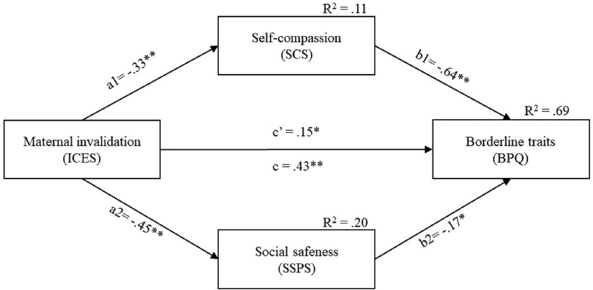
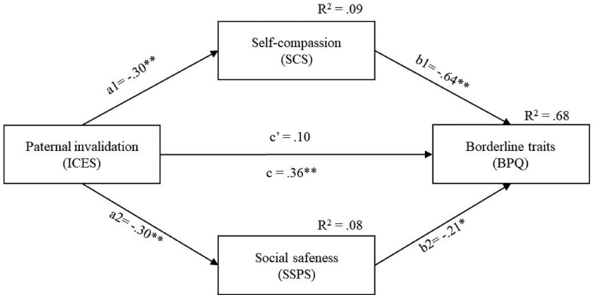
Sexual minority (SM) individuals experience minority-related social stressors that increase their vulnerability to experience psychopathological symptoms. Invalidating environments include non-acceptance of emotional expressions, and constitute a risk factor for developing borderline personality traits. Although research suggests that self-compassion and social safeness can act as protective factors to SM people against the development of anxiety and depression, less is known about their role in borderline personality symptoms experienced by SM. This study aims to test the mediation effect of self-compassion and social safeness in the relationship between paternal and maternal invalidation and borderline traits in a sample of 132 SM individuals with aged between 18-63 years old (M = 34.3, SD = 11.4). Self-report questionnaires were completed using an online survey. Data were analysed through SPSS and PROCESS Macro. Results showed that self-compassion and social safeness mediate the relationship between both maternal and paternal invalidation and borderline traits. These seem to echo previous studies about the positive relationship between parental invalidation and borderline personality traits, and adds to it by suggesting that difficulties in experiencing self-compassion as well as in feeling socially safe are significant risk factors underlying this relationship. These results yield clinical implications for affirmative psychological interventions with SM individuals, which are fully discussed.
Overview
CoChat Summary
## TL;DR
In 132 sexual minority adults from Portugal, the study found that self-compassion and social safeness mediated the link between parental invalidation and borderline traits. Mother’s invalidation showed a significant direct effect on borderline traits, while father’s invalidation was explained only indirectly through the mediators.
## Key findings
- In the sample of 132 sexual minority adults aged 18–63 years (M = 34.28, SD = 11.37), borderline traits were positively correlated with mother invalidation and father invalidation, and negatively correlated with self-compassion and social safeness.
- For maternal invalidation, the mediation model explained 69% of borderline traits (F(3,128) = 93.60, p < .001). The direct effect remained significant (c' = .15, p = .01), and both self-compassion (β = -.64, p < .001) and social safeness (β = -.17, p = .01) were significant predictors.
- For paternal invalidation, the mediation model explained 68% of borderline traits (F(3,128) = 89.80, p < .001). The direct effect was not significant (c' = .10, p = .065), but the total effect was significant (c = .35, p < .001) through self-compassion and social safeness.
- The pairwise contrasts showed that self-compassion had the greater effect than social safeness in both mediation models.
## Methods
- Design: Cross-sectional, online survey study conducted between January 2021 and March 2021.
- Sample/data: 132 Portuguese sexual minority adults, recruited through LGBT organizations, social media, online LGBT groups, and snowball sampling; inclusion required non-heterosexual self-identification, ages 18–65, Portuguese nationality, consent, and full questionnaire completion.
- Analysis: Descriptive statistics, Pearson correlations, and mediation analyses using SPSS 23 and PROCESS macro 3.5.1 with 5,000 bootstrap samples; assumptions checked with K-S test, skewness/kurtosis, Durbin-Watson, and VIF.
## Limitations
- The paper states that the sample had an unbalanced proportion of gender identity and sexual orientation, limiting how far the findings can be generalized.
- The cross-sectional design prevents causal conclusions, which the authors explicitly note.
- The paper states that self-report questionnaires have limitations such as social desirability and closed questions; evident from the text is that the study also relies on a non-probability online sample from Portuguese LGBT-related channels, which may limit representativeness.
Model-written summary. Check it against the paper before relying on it.
Integrity signals
Registry
Cites
Statistics
Figures


Verification
Claims the paper makes
1 Valid · 1 Not valid · 14 Not checked · 55 Own results and interpretations
A result the paper reports from its own data — it cites no other source for it, so there is none to check. The quote shows it is in the paper.
In the paper
“Self-compassion and social safeness were negatively correlated with maternal and paternal invalidation and positively correlated with each other.”
plainstates an association- Asserted: passes — The authors put it forward as true.
- Checkable: passes — It can be checked against evidence.
- Load-bearing: unclear — It is unclear whether the paper’s conclusions depend on it.
- Based: passes — The paper gives a reason why it holds.
- Rests on an assumption not shown here.
A result the paper reports from its own data — it cites no other source for it, so there is none to check. The quote shows it is in the paper.
In the paper
“Results showed that self-compassion and social safeness mediate the relationship between both maternal and paternal invalidation and border line traits.”
plainstates a causen = 132- Asserted: passes — The authors put it forward as true.
- Checkable: passes — It can be checked against evidence.
- Load-bearing: passes — The paper’s conclusions depend on it.
- Based: passes — The paper gives a reason why it holds.
- Rests on 4 assumptions not shown here.
A result the paper reports from its own data — it cites no other source for it, so there is none to check. The quote shows it is in the paper.
In the paper
“Borderline features were positively correlated with mother and father invalidation, and negatively correlated with selfcompassion and social safeness.”
plainstates an association- Asserted: passes — The authors put it forward as true.
- Checkable: passes — It can be checked against evidence.
- Load-bearing: passes — The paper’s conclusions depend on it.
- Based: passes — The paper gives a reason why it holds.
- Rests on an assumption not shown here.
A result the paper reports from its own data — it cites no other source for it, so there is none to check. The quote shows it is in the paper.
In the paper
“The effect of self-compassion was greater.”
plainstates a cause- Asserted: passes — The authors put it forward as true.
- Checkable: passes — It can be checked against evidence.
- Load-bearing: passes — The paper’s conclusions depend on it.
- Based: passes — The paper gives a reason why it holds.
- Rests on an assumption not shown here.
A result the paper reports from its own data — it cites no other source for it, so there is none to check. The quote shows it is in the paper.
In the paper
“Borderline features were positively correlated with mother and father invalidation, and negatively correlated with selfcompassion and social safeness.”
plainstates an association- Asserted: passes — The authors put it forward as true.
- Checkable: passes — It can be checked against evidence.
- Load-bearing: passes — The paper’s conclusions depend on it.
- Based: passes — The paper gives a reason why it holds.
- Rests on 2 assumptions not shown here.
31 more claims
Create a free account to see all 71 claims and to verify the 3 references still open.
- Probably not a substantial claim. 27
- The quote only partly states this claim. 3
- It may state two separate claims as one. 11
Statistics recomputed
Every reported test result, recomputed from its test statistic and degrees of freedom. A result shows as not adding up only once an independent check has confirmed it.
- ConsistentF(3, 128) = 93.6reported p < .001 · recomputed p < .001
“F (3, 128) = 93.60, p < .001”
- ConsistentF(3, 128) = 89.8reported p < .001 · recomputed p < .001
“F (3, 128) = 89.80, p < .001”
Self-check
Percentages, sums and reported differences re-computed from the paper’s own numbers.
Self-check results appear here once an independent check has confirmed them.
Citations
Cites
Diagnostic and Statistical Manual of Mental Disorders
American Psychiatric Association (2013) · doi:10.1176/appi.books.9780890425596 · Cited by 116,369
Principles and Practice of Structural Equation Modeling
Tabri, N., & Elliott, C. M. (2012) · Canadian Graduate Journal of Sociology and Criminology · doi:10.15353/cgjsc-rcessc.v1i1.25 · Cited by 38,891
(1993) · Cited by 7,136
Introduction to mediation, moderation, and conditional process analysis :
Hayes, A. F., & names (2015) · Cited by 7,004
The Development and Validation of a Scale to Measure Self-Compassion
NEFF, K. D. (2003) · Self and Identity · doi:10.1080/15298860309027 · Cited by 6,436 · cited 3×
“The original study by Neff (2003) indicated a very good internal consistency with a .92 Cronbach’s Alpha.”
BackgroundMethodCognitive-Behavioral Treatment of Borderline Personality Disorder
Cary, G. L. (1994) · American Journal of Psychotherapy · doi:10.1176/appi.psychotherapy.1994.48.1.155 · Cited by 6,283
(2016) · Cited by 3,399
Exploring compassion: A meta-analysis of the association between self-compassion and psychopathology
MacBeth, A., & Gumley, A. (2012) · Clinical Psychology Review · doi:10.1016/j.cpr.2012.06.003 · Cited by 1,838 · cited 1×
“Studies suggest that self-compassion is related to less psychopathological symptoms (MacBeth & Gumley, 2012) and greater well-being (Zessin et al., 2015).”
BackgroundCrowell, S. E., Beauchaine, T. P., & Linehan, M. M. (2009) · Psychological Bulletin · doi:10.1037/a0015616 · Cited by 1,292 · cited 1×
“This kind of environment usually inhibit the expression of personal emotions when not socially acceptable so that children need to internally manage their emotions with no parental support (Crowell et al., 2009).”
BackgroundStatistics without maths for psychology
Dancey, C. P., & Reidy, J. G. (1999) · Cited by 1,246
The Relationship Between Self‐Compassion and Well‐Being: A Meta‐Analysis
Zessin, U., Dickhäuser, O., & Garbade, S. (2015) · Applied Psychology: Health and Well-Being · doi:10.1111/aphw.12051 · Cited by 1,237 · cited 1×
“Studies suggest that self-compassion is related to less psychopathological symptoms (MacBeth & Gumley, 2012) and greater well-being (Zessin et al., 2015).”
BackgroundCochran, S. D., Sullivan, J. G., & Mays, V. M. (2003) · Journal of Consulting and Clinical Psychology · doi:10.1037/0022-006x.71.1.53 · Cited by 1,109
(2005) · doi:10.4324/9780203003459 · Cited by 1,041
Minority Stress and Lesbian Women.
Brown, J. A., & Brooks, V. R. (1982) · Contemporary Sociology · doi:10.2307/2068618 · Cited by 1,032
Gilbert, P. (2010) · Routledge eBooks · doi:10.4324/9780203851197 · Cited by 957
Meyer, I. H. (2013) · Psychology of Sexual Orientation and Gender Diversity · doi:10.1037/2329-0382.1.s.3 · Cited by 900
Bostwick, W. B., Boyd, C. J., Hughes, T. L., & McCabe, S. E. (2010) · American Journal of Public Health · doi:10.2105/ajph.2008.152942 · Cited by 829 · cited 2×
“…have a higher prevalence of mental health problems than heterosexual people in the general population (Cochran, 2001), including depression, anxiety, substance use (Bostwick et al., 2011; Cochran et al., 2003), stress (Wallace & Santacruz, 2017) and borderline symptoms (Reuter et al., 2015).”
BackgroundCochran, S. D. (2001) · American Psychologist · doi:10.1037/0003-066x.56.11.931 · Cited by 447 · cited 1×
“Studies have shown that SM individuals have a higher prevalence of mental health problems than heterosexual people in the general population (Cochran, 2001), including depression, anxiety, substance use (Bostwick et al., 2011; Cochran et al., 2003), stress (Wallace & Santacruz, 2017) and borderline…”
BackgroundDiamond, L. M., & Alley, J. (2022) · Neuroscience & Biobehavioral Reviews · doi:10.1016/j.neubiorev.2022.104720 · Cited by 412 · cited 1×
“However, SM individuals often lack this sense of safeness in their daily lives, and this is considered a primary factor contributing to their mental and physical health disparities (Diamond & Alley, 2022).”
BackgroundMinority stress and the health of sexual minorities
Meyer, I. H., & Frost, D. M. (2012) · Handbook of Psychology and Sexual Orientation · doi:10.1093/acprof:oso/9780199765218.003.0018 · Cited by 412 · cited 1×
“…minority-related environmental sources of stress (e.g. instances of discrimination, harassment, violence, microaggressions) – and proximal – which involve minority-related individual psychological phenomena (e.g. self-stigma, shame and internalised homophobia) (Meyer & Frost, 2013; Meyer, 2013).”
BackgroundFamily interaction and the development of borderline personality disorder: A transactional model
FRUZZETTI, A. E., SHENK, C., & HOFFMAN, P. D. (2005) · Development and Psychopathology · doi:10.1017/s0954579405050479 · Cited by 325 · cited 1×
“Fruzzetti et al. (2005) claimed that a problematic relationship between parents and children is a relevant aetiological distal factor for developing borderline traits.”
BackgroundGilbert, P., McEwan, K., Mitra, R., Franks, L., Richter, A., & Rockliff, H. (2008) · The Journal of Positive Psychology · doi:10.1080/17439760801999461 · Cited by 297
Buckholdt, K. E., Parra, G. R., & Jobe-Shields, L. (2014) · Journal of Child and Family Studies · doi:10.1007/s10826-013-9768-4 · Cited by 286
A Framework for Integrating Dimensional and Categorical Classifications of Personality Disorder
Livesley, W. J. (2007) · Journal of Personality Disorders · doi:10.1521/pedi.2007.21.2.199 · Cited by 224
Kelly, A. C., Zuroff, D. C., Leybman, M. J., & Gilbert, P. (2012) · Cognitive Therapy and Research · doi:10.1007/s10608-011-9432-5 · Cited by 176
Kelly, A. C., & Dupasquier, J. R. (2015) · Personality and Individual Differences · doi:10.1016/j.paid.2015.10.017 · Cited by 169
The BPQ: A Scale for the Assessment of Borderline Personality Based on DSM-IV Criteria
Poreh, A. M., Rawlings, D., Claridge, G., Freeman, J. L., Faulkner, C., & Shelton, C. (2006) · Journal of Personality Disorders · doi:10.1521/pedi.2006.20.3.247 · Cited by 157
Kirschner, H., Kuyken, W., Wright, K., Roberts, H., Brejcha, C., & Karl, A. (2019) · Clinical Psychological Science · doi:10.1177/2167702618812438 · Cited by 131
Feliu‐Soler, A., Pascual, J. C., Elices, M., Martín‐Blanco, A., Carmona, C., Cebolla, A., Simón, V., & Soler, J. (2017) · Clinical Psychology & Psychotherapy · doi:10.1002/cpp.2000 · Cited by 127
Petrocchi, N., Pistella, J., Salvati, M., Carone, N., Laghi, F., & Baiocco, R. (2019) · Sexuality Research and Social Policy · doi:10.1007/s13178-018-0373-6 · Cited by 111
Matos, M., Duarte, J., & Pinto-Gouveia, J. (2017) · The Journal of Psychology · doi:10.1080/00223980.2017.1393380 · Cited by 103 · cited 3×
“It is associated with less psychopathology (Kelly et al., 2012; Marta-Simões et al., 2017; Matos, Duarte et al., 2017), greater well-being and higher quality of life (Gilbert et al., 2008; Kelly et al., 2012; Marta-Simões et al., 2022), including among SM adults (Fingerhut, 2018; Krueger &…”
BackgroundYakushko, O. F. (2005) · International Journal for the Advancement of Counselling · doi:10.1007/s10447-005-2259-6 · Cited by 102
Social disadvantage and borderline personality disorder: A study of social networks.
Beeney, J. E., Hallquist, M. N., Clifton, A. D., Lazarus, S. A., & Pilkonis, P. A. (2018) · Personality Disorders Theory Research and Treatment · doi:10.1037/per0000234 · Cited by 100
“Second Generation” Voices: Queer Youth with Lesbian/Bisexual Mothers
Kuvalanka, K. A., & Goldberg, A. E. (2008) · Journal of Youth and Adolescence · doi:10.1007/s10964-008-9327-2 · Cited by 99
Rodriguez-Seijas, C. A., Morgan, T. A., & Zimmerman, M. A. (2020) · Assessment · doi:10.1177/1073191120961833 · Cited by 92
Gilbert, P., McEwan, K., Mitra, R., Richter, A., Franks, L., Mills, A., Bellew, R., & Gale, C. (2009) · University of Derby Online Research Archive. (University of Derby) · Cited by 89
Self-Compassion Buffers the Negative Psychological Impact of Stigma Stress on Sexual Minorities
Chan, K. K. S., Yung, C. S. W., & Nie, G. M. (2020) · Mindfulness · doi:10.1007/s12671-020-01451-1 · Cited by 79
Castilho, P., & Gouveia, J. P. (2011) · Psychologica · doi:10.14195/1647-8606_54_8 · Cited by 78
Toplu-Demirtaş, E., Kemer, G., Pope, A. L., & Moe, J. L. (2018) · Journal of Counseling Psychology · doi:10.1037/cou0000261 · Cited by 65 · cited 1×
“Literature suggests that self-compassion is an especially important psychological process when it comes to SM individuals (Carvalho & Guiomar, 2022; McLaren & Brown-Beresford, 2021; Set & Altinok, 2017; Toplu Demirtas et al., 2018).”
BackgroundFeinstein, B. A., Franco, M. G., Henderson, R., Collins, L. K., & Davari, J. (2019) · Journal of Bisexuality · doi:10.1080/15299716.2019.1671295 · Cited by 58
The role of self-compassion in the well-being of self-identifying gay men
Beard, K., Eames, C., & Withers, P. (2017) · Journal of Gay & Lesbian Mental Health · doi:10.1080/19359705.2016.1233163 · Cited by 57 · cited 2×
“Self-compassion can be seen as a contributor for resilience against minority stress in SM people, and may serve as an action of defence against minority stress (Beard et al., 2017).”
BackgroundCarvalho, S. A., & Guiomar, R. (2022) · LGBT Health · doi:10.1089/lgbt.2021.0434 · Cited by 56 · cited 2×
“Literature suggests that self-compassion is an especially important psychological process when it comes to SM individuals (Carvalho & Guiomar, 2022; McLaren & Brown-Beresford, 2021; Set & Altinok, 2017; Toplu Demirtas et al., 2018).”
BackgroundResultSelf-citationMatos, M., Carvalho, S. A., Cunha, M., Galhardo, A., & Sepodes, C. (2017) · Journal of LGBT Issues in Counseling · doi:10.1080/15538605.2017.1310007 · Cited by 55 · cited 1×
“…showed that in gay men, self-compassion mediates the association between memories of shame and memories of safeness, and depressive symptoms and internal shame (Matos, Carvalho et al., 2017), demonstrating it to be an attitude that solidifies resiliency in this population (Beard et al., 2017).”
BackgroundSelf-citationReich, D. B., & Zanarini, M. C. (2008) · Journal of Personality Disorders · doi:10.1521/pedi.2008.22.6.564 · Cited by 53
Fingerhut, A. W. (2018) · Psychology of Sexual Orientation and Gender Diversity · doi:10.1037/sgd0000271 · Cited by 51
Greene, D. C., & Britton, P. J. (2015) · Journal of LGBT Issues in Counseling · doi:10.1080/15538605.2015.1068143 · Cited by 48
Robertson, C. D., Kimbrel, N. A., & Nelson-Gray, R. O. (2013) · Journal of Personality Disorders · doi:10.1521/pedi_2012_26_062 · Cited by 46
Sexual orientation, social support, and mental health resilience in a U.S. national sample of adults
Krueger, E. A., & Upchurch, D. M. (2020) · Behavioral Medicine · doi:10.1080/08964289.2020.1825922 · Cited by 45
Sexual Orientation and Borderline Personality Disorder Features in a Community Sample of Adolescents
Reuter, T. R., Sharp, C., Kalpakci, A. H., Choi, H. J., & Temple, J. R. (2015) · Journal of Personality Disorders · doi:10.1521/pedi_2015_29_224 · Cited by 43
Gilbert, P. (2012) · SAGE Publications Ltd eBooks · doi:10.4135/9781446288368.n7 · Cited by 42
Perceived emotional invalidation and borderline personality disorder features: A test of theory
Sturrock, B., & Mellor, D. (2014) · Personality and Mental Health · doi:10.1002/pmh.1249 · Cited by 40 · cited 2×
“According to Sturrock and Mellor (2014), the perception of parental invalidation in childhood is a predictor of borderline traits in adulthood in the general population, which is congruent with our results in SM individuals.”
BackgroundResultRodriguez-Seijas, C. A., Morgan, T. A., & Zimmerman, M. (2021) · Assessment · doi:10.1177/1073191121991922 · Cited by 40
Is Self-Compassion Protective Among Sexual- and Gender-Minority Adolescents Across Racial Groups?
Vigna, A. J., Poehlmann, J., & Koenig, B. W. (2020) · Mindfulness · doi:10.1007/s12671-019-01294-5 · Cited by 33
Vigna, A. J., Poehlmann-Tynan, J., & Koenig, B. W. (2018) · Self and Identity · doi:10.1080/15298868.2018.1457566 · Cited by 32
Pérez, S., Lorca-Alamar, F., & Marco, J. H. (2020) · Journal of Trauma & Dissociation · doi:10.1080/15299732.2020.1719262 · Cited by 29
Self-Compassion and Life Satisfaction in Gay Men
Jennings, L. K., & Tan, P. P. (2014) · Psychological Reports · doi:10.2466/21.07.pr0.115c33z3 · Cited by 28
Goldberg, A. E., & Garcia, R. (2020) · Frontiers in Psychology · doi:10.3389/fpsyg.2020.00372 · Cited by 26
Keng, S.-L., & Wong, Y. Y. (2017) · Borderline Personality Disorder and Emotion Dysregulation · doi:10.1186/s40479-017-0075-3 · Cited by 23
Marta‐Simões, J., Tylka, T. L., & Ferreira, C. (2020) · Journal of Health Psychology · doi:10.1177/1359105320953463 · Cited by 23
Brown-Beresford, E., & McLaren, S. (2021) · Journal of Bisexuality · doi:10.1080/15299716.2021.2004483 · Cited by 22
Health Disparities and LGBT Populations
Wallace, B. C., & Santacruz, E. (2017) · doi:10.5040/9798400678530.ch-009 · Cited by 17
Shame and Depression: The Roles of Self-reassurance and Social Safeness
Marta‐Simões, J., Ferreira, C., & Mendes, A. L. (2017) · European Psychiatry · doi:10.1016/j.eurpsy.2017.02.012 · Cited by 15
Social role dysfunction and coping in borderline personality disorder
Carlson, E. M., Cox, D. W., Kealy, D., Chapman, A. L., & Ogrodniczuk, J. S. (2020) · Personality and Mental Health · doi:10.1002/pmh.1476 · Cited by 15
Set, Z., & Altınok, A. (2016) · Journal of Cognitive-Behavioral Psychotherapy and Research · doi:10.5455/jcbpr.239260 · Cited by 11
Psychometric properties of the Portuguese version of the Invalidating Childhood Environment Scale
Vieira, A. I., Gonçalves, M., Machado, B. C., Rodrigues, T. F., Machado, P. P. P., Brandão, I., Timóteo, S., Nunes, P., & Gonçalves, S. F. (2018) · Eating and Weight Disorders - Studies on Anorexia Bulimia and Obesity · doi:10.1007/s40519-018-0550-x · Cited by 9
(2014) · Psychologica · doi:10.14195/1647-8606 · Cited by 8
Carreiras, D., Castilho, P., & Cunha, M. (2021) · Psychologica · doi:10.14195/1647-8606_64-2_2 · Cited by 4
Self-citationMonteiro, L., Veríssimo, M., Santos, A. J., & Vaughn, B. E. (2012) · Análise Psicológica · doi:10.14417/ap.502 · Cited by 3
Research works printed but not linked: 2
- Loess P. F. (2019). Self-compassion and Fear of Compassion as Mediators in the Relationships of Childhood Invalidation with Emotion Dysregulation and with Borderline Personality Characteristics [Doctoral Dissertation University of Montana] Graduate Student Theses Dissertations & Professional Papers. https://scholarworks.umt.edu/etd/11379
- Pinto-Gouveia, J., & Duarte, C. (2007). Portuguese version of the Borderline Personality Questionnaire [unpublished manuscrito. In Center for Research in Neuropsychology and Cognitive and Behavioral Intervention . Portugal: University of Coimbra.
Metadata
- Authors
- Cano, S., Carreiras, D., Carvalho, S. A., & Cunha, M.
- Affiliations
- Instituto Superior Miguel Torga (PT)
- University of Coimbra (PT)
- Corresponding author
- Carreiras, Diogo
- Venue
- Psychology & Sexuality
- Publisher
- Informa UK Limited
- Published
- 2023-05-31
- Volume
- 15
- Issue
- 1
- Pages
- 114-126
- ISSN
- 1941-9899 (ISSN-L)
- 1941-9902
- OpenAlex
- W4378650664
- Cited by
- 0
- References
- 62
- FWCI
- 0.00
- Type
- journal article
- Language
- en
- Open access
- green
- hdl.handle.net
- Licence
- other-oa
- Locations
- Psychology and Sexuality (publishedVersion)
- Portuguese National Funding Agency for Science, Research and Technology (RCAAP Project by FCT) (submittedVersion, other-oa)
- Topics
- Social Sciences › Psychology › Clinical Psychology › Personality Disorders and Psychopathology
- Social Sciences › Psychology › Social Psychology › LGBTQ Health, Identity, and Policy
- Social Sciences › Psychology › Clinical Psychology › Personality Traits and Psychology
- Keywords
- self-compassion, social safeness, borderline personality traits, sexual minority adults, mediation, minority stress, protective factors
About these checks
Registry, retraction, Cites and statistics results are computed, not judged, with one exception: a printed reference that no index lists is read once by a model before it counts as a citation error. Claims are extracted by a model and kept only when their quote appears verbatim in the text; each cited source is then checked, with a model’s help, for whether it says what the claim relies on. Those verdicts can be wrong — read the claim’s quote and the cited source before relying on one.
The claim verdicts this report counts are experimental: their accuracy is not yet measured.
A language model drew the claims from the paper on 2026-10-11, under version 3 of the claim definition (model deepseek-v4.1-flash, prompt extract-v3).
A second model labelled each claim on 2026-10-11 (model jev-1.13-20260917, definition revision gold-guideline-v0.2).
Statistics and arithmetic are recomputed, not judged.
Confidence bands are shown only for fields calibrated on our annotated test set. None is calibrated yet, so no band is shown.
What counts as a claim ›How we measure confidence ›How we check this ›
Are you an author, or do you see a problem with this page? Request a review
Data sources
Bibliographic data: Semantic Scholar, OpenAlex, Crossref.
Contains information from the Semantic Scholar Academic Graph Datasets, made available under the ODC Attribution License (ODC-BY 1.0).
Semantic Scholar’s data is described in: Kinney, R., et al. (2023). The Semantic Scholar Open Data Platform. arXiv:2301.10140.
