

Language control in bilinguals: The adaptive control hypothesis
Open accessThe DOI matches its Crossref record; 62 of the 62 references it cites were found in a registry or an index; none of the 36 sources its claims cite is checked for support yet.
Abstract
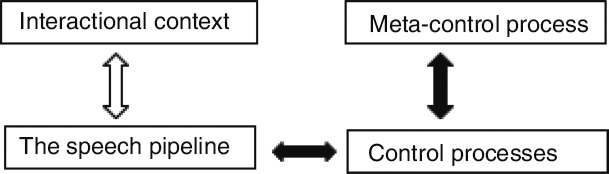
Speech comprehension and production are governed by control processes. We explore their nature and dynamics in bilingual speakers with a focus on speech production. Prior research indicates that individuals increase cognitive control in order to achieve a desired goal. In the adaptive control hypothesis we propose a stronger hypothesis: Language control processes themselves adapt to the recurrent demands placed on them by the interactional context. Adapting a control process means changing a parameter or parameters about the way it works (its neural capacity or efficiency) or the way it works in concert, or in cascade, with other control processes (e.g., its connectedness). We distinguish eight control processes (goal maintenance, conflict monitoring, interference suppression, salient cue detection, selective response inhibition, task disengagement, task engagement, opportunistic planning). We consider the demands on these processes imposed by three interactional contexts (single language, dual language, and dense code-switching). We predict adaptive changes in the neural regions and circuits associated with specific control processes. A dual-language context, for example, is predicted to lead to the adaptation of a circuit mediating a cascade of control processes that circumvents a control dilemma. Effective test of the adaptive control hypothesis requires behavioural and neuroimaging work that assesses language control in a range of tasks within the same individual.
Overview
CoChat Summary
TL;DR
The paper proposes the adaptive control hypothesis: bilingual language control processes themselves adapt to the recurrent demands of three interactional contexts—single-language, dual-language, and dense code-switching—by changing parameters such as neural capacity, efficiency, or coordination. It identifies eight control processes and predicts context-specific behavioural and neural adaptations, especially a dual-language adaptation that circumvents a control dilemma.
Key findings
- The paper distinguishes eight control processes: goal maintenance, conflict monitoring, interference suppression, salient cue detection, selective response inhibition, task disengagement, task engagement, and opportunistic planning.
- It contrasts three interactional contexts: single-language, dual-language, and dense code-switching. Table 1 indicates that single-language context increases demand on goal maintenance and interference control; dual-language context increases demand on goal maintenance, interference control, salient cue detection, selective response inhibition, task disengagement, and task engagement; dense code-switching increases demand on opportunistic planning.
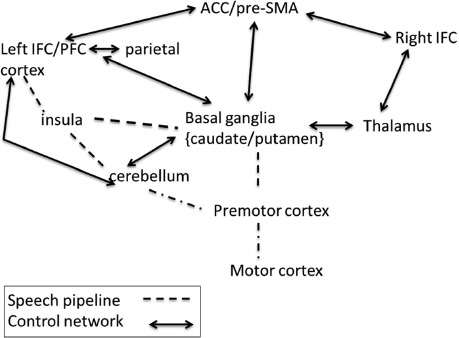
- The hypothesis predicts that dual-language speakers adapt a cascade linking salient cue detection to selective response inhibition, task disengagement, and task engagement to circumvent the control dilemma in which suppression reduces flexibility to switch. Dense code-switching is predicted to adapt a left frontal–right cerebellar circuit for morphosyntactic integration, while single-language context is associated with left inferior regions for suppressing the nontarget language.
- No original quantitative results are reported; the paper is theoretical and offers illustrative behavioural and neuroimaging predictions.
Methods
- Theoretical/review paper with no participants or new empirical data; it proposes the adaptive control hypothesis and derives testable predictions.
- It synthesizes prior work on bilingual language control, cognitive control, neuroimaging, and neuropsychology, using three interactional contexts and eight control processes as an organizing framework.
- The main analysis is conceptual: a table of context-dependent demands and illustrative predictions for behavioural tasks (e.g., cued language switching, Stroop) and neural circuits; it calls for within-individual behavioural and neuroimaging tests across a range of tasks.
Limitations
- The authors state that their illustrative predictions may prove false and that there may be no systematic behavioural or neural differences as a function of interactional context.
- The authors acknowledge circular causation: interactional context may shape adaptive response, but individual differences in predispositions and genetic make-up constrain such effects; they assume individual variation in executive control and sociality is normally distributed.
- The text makes evident that the hypothesis is programmatic and untested in this paper; contexts are idealized, speakers may experience mixtures of contexts, and factors such as proficiency, sensitivity to interaction cost, neuropharmacology, and genetic variation may moderate predicted adaptations.
Model-written summary. Check it against the paper before relying on it.
Integrity signals
Registry
Cites
Statistics
Figures
Verification
Claims the paper makes
0 Valid · 0 Not valid · 30 Not checked · 57 Own results and interpretations
In the paper
“Strikingly, the use of more than one language appears to be a further important factor shaping individual performance on such tasks (e.g., Bialystok, Craik, Green, & Gollan, 2009, for a review).”
§ Language control in bilinguals: The adaptive control hypothesis > Abstract
What the sources say
- Not checked yetcites Bialystok, Craik, Green, & Gollan, 2009 matched to “Bilingual Minds” (2009) source
hedgedstates an association- Asserted: passes — The authors put it forward as true.
- Checkable: passes — It can be checked against evidence.
- Load-bearing: passes — The paper’s conclusions depend on it.
- Based: passes — The paper gives a reason why it holds.
A conclusion the paper draws from its own results — it cites no other source for it, so there is none to check. The quote shows it is in the paper.
In the paper
“In other words, any learning effects during the experiment should be observed earlier for speakers from an interactional context that is best suited to the experimental conditions.”
§ Language control in bilinguals: The adaptive control hypothesis > THE ADAPTIVE CONTROL HYPOTHESIS > Testing the adaptive control hypothesis
plainstates an association- Asserted: passes — The authors put it forward as true.
- Checkable: passes — It can be checked against evidence.
- Load-bearing: passes — The paper’s conclusions depend on it.
- Based: passes — The paper gives a reason why it holds.
In the paper
“acknowledged a role of the pre-SMA in initiating speech in language switching (see Luk et al., 2012, for further discussion).”
§ Language control in bilinguals: The adaptive control hypothesis > THE ADAPTIVE CONTROL HYPOTHESIS > Neuroimaging predictions
What the sources say
- Not checked yetcites Luk et al., 2012 matched to “Cognitive control for language switching in bilinguals: A quantitative meta-analysis of functional neuroimaging studies” (2012) source
plainstates an association- Asserted: passes — The authors put it forward as true.
- Checkable: passes — It can be checked against evidence.
- Load-bearing: unclear — It is unclear whether the paper’s conclusions depend on it.
- Based: passes — The paper gives a reason why it holds.
In the paper
“In Figure 2 we include a direct link between frontal cortex and the right cerebellum as a further circuit involved in language control (Fabbro, Moretti, & Bava, 2000).”
§ Language control in bilinguals: The adaptive control hypothesis > THE ADAPTIVE CONTROL HYPOTHESIS > Neuroimaging predictions
What the sources say
- Not checked yetcites Fabbro, Moretti, & Bava, 2000 matched to “Language impairments in patients with cerebellar lesions” (2000) source
plainstates an association- Asserted: passes — The authors put it forward as true.
- Checkable: passes — It can be checked against evidence.
- Load-bearing: passes — The paper’s conclusions depend on it.
- Based: passes — The paper gives a reason why it holds.
In the paper
“Reperfusion of the cerebellum reduces such symptoms (Marien, Engelborghs, Fabbro, & De Deyn, 2001).”
§ Language control in bilinguals: The adaptive control hypothesis > THE ADAPTIVE CONTROL HYPOTHESIS > Neuroimaging predictions
What the sources say
- Not checked yetcites Marien, Engelborghs, Fabbro, & De Deyn, 2001 matched to “The Lateralized Linguistic Cerebellum: A Review and a New Hypothesis” (2001) source
plainstates a cause- Asserted: passes — The authors put it forward as true.
- Checkable: passes — It can be checked against evidence.
- Load-bearing: unclear — It is unclear whether the paper’s conclusions depend on it.
- Based: passes — The paper gives a reason why it holds.
43 more claims
Create a free account to see all 87 claims and to verify the 30 references still open.
- Probably not a substantial claim. 23
- It may state two separate claims as one. 25
Claims other papers make about this one
Each is checked against this paper’s own text: does it say what the citing paper says it does?
In the citing paper
“Alternating between languages requires not only activation of words in the to-be-attended language but also inhibition of words in the language that should no longer be used (‘language control’; Green & Abutalebi, 2013).”
From Language proficiency drives listening-related fatigue in those who communicate in English as their second language (2026) · cites this paper as Green & Abutalebi, 2013
In the citing paper
“Previous work highlights the cognitive demands of switching between multiple languages within a conversation (Green & Abutalebi, 2013).”
From Language proficiency drives listening-related fatigue in those who communicate in English as their second language (2026) · cites this paper as Green & Abutalebi, 2013
Citations
Cites
Miyake, A., Friedman, N. P., Emerson, M. J., Witzki, A. H., Howerter, A., & Wager, T. D. (2000) · Cognitive Psychology · doi:10.1006/cogp.1999.0734 · Cited by 15,798
Clark, H. H. (1996) · doi:10.1017/cbo9780511620539 · Cited by 5,123
Conflict monitoring and anterior cingulate cortex: an update
Botvinick, M. M., Cohen, J. D., & Carter, C. S. (2004) · Trends in Cognitive Sciences · doi:10.1016/j.tics.2004.10.003 · Cited by 3,623
Anterior Cingulate Conflict Monitoring and Adjustments in Control
Kerns, J. G., Cohen, J. D., MacDonald, A. W., Cho, R. Y., Stenger, V. A., & Carter, C. S. (2004) · Science · doi:10.1126/science.1089910 · Cited by 2,891 · cited 4×
“In addition, there is a demand on frontal structures linked to conflict monitoring and interference suppression (e.g., Kerns et al., 2004) and to parietal regions (and frontal regions) associated with task changes.”
BackgroundInfluentialMental control of the bilingual lexico-semantic system
GREEN, D. W. (1998) · Bilingualism Language and Cognition · doi:10.1017/s1366728998000133 · Cited by 2,807
Self-citationUsing language: Communicative acts
Clark, H. H. (1996) · Cited by 2,721
Using language: Index of names
Clark, H. H. (1996) · Cited by 2,720
The variable nature of cognitive control: a dual mechanisms framework
Braver, T. S. (2012) · Trends in Cognitive Sciences · doi:10.1016/j.tics.2011.12.010 · Cited by 2,482 · cited 1×
“One way to recognise the interplay of these processes is to distinguish proactive control processes that establish a task goal from reactive control processes that limit interference with it (Braver, 2012).”
BackgroundInverted-U–Shaped Dopamine Actions on Human Working Memory and Cognitive Control
Cools, R., & D'Esposito, M. (2011) · Biological Psychiatry · doi:10.1016/j.biopsych.2011.03.028 · Cited by 1,673 · cited 2×
“Neuroimaging data also implicate distinct neural regions in task switching and interference control (e.g., Cools & D’Esposito, 2011).”
BackgroundBilingual language production: The neurocognition of language representation and control
Abutalebi, J., & Green, D. (2007) · Journal of Neurolinguistics · doi:10.1016/j.jneuroling.2006.10.003 · Cited by 1,302 · cited 2×
“In previous papers (e.g., Abutalebi & Green, 2007, 2008), we reviewed work showing that both cortical and subcortical structures are involved in language control and language switching (see Luk, Green, Abutalebi, & Grady, 2012, for a recent metaanalysis).”
BackgroundSelf-citation
Cited by
Items 101–200 of 2,166
Gold, B. T. (2015) · Behavioural Brain Research · doi:10.1016/j.bbr.2014.12.006 · Cited by 108
Hennessy, S. L., Sachs, M. E., Ilari, B., & Habibi, A. (2019) · Frontiers in Neuroscience · doi:10.3389/fnins.2019.01080 · Cited by 105
Dong, Y., & Xie, Z. (2014) · Journal of Cognitive Psychology · doi:10.1080/20445911.2014.924951 · Cited by 105
Bilingualism alters children's frontal lobe functioning for attentional control
Arredondo, M. M., Hu, X., Satterfield, T., & Kovelman, I. (2016) · Developmental Science · doi:10.1111/desc.12377 · Cited by 105
Attentional control in interpreting: A model of language control and processing control
Dong, Y., & Li, P. (2019) · Bilingualism Language and Cognition · doi:10.1017/s1366728919000786 · Cited by 104
Jevtović, M., Duñabeitia, J. A., & de Bruin, A. (2019) · Bilingualism Language and Cognition · doi:10.1017/s1366728919000191 · Cited by 103
de Putte, E. V., Baene, W. D., García‐Pentón, L., Woumans, E., Dijkgraaf, A., & Duyck, W. (2017) · Cortex · doi:10.1016/j.cortex.2017.11.024 · Cited by 102
Publication Bias and the Validity of Evidence: What’s the Connection?
Bialystok, E., Kroll, J. F., Green, D. W., MacWhinney, B., & Craik, F. I. M. (2015) · Psychological Science · doi:10.1177/0956797615573759 · Cited by 102
Self-citationNiger-Congo Linguistic Features and Typology
Hyman, L. M., Rolle, N. R., Sande, H., Clem, E., Jenks, P., Lionnet, F., MERRILL, J. E., & Baier, N. (2019) · Cambridge University Press eBooks · doi:10.1017/9781108283991.009 · Cited by 102
On the flexibility of bilingual language control: The effect of language context
Timmer, K., Christoffels, I. K., & Costa, A. (2018) · Bilingualism Language and Cognition · doi:10.1017/s1366728918000329 · Cited by 102
Bilingualism reveals fundamental variation in language processing
Fricke, M., Zirnstein, M., Navarro‐Torres, C. A., & Kroll, J. F. (2018) · Bilingualism Language and Cognition · doi:10.1017/s1366728918000482 · Cited by 101
Effects of dense code-switching on executive control
Hofweber, J. E., Marinis, T., & Treffers‐Daller, J. (2016) · Linguistic Approaches to Bilingualism · doi:10.1075/lab.15052.hof · Cited by 101
A Bilingual Advantage? An Appeal for a Change in Perspective and Recommendations for Future Research
Poarch, G. J., & Krott, A. (2019) · Behavioral Sciences · doi:10.3390/bs9090095 · Cited by 100
Legault, J., Fang, S.-Y., Lan, Y., & Li, P. (2018) · Brain and Cognition · doi:10.1016/j.bandc.2018.09.004 · Cited by 100
Bilingual and Monolingual Language Modes
Grosjean, F. (2026) · Wiley eBooks · doi:10.1002/9781405198431.wbeal0090 · Cited by 100
Cognitive control in bilinguals: Proficiency and code-switching both matter
Kheder, S., & Kaan, E. (2021) · Cognition · doi:10.1016/j.cognition.2020.104575 · Cited by 99
Intra-sentential code-switching: Cognitive and neural approaches
van Hell, J. G., Litcofsky, K. A., & Ting, C. Y. (2015) · Cambridge University Press eBooks · doi:10.1017/cbo9781107447257.020 · Cited by 99
From the Field to the Lab: A Converging Methods Approach to the Study of Codeswitching
Beatty‐Martínez, A. L., Kroff, J. R. V., & Dussias, P. E. (2018) · Languages · doi:10.3390/languages3020019 · Cited by 99
Jylkkä, J., Lehtonen, M., LINDHOLM, F., KUUSAKOSKI, A., & Laine, M. (2017) · Bilingualism Language and Cognition · doi:10.1017/s1366728917000104 · Cited by 97
Cultural Effects Rather Than a Bilingual Advantage in Cognition: A Review and an Empirical Study
Samuel, S., Roehr‐Brackin, K., Pak, H., & Kim, H. (2018) · Cognitive Science · doi:10.1111/cogs.12672 · Cited by 96
Can monolinguals be like bilinguals? Evidence from dialect switching
Kirk, N. W., Kempe, V., Scott-Brown, K. C., Philipp, A. M., & Declerck, M. (2017) · Cognition · doi:10.1016/j.cognition.2017.10.001 · Cited by 95
A bilingual disadvantage in metacognitive processing
Folke, T., Ouzia, J., Bright, P., Martino, B. D., & Filippi, R. (2016) · Cognition · doi:10.1016/j.cognition.2016.02.008 · Cited by 94
Declerck, M., Koch, I., Duñabeitia, J. A., Grainger, J., & Stephan, D. N. (2019) · Journal of Experimental Psychology: Human Perception and Performance · doi:10.1037/xhp0000627 · Cited by 39
Why do bilinguals code-switch when emotional? Insights from immigrant parent–child interactions.
Williams, A. I., Srinivasan, M., Liu, C., Lee, P., & Zhou, Q. (2020) · Emotion · doi:10.1037/emo0000568 · Cited by 94
Are there cognitive benefits of code-switching in bilingual children? A longitudinal study
Kuzyk, O., Friend, M., Severdija, V., Zesiger, P., & Poulin‐Dubois, D. (2019) · Bilingualism Language and Cognition · doi:10.1017/s1366728918001207 · Cited by 92
The effect of bilingualism on brain development from early childhood to young adulthood
Pliatsikas, C., Meteyard, L., Veríssimo, J., DeLuca, V., Shattuck, K. F., & Ullman, M. T. (2020) · Brain Structure and Function · doi:10.1007/s00429-020-02115-5 · Cited by 91
The effect of childhood multilingualism and bilectalism on implicature understanding
Antoniou, K., & Katsos, N. (2017) · Applied Psycholinguistics · doi:10.1017/s014271641600045x · Cited by 90
The Oxford Handbook of the Mental Lexicon
Papafragou, A., Trueswell, J. C., & Gleitman, L. R. (2022) · Oxford University Press eBooks · doi:10.1093/oxfordhb/9780198845003.001.0001 · Cited by 89
Kousaie, S., Chai, X. J., Sander, K., & Klein, D. (2017) · Brain and Cognition · doi:10.1016/j.bandc.2017.06.003 · Cited by 89
Second Language Experience Facilitates Statistical Learning of Novel Linguistic Materials
Potter, C. E., Wang, T., & Saffran, J. R. (2016) · Cognitive Science · doi:10.1111/cogs.12473 · Cited by 89
Ooi, S. H., Goh, W. D., Sorace, A., & Bak, T. H. (2018) · Bilingualism Language and Cognition · doi:10.1017/s1366728918000020 · Cited by 89
Lüpke, F. (2016) · SOAS Research Online (SOAS University of London) · Cited by 89
Bilingualism and the severity of poststroke aphasia
Paplikar, A., Mekala, S., Bak, T. H., Dharamkar, S., Alladi, S., & Kaul, S. (2018) · Aphasiology · doi:10.1080/02687038.2017.1423272 · Cited by 88
Interlocutor identity affects language activation in bilinguals
Molnar, M. T., Ibáñez-Molina, A. J., & Carreiras, M. (2015) · Journal of Memory and Language · doi:10.1016/j.jml.2015.01.002 · Cited by 88
Consequences of multilingualism for neural architecture
Hayakawa, S. L., & Marian, V. (2019) · Behavioral and Brain Functions · doi:10.1186/s12993-019-0157-z · Cited by 87
Yurtsever, A., Anderson, J. A. E., & Grundy, J. G. (2023) · Developmental Review · doi:10.1016/j.dr.2023.101084 · Cited by 87
Duncan, H. D., Nikelski, J., Pilon, R., Steffener, J., Chertkow, H. M., & Phillips, N. A. (2017) · Neuropsychologia · doi:10.1016/j.neuropsychologia.2017.12.036 · Cited by 87
Language and cognitive control networks in bilinguals and monolinguals
Anderson, J. A. E., Chung-Fat-Yim, A., Bellana, B., Luk, G., & Bialystok, E. (2018) · Neuropsychologia · doi:10.1016/j.neuropsychologia.2018.06.023 · Cited by 87
Li, L., Abutalebi, J., Zou, L., Yan, X., Liu, L., Feng, X., Wang, R., Guo, T., & Ding, G. (2015) · Neuropsychologia · doi:10.1016/j.neuropsychologia.2015.04.007 · Cited by 86
Self-citationTranslanguaging: What is it besides smoke and mirrors?
Treffers‐Daller, J. (2024) · Linguistic Approaches to Bilingualism · doi:10.1075/lab.24015.tre · Cited by 86
Does integrating a code-switch during comprehension engage cognitive control?
Adler, R. M., Kroff, J. R. V., & Novick, J. M. (2020) · Journal of Experimental Psychology Learning Memory and Cognition · doi:10.1037/xlm0000755 · Cited by 86
Aparicio, X., Heidlmayr, K. D.-M., & Isel, F. (2017) · Journal of Psycholinguistic Research · doi:10.1007/s10936-017-9501-3 · Cited by 85
Yang, S., & Yang, H. (2016) · Journal of Experimental Child Psychology · doi:10.1016/j.jecp.2016.01.011 · Cited by 85
Language control in bilinguals: Intention to speak vs. execution of speech
Reverberi, C., Kuhlen, A. K., Abutalebi, J., Greulich, R. S., Costa, A., Seyed‐Allaei, S., & Haynes, J. (2015) · Brain and Language · doi:10.1016/j.bandl.2015.03.004 · Cited by 85
Self-citationHighly proficient bilinguals implement inhibition: Evidence from n-2 language repetition costs.
Declerck, M., Thoma, A. M., Koch, I., & Philipp, A. M. (2015) · Journal of Experimental Psychology Learning Memory and Cognition · doi:10.1037/xlm0000138 · Cited by 85
Cognitive control ability mediates prediction costs in monolinguals and bilinguals
Zirnstein, M., van Hell, J. G., & Kroll, J. F. (2018) · Cognition · doi:10.1016/j.cognition.2018.03.001 · Cited by 84
Rossi, E., Cheng, H., Kroll, J. F., Diaz, M. T., & Newman, S. D. (2017) · Frontiers in Psychology · doi:10.3389/fpsyg.2017.02040 · Cited by 83
Is mere exposure enough? The effects of bilingual environments on infant cognitive development
D’Souza, D., Brady, D., Haensel, J. X., & D’Souza, H. (2020) · Royal Society Open Science · doi:10.1098/rsos.180191 · Cited by 83
Hofweber, J. E., Marinis, T., & Treffers‐Daller, J. (2020) · Bilingualism Language and Cognition · doi:10.1017/s1366728919000804 · Cited by 82
Gullifer, J. W., & Titone, D. A. (2021) · Journal of Experimental Psychology General · doi:10.1037/xge0000933 · Cited by 82
Bilingualism modifies cognition through adaptation, not transfer
Bialystok, E. (2024) · Trends in Cognitive Sciences · doi:10.1016/j.tics.2024.07.012 · Cited by 81
Non-linguistic effects of language switching training
Timmer, K., Calabria, M., & Costa, A. (2018) · Cognition · doi:10.1016/j.cognition.2018.09.001 · Cited by 81
Learning and Processing Multiple Languages: The More the Easier?
Festman, J. (2020) · Language Learning · doi:10.1111/lang.12437 · Cited by 81
Kałamała, P., Szewczyk, J., Chuderski, A., Senderecka, M., & Wodniecka, Z. (2020) · Cognition · doi:10.1016/j.cognition.2020.104373 · Cited by 80
Bilingual memory, to the extreme: Lexical processing in simultaneous interpreters
Santilli, M., Vilas, M. G., Mikulan, E., Caro, M. M., Muñoz, É., Sedeño, L., Ibáñez, A. M., & García, A. M. (2018) · Bilingualism Language and Cognition · doi:10.1017/s1366728918000378 · Cited by 79
Language Use Across International Contexts: Shaping the Minds of L2 Speakers
Kroll, J. F., Dussias, P. E., & Bajo, M. T. (2018) · Annual Review of Applied Linguistics · doi:10.1017/s0267190518000119 · Cited by 79
Henrard, S., & Daele, A. V. (2017) · Frontiers in Psychology · doi:10.3389/fpsyg.2017.01870 · Cited by 78
Hervais‐Adelman, A., & Babcock, L. (2019) · Bilingualism Language and Cognition · doi:10.1017/s1366728919000324 · Cited by 78
The Nature of Exposure and Input in Early Bilingualism
Armon-Lotem, S., & Meir, N. (2018) · Cambridge University Press eBooks · doi:10.1017/9781316831922.011 · Cited by 77
Changes in executive function over time in bilingual and monolingual school-aged children.
Park, J., Weismer, S. E., & Kaushanskaya, M. (2018) · Developmental Psychology · doi:10.1037/dev0000562 · Cited by 77
Brain network reconfiguration for language and domain-general cognitive control in bilinguals
Wu, J., Yang, J., Chen, M., Li, S., Zhang, Z., Kang, C., Ding, G., & Guo, T. (2019) · NeuroImage · doi:10.1016/j.neuroimage.2019.06.022 · Cited by 76
Bilingual language switching costs in auditory comprehension
Olson, D. J. (2017) · Language, Cognition and Neuroscience · doi:10.1080/23273798.2016.1250927 · Cited by 51
First Language Attrition: What It Is, What It Isn’t, And What It Can Be
Gallo, F., Margaretto, B. B., Юрьевич, Ш. Ю., Abutalebi, J., Kreiner, H., Chitaya, T., Petrova, A., & Myachykov, A. V. (2019) · Frontiers in Human Neuroscience · doi:10.3389/fnhum.2021.686388 · Cited by 76
Self-citationBeyond bilingualism: multilingual experience correlates with caudate volume
Hervais‐Adelman, A., Egorova, N., & Golestani, N. (2018) · Brain Structure and Function · doi:10.1007/s00429-018-1695-0 · Cited by 74
A switch is not a switch: Syntactically-driven bilingual language control.
Gollan, T. H., & Goldrick, M. (2018) · Journal of Experimental Psychology Learning Memory and Cognition · doi:10.1037/xlm0000462 · Cited by 74
Linguistic and Cognitive Skills in Sardinian–Italian Bilingual Children
Garraffa, M., Beveridge, M. E. L., & Sorace, A. (2015) · Frontiers in Psychology · doi:10.3389/fpsyg.2015.01898 · Cited by 73
Individual differences in cognitive control advantages of elderly late Dutch-English bilinguals
Keijzer, M. C. J., & Schmid, M. S. (2016) · Linguistic Approaches to Bilingualism · doi:10.1075/lab.14032.kei · Cited by 73
Examining Language Switching and Cognitive Control Through the Adaptive Control Hypothesis
Lai, G., & O'BRIEN, B. A. (2020) · Frontiers in Psychology · doi:10.3389/fpsyg.2020.01171 · Cited by 72
Active bilingualism delays the onset of mild cognitive impairment
Calabria, M., Hernández, M., Cattaneo, G., Suades, A., Serra, M., Juncadella, M., Reñé, R., Sala, I., Lleó, A., Ortiz‐Gil, J., et al. (2020) · Neuropsychologia · doi:10.1016/j.neuropsychologia.2020.107528 · Cited by 72
The impact of second- and third-language learning on language aptitude and working memory
Huang, T., Loerts, H., & Steinkrauss, R. (2020) · International Journal of Bilingual Education and Bilingualism · doi:10.1080/13670050.2019.1703894 · Cited by 72
The relationship between bilingual language use and executive functions
Lehtonen, M., Fyndanis, V., & Jylkkä, J. (2023) · Nature Reviews Psychology · doi:10.1038/s44159-023-00178-9 · Cited by 72
Stasenko, A., Matt, G. E., & Gollan, T. H. (2017) · Journal of Experimental Psychology General · doi:10.1037/xge0000340 · Cited by 71
Antoniou, K., Veenstra, A., Kissine, M., & Katsos, N. (2019) · Bilingualism Language and Cognition · doi:10.1017/s1366728918001189 · Cited by 70
Plat, R., Lowie, W., & de Bot, K. (2018) · Frontiers in Psychology · doi:10.3389/fpsyg.2017.02256 · Cited by 25
Sierpowska, J., Coello, A. F., Gómez-Andrés, A., Camins, À., Castañer, S., Juncadella, M., Gabarrós, A., & Rodríguez‐Fornells, A. (2017) · Cortex · doi:10.1016/j.cortex.2017.10.017 · Cited by 70
Dong, Y., & Zhong, F. (2016) · Neuropsychologia · doi:10.1016/j.neuropsychologia.2016.12.007 · Cited by 70
Bilingualism and healthy aging: Aging effects and neural maintenance
Borsa, V. M., Perani, D., Rosa, P. A. D., Videsott, G., Guidi, L., Weekes, B., Franceschini, R., & Abutalebi, J. (2018) · Neuropsychologia · doi:10.1016/j.neuropsychologia.2018.01.012 · Cited by 70
Self-citationSeo, R., Stocco, A., & Prat, C. S. (2018) · NeuroImage · doi:10.1016/j.neuroimage.2018.02.010 · Cited by 70
Language exposure induced neuroplasticity in the bilingual brain: A follow-up fMRI study
Tu, L., Wang, J., Abutalebi, J., Jiang, B., Pan, X., Li, M., Gao, W., Yang, Y., Liang, B., Lu, Z., et al. (2014) · Cortex · doi:10.1016/j.cortex.2014.09.019 · Cited by 70
Self-citationHow age of acquisition influences brain architecture in bilinguals
Wei, M., Joshi, A. A., Zhang, M., Mei, L., Manis, F. R., He, Q., Beattie, R. L., Xue, G., Shattuck, D. W., Leahy, R. M., et al. (2015) · Journal of Neurolinguistics · doi:10.1016/j.jneuroling.2015.05.001 · Cited by 70
Clear Theories Are Needed to Interpret Differences: Perspectives on the Bilingual Advantage Debate
de Bruin, A., Dick, A. S., & Carreiras, M. (2021) · Neurobiology of Language · doi:10.1162/nol_a_00038 · Cited by 70
The effects of habitual code-switching in bilingual language production on cognitive control
Han, X., Wei, L., & Filippi, R. (2022) · Bilingualism Language and Cognition · doi:10.1017/s1366728922000244 · Cited by 70
Who is bilingual? Snapshots across the lifespan
Anderson, J. A. E., Hawrylewicz, K., & Bialystok, E. (2018) · Bilingualism Language and Cognition · doi:10.1017/s1366728918000950 · Cited by 70
van den Noort, M., Vermeire, K., Bosch, P., Staudte, H., Krajenbrink, T., Jaswetz, L., Struys, E., Yeo, S., Barisch, P., Perriard, B., et al. (2019) · Behavioral Sciences · doi:10.3390/bs9070081 · Cited by 69
When your heart is in your mouth: the effect of second language use on negative emotions
Dylman, A. S., & Bjärtå, A. (2018) · Cognition & Emotion · doi:10.1080/02699931.2018.1540403 · Cited by 68
The relationship between cognitive control and second language proficiency
Luque, A., & Morgan‐Short, K. (2020) · Journal of Neurolinguistics · doi:10.1016/j.jneuroling.2020.100956 · Cited by 67
The effect of bidialectalism on executive function
Poarch, G. J., Vanhove, J., & Berthelé, R. (2018) · International Journal of Bilingualism · doi:10.1177/1367006918763132 · Cited by 67
Sharaan, S., Fletcher‐Watson, S., & MacPherson, S. E. (2020) · Autism Research · doi:10.1002/aur.2439 · Cited by 66
Cognitive consequences of bilingualism: where to go from here?
Laine, M., & Lehtonen, M. (2018) · Language Cognition and Neuroscience · doi:10.1080/23273798.2018.1462498 · Cited by 65
The Complex Nature of Bilinguals' Language Usage Modulates Task-Switching Outcomes
Yang, H., Hartanto, A., & Yang, S. (2016) · Frontiers in Psychology · doi:10.3389/fpsyg.2016.00560 · Cited by 65
Bilingualism and Aging: Implications for (Delaying) Neurocognitive Decline
Gallo, F., DeLuca, V., Prystauka, Y., Voits, T., Rothman, J., & Abutalebi, J. (2022) · Frontiers in Human Neuroscience · doi:10.3389/fnhum.2022.819105 · Cited by 65
Self-citationThe influence of contextual faces on bilingual language control
Liu, C., Timmer, K., Jiao, L., Yuan, Y., & Wang, R. (2019) · Quarterly Journal of Experimental Psychology · doi:10.1177/1747021819836713 · Cited by 65
Treffers‐Daller, J., Ongun, Z., Hofweber, J. E., & Kořenář, M. (2020) · Frontiers in Psychology · doi:10.3389/fpsyg.2020.561088 · Cited by 65
Bice, K., & Kroll, J. F. (2020) · Journal of Neurolinguistics · doi:10.1016/j.jneuroling.2020.100963 · Cited by 65
The Quest for Signals in Noise: Leveraging Experiential Variation to Identify Bilingual Phenotypes
Beatty‐Martínez, A. L., & Titone, D. A. (2021) · Languages · doi:10.3390/languages6040168 · Cited by 65
Korenar, M., Treffers‐Daller, J., & Pliatsikas, C. (2023) · Scientific Reports · doi:10.1038/s41598-023-30326-3 · Cited by 64
Exploiting Language Variation to Better Understand the Cognitive Consequences of Bilingualism
Tabori, A. T., Mech, E. N., & Atagi, N. (2018) · Frontiers in Psychology · doi:10.3389/fpsyg.2018.01686 · Cited by 63
Bilingual lexical selection as a dynamic process: Evidence from Arabic-French bilinguals.
Boukadi, M., Davies, R. A. I., & Wilson, M. A. (2015) · Canadian Journal of Experimental Psychology/Revue canadienne de psychologie expérimentale · doi:10.1037/cep0000063 · Cited by 63
Processing of code-switched sentences by bilingual children: Cognitive and linguistic predictors
Gross, M. C., Lopez, E., Buac, M., & Kaushanskaya, M. (2019) · Cognitive Development · doi:10.1016/j.cogdev.2019.100821 · Cited by 62
Struys, E., Woumans, E., Nour, S., Kepinska, O., & van den Noort, M. (2018) · Bilingualism Language and Cognition · doi:10.1017/s1366728918000342 · Cited by 62
Metadata
- Authors
- Green, D. W., & Abutalebi, J.
- Affiliations
- University College London (GB)
- Vita-Salute San Raffaele University (IT)
- Corresponding author
- Green, David W.
- Venue
- Journal of Cognitive Psychology
- Publisher
- Informa UK Limited
- Published
- 2013-05-24
- Volume
- 25
- Issue
- 5
- Pages
- 515-530
- ISSN
- 2044-5911 (ISSN-L)
- 2044-592X
- PMC
- PMC4095950
- OpenAlex
- W2128442137
- Cited by
- 2,163
- References
- 62
- Citations by year
- 2026: 264 · 2025: 271 · 2024: 222 · 2023: 211 · 2022: 197 · 2021: 160 · 2020: 154 · 2019: 254 · 2018: 164 · 2017: 90 · 2016: 82 · 2015: 61 · 2014: 27 · 2013: 3
- FWCI
- 21.17
- Type
- journal article
- Language
- en
- Open access
- hybrid
- doi.org
- Licence
- cc-by
- Locations
- Journal of Cognitive Psychology (publishedVersion, cc-by)
- PubMed Central (publishedVersion, cc-by)
- Europe PMC (PubMed Central) (publishedVersion, cc-by)
- PubMed (publishedVersion)
- UCL Discovery (University College London) (submittedVersion)
- Archivio Istituzionale della Ricerca - Università Vita-Salute San Raffaele (submittedVersion)
- Topics
- Life Sciences › Neuroscience › Cognitive Neuroscience › Neurobiology of Language and Bilingualism
- Social Sciences › Psychology › Developmental and Educational Psychology › Language Development and Disorders
- Life Sciences › Neuroscience › Cognitive Neuroscience › Neural and Behavioral Psychology Studies
- Keywords
- language control, bilingualism, cognitive control, speech production, code-switching, control processes, interference suppression, conflict monitoring, task disengagement, task engagement, goal maintenance, opportunistic planning, neural circuits
About these checks
Registry, retraction, Cites and statistics results are computed, not judged, with one exception: a printed reference that no index lists is read once by a model before it counts as a citation error. Claims are extracted by a model and kept only when their quote appears verbatim in the text; each cited source is then checked, with a model’s help, for whether it says what the claim relies on. Those verdicts can be wrong — read the claim’s quote and the cited source before relying on one.
A language model drew the claims from the paper on 2026-11-24, under version 3 of the claim definition (model deepseek-v4.1-flash, prompt extract-v3).
A second model labelled each claim on 2026-11-24 (model jev-1.13-20260917, definition revision gold-guideline-v0.2).
Statistics and arithmetic are recomputed, not judged.
Confidence bands are shown only for fields calibrated on our annotated test set. None is calibrated yet, so no band is shown.
What counts as a claim ›How we measure confidence ›How we check this ›
Are you an author, or do you see a problem with this page? Request a review
Data sources
Bibliographic data: Semantic Scholar, OpenAlex, Crossref.
Contains information from the Semantic Scholar Academic Graph Datasets, made available under the ODC Attribution License (ODC-BY 1.0).
Semantic Scholar’s data is described in: Kinney, R., et al. (2023). The Semantic Scholar Open Data Platform. arXiv:2301.10140.
