

Language control in bilinguals: The adaptive control hypothesis
Open accessThe DOI matches its Crossref record; 62 of the 62 references it cites were found in a registry or an index; none of the 36 sources its claims cite is checked for support yet.
Abstract
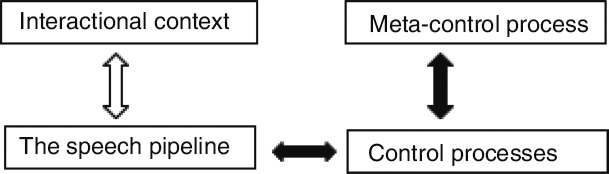
Speech comprehension and production are governed by control processes. We explore their nature and dynamics in bilingual speakers with a focus on speech production. Prior research indicates that individuals increase cognitive control in order to achieve a desired goal. In the adaptive control hypothesis we propose a stronger hypothesis: Language control processes themselves adapt to the recurrent demands placed on them by the interactional context. Adapting a control process means changing a parameter or parameters about the way it works (its neural capacity or efficiency) or the way it works in concert, or in cascade, with other control processes (e.g., its connectedness). We distinguish eight control processes (goal maintenance, conflict monitoring, interference suppression, salient cue detection, selective response inhibition, task disengagement, task engagement, opportunistic planning). We consider the demands on these processes imposed by three interactional contexts (single language, dual language, and dense code-switching). We predict adaptive changes in the neural regions and circuits associated with specific control processes. A dual-language context, for example, is predicted to lead to the adaptation of a circuit mediating a cascade of control processes that circumvents a control dilemma. Effective test of the adaptive control hypothesis requires behavioural and neuroimaging work that assesses language control in a range of tasks within the same individual.
Overview
CoChat Summary
TL;DR
The paper proposes the adaptive control hypothesis: bilingual language control processes themselves adapt to the recurrent demands of three interactional contexts—single-language, dual-language, and dense code-switching—by changing parameters such as neural capacity, efficiency, or coordination. It identifies eight control processes and predicts context-specific behavioural and neural adaptations, especially a dual-language adaptation that circumvents a control dilemma.
Key findings
- The paper distinguishes eight control processes: goal maintenance, conflict monitoring, interference suppression, salient cue detection, selective response inhibition, task disengagement, task engagement, and opportunistic planning.
- It contrasts three interactional contexts: single-language, dual-language, and dense code-switching. Table 1 indicates that single-language context increases demand on goal maintenance and interference control; dual-language context increases demand on goal maintenance, interference control, salient cue detection, selective response inhibition, task disengagement, and task engagement; dense code-switching increases demand on opportunistic planning.
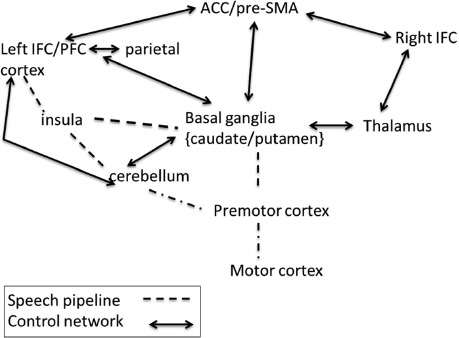
- The hypothesis predicts that dual-language speakers adapt a cascade linking salient cue detection to selective response inhibition, task disengagement, and task engagement to circumvent the control dilemma in which suppression reduces flexibility to switch. Dense code-switching is predicted to adapt a left frontal–right cerebellar circuit for morphosyntactic integration, while single-language context is associated with left inferior regions for suppressing the nontarget language.
- No original quantitative results are reported; the paper is theoretical and offers illustrative behavioural and neuroimaging predictions.
Methods
- Theoretical/review paper with no participants or new empirical data; it proposes the adaptive control hypothesis and derives testable predictions.
- It synthesizes prior work on bilingual language control, cognitive control, neuroimaging, and neuropsychology, using three interactional contexts and eight control processes as an organizing framework.
- The main analysis is conceptual: a table of context-dependent demands and illustrative predictions for behavioural tasks (e.g., cued language switching, Stroop) and neural circuits; it calls for within-individual behavioural and neuroimaging tests across a range of tasks.
Limitations
- The authors state that their illustrative predictions may prove false and that there may be no systematic behavioural or neural differences as a function of interactional context.
- The authors acknowledge circular causation: interactional context may shape adaptive response, but individual differences in predispositions and genetic make-up constrain such effects; they assume individual variation in executive control and sociality is normally distributed.
- The text makes evident that the hypothesis is programmatic and untested in this paper; contexts are idealized, speakers may experience mixtures of contexts, and factors such as proficiency, sensitivity to interaction cost, neuropharmacology, and genetic variation may moderate predicted adaptations.
Model-written summary. Check it against the paper before relying on it.
Integrity signals
Registry
Cites
Statistics
Figures
Verification
Claims the paper makes
0 Valid · 0 Not valid · 30 Not checked · 57 Own results and interpretations
In the paper
“Strikingly, the use of more than one language appears to be a further important factor shaping individual performance on such tasks (e.g., Bialystok, Craik, Green, & Gollan, 2009, for a review).”
§ Language control in bilinguals: The adaptive control hypothesis > Abstract
What the sources say
- Not checked yetcites Bialystok, Craik, Green, & Gollan, 2009 matched to “Bilingual Minds” (2009) source
hedgedstates an association- Asserted: passes — The authors put it forward as true.
- Checkable: passes — It can be checked against evidence.
- Load-bearing: passes — The paper’s conclusions depend on it.
- Based: passes — The paper gives a reason why it holds.
A conclusion the paper draws from its own results — it cites no other source for it, so there is none to check. The quote shows it is in the paper.
In the paper
“In other words, any learning effects during the experiment should be observed earlier for speakers from an interactional context that is best suited to the experimental conditions.”
§ Language control in bilinguals: The adaptive control hypothesis > THE ADAPTIVE CONTROL HYPOTHESIS > Testing the adaptive control hypothesis
plainstates an association- Asserted: passes — The authors put it forward as true.
- Checkable: passes — It can be checked against evidence.
- Load-bearing: passes — The paper’s conclusions depend on it.
- Based: passes — The paper gives a reason why it holds.
In the paper
“acknowledged a role of the pre-SMA in initiating speech in language switching (see Luk et al., 2012, for further discussion).”
§ Language control in bilinguals: The adaptive control hypothesis > THE ADAPTIVE CONTROL HYPOTHESIS > Neuroimaging predictions
What the sources say
- Not checked yetcites Luk et al., 2012 matched to “Cognitive control for language switching in bilinguals: A quantitative meta-analysis of functional neuroimaging studies” (2012) source
plainstates an association- Asserted: passes — The authors put it forward as true.
- Checkable: passes — It can be checked against evidence.
- Load-bearing: unclear — It is unclear whether the paper’s conclusions depend on it.
- Based: passes — The paper gives a reason why it holds.
In the paper
“In Figure 2 we include a direct link between frontal cortex and the right cerebellum as a further circuit involved in language control (Fabbro, Moretti, & Bava, 2000).”
§ Language control in bilinguals: The adaptive control hypothesis > THE ADAPTIVE CONTROL HYPOTHESIS > Neuroimaging predictions
What the sources say
- Not checked yetcites Fabbro, Moretti, & Bava, 2000 matched to “Language impairments in patients with cerebellar lesions” (2000) source
plainstates an association- Asserted: passes — The authors put it forward as true.
- Checkable: passes — It can be checked against evidence.
- Load-bearing: passes — The paper’s conclusions depend on it.
- Based: passes — The paper gives a reason why it holds.
In the paper
“Reperfusion of the cerebellum reduces such symptoms (Marien, Engelborghs, Fabbro, & De Deyn, 2001).”
§ Language control in bilinguals: The adaptive control hypothesis > THE ADAPTIVE CONTROL HYPOTHESIS > Neuroimaging predictions
What the sources say
- Not checked yetcites Marien, Engelborghs, Fabbro, & De Deyn, 2001 matched to “The Lateralized Linguistic Cerebellum: A Review and a New Hypothesis” (2001) source
plainstates a cause- Asserted: passes — The authors put it forward as true.
- Checkable: passes — It can be checked against evidence.
- Load-bearing: unclear — It is unclear whether the paper’s conclusions depend on it.
- Based: passes — The paper gives a reason why it holds.
43 more claims
Create a free account to see all 87 claims and to verify the 30 references still open.
- Probably not a substantial claim. 23
- It may state two separate claims as one. 25
Claims other papers make about this one
Each is checked against this paper’s own text: does it say what the citing paper says it does?
In the citing paper
“Alternating between languages requires not only activation of words in the to-be-attended language but also inhibition of words in the language that should no longer be used (‘language control’; Green & Abutalebi, 2013).”
From Language proficiency drives listening-related fatigue in those who communicate in English as their second language (2026) · cites this paper as Green & Abutalebi, 2013
In the citing paper
“Previous work highlights the cognitive demands of switching between multiple languages within a conversation (Green & Abutalebi, 2013).”
From Language proficiency drives listening-related fatigue in those who communicate in English as their second language (2026) · cites this paper as Green & Abutalebi, 2013
Citations
Cites
Miyake, A., Friedman, N. P., Emerson, M. J., Witzki, A. H., Howerter, A., & Wager, T. D. (2000) · Cognitive Psychology · doi:10.1006/cogp.1999.0734 · Cited by 15,798
Clark, H. H. (1996) · doi:10.1017/cbo9780511620539 · Cited by 5,123
Conflict monitoring and anterior cingulate cortex: an update
Botvinick, M. M., Cohen, J. D., & Carter, C. S. (2004) · Trends in Cognitive Sciences · doi:10.1016/j.tics.2004.10.003 · Cited by 3,623
Anterior Cingulate Conflict Monitoring and Adjustments in Control
Kerns, J. G., Cohen, J. D., MacDonald, A. W., Cho, R. Y., Stenger, V. A., & Carter, C. S. (2004) · Science · doi:10.1126/science.1089910 · Cited by 2,891 · cited 4×
“In addition, there is a demand on frontal structures linked to conflict monitoring and interference suppression (e.g., Kerns et al., 2004) and to parietal regions (and frontal regions) associated with task changes.”
BackgroundInfluentialMental control of the bilingual lexico-semantic system
GREEN, D. W. (1998) · Bilingualism Language and Cognition · doi:10.1017/s1366728998000133 · Cited by 2,807
Self-citationUsing language: Communicative acts
Clark, H. H. (1996) · Cited by 2,721
Using language: Index of names
Clark, H. H. (1996) · Cited by 2,720
The variable nature of cognitive control: a dual mechanisms framework
Braver, T. S. (2012) · Trends in Cognitive Sciences · doi:10.1016/j.tics.2011.12.010 · Cited by 2,482 · cited 1×
“One way to recognise the interplay of these processes is to distinguish proactive control processes that establish a task goal from reactive control processes that limit interference with it (Braver, 2012).”
BackgroundInverted-U–Shaped Dopamine Actions on Human Working Memory and Cognitive Control
Cools, R., & D'Esposito, M. (2011) · Biological Psychiatry · doi:10.1016/j.biopsych.2011.03.028 · Cited by 1,673 · cited 2×
“Neuroimaging data also implicate distinct neural regions in task switching and interference control (e.g., Cools & D’Esposito, 2011).”
BackgroundBilingual language production: The neurocognition of language representation and control
Abutalebi, J., & Green, D. (2007) · Journal of Neurolinguistics · doi:10.1016/j.jneuroling.2006.10.003 · Cited by 1,302 · cited 2×
“In previous papers (e.g., Abutalebi & Green, 2007, 2008), we reviewed work showing that both cortical and subcortical structures are involved in language control and language switching (see Luk, Green, Abutalebi, & Grady, 2012, for a recent metaanalysis).”
BackgroundSelf-citation
Cited by
Items 201–300 of 2,166
Effects of Bilingualism on Verbal and Nonverbal Memory Measures in Mild Cognitive Impairment
Rosselli, M., Loewenstein, D., Curiel, R. E., Peñate, A., Torres, V. L., Lang, M. K., Greig, M. T., Barker, W. W., & Duara, R. (2018) · Journal of the International Neuropsychological Society · doi:10.1017/s135561771800070x · Cited by 62
The importance of bilingual experience in assessing bilingual advantages in executive functions
Yang, H., Hartanto, A., & Yang, S. (2015) · Cortex · doi:10.1016/j.cortex.2015.11.018 · Cited by 62
How aging and bilingualism influence language processing: Theoretical and neural models
Rossi, E., & Diaz, M. T. (2016) · Linguistic Approaches to Bilingualism · doi:10.1075/lab.14029.ros · Cited by 61
How bilingualism protects the brain from aging: Insights from bimodal bilinguals
Li, L., Abutalebi, J., Emmorey, K. D., Gong, G., Yan, X., Feng, X., Zou, L., & Ding, G. (2017) · Human Brain Mapping · doi:10.1002/hbm.23652 · Cited by 61
Self-citationBilingual Language Experience Shapes Resting-State Brain Rhythms
Bice, K., Yamasaki, B. L., & Prat, C. S. (2020) · Neurobiology of Language · doi:10.1162/nol_a_00014 · Cited by 61
Executive control in older Welsh monolinguals and bilinguals
Clare, L., Whitaker, C. J., Martyr, A., Martin‐Forbes, P. A., Bastable, A. J. M., Pye, K. L., Quinn, C., THOMAS, E. M., Gathercole, V. C. M., & Hindle, J. V. (2016) · Journal of Cognitive Psychology · doi:10.1080/20445911.2016.1148041 · Cited by 61
Ware, C., Dautricourt, S., Gonneaud, J., & Chételat, G. (2021) · Frontiers in Aging Neuroscience · doi:10.3389/fnagi.2021.706672 · Cited by 60
Bilingualism and aging: A focused neuroscientific review
Zhang, H., Wu, Y. J., & Thierry, G. (2020) · Journal of Neurolinguistics · doi:10.1016/j.jneuroling.2020.100890 · Cited by 60
The cerebellum and cognition: further evidence for its role in language control
Yuan, Q., Li, H., Du, B., Dang, Q., Chang, Q., Zhang, Z., Zhang, M., Ding, G., Lu, C., & Guo, T. (2022) · Cerebral Cortex · doi:10.1093/cercor/bhac051 · Cited by 60
Pot, A., Porkert, J., & Keijzer, M. C. J. (2019) · Behavioral Sciences · doi:10.3390/bs9090098 · Cited by 60
Zhu, J. D., Blanco-Elorrieta, E., Sun, Y., Szakay, A., & Sowman, P. F. (2021) · NeuroImage · doi:10.1016/j.neuroimage.2021.118797 · Cited by 59
Kang, C., & Lust, B. (2018) · Bilingualism Language and Cognition · doi:10.1017/s1366728918000299 · Cited by 59
Robert, S., & Segerer, G. (2024) · Oxford University Press eBooks · doi:10.1093/oso/9780198736516.003.0011 · Cited by 59
Cognitive control, word retrieval and bilingual aphasia: Is there a relationship?
Faroqi‐Shah, Y., Sampson, M., Pranger, M., & Baughman, S. (2016) · Journal of Neurolinguistics · doi:10.1016/j.jneuroling.2016.07.001 · Cited by 58
Sun, X., Li, L., Ding, G., Wang, R., & Li, P. (2019) · Neuropsychologia · doi:10.1016/j.neuropsychologia.2019.03.020 · Cited by 57
Comparing visual search and eye movements in bilinguals and monolinguals
Ratiu, I., Hout, M. C., Walenchok, S. C., Azuma, T., & Goldinger, S. D. (2017) · Attention Perception & Psychophysics · doi:10.3758/s13414-017-1328-3 · Cited by 57
First language attrition and bilingualism: Adult speakers
Yılmaz, G., & Schmid, M. S. (2018) · Studies in bilingualism · doi:10.1075/sibil.54.11yil · Cited by 57
Research on bilingualism as discovery science
Navarro‐Torres, C. A., Beatty‐Martínez, A. L., Kroll, J. F., & Green, D. W. (2021) · Brain and Language · doi:10.1016/j.bandl.2021.105014 · Cited by 57
Self-citationCognitive control in bilinguals: Effects of language experience and individual variability
Bonfieni, M., Branigan, H. P., Pickering, M. J., & Sorace, A. (2019) · Bilingualism Language and Cognition · doi:10.1017/s1366728918001086 · Cited by 57
Heidlmayr, K. D.-M., Hemforth, B., Moutier, S., & Isel, F. (2015) · Frontiers in Psychology · doi:10.3389/fpsyg.2015.00821 · Cited by 56
Serratrice, L., & CAT, C. D. (2019) · Bilingualism Language and Cognition · doi:10.1017/s1366728918000962 · Cited by 56
Inhibitory control of the dominant language: Reversed language dominance is the tip of the iceberg
Goldrick, M., & Gollan, T. H. (2023) · Journal of Memory and Language · doi:10.1016/j.jml.2023.104410 · Cited by 56
Justice and equity for whom? Reframing research on the “bilingual (dis)advantage”
Luk, G. (2022) · Applied Psycholinguistics · doi:10.1017/s0142716422000339 · Cited by 55
Language context modulates executive control in bilinguals: Evidence from language production
Jiao, L., Grundy, J. G., Liu, C., & Chen, B. (2020) · Neuropsychologia · doi:10.1016/j.neuropsychologia.2020.107441 · Cited by 55
On the encapsulation of bilingual language control
Paap, K. R., Anders-Jefferson, R. T., Mikulinsky, R., Masuda, S., & Mason, L. (2018) · Journal of Memory and Language · doi:10.1016/j.jml.2018.12.001 · Cited by 55
Am I truly monolingual? Exploring foreign language experiences in monolinguals
Castro, S., Wodniecka, Z., & Timmer, K. (2022) · PLoS ONE · doi:10.1371/journal.pone.0265563 · Cited by 55
Two is better than one: bilingual education promotes the flexible mind
Christoffels, I. K., de Haan, A. M., Steenbergen, L., van den Wildenberg, W. P. M., & Colzato, L. S. (2014) · Psychological Research · doi:10.1007/s00426-014-0575-3 · Cited by 54
Bilingualism influences structural indices of interhemispheric organization
Felton, A., Vazquez, D., Ramos-Nuñez, A. I., Greene, M. R., Macbeth, A., Hernández, A. E., & Chiarello, C. (2016) · Journal of Neurolinguistics · doi:10.1016/j.jneuroling.2016.10.004 · Cited by 54
Ong, G., Sewell, D. K., Weekes, B., McKague, M., & Abutalebi, J. (2016) · Journal of Neurolinguistics · doi:10.1016/j.jneuroling.2016.08.002 · Cited by 53
Self-citationBlumenfeld, H. K., Schroeder, S. R., Bobb, S. C., Freeman, M. R., & Marian, V. (2016) · Linguistic Approaches to Bilingualism · doi:10.1075/lab.14030.blu · Cited by 53
Tiv, M., Gullifer, J. W., Feng, R. Y., & Titone, D. A. (2020) · Journal of Neurolinguistics · doi:10.1016/j.jneuroling.2020.100913 · Cited by 53
Code-switching and language control
Green, D. W., & Wei, L. (2016) · Bilingualism Language and Cognition · doi:10.1017/s1366728916000018 · Cited by 53
Self-citationThe Interface Hypothesis as a Framework for Studying L1 Attrition
Chamorro, G., & Sorace, A. (2019) · Oxford University Press eBooks · doi:10.1093/oxfordhb/9780198793595.013.42 · Cited by 53
Variation in language mixing in multilingual aphasia
Goral, M., Norvik, M., & Jensen, B. U. (2019) · Clinical Linguistics & Phonetics · doi:10.1080/02699206.2019.1584646 · Cited by 52
Zinszer, B. D., Anderson, A. J., Kang, O. E., Wheatley, T. P., & Raizada, R. D. S. (2016) · Journal of Cognitive Neuroscience · doi:10.1162/jocn_a_01000 · Cited by 52
Montgomery, L., Chondrogianni, V., Fletcher‐Watson, S., Rabagliati, H., Sorace, A., & Davis, R. (2021) · Journal of Autism and Developmental Disorders · doi:10.1007/s10803-021-05234-y · Cited by 52
Bilingualism and working memory performance: Evidence from a large-scale online study
Lukasik, K. M., Lehtonen, M., Soveri, A., Waris, O., Jylkkä, J., & Laine, M. (2018) · PLoS ONE · doi:10.1371/journal.pone.0205916 · Cited by 52
Neural correlates of grammatical inflection in older native and second-language speakers
Prehn, K., Taud, B., Reifegerste, J., Clahsen, H., & Flöel, A. (2017) · Bilingualism Language and Cognition · doi:10.1017/s1366728916001206 · Cited by 52
Cognitive advantages of immersion education after 1 year: Effects of amount of exposure
Purić, D., Vuksanović, J., & Chondrogianni, V. (2017) · Journal of Experimental Child Psychology · doi:10.1016/j.jecp.2017.02.011 · Cited by 51
Bilinguals’ Working Memory (WM) Advantage and Their Dual Language Practices
Yang, E. (2017) · Brain Sciences · doi:10.3390/brainsci7070086 · Cited by 51
Zheng, B., Báez, S., Su, L., Xia, X., Weis, S., Ibáñez, A. M., & García, A. M. (2020) · Brain and Cognition · doi:10.1016/j.bandc.2020.105584 · Cited by 51
Examining bilingual language switching across the lifespan in cued and voluntary switching contexts.
de Bruin, A., Samuel, A. G., & Duñabeitia, J. A. (2020) · Journal of Experimental Psychology Human Perception & Performance · doi:10.1037/xhp0000746 · Cited by 51
Ideologies of Language, Bilingualism, and Monolingualism
Fuller, J. M. (2018) · Cambridge University Press eBooks · doi:10.1017/9781316831922.007 · Cited by 51
Prosodic structures and templates in bilingual phonological development
Vihman, M. M. (2015) · Bilingualism Language and Cognition · doi:10.1017/s1366728914000790 · Cited by 51
Kang, C., Fu, Y., Wu, J., Ma, F., Lu, C., & Guo, T. (2017) · Human Brain Mapping · doi:10.1002/hbm.23765 · Cited by 51
Language control in bilingual language comprehension: evidence from the maze task
Wang, X. (2015) · Frontiers in Psychology · doi:10.3389/fpsyg.2015.01179 · Cited by 51
Interactive Alignment and Lexical Triggering of Code-Switching in Bilingual Dialogue
Kootstra, G. J., Dijkstra, T., & van Hell, J. G. (2020) · Frontiers in Psychology · doi:10.3389/fpsyg.2020.01747 · Cited by 51
Slevc, L. R., Davey, N. S., & Linck, J. A. (2016) · Journal of Cognitive Psychology · doi:10.1080/20445911.2016.1152274 · Cited by 51
Paap, K. R. (2018) · Cambridge University Press eBooks · doi:10.1017/9781316831922.023 · Cited by 50
Reifegerste, J., Elin, K., & Clahsen, H. (2018) · Bilingualism Language and Cognition · doi:10.1017/s1366728918000615 · Cited by 50
Recognizing the Effects of Language Mode on the Cognitive Advantages of Bilingualism
Yu, Z., & Schwieter, J. W. (2018) · Frontiers in Psychology · doi:10.3389/fpsyg.2018.00366 · Cited by 50
Translanguaging: a pedagogical concept that went wandering
Singleton, D., & Flynn, C. J. (2021) · International Multilingual Research Journal · doi:10.1080/19313152.2021.1985692 · Cited by 49
The Morphophonology of Intraword Codeswitching: Representation and Processing
Stefanich, S., Cabrelli, J., Hilderman, D., & Archibald, J. (2019) · Frontiers in Communication · doi:10.3389/fcomm.2019.00054 · Cited by 49
The effects of bilingualism on attentional processes in the first year of life
Kalashnikova, M., Pejović, J., & Carreiras, M. (2020) · Developmental Science · doi:10.1111/desc.13011 · Cited by 48
Hernández, A. E., Greene, M. R., Vaughn, K. A., Francis, D. J., & Grigorenko, E. L. (2015) · Journal of Neurolinguistics · doi:10.1016/j.jneuroling.2015.04.002 · Cited by 48
Coemans, S., Struys, E., Vandenborre, D., Wilssens, I., Engelborghs, S., Paquier, P. F., Tsapkini, K., & Keulen, S. (2021) · Frontiers in Aging Neuroscience · doi:10.3389/fnagi.2021.710818 · Cited by 48
Hartanto, A., & Yang, H. (2019) · Journal of Experimental Psychology Learning Memory and Cognition · doi:10.1037/xlm0000581 · Cited by 48
der Linden, L. V., de Putte, E. V., Woumans, E., Duyck, W., & Szmalec, A. (2018) · Frontiers in Psychology · doi:10.3389/fpsyg.2018.01998 · Cited by 48
Neural correlates of intra-sentential code-switching in the auditory modality
Fernandez, C. B., Litcofsky, K. A., & van Hell, J. G. (2019) · Journal of Neurolinguistics · doi:10.1016/j.jneuroling.2018.10.004 · Cited by 35
Kang, C., Ma, F., Li, S., Kroll, J. F., & Guo, T. (2020) · Bilingualism Language and Cognition · doi:10.1017/s1366728920000085 · Cited by 47
Westergaard, M. R., Mitrofanova, N., Rodina, Y., & Slabakova, R. (2023) · Cambridge University Press eBooks · doi:10.1017/9781108957823.010 · Cited by 47
Becoming Bilingual in Early Childhood
Serratrice, L. (2018) · Cambridge University Press eBooks · doi:10.1017/9781316831922.002 · Cited by 47
Anderson, J. A. E., Grundy, J. G., Grady, C. L., Craik, F. I. M., & Bialystok, E. (2021) · Neuropsychologia · doi:10.1016/j.neuropsychologia.2021.108071 · Cited by 47
Bilingual exposure enhances left IFG specialization for language in children
Arredondo, M. M., Hu, X., SEIFERT, E., Satterfield, T., & Kovelman, I. (2018) · Bilingualism Language and Cognition · doi:10.1017/s1366728918000512 · Cited by 47
Bilingualism as a Slice of Swiss Cheese
Bialystok, E. (2021) · Frontiers in Psychology · doi:10.3389/fpsyg.2021.769323 · Cited by 47
Carpenter, E., Rao, L., Peñaloza, C., & Kiran, S. (2020) · Aphasiology · doi:10.1080/02687038.2020.1759774 · Cited by 46
Comparative African Linguistics
Dimmendaal, G. J. (2019) · Cambridge University Press eBooks · doi:10.1017/9781108283991.007 · Cited by 46
Wang, R., Ke, S., Zhang, Q., Zhou, K., Li, P., & Yang, J. (2020) · Journal of Neurolinguistics · doi:10.1016/j.jneuroling.2020.100940 · Cited by 46
Gallo, F., Novitskiy, N., Myachykov, A. V., & Юрьевич, Ш. Ю. (2020) · Bilingualism Language and Cognition · doi:10.1017/s1366728920000486 · Cited by 46
Mouthon, M., Khateb, A., Lazeyras, F., Pegna, A. J., Lee-Jahnke, H., Lehr, C., & Annoni, J. (2019) · Bilingualism Language and Cognition · doi:10.1017/s1366728918001141 · Cited by 46
The bilingual advantage in the Stroop task: simultaneous vs. early bilinguals
Sabourin, L., & Vīnerte, S. (2014) · Bilingualism Language and Cognition · doi:10.1017/s1366728914000704 · Cited by 46
The Adaptive Bilingual Mind: Insights from Endangered Languages
Adamou, E. (2021) · Cambridge University Press eBooks · doi:10.1017/9781108884266 · Cited by 46
Chamorro, G., & Janke, V. (2020) · International Journal of Bilingual Education and Bilingualism · doi:10.1080/13670050.2020.1799323 · Cited by 45
Blanco-Elorrieta, E., & Caramazza, A. (2021) · Neurobiology of Language · doi:10.1162/nol_a_00041 · Cited by 45
Bilingual language interference initiates error detection: Evidence from language intrusions
Declerck, M., Lemhöfer, K., & Grainger, J. (2016) · Bilingualism Language and Cognition · doi:10.1017/s1366728916000845 · Cited by 45
Babcock, L., & Vallesi, A. (2015) · Frontiers in Psychology · doi:10.3389/fpsyg.2015.01622 · Cited by 45
Comparative Effects of Education and Bilingualism on the Onset of Mild Cognitive Impairment
Ramakrishnan, S., Mekala, S., Mamidipudi, A., Yareeda, S., Kandadai, R. M., Bak, T. H., Alladi, S., & Kaul, S. (2017) · Dementia and Geriatric Cognitive Disorders · doi:10.1159/000479791 · Cited by 45
Language balance and switching ability in children acquiring English as a second language
Goriot, C., Broersma, M., McQueen, J. M., Unsworth, S., & van Hout, R. W. N. M. (2018) · Journal of Experimental Child Psychology · doi:10.1016/j.jecp.2018.03.019 · Cited by 44
Jylkkä, J., Soveri, A., Wahlström, J., Lehtonen, M., Rodríguez‐Fornells, A., & Laine, M. (2017) · Journal of Cognitive Psychology · doi:10.1080/20445911.2017.1282489 · Cited by 44
Bilingualism and “brain reserve”: a matter of age
Heim, S., Stumme, J., Bittner, N., Jockwitz, C., Amunts, K., & Caspers, S. (2019) · Neurobiology of Aging · doi:10.1016/j.neurobiolaging.2019.05.021 · Cited by 44
Xie, Z. (2018) · Frontiers in Psychology · doi:10.3389/fpsyg.2018.00412 · Cited by 43
Bilingualism: A Neurocognitive Exercise in Managing Uncertainty
Gullifer, J. W., & Titone, D. A. (2021) · Neurobiology of Language · doi:10.1162/nol_a_00044 · Cited by 43
The Complexity in Bilingual Code-Switching Research: A Systematic Review
Rayo, W., Barrita, A. M., Martinez, L. C., & Carbajal, I. (2024) · Languages · doi:10.3390/languages9060217 · Cited by 43
Jiao, L., Liu, C., Liang, L., Plummer, P., Perfetti, C. A., & Chen, B. (2019) · Quarterly Journal of Experimental Psychology · doi:10.1177/1747021818821601 · Cited by 43
Singh, N., & Mishra, R. K. (2015) · Frontiers in Psychology · doi:10.3389/fpsyg.2014.01481 · Cited by 43
Zhang, H., Diaz, M. T., Guo, T., & Kroll, J. F. (2021) · Brain and Language · doi:10.1016/j.bandl.2021.105043 · Cited by 43
Maschio, N. D., Sulpizio, S., Toti, M., Caprioglio, C., Mauro, G. D., Fedeli, D., & Abutalebi, J. (2019) · Journal of Cultural Cognitive Science · doi:10.1007/s41809-019-00039-z · Cited by 43
Self-citationAssessing the implications of migrant multilingualism for language education
Poarch, G. J., & Bialystok, E. (2017) · Zeitschrift für Erziehungswissenschaft · doi:10.1007/s11618-017-0739-1 · Cited by 43
Executive control mechanisms in bilingualism: Beyond speed of processing
Marton, K., Goral, M., Campanelli, L., Yoon, J., & Obler, L. K. (2016) · Bilingualism Language and Cognition · doi:10.1017/s1366728915000930 · Cited by 43
Tosun, S., & Filipović, L. (2022) · Bilingualism Language and Cognition · doi:10.1017/s1366728922000141 · Cited by 43
Bilingualism and language similarity modify the neural mechanisms of selective attention
Olguin, A., Cekic, M., Bekinschtein, T. A., Katsos, N., & Božić, M. (2019) · Scientific Reports · doi:10.1038/s41598-019-44782-3 · Cited by 43
Becker, T. M., Prat, C. S., & Stocco, A. (2016) · Neuropsychologia · doi:10.1016/j.neuropsychologia.2016.01.020 · Cited by 42
Expertise, ecosystem, and emergentism: Dynamic developmental bilingualism
Claussenius‐Kalman, H. L., Hernández, A. E., & Li, P. (2021) · Brain and Language · doi:10.1016/j.bandl.2021.105013 · Cited by 42
Does bilingualism influence neuropsychological test performance in older adults? A systematic review
Çelik, S., Kokje, E., Meyer, P., Frölich, L., & Teichmann, B. (2020) · Applied Neuropsychology Adult · doi:10.1080/23279095.2020.1788032 · Cited by 42
Bailey, L. M., Lockary, K., & Higby, E. (2023) · Bilingualism Language and Cognition · doi:10.1017/s1366728923000597 · Cited by 42
Bilingualism and Dementia: Cognitive Reserve to Linguistic Competency
Mendez, M. F. (2019) · Journal of Alzheimer s Disease · doi:10.3233/jad-190397 · Cited by 42
Songbirds can learn flexible contextual control over syllable sequencing
Veit, L., Tian, L. Y., Hernandez, C. M., & Brainard, M. S. (2021) · eLife · doi:10.7554/elife.61610 · Cited by 42
Pliatsikas, C., Soares, S. M. P., Voits, T., DeLuca, V., & Rothman, J. (2021) · Scientific Reports · doi:10.1038/s41598-021-86443-4 · Cited by 42
Multilingualism across the Lifespan
Blackwood, R. J., & Røyneland, U. (2021) · Routledge eBooks · doi:10.4324/9781003125815 · Cited by 42
Xie, Z., & Dong, Y. (2015) · Bilingualism Language and Cognition · doi:10.1017/s1366728915000474 · Cited by 41
Metadata
- Authors
- Green, D. W., & Abutalebi, J.
- Affiliations
- University College London (GB)
- Vita-Salute San Raffaele University (IT)
- Corresponding author
- Green, David W.
- Venue
- Journal of Cognitive Psychology
- Publisher
- Informa UK Limited
- Published
- 2013-05-24
- Volume
- 25
- Issue
- 5
- Pages
- 515-530
- ISSN
- 2044-5911 (ISSN-L)
- 2044-592X
- PMC
- PMC4095950
- OpenAlex
- W2128442137
- Cited by
- 2,163
- References
- 62
- Citations by year
- 2026: 264 · 2025: 271 · 2024: 222 · 2023: 211 · 2022: 197 · 2021: 160 · 2020: 154 · 2019: 254 · 2018: 164 · 2017: 90 · 2016: 82 · 2015: 61 · 2014: 27 · 2013: 3
- FWCI
- 21.17
- Type
- journal article
- Language
- en
- Open access
- hybrid
- doi.org
- Licence
- cc-by
- Locations
- Journal of Cognitive Psychology (publishedVersion, cc-by)
- PubMed Central (publishedVersion, cc-by)
- Europe PMC (PubMed Central) (publishedVersion, cc-by)
- PubMed (publishedVersion)
- UCL Discovery (University College London) (submittedVersion)
- Archivio Istituzionale della Ricerca - Università Vita-Salute San Raffaele (submittedVersion)
- Topics
- Life Sciences › Neuroscience › Cognitive Neuroscience › Neurobiology of Language and Bilingualism
- Social Sciences › Psychology › Developmental and Educational Psychology › Language Development and Disorders
- Life Sciences › Neuroscience › Cognitive Neuroscience › Neural and Behavioral Psychology Studies
- Keywords
- language control, bilingualism, cognitive control, speech production, code-switching, control processes, interference suppression, conflict monitoring, task disengagement, task engagement, goal maintenance, opportunistic planning, neural circuits
About these checks
Registry, retraction, Cites and statistics results are computed, not judged, with one exception: a printed reference that no index lists is read once by a model before it counts as a citation error. Claims are extracted by a model and kept only when their quote appears verbatim in the text; each cited source is then checked, with a model’s help, for whether it says what the claim relies on. Those verdicts can be wrong — read the claim’s quote and the cited source before relying on one.
A language model drew the claims from the paper on 2026-11-24, under version 3 of the claim definition (model deepseek-v4.1-flash, prompt extract-v3).
A second model labelled each claim on 2026-11-24 (model jev-1.13-20260917, definition revision gold-guideline-v0.2).
Statistics and arithmetic are recomputed, not judged.
Confidence bands are shown only for fields calibrated on our annotated test set. None is calibrated yet, so no band is shown.
What counts as a claim ›How we measure confidence ›How we check this ›
Are you an author, or do you see a problem with this page? Request a review
Data sources
Bibliographic data: Semantic Scholar, OpenAlex, Crossref.
Contains information from the Semantic Scholar Academic Graph Datasets, made available under the ODC Attribution License (ODC-BY 1.0).
Semantic Scholar’s data is described in: Kinney, R., et al. (2023). The Semantic Scholar Open Data Platform. arXiv:2301.10140.
