

The DOI matches its Crossref record; 10 of the 10 references it cites were found in a registry or an index.
Rho GTPases, their post-translational modifications, disease-associated mutations and pharmacological inhibitors
Overview
The claims and statistics of this paper haven’t been checked yet.
Run the check — free, no account needed. It reads the open-access text and checks the sources it cites.
Integrity signals
Registry
Cites
Statistics
Figures
Verification
Claims the paper makes
The claims and statistics of this paper haven’t been checked yet.
Run the check — free, no account needed. It reads the open-access text and checks the sources it cites.
Claims other papers make about this one
Each is checked against this paper’s own text: does it say what the citing paper says it does?
In the citing paper
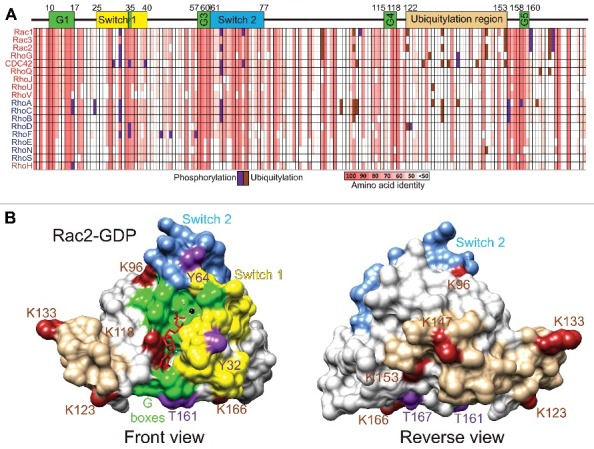
“RHOH residue lysine (Lys) 34 (K34), which belongs to the switch I domain [51], was located at the interface with NMHC IIA (Fig 5B).”
From Nascent RHOH acts as a molecular brake on actomyosin-mediated effector functions of inflammatory neutrophils (2022) · cites this paper as [51]
Self-check
Percentages, sums and reported differences re-computed from the paper’s own numbers.
The self-check needs the paper’s full text.
Citations
Cites
A landscape of driver mutations in melanoma
Hodis, E., Watson, I. R., Kryukov, G. V., Arold, S. T., Imielinski, M., Theurillat, J.-P., Nickerson, E., Auclair, D., Li, L., Place, C., et al. (2012) · Cell · doi:10.1016/j.cell.2012.06.024 · Cited by 2,610
A Comprehensive Survey of Ras Mutations in Cancer
Prior, I. A., Lewis, P. D., & Mattos, C. (2012) · Cancer Research · doi:10.1158/0008-5472.can-11-2612 · Cited by 2,063 · cited 1×
“quencies of activating mutations in human cancers that work by reducing intrinsic and/or GAP-induced GTPase activity, thereby locking the protein in the on-state.(51) Similar GTPase deficient mutations have not been”
BackgroundPhysiological concentrations of purines and pyrimidines
Traut, T. W. (1994) · Molecular and Cellular Biochemistry · doi:10.1007/bf00928361 · Cited by 1,867
Shutes, A., Onesto, C., Picard, V., Leblond, B., Schweighoffer, F., & Der, C. J. (2007) · Journal of Biological Chemistry · doi:10.1074/jbc.m703571200 · Cited by 336
Human RHOH deficiency causes T cell defects and susceptibility to EV-HPV infections
Crequer, A., Troeger, A., Patin, E., Ma, C. S., Picard, C., Pedergnana, V., Fieschi, C., Lim, A., Abhyankar, A., Gineau, L., et al. (2012) · Journal of Clinical Investigation · doi:10.1172/jci62949 · Cited by 159
Li, X., Bu, X., Lu, B., Avraham, H., Flavell, R. A., & Lim, B. (2002) · Molecular and Cellular Biology · doi:10.1128/mcb.22.4.1158-1171.2002 · Cited by 153
Gu, Y., Chae, H.-D., Siefring, J. E., Jasti, A. C., Hildeman, D. A., & Williams, D. A. (2006) · Nature Immunology · doi:10.1038/ni1396 · Cited by 110
Hematopoietic-specific Rho GTPases Rac2 and RhoH and human blood disorders
Troeger, A., & Williams, D. A. (2013) · Experimental Cell Research · doi:10.1016/j.yexcr.2013.07.002 · Cited by 73
The small GTPase RhoH is an atypical regulator of haematopoietic cells
Fueller, F., & Kubatzky, K. F. (2008) · Cell Communication and Signaling · doi:10.1186/1478-811x-6-6 · Cited by 40
Underexpression of RhoH in Hairy Cell Leukemia
Galiègue-Zouitina, S., Delestré, L., Dupont, C., Troussard, X., & Shelley, C. S. (2008) · Cancer Research · doi:10.1158/0008-5472.can-07-5661 · Cited by 34
Research works printed but not linked: 105
- 10.1016/0092-8674(85)90058-3 · DOI
- 10.1083/jcb.111.3.1001 · DOI
- 10.1016/0092-8674(92)90163-7 · DOI
- 10.1016/0092-8674(92)90164-8 · DOI
- 10.1016/0092-8674(95)90370-4 · DOI
- 10.1128/MCB.15.4.1942 · DOI
- 10.1016/j.cellsig.2014.09.022 · DOI
- 10.4161/sgtp.29710 · DOI
- 10.1038/nrm3802 · DOI
- 10.4161/sgtp.27539 · DOI
- 10.4161/sgtp.29716 · DOI
- 10.1038/nrm1365 · DOI
- 10.1016/j.cell.2007.05.018 · DOI · Paper page
- 10.1016/j.febslet.2013.05.021 · DOI
- 10.1093/molbev/msl145 · DOI · Paper page
- 10.1093/nar/16.22.10881 · DOI
- 10.1016/j.molcel.2009.02.023 · DOI · Paper page
- 10.1016/j.tcb.2012.04.004 · DOI
- 10.1073/pnas.1207358109 · DOI
- 10.1182/blood-2011-12-397844 · DOI
- 10.1074/jbc.M114.547596 · DOI · Paper page
- 10.1093/hmg/7.9.1463 · DOI
- 10.1016/j.molcel.2009.03.008 · DOI
- 10.1371/journal.pone.0028587 · DOI
- 10.1074/jbc.M307021200 · DOI
- 10.1523/JNEUROSCI.5449-13.2014 · DOI · Paper page
- 10.1074/jbc.275.1.423 · DOI
- 10.1111/j.1462-5822.2009.01373.x · DOI
- 10.1167/iovs.13-11955 · DOI
- 10.1128/MCB.11.7.3682 · DOI
- 10.1038/cr.2010.154 · DOI
- 10.1074/jbc.272.33.20384 · DOI · Paper page
- 10.1128/MCB.12.7.3138 · DOI
- 10.1101/gad.894301 · DOI
- 10.1128/MCB.20.24.9364-9375.2000 · DOI · Paper page
- 10.1016/j.bbrc.2003.10.100 · DOI
- 10.1126/science.1090772 · DOI · Paper page
- 10.1126/science.1105718 · DOI · Paper page
- 10.1016/j.bbamcr.2013.07.005 · DOI · Paper page
- 10.1016/j.molcel.2009.09.004 · DOI · Paper page
- 10.1186/1476-4598-13-76 · DOI
- 10.1038/onc.2012.189 · DOI
- 10.1016/j.devcel.2011.08.015 · DOI
- 10.1038/emboj.2011.423 · DOI
- 10.1096/fj.12-223099 · DOI
- 10.1093/hmg/ddh215 · DOI
- 10.1038/nm1621 · DOI
- Daugaard M, Nitsch R, Razaghi B, McDonald L, Jarrar A, Torrino S, Castillo-Lluva S, Rotblat B, Li L, Malliri A, et al. Hace1 controls ROS generation of vertebrate Rac1-dependent NADPH oxidase complexes. Nature Commun 2013; 4; PMID:NOT_FOUND
- 10.1038/onc.2014.468 · DOI
- 10.1161/01.RES.0000204727.46710.5e · DOI
- Williams DA, Tao W, Yang F, Kim C, Gu Y, Mansfield P, Levine JE, Petryniak B, Derrow CW, Harris C, et al. Dominant negative mutation of the hematopoietic-specific Rho GTPase, Rac2, is associated with a human phagocyte immunodeficiency. Blood 2000; 96:1646-54; PMID:10961859
- 10.1073/pnas.080074897 · DOI · Paper page
- 10.1016/j.jaci.2010.10.013 · DOI · Paper page
- 10.1016/j.jaci.2014.10.039 · DOI · Paper page
- 10.1073/pnas.83.23.8868 · DOI
- 10.1021/bi0490901 · DOI
- 10.1016/S0960-9822(06)00338-1 · DOI
- 10.1038/ng.2359 · DOI · Paper page
- 10.1126/science.1208130 · DOI
- 10.1073/pnas.1216141110 · DOI
- 10.1038/sj.onc.1203233 · DOI
- 10.1038/sj.onc.1203621 · DOI · Paper page
- 10.1101/gr.140988.112 · DOI
- 10.1530/EJE-12-0960 · DOI
- 10.1158/1541-7786.MCR-13-0557-T · DOI
- 10.1038/ng.2916 · DOI
- 10.1038/ng.2872 · DOI
- 10.1038/ng.2873 · DOI
- 10.1002/gcc.22202 · DOI
- 10.1038/ng.2984 · DOI
- 10.1093/emboj/17.5.1350 · DOI
- 10.1074/jbc.M100254200 · DOI
- 10.1016/j.cell.2008.09.043 · DOI
- Dallery E, Galiegue-Zouitina S, Collyn-d'Hooghe M, Quief S, Denis C, Hildebrand MP, Lantoine D, Deweindt C, Tilly H, Bastard C, et al. TTF, a gene encoding a novel small G protein, fuses to the lymphoma- associated LAZ3 gene by t(3;4) chromosomal translocation. Oncogene 1995; 10:2171-8; PMID:7784061
- 10.1038/35085588 · DOI · Paper page
- 10.1038/sj.onc.1203521 · DOI · Paper page
- 10.1111/j.1600-0609.2008.01132.x · DOI · Paper page
- 10.1182/blood-2006-04-019034 · DOI · Paper page
- 10.3390/cells5020028 · DOI
- 10.1073/pnas.212516099 · DOI
- 10.1016/j.canlet.2004.10.047 · DOI
- 10.1080/02841860701644094 · DOI
- 10.1007/s00432-005-0033-0 · DOI
- 10.1111/j.1745-7254.2008.00773.x · DOI
- 10.1042/bj20031041 · DOI
- 10.1016/j.yexcr.2008.09.005 · DOI
- 10.1007/s10585-008-9174-2 · DOI
- 10.2217/fon.11.143 · DOI
- 10.1073/pnas.0307512101 · DOI · Paper page
- 10.1074/jbc.M507913200 · DOI
- 10.1042/BC20060023 · DOI
- 10.1016/j.chembiol.2009.04.012 · DOI
- 10.1073/pnas.1212324110 · DOI
- 10.1016/j.chembiol.2012.05.009 · DOI
- 10.1016/j.chembiol.2006.02.009 · DOI
- 10.1172/JCI60282 · DOI
- 10.1177/1087057109352240 · DOI
- 10.1074/jbc.M112.435941 · DOI
- 10.1021/jm200161c · DOI
- 10.1038/onc.2012.99 · DOI
- 10.1111/jth.12861 · DOI · Paper page
- 10.1002/jcc.20084 · DOI
- 10.1038/msb.2011.75 · DOI
- 10.1074/jbc.M806531200 · DOI
- 10.1128/MCB.01646-09 · DOI
Cited by
Lagresle-Peyrou, C., Olichon, A., Sadek, H., Roche, P., Tardy, C., Silva, C. D., Garrigue, A., Fischer, A., Moshous, D., Collette, Y., et al. (2020) · Haematologica · doi:10.3324/haematol.2019.230250 · Cited by 35
Structure-based design of CDC42 effector interaction inhibitors for the treatment of cancer
Jahid, S., Ortega, J. A., Vuong, L. M., Acquistapace, I. M., Hachey, S. J., Flesher, J. L., La Serra, M. A., Brindani, N., La Sala, G., Manigrasso, J., et al. (2022) · Cell Reports · doi:10.1016/j.celrep.2022.110641 · Cited by 21
Peng, S., Stojkov, D., Gao, J., Oberson, K., Latzin, P., Casaulta, C., Yousefi, S., & Simon, H.-U. (2022) · PLOS Biology · doi:10.1371/journal.pbio.3001794 · Cited by 15
Metadata
- Authors
- Olson, M. F.
- Affiliations
- Cancer Research UK Beatson Institute, Garscube Estate, Glasgow, UK
- Venue
- Small GTPases
- Publisher
- Informa UK Limited
- Published
- 2016-08-22
- Volume
- 9
- Issue
- 3
- Pages
- 203-215
- ISSN
- 2154-1248
- 2154-1256
- PMC
- PMC5927519
- Cited by
- 96
- References
- 10
- Language
- en
- Funders
- Cancer Research UK (A18276)
- Medical Research Council (MR/M018776/1)
- Engineering and Physical Sciences Research Council (EP/N014642/1)
About these checks
Registry, retraction, Cites and statistics results are computed, not judged, with one exception: a printed reference that no index lists is read once by a model before it counts as a citation error. Claims are extracted by a model and kept only when their quote appears verbatim in the text; each cited source is then checked, with a model’s help, for whether it says what the claim relies on. Those verdicts can be wrong — read the claim’s quote and the cited source before relying on one.
Statistics and arithmetic are recomputed, not judged.
Confidence bands are shown only for fields calibrated on our annotated test set. None is calibrated yet, so no band is shown.
What counts as a claim ›How we measure confidence ›How we check this ›
Are you an author, or do you see a problem with this page? Request a review
How to cite
Cite CoChat for the checks on this page, and the paper for its own findings.
- This page
- CoChat. (2026). Citation check: Rho GTPases, their post-translational modifications, disease-associated mutations and pharmacological inhibitors. https://app.cochat.ai/papers/10.1080/21541248.2016.1218407
- The paper
- Olson, M. F. (2018). Rho GTPases, their post-translational modifications, disease-associated mutations and pharmacological inhibitors. Small GTPases. https://doi.org/10.1080/21541248.2016.1218407
