

CD133-directed CAR T cells for advanced metastasis malignancies: A phase I trial
Open accessThe DOI matches its Crossref record; 42 of the 42 references it cites were found in a registry or an index.
Abstract
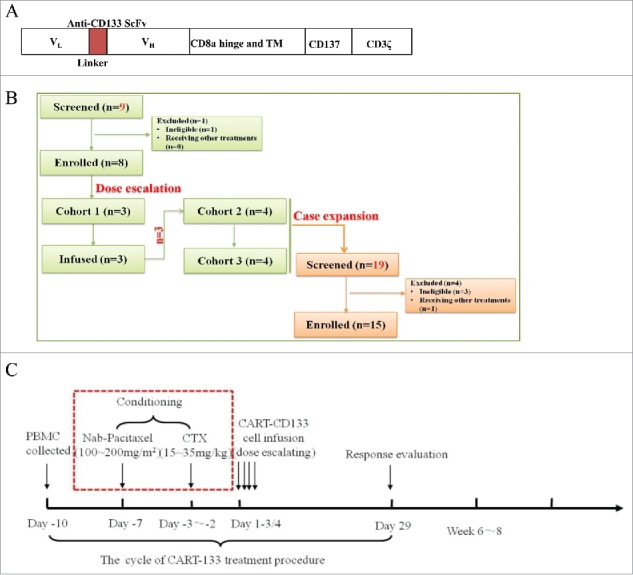
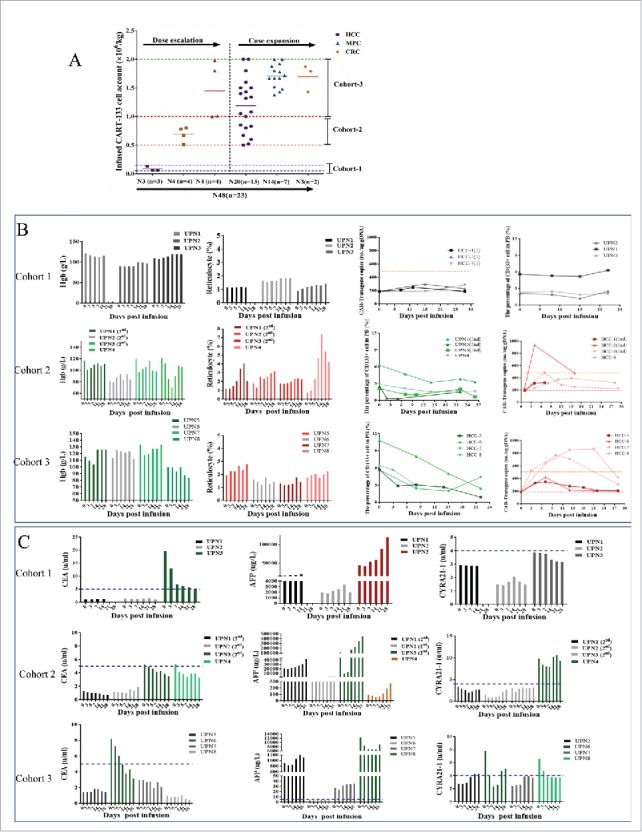
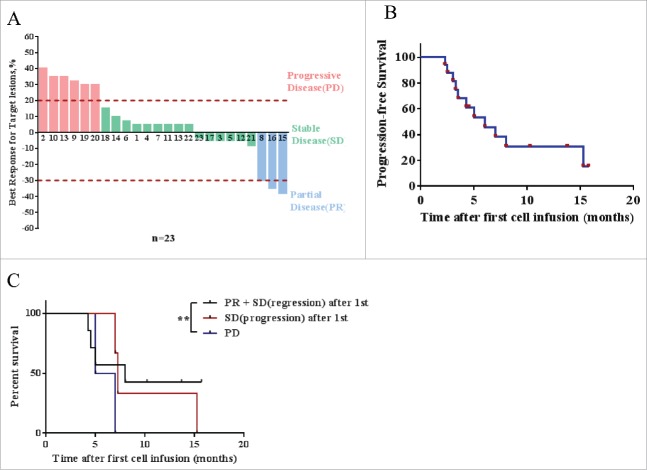
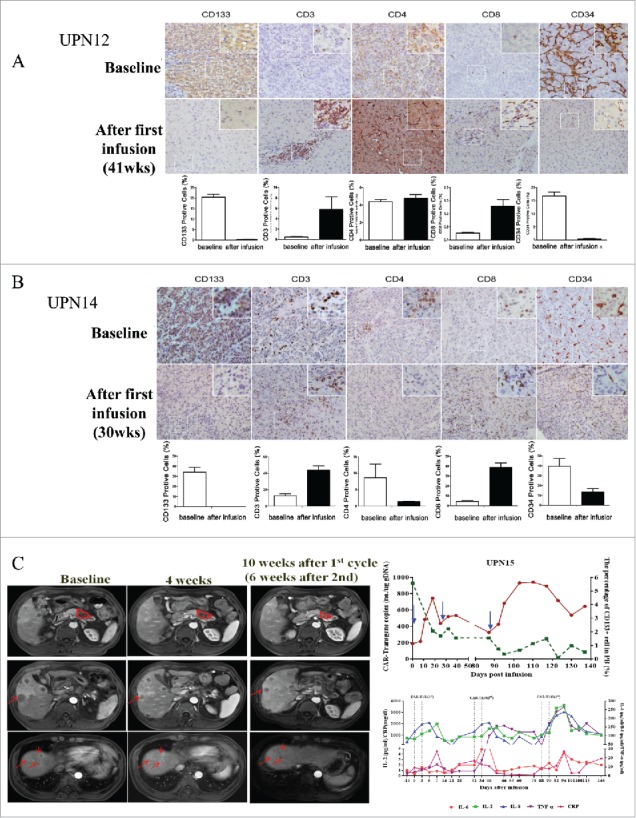
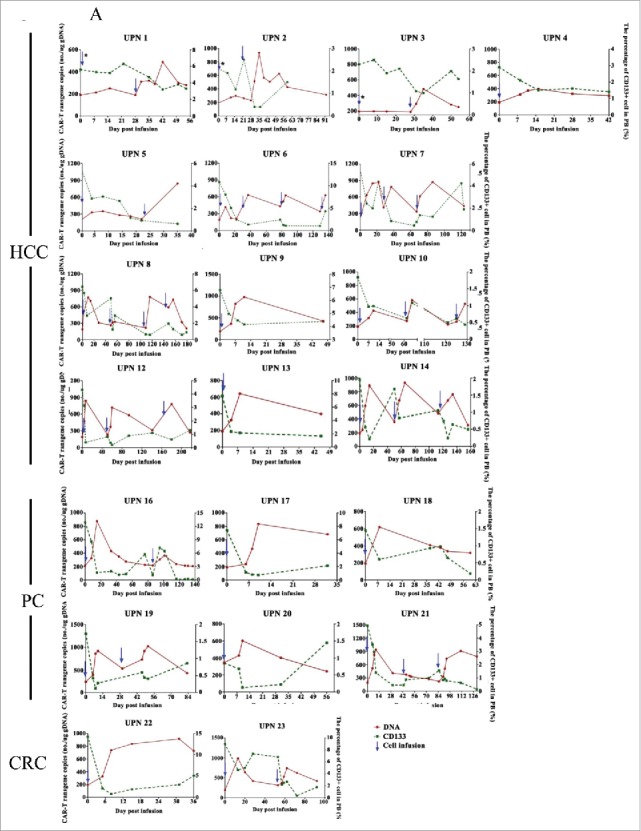
Expressed by cancer stem cells of various epithelial cell origins, CD133 is an attractive therapeutic target for cancers. Autologous chimeric antigen receptor-modified T-cell directed CD133 (CART-133) was first tested in this trial. The anti-tumor specificity and the postulated toxicities of CART-133 were first assessed. Then, we conducted a phase I clinical study in which patients with advanced and CD133-positive tumors received CART-133 cell-infusion. We enrolled 23 patients (14 with hepatocellular carcinoma [HCC], 7 with pancreatic carcinomas, and 2 with colorectal carcinomas). The 8 initially enrolled patients with HCC were treated by a CART-133 cell dose escalation scheme (0.05–2 × 10⁶/kg). The higher CAR-copy numbers and its reverse relationship with the count of CD133+ cells in peripheral blood led to the determination of an acceptable cell dose is 0.5–2 × 10⁶/kg and reinfusion cycle in 23 patients. The primary toxicity is a decrease in hemoglobin/platelet (≤ grade 3) that is self-recovered within 1 week. Of 23 patients, three achieved partial remission, and 14 achieved stable disease. The 3-month disease control rate was 65.2%, and the median progression-free survival was 5 months. Repeated cell infusions seemed to provide a longer period of disease stability, especially in patients who achieved tumor reduction after the first cell-infusion. 21 out of 23 patients had not developed detectable de novo lesions during this term. Analysis of biopsied tissues by immunohistochemistry showed CD133+ cells were eliminated after CART-133 infusions. This trial showed the feasibility, controllable toxicities, and effective activity of CART-133 transfer for treating patients with CD133-postive and late-stage metastasis malignancies.
Overview
The claims and statistics of this paper haven’t been checked yet.
Free: it reads the open-access text and checks the first 5 claims that cite a source we can check. Create a free account to check every claim.
Integrity signals
Registry
Cites
Statistics
Figures
Verification
Claims the paper makes
The claims and statistics of this paper haven’t been checked yet.
Free: it reads the open-access text and checks the first 5 claims that cite a source we can check. Create a free account to check every claim.
Claims other papers make about this one
Each is checked against this paper’s own text: does it say what the citing paper says it does?
The cited source says what the claim attributes to it.
In the citing paper
“CAR-T cells currently under development for targeting colorectal CSCs include CD133-, EpCAM-, or CD166-directed CAR-T cells [229,230,231,232].”
From Mechanisms and Strategies to Overcome Drug Resistance in Colorectal Cancer (2025) · cites this paper as [229]
Self-check
Percentages, sums and reported differences re-computed from the paper’s own numbers.
The self-check needs the paper’s full text.
Citations
Cites
New response evaluation criteria in solid tumours: revised RECIST guideline (version 1.1)
Eisenhauer, E. A., Therasse, P., Bogaerts, J., Schwartz, L. H., Sargent, D., Ford, R., Dancey, J., Arbuck, S., Gwyther, S., Mooney, M., et al. (2009) · European Journal of Cancer · doi:10.1016/j.ejca.2008.10.026 · Cited by 29,534 · cited 1×
“1 and immune-related response criteria.(25) Adverse events were documented and graded based on the Common Terminology Criteria for Adverse Events version 4.”
MethodSorafenib in advanced hepatocellular carcinoma
Llovet, J. M., Ricci, S., Mazzaferro, V., Hilgard, P., Gane, E., Blanc, J.-F., de Oliveira, A. C., Santoro, A., Raoul, J.-L., Forner, A., et al. (2008) · New England Journal of Medicine · doi:10.1056/nejmoa0708857 · Cited by 13,097
Stem cells, cancer, and cancer stem cells
Reya, T., Morrison, S. J., Clarke, M. F., & Weissman, I. L. (2001) · Nature · doi:10.1038/35102167 · Cited by 9,738 · cited 1×
“Moreover, CD133 is a marker of cancer stem cells (CSCs) and endothelial progenitor cells (EPCs) that had been verified to participate in tumor metastasis and recurrence.(20,21) These characteristics make CD133 a reasonable target for immunotherapy for patients with advanced CD133-postive tumors.”
BackgroundSorafenib in Advanced Hepatocellular Carcinoma
정, 재. (2008) · Cited by 5,586
Bruix, J., Qin, S., Merle, P., Granito, A., Huang, Y.-H., Bodoky, G., Pracht, M., Yokosuka, O., Rosmorduc, O., Breder, V., et al. (2017) · The Lancet · doi:10.1016/s0140-6736(16)32453-9 · Cited by 3,653
Clarke, M. F., Dick, J. E., Dirks, P. B., Eaves, C. J., Jamieson, C. H. M., Jones, D. L., Visvader, J., Weissman, I. L., & Wahl, G. M. (2006) · Cancer Research · doi:10.1158/0008-5472.can-06-3126 · Cited by 3,051 · cited 1×
“Moreover, CD133 is a marker of cancer stem cells (CSCs) and endothelial progenitor cells (EPCs) that had been verified to participate in tumor metastasis and recurrence.(20,21) These characteristics make CD133 a reasonable target for immunotherapy for patients with advanced CD133-postive tumors.”
BackgroundCancer Regression and Autoimmunity in Patients After Clonal Repopulation with Antitumor Lymphocytes
Dudley, M. E., Wunderlich, J. R., Robbins, P. F., Yang, J. C., Hwu, P., Schwartzentruber, D. J., Topalian, S. L., Sherry, R., Restifo, N. P., Hubicki, A. M., et al. (2002) · Science · doi:10.1126/science.1076514 · Cited by 2,823 · cited 1×
“Lymphocytes and interstitial cell clearance can contribute to the expansion of CART cells in vivo and infiltrate the solid tumor.(6,34,35) Therefore, lymphocyte clearance and reduced tumor load conditioning regimens are necessary under the premise that patients can tolerate a conditioning chemotherapy regimen to enhan…”
BackgroundCurrent concepts in the diagnosis and management of cytokine release syndrome.
Lee, D. W., Gardner, R., Porter, D. L., Louis, C. U., Ahmed, N., Jensen, M., Grupp, S. A., & Mackall, C. L. (2014) · Blood · doi:10.1182/blood-2014-05-552729 · Cited by 2,806 · cited 2×
“Cytokines release syndrome (CRS) graded and managed based on a previous report from Lee et al.(26) Dose-limiting toxicity (DLT) was defined as any grade 3 or above toxicity was considered possibly or likely related to CART-133 cells.”
MethodEfficacy and Toxicity Management of 19-28z CAR T Cell Therapy in B Cell Acute Lymphoblastic Leukemia
Davila, M. L., Riviere, I., Wang, X., Bartido, S., Park, J., Curran, K., Chung, S. S., Stefanski, J., Borquez-Ojeda, O., Olszewska, M., et al. (2014) · Science Translational Medicine · doi:10.1126/scitranslmed.3008226 · Cited by 2,476
Self-citationZou, W., Wolchok, J. D., & Chen, L. (2016) · Science Translational Medicine · doi:10.1126/scitranslmed.aad7118 · Cited by 2,400 · cited 1×
“PD-L1 pathway using anti-PD-1 therapy is considered an important approach with potential benefits in solid tumors.(39,40)”
Method
Cited by
Items 301–341 of 341
CAR-based therapeutic targets in pediatric high-grade gliomaPreprint
Griffioen, M. M. M. R., & Metselaar, D. S. (2024) · medRxiv · doi:10.1101/2024.08.28.24312703 · Cited by 2
Immunotherapy: a new era for hepatocellular carcinoma
He, Y., Guo, Y., Zhu, W., He, Y., & Hou, J. (2018) · Hepatoma Research · doi:10.20517/2394-5079.2018.45
“Lymphopenia presented in all the non-HCC patients with grade 2-4 and all HCC patients with grade 2([96]).”
BackgroundSelf-citationCAR T-Cell Therapy for CNS Malignancies
Sanber, K. S., Joseph, S. K., & Ahmed, N. M. (2019) · Elsevier eBooks · doi:10.1016/b978-0-323-66181-2.00012-3 · Cited by 1
Cancer Stem Cells as Therapeutic Targets for Gastrointestinal Cancers
Mandala, J. P., Pittala, S., & Srivani, G. (2020) · Springer eBooks · doi:10.1007/978-3-030-48405-7_3
Cancer Stem Cell as Target of CAR-T Cell Therapy
Li, X. (2020) · E3S Web of Conferences · doi:10.1051/e3sconf/202021803043
Self-citationSchäfer, D. (2021) · eDiss (Georg-August-Universität Göttingen) · doi:10.53846/goediss-8485
Zheng-Lin, B., & O'Reilly, E. M. (2021) · Cancer immunotherapy · doi:10.1007/13905_2021_8
Current status and perspectives on CAR-T therapy
Kim, J. W., & Lee, S. (2021) · Frontiers in Bioscience-Landmark · doi:10.52586/5033
Current Perspectives on Cancer Immunotherapy in Bone
Owen, K. L., Brockwell, N. K., & Parker, B. S. (2019) · Elsevier eBooks · doi:10.1016/b978-0-12-801238-3.11255-3
Shahrbaf, M. A., Goudarzi, K., Taheri, K. K., Alikhani, H. K., & Noori, M. (2021) · Modern Medical Laboratory Journal · doi:10.30699/mmlj17.4.2.19
Current State of Cell Therapies for Gastrointestinal Cancers
Kooragayala, K., Lou, J., & Hong, Y. K. (2022) · The Cancer Journal · doi:10.1097/ppo.0000000000000611
Qian, S., Chen, J., Zhao, Y., Zhu, X., Dai, D., Qin, L., Hong, J., Xu, Y., Yang, Z., Li, Y., et al. (2023) · Research Square · doi:10.21203/rs.3.rs-2651565/v1
The Application of CAR-T Cell Therapy
Yu, W. (2023) · Theoretical and Natural Science · doi:10.54254/2753-8818/4/20220501
Immunotherapy for Hepatocellular Carcinoma
Rai, V. (2023) · Springer eBooks · doi:10.1007/978-3-030-80962-1_221-1
Pancreatic cancer stem cells and inflammation: milestones achieved and challenges ahead
Periyasamy, L., Krishnamoorthy, S., Muruganantham, B., Ramachandran, I., & Muthusami, S. (2023) · Elsevier eBooks · doi:10.1016/b978-0-443-13212-4.00012-x
Immunotherapy in Pancreatic Cancer
Yeung, Z. P., & Kundranda, M. N. (2023) · Springer eBooks · doi:10.1007/978-3-031-38623-7_6
Immuno-histological Role of CD133 in Pathogenesis of Gastric Cancer
Alsatar, I. (2023) · Al-Kufa University Journal for Biology · doi:10.36320/ajb/v15.i3.13271
“These strategies have the potential to improve clinical outcomes for cancer immunotherapy [29,30].”
BackgroundWang, H., Wang, X., Ye, X., Ju, Y., Cao, N., Wang, S., & Cai, J. (2022) · Figshare · doi:10.6084/m9.figshare.20372741
Wang, H., Wang, X., Ye, X., Ju, Y., Cao, N., Wang, S., & Cai, J. (2022) · Figshare · doi:10.6084/m9.figshare.20372738
Wang, H., Wang, X., Ye, X., Ju, Y., Cao, N., Wang, S., & Cai, J. (2022) · Figshare · doi:10.6084/m9.figshare.20372744
Multiomics data analysis identifies TM4SF4 as a cell surface target in hepatocellular carcinomaPreprint
Wong, K. K., & Hamid, S. S. A. (2024) · bioRxiv (Cold Spring Harbor Laboratory) · doi:10.1101/2024.07.01.601537
Shabir, K. (2024) · Premier journal of science. · doi:10.70389/pjs.100028
Chimeric Antigen Receptor (CAR)‐T Cells: A New Era for Hepatocellular Carcinoma Treatment
Xu, M., & Yang, P. (2024) · Journal of Biochemical and Molecular Toxicology · doi:10.1002/jbt.70091
“Patients with CD133 + and late ‐ stage metastatic cancers were successfully treated in this phase I study with CART ‐ 133 transfer, demonstrating acceptable tolerability and beneficial efficacy [100].”
Cancer Stem Cells in Gastrointestinal Cancers
Li, M., Li, J., He, D., & Liu, M. (2024) · Stem cell biology and regenerative medicine · doi:10.1007/978-3-031-74842-4_12
Kar, S., Verma, D., Mehrotra, S., & Prajapati, V. K. (2025) · Advances in protein chemistry and structural biology · doi:10.1016/bs.apcsb.2024.10.017
Multiomics in silico analysis identifies TM4SF4 as a cell surface target in hepatocellular carcinoma
Wong, K. K., & Hamid, S. S. A. (2025) · PLoS ONE · doi:10.1371/journal.pone.0307048
“…of the selected cell surface target ( i.e., TM4SF4) was conducted to determine its expression profile compared with GPC3 and other common cell surface therapeutic targets in HCC, i.e., CD24 [53,54], CD133 ( PROM1 ) [55,56], CD147 ( BSG ) [57,58], EPCAM [59,60], MET [61,62], and MUC1 [63,64].”
Kowalczuk, D., Kasianik, V., Lazitskaya, D., Turlej, K., Sobchynskyi, M., Milasheuskaya, V., Myrnyi, A., Kiełbaszewska, I., Surosz, N., & Miraniuk, K. (2025) · Quality in Sport · doi:10.12775/qs.2025.41.60162 · Cited by 1
“In pancreatic cancer, other targets, such as CD133 [22], MUC-1 [23], PSCA [24], mesothelin [25], and FAP [26], are also being studied.”
Role of CAR-T cell therapy in pancreatic cancer: an updated narrative review of current evidence
Bejjani, G. E., Takla, J., Ballout, F. A., Mohtar, F., Bechaalany, M., & Attieh, R. (2026) · Journal of Pancreatology · doi:10.1097/jp9.0000000000000241
Immunotherapy for Hepatocellular Carcinoma
Rai, V. (2025) · Springer eBooks · doi:10.1007/978-3-032-00769-8_221
Targeting the Achilles’ heel of cancer stem cells
HUANG, M., BingYan, X. I. A. O., Wang, Y., XiaoYu, T. A. N. G., YueTong, W. A. N. G., & Hou, X. S. (2026) · Scientia Sinica Vitae · doi:10.1360/ssv-2025-0271
Self-citationShen, J., Ma, Y., Wang, Y., Yang, M., Liang, T., & Guo, L. (2026) · Biochemical Pharmacology · doi:10.1016/j.bcp.2026.118184 · Cited by 1
Self-citationYang, Y., Gao, Z., Song, P., Wang, C., Wang, K., Xi, Z., & Jing, R. (2026) · Frontiers in Immunology · doi:10.3389/fimmu.2026.1829723
“%) had stable disease; the overall 3 − month disease control rate was 65.2%, with a median PFS of 5 months, and repeated infusions may prolong disease stability (27).”
InfluentialCurrent therapeutic interventions to target cancer stem cells for metastasis
Arora, P., Bhatia, R., Sharma, S., Sharma, A., Chauhan, S. C., Singh, J., & Sharma, A. K. (2026) · International Journal of Clinical Oncology · doi:10.1007/s10147-026-03154-4
The role of chimeric antigen receptor (CAR) T cell therapy in breast cancer
Farajzadeh, A., Mahmoudi, M., Yazdani, S., Barati, A. M., Kheder, R. K., Rostami, O., Fadaee, A., Raouf-Rahmati, A., & Esmaeili, S. (2026) · International Immunopharmacology · doi:10.1016/j.intimp.2026.117280
Su, K., Tan, Z., Li, H., You, K., Xiao, S., Chen, H., Li, D., Liu, X., Du, X., Hu, J., et al. (2026) · BioFactors · doi:10.1002/biof.70150
“2, prostate stem cell antigen (PSCA), as well as CEA, MUC1, and CD133, among which MSLN remains the most representative [41, 67–71].”
Ismail, M., Al‐Gizey, N., Alabed, Z., Mustafa, N., Al-Najjar, E., Hamdaneh, Y., Eid, N., & Esmail, A. (2026) · Pharmaceuticals · doi:10.3390/ph19091449
“Future designs are likely to combine GPC3 targeting with persistence-enhancing armoring such as RUNX3 or IL-15/IL-21 [135,229], strategies that overcome shed GPC3-mediated CAR inhibition [43], and additional targets including CD133 or AFP to reduce relapse from stem-like tumor populations [231,232].”
Natural killer cell-based therapy for hepatocellular carcinoma (HCC): A literature review
Widowati, W., Wargasetia, T. L., Sadri, B., Nainggolan, I. M., Azis, R., Rifana, S. D., Rismani, E., & Vosough, M. (2026) · Medical Oncology · doi:10.1007/s12032-026-03393-5
“…cells, has already been targeted with autologous CAR-T cells in a phase I trial that enrolled 14 HCC patients among 23 total participants, achieving disease stabilization in the majority with manageable toxicity, a precedent that argues for evaluating CD133 as a CAR-NK target as well [82].”
Lefas, A. Y., Lote, H., & Chau, I. (2026) · Precision Oncology · doi:10.3390/precisoncol1040013
From failure to fate: Pressure-driven exhaustion in solid-tumor CAR T-cell therapy
Wang, P., Zhou, Y., Wang, Y., Li, Y., Xiao, X., & Wang, C. (2026) · Cell Insight · doi:10.1016/j.cellin.2026.100377
Self-citationCheng, L., Wang, J., Liu, Y., O’Brien, T., Krawczyk, J., Barkley, L. R., Yin, S., Shen, S., Li, J., & Zhang, S. (2026) · Biomarker Research · doi:10.1186/s40364-026-01013-y
“Some of these strategies have shown promise in preclinical models and early phase clinical studies [14, 15, 47, 86–99].”
InfluentialSelf-citationThe tumor targetome in CAR-T and TCR-T cell therapy
Wang, S., Sun, B., Rai, S., Yang, X., Banday, S., Memon, A., Kearl, T., Hematti, P., Shah, N., Dong, J., et al. (2026) · Targetome · doi:10.48130/targetome-0026-0050
Metadata
- Authors
- Wang, Y., Chen, M., Wu, Z., Tong, C., Dai, H., Guo, Y., Liu, Y., Huang, J., Lv, H., Luo, C., Feng, K.-C., Yang, Q.-M., Li, X.-L., & Han, W.
- Affiliations
- Chinese PLA General Hospital (CN)
- Department of Bio-therapeutic, Chinese PLA General Hospital, Beijing, China
- Department of Molecular & Immunology, Chinese PLA General Hospital, Beijing, China
- Corresponding author
- Han, Weidong
- Venue
- OncoImmunology
- Publisher
- Informa UK Limited
- Published
- 2018-05-07
- Volume
- 7
- Issue
- 7
- Pages
- e1440169
- ISSN
- 2162-4011 (ISSN-L)
- 2162-402X
- PMC
- PMC5993480
- OpenAlex
- W2790863559
- Cited by
- 338
- References
- 42
- Citations by year
- 2026: 25 · 2025: 37 · 2024: 50 · 2023: 48 · 2022: 57 · 2021: 47 · 2020: 39 · 2019: 26 · 2018: 9
- FWCI
- 11.37
- Type
- journal article
- Language
- en
- Open access
- gold
- doi.org
- Licence
- cc-by-nc-nd
- Locations
- OncoImmunology (publishedVersion, cc-by-nc-nd)
- Europe PMC (PubMed Central) (publishedVersion, cc-by-nc-nd)
- PubMed Central (publishedVersion, cc-by-nc-nd)
- PubMed (publishedVersion)
- DOAJ (DOAJ: Directory of Open Access Journals) (submittedVersion, cc-by-sa)
- Funders
- National Key Research and Developement Program of Chinas (2016YFC1303501 2016YFC1303504)
- Science and Technology Planning Project of Beijing City (Z151100003915076)
- Topics
- Health Sciences › Medicine › Oncology › CAR-T cell therapy research
- Life Sciences › Immunology and Microbiology › Immunology › Immunotherapy and Immune Responses
- Life Sciences › Biochemistry, Genetics and Molecular Biology › Biotechnology › Bacterial Cancer Therapy
- Keywords
- CD133, chimeric antigen receptor T cells, CAR T-cell therapy, cancer stem cells, hepatocellular carcinoma, pancreatic cancer, colorectal cancer, metastatic cancer, dose escalation, hematologic toxicity, disease control rate
About these checks
Registry, retraction, Cites and statistics results are computed, not judged, with one exception: a printed reference that no index lists is read once by a model before it counts as a citation error. Claims are extracted by a model and kept only when their quote appears verbatim in the text; each cited source is then checked, with a model’s help, for whether it says what the claim relies on. Those verdicts can be wrong — read the claim’s quote and the cited source before relying on one.
Statistics and arithmetic are recomputed, not judged.
Confidence bands are shown only for fields calibrated on our annotated test set. None is calibrated yet, so no band is shown.
What counts as a claim ›How we measure confidence ›How we check this ›
Are you an author, or do you see a problem with this page? Request a review
Data sources
Bibliographic data: Semantic Scholar, OpenAlex, Crossref.
Contains information from the Semantic Scholar Academic Graph Datasets, made available under the ODC Attribution License (ODC-BY 1.0).
Semantic Scholar’s data is described in: Kinney, R., et al. (2023). The Semantic Scholar Open Data Platform. arXiv:2301.10140.
