

The DOI matches its Crossref record; 17 of the 18 references it cites were found in a registry or an index.
SARS-CoV-2 neutralizing antibody responses are more robust in patients with severe disease
Open accessPublished version of a preprint
Abstract
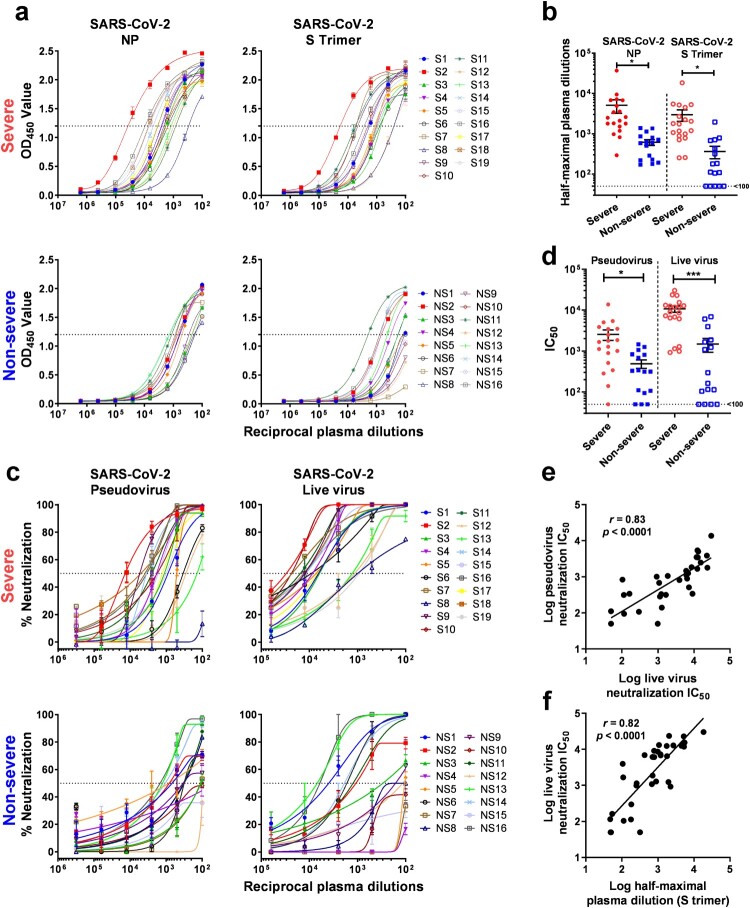
We studied plasma antibody responses of 35 patients about 1 month after SARS-CoV-2 infection. Titers of antibodies binding to the viral nucleocapsid and spike proteins were significantly higher in patients with severe disease. Likewise, mean antibody neutralization titers against SARS-CoV-2 pseudovirus and live virus were higher in the sicker patients, by ∼5-fold and ∼7-fold, respectively. These findings have important implications for those pursuing plasma therapy, isolation of neutralizing monoclonal antibodies, and determinants of immunity.
Overview
The claims and statistics of this paper haven’t been checked yet.
Run the check — free, no account needed. It reads the open-access text and checks the sources it cites.
Integrity signals
Registry
Cites
Statistics
Figures
Verification
Claims the paper makes
The claims and statistics of this paper haven’t been checked yet.
Run the check — free, no account needed. It reads the open-access text and checks the sources it cites.
Claims other papers make about this one
Each is checked against this paper’s own text: does it say what the citing paper says it does?
In the citing paper
“A total of 18 mutant pseudoviruses were made as previously described 20,21 , and each was found to have a robust titre (Extended Data Fig. 1c) that was adequate for neutralization studies.”
From Antibody resistance of SARS-CoV-2 variants B.1.351 and B.1.1.7 (2021) · cites this paper as [21]
Self-check
Percentages, sums and reported differences re-computed from the paper’s own numbers.
The self-check needs the paper’s full text.
Citations
Cites
Cryo-EM structure of the 2019-nCoV spike in the prefusion conformation
Wrapp, D., Wang, N., Corbett, K. S., Goldsmith, J. A., Hsieh, C.-L., Abiona, O., Graham, B. S., & McLellan, J. S. (2020) · Science · doi:10.1126/science.abb2507 · Cited by 8,897
Letko, M., Marzi, A., & Munster, V. (2020) · Nature Microbiology · doi:10.1038/s41564-020-0688-y · Cited by 3,109
To, K. K., Tsang, O. T.-Y., Leung, W.-S., Tam, A. R., Wu, T.-C., Lung, D. C., Yip, C. C., Cai, J., Chan, J. M., Chik, T. S., et al. (2020) · The Lancet Infectious Diseases · doi:10.1016/s1473-3099(20)30196-1 · Cited by 3,045
Antibody responses to SARS-CoV-2 in patients with COVID-19
Long, Q.-X., Liu, B.-Z., Deng, H.-J., Wu, G.-C., Deng, K., Chen, Y.-K., Liao, P., Qiu, J.-F., Lin, Y., Cai, X.-F., et al. (2020) · Nature Medicine · doi:10.1038/s41591-020-0897-1 · Cited by 2,876
Treatment of 5 Critically Ill Patients With COVID-19 With Convalescent Plasma
Shen, C., Wang, Z., Zhao, F., Yang, Y., Li, J., Yuan, J., Wang, F., Li, D., Yang, M., Xing, L., et al. (2020) · JAMA · doi:10.1001/jama.2020.4783 · Cited by 2,298
Self-citationEffectiveness of convalescent plasma therapy in severe COVID-19 patients
Duan, K., Liu, B., Li, C., Zhang, H., Yu, T., Qu, J., Zhou, M., Chen, L., Meng, S., Hu, Y., et al. (2020) · Proceedings of the National Academy of Sciences · doi:10.1073/pnas.2004168117 · Cited by 1,968
Self-citationOkba, N. M. A., Müller, M. A., Li, W., Wang, C., GeurtsvanKessel, C. H., Corman, V. M., Lamers, M. M., Sikkema, R. S., de Bruin, E., Chandler, F. D., et al. (2020) · Emerging Infectious Diseases · doi:10.3201/eid2607.200841 · Cited by 1,614
Development of an inactivated vaccine candidate for SARS-CoV-2
Gao, Q., Bao, L., Mao, H., Wang, L., Xu, K., Yang, M., Li, Y., Zhu, L., Wang, N., Lv, Z., et al. (2020) · Science · doi:10.1126/science.abc1932 · Cited by 1,434
DNA vaccine protection against SARS-CoV-2 in rhesus macaques
Yu, J., Tostanoski, L. H., Peter, L., Mercado, N. B., McMahan, K., Mahrokhian, S. H., Nkolola, J. P., Liu, J., Li, Z., Chandrashekar, A., et al. (2020) · Science · doi:10.1126/science.abc6284 · Cited by 997
Self-citationZhang, B., Liu, S., Tan, T., Huang, W., Dong, Y., Chen, L., Chen, Q., Zhang, L., Zhong, Q., Zhang, X., et al. (2020) · CHEST Journal · doi:10.1016/j.chest.2020.03.039 · Cited by 421
Cited by
Sorted by citations
Antibody resistance of SARS-CoV-2 variants B.1.351 and B.1.1.7
Wang, P., Nair, M. S., Liu, L., Iketani, S., Luo, Y., Guo, Y., Wang, M., Yu, J., Zhang, B., Kwong, P. D., et al. (2021) · Nature · doi:10.1038/s41586-021-03398-2 · Cited by 2,312
Self-citationPotent neutralizing antibodies against multiple epitopes on SARS-CoV-2 spike
Liu, L., Wang, P., Nair, M. S., Yu, J., Rapp, M., Wang, Q., Luo, Y., Chan, J. F.-W., Sahi, V., Figueroa, A., et al. (2020) · Nature · doi:10.1038/s41586-020-2571-7 · Cited by 1,349
Self-citationIncreased resistance of SARS-CoV-2 variant P.1 to antibody neutralization
Wang, P., Casner, R. G., Nair, M. S., Wang, M., Yu, J., Cerutti, G., Liu, L., Kwong, P. D., Huang, Y., Shapiro, L., et al. (2021) · Cell Host & Microbe · doi:10.1016/j.chom.2021.04.007 · Cited by 636
Self-citationAcute SARS-CoV-2 Infection Impairs Dendritic Cell and T Cell Responses
Zhou, R., To, K. K.-W., Wong, Y.-C., Liu, L., Zhou, B., Li, X., Huang, H., Mo, Y., Luk, T.-Y., Lau, T. T.-K., et al. (2020) · Immunity · doi:10.1016/j.immuni.2020.07.026 · Cited by 531
Self-citationAntibody response to SARS-CoV-2 infection in humans: A systematic review
Post, N., Eddy, D., Huntley, C., van Schalkwyk, M. C., Shrotri, M., Leeman, D., Rigby, S., Williams, S. V., Bermingham, W. H., Kellam, P., et al. (2020) · PLoS ONE · doi:10.1371/journal.pone.0244126 · Cited by 379
Metadata
- Authors
- Wang, P., Liu, L., Nair, M. S., Yin, M. T., Luo, Y., Wang, Q., Yuan, T., Mori, K., Solis, A. G., Yamashita, M., Garg, A., Purpura, L. J., Laracy, J. C., Yu, J., Joshua-Tor, L., Sodroski, J., Huang, Y., & Ho, D. D.
- Affiliations
- Aaron Diamond AIDS Research Center (US)
- Columbia University (US)
- Harvard University (US)
- Columbia University Vagelos College of Physicians and Surgeons
- Cold Spring Harbor Laboratory (US)
- Cold Spring Harbor Laboratory
- Corresponding author
- Ho, David D.
- ORCID
- Venue
- Emerging Microbes & Infections
- Publisher
- Informa UK Limited
- Published
- 2020-01
- Volume
- 9
- Issue
- 1
- Pages
- 2091-2093
- ISSN
- 2222-1751 (ISSN-L)
- PMC
- PMC7534308
- OpenAlex
- W3085665862
- Cited by
- 122
- References
- 18
- Citations by year
- 2026: 1 · 2025: 4 · 2024: 5 · 2023: 15 · 2022: 22 · 2021: 51 · 2020: 24
- FWCI
- 3.67
- Type
- journal article
- Language
- en
- Open access
- gold
- doi.org
- Licence
- Locations
- Emerging Microbes & Infections (publishedVersion, cc-by)
- bioRxiv (Cold Spring Harbor Laboratory) (acceptedVersion, cc-by-nc-nd)
- PubMed Central (publishedVersion, cc-by)
- PubMed (publishedVersion)
- Cold Spring Harbor Laboratory Institutional Repository (Cold Spring Harbor Laboratory) (acceptedVersion)
- DOAJ (DOAJ: Directory of Open Access Journals) (submittedVersion)
- Funders
- The JBP Foundation
- Wu Family China Center
- Jack Ma Foundation
- National Institute of Allergy and Infectious Diseases of the National Institutes of Health (T32AI114398)
- Topics
- Health Sciences › Medicine › Infectious Diseases › SARS-CoV-2 and COVID-19 Research
- Health Sciences › Medicine › Infectious Diseases › COVID-19 Clinical Research Studies
- Health Sciences › Medicine › Infectious Diseases › SARS-CoV-2 detection and testing
- Keywords
- SARS-CoV-2, neutralizing antibodies, antibody response, severe COVID-19, nucleocapsid protein, spike protein, antibody titers, pseudovirus neutralization, plasma therapy, monoclonal antibodies, humoral immunity
- MeSH terms
- Betacoronavirus, COVID-19, SARS-CoV-2, Adult, Aged, Antibodies, Viral, Antigens, Viral, Female, Humans, Male, Middle Aged, Neutralization Tests, Pneumonia, Viral, Severity of Illness Index, Viral Envelope Proteins, Coronavirus Infections, Nucleocapsid, Antibodies, Neutralizing, Pandemics, Spike Glycoprotein, Coronavirus
About these checks
Registry, retraction, Cites and statistics results are computed, not judged, with one exception: a printed reference that no index lists is read once by a model before it counts as a citation error. Claims are extracted by a model and kept only when their quote appears verbatim in the text; each cited source is then checked, with a model’s help, for whether it says what the claim relies on. Those verdicts can be wrong — read the claim’s quote and the cited source before relying on one.
Statistics and arithmetic are recomputed, not judged.
Confidence bands are shown only for fields calibrated on our annotated test set. None is calibrated yet, so no band is shown.
What counts as a claim ›How we measure confidence ›How we check this ›
Are you an author, or do you see a problem with this page? Request a review
