

The 10 Elements of Agroecology: enabling transitions towards sustainable agriculture and food systems through visual narratives
Open accessThe DOI matches its Crossref record; 145 of the 145 references it cites were found in a registry or an index; none of the 146 sources its claims cite is checked for support yet.
Abstract
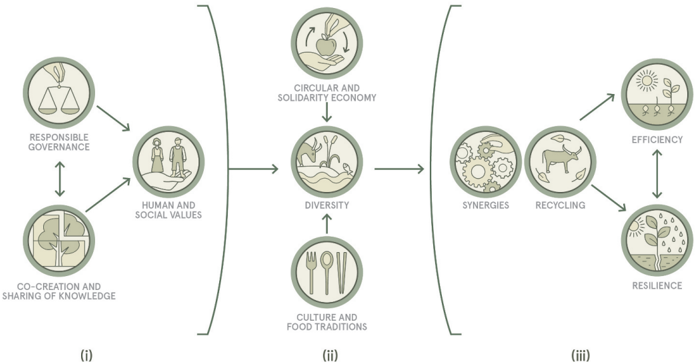
The magnitude and urgency of the challenges facing agriculture and food systems demand profound modifications in different aspects of human activity to achieve real transformative change and sustainability. Recognizing that the inherent complexity of achieving sustainability is commonly seen as a deterrent to decision-making, the Food and Agriculture Organization of the United Nations (FAO) has approved the 10 Elements of Agroecology as an analytical framework to support the design of differentiated paths for agriculture and food systems transformation, hence facilitating improved decision-making by policymakers, practitioners and other stakeholders in differing contexts at a range of levels on a number of scales. Biodiversity, consumers, education and governance are identified as promising entry points to build a structured process using visual narratives that rely on the 10 Elements of Agroecology to graphically dissect prospective social-ecological transition trajectories. We illustrate such applications with examples from agroforestry worldwide, public food procurement in Brazil and the United States of America, and agroecology education vis-à-vis secure access to land in Senegal. Nexus approaches are used to highlight and examine salient interactions among different sectors and entry points, and to develop visual narratives describing plausible theories of transformative change towards sustainable agriculture and food systems.
Overview
CoChat Summary
TL;DR
The paper presents FAO’s 10 Elements of Agroecology as an analytical framework to support differentiated transitions towards sustainable agriculture and food systems. It uses visual narratives and nexus approaches to illustrate how biodiversity, consumers, education, and governance can serve as entry points, with examples from agroforestry, public food procurement, and agroecology education.
Key findings
- The 10 Elements of Agroecology framework was developed between 2015 and 2019 through three phases and was approved by the 197 Members of FAO to guide FAO’s vision on agroecology; the regional meetings involved more than 1,400 participants representing 170 Member Countries and nearly 500 organizations.
- Four promising entry points are identified—biodiversity, consumers, education, and governance—each linked to a nexus and a stepwise visual narrative using the 10 Elements icons to describe plausible theories of transformative change.
- Illustrative examples include agroforestry, associated with 43% of all agricultural land globally, with 71% of African countries including agroforestry in their Nationally Determined Contributions; Brazil’s PNAE requires at least 30% of school food purchases directly from family farmers and provides 45 million public school students with a daily meal; the Los Angeles Good Food Purchasing Program serves over 700,000 meals per day, makes more than USD 17 million in annual purchases from sustainable local producers, and has created at least 220 new jobs; and in Senegal, KAS graduates receive official titles to 1 ha of municipal land initially for 10 years.
- The paper also notes that in 2012, coffee produced in compliance with a voluntary sustainability standard amounted to 40% of global coffee production.
Methods
- This is a review/conceptual paper. The 10 Elements framework was developed through information gathering (scientific and grey literature review, multi-actor consultations, and seven FAO regional/international meetings), synthesis by FAO and external experts, and FAO approval.
- The authors use four entry points and nexus approaches to construct visual narratives and plausible theories of transformative change, illustrated with examples from agroforestry worldwide, public food procurement in Brazil and the United States, and agroecology education linked to secure land access in Senegal.
- The main analysis is qualitative synthesis and illustrative case description; no primary quantitative data collection or statistical analysis is reported.
Limitations
- The paper states that the 10 Elements framework is not without criticism, particularly because of the heterogeneity of the elements, systems with numerous components where interactions can be nonlinear, interdependent, and involve feedback loops, and the difficulty of identifying valid thresholds to assess more sustainable development trajectories.
- The paper identifies key knowledge gaps: need for methodological tools to facilitate integrative thinking and co-creation; better understanding of what works in what contexts across spatial and temporal scales, including feedback mechanisms; limited knowledge of how system components react to more than one environmental or social factor at a time; and need for multidimensional assessment tools.
- Evident from the text: the nexus examples and visual narratives are illustrative rather than systematically evaluated, and the paper reports no empirical testing of the proposed transition trajectories.
Model-written summary. Check it against the paper before relying on it.
Integrity signals
Registry
Cites
Statistics
Figures

Verification
Claims the paper makes
0 Valid · 2 Not valid · 85 Not checked · 21 Own results and interpretations
None of the sources cited for this claim have been checked yet.
In the paper
“Prominent themes from presentations delivered during the First International Symposium on Agroecology for Food Security and Nutrition (FAO 2015) provided an initial coherent structure: recycling, efficiency, diversity, resilience and synergies as central ecological features of agroecology (Tittonell 2015).”
What the sources say
- Not checked yetcites FAO 2015
- Not checked yetcites Tittonell 2015
plainstates a cause- Asserted: passes — The authors put it forward as true.
- Checkable: passes — It can be checked against evidence.
- Load-bearing: passes — The paper’s conclusions depend on it.
- Based: passes — The paper gives a reason why it holds.
In the paper
“Nevertheless, calls in regional meetings for reinforcing social and political aspects of agroecology were also strong.”
What the sources say
- Not checked yetcites FAO 2018c
boosted- Asserted: passes — The authors put it forward as true.
- Checkable: passes — It can be checked against evidence.
- Load-bearing: passes — The paper’s conclusions depend on it.
- Based: passes — The paper gives a reason why it holds.
In the paper
“The world's agriculture and food systems are not presently delivering desirable outcomes on food security and nutrition (FAO 2019a).”
What the sources say
- Not checked yetcites FAO 2019a
plain- Asserted: passes — The authors put it forward as true.
- Checkable: passes — It can be checked against evidence.
- Load-bearing: passes — The paper’s conclusions depend on it.
- Based: passes — The paper gives a reason why it holds.
What the paper did — it cites no source for this, so there is none to check. The quote shows it is in the paper.
In the paper
“The 10 Elements of Agroecology resulted from a multi-stakeholder process intended to generate a system and process re-design framework to be optimized and adapted to local contexts.”
plainstates a cause- Asserted: passes — The authors put it forward as true.
- Checkable: passes — It can be checked against evidence.
- Load-bearing: unclear — It is unclear whether the paper’s conclusions depend on it.
- Based: passes — The paper gives a reason why it holds.
In the paper
“the 10 Elements of Agroecology were approved by the 197 Members of the Food and Agriculture Organization of the United Nations to guide FAO's vision on Agroecology (FAO 2019c).”
What the sources say
- Not checked yetcites FAO 2019c
plain- Asserted: passes — The authors put it forward as true.
- Checkable: passes — It can be checked against evidence.
- Load-bearing: unclear — It is unclear whether the paper’s conclusions depend on it.
- Based: passes — The paper gives a reason why it holds.
37 more claims
Create a free account to see all 108 claims and to verify the 146 references still open.
- It may state two separate claims as one. 36
- Probably not a substantial claim. 45
- The quote only partly states this claim. 1
Claims other papers make about this one
Each is checked against this paper’s own text: does it say what the citing paper says it does?
The source backs part of the claim, not all of it — or backs it for a different population, condition or comparison.
In the citing paper
“Aiming to achieve a sustainable agricultural production, the theoretical agroecological framework offers the opportunity to meet food needs on a global scale, harness ecosystem services through the management of service-providing organisms, and achieve other social and environmental goals (Barrios et al. 2020; Bommarco, Kleijn, and Potts 2013; Tittonel 2014).”
From Perspectives on agroecological transition: the case of Guachetá municipality, Colombia (2023) · cites this paper as Barrios et al. 2020
Experimental — accuracy not yet measuredThe cited source says what the claim attributes to it.
In the citing paper
“Agroecology is based on several principles that include biophysical and socio-technical dimensions (Barrios et al. 2020; FAO 2019; Leippert et al. 2020).”
From Methodological challenges in assessing the viability of agroecological practices: lessons from a multi-case study in Africa (2025) · cites this paper as Barrios et al. 2020
The cited source says what the claim attributes to it.
In the citing paper
“Context reflects the situated nature of agroecological initiatives (Méndez et al. 2017, Barrios et al. 2020).”
From A heuristic framework to portray agroecological transition initiatives in reflexive arrangements, illustrated with a conservation agriculture network in Denmark (2025) · cites this paper as Barrios et al. 2020
The cited source says what the claim attributes to it.
In the citing paper
“These practices are also likely to have positive effects on other elements of evaluated CAET, like diversity and synergies (Table 2), reflecting the interrelation between the elements of agroecology (Barrios et al. 2020).”
From Perspectives on agroecological transition: the case of Guachetá municipality, Colombia (2023) · cites this paper as Barrios et al. 2020
The cited source says what the claim attributes to it.
In the citing paper
“In fact, this is a core element within the agroecological theoretical framework, since it drives proper deci sion-making (Barrios et al. 2020).”
From Perspectives on agroecological transition: the case of Guachetá municipality, Colombia (2023) · cites this paper as Barrios et al. 2020
1 more claim about this paper
Create a free account to see every claim other papers make about this one.
Citations
Cites
null (2016) · Philosophy Study · doi:10.17265/2159-5313/2016.09.003 · Cited by 28,317
Transforming Our World: The 2030 Agenda for Sustainable Development
(2018) · A New Era in Global Health · doi:10.1891/9780826190123.ap02 · Cited by 19,351
Planetary boundaries: Guiding human development on a changing planet
Steffen, W., Richardson, K., Rockström, J., Cornell, S. E., Fetzer, I., Bennett, E. M., Biggs, R., Carpenter, S. R., de Vries, W., de Wit, C. A., et al. (2015) · Science · doi:10.1126/science.1259855 · Cited by 12,527 · cited 1×
“…on existing analyses that have advanced agroecology as a science, a practice and a social movement (Altieri 1995; Tomich et al. 2011; Tittonell 2014; Wezel et al. 2014; Gliessman 2015) as well as efforts to address global sustainability challenges (Steffen et al. 2015; Springmann et al. 2018).”
BackgroundFood in the Anthropocene: the EAT–Lancet Commission on healthy diets from sustainable food systems
Willett, W., Rockström, J., Loken, B., Springmann, M., Lang, T., Vermeulen, S., Garnett, T., Tilman, D., DeClerck, F., Wood, A., et al. (2019) · The Lancet · doi:10.1016/s0140-6736(18)31788-4 · Cited by 10,880 · cited 1×
“Changing consumption patterns towards nutritious and healthy foods can have major impacts on value chains and markets thus highlighting the close link between human health and environmental sustainability (Caron et al. 2018; Willett et al. 2019).”
BackgroundResilience, Adaptability and Transformability in Social–ecological Systems
Walker, B., Holling, C. S., Carpenter, S. R., & Kinzig, A. P. (2004) · Ecology and Society · doi:10.5751/es-00650-090205 · Cited by 7,821 · cited 1×
“Resilience is considered here as ‘the capacity of a system to absorb disturbance and reorganize while undergoing change so as to still retain essentially the same function, structure, identity, and feedbacks’ (Walker et al. 2004; Folke et al. 2010).”
BackgroundGhisellini, P., Cialani, C., & Ulgiati, S. (2016) · Journal of Cleaner Production · doi:10.1016/j.jclepro.2015.09.007 · Cited by 6,536 · cited 1×
“Re-designing food systems based on the principles of the circular economy can also contribute to face the global food loss and waste challenge by enhancing recycling, making food value chains shorter and more resource-use efficient (Ghisellini et al. 2015; FAO 2019d).”
BackgroundResilience Thinking: Integrating Resilience, Adaptability and Transformability
Folke, C., Carpenter, S. R., Walker, B., Scheffer, M., Chapin, T., & Rockström, J. (2010) · Ecology and Society · doi:10.5751/es-03610-150420 · Cited by 4,764 · cited 1×
“Resilience is considered here as ‘the capacity of a system to absorb disturbance and reorganize while undergoing change so as to still retain essentially the same function, structure, identity, and feedbacks’ (Walker et al. 2004; Folke et al. 2010).”
BackgroundLandscape perspectives on agricultural intensification and biodiversity—Ecosystem service management
Tscharntke, T., Klein, A. M., Kruess, A., Steffan‐Dewenter, I., & Thies, C. (2005) · Ecology Letters · doi:10.1111/j.1461-0248.2005.00782.x · Cited by 4,455 · cited 3×
“…regulation of pest and diseases, through habitat modifications that enhance the abundance and diversity of natural enemies and predators (Landis et al. 2000; Tscharntke et al. 2005; Pumariño et al. 2015), thus reducing the need for pesticide inputs that compromise food safety (Carvalho 2006).”
BackgroundKnowledge systems for sustainable development
Cash, D. W., Clark, W. C., Alcock, F., Dickson, N. M., Eckley, N., Guston, D. H., Jäger, J., & Mitchell, R. B. (2003) · Proceedings of the National Academy of Sciences · doi:10.1073/pnas.1231332100 · Cited by 3,660 · cited 2×
“Hence, fostering co-creation processes that build relevance, credibility and legitimacy is integral to the crafting of knowledge that is useful for sustainable development (Cash et al. 2003; Warner 2007; Barrios et al. 2012a; Clark et al. 2016; Lemos et al. 2018).”
BackgroundOptions for keeping the food system within environmental limits
Springmann, M., Clark, M., Mason-D’Croz, D., Wiebe, K., Bodirsky, B. L., Lassaletta, L., de Vries, W., Vermeulen, S. J., Herrero, M., Carlson, K. M., et al. (2018) · Nature · doi:10.1038/s41586-018-0594-0 · Cited by 3,380 · cited 3×
“…on existing analyses that have advanced agroecology as a science, a practice and a social movement (Altieri 1995; Tomich et al. 2011; Tittonell 2014; Wezel et al. 2014; Gliessman 2015) as well as efforts to address global sustainability challenges (Steffen et al. 2015; Springmann et al. 2018).”
BackgroundHabitat management to conserve natural enemies of arthropod pests in agriculture
Landis, D. A., Wratten, S. D., & Gurr, G. M. (2000) · Annual Review of Entomology · doi:10.1146/annurev.ento.45.1.175 · Cited by 3,100 · cited 3×
“…and managing biodiversity, agroecology can enhance the sustained provision of ecosystem services that are critical to agricultural production, including pollination and biological regulation of pests and diseases (Landis et al. 2000; Kremen and Miles 2012; Dumont et al. 2013; Midega et al. 2018).”
BackgroundPervasive human-driven decline of life on Earth points to the need for transformative change
Díaz, S., Settele, J., Brondízio, E. S., Ngo, H. T., Agard, J., Arneth, A., Balvanera, P., Brauman, K. A., Butchart, S. H. M., Chan, K. M. A., et al. (2019) · Science · doi:10.1126/science.aax3100 · Cited by 2,926 · cited 2×
“In order to meet SDG2, there is an urgent need for transformative change, understood here as a profound transformation of human activity across multiple dimensions and at multiple scales (Caron et al. 2018; Vermeulen et al. 2018; Díaz et al. 2019).”
BackgroundSustainable biochar to mitigate global climate change
Woolf, D., Amonette, J. E., Street-Perrott, F. A., Lehmann, J., & Joseph, S. (2010) · Nature Communications · doi:10.1038/ncomms1053 · Cited by 2,680 · cited 1×
“…at territorial and regional scale as well as between sectors of the food system (e.g. food waste or processing by-products as biochar recycled back onto agricultural soils to support plant production, fed to animals or used for biogas production – Woolf et al. 2010; de Boer and van Ittersum 2018).”
BackgroundThe ecological role of biodiversity in agroecosystems
Altieri, M. A. (1999) · Agriculture, Ecosystems & Environment · doi:10.1016/s0167-8809(99)00028-6 · Cited by 2,561 · cited 1×
“…importance of Diversity , be it diversity of species or ecological functions or knowledge held by different actors within an agricultural system (Altieri 1999; Cash et al. 2003; Doré et al. 2011; Teixeira et al. 2018), or diversity of activities and livelihood options within food systems…”
BackgroundSoil biodiversity and soil community composition determine ecosystem multifunctionality
Wagg, C., Bender, S. F., Widmer, F., & van der Heijden, M. G. A. (2014) · Proceedings of the National Academy of Sciences · doi:10.1073/pnas.1320054111 · Cited by 2,550 · cited 1×
“…contribute to soil health by fostering soil management that minimizes soil erosion, enhances soil carbon storage, promotes soil nutrient balance and cycles, and preserves and enhances biodiversity, including soil biodiversity (Six et al. 2002; Barrios 2007; Fonte et al. 2010; Wagg et al. 2014).”
BackgroundUnderstanding relationships among multiple ecosystem services
Bennett, E. M., Peterson, G. D., & Gordon, L. J. (2009) · Ecology Letters · doi:10.1111/j.1461-0248.2009.01387.x · Cited by 2,481 · cited 1×
“This emphasis, however, does not disregard the importance and pervasive presence of interactions that lead to trade-offs and the need to manage and minimize their impacts (Zhang et al. 2007; Bennet et al. 2009; Reed et al. 2013; Blaser et al. 2018; Kanter et al. 2018).”
BackgroundClimate Change and Food Systems
Vermeulen, S. J., Campbell, B. M., & Ingram, J. S. I. (2012) · Annual Review of Environment and Resources · doi:10.1146/annurev-environ-020411-130608 · Cited by 2,423 · cited 2×
“…the re-design of agricultural and food systems embraces the need to strategically use biological diversity (Midega et al. 2018; Rosenstock et al. 2019a), and that of market linkages (Vermeulen et al., 2012; Schipanski et al. 2016) to harness multiple concurrent benefits from component interactions.”
BackgroundEcosystem services and agriculture: tradeoffs and synergies
Power, A. G. (2010) · Philosophical Transactions of the Royal Society B: Biological Sciences · doi:10.1098/rstb.2010.0143 · Cited by 2,334 · cited 3×
“…a buffering effect or ‘insurance’ against environmental variation because different species respond differently to these variations, and thus collectively contribute to a more stable provision of ecosystem services (Zhang et al. 2007; Power 2010; Kremen and Miles 2012; Renard and Tilman 2019).”
BackgroundSafeguarding pollinators and their values to human well-being
Potts, S. G., Imperatriz-Fonseca, V., Ngo, H. T., Aizen, M. A., Biesmeijer, J. C., Breeze, T. D., Dicks, L. V., Garibaldi, L. A., Hill, R., Settele, J., et al. (2016) · Nature · doi:10.1038/nature20588 · Cited by 2,138 · cited 1×
“Furthermore, increased presence of trees in agriculture has been shown to enhance the abundance and diversity of pollinators that also benefit from lower pesticide applications in agriculture (Morandin and Kremen 2013; Potts et al. 2016).”
BackgroundEcological intensification: harnessing ecosystem services for food security
Bommarco, R., Kleijn, D., & Potts, S. G. (2013) · Trends in Ecology & Evolution · doi:10.1016/j.tree.2012.10.012 · Cited by 1,862 · cited 1×
“Furthermore, it also recognizes the importance of ecosystem services resulting from above-ground/below-ground biodiversity interactions in supporting agroecological transitions (i.e. social-ecological transitions based on the 10 Elements of Agroecology) (Bommarco et al. 2013; Veen et al. 2019).”
BackgroundThe Relevance of Circular Economy Practices to the Sustainable Development Goals
Schroeder, P., Anggraeni, K., & Weber, U. (2019) · Journal of Industrial Ecology · doi:10.1111/jiec.12732 · Cited by 1,758 · cited 1×
“The Circular and solidarity economy reconnects producers and consumers while providing innovative solutions for achieving the SDGs (de Boer and van Ittersum 2018; Schroeder et al. 2018).”
BackgroundYield gap analysis with local to global relevance—A review
van Ittersum, M. K., Cassman, K. G., Grassini, P., Wolf, J., Tittonell, P., & Hochman, Z. (2013) · Field Crops Research · doi:10.1016/j.fcr.2012.09.009 · Cited by 1,652 · cited 1×
“…of agricultural systems and the role of sub-stitution processes in supporting such efficiency gains (Keating et al. 2009; Tittonell and Giller 2013; van Ittersum et al. 2013), significantly less explicit attention has been devoted to the re-design of agroecosystems resulting from the interaction…”
BackgroundSelf-citationEcosystem services and dis-services to agriculture
Zhang, W., Ricketts, T. H., Kremen, C., Carney, K., & Swinton, S. M. (2007) · Ecological Economics · doi:10.1016/j.ecolecon.2007.02.024 · Cited by 1,590 · cited 2×
“…a buffering effect or ‘insurance’ against environmental variation because different species respond differently to these variations, and thus collectively contribute to a more stable provision of ecosystem services (Zhang et al. 2007; Power 2010; Kremen and Miles 2012; Renard and Tilman 2019).”
BackgroundResilience in Agriculture through Crop Diversification: Adaptive Management for Environmental Change
Lin, B. B. (2011) · BioScience · doi:10.1525/bio.2011.61.3.4 · Cited by 1,570 · cited 1×
“For instance, several studies have highlighted the positive contribution of crop diversity to the mean and variance in agricultural yields (Lin 2011; Gaudin et al. 2015; Bowles et al. 2020) and in farm income (D’Annolfo et al. 2017; van der Ploeg et al. 2019).”
BackgroundAgroecology as a science, a movement and a practice. A review
Wezel, A., Bellon, S., Doré, T., Francis, C., Vallod, D., & David, C. (2009) · Agronomy for Sustainable Development · doi:10.1051/agro/2009004 · Cited by 1,504 · cited 1×
“Responsible governance mechanisms at different scales can simultaneously support niche/territorial markets, by branding of agroecological produce (Wezel et al. 2009; IPES-Food 2019) and thus rewarding agricultural management that enhances regenerative production through the protection and…”
BackgroundAgroecology and the design of climate change-resilient farming systems
Altieri, M. A., Nicholls, C. I., Henao, A., & Lana, M. A. (2015) · Agronomy for Sustainable Development · doi:10.1007/s13593-015-0285-2 · Cited by 1,472 · cited 1×
“Diversified agroecological systems are usually more resilient – they have a greater capacity to recover from disturbances including extreme weather events such as drought, floods or hurricanes (Holt-Giménez 2002; Altieri et al. 2015) and boost soil health (Muchane et al. 2020).”
BackgroundSoil organic matter, biota and aggregation in temperate and tropical soils - Effects of no-tillage
Six, J., Feller, C., Denef, K., Ogle, S. M., de Moraes, J. C., & Albrecht, A. (2002) · Agronomie · doi:10.1051/agro:2002043 · Cited by 1,426 · cited 1×
“…contribute to soil health by fostering soil management that minimizes soil erosion, enhances soil carbon storage, promotes soil nutrient balance and cycles, and preserves and enhances biodiversity, including soil biodiversity (Six et al. 2002; Barrios 2007; Fonte et al. 2010; Wagg et al. 2014).”
BackgroundThe Determinants of Rural Livelihood Diversification in Developing Countries
Ellis, F. (2000) · Journal of Agricultural Economics · doi:10.1111/j.1477-9552.2000.tb01229.x · Cited by 1,312 · cited 1×
“A similar relationship applies to food systems where an increase in the diversity of activities, products or services can help to evade risks generated by uncertain markets or policy environments (Ellis 2000; Reilly and Willenbockel 2010).”
BackgroundAltieri, M. A., & Toledo, V. M. (2011) · Journal of Peasant Studies · doi:10.1080/03066150.2011.582947 · Cited by 1,279 · cited 1×
“By building autonomy and adaptive capacities to manage agricultural and food systems, agroecology can strengthen the capacity of people and communities to overcome poverty, hunger and malnutrition (Altieri and Toledo 2011; Lemos et al. 2018).”
BackgroundAgroecological practices for sustainable agriculture. A review
Wezel, A., Casagrande, M., Celette, F., Vian, J.-F., Ferrer, A., & Peigné, J. (2014) · Agronomy for Sustainable Development · doi:10.1007/s13593-013-0180-7 · Cited by 1,227 · cited 2×
“…and recycling), to being a broader, multidimensional concept that required additional principles to be defined, such as those in the realm of social, political and economic disciplines and dimensions (Altieri 1995; Wezel et al. 2014; Gliessman 2015; Dumont et al. 2016; Anderson et al. 2019a).”
BackgroundKremen, C., & Miles, A. (2012) · Ecology and Society · doi:10.5751/es-05035-170440 · Cited by 1,126 · cited 2×
“…a buffering effect or ‘insurance’ against environmental variation because different species respond differently to these variations, and thus collectively contribute to a more stable provision of ecosystem services (Zhang et al. 2007; Power 2010; Kremen and Miles 2012; Renard and Tilman 2019).”
BackgroundTittonell, P., & Giller, K. E. (2013) · Field Crops Research · doi:10.1016/j.fcr.2012.10.007 · Cited by 1,098 · cited 1×
“…increasing the efficiency of agricultural systems and the role of sub-stitution processes in supporting such efficiency gains (Keating et al. 2009; Tittonell and Giller 2013; van Ittersum et al. 2013), significantly less explicit attention has been devoted to the re-design of agroecosystems…”
BackgroundSelf-citationSoil biota, ecosystem services and land productivity
Barrios, E. (2007) · Ecological Economics · doi:10.1016/j.ecolecon.2007.03.004 · Cited by 1,067 · cited 1×
“…contribute to soil health by fostering soil management that minimizes soil erosion, enhances soil carbon storage, promotes soil nutrient balance and cycles, and preserves and enhances biodiversity, including soil biodiversity (Six et al. 2002; Barrios 2007; Fonte et al. 2010; Wagg et al. 2014).”
BackgroundSelf-citationAgroecology: The Ecology of Sustainable Food Systems
Gliessman, S. R. (2007) · Andalas University Repository (Andalas University) · Cited by 1,061
Food system resilience: Defining the concept
Tendall, D. M., Joerin, J., Kopainsky, B., Edwards, P., Shreck, A., Le, Q. B., Kruetli, P., Grant, M., & Six, J. (2015) · Global Food Security · doi:10.1016/j.gfs.2015.08.001 · Cited by 962 · cited 1×
“Enhanced Resilience of people, communities and eco-systems are key to sustainable agricultural and food systems (FAO 2014; Tendall et al. 2015).”
BackgroundAgriculture, pesticides, food security and food safety
Carvalho, F. P. (2006) · Environmental Science & Policy · doi:10.1016/j.envsci.2006.08.002 · Cited by 929 · cited 1×
“…regulation of pest and diseases, through habitat modifications that enhance the abundance and diversity of natural enemies and predators (Landis et al. 2000; Tscharntke et al. 2005; Pumariño et al. 2015), thus reducing the need for pesticide inputs that compromise food safety (Carvalho 2006).”
BackgroundAgroecology: The Science Of Sustainable Agriculture, Second Edition
Altieri, M. A. (1995) · Medical Entomology and Zoology · Cited by 904
Nexus approaches to global sustainable development
Liu, J., Hull, V., Godfray, H. C. J., Tilman, D., Gleick, P., Hoff, H., Pahl-Wostl, C., Xu, Z., Chung, M. G., Sun, J., et al. (2018) · Nature Sustainability · doi:10.1038/s41893-018-0135-8 · Cited by 871 · cited 1×
“Nexus approaches (Liu et al. 2018) are also proposed here to highlight and examine salient interactions among different sectors and entry points, and develop visual narratives using the 10 Elements of Agroecology icons to describe plausible theories of transformative change towards sustainable…”
MethodAltieri, M. A., Funes-Monzote, F. R., & Petersen, P. (2012) · Agronomy for Sustainable Development · doi:10.1007/s13593-011-0065-6 · Cited by 803 · cited 1×
“While these efficiency gains should contribute to increased net incomes over time (Altieri et al. 2012; Gliessman 2015; van der Ploeg et al. 2019) as corroborated by true-cost accounting (TEEB 2018), returns to labour may not necessarily increase in the short term (Ajayi et al. 2009).”
BackgroundSharrock, S. L. (2016) · CGSPace A Repository of Agricultural Research Outputs (Consultative Group for International Agricultural Research) · Cited by 803
When food systems meet sustainability – Current narratives and implications for actions
Béné, C., Oosterveer, P., Lamotte, L., Brouwer, I. D., de Haan, S., Prager, S. D., Talsma, E. F., & Khoury, C. K. (2019) · World Development · doi:10.1016/j.worlddev.2018.08.011 · Cited by 781 · cited 1×
“…system (Altieri 1999; Cash et al. 2003; Doré et al. 2011; Teixeira et al. 2018), or diversity of activities and livelihood options within food systems (Vermeulen et al., 2012; Béné et al. 2019), as a fundamental precondition and adaptive trait, particularly in the context of global change.”
BackgroundEcological intensification of agriculture — sustainable by nature
Tittonell, P. (2014) · Current Opinion in Environmental Sustainability · doi:10.1016/j.cosust.2014.08.006 · Cited by 770 · cited 5×
“…biological, socio-economic and institutional diversity and alignment in time and space to support greater efficiency, and in such sense, it may contribute to attaining related intensions, such as so-called ecological or sustainable intensification or climate smart agriculture (cf. Tittonell 2014).”
BackgroundResultInfluentialSelf-citationIntensification for redesigned and sustainable agricultural systems
Pretty, J. (2018) · Science · doi:10.1126/science.aav0294 · Cited by 655 · cited 2×
“This is consistent with earlier studies recommending greater attention to multidimensional performance rather than to the prevalent focus on the productivity metric (Tittonell 2014; Gliessman 2016; Caron et al. 2018; Pretty 2018; Rasmussen et al. 2018; Tomich et al. 2018).”
BackgroundResultZomer, R. J., Neufeldt, H., Xu, J., Ahrends, A., Bossio, D., Trabucco, A., van Noordwijk, M., & Wang, M. (2016) · Scientific Reports · doi:10.1038/srep29987 · Cited by 626 · cited 1×
“Agroforestry, broadly described as the integration and management of trees on farms together with crops and livestock, is a major land use associated with 43% of all agricultural land globally (Zomer et al. 2016).”
BackgroundNational food production stabilized by crop diversity
Renard, D., & Tilman, D. (2019) · Nature · doi:10.1038/s41586-019-1316-y · Cited by 623 · cited 1×
“…a buffering effect or ‘insurance’ against environmental variation because different species respond differently to these variations, and thus collectively contribute to a more stable provision of ecosystem services (Zhang et al. 2007; Power 2010; Kremen and Miles 2012; Renard and Tilman 2019).”
BackgroundAltieri, M. A. (1995) · doi:10.3362/9781788532310 · Cited by 612
Jones, A. D., Shrinivas, A., & Bezner-Kerr, R. (2014) · Food Policy · doi:10.1016/j.foodpol.2014.02.001 · Cited by 596 · cited 1×
“By empowering women and supporting diversified diets, agroecology can contribute to food and nutrition security while maintaining the health of ecosystems and their agro-biodiversity (Jones et al. 2014; Lachat et al. 2018).”
BackgroundCrafting usable knowledge for sustainable development
Clark, W. C., van Kerkhoff, L., Lebel, L., & Gallopin, G. C. (2016) · Proceedings of the National Academy of Sciences · doi:10.1073/pnas.1601266113 · Cited by 582 · cited 1×
“Hence, fostering co-creation processes that build relevance, credibility and legitimacy is integral to the crafting of knowledge that is useful for sustainable development (Cash et al. 2003; Warner 2007; Barrios et al. 2012a; Clark et al. 2016; Lemos et al. 2018).”
BackgroundAgroecology: Ecological Processes in Sustainable Agriculture
(1999) · Restoration Ecology · doi:10.1046/j.1526-100x.1999.72014.x · Cited by 577
Transforming food systems with agroecology
Gliessman, S. (2016) · Agroecology and Sustainable Food Systems · doi:10.1080/21683565.2015.1130765 · Cited by 526 · cited 1×
“This is consistent with earlier studies recommending greater attention to multidimensional performance rather than to the prevalent focus on the productivity metric (Tittonell 2014; Gliessman 2016; Caron et al. 2018; Pretty 2018; Rasmussen et al. 2018; Tomich et al. 2018).”
ResultBowles, T. M., Mooshammer, M., Socolar, Y., Calderón, F., Cavigelli, M. A., Culman, S. W., Deen, W., Drury, C. F., Garcia y Garcia, A., Gaudin, A. C. M., et al. (2020) · One Earth · doi:10.1016/j.oneear.2020.02.007 · Cited by 526 · cited 2×
“For instance, several studies have highlighted the positive contribution of crop diversity to the mean and variance in agricultural yields (Lin 2011; Gaudin et al. 2015; Bowles et al. 2020) and in farm income (D’Annolfo et al. 2017; van der Ploeg et al. 2019).”
BackgroundThe State of the World's Biodiversity for Food and Agriculture
(2019) · FAO eBooks · doi:10.4060/ca3129en · Cited by 502
Doré, T., Makowski, D., Malézieux, E., Munier-Jolain, N., Tchamitchian, M., & Tittonell, P. (2011) · European Journal of Agronomy · doi:10.1016/j.eja.2011.02.006 · Cited by 474 · cited 1×
“…it diversity of species or ecological functions or knowledge held by different actors within an agricultural system (Altieri 1999; Cash et al. 2003; Doré et al. 2011; Teixeira et al. 2018), or diversity of activities and livelihood options within food systems (Vermeulen et al., 2012; Béné et al.…”
BackgroundSelf-citationDick, W. A. (1999) · Journal of Environmental Quality · doi:10.2134/jeq1999.00472425002800010046x · Cited by 450
Agroecology as a Transdisciplinary, Participatory, and Action-Oriented Approach
Méndez, V. E., Bacon, C. M., & Cohen, R. (2013) · Agroecology and Sustainable Food Systems · doi:10.1080/10440046.2012.736926 · Cited by 438 · cited 1×
“…knowledge on agricultural biodiversity and management experience for specific contexts held by men and women, practical knowledge of producers and traders related to markets, and global scientific knowledge and practices (Méndez et al. 2013, 2015; Bendito and Barrios 2016; Nobre et al. 2017).”
BackgroundMidega, C. A. O., Pittchar, J. O., Pickett, J. A., Hailu, G. W., & Khan, Z. R. (2018) · Crop Protection · doi:10.1016/j.cropro.2017.11.003 · Cited by 431 · cited 3×
“…and managing biodiversity, agroecology can enhance the sustained provision of ecosystem services that are critical to agricultural production, including pollination and biological regulation of pests and diseases (Landis et al. 2000; Kremen and Miles 2012; Dumont et al. 2013; Midega et al. 2018).”
BackgroundIncreasing Crop Diversity Mitigates Weather Variations and Improves Yield Stability
Gaudin, A. C. M., Tolhurst, T. N., Ker, A. P., Janovicek, K., Tortora, C., Martin, R. C., & Deen, W. (2015) · PLOS ONE · doi:10.1371/journal.pone.0113261 · Cited by 418 · cited 1×
“For instance, several studies have highlighted the positive contribution of crop diversity to the mean and variance in agricultural yields (Lin 2011; Gaudin et al. 2015; Bowles et al. 2020) and in farm income (D’Annolfo et al. 2017; van der Ploeg et al. 2019).”
BackgroundBiodiversity, yield, and shade coffee certification
Perfecto, I., Vandermeer, J., Mas, A., & Pinto, L. S. (2005) · Ecological Economics · doi:10.1016/j.ecolecon.2004.10.009 · Cited by 409 · cited 1×
“…smallholder farmers, often facing poverty in the context of biodiversity-rich biomes, increasing climatic uncertainty and economic volatility, has encouraged the development of certification programs offering farmers the opportunity to link economic and environmental goals (Perfecto et al. 2005).”
BackgroundBiodiversity can support a greener revolution in Africa
Snapp, S. S., Blackie, M. J., Gilbert, R. A., Bezner-Kerr, R., & Kanyama-Phiri, G. Y. (2010) · Proceedings of the National Academy of Sciences · doi:10.1073/pnas.1007199107 · Cited by 405 · cited 1×
“…in the way plant and animal diversity are used and managed by men or women in agriculture can have important implications in the nutritional quality of food consumed and the adaptive capacity of agricultural systems to climate change (Snapp et al. 2010; Waha et al. 2018; Bezner Kerr et al. 2019b).”
BackgroundWomen in agriculture: Four myths
Doss, C., Meinzen-Dick, R., Quisumbing, A., & Theis, S. (2018) · Global Food Security · doi:10.1016/j.gfs.2017.10.001 · Cited by 402 · cited 1×
“…central to food security and nutrition as important holders of knowledge about production, processing and provision of food in most contexts, they commonly lack equitable access to land and natural resources, as well as control over their decisions (Siliprandi and Cintrão 2013; Doss et al. 2018).”
BackgroundTo co-produce or not to co-produce
Lemos, M. C., Arnott, J. C., Ardoin, N. M., Baja, K., Bednarek, A. T., Dewulf, A., Fieseler, C., Goodrich, K. A., Jagannathan, K., Klenk, N., et al. (2018) · Nature Sustainability · doi:10.1038/s41893-018-0191-0 · Cited by 391 · cited 2×
“By building autonomy and adaptive capacities to manage agricultural and food systems, agroecology can strengthen the capacity of people and communities to overcome poverty, hunger and malnutrition (Altieri and Toledo 2011; Lemos et al. 2018).”
BackgroundAnderson, C. R., Bruil, J., Chappell, M. J., Kiss, C., & Pimbert, M. P. (2019) · Sustainability · doi:10.3390/su11195272 · Cited by 375 · cited 4×
“…yet holistic version of reality that can facilitate decision-making by policymakers, practitioners and other stakeholders at different scales along agroecological transitions towards sustainable agriculture and food systems (Biovision 2019; HLPE 2019; INKOTA 2019; Anderson et al. 2019a).”
BackgroundInfluentialHedgerow restoration promotes pollinator populations and exports native bees to adjacent fields
Morandin, L. A., & Kremen, C. (2013) · Ecological Applications · doi:10.1890/12-1051.1 · Cited by 373 · cited 1×
“Furthermore, increased presence of trees in agriculture has been shown to enhance the abundance and diversity of pollinators that also benefit from lower pesticide applications in agriculture (Morandin and Kremen 2013; Potts et al. 2016).”
BackgroundProspects from agroecology and industrial ecology for animal production in the 21st century
Dumont, B., Fortun-Lamothe, L., Jouven, M., Thomas, M., & Tichit, M. (2013) · Animal · doi:10.1017/s1751731112002418 · Cited by 369 · cited 3×
“…and managing biodiversity, agroecology can enhance the sustained provision of ecosystem services that are critical to agricultural production, including pollination and biological regulation of pests and diseases (Landis et al. 2000; Kremen and Miles 2012; Dumont et al. 2013; Midega et al. 2018).”
BackgroundEvaluating agricultural trade-offs in the age of sustainable development
Kanter, D. R., Musumba, M., Wood, S. L. R., Palm, C., Antle, J., Balvanera, P., Dale, V. H., Havlik, P., Kline, K. L., Scholes, R. J., et al. (2018) · Agricultural Systems · doi:10.1016/j.agsy.2016.09.010 · Cited by 346 · cited 2×
“This emphasis, however, does not disregard the importance and pervasive presence of interactions that lead to trade-offs and the need to manage and minimize their impacts (Zhang et al. 2007; Bennet et al. 2009; Reed et al. 2013; Blaser et al. 2018; Kanter et al. 2018).”
BackgroundSelf-citationFood systems for sustainable development: proposals for a profound four-part transformation
Caron, P., Ferrero y de Loma-Osorio, G., Nabarro, D., Hainzelin, E., Guillou, M., Andersen, I., Arnold, T., Astralaga, M., Beukeboom, M., Bickersteth, S., et al. (2018) · Agronomy for Sustainable Development · doi:10.1007/s13593-018-0519-1 · Cited by 343 · cited 8×
“The difficulty of designing differentiated paths for agri-culture and food systems transformation, which responds to both local and national expectations and desires, has been identified as a major constraint to transformative change (Caron et al. 2018).”
BackgroundMethodResultInfluentialEco‐efficient Agriculture: Concepts, Challenges, and Opportunities
Keating, B. A., Carberry, P. S., Bindraban, P. S., Asseng, S., Meinke, H., & Dixon, J. (2010) · Crop Science · doi:10.2135/cropsci2009.10.0594 · Cited by 336 · cited 2×
“…been written about increasing the efficiency of agricultural systems and the role of sub-stitution processes in supporting such efficiency gains (Keating et al. 2009; Tittonell and Giller 2013; van Ittersum et al. 2013), significantly less explicit attention has been devoted to the re-design of…”
BackgroundSocial-ecological outcomes of agricultural intensification
Rasmussen, L. V., Coolsaet, B., Martin, A., Mertz, O., Pascual, U., Corbera, E., Dawson, N., Fisher, J. A., Franks, P., & Ryan, C. M. (2018) · Nature Sustainability · doi:10.1038/s41893-018-0070-8 · Cited by 333 · cited 1×
“This is consistent with earlier studies recommending greater attention to multidimensional performance rather than to the prevalent focus on the productivity metric (Tittonell 2014; Gliessman 2016; Caron et al. 2018; Pretty 2018; Rasmussen et al. 2018; Tomich et al. 2018).”
ResultGosnell, H., Gill, N., & Voyer, M. (2019) · Global Environmental Change · doi:10.1016/j.gloenvcha.2019.101965 · Cited by 331 · cited 2×
“…failure to deal with the issue in a sufficiently holistic way and to recognize the critical importance of pervasive interactions of a wide range of biological, socio-economic, cultural and political variables over time (Foran et al. 2014; IPES-Food 2016; Gosnell et al. 2019; Tamburino et al. 2020).”
Background(2019) · FAO eBooks · doi:10.4060/i2801e · Cited by 331 · cited 1×
“For instance, equitable access to land and natural resources (FAO 2012) is both key to social justice and a strong incentive for long-term investments necessary to protect soil, biodiversity and ecosystem services (Ratner et al. 2013; Anderson et al. 2019a).”
BackgroundAgroecological principles for the redesign of integrated crop–livestock systems
Bonaudo, T., Bendahan, A. B., Sabatier, R., Ryschawy, J., Bellon, S., Leger, F., Magda, D., & Tichit, M. (2014) · European Journal of Agronomy · doi:10.1016/j.eja.2013.09.010 · Cited by 325 · cited 2×
“In many instances, traditional agricultural systems are built around synergies – such as the integration of livestock with crops – that have been lost due to intensification, and merit reconsi-deration (Tittonell et al. 2009; Bonaudo et al. 2014).”
BackgroundThe real type and ideal type of transdisciplinary processes: part I—theoretical foundations
Scholz, R. W., & Steiner, G. (2015) · Sustainability Science · doi:10.1007/s11625-015-0326-4 · Cited by 323 · cited 1×
“…facilitated process of mutual learning between science and society that relates a targeted multidisciplinary or interdisciplinary research process and a multi-stakeholder discourse for developing socially robust orientations about a specific real-world issue or challenge’ (Scholz and Steiner 2015).”
BackgroundHolt-Giménez, E. (2006) · Cited by 321
Agroforestry boosts soil health in the humid and sub-humid tropics: A meta-analysis
Muchane, M. N., Sileshi, G. W., Gripenberg, S., Jonsson, M., Pumariño, L., & Barrios, E. (2020) · Agriculture, Ecosystems & Environment · doi:10.1016/j.agee.2020.106899 · Cited by 312 · cited 2×
“…access to nutritious foods, while simultaneously contributing to climate change adaptation (e.g. lower mean temperature and increased soil moisture) and mitigation (e.g. enhancing carbon storage) (Rosenstock et al. 2019a), and to enhanced soil health and ecosystem services (Muchane et al. 2020).”
BackgroundSelf-citationThe economic potential of agroecology: Empirical evidence from Europe
van der Ploeg, J. D., Barjolle, D., Bruil, J., Brunori, G., Costa Madureira, L. M., Dessein, J., Drąg, Z., Fink-Kessler, A., Gasselin, P., Gonzalez de Molina, M., et al. (2019) · Journal of Rural Studies · doi:10.1016/j.jrurstud.2019.09.003 · Cited by 299 · cited 2×
“For instance, several studies have highlighted the positive contribution of crop diversity to the mean and variance in agricultural yields (Lin 2011; Gaudin et al. 2015; Bowles et al. 2020) and in farm income (D’Annolfo et al. 2017; van der Ploeg et al. 2019).”
BackgroundAgricultural diversification as an important strategy for achieving food security in Africa
Waha, K., van Wijk, M. T., Fritz, S., See, L., Thornton, P. K., Wichern, J., & Herrero, M. (2018) · Global Change Biology · doi:10.1111/gcb.14158 · Cited by 287 · cited 1×
“…in the way plant and animal diversity are used and managed by men or women in agriculture can have important implications in the nutritional quality of food consumed and the adaptive capacity of agricultural systems to climate change (Snapp et al. 2010; Waha et al. 2018; Bezner Kerr et al. 2019b).”
BackgroundAgroecology: A Review from a Global-Change Perspective
Tomich, T. P., Brodt, S., Ferris, H., Galt, R., Horwath, W. R., Kebreab, E., Leveau, J. H. J., Liptzin, D., Lubell, M., Merel, P., et al. (2011) · Annual Review of Environment and Resources · doi:10.1146/annurev-environ-012110-121302 · Cited by 286 · cited 2×
“This framework builds on existing analyses that have advanced agroecology as a science, a practice and a social movement (Altieri 1995; Tomich et al. 2011; Tittonell 2014; Wezel et al. 2014; Gliessman 2015) as well as efforts to address global sustainability challenges (Steffen et al. 2015;…”
BackgroundRealizing Resilient Food Systems
Schipanski, M. E., MacDonald, G. K., Rosenzweig, S., Chappell, M. J., Bennett, E. M., Kerr, R. B., Blesh, J., Crews, T., Drinkwater, L., Lundgren, J. G., et al. (2016) · BioScience · doi:10.1093/biosci/biw052 · Cited by 281 · cited 3×
“…inputs through enhanced reliance on biological processes underpinning soil health and the regulation of pests and diseases (Tscharntke et al. 2005; Barrios et al. 2012b; Dumont et al. 2013), agroecology can reduce producers’ vulnerability to economic risk (Schipanski et al. 2016; Feliciano 2019).”
BackgroundDeFries, R. S., Fanzo, J., Mondal, P., Remans, R., & Wood, S. A. (2017) · Environmental Research Letters · doi:10.1088/1748-9326/aa625e · Cited by 265 · cited 1×
“…to foster broader partnerships among farmers, cooperatives, consumer associations as well as national research and advisory services, rural development organization and local governments, embodied in the main-streaming circular and solidarity economy (Méndez et al. 2010; DeFries et al. 2017).”
BackgroundHolt-Giménez, E. (2002) · Agriculture, Ecosystems & Environment · doi:10.1016/s0167-8809(02)00006-3 · Cited by 263 · cited 1×
“Diversified agroecological systems are usually more resilient – they have a greater capacity to recover from disturbances including extreme weather events such as drought, floods or hurricanes (Holt-Giménez 2002; Altieri et al. 2015) and boost soil health (Muchane et al. 2020).”
BackgroundClimate-smart sustainable agriculture in low-to-intermediate shade agroforests
Blaser, W. J., Oppong, J., Hart, S. P., Landolt, J., Yeboah, E., & Six, J. (2018) · Nature Sustainability · doi:10.1038/s41893-018-0062-8 · Cited by 259 · cited 2×
“For instance, recent studies in West Africa cocoa agroforests show that levels of shade-tree cover of 30% or lower are required to optimize the trade-offs between production, climate adaptation, climate mitigation and biodiversity conservation goals (Blaser et al. 2018).”
BackgroundEffects of agroforestry on pest, disease and weed control: A meta-analysis
Pumariño, L., Sileshi, G. W., Gripenberg, S., Kaartinen, R., Barrios, E., Muchane, M. N., Midega, C., & Jonsson, M. (2015) · Basic and Applied Ecology · doi:10.1016/j.baae.2015.08.006 · Cited by 248 · cited 2×
“…regulation of pest and diseases, through habitat modifications that enhance the abundance and diversity of natural enemies and predators (Landis et al. 2000; Tscharntke et al. 2005; Pumariño et al. 2015), thus reducing the need for pesticide inputs that compromise food safety (Carvalho 2006).”
BackgroundSelf-citationDietary species richness as a measure of food biodiversity and nutritional quality of diets
Lachat, C., Raneri, J. E., Smith, K. W., Kolsteren, P., Van Damme, P., Verzelen, K., Penafiel, D., Vanhove, W., Kennedy, G., Hunter, D., et al. (2018) · Proceedings of the National Academy of Sciences · doi:10.1073/pnas.1709194115 · Cited by 248 · cited 1×
“By empowering women and supporting diversified diets, agroecology can contribute to food and nutrition security while maintaining the health of ecosystems and their agro-biodiversity (Jones et al. 2014; Lachat et al. 2018).”
BackgroundTaking Complexity in Food Systems Seriously: An Interdisciplinary Analysis
Foran, T., Butler, J. R. A., Williams, L. J., Wanjura, W. J., Hall, A., Carter, L., & Carberry, P. S. (2014) · World Development · doi:10.1016/j.worlddev.2014.03.023 · Cited by 238 · cited 2×
“…failure to deal with the issue in a sufficiently holistic way and to recognize the critical importance of pervasive interactions of a wide range of biological, socio-economic, cultural and political variables over time (Foran et al. 2014; IPES-Food 2016; Gosnell et al. 2019; Tamburino et al. 2020).”
BackgroundBarrios, E., Valencia, V., Jonsson, M., Brauman, A., Hairiah, K., Mortimer, P. E., & Okubo, S. (2018) · International Journal of Biodiversity Science, Ecosystem Services & Management · doi:10.1080/21513732.2017.1399167 · Cited by 211 · cited 2×
“…positive impacts of organic matter management on soil structure, reduced soil erosion and C storage), and at the landscape level (i.e. system diversification concurrent impacts on biological control of pest and diseases, and on pollination) (Power 2010; Pumariño et al. 2015; Barrios et al. 2018).”
BackgroundSelf-citationFeliciano, D. (2019) · Sustainable Development · doi:10.1002/sd.1923 · Cited by 209 · cited 2×
“…inputs through enhanced reliance on biological processes underpinning soil health and the regulation of pests and diseases (Tscharntke et al. 2005; Barrios et al. 2012b; Dumont et al. 2013), agroecology can reduce producers’ vulnerability to economic risk (Schipanski et al. 2016; Feliciano 2019).”
BackgroundBellon, M. R., Kotu, B. H., Azzarri, C., & Caracciolo, F. (2020) · World Development · doi:10.1016/j.worlddev.2019.104682 · Cited by 209 · cited 1×
“Through diversification and integration, producers reduce their vulnerability should a single crop, livestock species or other commodity fail (Dumont et al. 2013; Bellon et al. 2020; Bowles et al. 2020).”
BackgroundScaling up agroforestry requires research ‘in’ rather than ‘for’ development
Coe, R., Sinclair, F., & Barrios, E. (2014) · Current Opinion in Environmental Sustainability · doi:10.1016/j.cosust.2013.10.013 · Cited by 207 · cited 1×
“…the critical importance of involving farmers and land managers at the onset of co-creation and sharing of knowledge for informing agroecosystem re-design processes to ensure the identification of relevant options that minimize trade-offs and are adapted to context variation (Coe et al. 2014).”
BackgroundSelf-citationMéndez, V. E., Bacon, C. M., Olson, M., Petchers, S., Herrador, D., Carranza, C., Trujillo, L., Guadarrama-Zugasti, C., Cordón, A., & Mendoza, A. (2010) · Renewable Agriculture and Food Systems · doi:10.1017/s1742170510000268 · Cited by 205 · cited 1×
“…to foster broader partnerships among farmers, cooperatives, consumer associations as well as national research and advisory services, rural development organization and local governments, embodied in the main-streaming circular and solidarity economy (Méndez et al. 2010; DeFries et al. 2017).”
BackgroundKERR, R. B., SNAPP, S., CHIRWA (deceased), M., SHUMBA, L., & MSACHI, R. (2007) · Experimental Agriculture · doi:10.1017/s0014479707005339 · Cited by 202 · cited 3×
“Agroecological transitions can be effective to reduce gender inequity if they are designed to address underlying power imbalances women face, such as norms, relationships and institutional structures that perpe-tuate discrimination and imbalance (Siliprandi and Cintrão 2013; Bezner Kerr et al. 2019a).”
BackgroundInfluentialScholes, R. J., Montanarella, L., Brainich, A., Barger, N. N., ten Brink, B., Cantele, M., Erasmus, B. F. N., Fisher, J. L., Gardner, T. A., Holland, T. G., et al. (2018) · Cited by 185
Vermeulen, S. J., Dinesh, D., Howden, S. M., Cramer, L., & Thornton, P. K. (2018) · Frontiers in Sustainable Food Systems · doi:10.3389/fsufs.2018.00065 · Cited by 185 · cited 1×
“In order to meet SDG2, there is an urgent need for transformative change, understood here as a profound transformation of human activity across multiple dimensions and at multiple scales (Caron et al. 2018; Vermeulen et al. 2018; Díaz et al. 2019).”
BackgroundRole and management of soil biodiversity for food security and nutrition; where do we stand?
Mujtar, V. A. E., Muñoz, N. B., McCormick, B. P., Pulleman, M., & Tittonell, P. A. (2019) · Global Food Security · doi:10.1016/j.gfs.2019.01.007 · Cited by 183 · cited 1×
“…that covers concepts such as diversification of activities and diversity of knowledge systems, but also biological diversity reflected by genetic, taxonomic and functional diversity in the different components of the agroecosystem (Pauli et al. 2012; Félix et al. 2018; El Mujtar et al. 2019).”
BackgroundSelf-citationRufino, M. C., Tittonell, P., van Wijk, M. T., Castellanos-Navarrete, A., Delve, R. J., de Ridder, N., & Giller, K. E. (2007) · Livestock Science · doi:10.1016/j.livsci.2007.09.011 · Cited by 182 · cited 1×
“When true-cost are accounted for (TEEB 2018), recycling can more likely lead to agricultural production with lower economic and environmental costs (FAO 2014) and greater systems efficiency (Rufino et al. 2007).”
BackgroundSelf-citationResource conflict, collective action, and resilience: an analytical framework
Ratner, B. D., Meinzen-Dick, R., May, C., & Haglund, E. (2013) · International Journal of the Commons · doi:10.18352/ijc.276 · Cited by 173 · cited 2×
“For instance, equitable access to land and natural resources (FAO 2012) is both key to social justice and a strong incentive for long-term investments necessary to protect soil, biodiversity and ecosystem services (Ratner et al. 2013; Anderson et al. 2019a).”
BackgroundEcological Intensification: Local Innovation to Address Global Challenges
Tittonell, P. A., Klerkx, L., Baudron, F., Félix, G. F., Ruggia, A., van Apeldoorn, D. F., Dogliotti, S., Mapfumo, P., & Rossing, W. A. H. (2016) · Sustainable agriculture reviews · doi:10.1007/978-3-319-26777-7_1 · Cited by 171 · cited 1×
“…design, but also of limitations in soil nutrient availability, often related to incidence of pests and diseases; of the linkage between land degradation and poverty; of uncondu-cive national and global policies with respect to incentives; and of institutional failures (Tittonell et al. 2016).”
BackgroundSelf-citationSidaner, E., Balaban, D., & Burlandy, L. (2013) · Public Health Nutrition · doi:10.1017/s1368980012005101 · Cited by 169 · cited 1×
“The PAA successfully demonstrated that public policy can simultaneously address food and nutrition security, social inclusion and biodiversity-friendly agriculture by providing strong support to family farming that is closely linked to agroecological food production (Sidaner et al. 2012).”
Backgroundvan Noordwijk, M., Leimona, B., Jindal, R., Villamor, G. B., Vardhan, M., Namirembe, S., Catacutan, D. C., Kerr, J. M., Minang, P. A., & Tomich, T. P. (2012) · Annual Review of Environment and Resources · doi:10.1146/annurev-environ-042511-150526 · Cited by 169 · cited 1×
“…support niche/territorial markets, by branding of agroecological produce (Wezel et al. 2009; IPES-Food 2019) and thus rewarding agricultural management that enhances regenerative production through the protection and enhancement of biodiversity and ecosystem services (van Noordwijk et al. 2012).”
BackgroundAnalysis of trade-offs in agricultural systems: current status and way forward
Klapwijk, C., van Wijk, M., Rosenstock, T., van Asten, P., Thornton, P., & Giller, K. (2014) · Current Opinion in Environmental Sustainability · doi:10.1016/j.cosust.2013.11.012 · Cited by 161 · cited 1×
“…to the field (i.e. crop yield vs. nitrogen fertilizer losses to the environment), to the farm (i.e. land for crop vs for animal production), to the landscape level (i.e. land for agricultural production vs. for nature conservation) (Tittonell et al. 2009; Power 2010; Klapwijk et al. 2014).”
BackgroundAgroforestry and Soil Health: Linking Trees, Soil Biota, and Ecosystem Services
Barrios, E., Sileshi, G. W., Shepherd, K., & Sinclair, F. (2012) · Soil Ecology and Ecosystem Services · doi:10.1093/acprof:oso/9780199575923.003.0028 · Cited by 159 · cited 2×
“…inputs through enhanced reliance on biological processes underpinning soil health and the regulation of pests and diseases (Tscharntke et al. 2005; Barrios et al. 2012b; Dumont et al. 2013), agroecology can reduce producers’ vulnerability to economic risk (Schipanski et al. 2016; Feliciano 2019).”
BackgroundSelf-citationA Planetary Health Perspective on Agroforestry in Sub-Saharan Africa
Rosenstock, T. S., Dawson, I. K., Aynekulu, E., Chomba, S., Degrande, A., Fornace, K., Jamnadass, R., Kimaro, A., Kindt, R., Lamanna, C., et al. (2019) · One Earth · doi:10.1016/j.oneear.2019.10.017 · Cited by 159 · cited 3×
“…access to nutritious foods, while simultaneously contributing to climate change adaptation (e.g. lower mean temperature and increased soil moisture) and mitigation (e.g. enhancing carbon storage) (Rosenstock et al. 2019a), and to enhanced soil health and ecosystem services (Muchane et al. 2020).”
BackgroundBezner Kerr, R., Kangmennaang, J., Dakishoni, L., Nyantakyi-Frimpong, H., Lupafya, E., Shumba, L., Msachi, R., Boateng, G. O., Snapp, S. S., Chitaya, A., et al. (2019) · Agriculture, Ecosystems & Environment · doi:10.1016/j.agee.2019.04.004 · Cited by 155 · cited 1×
“…in the way plant and animal diversity are used and managed by men or women in agriculture can have important implications in the nutritional quality of food consumed and the adaptive capacity of agricultural systems to climate change (Snapp et al. 2010; Waha et al. 2018; Bezner Kerr et al. 2019b).”
BackgroundAnderson, C. R., Maughan, C., & Pimbert, M. P. (2019) · Agriculture and Human Values · doi:10.1007/s10460-018-9894-0 · Cited by 149 · cited 1×
“…education play a fundamental role in sharing agroecological innovations resulting from co-creation processes while contributing to inclusive capacity building processes involving various local actors, especially women and youth (Holt-Giménez 2006; Ostergaard et al. 2010; Anderson et al. 2019b).”
BackgroundBezner Kerr, R., Hickey, C., Lupafya, E., & Dakishoni, L. (2019) · The Journal of Peasant Studies · doi:10.1080/03066150.2018.1547897 · Cited by 146
Agroecology in action: extending alternative agriculture through social networks
(2007) · Choice Reviews Online · doi:10.5860/choice.44-6230 · Cited by 144
Rosenstock, T. S., Wilkes, A., Jallo, C., Namoi, N., Bulusu, M., Suber, M., Mboi, D., Mulia, R., Simelton, E., Richards, M., et al. (2019) · Agriculture Ecosystems & Environment · doi:10.1016/j.agee.2019.106569 · Cited by 142 · cited 3×
“…access to nutritious foods, while simultaneously contributing to climate change adaptation (e.g. lower mean temperature and increased soil moisture) and mitigation (e.g. enhancing carbon storage) (Rosenstock et al. 2019a), and to enhanced soil health and ecosystem services (Muchane et al. 2020).”
BackgroundVeldhuizen, L. J. L., Giller, K. E., Oosterveer, P. J. M., Brouwer, I. D., Janssen, S. J. C., van Zanten, H. H. E., & Slingerland, M. A. (2019) · Global Food Security · doi:10.1016/j.gfs.2019.100336 · Cited by 141 · cited 2×
“Despite the growing consensus on the need for transformative change, however, there has been less agreement on how this could be accomplished (Foran et al. 2014; Veldhuizen et al. 2020).”
BackgroundFood and agricultural innovation pathways for prosperity
Tomich, T. P., Lidder, P., Coley, M., Gollin, D., Meinzen-Dick, R. S., Webb, P., & Carberry, P. (2018) · Agricultural Systems · doi:10.1016/j.agsy.2018.01.002 · Cited by 136 · cited 2×
“This is consistent with earlier studies recommending greater attention to multidimensional performance rather than to the prevalent focus on the productivity metric (Tittonell 2014; Gliessman 2016; Caron et al. 2018; Pretty 2018; Rasmussen et al. 2018; Tomich et al. 2018).”
BackgroundResultCarlisle, L., Montenegro de Wit, M., DeLonge, M. S., Iles, A., Calo, A., Getz, C., Ory, J., Munden-Dixon, K., Galt, R., Melone, B., et al. (2019) · Frontiers in Sustainable Food Systems · doi:10.3389/fsufs.2019.00096 · Cited by 136
Wittman, H., & Blesh, J. (2017) · Journal of Agrarian Change · doi:10.1111/joac.12131 · Cited by 135
Anticipating and Managing Future Trade-offs and Complementarities between Ecosystem Services
Reed, M. S., Hubacek, K., Bonn, A., Burt, T. P., Holden, J., Stringer, L. C., Beharry-Borg, N., Buckmaster, S., Chapman, D., Chapman, P. J., et al. (2013) · Ecology and Society · doi:10.5751/es-04924-180105 · Cited by 128
Clarifying the socioeconomic dimensions of agroecology: between principles and practices
Dumont, A. M., Vanloqueren, G., Stassart, P. M., & Baret, P. V. (2016) · Agroecology and Sustainable Food Systems · doi:10.1080/21683565.2015.1089967 · Cited by 128 · cited 1×
“…and recycling), to being a broader, multidimensional concept that required additional principles to be defined, such as those in the realm of social, political and economic disciplines and dimensions (Altieri 1995; Wezel et al. 2014; Gliessman 2015; Dumont et al. 2016; Anderson et al. 2019a).”
BackgroundManaging uncertainty: a review of food system scenario analysis and modelling
Reilly, M., & Willenbockel, D. (2010) · Philosophical Transactions of the Royal Society B: Biological Sciences · doi:10.1098/rstb.2010.0141 · Cited by 119 · cited 1×
“A similar relationship applies to food systems where an increase in the diversity of activities, products or services can help to evade risks generated by uncertain markets or policy environments (Ellis 2000; Reilly and Willenbockel 2010).”
BackgroundTittonell, P. A., van Wijk, M. T., Herrero, M., Rufino, M. C., de Ridder, N., & Giller, K. E. (2009) · Agricultural Systems · doi:10.1016/j.agsy.2009.02.003 · Cited by 119 · cited 2×
“In many instances, traditional agricultural systems are built around synergies – such as the integration of livestock with crops – that have been lost due to intensification, and merit reconsi-deration (Tittonell et al. 2009; Bonaudo et al. 2014).”
BackgroundSelf-citationUnderstanding Farm Diversity to Promote Agroecological Transitions
Teixeira, H. M., Van den Berg, L., Cardoso, I. M., Vermue, A. J., Bianchi, F. J. J. A., Peña-Claros, M., & Tittonell, P. (2018) · Sustainability · doi:10.3390/su10124337 · Cited by 114 · cited 2×
“…or ecological functions or knowledge held by different actors within an agricultural system (Altieri 1999; Cash et al. 2003; Doré et al. 2011; Teixeira et al. 2018), or diversity of activities and livelihood options within food systems (Vermeulen et al., 2012; Béné et al. 2019), as a…”
BackgroundSelf-citationFonte, S. J., Barrios, E., & Six, J. (2010) · Geoderma · doi:10.1016/j.geoderma.2009.12.016 · Cited by 113 · cited 1×
“…contribute to soil health by fostering soil management that minimizes soil erosion, enhances soil carbon storage, promotes soil nutrient balance and cycles, and preserves and enhances biodiversity, including soil biodiversity (Six et al. 2002; Barrios 2007; Fonte et al. 2010; Wagg et al. 2014).”
BackgroundSelf-citationA review of social and economic performance of agroecology
D'Annolfo, R., Gemmill-Herren, B., Graeub, B., & Garibaldi, L. A. (2017) · International Journal of Agricultural Sustainability · doi:10.1080/14735903.2017.1398123 · Cited by 108 · cited 1×
“For instance, several studies have highlighted the positive contribution of crop diversity to the mean and variance in agricultural yields (Lin 2011; Gaudin et al. 2015; Bowles et al. 2020) and in farm income (D’Annolfo et al. 2017; van der Ploeg et al. 2019).”
BackgroundSelf-citationNyaga, J., Barrios, E., Muthuri, C. W., Öborn, I., Matiru, V., & Sinclair, F. (2015) · Agriculture Ecosystems & Environment · doi:10.1016/j.agee.2015.06.013 · Cited by 103 · cited 1×
“The planting of fruit trees by low resource endowed farmers, despite their limited and often decreasing farm size, highlights the important role played by agroforestry for improving household nutrition that is consistent with local culture and food traditions (Nyaga et al. 2015).”
BackgroundSelf-citationAjayi, O. C., Akinnifesi, F. K., Sileshi, G., & Kanjipite, W. (2009) · Agrekon · doi:10.1080/03031853.2009.9523827 · Cited by 89 · cited 1×
“While these efficiency gains should contribute to increased net incomes over time (Altieri et al. 2012; Gliessman 2015; van der Ploeg et al. 2019) as corroborated by true-cost accounting (TEEB 2018), returns to labour may not necessarily increase in the short term (Ajayi et al. 2009).”
BackgroundWartenberg, A. C., Blaser‐Hart, W. J., Roshetko, J. M., van Noordwijk, M., & Six, J. (2019) · Plant and Soil · doi:10.1007/s11104-018-03921-x · Cited by 85 · cited 1×
“…at multiple benefits through agroforestry there are inherent trade-offs to be considered as all benefits cannot be maximized at the same time, and adequate management practices play a fundamental role in reducing trade-offs between production and other ecosystem services (Wartenberg et al., 2019).”
BackgroundLas transiciones agroecológicas
Tittonell, P. A. (2019) · Revista de la Facultad de Ciencias Agrarias UNCuyo · Cited by 84
Self-citationFrom population to production: 50 years of scientific literature on how to feed the world
Tamburino, L., Bravo, G., Clough, Y., & Nicholas, K. A. (2020) · Global Food Security · doi:10.1016/j.gfs.2019.100346 · Cited by 79 · cited 2×
“…failure to deal with the issue in a sufficiently holistic way and to recognize the critical importance of pervasive interactions of a wide range of biological, socio-economic, cultural and political variables over time (Foran et al. 2014; IPES-Food 2016; Gosnell et al. 2019; Tamburino et al. 2020).”
BackgroundPauli, N., Barrios, E., Conacher, A. J., & Oberthür, T. (2012) · Geoderma · doi:10.1016/j.geoderma.2012.05.027 · Cited by 68 · cited 1×
“…that covers concepts such as diversification of activities and diversity of knowledge systems, but also biological diversity reflected by genetic, taxonomic and functional diversity in the different components of the agroecosystem (Pauli et al. 2012; Félix et al. 2018; El Mujtar et al. 2019).”
BackgroundSelf-citationAlvarez, S., Rufino, M. C., Vayssières, J., Salgado, P., Tittonell, P. A., Tillard, E., & Bocquier, F. (2013) · Agricultural Systems · doi:10.1016/j.agsy.2013.03.005 · Cited by 65 · cited 1×
“Agroecological approaches rarely assess efficiency at the level of an individual component (e.g. nitrogen use efficiency by a crop) but at the level of the whole farm, or ecological network efficiency (Alvarez et al. 2014; Alomia-Hinojosa et al. 2020).”
BackgroundSelf-citationAgroecology: A Transdisciplinary, Participatory and Action-oriented Approach
(2015) · CRC Press eBooks · doi:10.1201/b19500 · Cited by 63
Students Learning Agroecology: Phenomenon-Based Education for Responsible Action
Østergaard, E., Lieblein, G., Breland, T. A., & Francis, C. A. (2010) · The Journal of Agricultural Education and Extension · doi:10.1080/13892240903533053 · Cited by 56 · cited 1×
“…education play a fundamental role in sharing agroecological innovations resulting from co-creation processes while contributing to inclusive capacity building processes involving various local actors, especially women and youth (Holt-Giménez 2006; Ostergaard et al. 2010; Anderson et al. 2019b).”
BackgroundThe Rural Household Multiple Indicator Survey, data from 13,310 farm households in 21 countries
van Wijk, M. T., Hammond, J., Gorman, L., Adams, S. N., Ayantunde, A. A., Baines, D., Bolliger, A., Bosire, C. K., Carpena, P., Chesterman, S., et al. (2020) · Scientific Data · doi:10.1038/s41597-020-0388-8 · Cited by 56 · cited 1×
“● Developing or adapting existing multidimensional assessment tools (e.g. Grabowski et al. 2018; FAO 2019g; van Wijk et al. 2020) is also central to building such understanding of change and predicting the magnitude of such change across scales, time and place.”
BackgroundPositive outcomes between crop diversity and agricultural employment worldwide
Garibaldi, L. A., & Pérez-Méndez, N. (2019) · Ecological Economics · doi:10.1016/j.ecolecon.2019.106358 · Cited by 52 · cited 1×
“Furthermore, recent global research shows that countries with higher crop diversity generally support more agricultural employment (Garibaldi and Perez-Mendez 2019).”
BackgroundBendito, A., & Barrios, E. (2016) · International Journal of Disaster Risk Science · doi:10.1007/s13753-016-0102-9 · Cited by 51 · cited 1×
“…knowledge on agricultural biodiversity and management experience for specific contexts held by men and women, practical knowledge of producers and traders related to markets, and global scientific knowledge and practices (Méndez et al. 2013, 2015; Bendito and Barrios 2016; Nobre et al. 2017).”
BackgroundSelf-citationCapturing Agroecosystem Vulnerability and Resilience
Groot, J. C. J., Arriola, J. C., Rossing, W. A. H., Massiotti, R. A., & Tittonell, P. A. (2016) · Sustainability · doi:10.3390/su8111206 · Cited by 45 · cited 1×
“Continuous evaluation is central to re-design (Groot et al. 2016; Kanter et al. 2018; Tittonell 2019), and in the case of social-ecological transitions guided by the 10 Elements of Agroecology, hereafter referred to as ‘agroecological transitions’ for brevity, monitoring and evaluation should…”
Self-citationUse and management of biodiversity by smallholder farmers in semi-arid West Africa
Félix, G. F., Diédhiou, I., Garff, M. L., Timmermann, C., Clermont‐Dauphin, C., Cournac, L., Groot, J. C. J., & Tittonell, P. A. (2018) · Global Food Security · doi:10.1016/j.gfs.2018.08.005 · Cited by 45 · cited 1×
“…that covers concepts such as diversification of activities and diversity of knowledge systems, but also biological diversity reflected by genetic, taxonomic and functional diversity in the different components of the agroecosystem (Pauli et al. 2012; Félix et al. 2018; El Mujtar et al. 2019).”
BackgroundSelf-citationVeen, G. F., Wubs, E. R. J., Bardgett, R. D., Barrios, E., Bradford, M. A., Carvalho, S., De Deyn, G. B., de Vries, F. T., Giller, K. E., Kleijn, D., et al. (2019) · Frontiers in Ecology and Evolution · doi:10.3389/fevo.2019.00300 · Cited by 38
Self-citationAlexander, S., & Dudley, N. (2017) · Cited by 37
InPaC-S: Participatory Knowledge Integration on Indicators of Soil Quality Methodological Guide
Barrios, E., Coutinho, H. L. C., & Medeiros, C. (2012) · LA Referencia (Red Federada de Repositorios Institucionales de Publicaciones Científicas) · Cited by 28
Self-citationAgroforestry: realizing the promise of an agroecological approach.
Prabhu, R., Barrios, E., Bayala, J., Diby, L. N., Donovan, J., Gyau, A., Graudal, L., Jamnadass, R., Kahia, J., Kehlenbeck, K., et al. (2015) · Research at the University of Copenhagen (University of Copenhagen) · Cited by 26
Self-citationKebede, Y., Bianchi, F. J. J. A., Baudron, F., Abraham, K., de Valença, A., & Tittonell, P. A. (2018) · Biological Control · doi:10.1016/j.biocontrol.2018.03.012 · Cited by 25 · cited 1×
“Diversified agricultural landscapes commonly show greater potential to contribute to pollination and pest and disease control ecosystem services (Bonaudo et al. 2014; Barrios et al. 2018; Kebede et al. 2018) and are able to better maintain such services when faced with climatic shocks.”
BackgroundSelf-citationLas transiciones agroecológicas: múltiples escalas, niveles y desafíos
Tittonell, P. A. (2019) · Americanae (AECID Library) · Cited by 17
Self-citationAlomia‐Hinojosa, V., Groot, J. C. J., Speelman, E. N., Bettinelli, C., McDonald, A. J., Alvarez, S., & Tittonell, P. A. (2019) · Ecological Indicators · doi:10.1016/j.ecolind.2019.105883 · Cited by 13 · cited 1×
“Agroecological approaches rarely assess efficiency at the level of an individual component (e.g. nitrogen use efficiency by a crop) but at the level of the whole farm, or ecological network efficiency (Alvarez et al. 2014; Alomia-Hinojosa et al. 2020).”
BackgroundSelf-citationSustainable agricultural intensification and measuring the immeasurable
Grabowski, P., Musumba, M., Palm, C. A., & Snapp, S. S. (2018) · Routledge eBooks · doi:10.4324/9781315561103-29 · Cited by 9 · cited 1×
“● Developing or adapting existing multidimensional assessment tools (e.g. Grabowski et al. 2018; FAO 2019g; van Wijk et al. 2020) is also central to building such understanding of change and predicting the magnitude of such change across scales, time and place.”
Background(2019) · FAO eBooks · doi:10.4060/ca4781en · Cited by 6 · cited 1×
“The alliance developed by the Kaydara Agroecology School (KAS) and the Fimela town government illustrates synergies developed in the education–governance–youth employment nexus (FAO 2016, 2019f ; Gora Ndiaye , personal personal communication).”
BackgroundVeen, G. F., Wubs, E. R. J., Bardgett, R. D., et al. (2019) · Leiden Repository (Leiden University) · doi:10.3929/ethz-b-000361033 · Cited by 5
DeClerck, F., Estrada-Carmona, N., Garbach, K., & Martinez-Snas, A. (2015) · CGSPace A Repository of Agricultural Research Outputs (Consultative Group for International Agricultural Research) · Cited by 4
Boillat, S., & Speranza, C. I. (2019) · BORIS (University Library Bern) · doi:10.7892/boris.140369 · Cited by 4
Barbero (2014) · doi:10.1016/j · Cited by 1
Research works printed but not linked: 18
- FAO. 2011a. Save and Grow: A policy-makers guide to the sustainable intensification of smallholder crop produc tion. Rome: Food and Agriculture Organization of the United Nations. http://www.fao.org/3/a-i2215e.pdf.
- FAO. 2011b. The state of food and agriculture. Women in agriculture: closing the gender gap for development. Rome: Food and Agriculture Organization of the United Nations. http://www.fao.org/3/a-i2050e.pdf.
- FAO. 2014. Building a common vision for sustainable food and agriculture. Rome: Food and Agriculture Organization of the United Nations. http://www.fao.org/3/a-i3940e.pdf.
- FAO. 2015. Proceedings of the FAO international sympo sium on agroecology for food security and nutrition. Rome: Food and Agriculture Organization of the United Nations. http://www.fao.org/3/a-i4729e.pdf.
- FAO. 2018a. Transforming food and agriculture to achieve the SDGs - 20 interconnected actions to guide decisionmakers. Rome: Food and Agriculture Organization of the United Nations. http://www.fao.org/3/I9900EN/ i9900en.pdf.
- FAO. 2018b. The 10 Elements of Agroecology: guiding the transition to sustainable food and agricultural systems. Rome: Food and Agriculture Organization of the United Nations. http://www.fao.org/3/i9037en/ i9037en.pdf.
- FAO. 2018c. Catalyzing dialogue and cooperation to scale up agroecology: outcomes of the FAO regional seminars on agroecology. Rome: Food and Agriculture Organization of the United Nations. http://www.fao. org/3/I8992EN/i8992en.pdf.
- FAO. 2018e. Characteristics, dynamics and drivers of rural migration in Senegal. Case study in Kaolack and Matam. Main facts and statistics. Rome: Food and Agriculture Organization of the United Nations. http://www.fao.org/ 3/ca2510en/CA2510EN.pdf.
- FAO. 2019a. The state of food security and nutrition in the world - safeguarding against economic slowdowns and downturns. Rome: Food and Agriculture Organization of the United Nations. http://www.fao.org/3/ca5162en/ca5162en.pdf.
- FAO 2019b. Scaling up Agroecology to achieve the sustain able development goals. Proceedings of the Second FAO International Symposium; Apr 3-5 2018; Rome: Food and Agriculture Organization of the United Nations. http://www.fao.org/3/ca3666en/ca3666en.pdf
- FAO. 2019c. Council. 163rd Session. The Ten Elements of Agroecology. Document CL 163/13 Rev.1. Rome: Food and Agriculture Organization of the United Nations. http://www.fao.org/3/ca7173en/ca7173en.pdf.
- FAO. 2019d. The state of food and agriculture. Moving forward on food loss and waste reduction. Rome: Food and Agriculture Organization of the United Nations. http://www.fao.org/3/ca6030en/ca6030en.pdf.
- FAO. 2019g. Tool for Agroecology Performance Evaluation (TAPE) - process of development and guidelines for application. Test version. Rome: Food and Agriculture Organization of the United Nations. http://www.fao.org/ 3/ca7407en/ca7407en.pdf.
- Nobre M, Hora K, Brito C, Parada S. 2017. Atlas de las mujeres rurales de América Latina y el Caribe - al tiempo de la vida y de los hechos. Santiago de Chile: FAO-RLC; p. 82.
- Potts J, Lynch M, Wilkings A, Huppé G, Cunningham M, Voora V. 2014. The state of sustainability reviews 2014 standards and the green economy. Winnipeg, Canada: International Institute for Sustainable Development (IISD) and the International Institute for Environment and Development (IIED); p. 363.
- Siliprandi EC, Cintrão RP, 2013. As mulheres rurais e a diversidade de produtos no programa de Aquisição de Alimentos. In: MDS - Ministério do Desenvolvimento Social e Combate à Fome. PAA - 10 anos de Aquisição de Alimentos; Brasília-Brasil: MDS. pp. 114-151.
- TEEB. 2018. The Economics of Ecosystems and Biodiversity. Measuring what matters in agriculture and food systems: a synthesis of the results and recom mendations of TEEB for Agriculture and Food's Scientific and Economic Foundations report. Geneva: UN Environment.
- Tittonell P 2015. Food security and ecosystem services in a changing world: it is time for agroecology. In FAO. Agroecology for Food Security and Nutrition: Proceedings of the FAO International Symposium; Rome. pp. 16-35.
Cited by
Wezel, A., Herren, B. G., Kerr, R. B., Barrios, E., Gonçalves, A. L. R., & Sinclair, F. (2020) · Agronomy for Sustainable Development · doi:10.1007/s13593-020-00646-z · Cited by 926
“In addition to the five levels described above, the FAO agroecology framework recognises all 10 elements as potential entry points for transformative change towards sustainable food and agricultural systems and the facilitative role of visual narratives and nexus analysis (Barrios et al. 2020).”
BackgroundInfluentialSelf-citationAssessment and Principles of Environmentally Sustainable Food and Agriculture Systems
Çakmakçı, R., Salık, M. A., & Çakmakçı, S. (2023) · Agriculture · doi:10.3390/agriculture13051073 · Cited by 269
“The agroecology approach, which applies ecological and social principles to the design and management of food and agricultural systems [46], is among the agricultural policies of the future and is adopted for the sustainability of European agriculture, to reduce the negative effects of agri-food…”
BackgroundFood, Fibre and Other Ecosystem Products
(IPCC), I. P. O. C. C. (2023) · Cambridge University Press eBooks · doi:10.1017/9781009325844.007 · Cited by 347
Mottet, A., Bicksler, A., Lucantoni, D., De Rosa, F., Scherf, B., Scopel, E., López-Ridaura, S., Gemmil-Herren, B., Bezner Kerr, R., Sourisseau, J.-M., et al. (2020) · Frontiers in Sustainable Food Systems · doi:10.3389/fsufs.2020.579154 · Cited by 238
“It also should be able to contribute to evaluating a wide range of agricultural systems against the 10 Elements of Agroecology approved by FAO member nations (FAO, 2018a; Barrios et al., 2020).”
BackgroundSelf-citationRegenerative agriculture—agroecology without politics?
Tittonell, P., El Mujtar, V., Felix, G., Kebede, Y., Laborda, L., Luján Soto, R., & de Vente, J. (2022) · Frontiers in Sustainable Food Systems · doi:10.3389/fsufs.2022.844261 · Cited by 164
Self-citation
Metadata
- Authors
- Barrios, E., Gemmill-Herren, B., Bicksler, A., Siliprandi, E., Brathwaite, R., Moller, S., Batello, C., & Tittonell, P.
- Affiliations
- Food and Agriculture Organization of the United Nations (IT)
- Resilient Livelihoods Systems, World Agroforestry Centre, Nairobi, Kenya
- Agroécologie (FR)
- Centre de Coopération Internationale en Recherche Agronomique pour le Développement (FR)
- Corresponding author
- Barrios, Edmundo
- Venue
- Ecosystems and People
- Publisher
- Informa UK Limited
- Published
- 2020-01
- Volume
- 16
- Issue
- 1
- Pages
- 230-247
- ISSN
- 2639-5908 (ISSN-L)
- 2639-5916
- OpenAlex
- W3084426055
- Cited by
- 293
- References
- 143
- Citations by year
- 2026: 51 · 2025: 60 · 2024: 60 · 2023: 70 · 2022: 27 · 2021: 19 · 2020: 6
- FWCI
- 46.17
- Type
- journal article
- Language
- en
- Open access
- gold
- doi.org
- Locations
- Ecosystems and People (publishedVersion, cc-by)
- HAL (submittedVersion, cc-by)
- Agritrop (Cirad) (submittedVersion, cc-by)
- DOAJ (DOAJ: Directory of Open Access Journals) (submittedVersion, cc-by-sa)
- University of Groningen research database (University of Groningen / Centre for Information Technology) (submittedVersion, cc-by)
- Topics
- Social Sciences › Development › Agriculture, Land Use, Rural Development
- Physical Sciences › Environmental Science › Global and Planetary Change › Sustainability and Climate Change Governance
- Life Sciences › Agricultural and Biological Sciences › Agronomy and Crop Science › Sustainable Agricultural Systems Analysis
- Keywords
- agroecology, sustainable agriculture, food system transformation, visual narrative, transformative change, agroforestry, public food procurement, agroecology education, land access, biodiversity, governance, customer engagement, nexus approach
About these checks
Registry, retraction, Cites and statistics results are computed, not judged, with one exception: a printed reference that no index lists is read once by a model before it counts as a citation error. Claims are extracted by a model and kept only when their quote appears verbatim in the text; each cited source is then checked, with a model’s help, for whether it says what the claim relies on. Those verdicts can be wrong — read the claim’s quote and the cited source before relying on one.
A language model drew the claims from the paper on 2026-10-05, under version 3 of the claim definition (model deepseek-v4.1-flash, prompt extract-v3).
A second model labelled each claim on 2026-10-05 (model jev-1.13-20260917, definition revision gold-guideline-v0.2).
Statistics and arithmetic are recomputed, not judged.
Confidence bands are shown only for fields calibrated on our annotated test set. None is calibrated yet, so no band is shown.
What counts as a claim ›How we measure confidence ›How we check this ›
Are you an author, or do you see a problem with this page? Request a review
Data sources
Bibliographic data: Semantic Scholar, OpenAlex, Crossref.
Contains information from the Semantic Scholar Academic Graph Datasets, made available under the ODC Attribution License (ODC-BY 1.0).
Semantic Scholar’s data is described in: Kinney, R., et al. (2023). The Semantic Scholar Open Data Platform. arXiv:2301.10140.
