

The DOI matches its Crossref record; 39 of the 39 references it cites were found in a registry or an index; none of the 47 sources its claims cite is checked for support yet.
The role of social support in the effectiveness of counseling for international students
Open accessAbstract
Previous studies on college counseling have shown that international student clients experience higher psychological distress and benefit less from individual psychotherapy in a university counseling center (UCC) setting compared to domestic student clients. International students face many challenges during adjustment to a foreign country, and social support plays a crucial role during this process and in their psychological well-being. This study aimed to compare the levels of pre-treatment symptoms and treatment outcomes between international and domestic student clients, and examine how perceived social support was related to these differences. The study used data collected from the Center for Collegiate Mental Health (CCMH), including 4876 clients treated by 1679 therapists in 98 UCCs, of which 2438 were international student clients from 142 countries. Multivariate general linear models were constructed to explore our research questions. International student clients reported lower perceived social network support and higher family support, and higher depression, academic distress and anger/frustration at pre-treatment than domestic student clients, but there were limited differences in treatment outcomes. Both perceived social network support and family support were predictive of pre-treatment symptoms, and family support was shown to be positively related to better treatment outcomes in patients with depression, anxiety and academic distress. Implications for clinical practice and future research are discussed.
Overview
AI snapshot
Written from the paper’s full text.
TL;DR
This study compared international and domestic student clients in university counseling centers and examined perceived family and social-network support as predictors of pre-treatment symptoms and treatment outcomes. International clients reported lower social-network support and higher family support, showed some higher pre-treatment symptoms, and had largely comparable treatment outcomes, with family support predicting better improvement in depression, anxiety, and academic distress.
Key findings
- The analyzed sample included 4,876 clients (2,438 international students from 142 countries) seen by 1,679 therapists in 98 UCCs; international clients reported lower perceived social-network support (M = 3.45 vs. 3.68) and higher perceived family support (M = 3.42 vs. 3.26) than domestic clients.
- At pre-treatment, international clients had higher depression (b = 0.11, p < 0.001) and anger/frustration (b = 0.12, p < 0.001); the univariate results showed no significant differences in anxiety, social anxiety, academic distress, eating concerns, or alcohol use.
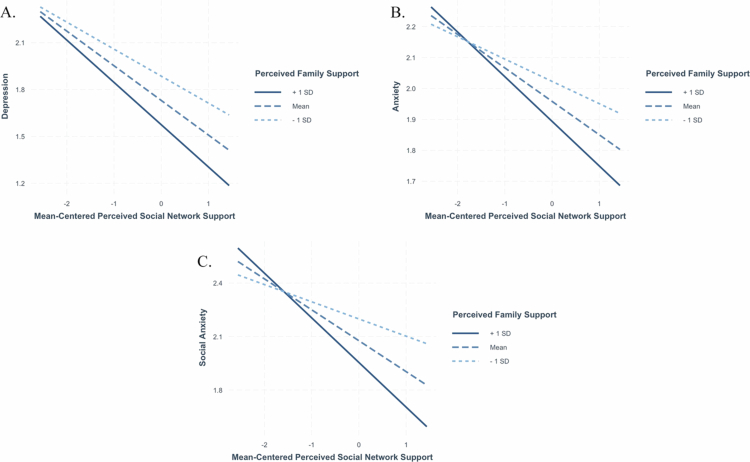
- Family support was negatively related to all CCAPS-34 subscales except alcohol use; social-network support was negatively related to depression, anxiety, social anxiety, academic distress, and anger/frustration, but not eating concerns or alcohol use. The negative relationship between social-network support and depression, anxiety, and social anxiety was stronger when family support was higher.
- For treatment outcomes, international and domestic clients differed only on anger/frustration improvement (b = 0.05, p = 0.001), with international clients showing less reduction; higher family support predicted more improvement in depression (b = −0.03), anxiety (b = −0.02), and academic distress (b = −0.04). Social-network support did not significantly predict overall treatment outcome (p = 0.010 against the p = 0.003 threshold).
Methods
- Used Center for Collegiate Mental Health (CCMH) data from 2017–2019 and 2021–2023, excluding 2019–2020 and 2020–2021 because of COVID-19. Eligible clients had at least one psychotherapy session, a first course of treatment with at least two individual sessions or clinical intake, completed SDS, and at least two CCAPS-34 records.
- International clients were exact-matched to domestic clients on race, gender, academic status, and same UCC using MatchIt; final matched sample was 4,876. Measures included SDS single items for perceived family and social-network support (1–5 Likert) and the CCAPS-34 seven subscales; outcomes were residualized change scores.
- Analyses used multivariate GLMs followed by univariate GLMs, with a Bonferroni-corrected significance threshold of p = 0.003 (0.05/16). Aim 2 models included number of attended sessions and a treatment-center fixed effect as covariates; therapist effects were not estimated.
Limitations
- Stated: only pre- and post-treatment time points were examined; social support was measured only at pre-treatment with one item per source; Likert items were treated as continuous; some clients continued after the last recorded outcome measurement, so session counts were imperfect; therapist effects were not examined because most therapists had only one client in the matched dataset; international students are not a monolith, and future work should consider country/region of origin, acculturation level, and native language.
- Stated: effect sizes were minimal, so the implications should be considered with caution.
- Evident: the abstract and discussion describe higher academic distress at intake for international clients, while the univariate results report no significant difference on academic distress; this inconsistency is visible in the text.
Model-written summary. Check it against the paper before relying on it.
Integrity signals
Registry
Cites
Statistics
Figures
Verification
Claims the paper makes
56 Own result · 14 Own method · 13 No full text of the sources · 12 Sources not found · 11 Own interpretation · 7 Not checked yet · 4 No basis given · 1 Check pending
A result the paper reports from its own data — it cites no other source for it, so there is none to check. The quote shows it is in the paper.
In the paper
“social anxiety (b = −0.17, F(1, 4871) = 177.76, p < 0.001, partial η2 = 0.040)”
§ The role of social support in the effectiveness of counseling for international students > Results > Differences in symptoms at pre-treatment (Aim 1)
plaincorrelational- Asserted: passes — The authors put it forward as true.
- Checkable: passes — It can be checked against evidence.
- Load-bearing: unclear — It is unclear whether the paper’s conclusions depend on it.
- Based: passes — The paper gives a reason why it holds.
A result the paper reports from its own data — it cites no other source for it, so there is none to check. The quote shows it is in the paper.
In the paper
“The omnibus multivariate GLM also suggested a significant interaction effect between perceived family support and perceived social network support, F(7, 4862) = 8.18, p < 0.001, partial η2 = 0.004, Pillai’s trace = 0.002.”
§ The role of social support in the effectiveness of counseling for international students > Results > Differences in symptoms at pre-treatment (Aim 1)
hedgedcorrelational- Asserted: passes — The authors put it forward as true.
- Checkable: passes — It can be checked against evidence.
- Load-bearing: unclear — It is unclear whether the paper’s conclusions depend on it.
- Based: passes — The paper gives a reason why it holds.
A result the paper reports from its own data — it cites no other source for it, so there is none to check. The quote shows it is in the paper.
In the paper
“academic distress (b = −0.09, F(1, 4871) = 122.13, p < 0.001, partial η2 = 0.010)”
§ The role of social support in the effectiveness of counseling for international students > Results > Differences in symptoms at pre-treatment (Aim 1)
plaincorrelational- Asserted: passes — The authors put it forward as true.
- Checkable: passes — It can be checked against evidence.
- Load-bearing: unclear — It is unclear whether the paper’s conclusions depend on it.
- Based: passes — The paper gives a reason why it holds.
A result the paper reports from its own data — it cites no other source for it, so there is none to check. The quote shows it is in the paper.
In the paper
“alcohol use (b = 0.00, F(1, 4871) = 0.002, p = 0.965, partial η2 < 0.001)”
§ The role of social support in the effectiveness of counseling for international students > Results > Differences in symptoms at pre-treatment (Aim 1)
plain- Asserted: passes — The authors put it forward as true.
- Checkable: passes — It can be checked against evidence.
- Load-bearing: unclear — It is unclear whether the paper’s conclusions depend on it.
- Based: passes — The paper gives a reason why it holds.
A result the paper reports from its own data — it cites no other source for it, so there is none to check. The quote shows it is in the paper.
In the paper
“while showing similar levels of anxiety, social anxiety, eating concerns and alcohol use.”
§ The role of social support in the effectiveness of counseling for international students > Discussion > Pre-treatment symptoms, international student status and social support
plain- Asserted: passes — The authors put it forward as true.
- Checkable: passes — It can be checked against evidence.
- Load-bearing: unclear — It is unclear whether the paper’s conclusions depend on it.
- Based: passes — The paper gives a reason why it holds.
A result the paper reports from its own data — it cites no other source for it, so there is none to check. The quote shows it is in the paper.
In the paper
“higher perceived family support across international and domestic student clients was related to more improvement on depression (b = −0.03, F(1,4775) = 16.36, p < 0.001, partial η2 = 0.005)”
§ The role of social support in the effectiveness of counseling for international students > Results > Differences in treatment outcomes (Aim 2)
plaincorrelational- Asserted: passes — The authors put it forward as true.
- Checkable: passes — It can be checked against evidence.
- Load-bearing: passes — The paper’s conclusions depend on it.
- Based: passes — The paper gives a reason why it holds.
A result the paper reports from its own data — it cites no other source for it, so there is none to check. The quote shows it is in the paper.
In the paper
“however, international student clients (M = 3.42) reported higher perceived family support than domestic student clients (M = 3.26), F(1, 4873) = 20.63, p < 0.001, partial η2 = 0.004.”
§ The role of social support in the effectiveness of counseling for international students > Results
plain- Asserted: passes — The authors put it forward as true.
- Checkable: passes — It can be checked against evidence.
- Load-bearing: unclear — It is unclear whether the paper’s conclusions depend on it.
- Based: passes — The paper gives a reason why it holds.
A result the paper reports from its own data — it cites no other source for it, so there is none to check. The quote shows it is in the paper.
In the paper
“international student clients presented to treatment with higher levels of depression (b = 0.11, F(1, 4871) = 26.92, p < 0.001, partial η2 = 0.003)”
§ The role of social support in the effectiveness of counseling for international students > Results > Differences in symptoms at pre-treatment (Aim 1)
plaincorrelational- Asserted: passes — The authors put it forward as true.
- Checkable: passes — It can be checked against evidence.
- Load-bearing: unclear — It is unclear whether the paper’s conclusions depend on it.
- Based: passes — The paper gives a reason why it holds.
A result the paper reports from its own data — it cites no other source for it, so there is none to check. The quote shows it is in the paper.
In the paper
“higher depression, academic distress and anger/frustration at pre-treatment than domestic student clients”
- Also stated in: § Discussion · plain
“international student clients experienced more depressive symptoms, academic distress and anger/frustration than domestic student clients at intake.”
§ The role of social support in the effectiveness of counseling for international students > Abstract
plaincorrelational- Asserted: passes — The authors put it forward as true.
- Checkable: passes — It can be checked against evidence.
- Load-bearing: passes — The paper’s conclusions depend on it.
- Based: passes — The paper gives a reason why it holds.
- Also stated in: § Discussion · plain
A result the paper reports from its own data — it cites no other source for it, so there is none to check. The quote shows it is in the paper.
In the paper
“international student clients experienced higher levels of depression, academic distress and anger/frustration compared to domestic student clients”
- Also stated in: § Conclusion · plain
“(2) international student clients presented higher depression, academic distress, and anger/frustration than domestic student clients at intake”
§ The role of social support in the effectiveness of counseling for international students > Discussion > Pre-treatment symptoms, international student status and social support
plaincorrelational- Asserted: passes — The authors put it forward as true.
- Checkable: passes — It can be checked against evidence.
- Load-bearing: passes — The paper’s conclusions depend on it.
- Based: passes — The paper gives a reason why it holds.
- Also stated in: § Conclusion · plain
A result the paper reports from its own data — it cites no other source for it, so there is none to check. The quote shows it is in the paper.
In the paper
“This interaction was not observed in externalizing symptoms in both groups.”
§ The role of social support in the effectiveness of counseling for international students > Discussion > Pre-treatment symptoms, international student status and social support
plain- Asserted: passes — The authors put it forward as true.
- Checkable: passes — It can be checked against evidence.
- Load-bearing: passes — The paper’s conclusions depend on it.
- Based: passes — The paper gives a reason why it holds.
A result the paper reports from its own data — it cites no other source for it, so there is none to check. The quote shows it is in the paper.
In the paper
“The relationship between perceived family support and alcohol use (b = −0.02, F(1, 4871) = 5.97, p = 0.015, partial η2 = 0.001) at pre-treatment was statistically insignificant.”
§ The role of social support in the effectiveness of counseling for international students > Results > Differences in symptoms at pre-treatment (Aim 1)
plain- Asserted: passes — The authors put it forward as true.
- Checkable: passes — It can be checked against evidence.
- Load-bearing: unclear — It is unclear whether the paper’s conclusions depend on it.
- Based: passes — The paper gives a reason why it holds.
A result the paper reports from its own data — it cites no other source for it, so there is none to check. The quote shows it is in the paper.
In the paper
“We found that international student clients (M = 3.45) reported lower perceived support from their local social network than domestic student clients (M = 3.68), F(1, 4873) = 50.99, p < 0.001, partial η2 = 0.010;”
§ The role of social support in the effectiveness of counseling for international students > Results
plain- Asserted: passes — The authors put it forward as true.
- Checkable: passes — It can be checked against evidence.
- Load-bearing: unclear — It is unclear whether the paper’s conclusions depend on it.
- Based: passes — The paper gives a reason why it holds.
A result the paper reports from its own data — it cites no other source for it, so there is none to check. The quote shows it is in the paper.
In the paper
“anger/frustration (b = −0.08, F(1, 4871) = 58.09, p < 0.001, partial η2 = 0.010)”
§ The role of social support in the effectiveness of counseling for international students > Results > Differences in symptoms at pre-treatment (Aim 1)
plaincorrelational- Asserted: passes — The authors put it forward as true.
- Checkable: passes — It can be checked against evidence.
- Load-bearing: unclear — It is unclear whether the paper’s conclusions depend on it.
- Based: passes — The paper gives a reason why it holds.
The paper states this without a source or data behind it here, so there is nothing to check it against. The quote shows it is in the paper.
In the paper
“international student clients reported significantly higher perceived family support than domestic student clients.”
- Also stated in: § Conclusion · plain
“(1) international student clients reported lower social network support than domestic student clients, but higher family support”
§ The role of social support in the effectiveness of counseling for international students > Discussion > Pre-treatment symptoms, international student status and social support
plaincorrelational- Asserted: passes — The authors put it forward as true.
- Checkable: passes — It can be checked against evidence.
- Load-bearing: passes — The paper’s conclusions depend on it.
- Based: passes — The paper gives a reason why it holds.
- Also stated in: § Conclusion · plain
A result the paper reports from its own data — it cites no other source for it, so there is none to check. The quote shows it is in the paper.
In the paper
“social anxiety (F(1, 4871) = 50.10, p < 0.001, partial η2 = 0.010)”
§ The role of social support in the effectiveness of counseling for international students > Results > Differences in symptoms at pre-treatment (Aim 1)
plaincorrelational- Asserted: passes — The authors put it forward as true.
- Checkable: passes — It can be checked against evidence.
- Load-bearing: unclear — It is unclear whether the paper’s conclusions depend on it.
- Based: passes — The paper gives a reason why it holds.
A result the paper reports from its own data — it cites no other source for it, so there is none to check. The quote shows it is in the paper.
In the paper
“academic distress (b = −0.04, F(1,4775) = 18.56, p < 0.001, partial η2 = 0.005)”
§ The role of social support in the effectiveness of counseling for international students > Results > Differences in treatment outcomes (Aim 2)
plaincorrelational- Asserted: passes — The authors put it forward as true.
- Checkable: passes — It can be checked against evidence.
- Load-bearing: passes — The paper’s conclusions depend on it.
- Based: passes — The paper gives a reason why it holds.
A result the paper reports from its own data — it cites no other source for it, so there is none to check. The quote shows it is in the paper.
In the paper
“while showing similar levels of anxiety, social anxiety, eating concerns and alcohol use.”
§ The role of social support in the effectiveness of counseling for international students > Discussion > Pre-treatment symptoms, international student status and social support
plain- Asserted: passes — The authors put it forward as true.
- Checkable: passes — It can be checked against evidence.
- Load-bearing: unclear — It is unclear whether the paper’s conclusions depend on it.
- Based: passes — The paper gives a reason why it holds.
A result the paper reports from its own data — it cites no other source for it, so there is none to check. The quote shows it is in the paper.
In the paper
“while showing similar levels of anxiety, social anxiety, eating concerns and alcohol use.”
§ The role of social support in the effectiveness of counseling for international students > Discussion > Pre-treatment symptoms, international student status and social support
plain- Asserted: passes — The authors put it forward as true.
- Checkable: passes — It can be checked against evidence.
- Load-bearing: passes — The paper’s conclusions depend on it.
- Based: passes — The paper gives a reason why it holds.
A result the paper reports from its own data — it cites no other source for it, so there is none to check. The quote shows it is in the paper.
In the paper
“eating concerns (b = −0.04, F(1, 4871) = 17.08, p = 0.023, partial η2 = 0.002)”
§ The role of social support in the effectiveness of counseling for international students > Results > Differences in symptoms at pre-treatment (Aim 1)
plaincorrelational- Asserted: passes — The authors put it forward as true.
- Checkable: passes — It can be checked against evidence.
- Load-bearing: unclear — It is unclear whether the paper’s conclusions depend on it.
- Based: passes — The paper gives a reason why it holds.
A result the paper reports from its own data — it cites no other source for it, so there is none to check. The quote shows it is in the paper.
In the paper
“this interaction was significant for depression (F(1, 4871) = 20.10, p < 0.001, partial η2 = 0.004)”
§ The role of social support in the effectiveness of counseling for international students > Results > Differences in symptoms at pre-treatment (Aim 1)
plaincorrelational- Asserted: passes — The authors put it forward as true.
- Checkable: passes — It can be checked against evidence.
- Load-bearing: unclear — It is unclear whether the paper’s conclusions depend on it.
- Based: passes — The paper gives a reason why it holds.
A result the paper reports from its own data — it cites no other source for it, so there is none to check. The quote shows it is in the paper.
In the paper
“while there were no significant differences in anxiety, social anxiety, academic distress, eating concerns and alcohol use between the two groups.”
§ The role of social support in the effectiveness of counseling for international students > Results > Differences in symptoms at pre-treatment (Aim 1)
plain- Asserted: passes — The authors put it forward as true.
- Checkable: passes — It can be checked against evidence.
- Load-bearing: unclear — It is unclear whether the paper’s conclusions depend on it.
- Based: passes — The paper gives a reason why it holds.
A result the paper reports from its own data — it cites no other source for it, so there is none to check. The quote shows it is in the paper.
In the paper
“In general, we found that the negative relationships between perceived social network support and these symptoms were more pronounced in clients who reported higher perceived family support.”
§ The role of social support in the effectiveness of counseling for international students > Results > Differences in symptoms at pre-treatment (Aim 1)
plaincorrelational- Asserted: passes — The authors put it forward as true.
- Checkable: passes — It can be checked against evidence.
- Load-bearing: passes — The paper’s conclusions depend on it.
- Based: passes — The paper gives a reason why it holds.
A result the paper reports from its own data — it cites no other source for it, so there is none to check. The quote shows it is in the paper.
In the paper
“social anxiety (b = −0.10, F(1, 4871) = 182.45, p < 0.001, partial η2 = 0.020)”
§ The role of social support in the effectiveness of counseling for international students > Results > Differences in symptoms at pre-treatment (Aim 1)
plaincorrelational- Asserted: passes — The authors put it forward as true.
- Checkable: passes — It can be checked against evidence.
- Load-bearing: unclear — It is unclear whether the paper’s conclusions depend on it.
- Based: passes — The paper gives a reason why it holds.
A result the paper reports from its own data — it cites no other source for it, so there is none to check. The quote shows it is in the paper.
In the paper
“We did not find any interactive effect between variables in predicting treatment outcome.”
§ The role of social support in the effectiveness of counseling for international students > Results > Differences in treatment outcomes (Aim 2)
plain- Asserted: passes — The authors put it forward as true.
- Checkable: passes — It can be checked against evidence.
- Load-bearing: unclear — It is unclear whether the paper’s conclusions depend on it.
- Based: passes — The paper gives a reason why it holds.
A result the paper reports from its own data — it cites no other source for it, so there is none to check. The quote shows it is in the paper.
In the paper
“we found a significant difference in treatment outcome between international and domestic student clients when all the outcome variables were analyzed as a set”
§ The role of social support in the effectiveness of counseling for international students > Discussion > International student status and treatment outcome
plain- Asserted: passes — The authors put it forward as true.
- Checkable: passes — It can be checked against evidence.
- Load-bearing: unclear — It is unclear whether the paper’s conclusions depend on it.
- Based: passes — The paper gives a reason why it holds.
A result the paper reports from its own data — it cites no other source for it, so there is none to check. The quote shows it is in the paper.
In the paper
“The multivariate GLM revealed significant main effects of international student status (F(7, 4862) = 13.07, p < 0.001, Pillai’s trace = 0.018), perceived family support (F(7, 4862) = 53.15, p < 0.001, Pillai’s trace = 0.071), and perceived social network support (F(7, 4862) = 52.44, p < 0.001, Pillai’s trace = 0.070) on pre-treatment psychological symptoms.”
§ The role of social support in the effectiveness of counseling for international students > Results > Differences in symptoms at pre-treatment (Aim 1)
plaincorrelational- Asserted: passes — The authors put it forward as true.
- Checkable: passes — It can be checked against evidence.
- Load-bearing: unclear — It is unclear whether the paper’s conclusions depend on it.
- Based: passes — The paper gives a reason why it holds.
A result the paper reports from its own data — it cites no other source for it, so there is none to check. The quote shows it is in the paper.
In the paper
“international student clients experienced higher levels of depression, academic distress and anger/frustration compared to domestic student clients”
- Also stated in: § Conclusion · plain
“(2) international student clients presented higher depression, academic distress, and anger/frustration than domestic student clients at intake”
§ The role of social support in the effectiveness of counseling for international students > Discussion > Pre-treatment symptoms, international student status and social support
plaincorrelational- Asserted: passes — The authors put it forward as true.
- Checkable: passes — It can be checked against evidence.
- Load-bearing: passes — The paper’s conclusions depend on it.
- Based: passes — The paper gives a reason why it holds.
- Also stated in: § Conclusion · plain
A result the paper reports from its own data — it cites no other source for it, so there is none to check. The quote shows it is in the paper.
In the paper
“while showing similar levels of anxiety, social anxiety, eating concerns and alcohol use.”
§ The role of social support in the effectiveness of counseling for international students > Discussion > Pre-treatment symptoms, international student status and social support
plain- Asserted: passes — The authors put it forward as true.
- Checkable: passes — It can be checked against evidence.
- Load-bearing: unclear — It is unclear whether the paper’s conclusions depend on it.
- Based: passes — The paper gives a reason why it holds.
A result the paper reports from its own data — it cites no other source for it, so there is none to check. The quote shows it is in the paper.
In the paper
“perceived social network support was not related to eating concerns (b = −0.04, F(1, 4871) = 6.27, p = 0.012, partial η2 = 0.002)”
§ The role of social support in the effectiveness of counseling for international students > Results > Differences in symptoms at pre-treatment (Aim 1)
plain- Asserted: passes — The authors put it forward as true.
- Checkable: passes — It can be checked against evidence.
- Load-bearing: unclear — It is unclear whether the paper’s conclusions depend on it.
- Based: passes — The paper gives a reason why it holds.
A result the paper reports from its own data — it cites no other source for it, so there is none to check. The quote shows it is in the paper.
In the paper
“higher perceived family support was related to overall better prognosis when predicting the treatment on all the symptoms as a set”
§ The role of social support in the effectiveness of counseling for international students > Discussion > Social support and treatment outcome
plaincorrelational- Asserted: passes — The authors put it forward as true.
- Checkable: passes — It can be checked against evidence.
- Load-bearing: passes — The paper’s conclusions depend on it.
- Based: passes — The paper gives a reason why it holds.
A result the paper reports from its own data — it cites no other source for it, so there is none to check. The quote shows it is in the paper.
In the paper
“anxiety (b = −0.05, F(1, 4871) = 55.72, p < 0.001, partial η2 = 0.004)”
§ The role of social support in the effectiveness of counseling for international students > Results > Differences in symptoms at pre-treatment (Aim 1)
plaincorrelational- Asserted: passes — The authors put it forward as true.
- Checkable: passes — It can be checked against evidence.
- Load-bearing: unclear — It is unclear whether the paper’s conclusions depend on it.
- Based: passes — The paper gives a reason why it holds.
A result the paper reports from its own data — it cites no other source for it, so there is none to check. The quote shows it is in the paper.
In the paper
“The omnibus multivariate GLM suggested significant main effects of international student status (F(7, 4764) = 3.75, p < 0.001, Pillai's trace = 0.005) and perceived family support (F(7, 4764) = 3.65, p < 0.001, Pillai's trace = 0.005) on residualized post-treatment change in psychological symptoms.”
§ The role of social support in the effectiveness of counseling for international students > Results > Differences in treatment outcomes (Aim 2)
hedgedcorrelational- Asserted: passes — The authors put it forward as true.
- Checkable: passes — It can be checked against evidence.
- Load-bearing: passes — The paper’s conclusions depend on it.
- Based: passes — The paper gives a reason why it holds.
A result the paper reports from its own data — it cites no other source for it, so there is none to check. The quote shows it is in the paper.
In the paper
“anxiety (b = −0.02, F(1,4775) = 10.70, p = 0.001, partial η2 = 0.003)”
§ The role of social support in the effectiveness of counseling for international students > Results > Differences in treatment outcomes (Aim 2)
plaincorrelational- Asserted: passes — The authors put it forward as true.
- Checkable: passes — It can be checked against evidence.
- Load-bearing: passes — The paper’s conclusions depend on it.
- Based: passes — The paper gives a reason why it holds.
A result the paper reports from its own data — it cites no other source for it, so there is none to check. The quote shows it is in the paper.
In the paper
“the effect size of these differences was minimal, suggesting an overall comparable treatment outcome between international and domestic student clients.”
§ The role of social support in the effectiveness of counseling for international students > Discussion > International student status and treatment outcome
hedged- Asserted: passes — The authors put it forward as true.
- Checkable: passes — It can be checked against evidence.
- Load-bearing: passes — The paper’s conclusions depend on it.
- Based: passes — The paper gives a reason why it holds.
A result the paper reports from its own data — it cites no other source for it, so there is none to check. The quote shows it is in the paper.
In the paper
“clients with higher perceived family support experienced lower levels of depression (b = −0.12, F(1, 4871) = 302.19, p < 0.001, partial η2 = 0.020)”
§ The role of social support in the effectiveness of counseling for international students > Results > Differences in symptoms at pre-treatment (Aim 1)
plaincorrelational- Asserted: passes — The authors put it forward as true.
- Checkable: passes — It can be checked against evidence.
- Load-bearing: unclear — It is unclear whether the paper’s conclusions depend on it.
- Based: passes — The paper gives a reason why it holds.
A result the paper reports from its own data — it cites no other source for it, so there is none to check. The quote shows it is in the paper.
In the paper
“international and domestic student clients had similar levels of improvement across most of the symptom domains.”
§ The role of social support in the effectiveness of counseling for international students > Discussion > International student status and treatment outcome
plain- Asserted: passes — The authors put it forward as true.
- Checkable: passes — It can be checked against evidence.
- Load-bearing: passes — The paper’s conclusions depend on it.
- Based: passes — The paper gives a reason why it holds.
A result the paper reports from its own data — it cites no other source for it, so there is none to check. The quote shows it is in the paper.
In the paper
“anxiety (F(1, 4871) = 10.60, p = 0.001, partial η2 = 0.002)”
§ The role of social support in the effectiveness of counseling for international students > Results > Differences in symptoms at pre-treatment (Aim 1)
plaincorrelational- Asserted: passes — The authors put it forward as true.
- Checkable: passes — It can be checked against evidence.
- Load-bearing: passes — The paper’s conclusions depend on it.
- Based: passes — The paper gives a reason why it holds.
A result the paper reports from its own data — it cites no other source for it, so there is none to check. The quote shows it is in the paper.
In the paper
“international and domestic student clients only significantly differed on the improvement anger/frustration (b = 0.05, F(1,4775) = 10.75, p = 0.001, partial η2 = 0.002).”
§ The role of social support in the effectiveness of counseling for international students > Results > Differences in treatment outcomes (Aim 2)
plain- Asserted: passes — The authors put it forward as true.
- Checkable: passes — It can be checked against evidence.
- Load-bearing: unclear — It is unclear whether the paper’s conclusions depend on it.
- Based: passes — The paper gives a reason why it holds.
A result the paper reports from its own data — it cites no other source for it, so there is none to check. The quote shows it is in the paper.
In the paper
“international student clients experienced higher levels of depression, academic distress and anger/frustration compared to domestic student clients”
- Also stated in: § Conclusion · plain
“(2) international student clients presented higher depression, academic distress, and anger/frustration than domestic student clients at intake”
§ The role of social support in the effectiveness of counseling for international students > Discussion > Pre-treatment symptoms, international student status and social support
plaincorrelational- Asserted: passes — The authors put it forward as true.
- Checkable: passes — It can be checked against evidence.
- Load-bearing: passes — The paper’s conclusions depend on it.
- Based: passes — The paper gives a reason why it holds.
- Also stated in: § Conclusion · plain
A result the paper reports from its own data — it cites no other source for it, so there is none to check. The quote shows it is in the paper.
In the paper
“One symptom domain that showed gaps in treatment effectiveness for international student clients, while controlling for other demographic variables, was anger/frustration.”
§ The role of social support in the effectiveness of counseling for international students > Discussion > International student status and treatment outcome
plaincorrelational- Asserted: passes — The authors put it forward as true.
- Checkable: passes — It can be checked against evidence.
- Load-bearing: passes — The paper’s conclusions depend on it.
- Based: passes — The paper gives a reason why it holds.
A result the paper reports from its own data — it cites no other source for it, so there is none to check. The quote shows it is in the paper.
In the paper
“higher perceived social network support only predicted more improvement in depressive symptoms.”
§ The role of social support in the effectiveness of counseling for international students > Discussion > Social support and treatment outcome
plaincorrelational- Asserted: passes — The authors put it forward as true.
- Checkable: passes — It can be checked against evidence.
- Load-bearing: passes — The paper’s conclusions depend on it.
- Based: passes — The paper gives a reason why it holds.
A result the paper reports from its own data — it cites no other source for it, so there is none to check. The quote shows it is in the paper.
In the paper
“anxiety (b = −0.11, F(1, 4871) = 69.18, p < 0.001, partial η2 = 0.020)”
§ The role of social support in the effectiveness of counseling for international students > Results > Differences in symptoms at pre-treatment (Aim 1)
plaincorrelational- Asserted: passes — The authors put it forward as true.
- Checkable: passes — It can be checked against evidence.
- Load-bearing: unclear — It is unclear whether the paper’s conclusions depend on it.
- Based: passes — The paper gives a reason why it holds.
A result the paper reports from its own data — it cites no other source for it, so there is none to check. The quote shows it is in the paper.
In the paper
“specifically more improvement in depression, anxiety and academic distress for both international and domestic student clients”
§ The role of social support in the effectiveness of counseling for international students > Discussion > Social support and treatment outcome
plaincorrelational- Asserted: passes — The authors put it forward as true.
- Checkable: passes — It can be checked against evidence.
- Load-bearing: passes — The paper’s conclusions depend on it.
- Based: passes — The paper gives a reason why it holds.
A result the paper reports from its own data — it cites no other source for it, so there is none to check. The quote shows it is in the paper.
In the paper
“we found that the two types of social support had a compounded effect on internalized symptoms such as depression, anxiety and social anxiety, where the negative relationship between perceived social network support and these symptoms became more pronounced when the clients had higher perceived family support.”
§ The role of social support in the effectiveness of counseling for international students > Discussion > Pre-treatment symptoms, international student status and social support
plaincorrelational- Asserted: passes — The authors put it forward as true.
- Checkable: passes — It can be checked against evidence.
- Load-bearing: passes — The paper’s conclusions depend on it.
- Based: passes — The paper gives a reason why it holds.
A result the paper reports from its own data — it cites no other source for it, so there is none to check. The quote shows it is in the paper.
In the paper
“anger/frustration (b = −0.07, F(1, 4871) = 105.00, p < 0.001, partial η2 = 0.010)”
§ The role of social support in the effectiveness of counseling for international students > Results > Differences in symptoms at pre-treatment (Aim 1)
plaincorrelational- Asserted: passes — The authors put it forward as true.
- Checkable: passes — It can be checked against evidence.
- Load-bearing: passes — The paper’s conclusions depend on it.
- Based: passes — The paper gives a reason why it holds.
A result the paper reports from its own data — it cites no other source for it, so there is none to check. The quote shows it is in the paper.
In the paper
“academic distress (b = −0.14, F(1, 4871) = 101.93, p < 0.001, partial η2 = 0.020)”
§ The role of social support in the effectiveness of counseling for international students > Results > Differences in symptoms at pre-treatment (Aim 1)
plaincorrelational- Asserted: passes — The authors put it forward as true.
- Checkable: passes — It can be checked against evidence.
- Load-bearing: unclear — It is unclear whether the paper’s conclusions depend on it.
- Based: passes — The paper gives a reason why it holds.
A result the paper reports from its own data — it cites no other source for it, so there is none to check. The quote shows it is in the paper.
In the paper
“anger/frustration (b = 0.12, F(1, 4871) = 33.81, p < 0.001, partial η2 = 0.006) than domestic student clients”
§ The role of social support in the effectiveness of counseling for international students > Results > Differences in symptoms at pre-treatment (Aim 1)
plaincorrelational- Asserted: passes — The authors put it forward as true.
- Checkable: passes — It can be checked against evidence.
- Load-bearing: unclear — It is unclear whether the paper’s conclusions depend on it.
- Based: passes — The paper gives a reason why it holds.
A result the paper reports from its own data — it cites no other source for it, so there is none to check. The quote shows it is in the paper.
In the paper
“We did not detect a significant effect of perceived social network support in both international and domestic student clients on treatment outcomes, F(7, 4764) = 2.63, p = 0.010.”
§ The role of social support in the effectiveness of counseling for international students > Results > Differences in treatment outcomes (Aim 2)
plain- Asserted: passes — The authors put it forward as true.
- Checkable: passes — It can be checked against evidence.
- Load-bearing: passes — The paper’s conclusions depend on it.
- Based: passes — The paper gives a reason why it holds.
A result the paper reports from its own data — it cites no other source for it, so there is none to check. The quote shows it is in the paper.
In the paper
“perceived social network support was negatively correlated to depression (b = −0.22, F(1, 4871) = 311.03, p < 0.001, partial η2 = 0.060)”
§ The role of social support in the effectiveness of counseling for international students > Results > Differences in symptoms at pre-treatment (Aim 1)
plaincorrelational- Asserted: passes — The authors put it forward as true.
- Checkable: passes — It can be checked against evidence.
- Load-bearing: unclear — It is unclear whether the paper’s conclusions depend on it.
- Based: passes — The paper gives a reason why it holds.
A result the paper reports from its own data — it cites no other source for it, so there is none to check. The quote shows it is in the paper.
In the paper
“Supporting our hypothesis on the relationship between perceived family support and psychological symptoms, the follow-up analysis revealed that perceived family support across both international and domestic students was negatively correlated with all CCAPS-34 subscale scores other than alcohol use.”
§ The role of social support in the effectiveness of counseling for international students > Results > Differences in symptoms at pre-treatment (Aim 1)
plaincorrelational- Asserted: passes — The authors put it forward as true.
- Checkable: passes — It can be checked against evidence.
- Load-bearing: unclear — It is unclear whether the paper’s conclusions depend on it.
- Based: passes — The paper gives a reason why it holds.
A result the paper reports from its own data — it cites no other source for it, so there is none to check. The quote shows it is in the paper.
In the paper
“international student clients reported higher anger/frustration at the end of treatment.”
§ The role of social support in the effectiveness of counseling for international students > Conclusion
plaincorrelational- Asserted: passes — The authors put it forward as true.
- Checkable: passes — It can be checked against evidence.
- Load-bearing: passes — The paper’s conclusions depend on it.
- Based: passes — The paper gives a reason why it holds.
A result the paper reports from its own data — it cites no other source for it, so there is none to check. The quote shows it is in the paper.
In the paper
“perceived social network support was not predictive of overall treatment outcome”
§ The role of social support in the effectiveness of counseling for international students > Discussion > Social support and treatment outcome
plain- Asserted: passes — The authors put it forward as true.
- Checkable: passes — It can be checked against evidence.
- Load-bearing: passes — The paper’s conclusions depend on it.
- Based: passes — The paper gives a reason why it holds.
In the paper
“we discovered that international student clients have lower perceived social network support (Robbins et al., 2024).”
§ The role of social support in the effectiveness of counseling for international students > Discussion > Pre-treatment symptoms, international student status and social support
What the sources say
- Not checked — no full text of the sourcecites Robbins et al., 2024 source
plaincorrelational- Asserted: passes — The authors put it forward as true.
- Checkable: passes — It can be checked against evidence.
- Load-bearing: passes — The paper’s conclusions depend on it.
- Based: passes — The paper gives a reason why it holds.
The paper states this without a source or data behind it here, so there is nothing to check it against. The quote shows it is in the paper.
In the paper
“The evidence gathered by these studies, however, suggested the presence of unmet mental health needs within this population.”
§ The role of social support in the effectiveness of counseling for international students > Abstract
hedged- Asserted: passes — The authors put it forward as true.
- Checkable: passes — It can be checked against evidence.
- Load-bearing: passes — The paper’s conclusions depend on it.
- Based: passes — The paper gives a reason why it holds.
In the paper
“In one study comparing the prevalence of mental health diagnoses among international and domestic students in the US, international students were less likely to report having received a formal mental health diagnosis from a professional despite reporting higher levels of depressive symptoms (Yeung et al., 2022).”
§ The role of social support in the effectiveness of counseling for international students > Abstract
What the sources say
- Not matchedcites Yeung et al., 2022
Couldn’t be matched to a paper in Crossref, so it can’t be checked.
plaincorrelational- Asserted: passes — The authors put it forward as true.
- Checkable: passes — It can be checked against evidence.
- Load-bearing: unclear — It is unclear whether the paper’s conclusions depend on it.
- Based: passes — The paper gives a reason why it holds.
- Not matched
The paper states this without a source or data behind it here, so there is nothing to check it against. The quote shows it is in the paper.
In the paper
“As a result of a combination of these factors, international students are at high risk of experiencing mental health problems.”
§ The role of social support in the effectiveness of counseling for international students > Abstract
plain- Asserted: passes — The authors put it forward as true.
- Checkable: passes — It can be checked against evidence.
- Load-bearing: passes — The paper’s conclusions depend on it.
- Based: passes — The paper gives a reason why it holds.
In the paper
“Aside from the acculturation process, Hefner and Eisenberg (2009) reported that international students (as well as ethnic minority students and students with low socioeconomic status) were at greater risk of social isolation.”
§ The role of social support in the effectiveness of counseling for international students > Abstract
What the sources say
- Not checked — no full text of the sourcecites Hefner and Eisenberg (2009) source
plain- Asserted: passes — The authors put it forward as true.
- Checkable: passes — It can be checked against evidence.
- Load-bearing: unclear — It is unclear whether the paper’s conclusions depend on it.
- Based: passes — The paper gives a reason why it holds.
In the paper
“Additionally, the studies included in the review by Constantino et al. (2021) did not differentiate among sources of social support (e.g. family members, friends and professional relationships).”
§ The role of social support in the effectiveness of counseling for international students > Abstract
What the sources say
- Not matchedcites Constantino et al. (2021)
Couldn’t be matched to a paper in Crossref, so it can’t be checked.
plain- Asserted: passes — The authors put it forward as true.
- Checkable: passes — It can be checked against evidence.
- Load-bearing: passes — The paper’s conclusions depend on it.
- Based: passes — The paper gives a reason why it holds.
- Not matched
In the paper
“One recent study specifically examined the role of social support from the local community and discovered that international student clients in treatment at UCCs who experienced lower perceived social support demonstrated higher levels of psychological distress at the end of treatment compared to their domestic counterparts, highlighting the role of perceived social support in the differential tre”
§ The role of social support in the effectiveness of counseling for international students > Abstract
What the sources say
- Not checked — no full text of the sourcecites Robbins et al., 2024 source
plaincorrelational- Asserted: passes — The authors put it forward as true.
- Checkable: passes — It can be checked against evidence.
- Load-bearing: passes — The paper’s conclusions depend on it.
- Based: passes — The paper gives a reason why it holds.
In the paper
“Social support is particularly crucial for international students undergoing acculturation, a process of sociocultural and psychological change in their relationship with their home and host cultures as they settle into a new cultural environment (Berry, 2005).”
§ The role of social support in the effectiveness of counseling for international students > Abstract
What the sources say
- Not checked — no full text of the sourcecites Berry, 2005 source
boostedcorrelational- Asserted: passes — The authors put it forward as true.
- Checkable: passes — It can be checked against evidence.
- Load-bearing: passes — The paper’s conclusions depend on it.
- Based: passes — The paper gives a reason why it holds.
What the paper did — it cites no source for this, so there is none to check. The quote shows it is in the paper.
In the paper
“We decided not to include the 2019–2020 and 2020–2021 academic years because of the timing of the COVID-19 pandemic, a period when institutions and students struggled to navigate through this global public health crisis.”
- Also stated in: § Participants · plain
“Thus, we included data collected in years that were not directly impacted by these issues to limit confounding effects.”
§ The role of social support in the effectiveness of counseling for international students > Methods > Participants
plain- Asserted: passes — The authors put it forward as true.
- Checkable: passes — It can be checked against evidence.
- Load-bearing: passes — The paper’s conclusions depend on it.
- Based: passes — The paper gives a reason why it holds.
- Also stated in: § Participants · plain
In the paper
“In recent reviews that were not specific to the college student population, social support was found to be a significant positive predictor of client improvement across various populations, diagnoses and treatment modalities (Constantino et al., 2021).”
§ The role of social support in the effectiveness of counseling for international students > Abstract
What the sources say
- Not matchedcites Constantino et al., 2021
Couldn’t be matched to a paper in Crossref, so it can’t be checked.
plaincorrelational- Asserted: passes — The authors put it forward as true.
- Checkable: passes — It can be checked against evidence.
- Load-bearing: passes — The paper’s conclusions depend on it.
- Based: passes — The paper gives a reason why it holds.
- Not matched
None of the sources cited for this claim have been checked yet.
In the paper
“First, studies frequently operationalize psychological distress as a univariate composite factor (e.g. Bartholomew et al., 2022; Keum et al., 2022; Robbins et al., 2024).”
§ The role of social support in the effectiveness of counseling for international students > Abstract
What the sources say
- Not matchedcites Bartholomew et al., 2022
Couldn’t be matched to a paper in Crossref, so it can’t be checked.
- Not matchedcites Keum et al., 2022
Couldn’t be matched to a paper in Crossref, so it can’t be checked.
- Not checked — no full text of the sourcecites Robbins et al., 2024 source
plain- Asserted: passes — The authors put it forward as true.
- Checkable: passes — It can be checked against evidence.
- Load-bearing: passes — The paper’s conclusions depend on it.
- Based: passes — The paper gives a reason why it holds.
- Not matched
In the paper
“Robust empirical evidence indicates that stronger social support is predictive of better mental health outcomes (Harandi et al., 2017).”
§ The role of social support in the effectiveness of counseling for international students > Abstract
What the sources say
- Not matchedcites Harandi et al., 2017
Couldn’t be matched to a paper in Crossref, so it can’t be checked.
boostedcorrelational- Asserted: passes — The authors put it forward as true.
- Checkable: passes — It can be checked against evidence.
- Load-bearing: passes — The paper’s conclusions depend on it.
- Based: passes — The paper gives a reason why it holds.
- Not matched
A claim is checked only against the cited paper’s full text, never its abstract, and none is available for its sources.
In the paper
“Studies have demonstrated that international students with higher levels of social support experience less acculturative stress, a factor that exacerbates psychological distress (Constantine et al., 2004; Rice et al., 2012; Wei et al., 2007; Yeh & Inose, 2003).”
§ The role of social support in the effectiveness of counseling for international students > Abstract
What the sources say
boostedcorrelational- Asserted: passes — The authors put it forward as true.
- Checkable: passes — It can be checked against evidence.
- Load-bearing: passes — The paper’s conclusions depend on it.
- Based: passes — The paper gives a reason why it holds.
In the paper
“Although it can be theorized that some clients' lack of social support could have reflected their existing interpersonal problems and symptomology, Zimmermann et al. (2020) demonstrated that social support as a predictor had a unique impact on treatment outcomes.”
§ The role of social support in the effectiveness of counseling for international students > Abstract
What the sources say
- Not checked — no full text of the sourcecites Zimmermann et al. (2020) source
boostedcorrelational- Asserted: passes — The authors put it forward as true.
- Checkable: passes — It can be checked against evidence.
- Load-bearing: passes — The paper’s conclusions depend on it.
- Based: passes — The paper gives a reason why it holds.
In the paper
“Kawamoto et al. (2018) provided foundational insight on how international student clients' levels of distress across a broad range of psychological symptoms (e.g. depression, anxiety, academic distress, etc.) compared to domestic students while controlling for cultural backgrounds.”
§ The role of social support in the effectiveness of counseling for international students > Abstract
What the sources say
- Not matchedcites Kawamoto et al. (2018)
Couldn’t be matched to a paper in Crossref, so it can’t be checked.
plaincorrelational- Asserted: passes — The authors put it forward as true.
- Checkable: passes — It can be checked against evidence.
- Load-bearing: passes — The paper’s conclusions depend on it.
- Based: passes — The paper gives a reason why it holds.
- Not matched
None of the sources cited for this claim have been checked yet.
In the paper
“Consistently, previous studies also suggested that international students were less likely to seek counseling because of cognitive (e.g. mental health stigma), cultural (e.g. adherence to original cultural values) and therapist (e.g. matching of ethnicity and cultural background) factors (Kawamoto et al., 2018; Liao et al., 2005; Tedeschi & Willis, 1993).”
§ The role of social support in the effectiveness of counseling for international students > Abstract
What the sources say
hedgeddirect- Asserted: passes — The authors put it forward as true.
- Checkable: passes — It can be checked against evidence.
- Load-bearing: unclear — It is unclear whether the paper’s conclusions depend on it.
- Based: passes — The paper gives a reason why it holds.
What the paper did — it cites no source for this, so there is none to check. The quote shows it is in the paper.
In the paper
“Therapist effects were not examined in this study because most therapists only had one client present in the matched dataset, which would vastly influence the accuracy of the estimation of therapist effects.”
§ The role of social support in the effectiveness of counseling for international students > Discussion > Limitations
plain- Asserted: passes — The authors put it forward as true.
- Checkable: passes — It can be checked against evidence.
- Load-bearing: unclear — It is unclear whether the paper’s conclusions depend on it.
- Based: passes — The paper gives a reason why it holds.
A conclusion the paper draws from its own results — it cites no other source for it, so there is none to check. The quote shows it is in the paper.
In the paper
“this type of remote connection seemed to be experienced by international student clients as being more supportive than the connection between domestic student clients and their parents.”
§ The role of social support in the effectiveness of counseling for international students > Discussion > Pre-treatment symptoms, international student status and social support
hedgedcorrelational- Asserted: passes — The authors put it forward as true.
- Checkable: passes — It can be checked against evidence.
- Load-bearing: passes — The paper’s conclusions depend on it.
- Based: passes — The paper gives a reason why it holds.
A conclusion the paper draws from its own results — it cites no other source for it, so there is none to check. The quote shows it is in the paper.
In the paper
“this result suggested that college counseling centers were adept at meeting the needs of international student clients.”
§ The role of social support in the effectiveness of counseling for international students > Discussion > International student status and treatment outcome
hedged- Asserted: passes — The authors put it forward as true.
- Checkable: passes — It can be checked against evidence.
- Load-bearing: passes — The paper’s conclusions depend on it.
- Based: passes — The paper gives a reason why it holds.
A conclusion the paper draws from its own results — it cites no other source for it, so there is none to check. The quote shows it is in the paper.
In the paper
“our results indicated that the difference in pre-treatment distress between the two groups was driven by the difference in negative emotional experiences and distress related to academic performances, rather than anxiety and externalizing behavioral issues.”
§ The role of social support in the effectiveness of counseling for international students > Discussion > Pre-treatment symptoms, international student status and social support
hedgeddirect- Asserted: passes — The authors put it forward as true.
- Checkable: passes — It can be checked against evidence.
- Load-bearing: passes — The paper’s conclusions depend on it.
- Based: passes — The paper gives a reason why it holds.
A conclusion the paper draws from its own results — it cites no other source for it, so there is none to check. The quote shows it is in the paper.
In the paper
“This result also indicated that having high-quality social support from multiple sources would be an important protective factor against developing more severe internalizing symptoms for both international and domestic student clients.”
§ The role of social support in the effectiveness of counseling for international students > Discussion > Pre-treatment symptoms, international student status and social support
hedgeddirect- Asserted: passes — The authors put it forward as true.
- Checkable: passes — It can be checked against evidence.
- Load-bearing: passes — The paper’s conclusions depend on it.
- Based: passes — The paper gives a reason why it holds.
A conclusion the paper draws from its own results — it cites no other source for it, so there is none to check. The quote shows it is in the paper.
In the paper
“It may also be that a focus on common stressors (e.g. academics, careers and relationships) provided treatment pathways that were helpful to both client populations.”
§ The role of social support in the effectiveness of counseling for international students > Discussion > International student status and treatment outcome
hedgedconditional- Asserted: passes — The authors put it forward as true.
- Checkable: unclear — It is unclear whether it could be checked against evidence.
- Load-bearing: unclear — It is unclear whether the paper’s conclusions depend on it.
- Based: passes — The paper gives a reason why it holds.
A conclusion the paper draws from its own results — it cites no other source for it, so there is none to check. The quote shows it is in the paper.
In the paper
“These results suggest that each type of support functions independently in the course of the clients' treatment.”
§ The role of social support in the effectiveness of counseling for international students > Discussion > Social support and treatment outcome
hedged- Asserted: passes — The authors put it forward as true.
- Checkable: passes — It can be checked against evidence.
- Load-bearing: passes — The paper’s conclusions depend on it.
- Based: passes — The paper gives a reason why it holds.
What the paper did — it cites no source for this, so there is none to check. The quote shows it is in the paper.
In the paper
“there is a small proportion of clients who continued to receive treatment after the last recorded outcome measurement; thus, their recorded number of utilized sessions did not perfectly match the actual number of utilized sessions.”
§ The role of social support in the effectiveness of counseling for international students > Discussion > Limitations
plaindirect- Asserted: passes — The authors put it forward as true.
- Checkable: passes — It can be checked against evidence.
- Load-bearing: unclear — It is unclear whether the paper’s conclusions depend on it.
- Based: passes — The paper gives a reason why it holds.
None of the sources cited for this claim have been checked yet.
In the paper
“Although these two constructs were assessed with single-item measures for actionable data collection in a large PRN context, these items have been shown to yield meaningful results in studies of social support among marginalized populations (e.g. Bartholomew et al., 2019; Robbins et al., 2024).”
§ The role of social support in the effectiveness of counseling for international students > Methods > Measures
What the sources say
- Not matchedcites Bartholomew et al., 2019
Couldn’t be matched to a paper in Crossref, so it can’t be checked.
- Not checked — no full text of the sourcecites Robbins et al., 2024 source
plain- Asserted: passes — The authors put it forward as true.
- Checkable: passes — It can be checked against evidence.
- Load-bearing: passes — The paper’s conclusions depend on it.
- Based: passes — The paper gives a reason why it holds.
- Not matched
A conclusion the paper draws from its own results — it cites no other source for it, so there is none to check. The quote shows it is in the paper.
In the paper
“the comparable findings between international and domestic student clients suggest a commonality in the college student experience, which can be leveraged to help normalize feelings of disappointment or shame in seeking mental health services”
§ The role of social support in the effectiveness of counseling for international students > Discussion > International student status and treatment outcome
hedged- Asserted: passes — The authors put it forward as true.
- Checkable: passes — It can be checked against evidence.
- Load-bearing: passes — The paper’s conclusions depend on it.
- Based: passes — The paper gives a reason why it holds.
None of the sources cited for this claim have been checked yet.
In the paper
“international students may experience a heightened level of cultural shock or stress from misunderstandings, or even discrimination, from the host culture, which could be manifested in the forms of irritability, frustration and anger in addition to other negative effects (Mesidor & Sly, 2016; Trifonovitch, 1977).”
§ The role of social support in the effectiveness of counseling for international students > Discussion > International student status and treatment outcome
What the sources say
- Not checked — no full text of the sourcecites Mesidor & Sly, 2016 source
- Not matchedcites Trifonovitch, 1977
Couldn’t be matched to a paper in Crossref, so it can’t be checked.
hedgedconditional- Asserted: passes — The authors put it forward as true.
- Checkable: passes — It can be checked against evidence.
- Load-bearing: passes — The paper’s conclusions depend on it.
- Based: passes — The paper gives a reason why it holds.
A conclusion the paper draws from its own results — it cites no other source for it, so there is none to check. The quote shows it is in the paper.
In the paper
“the findings of this study suggest that college and university counseling centers can effectively support the mental health needs of international student clients”
§ The role of social support in the effectiveness of counseling for international students > Discussion > Implications for college and university administration
hedgeddirect- Asserted: passes — The authors put it forward as true.
- Checkable: passes — It can be checked against evidence.
- Load-bearing: passes — The paper’s conclusions depend on it.
- Based: passes — The paper gives a reason why it holds.
In the paper
“The difference observed by Keum et al. was due mainly to center-level effects, where UCCs that serve a higher percentage of international students have more experience, familiarity and knowledge of best practices to treat this population.”
§ The role of social support in the effectiveness of counseling for international students > Discussion > International student status and treatment outcome
What the sources say
- Not matchedcites Keum et al. (2022)
Couldn’t be matched to a paper in Crossref, so it can’t be checked.
plaindirect- Asserted: passes — The authors put it forward as true.
- Checkable: passes — It can be checked against evidence.
- Load-bearing: unclear — It is unclear whether the paper’s conclusions depend on it.
- Based: passes — The paper gives a reason why it holds.
- Not matched
What the paper did — it cites no source for this, so there is none to check. The quote shows it is in the paper.
In the paper
“There were no significant differences between international and domestic student clients in the number of utilized sessions.”
§ The role of social support in the effectiveness of counseling for international students > Methods > Participants
plain- Asserted: passes — The authors put it forward as true.
- Checkable: passes — It can be checked against evidence.
- Load-bearing: unclear — It is unclear whether the paper’s conclusions depend on it.
- Based: passes — The paper gives a reason why it holds.
In the paper
“We included the number of attended sessions as a covariate for the Aim 2 analyses, as treatment dosage is directly related to treatment outcome (Howard et al., 1986).”
§ The role of social support in the effectiveness of counseling for international students > Methods > Statistical analyses
What the sources say
- Not checked — no full text of the sourcecites Howard et al., 1986 source
plaindirect- Asserted: passes — The authors put it forward as true.
- Checkable: passes — It can be checked against evidence.
- Load-bearing: passes — The paper’s conclusions depend on it.
- Based: passes — The paper gives a reason why it holds.
In the paper
“Keum et al. (2022) found that international student clients reported greater psychological distress at termination than domestic student clients.”
§ The role of social support in the effectiveness of counseling for international students > Discussion > International student status and treatment outcome
What the sources say
- Not matchedcites Keum et al. (2022)
Couldn’t be matched to a paper in Crossref, so it can’t be checked.
plaincorrelational- Asserted: passes — The authors put it forward as true.
- Checkable: passes — It can be checked against evidence.
- Load-bearing: passes — The paper’s conclusions depend on it.
- Based: passes — The paper gives a reason why it holds.
- Not matched
A conclusion the paper draws from its own results — it cites no other source for it, so there is none to check. The quote shows it is in the paper.
In the paper
“These findings implied that the quality of perceived family support, compared to perceived social network support, could be a more useful predictor of treatment outcome, especially for patients with internalizing symptoms.”
§ The role of social support in the effectiveness of counseling for international students > Discussion > Social support and treatment outcome
hedgedcorrelational- Asserted: passes — The authors put it forward as true.
- Checkable: passes — It can be checked against evidence.
- Load-bearing: passes — The paper’s conclusions depend on it.
- Based: passes — The paper gives a reason why it holds.
- It may state two separate claims as one. 19
- Probably not a substantial claim. 19
A result the paper reports from its own data — it cites no other source for it, so there is none to check. The quote shows it is in the paper.
In the paper
“we found that both types of social support were predictive of pre-treatment symptoms.”
- Also stated in: § Conclusion · plain
“(3) clients who reported higher perceived social support presented fewer psychological symptoms at intake”
§ The role of social support in the effectiveness of counseling for international students > Discussion > Pre-treatment symptoms, international student status and social support
plaincorrelational- Asserted: passes — The authors put it forward as true.
- Checkable: passes — It can be checked against evidence.
- Load-bearing: passes — The paper’s conclusions depend on it.
- Based: passes — The paper gives a reason why it holds.
It may state two separate claims as one.
- Also stated in: § Conclusion · plain
A result the paper reports from its own data — it cites no other source for it, so there is none to check. The quote shows it is in the paper.
In the paper
“We did not find significant interactive effects between international student status and either of the perceived social support variables, nor a three-way interaction between these variables on pre-treatment symptoms.”
§ The role of social support in the effectiveness of counseling for international students > Results > Differences in symptoms at pre-treatment (Aim 1)
plain- Asserted: passes — The authors put it forward as true.
- Checkable: passes — It can be checked against evidence.
- Load-bearing: unclear — It is unclear whether the paper’s conclusions depend on it.
- Based: passes — The paper gives a reason why it holds.
It may state two separate claims as one.
A result the paper reports from its own data — it cites no other source for it, so there is none to check. The quote shows it is in the paper.
In the paper
“We did not observe any interaction effects between social support and international student status, between the two types of social supports, nor a three-way interaction between these variables.”
§ The role of social support in the effectiveness of counseling for international students > Discussion > Social support and treatment outcome
plain- Asserted: passes — The authors put it forward as true.
- Checkable: passes — It can be checked against evidence.
- Load-bearing: passes — The paper’s conclusions depend on it.
- Based: passes — The paper gives a reason why it holds.
It may state two separate claims as one.
A result the paper reports from its own data — it cites no other source for it, so there is none to check. The quote shows it is in the paper.
In the paper
“Both perceived social network support and family support were predictive of pre-treatment symptoms”
§ The role of social support in the effectiveness of counseling for international students > Abstract
plaincorrelational- Asserted: passes — The authors put it forward as true.
- Checkable: passes — It can be checked against evidence.
- Load-bearing: passes — The paper’s conclusions depend on it.
- Based: passes — The paper gives a reason why it holds.
It may state two separate claims as one.
The paper states this without a source or data behind it here, so there is nothing to check it against. The quote shows it is in the paper.
In the paper
“However, to date, a limited number of studies have focused on the outcomes of international student clients in counseling.”
§ The role of social support in the effectiveness of counseling for international students > Abstract
plain- Asserted: passes — The authors put it forward as true.
- Checkable: passes — It can be checked against evidence.
- Load-bearing: passes — The paper’s conclusions depend on it.
- Based: passes — The paper gives a reason why it holds.
Probably not a substantial claim.
In the paper
“A study showed that international student clients reported higher psychological distress than domestic students after a course of treatment provided by the university counseling centers, although this gap in effectiveness was reduced when a higher proportion of international students were seen at these UCCs (Keum et al., 2022).”
§ The role of social support in the effectiveness of counseling for international students > Abstract
What the sources say
- Not matchedcites Keum et al., 2022
Couldn’t be matched to a paper in Crossref, so it can’t be checked.
plaindirect- Asserted: passes — The authors put it forward as true.
- Checkable: passes — It can be checked against evidence.
- Load-bearing: passes — The paper’s conclusions depend on it.
- Based: passes — The paper gives a reason why it holds.
It may state two separate claims as one.
- Not matched
A claim is checked only against the cited paper’s full text, never its abstract, and none is available for its sources.
In the paper
“International students experience a wide range of unique challenges, including acculturative and financial stress, racial discrimination and xenophobia, language barriers, limited social support and the development of self-identity (Prieto-Welch, 2016; Smith & Khawaja, 2011).”
§ The role of social support in the effectiveness of counseling for international students > Abstract
What the sources say
plain- Asserted: passes — The authors put it forward as true.
- Checkable: passes — It can be checked against evidence.
- Load-bearing: passes — The paper’s conclusions depend on it.
- Based: passes — The paper gives a reason why it holds.
Probably not a substantial claim. It may state two separate claims as one.
None of the sources cited for this claim have been checked yet.
In the paper
“Findings obtained within an extensive practice research network, the Center for Collegiate Mental Health (CCMH), which includes more than 800 UCCs across the United States, Canada and England, have demonstrated that college counseling is effective in relieving psychopathological symptoms such as academic distress, anxiety and depression, and improving academic performance and retention rates acros”
§ The role of social support in the effectiveness of counseling for international students > Abstract
What the sources say
boosteddirect- Asserted: passes — The authors put it forward as true.
- Checkable: passes — It can be checked against evidence.
- Load-bearing: fails — The paper’s conclusions may not depend on it.
- Based: passes — The paper gives a reason why it holds.
Probably not a substantial claim. The paper’s conclusions may not depend on it. It may state two separate claims as one.
In the paper
“Expanding upon the Robbins et al. (2024) study, which used all eligible clients, we used matching methods to create a more balanced dataset to address the wide gap in sample sizes between international and domestic student clients and to control for variables that may otherwise explain differences between the two groups.”
§ The role of social support in the effectiveness of counseling for international students > Methods > Participants
What the sources say
- Not checked — no full text of the sourcecites Robbins et al. (2024) source
plaindirect- Asserted: passes — The authors put it forward as true.
- Checkable: passes — It can be checked against evidence.
- Load-bearing: passes — The paper’s conclusions depend on it.
- Based: passes — The paper gives a reason why it holds.
It may state two separate claims as one.
In the paper
“Their study, nevertheless, mainly focused on describing psychological distress at the beginning of treatment, where a significant proportion of the client sample only attended one psychotherapy appointment instead of a course of treatment.”
§ The role of social support in the effectiveness of counseling for international students > Abstract
What the sources say
- Not matchedcites Kawamoto et al. (2018)
Couldn’t be matched to a paper in Crossref, so it can’t be checked.
plain- Asserted: passes — The authors put it forward as true.
- Checkable: passes — It can be checked against evidence.
- Load-bearing: passes — The paper’s conclusions depend on it.
- Based: passes — The paper gives a reason why it holds.
It may state two separate claims as one.
- Not matched
What the paper did — it cites no source for this, so there is none to check. The quote shows it is in the paper.
In the paper
“Because our present study focused on individual treatment, clients who attended group therapy during their first course of therapy were excluded to prevent the potential confounding effects of additional services that the client received.”
§ The role of social support in the effectiveness of counseling for international students > Methods > Participants
plain- Asserted: passes — The authors put it forward as true.
- Checkable: passes — It can be checked against evidence.
- Load-bearing: passes — The paper’s conclusions depend on it.
- Based: passes — The paper gives a reason why it holds.
Probably not a substantial claim.
In the paper
“A World Health Organization study of international students across eight countries showed that almost one in three first-year international students screened positive for at least one DSM-5 disorder in the past 12 months, with ‘major depressive episode’ and ‘generalized anxiety disorder’ having the highest prevalence rates (18.5% and 16.7%, respectively; Auerbach et al., 2018).”
§ The role of social support in the effectiveness of counseling for international students > Abstract
What the sources say
- Not checked yetcites Auerbach et al., 2018 source
plain- Asserted: passes — The authors put it forward as true.
- Checkable: passes — It can be checked against evidence.
- Load-bearing: fails — The paper’s conclusions may not depend on it.
- Based: passes — The paper gives a reason why it holds.
Probably not a substantial claim. The paper’s conclusions may not depend on it. It may state two separate claims as one.
In the paper
“Previous studies on college counseling have shown that international student clients experience higher psychological distress and benefit less from individual psychotherapy in a university counseling center (UCC) setting compared to domestic student clients.”
- Also stated in: § Abstract · hedged
“In addition, international student clients may not benefit as much from psychotherapy services provided by UCCs as domestic students.”
§ The role of social support in the effectiveness of counseling for international students > Abstract
What the sources say
- Not matchedcites Keum et al., 2022
Couldn’t be matched to a paper in Crossref, so it can’t be checked.
plaincorrelational- Asserted: passes — The authors put it forward as true.
- Checkable: passes — It can be checked against evidence.
- Load-bearing: passes — The paper’s conclusions depend on it.
- Based: passes — The paper gives a reason why it holds.
Probably not a substantial claim. It may state two separate claims as one.
- Also stated in: § Abstract · hedged
In the paper
“This result could potentially be attributed to the emergence of communication technologies (e.g. web-conferencing, internet-based messaging, social media, etc.) over the past decade that boosted the convenience and reduced the cost and difficulty of remote communication regardless of the students being within or across country borders from their families (Bacigalupe & Bräuninger, 2017).”
§ The role of social support in the effectiveness of counseling for international students > Discussion > Pre-treatment symptoms, international student status and social support
What the sources say
- Not checked — no full text of the sourcecites Bacigalupe & Bräuninger, 2017 source
hedgedconditional- Asserted: passes — The authors put it forward as true.
- Checkable: passes — It can be checked against evidence.
- Load-bearing: fails — The paper’s conclusions may not depend on it.
- Based: passes — The paper gives a reason why it holds.
Probably not a substantial claim. The paper’s conclusions may not depend on it.
What the paper did — it cites no source for this, so there is none to check. The quote shows it is in the paper.
In the paper
“although we treated the two social support items as continuous variables, Likert-scale items are ordinal by nature.”
§ The role of social support in the effectiveness of counseling for international students > Discussion > Limitations
plain- Asserted: passes — The authors put it forward as true.
- Checkable: passes — It can be checked against evidence.
- Load-bearing: fails — The paper’s conclusions may not depend on it.
- Based: passes — The paper gives a reason why it holds.
Probably not a substantial claim. The paper’s conclusions may not depend on it.
What the paper did — it cites no source for this, so there is none to check. The quote shows it is in the paper.
In the paper
“Because a significant proportion of therapists did not see more than one client in this dataset, we did not estimate therapist effects in our analyses.”
§ The role of social support in the effectiveness of counseling for international students > Methods > Statistical analyses
plain- Asserted: passes — The authors put it forward as true.
- Checkable: passes — It can be checked against evidence.
- Load-bearing: fails — The paper’s conclusions may not depend on it.
- Based: passes — The paper gives a reason why it holds.
Probably not a substantial claim. The paper’s conclusions may not depend on it.
A claim is checked only against the cited paper’s full text, never its abstract, and none is available for its sources.
In the paper
“With respect to validity, the CCAPS-34 is highly correlated with other common outcome measurements such as the Outcome Questionnaire-45 (OQ-45), the Beck Depression Inventory (BDI) and the Beck Anxiety Inventory (BAI) (Locke et al., 2012; Nordberg et al., 2018).”
§ The role of social support in the effectiveness of counseling for international students > Methods > Measures
What the sources say
boostedcorrelational- Asserted: passes — The authors put it forward as true.
- Checkable: passes — It can be checked against evidence.
- Load-bearing: fails — The paper’s conclusions may not depend on it.
- Based: passes — The paper gives a reason why it holds.
Probably not a substantial claim. The paper’s conclusions may not depend on it.
What the paper did — it cites no source for this, so there is none to check. The quote shows it is in the paper.
In the paper
“it only examined the two time points at pre- and post-treatment, which does not fully reveal the more detailed process across the course of treatment.”
§ The role of social support in the effectiveness of counseling for international students > Discussion > Limitations
plain- Asserted: passes — The authors put it forward as true.
- Checkable: passes — It can be checked against evidence.
- Load-bearing: unclear — It is unclear whether the paper’s conclusions depend on it.
- Based: passes — The paper gives a reason why it holds.
It may state two separate claims as one.
What the paper did — it cites no source for this, so there is none to check. The quote shows it is in the paper.
In the paper
“Perceived social support was only measured at pre-treatment with one singular item for each source of support, so we are not able to quantify whether there are changes in these areas throughout treatment, nor use a more nuanced perspective in understanding these constructs in this study.”
§ The role of social support in the effectiveness of counseling for international students > Discussion > Limitations
plain- Asserted: passes — The authors put it forward as true.
- Checkable: passes — It can be checked against evidence.
- Load-bearing: unclear — It is unclear whether the paper’s conclusions depend on it.
- Based: passes — The paper gives a reason why it holds.
It may state two separate claims as one.
What the paper did — it cites no source for this, so there is none to check. The quote shows it is in the paper.
In the paper
“In addition to their predictive values, we chose race/ethnicity and gender as control variables to account for some of the variance in students’ experiences with discrimination.”
§ The role of social support in the effectiveness of counseling for international students > Methods > Participants
plain- Asserted: passes — The authors put it forward as true.
- Checkable: passes — It can be checked against evidence.
- Load-bearing: fails — The paper’s conclusions may not depend on it.
- Based: passes — The paper gives a reason why it holds.
Probably not a substantial claim. The paper’s conclusions may not depend on it.
In the paper
“it is unfortunately common for international student clients who came to the United States as sojourner immigrants to experience a loss of social connections and support while adjusting to life in their host country, which exposes them to higher risks of feelings of loneliness and isolation (Sawir et al., 2007).”
§ The role of social support in the effectiveness of counseling for international students > Discussion > Pre-treatment symptoms, international student status and social support
What the sources say
- Not matchedcites Sawir et al., 2007
Couldn’t be matched to a paper in Crossref, so it can’t be checked.
plaindirect- Asserted: passes — The authors put it forward as true.
- Checkable: passes — It can be checked against evidence.
- Load-bearing: passes — The paper’s conclusions depend on it.
- Based: passes — The paper gives a reason why it holds.
It may state two separate claims as one.
- Not matched
A conclusion the paper draws from its own results — it cites no other source for it, so there is none to check. The quote shows it is in the paper.
In the paper
“we should acknowledge that the international student population is not a monolith. The experiences of international students may vary depending on how similar their home culture is to that of their host country.”
§ The role of social support in the effectiveness of counseling for international students > Discussion > Limitations
hedgedcorrelational- Asserted: passes — The authors put it forward as true.
- Checkable: passes — It can be checked against evidence.
- Load-bearing: fails — The paper’s conclusions may not depend on it.
- Based: fails — The paper may give no reason why it holds.
Probably not a substantial claim. The paper’s conclusions may not depend on it. The paper may give no reason why it holds. It may state two separate claims as one.
In the paper
“The CCAPS-34 has been shown to be invariant between international and domestic student clients, and the subscales demonstrated good internal consistency in studies including this population (Cronbach's α = 0.0.77–0.91; Bartholomew et al., 2023).”
§ The role of social support in the effectiveness of counseling for international students > Methods > Measures
What the sources say
- Not checked — no full text of the sourcecites Bartholomew et al., 2023 source
boosted- Asserted: passes — The authors put it forward as true.
- Checkable: passes — It can be checked against evidence.
- Load-bearing: passes — The paper’s conclusions depend on it.
- Based: passes — The paper gives a reason why it holds.
It may state two separate claims as one.
In the paper
“Across the subscales, the CCAPS-34 has acceptable to good internal consistency (Cronbach's α ranging from 0.76 to 0.89) and one-week test-retest reliability (coefficients range = 0.79–0.87) (Locke et al., 2012).”
§ The role of social support in the effectiveness of counseling for international students > Methods > Measures
What the sources say
- Not checked — no full text of the sourcecites Locke et al., 2012 source
plain- Asserted: passes — The authors put it forward as true.
- Checkable: passes — It can be checked against evidence.
- Load-bearing: fails — The paper’s conclusions may not depend on it.
- Based: passes — The paper gives a reason why it holds.
Probably not a substantial claim. The paper’s conclusions may not depend on it. It may state two separate claims as one.
What the paper did — it cites no source for this, so there is none to check. The quote shows it is in the paper.
In the paper
“Academic status was selected as a control for age, acculturation level, and nature of distress related to the students’ progression in their academic program.”
§ The role of social support in the effectiveness of counseling for international students > Methods > Participants
plain- Asserted: passes — The authors put it forward as true.
- Checkable: passes — It can be checked against evidence.
- Load-bearing: passes — The paper’s conclusions depend on it.
- Based: passes — The paper gives a reason why it holds.
Probably not a substantial claim.
What the paper did — it cites no source for this, so there is none to check. The quote shows it is in the paper.
In the paper
“Owing to the large number of models estimated in this study, we identified p = 0.003 (0.05/16) as the threshold for statistical significance across each step of the analyses using Bonferroni correction.”
§ The role of social support in the effectiveness of counseling for international students > Methods > Statistical analyses
plain- Asserted: passes — The authors put it forward as true.
- Checkable: passes — It can be checked against evidence.
- Load-bearing: passes — The paper’s conclusions depend on it.
- Based: passes — The paper gives a reason why it holds.
Probably not a substantial claim.
In the paper
“These negative experiences were predictive of increased difficulties in cross-cultural and academic adjustment processes, and further put international student clients at higher risk of poor academic self-perception than domestic student clients (Baba & Hosoda, 2014; Yamada et al., 2014).”
§ The role of social support in the effectiveness of counseling for international students > Discussion > Pre-treatment symptoms, international student status and social support
What the sources say
- Not matchedcites Baba & Hosoda, 2014
Couldn’t be matched to a paper in Crossref, so it can’t be checked.
- Check pendingcites Yamada et al., 2014 source
plaindirect- Asserted: passes — The authors put it forward as true.
- Checkable: passes — It can be checked against evidence.
- Load-bearing: passes — The paper’s conclusions depend on it.
- Based: passes — The paper gives a reason why it holds.
It may state two separate claims as one.
- Not matched
In the paper
“We chose the treatment center as a control variable to account for the center effect (as identified by Keum et al., 2022) as well as geographical location and local culture, which might interact with race/ethnicity to determine the students’ sense of belonging.”
§ The role of social support in the effectiveness of counseling for international students > Methods > Participants
What the sources say
- Not matchedcites Keum et al., 2022
Couldn’t be matched to a paper in Crossref, so it can’t be checked.
plain- Asserted: passes — The authors put it forward as true.
- Checkable: passes — It can be checked against evidence.
- Load-bearing: passes — The paper’s conclusions depend on it.
- Based: passes — The paper gives a reason why it holds.
Probably not a substantial claim.
- Not matched
None of the sources cited for this claim have been checked yet.
In the paper
“To account for the effect of treatment centers as documented in Keum et al. (2022) and Robbins et al. (2024), we included a fixed effect of treatment centers as a covariate in the Aim 2 models.”
§ The role of social support in the effectiveness of counseling for international students > Methods > Statistical analyses
What the sources say
- Not matchedcites Keum et al. (2022)
Couldn’t be matched to a paper in Crossref, so it can’t be checked.
- Not checked — no full text of the sourcecites Robbins et al. (2024) source
plain- Asserted: passes — The authors put it forward as true.
- Checkable: passes — It can be checked against evidence.
- Load-bearing: fails — The paper’s conclusions may not depend on it.
- Based: passes — The paper gives a reason why it holds.
Probably not a substantial claim. The paper’s conclusions may not depend on it.
- Not matched
What the paper did — it cites no source for this, so there is none to check. The quote shows it is in the paper.
In the paper
“therapists could vary in their level of competence in working with international student clients, which could uniquely contribute to the observed gaps in treatment effectiveness between international and domestic student clients.”
§ The role of social support in the effectiveness of counseling for international students > Discussion > Limitations
hedgedconditional- Asserted: passes — The authors put it forward as true.
- Checkable: passes — It can be checked against evidence.
- Load-bearing: fails — The paper’s conclusions may not depend on it.
- Based: fails — The paper may give no reason why it holds.
Probably not a substantial claim. The paper’s conclusions may not depend on it. The paper may give no reason why it holds.
A conclusion the paper draws from its own results — it cites no other source for it, so there is none to check. The quote shows it is in the paper.
In the paper
“However, it should be noted that despite the statistical significance criteria being met for the results we discussed, the effect sizes were minimal.”
§ The role of social support in the effectiveness of counseling for international students > Discussion
plain- Asserted: passes — The authors put it forward as true.
- Checkable: passes — It can be checked against evidence.
- Load-bearing: passes — The paper’s conclusions depend on it.
- Based: passes — The paper gives a reason why it holds.
It may state two separate claims as one.
What the paper did — it cites no source for this, so there is none to check. The quote shows it is in the paper.
In the paper
“Because the focus of the current study was on client-level differences, limited insight into center-level effects was generated from our analyses.”
§ The role of social support in the effectiveness of counseling for international students > Discussion > International student status and treatment outcome
plaindirect- Asserted: passes — The authors put it forward as true.
- Checkable: passes — It can be checked against evidence.
- Load-bearing: passes — The paper’s conclusions depend on it.
- Based: passes — The paper gives a reason why it holds.
Probably not a substantial claim.
The paper relies on this without support.
International students often encounter difficulties in providing meaningful social support when acclimating to the collegiate environment, which can engender experiences of loneliness and social isolation, contributing to adverse psychological outcomes.
“international students often encounter difficulties in providing meaningful social support when acclimating to the collegiate environment, which can engender experiences of loneliness and social isolation, contributing to adverse psychological outcomes.”
The paper relies on this without support.
Family support has varying levels of importance to international student clients and can have a profound impact on psychological adjustment.
“family support has varying levels of importance to international student clients and can have a profound impact on psychological adjustment.”
The paper relies on this without support.
Cultural variations inform the prevalence of mental health distress, susceptibility to different stressors, expression of distress, help-seeking, and treatment response among international student clients.
“These cultural variations inform the prevalence of mental health distress, susceptibility to different stressors, expression of distress, help-seeking, and treatment response among international student clients.”
Statistics that don’t add up
Each reported p-value recomputed from its test statistic and degrees of freedom.
Rated minor: it would not touch a result — a value no result rests on, a p-value that stays on the same side of the significance level, or a conflict that is clerical, resolved elsewhere in the paper, or outside its own findings.
In the paper
“F(1, 4871) = 17.08, p = 0.023”
§ The role of social support in the effectiveness of counseling for international students > Results > Differences in symptoms at pre-treatment (Aim 1)
Reported p = .023 · recomputed p < .001
Statistics recomputed
Every reported test result, recomputed from its test statistic and degrees of freedom. A result shows as not adding up only once an independent check has confirmed it.
- Doesn’t add upF(1, 4871) = 17.08reported p = .023 · recomputed p < .001
“F(1, 4871) = 17.08, p = .023”
- Consistentt(4874) = 3.6reported p < .001 · recomputed p < .001
“t(4874) = 3.60, p < .001”
- ConsistentF(1, 4873) = 50.99reported p < .001 · recomputed p < .001
“F(1, 4873) = 50.99, p < .001”
- ConsistentF(1, 4873) = 20.63reported p < .001 · recomputed p < .001
“F(1, 4873) = 20.63, p < .001”
- ConsistentF(7, 4862) = 13.07reported p < .001 · recomputed p < .001
“F(7, 4862) = 13.07, p < .001”
- ConsistentF(7, 4862) = 53.15reported p < .001 · recomputed p < .001
“F(7, 4862) = 53.15, p < .001”
- ConsistentF(7, 4862) = 52.44reported p < .001 · recomputed p < .001
“F(7, 4862) = 52.44, p < .001”
- ConsistentF(1, 4871) = 26.92reported p < .001 · recomputed p < .001
“F(1, 4871) = 26.92, p < .001”
- ConsistentF(1, 4871) = 33.81reported p < .001 · recomputed p < .001
“F(1, 4871) = 33.81, p < .001”
- ConsistentF(1, 4871) = 302.19reported p < .001 · recomputed p < .001
“F(1, 4871) = 302.19, p < .001”
- ConsistentF(1, 4871) = 55.72reported p < .001 · recomputed p < .001
“F(1, 4871) = 55.72, p < .001”
- ConsistentF(1, 4871) = 182.45reported p < .001 · recomputed p < .001
“F(1, 4871) = 182.45, p < .001”
- ConsistentF(1, 4871) = 122.13reported p < .001 · recomputed p < .001
“F(1, 4871) = 122.13, p < .001”
- ConsistentF(1, 4871) = 105reported p < .001 · recomputed p < .001
“F(1, 4871) = 105.00, p < .001”
- ConsistentF(1, 4871) = 5.97reported p = .015 · recomputed p = .015
“F(1, 4871) = 5.97, p = .015”
- ConsistentF(1, 4871) = 311.03reported p < .001 · recomputed p < .001
“F(1, 4871) = 311.03, p < .001”
- ConsistentF(1, 4871) = 69.18reported p < .001 · recomputed p < .001
“F(1, 4871) = 69.18, p < .001”
- ConsistentF(1, 4871) = 177.76reported p < .001 · recomputed p < .001
“F(1, 4871) = 177.76, p < .001”
- ConsistentF(1, 4871) = 101.93reported p < .001 · recomputed p < .001
“F(1, 4871) = 101.93, p < .001”
- ConsistentF(1, 4871) = 58.09reported p < .001 · recomputed p < .001
“F(1, 4871) = 58.09, p < .001”
- ConsistentF(1, 4871) = 6.27reported p = .012 · recomputed p = .012
“F(1, 4871) = 6.27, p = .012”
- ConsistentF(1, 4871) = 0.002reported p = .965 · recomputed p = .964
“F(1, 4871) = 0.002, p = .965”
- ConsistentF(7, 4862) = 8.18reported p < .001 · recomputed p < .001
“F(7, 4862) = 8.18, p < .001”
- ConsistentF(1, 4871) = 20.1reported p < .001 · recomputed p < .001
“F(1, 4871) = 20.10, p < .001”
- ConsistentF(1, 4871) = 10.6reported p = .001 · recomputed p = .001
“F(1, 4871) = 10.60, p = .001”
- ConsistentF(1, 4871) = 50.1reported p < .001 · recomputed p < .001
“F(1, 4871) = 50.10, p < .001”
- ConsistentF(7, 4764) = 3.75reported p < .001 · recomputed p < .001
“F(7, 4764) = 3.75, p < .001”
- ConsistentF(7, 4764) = 3.65reported p < .001 · recomputed p < .001
“F(7, 4764) = 3.65, p < .001”
- ConsistentF(7, 4764) = 2.63reported p = .01 · recomputed p = .010
“F(7, 4764) = 2.63, p = .010”
- ConsistentF(1, 4775) = 10.75reported p = .001 · recomputed p = .001
“F(1,4775) = 10.75, p = .001”
- ConsistentF(1, 4775) = 16.36reported p < .001 · recomputed p < .001
“F(1,4775) = 16.36, p < .001”
- ConsistentF(1, 4775) = 10.7reported p = .001 · recomputed p = .001
“F(1,4775) = 10.70, p = .001”
- ConsistentF(1, 4775) = 18.56reported p < .001 · recomputed p < .001
“F(1,4775) = 18.56, p < .001”
Self-check
Percentages, sums and reported differences re-computed from the paper’s own numbers.
Each contradiction between two passages listed here was confirmed by an independent check.
Rated major: it would touch a result — a value a result rests on, reported and recomputed p-values on opposite sides of the significance level, two passages that conflict with no sign which is right, or a cited work retracted before this paper was published.
In the paper
§ The role of social support in the effectiveness of counseling for international students > Abstract
“International student clients reported lower perceived social network support and higher family support, and higher depression, academic distress and anger/frustration at pre-treatment than domestic student clients”
§ The role of social support in the effectiveness of counseling for international students > Results > Differences in symptoms at pre-treatment (Aim 1)
“there were no significant differences in anxiety, social anxiety, academic distress, eating concerns and alcohol use between the two groups”
Rated minor: it would not touch a result — a value no result rests on, a p-value that stays on the same side of the significance level, or a conflict that is clerical, resolved elsewhere in the paper, or outside its own findings.
In the paper
§ The role of social support in the effectiveness of counseling for international students > Results > Differences in symptoms at pre-treatment (Aim 1)
“the follow-up analysis revealed that perceived family support across both international and domestic students was negatively correlated with all CCAPS-34 subscale scores other than alcohol use.”
§ The role of social support in the effectiveness of counseling for international students > Results > Differences in symptoms at pre-treatment (Aim 1)
“eating concerns (b = −0.04, F(1, 4871) = 17.08, p = 0.023, partial η2 = 0.002)”
Citations
Cites
MatchIt : Nonparametric Preprocessing for Parametric Causal Inference
Ho, D. E., Imai, K., King, G., & Stuart, E. A. (2011) · Journal of Statistical Software · doi:10.18637/jss.v042.i08 · Cited by 4,385
Auerbach, R. P., Collaborators, W. W.-I., Mortier, P., Bruffaerts, R., Alonso, J., Benjet, C., Cuijpers, P., Demyttenaere, K., Ebert, D. D., Green, J. G., et al. (2018) · Journal of Abnormal Psychology · doi:10.1037/abn0000362 · Cited by 2,522 · cited 1×
“…showed that almost one in three first-year international students screened positive for at least one DSM-5 disorder in the past 12 months, with ‘major depressive episode’ and ‘generalized anxiety disorder’ having the highest prevalence rates (18.5% and 16.7%, respectively; Auerbach et al., 2018).”
InfluentialAcculturation: Living successfully in two cultures
Berry, J. W. (2005) · International Journal of Intercultural Relations · doi:10.1016/j.ijintrel.2005.07.013 · Cited by 2,498
Yeh, C. J., & Inose, M. (2003) · Counselling Psychology Quarterly · doi:10.1080/0951507031000114058 · Cited by 1,150
A review of the acculturation experiences of international students
Smith, R. A., & Khawaja, N. G. (2011) · International Journal of Intercultural Relations · doi:10.1016/j.ijintrel.2011.08.004 · Cited by 1,130
The dose-effect relationship in psychotherapy.
Howard, K. I., Kopta, S. M., Krause, M. S., & Orlinsky, D. E. (1986) · American Psychologist · doi:10.1037/0003-066x.41.2.159 · Cited by 891
Loneliness and international students: an Australian study
Sawir, E., Marginson, S., Deumert, A., Nyland, C., & Ramia, G. (2008) · Journal of Studies in International Education · doi:10.1177/1028315307299699 · Cited by 829
Social support and mental health among college students.
Hefner, J., & Eisenberg, D. (2009) · American Journal of Orthopsychiatry · doi:10.1037/a0016918 · Cited by 810
The correlation of social support with mental health: A meta-analysis
Fasihi Harandi, T., Mohammad Taghinasab, M., & Dehghan Nayeri, T. (2017) · Electronic Physician · doi:10.19082/5212 · Cited by 733
Factors that Contribute to the Adjustment of International Students
Mesidor, J. K., & Sly, K. F. (2016) · Journal of International Students · doi:10.32674/jis.v6i1.569 · Cited by 319
Research works printed but not linked: 4
- Baba, Y., & Hosoda, M. (2014). Home away home: Better understanding of the role of social support in predicting cross-cultural adjustment among international students. College Student Journal, 1, 1–15.
- 10.1055/a-1686-4682 · DOI
- Hwang, B., Bennett, R., & Beauchemin, J. (2014). International students' utilization of counseling services. College Student Journal, 48(3), 347–354.
- Trifonovitch, G. J. (1977). Culture learning/culture teaching. Educational Perspectives, 16(4), 18–22.
Cited by
Still being checked.
Metadata
- Authors
- Tan, H., Castonguay, L. G., Janis, R. A., Hayes, J. A., Magruder, S. A. N., Chun-Kennedy, C. L., & Scofield, B. E.
- Affiliations
- Pennsylvania State University (US)
- Corresponding author
- Tan, Hongjun
- ORCID
- Venue
- Cogent Mental Health
- Publisher
- Informa UK Limited
- Published
- 2026-04-07
- Volume
- 5
- Issue
- 1
- Pages
- 2653852-2653852
- ISSN
- 2832-4765 (ISSN-L)
- PMC
- PMC13059032
- OpenAlex
- W7151245652
- Semantic Scholar
- d4bac42f6a2d4ff1a4b1fb57ec4526919c0a828d
- Cited by
- 0
- References
- 39
- FWCI
- 0.00
- Type
- journal article
- Language
- en
- Open access
- diamond
- doi.org
- Licence
- Locations
- Cogent Mental Health (publishedVersion, cc-by)
- PubMed Central (publishedVersion, cc-by)
- PubMed (publishedVersion)
- DOAJ (DOAJ: Directory of Open Access Journals) (submittedVersion, cc-by-sa)
- Topics
- Social Sciences › Communication › International Student and Expatriate Challenges
- Social Sciences › Psychology › Developmental and Educational Psychology › Student Stress and Coping
- Health Sciences › Medicine › Psychiatry and Mental health › Mental Health Treatment and Access
- Keywords
- international students, social support, university counseling services, college counseling, family support, psychological distress, depression, academic distress, anxiety, cross-cultural adaptation (acculturation), treatment outcomes, domestic students
About these checks
Registry, retraction, Cites and statistics results are computed, not judged, with one exception: a printed reference that no index lists is read once by a model before it counts as a citation error. Claims are extracted by a model and kept only when their quote appears verbatim in the text; each cited source is then checked, with a model’s help, for whether it says what the claim relies on. Those verdicts can be wrong — read the claim’s quote and the cited source before relying on one.
A language model drew the claims from the paper on 2026-11-11, under version 3 of the claim definition (model deepseek-v4.1-flash, prompt extract-v3).
A second model labelled each claim on 2026-11-11 (model jev-1.13-20260917, definition revision gold-guideline-v0.2).
Statistics and arithmetic are recomputed, not judged.
Confidence bands are shown only for fields calibrated on our annotated test set. None is calibrated yet, so no band is shown.
What counts as a claim ›How we measure confidence ›How we check this ›
Are you an author, or do you see a problem with this page? Request a review
