

Attributing human mortality during extreme heat waves to anthropogenic climate change
Open accessThe DOI matches its Crossref record; 35 of the 35 references it cites were found in a registry or an index.
Abstract
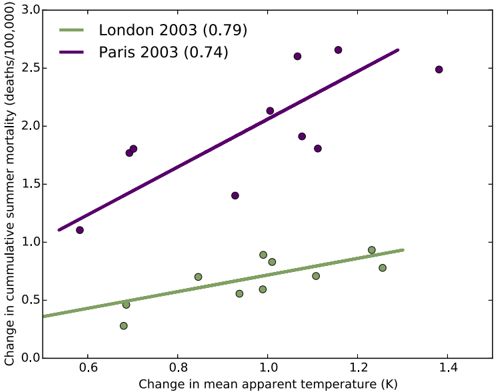
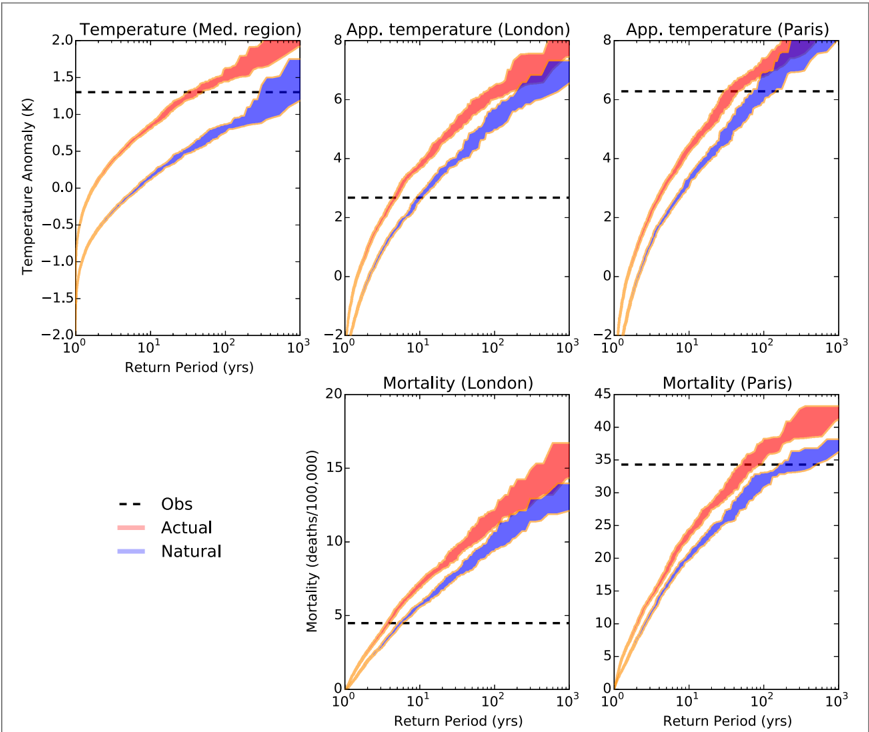
It has been argued that climate change is the biggest global health threat of the 21st century. The extreme high temperatures of the summer of 2003 were associated with up to seventy thousand excess deaths across Europe. Previous studies have attributed the meteorological event to the human influence on climate, or examined the role of heat waves on human health. Here, for the first time, we explicitly quantify the role of human activity on climate and heat-related mortality in an event attribution framework, analysing both the Europe-wide temperature response in 2003, and localised responses over London and Paris. Using publicly-donated computing, we perform many thousands of climate simulations of a high-resolution regional climate model. This allows generation of a comprehensive statistical description of the 2003 event and the role of human influence within it, using the results as input to a health impact assessment model of human mortality. We find large-scale dynamical modes of atmospheric variability remain largely unchanged under anthropogenic climate change, and hence the direct thermodynamical response is mainly responsible for the increased mortality. In summer 2003, anthropogenic climate change increased the risk of heat-related mortality in Central Paris by ∼70% and by ∼20% in London, which experienced lower extreme heat. Out of the estimated ∼315 and ∼735 summer deaths attributed to the heatwave event in Greater London and Central Paris, respectively, 64 (±3) deaths were attributable to anthropogenic climate change in London, and 506 (±51) in Paris. Such an ability to robustly attribute specific damages to anthropogenic drivers of increased extreme heat can inform societal responses to, and responsibilities for, climate change.
Overview
The claims and statistics of this paper haven’t been checked yet.
Free: it reads the open-access text and checks the first 5 claims that cite a source we can check. Create a free account to check every claim.
Integrity signals
Registry
Cites
Statistics
Figures



Verification
Claims the paper makes
The claims and statistics of this paper haven’t been checked yet.
Free: it reads the open-access text and checks the first 5 claims that cite a source we can check. Create a free account to check every claim.
Claims other papers make about this one
Each is checked against this paper’s own text: does it say what the citing paper says it does?
The cited source says what the claim attributes to it.
In the citing paper
“These studies are often conducted in the climate science disciplines and rarely take the additional step of estimating associated human health impacts9–11.”
From The burden of heat-related mortality attributable to recent human-induced climate change (2021) · cites this paper as [10]
Self-check
Percentages, sums and reported differences re-computed from the paper’s own numbers.
The self-check needs the paper’s full text.
Citations
Cites
The ERA‐Interim reanalysis: configuration and performance of the data assimilation system
Dee, D. P., Uppala, S. M., Simmons, A. J., Berrisford, P., Poli, P., Kobayashi, S., Andrae, U., Balmaseda, M. A., Balsamo, G., Bauer, P., et al. (2011) · Quarterly Journal of the Royal Meteorological Society · doi:10.1002/qj.828 · Cited by 24,480
Managing the health effects of climate change
Costello, A., Abbas, M., Allen, A., Ball, S., Bell, S., Bellamy, R., Friel, S., Groce, N., Johnson, A., Kett, M., et al. (2009) · The Lancet · doi:10.1016/s0140-6736(09)60935-1 · Cited by 3,102
Lanczos Filtering in One and Two Dimensions
Duchon, C. E. (1979) · Journal of Applied Meteorology · doi:10.1175/1520-0450(1979)018<1016:lfioat>2.0.co;2 · Cited by 2,398
Death toll exceeded 70,000 in Europe during the summer of 2003
Robine, J.-M., Cheung, S. L. K., Le Roy, S., Van Oyen, H., Griffiths, C., Michel, J.-P., & Herrmann, F. R. (2007) · Comptes Rendus. Biologies · doi:10.1016/j.crvi.2007.12.001 · Cited by 2,127
Health and climate change: policy responses to protect public health
Watts, N., Adger, W. N., Agnolucci, P., Blackstock, J., Byass, P., Cai, W., Chaytor, S., Colbourn, T., Collins, M., Cooper, A., et al. (2015) · The Lancet · doi:10.1016/s0140-6736(15)60854-6 · Cited by 2,055
Human contribution to the European heatwave of 2003
Stott, P. A., Stone, D. A., & Allen, M. R. (2004) · Nature · doi:10.1038/nature03089 · Cited by 1,735
Self-citationAnthropogenic contribution to global occurrence of heavy-precipitation and high-temperature extremes
Fischer, E. M., & Knutti, R. (2015) · Nature Climate Change · doi:10.1038/nclimate2617 · Cited by 1,427
Heat wave: a social autopsy of disaster in Chicago
(2003) · Choice Reviews Online · doi:10.5860/choice.40-4319 · Cited by 1,273
A trend-preserving bias correction – the ISI-MIP approach
Hempel, S., Frieler, K., Warszawski, L., Schewe, J., & Piontek, F. (2013) · Earth System Dynamics · doi:10.5194/esd-4-219-2013 · Cited by 1,238
High ambient temperature and mortality: a review of epidemiologic studies from 2001 to 2008
Basu, R. (2009) · Environmental Health · doi:10.1186/1476-069x-8-40 · Cited by 1,135
Research works printed but not linked: 2
- 10.1175/1520-0450(1979)018<0874:taospi>2.0.co;2 · DOI · Paper page
- Masato G 2016 On the link between Eurasian heatwaves and the upper troposphere ridges and blocking Q. J. R. Meteorol. Soc. in review
Cited by
Items 101–200 of 484
On the Linearity of Local and Regional Temperature Changes from 1.5°C to 2°C of Global Warming
King, A. D., Knutti, R., Uhe, P. F., Mitchell, D., Lewis, S. C., Arblaster, J. M., & Freychet, N. (2018) · Journal of Climate · doi:10.1175/jcli-d-17-0649.1 · Cited by 59
Self-citationPioppi, B., Pigliautile, I., Piselli, C., & Pisello, A. L. (2019) · The Science of The Total Environment · doi:10.1016/j.scitotenv.2019.134448 · Cited by 54
Supran, G. J., & Орескес, Н. (2020) · Environmental Research Letters · doi:10.1088/1748-9326/ab89d5 · Cited by 54
“Yet, that same year, one ExxonMobil Corp advertorial stressed the alleged ‘debate over climate change’ and fostered uncertainty that AGW had been observed, saying ‘last year’s record summer heat in Europe does not confirm a warming world’ (climate attribution assessments have since disproved this claim [40]).”
BackgroundAl-Kindi, S. G., Motairek, I. K., Khraishah, H., & Rajagopalan, S. (2023) · European Journal of Preventive Cardiology · doi:10.1093/eurjpc/zwad130 · Cited by 54
Donat, M. G., Pitman, A. J., & Angélil, O. (2018) · Geophysical Research Letters · doi:10.1029/2018gl079128 · Cited by 56
“Extreme temperatures threaten human health (Haines et al., 2006; Mitchell et al., 2016), economic growth (Burke et al., 2015) and natural ecosystems (Vasseur et al., 2014).”
BackgroundBurning embers: synthesis of the health risks of climate change
Ebi, K. L., Boyer, C., Ogden, N., Paz, S., Berry, P., Campbell-Lendrum, D., Hess, J. J., & Woodward, A. (2021) · Environmental Research Letters · doi:10.1088/1748-9326/abeadd · Cited by 52
Atmospheric Blocking and Weather Extremes over the Euro-Atlantic Sector – A ReviewPreprint
Kautz, L., Martius, O., Pfahl, S., Pinto, J. G., Ramos, A. M., Sousa, P. M., & Woollings, T. J. (2021) · doi:10.5194/wcd-2021-56 · Cited by 54
“The relevance of extreme weather events for society may increase in the coming years, as regional changes in the magnitude and frequency of these events are expected due to global warming (Mitchell et al., 2006; Rahmstorf and Coumou, 2011; Coumou and Rahmstorf, 2012; Mitchell et al., 2016).”
Event attribution is not ready for a major role in loss and damage
King, A. D., Grose, M., Kimutai, J., Pinto, I., & Harrington, L. J. (2023) · Nature Climate Change · doi:10.1038/s41558-023-01651-2 · Cited by 56
2018 summer extreme temperatures in South Korea and their intensification under 3 °C global warming
Im, E., Xuan, T. N., Kim, Y., & Ahn, J. (2019) · Environmental Research Letters · doi:10.1088/1748-9326/ab3b8f · Cited by 52
Brooks, K., Landeg, O., Kovats, S. R., Sewell, M. F., & O’Connell, E. (2023) · BMJ Open · doi:10.1136/bmjopen-2022-068298 · Cited by 50
Kousis, I., & Pisello, A. L. (2020) · Environmental Research Letters · doi:10.1088/1748-9326/abaa0d · Cited by 53
The Resilience of Inter-basin Transfers to Severe Droughts With Changing Spatial Characteristics
Murgatroyd, A., & Hall, J. W. (2020) · Frontiers in Environmental Science · doi:10.3389/fenvs.2020.571647 · Cited by 50
“, 2016), heat relatedmortality in London and Paris (Mitchell et al., 2016), flood damage in southern England (Schaller et al.”
BackgroundHuang, J., Li, Q., & Song, Z. (2021) · The Science of The Total Environment · doi:10.1016/j.scitotenv.2021.151656 · Cited by 51
The burden of heatwave-related preterm births and associated human capital losses in China
Zhang, Y., Hajat, S., Zhao, L., Chen, H., Cheng, L., Ren, M., Gu, K., Ji, J. S., Liang, W., & Huang, C. (2022) · Nature Communications · doi:10.1038/s41467-022-35008-8 · Cited by 53
“Considering that both natural and anthropogenic forcings can cause actual climate variabilities, an emerging body of studies are dedicated to detecting the independent contribution of anthropogenic climate change to health effects 8,9 .”
Cumulative air pollution indicators highlight unique patterns of injustice in urban Canada
Giang, A., & Castellani, K. (2020) · Environmental Research Letters · doi:10.1088/1748-9326/abcac5 · Cited by 48
Figuerola, C. M. T., Jordá, G., Moragues, P. D. V., Vaquer‐Sunyer, R., Rita, J., Canals, V., Cladera, A., Escalona, J. M., & Chueca, M. Á. M. (2021) · Regional Environmental Change · doi:10.1007/s10113-021-01810-1 · Cited by 50
Heat disproportionately kills young people: Evidence from wet-bulb temperature in Mexico
Wilson, A. J., Bressler, R. D., Ivanovich, C. C., Tuholske, C. P., Raymond, C., Horton, R., Sobel, A. H., Kinney, P. L., Cavazos, T., & Shrader, J. G. (2024) · Science Advances · doi:10.1126/sciadv.adq3367 · Cited by 53
Climate attribution of heat mortality
Mitchell, D. (2021) · Nature Climate Change · doi:10.1038/s41558-021-01049-y · Cited by 47
Self-citationFranzke, C. L. E., & Torelló‐Sentelles, H. (2020) · Climatic Change · doi:10.1007/s10584-020-02825-z · Cited by 48
The Double Burden: Climate Change Challenges for Health Systems
Martins, F. P., Paschoalotto, M. A. C., Closs, J. G. V., Bukowski, M., & Veras, M. M. (2024) · Environmental Health Insights · doi:10.1177/11786302241298789 · Cited by 51
Climate and health implications of future aerosol emission scenarios
Partanen, A., Landry, J., & Matthews, H. D. (2018) · Environmental Research Letters · doi:10.1088/1748-9326/aaa511 · Cited by 49
“Aerosol emissions could also affect human mortality indirectly; in particular, heat waves are known to increase premature mortality (Mitchell et al 2016) and aerosol-induced cooling could reduce heat wave intensities (Péré et al 2011).”
BackgroundReduced heat exposure by limiting global warming to 1.5 °C
King, A. D., Donat, M. G., Lewis, S. C., Henley, B. J., Mitchell, D., Stott, P. A., Fischer, E. M., & Karoly, D. J. (2018) · Nature Climate Change · doi:10.1038/s41558-018-0191-0 · Cited by 45
Self-citationHealth losses attributed to anthropogenic climate change
Carlson, C. J., Mitchell, D., Gibb, R., Stuart-Smith, R. F., Carleton, T. A., Lavelle, T. E., Lippi, C. A., Lukas-Sithole, M., North, M. A., Ryan, S. J., et al. (2025) · Nature Climate Change · doi:10.1038/s41558-025-02399-7 · Cited by 54
“The first end-to-end health impact attribution study, which estimated the contribution of human-caused climate change to heat-related mortality during the 2003 European heat wave, was conducted in 2016 6 .”
Self-citationAnderson, G. B., Barnes, E. A., Bell, M. L., & Dominici, F. (2019) · American Journal of Epidemiology · doi:10.1093/aje/kwz034 · Cited by 47
“However, some researchers have explored climate attribution for barrier reef bleaching, marine resources, and ecosystem productivity (65), and a handful of climate attribution studies have been conducted for health outcomes (66), including an investigation of death in England andWales during and after the 2003 heat wa…”
BackgroundWinter pressures on the UK health system dominated by the Greenland Blocking weather regime
Charlton-Perez, A. J., Aldridge, R. W., Grams, C. M., & Lee, R. (2019) · Weather and Climate Extremes · doi:10.1016/j.wace.2019.100218 · Cited by 35
“A similar end-to-end attribution approach (Stone and Allen, 2005) has been demonstrated for heat-related deaths during the summer of 2003 by (Mitchell et al., 2016), who demonstrated that anthropogenic climate change had increased the likelihood of extreme heat related mortality by 70% in central Paris and 20% in Lond…”
BackgroundBugaj, T. J., Heilborn, M., Terhoeven, V., Kaisinger, S., Nagy, E., Friederich, H., & Nikendei, C. (2021) · Medical Education Online · doi:10.1080/10872981.2021.1917037 · Cited by 43
“an [3] additional professional responsibility as future doctors (with a mission to also educate patients about climate change and its health implications).”
BackgroundKim, Y., & Kim, Y. (2023) · Sustainable Cities and Society · doi:10.1016/j.scs.2023.104710 · Cited by 43
Mosca, F., Sani, G. M. D., Giachetta, A., & Perini, K. (2021) · Sustainability · doi:10.3390/su132111638 · Cited by 47
Evaluating heat extremes in the UK Climate Projections (UKCP18)
Kennedy-Asser, A. T., Andrews, O., Mitchell, D., & Warren, R. (2021) · Environmental Research Letters · doi:10.1088/1748-9326/abc4ad · Cited by 49
Self-citationSpatial and Temporal Variation Characteristics of Heatwaves in Recent Decades over China
Liu, J., Ren, Y., Tao, H., & Shalamzari, M. J. (2021) · Remote Sensing · doi:10.3390/rs13193824 · Cited by 42
Ntoumos, A., Hadjinicolaou, P., Zittis, G., Proestos, Y., & Lelieveld, J. (2022) · Earth Systems and Environment · doi:10.1007/s41748-022-00297-y · Cited by 45
“2018), for example, they are recognized as the major weather-related cause of premature mortality (Gosling et al. 2009; Mitchell et al. 2016).”
BackgroundA microscale three-dimensional model of urban outdoor thermal exposure (TUF-Pedestrian)
Lachapelle, J. A., Krayenhoff, E. S., Middel, A., Meltzer, S., Broadbent, A. M., & Georgescu, M. (2022) · International Journal of Biometeorology · doi:10.1007/s00484-022-02241-1 · Cited by 41
Assessing mid-latitude dynamics in extreme event attribution systems
Mitchell, D., Davini, P., Harvey, B. J., Massey, N., Haustein, K., Woollings, T. J., Jones, R., Otto, F. E. L., Guillod, B. P., Sparrow, S., et al. (2016) · Climate Dynamics · doi:10.1007/s00382-016-3308-z · Cited by 40
“Mitchell et al. (2016) attributed changes in summer blocking, and ref.”
BackgroundSelf-citationZhang, M., Yu, H., King, A. D., Wei, Y. X., Huang, J., & Ren, Y. (2020) · Climatic Change · doi:10.1007/s10584-020-02725-2 · Cited by 41
The question of life, the universe and event attribution
Stone, D. A., Rosier, S. M., & Frame, D. J. (2021) · Nature Climate Change · doi:10.1038/s41558-021-01012-x · Cited by 40
Heat-related mortality amplified during the COVID-19 pandemic
Sousa, P. M., Trigo, R. M., Russo, A., Geirinhas, J. L., Rodrigues, A. P., Silva, S., & Torres, A. R. (2022) · International Journal of Biometeorology · doi:10.1007/s00484-021-02192-z · Cited by 40
Extreme events impact attribution: A state of the art
Noy, I., Stone, D. A., & Uher, T. (2024) · Cell Reports Sustainability · doi:10.1016/j.crsus.2024.100101 · Cited by 49
Parison, S., Chaumont, M., Kounkou‐Arnaud, R., Long, F., Bernik, A., da Silva, M., & Hendel, M. (2023) · Sustainable Cities and Society · doi:10.1016/j.scs.2023.104818 · Cited by 37
21st Century Global and Regional Surface Temperature Projections
Ma, N., Jiang, J. H., Hou, K., Lin, Y., Rosen, P. E., Vu, T., Gu, Y., & Fahy, K. A. (2022) · Earth and Space Science · doi:10.1029/2022ea002662 · Cited by 37
“Historically, fatal heatwaves have been linked to anthropogenic global warming (Mitchell et al., 2016).”
BackgroundMortality burden attributed to anthropogenic warming during Europe’s 2022 record-breaking summer
Beck, T. M., Schumacher, D. L., Achebak, H., Vicedo‐Cabrera, A. M., Seneviratne, S. I., & Ballester, J. (2024) · npj Climate and Atmospheric Science · doi:10.1038/s41612-024-00783-2 · Cited by 38
“Furthermore, Mitchell et al. 12 found a percentage of 20% for London and 70% for Paris for the summer of 2003, which is reasonably close to our estimate for the summer of 2022, i.e. a percentage of 36% for the United Kingdom and 54% for France (Table S2).”
Wong, E. Y. C., Ho, D. C. K., So, S. C. K., & Poo, M. C. (2021) · Corporate Social Responsibility and Environmental Management · doi:10.1002/csr.2193 · Cited by 36
Yang, Y., & Zhao, N. (2023) · Environmental Pollution · doi:10.1016/j.envpol.2023.122443 · Cited by 35
Impacts of idealized land cover changes on climate extremes in Europe
Hu, X., Huang, B., & Cherubini, F. (2019) · Ecological Indicators · doi:10.1016/j.ecolind.2019.05.037 · Cited by 34
Mosca, F., Canepa, M., & Perini, K. (2023) · Urban Climate · doi:10.1016/j.uclim.2023.101580 · Cited by 33
Acceleration of daily land temperature extremes and correlations with surface energy fluxes
Huntingford, C., Cox, P. M., Ritchie, P. D. L., Clarke, J. J., Parry, I., & Williamson, M. S. (2024) · npj Climate and Atmospheric Science · doi:10.1038/s41612-024-00626-0 · Cited by 32
Self-citationGlobal Warming in Local Discourses: How Communities around the World Make Sense of Climate Change
Brüggemann, M., & Rödder, S. (2020) · Global communications · doi:10.11647/obp.0212 · Cited by 38
“Attributing damage and losses from extreme weather to climate change is thus possible with quantitative information on vulnerability and exposure and an understanding of local decision-making and governance structures, but very few studies have assessed this final link in the chain of causality (Mitchell et al. 2016;…”
BackgroundStratospheric aerosol injection may impact global systems and human health outcomes
Tracy, S. M., Moch, J. M., Eastham, S. D., & Buonocore, J. J. (2022) · Elementa Science of the Anthropocene · doi:10.1525/elementa.2022.00047 · Cited by 36
Towards the Integrated Study of Urban Climate, Air Pollution, and Public Health
Salmond, J., Sabel, C. E., & Vardoulakis, S. (2018) · Climate · doi:10.3390/cli6010014 · Cited by 31
“Short lived climate pollutants (SLCP), such as black carbon and ozone, can exacerbate climate change, altering the frequency, duration, and location of heatwaves and cold spells, storm intensity, precipitation patterns, and, possibly, ultra-violet radiation exposure, indirectly threatening urban lives and livelihoods…”
BackgroundSelf-citationBiodiversity and Health in the Face of Climate Change: Implications for Public Health
Cook, P. A., Howarth, M. L., & Wheater, C. P. (2019) · Springer eBooks · doi:10.1007/978-3-030-02318-8_11 · Cited by 37
Anthropogenic climate change and heat effects on health
Christidis, N., Mitchell, D., & Stott, P. A. (2019) · International Journal of Climatology · doi:10.1002/joc.6104 · Cited by 29
“While Christidis et al. (2010) considered trends over several decades, Mitchell (2016) and Mitchell et al. (2016) employed event attribution methodologies to examine how human influence increased the chances of mortality and human discomfort during specific devastating heatwaves in two European…”
BackgroundSelf-citationLeya, R. S., Jodder, P. K., Rahaman, K. R., Chowdhury, M. A., Parida, D., & Islam, M. S. (2022) · Earth Systems and Environment · doi:10.1007/s41748-022-00309-x · Cited by 31
“1 3 Published in partnership with CECCR at King Abdulaziz University heat waves are expected to strike more frequently in the future, consequently imposing numerous adverse health effects on the urban population worldwide (Campbell et al. 2018; Kuehn and McCormick 2017; Mitchell et al. 2016; Van Oldenborgh et al. 2018…”
BackgroundDubey, A. K., & Kumar, P. (2022) · Climate Dynamics · doi:10.1007/s00382-022-06309-x · Cited by 30
Seong, K., Jiao, J., & Mandalapu, A. (2022) · Environment and Planning B Urban Analytics and City Science · doi:10.1177/23998083221129618 · Cited by 34
“Extreme heat events, increased due to climate change, threaten public health, the water supply, and the state’s infrastructure in urban areas (Luber and McGeehin, 2008; Mitchell et al., 2016).”
BackgroundGibson, P. B., Stone, D. A., Thatcher, M., Broadbent, A. M., Dean, S. M., Rosier, S. M., Stuart, S. J., & Sood, A. (2023) · Journal of Geophysical Research Atmospheres · doi:10.1029/2023jd038530 · Cited by 31
“, the jet, storm tracks, blocking, cyclones) is particularly important for building confidence in attributions statements in mid-latitude regions (Mitchell et al., 2016).”
BackgroundMethodForoutan, E., Hu, T., Zhang, F., & Yu, H. (2024) · International Journal of Applied Earth Observation and Geoinformation · doi:10.1016/j.jag.2024.103653 · Cited by 32
Abadi, A. M., Gwon, Y., Gribble, M. O., Berman, J. D., Bilotta, R., Hobbins, M., & Bell, J. E. (2022) · SSRN Electronic Journal · doi:10.1016/j.scitotenv.2022.156660 · Cited by 29
The attribution of human health outcomes to climate change: transdisciplinary practical guidance
Ebi, K. L., Haines, A., Andrade, R. F. S., Åström, C., Barreto, M. L., Bonell, A., Bowen, K., Brink, N. B., Caminade, C., Carlson, C. J., et al. (2025) · Climatic Change · doi:10.1007/s10584-025-03976-7 · Cited by 33
“Examples include economic losses, food security, wildfires, agriculture, hydrological change, and health (e.g., Uhe et al. 2021 ; Mitchell et al. 2016 ; Ebi et al. 2017, 2020 ; Dasgupta and Robinson 2022 ; Romanovska et al. 2024 ; Burton et al. 2024 ; Gibb et al. 2023 ; Vicedo-Cabrera et al. 2021,…”
Self-citationClimate change and epilepsy: Time to take action
Sisodiya, S. M., Fowler, H. J., LAKE, I. R., Nanji, R. O., Gaweł, K., Esguerra, C. V., Newton, C. R. J. C., & Foley, A. (2019) · Epilepsia Open · doi:10.1002/epi4.12359 · Cited by 30
“31 Modeling suggests that in summer 2003, when an estimated 735 people died of causes relating to extreme heat in central Paris, anthropogenic climate change increased the risk of heat‐related mortality by approximately 70%, 32 illustrating the scale of the issue.”
BackgroundResearch Priorities for Climate Litigation
Wentz, J. A., Merner, L. D., Franta, B., Lehmen, A., & Frumhoff, P. C. (2022) · Earth s Future · doi:10.1029/2022ef002928 · Cited by 42
“, 2021); on how physical changes in marine systems affect fishery productivity, food security, and livelihoods; and on how, exacerbated by climate change, extreme events such as heat waves and wildfires affect public health and welfare (Mitchell et al., 2016).”
BackgroundSelf-citationEvaluation of the influence of climatic changes on the degradation of the historic buildings
Pinheiro, V. R. F., Fontenele, R., Magalhães, A., Frota, N. T. S., & Mesquita, E. (2024) · Energy and Buildings · doi:10.1016/j.enbuild.2024.114813 · Cited by 28
Climate Change, Air Pollution, and Health: Common Sources, Similar Impacts, and Common Solutions
Ramanathan, V. (2020) · Springer eBooks · doi:10.1007/978-3-030-31125-4_5 · Cited by 27
“For example, the 2003 European heat wave led to about 70,000 premature mortalities (Mitchell et al., 2016).”
BackgroundClimate Change and Young People in Uganda: A Literature Review
Mugeere, A. B., Barford, A., & Magimbi, P. (2021) · The Journal of Environment & Development · doi:10.1177/10704965211047159 · Cited by 27
Projected risks associated with heat stress in the UK Climate Projections (UKCP18)
Kennedy-Asser, A. T., Owen, G. E., Griffith, G. J., Andrews, O., Lo, Y. T. E., Mitchell, D., Jenkins, K., & Warren, R. (2022) · Environmental Research Letters · doi:10.1088/1748-9326/ac541a · Cited by 30
Self-citationMing, R., Li, B., Du, C., Yu, W. B., Liu, H., Kosonen, R., & Yao, R. (2023) · Energy and Buildings · doi:10.1016/j.enbuild.2023.112834 · Cited by 28
When don’t we need a new extreme event attribution study?
Clarke, B. J., Otto, F. E. L., & Jones, R. (2023) · Climatic Change · doi:10.1007/s10584-023-03521-4 · Cited by 44
“Across several major European cities including London, higher mean temperatures are associated with a greater-than-linear rise in mortality (Baccini et al. 2008; Gasparrini et al. 2015; de’ Donato et al. 2015; Mitchell et al. 2016; Vicedo-Cabrera et al. 2019).”
BackgroundSpatiotemporal changes in Universal Thermal Climate Index in the Middle East and North Africa
Hamed, M. M., Kyaw, A. K., Nashwan, M. S., & Shahid, S. (2023) · Atmospheric Research · doi:10.1016/j.atmosres.2023.107008 · Cited by 27
Wang, L., Gu, X., Slater, L. J., Lai, Y., Zheng, Y., Gong, J., Dembélé, M., Tosunoğlu, F., Liu, J., Zhang, X., et al. (2023) · Earth s Future · doi:10.1029/2023ef003613 · Cited by 28
“The occurrence probabilities of EPEs may be altered by ACC (Fowler et al., 2021; IPCC, 2012; Mann et al., 2017; Mitchell et al., 2016; van Oldenborgh et al., 2018, 2021; Vogel et al., 2019; Willems et al., 2012; T. J. Zhou et al., 2019), as ACC has affected the stationarity of climate (Cheng et…”
BackgroundExtreme Event Attribution in the Mediterranean
Jézéquel, A., Faranda, D., Drobinski, P., & Lionello, P. (2025) · International Journal of Climatology · doi:10.1002/joc.8799 · Cited by 29
“Increasing number of hot days, longer, more intense heatwaves (Efthymiadis et al. 2011), attributable to climate change (Clarke et al. 2022) Increasing number of hot days, longer, more intense heatwaves (Molina et al. 2020, Lionello and Scarascia 2020) The 2017 summer heatwave in Southern Europe was made at least 3 ti…”
InfluentialZhu, Z., Zhang, T., Benmarhnia, T., Chen, X., Wang, H., Wulayin, M., Knibbs, L. D., Yang, S., Xu, L., Huang, C., et al. (2024) · The Lancet Planetary Health · doi:10.1016/s2542-5196(24)00242-0 · Cited by 28
Modeling nonstationary temperature maxima based on extremal dependence changing with event magnitude
Zhong, P., Huser, R., & Opitz, T. (2022) · The Annals of Applied Statistics · doi:10.1214/21-aoas1504 · Cited by 32
“High surface air temperature has indeed been shown to directly contribute to the increase in human mortality rate during the hot season (Ballester et al. (1997), Mitchell et al. (2016), Brown (2016)).”
BackgroundSelecting Indicators and Optimizing Decision Rules for Long‐Term Water Resources Planning
Murgatroyd, A., & Hall, J. W. (2021) · Water Resources Research · doi:10.1029/2020wr028117 · Cited by 26
“, 2016), heat-related mortality (Mitchell et al., 2016), flood damage (Schaller et al.”
BackgroundAttribution of the 2015 drought in Marathwada, India from a multivariate perspective
Zachariah, M., Kumari, S., Mondal, A., Haustein, K., & Otto, F. E. L. (2022) · Weather and Climate Extremes · doi:10.1016/j.wace.2022.100546 · Cited by 26
Williams, E. L. (2019) · Climatic Change · doi:10.1007/s10584-019-02620-5 · Cited by 25
Living with air-conditioning: experiences in Dubai, Chongqing and London
Murtagh, N., Badi, S. M., Shi, Y., Wei, S., & Yu, W. (2022) · Buildings and Cities · doi:10.5334/bc.147 · Cited by 32
Iliopoulou, K., Léone, M., Hunfeld, N., Ferrer, R., Baid, H., Ostermann, M., Scaramuzzo, G., Touw, H. R. W., Ioan, A.-M., Θεοδωρακοπούλου, Μ., et al. (2025) · Journal of Critical Care · doi:10.1016/j.jcrc.2025.155079 · Cited by 23
Varvaštian, S., & Kalunga, F. K. (2020) · Transnational Environmental Law · doi:10.1017/s2047102520000138 · Cited by 23
Frick, M., Neu, L., Liebhaber, N., Sperner‐Unterweger, B., Stötter, J., Keller, L., & Hüfner, K. (2021) · Sustainability · doi:10.3390/su132313361 · Cited by 26
Detection and regional analysis of heatwave characteristics in İstanbul
Yılmaz, M., Kara, Y., Çulpan, H. C., Can, G., & Toros, H. (2023) · Sustainable Cities and Society · doi:10.1016/j.scs.2023.104789 · Cited by 25
Practicing nurses' and nursing students' perceptions of climate change: A scoping review
Bérubé, A., Diallo, T., Roberge, M., Audate, P. P., Leblanc, N., Jobin, É., Moubarak, N., Guillaumie, L., Dupéré, S., Guichard, A., et al. (2024) · Nursing Open · doi:10.1002/nop2.70043 · Cited by 24
“In Europe, heatwaves and severe heatwaves are projected to be at least twice as frequent in the near future (2020–2049) (Lhotka et al., 2018), posing potentially a significant risk of loss of many human lives (Mitchell et al., 2016 ).”
BackgroundAdvancing Australia's role in climate change and health research
Green, D., Pitman, A. J., Barnett, A. G., Kaldor, J. M., Doherty, P. C., & Stanley, F. J. (2017) · Nature Climate Change · doi:10.1038/nclimate3182 · Cited by 24
Impacts of Anthropogenic Forcings and El Niño on Chinese Extreme Temperatures
Freychet, N., Sparrow, S., Tett, S. F. B., Mineter, M. J., Hegerl, G. C., & Wallom, D. C. H. (2018) · Advances in Atmospheric Sciences · doi:10.1007/s00376-018-7258-8 · Cited by 22
Self-citationEyster, H. N., & Beckage, B. (2023) · Atmosphere · doi:10.3390/atmos14030552 · Cited by 22
Connecting extreme weather events to climate change
Wehner, M. F. (2023) · Physics Today · doi:10.1063/pt.3.5309 · Cited by 22
Li, S., Rupp, D. E., Hawkins, L., Mote, P. W., McNeall, D., Sparrow, S., Wallom, D. C. H., Betts, R., & Wettstein, J. J. (2019) · Geoscientific model development · doi:10.5194/gmd-12-3017-2019 · Cited by 24
“, 2016) and heat-related mortality (Mitchell et al., 2016), an important next step would be to investigate how the tails of distributions of weather variables respond to parameter perturbations.”
BackgroundSelf-citationEstimation of heat-related deaths during heat wave episodes in South Korea (2006–2017)
Lim, Y.-H., Lee, K., Bae, H.-J., Kim, D., Yoo, H., Park, S., & Hong, Y. (2019) · International Journal of Biometeorology · doi:10.1007/s00484-019-01774-2 · Cited by 22
Rendell, R. J., Higlett, M. P., Khazova, M., & O’Hagan, J. (2020) · Journal of Environmental and Public Health · doi:10.1155/2020/2589601 · Cited by 23
He, Y., Zhao, Y., Sun, S., Fang, J., Zhang, Y., Sun, Q., Liu, L., Duan, Y., Hu, X., & Shi, P. (2024) · Climatic Change · doi:10.1007/s10584-024-03718-1 · Cited by 22
Attribution of extreme events to climate change in the Australian region – A review
Lane, T. P., King, A. D., Perkins-Kirkpatrick, S. E., Pitman, A. J., Alexander, L. V., Arblaster, J. M., Bindoff, N. L., Bishop, C. H., Black, M., Bradstock, R. A., et al. (2023) · Weather and Climate Extremes · doi:10.1016/j.wace.2023.100622 · Cited by 26
Blue space resilient urban planning to enhance severely distressed thermal environment
Gupta, A., & De, B. (2024) · Physics and Chemistry of the Earth Parts A/B/C · doi:10.1016/j.pce.2024.103804 · Cited by 22
Tosca, M. G., Galvin, A., Gilbert, I., Walls, K., Tyler, G. E., & Nastan, A. M. (2021) · Elementa Science of the Anthropocene · doi:10.1525/elementa.2021.00016 · Cited by 20
“, 2018), and heat waves are becoming increasingly dangerous (Hayhoe et al., 2010; Mitchell et al., 2016), to name a few.”
BackgroundUrban Areas and Air Pollution: Causes, Concerns, and Mitigation
Gupta, S., & Kumar, R. (2023) · Springer eBooks · doi:10.1007/978-3-031-45300-7_7 · Cited by 24
Gupta, A., Sadab, A., & De, B. (2024) · Journal of Water and Climate Change · doi:10.2166/wcc.2024.370 · Cited by 20
Broadening the scope of anthropogenic influence in extreme event attribution
Jézéquel, A., Bastos, A., Faranda, D., Kimutai, J., Grix, N. L., Wilson, A. M., Rufat, S., Shepherd, T. G., Stuart-Smith, R. F., Loon, A. F. V., et al. (2024) · Environmental Research Climate · doi:10.1088/2752-5295/ad7527 · Cited by 22
“…relied either on tailored statistical analyses such as transfer functions or Bayesian regression models commonly used in epidemiological studies (Mitchell et al 2016, Frame et al 2020a, 2020b, Litzow et al 2021, Vicedo-Cabrera et al 2021, 2023), or on dynamical impact models, deriving impacts…”
Yao, X., Qu, Y., Zhang, L., Mishra, A. K., Yin, J., Ding, R., Yang, J., Bai, C., Zhang, L., Li, M., et al. (2024) · One Earth · doi:10.1016/j.oneear.2024.09.016 · Cited by 23
Eyster, H. N., & Beckage, B. (2022) · Atmosphere · doi:10.3390/atmos13050830 · Cited by 20
Mosca, F., Calbi, M., Roccotiello, E., & Perini, K. (2025) · Sustainable Cities and Society · doi:10.1016/j.scs.2025.106170 · Cited by 20
Lee, C. C., Obarein, O. A., Sheridan, S. C., Smith, E. T., & Adams, R. E. (2020) · International Journal of Climatology · doi:10.1002/joc.6852 · Cited by 19
Wang, T., She, D., Bao, Z., Zhang, Q., Wang, L., Wei, Y., & Niu, Q. (2025) · Environmental Research Letters · doi:10.1088/1748-9326/adad01 · Cited by 23
Jézéquel, A., Yiou, P., & Vanderlinden, J. (2019) · Weather and Climate Extremes · doi:10.1016/j.wace.2019.100231 · Cited by 19
Schwab, M., Meinke, I., Vanderlinden, J., & von STORCH, H. (2017) · Weather and Climate Extremes · doi:10.1016/j.wace.2017.09.001 · Cited by 19
Metadata
- Authors
- Mitchell, D., Heaviside, C., Vardoulakis, S., Huntingford, C., Masato, G., P Guillod, B., Frumhoff, P., Bowery, A., Wallom, D., & Allen, M.
- Affiliations
- Public Health England (GB)
- UK Centre for Ecology & Hydrology (GB)
- University of Reading (GB)
- Union of Concerned Scientists (US)
- University of Oxford (GB)
- Venue
- Environmental Research Letters
- Publisher
- IOP Publishing
- Published
- 2016-07-01
- Volume
- 11
- Issue
- 7
- Pages
- 074006
- ISSN
- 1748-9326 (ISSN-L)
- OpenAlex
- W2471123203
- Semantic Scholar
- 20c1a9b15ac36dd32d44cbd003f7de57b7dc1956
- Cited by
- 439
- References
- 34
- Citations by year
- 2026: 27 · 2025: 62 · 2024: 51 · 2023: 56 · 2022: 55 · 2021: 60 · 2020: 47 · 2019: 29 · 2018: 24 · 2017: 25 · 2016: 3
- FWCI
- 17.00
- Type
- journal article
- Language
- en
- Open access
- gold
- doi.org
- Licence
- cc-by
- iopscience.iop.org/info/page/text-and-data-mining (tdm, 7 d)
- creativecommons.org/licenses/by/3.0/ (vor, 7 d)
- Locations
- Environmental Research Letters (publishedVersion, cc-by)
- Explore Bristol Research (publishedVersion, cc-by)
- NERC Open Research Archive (Natural Environment Research Council) (acceptedVersion)
- CentAUR (University of Reading) (submittedVersion)
- Bristol Research (University of Bristol) (submittedVersion, cc-by)
- DOAJ (DOAJ: Directory of Open Access Journals) (submittedVersion)
- Funders
- Union of Concerned Scientists (N/A)
- Topics
- Physical Sciences › Environmental Science › Health, Toxicology and Mutagenesis › Climate Change and Health Impacts
- Physical Sciences › Environmental Science › Global and Planetary Change › Climate variability and models
- Physical Sciences › Environmental Science › Global and Planetary Change › Climate Change and Environmental Impact
- Keywords
- 2003 European heatwave, heat-related mortality, anthropogenic climate change attribution, extreme heat, regional climate model simulation, London, Paris, climate responsibility
About these checks
Registry, retraction, Cites and statistics results are computed, not judged, with one exception: a printed reference that no index lists is read once by a model before it counts as a citation error. Claims are extracted by a model and kept only when their quote appears verbatim in the text; each cited source is then checked, with a model’s help, for whether it says what the claim relies on. Those verdicts can be wrong — read the claim’s quote and the cited source before relying on one.
Statistics and arithmetic are recomputed, not judged.
Confidence bands are shown only for fields calibrated on our annotated test set. None is calibrated yet, so no band is shown.
What counts as a claim ›How we measure confidence ›How we check this ›
Are you an author, or do you see a problem with this page? Request a review
Data sources
Bibliographic data: Semantic Scholar, OpenAlex, Crossref.
Contains information from the Semantic Scholar Academic Graph Datasets, made available under the ODC Attribution License (ODC-BY 1.0).
Semantic Scholar’s data is described in: Kinney, R., et al. (2023). The Semantic Scholar Open Data Platform. arXiv:2301.10140.
