

Attributing human mortality during extreme heat waves to anthropogenic climate change
Open accessThe DOI matches its Crossref record; 35 of the 35 references it cites were found in a registry or an index.
Abstract
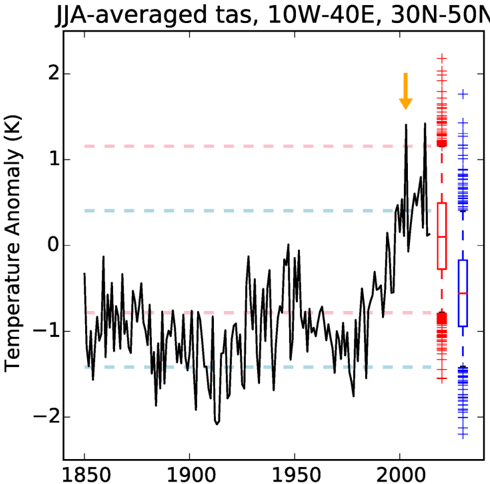
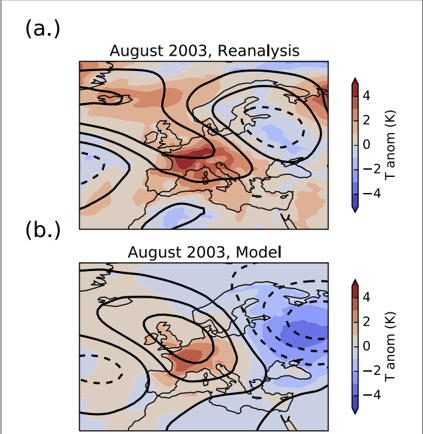
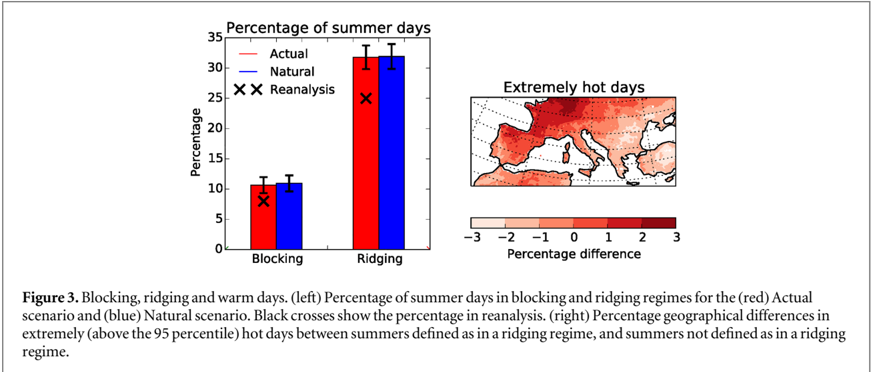
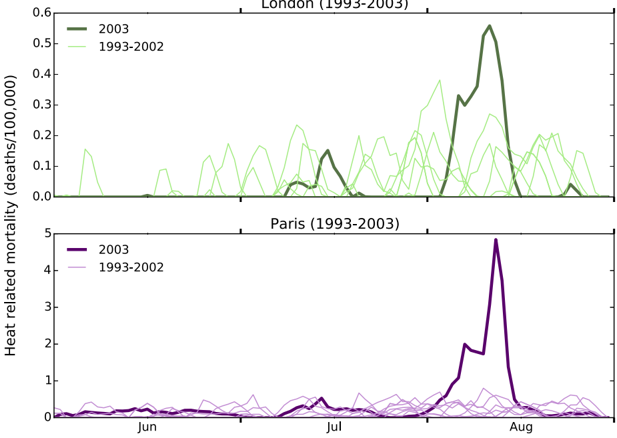
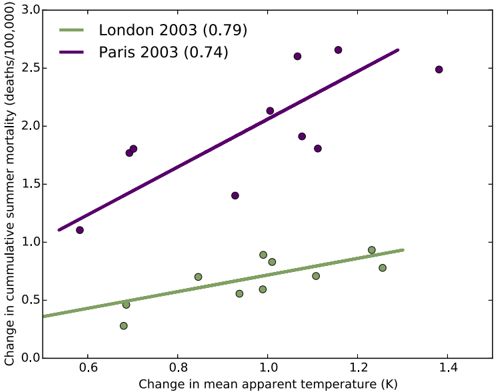
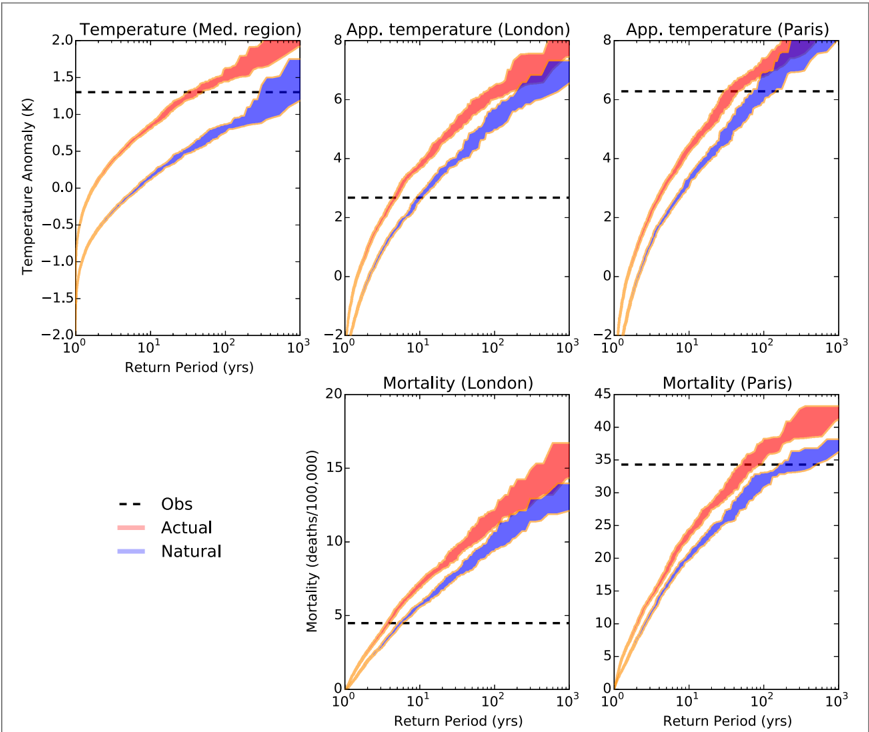
It has been argued that climate change is the biggest global health threat of the 21st century. The extreme high temperatures of the summer of 2003 were associated with up to seventy thousand excess deaths across Europe. Previous studies have attributed the meteorological event to the human influence on climate, or examined the role of heat waves on human health. Here, for the first time, we explicitly quantify the role of human activity on climate and heat-related mortality in an event attribution framework, analysing both the Europe-wide temperature response in 2003, and localised responses over London and Paris. Using publicly-donated computing, we perform many thousands of climate simulations of a high-resolution regional climate model. This allows generation of a comprehensive statistical description of the 2003 event and the role of human influence within it, using the results as input to a health impact assessment model of human mortality. We find large-scale dynamical modes of atmospheric variability remain largely unchanged under anthropogenic climate change, and hence the direct thermodynamical response is mainly responsible for the increased mortality. In summer 2003, anthropogenic climate change increased the risk of heat-related mortality in Central Paris by ∼70% and by ∼20% in London, which experienced lower extreme heat. Out of the estimated ∼315 and ∼735 summer deaths attributed to the heatwave event in Greater London and Central Paris, respectively, 64 (±3) deaths were attributable to anthropogenic climate change in London, and 506 (±51) in Paris. Such an ability to robustly attribute specific damages to anthropogenic drivers of increased extreme heat can inform societal responses to, and responsibilities for, climate change.
Overview
The claims and statistics of this paper haven’t been checked yet.
Free: it reads the open-access text and checks the first 5 claims that cite a source we can check. Create a free account to check every claim.
Integrity signals
Registry
Cites
Statistics
Figures



Verification
Claims the paper makes
The claims and statistics of this paper haven’t been checked yet.
Free: it reads the open-access text and checks the first 5 claims that cite a source we can check. Create a free account to check every claim.
Claims other papers make about this one
Each is checked against this paper’s own text: does it say what the citing paper says it does?
The cited source says what the claim attributes to it.
In the citing paper
“These studies are often conducted in the climate science disciplines and rarely take the additional step of estimating associated human health impacts9–11.”
From The burden of heat-related mortality attributable to recent human-induced climate change (2021) · cites this paper as [10]
Self-check
Percentages, sums and reported differences re-computed from the paper’s own numbers.
The self-check needs the paper’s full text.
Citations
Cites
The ERA‐Interim reanalysis: configuration and performance of the data assimilation system
Dee, D. P., Uppala, S. M., Simmons, A. J., Berrisford, P., Poli, P., Kobayashi, S., Andrae, U., Balmaseda, M. A., Balsamo, G., Bauer, P., et al. (2011) · Quarterly Journal of the Royal Meteorological Society · doi:10.1002/qj.828 · Cited by 24,480
Managing the health effects of climate change
Costello, A., Abbas, M., Allen, A., Ball, S., Bell, S., Bellamy, R., Friel, S., Groce, N., Johnson, A., Kett, M., et al. (2009) · The Lancet · doi:10.1016/s0140-6736(09)60935-1 · Cited by 3,102
Lanczos Filtering in One and Two Dimensions
Duchon, C. E. (1979) · Journal of Applied Meteorology · doi:10.1175/1520-0450(1979)018<1016:lfioat>2.0.co;2 · Cited by 2,398
Death toll exceeded 70,000 in Europe during the summer of 2003
Robine, J.-M., Cheung, S. L. K., Le Roy, S., Van Oyen, H., Griffiths, C., Michel, J.-P., & Herrmann, F. R. (2007) · Comptes Rendus. Biologies · doi:10.1016/j.crvi.2007.12.001 · Cited by 2,127
Health and climate change: policy responses to protect public health
Watts, N., Adger, W. N., Agnolucci, P., Blackstock, J., Byass, P., Cai, W., Chaytor, S., Colbourn, T., Collins, M., Cooper, A., et al. (2015) · The Lancet · doi:10.1016/s0140-6736(15)60854-6 · Cited by 2,055
Human contribution to the European heatwave of 2003
Stott, P. A., Stone, D. A., & Allen, M. R. (2004) · Nature · doi:10.1038/nature03089 · Cited by 1,735
Self-citationAnthropogenic contribution to global occurrence of heavy-precipitation and high-temperature extremes
Fischer, E. M., & Knutti, R. (2015) · Nature Climate Change · doi:10.1038/nclimate2617 · Cited by 1,427
Heat wave: a social autopsy of disaster in Chicago
(2003) · Choice Reviews Online · doi:10.5860/choice.40-4319 · Cited by 1,273
A trend-preserving bias correction – the ISI-MIP approach
Hempel, S., Frieler, K., Warszawski, L., Schewe, J., & Piontek, F. (2013) · Earth System Dynamics · doi:10.5194/esd-4-219-2013 · Cited by 1,238
High ambient temperature and mortality: a review of epidemiologic studies from 2001 to 2008
Basu, R. (2009) · Environmental Health · doi:10.1186/1476-069x-8-40 · Cited by 1,135
Research works printed but not linked: 2
- 10.1175/1520-0450(1979)018<0874:taospi>2.0.co;2 · DOI · Paper page
- Masato G 2016 On the link between Eurasian heatwaves and the upper troposphere ridges and blocking Q. J. R. Meteorol. Soc. in review
Cited by
Items 401–484 of 484
Niskanen, N. (2022) · UTUPub (University of Turku) · Cited by 12
Attributing extreme weather events in Africa to climate change : science, policy and practice
Young, H. R. (2017) · CentAUR (University of Reading)
New Zealand weather extremes and climate-related events; a model-based assessment
Nistor, B. (2018) · Open Access Victoria University of Wellington | Te Herenga Waka (Figshare) · doi:10.26686/wgtn.17072582
“An advantage of prescribing SSTs within an atmosphere-only model is that dynamical processes, particularly synoptic circulation regimes that can be related to the extreme event (Otto et al., 2012; Mitchell et al., 2016), may be better represented due to a reduction in biases associated with the ocean state.”
BackgroundChallenging the use of extreme event attribution for loss and damagePreprint
Jézéquel, A., Yiou, P., & Vanderlinden, J. (2018) · HAL
Attribution-based parametric insurance: towards affordable premiums
Dorbor, S. S. D. (2020) · Open University of Cape Town (University of Cape Town) · Cited by 1
Using Expert Crowdsourcing to Annotate Extreme Weather Events
Paulino, D., Correia, A., Barroso, J., Liberato, M. L. R., & Paredes, H. (2021) · Advances in intelligent systems and computing · doi:10.1007/978-3-030-72651-5_50
Arbuthnott, K. (2021) · LSHTM Research Online (London School of Hygiene and Tropical Medicine) · doi:10.17037/pubs.04659905
He, J. Y. (2020) · UTS ePRESS (University of Technology Sydney)
Burkart, K. G., Brauer, M. D., Hess, J. J., Aravkin, A. Y., Ashbaugh, C., Chalek, J., Dalton, B. E., Fukutaki, K. G., Godwin, W., Hay, S. I., et al. (2021) · SSRN Electronic Journal · doi:10.2139/ssrn.3905933
(2021) · Weather and Climate Dynamics · doi:10.5194/wcd-2021-56-rc3
Kautz, L. (2021) · Weather and Climate Dynamics · doi:10.5194/wcd-2021-56-ac4
Kautz, L. (2021) · Weather and Climate Dynamics · doi:10.5194/wcd-2021-56-ac1
Kautz, L. (2021) · Weather and Climate Dynamics · doi:10.5194/wcd-2021-56-ac2
Kautz, L. (2021) · Weather and Climate Dynamics · doi:10.5194/wcd-2021-56-ac3
(2021) · Weather and Climate Dynamics · doi:10.5194/wcd-2021-56-rc1
Challenges of Climate Change with the Era of Covid-19
Kumar, A., Khandelwal, S. G., & Yau, Y. (2021) · LS International Journal of Life Sciences · doi:10.5958/2319-1198.2021.00014.2
(2022) · Weather and Climate Dynamics · doi:10.5194/wcd-2022-9-rc1
Heat, Wildfire and Energy Demand: An Examination of Residential Buildings and Community Equity
Antonopoulos, C. (2022) · PDXScholar (Portland State University) · doi:10.15760/etd.7772 · Cited by 1
Faranda, D. (2022) · Weather and Climate Dynamics · doi:10.5194/wcd-2022-9-ac1
(2022) · Weather and Climate Dynamics · doi:10.5194/wcd-2022-9-rc2
Nemoral European Beech and Oak Forests under Climate Change
Kasper, J. (2023) · eDiss (Georg-August-Universität Göttingen) · doi:10.53846/goediss-9885 · Cited by 2
Agudelo‐Cantero, G. A. (2023) · Digital Library of Theses and Dissertations (Universidade de São Paulo) · doi:10.11606/t.41.2023.tde-22052023-151940
Cambio climático: un futuro inexorable
de Hidalgo, U. A. D. E. (2022) · Universidad Autónoma del Estado de Hidalgo eBooks · doi:10.29057/books.128
Understanding the Relationship Between Urban Form Factors and Extreme Heat in SeoulPreprint
Kim, D., & Quan, S. J. (2024) · doi:10.46855/energy-proceedings-11065
Thalheimer, L., Muttarak, R., Cuaresma, J. C., Li, S., & Otto, F. E. L. (2024) · SSRN Electronic Journal · doi:10.2139/ssrn.4786263
Health Inequalities Associated with Climate Change: An Urgent Public Health Concern
Private Practice, O., Lee, C. Y., & Suzuki, J. B. (2023) · Epidemiology and Public Health · doi:10.52768/epidemiolpublichealth/1016
“If no action is taken to miti - gate the effects of climate change morbidity and mortality will continue, especially vulnerable marginalized populations (Afri - can Americans, Hispanics, Asians) that contribute the least to greenhouse gas emissions and pollution [3,4].”
BackgroundModélisation des impacts des arbres sur la qualité de l’air de l’échelle de la rue à la ville.
Maison, A. (2023) · theses.fr (ABES) · doi:10.70675/3be9da3ezf356z4750za064zf3a78886c188
Cao, Z., Yung, W., & Ke, Y. (2024) · eLife · doi:10.7554/elife.101302.1
Cao, Z., Yung, W., & Ke, Y. (2025) · eLife · doi:10.7554/elife.101302.2
The perfect storm: human influence on the loss potential of Eunice-like cyclones
Leach, N. J., Ermis, S., Brocklehurst, A., Kumar, D., Georgios, A., Braun, L., Dixon, M., Murphy, J., & Shaffrey, L. (2026) · Environmental Research Letters · doi:10.1088/1748-9326/ae886a
“However, more recently, studies have explicitly attempted to calculate attributable changes in impacts such as incurred losses or excess mortality (Mitchell et al 2016, Frame et al 2020, Lott et al 2021).”
Impact of suburban landscape on outdoor thermal comfort in tropical savanna climate
Díaz, G. A., & Mora, A. (2025) · Geology Ecology and Landscapes · doi:10.1080/24749508.2025.2529028
“Rising global temperatures due to climate change, combined with increasing urbanization (Masson-Delmotte et al., 2018), are anticipated to raise temperatures in cities (Mitchell et al., 2016), thus affecting the outdoor thermal comfort of their citizens.”
Troy, C. L. C., & Thier, K. (2025) · Emerald Group Publishing Limited eBooks · doi:10.1108/978-1-83797-811-320251001
Heat waves threaten city dwellers, especially minorities and the poor
Singer, M. C. (2017) · The Conversation · doi:10.64628/aai.qu96yf4sm
Tibetan Plateau darkening exacerbates summer heatwaves through land–atmosphere feedbacks
Shi, L., Dong, W. G., Liu, F., Zhang, J., & Jia, X. (2025) · Atmospheric and Oceanic Science Letters · doi:10.1016/j.aosl.2025.100728 · Cited by 1
Macroclimate growing conditions for luxury crops after stratospheric aerosol injection
Morrison, A. L., Barnes, E. A., Hurrell, J. W., & Hueholt, D. M. (2025) · Environmental Research Letters · doi:10.1088/1748-9326/adfbff
“…of climate change concerns, and climate intervention has been proposed as a potential way to combat harmful climate change impacts [44], including heatwaves [45, 46] and extreme precipitation [47– 49], which often disproportionately affect vulnerable communities where smallholders live [50, 51].”
Láthatatlan természet: Az ökológiai krízis és az éghajlatváltozás reprezentációs problémái
Pataki, V. P. (2024) · Eötvös Loránd Tudományegyetem · doi:10.15476/elte.2023.197
Understanding decision-maker needs for extreme event attribution science
Bourbon, H. R., Machin, F., Hope, P. K., Mackie, B., & Lede, E. (2025) · Weather and Climate Extremes · doi:10.1016/j.wace.2025.100842
Η γεωγραφία της περιβαλλοντικής μετανάστευσης. Ελλάδα: περιπτώσεις μελέτης και πληγείσες περιοχές
Σούφλα, Π. Κ. (2023) · University of Thessaly Institutional Repository (University of Thessaly) · doi:10.26253/heal.uth.39459
Clarke, B. J. (2023) · Oxford University Research Archive (ORA) (University of Oxford) · doi:10.5287/ora-bp4ngdqxz · Cited by 1
Adaptive water resources planning to manage future risks to London's water supply
Murgatroyd, A. (2020) · Oxford University Research Archive (ORA) (University of Oxford) · doi:10.5287/ora-yq6gm1zv7 · Cited by 1
Generative sustainability: a human resource framework to navigate the future of work
Sagan, M. A. (2025) · Nottingham ePrints (University of Nottingham) · Cited by 4
Coronel, P. A. P. (2024) · DUGiDocs (Universitat de Girona)
Puvvula, J. (2022) · DigitalCommons@UNMC
Kindberg, E. (2023) · DiVA (Linkoping University) · Cited by 1
Lachapelle, J. A. (2021) · The Atrium (University of Guelph)
Vulnerability Levels and Adaptative Capacities to Heatwaves of Citizens in Belgrade, Serbia
Stanojevic, A. (2024) · Lund University Publications Student Papers (Lund University)
Sambrook, K. (2023) · White Rose eTheses Online (University of Leeds, The University of Sheffield, University of York)
Cross-Chapter Box HEALTH : Co-benefits of Climate Actions for Human Health, Wellbeing and Equity
Tirado, M. C., Biesbroek, G. R., Pelling, M., Hess, J., Creutzig, F., Kerr, R. B., Eriksen, S., Campbell-Lendrum, D. H., Gilmore, E., Figueroa, M., et al. (2022) · Wageningen University & Research Publications · Cited by 1
Responsabilidad estatal por eventos climatológicos extremos: el caso de las olas de calor
Presa, M. C. G. (2024) · Buleria (Universidad de León) · Cited by 1
The impact of heat waves on mortality rate: İstanbul case
Yılmaz, M. (2024) · Istanbul Technical University Academic Open Archive (Istanbul Technical University)
A novel framework for expanding temperature intensity-duration-frequency curve utility
Tierney, G., Mallard, M. S., Spero, T. L., & Jalowska, A. M. (2025) · Natural Hazards · doi:10.1007/s11069-025-07811-1 · Cited by 1
“This shift in extremes increased temperature-related deaths during heat waves (e.g. Mitchell et al. 2016; Gasparrini et al. 2017; Ballester et al. 2023), spurring adaptation and mitigation efforts across sectors such as public health (Patel et al. 2022; Turek-Hankins et al. 2021), energy (Añel et…”
What drives the compound drought and heat events? A dynamic perspective
Zhou, S., Wu, S., Gao, J., Liu, L., Wang, J., Yan, R., & Li, B. (2026) · Weather and Climate Extremes · doi:10.1016/j.wace.2026.100863 · Cited by 4
Dima, D., & Voinea, S. (2026) · Theoretical and Applied Climatology · doi:10.1007/s00704-026-06049-6
The effects of extreme heat on stroke hospitalizations: Evidence from China
Li, L., Zhao, N., Zhao, C., Zhang, X., Ma, C., & Xu, W. (2026) · Economics & Human Biology · doi:10.1016/j.ehb.2026.101595
Statistical and epistemological approaches of extreme event attribution
Jézéquel, A. (2018) · theses.fr (ABES) · doi:10.70675/b2314ba0zf509z4e85z8d1az890968b11e98 · Cited by 1
Experimental Investigation of Plumes of Soluble Particles
Cui, Y. (2022) · theses.fr (ABES) · doi:10.70675/874c05f0z7cfaz4355z88e8z27233fc16977
Krouma, M. (2023) · theses.fr (ABES) · doi:10.70675/83db7066z4eb5z4b1czb2bfz15378a3018d9
Impact of climate change on severe storms in Europe : attribution and projection
Ginesta, M. (2024) · theses.fr (ABES) · doi:10.70675/8c31f29fz8385z4778z85f1z33cc43c9b653 · Cited by 1
Distinct Oceanic Apparent Temperature Responses to Global Warming Driven by Near-Surface Wind Speed
Liao, L., Tett, S. F. B., Li, H., Li, Z., Jiao, B., & Li, Q. (2026) · Ocean-Land-Atmosphere Research · doi:10.34133/olar.0151
Smiley, K. T., García, O. D., Done, J., Hemmerling, S. A., Larrison, K., Mostafiz, R. B., Rahim, M. A., Valle, A. R., & Yevuyibor, J. T. (2026) · Environmental Research Climate · doi:10.1088/2752-5295/ae6889
“…damages attributed to climate change for the event’ or ‘Y deaths attributed to climate change for the event’; Frame et al 2020; Newman and Noy 2023, Mitchell et al 2016), but much less research studies impacts at local or regional scales which may be of greater utility to policy makers,…”
Extreme weather events in early Summer 2018 connected by a recurrent hemispheric wave pattern.Preprint
Rahmstorf, S., Coumou, D., Petoukhov, V. K., Gray, L. J., Petri, S., Kornhuber, K., & Osprey, S. (2018) · OSF Preprints (OSF Preprints)
Heatwave intensification and regional vulnerability across Texas under recent climate warming
Dayal, D., Palmate, S. S., & Sanchez, R. (2026) · Environmental Research Communications · doi:10.1088/2515-7620/ae6a64
“Applications in Australia, Europe, and Asia have demonstrated its robustness and strong association with heat-related morbidity and mortality (Mitchell et al 2016, Zhang et al 2017, Oliveira et al 2022).”
Klimatanpassning i stadens mellanrum
Collijn, A. (2026) · Epsilon Archive for Student Projects (University of Southampton)
Climate-Induced Mortality in India: Regional Disparities and Emerging Hotspots
Das, U. (2026) · Advances in global change research · doi:10.1007/978-3-032-25479-5_5
A mesoscale CFD framework for extreme temperature mapping in urban environments
Piazza, A., Bitsuamlak, G., Repetto, M. P., Žužul, J., & Burlando, M. (2026) · Urban Climate · doi:10.1016/j.uclim.2026.102978
Guiding the development of climate counterfactuals for health impact attribution studiesPreprint
Charnley, G. E. C., Kotz, M., Kawiecki, A. B., & Grayson, K. (2026) · medRxiv · doi:10.64898/2026.06.16.26355779
Zheng, Y., Chang, Y., Luo, X., & Fan, J. (2026) · Sustainable Cities and Society · doi:10.1016/j.scs.2026.107643
Introduction to Urban Adaptation
Mosca, F. (2026) · SpringerBriefs in applied sciences and technology · doi:10.1007/978-3-032-28039-8_1
Mosca, F. (2026) · SpringerBriefs in applied sciences and technology · doi:10.1007/978-3-032-28039-8_4
AI Greenwashing? A Comparison of AI Companies’ Environmental Policies and Actual Impact
Potasznik, A. (2026) · Proceedings of IASEAI Conference · doi:10.1609/iaseai.v2i1.43051
Thorburn, J. (2026) · Open University of Cape Town (University of Cape Town)
Heat-health interventions for people experiencing homelessness
Moses, A., Guo, S. S., Wood, L. J., Jay, O., & English, T. (2026) · The Lancet Public Health · doi:10.1016/s2468-2667(26)00160-x
Finnemann, A., Dablander, F., Wiers, R. W. H. J., & Haslbeck, J. M. B. (2026) · medRxiv · doi:10.64898/2026.09.03.26362192
Smith, F., Behr, D. M., Bizzozzero, M. R., Allen, S. J., Connor, R. C., King, S. L., Özgül, A., & Krützen, M. (2026) · bioRxiv (Cold Spring Harbor Laboratory) · doi:10.64898/2026.09.25.754421
“…spp.; Welbergen et al. 2008), howler monkeys ( Alouatta palliata mexicana ; Pozo‐ Montuy et al. 2024), koalas (Gordon et al. 1988) and humans (Mitchell et al. 2016), as well as the common murre ( Uria aalge ; Piatt et al. 2020), highlighting the capacity of extreme climatic events to drive…”
Nguyen, H., Bellenger, H., Duvel, J.-P., Christian, J. I., Perrot, X., Agostino, R. D., & Latos, B. (2026) · Quarterly Journal of the Royal Meteorological Society · doi:10.1002/qj.70323
Limaheluw, J., Niese, R., Schram-Bijkerk, D., Hall, L. F., de Kraker, J., Oostdijk, S. C. J., Serafim, F., & Husman, A. M. D. R. (2026) · BMJ Open · doi:10.1136/bmjopen-2025-108532
Adnan, F., Hussain, S., Husnain, S., & Khan, H. A. (2024) · Dialogue Social Science Review (DSSR)
Environmental health resilience and exposure reduction for healthy aging and longevity
Ji, J. S., Jia, Y., Astell‐Burt, T., Chen, D., Peters, A., Sadana, R., Woodward, A. J., & Haines, A. (2026) · Nature Aging · doi:10.1038/s43587-026-01231-x
Metadata
- Authors
- Mitchell, D., Heaviside, C., Vardoulakis, S., Huntingford, C., Masato, G., P Guillod, B., Frumhoff, P., Bowery, A., Wallom, D., & Allen, M.
- Affiliations
- Public Health England (GB)
- UK Centre for Ecology & Hydrology (GB)
- University of Reading (GB)
- Union of Concerned Scientists (US)
- University of Oxford (GB)
- Venue
- Environmental Research Letters
- Publisher
- IOP Publishing
- Published
- 2016-07-01
- Volume
- 11
- Issue
- 7
- Pages
- 074006
- ISSN
- 1748-9326 (ISSN-L)
- OpenAlex
- W2471123203
- Semantic Scholar
- 20c1a9b15ac36dd32d44cbd003f7de57b7dc1956
- Cited by
- 439
- References
- 34
- Citations by year
- 2026: 27 · 2025: 62 · 2024: 51 · 2023: 56 · 2022: 55 · 2021: 60 · 2020: 47 · 2019: 29 · 2018: 24 · 2017: 25 · 2016: 3
- FWCI
- 17.00
- Type
- journal article
- Language
- en
- Open access
- gold
- doi.org
- Licence
- cc-by
- iopscience.iop.org/info/page/text-and-data-mining (tdm, 7 d)
- creativecommons.org/licenses/by/3.0/ (vor, 7 d)
- Locations
- Environmental Research Letters (publishedVersion, cc-by)
- Explore Bristol Research (publishedVersion, cc-by)
- NERC Open Research Archive (Natural Environment Research Council) (acceptedVersion)
- CentAUR (University of Reading) (submittedVersion)
- Bristol Research (University of Bristol) (submittedVersion, cc-by)
- DOAJ (DOAJ: Directory of Open Access Journals) (submittedVersion)
- Funders
- Union of Concerned Scientists (N/A)
- Topics
- Physical Sciences › Environmental Science › Health, Toxicology and Mutagenesis › Climate Change and Health Impacts
- Physical Sciences › Environmental Science › Global and Planetary Change › Climate variability and models
- Physical Sciences › Environmental Science › Global and Planetary Change › Climate Change and Environmental Impact
- Keywords
- 2003 European heatwave, heat-related mortality, anthropogenic climate change attribution, extreme heat, regional climate model simulation, London, Paris, climate responsibility
About these checks
Registry, retraction, Cites and statistics results are computed, not judged, with one exception: a printed reference that no index lists is read once by a model before it counts as a citation error. Claims are extracted by a model and kept only when their quote appears verbatim in the text; each cited source is then checked, with a model’s help, for whether it says what the claim relies on. Those verdicts can be wrong — read the claim’s quote and the cited source before relying on one.
Statistics and arithmetic are recomputed, not judged.
Confidence bands are shown only for fields calibrated on our annotated test set. None is calibrated yet, so no band is shown.
What counts as a claim ›How we measure confidence ›How we check this ›
Are you an author, or do you see a problem with this page? Request a review
Data sources
Bibliographic data: Semantic Scholar, OpenAlex, Crossref.
Contains information from the Semantic Scholar Academic Graph Datasets, made available under the ODC Attribution License (ODC-BY 1.0).
Semantic Scholar’s data is described in: Kinney, R., et al. (2023). The Semantic Scholar Open Data Platform. arXiv:2301.10140.
