

Material efficiency strategies to reducing greenhouse gas emissions associated with buildings, vehicles, and electronics—a review
Open accessThe DOI matches its Crossref record; 198 of the 199 references it cites were found in a registry or an index; 18 of the 239 sources its claims cite were checked for support.
Abstract
As one quarter of global energy use serves the production of materials, the more efficient use of these materials presents a significant opportunity for the mitigation of greenhouse gas (GHG) emissions. With the renewed interest of policy makers in the circular economy, material efficiency (ME) strategies such as light-weighting and downsizing of and lifetime extension for products, reuse and recycling of materials, and appropriate material choice are being promoted. Yet, the emissions savings from ME remain poorly understood, owing in part to the multitude of material uses and diversity of circumstances and in part to a lack of analytical effort. We have reviewed emissions reductions from ME strategies applied to buildings, cars, and electronics. We find that there can be a systematic trade-off between material use in the production of buildings, vehicles, and appliances and energy use in their operation, requiring a careful life cycle assessment of ME strategies. We find that the largest potential emission reductions quantified in the literature result from more intensive use of and lifetime extension for buildings and the light-weighting and reduced size of vehicles. Replacing metals and concrete with timber in construction can result in significant GHG benefits, but trade-offs and limitations to the potential supply of timber need to be recognized. Repair and remanufacturing of products can also result in emission reductions, which have been quantified only on a case-by-case basis and are difficult to generalize. The recovery of steel, aluminum, and copper from building demolition waste and the end-of-life vehicles and appliances already results in the recycling of base metals, which achieves significant emission reductions. Higher collection rates, sorting efficiencies, and the alloy-specific sorting of metals to preserve the function of alloying elements while avoiding the contamination of base metals are important steps to further reduce emissions.
Overview
CoChat Summary
TL;DR
This review synthesizes material efficiency (ME) strategies for reducing greenhouse gas emissions from buildings, vehicles, and electronics, finding the largest quantified reductions from more intensive use and lifetime extension of buildings and light-weighting/downsizing of vehicles. It highlights systematic trade-offs between material production and operational energy use, and concludes that evidence for additional ME-driven GHG reductions in electronics is limited.
Key findings
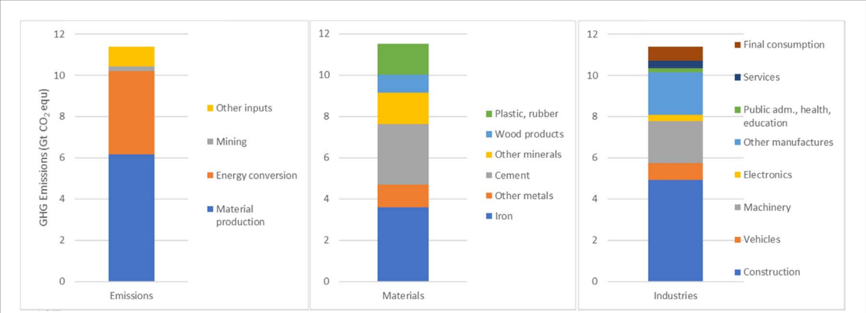
- Material production caused 11.4 Gt CO₂-equivalent cradle-to-gate emissions in 2015; iron and steel contributed 32%, cement/lime/plaster 26%, rubber/plastics 13%, and other non-metallic minerals 13%.
- The largest quantified emission reductions in the reviewed literature come from more intensive use and lifetime extension of buildings and light-weighting/reduced size of vehicles; examples include building more intensive use ↓40% [16], building lifetime extension ↓47% [16] or ↓40% [66], vehicle more intensive use ↓39% steel fleet [16] and ↓93%–96% vehicle [149], and vehicle light-weighting ↓5%–45% steel [16,207].
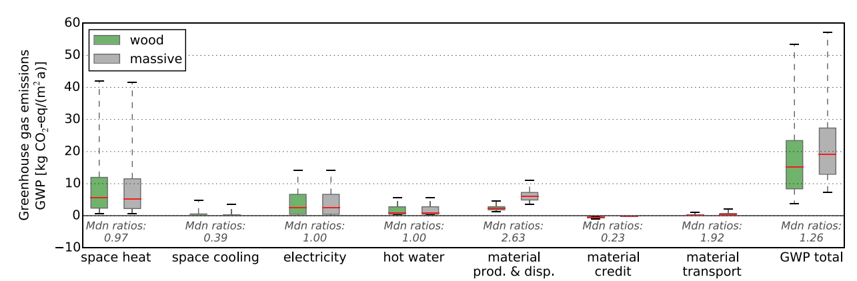
- Replacing steel and concrete with timber can yield significant GHG benefits, but trade-offs and limited timber supply must be recognized; one Swiss study reports a median life cycle benefit of 25% for wood constructions due exclusively to material production, with increased heating/cooling energy from loss of thermal mass.
- Recycling of base metals from buildings, end-of-life vehicles, and appliances already achieves significant emission reductions; for electronics, quantified GHG benefit from recycling ranges from 1% to 10% of life cycle emissions, and the review finds minimal scope for additional ME-driven GHG reductions in EEE.
Methods
- The paper is a literature review of ME strategies applied to buildings, cars, and electrical and electronic equipment (EEE), addressing what strategies exist, their potential GHG reductions, and important gaps.
- It draws on existing case studies, scenario analyses, and modeling studies, including EXIOBASE-based estimates of material production emissions and IEA projections.
- Table 3 evaluates the state of evidence using IPCC-like scoring: availability of evidence (limited, medium, robust) and level of agreement (low, medium, high), based on reviewed case studies and expert judgment.
Limitations
- The paper states that emissions savings from ME remain poorly understood due to the multitude of material uses, diversity of circumstances, and lack of analytical effort; there are few up-scaling/scenario studies and very few ex-post studies.
- The paper states that studies often focus on highly developed countries or China, with a lack of information from other regions, and that the global potential emission reductions from materials are still poorly characterized.
- The paper states that integrated assessment models are poorly equipped to analyze ME options due to lack of data on technology performance, costs, markets, barriers, intersectoral life cycle effects, and material-containing product stocks; behavioral responses and rebound effects remain open questions. Evident from the text: many strategies are quantified only case-by-case and are difficult to generalize, and system boundary choices vary across studies.
Model-written summary. Check it against the paper before relying on it.
Integrity signals
Registry
Cites
Statistics
Figures
Verification
Claims the paper makes
13 Valid · 9 Not valid · 142 Not checked · 81 Own results and interpretations
Every source the paper cites for this claim was checked and supports it.
In the paper
“Second, displaced materials such as cement and steel have high emissions during production [76].”
§ Material efficiency strategies to reducing greenhouse gas emissions associated with buildings, vehicles, and electronics-a review > Lightweight design and material choice
What the sources say
- Supportedcites [76] 75. Oliver C D, Nassar N T, Lippke B R and McCarter J B 2014 Carbon, fossil fuel, and biodiversity mitigation with wood and forests J. Sustain. For. 33 248-75 source
The Introduction describes steel and concrete as substitutes for wood that use more energy in manufacture and therefore cause more fossil-fuel consumption and CO₂ emissions. The Results likewise identify emissions savings from avoiding the fossil fuels needed to manufacture steel or concrete. The paper discusses concrete rather than cement by name, but this supports the citing sentence’s point about high production emissions from displaced materials. (LLM, conf=0.92)
plain- Asserted: passes — The authors put it forward as true.
- Checkable: passes — It can be checked against evidence.
- Load-bearing: passes — The paper’s conclusions depend on it.
- Based: passes — The paper gives a reason why it holds.
- Supported
The cited sources support only part of this claim — read each source’s verdict below.
In the paper
“In Switzerland, a continued growth of floor area by 20% until 2050 would lead to an increase in cumulated material-related GHG emissions of 8% compared to a baseline scenario [44].”
§ Material efficiency strategies to reducing greenhouse gas emissions associated with buildings, vehicles, and electronics-a review > More intensive use
What the sources say
- Partly supportedcites [44] 43. Heeren N and Hellweg S 2018 Tracking construction material over space and time: prospective and geo-referenced modeling of building stocks and construction material flows J. Ind. Ecol. 23 253-67 sourceExperimental — accuracy not yet measured
Our copy does carry the 8% figure in the scenario-results section (i n press, adjacent to Table 1 / Figure 5): 'Total cumulated emissions in 2055 are 8% higher for...' — but the sentence is cut off in our copy, so the comparator scenario is not fully stated there. Two qualifiers diverge from the claim: the source's 20% is not growth of total floor area but scenario 2 'Floor area', in which new constructions from 2015 are built with 20% larger floor space per person (59 and 62 m2/capita instead of 49 and 52), relative to a 'Base' scenario with constant per-capita floor area; and the cumulated-emissions comparison is reported for 2055, not 2050 (the simulation runs 2015-2055). The material-related GHG metric itself is supported (Figure 5: cumulated GHG emissions 2015-2055 for production and disposal of construction material; Abstract: 'An increase per capita floor area or material turnover will lead to a considerable increase in impacts'), but the scope is Swiss residential buildings, not Switzerland's building stock generally. (LLM, conf=0.70)
hedgedstates a cause- Asserted: passes — The authors put it forward as true.
- Checkable: passes — It can be checked against evidence.
- Load-bearing: unclear — It is unclear whether the paper’s conclusions depend on it.
- Based: passes — The paper gives a reason why it holds.
- Partly supported
None of the sources cited for this claim have been checked yet.
In the paper
“There is a renewed interest in the enhanced carbonation of concrete, a process by which CO 2 is absorbed from the atmosphere [73,102,109].”
§ Material efficiency strategies to reducing greenhouse gas emissions associated with buildings, vehicles, and electronics-a review > Issues of alloy-specific recycling are further discussed in the section on vehicle recycling.
What the sources say
- Not checked yetcites [73] 72. Dodoo A, Gustavsson L and Sathre R 2009 Carbon implications of end-of-life management of building materials Resour. Conserv. Recycl. 53 276-86 source
- Not checked yetcites [102] 101. Butera S, Christensen T H and Astrup T F 2015 Life cycle assessment of construction and demolition waste management Waste Manage. 44 196-205 source
- Could not verifycites [109] 108. Vieira P S and Horvath A 2008 Assessing the end-of-life impacts of buildings Environ. Sci. Technol. 42 4663-9 sourceExperimental — accuracy not yet measured
The Discussion reports that recycling concrete could reduce buildings’ greenhouse-gas emissions, but does not describe CO2 absorption from the atmosphere. Searches for concrete carbonation and enhanced carbonation found no passage addressing the process or renewed interest in it. (LLM, conf=0.75)
plain- Asserted: passes — The authors put it forward as true.
- Checkable: passes — It can be checked against evidence.
- Load-bearing: unclear — It is unclear whether the paper’s conclusions depend on it.
- Based: passes — The paper gives a reason why it holds.
The cited sources support only part of this claim — read each source’s verdict below.
In the paper
“Materials constituted 55% of the carbon footprint of vehicle and transport equipment manufacturing of 1.6 Gt [27,42,119].”
§ Material efficiency strategies to reducing greenhouse gas emissions associated with buildings, vehicles, and electronics-a review > ME in vehicles
What the sources say
- Not checked yetcites [27] 27. Hertwich E G 2019 The Carbon Footprint of Material Production Rises to 23% of Global GHG Emissions; New Haven
- Partly supportedcites [42] 41. Hertwich E G and Wood R 2018 The growing importance of scope 3 greenhouse gas emissions from industry Environ. Res. Lett. 13 104013 sourceExperimental — accuracy not yet measured
The section 'More insight by disaggregating industry' (p. 8) says materials were the largest contributor to emissions embodied in manufactured products. It does not give a 55% share or a 1.6 Gt footprint for vehicle and transport equipment manufacturing; Table 3 (p. 9) uses broader sector categories. (LLM, conf=0.84)
- Could not verifycites [119] 118. Stadler K et al 2018 EXIOBASE3-developing a time series of detailed environmentally extended multi-regional input- output tables J. Ind. Ecol. 22 502-15 sourceExperimental — accuracy not yet measured
The Emission Accounts section (p. 6) describes how emissions are allocated to EXIOBASE industries and products, but does not give a carbon footprint for vehicle and transport equipment manufacturing. Searches for “55%,” “1.6 Gt,” and “transport equipment” found no passage establishing the claimed materials share or total. (LLM, conf=0.72)
plain- Asserted: passes — The authors put it forward as true.
- Checkable: passes — It can be checked against evidence.
- Load-bearing: unclear — It is unclear whether the paper’s conclusions depend on it.
- Based: passes — The paper gives a reason why it holds.
The sources with a verdict support this claim; the rest weren’t checked yet, have no full text we could read, or their verdicts aren’t rated yet.
In the paper
“For gasoline-driven vehicles, this type of light-weighting results in a reduction of life cycle emissions due to the reduction in operational energy use and despite the increased energy requirement for material production [151][152][153].”
§ Material efficiency strategies to reducing greenhouse gas emissions associated with buildings, vehicles, and electronics-a review > Lifetime extension
What the sources say
- Not checked yetcites [151] 149. Koffler C 2014 Life cycle assessment of automotive lightweighting through polymers under US boundary conditions Int. J. Life Cycle Assess. 19 538-45 source
- Not checked yetcites [152] 150. Dhingra R and Das S 2014 Life cycle energy and environmental evaluation of downsized versus lightweight material automotive engines J. Clean. Prod. 85 347-58 source
- Supportedcites [153] 151. Modaresi R, Pauliuk S, Løvik A N and Müller D B 2014 Global carbon benefits of material substitution in passenger cars until 2050 and the impact on the steel and aluminum industries Environ. Sci. Technol. 48 10776-84 source
The Introduction says that light-weighting reduces fuel consumption but often raises emissions from materials production. Section 3.1 reports net GHG-emissions savings for the modeled light-weighting scenarios; the paper includes gasoline vehicles among its modeled drive technologies. Together, these passages support the claimed trade-off, though the reported savings are scenario-based rather than a guarantee for every vehicle. (LLM, conf=0.86)
plainstates a cause- Asserted: passes — The authors put it forward as true.
- Checkable: passes — It can be checked against evidence.
- Load-bearing: passes — The paper’s conclusions depend on it.
- Based: passes — The paper gives a reason why it holds.
116 more claims · 3 with their cited sources checked
Create a free account to see all 245 claims and to verify the 221 references still open.
- Probably not a substantial claim. 43
- It may state two separate claims as one. 98
Claims other papers make about this one
Each is checked against this paper’s own text: does it say what the citing paper says it does?
In the citing paper
“On the other hand, shared mobility can lead to higher utilization of each vehicle, which means a more efficient use of materials [341].”
From Tackling climate change with machine learning (2023) · cites this paper as [341]
In the citing paper
“AM (3-D printing) can produce lighter parts in vehicles, such as road vehicles and aircraft, that reduce energy consumption [341,407].”
From Tackling climate change with machine learning (2023) · cites this paper as [341]
Self-check
Percentages, sums and reported differences re-computed from the paper’s own numbers.
Each contradiction between two passages listed here was confirmed by an independent check.
Rated minor: it would not touch a result — a value no result rests on, a p-value that stays on the same side of the significance level, or a conflict that is clerical, resolved elsewhere in the paper, or outside its own findings.
In the paper
§ Material efficiency strategies to reducing greenhouse gas emissions associated with buildings, vehicles, and electronics-a review > The state of evidence Evaluation of ME strategies
“For light-weighting of buildings, there is also limited evidence but a strong agreement about a substantial potential for emission reductions in the construction phase with few trade-offs.”
§ Material efficiency strategies to reducing greenhouse gas emissions associated with buildings, vehicles, and electronics-a review > Conclusions
“| | Light-weight design | ↓19 [16]-50% [71] | -↑ | ↓ - | MH | ◊ Conventions, labor costs |”
Citations
Cites
Change, I. P. O. C. (2015) · Cambridge University Press eBooks · doi:10.1017/cbo9781107415416 · Cited by 4,693
Climate change 2014 : mitigation of climate change
Edenhofer, O., Pichs-Madruga, R., & Sokona, Y. (2014) · University of North Texas Digital Library (University of North Texas) · Cited by 1,975
E-waste: An assessment of global production and environmental impacts
Robinson, B. H. (2009) · Science of The Total Environment · doi:10.1016/j.scitotenv.2009.09.044 · Cited by 1,777
Comparative Environmental Life Cycle Assessment of Conventional and Electric Vehicles
Hawkins, T. R., Singh, B., Majeau‐Bettez, G., & Strømman, A. H. (2013) · Journal of Industrial Ecology · doi:10.1111/j.1530-9290.2012.00532.x · Cited by 1,670
Monteiro, P. J. M., Miller, S. A., & Horvath, A. (2017) · Nature Materials · doi:10.1038/nmat4930 · Cited by 1,454
Life cycle energy analysis of buildings: An overview
Ramesh, T., Prakash, R., & Shukla, K. K. (2010) · Energy and Buildings · doi:10.1016/j.enbuild.2010.05.007 · Cited by 1,408
Energy use in the life cycle of conventional and low-energy buildings: A review article
Sartori, I., & Hestnes, A. G. (2007) · Energy and Buildings · doi:10.1016/j.enbuild.2006.07.001 · Cited by 1,284
Zink, T., & Geyer, R. (2017) · Journal of Industrial Ecology · doi:10.1111/jiec.12545 · Cited by 1,210
(2010) · Encyclopedia of Geography · doi:10.4135/9781412939591.n1196 · Cited by 1,191
Grubler, A., Wilson, C., Bento, N., Boza-Kiss, B., Krey, V., McCollum, D. L., Rao, N. D., Riahi, K., Rogelj, J., De Stercke, S., et al. (2018) · Nature Energy · doi:10.1038/s41560-018-0172-6 · Cited by 1,178
Research works printed but not linked: 7
- 5. Hashimoto S H and Moriguchi Y M 2013 Resource management for carbon management: a literature review Glob. Environ. Res. 17 39-46
- 9. G7. Communiqué 2017 G7 Bologna Environment Ministers' Meeting
- 48. IEA 2016 Annex E: buildings sector model Energy Technology Perspectives 2016 (Paris: International Energy Agency) p 27
- 55. Swilling M et al 2018 The Weight of Cities: Resource Requirements of Future Urbanization; International Resource Panel (Nairobi: United Nations Environment Programme)
- 76. Smith P et al 2014 Agriculture, forestry and other land use Climate Change 2014: Mitigation of Climate Change ed O Edenhofer et al (Geneva: Intergovernmental Panel on Climate Change)
- 117. 118International Energy Agency (IEA) CO 2 Emissions from Fuel Combustion Statistics (https://doi.org/10.1787/co2-data- en) (Accessed: 3 July 2018) · doi:10.1787/co2-data-
- 158. Nasr N Z, Russell J D, Kreiss C, Hilton B, Hellweg S, Bringezu S and von Gries N 2018 Assessment of resource efficiency and innovation in circular economy through remanufacturing, refurbishment Repair Direct Reuse
Cited by
Items 101–200 of 566
Life cycle assessment of a concrete 3D printing process
Roux, C., Kuzmenko, K., Roussel, N., Mesnil, R., & Féraille, A. (2022) · The International Journal of Life Cycle Assessment · doi:10.1007/s11367-022-02111-3 · Cited by 51
“Moreover, only a small share of these devices is efficiently collected and recovered (Hertwich et al. 2019).”
BackgroundEnvironmentally Friendly Smart Construction—Review of Recent Developments and Opportunities
Shufrin, I., Pasternak, E., & Dyskin, A. (2023) · Applied Sciences · doi:10.3390/app132312891 · Cited by 52
Liu, J., Daigo, I., Panasiuk, D., Dunuwila, P., Hamada, K., & Hoshino, T. (2022) · Journal of Cleaner Production · doi:10.1016/j.jclepro.2022.131317 · Cited by 51
Ali, S. H., Kalantzakos, S., Eggert, R. G., Gauß, R., Karayannopoulos, C., Klinger, J. M., Pu, X., Vekasi, K., & Perrons, R. K. (2022) · Environmental Science & Technology · doi:10.1021/acs.est.2c05413 · Cited by 50
Self-citationLeveraging opportunity of low carbon transition by super-emitter cities in China
Zheng, H., Zhang, Z., Dietzenbacher, E., Zhou, Y., Többen, J., Feng, K., Moran, D. D., Jiang, M., Shan, Y., Wang, D., et al. (2023) · 中国科学通报:英文版 · doi:10.1016/j.scib.2023.08.016 · Cited by 50
“For example, the better design in capital investment by using cross-laminated timber in construction in Nordic countries results in substantial carbon emissions reductions, which is one of the reasons for these countries with the least carbon intensity in capital formation [67,68].”
BackgroundComparative life cycle assessment of four buildings in Greenland
Ryberg, M. W., Ohms, P. K., Møller, E. B., & Lading, T. (2021) · Building and Environment · doi:10.1016/j.buildenv.2021.108130 · Cited by 50
How Lack of Knowledge and Tools Hinders the Eco-Design of Buildings—A Systematic Review
Ipsen, K. L., Pizzol, M., Birkved, M., & Amor, B. (2021) · Urban Science · doi:10.3390/urbansci5010020 · Cited by 48
“Furthermore, this strategy is limited by the fact that ensuring energy efficiency during use does not necessarily ensure a reduction in energy consumption or environmental impacts throughout the lifecycle of the building, as the measures for decreasing operational energy might need an increase in embodied energy, and…”
BackgroundMethodInfluentialPauliuk, S., Carrer, F., Heeren, N., & Hertwich, E. G. (2024) · Journal of Industrial Ecology · doi:10.1111/jiec.13557 · Cited by 48
Self-citationWiedenhofer, D., Streeck, J., Wiese, F., Verdolini, E., Mastrucci, A., Ju, Y., Boza‐Kiss, B., Min, J., Norman, J., Wieland, H., et al. (2025) · Annual Review of Environment and Resources · doi:10.1146/annurev-environ-111523-102441 · Cited by 48
Self-citationIntroducing sufficiency in the building sector in net-zero scenarios for France
Gaspard, A., Château, L., Laruelle, C., Lafitte, B., Léonardon, P., Minier, Q., Motamedi, K., Ougier, L., Pineau, A., & Thiriot, S. (2022) · Energy and Buildings · doi:10.1016/j.enbuild.2022.112590 · Cited by 47
Fisch-Romito, V. (2021) · Global Environmental Change · doi:10.1016/j.gloenvcha.2021.102362 · Cited by 47
Salami, B. A., Abba, S. I., Adewumi, A. A., Dodo, U. A., Otukogbe, G. K., & Oyedele, L. O. (2023) · Case Studies in Construction Materials · doi:10.1016/j.cscm.2023.e02676 · Cited by 44
Cement and Alternatives in the Anthropocene
Miller, S. A., Juenger, M. C. G., Kurtis, K. E., & Weiss, J. (2024) · Annual Review of Environment and Resources · doi:10.1146/annurev-environ-112621-070104 · Cited by 47
Pérez-Sánchez, L. À., Velasco-Fernández, R., & Giampietro, M. (2022) · Renewable and Sustainable Energy Reviews · doi:10.1016/j.rser.2022.112388 · Cited by 43
Agent‐based modeling and simulation for the circular economy: Lessons learned and path forward
Walzberg, J., Frayret, J., Eberle, A. L., Carpenter, A. C., & Heath, G. A. (2023) · Journal of Industrial Ecology · doi:10.1111/jiec.13423 · Cited by 44
“CEstrategiesmaybeappliedtobothenergy-generatingtechnologies,suchasrenewables,andenergy-consumingtechnologies,suchasbuildings, and electronics (Cantzler et al., 2020; Hertwich et al., 2019).”
Karakosta, C., & Papathanasiou, J. (2025) · Energies · doi:10.3390/en18051285 · Cited by 44
Plank, B., Eisenmenger, N., & Schaffartzik, A. (2020) · Journal of Industrial Ecology · doi:10.1111/jiec.13076 · Cited by 43
“Itiscrucialto gaina better understanding of the coupling of sectors and cascading of materials, including implications to material quality resulting from increased reuse and recycling (Hertwich et al., 2019).”
Roithner, C., Cencic, O., Honic, M., & Rechberger, H. (2022) · Resources Conservation and Recycling · doi:10.1016/j.resconrec.2022.106407 · Cited by 42
Lewandowski, S., & Ullrich, A. (2022) · Journal of Environmental Management · doi:10.1016/j.jenvman.2022.116437 · Cited by 41
“Hertwich et al. (2019) reviewed the literature on material efficiency strategies to reducing greenhouse gas emissions with a focus on buildings, vehicles, and electronics.”
Exploring the effective reuse rate of materials and elements in the construction sector
Gobbo, É., Nia, E. M., Ghyoot, M., Straub, A., Meesters, V., Chaussabel, C., Geerts, G., Mouchet, M., Richard, C., Doutreleau, M., et al. (2024) · Journal of Building Engineering · doi:10.1016/j.jobe.2024.111344 · Cited by 40
Industrial decarbonization under Japan’s national mitigation scenarios: a multi-model analysis
Ju, Y., Sugiyama, M., Kato, E., Matsuo, Y., Oshiro, K., & Herran, D. S. (2021) · Sustainability Science · doi:10.1007/s11625-021-00905-2 · Cited by 39
Νίκας, Α., Xexakis, G., Koasidis, K., Acosta‐Fernández, J., Arto, I., Calzadilla, A., Doménech, T., Gambhir, A., Giljum, S., González‐Eguino, M., et al. (2021) · Sustainable Production and Consumption · doi:10.1016/j.spc.2021.12.011 · Cited by 41
Arceo, A., MacLean, H. L., & Saxe, S. (2022) · Resources Conservation and Recycling · doi:10.1016/j.resconrec.2022.106683 · Cited by 39
Sofuoğlu, E., & Kırıkkaleli, D. (2022) · Environmental Science and Pollution Research · doi:10.1007/s11356-022-24078-2 · Cited by 39
“There is significant potential to reduce emissions in manufacturing materials used in buildings and vehicles (Hertwich et al. 2019).”
BackgroundEmission of greenhouse gases from transportation
Azhar, U., Yaseen, S., Arif, M., Babar, M., & Sagir, M. (2024) · Elsevier eBooks · doi:10.1016/b978-0-443-19231-9.00016-8 · Cited by 39
Circular strategies for building sector decarbonization in China: A scenario analysis
Mastrucci, A., Guo, F., Zhong, X., Maczek, F., & van Ruijven, B. J. (2024) · Journal of Industrial Ecology · doi:10.1111/jiec.13523 · Cited by 40
Opportunities for reducing the supply chain water footprint of metals used in consumer electronics
Madaka, H., Babbitt, C. W., & Ryen, E. G. (2021) · Resources Conservation and Recycling · doi:10.1016/j.resconrec.2021.105926 · Cited by 38
Tan, J., Wehde, M. V., Brønd, F., & Kalvig, P. (2020) · Resources Conservation and Recycling · doi:10.1016/j.resconrec.2020.105242 · Cited by 37
Schukraft, J., Lohr, C., & Weidenmann, K. A. (2021) · Composite Structures · doi:10.1016/j.compstruct.2021.113742 · Cited by 37
Reflective coatings: Enhancing building performance and sustainability
Yuan, J., Jiao, Z., Chai, J., Farnham, C., & Emura, K. (2024) · Nano-Structures & Nano-Objects · doi:10.1016/j.nanoso.2024.101296 · Cited by 36
Incorporating carbon capture and storage in decarbonizing China's cement sector
Wu, T., Ng, S. T., & Chen, J. (2024) · Renewable and Sustainable Energy Reviews · doi:10.1016/j.rser.2024.115098 · Cited by 36
Ye, Q., Hertwich, E. G., Krol, M. S., Vivanco, D. F., Lounsbury, A. W., Zheng, X., Hoekstra, A. Y., Wang, Y., & Wang, R. (2021) · Environmental Science & Technology · doi:10.1021/acs.est.0c07263 · Cited by 36
Self-citationErçetin, A., Akkoyun, F., Şimşir, E., Pimenov, D. Y., Giasin, K., Chandrashekarappa, M. P. G., Lakshmikanthan, A., & Wojciechowski, S. (2021) · Materials · doi:10.3390/ma14175095 · Cited by 36
“Environmental perspectives also demand the use of magnesium parts that reduce vehicle weight, with design changes in structures and engine size that could result in fuel savings and reduce greenhouse gas emissions (80% of CO2 emissions from road transport and 45% from cars) by 60% [10,11].”
BackgroundAre Used Cars More Sustainable? Price Prediction Based on Linear Regression
Alhakamy, A., Alhowaity, A., Alatawi, A. A., & Alsaadi, H. (2023) · Sustainability · doi:10.3390/su15020911 · Cited by 37
Streeck, J., Dammerer, Q., Wiedenhofer, D., & Krausmann, F. (2021) · Journal of Industrial Ecology · doi:10.1111/jiec.13166 · Cited by 35
“Buildings in the USA, for example, have a much shorter lifetime than in Europe, which might indicate room for improvement (Hertwich et al., 2019).”
Tran, T. H., & Egermann, M. (2022) · Energy Policy · doi:10.1016/j.enpol.2022.112951 · Cited by 35
Leakage-free porous cellulose-based phase change cryogels for sound and thermal insulation
Le, W. T., Kankkunen, A., Rojas, O. J., & Yazdani, M. R. (2023) · Solar Energy Materials and Solar Cells · doi:10.1016/j.solmat.2023.112337 · Cited by 33
The role of consumer preferences in reducing material intensity of electronic products
Kasulaitis, B. V., Babbitt, C. W., & Tyler, A. C. (2020) · Journal of Industrial Ecology · doi:10.1111/jiec.13052 · Cited by 33
“…as increased use-phase energy as lifetimes are extended and only modest greenhouse gas emission reductions through material recycling, which are likely to limit the extent to which material efficiency strategies can actually reduce the overall climate impact of electronics (Hertwich et al., 2019).”
BackgroundSubstitution, natural capital and sustainability
Reijnders, L. (2021) · Journal of Integrative Environmental Sciences · doi:10.1080/1943815x.2021.2007133 · Cited by 33
“This has been shown for manufacturing and heavy industry (e.g. Gutowski et al. 2013: Camilleri 2018), electronics and vehicles (Hertwich et al. 2019) and buildings (Kedir and Hall 2020; Saade et al. 2020).”
BackgroundArceo, A., Saxe, S., & MacLean, H. L. (2023) · Building and Environment · doi:10.1016/j.buildenv.2023.110599 · Cited by 32
Mapping the global flows of steel scraps: an alloy elements recovery perspective
Cai, W., Geng, Y., Li, M., Gao, Z., & Wei, W. (2023) · Environmental Research Letters · doi:10.1088/1748-9326/acf2ad · Cited by 31
“A typical example is that high-quality steel sheets from vehicles are downgraded into ordinary steel for construction purposes (Ohno et al 2014, Hertwich et al 2019).”
Strategies for connecting whole-building LCA to the low-carbon design process
McCord, K. H., Dillon, H. E., Gunderson, P., Carlson, S., Phillips, A. R., Griechen, D., & Antonopoulos, C. (2024) · Environmental Research Infrastructure and Sustainability · doi:10.1088/2634-4505/ad17ce · Cited by 31
“Optimizing material selection and use in building design can have a significant impact on our ability to meet climate goals [7], so expanding beyond the current limitations of WBLCA tools is essential.”
BackgroundThe rebound effect of material and energy efficiency for the EU and its major trading partners
Karakaya, E., Alataş, S., Erkara, E., Mert, B., Akdoğan, T., & Hiçyılmaz, B. (2024) · Energy Economics · doi:10.1016/j.eneco.2024.107623 · Cited by 30
Ünlü, G., Maczek, F., Min, J., Frank, S., Glatter, F., Kishimoto, P. N., Streeck, J., Eisenmenger, N., Krey, V., & Wiedenhofer, D. (2024) · Geoscientific model development · doi:10.5194/gmd-17-8321-2024 · Cited by 30
Norouzi, M., HADDAD, A. N., Jiménez, L., Mohajerani, M., & Boer, D. T. (2025) · Renewable Energy · doi:10.1016/j.renene.2025.122476 · Cited by 30
Environmental impact of wine fermentation in steel and concrete tanks
Montalvo, F. J. F., García-Alcaráz, J. L., Cámara, E. M., Macías, E. J., & Blanco‐Fernández, J. (2020) · Journal of Cleaner Production · doi:10.1016/j.jclepro.2020.123602 · Cited by 30
Stroykov, G., Cherepovitsyn, A., & Iamshchikova, E. A. (2020) · Resources · doi:10.3390/resources9110130 · Cited by 30
“It is very important that a large number of studies dealing with climate change have recently been carried out and the use of renewable energy sources is considered to be one of the factors that contribute to the reduction of carbon dioxide emissions into the atmosphere [33], changes in economic structures, and the de…”
BackgroundImpact of Circular Economy Measures in the European Union Built Environment on a Net-Zero Target
Sharmina, M., Pappas, D., Scott, K., & Gallego‐Schmid, A. (2023) · Circular Economy and Sustainability · doi:10.1007/s43615-023-00257-2 · Cited by 30
“4) such as optimisation and material substitution [46], recycling [59], design for disassembly [60] and intensive use [61].”
Embodied GHG of missing middle: Residential building form and strategies for more efficient housing
Rankin, K. H., Arceo, A., Isin, K., & Saxe, S. (2024) · Journal of Industrial Ecology · doi:10.1111/jiec.13461 · Cited by 30
Kito, M., Nakamoto, Y., Kagawa, S., Hienuki, S., & Hubacek, K. (2024) · Journal of Cleaner Production · doi:10.1016/j.jclepro.2024.140658 · Cited by 29
Analysis and design recommendations for structures strengthened by prestressed bonded Fe-SMA
Li, L., Wang, S., Chatzi, E., Motavalli, M., & Ghafoori, E. (2024) · Engineering Structures · doi:10.1016/j.engstruct.2024.117513 · Cited by 29
Climate mitigation from circular and sharing economy in the buildings sector
Harris, S. E., Mata, É., Lucena, A. F. P., & Bertoldi, P. (2022) · Resources Conservation and Recycling · doi:10.1016/j.resconrec.2022.106709 · Cited by 30
Unlocking the societal potential of engineered living materials
Heveran, C. M., Gerlach, R., Hernandez, C. J., Intemann, K. K., Meyer, A. S., Ajo-Franklin, C. M., Charrier, M., Srubar, W. V., Joshi, N., Nelson, A., et al. (2024) · Matter · doi:10.1016/j.matt.2024.07.011 · Cited by 28
Chen, F., Ali, S., Ma, J., Arshad, S., & Ahmad, S. (2023) · Gondwana Research · doi:10.1016/j.gr.2023.01.010 · Cited by 28
Self-citationRamanauskė, N., Baležentis, T., & Štreimikienė, D. (2023) · Technological Forecasting and Social Change · doi:10.1016/j.techfore.2023.122628 · Cited by 29
Liu, Y., Song, L., Wang, W., Jian, X., & Chen, W. (2021) · Waste Management · doi:10.1016/j.wasman.2021.10.039 · Cited by 27
Lin, Y., Ma, L., Li, Z., & Ni, W. (2023) · Journal of Cleaner Production · doi:10.1016/j.jclepro.2023.139038 · Cited by 28
Yoffe, H., Rankin, K. H., Bachmann, C., Posen, I. D., & Saxe, S. (2024) · Environmental Research Infrastructure and Sustainability · doi:10.1088/2634-4505/ad546a · Cited by 27
Lausselet, C., & Brattebø, H. (2021) · The International Journal of Life Cycle Assessment · doi:10.1007/s11367-021-01973-3 · Cited by 26
Eerma, M. H., Manning, D., Økland, G. L., del Angel, C. R., Seifert, P., Winkler, J., Blaumann, A. Z., Zozmann, E., Hosseinioun, S., Göke, L., et al. (2022) · Renewable and Sustainable Energy Transition · doi:10.1016/j.rset.2022.100028 · Cited by 26
Carbon Fibers Waste Recovery via Pyro-Gasification: Semi-Industrial Pilot Plant Testing and LCA
Ciacci, L., Zattini, G., Tosi, C., Berti, B., Passarini, F., & Giorgini, L. (2022) · Sustainability · doi:10.3390/su14073744 · Cited by 26
Self-citationMore intensive use and lifetime extension can enable net-zero emissions in China’s cement cycle
Wu, T., Ng, S. T., Chen, J., & Cao, Z. (2023) · Resources Conservation and Recycling · doi:10.1016/j.resconrec.2023.107144 · Cited by 26
A Future Growth Model for Building More Housing and Infrastructure with Less Embodied Greenhouse Gas
Rankin, K. H., & Saxe, S. (2024) · Environmental Science & Technology · doi:10.1021/acs.est.4c02070 · Cited by 26
Responsible Materials Management for a Resource-Efficient and Low-Carbon Society
Mancini, L., & Nuss, P. (2020) · Resources · doi:10.3390/resources9060068 · Cited by 27
Sustainable practices for reduction of environmental footprint in tanneries of Pakistan
Sikander, M., Kumar, L., Naqvi, S. A., Arshad, M., & Jabeen, S. (2021) · Case Studies in Chemical and Environmental Engineering · doi:10.1016/j.cscee.2021.100161 · Cited by 26
Baskaran, D., & Byun, H. (2025) · Environmental Science and Ecotechnology · doi:10.1016/j.ese.2025.100587 · Cited by 25
“Rethinking concrete materials benefits small residents with large household sizes, fewer second homes, shared office spaces, and dual-use spaces, which could secure the buildings from climate change [170].”
Bao, Y., Huang, Z., Li, L., Wang, H., Lin, J., & Liu, G. (2022) · Resources Conservation and Recycling · doi:10.1016/j.resconrec.2022.106723 · Cited by 25
An Evaluation of Space Use Efficiency in Residential Houses, Kabul City
Ibrahimy, R., Mohmmand, M. A., & Elham, F. A. (2023) · Journal for Research in Applied Sciences and Biotechnology · doi:10.55544/jrasb.2.3.1 · Cited by 25
“[13] The quantity and spatial distribution of occupants in a building are collectively referred to as the occupancy load [17].”
BackgroundExploring the relationship between economic complexity and resource efficiency
Ma, F., Wang, H., Schandl, H., Fishman, T., Tan, X., Li, Y., Shi, L., Wang, P., & Chen, W. (2022) · Resources Conservation and Recycling · doi:10.1016/j.resconrec.2022.106530 · Cited by 24
Self-citationGembali, V., Kumar, A., & Sarma, P. R. S. (2024) · Annals of Operations Research · doi:10.1007/s10479-024-05864-2 · Cited by 24
He, H., & Myers, R. J. (2021) · Environmental Science & Technology · doi:10.1021/acs.est.0c02387 · Cited by 24
Wiedenhofer, D., Streeck, J., Wiese, F., Verdolini, E., Mastrucci, A., Ju, Y., Boza‐Kiss, B., Min, J., Norman, J., Wieland, H., et al. (2024) · Annual Review of Environment and Resources · doi:10.1146/annurev-environ-110822-044428 · Cited by 23
Self-citationWu, X., Shen, Q., Teng, Y., & Jiang, R. (2024) · Journal of Building Engineering · doi:10.1016/j.jobe.2024.111736 · Cited by 25
Mujeeb, A., Oladigbolu, J. O., Bakare, M. S., & Ibrahim, A. A. (2025) · Scientific African · doi:10.1016/j.sciaf.2025.e03053 · Cited by 23
Chiari, L., Komatsu, A., & Fujinami, M. (2021) · ISIJ International · doi:10.2355/isijinternational.isijint-2020-670 · Cited by 23
Can future cities grow a carbon storage equal to forests?
Talvitie, I., Kinnunen, A., Amiri, A., & Junnila, S. (2023) · Environmental Research Letters · doi:10.1088/1748-9326/acc677 · Cited by 23
Mazzetto, S. (2024) · Sustainability · doi:10.3390/su17010025 · Cited by 23
Walzberg, J., Burton, R., Zhao, F., Frost, K., Muller, S. M., Carpenter, A. C., & Heath, G. A. (2021) · Resources Conservation and Recycling · doi:10.1016/j.resconrec.2021.106102 · Cited by 23
Hata, S., Nansai, K., & Nakajima, K. (2022) · Resources Conservation and Recycling · doi:10.1016/j.resconrec.2022.106334 · Cited by 23
Feickert, K., & Mueller, C. (2024) · Building and Environment · doi:10.1016/j.buildenv.2024.112485 · Cited by 22
Li, J., Nazari, S., Ma, X., Wei, N., & He, Y. (2025) · Next Materials · doi:10.1016/j.nxmate.2025.100641 · Cited by 22
Bridging the gap: Enhancing mitigation ambition and action at G20 level and globally
United Nations Environment Programme (2019) · The emissions gap report · doi:10.18356/9789210022262c008 · Cited by 22
Toppinen, A., Aaltio, A., Lähtinen, K., Jussila, J., & Toivonen, R. (2022) · Frontiers in Built Environment · doi:10.3389/fbuil.2022.1046954 · Cited by 22
“prefabrication) to reduce construction waste are avenues for improving corporate responsibility, as materials contribute to over 50% of the carbon footprint of buildings and infrastructure and material efficiency improves strategies such as the light-weighting of and lifetime extension for products (Hertwich et al., 2…”
BackgroundSystematic review of circular economy strategy outcomes in the automobile industry
He, Z., Sun, L., Hijioka, Y., Nakajima, K., & Fujii, M. (2023) · Resources Conservation and Recycling · doi:10.1016/j.resconrec.2023.107203 · Cited by 22
Hartwell, R., & Overend, M. (2024) · Building and Environment · doi:10.1016/j.buildenv.2024.111866 · Cited by 22
Pathways to a net zero building sector in Colombia: Insights from a circular economy perspective
Vélez-Henao, J. A., & Pauliuk, S. (2024) · Resources Conservation and Recycling · doi:10.1016/j.resconrec.2024.107971 · Cited by 22
Self-citationGreenhouse gas emissions of global construction material production
Kane, S., Olsson, J. A., & Miller, S. A. (2025) · Environmental Research Infrastructure and Sustainability · doi:10.1088/2634-4505/adbd6e · Cited by 22
“Global mass production can impact viable material and process alternatives due to resource availability and process scaling (Pomponi et al 2020, Shah et al 2022) or by impacting the reduction of emissions potential of material efficiency strategies (Hertwich et al 2019).”
Climate Change Impacts on Built Environment: A Systematic Review
Rathnayaka, B., Siriwardana, C., Amaratunga, D., Haigh, R., & Robert, D. J. (2022) · Lecture notes in civil engineering · doi:10.1007/978-981-19-2886-4_31 · Cited by 21
Make engineered living materials carry their weight
Heveran, C. M., & Hernandez, C. J. (2023) · Matter · doi:10.1016/j.matt.2023.07.023 · Cited by 21
“109,110 While stiff materials are a relatively recent goal for ELM design, the success of biofilms in establishing for years on stiffer, non-living surfaces has been known for considerable time.”
BackgroundInnovative materials in sustainable construction: A review
Iluyomade, T. D., & Okwandu, A. C. (2024) · International Journal of Science and Research Archive · doi:10.30574/ijsra.2024.12.1.1048 · Cited by 22
“By offering sustainable alternatives to traditional building materials, innovative materials help reduce environmental impact, improve energy efficiency, and lower lifecycle costs (Hertwich, et. al., 2019, Ibekwe, et. al., 2024, Ingrao, et. al., 2018).”
de Lange, D. E. (2024) · Journal of Cleaner Production · doi:10.1016/j.jclepro.2024.144350 · Cited by 22
Promoting Green Buildings: Barriers, Solutions, and Policies
Azhgaliyeva, D., & Rahut, D. B. (2022) · doi:10.56506/cvyc4388 · Cited by 21
“There are thus opportunities to use materials that are environmentally friendly to build structures that are energy efficient (EA 2019; Hertwich et al. 2019).”
BackgroundGreenhouse gas emissions of Delhi, India: A trend analysis of sources and sinks for 2017–2021
Arora, T., Reddy, C. S., Sharma, R., Kilaparthi, S. D., & Gupta, L. (2023) · Urban Climate · doi:10.1016/j.uclim.2023.101634 · Cited by 20
Trilemma or Trinity? The nexus of economic growth, circular economy and net zero
Basu, P., Jamasb, T., & Sen, A. (2024) · Energy Economics · doi:10.1016/j.eneco.2024.107844 · Cited by 20
Enhancing sustainable construction decisions: integrating BIM and VR for circular economy assessment
Sahebzamani, E., & Forcada, N. (2025) · Building Research & Information · doi:10.1080/09613218.2024.2449441 · Cited by 20
“For instance, some studies have examined the life-cycle of materials like steel, aluminium and copper in construction waste (Hertwich et al., 2019), while others have explored the efficiency of using materials like wood, cement and plastics in residential buildings and vehicles (Cobut et al., 2016;…”
Neumann, K., & Hirschnitz-Garbers, M. (2022) · Journal of Sustainable Development of Energy Water and Environment Systems · doi:10.13044/j.sdewes.d10.0427 · Cited by 20
“Reduced per capita floor space in housing is also discussed (e.g., [7, 54, 55] ).”
BackgroundResultInfluentialSemi-analytical Industrial Cooling System Model for Reinforcement LearningPreprint
Chervonyi, Y., Dutta, P., Trochim, P., Voicu, O., Păduraru, C., Qian, C., Karagozler, M. E., Davis, J. Q., Chippendale, R. D., Bajaj, G., et al. (2022) · arXiv (Cornell University) · doi:10.48550/arxiv.2207.13131 · Cited by 20
Patel, A., & Singh, S. (2022) · Benchmarking An International Journal · doi:10.1108/bij-08-2021-0486 · Cited by 19
Green Building Concepts and Technologies in Ethiopia: The Case of Wegagen Bank Headquarters Building
Gelan, E. (2022) · Technologies · doi:10.3390/technologies11010002 · Cited by 19
Liu, Z., Saito, R., Guo, J., Hirai, C., Haga, C., Matsui, T., Shirakawa, H., & Tanikawa, H. (2023) · Environmental Science & Technology · doi:10.1021/acs.est.2c08468 · Cited by 19
Metadata
- Authors
- Hertwich, E. G., Ali, S., Ciacci, L., Fishman, T., Heeren, N., Masanet, E., Asghari, F. N., Olivetti, E., Pauliuk, S., Tu, Q., & Wolfram, P.
- Affiliations
- Yale University (US)
- University of Delaware (US)
- University of Bologna (IT)
- Reichman University (IL)
- Northwestern University (US)
- Massachusetts Institute of Technology (US)
- University of Freiburg (DE)
- ORCID
- Venue
- Environmental Research Letters
- Publisher
- IOP Publishing
- Published
- 2019-04-16
- Volume
- 14
- Issue
- 4
- Pages
- 043004
- ISSN
- 1748-9326 (ISSN-L)
- OpenAlex
- W2921283133
- Cited by
- 477
- References
- 199
- Citations by year
- 2026: 57 · 2025: 82 · 2024: 88 · 2023: 72 · 2022: 70 · 2021: 66 · 2020: 38 · 2019: 4
- FWCI
- 18.86
- Type
- journal article
- Language
- en
- Open access
- gold
- doi.org
- Licence
- cc-by
- iopscience.iop.org/info/page/text-and-data-mining (tdm)
- creativecommons.org/licenses/by/3.0/ (vor)
- Locations
- Environmental Research Letters (publishedVersion, cc-by)
- Archivio istituzionale della ricerca (Alma Mater Studiorum Università di Bologna) (submittedVersion)
- DOAJ (DOAJ: Directory of Open Access Journals) (submittedVersion)
- DSpace@MIT (Massachusetts Institute of Technology) (submittedVersion, cc-by-nc)
- INFM-OAR (INFN Catania) (submittedVersion, cc-by)
- Funders
- United Nations Environment
- Topics
- Physical Sciences › Environmental Science › Environmental Engineering › Environmental Impact and Sustainability
- Physical Sciences › Environmental Science › Environmental Engineering › Sustainability and Ecological Systems Analysis
- Physical Sciences › Engineering › Building and Construction › Sustainable Design and Development
- Keywords
- material efficiency, greenhouse gas emissions, circular economy, buildings, vehicles, electronics, lightweight design, service life extension, material reuse and recycling, metal recovery, demolition waste, end-of-life vehicles, appliance recycling, metal sorting, life cycle assessment
About these checks
Registry, retraction, Cites and statistics results are computed, not judged, with one exception: a printed reference that no index lists is read once by a model before it counts as a citation error. Claims are extracted by a model and kept only when their quote appears verbatim in the text; each cited source is then checked, with a model’s help, for whether it says what the claim relies on. Those verdicts can be wrong — read the claim’s quote and the cited source before relying on one.
The claim verdicts this report counts are experimental: their accuracy is not yet measured.
A language model drew the claims from the paper on 2026-09-28, under version 3 of the claim definition (model deepseek-v4.1-flash, prompt extract-v3).
A second model labelled each claim on 2026-09-28 (model jev-1.13-20260917, definition revision gold-guideline-v0.2).
Cited sources are checked with a language model’s help (gpt-6-sol and qwen3.8-omni-flash).
Statistics and arithmetic are recomputed, not judged.
Confidence bands are shown only for fields calibrated on our annotated test set. None is calibrated yet, so no band is shown.
What counts as a claim ›How we measure confidence ›How we check this ›
Are you an author, or do you see a problem with this page? Request a review
Data sources
Bibliographic data: Semantic Scholar, OpenAlex, Crossref.
Contains information from the Semantic Scholar Academic Graph Datasets, made available under the ODC Attribution License (ODC-BY 1.0).
Semantic Scholar’s data is described in: Kinney, R., et al. (2023). The Semantic Scholar Open Data Platform. arXiv:2301.10140.
