

Material efficiency strategies to reducing greenhouse gas emissions associated with buildings, vehicles, and electronics—a review
Open accessThe DOI matches its Crossref record; 198 of the 199 references it cites were found in a registry or an index; 18 of the 239 sources its claims cite were checked for support.
Abstract
As one quarter of global energy use serves the production of materials, the more efficient use of these materials presents a significant opportunity for the mitigation of greenhouse gas (GHG) emissions. With the renewed interest of policy makers in the circular economy, material efficiency (ME) strategies such as light-weighting and downsizing of and lifetime extension for products, reuse and recycling of materials, and appropriate material choice are being promoted. Yet, the emissions savings from ME remain poorly understood, owing in part to the multitude of material uses and diversity of circumstances and in part to a lack of analytical effort. We have reviewed emissions reductions from ME strategies applied to buildings, cars, and electronics. We find that there can be a systematic trade-off between material use in the production of buildings, vehicles, and appliances and energy use in their operation, requiring a careful life cycle assessment of ME strategies. We find that the largest potential emission reductions quantified in the literature result from more intensive use of and lifetime extension for buildings and the light-weighting and reduced size of vehicles. Replacing metals and concrete with timber in construction can result in significant GHG benefits, but trade-offs and limitations to the potential supply of timber need to be recognized. Repair and remanufacturing of products can also result in emission reductions, which have been quantified only on a case-by-case basis and are difficult to generalize. The recovery of steel, aluminum, and copper from building demolition waste and the end-of-life vehicles and appliances already results in the recycling of base metals, which achieves significant emission reductions. Higher collection rates, sorting efficiencies, and the alloy-specific sorting of metals to preserve the function of alloying elements while avoiding the contamination of base metals are important steps to further reduce emissions.
Overview
CoChat Summary
TL;DR
This review synthesizes material efficiency (ME) strategies for reducing greenhouse gas emissions from buildings, vehicles, and electronics, finding the largest quantified reductions from more intensive use and lifetime extension of buildings and light-weighting/downsizing of vehicles. It highlights systematic trade-offs between material production and operational energy use, and concludes that evidence for additional ME-driven GHG reductions in electronics is limited.
Key findings
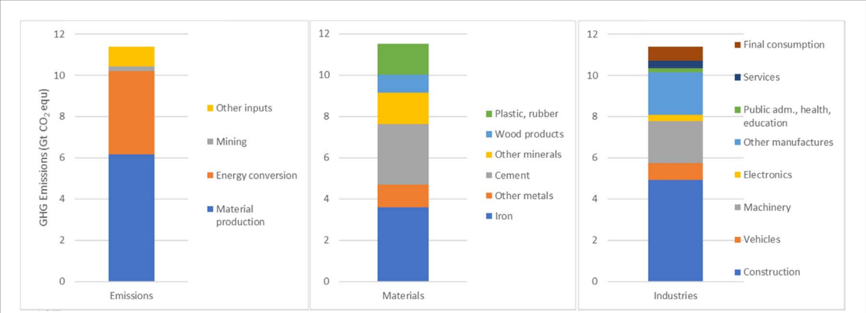
- Material production caused 11.4 Gt CO₂-equivalent cradle-to-gate emissions in 2015; iron and steel contributed 32%, cement/lime/plaster 26%, rubber/plastics 13%, and other non-metallic minerals 13%.
- The largest quantified emission reductions in the reviewed literature come from more intensive use and lifetime extension of buildings and light-weighting/reduced size of vehicles; examples include building more intensive use ↓40% [16], building lifetime extension ↓47% [16] or ↓40% [66], vehicle more intensive use ↓39% steel fleet [16] and ↓93%–96% vehicle [149], and vehicle light-weighting ↓5%–45% steel [16,207].
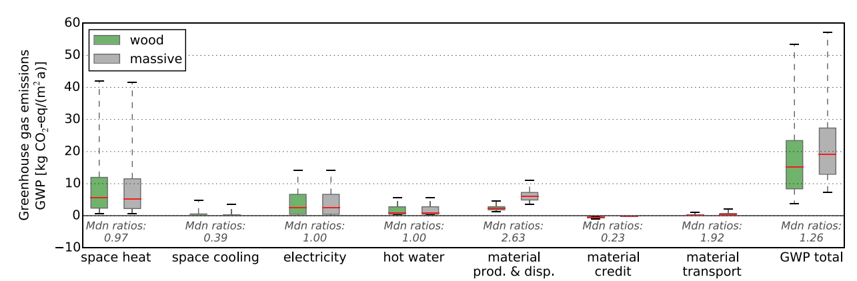
- Replacing steel and concrete with timber can yield significant GHG benefits, but trade-offs and limited timber supply must be recognized; one Swiss study reports a median life cycle benefit of 25% for wood constructions due exclusively to material production, with increased heating/cooling energy from loss of thermal mass.
- Recycling of base metals from buildings, end-of-life vehicles, and appliances already achieves significant emission reductions; for electronics, quantified GHG benefit from recycling ranges from 1% to 10% of life cycle emissions, and the review finds minimal scope for additional ME-driven GHG reductions in EEE.
Methods
- The paper is a literature review of ME strategies applied to buildings, cars, and electrical and electronic equipment (EEE), addressing what strategies exist, their potential GHG reductions, and important gaps.
- It draws on existing case studies, scenario analyses, and modeling studies, including EXIOBASE-based estimates of material production emissions and IEA projections.
- Table 3 evaluates the state of evidence using IPCC-like scoring: availability of evidence (limited, medium, robust) and level of agreement (low, medium, high), based on reviewed case studies and expert judgment.
Limitations
- The paper states that emissions savings from ME remain poorly understood due to the multitude of material uses, diversity of circumstances, and lack of analytical effort; there are few up-scaling/scenario studies and very few ex-post studies.
- The paper states that studies often focus on highly developed countries or China, with a lack of information from other regions, and that the global potential emission reductions from materials are still poorly characterized.
- The paper states that integrated assessment models are poorly equipped to analyze ME options due to lack of data on technology performance, costs, markets, barriers, intersectoral life cycle effects, and material-containing product stocks; behavioral responses and rebound effects remain open questions. Evident from the text: many strategies are quantified only case-by-case and are difficult to generalize, and system boundary choices vary across studies.
Model-written summary. Check it against the paper before relying on it.
Integrity signals
Registry
Cites
Statistics
Figures
Verification
Claims the paper makes
13 Valid · 9 Not valid · 142 Not checked · 81 Own results and interpretations
Every source the paper cites for this claim was checked and supports it.
In the paper
“Second, displaced materials such as cement and steel have high emissions during production [76].”
§ Material efficiency strategies to reducing greenhouse gas emissions associated with buildings, vehicles, and electronics-a review > Lightweight design and material choice
What the sources say
- Supportedcites [76] 75. Oliver C D, Nassar N T, Lippke B R and McCarter J B 2014 Carbon, fossil fuel, and biodiversity mitigation with wood and forests J. Sustain. For. 33 248-75 source
The Introduction describes steel and concrete as substitutes for wood that use more energy in manufacture and therefore cause more fossil-fuel consumption and CO₂ emissions. The Results likewise identify emissions savings from avoiding the fossil fuels needed to manufacture steel or concrete. The paper discusses concrete rather than cement by name, but this supports the citing sentence’s point about high production emissions from displaced materials. (LLM, conf=0.92)
plain- Asserted: passes — The authors put it forward as true.
- Checkable: passes — It can be checked against evidence.
- Load-bearing: passes — The paper’s conclusions depend on it.
- Based: passes — The paper gives a reason why it holds.
- Supported
The cited sources support only part of this claim — read each source’s verdict below.
In the paper
“In Switzerland, a continued growth of floor area by 20% until 2050 would lead to an increase in cumulated material-related GHG emissions of 8% compared to a baseline scenario [44].”
§ Material efficiency strategies to reducing greenhouse gas emissions associated with buildings, vehicles, and electronics-a review > More intensive use
What the sources say
- Partly supportedcites [44] 43. Heeren N and Hellweg S 2018 Tracking construction material over space and time: prospective and geo-referenced modeling of building stocks and construction material flows J. Ind. Ecol. 23 253-67 sourceExperimental — accuracy not yet measured
Our copy does carry the 8% figure in the scenario-results section (i n press, adjacent to Table 1 / Figure 5): 'Total cumulated emissions in 2055 are 8% higher for...' — but the sentence is cut off in our copy, so the comparator scenario is not fully stated there. Two qualifiers diverge from the claim: the source's 20% is not growth of total floor area but scenario 2 'Floor area', in which new constructions from 2015 are built with 20% larger floor space per person (59 and 62 m2/capita instead of 49 and 52), relative to a 'Base' scenario with constant per-capita floor area; and the cumulated-emissions comparison is reported for 2055, not 2050 (the simulation runs 2015-2055). The material-related GHG metric itself is supported (Figure 5: cumulated GHG emissions 2015-2055 for production and disposal of construction material; Abstract: 'An increase per capita floor area or material turnover will lead to a considerable increase in impacts'), but the scope is Swiss residential buildings, not Switzerland's building stock generally. (LLM, conf=0.70)
hedgedstates a cause- Asserted: passes — The authors put it forward as true.
- Checkable: passes — It can be checked against evidence.
- Load-bearing: unclear — It is unclear whether the paper’s conclusions depend on it.
- Based: passes — The paper gives a reason why it holds.
- Partly supported
None of the sources cited for this claim have been checked yet.
In the paper
“There is a renewed interest in the enhanced carbonation of concrete, a process by which CO 2 is absorbed from the atmosphere [73,102,109].”
§ Material efficiency strategies to reducing greenhouse gas emissions associated with buildings, vehicles, and electronics-a review > Issues of alloy-specific recycling are further discussed in the section on vehicle recycling.
What the sources say
- Not checked yetcites [73] 72. Dodoo A, Gustavsson L and Sathre R 2009 Carbon implications of end-of-life management of building materials Resour. Conserv. Recycl. 53 276-86 source
- Not checked yetcites [102] 101. Butera S, Christensen T H and Astrup T F 2015 Life cycle assessment of construction and demolition waste management Waste Manage. 44 196-205 source
- Could not verifycites [109] 108. Vieira P S and Horvath A 2008 Assessing the end-of-life impacts of buildings Environ. Sci. Technol. 42 4663-9 sourceExperimental — accuracy not yet measured
The Discussion reports that recycling concrete could reduce buildings’ greenhouse-gas emissions, but does not describe CO2 absorption from the atmosphere. Searches for concrete carbonation and enhanced carbonation found no passage addressing the process or renewed interest in it. (LLM, conf=0.75)
plain- Asserted: passes — The authors put it forward as true.
- Checkable: passes — It can be checked against evidence.
- Load-bearing: unclear — It is unclear whether the paper’s conclusions depend on it.
- Based: passes — The paper gives a reason why it holds.
The cited sources support only part of this claim — read each source’s verdict below.
In the paper
“Materials constituted 55% of the carbon footprint of vehicle and transport equipment manufacturing of 1.6 Gt [27,42,119].”
§ Material efficiency strategies to reducing greenhouse gas emissions associated with buildings, vehicles, and electronics-a review > ME in vehicles
What the sources say
- Not checked yetcites [27] 27. Hertwich E G 2019 The Carbon Footprint of Material Production Rises to 23% of Global GHG Emissions; New Haven
- Partly supportedcites [42] 41. Hertwich E G and Wood R 2018 The growing importance of scope 3 greenhouse gas emissions from industry Environ. Res. Lett. 13 104013 sourceExperimental — accuracy not yet measured
The section 'More insight by disaggregating industry' (p. 8) says materials were the largest contributor to emissions embodied in manufactured products. It does not give a 55% share or a 1.6 Gt footprint for vehicle and transport equipment manufacturing; Table 3 (p. 9) uses broader sector categories. (LLM, conf=0.84)
- Could not verifycites [119] 118. Stadler K et al 2018 EXIOBASE3-developing a time series of detailed environmentally extended multi-regional input- output tables J. Ind. Ecol. 22 502-15 sourceExperimental — accuracy not yet measured
The Emission Accounts section (p. 6) describes how emissions are allocated to EXIOBASE industries and products, but does not give a carbon footprint for vehicle and transport equipment manufacturing. Searches for “55%,” “1.6 Gt,” and “transport equipment” found no passage establishing the claimed materials share or total. (LLM, conf=0.72)
plain- Asserted: passes — The authors put it forward as true.
- Checkable: passes — It can be checked against evidence.
- Load-bearing: unclear — It is unclear whether the paper’s conclusions depend on it.
- Based: passes — The paper gives a reason why it holds.
The sources with a verdict support this claim; the rest weren’t checked yet, have no full text we could read, or their verdicts aren’t rated yet.
In the paper
“For gasoline-driven vehicles, this type of light-weighting results in a reduction of life cycle emissions due to the reduction in operational energy use and despite the increased energy requirement for material production [151][152][153].”
§ Material efficiency strategies to reducing greenhouse gas emissions associated with buildings, vehicles, and electronics-a review > Lifetime extension
What the sources say
- Not checked yetcites [151] 149. Koffler C 2014 Life cycle assessment of automotive lightweighting through polymers under US boundary conditions Int. J. Life Cycle Assess. 19 538-45 source
- Not checked yetcites [152] 150. Dhingra R and Das S 2014 Life cycle energy and environmental evaluation of downsized versus lightweight material automotive engines J. Clean. Prod. 85 347-58 source
- Supportedcites [153] 151. Modaresi R, Pauliuk S, Løvik A N and Müller D B 2014 Global carbon benefits of material substitution in passenger cars until 2050 and the impact on the steel and aluminum industries Environ. Sci. Technol. 48 10776-84 source
The Introduction says that light-weighting reduces fuel consumption but often raises emissions from materials production. Section 3.1 reports net GHG-emissions savings for the modeled light-weighting scenarios; the paper includes gasoline vehicles among its modeled drive technologies. Together, these passages support the claimed trade-off, though the reported savings are scenario-based rather than a guarantee for every vehicle. (LLM, conf=0.86)
plainstates a cause- Asserted: passes — The authors put it forward as true.
- Checkable: passes — It can be checked against evidence.
- Load-bearing: passes — The paper’s conclusions depend on it.
- Based: passes — The paper gives a reason why it holds.
116 more claims · 3 with their cited sources checked
Create a free account to see all 245 claims and to verify the 221 references still open.
- Probably not a substantial claim. 43
- It may state two separate claims as one. 98
Claims other papers make about this one
Each is checked against this paper’s own text: does it say what the citing paper says it does?
In the citing paper
“On the other hand, shared mobility can lead to higher utilization of each vehicle, which means a more efficient use of materials [341].”
From Tackling climate change with machine learning (2023) · cites this paper as [341]
In the citing paper
“AM (3-D printing) can produce lighter parts in vehicles, such as road vehicles and aircraft, that reduce energy consumption [341,407].”
From Tackling climate change with machine learning (2023) · cites this paper as [341]
Self-check
Percentages, sums and reported differences re-computed from the paper’s own numbers.
Each contradiction between two passages listed here was confirmed by an independent check.
Rated minor: it would not touch a result — a value no result rests on, a p-value that stays on the same side of the significance level, or a conflict that is clerical, resolved elsewhere in the paper, or outside its own findings.
In the paper
§ Material efficiency strategies to reducing greenhouse gas emissions associated with buildings, vehicles, and electronics-a review > The state of evidence Evaluation of ME strategies
“For light-weighting of buildings, there is also limited evidence but a strong agreement about a substantial potential for emission reductions in the construction phase with few trade-offs.”
§ Material efficiency strategies to reducing greenhouse gas emissions associated with buildings, vehicles, and electronics-a review > Conclusions
“| | Light-weight design | ↓19 [16]-50% [71] | -↑ | ↓ - | MH | ◊ Conventions, labor costs |”
Citations
Cites
Change, I. P. O. C. (2015) · Cambridge University Press eBooks · doi:10.1017/cbo9781107415416 · Cited by 4,693
Climate change 2014 : mitigation of climate change
Edenhofer, O., Pichs-Madruga, R., & Sokona, Y. (2014) · University of North Texas Digital Library (University of North Texas) · Cited by 1,975
E-waste: An assessment of global production and environmental impacts
Robinson, B. H. (2009) · Science of The Total Environment · doi:10.1016/j.scitotenv.2009.09.044 · Cited by 1,777
Comparative Environmental Life Cycle Assessment of Conventional and Electric Vehicles
Hawkins, T. R., Singh, B., Majeau‐Bettez, G., & Strømman, A. H. (2013) · Journal of Industrial Ecology · doi:10.1111/j.1530-9290.2012.00532.x · Cited by 1,670
Monteiro, P. J. M., Miller, S. A., & Horvath, A. (2017) · Nature Materials · doi:10.1038/nmat4930 · Cited by 1,454
Life cycle energy analysis of buildings: An overview
Ramesh, T., Prakash, R., & Shukla, K. K. (2010) · Energy and Buildings · doi:10.1016/j.enbuild.2010.05.007 · Cited by 1,408
Energy use in the life cycle of conventional and low-energy buildings: A review article
Sartori, I., & Hestnes, A. G. (2007) · Energy and Buildings · doi:10.1016/j.enbuild.2006.07.001 · Cited by 1,284
Zink, T., & Geyer, R. (2017) · Journal of Industrial Ecology · doi:10.1111/jiec.12545 · Cited by 1,210
(2010) · Encyclopedia of Geography · doi:10.4135/9781412939591.n1196 · Cited by 1,191
Grubler, A., Wilson, C., Bento, N., Boza-Kiss, B., Krey, V., McCollum, D. L., Rao, N. D., Riahi, K., Rogelj, J., De Stercke, S., et al. (2018) · Nature Energy · doi:10.1038/s41560-018-0172-6 · Cited by 1,178
Research works printed but not linked: 7
- 5. Hashimoto S H and Moriguchi Y M 2013 Resource management for carbon management: a literature review Glob. Environ. Res. 17 39-46
- 9. G7. Communiqué 2017 G7 Bologna Environment Ministers' Meeting
- 48. IEA 2016 Annex E: buildings sector model Energy Technology Perspectives 2016 (Paris: International Energy Agency) p 27
- 55. Swilling M et al 2018 The Weight of Cities: Resource Requirements of Future Urbanization; International Resource Panel (Nairobi: United Nations Environment Programme)
- 76. Smith P et al 2014 Agriculture, forestry and other land use Climate Change 2014: Mitigation of Climate Change ed O Edenhofer et al (Geneva: Intergovernmental Panel on Climate Change)
- 117. 118International Energy Agency (IEA) CO 2 Emissions from Fuel Combustion Statistics (https://doi.org/10.1787/co2-data- en) (Accessed: 3 July 2018) · doi:10.1787/co2-data-
- 158. Nasr N Z, Russell J D, Kreiss C, Hilton B, Hellweg S, Bringezu S and von Gries N 2018 Assessment of resource efficiency and innovation in circular economy through remanufacturing, refurbishment Repair Direct Reuse
Cited by
Items 201–300 of 566
Bottom-up LCA building stock model: Tool for future building-management scenarios
Shinde, R., Kim, A., & Hellweg, S. (2023) · Journal of Cleaner Production · doi:10.1016/j.jclepro.2023.140272 · Cited by 19
Evaluation of the Carbon Footprint of Wooden Glamping Structures by Life Cycle Assessment
Sebestyén, T. T. (2024) · Sustainability · doi:10.3390/su16072906 · Cited by 19
Devkota, K., Rasul, M. G., Chowdhury, A. A., & Azad, A. K. (2025) · Journal of Building Engineering · doi:10.1016/j.jobe.2025.111790 · Cited by 19
A Preparation for Reuse Trial of Washing Machines in Ireland
Johnson, M., McMahon, K., & Fitzpatrick, C. (2020) · Sustainability · doi:10.3390/su12031175 · Cited by 20
Beyond energy: incentivizing decarbonization through the circular economy
Sen, A., Napoli, C., & Meini, L. (2021) · Oxford University Research Archive (ORA) (University of Oxford) · doi:10.5287/ora-gpe6nv9y0 · Cited by 19
Embodied Energy Consumption in the Residential Sector: A Case Study of Affordable Housing
Anderson, N. D., Wedawatta, G., Rathnayake, I., Domingo, N., & Azizi, Z. M. (2022) · Sustainability · doi:10.3390/su14095051 · Cited by 19
“[56] compiled six strategies for reducing embodied energy throughout the 186 production of buildings.”
BackgroundEstimating the use of materials and their GHG emissions in the German building sector
Rheude, F., & Röder, H. (2022) · Cleaner Environmental Systems · doi:10.1016/j.cesys.2022.100095 · Cited by 18
Shahmohammadi, S., Pedinotti-Castelle, M., & Amor, B. (2024) · Sustainable Production and Consumption · doi:10.1016/j.spc.2024.11.001 · Cited by 18
Closing the global sand circularity gap needs a systems approach
Cao, Z., Chu, C., Liu, J., Su, X., Zhong, X., & Behrens, P. (2025) · One Earth · doi:10.1016/j.oneear.2025.101199 · Cited by 19
Lu, Y., & Schandl, H. (2021) · Journal of Industrial Ecology · doi:10.1111/jiec.13138 · Cited by 18
“…total materials use (44% in 2007 compared to 3% for iron and steel, and 6% for NFM) as well as the large proportion of GHG emissions from the construction sector (around 50% in the total cradle-togate GHG emissions from production of materials according to Figure 3(c) in Hertwich et al. (2019)).”
BackgroundMethodInfluentialRepresenting vehicle-technological opportunities in integrated energy modeling
Wolfram, P., & Hertwich, E. G. (2019) · Transportation Research Part D Transport and Environment · doi:10.1016/j.trd.2019.06.006 · Cited by 18
Self-citationBridging the Gap – Enhancing mitigation ambition and action at G20 level and globally
Rogelj, J., & den Elzen, M. G. J. (2019) · IIASA PURE (International Institute of Applied Systems Analysis) · Cited by 17
Insight from Review Articles of Life Cycle Assessment for Buildings
Zhang, Y., Lu, Y., Huang, Z., Chen, D., Cheng, B., Wang, D., & Lu, C. (2025) · Applied Sciences · doi:10.3390/app15147751 · Cited by 17
Optimization framework for cost and carbon emission of timber floor elements
Nesheim, S. Ø., Mela, K., Malo, K. A., & Labonnote, N. (2021) · Engineering Structures · doi:10.1016/j.engstruct.2021.113485 · Cited by 17
Ciacci, L., Matos, C. T. D., Reck, B. K., Wittmer, D., Bernardi, E., Mathieux, F., & Passarini, F. (2022) · Journal of Industrial Ecology · doi:10.1111/jiec.13226 · Cited by 17
“…(Fishman et a. et al., 2015; Müller et al., 2011; Wiedenhofer et al., 2015) and it is enhanced by material efficiency strategies such as lightweighting of certain goods (e.g., vehicles) and product lifetime extension (Hertwich et al., 2019), which in the end influencematerial accumulation in use.”
BackgroundSelf-citationDuntu, S. H., Hukpati, K., Ahmad, I., Islam, M., & Boakye–Yiadom, S. (2022) · Materials Science and Engineering A · doi:10.1016/j.msea.2022.142655 · Cited by 17
Song, L., Dai, S., Cao, Z., Liu, Y., & Chen, W. (2021) · Journal of Cleaner Production · doi:10.1016/j.jclepro.2021.126482 · Cited by 17
Binet, F., Saunier, F., & Margni, M. D. (2021) · Frontiers in Sustainability · doi:10.3389/frsus.2021.738890 · Cited by 17
The Collapse of the Global Consumption Model: in Search of Sustainability
Бобылев, С. Н., Solovyeva, S., & Kiryushin, P. (2022) · World Economy and International Relations · doi:10.20542/0131-2227-2022-66-11-92-100 · Cited by 16
Haas, W., Baumgart, A., Eisenmenger, N., Virág, D., Kalt, G., Sommer, M., Kratena, K., & Meyer, I. (2025) · Journal of Industrial Ecology · doi:10.1111/jiec.13619 · Cited by 16
“…material and carbon reductions are well in line with international research on material efficiency and GHG emissions for buildings and vehicles like the review of Hertwich et al. (2019, 2020) or the scenario exercises by Pauliuk et al. (2021) for the world and Pauliuk and Heeren (2020) for Germany.”
Das, D., Kalbar, P. P., & Velaga, N. R. (2022) · Sustainable Production and Consumption · doi:10.1016/j.spc.2022.07.007 · Cited by 16
Iyer, A. V., Rao, N. D., & Hertwich, E. G. (2023) · Environmental Science & Technology · doi:10.1021/acs.est.2c06418 · Cited by 16
Self-citationDecarbonising the Cement and Concrete Industry—A Step Forward to a Sustainable Future
Luhar, S., Ashour, A. F., & Luhar, I. (2026) · Journal of Composites Science · doi:10.3390/jcs10050226 · Cited by 15
Greener homes: Factors underpinning Europeans' intention to live in multi-storey wooden buildings
Kim, D.-H., Franzini, F., Thorsen, B. J., Berghäll, S., & Aguilar, F. X. (2023) · Sustainable Production and Consumption · doi:10.1016/j.spc.2023.05.030 · Cited by 15
Resource, economic, and carbon benefits of end-of-life trucks’ urban mining in China
Xu, G., Xin, X., Liu, W., Yang, S., Miao, Y., Liu, F., Liu, H., Feng, Y., Liang, X., He, Z., et al. (2025) · Communications Earth & Environment · doi:10.1038/s43247-025-02832-x · Cited by 15
“environmental impact — can alleviate resource scarcity, reinforce industrial economic chains downstream, and reduce energy consumption and carbon emissions 28 – 30 .”
Barenji, A. B., Eivani, A. R., Jafarian, H. R., & Park, N. (2020) · Journal of Materials Research and Technology · doi:10.1016/j.jmrt.2020.03.085 · Cited by 15
Hirschnitz-Garbers, M., Sosa, A. A., & Hinzmann, M. (2022) · Journal of Sustainable Development of Energy Water and Environment Systems · doi:10.13044/j.sdewes.d9.0408 · Cited by 15
“Studies cover analyses of potential GHG emission reduction effects of material efficiency strategies related to buildings, vehicles, and electronics [26], as well as of measures to re-use goods [27], of circular economy approaches in Austria [28] and the city of Guiyang, China [29], and of sustainable consumption stra…”
BackgroundInfluentialBala-Litwiniak, A., Musiał, D., & Nabiałczyk, M. (2023) · Materials · doi:10.3390/ma16227156 · Cited by 15
“The combustion of fuels such as coal, crude oil and natural gas causes significant emissions of pollutants, which, due to increasingly higher environmental protection standards, require continuous reduction [8,9].”
BackgroundThe impact of demand-side strategies to enable a more circular economy in private car mobility
Chapman, D. A., Eyckmans, J., & Acker, K. V. (2024) · Sustainable Production and Consumption · doi:10.1016/j.spc.2024.06.029 · Cited by 16
Zhang, Y., & Yang, P. (2023) · Journal of Hydrology · doi:10.1016/j.jhydrol.2023.129471 · Cited by 14
Baniya, B. (2023) · Sustainability · doi:10.3390/su15118460 · Cited by 15
Pérez-Sánchez, L. À., Fishman, T., & Behrens, P. (2024) · Journal of Cleaner Production · doi:10.1016/j.jclepro.2024.141954 · Cited by 14
Self-citationCircular economy strategies in cities as a value‐driven approach to infrastructure management
Zuluaga, S., Saxe, S., & Karney, B. W. (2025) · Journal of Industrial Ecology · doi:10.1111/jiec.70086 · Cited by 14
“This demand for infrastructure, in turn, implies a large demand for primary materials (Hertwich et al., 2019; Masanet et al., 2021).”
Yamashita, N., Fishman, T., Kayo, C., & Tanikawa, H. (2024) · Sustainable Production and Consumption · doi:10.1016/j.spc.2024.11.003 · Cited by 13
Self-citationA combination of measures limits demand for critical materials in Sweden’s electric car transition
Morfeldt, J., Johansson, D. J. A., & Davidsson, S. (2025) · Communications Earth & Environment · doi:10.1038/s43247-025-02085-8 · Cited by 13
“Shifts towards smaller cars and lightweight materials have been highlighted as material ef fi ciency strategies 17,22 as well as important factors for reducing passenger cars ’ carbon footprints 20,23 – 25 .”
Factors influencing human trust in intelligent built environment systems
Behzadan, A. H., & Dabiri, A. (2025) · AI and Ethics · doi:10.1007/s43681-025-00813-6 · Cited by 13
“This problem context is characterized by limited quantified data due to diverse repair and maintenance interventions, a variety of materials, and insufficient analytical efforts and long-term monitoring [ 79 , 80].”
Tozan, B., Hoxha, E., Stapel, E. B., & Birgisdóttir, H. (2025) · Sustainable Cities and Society · doi:10.1016/j.scs.2025.106770 · Cited by 15
Consumption inequalities in material use undermining resources sustainability
Tian, P., Feng, K., Chen, X., Li, D., Jiang, M., Li, J., Zheng, H., Shan, Y., & Sun, L. (2026) · Nature Sustainability · doi:10.1038/s41893-025-01726-2 · Cited by 14
Impact of Urban Mining on Energy Efficiency: Evidence from China
Shen, H., Yang, Z., Bao, Y., Xia, X., & Wang, D. (2022) · Sustainability · doi:10.3390/su142215039 · Cited by 13
Towards sustainable development goals and role of bio-based building materials
Aghamohammadi, N., & Shahmohammadi, M. (2023) · Elsevier eBooks · doi:10.1016/b978-0-323-91149-8.00004-1 · Cited by 14
Improving die tooling properties by spraying TiC-Ti-Al and TiB2-Ti-Al electro-explosive coatings
Романов, Д. А. (2020) · Materials Research Express · doi:10.1088/2053-1591/ab86f6 · Cited by 13
Effect of TiO2 percentage on the hydrogen-based direct reducibility of high-grade pellets
Sadeghi, B., Cavaliere, P. D., Bayat, M., Aminaei, M., Esfahani, N. E., Laska, A., Koszelow, D., & Concalves, N. R. (2025) · Powder Technology · doi:10.1016/j.powtec.2025.120813 · Cited by 12
Valentini, F., Maracchini, G., di Filippo, R., Dorigato, A., & Bursi, O. S. (2025) · Energy and Buildings · doi:10.1016/j.enbuild.2025.116245 · Cited by 12
A Plant-Based Sensor for UV-A Radiation Measurements
Trigona, C., Napoli, G., Pasquale, S., Puglisi, I., Baglieri, A., & Gueli, A. M. (2021) · IEEE International Instrumentation and Measurement Technology Conference · doi:10.1109/i2mtc50364.2021.9459911 · Cited by 12
Climate Change Mitigation: Policies and Lessons for Asia
Azhgaliyeva, D., & Rahut, D. (2022) · Asian Development Bank Institute eBooks · doi:10.56506/ojyg4210 · Cited by 12
Khan, S. A., & Rena, R. (2023) · Advances in marketing, customer relationship management, and e-services book series · doi:10.4018/978-1-6684-8166-0.ch001 · Cited by 12
Kiruthika, K., Ambily, P. S., Vijayan, P., & Kaliyavaradhan, S. K. (2023) · European Journal of Environmental and Civil engineering · doi:10.1080/19648189.2023.2260865 · Cited by 12
“CO 2 emissions (in GtCO 2 e) from production of materials (Hertwich et al., 2019). as primary, operation, demolition, and end of life.”
BackgroundOrlandini, L. C., & Punhagui, K. R. G. (2023) · Environmental Development · doi:10.1016/j.envdev.2023.100946 · Cited by 12
Barenji, A. B., Russo, M. B., Jabar, S., Kotadia, H. R., Ceglarek, D. J., Ayarkwa, K. F., Smith, J. R., & Franciosa, P. (2025) · Journal of Advanced Joining Processes · doi:10.1016/j.jajp.2025.100290 · Cited by 12
Camana, D., Toniolo, S., Manzardo, A., Piron, M., & Scipioni, A. (2021) · Waste Management & Research The Journal for a Sustainable Circular Economy · doi:10.1177/0734242x211017979 · Cited by 12
“…(Sakai et al., 2017), indicators for achieving resource efficiency (Huysman et al., 2015), water footprint for policies (Vanham and Bidoglio, 2013), flow optimisation for symbiosis scenarios (Brondi et al., 2018) and application of CE principles to recycling paths (Hertwich et al., 2019).”
BackgroundA critical review of land transport management in Indonesia: Does it support CO2 emission reduction?
Putra, A. P., Wasiaturrahma, W., Ibrahim, K. H., Endarti, E. W., & Sunyoto, K. (2025) · Social Sciences & Humanities Open · doi:10.1016/j.ssaho.2025.101972 · Cited by 11
The climate limits of construction in over 1,000 cities
Rankin, K. H., Serrenho, A. C., Bachmann, C., Posen, I. D., & Saxe, S. (2026) · Nature Cities · doi:10.1038/s44284-025-00379-8 · Cited by 11
Moghayedi, A., Massyn, M., Jeune, K. L., & Michell, K. (2022) · IOP Conference Series Earth and Environmental Science · doi:10.1088/1755-1315/1101/2/022021 · Cited by 11
“Therefore, the building sector's impact on the environment has attracted significant attention, especially in the way building materials are being exploited to contribute to the overall environmental pollution [11].”
BackgroundSong, H., Wang, C., Sun, K., Geng, H., & Zuo, L. (2023) · Resources Policy · doi:10.1016/j.resourpol.2023.103895 · Cited by 11
Recycled Surgical Mask Waste as a Resource Material in Sustainable Geopolymer Bricks
Thoudam, K., Hossiney, N., Kumar, S. L., Alex, J., Prakasan, S., Chandra, K., Urs, Y., & Arunkumar, A. S. (2023) · Recycling · doi:10.3390/recycling8060093 · Cited by 11
Resource efficiency for UK cars from 1960 to 2015: From stocks and flows to service provision
Rodrigues, B., Carmona, L. G., Whiting, K., & Sousa, T. (2021) · Environmental Development · doi:10.1016/j.envdev.2021.100676 · Cited by 11
Suratno, S., & Ichtiarto, B. P. (2021) · Journal Européen des Systèmes Automatisés · doi:10.18280/jesa.540603 · Cited by 11
“To create an environmentally friendly transportation system, it is necessary to make improvements to reduce greenhouse gas emissions [18-20].”
BackgroundImproved Copper Circularity as a Result of Increased Material Efficiency in the U.S. Housing Stock
Wang, T., Berrill, P., Zimmerman, J. B., Rao, N. D., Min, J., & Hertwich, E. G. (2022) · Environmental Science & Technology · doi:10.1021/acs.est.1c06474 · Cited by 11
Self-citationA stock-flow-service nexus vision of the low carbon economy
Carmona, L. G., Whiting, K., & Cullen, J. M. (2022) · Energy Reports · doi:10.1016/j.egyr.2022.10.086 · Cited by 12
Wilson, C., Grubler, A., Nemet, G., Pachauri, S., Pauliuk, S., & Wiedenhofer, D. (2023) · IIASA PURE (International Institute of Applied Systems Analysis) · Cited by 11
Self-citationEffects of Mn Segregations on Intergranular Fracture in a Medium‐Mn Low‐Density Steel
Jung, H., Lee, G., Koo, M., Song, H., Ko, W., & Sohn, S. S. (2022) · steel research international · doi:10.1002/srin.202200240 · Cited by 11
Pauliuk, S. (2020) · SocArXiv (OSF Preprints) · doi:10.31235/osf.io/y4xcv · Cited by 13
Self-citationTeixeira, A., & Lefèvre, J. (2025) · Journal of Industrial Ecology · doi:10.1111/jiec.70001 · Cited by 10
“More concretely, three main types of circular economy strategies (Aguilar-Hernandez et al., 2018; Hertwich et al., 2019, 2020; Korhonen et al., 2018) could significantly reduce the CFM and decouple economic activity from material extraction: closing supply loops (recycling, reuse, and…”
How demand for and trade of construction materials affects greenhouse gas emissions
Fritzeen, W. E., Ferreira, J. P., Shobe, W., O’Rourke, P., Fuhrman, J., Doney, S. C., & Clarens, A. F. (2025) · Resources Conservation and Recycling · doi:10.1016/j.resconrec.2025.108513 · Cited by 10
Deng, G., Zhang, N., Liao, W., He, Y., Lü, L., Chi, L., & Ma, H. (2025) · Materials & Design · doi:10.1016/j.matdes.2025.115292 · Cited by 10
Living Sensors: The Greenest Paradigm in Instrumentation and Measurements
Trigona, C. (2023) · IEEE Instrumentation & Measurement Magazine · doi:10.1109/mim.2023.10034956 · Cited by 10
“As a matter of fact, the semiconductor manufacturing process and the fabrication of integrated sensors represents an un-green step, far from being considered ecofriendly, considering that the CO2 emission and pollutants is quite significant during manufacturing [5], [6].”
BackgroundThe German Energy System: Analysis of Past, Present, and Future Developments
Edo, G. I. (2023) · Advanced Energy Conversion Materials · doi:10.37256/aecm.4120232207 · Cited by 11
“On the other hand, it appears that the significant reduction in heat consumption is the primary means by which the CO2 emissions associated with the provision of heat are reduced [16].”
BackgroundCircular economy strategies research for Beijing buildings in a low-carbon future
Yue, Z., & Dai, T. (2024) · Sustainable Cities and Society · doi:10.1016/j.scs.2024.105894 · Cited by 10
Osvaldová, M., & Potkány, M. (2024) · Forests · doi:10.3390/f16010052 · Cited by 10
Fracchia, E., Gobber, F. S., & Rosso, M. (2020) · Metals · doi:10.3390/met10050618 · Cited by 10
“These advances are mainly associated with needing to reduce the environmental impact of vehicles by reducing CO2 emissions [1].”
BackgroundWang, Y., Ma, Q., Wang, T., Zhang, B., Wang, D., Zhang, X., Nagaumi, H., Yang, B., Ren, X., Huang, J., et al. (2026) · Carbon Neutral Systems · doi:10.1007/s44438-026-00023-5 · Cited by 9
“The result is a lightweight housing that not only reduces mass but also minimizes material usage and upstream emissions (Hertwich et al. 2019). c. Integrated exhaust and NVH modules – Combining muffler and aftertreatment functions into integrated modules reduces the total number of cans, shells and…”
Principles of a Circular Economy for Batteries
Helbig, C., & Hillenbrand, M. (2024) · The Materials Research Society series · doi:10.1007/978-3-031-48359-2_2 · Cited by 9
Nguyen, T. C., Miatto, A., & Kim, J. (2023) · Ecological Economics · doi:10.1016/j.ecolecon.2024.108165 · Cited by 9
McMahon, K., Uchendu, C., & Fitzpatrick, C. (2023) · Journal of Industrial Ecology · doi:10.1111/jiec.13406 · Cited by 9
Mapping of construction materials reuse practices within large Norwegian municipalities
Kummen, T. M., Bohne, R. A., & Lohne, J. (2023) · IOP Conference Series Earth and Environmental Science · doi:10.1088/1755-1315/1176/1/012036 · Cited by 9
The making-or-breaking of material and resource efficiency in the Nordics
Alola, A. A., Çelik, A., Obekpa, H. O., Usman, O., & Echebiri, C. K. (2023) · Cleaner and Responsible Consumption · doi:10.1016/j.clrc.2023.100151 · Cited by 9
Alataş, S., Karakaya, E., & Hiçyılmaz, B. (2020) · Sustainable Production and Consumption · doi:10.1016/j.spc.2020.11.015 · Cited by 9
Malleeswaran, B., & Uthayakumar, R. (2021) · International Journal of Sustainable Engineering · doi:10.1080/19397038.2021.1964632 · Cited by 9
“Hertwich et al. (Hertwich et al. 2019) implemented the efficient strategies to reducing GHGs with buildings, vehicles, and electronics a review.”
BackgroundDocumentation of the transport-sector model within the RECC model framework
Wolfram, P., Tu, Q., Hertwich, E. G., & Pauliuk, S. (2020) · Zenodo (CERN European Organization for Nuclear Research) · doi:10.5281/zenodo.3631937 · Cited by 10
Self-citationVann, C., Ruiz-Valero, L., Zuluaga, S., Fishman, T., & Saxe, S. (2025) · Resources Conservation and Recycling · doi:10.1016/j.resconrec.2025.108548 · Cited by 9
Self-citationDecarbonizing global steel production
Wang, P., Yin, Y.-L., Li, Z., Bataille, C., Franks, D. M., Watari, T., Åhman, M., Nilsson, L. J., Ma, X., Meng, J., et al. (2026) · Nature Reviews Earth & Environment · doi:10.1038/s43017-026-00786-y · Cited by 10
“Material efficiency, through lightweight design, product reuse, extended lifetimes and improved fabrication yield, consistently emerges as the dominant contributor to the projected cumulative GHG reduction 140 (Fig.”
Balancing the Mechanical Performance and Environmental Sustainability of Fiber-Reinforced Concrete
Schultz, C., Cunningham, P. R., Jin, F., & Miller, S. A. (2025) · Journal of Materials in Civil Engineering · doi:10.1061/jmcee7.mteng-19454 · Cited by 8
Estimation of the Lifespan of Imported Passenger Vehicles in Mongolia
Mendjargal, T., Yamasue, E., & Tanikawa, H. (2022) · Sustainability · doi:10.3390/su142114582 · Cited by 8
Applications of Polymeric Foams in Thermal Insulation
Regasa, M. B., & Fanta, G. M. (2023) · ACS symposium series · doi:10.1021/bk-2023-1440.ch008 · Cited by 8
Miller, S. A., & Grubert, E. A. (2021) · Environmental Research Communications · doi:10.1088/2515-7620/abf0f2 · Cited by 8
Climate impact reduction strategies in early architectural design
Tu, S., Roberts, M., & Zhuang, W. (2025) · Journal of Building Engineering · doi:10.1016/j.jobe.2025.114621 · Cited by 7
Reconciling Circular Economy and Net Zero: Firm Capabilities to Resolve Sustainability Tensions
Arranz, C. F. A., Arroyabe, M. F., Demirel, P., Kesidou, E., Panwar, R., & Pinkse, J. (2026) · British Journal of Management · doi:10.1111/1467-8551.70061 · Cited by 7
Durable Economies: Organizing the Material Foundations of Society
Jaeger‐Erben, M., Wieser, H., Marwede, M., & Hofmann, F. (2023) · Arbeit und Organisation · doi:10.1515/9783839463963 · Cited by 7
Singh, P., Mulay, P., & Patil, Y. B. (2023) · Environmental and Climate Technologies · doi:10.2478/rtuect-2023-0057 · Cited by 7
Li, H., Pauliuk, S., Liu, Y., Sun, X., Wang, P., & Chen, W. (2025) · Resources Conservation and Recycling · doi:10.1016/j.resconrec.2025.108349 · Cited by 7
Self-citationSun, X., Wang, Y., Ren, J., Wai, O. W. H., & Li, X. D. (2025) · Environmental Science & Technology · doi:10.1021/acs.est.5c00261 · Cited by 7
Policy for material efficiency in homes and cars: Enabling new climate change mitigation strategies
Lifset, R., Hertwich, E. G., & Makov, T. (2024) · Wiley Interdisciplinary Reviews Climate Change · doi:10.1002/wcc.881 · Cited by 8
“A variety of characterizations of material efficiency strategies have been suggested (Allwood et al., 2011; Barrett & Scott, 2012; Hertwich et al., 2019, 2020) and for related frameworks such as the circular economy (e.g., Ellen MacArthur Foundation, 2023; McKinsey Center for Business and…”
BackgroundSelf-citationvan Diemen, M., Brusselaers, J., & Rentrop, C. (2025) · Environmental Research Communications · doi:10.1088/2515-7620/ad9f0f · Cited by 8
Akın, Ş., Carrer, F., & Hertwich, E. G. (2025) · Sustainable Cities and Society · doi:10.1016/j.scs.2025.106351 · Cited by 7
Self-citationGingrich, S., Matej, S., Erb, K.-H., Haberl, H., Noë, J. L., Kaufmann, L., Magerl, A., Schaffartzik, A., Wiedenhofer, D., & Pauliuk, S. (2025) · iScience · doi:10.1016/j.isci.2025.113472 · Cited by 8
“40,41 42–44 Nevertheless, knowledge gaps prevail on delineating corridors of wood provision that meet material services while respecting ecological limits, and the overall climate impacts they entail.”
Self-citationStructure of the Surface Region of Stainless Steel: Bulk and Thin Films
Garai, D., Wilson, A., Carlomagno, I., Meneghini, C., Carlà, F., Hussain, H., Gupta, A. K., & Zegenhagen, J. (2022) · physica status solidi (b) · doi:10.1002/pssb.202100513 · Cited by 7
Song, J., Su, X., Hou, L., Chu, C., Wu, T., Dai, H., Ou, Y., Nishiura, O., Cao, Z., & Ju, M. (2025) · Environmental Science & Technology · doi:10.1021/acs.est.4c14724 · Cited by 7
Huppes, C. M. (2023) · LA Referencia (Red Federada de Repositorios Institucionales de Publicaciones Científicas) · Cited by 7
To renovate or build with wood? Results from Finnish citizen survey data
Ruokamo, E., Franzini, F., Lähtinen, K., & Toppinen, A. (2024) · Construction Management and Economics · doi:10.1080/01446193.2024.2358063 · Cited by 6
“…analysis of construction materials find that the emissions generated during the production of construction materials vary widely (e.g., Hertwich et al. 2019, table 1), some of which estimate that the emissions associated with concrete production to be more than twice that of wood…”
Can agglomerated tall buildings reduce carbon emissions compared to a low-rise urban sprawl?
Thaneya, A. B., Chang, S. Y., Herbreteau, E., Jeria, C., Jiang, Z., & Horvath, A. (2025) · Environmental Research Infrastructure and Sustainability · doi:10.1088/2634-4505/adba84 · Cited by 6
Metadata
- Authors
- Hertwich, E. G., Ali, S., Ciacci, L., Fishman, T., Heeren, N., Masanet, E., Asghari, F. N., Olivetti, E., Pauliuk, S., Tu, Q., & Wolfram, P.
- Affiliations
- Yale University (US)
- University of Delaware (US)
- University of Bologna (IT)
- Reichman University (IL)
- Northwestern University (US)
- Massachusetts Institute of Technology (US)
- University of Freiburg (DE)
- ORCID
- Venue
- Environmental Research Letters
- Publisher
- IOP Publishing
- Published
- 2019-04-16
- Volume
- 14
- Issue
- 4
- Pages
- 043004
- ISSN
- 1748-9326 (ISSN-L)
- OpenAlex
- W2921283133
- Cited by
- 477
- References
- 199
- Citations by year
- 2026: 57 · 2025: 82 · 2024: 88 · 2023: 72 · 2022: 70 · 2021: 66 · 2020: 38 · 2019: 4
- FWCI
- 18.86
- Type
- journal article
- Language
- en
- Open access
- gold
- doi.org
- Licence
- cc-by
- iopscience.iop.org/info/page/text-and-data-mining (tdm)
- creativecommons.org/licenses/by/3.0/ (vor)
- Locations
- Environmental Research Letters (publishedVersion, cc-by)
- Archivio istituzionale della ricerca (Alma Mater Studiorum Università di Bologna) (submittedVersion)
- DOAJ (DOAJ: Directory of Open Access Journals) (submittedVersion)
- DSpace@MIT (Massachusetts Institute of Technology) (submittedVersion, cc-by-nc)
- INFM-OAR (INFN Catania) (submittedVersion, cc-by)
- Funders
- United Nations Environment
- Topics
- Physical Sciences › Environmental Science › Environmental Engineering › Environmental Impact and Sustainability
- Physical Sciences › Environmental Science › Environmental Engineering › Sustainability and Ecological Systems Analysis
- Physical Sciences › Engineering › Building and Construction › Sustainable Design and Development
- Keywords
- material efficiency, greenhouse gas emissions, circular economy, buildings, vehicles, electronics, lightweight design, service life extension, material reuse and recycling, metal recovery, demolition waste, end-of-life vehicles, appliance recycling, metal sorting, life cycle assessment
About these checks
Registry, retraction, Cites and statistics results are computed, not judged, with one exception: a printed reference that no index lists is read once by a model before it counts as a citation error. Claims are extracted by a model and kept only when their quote appears verbatim in the text; each cited source is then checked, with a model’s help, for whether it says what the claim relies on. Those verdicts can be wrong — read the claim’s quote and the cited source before relying on one.
The claim verdicts this report counts are experimental: their accuracy is not yet measured.
A language model drew the claims from the paper on 2026-09-28, under version 3 of the claim definition (model deepseek-v4.1-flash, prompt extract-v3).
A second model labelled each claim on 2026-09-28 (model jev-1.13-20260917, definition revision gold-guideline-v0.2).
Cited sources are checked with a language model’s help (gpt-6-sol and qwen3.8-omni-flash).
Statistics and arithmetic are recomputed, not judged.
Confidence bands are shown only for fields calibrated on our annotated test set. None is calibrated yet, so no band is shown.
What counts as a claim ›How we measure confidence ›How we check this ›
Are you an author, or do you see a problem with this page? Request a review
Data sources
Bibliographic data: Semantic Scholar, OpenAlex, Crossref.
Contains information from the Semantic Scholar Academic Graph Datasets, made available under the ODC Attribution License (ODC-BY 1.0).
Semantic Scholar’s data is described in: Kinney, R., et al. (2023). The Semantic Scholar Open Data Platform. arXiv:2301.10140.
