

The DOI matches its Crossref record; 7 of the 7 references it cites were found in a registry or an index.
Silicon photonic processor of two-qubit entangling quantum logic
Overview
The claims and statistics of this paper haven’t been checked yet.
Run the check — free, no account needed. It reads the open-access text and checks the sources it cites.
Integrity signals
Registry
Cites
Statistics
Figures
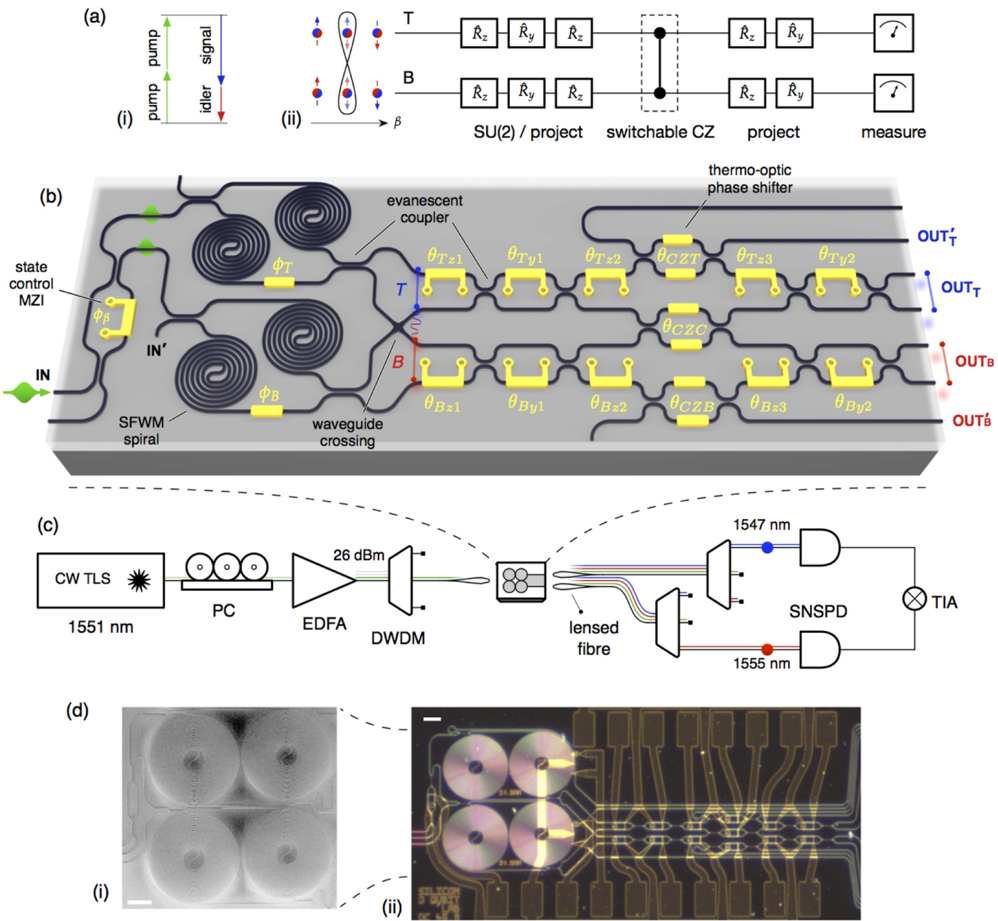
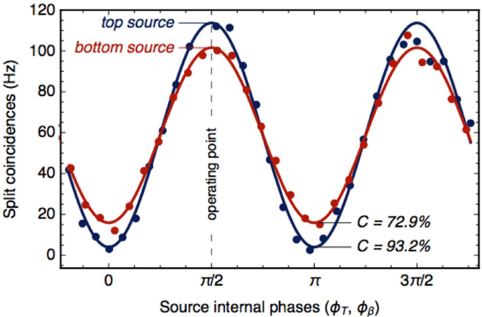
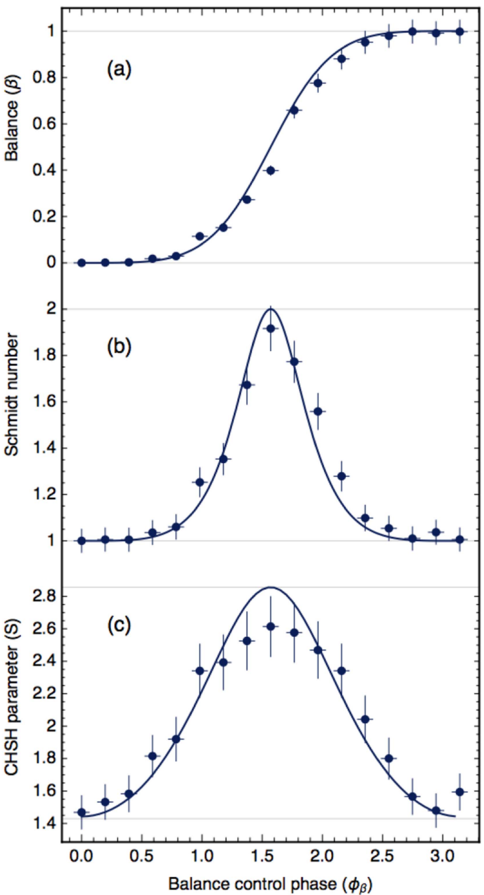
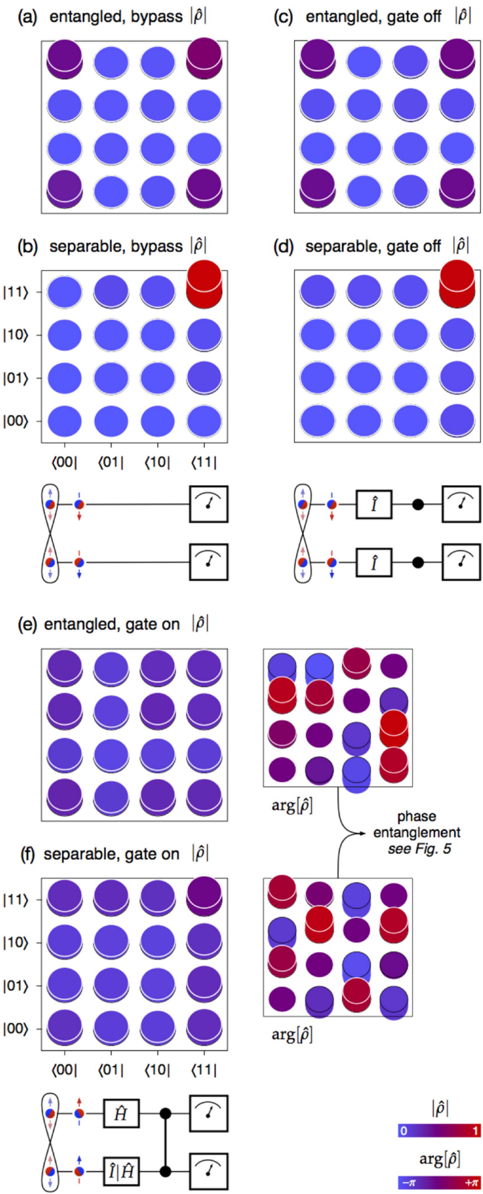
Verification
Claims the paper makes
The claims and statistics of this paper haven’t been checked yet.
Run the check — free, no account needed. It reads the open-access text and checks the sources it cites.
Claims other papers make about this one
Each is checked against this paper’s own text: does it say what the citing paper says it does?
The check wasn’t confident either way, so it gives no verdict — never disputed.
In the citing paper
“Si-based MZIs with a 65dB on-off ratio has been achieved with near-perfect beamsplitters [41], equivalent to having a Pauli-Z error rate of < 10 -6 [42].”
From Integrated photonic quantum technologies (2020) · cites this paper as [41]
Experimental — accuracy not yet measuredThe check wasn’t confident either way, so it gives no verdict — never disputed.
In the citing paper
“The continuous-time QW has been adopted to identify signature of bosonic coalescence [107], to simulate Fano resonance [108], to shed light on the interplay between quantum coherence and noise for assist transport processes in complex networks [40, 41, 109] ( Fig.5d ), and to quantum fast hitting on hexagonal graphs [110].”
From Integrated photonic quantum technologies (2020) · cites this paper as [41]
Experimental — accuracy not yet measuredIn the citing paper
“environmentassisted QT is observed with single-particle (coherent light) by controlling and mapping static and dynamic disorders in a re-programmable Si device. The device consists of 176 TOPSs and 88 MZIs in a 4.9×2.4mm 2 area, and it enables ultra-high precision controls of photons.”
From Integrated photonic quantum technologies (2020) · cites this paper as [41]
Self-check
Percentages, sums and reported differences re-computed from the paper’s own numbers.
The self-check needs the paper’s full text.
Citations
Cites
James, D. F. V., Kwiat, P. G., Munro, W. J., & White, A. G. (2001) · Physical Review A · doi:10.1103/physreva.64.052312 · Cited by 2,176 · cited 2×
“[48] D F V James, P G Kwiat, W J Munro, and A G White, “Measurement of qubits,” Physical Review A 64, 052312 (2001).”
BackgroundMethodCarolan, J., Harrold, C., Sparrow, C., Martín-López, E., Russell, N. J., Silverstone, J. W., Shadbolt, P. J., Matsuda, N., Oguma, M., Itoh, M., et al. (2015) · Science · doi:10.1126/science.aab3642 · Cited by 1,093
Self-citationPernice, W. H. P., Schuck, C., Minaeva, O., Li, M., Goltsman, G. N., Sergienko, A. V., & Tang, H. X. (2012) · Nature Communications · doi:10.1038/ncomms2307 · Cited by 477
Linear optical controlled-NOT gate in the coincidence basis
Ralph, T. C., Langford, N. K., Bell, T. B., & White, A. G. (2002) · Physical Review A · doi:10.1103/physreva.65.062324 · Cited by 346
On-chip detection of non-classical light by scalable integration of single-photon detectors
Najafi, F., Mower, J., Harris, N. C., Bellei, F., Dane, A., Lee, C., Hu, X., Kharel, P., Marsili, F., Assefa, S., et al. (2015) · Nature Communications · doi:10.1038/ncomms6873 · Cited by 330
Polarization Entangled State Measurement on a Chip
Sansoni, L., Sciarrino, F., Vallone, G., Mataloni, P., Crespi, A., Ramponi, R., & Osellame, R. (2010) · Physical Review Letters · doi:10.1103/physrevlett.105.200503 · Cited by 255 · cited 1×
“[9] Linda Sansoni, Fabio Sciarrino, Giuseppe Vallone, Paolo Mataloni, Andrea Crespi, Roberta Ramponi, and Roberto Osellame, “Polarization entangled state mea-”
BackgroundThe Schmidt number as a universal entanglement measure
Sperling, J., & Vogel, W. (2011) · Physica Scripta · doi:10.1088/0031-8949/83/04/045002 · Cited by 96
Research works printed but not linked: 47
- 10.1038/nphoton.2009.229 · DOI · Paper page
- Latmiral L, 2016, New J. Phys., 18, 10.1088/1367-2630/18/11/113008 · DOI
- 10.1126/science.1155441 · DOI · Paper page
- 10.1038/nphoton.2014.217 · DOI · Paper page
- Minkov M, 2016, J. Opt., 18, 10.1088/2040-8978/18/5/054012 · DOI
- 10.1364/OE.22.022831 · DOI
- 10.1038/ncomms9236 · DOI
- 10.1038/nphoton.2013.102 · DOI · Paper page
- 10.1038/lsa.2015.127 · DOI · Paper page
- 10.1126/sciadv.1400255 · DOI · Paper page
- 10.1364/OPTICA.4.000090 · DOI · Paper page
- 10.1038/srep35975 · DOI
- Alibart O, 2016, J. Opt., 18, 10.1088/2040-8978/18/10/104001 · DOI
- 10.1002/lpor.201600297 · DOI · Paper page
- 10.1038/s41534-016-0005-z · DOI · Paper page
- Zhang X, 2016, J. Opt., 18
- 10.1038/nphoton.2013.183 · DOI · Paper page
- 10.1109/JSTQE.2016.2573218 · DOI
- 10.1364/OE.14.012388 · DOI
- 10.1364/OE.20.023100 · DOI · Paper page
- 10.1038/srep00817 · DOI · Paper page
- 10.1364/OL.38.001960 · DOI · Paper page
- 10.1038/ncomms3582 · DOI · Paper page
- 10.1038/ncomms10853 · DOI
- Harada K, 2011, New J. Phys., 13, 10.1088/1367-2630/13/6/065005 · DOI
- 10.1038/nphoton.2013.339 · DOI · Paper page
- 10.1038/srep03913 · DOI
- 10.1364/OE.21.005014 · DOI
- 10.1038/ncomms8948 · DOI
- 10.1103/PhysRevX.4.041047 · DOI · Paper page
- 10.1364/OL.42.000815 · DOI · Paper page
- 10.1364/OL.41.005318 · DOI
- 10.1364/OE.16.004309 · DOI
- 10.1364/OE.22.010487 · DOI · Paper page
- 10.1038/nphoton.2011.283 · DOI · Paper page
- 10.1103/PhysRevA.76.031804 · DOI
- 10.1103/PhysRevA.86.033830 · DOI
- 10.1103/RevModPhys.81.865 · DOI · Paper page
- 10.1103/PhysRevA.61.040301 · DOI · Paper page
- 10.1049/el:19951453 · DOI
- 10.1364/OE.21.010208 · DOI
- 10.1038/nphoton.2010.185 · DOI
- 10.1103/PhysRevLett.118.100503 · DOI
- 10.1364/OE.24.003313 · DOI
- 10.1103/PhysRevLett.49.91 · DOI · Paper page
- 10.1103/PhysRevLett.92.220402 · DOI · Paper page
- 10.1364/OL.38.002732 · DOI
Cited by
Sorted by citations
Integrated photonic quantum technologies
Wang, J., Sciarrino, F., Laing, A., & Thompson, M. G. (2020) · Nature Photonics · doi:10.1038/s41566-019-0532-1 · Cited by 1,576
Self-citationWitnessing eigenstates for quantum simulation of Hamiltonian spectra
Santagati, R., Wang, J., Gentile, A. A., Paesani, S., Wiebe, N., McClean, J. R., Morley-Short, S., Shadbolt, P. J., Bonneau, D., Silverstone, J. W., et al. (2018) · Science Advances · doi:10.1126/sciadv.aap9646 · Cited by 211
Self-citationNonlinear integrated quantum electro-optic circuits
Luo, K.-H., Brauner, S., Eigner, C., Sharapova, P. R., Ricken, R., Meier, T., Herrmann, H., & Silberhorn, C. (2019) · Science Advances · doi:10.1126/sciadv.aat1451 · Cited by 98
Metadata
- Authors
- Santagati, R., Silverstone, J. W., Strain, M. J., Sorel, M., Miki, S., Yamashita, T., Fujiwara, M., Sasaki, M., Terai, H., Tanner, M. G., Natarajan, C. M., Hadfield, R. H., O’Brien, J. L., & Thompson, M. G.
- Venue
- Journal of Optics
- Publisher
- IOP Publishing
- Published
- 2017-10-20
- Volume
- 19
- Issue
- 11
- Pages
- 114006
- ISSN
- 2040-8978
- 2040-8986
- Cited by
- 43
- References
- 7
- Licence
- Funders
- Royal Society (Wolfson Merit Award)
- Engineering and Physical Sciences Research Council (EP/L024020/1, EP/K033085/1, Doctoral Training Account, Early Career Fellowship)
- European Research Council (640079 QPE ERC-2014-ST, BBOI, QUCHIP)
- RAENG (Chair in Emerging Technologies)
About these checks
Registry, retraction, Cites and statistics results are computed, not judged, with one exception: a printed reference that no index lists is read once by a model before it counts as a citation error. Claims are extracted by a model and kept only when their quote appears verbatim in the text; each cited source is then checked, with a model’s help, for whether it says what the claim relies on. Those verdicts can be wrong — read the claim’s quote and the cited source before relying on one.
Statistics and arithmetic are recomputed, not judged.
Confidence bands are shown only for fields calibrated on our annotated test set. None is calibrated yet, so no band is shown.
What counts as a claim ›How we measure confidence ›How we check this ›
Are you an author, or do you see a problem with this page? Request a review
