

Demonstration of quantum volume 64 on a superconducting quantum computing system
Open accessThe DOI matches its Crossref record; 55 of the 55 references it cites were found in a registry or an index.
Abstract
We improve the quality of quantum circuits on superconducting quantum computing systems, as measured by the quantum volume (QV), with a combination of dynamical decoupling, compiler optimizations, shorter two-qubit gates, and excited state promoted readout. This result shows that the path to larger QV systems requires the simultaneous increase of coherence, control gate fidelities, measurement fidelities, and smarter software which takes into account hardware details, thereby demonstrating the need to continue to co-design the software and hardware stack for the foreseeable future.
Overview
The claims and statistics of this paper haven’t been checked yet.
Free: it reads the open-access text and checks the first 5 claims that cite a source we can check. Create a free account to check every claim.
Integrity signals
Registry
Cites
Statistics
Figures
Verification
Claims the paper makes
The claims and statistics of this paper haven’t been checked yet.
Free: it reads the open-access text and checks the first 5 claims that cite a source we can check. Create a free account to check every claim.
Claims other papers make about this one
Each is checked against this paper’s own text: does it say what the citing paper says it does?
The source backs part of the claim, not all of it — or backs it for a different population, condition or comparison.
In the citing paper
“The advantage of this fabrication technique is the possibility for in situ fabrication of the JJ and minimal etch damage to achieve high-coherence qubits of up to hundreds of microseconds19–22.”
From Advanced CMOS manufacturing of superconducting qubits on 300 mm wafers (2024) · cites this paper as [22]
Experimental — accuracy not yet measured
Self-check
Percentages, sums and reported differences re-computed from the paper’s own numbers.
The self-check needs the paper’s full text.
Citations
Cites
Effects of Diffusion on Free Precession in Nuclear Magnetic Resonance Experiments
Carr, H. Y., & Purcell, E. M. (1954) · Physical Review · doi:10.1103/physrev.94.630 · Cited by 6,466
Modified Spin-Echo Method for Measuring Nuclear Relaxation Times
Meiboom, S., & Gill, D. (1958) · Review of Scientific Instruments · doi:10.1063/1.1716296 · Cited by 6,022 · cited 1×
“decoupling sequences have been proposed [29], [30], [31], some with self-correcting properties [32], [33], others with non-equidistant temporal spacing [34], and hybrids combining both [35], [36], [37], in order to optimize the effective filter function.”
BackgroundHahn, E. L. (1950) · Physical Review · doi:10.1103/physrev.80.580 · Cited by 5,085
Charge-insensitive qubit design derived from the Cooper pair box
Koch, J., Yu, T. M., Gambetta, J., Houck, A. A., Schuster, D. I., Majer, J., Blais, A., Devoret, M. H., Girvin, S. M., & Schoelkopf, R. J. (2007) · Physical Review A · doi:10.1103/physreva.76.042319 · Cited by 3,351 · cited 1×
“Secondly, even though the | f 〉-state has a lifetime half of the |1〉-state [53], the qubit excitation has to decay twice | f 〉 → |1〉 → |0〉 (while a two-photon decay | f 〉 → |0〉 is strongly suppressed [54] ).”
Dynamical Decoupling of Open Quantum Systems
Viola, L., Knill, E., & Lloyd, S. (1999) · Physical Review Letters · doi:10.1103/physrevlett.82.2417 · Cited by 1,808 · cited 1×
“Dynamical decoupling is a thoroughly discussed error mitigation technique [25], [26], [27], and in its simplest form, can be a single Hahn echo-pulse [28], refocusing the lowfrequency noise spectrum acting on a unitary.”
BackgroundRandomized benchmarking of quantum gates
Knill, E., Leibfried, D., Reichle, R., Britton, J., Blakestad, R. B., Jost, J. D., Langer, C., Ozeri, R., Seidelin, S., & Wineland, D. J. (2008) · Physical Review A · doi:10.1103/physreva.77.012307 · Cited by 1,019 · cited 1×
“randomized benchmarking [43, 44] and gate set tomography [45, 46], QV was developed as a holistic system measure and hence is sensitive to SPAM-errors.”
BackgroundSimple Pulses for Elimination of Leakage in Weakly Nonlinear Qubits
Motzoi, F., Gambetta, J. M., Rebentrost, P., & Wilhelm, F. K. (2009) · Physical Review Letters · doi:10.1103/physrevlett.103.110501 · Cited by 814 · cited 1×
“A DRAG pulse envelope [15] corrects σz-errors and signal dispersion due to wiring.”
BackgroundScalable and Robust Randomized Benchmarking of Quantum Processes
Magesan, E., Gambetta, J. M., & Emerson, J. (2011) · Physical Review Letters · doi:10.1103/physrevlett.106.180504 · Cited by 724 · cited 1×
“randomized benchmarking [43, 44] and gate set tomography [45, 46], QV was developed as a holistic system measure and hence is sensitive to SPAM-errors.”
BackgroundSelf-citationKeeping a Quantum Bit Alive by Optimized π -Pulse Sequences
Uhrig, G. S. (2007) · Physical Review Letters · doi:10.1103/physrevlett.98.100504 · Cited by 716 · cited 1×
“Various decoupling sequences have been proposed [32–34], some with self-correcting properties [35, 36], others with non-equidistant temporal spacing [37], and hybrids combining both [38–40], in order to optimize the effective filter function.”
MethodValidating quantum computers using randomized model circuits
Cross, A. W., Bishop, L. S., Sheldon, S., Nation, P. D., & Gambetta, J. M. (2019) · Physical Review A · doi:10.1103/physreva.100.032328 · Cited by 704 · cited 4×
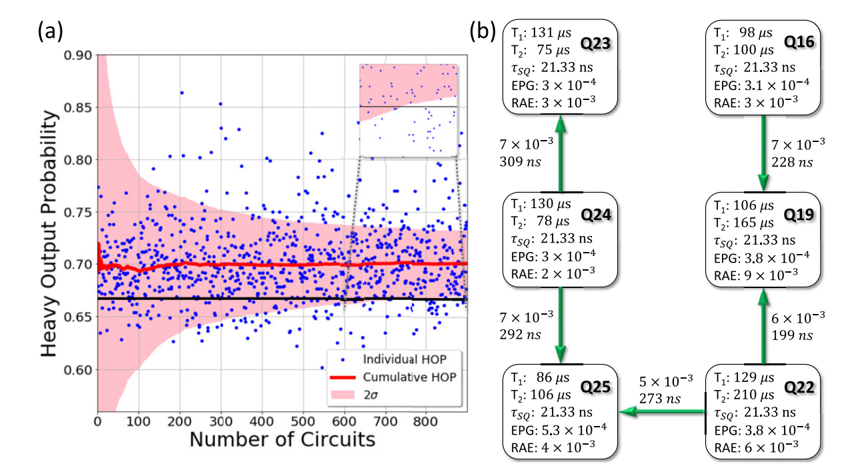
“Red: cumulative HOP with shaded region ±2σ as calculated per appendix C of [1].”
BackgroundMethodInfluentialSelf-citation
Cited by
Suppressing quantum errors by scaling a surface code logical qubit
Google Quantum, A. I., Acharya, R., Aleiner, I., Allen, R., Andersen, T. I., Ansmann, M., Arute, F., Arya, K., Asfaw, A., Atalaya, J., et al. (2023) · Nature · doi:10.1038/s41586-022-05434-1 · Cited by 1,103
The Variational Quantum Eigensolver: A review of methods and best practices
Tilly, J., Chen, H., Cao, S., Picozzi, D., Setia, K., Li, Y., Grant, E., Wossnig, L., Rungger, I., Booth, G. H., et al. (2022) · Physics Reports · doi:10.1016/j.physrep.2022.08.003 · Cited by 1,031
Noise-Induced Barren Plateaus in Variational Quantum Algorithms
Wang, S., Fontana, E., Cerezo, M., Sharma, K., Sone, A., Cincio, L., & Coles, P. J. (2020) · arXiv · doi:10.48550/arxiv.2007.14384 · Cited by 791
Noise-induced barren plateaus in variational quantum algorithms
Wang, S., Fontana, E., Cerezo, M., Sharma, K., Sone, A., Cincio, L., & Coles, P. J. (2021) · Nature Communications · doi:10.1038/s41467-021-27045-6 · Cited by 773
“At time of writing this holds the record for the largest quantum volume measured on an IBM Quantum device, which was demonstrated on a line of 6 qubits [80].”
BackgroundCai, Z., Babbush, R., Benjamin, S. C., Endo, S., Huggins, W. J., Li, Y., McClean, J. R., & O’Brien, T. E. (2023) · Reviews of Modern Physics · doi:10.1103/revmodphys.95.045005 · Cited by 591
“…to see reports of experiments demonstrating high-quality control over multiple qubits [see e.g. Asavanant et al. (2019); Ebadi et al. (2021); Jurcevic et al. (2021); Madjarov et al. (2020); and Xue et al. (2022)], some even reaching beyond 50 qubits [see e.g. Arute et al. (2019) and Wu et…”
Background
Metadata
- Authors
- Jurcevic, P., Javadi-Abhari, A., Bishop, L. S., Lauer, I., Bogorin, D. F., Brink, M., Capelluto, L., Günlük, O., Itoko, T., Kanazawa, N., Kandala, A., Keefe, G. A., Krsulich, K., Landers, W., Lewandowski, E. P., McClure, D. T., Nannicini, G., Narasgond, A., Nayfeh, H. M., Pritchett, E., Rothwell, M. B., Srinivasan, S., Sundaresan, N., Wang, C., Wei, K. X., Wood, C. J., Yau, J.-B., Zhang, E. J., Dial, O. E., Chow, J. M., & Gambetta, J. M.
- Affiliations
- IBM (United States) (US)
- IBM Research - Tokyo (JP)
- Corresponding author
- Jurcevic, Petar
- ORCID
- Jurcevic, Petar
- Javadi-Abhari, Ali
- Bishop, Lev S
- Lauer, Isaac
- Brink, Markus
- Günlük, Oktay
- Itoko, Toshinari
- Kanazawa, Naoki
- Kandala, Abhinav
- Keefe, George A
- Krsulich, Kevin
- Landers, William
- Lewandowski, Eric P
- McClure, Douglas T
- Nannicini, Giacomo
- Nayfeh, Hasan M
- Rothwell, Mary Beth
- Srinivasan, Srikanth
- Sundaresan, Neereja
- Wang, Cindy
- Wei, Ken X
- Wood, Christopher J
- Yau, Jeng-Bang
- Zhang, Eric J
- Dial, Oliver E
- Chow, Jerry M
- Gambetta, Jay M
- Venue
- Quantum Science and Technology
- Publisher
- IOP Publishing
- Published
- 2021-03-17
- Volume
- 6
- Issue
- 2
- Pages
- 025020
- ISSN
- 2058-9565 (ISSN-L)
- OpenAlex
- W3062963497
- Cited by
- 85
- References
- 52
- Citations by year
- 2025: 5 · 2024: 5 · 2023: 7 · 2022: 28 · 2021: 33
- FWCI
- 6.45
- Type
- journal article
- Language
- en
- Open access
- hybrid
- doi.org
- Licence
- cc-by
- creativecommons.org/licenses/by/4.0/ (vor)
- iopscience.iop.org/info/page/text-and-data-mining (tdm)
- Locations
- Quantum Science and Technology (publishedVersion, cc-by)
- arXiv (Cornell University) (submittedVersion)
- arXiv (Cornell University)
- Funders
- Intelligence Advanced Research Projects Activity (W911NF-16-1-0114)
- Army Research Office (W911NF-16-1-0114, W911NF-16-1-, W911NF)
- Topics
- Physical Sciences › Computer Science › Artificial Intelligence › Quantum Computing Algorithms and Architecture
- Physical Sciences › Physics and Astronomy › Atomic and Molecular Physics, and Optics › Quantum Information and Cryptography
- Physical Sciences › Physics and Astronomy › Atomic and Molecular Physics, and Optics › Quantum Mechanics and Applications
- Keywords
- quantum volume, superconducting quantum computing, dynamical decoupling, compiler optimization, two-qubit gate fidelity, measurement fidelity, coherence, hardware-software co-design
About these checks
Registry, retraction, Cites and statistics results are computed, not judged, with one exception: a printed reference that no index lists is read once by a model before it counts as a citation error. Claims are extracted by a model and kept only when their quote appears verbatim in the text; each cited source is then checked, with a model’s help, for whether it says what the claim relies on. Those verdicts can be wrong — read the claim’s quote and the cited source before relying on one.
Statistics and arithmetic are recomputed, not judged.
Confidence bands are shown only for fields calibrated on our annotated test set. None is calibrated yet, so no band is shown.
What counts as a claim ›How we measure confidence ›How we check this ›
Are you an author, or do you see a problem with this page? Request a review
How to cite
Cite CoChat for the checks on this page, and the paper for its own findings.
- This page
- CoChat. (2026). Citation check: Demonstration of quantum volume 64 on a superconducting quantum computing system. https://app.cochat.ai/papers/10.1088/2058-9565/abe519
- The paper
- Jurcevic, P., Javadi-Abhari, A., Bishop, L. S., Lauer, I., Bogorin, D. F., Brink, M., Capelluto, L., Günlük, O., Itoko, T., Kanazawa, N., Kandala, A., Keefe, G. A., Krsulich, K., Landers, W., Lewandowski, E. P., McClure, D. T., Nannicini, G., Narasgond, A., Nayfeh, H. M., . . . Gambetta, J. M. (2021). Demonstration of quantum volume 64 on a superconducting quantum computing system. Quantum Science and Technology. https://doi.org/10.1088/2058-9565/abe519
Data sources
Bibliographic data: Semantic Scholar, OpenAlex, Crossref.
Contains information from the Semantic Scholar Academic Graph Datasets, made available under the ODC Attribution License (ODC-BY 1.0).
Semantic Scholar’s data is described in: Kinney, R., et al. (2023). The Semantic Scholar Open Data Platform. arXiv:2301.10140.
