

Demonstration of quantum volume 64 on a superconducting quantum computing system
Open accessThe DOI matches its Crossref record; 55 of the 55 references it cites were found in a registry or an index.
Abstract
We improve the quality of quantum circuits on superconducting quantum computing systems, as measured by the quantum volume (QV), with a combination of dynamical decoupling, compiler optimizations, shorter two-qubit gates, and excited state promoted readout. This result shows that the path to larger QV systems requires the simultaneous increase of coherence, control gate fidelities, measurement fidelities, and smarter software which takes into account hardware details, thereby demonstrating the need to continue to co-design the software and hardware stack for the foreseeable future.
Overview
The claims and statistics of this paper haven’t been checked yet.
Free: it reads the open-access text and checks the first 5 claims that cite a source we can check. Create a free account to check every claim.
Integrity signals
Registry
Cites
Statistics
Figures
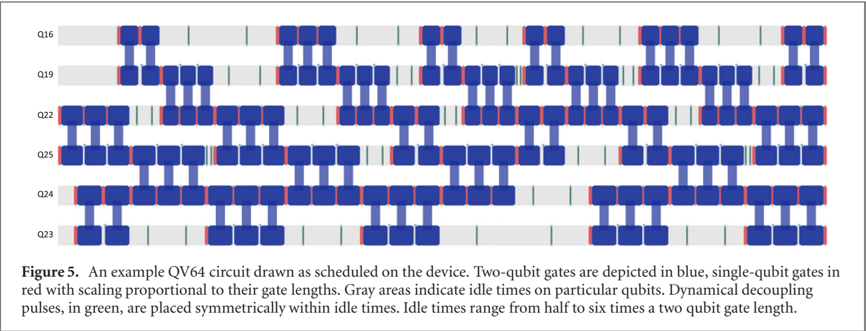
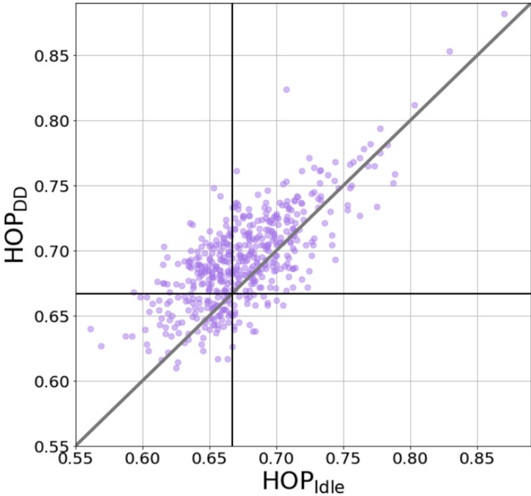
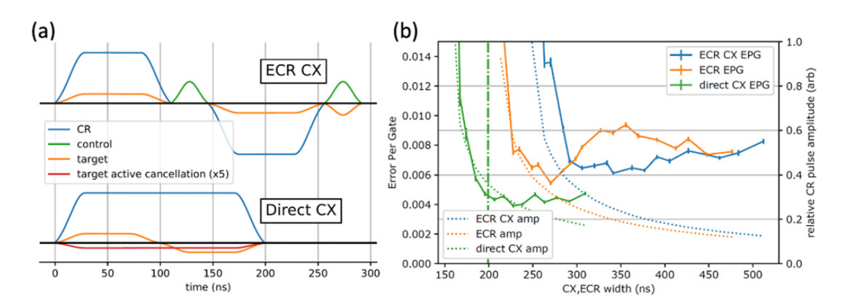
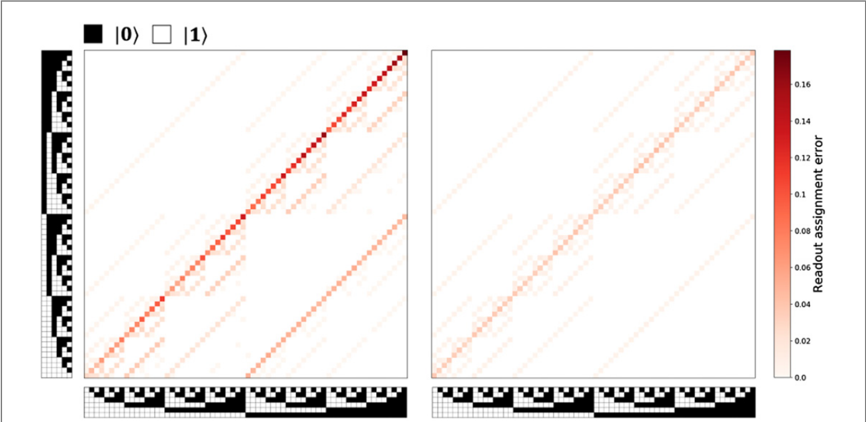
Verification
Claims the paper makes
The claims and statistics of this paper haven’t been checked yet.
Free: it reads the open-access text and checks the first 5 claims that cite a source we can check. Create a free account to check every claim.
Claims other papers make about this one
Each is checked against this paper’s own text: does it say what the citing paper says it does?
The source backs part of the claim, not all of it — or backs it for a different population, condition or comparison.
In the citing paper
“The advantage of this fabrication technique is the possibility for in situ fabrication of the JJ and minimal etch damage to achieve high-coherence qubits of up to hundreds of microseconds19–22.”
From Advanced CMOS manufacturing of superconducting qubits on 300 mm wafers (2024) · cites this paper as [22]
Experimental — accuracy not yet measured
Self-check
Percentages, sums and reported differences re-computed from the paper’s own numbers.
The self-check needs the paper’s full text.
Citations
Cites
Effects of Diffusion on Free Precession in Nuclear Magnetic Resonance Experiments
Carr, H. Y., & Purcell, E. M. (1954) · Physical Review · doi:10.1103/physrev.94.630 · Cited by 6,466
Modified Spin-Echo Method for Measuring Nuclear Relaxation Times
Meiboom, S., & Gill, D. (1958) · Review of Scientific Instruments · doi:10.1063/1.1716296 · Cited by 6,022 · cited 1×
“decoupling sequences have been proposed [29], [30], [31], some with self-correcting properties [32], [33], others with non-equidistant temporal spacing [34], and hybrids combining both [35], [36], [37], in order to optimize the effective filter function.”
BackgroundHahn, E. L. (1950) · Physical Review · doi:10.1103/physrev.80.580 · Cited by 5,085
Charge-insensitive qubit design derived from the Cooper pair box
Koch, J., Yu, T. M., Gambetta, J., Houck, A. A., Schuster, D. I., Majer, J., Blais, A., Devoret, M. H., Girvin, S. M., & Schoelkopf, R. J. (2007) · Physical Review A · doi:10.1103/physreva.76.042319 · Cited by 3,351 · cited 1×
“Secondly, even though the | f 〉-state has a lifetime half of the |1〉-state [53], the qubit excitation has to decay twice | f 〉 → |1〉 → |0〉 (while a two-photon decay | f 〉 → |0〉 is strongly suppressed [54] ).”
Dynamical Decoupling of Open Quantum Systems
Viola, L., Knill, E., & Lloyd, S. (1999) · Physical Review Letters · doi:10.1103/physrevlett.82.2417 · Cited by 1,808 · cited 1×
“Dynamical decoupling is a thoroughly discussed error mitigation technique [25], [26], [27], and in its simplest form, can be a single Hahn echo-pulse [28], refocusing the lowfrequency noise spectrum acting on a unitary.”
BackgroundRandomized benchmarking of quantum gates
Knill, E., Leibfried, D., Reichle, R., Britton, J., Blakestad, R. B., Jost, J. D., Langer, C., Ozeri, R., Seidelin, S., & Wineland, D. J. (2008) · Physical Review A · doi:10.1103/physreva.77.012307 · Cited by 1,019 · cited 1×
“randomized benchmarking [43, 44] and gate set tomography [45, 46], QV was developed as a holistic system measure and hence is sensitive to SPAM-errors.”
BackgroundSimple Pulses for Elimination of Leakage in Weakly Nonlinear Qubits
Motzoi, F., Gambetta, J. M., Rebentrost, P., & Wilhelm, F. K. (2009) · Physical Review Letters · doi:10.1103/physrevlett.103.110501 · Cited by 814 · cited 1×
“A DRAG pulse envelope [15] corrects σz-errors and signal dispersion due to wiring.”
BackgroundScalable and Robust Randomized Benchmarking of Quantum Processes
Magesan, E., Gambetta, J. M., & Emerson, J. (2011) · Physical Review Letters · doi:10.1103/physrevlett.106.180504 · Cited by 724 · cited 1×
“randomized benchmarking [43, 44] and gate set tomography [45, 46], QV was developed as a holistic system measure and hence is sensitive to SPAM-errors.”
BackgroundSelf-citationKeeping a Quantum Bit Alive by Optimized π -Pulse Sequences
Uhrig, G. S. (2007) · Physical Review Letters · doi:10.1103/physrevlett.98.100504 · Cited by 716 · cited 1×
“Various decoupling sequences have been proposed [32–34], some with self-correcting properties [35, 36], others with non-equidistant temporal spacing [37], and hybrids combining both [38–40], in order to optimize the effective filter function.”
MethodValidating quantum computers using randomized model circuits
Cross, A. W., Bishop, L. S., Sheldon, S., Nation, P. D., & Gambetta, J. M. (2019) · Physical Review A · doi:10.1103/physreva.100.032328 · Cited by 704 · cited 4×
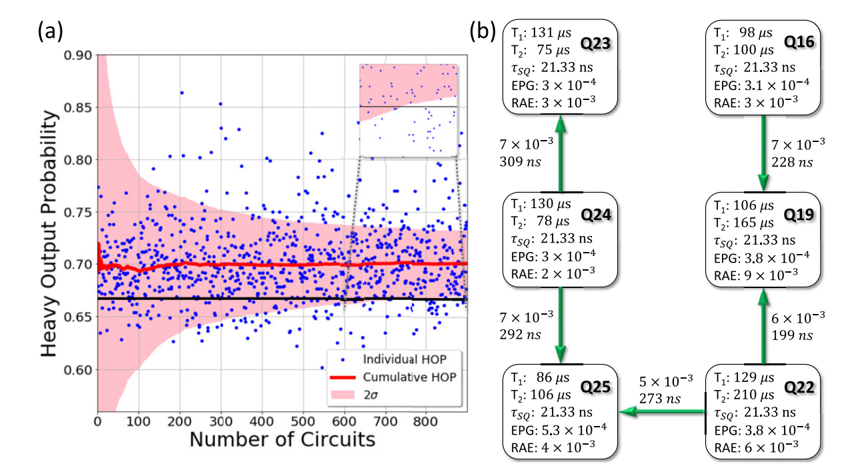
“Red: cumulative HOP with shaded region ±2σ as calculated per appendix C of [1].”
BackgroundMethodInfluentialSelf-citationTackling the Qubit Mapping Problem for NISQ-Era Quantum Devices
Li, G., Ding, Y., & Xie, Y. (2019) · Proceedings of the Twenty-Fourth International Conference on Architectural Support for Programming Languages and Operating Systems · doi:10.1145/3297858.3304023 · Cited by 594 · cited 1×
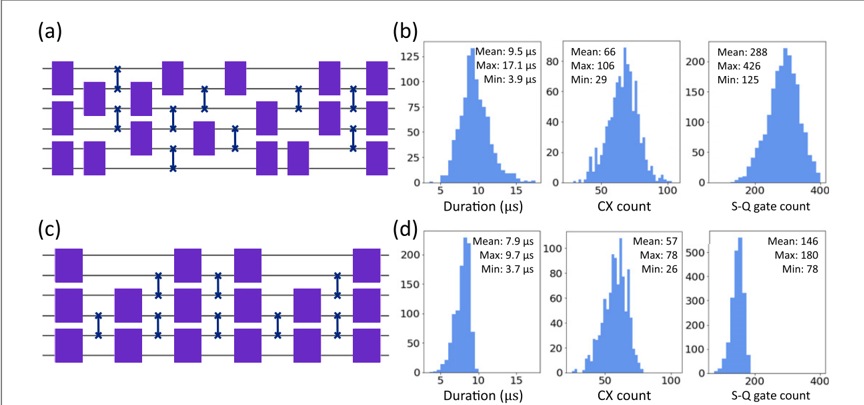
“state-of-the art SABRE algorithm [20] available in Qiskit, showing substantial improvement in both the mean and maximum number of uses of the entangling gate.”
MethodFault-Tolerant Quantum Dynamical Decoupling
Khodjasteh, K., & Lidar, D. A. (2005) · Physical Review Letters · doi:10.1103/physrevlett.95.180501 · Cited by 576 · cited 1×
“decoupling sequences have been proposed [29], [30], [31], some with self-correcting properties [32], [33], others with non-equidistant temporal spacing [34], and hybrids combining both [35], [36], [37], in order to optimize the effective filter function.”
BackgroundQuantum approximate optimization of non-planar graph problems on a planar superconducting processor
Harrigan, M. P., Sung, K. J., Neeley, M., Satzinger, K. J., Arute, F., Arya, K., Atalaya, J., Bardin, J. C., Barends, R., Boixo, S., et al. (2021) · Nature Physics · doi:10.1038/s41567-020-01105-y · Cited by 564 · cited 1×
“This demonstrates the benefit of removing simplifying abstraction barriers in the exposed gate set to gain efficiency in compiling [22], [23], [24].”
BackgroundDemonstration of the trapped-ion quantum CCD computer architecture
Pino, J. M., Dreiling, J. M., Figgatt, C., Gaebler, J. P., Moses, S. A., Allman, M. S., Baldwin, C. H., Foss-Feig, M., Hayes, D., Mayer, K., et al. (2021) · Nature · doi:10.1038/s41586-021-03318-4 · Cited by 547
Procedure for systematically tuning up cross-talk in the cross-resonance gate
Sheldon, S., Magesan, E., Chow, J. M., & Gambetta, J. M. (2016) · Physical Review A · doi:10.1103/physreva.93.060302 · Cited by 477 · cited 1×
“The CX gate itself can be implemented directly or be created using an echo cross-resonance (ECR) pulse [21] (cf section 5).”
BackgroundSelf-citationSimple All-Microwave Entangling Gate for Fixed-Frequency Superconducting Qubits
Chow, J. M., Córcoles, A. D., Gambetta, J. M., Rigetti, C., Johnson, B. R., Smolin, J. A., Rozen, J. R., Keefe, G. A., Rothwell, M. B., Ketchen, M. B., et al. (2011) · Physical Review Letters · doi:10.1103/physrevlett.107.080502 · Cited by 464 · cited 1×
“This sequence demonstrates an improvement over previous direct CNOT attempts [18] by leveraging our understanding of target rotary pulsing [7].”
BackgroundSelf-citationOptimal quantum circuits for general two-qubit gates
Vatan, F., & Williams, C. (2004) · Physical Review A · doi:10.1103/physreva.69.032315 · Cited by 443 · cited 2×
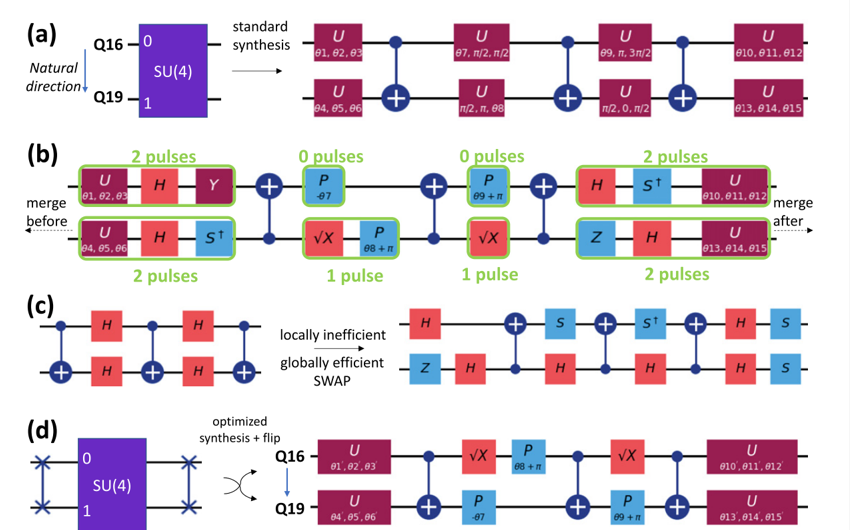
“While the question of ‘optimal’ SU(4) decomposition has been extensively studied, the optimality criteria has usually been the number of two-qubit gates [23, 24].”
BackgroundRigetti, C., & Devoret, M. (2010) · Physical Review B · doi:10.1103/physrevb.81.134507 · Cited by 356 · cited 1×
“Two-qubit gates are based on a cross-resonance scheme [13], [14], [15] with a target rotary pulse [4] and an additional offset pulse-shape on the target for implementing a direct (echoless) CNOT as described later.”
MethodColloquium: Protecting quantum information against environmental noise
Suter, D., & Álvarez, G. A. (2016) · Reviews of Modern Physics · doi:10.1103/revmodphys.88.041001 · Cited by 354
Universal Gate for Fixed-Frequency Qubits via a Tunable Bus
McKay, D. C., Filipp, S., Mezzacapo, A., Magesan, E., Chow, J. M., & Gambetta, J. M. (2016) · Physical Review Applied · doi:10.1103/physrevapplied.6.064007 · Cited by 321 · cited 1×
“The Phase gate can be achieved with zero time and error [22].”
BackgroundQuantum trajectory approach to circuit QED: Quantum jumps and the Zeno effect
Gambetta, J., Blais, A., Boissonneault, M., Houck, A. A., Schuster, D. I., & Girvin, S. M. (2008) · Physical Review A · doi:10.1103/physreva.77.012112 · Cited by 297 · cited 1×
“Single qubits are dispersively read out by transversely coupled transmission line cavities [50].”
BackgroundSelf-citationSelf-consistent quantum process tomography
Merkel, S. T., Gambetta, J. M., Smolin, J. A., Poletto, S., Córcoles, A. D., Johnson, B. R., Ryan, C. A., & Steffen, M. (2013) · Physical Review A · doi:10.1103/physreva.87.062119 · Cited by 294 · cited 1×
“randomized benchmarking [43, 44] and gate set tomography [45, 46], QV was developed as a holistic system measure and hence is sensitive to SPAM-errors.”
BackgroundSelf-citationCharacterization of Addressability by Simultaneous Randomized Benchmarking
Gambetta, J. M., Córcoles, A. D., Merkel, S. T., Johnson, B. R., Smolin, J. A., Chow, J. M., Ryan, C. A., Rigetti, C., Poletto, S., Ohki, T. A., et al. (2012) · Physical Review Letters · doi:10.1103/physrevlett.109.240504 · Cited by 289 · cited 1×
“Gate errors were measured with simultaneous single-qubit and individual two-qubit randomized benchmarking [14].”
MethodSelf-citationMinimal universal two-qubit controlled-NOT-based circuits
Shende, V. V., Markov, I. L., & Bullock, S. S. (2004) · Physical Review A · doi:10.1103/physreva.69.062321 · Cited by 288 · cited 1×
“While the question of ‘optimal’ SU(4) decomposition has been extensively studied, the optimality criteria has usually been the number of two-qubit gates [23, 24].”
BackgroundSingle-shot qubit readout in circuit quantum electrodynamics
Mallet, F., Ong, F. R., Palacios-Laloy, A., Nguyen, F., Bertet, P., Vion, D., & Esteve, D. (2009) · Nature Physics · doi:10.1038/nphys1400 · Cited by 284 · cited 2×
“In section 2 we give an overview of the ibmq_montreal device, which is a 27-qubit IBM Quantum Falcon processor; in section 3 we discuss the improvements to the compiler; in section 4 we discuss the dynamical decoupling protocol; in section 5 we discuss the faster implementation of the direct CNOT gate which extends th…”
BackgroundMethodRobust Dynamical Decoupling for Quantum Computing and Quantum Memory
Souza, A. M., Álvarez, G. A., & Suter, D. (2011) · Physical Review Letters · doi:10.1103/physrevlett.106.240501 · Cited by 276
Co-designing a scalable quantum computer with trapped atomic ions
Brown, K. R., Kim, J., & Monroe, C. (2016) · npj Quantum Information · doi:10.1038/npjqi.2016.34 · Cited by 250
Souza, A. M., Álvarez, G. A., & Suter, D. (2012) · Philosophical Transactions of the Royal Society A: Mathematical, Physical and Engineering Sciences · doi:10.1098/rsta.2011.0355 · Cited by 230
Topological and Subsystem Codes on Low-Degree Graphs with Flag Qubits
Chamberland, C., Zhu, G., Yoder, T. J., Hertzberg, J. B., & Cross, A. W. (2020) · Physical Review X · doi:10.1103/physrevx.10.011022 · Cited by 223
Fast and Unconditional All-Microwave Reset of a Superconducting Qubit
Magnard, P., Kurpiers, P., Royer, B., Walter, T., Besse, J.-C., Gasparinetti, S., Pechal, M., Heinsoo, J., Storz, S., Blais, A., et al. (2018) · Physical Review Letters · doi:10.1103/physrevlett.121.060502 · Cited by 217 · cited 1×
“Various active reset schemes have been proposed and experimentally demonstrated [47, 48].”
BackgroundPerformance of deterministic dynamical decoupling schemes: Concatenated and periodic pulse sequences
Khodjasteh, K., & Lidar, D. A. (2007) · Physical Review A · doi:10.1103/physreva.75.062310 · Cited by 216
Modified Carr-Purcell-Meiboom-Gill sequence for NMR fourier imaging applications
Maudsley, A. A. (1986) · Journal of Magnetic Resonance (1969) · doi:10.1016/0022-2364(86)90160-5 · Cited by 209
Demonstration of Fidelity Improvement Using Dynamical Decoupling with Superconducting Qubits
Pokharel, B., Anand, N., Fortman, B., & Lidar, D. A. (2018) · Physical Review Letters · doi:10.1103/physrevlett.121.220502 · Cited by 209 · cited 1×
“Recently, dynamical decoupling has been shown to improve single-qubit states and an entangled two-qubit state on a Rigetti and IBM quantum computer [41].”
BackgroundCoherence and Decay of Higher Energy Levels of a Superconducting Transmon Qubit
Peterer, M. J., Bader, S. J., Jin, X., Yan, F., Kamal, A., Gudmundsen, T. J., Leek, P. J., Orlando, T. P., Oliver, W. D., & Gustavsson, S. (2015) · Physical Review Letters · doi:10.1103/physrevlett.114.010501 · Cited by 206 · cited 1×
“Secondly, even though the | f 〉-state has a lifetime half of the |1〉-state [53], the qubit excitation has to decay twice | f 〉 → |1〉 → |0〉 (while a two-photon decay | f 〉 → |0〉 is strongly suppressed [54] ).”
Microwave-induced coupling of superconducting qubits
Paraoanu, G. S. (2006) · Physical Review B · doi:10.1103/physrevb.74.140504 · Cited by 172
Reducing Unitary and Spectator Errors in Cross Resonance with Optimized Rotary Echoes
Sundaresan, N., Lauer, I., Pritchett, E., Magesan, E., Jurcevic, P., & Gambetta, J. M. (2020) · PRX Quantum · doi:10.1103/prxquantum.1.020318 · Cited by 142 · cited 5×
“In section 2 we give an overview of the ibmq_montreal device, which is a 27-qubit IBM Quantum Falcon processor; in section 3 we discuss the improvements to the compiler; in section 4 we discuss the dynamical decoupling protocol; in section 5 we discuss the faster implementation of the direct CNOT gate which extends th…”
BackgroundMethodInfluentialSelf-citationFull-stack, real-system quantum computer studies: architectural comparisons and design insights
Murali, P., Linke, N. M., Martonosi, M., Abhari, A. J., Nguyen, N. H., & Alderete, C. H. (2019) · Proceedings of the 46th International Symposium on Computer Architecture · doi:10.1145/3307650.3322273 · Cited by 128
Self-citationBasic circuit compilation techniques for an ion-trap quantum machine
Maslov, D. (2017) · New Journal of Physics · doi:10.1088/1367-2630/aa5e47 · Cited by 119 · cited 1×
“This demonstrates the benefit of removing simplifying abstraction barriers in the exposed gate set to gain efficiency in compiling [22], [23], [24].”
BackgroundConcatenated Control Sequences Based on Optimized Dynamic Decoupling
Uhrig, G. S. (2009) · Physical Review Letters · doi:10.1103/physrevlett.102.120502 · Cited by 104
A quantum-classical cloud platform optimized for variational hybrid algorithms
Karalekas, P. J., Tezak, N. A., Peterson, E. C., Ryan, C. A., da Silva, M. P., & Smith, R. S. (2020) · Quantum Science and Technology · doi:10.1088/2058-9565/ab7559 · Cited by 99 · cited 1×
“In reference [6] QV8 was measured for the Rigetti Aspen-4 quantum system.”
MethodQiskit Backend Specifications for OpenQASM and OpenPulse Experiments
McKay, D. C., Alexander, T., Bello, L., Biercuk, M. J., Bishop, L. S., Chen, J., Chow, J. M., Corcoles, A. D., Egger, D. J., Filipp, S., et al. (2018) · arXiv (Cornell University) · doi:10.48550/arxiv.1809.03452 · Cited by 96
Self-citationDemonstration of the trapped-ion quantum CCD computer architecture
Pino, J. M., Dreiling, J., Figgatt, C., Gaebler, J., Moses, S. A., Allman, M. S., Baldwin, C. H., Foss‐Feig, M., Hayes, D., Mayer, K., et al. (2021) · RePEc: Research Papers in Economics · Cited by 87
Robust, self-consistent, closed-form tomography of quantum logic gates on a trapped ion qubit
Blume-Kohout, R., Gamble, J. K., Nielsen, E., Mizrahi, J., Sterk, J. D., & Maunz, P. (2013) · arXiv (Cornell University) · doi:10.48550/arxiv.1310.4492 · Cited by 85
High-Fidelity Measurement of Qubits Encoded in Multilevel Superconducting Circuits
Elder, S. S., Wang, C. S., Reinhold, P., Hann, C. T., Chou, K. S., Lester, B. J., Rosenblum, S., Frunzio, L., Jiang, L., & Schoelkopf, R. J. (2020) · Physical Review X · doi:10.1103/physrevx.10.011001 · Cited by 82 · cited 1×
“In order to further boost readout we have implemented excited state promotion (ESP) by applying an additional π-pulse between the first and second excited transmon states |1〉 → | f 〉 before each measurement pulse [11, 52], where | f 〉 is the second excited transmon state.”
MethodSelf-citationPulsed Reset Protocol for Fixed-Frequency Superconducting Qubits
Egger, D. J., Werninghaus, M., Ganzhorn, M., Salis, G., Fuhrer, A., Müller, P., & Filipp, S. (2018) · Physical Review Applied · doi:10.1103/physrevapplied.10.044030 · Cited by 72 · cited 1×
“Various active reset schemes have been proposed and experimentally demonstrated [47, 48].”
BackgroundTomography via correlation of noisy measurement records
Ryan, C. A., Johnson, B. R., Gambetta, J. M., Chow, J. M., da Silva, M. P., Dial, O. E., & Ohki, T. A. (2015) · Physical Review A · doi:10.1103/physreva.91.022118 · Cited by 63 · cited 1×
“The I–Q trajectories of each measurement signal are integrated with a filter function weighting the initial signal more heavily, hence reducing the sensitivity to T1 events during measurement [51].”
BackgroundSelf-citationDemonstration of the QCCD trapped-ion quantum computer architecturePreprint
Pino, J. M. R., Dreiling, J., Figgatt, C., Gaebler, J., Moses, S. A., Allman, M. S., Baldwin, C. H., Foss‐Feig, M., Hayes, D., Mayer, K., et al. (2020) · arXiv (Cornell University) · Cited by 57
Full-Stack, Real-System Quantum Computer Studies: Architectural Comparisons and Design InsightsPreprint
Murali, P., Linke, N. M., Martonosi, M., Javadi-Abhari, A., Nguyen, N. H., & Alderete, C. H. (2019) · arXiv (Cornell University) · doi:10.48550/arxiv.1905.11349 · Cited by 45
Self-citationNam, Y., & Maslov, D. (2019) · npj Quantum Information · doi:10.1038/s41534-019-0152-0 · Cited by 41
Quadratic dynamical decoupling with nonuniform error suppression
Quiroz, G., & Lidar, D. A. (2011) · Physical Review A · doi:10.1103/physreva.84.042328 · Cited by 19
Enhancing qubit readout through dissipative sub-Poissonian dynamics
D’Anjou, B., & Coish, W. A. (2017) · Physical Review A · doi:10.1103/physreva.96.052321 · Cited by 16
Co-Designing a Scalable Quantum Computer with Trapped Atomic IonsPreprint
Brown, K. R., Kim, J. E., & Monroe, C. R. (2016) · arXiv (Cornell University) · doi:10.48550/arxiv.1602.02840 · Cited by 16
Tackling the Qubit Mapping Problem for NISQ-Era Quantum DevicesPreprint
Li, G., Ding, Y., & Xie, Y. (2018) · arXiv (Cornell University) · doi:10.48550/arxiv.1809.02573 · Cited by 11 · cited 1×
“state-of-the art SABRE algorithm [20] available in Qiskit, showing substantial improvement in both the mean and maximum number of uses of the entangling gate.”
MethodToward a Theory of Algorithm-Architecture Co-design
Vuduc, R. W., & Czechowski, K. (2013) · Lecture notes in computer science · doi:10.1007/978-3-642-38718-0_2 · Cited by 2
The Physical Implementation of Quantum Computation
DiVincenzo, D. P. (2000) · Fortschritte der Physik · doi:10.1002/1521-3978(200009)48:9/11<771::aid-prop771>3.0.co;2-e · cited 1×
“Qubit-state initialization to a fiducial simple state and qubit-specific measurement are two out of five (plus two) necessary DiVincenzo criteria for quantum computation [42].”
Background
Cited by
Suppressing quantum errors by scaling a surface code logical qubit
Google Quantum, A. I., Acharya, R., Aleiner, I., Allen, R., Andersen, T. I., Ansmann, M., Arute, F., Arya, K., Asfaw, A., Atalaya, J., et al. (2023) · Nature · doi:10.1038/s41586-022-05434-1 · Cited by 1,103
The Variational Quantum Eigensolver: A review of methods and best practices
Tilly, J., Chen, H., Cao, S., Picozzi, D., Setia, K., Li, Y., Grant, E., Wossnig, L., Rungger, I., Booth, G. H., et al. (2022) · Physics Reports · doi:10.1016/j.physrep.2022.08.003 · Cited by 1,031
Noise-Induced Barren Plateaus in Variational Quantum Algorithms
Wang, S., Fontana, E., Cerezo, M., Sharma, K., Sone, A., Cincio, L., & Coles, P. J. (2020) · arXiv · doi:10.48550/arxiv.2007.14384 · Cited by 791
Noise-induced barren plateaus in variational quantum algorithms
Wang, S., Fontana, E., Cerezo, M., Sharma, K., Sone, A., Cincio, L., & Coles, P. J. (2021) · Nature Communications · doi:10.1038/s41467-021-27045-6 · Cited by 773
“At time of writing this holds the record for the largest quantum volume measured on an IBM Quantum device, which was demonstrated on a line of 6 qubits [80].”
BackgroundCai, Z., Babbush, R., Benjamin, S. C., Endo, S., Huggins, W. J., Li, Y., McClean, J. R., & O’Brien, T. E. (2023) · Reviews of Modern Physics · doi:10.1103/revmodphys.95.045005 · Cited by 591
“…to see reports of experiments demonstrating high-quality control over multiple qubits [see e.g. Asavanant et al. (2019); Ebadi et al. (2021); Jurcevic et al. (2021); Madjarov et al. (2020); and Xue et al. (2022)], some even reaching beyond 50 qubits [see e.g. Arute et al. (2019) and Wu et…”
Background
Metadata
- Authors
- Jurcevic, P., Javadi-Abhari, A., Bishop, L. S., Lauer, I., Bogorin, D. F., Brink, M., Capelluto, L., Günlük, O., Itoko, T., Kanazawa, N., Kandala, A., Keefe, G. A., Krsulich, K., Landers, W., Lewandowski, E. P., McClure, D. T., Nannicini, G., Narasgond, A., Nayfeh, H. M., Pritchett, E., Rothwell, M. B., Srinivasan, S., Sundaresan, N., Wang, C., Wei, K. X., Wood, C. J., Yau, J.-B., Zhang, E. J., Dial, O. E., Chow, J. M., & Gambetta, J. M.
- Affiliations
- IBM (United States) (US)
- IBM Research - Tokyo (JP)
- Corresponding author
- Jurcevic, Petar
- ORCID
- Jurcevic, Petar
- Javadi-Abhari, Ali
- Bishop, Lev S
- Lauer, Isaac
- Brink, Markus
- Günlük, Oktay
- Itoko, Toshinari
- Kanazawa, Naoki
- Kandala, Abhinav
- Keefe, George A
- Krsulich, Kevin
- Landers, William
- Lewandowski, Eric P
- McClure, Douglas T
- Nannicini, Giacomo
- Nayfeh, Hasan M
- Rothwell, Mary Beth
- Srinivasan, Srikanth
- Sundaresan, Neereja
- Wang, Cindy
- Wei, Ken X
- Wood, Christopher J
- Yau, Jeng-Bang
- Zhang, Eric J
- Dial, Oliver E
- Chow, Jerry M
- Gambetta, Jay M
- Venue
- Quantum Science and Technology
- Publisher
- IOP Publishing
- Published
- 2021-03-17
- Volume
- 6
- Issue
- 2
- Pages
- 025020
- ISSN
- 2058-9565 (ISSN-L)
- OpenAlex
- W3062963497
- Cited by
- 85
- References
- 52
- Citations by year
- 2025: 5 · 2024: 5 · 2023: 7 · 2022: 28 · 2021: 33
- FWCI
- 6.45
- Type
- journal article
- Language
- en
- Open access
- hybrid
- doi.org
- Licence
- cc-by
- creativecommons.org/licenses/by/4.0/ (vor)
- iopscience.iop.org/info/page/text-and-data-mining (tdm)
- Locations
- Quantum Science and Technology (publishedVersion, cc-by)
- arXiv (Cornell University) (submittedVersion)
- arXiv (Cornell University)
- Funders
- Intelligence Advanced Research Projects Activity (W911NF-16-1-0114)
- Army Research Office (W911NF-16-1-0114, W911NF-16-1-, W911NF)
- Topics
- Physical Sciences › Computer Science › Artificial Intelligence › Quantum Computing Algorithms and Architecture
- Physical Sciences › Physics and Astronomy › Atomic and Molecular Physics, and Optics › Quantum Information and Cryptography
- Physical Sciences › Physics and Astronomy › Atomic and Molecular Physics, and Optics › Quantum Mechanics and Applications
- Keywords
- quantum volume, superconducting quantum computing, dynamical decoupling, compiler optimization, two-qubit gate fidelity, measurement fidelity, coherence, hardware-software co-design
About these checks
Registry, retraction, Cites and statistics results are computed, not judged, with one exception: a printed reference that no index lists is read once by a model before it counts as a citation error. Claims are extracted by a model and kept only when their quote appears verbatim in the text; each cited source is then checked, with a model’s help, for whether it says what the claim relies on. Those verdicts can be wrong — read the claim’s quote and the cited source before relying on one.
Statistics and arithmetic are recomputed, not judged.
Confidence bands are shown only for fields calibrated on our annotated test set. None is calibrated yet, so no band is shown.
What counts as a claim ›How we measure confidence ›How we check this ›
Are you an author, or do you see a problem with this page? Request a review
Data sources
Bibliographic data: Semantic Scholar, OpenAlex, Crossref.
Contains information from the Semantic Scholar Academic Graph Datasets, made available under the ODC Attribution License (ODC-BY 1.0).
Semantic Scholar’s data is described in: Kinney, R., et al. (2023). The Semantic Scholar Open Data Platform. arXiv:2301.10140.
