

Stunting in childhood: an overview of global burden, trends, determinants, and drivers of decline
Open accessThe DOI matches its Crossref record; 125 of the 129 references it cites were found in a registry or an index.
Abstract
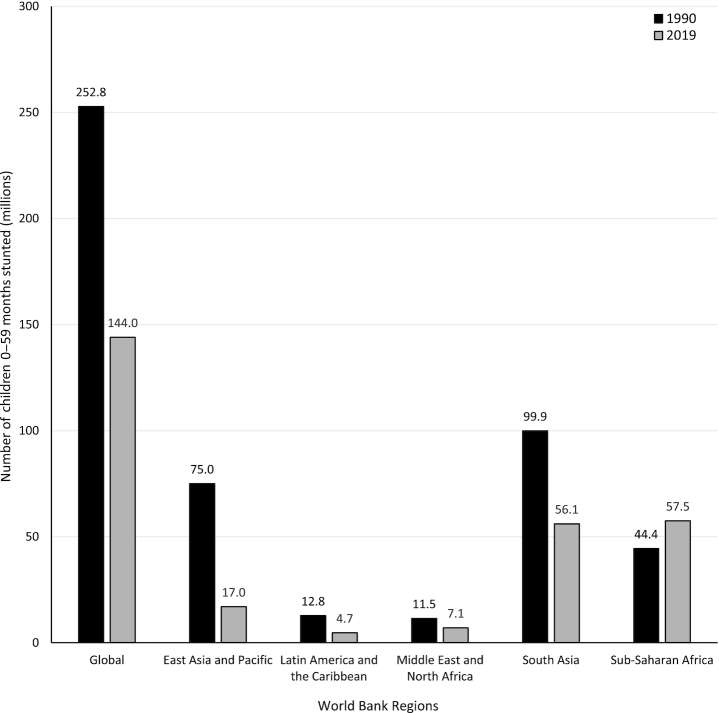
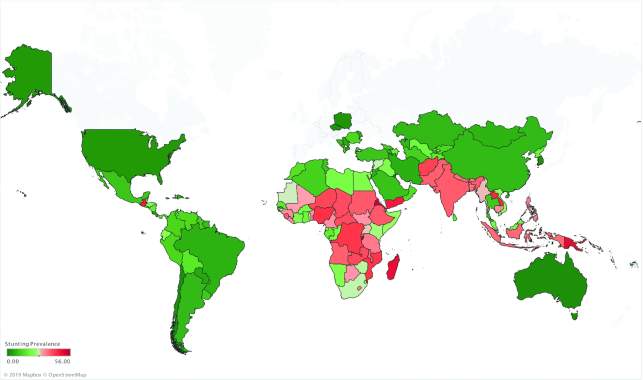
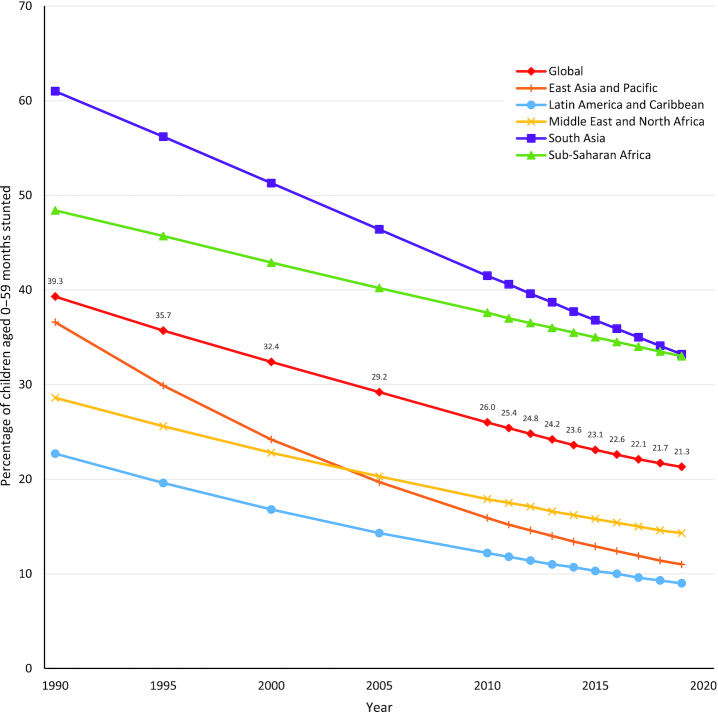
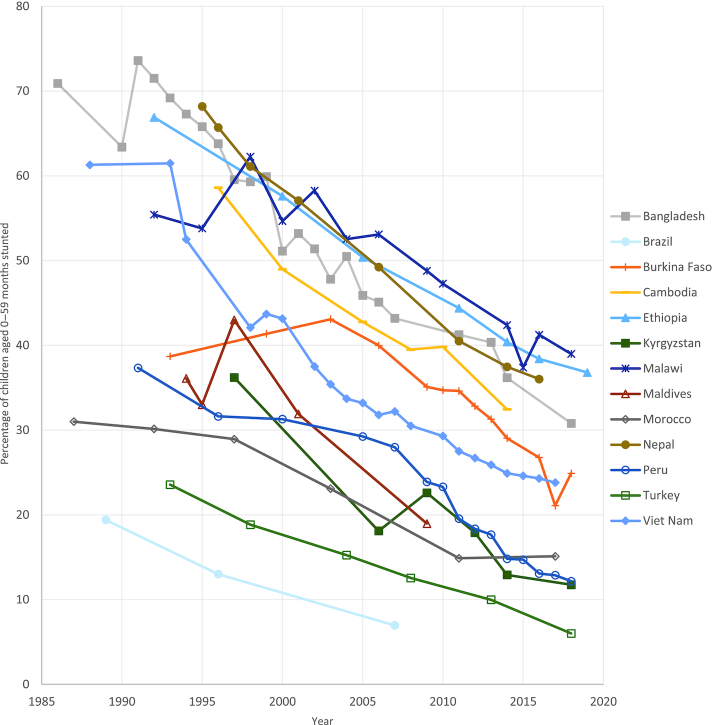
BACKGROUND: Progress has been made worldwide in reducing chronic undernutrition and rates of linear growth stunting in children under 5 y of age, although rates still remain high in many regions. Policies, programs, and interventions supporting maternal and child health and nutrition have the potential to improve child growth and development. OBJECTIVE: This article synthesizes the available global evidence on the drivers of national declines in stunting prevalence and compares the relative effect of major drivers of stunting decline between countries. METHODS: We conducted a systematic review of published peer-reviewed and gray literature analyzing the relation between changes in key determinants of child linear growth and contemporaneous changes in linear growth outcomes over time. RESULTS: Among the basic determinants of stunting assessed within regression-decomposition analyses, improvement in asset index score was a consistent and strong driver of improved linear growth outcomes. Increased parental education was also a strong predictor of improved child growth. Of the underlying determinants of stunting, reduced rates of open defecation, improved sanitation infrastructure, and improved access to key maternal health services, including optimal antenatal care and delivery in a health facility or with a skilled birth attendant, all accounted for substantially improved child growth, although the magnitude of variation explained by each differed substantially between countries. At the immediate level, changes in several maternal characteristics predicted modest stunting reductions, including parity, interpregnancy interval, and maternal height. CONCLUSIONS: Unique sets of stunting determinants predicted stunting reduction within countries that have reduced stunting. Several common drivers emerge at the basic, underlying, and immediate levels, including improvements in maternal and paternal education, household socioeconomic status, sanitation conditions, maternal health services access, and family planning. Further data collection and in-depth mixed-methods research are required to strengthen recommendations for those countries where the stunting burden remains unacceptably high.
Overview
The claims and statistics of this paper haven’t been checked yet.
Free: it reads the open-access text and checks the first 5 claims that cite a source we can check. Create a free account to check every claim.
Integrity signals
Registry
Cites
Statistics
Figures
Verification
Claims the paper makes
The claims and statistics of this paper haven’t been checked yet.
Free: it reads the open-access text and checks the first 5 claims that cite a source we can check. Create a free account to check every claim.
Claims other papers make about this one
Each is checked against this paper’s own text: does it say what the citing paper says it does?
The cited source says what the claim attributes to it.
In the citing paper
“The substantial progress in reducing the tuberculosis burden in children might reflect recent trends showing marked decreases in child mortality,54 global improvements in child nutrition outcomes,55, 56 increasing tuberculosis case finding and services for children,57, 58, 59 and continued reductions in vertical HIV transmission.60, 61”
Self-check
Percentages, sums and reported differences re-computed from the paper’s own numbers.
The self-check needs the paper’s full text.
Citations
Cites
Maternal and child undernutrition and overweight in low-income and middle-income countries
Black, R. E., Victora, C. G., Walker, S. P., Bhutta, Z. A., Christian, P., de Onis, M., Ezzati, M., Grantham-McGregor, S., Katz, J., Martorell, R., et al. (2013) · The Lancet · doi:10.1016/s0140-6736(13)60937-x · Cited by 8,475
Self-citationMaternal and child undernutrition: global and regional exposures and health consequences
Black, R. E., Allen, L. H., Bhutta, Z. A., Caulfield, L. E., de Onis, M., Ezzati, M., Mathers, C., & Rivera, J. (2008) · The Lancet · doi:10.1016/s0140-6736(07)61690-0 · Cited by 6,443 · cited 1×
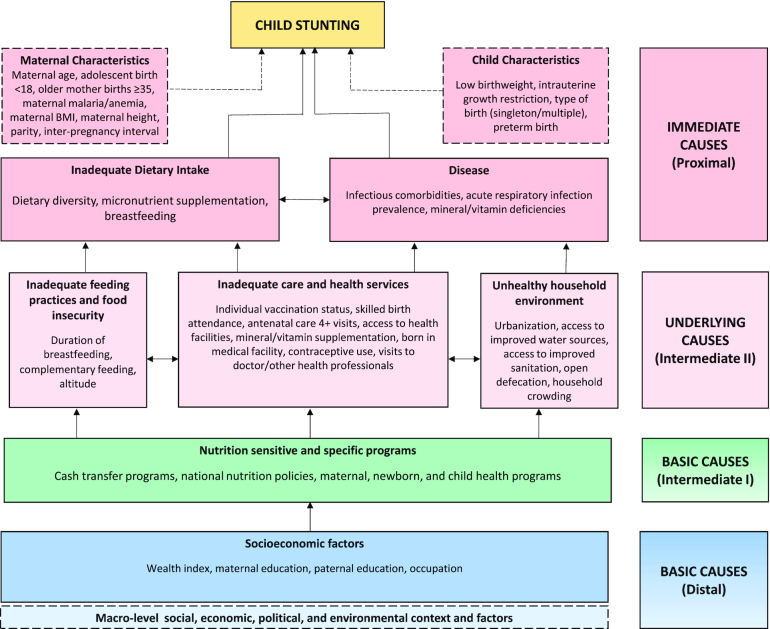
“Adapted versions of the UNICEF framework were highlighted in the Lancet Series on Maternal and Child Nutrition in 2008 (10), and expanded in 2013 (1) to incorporate the theorized effects of both nutrition-sensitive and nutrition-specific interventions.”
MethodSelf-citationDisease control priorities in developing countries
(2006) · Choice Reviews Online · doi:10.5860/choice.44-0343 · Cited by 3,628
Arimond, M., & Ruel, M. T. (2004) · The Journal of Nutrition · doi:10.1093/jn/134.10.2579 · Cited by 1,170 · cited 1×
“Inadequate dietary diversity is associated with increased odds of childhood stunting (123).”
BackgroundAn extension of the Blinder-Oaxaca decomposition technique to logit and probit models
Fairlie, R. W. (2005) · Journal of Economic and Social Measurement · doi:10.3233/jem-2005-0259 · Cited by 1,077 · cited 1×
“Some studies used extensions of Oaxaca-Blinder methods to incorporate dummy and nominal variables into the decomposition analysis (103, 104) or account for logit and probit models (105).”
MethodWagstaff, A., van Doorslaer, E., & Watanabe, N. (2003) · Journal of Econometrics · doi:10.1016/s0304-4076(02)00161-6 · Cited by 1,057
Child undernutrition, tropical enteropathy, toilets, and handwashing
Humphrey, J. H. (2009) · The Lancet · doi:10.1016/s0140-6736(09)60950-8 · Cited by 862
Role of Chlorogenic Acids in Controlling Oxidative and Inflammatory Stress Conditions
Liang, N., & Kitts, D. (2015) · Nutrients · doi:10.3390/nu8010016 · Cited by 805
Contextualising complementary feeding in a broader framework for stunting prevention
Stewart, C. P., Iannotti, L., Dewey, K. G., Michaelsen, K. F., & Onyango, A. W. (2013) · Maternal & Child Nutrition · doi:10.1111/mcn.12088 · Cited by 710
Rutstein, S. O. (2005) · International Journal of Gynecology & Obstetrics · doi:10.1016/j.ijgo.2004.11.012 · Cited by 665
Research works printed but not linked: 3
- Headey D, Hoddinott J, Park S Accounting for nutritional changes in six success stories: a regression-decomposition approach. Global Food Security. 2017; 13: 12– 20. · DOI
- Huicho L, Huayanay-Espinoza CA, Herrera-Perez E, Segura ER, de Guzman JN, Rivera-Ch M, Barros AJ Factors behind the success story of under-five stunting in Peru: a district ecological multilevel analysis. BMC Pediatr. 2017; 17(1): 29. 28103825 PMC5248498 · DOI
- Ponce N, Shimkhada R, Raub A, Daoud A, Nandi A, Richter L, Heymann J The association of minimum wage change on child nutritional status in LMICs: a quasi-experimental multi-country study. Global Public Health. 2018; 13(9): 1307– 21. 28766376 · DOI
Cited by
Items 301–380 of 380
Family Empowerment in Efforts to Reduce Stunting in Bone Regency, South Sulawesi
Jeddawi, M., Nain, U., & Ibrahim, S. (2024) · Journal La Sociale · doi:10.37899/journal-la-sociale.v5i6.1431
“…2020; Poverty and limited access to health resources worsen children's nutritional conditions, while low parental education often correlates with inadequate nutritional knowledge (Dessie et al., 2022; Hailu et al., 2020; Nurbaiti et al., 2022; Uwiringiyimana et al., 2022; Vaivada et al., 2020).”
BackgroundANALYSIS OF STUNTING INCIDENTS OGAN KOMERING ULU REGENCY IN 2024
Elentius, N., Suryani, L., & Priyatno, A. D. (2024) · Cendekia Medika Jurnal Stikes Al-Ma`arif Baturaja · doi:10.52235/cendekiamedika.v9i2.386
17. Epidemiologia da Malnutrição Infantil
Gigante, D. P., & de França, G. V. A. (2024) · Editora FIOCRUZ eBooks · doi:10.7476/9786557081891.0020
IoT-based Growth Monitoring System for Stunting Detection in Children aged 2–5 Years
Rahmawati, D., Susanti, H., Mukhtar, H., Budiman, F., Priharti, W., Sadika, F., Cahyadi, W. A., & Yani, D. I. (2024) · International Conference on Electrical, Computer and Energy Technologies (ICECET) · doi:10.1109/icecet61485.2024.10698056
“The causes of stunting are attributed to several factors, such as nutrition, household poverty, culture, and the environment[7, 8].”
BackgroundInovasi desain alat ukur bayi untuk mendeteksi stunting
Mawarni, G. C. P., & Muttaqien, T. Z. (2024) · Jurnal Desain · doi:10.30998/jd.v11i3.13370
“Kondisi stunting sangat memprihatinkan karena anak dengan stunting lebih rentan terhadap morbiditas, kematian, dan perkembangan kognitif serta motorik yang tidak optimal (Black et al. dalam Vaivada et al. 2020).”
BackgroundVijayaraghavan, A. P., & Chattaraj, D. (2024) · Springer eBooks · doi:10.1007/978-981-97-9302-0_1
Asrina, A., Soviyati, E., & Nurmalia, E. (2024) · Jurnal Pemberdayaan dan Pendidikan Kesehatan (JPPK) · doi:10.34305/jppk.v4i01.1337
Combat stunting in Indonesia: Quo vadis?
Choironi, E. A. (2024) · Jurnal kedokteran dan kesehatan Indonesia · doi:10.20885/jkki.vol15.iss3.art1
Wismaya, H. S., Sugianto, W., & Hanifah, R. D. (2024) · Jurnal Pendidikan Fisika dan Teknologi · doi:10.29303/jpft.v10i2.8228
“Nutritional status monitoring in Indonesia predominantly relies on traditional anthropometric methods such as weight-for-height or height-for-age measurements (Hermawan, Kurniasari, Sandayanti, Sari, & Listyaningsih, 2023; Khalil, Dali, Mohktar, & Ibrahim, 2014; Vaivada et al., 2020).”
Riskiah, D. M., SEKRIPTINI, A. Y., Judijanto, L., IPOSS Jakarta, I., Khariri, K., Sutriyawan, A., & Elvina, A. (2025) · Journal of Public Health and Development · doi:10.55131/jphd/2025/230115
The Relationship of Pregnancy Distance and Mother's Knowledge on The Incident of Stunting in Toddler
Andriani, R., Rosita, E., Bancin, R., Wiguna, R. N., & Marhamah, E. (2023) · Griya Widya Journal of Sexual and Reproductive Health · doi:10.53088/griyawidya.v3i1.1085
“Toddlers with stunting are a physical sign of malnutrition that is clearly visible and measurable (Vaivada et al., 2020).”
Damanik, H. D., Flora, R., Zulkifli, H., & Zulkarnain, M. (2025) · Jurnal PROMKES · doi:10.20473/jpk.v13.isi1.2025.147-154
“Improvements in maternal and paternal education, household socioeconomic status, sanitation conditions, access to maternal health services, and family planning are among the factors that have been found to have a particularly significant impact (Vaivada et al., 2020).”
Nasrul, N., Hafid, F., Faisal, T. I., Taufiqurrahman, T., & Ramadhan, K. (2024) · Nutrición clínica y dietética hospitalaria/Nutrición clínica, dietética hospitalaria · doi:10.12873/443nasrul · Cited by 5
Liman, P. B., Setiati, D., Yuliana, Y., Faradilla, M. A., Anastasya, K., & Yenny, Y. (2024) · International Journal of Community Service Learning · doi:10.23887/ijcsl.v8i4.79886
“It is known that training in the use of growth charts is adequate for health cadres and teachers but is still lacking for parents (Casadei & Kiel, 2021; Vaivada et al., 2020).”
Nawaz, N. G., & Azhar, M. (2025) · Social Sciences Spectrum · doi:10.71085/sss.04.02.257
“Household and environmental factors influence these conditions, including access to sanitation, clean water, and hygiene habits (Vaivada et al., 2020; Mehmood & Arshad, 2024).”
Predisposition Factors Related to Stunting Preventing Behaviors
Anita, W., Zalni, R. I., & Aldinda, T. W. (2025) · Jurnal Ners dan Kebidanan (Journal of Ners and Midwifery) · doi:10.26699/jnk.v12i1.art.p026-034
“In addition, increasing parental education indicates that children will grow up better (Vaivada et al., 2020).”
Child height figures show effects of covid, obesity, and inequality
Moscrop, A., Dorling, D., Cole, T. J., & Wright, C. M. (2025) · BMJ · doi:10.1136/bmj.r917
The intergenerational transmission of low height growth in sub-Saharan AfricaPreprint
Dembélé, B. (2025) · Research Square · doi:10.21203/rs.3.rs-6563475/v1
Malikhah, S. N. A., Anwar, M. C., & Nuryanto, N. (2024) · Public Health Research Development. · doi:10.36568/phrd.v1i2.28
“Children who have a TB/U Z-score of less than -3 SD are categorised as severely stunted [2], [3] .”
Assessment of Stunting and Its Effect on Wasting in Children Under Two in Rural Madagascar
Rotella, R., Morales‐Suárez‐Varela, M., González, A. L., & Soriano, J. M. (2025) · Children · doi:10.3390/children12060686 · Cited by 2
“Wasting and stunting are both associated with increased mortality, particularly when present in the same child [10,58,59].”
Children’s rights to the city: growth and decline in Aotearoa-New Zealand
Freeman, C., Turner, S., Woolley, H., & Buttery, Y. (2025) · Children s Geographies · doi:10.1080/14733285.2025.2460993
“Moreover, their numbers are declining (Vaivada et al. 2020).”
Armaini, Syukur, S., Zein, R., Rilda, Y., Septiani, U., & Wendari, T. P. (2025) · Warta Pengabdian Andalas · doi:10.25077/jwa.32.2.147-158.2025
Fardiani, N. A., Margawati, A., & Syauqy, A. (2025) · Journal of Nutrition College · doi:10.14710/jnc.v14i3.49446
Sari, P. I., Dimiati, H., Sofia, S., & Subianto, M. (2025) · International Journal of ADVANCED AND APPLIED SCIENCES · doi:10.21833/ijaas.2025.08.025
Family support and quality of life among stunted preschool-aged children: A cross-sectional study
Handayani, F., Anwar, S., & Sutini, T. (2025) · The Journal of Palembang Nursing Studies · doi:10.55048/jpns106
Spatial-Temporal Study of Stunting Risk in East Java 2021 - 2023
Sofiyulloh, S., Rahmaniati, M., & Nugraha, F. (2025) · Medical Technology and Public Health Journal · doi:10.33086/mtphj.v9i2.6921
Chinese Aid for Transportation Infrastructure and Child Health in Africa
Li, J. (2025) · Health Economics · doi:10.1002/hec.70035 · Cited by 1
Erkudov, V. O., & Май, Д. Т. (2025) · Russian Biomedical Research · doi:10.56871/rbr.2025.80.56.005 · Cited by 3
Hopkins, K., McCarthy, E. D., Babiker, M., Lane, C., Whelan, R., & McGrath, J. (2025) · Irish Journal of Psychological Medicine · doi:10.1017/ipm.2025.10097
“Additional clinical factors reported to influence weight and height were not considered such as ADHD severity (Inglis et al. 2016), depressive illness (Biederman et al. 2010), socioeconomic status and parental height (Vaivada et al. 2020).”
Win, H., Wallenborn, J. T., Probst-Hensch, N., & Fink, G. (2021) · Figshare · doi:10.6084/m9.figshare.17104107
Tello, B., Rivadeneira, M. F., Moncayo, A. L., Buitrón, J., Astudillo, F., Estrella, A., & Torres, A. L. (2022) · Figshare · doi:10.6084/m9.figshare.19313473
Mehta, K., Mukherjee, S. G., Bhattacharjee, I., Fate, K., Kachwaha, S., Rajeev, T., Kant, A., Banerjee, M., & Shet, A. (2024) · Figshare · doi:10.6084/m9.figshare.26777617
Rivadeneira, M. F., Moncayo, A. L., Cóndor, J. D., Tello, B., Buitrón, J., Astudillo, F., Caicedo-Gallardo, J. D., Estrella-Proaño, A., Naranjo-Estrella, A., & Torres, A. L. (2022) · Figshare · doi:10.6084/m9.figshare.21430887
Mehta, K., Mukherjee, S. G., Bhattacharjee, I., Fate, K., Kachwaha, S., Rajeev, T., Kant, A., Banerjee, M., & Shet, A. (2024) · Figshare · doi:10.6084/m9.figshare.26777620
Aronsson, A. E., Vidaurre-Teixidó, P., Jensen, M. R., Solhaug, S., & McNamara, C. (2023) · Figshare · doi:10.6084/m9.figshare.23983368
Win, H., Shafique, S., Mizan, S., Wallenborn, J. T., Probst-Hensch, N., & Fink, G. (2022) · Figshare · doi:10.6084/m9.figshare.20508362
Aronsson, A. E., Vidaurre-Teixidó, P., Jensen, M. R., Solhaug, S., & McNamara, C. L. (2023) · Figshare · doi:10.6084/m9.figshare.23983365
Assessment of indicators of children education in Serbia with implication to the health literacy
Maričić, M., Trbović, V., Jugovic, K. P., Jezdimirović, D., Antić, G., Pažun, V., Ilić, S., Jelić, M., & Stojanović, G. (2025) · Medicinski casopis · doi:10.5937/mckg59-60139
Integrating an Expert System with Chatbot Using Certainty Factors and BERT for Stunting Prevention
Liliana, D. Y., Nalawati, R. E., Iswara, R. W., Abizard, M., Yulianingsih, S., & Dwiyanto, B. A. S. (2025) · International Conference on Informatics and Computing (ICIC) · doi:10.1109/icic68054.2025.11309410
“Stunting conditions reflect growth failure due to inadequate nutritional intake; hence, the first 1000 days of life of toddlers are the most critical phase in supporting their growth, since growth disorders that occur in this phase are difficult to correct after the age of two years [6].”
Ramadhani, F., Idrus, S. I. A., Septiana, D., Arnita, Wahyuningrum, D. R., & Salamah (2025) · International Conference on Computing and Applied Informatics (ICCAI) · doi:10.1109/iccai65301.2025.11278946
“Stunting is a major public health issue, especially in Indonesia, where North Sumatra still shows high rates despite various interventions [1], [2].”
HUBUNGAN ASUPAN YODIUM DENGAN KEJADIAN STUNTING PADA BALITA: LITERATURE REVIEW
Setianingsih, I., Noer, E. R., & Margawati, A. (2025) · Journal of Nutrition College · doi:10.14710/jnc.v15i1.50880
Decomposing Changes in Child Health Inequality in Sub-Saharan Africa
Pérez-Mesa, D., Marrero, G. A., & Curvo, S. D. (2025) · The Journal of Development Studies · doi:10.1080/00220388.2025.2543248 · Cited by 1
“…in the literature regarding child height as a key indicator of child health, most studies examining child health and its inequality rely on a binary classification distinguishing between stunted and non-stunted children (e.g. Van de Poel et al., 2008; Bredenkamp et al., 2014; Vaivada et al., 2020).”
Khan, G. N., Ahmed, I., Haris, E. M., Ariff, S., Khan, A., Hussain, I., Umer, M., Sajid, M., Hussainyar, M. A., Khan, M. A., et al. (2026) · BMJ Paediatrics Open · doi:10.1136/bmjpo-2025-003790
Simatupang, M. Y., Gultom, S., & Rahman, A. (2026) · Journal of Education and Health Promotion · doi:10.4103/jehp.jehp_702_25
“[35] The positive outcomes observed in this study support its potential for broader application and policy integration, particularly in areas with high stunting burdens and limited training infrastructure.”
Meriç, Ç. S., Şahin, K., & Yılmaz, H. Ö. (2026) · BMC Pediatrics · doi:10.1186/s12887-026-06676-y
“The fact that behavior was only found to be associated with HAZ in our study is also consistent with the literature; because HAZ is a biological indicator sensitive to long-term nutritional practices and is less affected by short-term weight fluctuations [34].”
Masmuri, Hidayah, N., Limansyah, D., & Sarkarsi, R. (2026) · INTERNATIONAL JOURNAL OF CARE SCHOLARS · doi:10.31436/ijcs.v9i1.502
“This is evident from various initiatives focusing on comprehensive nutritional improvement (1).”
Sinharoy, S., Reese, H., Clasen, T., & Sinharoy, S. S. (2026) · PLoS ONE · doi:10.1371/journal.pone.0343796 · Cited by 5
Chiu, S., Yang, C., Lu, L. C., Feng, X., & Chiu, Y. (2026) · Review of Development Economics · doi:10.1111/rode.70143
Pereyra, I., Gómez, A., Ferreira, A., & Fletcher, A. M. (2026) · Nutrición Hospitalaria · doi:10.20960/nh.06364
Kornher, L., Abdulai, A., & Usman, M. A. (2026) · Applied Economics · doi:10.1080/00036846.2026.2652067
On the Population Reach of Contraception: An Analysis of Child Health in Sub-Saharan Africa
Lin, Y., Smith‐Greenaway, E., & Ferguson, L. (2026) · Population Research and Policy Review · doi:10.1007/s11113-026-10010-w · Cited by 1
“…most childhood morbidity in sub-Saharan Africa stems from infectious disease (Aboagye et al., 2022 ; Heikens & Manary, 2009 ; Safiri et al., 2021; Vaivada et al., 2020 ), women’s contraceptive use has the potential to benefit all children’s health via reducing the local disease burden…”
Takyi, E., Momberg, D. J., Mohamed, R. S., Bernard, J., Norris, S. A., Richter, L., May, J., Murphy‐Alford, A. J., Rakgoale, L., Sahibdeen, V., et al. (2026) · bioRxiv (Cold Spring Harbor Laboratory) · doi:10.64898/2026.05.11.723332
“Reducing the prevalence of childhood stunting remains a major global health priority (Vaivada et al., 2020).”
Schistosomiasis and childhood stunting
Colt, S., Friedman, J. F., & Bustinduy, A. L. (2026) · Philosophical Transactions of the Royal Society B Biological Sciences · doi:10.1098/rstb.2025.0044 · Cited by 1
Saliaputri, L., Ginanjar, I., & Handoko, B. (2026) · Risk Management and Healthcare Policy · doi:10.2147/rmhp.s594491
“9,10 Consequently, stunting reduction is a central tenet of the Sustainable Development Goals (SDGs), specifically Target 2.2, which aims to end all forms of malnutrition by 2030.”
InfluentialLubis, A., Engelen, A., Anggraini, C. N., Kurniawati, R., & Rahman, I. (2026) · Nutrire · doi:10.1186/s41110-026-00485-0 · Cited by 6
Environmental Toxicant Exposure and Height Among Children and Adolescents
Lu, J., Guo, J. Z., Li, Y. Y., Shi, D., Wang, Y., Lian, X., Li, S., Chen, X., Huang, S., Guo, J. Z., et al. (2026) · Toxics · doi:10.3390/toxics14060481
“The linear growth during childhood and adolescence reflects the overall health status and future development prospects of the individual [1].”
Azwar, A., Zamzami, L., Eddie, R. J., & Dhad, F. F. (2026) · Ecology of Food and Nutrition · doi:10.1080/03670244.2026.2683370
“Third, it identifies the socio-cultural mechanisms through which policy messages are selectively adapted, only partially internalized, or unevenly implemented in daily family life (Azwar, Saputra, and Mulia 2026; Cameron et al. 2021; Vaivada et al. 2020).”
Bhadra, D. (2026) · Journal of Health Population and Nutrition · doi:10.1186/s41043-026-01341-7
“…variation across the full growth distribution, this study focuses on binary stunting because it is the primary indicator used for population-level monitoring and policy evaluation of chronic undernutrition including child health research and international nutrition surveillance efforts [45, 46].”
Jaya, I. G. N. M., Tantular, B., Pangastuti, S. S., Amelia, K., Mulyadi, C., & Kristiani, F. (2026) · Sustainability · doi:10.3390/su18125959
Uddin, M. S., & Masud, M. R. (2026) · PLOS Global Public Health · doi:10.1371/journal.pgph.0005233
Black, M. M., & Lutter, C. K. (2026) · Journal of Nutrition · doi:10.1016/j.tjnut.2026.101677 · Cited by 1
“To address deficiencies in nutrition and child development, effective interventions implemented globally have reduced stunting [6] and anemia [7] and improved children ’ s cognitive, motor, and socioemotional development [8 – 10].”
Copana-Olmos, R., Suarez-Barrientos, E. L., Casson, N., Armaza-Cespedes, A., Bustos, J. M. M., Mesias, P. M., Campos-Miño, S., Peralta-Flores, S., & Canedo, P. A. S. (2026) · Discover Public Health · doi:10.1186/s12982-026-02388-x
Devereux, S., & Ikebuaku, K. (2026) · Ecology of Food and Nutrition · doi:10.1080/03670244.2026.2693925
“Stunted growth (low height-for-age) among children under 5-years old is a robust, measurable indicator of chronic hunger (Vaivada et al. 2020).”
Saefurrohim, M. Z., Wisnuwardani, R. W., Sumarni, Arfandi, M. A., & Utomo, D. N. D. (2026) · Jurnal Keluarga Berencana · doi:10.37306/kkb.v11i1.429
Titaley, C. R., Malakauseya, M. L. V., Tjandrarini, D. H., & Ariawan, I. (2026) · BMJ Nutrition Prevention & Health · doi:10.1136/bmjnph-2025-001468
Devi, S., Xu, L., Ball, R. O., Pencharz, P. B., Kurpad, A. V., & Elango, R. (2026) · Journal of Nutrition · doi:10.1016/j.tjnut.2026.101744
Ndimbo, G. K., & Mpambije, C. J. (2026) · Discover Public Health · doi:10.1186/s12982-026-02608-4
Azim, L. O. L., Asfian, P., Kalza, L. A., Saktiansyah, L. O. A., Hartoyo, A. M., & Kamrin, K. (2026) · Tintamas. · doi:10.53088/tintamas.v3i2.3108
Intersectional analysis of early childhood stunting in households in Nigeria
Oginni, A. B. (2026) · PLoS ONE · doi:10.1371/journal.pone.0355408
“Other common drivers include paternal education, sanitation conditions, maternal health services access, and family planning [20].”
Maternal parenting style and risk of stunting in children under five: Evidence from rural Indonesia
Hartatik, & Yuswatiningsih, E. (2025) · Nurse Professional Education Journal · doi:10.67958/nurseedu.v1i1.9
“The figures are still high in many regions; policies, programs, and interventions supporting maternal and child health and nutrition can potentially improve child growth and development (Vaivada et al., 2020).”
Asmorowati, S., Schubert, V., Mangai, M. S., Irianto, J., Yuniningsih, T., Anggika, S. I. K., & Windhiari, W. D. (2026) · Public Administration Review · doi:10.1111/puar.70175
Susanto, T., Rasni, H., & Wuryaningsih, E. W. (2026) · Journal of Pediatric Health Care · doi:10.1016/j.pedhc.2026.07.010
Lowe, C., Arjuna, T., Hasanbasri, M., Sarma, H., Sutarsa, I. N., Navarro, S., Gray, D. J., & Kelly, M. (2026) · International Journal of Environmental Research and Public Health · doi:10.3390/ijerph23091210
Kagoyire, C., Nduwayezu, G., Oucheikh, R., Bizimana, J. P., Pilesjö, P., & Mansourian, A. (2026) · Geospatial health · doi:10.4081/gh.2026.1491
Wahyuningsih, E., Kholifah, S., Chawa, A. F., & Utaminingsih, A. (2026) · Women s Studies · doi:10.1080/00497878.2026.2726920
Silfia, A., Rosmawati, R., Riyadi, S., Asio, A., Febrianti, S., Sari, B., & Mahsalisa, F. (2026) · Majalah Cendekia Mengabdi · doi:10.63004/mcm.v4i3.1923
Dimbuene, Z. T., & Sampasa‐Kanyinga, H. (2026) · PLoS ONE · doi:10.1371/journal.pone.0360056
Use of Relative and Absolute Measures to Evaluate Catch-Up Growth Among Indonesian Children
Lowe, C., Sarma, H., Arjuna, T., Sutarsa, I. N., Gray, D. J., & Kelly, M. (2026) · Food and Nutrition Bulletin · doi:10.1177/03795721261478159
Masitoh, S., Kurniawati, D., Paramashanti, B. A., Purwatiningsih, Y., Suparmi, S., & Utami, N. H. (2026) · Journal of Research in Health Sciences · doi:10.34172/jrhs.13920
“11,12 Compared with socioeconomic and environmental factors, which frequently require broader structural changes and long-term investment 13 , birth spacing can be influenced through established reproductive health policy interventions and programs.”
Maidelwita, Y., Rahmayanti, R., Suciana, S., Sarfika, R., & Sansuwito, T. B. (2026) · Child Health Nursing Research · doi:10.4094/chnr.2026.022
Metadata
- Authors
- Vaivada, T., Akseer, N., Akseer, S., Somaskandan, A., Stefopulos, M., & Bhutta, Z. A.
- Affiliations
- Hospital for Sick Children (CA)
- University of Toronto (CA)
- Aga Khan University (PK)
- Corresponding author
- Bhutta, Zulfiqar A
- Venue
- The American Journal of Clinical Nutrition
- Publisher
- Elsevier BV
- Published
- 2020-09
- Volume
- 112
- Issue
- Suppl 2
- Pages
- 777S-791S
- ISSN
- 0002-9165 (ISSN-L)
- PMC
- PMC7487433
- OpenAlex
- W3082627770
- Cited by
- 381
- References
- 129
- Citations by year
- 2026: 58 · 2025: 57 · 2024: 93 · 2023: 75 · 2022: 76 · 2021: 17 · 2020: 5
- FWCI
- 5.31
- Type
- journal article
- Language
- en
- Open access
- hybrid
- doi.org
- Licence
- cc-by
- www.elsevier.com/tdm/userlicense/1.0/ (tdm)
- creativecommons.org/licenses/by/4.0/ (vor)
- Locations
- American Journal of Clinical Nutrition (publishedVersion, cc-by)
- PubMed Central (publishedVersion, cc-by)
- PubMed (publishedVersion)
- eCommons - AKU (Aga Khan University) (submittedVersion, cc-by)
- Topics
- Health Sciences › Nursing › Nutrition and Dietetics › Child Nutrition and Water Access
- Health Sciences › Medicine › Pediatrics, Perinatology and Child Health › Public Health and Nutrition
- Health Sciences › Medicine › Pediatrics, Perinatology and Child Health › Global Maternal and Child Health
- Keywords
- child stunting, linear growth, malnutrition, household asset index, parental education, sanitation, open defecation, obstetric care, prenatal care, skilled birth attendance, family planning, parity, interpregnancy interval, maternal height, socioeconomic status
- MeSH terms
- Child Health, Adolescent, Child, Child Development, Child, Preschool, Female, Growth Disorders, Humans, Male, Nutritional Status
About these checks
Registry, retraction, Cites and statistics results are computed, not judged, with one exception: a printed reference that no index lists is read once by a model before it counts as a citation error. Claims are extracted by a model and kept only when their quote appears verbatim in the text; each cited source is then checked, with a model’s help, for whether it says what the claim relies on. Those verdicts can be wrong — read the claim’s quote and the cited source before relying on one.
Statistics and arithmetic are recomputed, not judged.
Confidence bands are shown only for fields calibrated on our annotated test set. None is calibrated yet, so no band is shown.
What counts as a claim ›How we measure confidence ›How we check this ›
Are you an author, or do you see a problem with this page? Request a review
Data sources
Bibliographic data: Semantic Scholar, OpenAlex, Crossref.
Contains information from the Semantic Scholar Academic Graph Datasets, made available under the ODC Attribution License (ODC-BY 1.0).
Semantic Scholar’s data is described in: Kinney, R., et al. (2023). The Semantic Scholar Open Data Platform. arXiv:2301.10140.
