

Negative association of antibiotics on clinical activity of immune checkpoint inhibitors in patients with advanced renal cell and non-small-cell lung cancer
Open accessThe DOI matches its Crossref record; 36 of the 39 references it cites were found in a registry or an index; 3 of the 18 sources its claims cite were checked for support.
Abstract
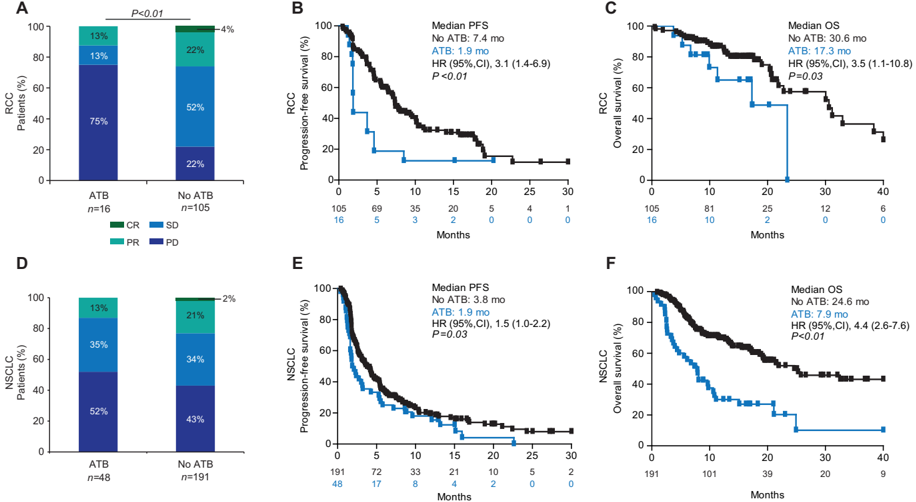
Background: The composition of gut microbiota affects antitumor immune responses, preclinical and clinical outcome following immune checkpoint inhibitors (ICI) in cancer. Antibiotics (ATB) alter gut microbiota diversity and composition leading to dysbiosis, which may affect effectiveness of ICI. Patients and methods: We examined patients with advanced renal cell carcinoma (RCC) and non-small-cell lung cancer (NSCLC) treated with anti-programmed cell death ligand-1 mAb monotherapy or combination at two academic institutions. Those receiving ATB within 30 days of beginning ICI were compared with those who did not. Objective response, progression-free survival (PFS) determined by RECIST1.1 and overall survival (OS) were assessed. Results: Sixteen of 121 (13%) RCC patients and 48 of 239 (20%) NSCLC patients received ATB. The most common ATB were β-lactam or quinolones for pneumonia or urinary tract infections. In RCC patients, ATB compared with no ATB was associated with increased risk of primary progressive disease (PD) (75% versus 22%, P < 0.01), shorter PFS [median 1.9 versus 7.4 months, hazard ratio (HR) 3.1, 95% confidence interval (CI) 1.4-6.9, P < 0.01], and shorter OS (median 17.3 versus 30.6 months, HR 3.5, 95% CI 1.1-10.8, P = 0.03). In NSCLC patients, ATB was associated with similar rates of primary PD (52% versus 43%, P = 0.26) but decreased PFS (median 1.9 versus 3.8 months, HR 1.5, 95% CI 1.0-2.2, P = 0.03) and OS (median 7.9 versus 24.6 months, HR 4.4, 95% CI 2.6-7.7, P < 0.01). In multivariate analyses, the impact of ATB remained significant for PFS in RCC and for OS in NSCLC. Conclusion: ATB were associated with reduced clinical benefit from ICI in RCC and NSCLC. Modulatation of ATB-related dysbiosis and gut microbiota composition may be a strategy to improve clinical outcomes with ICI.
Overview
CoChat Summary
TL;DR
In two independent cohorts of advanced RCC and NSCLC treated with immune checkpoint inhibitors, antibiotic use within 30 days before starting therapy was associated with worse clinical outcomes. The association remained significant for PFS in RCC and for OS in NSCLC in multivariate analyses.
Key findings
- Among 121 RCC patients, 16 (13%) received antibiotics within 30 days of starting ICI. Antibiotic use was associated with more primary progressive disease (75% versus 22%, P < 0.01), shorter median PFS (1.9 versus 7.4 months; HR 3.1, 95% CI 1.4–6.9, P < 0.01), and shorter median OS (17.3 versus 30.6 months; HR 3.5, 95% CI 1.1–10.8, P = 0.03).
- Among 239 NSCLC patients, 48 (20%) received antibiotics within 30 days. Antibiotic use was not associated with primary PD (52% versus 43%, P = 0.26) but was associated with shorter median PFS (1.9 versus 3.8 months; HR 1.5, 95% CI 1.0–2.2, P = 0.03) and shorter median OS (7.9 versus 24.6 months; HR 4.4, 95% CI 2.6–7.7, P < 0.01).
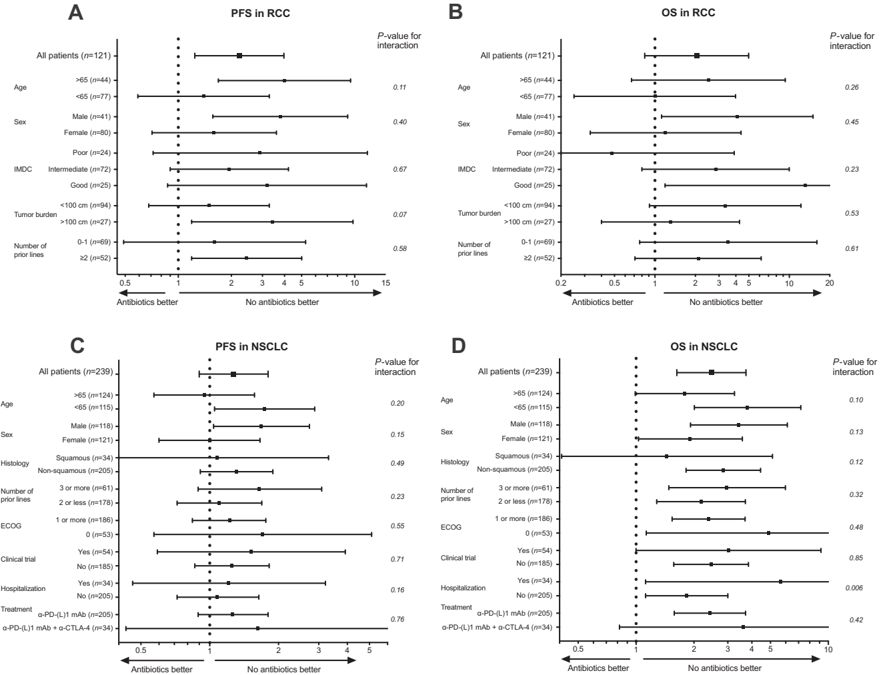
- In multivariate analysis, antibiotics remained associated with worse PFS in RCC (HR 2.0, P < 0.01) but not OS (HR 2.1, P = 0.11); in NSCLC, antibiotics were not significantly associated with PFS (HR 1.3, 95% CI 0.9–1.8, P = 0.17) but remained associated with worse OS (HR 2.5, 95% CI 1.6–3.7, P < 0.01).
- With a 60-day antibiotic window, RCC showed shorter PFS (median 3.1 versus 7.4 months; HR 2.3, 95% CI 1.2–4.4, P < 0.01) and a trend toward worse OS (median 23.4 versus 30 months; HR 1.9, 95% CI 0.8–4.7, P = 0.15); NSCLC showed no difference in objective response or PFS but shorter OS (median 9.8 versus 21.9 months; HR 2.0, 95% CI 1.3–3.2, P < 0.01).
Methods
- Retrospective review of patients with advanced RCC (n = 121) at Gustave Roussy and NSCLC (n = 239) at Memorial Sloan Kettering Cancer Center treated with anti-PD-(L)1 monoclonal antibody monotherapy or combination therapy.
- Antibiotic use was assessed within 30 days or up to 60 days before the first ICI injection; antibiotic class, indication, route, and duration were collected.
- Tumor response was determined by RECIST 1.1; PFS and OS were estimated by Kaplan–Meier and compared with log-rank tests, with multivariable Cox regression adjusting for clinicopathologic features.
Limitations
- The authors state the study is retrospective, with data entry from two institutions; although responses were reviewed with RECIST 1.1, scan timing was not prespecified.
- The authors note differences in patient characteristics between antibiotic and no-antibiotic groups, including higher recent hospitalization in NSCLC and differences in prior lines in RCC, and that analyses did not account for diet, country of origin, or other medications.
- The authors state they did not characterize the mechanism by which antibiotics affect outcomes, and PD-L1 status was lacking in most patients; the text also makes evident that antibiotic subgroups were small and immune-related adverse events were too few to evaluate.
Model-written summary. Check it against the paper before relying on it.
Integrity signals
Registry
Cites
Statistics
Figures




Verification
Claims the paper makes
2 Valid · 1 Not valid · 7 Not checked · 33 Own results and interpretations
At least one cited source doesn’t support this claim or points to a different paper, and none confirmed it — see the verdicts below.
In the paper
“16S ribosomal RNA sequencing of gene amplicons of patients' feces revealed that microbiota returns to its baseline within 1-3 months after ATB discontinuation.”
§ Negative association of antibiotics on clinical activity of immune checkpoint inhibitors in patients with advanced renal cell and non-small-cell lung cancer > Discussion
What the sources say
- Not checked yetcites [14] matched to “Effects of antibiotics on gut microbiota” (2016) source
- Disputedcites [20] matched to “Short-term antibiotic treatment has differing long-term impacts on the human throat and gut microbiome” (2010) sourceExperimental — accuracy not yet measured
The Results section ('Transient and persistent effects of antibiotic treatment'; page unavailable) says fecal microbial communities had only partially recovered at one and four years and remained distinct from their pretreatment compositions. The paper does not report a return to baseline within 1–3 months. (LLM, conf=0.87)
Checked by a reasoning model — may be wrong.
plainstates a cause- Asserted: passes — The authors put it forward as true.
- Checkable: passes — It can be checked against evidence.
- Load-bearing: passes — The paper’s conclusions depend on it.
- Based: passes — The paper gives a reason why it holds.
The sources with a verdict support this claim; the rest weren’t checked yet, have no full text we could read, or their verdicts aren’t rated yet.
In the paper
“However, some bacteria may take years to fully recover [14,20].”
§ Negative association of antibiotics on clinical activity of immune checkpoint inhibitors in patients with advanced renal cell and non-small-cell lung cancer > Discussion
What the sources say
- Not checked yetcites [14] matched to “Effects of antibiotics on gut microbiota” (2016) source
- Supportedcites [20] matched to “Short-term antibiotic treatment has differing long-term impacts on the human throat and gut microbiome” (2010) source
The Results section 'Transient and persistent effects of antibiotic treatment' states that 'One and four years after treatment, the fecal microbial communities had partially recovered to their pre-treatment compositions, however these were still separated along CA axis 2', i.e. full recovery had not occurred even four years after a one-week course. The 'Individuality in antibiotic response' section adds taxon-level persistence (e.g. the increase of unclassified Enterobacteriaceae in patient D persisted during the 4-year period), and the Abstract/Discussion report erm(B) still elevated four years post treatment. The hedged claim that some bacteria 'may take years to fully recover' is therefore within what this source shows; the only points it credits to others (two-year Bacteroides/erm persistence, a resistant clone persisting three years) are separate citations [8] and [10] and are not what the citing sentence attributes here. (LLM, conf=0.82)
hedgedstates a possible cause- Asserted: passes — The authors put it forward as true.
- Checkable: passes — It can be checked against evidence.
- Load-bearing: unclear — It is unclear whether the paper’s conclusions depend on it.
- Based: passes — The paper gives a reason why it holds.
The sources with a verdict support this claim; the rest weren’t checked yet, have no full text we could read, or their verdicts aren’t rated yet.
In the paper
“In oncology, converging findings demonstrate the negative impact of ATBinduced dysbiosis in mice.”
§ Negative association of antibiotics on clinical activity of immune checkpoint inhibitors in patients with advanced renal cell and non-small-cell lung cancer > Introduction
What the sources say
- Supportedcites [9] matched to “Anticancer immunotherapy by CTLA-4 blockade relies on the gut microbiota” (2015) source
The Results passage opening Fig. 1 states that broad-spectrum antibiotics (ampicillin+colistin+streptomycin, and imipenem alone but not colistin) 'compromised the antitumor effects of CTLA-4-specific Ab', confirmed across the Ret melanoma and MC38 colon cancer models and mirrored by germ-free housing — i.e. converging mouse evidence in oncology that antibiotic-induced microbiota disruption harms checkpoint-blockade efficacy. The Abstract states it outright: 'Tumors in antibiotic-treated or germ-free mice did not respond to CTLA blockade.' The only framing shift is minor: the paper attributes the loss of efficacy to depletion/recomposition of the microbiota (rescued by B. fragilis gavage) rather than using the word 'dysbiosis', and it hedges the mechanism ('suggest that the gut microbiota is required'), but the negative impact of antibiotic treatment itself is asserted as fact. (LLM, conf=0.90)
- Not checked yetcites [10]
boostedstates a cause- Asserted: passes — The authors put it forward as true.
- Checkable: passes — It can be checked against evidence.
- Load-bearing: passes — The paper’s conclusions depend on it.
- Based: passes — The paper gives a reason why it holds.
- Supported
A result the paper reports from its own data — it cites no other source for it, so there is none to check. The quote shows it is in the paper.
In the paper
“and shorter OS (median 17.3 versus 30.6 months, HR 3.5, 95% CI 1.1-10.8,P ¼ 0.03).”
- Also stated in: § Results · plain
“median OS, 17.3 months versus 30.6 months, HR 3.5, 95% CI 1.1-10.8,P ¼ 0.03”
§ Negative association of antibiotics on clinical activity of immune checkpoint inhibitors in patients with advanced renal cell and non-small-cell lung cancer > Abstract
plainstates an association- Asserted: passes — The authors put it forward as true.
- Checkable: passes — It can be checked against evidence.
- Load-bearing: passes — The paper’s conclusions depend on it.
- Based: passes — The paper gives a reason why it holds.
- Also stated in: § Results · plain
A result the paper reports from its own data — it cites no other source for it, so there is none to check. The quote shows it is in the paper.
In the paper
“In RCC, ATB-60 days remained associated with increased risk of primary progression (P < 0.01)”
§ Negative association of antibiotics on clinical activity of immune checkpoint inhibitors in patients with advanced renal cell and non-small-cell lung cancer > Results
plainstates an association- Asserted: passes — The authors put it forward as true.
- Checkable: passes — It can be checked against evidence.
- Load-bearing: passes — The paper’s conclusions depend on it.
- Based: passes — The paper gives a reason why it holds.
20 more claims
Create a free account to see all 43 claims and to verify the 15 references still open.
- It may state two separate claims as one. 11
- Probably not a substantial claim. 11
Claims other papers make about this one
Each is checked against this paper’s own text: does it say what the citing paper says it does?
The source backs part of the claim, not all of it — or backs it for a different population, condition or comparison.
In the citing paper
“Similarly, antibiotics (ATB) prior to ICI initiation drastically reduced the clinical benefit in several cohorts of patients across various cancer types (melanoma, advanced NSCLC, renal cell carcinoma (RCC), and urothelial cancer) 18,[20][21][22] .”
From Intestinal Akkermansia muciniphila predicts clinical response to PD-1 blockade in patients with advanced non-small-cell lung cancer (2022) · cites this paper as [20]
Experimental — accuracy not yet measuredThe source backs part of the claim, not all of it — or backs it for a different population, condition or comparison.
In the citing paper
“However, increasing clinical evidence suggests that systemic antibiotics abolish immune checkpoint blockade efficacy and decrease patient survival (133, 136, 137).”
From The microbiome and human cancer (2021) · cites this paper as [137]
Experimental — accuracy not yet measuredThe source backs part of the claim, not all of it — or backs it for a different population, condition or comparison.
In the citing paper
“However, the clinical value of this observation is limited by its derivation from selected oncological indications, including renal and non-small cell lung cancer (NSCLC), 2 for which external validation, especially outside clinical trials, is necessary.”
From Association of Prior Antibiotic Treatment With Survival and Response to Immune Checkpoint Inhibitor Therapy in Patients With Cancer (2019) · cites this paper as [2]
Experimental — accuracy not yet measuredThe source backs part of the claim, not all of it — or backs it for a different population, condition or comparison.
In the citing paper
“However, our results suggest that administration of these classes of antibiotics constitutes a likely surrogate for poor disease status and a state of increased systemic inflammation prior to initiation of CAR-T cell therapy, as was recently suggested in cancer patients treated with other ICBs28,35.”
From A non-antibiotic-disrupted gut microbiome is associated with clinical responses to CD19-CAR-T cell cancer immunotherapy (2023) · cites this paper as [28]
Experimental — accuracy not yet measuredThe cited source says what the claim attributes to it.
In the citing paper
“Supporting this contention, we and others reported that primary responses to anti-PD-1/ PD-L1 antibodies in patients with epithelial tumours and melanoma could, at least in part, be attributed to the taxonomic composition of the gut microbial ecosystem 18,20,25 .”
From Intestinal Akkermansia muciniphila predicts clinical response to PD-1 blockade in patients with advanced non-small-cell lung cancer (2022) · cites this paper as [20]
14 more claims about this paper
Create a free account to see every claim other papers make about this one.
Self-check
Percentages, sums and reported differences re-computed from the paper’s own numbers.
Each contradiction between two passages listed here was confirmed by an independent check.
Rated major: it would touch a result — a value a result rests on, reported and recomputed p-values on opposite sides of the significance level, two passages that conflict with no sign which is right, or a cited work retracted before this paper was published.
In the paper
§ Negative association of antibiotics on clinical activity of immune checkpoint inhibitors in patients with advanced renal cell and non-small-cell lung cancer > Results
“median PFS, 1.9 months versus 3.8 months, HR 1.5, 95% CI 1.0-2.2,P ¼ 0.03”
§ Negative association of antibiotics on clinical activity of immune checkpoint inhibitors in patients with advanced renal cell and non-small-cell lung cancer > Discussion
“ATB 30-0/No ATB 1.4 (1.0-2.0)0.04 1.3 (0.9-1.8) 0.17”
Rated major: it would touch a result — a value a result rests on, reported and recomputed p-values on opposite sides of the significance level, two passages that conflict with no sign which is right, or a cited work retracted before this paper was published.
In the paper
§ Negative association of antibiotics on clinical activity of immune checkpoint inhibitors in patients with advanced renal cell and non-small-cell lung cancer > Results
“median OS, 7.9 months versus 24.6 months, HR 4.4, 95% CI 2.6-7.7,P < 0.01”
§ Negative association of antibiotics on clinical activity of immune checkpoint inhibitors in patients with advanced renal cell and non-small-cell lung cancer > Discussion
“ATB 30-0/No ATB 2.9 (1.9-4.4)<0.01 2.5 (1.6-3.7)<0.01”
Rated major: it would touch a result — a value a result rests on, reported and recomputed p-values on opposite sides of the significance level, two passages that conflict with no sign which is right, or a cited work retracted before this paper was published.
In the paper
§ Negative association of antibiotics on clinical activity of immune checkpoint inhibitors in patients with advanced renal cell and non-small-cell lung cancer > Results
“median PFS, 1.9 months versus 7.4 months, HR 3.1, 95% CI 1.4-6.9,P < 0.01”
§ Negative association of antibiotics on clinical activity of immune checkpoint inhibitors in patients with advanced renal cell and non-small-cell lung cancer > Discussion
“ATB 30-0/No ATB 2.3 (1.3-4.0)<0.01 2.2 (1.3-3.3)<0.01”
Rated minor: it would not touch a result — a value no result rests on, a p-value that stays on the same side of the significance level, or a conflict that is clerical, resolved elsewhere in the paper, or outside its own findings.
In the paper
§ Negative association of antibiotics on clinical activity of immune checkpoint inhibitors in patients with advanced renal cell and non-small-cell lung cancer > Results
“Range 28-83 29-83 30-82”
§ Negative association of antibiotics on clinical activity of immune checkpoint inhibitors in patients with advanced renal cell and non-small-cell lung cancer > Results
“ATB 30-0 (n 5 16) No ATB (n 5 105)”
Rated minor: it would not touch a result — a value no result rests on, a p-value that stays on the same side of the significance level, or a conflict that is clerical, resolved elsewhere in the paper, or outside its own findings.
In the paper
§ Negative association of antibiotics on clinical activity of immune checkpoint inhibitors in patients with advanced renal cell and non-small-cell lung cancer > Discussion
“Female (n=80) Male (n=41)”
§ Negative association of antibiotics on clinical activity of immune checkpoint inhibitors in patients with advanced renal cell and non-small-cell lung cancer > Results
“Gender, n (%) Male 80 (66) 9 (56) 71 (68) 0.37 Female 41 (34) 7 (44) 34 (32)”
4 more findings
Create a free account to see every finding of this check.
Citations
Cites
New response evaluation criteria in solid tumours: revised RECIST guideline (version 1.1)
Eisenhauer, E. A., Therasse, P., Bogaerts, J., Schwartz, L. H., Sargent, D., Ford, R., Dancey, J., Arbuck, S., Gwyther, S., Mooney, M., et al. (2009) · European Journal of Cancer · doi:10.1016/j.ejca.2008.10.026 · Cited by 29,534
Adverse Renal Effects of Immune Checkpoint Inhibitors: A Narrative Review
Wanchoo, R., Karam, S., Uppal, N. N., Barta, V. S., Deray, G., Devoe, C., Launay-Vacher, V., Jhaveri, K. D., & on behalf of Cancer and Kidney International Network Workgroup on Immune Checkpoint Inhibitors (2017) · American Journal of Nephrology · doi:10.1159/000455014 · Cited by 15,256
Pembrolizumab versus Chemotherapy for PD-L1-Positive Non-Small-Cell Lung Cancer
Reck, M., Rodríguez-Abreu, D., Robinson, A. G., Hui, R., Csőszi, T., Fülöp, A., Gottfried, M., Peled, N., Tafreshi, A., Cuffe, S., et al. (2016) · New England Journal of Medicine · doi:10.1056/nejmoa1606774 · Cited by 10,089
Nivolumab versus docetaxel in advanced nonsquamous non-small-cell lung cancer
Borghaei, H., Paz-Ares, L., Horn, L., Spigel, D. R., Steins, M., Ready, N. E., Chow, L. Q., Vokes, E. E., Felip, E., Holgado, E., et al. (2015) · New England Journal of Medicine · doi:10.1056/nejmoa1507643 · Cited by 9,335
Nivolumab versus Everolimus in Advanced Renal-Cell Carcinoma
Motzer, R. J., Escudier, B., McDermott, D. F., George, S., Hammers, H. J., Srinivas, S., Tykodi, S. S., Sosman, J. A., Procopio, G., Plimack, E. R., et al. (2015) · New England Journal of Medicine · doi:10.1056/nejmoa1510665 · Cited by 5,807
Self-citationGut microbiome influences efficacy of PD-1-based immunotherapy against epithelial tumors
Routy, B., Le Chatelier, E., Derosa, L., Duong, C. P. M., Alou, M. T., Daillère, R., Fluckiger, A., Messaoudene, M., Rauber, C., Roberti, M. P., et al. (2018) · Science · doi:10.1126/science.aan3706 · Cited by 5,671
Self-citationDiversity, stability and resilience of the human gut microbiota
Lozupone, C. A., Stombaugh, J. I., Gordon, J. I., Jansson, J. K., & Knight, R. (2012) · Nature · doi:10.1038/nature11550 · Cited by 5,533
Gut microbiome modulates response to anti-PD-1 immunotherapy in melanoma patients
Gopalakrishnan, V., Spencer, C. N., Nezi, L., Reuben, A., Andrews, M. C., Karpinets, T. V., Prieto, P. A., Vicente, D., Hoffman, K., Wei, S. C., et al. (2018) · Science · doi:10.1126/science.aan4236 · Cited by 4,812
Self-citationIFN-γ–related mRNA profile predicts clinical response to PD-1 blockade
Ayers, M., Lunceford, J., Nebozhyn, M., Murphy, E., Loboda, A., Kaufman, D. R., Albright, A., Cheng, J. D., Kang, S. P., Shankaran, V., et al. (2017) · Journal of Clinical Investigation · doi:10.1172/jci91190 · Cited by 3,788
Anticancer immunotherapy by CTLA-4 blockade relies on the gut microbiota
Vétizou, M., Pitt, J. M., Daillère, R., Lepage, P., Waldschmitt, N., Flament, C., Rusakiewicz, S., Routy, B., Roberti, M. P., Duong, C. P. M., et al. (2015) · Science · doi:10.1126/science.aad1329 · Cited by 3,488
Self-citation
Cited by
Items 101–200 of 909
Ouaknine Krief, J., Helly de Tauriers, P., Dumenil, C., Neveux, N., Dumoulin, J., Giraud, V., Labrune, S., Tisserand, J., Julie, C., Emile, J.-F., et al. (2019) · Journal for ImmunoTherapy of Cancer · doi:10.1186/s40425-019-0658-1 · Cited by 99
Fecal Microbial Transplantation for Diseases Beyond Recurrent Clostridium Difficile Infection
D’Haens, G. R., & Jobin, C. (2019) · Gastroenterology · doi:10.1053/j.gastro.2019.04.053 · Cited by 98
Hendriks, L. E. L., Rouleau, É., & Besse, B. (2018) · Translational Lung Cancer Research · doi:10.21037/tlcr.2018.09.22 · Cited by 104
“Use of antibiotics retained its significance for OS in multivariate analysis (69).”
BackgroundRaufaste-Cazavieille, V., Santiago, R., & Droit, A. (2022) · Frontiers in Molecular Biosciences · doi:10.3389/fmolb.2022.962743 · Cited by 112
C-reactive protein as an early marker of immune-related adverse events
Abolhassani, A.-R., Schuler, G., Kirchberger, M. C., & Heinzerling, L. (2019) · Journal of Cancer Research and Clinical Oncology · doi:10.1007/s00432-019-03002-1 · Cited by 107
Biomaterial scaffold-based local drug delivery systems for cancer immunotherapy
Yang, C., Blum, N. T., Lin, J., Qu, J., & Huang, P. (2020) · 中国科学通报:英文版 · doi:10.1016/j.scib.2020.04.012 · Cited by 99
“For example, immune checkpoint blockades (ICB) therapies have been regarded as an effective strategy to combat malignant cancers including melanoma [3], breast [4], bladder [5], and kidney [6] cancers.”
BackgroundWalsh, R. J., & Soo, R. A. (2020) · Therapeutic Advances in Medical Oncology · doi:10.1177/1758835920937902 · Cited by 100
SVATON, M., ZEMANOVA, M., ZEMANOVA, P., KULTAN, J., FISCHER, O., SKRICKOVA, J., JAKUBIKOVA, L., CERNOVSKA, M., HRNCIARIK, M., JIROUSEK, M., et al. (2020) · Anticancer Research · doi:10.21873/anticanres.14182 · Cited by 88
Inamura, K., Hamada, T., Bullman, S., Ugai, T., Yachida, S., & Ogino, S. (2022) · Gut · doi:10.1136/gutjnl-2022-327209 · Cited by 100
The Resistance Mechanisms of Lung Cancer Immunotherapy
Wang, F., Wang, S., & Zhou, Q. H. (2020) · Frontiers in Oncology · doi:10.3389/fonc.2020.568059 · Cited by 99
“Antibiotics exposure has been reported to be associated with inferior clinical outcomes during ICIs therapy in NSCLC (244, 254).”
BackgroundHost-Microbiome Interaction in Lung Cancer
Dong, Q., Chen, E. S., Zhao, C. N., & Jin, C. (2021) · Frontiers in Immunology · doi:10.3389/fimmu.2021.679829 · Cited by 102
Tiu, B. C., Zubiri, L., Iheke, J., Pahalyants, V., Theodosakis, N., Ugwu‐Dike, P., Seo, J., Tang, K., Sise, M. E., Sullivan, R. J., et al. (2022) · Journal for ImmunoTherapy of Cancer · doi:10.1136/jitc-2022-004670 · Cited by 101
Elkrief, A., Pidgeon, R., Vareki, S. M., Messaoudene, M., Castagner, B., & Routy, B. (2025) · Nature Reviews Drug Discovery · doi:10.1038/s41573-025-01211-7 · Cited by 109
“The importance of the microbiome in routine oncology practice was further galvanized by large-scale meta-analyses in more than 46,000 patients from more than 100 studies demonstrating the negative role of antibiotics before initiating ICIs 45–48 .”
Self-citationBiology and therapeutic targeting of tumour‐associated macrophages
Beltraminelli, T., & De Palma, M. (2020) · The Journal of Pathology · doi:10.1002/path.5403 · Cited by 86
Lee, K. A., Shaw, H. M., Bataille, V. A., Nathan, P., & Spector, T. D. (2020) · European Journal of Cancer · doi:10.1016/j.ejca.2020.07.026 · Cited by 94
Advanced-Stage Non–Small Cell Lung Cancer: Advances in Thoracic Oncology 2018
Remón, J., Ahn, M., Girard, N., Johnson, M. L., Kim, D., Lopes, G. D. L., Jr., Pillai, R. N., Solomon, B., Villacampa, G. J., & Zhou, Q. H. (2019) · Journal of Thoracic Oncology · doi:10.1016/j.jtho.2019.03.022 · Cited by 90
Iglesias-Santamaría, A. (2020) · Clinical & Translational Oncology · doi:10.1007/s12094-019-02282-w · Cited by 90
The microbiome: an integral player in immune homeostasis and inflammation in the respiratory tract
Perdijk, O., Azzoni, R., & Marsland, B. J. (2023) · Physiological Reviews · doi:10.1152/physrev.00020.2023 · Cited by 105
Cohen, R., Bennouna, J., Meurisse, A., Tournigand, C., De La Fouchardière, C., Tougeron, D., Borg, C., Mazard, T., Chibaudel, B., Garcia-Larnicol, M.-L., et al. (2020) · Journal for ImmunoTherapy of Cancer · doi:10.1136/jitc-2020-001499 · Cited by 81
Can we harness the microbiota to enhance the efficacy of cancer immunotherapy?
Finlay, B. B., Goldszmid, R., Honda, K., Trinchieri, G., Wargo, J., & Zitvogel, L. (2020) · Nature Reviews Immunology · doi:10.1038/s41577-020-0374-6 · Cited by 81
Self-citationImmune Checkpoint Inhibitors: Toward New Paradigms in Renal Cell Carcinoma
Flippot, R., Escudier, B. J., & Albiges, L. K. (2018) · Drugs · doi:10.1007/s40265-018-0970-y · Cited by 81
“Antibiotics administered up to 1 month prior the first injection of nivolumab have also been reported to be associated with poor outcomes in RCC [67].”
BackgroundSelf-citationFidelle, M., Yonekura, S., Picard, M., Cogdill, A., Hollebecque, A., Roberti, M. P., & Zitvogel, L. (2020) · Frontiers in Immunology · doi:10.3389/fimmu.2020.600886 · Cited by 81
Self-citationGreten, T. F., Abou-Alfa, G. K., Cheng, A.-L., Duffy, A. G., El-Khoueiry, A. B., Finn, R. S., Galle, P. R., Goyal, L., He, A. R., Kaseb, A. O., et al. (2021) · Journal for ImmunoTherapy of Cancer · doi:10.1136/jitc-2021-002794 · Cited by 80
Giordan, Q., Salleron, J., Vallance, C., Moriana, C., & Clément-Duchêne, C. (2021) · Frontiers in Immunology · doi:10.3389/fimmu.2021.716317 · Cited by 84
Intratumor microbiome in cancer progression: current developments, challenges and future trends
Liu, J., & Zhang, Y. (2022) · Biomarker Research · doi:10.1186/s40364-022-00381-5 · Cited by 80
“Nevertheless, systemic antibiotics are not always beneficial, as they can weaken the immune checkpoint blockade (ICB) and result in a poor prognosis [182, 183].”
BackgroundDizman, N., Hsu, J., Bergerot, P. G., Gillece, J. D., Folkerts, M., Reining, L., Trent, J., Highlander, S. K., & Pal, S. K. (2021) · Cancer Medicine · doi:10.1002/cam4.3569 · Cited by 78
Zhang, C., Wang, J., Sun, Z., Cao, Y., Mu, Z., & Ji, X. (2021) · Cancer Science · doi:10.1111/cas.14979 · Cited by 79
Tonneau, M., Elkrief, A., Pasquier, D., del Socorro, T. P., Chamaillard, M., Bahig, H., & Routy, B. (2020) · Radiotherapy and Oncology · doi:10.1016/j.radonc.2020.10.033 · Cited by 79
Self-citationTsikala-Vafea, M., Belani, N., Vieira, K., Khan, H., & Farmakiotis, D. (2021) · International Journal of Infectious Diseases · doi:10.1016/j.ijid.2021.03.063 · Cited by 75
The gut microbiome and efficacy of cancer immunotherapy
Roviello, G., Iannone, L. F., Bersanelli, M., Mini, E., & Catalano, M. (2021) · Pharmacology & Therapeutics · doi:10.1016/j.pharmthera.2021.107973 · Cited by 84
Microbial metabolites in colorectal tumorigenesis and cancer therapy
Liu, Y., Lau, H. C.-H., & Yu, J. Q. (2023) · Gut Microbes · doi:10.1080/19490976.2023.2203968 · Cited by 89
Fecal microbiota transplantation: no longer cinderella in tumour immunotherapy
Yang, Y., An, Y., Dong, Y., Chu, Q., Wei, J., Wang, B., & Cao, H. (2024) · EBioMedicine · doi:10.1016/j.ebiom.2024.104967 · Cited by 90
Shaikh, F. Y., Gills, J. J., & Sears, C. L. (2019) · EBioMedicine · doi:10.1016/j.ebiom.2019.08.076 · Cited by 77
Mollica, V., Santoni, M., Matrana, M. R., Basso, U., Giorgi, U. D., Rizzo, A., Maruzzo, M., Marchetti, A., Rosellini, M., Bleve, S., et al. (2021) · Targeted Oncology · doi:10.1007/s11523-021-00861-y · Cited by 83
Local tumor microbial signatures and response to checkpoint blockade in non-small cell lung cancer
Boesch, M., Baty, F., Albrich, W. C., Flatz, L., Rodriguez, R., Rothschild, S. I., Joerger, M., Früh, M., & Brutsche, M. H. (2021) · OncoImmunology · doi:10.1080/2162402x.2021.1988403 · Cited by 81
Che, H., Xiong, Q., Ma, J., Chen, S., Wu, H., Xu, H., & Hou, B. (2022) · BMC Cancer · doi:10.1186/s12885-022-10004-9 · Cited by 74
Spahn, S., Roessler, D., Pompilia, R., Gabernet, G., Gladstone, B. P., Horger, M., Biskup, S., Feldhahn, M., Nahnsen, S., Hilke, F. J., et al. (2020) · Cancers · doi:10.3390/cancers12123830 · Cited by 79
“Modulation of the gut microbiome by antibiotic treatment has been associated with response to ICI treatment [19,29].”
BackgroundResultThe heightened importance of the microbiome in cancer immunotherapy
Villemin, C., Six, A., Neville, B. A., Lawley, T. D., Robinson, M. J., & Bakdash, G. (2023) · Trends in Immunology · doi:10.1016/j.it.2022.11.002 · Cited by 73
Anderson, R., Theron, A. J., & Rapoport, B. L. (2019) · Frontiers in Immunology · doi:10.3389/fimmu.2019.02254 · Cited by 77
Antibiotic use influences outcomes in advanced pancreatic adenocarcinoma patients
Mohindroo, C., Hasanov, M., Rogers, J. E., Dong, W., Prakash, L. R., Baydogan, S., Mizrahi, J. D., Overman, M. J., Varadhachary, G. R., Wolff, R. A., et al. (2021) · Cancer Medicine · doi:10.1002/cam4.3870 · Cited by 79
Crespin, A., Bescop, C. L., de Gunzburg, J., Vitry, F., Zalcman, G., Cervesi, J., & Bandinelli, P.-A. (2023) · Frontiers in Oncology · doi:10.3389/fonc.2023.1075593 · Cited by 88
Self-citationFaecalibacterium prausnitzii strain EXL01 boosts efficacy of immune checkpoint inhibitors
Bredon, M., Danne, C., Pham, H. P., Ruffié, P., Bessede, A., Rolhion, N., Creusot, L., Brot, L., Alonso, I., Langella, P., et al. (2024) · OncoImmunology · doi:10.1080/2162402x.2024.2374954 · Cited by 74
Self-citationKim, H., Lee, J. E., Hong, S. H., Lee, M. A., Kang, J. H., & Kim, I.-H. (2019) · BMC Cancer · doi:10.1186/s12885-019-6267-z · Cited by 72
Ochi, N., Ichihara, E., Takigawa, N., Harada, D., Inoue, K., Shibayama, T., Hosokawa, S., Kishino, D., Harita, S., Oda, N., et al. (2021) · European Journal of Cancer · doi:10.1016/j.ejca.2021.02.040 · Cited by 79
Cancer Immune Checkpoint Inhibitor Therapy and the Gut Microbiota
Frankel, A. E., Deshmukh, S. K., Reddy, A., Lightcap, J., Hayes, M., McClellan, S. B., Singh, S., Rabideau, B. D., Glover, T. G., Roberts, B., et al. (2019) · Integrative Cancer Therapies · doi:10.1177/1534735419846379 · Cited by 76
Martini, G., Ciardiello, D., Dallio, M., Famiglietti, V., Esposito, L., Corte, C. M. D., Napolitano, S., Fasano, M., Gravina, A. G., Romano, M., et al. (2022) · International Journal of Cancer · doi:10.1002/ijc.34033 · Cited by 79
“In this context, antibiotic treatment, by altering intestinal microbiota composition, negatively affected ICI therapy in NSCLC, renal cell carcinoma, and urothelial cancer patients, with significantly shorter PFS and OS in antibiotictreated patients.(28,31,32) Qualitative evaluation of gut microbiota species found sig…”
BackgroundBeyond the Gut: The intratumoral microbiome's influence on tumorigenesis and treatment response
Zhang, H., Fu, L., Leiliang, X., Qu, C., Wu, W., Wen, R., Huang, N., He, Q., Cheng, Q., Liu, G., et al. (2024) · 癌症:英文版 · doi:10.1002/cac2.12597 · Cited by 78
Hussain, N., Naeem, M., & Pinato, D. J. (2021) · Human Vaccines & Immunotherapeutics · doi:10.1080/21645515.2020.1769398 · Cited by 69
Cheung, K. S., Lam, L. K., Seto, W., & Leung, W. K. (2021) · Liver Cancer · doi:10.1159/000518090 · Cited by 78
Pulanco, M. C., Madsen, A. T., Tanwar, A., Corrigan, D. T., & Zang, X. (2023) · Cellular and Molecular Immunology · doi:10.1038/s41423-023-01019-8 · Cited by 75
“This finding was further confirmed by studies showing that using antibiotics in conjunction with ICB was associated with worse outcomes [200, 203].”
ResultJoachim, L., Göttert, S., Sax, A., Steiger, K., Neuhaus, K., Heinrich, P., Fan, K., Orberg, E. T., Kleigrewe, K., Ruland, J., et al. (2023) · eBioMedicine · doi:10.1016/j.ebiom.2023.104834 · Cited by 67
Beyond PD-L1 Markers for Lung Cancer Immunotherapy
Wojas‐Krawczyk, K., Kalinka‐Warzocha, E., Grenda, A., Krawczyk, P. A., & Milanowski, J. (2019) · International Journal of Molecular Sciences · doi:10.3390/ijms20081915 · Cited by 80
“Sixteen patients with RCC and 48 NSCLC patients received antibiotics within 30 days from the beginning of ICI therapy [72].”
BackgroundInfluentialPerrone, F., Minari, R., Bersanelli, M., Bordi, P., Tiseo, M., Favari, E., Sabato, R., & Buti, S. (2020) · Journal of Immunotherapy · doi:10.1097/cji.0000000000000321 · Cited by 71
Harnessing the Microbiome for Pancreatic Cancer Immunotherapy
Vitiello, G. A., Cohen, D. J., & Miller, G. (2019) · Trends in Cancer · doi:10.1016/j.trecan.2019.10.005 · Cited by 68
Cortellini, A., Ricciuti, B., Facchinetti, F., Alessi, J. V., Venkatraman, D., Dall’Olio, F. G., Cravero, P., Vaz, V. R., Ottaviani, D., Majem, M., et al. (2021) · Annals of Oncology · doi:10.1016/j.annonc.2021.08.1744 · Cited by 73
The Microbiome and Cancer: A Translational Science Review
Fernandez, E., Wargo, J. A., & Helmink, B. A. (2025) · JAMA · doi:10.1001/jama.2025.2191 · Cited by 95
Liu, X., Wang, L., Jing, N., Jiang, G., & Liu, Z. (2020) · Microorganisms · doi:10.3390/microorganisms8020175 · Cited by 72
“Higher species diversity is correlated with higher response rates to ICIs [30,31], hence we analyzed the alpha diversity.”
BackgroundZhu, R., Lang, T., Yan, W., Zhu, X. G., Huang, X. Y., Yin, Q., & Li, Y. (2021) · Advanced Science · doi:10.1002/advs.202003542 · Cited by 68
Amodio, V., Mauri, G., Reilly, N. M., Bianchi, A. S., Siena, S., Bardelli, A., & Germano, G. (2021) · Cancers · doi:10.3390/cancers13112638 · Cited by 74
“For example, alterations in the composition of gut microbiota due to antibiotics were associated with primary resistance to CPIs in pre-clinical models (sarcoma and melanoma) [57] and in NSCLC and RCC patients treated with beta-lactam and quinolones [58].”
BackgroundRossi, G., Pezzuto, A., Sini, C., Tuzi, A., Citarella, F., McCusker, M. G., Nigro, O., Tanda, E., & Russo, A. (2019) · Critical Reviews in Oncology/Hematology · doi:10.1016/j.critrevonc.2019.07.005 · Cited by 66
Sen, S., Carmagnani Pestana, R., Hess, K., Viola, G. M., & Subbiah, V. (2018) · Annals of Oncology · doi:10.1093/annonc/mdy453 · Cited by 65
“[1] recently demonstrated that ATB use within 30 days of beginning ICI had a negative impact on progression-free survival (PFS) and overall survival (OS) in patients with renal cell carcinoma (RCC) and non-small-cell lung cancer (NSCLC) treated with ICI.”
BackgroundImmune-resistant mechanisms in cancer immunotherapy
Kawakami, Y., Ohta, S., Sayem, M. A., Tsukamoto, N., & Yaguchi, T. (2020) · International Journal of Clinical Oncology · doi:10.1007/s10147-019-01611-x · Cited by 69
Gut Microbiome Modulates Response to Cancer Immunotherapy
Khan, M. A. W., Ologun, G. O., Arora, R., McQuade, J. L., & Wargo, J. A. (2020) · Digestive Diseases and Sciences · doi:10.1007/s10620-020-06111-x · Cited by 75
Huemer, F., Lang, D., Westphal, T., Gampenrieder, S. P., Hutarew, G., Weiß, L., Hackl, H., Lamprecht, B., Rinnerthaler, G., & Greil, R. (2019) · Journal of Clinical Medicine · doi:10.3390/jcm8071014 · Cited by 72
“While several retrospective studies reported a detrimental effect of antibiotic exposure in temporal proximity to the start of ICB in aNSCLC [18,20,22], including our single-center experience with non-squamous NSCLC patients [19], Metges et al.”
BackgroundPancreatic Cancer, Gut Microbiota, and Therapeutic Efficacy
Zhang, X., Liu, Q., Liao, Q., & Zhao, Y. (2020) · Journal of Cancer · doi:10.7150/jca.37445 · Cited by 75
“However, other clinical observations in non–small-cell lung cancer showed no beneficial impact of antibiotics on anti-PD-1 therapy [39,44,47].”
BackgroundInamura, K. (2020) · Seminars in Cancer Biology · doi:10.1016/j.semcancer.2020.06.006 · Cited by 63
Tumor-Associated Microbiome: Where Do We Stand?
Oliva, M., Mulet-Margalef, N., Ochoa-de-Olza, M., Napoli, S., Mas-Lloret, J., Laquente, B., Alemany, L., Duell, E. J., Nuciforo, P. G., & Moreno, V. R. (2021) · International Journal of Molecular Sciences · doi:10.3390/ijms22031446 · Cited by 66
Spakowicz, D., Hoyd, R., Muniak, M., Husain, M., Bassett, J. S., Wang, L., Tinoco, G., Patel, S. H., Burkart, J., Miah, A., et al. (2020) · BMC Cancer · doi:10.1186/s12885-020-06882-6 · Cited by 62
Jaye, K. M., Li, C. G., & Bhuyan, D. J. (2021) · Critical Reviews in Oncology/Hematology · doi:10.1016/j.critrevonc.2021.103429 · Cited by 70
Hanna, G. J., Ruiz, E. S., LeBoeuf, N. R., Thakuria, M., Schmults, C. D., DeCaprio, J. A., & Silk, A. W. (2020) · British Journal of Cancer · doi:10.1038/s41416-020-01044-8 · Cited by 65
Atezolizumab and Nab-Paclitaxel in Advanced Triple-Negative Breast Cancer
Aktaş, B. Y., Taban, H., & Aksoy, S. (2019) · New England Journal of Medicine · doi:10.1056/nejmc1900150 · Cited by 68
Fujiwara, Y., Mittra, A., Naqash, A. R., & Takebe, N. (2020) · Cancer Drug Resistance · doi:10.20517/cdr.2020.11 · Cited by 87
“Furthermore, there are patients who despite responding initially, develop Cytokines IL-2 Enhances CD8+ T cell response [221] IL-12 Activates effector T cells and NK cells Increases IFNγ [222,223] IL-15 Expands NK cells [224] Chemokine inhibition CCR-1 antagonist Reduces MDSCs in the TME [225] CCR-2 antagonist Reduces…”
BackgroundTumour Microenvironment and Immune Evasion in EGFR Addicted NSCLC: Hurdles and Possibilities
Santaniello, A., Napolitano, F., Servetto, A., Placido, P. D., Silvestris, N., Bianco, C., Formisano, L., & Bianco, R. (2019) · Cancers · doi:10.3390/cancers11101419 · Cited by 62
Schett, A., Rothschild, S. I., Fontecedro, A. C., Krähenbühl, S., Früh, M., Schmid, S., Driessen, C., & Joerger, M. (2019) · Cancer Chemotherapy and Pharmacology · doi:10.1007/s00280-019-03993-1 · Cited by 67
Li, Q., Li, Y., Wang, Y., Xu, L., Guo, Y., Wang, Y., Wang, L., & Guo, C. (2021) · OncoImmunology · doi:10.1080/2162402x.2020.1868122 · Cited by 67
Roles of microbiota in response to cancer immunotherapy
Inamura, K. (2020) · Seminars in Cancer Biology · doi:10.1016/j.semcancer.2019.12.026 · Cited by 65
Di Luccia, B., Molgora, M., Khantakova, D., Jaeger, N., Chang, H.-W., Czepielewski, R. S., Helmink, B. A., Onufer, E. J., Fachi, J. L., Bhattarai, B., et al. (2024) · Science Immunology · doi:10.1126/sciimmunol.adi5374 · Cited by 59
“S2); in fact, tumor growth was more robust than in any other condition, in agreement with the described requirement of the microbiota for CPIs to succeed ( 13 , 17 ).”
BackgroundThe tumor organismal environment: Role in tumor development and cancer immunotherapy
Dieterich, L. C., & Bikfalvi, A. (2019) · Seminars in Cancer Biology · doi:10.1016/j.semcancer.2019.12.021 · Cited by 68
Pan, Y., Fu, Y., Zeng, Y., Liu, X., Peng, Y., Hu, C., Deng, C., Qiu, Z., Zou, J. P., Liu, Y., et al. (2022) · Biomarker Research · doi:10.1186/s40364-022-00355-7 · Cited by 60
“Antibiotic administration within 30 days prior to the commencement of tumor immunotherapy significantly shortens PFS and OS [106].”
BackgroundEmergency presentations in patients treated with immune checkpoint inhibitors
Cooksley, T., Gupta, A., Al-Sayed, T., & Lorigan, P. C. (2020) · European Journal of Cancer · doi:10.1016/j.ejca.2020.02.025 · Cited by 68
Microbiome dysbiosis and epigenetic modulations in lung cancer: From pathogenesis to therapy
Khan, F. H., Bhat, B. A., Sheikh, B. A., Tariq, L., Padmanabhan, R., Verma, J. P., Shukla, A. C., Dowlati, A., & Abbas, A. (2021) · Seminars in Cancer Biology · doi:10.1016/j.semcancer.2021.07.005 · Cited by 65
The role of the bacterial microbiome in the treatment of cancer
Yu, Z., Xie, R., You, R., Liu, Y., Chen, X.-Y., Chen, M., & Huang, P.-Y. (2021) · BMC Cancer · doi:10.1186/s12885-021-08664-0 · Cited by 62
“Pretreatment antibiotics (ATBs) have been found to have a negative impact on ICI efficiency due their impact on the diversity of the gut microbiome and lead to secondary dysbiosis [18, 43, 44].”
BackgroundAlmawash, S. (2025) · Cancers · doi:10.3390/cancers17050880 · Cited by 80
Impact of the Gut Microbiome on Immune Checkpoint Inhibitor Efficacy—A Systematic Review
Pierrard, J., & Seront, E. (2019) · Current Oncology · doi:10.3747/co.26.5177 · Cited by 64
Gut microbiota: impacts on gastrointestinal cancer immunotherapy
Lau, H. C.-H., Sung, J. J. �., & Yu, J. Q. (2021) · Gut Microbes · doi:10.1080/19490976.2020.1869504 · Cited by 60
“performed the largest independent retrospective study by far to assess the effect of antibiotic treatment prior to the first dose of the anti-PD-1/PD-L1 drug in 360 patients with RCC (n = 121) or NSCLC (n = 139).(74) Shorter progression-free survival (PFS) and overall survival was observed in RCC patients exposed to a…”
BackgroundPederzoli, F., Bandini, M., Raggi, D., Marandino, L., Basile, G., Alfano, M., Colombo, R., Salonia, A., Briganti, A., Gallina, A., et al. (2021) · European Urology · doi:10.1016/j.eururo.2021.05.018 · Cited by 61
Urinary microbiota and bladder cancer: A systematic review and a focus on uropathogens
Yacouba, A., Alou, M. T., Lagier, J., Dubourg, G., & Raoult, D. (2022) · Seminars in Cancer Biology · doi:10.1016/j.semcancer.2021.12.010 · Cited by 65
Raoul, J., Moreau-Bachelard, C., Gilabert, M., Edeline, J., & Frenel, J. (2023) · ESMO Open · doi:10.1016/j.esmoop.2023.100880 · Cited by 58
“It is now clear that antibiotics (ATB) can inhibit the clinical benefits of ICI by modifying the composition of the gut microbiome.(2,33,34) PPIs decrease bacterial richness and induce profound changes in the gut microbiome; these alterations are more prominent than the effects of ATB or other commonly used drugs and…”
BackgroundThe Human Microbiota and Prostate Cancer: Friend or Foe?
Massari, F., Mollica, V., Nunno, V. D., Gatto, L., Santoni, M., Scarpelli, M., Cimadamore, A., López-Beltrán, A., Cheng, L., Battelli, N., et al. (2019) · Cancers · doi:10.3390/cancers11040459 · Cited by 62
Huemer, F., Leisch, M., Geisberger, R., Melchardt, T., Rinnerthaler, G., Zaborsky, N., & Greil, R. (2020) · International Journal of Molecular Sciences · doi:10.3390/ijms21082856 · Cited by 62
Yang, M., Wang, Y., Yuan, M., Tao, M., Kong, C., Li, H., Tong, J., Zhu, H., & Yan, X. (2020) · International Immunopharmacology · doi:10.1016/j.intimp.2020.106876 · Cited by 64
Giglio, A. D., Mezquita, L., Auclin, É., Blanc‐Durand, F., Riudavets, M., Caramella, C., Martinez, G., Benítez, J. C., Martín-Romano, P., Amarti, L. E., et al. (2020) · Cancers · doi:10.3390/cancers12102827 · Cited by 62
“Moreover, several retrospective analyses [24,25] confirmed the detrimental role of antibiotics in survival outcomes in cohorts of advanced NSCLCs treated with anti-PD-(L)1 inhibitors, albeit the assessment of the underlying mechanisms is still an open issue.”
BackgroundHuang, C.-L., Li, M., Liu, B., Zhu, H., Dai, Q., Fan, X., Mehta, K. D., Huang, C. H., Neupane, P. C., Wang, F., et al. (2021) · Frontiers in Oncology · doi:10.3389/fonc.2021.642110 · Cited by 68
Emerging clinical relevance of microbiome in cancer: promising biomarkers and therapeutic targets
Dai, J.-H., Tan, X.-R., Qiao, H., & Liu, N. (2023) · Protein & Cell · doi:10.1093/procel/pwad052 · Cited by 59
“Recent studies highlight that antibiotic exposure is involved in the reduced clinical benefit of ICIs in cancer patients (Derosa et al., 2018; Routy et al., 2018).”
BackgroundPorcari, S., CICCARESE, C., Heidrich, V., Rondinella, D., Quaranta, G., Severino, A., Arduini, D., Buti, S., Fornarini, G., Primi, F., et al. (2026) · Nature Medicine · doi:10.1038/s41591-025-04189-2 · Cited by 71
Self-citationThe Gut-Prostate Axis: A New Perspective of Prostate Cancer Biology through the Gut Microbiome
Fujita, K., Matsushita, M., Velasco, M. A. D., Hatano, K., Minami, T., Nonomura, N., & Uemura, H. (2023) · Cancers · doi:10.3390/cancers15051375 · Cited by 67
Microbiome bacterial influencers of host immunity and response to immunotherapy
Yousefi, Y., Baines, K. J., & Vareki, S. M. (2024) · Cell Reports Medicine · doi:10.1016/j.xcrm.2024.101487 · Cited by 71
“40 For example, observational studies have exhibited an inverse correlation between antibiotic treatment and the positive outcomes of ICI administration, 41–44 suggesting that gut microbiome integrity and gut-trained immunity regulate the effectiveness of ICI therapy.”
BackgroundInfluentialTumour neoantigen mimicry by microbial species in cancer immunotherapy
Boesch, M., Baty, F., Rothschild, S. I., Tamm, M., Joerger, M., Früh, M., & Brutsche, M. H. (2021) · British Journal of Cancer · doi:10.1038/s41416-021-01365-2 · Cited by 58
Pinato, D. J., Li, X., Mishra-Kalyani, P. S., D’Alessio, A., Fulgenzi, C. A. M., Scheiner, B., Pinter, M., Wei, G., Schneider, J., Rivera, D. R. R., et al. (2023) · JHEP Reports · doi:10.1016/j.jhepr.2023.100747 · Cited by 66
“[20] Derosa L, Hellmann MD, Spaziano M, Halpenny D, Fidelle M, Rizvi H, et al.”
BackgroundUpdate on Biomarkers in Renal Cell Carcinoma
Saliby, R. M., Saad, E., Kashima, S., Schoenfeld, D. A., & Braun, D. A. (2024) · American Society of Clinical Oncology Educational Book · doi:10.1200/edbk_430734 · Cited by 65
Metadata
- Authors
- Derosa, L., Hellmann, M. D., Spaziano, M., Halpenny, D., Fidelle, M., Rizvi, H., Long, N., Plodkowski, A. J., Arbour, K. C., Chaft, J. E., Rouche, J. A., Zitvogel, L., Zalcman, G., Albiges, L., Escudier, B., & Routy, B.
- Affiliations
- Université Paris-Sud (FR)
- Memorial Sloan Kettering Cancer Center (US)
- McGill University (CA)
- Institut Gustave Roussy (FR)
- Assistance Publique – Hôpitaux de Paris (FR)
- Corresponding author
- Routy, B.
- ORCID
- Venue
- Annals of Oncology
- Publisher
- Elsevier BV
- Published
- 2018-06
- Volume
- 29
- Issue
- 6
- Pages
- 1437-1444
- ISSN
- 0923-7534 (ISSN-L)
- PMC
- PMC6354674
- OpenAlex
- W2795186863
- Cited by
- 908
- References
- 39
- Citations by year
- 2026: 94 · 2025: 94 · 2024: 86 · 2023: 119 · 2022: 133 · 2021: 143 · 2020: 126 · 2019: 93 · 2018: 19
- FWCI
- 35.80
- Type
- journal article
- Language
- en
- Open access
- hybrid
- doi.org
- Licence
- cc-by-nc-nd
- www.elsevier.com/tdm/userlicense/1.0/ (tdm)
- www.elsevier.com/open-access/userlicense/1.0/ (vor, 515 d)
- Locations
- Annals of Oncology (publishedVersion, cc-by-nc-nd)
- PubMed Central (publishedVersion)
- PubMed (publishedVersion)
- Funders
- Gustave Roussy Fondation Philanthropia
- RK Smiley Canadian Hematology Society
- Topics
- Health Sciences › Medicine › Oncology › Cancer Immunotherapy and Biomarkers
- Life Sciences › Biochemistry, Genetics and Molecular Biology › Molecular Biology › Gut microbiota and health
- Life Sciences › Biochemistry, Genetics and Molecular Biology › Cancer Research › Ferroptosis and cancer prognosis
- Keywords
- antibiotics, immune checkpoint inhibitors, PD-1/PD-L1 blockade, renal cell carcinoma, non-small cell lung cancer, gut microbiota, dysbiosis, progression-free survival, overall survival, antitumor immunity, beta-lactam antibiotics, quinolones, immunotherapy response
- MeSH terms
- Antineoplastic Agents, Immunological, Nivolumab, Aged, Anti-Bacterial Agents, Carcinoma, Non-Small-Cell Lung, Carcinoma, Renal Cell, Female, Follow-Up Studies, Humans, Immunotherapy, Kidney Neoplasms, Lung Neoplasms, Male, Prognosis, Survival Rate, Cell Cycle Checkpoints, Dysbiosis
About these checks
Registry, retraction, Cites and statistics results are computed, not judged, with one exception: a printed reference that no index lists is read once by a model before it counts as a citation error. Claims are extracted by a model and kept only when their quote appears verbatim in the text; each cited source is then checked, with a model’s help, for whether it says what the claim relies on. Those verdicts can be wrong — read the claim’s quote and the cited source before relying on one.
The claim verdicts this report counts are experimental: their accuracy is not yet measured.
A language model drew the claims from the paper on 2026-10-07, under version 3 of the claim definition (model deepseek-v4.1-flash, prompt extract-v3).
A second model labelled each claim on 2026-10-07 (model jev-1.13-20260917, definition revision gold-guideline-v0.2).
Cited sources are checked with a language model’s help (gpt-6-sol and qwen3.8-omni-flash).
Statistics and arithmetic are recomputed, not judged.
Confidence bands are shown only for fields calibrated on our annotated test set. None is calibrated yet, so no band is shown.
What counts as a claim ›How we measure confidence ›How we check this ›
Are you an author, or do you see a problem with this page? Request a review
Data sources
Bibliographic data: Semantic Scholar, OpenAlex, Crossref.
Contains information from the Semantic Scholar Academic Graph Datasets, made available under the ODC Attribution License (ODC-BY 1.0).
Semantic Scholar’s data is described in: Kinney, R., et al. (2023). The Semantic Scholar Open Data Platform. arXiv:2301.10140.
