

Negative association of antibiotics on clinical activity of immune checkpoint inhibitors in patients with advanced renal cell and non-small-cell lung cancer
Open accessThe DOI matches its Crossref record; 36 of the 39 references it cites were found in a registry or an index; 3 of the 18 sources its claims cite were checked for support.
Abstract
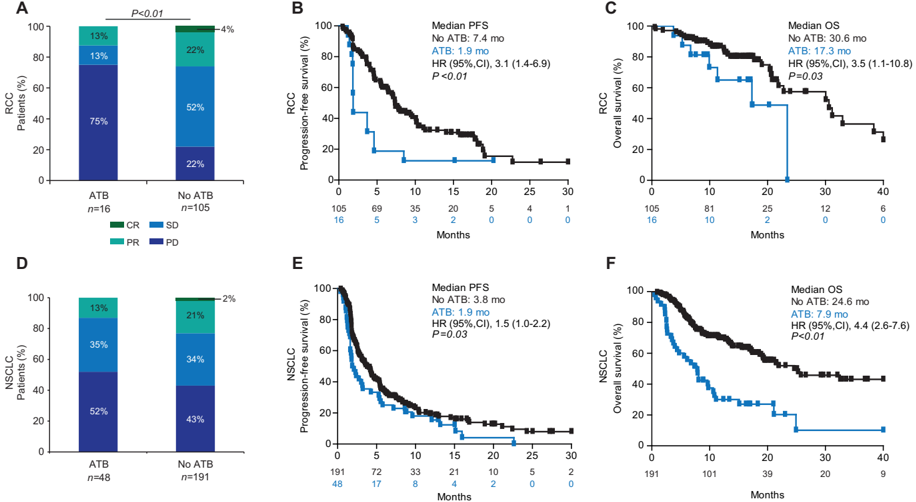
Background: The composition of gut microbiota affects antitumor immune responses, preclinical and clinical outcome following immune checkpoint inhibitors (ICI) in cancer. Antibiotics (ATB) alter gut microbiota diversity and composition leading to dysbiosis, which may affect effectiveness of ICI. Patients and methods: We examined patients with advanced renal cell carcinoma (RCC) and non-small-cell lung cancer (NSCLC) treated with anti-programmed cell death ligand-1 mAb monotherapy or combination at two academic institutions. Those receiving ATB within 30 days of beginning ICI were compared with those who did not. Objective response, progression-free survival (PFS) determined by RECIST1.1 and overall survival (OS) were assessed. Results: Sixteen of 121 (13%) RCC patients and 48 of 239 (20%) NSCLC patients received ATB. The most common ATB were β-lactam or quinolones for pneumonia or urinary tract infections. In RCC patients, ATB compared with no ATB was associated with increased risk of primary progressive disease (PD) (75% versus 22%, P < 0.01), shorter PFS [median 1.9 versus 7.4 months, hazard ratio (HR) 3.1, 95% confidence interval (CI) 1.4-6.9, P < 0.01], and shorter OS (median 17.3 versus 30.6 months, HR 3.5, 95% CI 1.1-10.8, P = 0.03). In NSCLC patients, ATB was associated with similar rates of primary PD (52% versus 43%, P = 0.26) but decreased PFS (median 1.9 versus 3.8 months, HR 1.5, 95% CI 1.0-2.2, P = 0.03) and OS (median 7.9 versus 24.6 months, HR 4.4, 95% CI 2.6-7.7, P < 0.01). In multivariate analyses, the impact of ATB remained significant for PFS in RCC and for OS in NSCLC. Conclusion: ATB were associated with reduced clinical benefit from ICI in RCC and NSCLC. Modulatation of ATB-related dysbiosis and gut microbiota composition may be a strategy to improve clinical outcomes with ICI.
Overview
CoChat Summary
TL;DR
In two independent cohorts of advanced RCC and NSCLC treated with immune checkpoint inhibitors, antibiotic use within 30 days before starting therapy was associated with worse clinical outcomes. The association remained significant for PFS in RCC and for OS in NSCLC in multivariate analyses.
Key findings
- Among 121 RCC patients, 16 (13%) received antibiotics within 30 days of starting ICI. Antibiotic use was associated with more primary progressive disease (75% versus 22%, P < 0.01), shorter median PFS (1.9 versus 7.4 months; HR 3.1, 95% CI 1.4–6.9, P < 0.01), and shorter median OS (17.3 versus 30.6 months; HR 3.5, 95% CI 1.1–10.8, P = 0.03).
- Among 239 NSCLC patients, 48 (20%) received antibiotics within 30 days. Antibiotic use was not associated with primary PD (52% versus 43%, P = 0.26) but was associated with shorter median PFS (1.9 versus 3.8 months; HR 1.5, 95% CI 1.0–2.2, P = 0.03) and shorter median OS (7.9 versus 24.6 months; HR 4.4, 95% CI 2.6–7.7, P < 0.01).
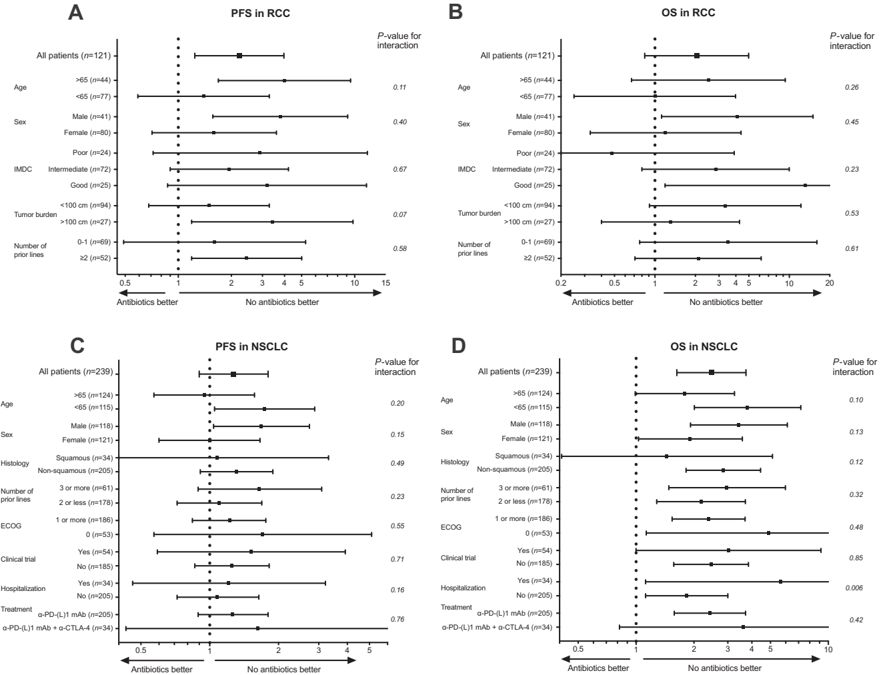
- In multivariate analysis, antibiotics remained associated with worse PFS in RCC (HR 2.0, P < 0.01) but not OS (HR 2.1, P = 0.11); in NSCLC, antibiotics were not significantly associated with PFS (HR 1.3, 95% CI 0.9–1.8, P = 0.17) but remained associated with worse OS (HR 2.5, 95% CI 1.6–3.7, P < 0.01).
- With a 60-day antibiotic window, RCC showed shorter PFS (median 3.1 versus 7.4 months; HR 2.3, 95% CI 1.2–4.4, P < 0.01) and a trend toward worse OS (median 23.4 versus 30 months; HR 1.9, 95% CI 0.8–4.7, P = 0.15); NSCLC showed no difference in objective response or PFS but shorter OS (median 9.8 versus 21.9 months; HR 2.0, 95% CI 1.3–3.2, P < 0.01).
Methods
- Retrospective review of patients with advanced RCC (n = 121) at Gustave Roussy and NSCLC (n = 239) at Memorial Sloan Kettering Cancer Center treated with anti-PD-(L)1 monoclonal antibody monotherapy or combination therapy.
- Antibiotic use was assessed within 30 days or up to 60 days before the first ICI injection; antibiotic class, indication, route, and duration were collected.
- Tumor response was determined by RECIST 1.1; PFS and OS were estimated by Kaplan–Meier and compared with log-rank tests, with multivariable Cox regression adjusting for clinicopathologic features.
Limitations
- The authors state the study is retrospective, with data entry from two institutions; although responses were reviewed with RECIST 1.1, scan timing was not prespecified.
- The authors note differences in patient characteristics between antibiotic and no-antibiotic groups, including higher recent hospitalization in NSCLC and differences in prior lines in RCC, and that analyses did not account for diet, country of origin, or other medications.
- The authors state they did not characterize the mechanism by which antibiotics affect outcomes, and PD-L1 status was lacking in most patients; the text also makes evident that antibiotic subgroups were small and immune-related adverse events were too few to evaluate.
Model-written summary. Check it against the paper before relying on it.
Integrity signals
Registry
Cites
Statistics
Figures




Verification
Claims the paper makes
2 Valid · 1 Not valid · 7 Not checked · 33 Own results and interpretations
At least one cited source doesn’t support this claim or points to a different paper, and none confirmed it — see the verdicts below.
In the paper
“16S ribosomal RNA sequencing of gene amplicons of patients' feces revealed that microbiota returns to its baseline within 1-3 months after ATB discontinuation.”
§ Negative association of antibiotics on clinical activity of immune checkpoint inhibitors in patients with advanced renal cell and non-small-cell lung cancer > Discussion
What the sources say
- Not checked yetcites [14] matched to “Effects of antibiotics on gut microbiota” (2016) source
- Disputedcites [20] matched to “Short-term antibiotic treatment has differing long-term impacts on the human throat and gut microbiome” (2010) sourceExperimental — accuracy not yet measured
The Results section ('Transient and persistent effects of antibiotic treatment'; page unavailable) says fecal microbial communities had only partially recovered at one and four years and remained distinct from their pretreatment compositions. The paper does not report a return to baseline within 1–3 months. (LLM, conf=0.87)
Checked by a reasoning model — may be wrong.
plainstates a cause- Asserted: passes — The authors put it forward as true.
- Checkable: passes — It can be checked against evidence.
- Load-bearing: passes — The paper’s conclusions depend on it.
- Based: passes — The paper gives a reason why it holds.
The sources with a verdict support this claim; the rest weren’t checked yet, have no full text we could read, or their verdicts aren’t rated yet.
In the paper
“However, some bacteria may take years to fully recover [14,20].”
§ Negative association of antibiotics on clinical activity of immune checkpoint inhibitors in patients with advanced renal cell and non-small-cell lung cancer > Discussion
What the sources say
- Not checked yetcites [14] matched to “Effects of antibiotics on gut microbiota” (2016) source
- Supportedcites [20] matched to “Short-term antibiotic treatment has differing long-term impacts on the human throat and gut microbiome” (2010) source
The Results section 'Transient and persistent effects of antibiotic treatment' states that 'One and four years after treatment, the fecal microbial communities had partially recovered to their pre-treatment compositions, however these were still separated along CA axis 2', i.e. full recovery had not occurred even four years after a one-week course. The 'Individuality in antibiotic response' section adds taxon-level persistence (e.g. the increase of unclassified Enterobacteriaceae in patient D persisted during the 4-year period), and the Abstract/Discussion report erm(B) still elevated four years post treatment. The hedged claim that some bacteria 'may take years to fully recover' is therefore within what this source shows; the only points it credits to others (two-year Bacteroides/erm persistence, a resistant clone persisting three years) are separate citations [8] and [10] and are not what the citing sentence attributes here. (LLM, conf=0.82)
hedgedstates a possible cause- Asserted: passes — The authors put it forward as true.
- Checkable: passes — It can be checked against evidence.
- Load-bearing: unclear — It is unclear whether the paper’s conclusions depend on it.
- Based: passes — The paper gives a reason why it holds.
The sources with a verdict support this claim; the rest weren’t checked yet, have no full text we could read, or their verdicts aren’t rated yet.
In the paper
“In oncology, converging findings demonstrate the negative impact of ATBinduced dysbiosis in mice.”
§ Negative association of antibiotics on clinical activity of immune checkpoint inhibitors in patients with advanced renal cell and non-small-cell lung cancer > Introduction
What the sources say
- Supportedcites [9] matched to “Anticancer immunotherapy by CTLA-4 blockade relies on the gut microbiota” (2015) source
The Results passage opening Fig. 1 states that broad-spectrum antibiotics (ampicillin+colistin+streptomycin, and imipenem alone but not colistin) 'compromised the antitumor effects of CTLA-4-specific Ab', confirmed across the Ret melanoma and MC38 colon cancer models and mirrored by germ-free housing — i.e. converging mouse evidence in oncology that antibiotic-induced microbiota disruption harms checkpoint-blockade efficacy. The Abstract states it outright: 'Tumors in antibiotic-treated or germ-free mice did not respond to CTLA blockade.' The only framing shift is minor: the paper attributes the loss of efficacy to depletion/recomposition of the microbiota (rescued by B. fragilis gavage) rather than using the word 'dysbiosis', and it hedges the mechanism ('suggest that the gut microbiota is required'), but the negative impact of antibiotic treatment itself is asserted as fact. (LLM, conf=0.90)
- Not checked yetcites [10]
boostedstates a cause- Asserted: passes — The authors put it forward as true.
- Checkable: passes — It can be checked against evidence.
- Load-bearing: passes — The paper’s conclusions depend on it.
- Based: passes — The paper gives a reason why it holds.
- Supported
A result the paper reports from its own data — it cites no other source for it, so there is none to check. The quote shows it is in the paper.
In the paper
“and shorter OS (median 17.3 versus 30.6 months, HR 3.5, 95% CI 1.1-10.8,P ¼ 0.03).”
- Also stated in: § Results · plain
“median OS, 17.3 months versus 30.6 months, HR 3.5, 95% CI 1.1-10.8,P ¼ 0.03”
§ Negative association of antibiotics on clinical activity of immune checkpoint inhibitors in patients with advanced renal cell and non-small-cell lung cancer > Abstract
plainstates an association- Asserted: passes — The authors put it forward as true.
- Checkable: passes — It can be checked against evidence.
- Load-bearing: passes — The paper’s conclusions depend on it.
- Based: passes — The paper gives a reason why it holds.
- Also stated in: § Results · plain
A result the paper reports from its own data — it cites no other source for it, so there is none to check. The quote shows it is in the paper.
In the paper
“In RCC, ATB-60 days remained associated with increased risk of primary progression (P < 0.01)”
§ Negative association of antibiotics on clinical activity of immune checkpoint inhibitors in patients with advanced renal cell and non-small-cell lung cancer > Results
plainstates an association- Asserted: passes — The authors put it forward as true.
- Checkable: passes — It can be checked against evidence.
- Load-bearing: passes — The paper’s conclusions depend on it.
- Based: passes — The paper gives a reason why it holds.
20 more claims
Create a free account to see all 43 claims and to verify the 15 references still open.
- It may state two separate claims as one. 11
- Probably not a substantial claim. 11
Claims other papers make about this one
Each is checked against this paper’s own text: does it say what the citing paper says it does?
The source backs part of the claim, not all of it — or backs it for a different population, condition or comparison.
In the citing paper
“Similarly, antibiotics (ATB) prior to ICI initiation drastically reduced the clinical benefit in several cohorts of patients across various cancer types (melanoma, advanced NSCLC, renal cell carcinoma (RCC), and urothelial cancer) 18,[20][21][22] .”
From Intestinal Akkermansia muciniphila predicts clinical response to PD-1 blockade in patients with advanced non-small-cell lung cancer (2022) · cites this paper as [20]
Experimental — accuracy not yet measuredThe source backs part of the claim, not all of it — or backs it for a different population, condition or comparison.
In the citing paper
“However, increasing clinical evidence suggests that systemic antibiotics abolish immune checkpoint blockade efficacy and decrease patient survival (133, 136, 137).”
From The microbiome and human cancer (2021) · cites this paper as [137]
Experimental — accuracy not yet measuredThe source backs part of the claim, not all of it — or backs it for a different population, condition or comparison.
In the citing paper
“However, the clinical value of this observation is limited by its derivation from selected oncological indications, including renal and non-small cell lung cancer (NSCLC), 2 for which external validation, especially outside clinical trials, is necessary.”
From Association of Prior Antibiotic Treatment With Survival and Response to Immune Checkpoint Inhibitor Therapy in Patients With Cancer (2019) · cites this paper as [2]
Experimental — accuracy not yet measuredThe source backs part of the claim, not all of it — or backs it for a different population, condition or comparison.
In the citing paper
“However, our results suggest that administration of these classes of antibiotics constitutes a likely surrogate for poor disease status and a state of increased systemic inflammation prior to initiation of CAR-T cell therapy, as was recently suggested in cancer patients treated with other ICBs28,35.”
From A non-antibiotic-disrupted gut microbiome is associated with clinical responses to CD19-CAR-T cell cancer immunotherapy (2023) · cites this paper as [28]
Experimental — accuracy not yet measuredThe cited source says what the claim attributes to it.
In the citing paper
“Supporting this contention, we and others reported that primary responses to anti-PD-1/ PD-L1 antibodies in patients with epithelial tumours and melanoma could, at least in part, be attributed to the taxonomic composition of the gut microbial ecosystem 18,20,25 .”
From Intestinal Akkermansia muciniphila predicts clinical response to PD-1 blockade in patients with advanced non-small-cell lung cancer (2022) · cites this paper as [20]
14 more claims about this paper
Create a free account to see every claim other papers make about this one.
Self-check
Percentages, sums and reported differences re-computed from the paper’s own numbers.
Each contradiction between two passages listed here was confirmed by an independent check.
Rated major: it would touch a result — a value a result rests on, reported and recomputed p-values on opposite sides of the significance level, two passages that conflict with no sign which is right, or a cited work retracted before this paper was published.
In the paper
§ Negative association of antibiotics on clinical activity of immune checkpoint inhibitors in patients with advanced renal cell and non-small-cell lung cancer > Results
“median PFS, 1.9 months versus 3.8 months, HR 1.5, 95% CI 1.0-2.2,P ¼ 0.03”
§ Negative association of antibiotics on clinical activity of immune checkpoint inhibitors in patients with advanced renal cell and non-small-cell lung cancer > Discussion
“ATB 30-0/No ATB 1.4 (1.0-2.0)0.04 1.3 (0.9-1.8) 0.17”
Rated major: it would touch a result — a value a result rests on, reported and recomputed p-values on opposite sides of the significance level, two passages that conflict with no sign which is right, or a cited work retracted before this paper was published.
In the paper
§ Negative association of antibiotics on clinical activity of immune checkpoint inhibitors in patients with advanced renal cell and non-small-cell lung cancer > Results
“median OS, 7.9 months versus 24.6 months, HR 4.4, 95% CI 2.6-7.7,P < 0.01”
§ Negative association of antibiotics on clinical activity of immune checkpoint inhibitors in patients with advanced renal cell and non-small-cell lung cancer > Discussion
“ATB 30-0/No ATB 2.9 (1.9-4.4)<0.01 2.5 (1.6-3.7)<0.01”
Rated major: it would touch a result — a value a result rests on, reported and recomputed p-values on opposite sides of the significance level, two passages that conflict with no sign which is right, or a cited work retracted before this paper was published.
In the paper
§ Negative association of antibiotics on clinical activity of immune checkpoint inhibitors in patients with advanced renal cell and non-small-cell lung cancer > Results
“median PFS, 1.9 months versus 7.4 months, HR 3.1, 95% CI 1.4-6.9,P < 0.01”
§ Negative association of antibiotics on clinical activity of immune checkpoint inhibitors in patients with advanced renal cell and non-small-cell lung cancer > Discussion
“ATB 30-0/No ATB 2.3 (1.3-4.0)<0.01 2.2 (1.3-3.3)<0.01”
Rated minor: it would not touch a result — a value no result rests on, a p-value that stays on the same side of the significance level, or a conflict that is clerical, resolved elsewhere in the paper, or outside its own findings.
In the paper
§ Negative association of antibiotics on clinical activity of immune checkpoint inhibitors in patients with advanced renal cell and non-small-cell lung cancer > Results
“Range 28-83 29-83 30-82”
§ Negative association of antibiotics on clinical activity of immune checkpoint inhibitors in patients with advanced renal cell and non-small-cell lung cancer > Results
“ATB 30-0 (n 5 16) No ATB (n 5 105)”
Rated minor: it would not touch a result — a value no result rests on, a p-value that stays on the same side of the significance level, or a conflict that is clerical, resolved elsewhere in the paper, or outside its own findings.
In the paper
§ Negative association of antibiotics on clinical activity of immune checkpoint inhibitors in patients with advanced renal cell and non-small-cell lung cancer > Discussion
“Female (n=80) Male (n=41)”
§ Negative association of antibiotics on clinical activity of immune checkpoint inhibitors in patients with advanced renal cell and non-small-cell lung cancer > Results
“Gender, n (%) Male 80 (66) 9 (56) 71 (68) 0.37 Female 41 (34) 7 (44) 34 (32)”
4 more findings
Create a free account to see every finding of this check.
Citations
Cites
New response evaluation criteria in solid tumours: revised RECIST guideline (version 1.1)
Eisenhauer, E. A., Therasse, P., Bogaerts, J., Schwartz, L. H., Sargent, D., Ford, R., Dancey, J., Arbuck, S., Gwyther, S., Mooney, M., et al. (2009) · European Journal of Cancer · doi:10.1016/j.ejca.2008.10.026 · Cited by 29,534
Adverse Renal Effects of Immune Checkpoint Inhibitors: A Narrative Review
Wanchoo, R., Karam, S., Uppal, N. N., Barta, V. S., Deray, G., Devoe, C., Launay-Vacher, V., Jhaveri, K. D., & on behalf of Cancer and Kidney International Network Workgroup on Immune Checkpoint Inhibitors (2017) · American Journal of Nephrology · doi:10.1159/000455014 · Cited by 15,256
Pembrolizumab versus Chemotherapy for PD-L1-Positive Non-Small-Cell Lung Cancer
Reck, M., Rodríguez-Abreu, D., Robinson, A. G., Hui, R., Csőszi, T., Fülöp, A., Gottfried, M., Peled, N., Tafreshi, A., Cuffe, S., et al. (2016) · New England Journal of Medicine · doi:10.1056/nejmoa1606774 · Cited by 10,089
Nivolumab versus docetaxel in advanced nonsquamous non-small-cell lung cancer
Borghaei, H., Paz-Ares, L., Horn, L., Spigel, D. R., Steins, M., Ready, N. E., Chow, L. Q., Vokes, E. E., Felip, E., Holgado, E., et al. (2015) · New England Journal of Medicine · doi:10.1056/nejmoa1507643 · Cited by 9,335
Nivolumab versus Everolimus in Advanced Renal-Cell Carcinoma
Motzer, R. J., Escudier, B., McDermott, D. F., George, S., Hammers, H. J., Srinivas, S., Tykodi, S. S., Sosman, J. A., Procopio, G., Plimack, E. R., et al. (2015) · New England Journal of Medicine · doi:10.1056/nejmoa1510665 · Cited by 5,807
Self-citationGut microbiome influences efficacy of PD-1-based immunotherapy against epithelial tumors
Routy, B., Le Chatelier, E., Derosa, L., Duong, C. P. M., Alou, M. T., Daillère, R., Fluckiger, A., Messaoudene, M., Rauber, C., Roberti, M. P., et al. (2018) · Science · doi:10.1126/science.aan3706 · Cited by 5,671
Self-citationDiversity, stability and resilience of the human gut microbiota
Lozupone, C. A., Stombaugh, J. I., Gordon, J. I., Jansson, J. K., & Knight, R. (2012) · Nature · doi:10.1038/nature11550 · Cited by 5,533
Gut microbiome modulates response to anti-PD-1 immunotherapy in melanoma patients
Gopalakrishnan, V., Spencer, C. N., Nezi, L., Reuben, A., Andrews, M. C., Karpinets, T. V., Prieto, P. A., Vicente, D., Hoffman, K., Wei, S. C., et al. (2018) · Science · doi:10.1126/science.aan4236 · Cited by 4,812
Self-citationIFN-γ–related mRNA profile predicts clinical response to PD-1 blockade
Ayers, M., Lunceford, J., Nebozhyn, M., Murphy, E., Loboda, A., Kaufman, D. R., Albright, A., Cheng, J. D., Kang, S. P., Shankaran, V., et al. (2017) · Journal of Clinical Investigation · doi:10.1172/jci91190 · Cited by 3,788
Anticancer immunotherapy by CTLA-4 blockade relies on the gut microbiota
Vétizou, M., Pitt, J. M., Daillère, R., Lepage, P., Waldschmitt, N., Flament, C., Rusakiewicz, S., Routy, B., Roberti, M. P., Duong, C. P. M., et al. (2015) · Science · doi:10.1126/science.aad1329 · Cited by 3,488
Self-citation
Cited by
Items 201–300 of 909
Guo, J., Lin, C., Lin, C.-Y., Hsieh, M., Kuo, H., Lien, M.-Y., Shao, Y., Huang, T., & Hsu, C. (2019) · Anticancer Research · doi:10.21873/anticanres.13765 · Cited by 53
Wang, Z., Li, L., Wang, S., Wei, J., Qu, L., Pan, L., & Xu, K. (2022) · Frontiers in Pharmacology · doi:10.3389/fphar.2022.1025860 · Cited by 64
“Dysbiosis is an alteration in the composition of the microbiota, disrupting the physiological homeostasis inside the intestinal epithelial cells (Derosa et al., 2018).”
BackgroundIntratumoral bacteria are an important “accomplice” in tumor development and metastasis
Wang, G., He, X., & Wang, Q. (2022) · Biochimica et Biophysica Acta (BBA) - Reviews on Cancer · doi:10.1016/j.bbcan.2022.188846 · Cited by 52
Unraveling resistance to immunotherapy in MSI-high colorectal cancer
Heregger, R., Huemer, F., Steiner, M., Gonzalez-Martinez, A., Greil, R., & Weiss, L. (2023) · Cancers · doi:10.3390/cancers15205090 · Cited by 52
The Role of the Microbiome in Cancer and Therapy Efficacy: Focus on Lung Cancer
Halley, A., Leonetti, A., Gregori, A., Tiseo, M., Deng, D., Giovannetti, E., & Peters, G. J. (2020) · Anticancer Research · doi:10.21873/anticanres.14484 · Cited by 56
Biomarkers for Response to Immune Checkpoint Blockade
Ganesan, S., & Mehnert, J. (2020) · Annual Review of Cancer Biology · doi:10.1146/annurev-cancerbio-030419-033604 · Cited by 51
Bai, J., Chen, H., & Bai, X. (2021) · Journal of Clinical Laboratory Analysis · doi:10.1002/jcla.23810 · Cited by 59
Mitochondria and Antibiotics: For Good or for Evil?
Suarez-Rivero, J. M., Pastor‐Maldonado, C. J., Povea-Cabello, S., Álvarez-Córdoba, M., Villalón-García, I., Talaverón-Rey, M., Suárez-Carrillo, A., Munuera-Cabeza, M., & Sánchez-Alcázar, J. A. (2021) · Biomolecules · doi:10.3390/biom11071050 · Cited by 62
“A retrospective study carried out with 121 renal cell carcinoma and 239 nonsmall cell lung cancer (NSCLC) patients treated with ICI demonstrated that those who had received antibiotic treatments (generally β-lactams or quinolones) presented an increased risk of primary progressive disease and reduced progression-free…”
Hamada, K., Isobe, J., Hattori, K., Hosonuma, M., Baba, Y., Murayama, M., Narikawa, Y., Toyoda, H., Funayama, E., Tajima, K., et al. (2023) · Frontiers in Immunology · doi:10.3389/fimmu.2023.1164724 · Cited by 60
“Furthermore, it has been reported that the administration of antibiotics has a robust negative effect on intestinal bacteria and thereby, on the therapeutic effect of ICIs (24, 25) While the effect of the microbiota on ICI efficacy has been reported in various countries, it has not yet been reported in Japanese indivi…”
BackgroundInfluentialMariniello, A., Borgeaud, M., WEINER, M. H., Frisone, D., Kim, F., & Addeo, A. (2025) · BioDrugs · doi:10.1007/s40259-024-00700-2 · Cited by 79
“Decreased progression-free survival (PFS) and OS were also observed in patients with renal cell carcinoma and non-small cell lung cancer treated with PD1-blockade who received antibiotics compared with patients who did not [123, 124].”
Mechanisms of Primary and Secondary Resistance to Immune Checkpoint Inhibitors in Cancer
Seto, T., Sam, D. L., & Pan, M. (2019) · Medical Sciences · doi:10.3390/medsci7020014 · Cited by 60
“A French study found that patients with lung cancer or renal cell carcinoma treated with a β-lactam for pneumonia or a quinolone for urinary tract infection were associated with shorter PFS and OS [14].”
BackgroundPorcari, S., Ng, S. C., Zitvogel, L., Sokol, H., Weersma, R. K., Elinav, E., Gasbarrini, A., Cammarota, G., Tilg, H., & Ianiro, G. (2025) · Cell · doi:10.1016/j.cell.2025.04.016 · Cited by 61
Self-citationGaucher, L., Adda, L., Séjourné, A., Joachim, C., Chaby, G., Poulet, C., Liabeuf, S., Gras‐Champel, V., Masmoudi, K., Houessinon, A., et al. (2021) · Therapeutic Advances in Medical Oncology · doi:10.1177/17588359211000591 · Cited by 53
UEDA, K., YONEKURA, S., OGASAWARA, N., MATSUNAGA, Y., HOSHINO, R., KUROSE, H., CHIKUI, K., UEMURA, K., NAKIRI, M., NISHIHARA, K., et al. (2019) · Anticancer Research · doi:10.21873/anticanres.13836 · Cited by 48
Gut microbiome and response to checkpoint inhibitors in non-small cell lung cancer—A review
Nagasaka, M., Sexton, R. E., Alhasan, R., Rahman, S. B., Azmi, A. S., & Sukari, A. W. (2019) · Critical Reviews in Oncology/Hematology · doi:10.1016/j.critrevonc.2019.102841 · Cited by 56
Zhou, J., Huang, G., Wong, W.-C., Hu, D., Zhu, J.-W., Li, R., & Zhou, H. K. (2022) · Frontiers in Immunology · doi:10.3389/fimmu.2022.968729 · Cited by 53
Fulop, D. J., Zylberberg, H. M., Wu, Y. L., Aronson, A., Labiner, A. J., Wisnivesky, J. P., Cohen, D. J., Sigel, K. M., & Lucas, A. L. (2023) · JAMA Network Open · doi:10.1001/jamanetworkopen.2023.4254 · Cited by 52
Elkrief, A., Waters, N. R., Smith, N., Dai, A., Slingerland, J., Aleynick, N., Febles, B., Gogia, P., Socci, N. D., Lumish, M., et al. (2024) · Cancer Immunology Research · doi:10.1158/2326-6066.cir-23-0498 · Cited by 48
Self-citationHow Chemotherapy Affects the Tumor Immune Microenvironment: A Narrative Review
Merlano, M. C., Denaro, N., Galizia, D., Ruatta, F., Occelli, M., Minei, S., Abbona, A., Paccagnella, M., Ghidini, M., & Garrone, O. (2022) · Biomedicines · doi:10.3390/biomedicines10081822 · Cited by 54
“Intriguingly, data show that antibiotic therapy administered within one month of starting immunotherapy is the worst predictor of response compared to antibiotic therapy given more than one month before immunotherapy [56] and even during immunotherapy [57].”
BackgroundComplex interactions between the microbiome and cancer immune therapy
Schwartz, D. J., Rebeck, O. N., & Dantas, G. A. (2019) · Critical Reviews in Clinical Laboratory Sciences · doi:10.1080/10408363.2019.1660303 · Cited by 55
Petrelli, F., Iaculli, A., Signorelli, D., Ghidini, A., Dottorini, L., Perego, G., Ghidini, M., Zaniboni, A., Gori, S., & Inno, A. (2020) · Journal of Clinical Medicine · doi:10.3390/jcm9051458 · Cited by 47
Pleiotropic Effects of Metformin on the Antitumor Efficiency of Immune Checkpoint Inhibitors
Liu, W., Wang, Y., Luo, J., Liu, M., & Luo, Z. (2021) · Frontiers in Immunology · doi:10.3389/fimmu.2020.586760 · Cited by 51
The role of gut microbiome in modulating response to immune checkpoint inhibitor therapy in cancer
Naqash, A. R., Kihn-Alarcón, A. J., Stavraka, C., Kerrigan, K. C., Vareki, S. M., Pinato, D. J., & Puri, S. (2021) · Annals of Translational Medicine · doi:10.21037/atm-20-6427 · Cited by 54
“There is a growing body of evidence associating the use of ATB with adverse response rates and survival outcomes in patients receiving ICPIs across a range of solid tumors (21-29).”
BackgroundAirway Fusobacterium is Associated with Poor Response to Immunotherapy in Lung Cancer
Chu, S., Cheng, Z., Yin, Z., Xu, J., Wu, F., Jin, Y., & Yang, G. (2022) · OncoTargets and Therapy · doi:10.2147/ott.s348382 · Cited by 52
Effects of intestinal flora on pharmacokinetics and pharmacodynamics of drugs
Džidić-Krivić, A., Kusturica, J., Sher, E. K., Selak, N., Osmančević, N., Farhat, E. K., & Sher, F. (2023) · Drug Metabolism Reviews · doi:10.1080/03602532.2023.2186313 · Cited by 50
“A recent study (Derosa et al. 2018) has shown that gut microbiota is one of the factors affecting outcomes of this therapy.”
BackgroundThe impact of the gut microbiome on tumor immunotherapy: from mechanism to application strategies
Guo, C., Kong, L., Xiao, L., Liu, K., Cui, H., Xin, Q., Gu, X., Jiang, C., & Wu, J. (2023) · Cell & Bioscience · doi:10.1186/s13578-023-01135-y · Cited by 48
“There is substantial clinical evidence that the baseline composition of a patient’s gut microbiome is associated with the antitumor efficacy of ICB therapy [17, 81] (Table 1).”
BackgroundMicrobiota in cancer: molecular mechanisms and therapeutic interventions
Chen, Z., Guan, D., Wang, Z., Li, X., Dong, S., Huang, J., & Zhou, W. (2023) · MedComm · doi:10.1002/mco2.417 · Cited by 50
Gut microbiome and cancer immunotherapy
Sun, J., Yin, T., Zhou, J., Jiang, X., & Lu, X. (2019) · Journal of Cellular Physiology · doi:10.1002/jcp.29359 · Cited by 53
“The analysis suggested a shorter PFS and OS both in RCC and NSCLC patients treated by antibiotic (Derosa et al., 2018).”
BackgroundGut microbiota targeted nanomedicine for cancer therapy: Challenges and future considerations
Rajoka, M. S. R., Mehwish, H. M., Xiong, Y., Song, X., Hussain, N., Zhu, Q., & He, Z. (2020) · Trends in Food Science & Technology · doi:10.1016/j.tifs.2020.10.036 · Cited by 47
Kim, C. G., Koh, J.-Y., Shin, S.-J., Shin, J.-H., Hong, M., Chung, H. C., Rha, S. Y., Kim, H. S., Lee, C.-K., Lee, J. H., et al. (2023) · Cell Reports Medicine · doi:10.1016/j.xcrm.2023.101251 · Cited by 45
“20 In accordance with this hypothesis, previous studies have reported that ATB treatment negatively affects the clinical activity of ICIs in patients with non-small cell lung cancer, 21,22 renal cell cancer, 21 and melanoma.”
BackgroundResultAcquired Resistance to PD-1/PD-L1 Blockade in Lung Cancer: Mechanisms and Patterns of Failure
Pathak, R., Pharaon, R. R., Mohanty, A. R., Villaflor, V. M., Salgia, R., & Massarelli, E. (2020) · Cancers · doi:10.3390/cancers12123851 · Cited by 51
HAMADA, K., YOSHIMURA, K., HIRASAWA, Y., HOSONUMA, M., MURAYAMA, M., NARIKAWA, Y., ARIIZUMI, H., OHKUMA, R., SHIDA, M., KUBOTA, Y., et al. (2021) · Anticancer Research · doi:10.21873/anticanres.15312 · Cited by 43
Shaikh, F. Y., White, J. R., Gills, J. J., Hakozaki, T., Richard, C., Routy, B., Okuma, Y., Usyk, M., Pandey, A., Weber, J. S., et al. (2021) · Clinical Cancer Research · doi:10.1158/1078-0432.ccr-20-4834 · Cited by 44
Self-citationThe Lung Microbiota and Lung Cancer: A Growing Relationship
Zerdan, M. B., Kassab, J. T., Meouchy, P., Haroun, E., Nehme, R., Zerdan, M. B., Fahed, G., Petrosino, M., Dutta, D., & Graziano, S. L. (2022) · Cancers · doi:10.3390/cancers14194813 · Cited by 49
“Other studies have also shown similar effects of gut microbiota on cancer immunotherapy [87,88].”
ResultGut microbiota in brain tumors: An emerging crucial player
Lin, B. C., Ye, Z., Ye, Z., Wang, M., Cao, Z., Gao, R., & Zhang, Y. (2023) · CNS Neuroscience & Therapeutics · doi:10.1111/cns.14081 · Cited by 47
Checkpoint Inhibitor Pneumonitis: Mechanisms, Characteristics, Management Strategies, and Beyond
Reuss, J. E., Suresh, K. S., & Naidoo, J. (2020) · Current Oncology Reports · doi:10.1007/s11912-020-00920-z · Cited by 48
The role of the microbiome in drug resistance in gastrointestinal cancers
Garajová, I., Balsano, R., Wang, H., Leonardi, F., Giovannetti, E., Deng, D., & Peters, G. J. (2020) · Expert Review of Anticancer Therapy · doi:10.1080/14737140.2021.1844007 · Cited by 50
Zhang, F., Ferrero, M., Dong, N., D’Auria, G., Reyes-Prieto, M., Herreros-Pomares, A., Calabuig-Fariñas, S., Duréndez, E., Aparisi, F., Blasco, A., et al. (2021) · Cancers · doi:10.3390/cancers13112514 · Cited by 43
“Interestingly, some reports have demonstrated that the use of ATB is a negative factor in the effectiveness and clinical outcomes to ICB [29,33,34].”
BackgroundLi, Y., Sharma, A., & Schmidt‐Wolf, I. G. H. (2024) · Molecular Cancer · doi:10.1186/s12943-023-01926-4 · Cited by 56
Biomarkers for immunotherapy resistance in non-small cell lung cancer
Rother, C., John, T., & Wong, A. N. M. (2024) · Frontiers in Oncology · doi:10.3389/fonc.2024.1489977 · Cited by 59
Is it true that gut microbiota is considered as panacea in cancer therapy?
Farrokhi, A. S., Darabi, N., Yousefi, B., Askandar, R. H., Shariati, M., & Eslami, M. (2019) · Journal of Cellular Physiology · doi:10.1002/jcp.28333 · Cited by 45
“In particular, the use of immunotherapeutic antibodies is recommended to block tumors by activating immune checkpoints (Derosa et al., 2018; Sears & Pardoll, 2018).”
BackgroundPredicting cancer immunotherapy response from gut microbiomes using machine learning models
Liang, H., Jo, J., Zhang, Z., MacGibeny, M. A., Han, J., Proctor, D. M., Taylor, M. E., Che, Y., Juneau, P. L., Apolo, A. B., et al. (2022) · Oncotarget · doi:10.18632/oncotarget.28252 · Cited by 50
“2335); although not statistically significant due to a small sample size, our data align with prior observations of a negative association between recent antibiotic use and immunotherapy outcomes [35, 36].”
BackgroundResultKubeček, O., Paterová, P., & Novosadová, M. (2021) · Life · doi:10.3390/life11121387 · Cited by 60
Antimicrobial exposure is associated with decreased survival in triple-negative breast cancer
Ransohoff, J. D., Ritter, V., Purington, N., Andrade, K., Han, S. S., Liu, M., Liang, S., John, E. M., Gomez, S. L., Telli, M. L., et al. (2023) · Nature Communications · doi:10.1038/s41467-023-37636-0 · Cited by 49
Zhu, X., Huang, X., Hu, M., Sun, R., Li, J., Wang, H., Pan, X., Ma, Y., Ning, L., Tong, T., et al. (2024) · Cell Host & Microbe · doi:10.1016/j.chom.2024.03.002 · Cited by 43
An Update on Predictive Biomarkers in Metastatic Renal Cell Carcinoma
Dudani, S., Savard, M.-F., & Heng, D. Y. C. (2019) · European Urology Focus · doi:10.1016/j.euf.2019.04.004 · Cited by 44
Facts and Hopes for Gut Microbiota Interventions in Cancer Immunotherapy
Davar, D., & Zarour, H. M. (2022) · Clinical Cancer Research · doi:10.1158/1078-0432.ccr-21-1129 · Cited by 40
“Firstly, in line with preclinical studies that showed that broad-spectrum antibiotics promoted unfavorable clinical outcomes to treatment with ICI targeting CTLA-4 (22) or PD-1/PD-L1 (26–28), patients with cancer who received broad-spectrum antibiotics shortly before or during ICI therapy had poorer progression-free s…”
ResultImmunotherapy Is Changing First-Line Treatment of Metastatic Renal-Cell Carcinoma
Labriola, M., Batich, K. A., Zhu, J., McNamara, M. A., Harrison, M. R., Armstrong, A. J., George, D. J., & Zhang, T. (2019) · Clinical Genitourinary Cancer · doi:10.1016/j.clgc.2019.01.017 · Cited by 42
Immune checkpoint inhibitor–related luminal GI adverse events
Kröner, P. T., Mody, K., & Farraye, F. A. (2019) · Gastrointestinal Endoscopy · doi:10.1016/j.gie.2019.09.009 · Cited by 43
Peng, K., Chen, K., Teply, B. A., Yee, G. C., Farazi, P. A., & Lyden, E. R. (2022) · Annals of Pharmacotherapy · doi:10.1177/10600280211033938 · Cited by 40
Unveiling the intratumoral microbiota within cancer landscapes
Che, S., Yan, Z., Feng, Y., & Hai, Z. (2024) · iScience · doi:10.1016/j.isci.2024.109893 · Cited by 44
“260,261 Dietary interventions, prebiotics, and postbiotics are promising strategies for enhancing antitumor immunity and therapy responses in both mouse models and clinical trials (NCT03870607, NCT03950635).”
BackgroundMicro- and Mycobiota Dysbiosis in Pancreatic Ductal Adenocarcinoma Development
Bellotti, R., Speth, C., Adolph, T. E., Lass‐Flörl, C., Effenberger, M., Öfner, D., & Maglione, M. (2021) · Cancers · doi:10.3390/cancers13143431 · Cited by 42
“Of note, in renal and non-small cell lung carcinoma, bacterial ablation reduced the effectiveness of checkpoint blockade therapy [77].”
BackgroundThe Role of Microbiota-Derived Vitamins in Immune Homeostasis and Enhancing Cancer Immunotherapy
Gholami, H., Chmiel, J. A., Burton, J. P., & Vareki, S. M. (2023) · Cancers · doi:10.3390/cancers15041300 · Cited by 44
“Antibiotic-treated patients with advanced solid tumors displayed reduced survival rates and poor ICI responses, which were associated with reduced gut microbiota diversity and abundance [56,263,265].”
BackgroundImpact of Use of Antibiotics on Response to Immune Checkpoint Inhibitors and Tumor Microenvironment
Khan, U., Ho, K., Hwang, E. K., Peña, C., Brouwer, J., Hoffman, K., Betel, D., Sonnenberg, G. F., Faltas, B. M., Saxena, A., et al. (2021) · American Journal of Clinical Oncology · doi:10.1097/coc.0000000000000813 · Cited by 42
Schubert, M., Rohrbach, R., Schmitt, M. W., & Stein‐Thoeringer, C. K. (2021) · Frontiers in Immunology · doi:10.3389/fimmu.2021.670286 · Cited by 41
C-Reactive Protein Levels Predict Responses to PD-1 Inhibitors in Hepatocellular Carcinoma Patients
Zhang, Y., Lu, L., He, Z., Xu, Z.-S., Xiang, Z., Nie, R., Lin, W., Chen, W., Zhou, J., Yin, Y., et al. (2022) · Frontiers in Immunology · doi:10.3389/fimmu.2022.808101 · Cited by 43
The gut microbiome and melanoma: A review
Makaranka, S., Scutt, F., Frixou, M., Wensley, K. E., Sharma, R., & Greenhowe, J. (2022) · Experimental Dermatology · doi:10.1111/exd.14639 · Cited by 44
Boesch, M., Horvath, L., Baty, F., Pircher, A., Wolf, D., Spahn, S., Straussman, R., Tilg, H., & Brutsche, M. H. (2022) · Journal for ImmunoTherapy of Cancer · doi:10.1136/jitc-2022-005401 · Cited by 38
Management of Renal Cell Carcinoma: Promising Biomarkers and the Challenges to Reach the Clinic
Lyskjær, I., Iisager, L., Axelsen, C. T., Nielsen, T. K., Dyrskjøt, L., & Fristrup, N. (2023) · Clinical Cancer Research · doi:10.1158/1078-0432.ccr-23-1892 · Cited by 45
“Administering antibiotics prior to immunotherapy treat-ment is linked to a reduced PFS, which could be caused by an altered microbiome (98).”
BackgroundTurning cold tumors into hot tumors: harnessing the potential of tumor immunity using nanoparticles
Rodallec, A., Sicard, G., Fanciullino, R., Benzekry, S., Lacarelle, B., Milano, G. A., & Ciccolini, J. (2018) · Expert Opinion on Drug Metabolism & Toxicology · doi:10.1080/17425255.2018.1540588 · Cited by 42
“Indeed reducing toxicities, especially the neutropenia-related infections, will lead to cutting broad-spectrum antibiotherapy, whom administration has been repeatedly associated with reduced survival in immunotherapy-treated patients [29], much probably because of the disruption of gut microbiome necessary to the immu…”
BackgroundDaillère, R., Derosa, L., Bonvalet, M., Segata, N., Routy, B., Gariboldi, M., Budinská, E., De Vries, I. J. M., Naccarati, A. G., Zitvogel, V., et al. (2020) · OncoImmunology · doi:10.1080/2162402x.2020.1774298 · Cited by 38
Self-citationRapoport, B. L., Shannon, V. R., Cooksley, T., Johnson, D. B., Anderson, L., Blidner, A. G., Tintinger, G. R., & Anderson, R. (2021) · Frontiers in Pharmacology · doi:10.3389/fphar.2021.743582 · Cited by 44
Modulation of Anti-Tumour Immune Responses by Probiotic Bacteria
Aindelis, G., & Chlichlia, K. (2020) · Vaccines · doi:10.3390/vaccines8020329 · Cited by 43
“[85] examined the outcome of anti-PD-L1 blockade treatment, in renal cell carcinoma (RCC) and NSCLC, through antibiotic administration in clinical settings.”
BackgroundWu, Q., Liu, J., Wu, S., & Xie, X. (2021) · International Immunopharmacology · doi:10.1016/j.intimp.2020.107303 · Cited by 43
Gaucher, L., Adda, L., Séjourné, A., Joachim, C., Chaby, G., Poulet, C., Liabeuf, S., Gras‐Champel, V., Masmoudi, K., Moreira, A., et al. (2021) · Therapeutic Advances in Medical Oncology · doi:10.1177/1758835921996656 · Cited by 42
The impact of microbiota on PD-1/PD-L1 inhibitor therapy outcomes: A focus on solid tumors
Najafi, S., Majidpoor, J., & Mortezaee, K. (2022) · Life Sciences · doi:10.1016/j.lfs.2022.121138 · Cited by 38
Castello, A., Rossi, S., Toschi, L., & Lopci, E. (2021) · Journal of Clinical Medicine · doi:10.3390/jcm10061251 · Cited by 36
“Previously, two studies have demonstrated that ATB treatment was predictive only for shorter OS in NSCLC patients under ICI therapy [22,36].”
BackgroundResultInfluentialResistance to immune checkpoint inhibitors in gastric cancer
Liu, K., Yuan, S., Wang, C., & Zhu, H. (2023) · Frontiers in Pharmacology · doi:10.3389/fphar.2023.1285343 · Cited by 38
Guo, Y., Wang, Q., Li, D., Onyema, O. O., Mei, Z., Manafi, A., Banerjee, A., Mahgoub, B., Stoler, M. H., Barker, T. H., et al. (2019) · American Journal of Transplantation · doi:10.1111/ajt.15523 · Cited by 36
Microbiome as an Immunological Modifier
Kumar, M., Singh, P., Murugesan, S., Vétizou, M., McCulloch, J. A., Badger, J. H., Trinchieri, G., & Khodor, S. A. (2019) · Methods in molecular biology · doi:10.1007/978-1-4939-9773-2_27 · Cited by 40
Management of Immune Checkpoint Inhibitor Toxicities
Durrechou, Q., Domblides, C., Sionneau, B., Lefort, F., Quivy, A., Ravaud, A., Gross‐Goupil, M., & Daste, A. (2020) · Cancer Management and Research · doi:10.2147/cmar.s218756 · Cited by 40
Yu, Y., Zheng, P., Gao, L., Li, H., Tao, P., Dengfeng, W., Ding, F., Shi, Q., & Chen, H. (2020) · Journal of Immunotherapy · doi:10.1097/cji.0000000000000346 · Cited by 41
Zhao, L., Li, Y., Jiang, N., Song, X., Xu, J., Zhu, X., Chen, C., Kong, C., Wang, X., Zong, D., et al. (2022) · Journal of Immunotherapy · doi:10.1097/cji.0000000000000415 · Cited by 39
“Medication number 2 Median time to ir-SAE, IQR (d) 29 (16-107)”
BackgroundFlorez, M. A., Kemnade, J. O., Chen, N., Du, W., Sabichi, A. L., Wang, D. Y., Huang, Q., Miller-Chism, C. N., Jotwani, A. C., Chen, A. C., et al. (2022) · Cancer Research Communications · doi:10.1158/2767-9764.crc-21-0143 · Cited by 37
“Studies have suggested that the efficacy of ICI in various cancer types may be impacted by multiple factors including the use of antibiotics (40, 41), the gut microbiome, mutational burden, infections, and exercise (42, 43).”
BackgroundGuillot, N., Roméo, B., Manesh, S. S., Milano, G., Brest, P., Zitvogel, L., Hofman, P., & Mograbi, B. (2023) · Trends in Molecular Medicine · doi:10.1016/j.molmed.2023.08.004 · Cited by 36
Self-citationTakada, K., Shimokawa, M., Takamori, S., Shimamatsu, S., Hirai, F., Tagawa, T., Okamoto, T., Hamatake, M., Tsuchiya‐Kawano, Y., Otsubo, K., et al. (2022) · BMC Cancer · doi:10.1186/s12885-022-09385-8 · Cited by 40
Mousa, S., Sarfraz, M., & Mousa, W. K. (2023) · Metabolites · doi:10.3390/metabo13050674 · Cited by 41
Silver, N. L., Dai, J., Kerr, T. D., Altemus, J. B., Garg, R. R., Simmons, H. L., Alban, T. J., Noël‐Romas, L., Makarov, V., Shih, D. J. H., et al. (2026) · Nature Cancer · doi:10.1038/s43018-025-01067-1 · Cited by 55
“Multiple correlative studies focused on tumor types with low levels of intratumoral bacteria indicated that there is a reduced response to ICB when persons receive antibiotics 50–52 , whereas, in persons with HNSCC, we observed improved clinical benefit in those receiving antibiotics.”
Wang, L., Jing, N., Liu, X., Jiang, G., & Liu, Z. (2019) · Journal of Functional Foods · doi:10.1016/j.jff.2019.103647 · Cited by 37
Buti, S., Bersanelli, M., Perrone, F., Sergio Bracarda, A., Maïo, M. D., Giusti, R., Nigro, O., Cortinovis, D. L., Aerts, J. G. J. V., Guaitoli, G., et al. (2021) · European Journal of Cancer · doi:10.1016/j.ejca.2021.03.041 · Cited by 37
Kelly, R. J., Bever, K. M., Chao, J., Ciombor, K. K., Eng, C., Fakih, M., Goyal, L., Hubbard, J. M., Iyer, R. V., Kemberling, H., et al. (2023) · Journal for ImmunoTherapy of Cancer · doi:10.1136/jitc-2022-006658 · Cited by 38
Ji, J. H., Ha, S. Y., Lee, D., Sankar, K. N., Koltsova, E. K., Abou‐Alfa, G. K., & Yang, J. D. (2023) · International Journal of Molecular Sciences · doi:10.3390/ijms24087640 · Cited by 40
Optimizing Cancer Treatment Through Gut Microbiome Modulation
Kim, K., Lee, M., Shin, Y., Lee, Y., & Kim, T. J. (2025) · Cancers · doi:10.3390/cancers17071252 · Cited by 40
Kulkarni, A. A., Ebadi, M., Zhang, S., Meybodi, M. A., Ali, A. M., DeFor, T. E., Shanley, R., Weisdorf, D. J., Ryan, C. J., Vasu, S., et al. (2020) · ESMO Open · doi:10.1136/esmoopen-2020-000803 · Cited by 37
Giustini, N., & Bazhenova, L. A. (2021) · Lung Cancer Targets and Therapy · doi:10.2147/lctt.s235102 · Cited by 38
The link among microbiota, epigenetics, and disease development
El-Sayed, A., Aleya, L., & Kamel, M. S. (2021) · Environmental Science and Pollution Research · doi:10.1007/s11356-021-13862-1 · Cited by 39
Yin, H., Yang, L., Peng, G., Yang, K., Mi, Y., Hu, X., Hao, X., Jiao, Y., Wang, X., & Wang, Y. (2021) · Cancer Biology and Medicine · doi:10.20892/j.issn.2095-3941.2020.0450 · Cited by 40
“The number of prior regimens was also associated with decreased OS in another cohort of patients with NSCLC receiving ICI therapy 45 .”
Rounis, K., Makrakis, D., Papadaki, C., Monastirioti, A. A., Vamvakas, L. N., Kalbakis, K., Gourlia, K., Xanthopoulos, I., Tsamardinos, I., Mavroudis, D., et al. (2021) · PLoS ONE · doi:10.1371/journal.pone.0252537 · Cited by 39
“Our results are in accordance with previously published prospective and retrospective studies [33, 34] and further reinforce the data published by Tinsley et al [35] reporting worst outcomes with cumulative ATB administration in patients with metastatic malignancies receiving ICIs indicating a dose dependent effect be…”
ResultMicrobiome influencers of checkpoint blockade–associated toxicity
Wang, Y., Jenq, R. R., Wargo, J. A., & Watowich, S. S. (2023) · The Journal of Experimental Medicine · doi:10.1084/jem.20220948 · Cited by 37
“…affects response to immunotherapy, chemotherapy, radiation treatment, and stem cell transplantation (Abu-Sbeih et al., 2019; Chang et al., 2021b; Derosa et al., 2018; Faith et al., 2011; Muegge et al., 2011; Shono et al., 2016; Spencer et al., 2021; Taur et al., 2014; Tonneau et al., 2021;…”
BackgroundGut Microbiota and Lung Cancer: A Mendelian Randomization Study
Zhou, H., Liu, J., Shen, J., Fang, W., & Zhang, L. (2020) · JTO Clinical and Research Reports · doi:10.1016/j.jtocrr.2020.100042 · Cited by 36
Jiang, H., & Zhang, Q. (2024) · Oncology Letters · doi:10.3892/ol.2024.14221 · Cited by 36
“…anti‑ biotic use diminished PFS and OS in patients with advanced renal cell carcinoma and NSCLC, and it exacerbated disease progression in patients with renal cell carcinoma who received antibiotics within 30 days of commencing ICIs, in comparison with those who did not receive antibiotics (93).”
ResultAugustus, E., Zwaenepoel, K., Siozopoulou, V., Raskin, J., Jordaens, S., Baggerman, G., Sorber, L., Roeyen, G., Peeters, M., & Pauwels, P. (2021) · Cancers · doi:10.3390/cancers13071675 · Cited by 38
Luo, B., Zhang, Y., Zhang, C., Liu, X., & Shi, C. (2021) · Cancer Letters · doi:10.1016/j.canlet.2021.04.001 · Cited by 34
Understanding the Tumor Immune Microenvironment in Renal Cell Carcinoma
Shapiro, D. D., Dolan, B. K., Laklouk, I. A., Rassi, S., Ložar, T., Emamekhoo, H., Wentland, A. L., Lubner, M. G., & Abel, E. J. (2023) · Cancers · doi:10.3390/cancers15092500 · Cited by 41
Checkpoint inhibitor responses can be regulated by the gut microbiota – A systematic review
Zeriouh, M., Raskov, H., Kvich, L., Gögenür, I., & Bennedsen, A. L. B. (2023) · Neoplasia · doi:10.1016/j.neo.2023.100923 · Cited by 33
Elkrief, A., Routy, B., Derosa, L., Bolte, L. A., Wargo, J. A., McQuade, J. L., & Zitvogel, L. (2025) · American Society of Clinical Oncology Educational Book · doi:10.1200/edbk-25-472902 · Cited by 43
Self-citationMicrobiome and Cancers, With Focus on Genitourinary Tumors
Cimadamore, A., Santoni, M., Massari, F., Gasparrini, S., Cheng, L., López-Beltrán, A., Montironi, R., & Scarpelli, M. (2019) · Frontiers in Oncology · doi:10.3389/fonc.2019.00178 · Cited by 33
“Similar rates were also obtained in the NSCLC cohort (29).”
ResultSide effects of immunotherapy: a constant challenge for oncologists
Scotté, F., Ratta, R., & Beuzeboc, P. (2019) · Current Opinion in Oncology · doi:10.1097/cco.0000000000000541 · Cited by 38
Xu, H., Xu, X., Wang, H., Ge, W., & Cao, D. (2020) · Critical Reviews in Oncology/Hematology · doi:10.1016/j.critrevonc.2020.102909 · Cited by 37
The human microbiome and genitourinary malignancies
Nicolaro, M., Portal, D. E., Shinder, B. M., Patel, H. V., & Singer, E. A. (2020) · Annals of Translational Medicine · doi:10.21037/atm-20-2976 · Cited by 32
“(41) Advanced RCC (n=121) PD-1/PD-L1, CTLA-4 PFS: 7.”
BackgroundResultInfluential
Metadata
- Authors
- Derosa, L., Hellmann, M. D., Spaziano, M., Halpenny, D., Fidelle, M., Rizvi, H., Long, N., Plodkowski, A. J., Arbour, K. C., Chaft, J. E., Rouche, J. A., Zitvogel, L., Zalcman, G., Albiges, L., Escudier, B., & Routy, B.
- Affiliations
- Université Paris-Sud (FR)
- Memorial Sloan Kettering Cancer Center (US)
- McGill University (CA)
- Institut Gustave Roussy (FR)
- Assistance Publique – Hôpitaux de Paris (FR)
- Corresponding author
- Routy, B.
- ORCID
- Venue
- Annals of Oncology
- Publisher
- Elsevier BV
- Published
- 2018-06
- Volume
- 29
- Issue
- 6
- Pages
- 1437-1444
- ISSN
- 0923-7534 (ISSN-L)
- PMC
- PMC6354674
- OpenAlex
- W2795186863
- Cited by
- 908
- References
- 39
- Citations by year
- 2026: 94 · 2025: 94 · 2024: 86 · 2023: 119 · 2022: 133 · 2021: 143 · 2020: 126 · 2019: 93 · 2018: 19
- FWCI
- 35.80
- Type
- journal article
- Language
- en
- Open access
- hybrid
- doi.org
- Licence
- cc-by-nc-nd
- www.elsevier.com/tdm/userlicense/1.0/ (tdm)
- www.elsevier.com/open-access/userlicense/1.0/ (vor, 515 d)
- Locations
- Annals of Oncology (publishedVersion, cc-by-nc-nd)
- PubMed Central (publishedVersion)
- PubMed (publishedVersion)
- Funders
- Gustave Roussy Fondation Philanthropia
- RK Smiley Canadian Hematology Society
- Topics
- Health Sciences › Medicine › Oncology › Cancer Immunotherapy and Biomarkers
- Life Sciences › Biochemistry, Genetics and Molecular Biology › Molecular Biology › Gut microbiota and health
- Life Sciences › Biochemistry, Genetics and Molecular Biology › Cancer Research › Ferroptosis and cancer prognosis
- Keywords
- antibiotics, immune checkpoint inhibitors, PD-1/PD-L1 blockade, renal cell carcinoma, non-small cell lung cancer, gut microbiota, dysbiosis, progression-free survival, overall survival, antitumor immunity, beta-lactam antibiotics, quinolones, immunotherapy response
- MeSH terms
- Antineoplastic Agents, Immunological, Nivolumab, Aged, Anti-Bacterial Agents, Carcinoma, Non-Small-Cell Lung, Carcinoma, Renal Cell, Female, Follow-Up Studies, Humans, Immunotherapy, Kidney Neoplasms, Lung Neoplasms, Male, Prognosis, Survival Rate, Cell Cycle Checkpoints, Dysbiosis
About these checks
Registry, retraction, Cites and statistics results are computed, not judged, with one exception: a printed reference that no index lists is read once by a model before it counts as a citation error. Claims are extracted by a model and kept only when their quote appears verbatim in the text; each cited source is then checked, with a model’s help, for whether it says what the claim relies on. Those verdicts can be wrong — read the claim’s quote and the cited source before relying on one.
The claim verdicts this report counts are experimental: their accuracy is not yet measured.
A language model drew the claims from the paper on 2026-10-07, under version 3 of the claim definition (model deepseek-v4.1-flash, prompt extract-v3).
A second model labelled each claim on 2026-10-07 (model jev-1.13-20260917, definition revision gold-guideline-v0.2).
Cited sources are checked with a language model’s help (gpt-6-sol and qwen3.8-omni-flash).
Statistics and arithmetic are recomputed, not judged.
Confidence bands are shown only for fields calibrated on our annotated test set. None is calibrated yet, so no band is shown.
What counts as a claim ›How we measure confidence ›How we check this ›
Are you an author, or do you see a problem with this page? Request a review
Data sources
Bibliographic data: Semantic Scholar, OpenAlex, Crossref.
Contains information from the Semantic Scholar Academic Graph Datasets, made available under the ODC Attribution License (ODC-BY 1.0).
Semantic Scholar’s data is described in: Kinney, R., et al. (2023). The Semantic Scholar Open Data Platform. arXiv:2301.10140.
