

Negative association of antibiotics on clinical activity of immune checkpoint inhibitors in patients with advanced renal cell and non-small-cell lung cancer
Open accessThe DOI matches its Crossref record; 36 of the 39 references it cites were found in a registry or an index; 3 of the 18 sources its claims cite were checked for support.
Abstract
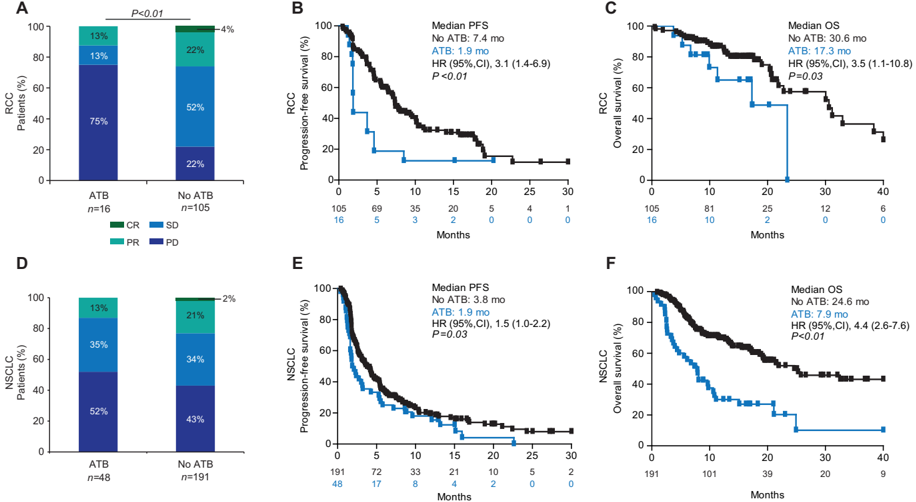
Background: The composition of gut microbiota affects antitumor immune responses, preclinical and clinical outcome following immune checkpoint inhibitors (ICI) in cancer. Antibiotics (ATB) alter gut microbiota diversity and composition leading to dysbiosis, which may affect effectiveness of ICI. Patients and methods: We examined patients with advanced renal cell carcinoma (RCC) and non-small-cell lung cancer (NSCLC) treated with anti-programmed cell death ligand-1 mAb monotherapy or combination at two academic institutions. Those receiving ATB within 30 days of beginning ICI were compared with those who did not. Objective response, progression-free survival (PFS) determined by RECIST1.1 and overall survival (OS) were assessed. Results: Sixteen of 121 (13%) RCC patients and 48 of 239 (20%) NSCLC patients received ATB. The most common ATB were β-lactam or quinolones for pneumonia or urinary tract infections. In RCC patients, ATB compared with no ATB was associated with increased risk of primary progressive disease (PD) (75% versus 22%, P < 0.01), shorter PFS [median 1.9 versus 7.4 months, hazard ratio (HR) 3.1, 95% confidence interval (CI) 1.4-6.9, P < 0.01], and shorter OS (median 17.3 versus 30.6 months, HR 3.5, 95% CI 1.1-10.8, P = 0.03). In NSCLC patients, ATB was associated with similar rates of primary PD (52% versus 43%, P = 0.26) but decreased PFS (median 1.9 versus 3.8 months, HR 1.5, 95% CI 1.0-2.2, P = 0.03) and OS (median 7.9 versus 24.6 months, HR 4.4, 95% CI 2.6-7.7, P < 0.01). In multivariate analyses, the impact of ATB remained significant for PFS in RCC and for OS in NSCLC. Conclusion: ATB were associated with reduced clinical benefit from ICI in RCC and NSCLC. Modulatation of ATB-related dysbiosis and gut microbiota composition may be a strategy to improve clinical outcomes with ICI.
Overview
CoChat Summary
TL;DR
In two independent cohorts of advanced RCC and NSCLC treated with immune checkpoint inhibitors, antibiotic use within 30 days before starting therapy was associated with worse clinical outcomes. The association remained significant for PFS in RCC and for OS in NSCLC in multivariate analyses.
Key findings
- Among 121 RCC patients, 16 (13%) received antibiotics within 30 days of starting ICI. Antibiotic use was associated with more primary progressive disease (75% versus 22%, P < 0.01), shorter median PFS (1.9 versus 7.4 months; HR 3.1, 95% CI 1.4–6.9, P < 0.01), and shorter median OS (17.3 versus 30.6 months; HR 3.5, 95% CI 1.1–10.8, P = 0.03).
- Among 239 NSCLC patients, 48 (20%) received antibiotics within 30 days. Antibiotic use was not associated with primary PD (52% versus 43%, P = 0.26) but was associated with shorter median PFS (1.9 versus 3.8 months; HR 1.5, 95% CI 1.0–2.2, P = 0.03) and shorter median OS (7.9 versus 24.6 months; HR 4.4, 95% CI 2.6–7.7, P < 0.01).
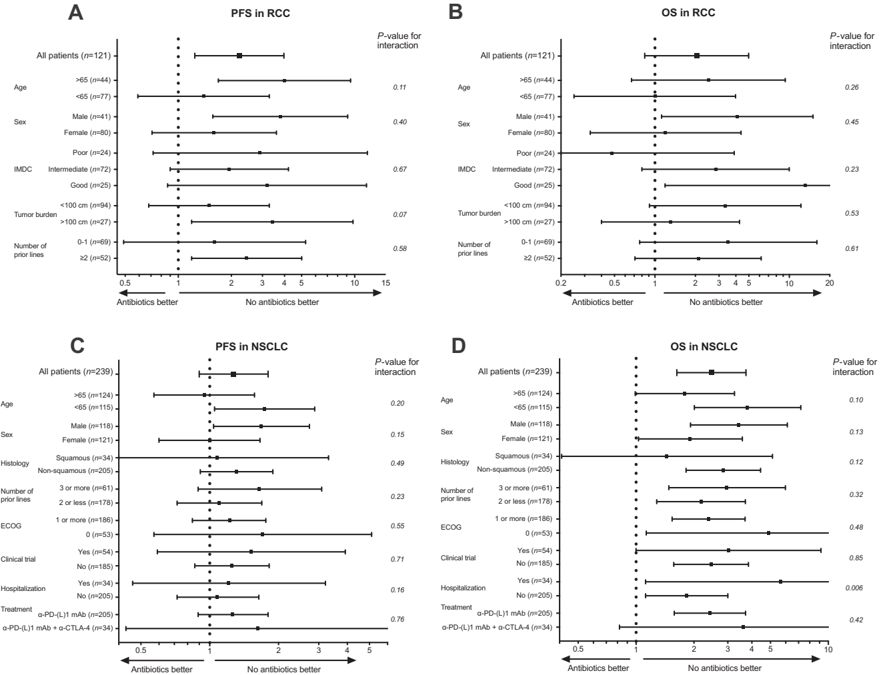
- In multivariate analysis, antibiotics remained associated with worse PFS in RCC (HR 2.0, P < 0.01) but not OS (HR 2.1, P = 0.11); in NSCLC, antibiotics were not significantly associated with PFS (HR 1.3, 95% CI 0.9–1.8, P = 0.17) but remained associated with worse OS (HR 2.5, 95% CI 1.6–3.7, P < 0.01).
- With a 60-day antibiotic window, RCC showed shorter PFS (median 3.1 versus 7.4 months; HR 2.3, 95% CI 1.2–4.4, P < 0.01) and a trend toward worse OS (median 23.4 versus 30 months; HR 1.9, 95% CI 0.8–4.7, P = 0.15); NSCLC showed no difference in objective response or PFS but shorter OS (median 9.8 versus 21.9 months; HR 2.0, 95% CI 1.3–3.2, P < 0.01).
Methods
- Retrospective review of patients with advanced RCC (n = 121) at Gustave Roussy and NSCLC (n = 239) at Memorial Sloan Kettering Cancer Center treated with anti-PD-(L)1 monoclonal antibody monotherapy or combination therapy.
- Antibiotic use was assessed within 30 days or up to 60 days before the first ICI injection; antibiotic class, indication, route, and duration were collected.
- Tumor response was determined by RECIST 1.1; PFS and OS were estimated by Kaplan–Meier and compared with log-rank tests, with multivariable Cox regression adjusting for clinicopathologic features.
Limitations
- The authors state the study is retrospective, with data entry from two institutions; although responses were reviewed with RECIST 1.1, scan timing was not prespecified.
- The authors note differences in patient characteristics between antibiotic and no-antibiotic groups, including higher recent hospitalization in NSCLC and differences in prior lines in RCC, and that analyses did not account for diet, country of origin, or other medications.
- The authors state they did not characterize the mechanism by which antibiotics affect outcomes, and PD-L1 status was lacking in most patients; the text also makes evident that antibiotic subgroups were small and immune-related adverse events were too few to evaluate.
Model-written summary. Check it against the paper before relying on it.
Integrity signals
Registry
Cites
Statistics
Figures




Verification
Claims the paper makes
2 Valid · 1 Not valid · 7 Not checked · 33 Own results and interpretations
At least one cited source doesn’t support this claim or points to a different paper, and none confirmed it — see the verdicts below.
In the paper
“16S ribosomal RNA sequencing of gene amplicons of patients' feces revealed that microbiota returns to its baseline within 1-3 months after ATB discontinuation.”
§ Negative association of antibiotics on clinical activity of immune checkpoint inhibitors in patients with advanced renal cell and non-small-cell lung cancer > Discussion
What the sources say
- Not checked yetcites [14] matched to “Effects of antibiotics on gut microbiota” (2016) source
- Disputedcites [20] matched to “Short-term antibiotic treatment has differing long-term impacts on the human throat and gut microbiome” (2010) sourceExperimental — accuracy not yet measured
The Results section ('Transient and persistent effects of antibiotic treatment'; page unavailable) says fecal microbial communities had only partially recovered at one and four years and remained distinct from their pretreatment compositions. The paper does not report a return to baseline within 1–3 months. (LLM, conf=0.87)
Checked by a reasoning model — may be wrong.
plainstates a cause- Asserted: passes — The authors put it forward as true.
- Checkable: passes — It can be checked against evidence.
- Load-bearing: passes — The paper’s conclusions depend on it.
- Based: passes — The paper gives a reason why it holds.
The sources with a verdict support this claim; the rest weren’t checked yet, have no full text we could read, or their verdicts aren’t rated yet.
In the paper
“However, some bacteria may take years to fully recover [14,20].”
§ Negative association of antibiotics on clinical activity of immune checkpoint inhibitors in patients with advanced renal cell and non-small-cell lung cancer > Discussion
What the sources say
- Not checked yetcites [14] matched to “Effects of antibiotics on gut microbiota” (2016) source
- Supportedcites [20] matched to “Short-term antibiotic treatment has differing long-term impacts on the human throat and gut microbiome” (2010) source
The Results section 'Transient and persistent effects of antibiotic treatment' states that 'One and four years after treatment, the fecal microbial communities had partially recovered to their pre-treatment compositions, however these were still separated along CA axis 2', i.e. full recovery had not occurred even four years after a one-week course. The 'Individuality in antibiotic response' section adds taxon-level persistence (e.g. the increase of unclassified Enterobacteriaceae in patient D persisted during the 4-year period), and the Abstract/Discussion report erm(B) still elevated four years post treatment. The hedged claim that some bacteria 'may take years to fully recover' is therefore within what this source shows; the only points it credits to others (two-year Bacteroides/erm persistence, a resistant clone persisting three years) are separate citations [8] and [10] and are not what the citing sentence attributes here. (LLM, conf=0.82)
hedgedstates a possible cause- Asserted: passes — The authors put it forward as true.
- Checkable: passes — It can be checked against evidence.
- Load-bearing: unclear — It is unclear whether the paper’s conclusions depend on it.
- Based: passes — The paper gives a reason why it holds.
The sources with a verdict support this claim; the rest weren’t checked yet, have no full text we could read, or their verdicts aren’t rated yet.
In the paper
“In oncology, converging findings demonstrate the negative impact of ATBinduced dysbiosis in mice.”
§ Negative association of antibiotics on clinical activity of immune checkpoint inhibitors in patients with advanced renal cell and non-small-cell lung cancer > Introduction
What the sources say
- Supportedcites [9] matched to “Anticancer immunotherapy by CTLA-4 blockade relies on the gut microbiota” (2015) source
The Results passage opening Fig. 1 states that broad-spectrum antibiotics (ampicillin+colistin+streptomycin, and imipenem alone but not colistin) 'compromised the antitumor effects of CTLA-4-specific Ab', confirmed across the Ret melanoma and MC38 colon cancer models and mirrored by germ-free housing — i.e. converging mouse evidence in oncology that antibiotic-induced microbiota disruption harms checkpoint-blockade efficacy. The Abstract states it outright: 'Tumors in antibiotic-treated or germ-free mice did not respond to CTLA blockade.' The only framing shift is minor: the paper attributes the loss of efficacy to depletion/recomposition of the microbiota (rescued by B. fragilis gavage) rather than using the word 'dysbiosis', and it hedges the mechanism ('suggest that the gut microbiota is required'), but the negative impact of antibiotic treatment itself is asserted as fact. (LLM, conf=0.90)
- Not checked yetcites [10]
boostedstates a cause- Asserted: passes — The authors put it forward as true.
- Checkable: passes — It can be checked against evidence.
- Load-bearing: passes — The paper’s conclusions depend on it.
- Based: passes — The paper gives a reason why it holds.
- Supported
A result the paper reports from its own data — it cites no other source for it, so there is none to check. The quote shows it is in the paper.
In the paper
“and shorter OS (median 17.3 versus 30.6 months, HR 3.5, 95% CI 1.1-10.8,P ¼ 0.03).”
- Also stated in: § Results · plain
“median OS, 17.3 months versus 30.6 months, HR 3.5, 95% CI 1.1-10.8,P ¼ 0.03”
§ Negative association of antibiotics on clinical activity of immune checkpoint inhibitors in patients with advanced renal cell and non-small-cell lung cancer > Abstract
plainstates an association- Asserted: passes — The authors put it forward as true.
- Checkable: passes — It can be checked against evidence.
- Load-bearing: passes — The paper’s conclusions depend on it.
- Based: passes — The paper gives a reason why it holds.
- Also stated in: § Results · plain
A result the paper reports from its own data — it cites no other source for it, so there is none to check. The quote shows it is in the paper.
In the paper
“In RCC, ATB-60 days remained associated with increased risk of primary progression (P < 0.01)”
§ Negative association of antibiotics on clinical activity of immune checkpoint inhibitors in patients with advanced renal cell and non-small-cell lung cancer > Results
plainstates an association- Asserted: passes — The authors put it forward as true.
- Checkable: passes — It can be checked against evidence.
- Load-bearing: passes — The paper’s conclusions depend on it.
- Based: passes — The paper gives a reason why it holds.
20 more claims
Create a free account to see all 43 claims and to verify the 15 references still open.
- It may state two separate claims as one. 11
- Probably not a substantial claim. 11
Claims other papers make about this one
Each is checked against this paper’s own text: does it say what the citing paper says it does?
The source backs part of the claim, not all of it — or backs it for a different population, condition or comparison.
In the citing paper
“Similarly, antibiotics (ATB) prior to ICI initiation drastically reduced the clinical benefit in several cohorts of patients across various cancer types (melanoma, advanced NSCLC, renal cell carcinoma (RCC), and urothelial cancer) 18,[20][21][22] .”
From Intestinal Akkermansia muciniphila predicts clinical response to PD-1 blockade in patients with advanced non-small-cell lung cancer (2022) · cites this paper as [20]
Experimental — accuracy not yet measuredThe source backs part of the claim, not all of it — or backs it for a different population, condition or comparison.
In the citing paper
“However, increasing clinical evidence suggests that systemic antibiotics abolish immune checkpoint blockade efficacy and decrease patient survival (133, 136, 137).”
From The microbiome and human cancer (2021) · cites this paper as [137]
Experimental — accuracy not yet measuredThe source backs part of the claim, not all of it — or backs it for a different population, condition or comparison.
In the citing paper
“However, the clinical value of this observation is limited by its derivation from selected oncological indications, including renal and non-small cell lung cancer (NSCLC), 2 for which external validation, especially outside clinical trials, is necessary.”
From Association of Prior Antibiotic Treatment With Survival and Response to Immune Checkpoint Inhibitor Therapy in Patients With Cancer (2019) · cites this paper as [2]
Experimental — accuracy not yet measuredThe source backs part of the claim, not all of it — or backs it for a different population, condition or comparison.
In the citing paper
“However, our results suggest that administration of these classes of antibiotics constitutes a likely surrogate for poor disease status and a state of increased systemic inflammation prior to initiation of CAR-T cell therapy, as was recently suggested in cancer patients treated with other ICBs28,35.”
From A non-antibiotic-disrupted gut microbiome is associated with clinical responses to CD19-CAR-T cell cancer immunotherapy (2023) · cites this paper as [28]
Experimental — accuracy not yet measuredThe cited source says what the claim attributes to it.
In the citing paper
“Supporting this contention, we and others reported that primary responses to anti-PD-1/ PD-L1 antibodies in patients with epithelial tumours and melanoma could, at least in part, be attributed to the taxonomic composition of the gut microbial ecosystem 18,20,25 .”
From Intestinal Akkermansia muciniphila predicts clinical response to PD-1 blockade in patients with advanced non-small-cell lung cancer (2022) · cites this paper as [20]
14 more claims about this paper
Create a free account to see every claim other papers make about this one.
Self-check
Percentages, sums and reported differences re-computed from the paper’s own numbers.
Each contradiction between two passages listed here was confirmed by an independent check.
Rated major: it would touch a result — a value a result rests on, reported and recomputed p-values on opposite sides of the significance level, two passages that conflict with no sign which is right, or a cited work retracted before this paper was published.
In the paper
§ Negative association of antibiotics on clinical activity of immune checkpoint inhibitors in patients with advanced renal cell and non-small-cell lung cancer > Results
“median PFS, 1.9 months versus 3.8 months, HR 1.5, 95% CI 1.0-2.2,P ¼ 0.03”
§ Negative association of antibiotics on clinical activity of immune checkpoint inhibitors in patients with advanced renal cell and non-small-cell lung cancer > Discussion
“ATB 30-0/No ATB 1.4 (1.0-2.0)0.04 1.3 (0.9-1.8) 0.17”
Rated major: it would touch a result — a value a result rests on, reported and recomputed p-values on opposite sides of the significance level, two passages that conflict with no sign which is right, or a cited work retracted before this paper was published.
In the paper
§ Negative association of antibiotics on clinical activity of immune checkpoint inhibitors in patients with advanced renal cell and non-small-cell lung cancer > Results
“median OS, 7.9 months versus 24.6 months, HR 4.4, 95% CI 2.6-7.7,P < 0.01”
§ Negative association of antibiotics on clinical activity of immune checkpoint inhibitors in patients with advanced renal cell and non-small-cell lung cancer > Discussion
“ATB 30-0/No ATB 2.9 (1.9-4.4)<0.01 2.5 (1.6-3.7)<0.01”
Rated major: it would touch a result — a value a result rests on, reported and recomputed p-values on opposite sides of the significance level, two passages that conflict with no sign which is right, or a cited work retracted before this paper was published.
In the paper
§ Negative association of antibiotics on clinical activity of immune checkpoint inhibitors in patients with advanced renal cell and non-small-cell lung cancer > Results
“median PFS, 1.9 months versus 7.4 months, HR 3.1, 95% CI 1.4-6.9,P < 0.01”
§ Negative association of antibiotics on clinical activity of immune checkpoint inhibitors in patients with advanced renal cell and non-small-cell lung cancer > Discussion
“ATB 30-0/No ATB 2.3 (1.3-4.0)<0.01 2.2 (1.3-3.3)<0.01”
Rated minor: it would not touch a result — a value no result rests on, a p-value that stays on the same side of the significance level, or a conflict that is clerical, resolved elsewhere in the paper, or outside its own findings.
In the paper
§ Negative association of antibiotics on clinical activity of immune checkpoint inhibitors in patients with advanced renal cell and non-small-cell lung cancer > Results
“Range 28-83 29-83 30-82”
§ Negative association of antibiotics on clinical activity of immune checkpoint inhibitors in patients with advanced renal cell and non-small-cell lung cancer > Results
“ATB 30-0 (n 5 16) No ATB (n 5 105)”
Rated minor: it would not touch a result — a value no result rests on, a p-value that stays on the same side of the significance level, or a conflict that is clerical, resolved elsewhere in the paper, or outside its own findings.
In the paper
§ Negative association of antibiotics on clinical activity of immune checkpoint inhibitors in patients with advanced renal cell and non-small-cell lung cancer > Discussion
“Female (n=80) Male (n=41)”
§ Negative association of antibiotics on clinical activity of immune checkpoint inhibitors in patients with advanced renal cell and non-small-cell lung cancer > Results
“Gender, n (%) Male 80 (66) 9 (56) 71 (68) 0.37 Female 41 (34) 7 (44) 34 (32)”
4 more findings
Create a free account to see every finding of this check.
Citations
Cites
New response evaluation criteria in solid tumours: revised RECIST guideline (version 1.1)
Eisenhauer, E. A., Therasse, P., Bogaerts, J., Schwartz, L. H., Sargent, D., Ford, R., Dancey, J., Arbuck, S., Gwyther, S., Mooney, M., et al. (2009) · European Journal of Cancer · doi:10.1016/j.ejca.2008.10.026 · Cited by 29,534
Adverse Renal Effects of Immune Checkpoint Inhibitors: A Narrative Review
Wanchoo, R., Karam, S., Uppal, N. N., Barta, V. S., Deray, G., Devoe, C., Launay-Vacher, V., Jhaveri, K. D., & on behalf of Cancer and Kidney International Network Workgroup on Immune Checkpoint Inhibitors (2017) · American Journal of Nephrology · doi:10.1159/000455014 · Cited by 15,256
Pembrolizumab versus Chemotherapy for PD-L1-Positive Non-Small-Cell Lung Cancer
Reck, M., Rodríguez-Abreu, D., Robinson, A. G., Hui, R., Csőszi, T., Fülöp, A., Gottfried, M., Peled, N., Tafreshi, A., Cuffe, S., et al. (2016) · New England Journal of Medicine · doi:10.1056/nejmoa1606774 · Cited by 10,089
Nivolumab versus docetaxel in advanced nonsquamous non-small-cell lung cancer
Borghaei, H., Paz-Ares, L., Horn, L., Spigel, D. R., Steins, M., Ready, N. E., Chow, L. Q., Vokes, E. E., Felip, E., Holgado, E., et al. (2015) · New England Journal of Medicine · doi:10.1056/nejmoa1507643 · Cited by 9,335
Nivolumab versus Everolimus in Advanced Renal-Cell Carcinoma
Motzer, R. J., Escudier, B., McDermott, D. F., George, S., Hammers, H. J., Srinivas, S., Tykodi, S. S., Sosman, J. A., Procopio, G., Plimack, E. R., et al. (2015) · New England Journal of Medicine · doi:10.1056/nejmoa1510665 · Cited by 5,807
Self-citationGut microbiome influences efficacy of PD-1-based immunotherapy against epithelial tumors
Routy, B., Le Chatelier, E., Derosa, L., Duong, C. P. M., Alou, M. T., Daillère, R., Fluckiger, A., Messaoudene, M., Rauber, C., Roberti, M. P., et al. (2018) · Science · doi:10.1126/science.aan3706 · Cited by 5,671
Self-citationDiversity, stability and resilience of the human gut microbiota
Lozupone, C. A., Stombaugh, J. I., Gordon, J. I., Jansson, J. K., & Knight, R. (2012) · Nature · doi:10.1038/nature11550 · Cited by 5,533
Gut microbiome modulates response to anti-PD-1 immunotherapy in melanoma patients
Gopalakrishnan, V., Spencer, C. N., Nezi, L., Reuben, A., Andrews, M. C., Karpinets, T. V., Prieto, P. A., Vicente, D., Hoffman, K., Wei, S. C., et al. (2018) · Science · doi:10.1126/science.aan4236 · Cited by 4,812
Self-citationIFN-γ–related mRNA profile predicts clinical response to PD-1 blockade
Ayers, M., Lunceford, J., Nebozhyn, M., Murphy, E., Loboda, A., Kaufman, D. R., Albright, A., Cheng, J. D., Kang, S. P., Shankaran, V., et al. (2017) · Journal of Clinical Investigation · doi:10.1172/jci91190 · Cited by 3,788
Anticancer immunotherapy by CTLA-4 blockade relies on the gut microbiota
Vétizou, M., Pitt, J. M., Daillère, R., Lepage, P., Waldschmitt, N., Flament, C., Rusakiewicz, S., Routy, B., Roberti, M. P., Duong, C. P. M., et al. (2015) · Science · doi:10.1126/science.aad1329 · Cited by 3,488
Self-citation
Cited by
Items 401–500 of 909
Quandt, Z., Lucas, A., Liang, S. I., Yang, E., Stone, S., Fadlullah, M. Z. H., Bayless, N. L., Marr, S. S., Thompson, M. A., Padrón, L., et al. (2025) · Journal for ImmunoTherapy of Cancer · doi:10.1136/jitc-2025-011545 · Cited by 29
The microbiome as a therapeutic co-driver in melanoma immuno-oncology
Bautista, J., Chávez, J. A. V., Larco, D. S. B., Martín-Aguilera, R., & López‐Cortés, A. (2025) · Frontiers in Medicine · doi:10.3389/fmed.2025.1673880 · Cited by 28
Promising predictors of checkpoint inhibitor response in NSCLC
Friedlaender, A., & Alfredo, A. (2020) · Expert Review of Anticancer Therapy · doi:10.1080/14737140.2020.1816173 · Cited by 21
Pak, S., Kim, S., Kim, S. H., Joung, J. Y., Park, W. S., Chung, J., Lee, K. H., & Seo, H. K. (2021) · Frontiers in Oncology · doi:10.3389/fonc.2021.570077 · Cited by 22
The cure from within? a review of the microbiome and diet in melanoma
Kumar, P. R., Brazel, D., DeRogatis, J. M., Goldstein, J. B., Whiteson, K., Chow, W. A., Tinoco, R., & Moyers, J. T. (2022) · Cancer and Metastasis Reviews · doi:10.1007/s10555-022-10029-3 · Cited by 25
“Additional studies have re-emphasized GM importance by showing that patients with malignancy on antibiotics had significantly shorter overall survival and progression free survival on immunotherapy agents as compared to patients who were not on antibiotics [63, 136].”
BackgroundKato, T., Fujita, K., Minami, T., Nagahara, A., Hyashi, Y., Nakata, W., Matsuzaki, K., Nakano, K., Hatano, K., Kawashima, A., et al. (2022) · International Journal of Clinical Oncology · doi:10.1007/s10147-022-02215-8 · Cited by 24
“On the other hand, recently, several studies reported the negative association of ATB on the response to ICIs in patients with RCC and NSCLC [25, 26, 28].”
BackgroundWada, A., Enokida, T., Okano, S., Sato, M., Tanaka, H., Ueda, Y., Fujisawa, T., Takeshita, N., Tanaka, N., & Tahara, M. (2023) · European Journal of Cancer · doi:10.1016/j.ejca.2023.02.011 · Cited by 23
Primary and acquired resistance to first-line therapy for clear cell renal cell carcinoma
Astore, S., Baciarello, G., Cerbone, L., & Calabrò, F. (2023) · Cancer Drug Resistance · doi:10.20517/cdr.2023.33 · Cited by 29
Zapata, M. E. S., Pellitero, A. M., Isla, D., Gálvez, E. H., Ruiz, M. G., Sesma, A., Barbero-Herranz, R., Galeano, J., del Campo, R., Ocáriz, M., et al. (2024) · Heliyon · doi:10.1016/j.heliyon.2024.e33684 · Cited by 24
“Some trials have demonstrated that certain commensal bacteria, such as Akkermansia muciniphila, are more abundant in stool samples from responders [47,50].”
BackgroundStratmann, J., Lacko, R., Balló, O., Shaid, S., Gleiber, W., Vehreschild, M. J. G. T., Wichelhaus, T. A., Reinheimer, C., Göttig, S., Kempf, V. A. J., et al. (2020) · PLoS ONE · doi:10.1371/journal.pone.0242544 · Cited by 19
“This is also supported by reduced clinical benefit from immunotherapy after the usage of antibiotics in patients with NSCLC [56, 60].”
BackgroundFaget, J., Boivin, G., Ancey, P., Gkasti, A., Mussard, J., Engblom, C., Pfirschke, C., Vázquez, J., Bendriss‐Vermare, N., Caux, C., et al. (2018) · bioRxiv (Cold Spring Harbor Laboratory) · doi:10.1101/498881 · Cited by 22
Wang, X., Xiong, D., Cui, S., Duan, B., Ding, G., Huang, Y., & Wang, Q. (2026) · Frontiers in Immunology · doi:10.3389/fimmu.2026.1732079 · Cited by 29
“This may re fl ect elimination of bene fi cial microbes and altered microbial metabolism (17, 18).”
Simple and effective bacterial-based intratumoral cancer immunotherapy
Carroll, C., Andrew, E. R., Malik, L., Elliott, K. F., Brennan, M., Meyer, J., Hintze, A., Almonte, A. A., Lappin, C., Macpherson, P., et al. (2021) · Journal for ImmunoTherapy of Cancer · doi:10.1136/jitc-2021-002688 · Cited by 22
Rassy, E., Dalban, C., Colomba, É., Derosa, L., Silva, C. A. C., Négrier, S., Chevreau, C., Gravis, G., Oudard, S. M., Laguerre, B., et al. (2022) · Clinical Genitourinary Cancer · doi:10.1016/j.clgc.2022.07.003 · Cited by 20
Self-citationGut microbiota: a potential target for improved cancer therapy
Zhao, M., Jiang, G., Zhou, H., Li, J., Xiang, W., Li, S., Wang, H., & Zhou, J. (2022) · Journal of Cancer Research and Clinical Oncology · doi:10.1007/s00432-022-04546-5 · Cited by 20
The Microbiome’s Influence on Head and Neck Cancers
Dorobisz, K., Dorobisz, T. A., & Zatoński, T. (2023) · Current Oncology Reports · doi:10.1007/s11912-022-01352-7 · Cited by 27
Microbiota: A key factor affecting and regulating the efficacy of immunotherapy
Jiang, Y., Jia, D., Sun, Y., Ding, N., & Wang, L. (2023) · Clinical and Translational Medicine · doi:10.1002/ctm2.1508 · Cited by 22
The Microbiome Modulates the Immune System to Influence Cancer Therapy
Roy, R., & Singh, S. K. (2024) · Cancers · doi:10.3390/cancers16040779 · Cited by 20
“…treatment increased the risk of primary progressive disease in both types of cancer patients, suggesting that antibiotics reduced the clinical benefits of immune-checkpoint inhibitor therapy in the RCC and NSCLC patients, which can be modulated by altering the gut microbiota composition [59].”
BackgroundSun, L., Wang, X., Zhou, H., Li, R., Meng, M., Roviello, G., Oh, B., Feng, L., Yu, Z., & Wang, J. (2024) · Journal of Thoracic Disease · doi:10.21037/jtd-24-1201 · Cited by 24
“The connection between the human gut microbiome and clinical responses to anti-PD-1/PD-L1 treatment has become apparent in recent years (11,12), and the gut microbiota has been shown to play a critical role in ICI treatment for advanced melanoma (13), NSCLC (14), and advanced renal cell cancer (15).”
Antibiotics and immunotherapy in gastrointestinal tumors: Friend or foe?
Yan, C., Tu, X., Wu, W., Tong, Z., Liu, L., Zheng, Y., Jiang, W., Zhao, P., Fang, W. J., & Zhang, H. (2019) · World Journal of Clinical Cases · doi:10.12998/wjcc.v7.i11.1253 · Cited by 20
Lu, L., Zhuang, T., Shao, E., Liu, Y., He, H., Shu, Z., Huang, Y., Yao, Y., Lin, S., Lin, S., et al. (2019) · PLoS ONE · doi:10.1371/journal.pone.0221964 · Cited by 20
Ciccolini, J., Benzekry, S., & Barlési, F. (2020) · British Journal of Cancer · doi:10.1038/s41416-020-0918-3 · Cited by 19
Conde‐Estévez, D., Monge‐Escartín, I., Ríos-Hoyo, A., Monzonís, X., Echeverría-Esnal, D., Moliner, L., Durán, X., Taus, Á., & Arriola, E. (2020) · Journal of Chemotherapy · doi:10.1080/1120009x.2020.1849488 · Cited by 22
Mouritzen, M. T., Junker, K. F., Carus, A., Ladekarl, M. B., Meldgaard, P., Nielsen, A. W. M., Livbjerg, A., Larsen, J. W., Skúladóttir, H., Kristiansen, C., et al. (2022) · Acta Oncologica · doi:10.1080/0284186x.2021.2023213 · Cited by 19
Huang, S., Bai, X., Fang, T., Guo, Y., Zheng, K., & Lin, X. (2021) · Journal of Zhejiang University SCIENCE B · doi:10.1631/jzus.b2000449 · Cited by 19
Immune checkpoint blockade in renal cell carcinoma
Rappold, P. M., Silagy, A. W., Kotecha, R. R., & Hakimi, A. A. (2021) · Journal of Surgical Oncology · doi:10.1002/jso.26339 · Cited by 23
“These findings were subsequently validated in a separate cohort of 121 patients with RCC receiving anti‐PD‐1 therapy.(82) The patients receiving antibiotics within 30 days of starting PD‐1 inhibitors (13% of the cohort) had an increased risk of progressive disease (75% vs.”
ResultBoudou, P., Arrondeau, J., Gervais, C., Durand, J.-P., Fabre, E., Percin, S. D., Villeminey, C., Piketty, A.-C., Rassy, N., Ulmann, G., et al. (2021) · EBioMedicine · doi:10.1016/j.ebiom.2021.103630 · Cited by 19
Long-Term Use of Proton Pump Inhibitors in Cancer Patients: An Opinion Paper
Raoul, J., Edeline, J., Simmet, V., Moreau-Bachelard, C., Gilabert, M., & Frenel, J. (2022) · Cancers · doi:10.3390/cancers14051156 · Cited by 23
“Recent works on preclinical models, confirmed in retrospective analyses, suggest that patients who received antibiotics around the time of the initiation of immune checkpoint inhibitors (ICI) experienced reduced clinical benefits [33,55].”
ResultThe Emerging Roles of Human Gut Microbiota in Gastrointestinal Cancer
Guo, Q., Qin, H., Liu, X., Zhang, X., Chen, Z., Qin, T., Chang, L., & Zhang, W. (2022) · Frontiers in Immunology · doi:10.3389/fimmu.2022.915047 · Cited by 25
Xu, K., Cai, J., Xing, J. Q., Li, X., Wu, B., Zhu, Z., & Zhang, Z. (2022) · BMC Cancer · doi:10.1186/s12885-022-10307-x · Cited by 23
“Cancer patients receive broad-spectrum antibiotics (ATB) generally for common indications (such as pneumonia or urinary tract infection) [17, 18], or to exclude infectious diseases before the final diagnosis of cancer.”
BackgroundBernicker, E., & Quigley, E. M. M. (2019) · Journal of Thoracic Oncology · doi:10.1016/j.jtho.2019.05.016 · Cited by 21
Pérez-Ruiz, E., Jiménez-Castro, J., Berciano‐Guerrero, M., Valdivia, J., Estalella-Mendoza, S., Toscano, F., Artacho, M. R. D. L. B., Garrido-Siles, M., Bautista, M. J. M., Roldán, R. V., et al. (2020) · Clinical & Translational Oncology · doi:10.1007/s12094-020-02315-9 · Cited by 20
Swami, U., Chennamadhavuni, A., Borcherding, N. C., Bossler, A., Mott, S. L., Garje, R., Zakharia, Y., & Milhem, M. M. (2020) · Antibiotics · doi:10.3390/antibiotics9110740 · Cited by 19
“For example, antibiotics have been associated with reduced benefit in melanoma [15,16], non-small cell lung cancer (NSCLC) [15,17,18], and kidney cancer [17].”
BackgroundBouferraa, Y., Chedid, A., Amhaz, G., Lakkiss, A. E., Mukherji, D., Temraz, S. N., & Shamseddine, A. I. (2021) · International Journal of Molecular Sciences · doi:10.3390/ijms22158036 · Cited by 18
“This deleterious effect of antibiotics on CPIs may last for a period of several months, highlighting the importance of weighing risks and benefits when prescribing antibiotics to cancer patients treated with CPIs [30,82,84].”
BackgroundXu, J., Song, J., Fu, Z., Zhou, H. K., Zhang, Y., & Chen, S. (2025) · BMC Cancer · doi:10.1186/s12885-025-15094-9 · Cited by 28
Microbiota regulates intratumoral monocytes to promote anti-tumor immune responses
McCoy, K. D., & Geuking, M. B. (2021) · Cell · doi:10.1016/j.cell.2021.09.024 · Cited by 17
Araji, G., Maamari, J., Ahmad, F. A., Zareef, R. O., Chaftari, P. S., & Yeung, S. J. (2021) · Journal of Immunotherapy and Precision Oncology · doi:10.36401/jipo-21-10 · Cited by 22
“Akkermansia muciniphila was also consistently found to be associated with favorable clinical outcomes and improved PFS in NSCLC and RCC studies conducted by Routy et al([55]) and Derosa et al.([57]) A positive correlation was also noted in a study on melanoma patients.”
BackgroundResultInfluentialMorrell, S. L., Kohonen‐Corish, M. R. J., Ward, R. L., Sorrell, T. C., Roder, D. M., & Currow, D. C. (2022) · Journal of Clinical Epidemiology · doi:10.1016/j.jclinepi.2022.04.003 · Cited by 19
Colard‐Thomas, J., Thomas, Q. D., & Viala, M. (2023) · Cancers · doi:10.3390/cancers15082276 · Cited by 22
“Derosa (2018) [68] RCC NSCLC ICI (multiple) +/− TT Within 30 d before ICI initiation 16/121 (13) RCC 13% vs.”
BackgroundGut microbiota and immunotherapy of renal cell carcinoma
Bibbò, S., Porcari, S., Vecchio, L. E. D., Severino, A., Mullish, B. H., Ianiro, G., Gasbarrini, A., & Cammarota, G. (2023) · Human Vaccines & Immunotherapeutics · doi:10.1080/21645515.2023.2268982 · Cited by 20
“71,72”
https://cdrjournal.com/article/view/3531
Moreira, M., Pobel, C., Epaillard, N., Simonaggio, A., Oudard, S. M., & Vano, Y. A. (2020) · Cancer Drug Resistance · doi:10.20517/cdr.2020.16 · Cited by 39
“Lalani([23]), Derosa et al.([24]) and Tinsley et al.”
BackgroundInfluentialRecent advances in primary resistance mechanisms against immune checkpoint inhibitors
Li, Y.-Z., & Zhang, H.-M. (2021) · Current Opinion in Oncology · doi:10.1097/cco.0000000000000802 · Cited by 20
The Role of Hitchhiking in Cancer Therapeutics—A Review
Padmakumar, A., Koyande, N. P., & Rengan, A. K. (2022) · Advanced Therapeutics · doi:10.1002/adtp.202200042 · Cited by 20
Michaelidou, K., Agelaki, S., & Mavridis, K. (2020) · Expert Review of Molecular Diagnostics · doi:10.1080/14737159.2020.1724785 · Cited by 17
“[109] showed that ATB alters gut microbiota composition and diversity leading to dysbiosis, which is associated with reduced clinical benefit from ICIs in NSCLC patients.”
BackgroundMalard, F., Thépot, S., Cluzeau, T., Carré, M., Lebon, D., Bories, P., Legrand, O., Schwarz, M., Loschi, M. L., Meunier, M., et al. (2025) · Blood Advances · doi:10.1182/bloodadvances.2024015571 · Cited by 22
“8-10 Therefore, therapeutic strategies developed to restore or preserve the gut microbiota composition are worth evaluating given that they could improve the outcome of patients undergoing immunochemotherapy.”
Fluctuations in Gut Microbiome Composition During Immune Checkpoint Inhibitor Therapy
Sarkar, J., Gomez, E. C., Oba, T., Chen, H., Dy, G. K., Segal, B. H., Ernstoff, M. S., & Ito, F. (2023) · World Journal of Oncology · doi:10.14740/wjon1587 · Cited by 20
“As an example, use of antibiotics has been shown to reduce the efficacy of ICIs in a number of cancers [37, 38].”
MethodAbdelhamid, A., Tuminello, S., Ivic‐Pavlicic, T., Flores, R. M., & Taioli, E. (2023) · Translational Lung Cancer Research · doi:10.21037/tlcr-23-597 · Cited by 21
“Two studies: Routy, 2018 and Derosa, 2018 reported on the same patient population (24,25).”
BackgroundChorti, E., Kowall, B., Hassel, J. C., Schilling, B., Sachse, M., Gutzmer, R., Loquai, C., Kähler, K. C., Hüsing, A., Gilde, C., et al. (2024) · European Journal of Cancer · doi:10.1016/j.ejca.2024.113536 · Cited by 19
Luo, W., Mei, S., Huang, Z., Chen, Z., Zhang, Y., Yang, M., Liu, J., Xu, J., Yang, X., Zhong, R.-W., et al. (2024) · Journal of Translational Medicine · doi:10.1186/s12967-024-05135-5 · Cited by 26
“…immunotherapy efficacy in EGFR + NSCLC. Previous studies indicated that the use of antibiotics, which affects the composition and diversity of gut microbiota, was associated with poor immunotherapy outcomes in patients with advanced EGFR-NSCLC, both in European and Asian populations [24–26].”
BackgroundGuan, S., Jifeng, S., Wang, Y., Han, S., Chen, C., Yue, D., Huang, Y., Ren, K., Wang, J., Wang, J., et al. (2024) · Cancer Immunology Immunotherapy · doi:10.1007/s00262-024-03696-4 · Cited by 21
Diop, K., Mbaye, B., Nili, S., Filin, A., Benlaïfaoui, M., Malo, J., Renaud, A. S., Belkaïd, W., Hunter, S., Messaoudene, M., et al. (2025) · Gut Pathogens · doi:10.1186/s13099-025-00694-4 · Cited by 17
“…shotgun metagenomics sequencing of patients with NSCLC, melanoma, and renal cell carcinoma demonstrated enrichment of beneficial commensal bacteria in responder patients compared to enrichment of deleterious bacteria in non-responder patients, mirroring observations in preclinical models [2, 7].”
Self-citationPrabhash, K., Kapoor, A., Noronha, V., Patil, V., Joshi, A., Menon, N. S., Abraham, G., Talreja, V. T., & Dsouza, H. (2019) · Cancer Research Statistics and Treatment · doi:10.4103/crst.crst_88_19 · Cited by 16
“There have been previous reports of negative association of antibiotics on clinical activity of CPI in patients with advanced renal and NSCLC both in terms of PFS and OS.[13] To our knowledge, no previous study has reported results on the use of antibiotics in patients who received steroids while receiving CPI.”
ResultGut Microbiota-Mediated Modulation of Cancer Progression and Therapy Efficacy
Cheng, P., Shen, P., Shan, Y., Yu, Y., Deng, R., Chen, W., Lu, Y., & Wei, Z. (2021) · Frontiers in Cell and Developmental Biology · doi:10.3389/fcell.2021.626045 · Cited by 18
Lung microbiome: an emerging player in lung cancer pathogenesis and progression
Karvela, A., Veloudiou, O.-Z., Karachaliou, A., Kloukina, T., Gomatou, G., & Kotteas, E. A. (2023) · Clinical & Translational Oncology · doi:10.1007/s12094-023-03139-z · Cited by 17
Gut microbiome and gastric cancer: microbial interactions and therapeutic potential
El-Ghannam, M., Hassanien, M. H., Ameen, Y. A., Turky, E. A., ELattar, G. M., Ray, A. A. E., & Eltalkawy, M. D. (2025) · Gut Pathogens · doi:10.1186/s13099-025-00729-w · Cited by 16
“They may also reduce the efficacy of chemotherapy [183, 184], radiation [185], and immuno-therapy [186].”
Analysis of interactions of immune checkpoint inhibitors with antibiotics in cancer therapy
Li, Y., Wang, S., Lin, M., Hou, C., Li, C., & Li, G. (2022) · Frontiers of Medicine · doi:10.1007/s11684-022-0927-0 · Cited by 15
Oral infections in oral cancer survivors: A mini-review
Pispero, A., Lombardi, N., Manfredi, M., Varoni, E. M., Sardella, A., & Lodi, G. (2022) · Frontiers in Oral Health · doi:10.3389/froh.2022.970074 · Cited by 17
“In the gut, chemotherapy has been reported to produce severe dysbiosis, which may be further worsened by the concomitant use of antibiotics (10); the latter associated with a decrease the clinical activity of cancer immunotherapy (11).”
BackgroundNeurological adverse events associated with PD-1/PD-L1 immune checkpoint inhibitors
Zhou, Y., & Li, H. (2023) · Frontiers in Neuroscience · doi:10.3389/fnins.2023.1227049 · Cited by 15
Non-pharmaceutical interventions to optimize cancer immunotherapy
Boesch, M., Baty, F., Rassouli, F., Kowatsch, T., Joerger, M., Früh, M., & Brutsche, M. H. (2023) · OncoImmunology · doi:10.1080/2162402x.2023.2255459 · Cited by 20
“13 Given these data, prescription and use of antibiotics in cancer patients currently receiving, or scheduled to receive, ICB therapy should follow particularly careful considerations beyond the pure anti-infective perspective.”
BackgroundGiudice, T. D., Staropoli, N., Tassone, P., Tagliaferri, P., & Barbieri, V. (2024) · Cancers · doi:10.3390/cancers16101806 · Cited by 17
Navigating practical challenges in immunotherapy for metastatic triple negative breast cancer
Licata, L., Dieci, M. V., Angelis, C. D., Marchiò, C., Miglietta, F., Cortesi, L., Fabi, A., Schmid, P., Cortés, J., Pusztai, L., et al. (2024) · Cancer Treatment Reviews · doi:10.1016/j.ctrv.2024.102762 · Cited by 17
Ascierto, P. A., Agarwala, S. S., Botti, G., Budillon, A., Davies, M. A., Dummer, R., Ernstoff, M. S., Ferrone, S., Formenti, S. C., Gajewski, T. F., et al. (2019) · Journal of Translational Medicine · doi:10.1186/s12967-019-1979-z · Cited by 16
Self-citationDaillère, R., Routy, B., Goubet, A., Cogdill, A. P., Ferrere, G., Silva, C. A.-C., Fluckiger, A., Ly, P., Haddad, Y., Pizzato, E., et al. (2020) · OncoImmunology · doi:10.1080/2162402x.2020.1794423 · Cited by 18
Self-citationBiomarkers for immune checkpoint therapy targeting programmed death 1 and programmed death ligand 1
Fan, J., Shen, X., Wang, Y., Zhou, H., Liu, G., Li, Y., & Xu, Z. (2020) · Biomedicine & Pharmacotherapy · doi:10.1016/j.biopha.2020.110621 · Cited by 15
Ma, W., Gong, Z., Abu‐Sbeih, H., Peng, Y., Peng, F. B., Zou, F., Charabaty, A., Okhuysen, P. C., McQuade, J. L., Altan, M., et al. (2021) · American Journal of Clinical Oncology · doi:10.1097/coc.0000000000000841 · Cited by 16
“Infection to immunosuppressant (N= 8), median (IQR) (d) 16 (11-69)* 6.”
Angrish, M. D., Agha, A., & Pezo, R. C. (2021) · Journal of Skin Cancer · doi:10.1155/2021/9120162 · Cited by 15
“which found a significant increase in primary disease progression, and a significant decrease in PFS and OS for advanced renal cell and NSCLC patients who received antibiotics within 30 days prior to ICIs, as opposed to those who did not [9].”
ResultSimonetti, S., Iuliani, M., Stellato, M., Cavaliere, S., Vincenzi, B., Tonini, G., Santini, D., & Pantano, F. (2022) · Journal for ImmunoTherapy of Cancer · doi:10.1136/jitc-2022-005136 · Cited by 17
“12 13 Tumor micro-environment including tumor infiltrating immune cells and microbiome 14–16 are other interesting fields of Open access investigation, but these are far to be reproducibility as biomarkers.”
Santoni, M., Molina‐Cerrillo, J., Myint, Z. W., Massari, F., Büchler, T., Buti, S., Matrana, M. R., Giorgi, U. D., Rizzo, M., Ortego, I., et al. (2022) · Targeted Oncology · doi:10.1007/s11523-022-00907-9 · Cited by 17
Pharmacomicrobiomics in precision cancer therapy: bench to bedside
Ngoc, K. L., Pham, T. T. H., Nguyen, T. K., & Huong, P. T. (2024) · Frontiers in Immunology · doi:10.3389/fimmu.2024.1428420 · Cited by 20
The microbiota in radiotherapy-induced cancer immunosurveillance
Chen, J., Deutsch, É., Kroemer, G., Galluzzi, L., & Zitvogel, L. (2025) · Nature Reviews Clinical Oncology · doi:10.1038/s41571-025-01052-8 · Cited by 19
Self-citationBurns, E. A., Gee, K., Kieser, R. B., Xu, J., Zhang, Y., Crenshaw, A., Muhsen, I. N., Mylavarapu, C., Esmail, A., Shah, S., et al. (2022) · Cancers · doi:10.3390/cancers15010081 · Cited by 15
Tsakmaklis, A., Farowski, F., Zenner, R., Lesker, T. R., Strowig, T., Schlößer, H., Lehmann, J. M., von Bergwelt‐Baildon, M., Mauch, C., Schlaak, M. S., et al. (2023) · BMC Cancer · doi:10.1186/s12885-023-11551-5 · Cited by 14
“…that advanced cancer stages can imply an altered composition of the gut microbiome, especially as an adverse effect of more medication such as chemotherapy or antibiotics, the specific implications of different cancer stages on the efficacy of ICI is still subject of ongoing investigation [29, 30].”
BackgroundAsadzadeh, F., Emami, S., Elbeltagi, A., Akıner, M. E., Rezaverdinejad, V., Taran, F., & Salem, A. (2025) · Scientific Reports · doi:10.1038/s41598-025-04605-0 · Cited by 20
Qiu, H., Ma, Q., Chen, X., Wen, X., Zhang, N., Liu, W.-M., Wang, T., & Zhang, L. (2022) · PubMed Central · Cited by 23
Luo, Z., Hao, S., Li, Y., Cheng, L., Zhou, X., Gunes, E. G., Liu, S., & Chen, J. (2022) · Frontiers in Immunology · doi:10.3389/fimmu.2022.1065004 · Cited by 19
“Ten studies (8, 14, 15, 21–23, 31–34) were included in the systematic review, four studies (8, 14, 15, 31) were excluded from meta-analysis for the following reasons: 1.”
BackgroundResultInfluentialAntibiotics Modulate Chemotherapy Efficacy in Patients with Esophageal Cancer
Wu, C., Lai, R., Li, J., Zhang, J., Zhao, Y., Zhang, X., Zhao, Y., & Guo, Z. (2020) · Cancer Management and Research · doi:10.2147/cmar.s248130 · Cited by 14
Gut microbes and immunotherapy for non-small cell lung cancer: a systematic review
Jin, Y., Jie, Z., & Fan, X. (2025) · Frontiers in Oncology · doi:10.3389/fonc.2025.1518474 · Cited by 24
The Gut Microbiome and Metastatic Renal Cell Carcinoma
Meza, L., Feng, M., Lee, K., Sperandio, R., & Pal, S. K. (2023) · Journal of Clinical Medicine · doi:10.3390/jcm12041502 · Cited by 12
“Overall, the resulting evidence indicates that treatment with antibiotics is associated with decreased overall survival (OS), progression-free survival (PFS) and objective response rate (ORR) in patients with mRCC treated with standard-of-care ICIs [84].”
BackgroundThe Microbiome in Advanced Melanoma: Where Are We Now?
Fortman, D. D., Hurd, D. E., & Davar, D. (2023) · Current Oncology Reports · doi:10.1007/s11912-023-01431-3 · Cited by 14
Roy, A. M., & George, S. (2023) · Cancer Drug Resistance · doi:10.20517/cdr.2023.47 · Cited by 14
Nucera, F., Ruggeri, P., Spagnolo, C. C., Santarpía, M., Ieni, A., Monaco, F. L., Tuccari, G., Pioggia, G., & Gangemi, S. (2024) · International Journal of Molecular Sciences · doi:10.3390/ijms25126685 · Cited by 16
“In contrast, antibiotics may decrease the effectiveness of the treatment as they encourage the development of gut microbiota dysbiosis [110–113].”
BackgroundReyes, A., Muddasani, R., & Massarelli, E. (2024) · Cancers · doi:10.3390/cancers16162919 · Cited by 15
Predictive biomarkers for immune checkpoint inhibitors therapy in lung cancer
Yao, J., Lin, X., Zhang, X., Xie, M., Ma, X., Bao, X., Song, J., Liang, Y., Wang, Q., & Xue, X. (2024) · Human Vaccines & Immunotherapeutics · doi:10.1080/21645515.2024.2406063 · Cited by 15
“80 Although it is uncertain how the microbiome affects the immune response, micro-biota-derived metabolites play an important role in immuno-modulation.”
BackgroundThe therapeutic promise of probiotic Bacteroides fragilis (BF839) in cancer immunotherapy
Peng, K., Li, Y., Yang, Q., Yu, P., Zeng, T., Lin, C., Deng, Y., & Chen, J. (2025) · Frontiers in Microbiology · doi:10.3389/fmicb.2025.1523754 · Cited by 17
Immunotherapy for non-small cell lung cancer
Vafadar, S. (2019) · JAAPA · doi:10.1097/01.jaa.0000569792.99069.e6 · Cited by 13
Bersanelli, M., Lattanzi, E., D’Abbiero, N., Buti, S., Leonetti, A., Can�, M., Trapani, S., Gravina, G., Porzio, G., Cannita, K., et al. (2019) · Biomedical Reports · doi:10.3892/br.2019.1265 · Cited by 15
“Thus, the respective effects of concomitant medications, concurrent treatments and other possible immunomodulatory events in the clinical history of patients prior to the initiation of immunotherapy, or during its course, have been largely explored in the recent years, obtaining a wide range of controversial evidence…”
BackgroundGan, C. L., Dudani, S., & Heng, D. Y. C. (2020) · The Cancer Journal · doi:10.1097/ppo.0000000000000468 · Cited by 13
Cren, P., Bertrand, N., Deley, M. L., Génin, M., Mortier, L., Odou, P., Penel, N., & Chazard, E. (2020) · OncoImmunology · doi:10.1080/2162402x.2020.1846914 · Cited by 13
Reens, A. L., Cabral, D. J., Liang, X., Norton, J. E., Therien, A. G., Hazuda, D. J., & Swaminathan, G. (2021) · Frontiers in Immunology · doi:10.3389/fimmu.2021.643255 · Cited by 17
Chen, H., Han, K., He, Z., & Huang, Y. (2021) · Technology in Cancer Research & Treatment · doi:10.1177/15330338211033498 · Cited by 14
“The chronological order of antibiotic exposure and immunotherapy affects the outcome of ICIs.”
ResultInfluentialMjaess, G., Karam, A., Aoun, F. Y., Albisinni, S., & Roumeguère, T. (2021) · Cancer · doi:10.1002/cncr.33893 · Cited by 14
“Moreover, a study with a multivariate analysis suggested that antibiotic therapy within the month before the administration of anti– PDL1 treatments was associated with shorter PFS and OS in patients with advanced RCC.(29) Derosa et al(30) showed that overrepresentation of Akkermansia muciniphila, Bacteroides salyersi…”
InfluentialBaldessari, C., Pecchi, A., Marcheselli, R., Guaitoli, G., Bonacini, R., Valoriani, F., Torricelli, P., Reverberi, L., Menozzi, R., Pugliese, G., et al. (2021) · Immunotherapy · doi:10.2217/imt-2021-0038 · Cited by 16
Strategies for the treatment of colorectal cancer caused by gut microbiota
de Souza, J. B., de Castro, M. C. A. B., & Cavalcanti, I. M. F. (2021) · Life Sciences · doi:10.1016/j.lfs.2021.120202 · Cited by 15
Potential role of intratumor bacteria outside the gastrointestinal tract: More than passengers
Liu, Z., Hong, L., & Ling, Z. (2023) · Cancer Medicine · doi:10.1002/cam4.6298 · Cited by 13
Akıner, M. E., & Akıner, İ. (2021) · Sustainability · doi:10.3390/su13073917 · Cited by 16
Chauhan, P., Akıner, M. E., Sain, K., & Kumar, A. (2022) · Arabian Journal of Geosciences · doi:10.1007/s12517-022-09773-1 · Cited by 14
“05, the difference is statistically significant (Derosa et al. 2018).”
A Review of Immunotherapy in Renal Cell Carcinoma: Current Landscape and Future Directions
Peshin, S., Dharia, A. A., Moka, N., & Skelton, W. P. (2025) · Cancers · doi:10.3390/cancers17193139 · Cited by 15
“…is also being studied as a predictive marker for response to Immunotherapy in RCC. Studies have shown that responders have high levels of immune stimulatory bacteria like Akkermansia muciniphila, Bifidobacterium, and Faecalibacterium, while non-responders showed depletion of these species [61,62].”
Wu, L., Li, Y., Wang, W., Deng, L., Ge, H., Cui, M., & Bi, N. (2025) · Med · doi:10.1016/j.medj.2025.100877 · Cited by 13
Takada, K., Shimokawa, M., Takamori, S., Shimamatsu, S., Hirai, F., Ono, Y., Tagawa, T., Okamoto, T., Hamatake, M., Okamoto, I., et al. (2022) · PLoS ONE · doi:10.1371/journal.pone.0263247 · Cited by 14
Joshi, I., Peravali, M., Geng, X., Rao, S., Chen, K. Y., Veytsman, I. G., Giaccone, G., Liu, S. V., & Kim, C. (2022) · Clinical Lung Cancer · doi:10.1016/j.cllc.2022.03.010 · Cited by 13
Metadata
- Authors
- Derosa, L., Hellmann, M. D., Spaziano, M., Halpenny, D., Fidelle, M., Rizvi, H., Long, N., Plodkowski, A. J., Arbour, K. C., Chaft, J. E., Rouche, J. A., Zitvogel, L., Zalcman, G., Albiges, L., Escudier, B., & Routy, B.
- Affiliations
- Université Paris-Sud (FR)
- Memorial Sloan Kettering Cancer Center (US)
- McGill University (CA)
- Institut Gustave Roussy (FR)
- Assistance Publique – Hôpitaux de Paris (FR)
- Corresponding author
- Routy, B.
- ORCID
- Venue
- Annals of Oncology
- Publisher
- Elsevier BV
- Published
- 2018-06
- Volume
- 29
- Issue
- 6
- Pages
- 1437-1444
- ISSN
- 0923-7534 (ISSN-L)
- PMC
- PMC6354674
- OpenAlex
- W2795186863
- Cited by
- 908
- References
- 39
- Citations by year
- 2026: 94 · 2025: 94 · 2024: 86 · 2023: 119 · 2022: 133 · 2021: 143 · 2020: 126 · 2019: 93 · 2018: 19
- FWCI
- 35.80
- Type
- journal article
- Language
- en
- Open access
- hybrid
- doi.org
- Licence
- cc-by-nc-nd
- www.elsevier.com/tdm/userlicense/1.0/ (tdm)
- www.elsevier.com/open-access/userlicense/1.0/ (vor, 515 d)
- Locations
- Annals of Oncology (publishedVersion, cc-by-nc-nd)
- PubMed Central (publishedVersion)
- PubMed (publishedVersion)
- Funders
- Gustave Roussy Fondation Philanthropia
- RK Smiley Canadian Hematology Society
- Topics
- Health Sciences › Medicine › Oncology › Cancer Immunotherapy and Biomarkers
- Life Sciences › Biochemistry, Genetics and Molecular Biology › Molecular Biology › Gut microbiota and health
- Life Sciences › Biochemistry, Genetics and Molecular Biology › Cancer Research › Ferroptosis and cancer prognosis
- Keywords
- antibiotics, immune checkpoint inhibitors, PD-1/PD-L1 blockade, renal cell carcinoma, non-small cell lung cancer, gut microbiota, dysbiosis, progression-free survival, overall survival, antitumor immunity, beta-lactam antibiotics, quinolones, immunotherapy response
- MeSH terms
- Antineoplastic Agents, Immunological, Nivolumab, Aged, Anti-Bacterial Agents, Carcinoma, Non-Small-Cell Lung, Carcinoma, Renal Cell, Female, Follow-Up Studies, Humans, Immunotherapy, Kidney Neoplasms, Lung Neoplasms, Male, Prognosis, Survival Rate, Cell Cycle Checkpoints, Dysbiosis
About these checks
Registry, retraction, Cites and statistics results are computed, not judged, with one exception: a printed reference that no index lists is read once by a model before it counts as a citation error. Claims are extracted by a model and kept only when their quote appears verbatim in the text; each cited source is then checked, with a model’s help, for whether it says what the claim relies on. Those verdicts can be wrong — read the claim’s quote and the cited source before relying on one.
The claim verdicts this report counts are experimental: their accuracy is not yet measured.
A language model drew the claims from the paper on 2026-10-07, under version 3 of the claim definition (model deepseek-v4.1-flash, prompt extract-v3).
A second model labelled each claim on 2026-10-07 (model jev-1.13-20260917, definition revision gold-guideline-v0.2).
Cited sources are checked with a language model’s help (gpt-6-sol and qwen3.8-omni-flash).
Statistics and arithmetic are recomputed, not judged.
Confidence bands are shown only for fields calibrated on our annotated test set. None is calibrated yet, so no band is shown.
What counts as a claim ›How we measure confidence ›How we check this ›
Are you an author, or do you see a problem with this page? Request a review
Data sources
Bibliographic data: Semantic Scholar, OpenAlex, Crossref.
Contains information from the Semantic Scholar Academic Graph Datasets, made available under the ODC Attribution License (ODC-BY 1.0).
Semantic Scholar’s data is described in: Kinney, R., et al. (2023). The Semantic Scholar Open Data Platform. arXiv:2301.10140.
