

Negative association of antibiotics on clinical activity of immune checkpoint inhibitors in patients with advanced renal cell and non-small-cell lung cancer
Open accessThe DOI matches its Crossref record; 36 of the 39 references it cites were found in a registry or an index; 3 of the 18 sources its claims cite were checked for support.
Abstract
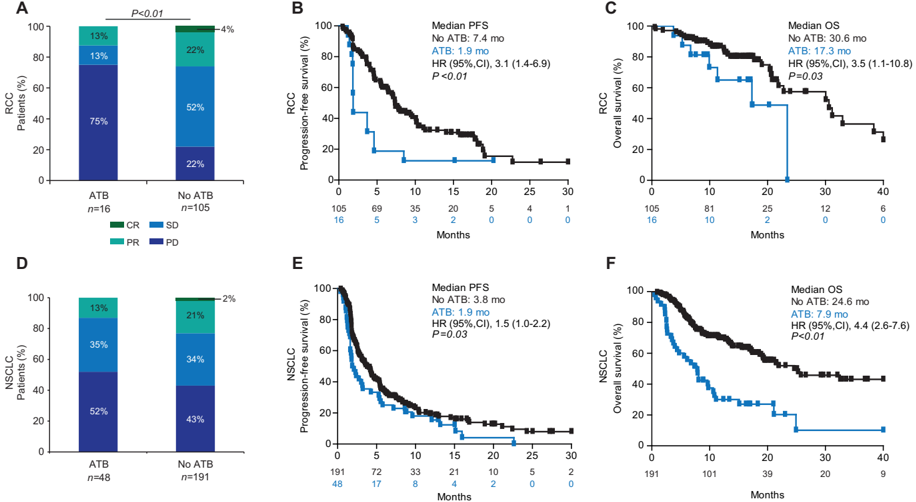
Background: The composition of gut microbiota affects antitumor immune responses, preclinical and clinical outcome following immune checkpoint inhibitors (ICI) in cancer. Antibiotics (ATB) alter gut microbiota diversity and composition leading to dysbiosis, which may affect effectiveness of ICI. Patients and methods: We examined patients with advanced renal cell carcinoma (RCC) and non-small-cell lung cancer (NSCLC) treated with anti-programmed cell death ligand-1 mAb monotherapy or combination at two academic institutions. Those receiving ATB within 30 days of beginning ICI were compared with those who did not. Objective response, progression-free survival (PFS) determined by RECIST1.1 and overall survival (OS) were assessed. Results: Sixteen of 121 (13%) RCC patients and 48 of 239 (20%) NSCLC patients received ATB. The most common ATB were β-lactam or quinolones for pneumonia or urinary tract infections. In RCC patients, ATB compared with no ATB was associated with increased risk of primary progressive disease (PD) (75% versus 22%, P < 0.01), shorter PFS [median 1.9 versus 7.4 months, hazard ratio (HR) 3.1, 95% confidence interval (CI) 1.4-6.9, P < 0.01], and shorter OS (median 17.3 versus 30.6 months, HR 3.5, 95% CI 1.1-10.8, P = 0.03). In NSCLC patients, ATB was associated with similar rates of primary PD (52% versus 43%, P = 0.26) but decreased PFS (median 1.9 versus 3.8 months, HR 1.5, 95% CI 1.0-2.2, P = 0.03) and OS (median 7.9 versus 24.6 months, HR 4.4, 95% CI 2.6-7.7, P < 0.01). In multivariate analyses, the impact of ATB remained significant for PFS in RCC and for OS in NSCLC. Conclusion: ATB were associated with reduced clinical benefit from ICI in RCC and NSCLC. Modulatation of ATB-related dysbiosis and gut microbiota composition may be a strategy to improve clinical outcomes with ICI.
Overview
CoChat Summary
TL;DR
In two independent cohorts of advanced RCC and NSCLC treated with immune checkpoint inhibitors, antibiotic use within 30 days before starting therapy was associated with worse clinical outcomes. The association remained significant for PFS in RCC and for OS in NSCLC in multivariate analyses.
Key findings
- Among 121 RCC patients, 16 (13%) received antibiotics within 30 days of starting ICI. Antibiotic use was associated with more primary progressive disease (75% versus 22%, P < 0.01), shorter median PFS (1.9 versus 7.4 months; HR 3.1, 95% CI 1.4–6.9, P < 0.01), and shorter median OS (17.3 versus 30.6 months; HR 3.5, 95% CI 1.1–10.8, P = 0.03).
- Among 239 NSCLC patients, 48 (20%) received antibiotics within 30 days. Antibiotic use was not associated with primary PD (52% versus 43%, P = 0.26) but was associated with shorter median PFS (1.9 versus 3.8 months; HR 1.5, 95% CI 1.0–2.2, P = 0.03) and shorter median OS (7.9 versus 24.6 months; HR 4.4, 95% CI 2.6–7.7, P < 0.01).
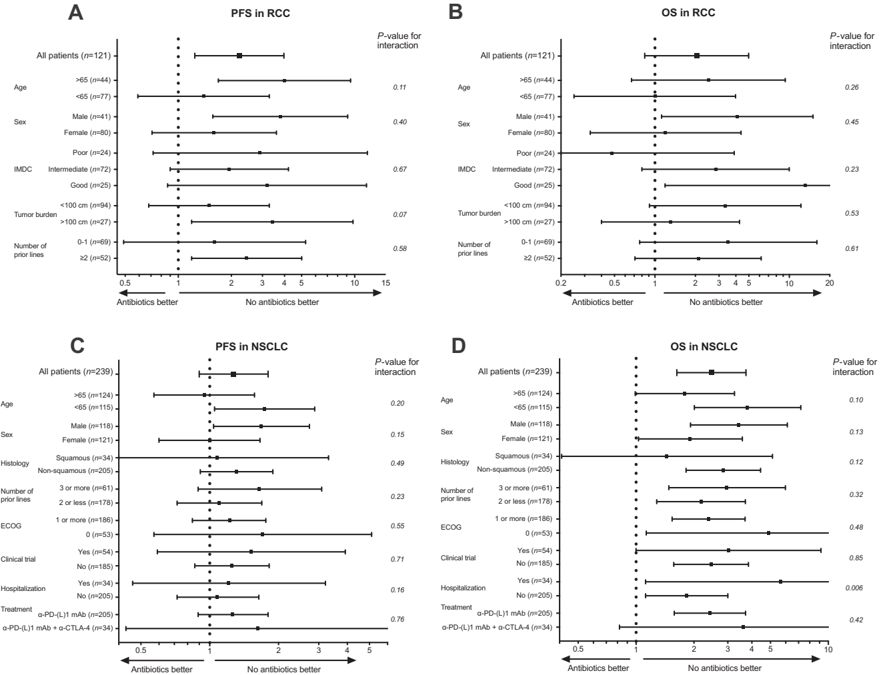
- In multivariate analysis, antibiotics remained associated with worse PFS in RCC (HR 2.0, P < 0.01) but not OS (HR 2.1, P = 0.11); in NSCLC, antibiotics were not significantly associated with PFS (HR 1.3, 95% CI 0.9–1.8, P = 0.17) but remained associated with worse OS (HR 2.5, 95% CI 1.6–3.7, P < 0.01).
- With a 60-day antibiotic window, RCC showed shorter PFS (median 3.1 versus 7.4 months; HR 2.3, 95% CI 1.2–4.4, P < 0.01) and a trend toward worse OS (median 23.4 versus 30 months; HR 1.9, 95% CI 0.8–4.7, P = 0.15); NSCLC showed no difference in objective response or PFS but shorter OS (median 9.8 versus 21.9 months; HR 2.0, 95% CI 1.3–3.2, P < 0.01).
Methods
- Retrospective review of patients with advanced RCC (n = 121) at Gustave Roussy and NSCLC (n = 239) at Memorial Sloan Kettering Cancer Center treated with anti-PD-(L)1 monoclonal antibody monotherapy or combination therapy.
- Antibiotic use was assessed within 30 days or up to 60 days before the first ICI injection; antibiotic class, indication, route, and duration were collected.
- Tumor response was determined by RECIST 1.1; PFS and OS were estimated by Kaplan–Meier and compared with log-rank tests, with multivariable Cox regression adjusting for clinicopathologic features.
Limitations
- The authors state the study is retrospective, with data entry from two institutions; although responses were reviewed with RECIST 1.1, scan timing was not prespecified.
- The authors note differences in patient characteristics between antibiotic and no-antibiotic groups, including higher recent hospitalization in NSCLC and differences in prior lines in RCC, and that analyses did not account for diet, country of origin, or other medications.
- The authors state they did not characterize the mechanism by which antibiotics affect outcomes, and PD-L1 status was lacking in most patients; the text also makes evident that antibiotic subgroups were small and immune-related adverse events were too few to evaluate.
Model-written summary. Check it against the paper before relying on it.
Integrity signals
Registry
Cites
Statistics
Figures




Verification
Claims the paper makes
2 Valid · 1 Not valid · 7 Not checked · 33 Own results and interpretations
At least one cited source doesn’t support this claim or points to a different paper, and none confirmed it — see the verdicts below.
In the paper
“16S ribosomal RNA sequencing of gene amplicons of patients' feces revealed that microbiota returns to its baseline within 1-3 months after ATB discontinuation.”
§ Negative association of antibiotics on clinical activity of immune checkpoint inhibitors in patients with advanced renal cell and non-small-cell lung cancer > Discussion
What the sources say
- Not checked yetcites [14] matched to “Effects of antibiotics on gut microbiota” (2016) source
- Disputedcites [20] matched to “Short-term antibiotic treatment has differing long-term impacts on the human throat and gut microbiome” (2010) sourceExperimental — accuracy not yet measured
The Results section ('Transient and persistent effects of antibiotic treatment'; page unavailable) says fecal microbial communities had only partially recovered at one and four years and remained distinct from their pretreatment compositions. The paper does not report a return to baseline within 1–3 months. (LLM, conf=0.87)
Checked by a reasoning model — may be wrong.
plainstates a cause- Asserted: passes — The authors put it forward as true.
- Checkable: passes — It can be checked against evidence.
- Load-bearing: passes — The paper’s conclusions depend on it.
- Based: passes — The paper gives a reason why it holds.
The sources with a verdict support this claim; the rest weren’t checked yet, have no full text we could read, or their verdicts aren’t rated yet.
In the paper
“However, some bacteria may take years to fully recover [14,20].”
§ Negative association of antibiotics on clinical activity of immune checkpoint inhibitors in patients with advanced renal cell and non-small-cell lung cancer > Discussion
What the sources say
- Not checked yetcites [14] matched to “Effects of antibiotics on gut microbiota” (2016) source
- Supportedcites [20] matched to “Short-term antibiotic treatment has differing long-term impacts on the human throat and gut microbiome” (2010) source
The Results section 'Transient and persistent effects of antibiotic treatment' states that 'One and four years after treatment, the fecal microbial communities had partially recovered to their pre-treatment compositions, however these were still separated along CA axis 2', i.e. full recovery had not occurred even four years after a one-week course. The 'Individuality in antibiotic response' section adds taxon-level persistence (e.g. the increase of unclassified Enterobacteriaceae in patient D persisted during the 4-year period), and the Abstract/Discussion report erm(B) still elevated four years post treatment. The hedged claim that some bacteria 'may take years to fully recover' is therefore within what this source shows; the only points it credits to others (two-year Bacteroides/erm persistence, a resistant clone persisting three years) are separate citations [8] and [10] and are not what the citing sentence attributes here. (LLM, conf=0.82)
hedgedstates a possible cause- Asserted: passes — The authors put it forward as true.
- Checkable: passes — It can be checked against evidence.
- Load-bearing: unclear — It is unclear whether the paper’s conclusions depend on it.
- Based: passes — The paper gives a reason why it holds.
The sources with a verdict support this claim; the rest weren’t checked yet, have no full text we could read, or their verdicts aren’t rated yet.
In the paper
“In oncology, converging findings demonstrate the negative impact of ATBinduced dysbiosis in mice.”
§ Negative association of antibiotics on clinical activity of immune checkpoint inhibitors in patients with advanced renal cell and non-small-cell lung cancer > Introduction
What the sources say
- Supportedcites [9] matched to “Anticancer immunotherapy by CTLA-4 blockade relies on the gut microbiota” (2015) source
The Results passage opening Fig. 1 states that broad-spectrum antibiotics (ampicillin+colistin+streptomycin, and imipenem alone but not colistin) 'compromised the antitumor effects of CTLA-4-specific Ab', confirmed across the Ret melanoma and MC38 colon cancer models and mirrored by germ-free housing — i.e. converging mouse evidence in oncology that antibiotic-induced microbiota disruption harms checkpoint-blockade efficacy. The Abstract states it outright: 'Tumors in antibiotic-treated or germ-free mice did not respond to CTLA blockade.' The only framing shift is minor: the paper attributes the loss of efficacy to depletion/recomposition of the microbiota (rescued by B. fragilis gavage) rather than using the word 'dysbiosis', and it hedges the mechanism ('suggest that the gut microbiota is required'), but the negative impact of antibiotic treatment itself is asserted as fact. (LLM, conf=0.90)
- Not checked yetcites [10]
boostedstates a cause- Asserted: passes — The authors put it forward as true.
- Checkable: passes — It can be checked against evidence.
- Load-bearing: passes — The paper’s conclusions depend on it.
- Based: passes — The paper gives a reason why it holds.
- Supported
A result the paper reports from its own data — it cites no other source for it, so there is none to check. The quote shows it is in the paper.
In the paper
“and shorter OS (median 17.3 versus 30.6 months, HR 3.5, 95% CI 1.1-10.8,P ¼ 0.03).”
- Also stated in: § Results · plain
“median OS, 17.3 months versus 30.6 months, HR 3.5, 95% CI 1.1-10.8,P ¼ 0.03”
§ Negative association of antibiotics on clinical activity of immune checkpoint inhibitors in patients with advanced renal cell and non-small-cell lung cancer > Abstract
plainstates an association- Asserted: passes — The authors put it forward as true.
- Checkable: passes — It can be checked against evidence.
- Load-bearing: passes — The paper’s conclusions depend on it.
- Based: passes — The paper gives a reason why it holds.
- Also stated in: § Results · plain
A result the paper reports from its own data — it cites no other source for it, so there is none to check. The quote shows it is in the paper.
In the paper
“In RCC, ATB-60 days remained associated with increased risk of primary progression (P < 0.01)”
§ Negative association of antibiotics on clinical activity of immune checkpoint inhibitors in patients with advanced renal cell and non-small-cell lung cancer > Results
plainstates an association- Asserted: passes — The authors put it forward as true.
- Checkable: passes — It can be checked against evidence.
- Load-bearing: passes — The paper’s conclusions depend on it.
- Based: passes — The paper gives a reason why it holds.
20 more claims
Create a free account to see all 43 claims and to verify the 15 references still open.
- It may state two separate claims as one. 11
- Probably not a substantial claim. 11
Claims other papers make about this one
Each is checked against this paper’s own text: does it say what the citing paper says it does?
The source backs part of the claim, not all of it — or backs it for a different population, condition or comparison.
In the citing paper
“Similarly, antibiotics (ATB) prior to ICI initiation drastically reduced the clinical benefit in several cohorts of patients across various cancer types (melanoma, advanced NSCLC, renal cell carcinoma (RCC), and urothelial cancer) 18,[20][21][22] .”
From Intestinal Akkermansia muciniphila predicts clinical response to PD-1 blockade in patients with advanced non-small-cell lung cancer (2022) · cites this paper as [20]
Experimental — accuracy not yet measuredThe source backs part of the claim, not all of it — or backs it for a different population, condition or comparison.
In the citing paper
“However, increasing clinical evidence suggests that systemic antibiotics abolish immune checkpoint blockade efficacy and decrease patient survival (133, 136, 137).”
From The microbiome and human cancer (2021) · cites this paper as [137]
Experimental — accuracy not yet measuredThe source backs part of the claim, not all of it — or backs it for a different population, condition or comparison.
In the citing paper
“However, the clinical value of this observation is limited by its derivation from selected oncological indications, including renal and non-small cell lung cancer (NSCLC), 2 for which external validation, especially outside clinical trials, is necessary.”
From Association of Prior Antibiotic Treatment With Survival and Response to Immune Checkpoint Inhibitor Therapy in Patients With Cancer (2019) · cites this paper as [2]
Experimental — accuracy not yet measuredThe source backs part of the claim, not all of it — or backs it for a different population, condition or comparison.
In the citing paper
“However, our results suggest that administration of these classes of antibiotics constitutes a likely surrogate for poor disease status and a state of increased systemic inflammation prior to initiation of CAR-T cell therapy, as was recently suggested in cancer patients treated with other ICBs28,35.”
From A non-antibiotic-disrupted gut microbiome is associated with clinical responses to CD19-CAR-T cell cancer immunotherapy (2023) · cites this paper as [28]
Experimental — accuracy not yet measuredThe cited source says what the claim attributes to it.
In the citing paper
“Supporting this contention, we and others reported that primary responses to anti-PD-1/ PD-L1 antibodies in patients with epithelial tumours and melanoma could, at least in part, be attributed to the taxonomic composition of the gut microbial ecosystem 18,20,25 .”
From Intestinal Akkermansia muciniphila predicts clinical response to PD-1 blockade in patients with advanced non-small-cell lung cancer (2022) · cites this paper as [20]
14 more claims about this paper
Create a free account to see every claim other papers make about this one.
Self-check
Percentages, sums and reported differences re-computed from the paper’s own numbers.
Each contradiction between two passages listed here was confirmed by an independent check.
Rated major: it would touch a result — a value a result rests on, reported and recomputed p-values on opposite sides of the significance level, two passages that conflict with no sign which is right, or a cited work retracted before this paper was published.
In the paper
§ Negative association of antibiotics on clinical activity of immune checkpoint inhibitors in patients with advanced renal cell and non-small-cell lung cancer > Results
“median PFS, 1.9 months versus 3.8 months, HR 1.5, 95% CI 1.0-2.2,P ¼ 0.03”
§ Negative association of antibiotics on clinical activity of immune checkpoint inhibitors in patients with advanced renal cell and non-small-cell lung cancer > Discussion
“ATB 30-0/No ATB 1.4 (1.0-2.0)0.04 1.3 (0.9-1.8) 0.17”
Rated major: it would touch a result — a value a result rests on, reported and recomputed p-values on opposite sides of the significance level, two passages that conflict with no sign which is right, or a cited work retracted before this paper was published.
In the paper
§ Negative association of antibiotics on clinical activity of immune checkpoint inhibitors in patients with advanced renal cell and non-small-cell lung cancer > Results
“median OS, 7.9 months versus 24.6 months, HR 4.4, 95% CI 2.6-7.7,P < 0.01”
§ Negative association of antibiotics on clinical activity of immune checkpoint inhibitors in patients with advanced renal cell and non-small-cell lung cancer > Discussion
“ATB 30-0/No ATB 2.9 (1.9-4.4)<0.01 2.5 (1.6-3.7)<0.01”
Rated major: it would touch a result — a value a result rests on, reported and recomputed p-values on opposite sides of the significance level, two passages that conflict with no sign which is right, or a cited work retracted before this paper was published.
In the paper
§ Negative association of antibiotics on clinical activity of immune checkpoint inhibitors in patients with advanced renal cell and non-small-cell lung cancer > Results
“median PFS, 1.9 months versus 7.4 months, HR 3.1, 95% CI 1.4-6.9,P < 0.01”
§ Negative association of antibiotics on clinical activity of immune checkpoint inhibitors in patients with advanced renal cell and non-small-cell lung cancer > Discussion
“ATB 30-0/No ATB 2.3 (1.3-4.0)<0.01 2.2 (1.3-3.3)<0.01”
Rated minor: it would not touch a result — a value no result rests on, a p-value that stays on the same side of the significance level, or a conflict that is clerical, resolved elsewhere in the paper, or outside its own findings.
In the paper
§ Negative association of antibiotics on clinical activity of immune checkpoint inhibitors in patients with advanced renal cell and non-small-cell lung cancer > Results
“Range 28-83 29-83 30-82”
§ Negative association of antibiotics on clinical activity of immune checkpoint inhibitors in patients with advanced renal cell and non-small-cell lung cancer > Results
“ATB 30-0 (n 5 16) No ATB (n 5 105)”
Rated minor: it would not touch a result — a value no result rests on, a p-value that stays on the same side of the significance level, or a conflict that is clerical, resolved elsewhere in the paper, or outside its own findings.
In the paper
§ Negative association of antibiotics on clinical activity of immune checkpoint inhibitors in patients with advanced renal cell and non-small-cell lung cancer > Discussion
“Female (n=80) Male (n=41)”
§ Negative association of antibiotics on clinical activity of immune checkpoint inhibitors in patients with advanced renal cell and non-small-cell lung cancer > Results
“Gender, n (%) Male 80 (66) 9 (56) 71 (68) 0.37 Female 41 (34) 7 (44) 34 (32)”
4 more findings
Create a free account to see every finding of this check.
Citations
Cites
New response evaluation criteria in solid tumours: revised RECIST guideline (version 1.1)
Eisenhauer, E. A., Therasse, P., Bogaerts, J., Schwartz, L. H., Sargent, D., Ford, R., Dancey, J., Arbuck, S., Gwyther, S., Mooney, M., et al. (2009) · European Journal of Cancer · doi:10.1016/j.ejca.2008.10.026 · Cited by 29,534
Adverse Renal Effects of Immune Checkpoint Inhibitors: A Narrative Review
Wanchoo, R., Karam, S., Uppal, N. N., Barta, V. S., Deray, G., Devoe, C., Launay-Vacher, V., Jhaveri, K. D., & on behalf of Cancer and Kidney International Network Workgroup on Immune Checkpoint Inhibitors (2017) · American Journal of Nephrology · doi:10.1159/000455014 · Cited by 15,256
Pembrolizumab versus Chemotherapy for PD-L1-Positive Non-Small-Cell Lung Cancer
Reck, M., Rodríguez-Abreu, D., Robinson, A. G., Hui, R., Csőszi, T., Fülöp, A., Gottfried, M., Peled, N., Tafreshi, A., Cuffe, S., et al. (2016) · New England Journal of Medicine · doi:10.1056/nejmoa1606774 · Cited by 10,089
Nivolumab versus docetaxel in advanced nonsquamous non-small-cell lung cancer
Borghaei, H., Paz-Ares, L., Horn, L., Spigel, D. R., Steins, M., Ready, N. E., Chow, L. Q., Vokes, E. E., Felip, E., Holgado, E., et al. (2015) · New England Journal of Medicine · doi:10.1056/nejmoa1507643 · Cited by 9,335
Nivolumab versus Everolimus in Advanced Renal-Cell Carcinoma
Motzer, R. J., Escudier, B., McDermott, D. F., George, S., Hammers, H. J., Srinivas, S., Tykodi, S. S., Sosman, J. A., Procopio, G., Plimack, E. R., et al. (2015) · New England Journal of Medicine · doi:10.1056/nejmoa1510665 · Cited by 5,807
Self-citationGut microbiome influences efficacy of PD-1-based immunotherapy against epithelial tumors
Routy, B., Le Chatelier, E., Derosa, L., Duong, C. P. M., Alou, M. T., Daillère, R., Fluckiger, A., Messaoudene, M., Rauber, C., Roberti, M. P., et al. (2018) · Science · doi:10.1126/science.aan3706 · Cited by 5,671
Self-citationDiversity, stability and resilience of the human gut microbiota
Lozupone, C. A., Stombaugh, J. I., Gordon, J. I., Jansson, J. K., & Knight, R. (2012) · Nature · doi:10.1038/nature11550 · Cited by 5,533
Gut microbiome modulates response to anti-PD-1 immunotherapy in melanoma patients
Gopalakrishnan, V., Spencer, C. N., Nezi, L., Reuben, A., Andrews, M. C., Karpinets, T. V., Prieto, P. A., Vicente, D., Hoffman, K., Wei, S. C., et al. (2018) · Science · doi:10.1126/science.aan4236 · Cited by 4,812
Self-citationIFN-γ–related mRNA profile predicts clinical response to PD-1 blockade
Ayers, M., Lunceford, J., Nebozhyn, M., Murphy, E., Loboda, A., Kaufman, D. R., Albright, A., Cheng, J. D., Kang, S. P., Shankaran, V., et al. (2017) · Journal of Clinical Investigation · doi:10.1172/jci91190 · Cited by 3,788
Anticancer immunotherapy by CTLA-4 blockade relies on the gut microbiota
Vétizou, M., Pitt, J. M., Daillère, R., Lepage, P., Waldschmitt, N., Flament, C., Rusakiewicz, S., Routy, B., Roberti, M. P., Duong, C. P. M., et al. (2015) · Science · doi:10.1126/science.aad1329 · Cited by 3,488
Self-citation
Cited by
Items 801–900 of 909
Influence of Antibiotic Use on the Effectiveness and Safety of Immune Checkpoint Inhibitors
Minamishima, T., Hida, H., Miyazaki, M., Kon, S., Senzaki, K., Nagai, T., & Yamada, K. (2022) · Iryo Yakugaku (Japanese Journal of Pharmaceutical Health Care and Sciences) · doi:10.5649/jjphcs.48.173
The microbiome and cancer immunotherapy
Niederhuber, J. E. (2023) · Elsevier eBooks · doi:10.1016/b978-0-323-87763-3.00020-4
Argoubi, R., Reese, E. S., Furegato, M., Medina, P., & Bobiak, S. N. (2023) · Journal of Comparative Effectiveness Research · doi:10.57264/cer-2022-0201
Research Progress on Gut Microbiota and Immunotherapy of Lung Cancer
谢, 欣. (2023) · Advances in Clinical Medicine · doi:10.12677/acm.2023.1381754
Mikroorganismen im Darm und die Entstehung von Krebs
(2023) · Deutsche Zeitschrift für Onkologie · doi:10.1055/a-2182-7997
Immuncheckpoint-Inhibition: Basiswissen für die klinische Praxis
Klein, C. R., & Feldmann, G. (2024) · Angewandte Nuklearmedizin · doi:10.1055/a-2182-6499
Wan, N., Chen, Y., Lu, L., Wang, B., He, L., Liang, H., Xie, F., Jian, X., Ji, B., & Zhang, J. (2024) · European Journal of Cancer Care · doi:10.1155/2024/6004679
Strategies to optimize the promise of checkpoint-targeted anti-cancer therapy
Rapoport, B. L., & Anderson, R. (2024) · Immunotherapy · doi:10.1080/1750743x.2024.2343271
Huang, Z., Luo, X., Liao, C., Li, Y., Deng, M., Liu, X., Liu, J., Chen, T., Li, Y., Wang, K., et al. (2024) · SSRN Electronic Journal · doi:10.2139/ssrn.4820046
Disputes and Challenges of Immune Checkpoint Inhibitors in Gastrointestinal Cancers
(2024) · Frontiers research topics · doi:10.3389/978-2-8325-4910-0
Immuncheckpoint-Inhibition – Basiswissen für die klinische Praxis
Klein, C. R., & Feldmann, G. (2024) · Radiopraxis · doi:10.1055/a-2340-0416
“Merke Die Komposition des Darmmikrobioms ist ein unabhängiger prädiktiver Biomarker für ICI-Effektivität [9], zudem prädiziert eine Antibiotikaexposition vor Therapiebeginn ein reduziertes Ansprechen auf ICI und kann prinzipiell das Risiko einer ICI-Resistenzentwicklung erhöhen [10].”
Metastasiertes Nierenzellkarzinom: Neue Inhibitoren und fäkale Mikrobiota bessern Prognose
Gulden, J. (2024) · Deutsches Ärzteblatt · doi:10.3238/persesmo.2024.10.18.13
Human microbiome and respiratory diseases
Pathak, A., Roy, M., Puno, G., Pandiyarajan, A. P., Baraskar, S. M., & Chaudhary, K. (2024) · Elsevier eBooks · doi:10.1016/b978-0-443-15435-5.00009-8 · Cited by 3
Uğraklı, M., Koçak, M. Z., Uğraklı, S., Dinç, G., Genç, T. B., Çağlayan, M., Er, M. M., Hendem, E., Eryılmaz, M. K., Araz, M., et al. (2025) · Research Square · doi:10.21203/rs.3.rs-6066659/v1
Association of Antibiotic Used During Surgery With the Outcome in Stage I-III Gastric Cancer
Ding, L., Zhou, M., Yin, J., Zhang, X., Ye, Q., & Qian, N. (2025) · Cancer Control · doi:10.1177/10732748251339261
“…received immune checkpoint blockade therapies for non-small cell lung cancer; however, the initial point for Abx exposure was intricate and included 21 d before or after, 29 30 d before or after, 30 30 d before, 31,32 30 d after, 33 and 60 d before and 30 d after 34,35 the start of the treatment.”
Shen, Y., Chen, J.-Q., Yu, Z., Lin, Z.-L., Cao, L., Li, H., Li, Y., Meng, Y., Li, B., Chen, J., et al. (2025) · Research Square · doi:10.21203/rs.3.rs-6615560/v1
Kistenfeger, Q., Haight, P. J., Levine, M. D., Wang, H., Backes, F. J., Bixel, K. L., Copeland, L. J., Cohn, D. E., Cosgrove, C. M., O’Malley, D. M., et al. (2025) · Gynecologic Oncology · doi:10.1016/j.ygyno.2025.05.012 · Cited by 1
Ye, Q., Liu, L., Cui, M., Liu, M., & Yan, B. (2025) · Clinical Medicine Insights Oncology · doi:10.1177/11795549251348376
Magdelaine, P., Costantini, A., Kamga, P. T., Youkou, C. G. K., Arrondeau, J., Wislez, M., Emile, J., & Leprieur, E. G. (2025) · Translational Lung Cancer Research · doi:10.21037/tlcr-2024-1083 · Cited by 1
Novel Immune Modulatory Agents in the Treatment of Non-small Cell Lung Cancer
Reyes, A., & Lee, M. (2025) · Cancer treatment and research · doi:10.1007/978-3-031-97242-3_8
Ye, P., Qi, X., Yu, M., Zhang, G., Guo, M., Zheng, J., Feng, L., Wei, Z., Su, J., Yi, D., et al. (2025) · JAAOS Global Research and Reviews · doi:10.5435/jaaosglobal-d-25-00062
Qu, Z., Wang, Y., Wang, Z., Zhang, Y., Zhang, Y., & Gu, K. (2025) · Discover Oncology · doi:10.1007/s12672-025-03558-0
“Antibi-otic-induced dysbiosis has been associated with diminished ICIs efficacy across multiple malignancies including lung cancer, renal carcinoma and head/neck squamous cell carcinoma [7, 8].”
Targeting the Gut Microbiome in Cancer Treatment
Čierniková, S., Ševčíková, A., Kasperova, B., Drgoňa, Ľ., & Mego, M. (2025) · Springer eBooks · doi:10.1007/978-3-032-00771-1_263
Immunological Effects of Conventional Anticancer Drugs
Garrone, O., Denaro, N., Paccagnella, M., Abbona, A., & Merlano, M. C. (2025) · Springer eBooks · doi:10.1007/978-3-032-00775-9_340
Zhao, Y., Naidoo, J., Conroy, M. R., Ferri, J. T., Gills, J. J., Chen, K. Y., White, J. R., Glass, S., Assan, W. O., Peloza, K. E., et al. (2025) · medRxiv · doi:10.1101/2025.10.01.25336378
New Highlights: The Microbiome of Bronchoalveolar Lavage Fluid Predicts the Prognosis of Lung Cancer
Xu, Q., & Lv, T. (2025) · Phenomics · doi:10.1007/s43657-025-00222-z
“Santoni et al. (2018) and Derosa et al. (2018a) found that the use of β-lactam inhibitors, fluoro - quinolones before or during PD-1/PD-L1 resulted in signifi - cantly shorter PFS and OS.”
Wang, Y. S., Wang, Q. Y., Moise, A. E., Syed, H. C., Malo, J., Soberano, S., Belkaïd, W., Messaoudene, M., Bélanger, K., Desîlets, A., et al. (2025) · Current Oncology · doi:10.3390/curroncol32110630
“The relatively high incidence of ATB exposure, compared with the 30% previously described for ICIs [12,13], likely reflects that fever is a common side effect of BRAFi/MEKi [8,9].”
Self-citationSpakowicz, D. J., Hoyd, R., Muniak, M., Husain, M., Bassett, J. S., Wang, L., Tinoco, G., Patel, S. H., Burkart, J. T., Miah, A., et al. (2020) · Figshare · doi:10.6084/m9.figshare.12262949
Takada, K., Shimokawa, M., Takamori, S., Shimamatsu, S., Hirai, F., Tagawa, T., Okamoto, T., Hamatake, M., Tsuchiya‐Kawano, Y., Otsubo, K., et al. (2022) · Figshare · doi:10.6084/m9.figshare.19728038
Takada, K., Shimokawa, M., Takamori, S., Shimamatsu, S., Hirai, F., Tagawa, T., Okamoto, T., Hamatake, M., Tsuchiya‐Kawano, Y., Otsubo, K., et al. (2022) · Figshare · doi:10.6084/m9.figshare.19728041
Tsakmaklis, A., Farowski, F., Zenner, R., Lesker, T. R., Strowig, T., Schlößer, H., Lehmann, J., von Bergwelt-Baildon, M., Mauch, C., Schlaak, M. S., et al. (2024) · Figshare · doi:10.6084/m9.figshare.26646451
Luo, W., Mei, S.-Q., Huang, Z.-J., Chen, Z.-H., Zhang, Y.-C., Yang, M.-Y., Liu, J.-Q., Xu, J.-Y., Yang, X.-R., Zhong, R., et al. (2024) · Figshare · doi:10.6084/m9.figshare.25530414
Spakowicz, D. J., Hoyd, R., Muniak, M., Husain, M., Bassett, J. S., Wang, L., Tinoco, G., Patel, S. H., Burkart, J. T., Miah, A., et al. (2020) · Figshare · doi:10.6084/m9.figshare.12262943
Luo, W., Mei, S.-Q., Huang, Z.-J., Chen, Z.-H., Zhang, Y.-C., Yang, M.-Y., Liu, J.-Q., Xu, J.-Y., Yang, X.-R., Zhong, R., et al. (2024) · Figshare · doi:10.6084/m9.figshare.25530316
Impact of proton pump inhibitor use on microbiota and diversity
Alsharef, A. S., Alsaedi, E. A. H., Almohmmadi, G. T., Alahmadi, K., Alhemshy, L. Z., Albugami, M. K., Alghanim, W. S., Alharbi, S. S., Alahmadi, Y. K., Aljohani, Y. S., et al. (2025) · International Journal of Community Medicine and Public Health · doi:10.18203/2394-6040.ijcmph20254453
Korchazhkina, N. B., Ogorodnikov, V. А., Mochalova, A. S., & Suetina, M. S. (2025) · Fizioterapevt (Physiotherapist) · doi:10.33920/med-14-2506-08
Biliary stents can modify the microbiota and promote the progression of pancreatic cancer
Fiordaliso, M., Pala, B., Marincola, G., Piscione, M., Savino, L., Mazzone, M., Marcantonio, M. C. D., & Mincione, G. (2026) · Frontiers in Oncology · doi:10.3389/fonc.2026.1633611 · Cited by 1
Biomarkers of Immunotherapy Response in Surgical Oncology
Bae, J., & Cohen, S. (2026) · Surgical Oncology Clinics of North America · doi:10.1016/j.soc.2025.12.011
Kankkunen, E., Sunela, K. L., Makkonen, T. M., Jalkanen, K. J., & Mattila, K. (2026) · Acta Oncologica · doi:10.2340/1651-226x.2026.44974
“Previous studies have shown the potential effect of gut microbiome on the efficacy of immunotherapy [13, 19, 22–24] and the association of ABT with poor outcomes in various cancers treated with ICI [25, 26].”
Microbiome and EGFR -mutant non-small cell lung cancer: a complex interplay
Eccher, S., Sposito, M., Scaglione, I. M., Pasqualin, L., Rota, M., Bonato, A., Longo, L., Avancini, A., Trestini, I., Tregnago, D., et al. (2026) · Expert Review of Clinical Immunology · doi:10.1080/1744666x.2026.2645844
Halle, Ž. B., Tomašić, V., Bišćanin, A., Čačić, P., Saric, I., Mustapić, S., Stojić, J., Luetić, K., Bekić, D., Paić, M., et al. (2026) · Biomedicines · doi:10.3390/biomedicines14030683
“Antibiotic stewardship remains essential, as antibiotic-induced dysbiosis negatively affects ICI efficacy and increases irAE incidence [125].”
THE IMPACT OF ANTIBIOTIC THERAPY ON THE EFFECTIVENESS OF IMMUNOTHERAPY: A REVIEW OF CURRENT EVIDENCE
Zdobylak, D., Kowalska, M., Zieba, A., Domin, M., Całka, J., Ścibisz, K., Ollik, K., Harenza, K., Taranowicz, M., & Kowalczyk, O. (2026) · International Journal of Innovative Technologies in Social Science · doi:10.31435/ijitss.1(49).2026.4882
Role of the gut microbiome in the development of colorectal cancer
Shanbhag, A. P. (2026) · Elsevier eBooks · doi:10.1016/b978-0-443-40483-2.00040-6
Lee, A. L. Y., Wei, A. C., & Yeong, K. Y. (2026) · Drug Discovery Today · doi:10.1016/j.drudis.2026.104651 · Cited by 1
Salazar, V., Espenschied, S. T., Fernandez, A. P., Karell, P. E., Sangwan, N., & Stappenbeck, T. S. (2026) · Cell Host & Microbe · doi:10.1016/j.chom.2026.03.008
Rao, X., Zhou, R., Li, W., Chai, X., & Zhang, H. (2026) · Critical Reviews in Oncology/Hematology · doi:10.1016/j.critrevonc.2026.105308
Développement d'un immunoliposome de docétaxel-trastuzumab dans le cancer du sein
Rodallec, A. (2018) · theses.fr (ABES) · doi:10.70675/e87bcdc1z7b4fz4cb5zae8czbd9152b8a412
Champiat, S. (2019) · theses.fr (ABES) · doi:10.70675/e358773dz1898z4feezbb3bzbdee7c7f20a6
Role du microbiote intestinal et avec anticorps anti-PD1 induit immunesurveillance du cancer du rein
Derosa, L. (2019) · theses.fr (ABES) · doi:10.70675/e3d7f456z3645z487az8659zc864d2b57698 · Cited by 1
Self-citationDanlos, F. (2021) · theses.fr (ABES) · doi:10.70675/ff8cb58bzc391z43f8zbd32zc8c4b2cdc725
Fidelle, M. (2021) · theses.fr (ABES) · doi:10.70675/2168c5d5zc7cez4351zb678z1a8c9761484f
Self-citationGut microbiota-related biomarkers in immuno-oncology
Silva, C. A. C. (2023) · theses.fr (ABES) · doi:10.70675/9022496ez0bbbz4f94z9760z4ae0a6ee5e7a
Etude du microbiote urinaire et cancer de la vessie
Yacouba, A. (2022) · theses.fr (ABES) · doi:10.70675/341a3bb8z12c2z4184z8125zc97204dff5fb
Marcos-Kovandzic, L. (2024) · theses.fr (ABES) · doi:10.70675/3bde4b45z23ecz4b69zb90dzabccd7cd7fca
Yu, J., Guo, C., Liu, Y., Ren, X., Guo, Y., Ran, B., Xiao, L., Kong, L., Gu, X., Jiang, C., et al. (2026) · Journal of Advanced Research · doi:10.1016/j.jare.2026.04.044 · Cited by 1
A “healthy gut state” as the key determinant of immune checkpoint inhibitor efficacy
Sokol, H., Elkrief, A., & Routy, B. (2026) · Molecular Therapy · doi:10.1016/j.ymthe.2026.04.034
Self-citationQiao, S., Yang, L., Hao, H., Ding, Q., Ding, F., Chen, Z., Zhang, J., He, Y., Li, M., Xu, J., et al. (2026) · Advanced Science · doi:10.1002/advs.202519942
“This was observed not only in gastrointestinal tumors, but also in cancer types with a high degree of immune infiltration, such as lung cancer and melanoma [ 11–13 ].”
Pütz, S. M., Engelhard, M., Wingen-Heimann, S. M., Brilz, D. F., Akrich, B., Kohl, H., Classen, A. Y., Gudiol, C., Sastre-Escolà, E., Trudzinski, F. C., et al. (2026) · Infection · doi:10.1007/s15010-026-02805-y
“…especially within a window of 30 days before immune checkpoint inhibitor (ICI) initiation, is associated with significantly shorter overall survival (OS) and progression-free survival (PFS) in patients with NSCLC and other malignancies compared to patients without antibiotic exposure [19 , 20].”
Fecal microbiota transplantation
Afaque, M. Y., Afridi, S., & Shahi, M. (2026) · Elsevier eBooks · doi:10.1016/b978-0-443-40551-8.00017-2
Li, L., Du, J., Yang, J., Chai, L., Nie, J., Cai, X., He, L., Jia, J., Ma, R., & Guo, Y. H. (2026) · Frontiers in Immunology · doi:10.3389/fimmu.2026.1753591
Harnessing the immune system in lung cancer: emerging role of the microbiome
Roostaei, G., Riahi, T., Nikfar, S., & Abdollahi, M. R. (2026) · Expert Review of Clinical Immunology · doi:10.1080/1744666x.2026.2661805
“Similarly, taxa such as Akkermansia muciniphila , Ruminococcaceae , and Lachnospiraceae correlated with enhanced dendritic cell activation and CD8 + T-cell infiltration [118], whereas enrichment of Bacteroides and related taxa predicted poor outcomes [105,119].”
InfluentialThe Role of Selected Bacteria in Breast Cancer Initiation and Development
Gebretsadik, G., Islam, S., Szpendyk, J., Thomas, V. D., & Furuta, S. (2026) · International Journal of Molecular Sciences · doi:10.3390/ijms27104585
“Antibiotic use has also been linked to altered treatment responses and impaired immunotherapy efficacy of cancer patients [191,192].”
Renal Cell Carcinoma: Integrating Histology, Multiomics, and Targeted Therapeutic Strategies
Ongaro, L., Amodeo, A., Crestani, A., Gianfrancesco, L. D., Giannarini, G., Garaffa, G., Simonato, A., Porreca, A., Pavan, N., & Claps, F. (2026) · Cancer drug discovery and develogment/Cancer drug discovery and development · doi:10.1007/978-3-032-24071-2_6 · Cited by 1
Guidelines for gut microbiota technology of the chinese anti-cancer association (2025 Edition)
Wang, Q., Guo, Z., Wu, Q., Wang, X., He, M., Liang, J., Li, X., Long, H., Qiao, M., Wang, J., et al. (2026) · Holistic Integrative Oncology · doi:10.1007/s44178-026-00264-x
“The use of antibiotics has been related to the adverse effects of immunotherapy blocking PD-1, in that patients with unresponsive lung and renal cancer are treated with low levels of Akkerman-sia muciniphila , which can be used orally in cancer-bearing mice [13].”
Zalabardo-Aguilar, M., Fernandez, I., Girona, A., González, A., Blanco, J., Campos, O., Sánchez‐Muñoz, A., Onieva, J. L., Jerez, J. M., Pascual, J., et al. (2026) · The Breast · doi:10.1016/j.breast.2026.104833
The role and mechanisms of microecological dysbiosis in lung cancer therapy
Shuai, Y., & Tang, M. (2026) · Holistic Integrative Oncology · doi:10.1007/s44178-026-00269-6
“Conversely, the use of broad-spectrum antibiotics, which disrupt microbial balance, is associated with significantly shorter overall survival (OS) and progression-free survival (PFS) in patients [31, 37, 38].”
Su, X., Xiang, Y., Zhao, H., Li, O., Zhang, L., & Guo, B. (2026) · Frontiers in Microbiology · doi:10.3389/fmicb.2026.1839030 · Cited by 1
“Meanwhile, although the destructive impact of broad-spectrum antibiotics on the microbiota is widely documented (Derosa et al., 2018), proton pump inhibitors (PPIs) and other common medications can also independently alter microbial composition (Cortellini et al., 2020).”
Joo, M.-K., Tak, J., Ha, S., Yoon, K., Namgoong, J., & Kim, H. O. (2026) · Frontiers in Microbiology · doi:10.3389/fmicb.2026.1835588
“In NSCLC, for example, antibiotics administered within 30 days before anti-PD-1 therapy reduced OS (Derosa et al., 2018; Ochi et al., 2021; Ruiz-Patiño et al., 2020).”
Luo, W., Huang, Z., Mei, S., Zhang, Q., Chen, Z., Chen, P.-P., Huang, G.-H., Wang, F., Deng, Y., Tu, H.-Y., et al. (2026) · Journal of Translational Medicine · doi:10.1186/s12967-026-08580-6 · Cited by 1
Tumor associated depression, gut microbiota, and immune checkpoint inhibitor sensitivity
Wang, J. (2026) · Psycho-Oncologie · doi:10.18282/po5751
Antibiotic Use and Immune Checkpoint Inhibition in Head and Neck Squamous Cell Carcinoma
Wu, S. S., Divi, V., Sunwoo, J. B., Jetly, A., Sun, F., Colevas, A. D., Holsinger, F. C., Lee, J. J., Finegersh, A., Baik, F. M., et al. (2026) · Head & Neck · doi:10.1002/hed.70392
Kuang, G., Qiu, Z., Li, L., Bai, J., Ji, H., & Liu, Y. (2026) · Frontiers in Cell and Developmental Biology · doi:10.3389/fcell.2026.1893882
“…antibiotics, glucocorticoids, and proton pump inhibitors can influence ICI efficacy and survival outcomes by altering the gut microbiota, systemic immune activity, inflammatory status, and baseline patient prognosis (Routy et al., 2018; Derosa et al., 2018; Arbour et al., 2018; Dar et al., 2022).”
Boadi, B. B., Fosu, K., Quaw, E. B., Awortwe, K. Y., Agholo, A. E., Tuah, B., Quarshie, J. T., Isawumi, A., Kusi, K. A., & Aikins, A. R. (2026) · International Journal of Breast Cancer · doi:10.1155/ijbc/9772651
Bohm, M. S., Yarbro, J. R., Torres, C. F., Mustafa, Z. T., Chaib, M., Mims, T. S., Joseph, S., Elasy, J. H., Sipe, L. M., Cook, K. L., et al. (2026) · Scientific Reports · doi:10.1038/s41598-026-59669-3
“Furthermore, preclinical and clinical literature has demonstrated that broad-spectrum antibiotic exposure is frequently associated with impaired response to immune checkpoint blockade and poorer outcomes in cancer patients, particularly in the context of PD-1/ PD-L1-based immunotherapy 58–64 .”
Fan, Y., Guo, X., Lyu, J., Wang, X., Xu, F., Junzhen, Y., & He, Y. (2026) · Medicinal Research Reviews · doi:10.1002/med.70093
Insights Into Infections and Inflammation in Prostate Cancer Development and Management: An Overview
Bahadoran, E., Babaei, A., Shahbazi, S., Badri, M., Nikkhahi, F., & Sabzi, S. (2026) · BioMed Research International · doi:10.1155/bmri/7584584
Alotaibi, B. S. (2026) · Saudi Pharmaceutical Journal · doi:10.1007/s44446-026-00107-w
“Both preclinical as well as clinical studies have indicated that the use of antibiotics, predominantly broad-spectrum antibiotics, might impair the efficacy of ICIs.”
InfluentialHu, S., Shi, G., Zhao, J., Long, X., Tang, L., Qi, Z., Xu, X., Cheng, P., & Liu, J. (2026) · Molecular Therapy · doi:10.1016/j.ymthe.2026.08.021 · Cited by 1
Zhan, T., & Cao, H. (2026) · Frontiers in Medicine · doi:10.3389/fmed.2026.1900721
“Antibiotic exposure around immune checkpoint inhibitor initiation has been associated with poorer outcomes in patients receiving PD-1/PD-L1 inhibitors, possibly through gut microbiome disruption and impaired antitumor immune function (37, 38).”
Adam, M., Venugopal, A., Almohana, A., Awadallah, M., Purohit, P., Abid, A., Jose, E., Rajendiran, A., Banka, P., Ilipilla, C., et al. (2026) · Cell Cycle · doi:10.1080/15384101.2026.2725418
Wang, K., Song, W., Bai, Q., Shen, S., Lu, X., Su, C., Yang, S., Wang, Y., Xia, Y., Zan, R., et al. (2026) · Cancer Science · doi:10.1111/cas.70516
Molecular pathways linking the gut microbiome to antitumor immunity
Olea, X. D., Ramer‐Tait, A. E., Cohen, J. E., Osterman, A., & Ronai, Z. A. (2026) · Trends in Microbiology · doi:10.1016/j.tim.2026.08.013
Lu, J., Xuan, M., Yu, L., Xie, Z., Chu, Q., Wei, S., Wang, T., Xue, C., & Li, L. (2026) · MedComm · doi:10.1002/mco2.70994
“The removal of microbes often disrupts intestinal microbiota homeostasis, which may weaken the effectiveness of immunotherapy and increase the risk of immune-related adverse events [ 212, 213 ].”
Exploring the Opportunities and Challenges of Lung Cancer Immunotherapy through the Lung-Gut Axis
刘, 文. (2026) · Advances in Clinical Medicine · doi:10.12677/acm.2026.1693258
Biazzo, M., Soriani, M., Micallef, M. P., Zaky, E., & Podrini, C. (2026) · Microorganisms · doi:10.3390/microorganisms14102147
“Across multiple cancers, antibiotic exposure before or during ICI therapy is associated with reduced progression-free survival (PFS) and overall survival (OS) [13,14].”
InfluentialThe microbiome: Its impact on cancer development and therapeutic responses
Sahu, S. K., Polu, P. R., Singh, I., & Parida, S. K. (2026) · Elsevier eBooks · doi:10.1016/b978-0-443-33206-7.00007-8
Cancer pharmacomicrobiomics: Targeting microbiota to optimize cancer therapy outcomes
Punuri, S. V., Dagar, W., Vodnala, S., Bhyan, B., & Jangra, S. (2026) · Elsevier eBooks · doi:10.1016/b978-0-443-33206-7.00011-x
Gut microbiota: A key modulator of individualized efficacy and toxicity in cancer therapy
Hou, X., Chen, K., Ran, L., Pu, R., Tong, R., Li, P., Liu, K., Du, H., Liu, Y., & Hou, X. (2026) · Journal of Pharmaceutical Analysis · doi:10.1016/j.jpha.2026.101802
Şişli, İ., Yüce, M., & Albayrak, E. (2026) · Medical Oncology · doi:10.1007/s12032-026-03403-6
“Disruption of microbiota balance can impair the efficacy of immunotherapies and accelerate the progression of certain cancer types [10, 11].”
Cancer and the microbiome: from association to intervention
Moradi, A., Winayak, R., & Pal, S. K. (2026) · The Lancet Oncology · doi:10.1016/s1470-2045(26)00326-8
Spagnolo, C. C., Campo, I., Fassi, E., Nucera, F., Ruggeri, P., Muscolino, P., Infurna, C., Ieni, A., Gregorc, V., Lazzari, C., et al. (2026) · Immunotherapy · doi:10.1080/1750743x.2026.2738337
Chen, Q., Wang, J., Sun, D., & Qin, J. (2026) · Frontiers in Immunology · doi:10.3389/fimmu.2026.1907688
“Derosa et al. (74) fi rst reported this association in NSCLC and renal cell carcinoma, and subsequent large-scale cohort studies have con fi rmed a 21% increased mortality risk with antibiotic exposure.”
Proton Pump Inhibitors and the Gut Microbiota: From Mechanisms to Clinical Implications
Deutschbein, F., Severino, A., Ferrari, M., Capuano, E., Fusco, W. G., Varca, S., Rondinella, D., Galasso, T., Porcari, S., Gasbarrini, A., et al. (2026) · Microorganisms · doi:10.3390/microorganisms14102236
“…diversity and depletion of taxa associated with favorable responses to ICI therapy [116–118], including Akkermansia muciniphila , Faecalibacterium prausnitzii and members of the Ruminococcaceae and Lachnospiraceae families, associated with the expansion of oral and opportunistic bacteria [119–121].”
Zhang, L., Du, X., Sun, L., Shi, Z., & Nie, Y. (2026) · Microbiota Medicine Research · doi:10.1002/mmr3.70015
Ma, L., Wang, Z., & Mao, J. (2026) · Frontiers in Cellular and Infection Microbiology · doi:10.3389/fcimb.2026.1902754
“…not be inferred from melanoma or bacterial-only cohorts (Iida et al., 2013; Sivan et al., 2015; Ve ́ tizou et al., 2015; Zitvogel et al., 2015; Derosa et al., 2018; Gopalakrishnan et al., 2018; Matson et al., 2018; Routy et al., 2018; Pinato et al., 2019; Mager et al., 2020; Baruch et al.,…”
ZHANG, Y.-F., Ran, X. U. E., & Lin, S. H. E. N. (2026) · Shengming kexue · doi:10.3724/cbls.2026124
Metadata
- Authors
- Derosa, L., Hellmann, M. D., Spaziano, M., Halpenny, D., Fidelle, M., Rizvi, H., Long, N., Plodkowski, A. J., Arbour, K. C., Chaft, J. E., Rouche, J. A., Zitvogel, L., Zalcman, G., Albiges, L., Escudier, B., & Routy, B.
- Affiliations
- Université Paris-Sud (FR)
- Memorial Sloan Kettering Cancer Center (US)
- McGill University (CA)
- Institut Gustave Roussy (FR)
- Assistance Publique – Hôpitaux de Paris (FR)
- Corresponding author
- Routy, B.
- ORCID
- Venue
- Annals of Oncology
- Publisher
- Elsevier BV
- Published
- 2018-06
- Volume
- 29
- Issue
- 6
- Pages
- 1437-1444
- ISSN
- 0923-7534 (ISSN-L)
- PMC
- PMC6354674
- OpenAlex
- W2795186863
- Cited by
- 908
- References
- 39
- Citations by year
- 2026: 94 · 2025: 94 · 2024: 86 · 2023: 119 · 2022: 133 · 2021: 143 · 2020: 126 · 2019: 93 · 2018: 19
- FWCI
- 35.80
- Type
- journal article
- Language
- en
- Open access
- hybrid
- doi.org
- Licence
- cc-by-nc-nd
- www.elsevier.com/tdm/userlicense/1.0/ (tdm)
- www.elsevier.com/open-access/userlicense/1.0/ (vor, 515 d)
- Locations
- Annals of Oncology (publishedVersion, cc-by-nc-nd)
- PubMed Central (publishedVersion)
- PubMed (publishedVersion)
- Funders
- Gustave Roussy Fondation Philanthropia
- RK Smiley Canadian Hematology Society
- Topics
- Health Sciences › Medicine › Oncology › Cancer Immunotherapy and Biomarkers
- Life Sciences › Biochemistry, Genetics and Molecular Biology › Molecular Biology › Gut microbiota and health
- Life Sciences › Biochemistry, Genetics and Molecular Biology › Cancer Research › Ferroptosis and cancer prognosis
- Keywords
- antibiotics, immune checkpoint inhibitors, PD-1/PD-L1 blockade, renal cell carcinoma, non-small cell lung cancer, gut microbiota, dysbiosis, progression-free survival, overall survival, antitumor immunity, beta-lactam antibiotics, quinolones, immunotherapy response
- MeSH terms
- Antineoplastic Agents, Immunological, Nivolumab, Aged, Anti-Bacterial Agents, Carcinoma, Non-Small-Cell Lung, Carcinoma, Renal Cell, Female, Follow-Up Studies, Humans, Immunotherapy, Kidney Neoplasms, Lung Neoplasms, Male, Prognosis, Survival Rate, Cell Cycle Checkpoints, Dysbiosis
About these checks
Registry, retraction, Cites and statistics results are computed, not judged, with one exception: a printed reference that no index lists is read once by a model before it counts as a citation error. Claims are extracted by a model and kept only when their quote appears verbatim in the text; each cited source is then checked, with a model’s help, for whether it says what the claim relies on. Those verdicts can be wrong — read the claim’s quote and the cited source before relying on one.
The claim verdicts this report counts are experimental: their accuracy is not yet measured.
A language model drew the claims from the paper on 2026-10-07, under version 3 of the claim definition (model deepseek-v4.1-flash, prompt extract-v3).
A second model labelled each claim on 2026-10-07 (model jev-1.13-20260917, definition revision gold-guideline-v0.2).
Cited sources are checked with a language model’s help (gpt-6-sol and qwen3.8-omni-flash).
Statistics and arithmetic are recomputed, not judged.
Confidence bands are shown only for fields calibrated on our annotated test set. None is calibrated yet, so no band is shown.
What counts as a claim ›How we measure confidence ›How we check this ›
Are you an author, or do you see a problem with this page? Request a review
Data sources
Bibliographic data: Semantic Scholar, OpenAlex, Crossref.
Contains information from the Semantic Scholar Academic Graph Datasets, made available under the ODC Attribution License (ODC-BY 1.0).
Semantic Scholar’s data is described in: Kinney, R., et al. (2023). The Semantic Scholar Open Data Platform. arXiv:2301.10140.
