

Negative association of antibiotics on clinical activity of immune checkpoint inhibitors in patients with advanced renal cell and non-small-cell lung cancer
Open accessThe DOI matches its Crossref record; 36 of the 39 references it cites were found in a registry or an index; 3 of the 18 sources its claims cite were checked for support.
Abstract
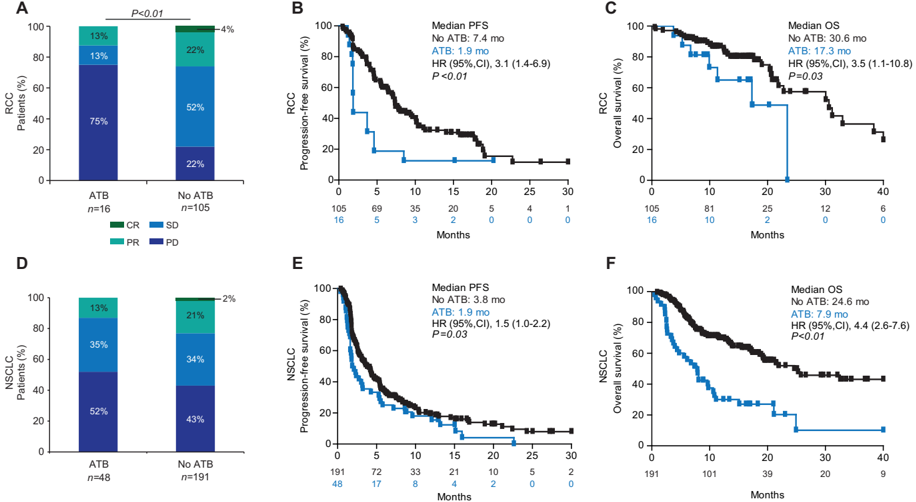
Background: The composition of gut microbiota affects antitumor immune responses, preclinical and clinical outcome following immune checkpoint inhibitors (ICI) in cancer. Antibiotics (ATB) alter gut microbiota diversity and composition leading to dysbiosis, which may affect effectiveness of ICI. Patients and methods: We examined patients with advanced renal cell carcinoma (RCC) and non-small-cell lung cancer (NSCLC) treated with anti-programmed cell death ligand-1 mAb monotherapy or combination at two academic institutions. Those receiving ATB within 30 days of beginning ICI were compared with those who did not. Objective response, progression-free survival (PFS) determined by RECIST1.1 and overall survival (OS) were assessed. Results: Sixteen of 121 (13%) RCC patients and 48 of 239 (20%) NSCLC patients received ATB. The most common ATB were β-lactam or quinolones for pneumonia or urinary tract infections. In RCC patients, ATB compared with no ATB was associated with increased risk of primary progressive disease (PD) (75% versus 22%, P < 0.01), shorter PFS [median 1.9 versus 7.4 months, hazard ratio (HR) 3.1, 95% confidence interval (CI) 1.4-6.9, P < 0.01], and shorter OS (median 17.3 versus 30.6 months, HR 3.5, 95% CI 1.1-10.8, P = 0.03). In NSCLC patients, ATB was associated with similar rates of primary PD (52% versus 43%, P = 0.26) but decreased PFS (median 1.9 versus 3.8 months, HR 1.5, 95% CI 1.0-2.2, P = 0.03) and OS (median 7.9 versus 24.6 months, HR 4.4, 95% CI 2.6-7.7, P < 0.01). In multivariate analyses, the impact of ATB remained significant for PFS in RCC and for OS in NSCLC. Conclusion: ATB were associated with reduced clinical benefit from ICI in RCC and NSCLC. Modulatation of ATB-related dysbiosis and gut microbiota composition may be a strategy to improve clinical outcomes with ICI.
Overview
CoChat Summary
TL;DR
In two independent cohorts of advanced RCC and NSCLC treated with immune checkpoint inhibitors, antibiotic use within 30 days before starting therapy was associated with worse clinical outcomes. The association remained significant for PFS in RCC and for OS in NSCLC in multivariate analyses.
Key findings
- Among 121 RCC patients, 16 (13%) received antibiotics within 30 days of starting ICI. Antibiotic use was associated with more primary progressive disease (75% versus 22%, P < 0.01), shorter median PFS (1.9 versus 7.4 months; HR 3.1, 95% CI 1.4–6.9, P < 0.01), and shorter median OS (17.3 versus 30.6 months; HR 3.5, 95% CI 1.1–10.8, P = 0.03).
- Among 239 NSCLC patients, 48 (20%) received antibiotics within 30 days. Antibiotic use was not associated with primary PD (52% versus 43%, P = 0.26) but was associated with shorter median PFS (1.9 versus 3.8 months; HR 1.5, 95% CI 1.0–2.2, P = 0.03) and shorter median OS (7.9 versus 24.6 months; HR 4.4, 95% CI 2.6–7.7, P < 0.01).
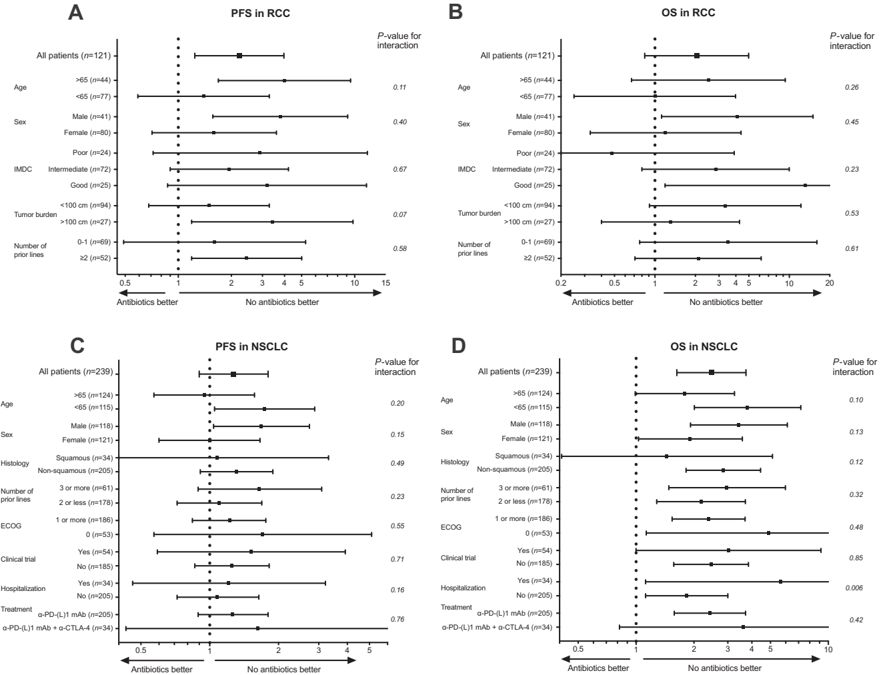
- In multivariate analysis, antibiotics remained associated with worse PFS in RCC (HR 2.0, P < 0.01) but not OS (HR 2.1, P = 0.11); in NSCLC, antibiotics were not significantly associated with PFS (HR 1.3, 95% CI 0.9–1.8, P = 0.17) but remained associated with worse OS (HR 2.5, 95% CI 1.6–3.7, P < 0.01).
- With a 60-day antibiotic window, RCC showed shorter PFS (median 3.1 versus 7.4 months; HR 2.3, 95% CI 1.2–4.4, P < 0.01) and a trend toward worse OS (median 23.4 versus 30 months; HR 1.9, 95% CI 0.8–4.7, P = 0.15); NSCLC showed no difference in objective response or PFS but shorter OS (median 9.8 versus 21.9 months; HR 2.0, 95% CI 1.3–3.2, P < 0.01).
Methods
- Retrospective review of patients with advanced RCC (n = 121) at Gustave Roussy and NSCLC (n = 239) at Memorial Sloan Kettering Cancer Center treated with anti-PD-(L)1 monoclonal antibody monotherapy or combination therapy.
- Antibiotic use was assessed within 30 days or up to 60 days before the first ICI injection; antibiotic class, indication, route, and duration were collected.
- Tumor response was determined by RECIST 1.1; PFS and OS were estimated by Kaplan–Meier and compared with log-rank tests, with multivariable Cox regression adjusting for clinicopathologic features.
Limitations
- The authors state the study is retrospective, with data entry from two institutions; although responses were reviewed with RECIST 1.1, scan timing was not prespecified.
- The authors note differences in patient characteristics between antibiotic and no-antibiotic groups, including higher recent hospitalization in NSCLC and differences in prior lines in RCC, and that analyses did not account for diet, country of origin, or other medications.
- The authors state they did not characterize the mechanism by which antibiotics affect outcomes, and PD-L1 status was lacking in most patients; the text also makes evident that antibiotic subgroups were small and immune-related adverse events were too few to evaluate.
Model-written summary. Check it against the paper before relying on it.
Integrity signals
Registry
Cites
Statistics
Figures




Verification
Claims the paper makes
2 Valid · 1 Not valid · 7 Not checked · 33 Own results and interpretations
At least one cited source doesn’t support this claim or points to a different paper, and none confirmed it — see the verdicts below.
In the paper
“16S ribosomal RNA sequencing of gene amplicons of patients' feces revealed that microbiota returns to its baseline within 1-3 months after ATB discontinuation.”
§ Negative association of antibiotics on clinical activity of immune checkpoint inhibitors in patients with advanced renal cell and non-small-cell lung cancer > Discussion
What the sources say
- Not checked yetcites [14] matched to “Effects of antibiotics on gut microbiota” (2016) source
- Disputedcites [20] matched to “Short-term antibiotic treatment has differing long-term impacts on the human throat and gut microbiome” (2010) sourceExperimental — accuracy not yet measured
The Results section ('Transient and persistent effects of antibiotic treatment'; page unavailable) says fecal microbial communities had only partially recovered at one and four years and remained distinct from their pretreatment compositions. The paper does not report a return to baseline within 1–3 months. (LLM, conf=0.87)
Checked by a reasoning model — may be wrong.
plainstates a cause- Asserted: passes — The authors put it forward as true.
- Checkable: passes — It can be checked against evidence.
- Load-bearing: passes — The paper’s conclusions depend on it.
- Based: passes — The paper gives a reason why it holds.
The sources with a verdict support this claim; the rest weren’t checked yet, have no full text we could read, or their verdicts aren’t rated yet.
In the paper
“However, some bacteria may take years to fully recover [14,20].”
§ Negative association of antibiotics on clinical activity of immune checkpoint inhibitors in patients with advanced renal cell and non-small-cell lung cancer > Discussion
What the sources say
- Not checked yetcites [14] matched to “Effects of antibiotics on gut microbiota” (2016) source
- Supportedcites [20] matched to “Short-term antibiotic treatment has differing long-term impacts on the human throat and gut microbiome” (2010) source
The Results section 'Transient and persistent effects of antibiotic treatment' states that 'One and four years after treatment, the fecal microbial communities had partially recovered to their pre-treatment compositions, however these were still separated along CA axis 2', i.e. full recovery had not occurred even four years after a one-week course. The 'Individuality in antibiotic response' section adds taxon-level persistence (e.g. the increase of unclassified Enterobacteriaceae in patient D persisted during the 4-year period), and the Abstract/Discussion report erm(B) still elevated four years post treatment. The hedged claim that some bacteria 'may take years to fully recover' is therefore within what this source shows; the only points it credits to others (two-year Bacteroides/erm persistence, a resistant clone persisting three years) are separate citations [8] and [10] and are not what the citing sentence attributes here. (LLM, conf=0.82)
hedgedstates a possible cause- Asserted: passes — The authors put it forward as true.
- Checkable: passes — It can be checked against evidence.
- Load-bearing: unclear — It is unclear whether the paper’s conclusions depend on it.
- Based: passes — The paper gives a reason why it holds.
The sources with a verdict support this claim; the rest weren’t checked yet, have no full text we could read, or their verdicts aren’t rated yet.
In the paper
“In oncology, converging findings demonstrate the negative impact of ATBinduced dysbiosis in mice.”
§ Negative association of antibiotics on clinical activity of immune checkpoint inhibitors in patients with advanced renal cell and non-small-cell lung cancer > Introduction
What the sources say
- Supportedcites [9] matched to “Anticancer immunotherapy by CTLA-4 blockade relies on the gut microbiota” (2015) source
The Results passage opening Fig. 1 states that broad-spectrum antibiotics (ampicillin+colistin+streptomycin, and imipenem alone but not colistin) 'compromised the antitumor effects of CTLA-4-specific Ab', confirmed across the Ret melanoma and MC38 colon cancer models and mirrored by germ-free housing — i.e. converging mouse evidence in oncology that antibiotic-induced microbiota disruption harms checkpoint-blockade efficacy. The Abstract states it outright: 'Tumors in antibiotic-treated or germ-free mice did not respond to CTLA blockade.' The only framing shift is minor: the paper attributes the loss of efficacy to depletion/recomposition of the microbiota (rescued by B. fragilis gavage) rather than using the word 'dysbiosis', and it hedges the mechanism ('suggest that the gut microbiota is required'), but the negative impact of antibiotic treatment itself is asserted as fact. (LLM, conf=0.90)
- Not checked yetcites [10]
boostedstates a cause- Asserted: passes — The authors put it forward as true.
- Checkable: passes — It can be checked against evidence.
- Load-bearing: passes — The paper’s conclusions depend on it.
- Based: passes — The paper gives a reason why it holds.
- Supported
A result the paper reports from its own data — it cites no other source for it, so there is none to check. The quote shows it is in the paper.
In the paper
“and shorter OS (median 17.3 versus 30.6 months, HR 3.5, 95% CI 1.1-10.8,P ¼ 0.03).”
- Also stated in: § Results · plain
“median OS, 17.3 months versus 30.6 months, HR 3.5, 95% CI 1.1-10.8,P ¼ 0.03”
§ Negative association of antibiotics on clinical activity of immune checkpoint inhibitors in patients with advanced renal cell and non-small-cell lung cancer > Abstract
plainstates an association- Asserted: passes — The authors put it forward as true.
- Checkable: passes — It can be checked against evidence.
- Load-bearing: passes — The paper’s conclusions depend on it.
- Based: passes — The paper gives a reason why it holds.
- Also stated in: § Results · plain
A result the paper reports from its own data — it cites no other source for it, so there is none to check. The quote shows it is in the paper.
In the paper
“In RCC, ATB-60 days remained associated with increased risk of primary progression (P < 0.01)”
§ Negative association of antibiotics on clinical activity of immune checkpoint inhibitors in patients with advanced renal cell and non-small-cell lung cancer > Results
plainstates an association- Asserted: passes — The authors put it forward as true.
- Checkable: passes — It can be checked against evidence.
- Load-bearing: passes — The paper’s conclusions depend on it.
- Based: passes — The paper gives a reason why it holds.
20 more claims
Create a free account to see all 43 claims and to verify the 15 references still open.
- It may state two separate claims as one. 11
- Probably not a substantial claim. 11
Claims other papers make about this one
Each is checked against this paper’s own text: does it say what the citing paper says it does?
The source backs part of the claim, not all of it — or backs it for a different population, condition or comparison.
In the citing paper
“Similarly, antibiotics (ATB) prior to ICI initiation drastically reduced the clinical benefit in several cohorts of patients across various cancer types (melanoma, advanced NSCLC, renal cell carcinoma (RCC), and urothelial cancer) 18,[20][21][22] .”
From Intestinal Akkermansia muciniphila predicts clinical response to PD-1 blockade in patients with advanced non-small-cell lung cancer (2022) · cites this paper as [20]
Experimental — accuracy not yet measuredThe source backs part of the claim, not all of it — or backs it for a different population, condition or comparison.
In the citing paper
“However, increasing clinical evidence suggests that systemic antibiotics abolish immune checkpoint blockade efficacy and decrease patient survival (133, 136, 137).”
From The microbiome and human cancer (2021) · cites this paper as [137]
Experimental — accuracy not yet measuredThe source backs part of the claim, not all of it — or backs it for a different population, condition or comparison.
In the citing paper
“However, the clinical value of this observation is limited by its derivation from selected oncological indications, including renal and non-small cell lung cancer (NSCLC), 2 for which external validation, especially outside clinical trials, is necessary.”
From Association of Prior Antibiotic Treatment With Survival and Response to Immune Checkpoint Inhibitor Therapy in Patients With Cancer (2019) · cites this paper as [2]
Experimental — accuracy not yet measuredThe source backs part of the claim, not all of it — or backs it for a different population, condition or comparison.
In the citing paper
“However, our results suggest that administration of these classes of antibiotics constitutes a likely surrogate for poor disease status and a state of increased systemic inflammation prior to initiation of CAR-T cell therapy, as was recently suggested in cancer patients treated with other ICBs28,35.”
From A non-antibiotic-disrupted gut microbiome is associated with clinical responses to CD19-CAR-T cell cancer immunotherapy (2023) · cites this paper as [28]
Experimental — accuracy not yet measuredThe cited source says what the claim attributes to it.
In the citing paper
“Supporting this contention, we and others reported that primary responses to anti-PD-1/ PD-L1 antibodies in patients with epithelial tumours and melanoma could, at least in part, be attributed to the taxonomic composition of the gut microbial ecosystem 18,20,25 .”
From Intestinal Akkermansia muciniphila predicts clinical response to PD-1 blockade in patients with advanced non-small-cell lung cancer (2022) · cites this paper as [20]
14 more claims about this paper
Create a free account to see every claim other papers make about this one.
Self-check
Percentages, sums and reported differences re-computed from the paper’s own numbers.
Each contradiction between two passages listed here was confirmed by an independent check.
Rated major: it would touch a result — a value a result rests on, reported and recomputed p-values on opposite sides of the significance level, two passages that conflict with no sign which is right, or a cited work retracted before this paper was published.
In the paper
§ Negative association of antibiotics on clinical activity of immune checkpoint inhibitors in patients with advanced renal cell and non-small-cell lung cancer > Results
“median PFS, 1.9 months versus 3.8 months, HR 1.5, 95% CI 1.0-2.2,P ¼ 0.03”
§ Negative association of antibiotics on clinical activity of immune checkpoint inhibitors in patients with advanced renal cell and non-small-cell lung cancer > Discussion
“ATB 30-0/No ATB 1.4 (1.0-2.0)0.04 1.3 (0.9-1.8) 0.17”
Rated major: it would touch a result — a value a result rests on, reported and recomputed p-values on opposite sides of the significance level, two passages that conflict with no sign which is right, or a cited work retracted before this paper was published.
In the paper
§ Negative association of antibiotics on clinical activity of immune checkpoint inhibitors in patients with advanced renal cell and non-small-cell lung cancer > Results
“median OS, 7.9 months versus 24.6 months, HR 4.4, 95% CI 2.6-7.7,P < 0.01”
§ Negative association of antibiotics on clinical activity of immune checkpoint inhibitors in patients with advanced renal cell and non-small-cell lung cancer > Discussion
“ATB 30-0/No ATB 2.9 (1.9-4.4)<0.01 2.5 (1.6-3.7)<0.01”
Rated major: it would touch a result — a value a result rests on, reported and recomputed p-values on opposite sides of the significance level, two passages that conflict with no sign which is right, or a cited work retracted before this paper was published.
In the paper
§ Negative association of antibiotics on clinical activity of immune checkpoint inhibitors in patients with advanced renal cell and non-small-cell lung cancer > Results
“median PFS, 1.9 months versus 7.4 months, HR 3.1, 95% CI 1.4-6.9,P < 0.01”
§ Negative association of antibiotics on clinical activity of immune checkpoint inhibitors in patients with advanced renal cell and non-small-cell lung cancer > Discussion
“ATB 30-0/No ATB 2.3 (1.3-4.0)<0.01 2.2 (1.3-3.3)<0.01”
Rated minor: it would not touch a result — a value no result rests on, a p-value that stays on the same side of the significance level, or a conflict that is clerical, resolved elsewhere in the paper, or outside its own findings.
In the paper
§ Negative association of antibiotics on clinical activity of immune checkpoint inhibitors in patients with advanced renal cell and non-small-cell lung cancer > Results
“Range 28-83 29-83 30-82”
§ Negative association of antibiotics on clinical activity of immune checkpoint inhibitors in patients with advanced renal cell and non-small-cell lung cancer > Results
“ATB 30-0 (n 5 16) No ATB (n 5 105)”
Rated minor: it would not touch a result — a value no result rests on, a p-value that stays on the same side of the significance level, or a conflict that is clerical, resolved elsewhere in the paper, or outside its own findings.
In the paper
§ Negative association of antibiotics on clinical activity of immune checkpoint inhibitors in patients with advanced renal cell and non-small-cell lung cancer > Discussion
“Female (n=80) Male (n=41)”
§ Negative association of antibiotics on clinical activity of immune checkpoint inhibitors in patients with advanced renal cell and non-small-cell lung cancer > Results
“Gender, n (%) Male 80 (66) 9 (56) 71 (68) 0.37 Female 41 (34) 7 (44) 34 (32)”
4 more findings
Create a free account to see every finding of this check.
Citations
Cites
New response evaluation criteria in solid tumours: revised RECIST guideline (version 1.1)
Eisenhauer, E. A., Therasse, P., Bogaerts, J., Schwartz, L. H., Sargent, D., Ford, R., Dancey, J., Arbuck, S., Gwyther, S., Mooney, M., et al. (2009) · European Journal of Cancer · doi:10.1016/j.ejca.2008.10.026 · Cited by 29,534
Adverse Renal Effects of Immune Checkpoint Inhibitors: A Narrative Review
Wanchoo, R., Karam, S., Uppal, N. N., Barta, V. S., Deray, G., Devoe, C., Launay-Vacher, V., Jhaveri, K. D., & on behalf of Cancer and Kidney International Network Workgroup on Immune Checkpoint Inhibitors (2017) · American Journal of Nephrology · doi:10.1159/000455014 · Cited by 15,256
Pembrolizumab versus Chemotherapy for PD-L1-Positive Non-Small-Cell Lung Cancer
Reck, M., Rodríguez-Abreu, D., Robinson, A. G., Hui, R., Csőszi, T., Fülöp, A., Gottfried, M., Peled, N., Tafreshi, A., Cuffe, S., et al. (2016) · New England Journal of Medicine · doi:10.1056/nejmoa1606774 · Cited by 10,089
Nivolumab versus docetaxel in advanced nonsquamous non-small-cell lung cancer
Borghaei, H., Paz-Ares, L., Horn, L., Spigel, D. R., Steins, M., Ready, N. E., Chow, L. Q., Vokes, E. E., Felip, E., Holgado, E., et al. (2015) · New England Journal of Medicine · doi:10.1056/nejmoa1507643 · Cited by 9,335
Nivolumab versus Everolimus in Advanced Renal-Cell Carcinoma
Motzer, R. J., Escudier, B., McDermott, D. F., George, S., Hammers, H. J., Srinivas, S., Tykodi, S. S., Sosman, J. A., Procopio, G., Plimack, E. R., et al. (2015) · New England Journal of Medicine · doi:10.1056/nejmoa1510665 · Cited by 5,807
Self-citationGut microbiome influences efficacy of PD-1-based immunotherapy against epithelial tumors
Routy, B., Le Chatelier, E., Derosa, L., Duong, C. P. M., Alou, M. T., Daillère, R., Fluckiger, A., Messaoudene, M., Rauber, C., Roberti, M. P., et al. (2018) · Science · doi:10.1126/science.aan3706 · Cited by 5,671
Self-citationDiversity, stability and resilience of the human gut microbiota
Lozupone, C. A., Stombaugh, J. I., Gordon, J. I., Jansson, J. K., & Knight, R. (2012) · Nature · doi:10.1038/nature11550 · Cited by 5,533
Gut microbiome modulates response to anti-PD-1 immunotherapy in melanoma patients
Gopalakrishnan, V., Spencer, C. N., Nezi, L., Reuben, A., Andrews, M. C., Karpinets, T. V., Prieto, P. A., Vicente, D., Hoffman, K., Wei, S. C., et al. (2018) · Science · doi:10.1126/science.aan4236 · Cited by 4,812
Self-citationIFN-γ–related mRNA profile predicts clinical response to PD-1 blockade
Ayers, M., Lunceford, J., Nebozhyn, M., Murphy, E., Loboda, A., Kaufman, D. R., Albright, A., Cheng, J. D., Kang, S. P., Shankaran, V., et al. (2017) · Journal of Clinical Investigation · doi:10.1172/jci91190 · Cited by 3,788
Anticancer immunotherapy by CTLA-4 blockade relies on the gut microbiota
Vétizou, M., Pitt, J. M., Daillère, R., Lepage, P., Waldschmitt, N., Flament, C., Rusakiewicz, S., Routy, B., Roberti, M. P., Duong, C. P. M., et al. (2015) · Science · doi:10.1126/science.aad1329 · Cited by 3,488
Self-citation
Cited by
Items 701–800 of 909
Microbiome therapeutics in respiratory illnesses
Yadav, M. (2023) · Elsevier eBooks · doi:10.1016/b978-0-323-99336-4.00005-7 · Cited by 3
The East Asian gut microbiome and its role in oncology: a narrative review
Wong, E. Y. T., Lee, J. J., Lim, J. Y., & Toh, H. C. (2023) · Singapore Medical Journal · doi:10.4103/singaporemedj.smj-2022-042 · Cited by 2
“[48] The field of onco-microbiome is maturing rapidly, and earlier pioneer discovery studies need more prospective studies to validate and elucidate the precise microbial–immune mechanisms leading to patient response and toxicity to ICI.”
Chen, Q., Zhang, Z., Li, X., Feng, S., & Liu, S. (2023) · Frontiers in Oncology · doi:10.3389/fonc.2023.1204248 · Cited by 3
Yu, Z., Li, Q., & Yu, G. (2023) · Cancer Treatment and Research Communications · doi:10.1016/j.ctarc.2023.100758 · Cited by 3
Stem Cell Origin of Cancer: Clinical Implications for Cancer Immunity and Immunotherapy
Tu, S., Aydın, A. M., Maraboyina, S., Chen, Z., Singh, S. R. K., Gökden, N., & Langford, T. (2023) · Cancers · doi:10.3390/cancers15225385 · Cited by 2
“Intriguingly, the benefit of Clostridium butyricum was observed to be more pronounced in patients who had received antibiotic therapy, given that antibiotics have consistently been found to diminish the impact of CPI [55].”
BackgroundHunter, C., Dia, K., Boykins, J., Perry, K., Banerjee, N., Cuffee, J., Armstrong, E., Morgan, G., Banerjee, H. N., Banerjee, A., et al. (2024) · Journal of Solid Tumors · doi:10.5430/jst.v14n1p1 · Cited by 2
Deng, F., Ye, H., Zhang, P., Xu, J., Li, Y., Sun, M., & Yang, Z. (2024) · Thoracic Cancer · doi:10.1111/1759-7714.15492 · Cited by 3
“Furthermore, multiple studies have shown that antibiotics may negatively affect the efficacy of immunotherapy for various types of tumors, including melanoma, renal cell carcinoma, gynecological malignancies, and gastro-intestinal tumors [14–19].”
Beyond the tumor: the gut microbiome as a key player in immunotherapy efficacy and resistance
Zhao, Y., Liu, W., & Hu, Y. (2025) · Naunyn-Schmiedeberg s Archives of Pharmacology · doi:10.1007/s00210-025-04315-4 · Cited by 3
“Evidence has shown that gastrointestinal (GI) microorganisms, their metabolites, and their environment play a role in the efficacy and response to immunotherapy (Qian et al. 2020; Derosa et al. 2018; Chrysostomou et al. 2023; Yang et al. 2024).”
Immunoregulatory role of pulmonary microbiota in lung cancer: a bibliometric analysis
Jia, H., Gong, Y., Wei, H., Zhao, C., Zang, Q., & Lin, C. L. S. (2025) · Discover Oncology · doi:10.1007/s12672-025-02595-z · Cited by 2
“Therefore, during immunotherapy, careful regulation of antibiotic timing [69] and targeted antibiotic strategies are essential.”
Latest progress in molecular biology and treatment in genitourinary tumours
del Alba, A. G., Arranz, J. Á., Bellmunt, J., Maroto, P., Calvo, O. F., Valderrama, B. P., González‐Billalabeitia, E., Méndez-Vidal, M. J., Cassinello, J., Romero-Laorden, N., et al. (2020) · Clinical & Translational Oncology · doi:10.1007/s12094-020-02373-z · Cited by 2
“03) in those receiving antibiotics compared with those who did not [136].”
ResultFidelle, M., Derosa, L., Routy, B., & Zitvogel, L. (2021) · Bulletin de l Académie Nationale de Médecine · doi:10.1016/j.banm.2021.01.022 · Cited by 2
Self-citationQuaquarini, E., Sottotetti, F., Agustoni, F., Pozzi, E., Malovini, A. L., Teragni, C. M., Palumbo, R., Saltalamacchia, G., Tagliaferri, B., Balletti, E., et al. (2022) · Journal of Personalized Medicine · doi:10.3390/jpm12050679 · Cited by 3
“Antibiotic therapy was also correlated with a negative outcome in patients treated with ICIs alone in terms of overall response, time to progression, and OS [52,53].”
Garrido-Martin, E. M., & Paz-Ares, L. G. (2020) · Archivos de Bronconeumología · doi:10.1016/j.arbr.2019.04.018 · Cited by 3
Biomarker: der Weg zur individualisierten Therapie bei Nierenzelltumoren
Zeuschner, P., Zaccagnino, A., & Junker, K. (2021) · Aktuelle Urologie · doi:10.1055/a-1517-6259 · Cited by 4
“In zwei weiteren Arbeiten konnte auch gezeigt werden, dass der Antibiotikaeinsatz vor oder unter laufender CI-Therapie zu einem schlechteren Outcome beim mNZK führen kann [60, 61].”
BackgroundMore fuel for the fire: Gut microbes and toxicity to immune agonist antibodies in cancer
Chelvanambi, M., & Wargo, J. A. (2021) · Cell Reports Medicine · doi:10.1016/j.xcrm.2021.100482 · Cited by 2
“While it might be tempting to combine antibiotics with IAA ± ICB in light of this data, it is important to note that other hallmark studies have shown that microbiome depletion using broad-spectrum antibiotics prior to immunotherapy significantly worsens clinical outcomes.(8,9) This dichotomy suggests”
ResultFuture treatment options in metastatic clear cell renal cell carcinoma
Simonaggio, A., Auvray, M., Rochand, A., Thibault, C., Gervais, C., Oudard, S. M., & Vano, Y. A. (2022) · Bulletin du Cancer · doi:10.1016/s0007-4551(22)00238-7 · Cited by 3
Combinatorial Strategies for T Lymphocyte-Based Cancer Immunotherapy
Hargadon, K. M., & Wall, J. B. (2022) · Springer eBooks · doi:10.1007/978-3-030-80962-1_211-1 · Cited by 2
The Human Microbiome and Checkpoint Inhibition: Potential Benefits From Antibiotic Stewardship
Farmakiotis, D. (2019) · Clinical Infectious Diseases · doi:10.1093/cid/ciz1003 · Cited by 2
Immuno-Oncology in Pancreatic Cancer
Jamieson, N. B., & Steele, C. W. (2021) · Springer eBooks · doi:10.1007/978-3-030-53786-9_20 · Cited by 2
Acharya, M., Kim, T., & Li, C. (2021) · Cancers · doi:10.3390/cancers13174367 · Cited by 3
A new era of treating advanced lung cancer is upon us
Weiss, G. J. (2018) · Translational Lung Cancer Research · doi:10.21037/tlcr.2018.07.03 · Cited by 2
“This has been followed by a provocative publication, showing inferior survival in patients with NSCLC that received antibiotic therapy (which can alter the host gut microbiome) within 30 days of initiating checkpoint inhibitor treatment for their cancer (15).”
BackgroundUlusan, M., Bireller, E. S., Ertuğrul, B., Kaşarcı, G., Ataş, M. N., Aydemir, L., Ergen, A., & Çakmakoğlu, B. (2023) · Journal of Stomatology Oral and Maxillofacial Surgery · doi:10.1016/j.jormas.2023.101502 · Cited by 1
Resistance to immune checkpoint inhibitors in the treatment of metastatic renal cancer
Измайлов, А. А., Радимович, Р. Р., Sultanbayev, A. V., Меньшиков, К. В., Gilyazova, I. R., Zabelin, V. M., & Izmailov, A. A. (2023) · Siberian Journal of Oncology · doi:10.21294/1814-4861-2023-22-4-109-117 · Cited by 2
Anti-cancer alternative therapies: from inorganic nanoparticles to tumor-killing bacteria
Mihăescu, G., Constantin, M., Andronic, O., Bolocan, A., & Filip, R. (2022) · ROMANIAN BIOTECHNOLOGICAL LETTERS · doi:10.25083/rbl/27.2/3416.3421 · Cited by 1
Human microbiome, cancer and cancer therapy
Veerasamy, R., Karunakaran, R., & Vasu, S. (2024) · Elsevier eBooks · doi:10.1016/b978-0-443-15435-5.00007-4 · Cited by 1
Hughes, V. S., Vick, E. J., Schwartz, R. N., Jandarov, R., Guo, J. J., Lin, A. C., & Hincapie, A. L. (2025) · JAPhA Pharmacotherapy · doi:10.1016/j.japhar.2025.100012 · Cited by 1
Combinatorial Strategies for T Lymphocyte-Based Cancer Immunotherapy
Hargadon, K. M., & Wall, J. B. (2025) · Springer eBooks · doi:10.1007/978-3-032-00767-4_211 · Cited by 1
Efil, S. C., Kuş, F., Koylu, B., Durukan, B. M., Bayram, S., Guzel, H. G., Öztürk, B., Muğlu, H., Bilici, A. E., Köse, F., et al. (2025) · Cancers · doi:10.3390/cancers18010101 · Cited by 1
“Prior studies in other malignancies have reported associations between antibiotic exposure and poorer outcomes during ICI therapy, potentially mediated by disruption of the gut microbiome and impaired antitumor immune responses [25–27].”
Effect of the Addition of Xianglian Granules to PD-1 Monoclonal Antibodies in Pancancer Patients
Wu, T.-T., Li, S. Y., Shuang, H., Li, Y., Fu, S., Jiang, H., Zhang, S., Du, B., Lv, J., Xiaoting, X., et al. (2025) · Biological Procedures Online · doi:10.1186/s12575-025-00309-x · Cited by 1
“The intestinal barrier of the two groups was analyzed, and after XG treatment, the level of diamine oxidase (DAO) in the XG group [9 (7, 21)] was also lower than that in the control group [21 (11, 24)], and the level of D-lactic acid (D-LA) in the XG group [3 (1, 14)] was significantly lower than…”
Hendem, E., KOÇAK, M. Z., Çetinkaya, A. M., Dinç, G., Çağlayan, M., Uğraklı, M., Çağlayan, D., Araz, M., Eryılmaz, M. K., Sakin, A., et al. (2026) · Medicina · doi:10.3390/medicina62010214 · Cited by 1
Kleinhans, M., Lissen, A., Hewitson, L., & Rijkers, G. T. (2026) · Expert Review of Anticancer Therapy · doi:10.1080/14737140.2026.2621240 · Cited by 3
Caramella, I., Abeni, C., Cherri, S., Ogliosi, C., Morena, T., Galvagni, G., Meriggi, F. A., & Zaniboni, A. (2026) · Cancers · doi:10.3390/cancers18030497 · Cited by 1
Ziogas, D. C., Theocharopoulos, C., Martinos, A., Lyrarakis, G., Stefanou, D. T., Anastasopoulou, A. N., & Gogas, H. (2026) · Current Oncology Reports · doi:10.1007/s11912-026-01744-z · Cited by 2
“…renal cell carcinoma, non-small-cell lung cancer and urothelial carcinoma suggests that broad-spectrum antibiotics, like β-lactams or quinolones, are particularly impactful when administered up to 30 days prior to ICI treatment, and were associated with significantly worse PFS and OS [ 23 , 78 ].”
Toda, M., Takada, K., Nomura, K., Kosai, K., Hayasaka, K., Watanabe, T., Takamori, S., Hamada, A., Suda, K., Ohara, S., et al. (2026) · Lung Cancer · doi:10.1016/j.lungcan.2026.109344 · Cited by 1
Huang, B., Zhao, J., Zhu, J., Wang, X., Li, M., Xu, J., Wang, K., Wang, X., Wang, W., Bo, C., et al. (2026) · Clinical Cancer Research · doi:10.1158/1078-0432.ccr-25-4153 · Cited by 2
“The diversity of gut microbiota is positively correlated with response to cancer immunotherapy (11–13), the outcomes of which may be impaired by antibiotics (14, 15).”
Microbiota as a modulator of drug response: targeting microbial–drug crosstalk in cancer therapy
Zhao, T., Liu, M., Qiu, L. X., Zhang, H., Zhang, N., Liu, Z., Xia, Z., Luo, P., Huang, J., & Cheng, Q. (2026) · Gut Microbes · doi:10.1080/19490976.2026.2651930 · Cited by 1
Braun, A. E., Hesami, H., Deng, M., Hasler, J., Bukavina, L., Handorf, E. A., & Abbosh, P. H. (2026) · JCO Oncology Practice · doi:10.1200/op-25-00963 · Cited by 3
“23 However, two meta-analyses, 24,25 including mRCC subgroup analysis, 12,26,27 found cABT was associated with reduced PFS and OS.”
Yu, J., Li, Q., Zou, S., Rong, Y., Zhang, Y., & Chen, C. (2026) · Frontiers in Immunology · doi:10.3389/fimmu.2026.1733373 · Cited by 1
Fujimoto, A., Uozumi, R., Fujii, H., Tamaki, S., Eto, T., Yamaguchi, M., Maehara, Y., Iihara, H., HATAKEYAMA, T., Higuchi, A., et al. (2026) · Journal of Gastrointestinal Cancer · doi:10.1007/s12029-026-01499-7 · Cited by 1
“…use of proton pump inhibitors (PPIs) and antibiotics has been associated with shortened survival outcomes in patients with advanced non-small cell lung cancer (NSCLC) or metastatic renal cell carcinoma (RCC) treated with ICIs [11–13], which may be associated with gut dysbiosis [8, 14, 15].”
Stylianakis, D., Bertaglia, V., Sangiolo, D., Podda, M., Saba, G., Stylianakis, I., Denaro, N., Pisanu, A., Agelaki, S., Scartozzi, M., et al. (2026) · Cancer Treatment Reviews · doi:10.1016/j.ctrv.2026.103162 · Cited by 3
Sugimoto, K., Toyoda, S., Inoki, L., Mori, K., Yanagisawa, T., Tamura, K., Nukaya, T., Maenosono, R., Morinaka, H., Nishimura, S., et al. (2026) · International Journal of Clinical Oncology · doi:10.1007/s10147-026-03075-2 · Cited by 2
Zhao, N., Wu, X., Zhao, W., Cheng, X., He, H., & Cao, D. (2026) · BMC Cancer · doi:10.1186/s12885-026-16302-w · Cited by 1
Yang, J., Wang, W., Jiao, M., Zhang, Z., Lei, S., Lan, N., Chen, M. Y., Wang, Z., Hui, B., Bakhat, T. I. D., et al. (2026) · Frontiers in Immunology · doi:10.3389/fimmu.2026.1873839 · Cited by 2
“This timeframe was selected based on previous studies suggesting that the gut microbiome and host immune environment may be particularly susceptible to pharmacological perturbation during the initiation phase of immunotherapy (11, 18).”
Microbiome as a prediction of immunotherapy response in lung cancer
Rojas, L., Zuluaga, J., & Cardona, A. F. (2026) · Frontiers in Immunology · doi:10.3389/fimmu.2026.1849553 · Cited by 1
Bile acids in cancer: From metabolism to immunomodulation
Fang, Q., & Schneider, K. M. (2026) · Immunity · doi:10.1016/j.immuni.2026.07.003 · Cited by 3
Decoding the power of the microbiome in human health
Kumar, M., Almohannadi, N., & Khodor, S. A. (2026) · Frontiers in Cellular and Infection Microbiology · doi:10.3389/fcimb.2026.1877371 · Cited by 1
“…and MHC-II expression (Sivan et al., 2015), while A. muciniphila supports mucosal barrier integrity and immune signaling, and F. prausnitzii contributes anti-in fl ammatory effects via butyrate production (Derosa et al., 2018; Routy et al., 2018; Shi et al., 2025; Chen et al., 2026).”
Sagawa, T., Hirakawa, M., Nagashima, H., & Fujikawa, K. (2026) · Medical Oncology · doi:10.1007/s12032-026-03434-z · Cited by 1
“Foundational studies showed that antibiotic use was associated with poorer outcomes in patients treated with PD-1/PD-L1 blockade [13, 27, 28].”
InfluentialFirst-line treatment of metastatic renal cell carcinoma: current standard of care
Marszalek, M. (2019) · memo - Magazine of European Medical Oncology · doi:10.1007/s12254-019-00550-7 · Cited by 1
“indicated within an 6 week period before the start of checkpoint inhibitor treatment [14].”
BackgroundDie Rolle des Mikrobioms bei urologischen Erkrankungen
Atzler, M., Westhofen, T., Tamalunas, A. J., Schott, M., Keller, P., Ebner, B., Stief, C. G., & Magistro, G. (2021) · Aktuelle Urologie · doi:10.1055/a-1478-2960 · Cited by 4
“[17] Derosa L, Hellmann MD, Spaziano M et al.”
BackgroundPredictive Factors for the Efficacy of Immune Checkpoint Inhibitors Against Lung Cancer
Ochi, N., Yamane, H., & Takigawa, N. (2022) · Haigan · doi:10.2482/haigan.62.355 · Cited by 2
del Socorro, T. P., Tonneau, M., Pasquier, D., & Chamaillard, M. (2023) · The Cancer Journal · doi:10.1097/ppo.0000000000000652 · Cited by 1
Novel Targets in Development for Advanced Renal Cell Carcinoma
Thapa, B., Nelson, A. A., & Kilari, D. (2023) · Springer eBooks · doi:10.1007/978-3-031-40901-1_14 · Cited by 1
The Effects of Antibiotics on the Development and Treatment of Non-Small Cell Lung Cancer
Švecová, P., Jakubec, P., Škarda, J., Glogarová, V., & Mitták, M. (2023) · Polish Journal of Microbiology · doi:10.33073/pjm-2023-047 · Cited by 3
“Derosa et al. (2018) conducted a trial with the hypothesis that anti-PD-1 monoclonal antibodies and ATB-induced gut microbiota alterations may contribute to ICI resistance (mAb) and anti-PD-L1 mAb.”
BackgroundResultInfluentialAntibiotic use during radical surgery in stage I-III colorectal cancer: correlation with outcomes?
Xu, M., Chen, Y., Li, P., Ye, Q., Feng, S., & Yan, B. (2024) · BMC Cancer · doi:10.1186/s12885-024-12550-w · Cited by 1
“…(RCC) and 239 non-small cell lung cancer (NSCLC) patients who received immunotherapy with or without ATBs (mainly β-lactam or quinolones ) concurrently, and their results indicated that patients with ATB use was associated with significantly worse progression free survival (PFS) and OS [10].”
BackgroundMethodInteraction of the Gut Microbiome With Cancer Treatment
Barrenechea, P. M. (2024) · Journal of the Advanced Practitioner in Oncology · doi:10.6004/jadpro.2024.15.5.3 · Cited by 1
“Patients with NSCLC who were given antibiotics showed decreased primary progressive disease but experienced even shorter progression-free survival and overall survival than patients with RCC who received antibiotics (Derosa et al., 2018).”
BackgroundResultAntibiotics in Cancer Therapy: Unraveling Mechanisms, Efficacy and Challenges
Nikitha, K., & Thanuja, B. (2024) · International Journal of Innovative Science and Research Technology (IJISRT) · doi:10.38124/ijisrt/ijisrt24sep1565 · Cited by 1
Microbiome in RCC – A systematic review of the literature
Leonard, S., Montanaro, F., Leopold, Z., Helstrom, E. K., Abbosh, P. H., Fulmes, A., Correa, A. F., Barata, P. C., Nizam, A., Weight, C., et al. (2024) · Kidney Cancer · doi:10.1177/24684570241292246 · Cited by 1
Bairi, K. E., Amrani, M., & Maleb, A. (2020) · Springer eBooks · doi:10.1007/978-3-030-53821-7_5 · Cited by 1
Microbiota in Cancer Immunotherapy: The Next Milestone of Immuno-oncology?
Ting, N. L.-N., & Yu, J. (2023) · Springer eBooks · doi:10.1007/978-981-19-4492-5_17 · Cited by 1
Cooper, A. J., & Heist, R. S. (2023) · Hematology/Oncology Clinics of North America · doi:10.1016/j.hoc.2023.02.004 · Cited by 1
Xu, J., Lin, X., Liu, W., Ye, J., Xie, F., Deng, H., Deng, M., & Yu, Z. (2021) · Research Square · doi:10.21203/rs.3.rs-936584/v1 · Cited by 1
Couto, J. I. (2021) · MOspace Institutional Repository (University of Missouri) · doi:10.32469/10355/88084 · Cited by 2
Luo, W., Mei, S., Huang, Z., Chen, Z., Zhang, Y., Yang, M., Liu, J., Xu, J.-Y., Yang, X., Zhong, R.-W., et al. (2024) · SSRN Electronic Journal · doi:10.2139/ssrn.4681862 · Cited by 1
Semiglazova, Т. Y., Бриш, Н. А., Galunova, T. Y., Бернацкий, А. С., & Семиглазов, В. В. (2018) · Meditsinskiy sovet = Medical Council · doi:10.21518/2079-701x-2018-10-128-133
Messaoudene, M., Derosa, L., Belkaïd, W., & Routy, B. (2018) · médecine/sciences · doi:10.1051/medsci/20183408009
“Cette association négative a été confirmée et approfondie dans une étude récente qui a inclus 239 patients atteints de cancer du poumon et 121 traités pour un cancer du rein [6].”
BackgroundSelf-citationCheckpointhemmer: schlechteres Ansprechen durch Antibiose?
Kreutzkamp, B. (2018) · Im Focus Onkologie · doi:10.1007/s15015-018-4234-1
Der Einsatz von Checkpoint-Hemmern beim Lungenkarzinom wird breiter
Rawluk, J. K., & Waller, C. F. (2018) · Pneumo News · doi:10.1007/s15033-018-0819-9
Arora, R., Hermann, A., & Wargo, J. A. (2019) · Springer eBooks · doi:10.1007/978-1-4614-7322-0_41-1
The Gut Microbiome and Immune Modulation in The Treatment of Malignancy
Babu, H. S., West, N. P., Cripps, A. W., Sanmugarajah, J., & Mason, R. (2019) · Insights in Biomedicine · doi:10.36648/2572-5610.4.2.62
Quelle stratégie thérapeutique pour les stades métastatiques ?
Simonaggio, A., Rivallin, G., Marret, S., Oudard, S. M., & Vano, Y.-A. (2018) · ONCOLOGIE · doi:10.3166/onco-2019-0026
Clinical practice of renal cell carcinoma treatment with nivolumab
Potocki, P. M., & Wysocki, P. J. (2019) · Oncology in Clinical Practice · doi:10.5603/ocp.2019.0002
Ferreira, M. A. M., & Meurice, J.-C. (2019) · Revue des Maladies Respiratoires Actualités · doi:10.1016/s1877-1203(19)30040-0
Impfungen und Krebserkrankungen
Wagner, A., & Wiedermann, U. (2019) · Springer eBooks · doi:10.1007/978-3-662-57982-4_15
The Effect of Intestinal Microbiome on the Effectiveness of Antitumor Immunotherapy
Olekhnovich, E. I., Manolov, A. I., Pavlenko, A. V., Konanov, D. N., Fedorov, D. E., Tikhonova, P., Glushchenko, O. E., & Ilina, E. N. (2020) · Biochemistry (Moscow) Supplement Series B Biomedical Chemistry · doi:10.1134/s1990750820030105
Yuasa, T. (2020) · International Journal of Urology · doi:10.1111/iju.14379
Grenda, A., Iwan, E., Krawczyk, P. A., Chmielewska, I., Jarosz, B., Reszka, K., Kucharczyk, T., Wojas‐Krawczyk, K., Gil, M., Słomiany-Szwarc, M., et al. (2021) · Oncology in Clinical Practice · doi:10.5603/ocp.2020.0031
Hao, J., Zhao, Y., He, J., Wang, Y., & Dong, Y. (2020) · Research Square · doi:10.21203/rs.3.rs-30778/v1
“…d cancer 60 17 vs 43 -0.5 ~ + 0.5 NA 5.6 vs 20.8 Derosa et al, 2018 France Nonsmall cell lung cancer 239 48 vs 191 -2 ~ 0 1.9 vs 3.8 7.9 vs 24.6 Derosa et al, 2018 France Renal cell carcinom a 121 16 vs 105 -2 ~ 0 1.9 vs 7.4 17.3 vs 30.6 Routy et al, 2018 France Urothelial carcinom a 42 12 vs…”
InfluentialAntibióticos e imunoterapia – devemos preocupar-nos?
Valério, M. P. Q., Sousa, S., Rodrigues, D. M., Figueiredo, C., & Barata, F. (2020) · Revista do Grupo de Estudos do Cancro do Pulmão · doi:10.32932/gecp.2020.12.008
4CPS-302 Sorafenib in hepatocarcinoma: results in a real world setting
Parada, J. H., Gomariz, M. C., Pérez, Á. P., & Jesús, C. M. (2021) · Section 4: Clinical pharmacy services · doi:10.1136/ejhpharm-2021-eahpconf.134
Tejada, E. T., Guindo, P. N., & Reche, F. V. (2021) · Section 4: Clinical pharmacy services · doi:10.1136/ejhpharm-2021-eahpconf.132
Microbiome of Genitourinary Tumors: Especially in Prostate Cancer and Kidney Cancer
Min, K., Yun, S. J., Park, H., & Ha, Y. (2021) · Journal of Urologic Oncology · doi:10.22465/kjuo.2021.19.3.136
The future of club ownership and governance in Britain and Ireland
Hassan, D. (2014)
Improving immunotherapy responses in gastrointestinal cancers
Chalabi, M. (2022) · Utrecht University Repository (Utrecht University) · doi:10.33540/904
Predictive Biomarkers of Immunotherapy Efficacy in RCC and Their Role in Non-metastatic Stages
Malhotra, J., Meza, L. A., Salgia, N., & Pal, S. K. (2022) · Springer eBooks · doi:10.1007/978-3-030-80546-3_17
Arora, R., Hermann, A., & Wargo, J. A. (2019) · Springer eBooks · doi:10.1007/978-1-4614-7147-9_41
Efficacy of immune checkpoint inhibitors in post-TKI NSCLC patients harboring EGFR-mutationsPreprint
Sun, S., Duan, C., Yu, S., Zhang, Q., Xu, N., Hu, X., & Yu, H. (2022) · Research Square · doi:10.21203/rs.3.rs-1618605/v1
The Microbiome and Cancer: A Dangerous Liaison
Meisel, A. (2021) · healthbook TIMES Oncology Hematology · doi:10.36000/hbt.oh.2021.08.035
Li, R., Huang, C., Hong, C., Wang, J., Li, Q., Hu, C., Cui, H., Dong, Z., Zhu, H., Liu, L., et al. (2022) · PubMed · doi:10.12122/j.issn.1673-4254.2022.05.10
Infections et cytopénies… impact sur et de l’immunothérapie
Bergot, E. (2022) · Revue des Maladies Respiratoires Actualités · doi:10.1016/s1877-1203(22)00141-0
Current Status of Immune Checkpoint Inhibitors in the Broncho-Esophagological Field
Murayama, M., Hosonuma, M., Kuramasu, A., & Yoshimura, K. (2022) · Nihon Kikan Shokudoka Gakkai Kaiho · doi:10.2468/jbes.73.308
Translational Research in Cancer Immunotherapies
Nishi, T., & Togashi, Y. (2022) · Haigan · doi:10.2482/haigan.62.363
Microbiome as a therapeutic target
Moiseenko, F. V. (2022) · Practical oncology · doi:10.31917/2303160
Immunological Effects of Conventional Anticancer Drugs
Garrone, O., Denaro, N., Paccagnella, M., Abbona, A., & Merlano, M. C. (2022) · Springer eBooks · doi:10.1007/978-3-030-80962-1_340-1 · Cited by 1
Targeting the Gut Microbiome in Cancer Treatment
Čierniková, S., Ševčíková, A., Kasperova, B., Drgoňa, Ľ., & Mego, M. (2022) · Springer eBooks · doi:10.1007/978-3-030-80962-1_263-1
Gut Microbiome and Immune Responses in Gastrointestinal Cancer
Laube, R., & Liu, K. (2023) · Springer eBooks · doi:10.1007/978-981-19-4492-5_11 · Cited by 1
Mouritzen, M. T. (2022) · VBN Forskningsportal (Aalborg Universitet) · doi:10.54337/aau515553116
(2023) · doi:10.1158/1078-0432.c.6530814
Self-citation(2023) · doi:10.1158/0008-5472.c.6513535.v1
(2023) · doi:10.1158/1078-0432.c.6530814.v1
Self-citationFlorez, M. A., Kemnade, J. O., Chen, N., Du, W., Sabichi, A. L., Wang, D. Y., Huang, Q., Miller-Chism, C. N., Jotwani, A. C., Chen, A. C., et al. (2023) · doi:10.1158/2767-9764.c.6550908
Metadata
- Authors
- Derosa, L., Hellmann, M. D., Spaziano, M., Halpenny, D., Fidelle, M., Rizvi, H., Long, N., Plodkowski, A. J., Arbour, K. C., Chaft, J. E., Rouche, J. A., Zitvogel, L., Zalcman, G., Albiges, L., Escudier, B., & Routy, B.
- Affiliations
- Université Paris-Sud (FR)
- Memorial Sloan Kettering Cancer Center (US)
- McGill University (CA)
- Institut Gustave Roussy (FR)
- Assistance Publique – Hôpitaux de Paris (FR)
- Corresponding author
- Routy, B.
- ORCID
- Venue
- Annals of Oncology
- Publisher
- Elsevier BV
- Published
- 2018-06
- Volume
- 29
- Issue
- 6
- Pages
- 1437-1444
- ISSN
- 0923-7534 (ISSN-L)
- PMC
- PMC6354674
- OpenAlex
- W2795186863
- Cited by
- 908
- References
- 39
- Citations by year
- 2026: 94 · 2025: 94 · 2024: 86 · 2023: 119 · 2022: 133 · 2021: 143 · 2020: 126 · 2019: 93 · 2018: 19
- FWCI
- 35.80
- Type
- journal article
- Language
- en
- Open access
- hybrid
- doi.org
- Licence
- cc-by-nc-nd
- www.elsevier.com/tdm/userlicense/1.0/ (tdm)
- www.elsevier.com/open-access/userlicense/1.0/ (vor, 515 d)
- Locations
- Annals of Oncology (publishedVersion, cc-by-nc-nd)
- PubMed Central (publishedVersion)
- PubMed (publishedVersion)
- Funders
- Gustave Roussy Fondation Philanthropia
- RK Smiley Canadian Hematology Society
- Topics
- Health Sciences › Medicine › Oncology › Cancer Immunotherapy and Biomarkers
- Life Sciences › Biochemistry, Genetics and Molecular Biology › Molecular Biology › Gut microbiota and health
- Life Sciences › Biochemistry, Genetics and Molecular Biology › Cancer Research › Ferroptosis and cancer prognosis
- Keywords
- antibiotics, immune checkpoint inhibitors, PD-1/PD-L1 blockade, renal cell carcinoma, non-small cell lung cancer, gut microbiota, dysbiosis, progression-free survival, overall survival, antitumor immunity, beta-lactam antibiotics, quinolones, immunotherapy response
- MeSH terms
- Antineoplastic Agents, Immunological, Nivolumab, Aged, Anti-Bacterial Agents, Carcinoma, Non-Small-Cell Lung, Carcinoma, Renal Cell, Female, Follow-Up Studies, Humans, Immunotherapy, Kidney Neoplasms, Lung Neoplasms, Male, Prognosis, Survival Rate, Cell Cycle Checkpoints, Dysbiosis
About these checks
Registry, retraction, Cites and statistics results are computed, not judged, with one exception: a printed reference that no index lists is read once by a model before it counts as a citation error. Claims are extracted by a model and kept only when their quote appears verbatim in the text; each cited source is then checked, with a model’s help, for whether it says what the claim relies on. Those verdicts can be wrong — read the claim’s quote and the cited source before relying on one.
The claim verdicts this report counts are experimental: their accuracy is not yet measured.
A language model drew the claims from the paper on 2026-10-07, under version 3 of the claim definition (model deepseek-v4.1-flash, prompt extract-v3).
A second model labelled each claim on 2026-10-07 (model jev-1.13-20260917, definition revision gold-guideline-v0.2).
Cited sources are checked with a language model’s help (gpt-6-sol and qwen3.8-omni-flash).
Statistics and arithmetic are recomputed, not judged.
Confidence bands are shown only for fields calibrated on our annotated test set. None is calibrated yet, so no band is shown.
What counts as a claim ›How we measure confidence ›How we check this ›
Are you an author, or do you see a problem with this page? Request a review
Data sources
Bibliographic data: Semantic Scholar, OpenAlex, Crossref.
Contains information from the Semantic Scholar Academic Graph Datasets, made available under the ODC Attribution License (ODC-BY 1.0).
Semantic Scholar’s data is described in: Kinney, R., et al. (2023). The Semantic Scholar Open Data Platform. arXiv:2301.10140.
