

Negative association of antibiotics on clinical activity of immune checkpoint inhibitors in patients with advanced renal cell and non-small-cell lung cancer
Open accessThe DOI matches its Crossref record; 36 of the 39 references it cites were found in a registry or an index; 3 of the 18 sources its claims cite were checked for support.
Abstract
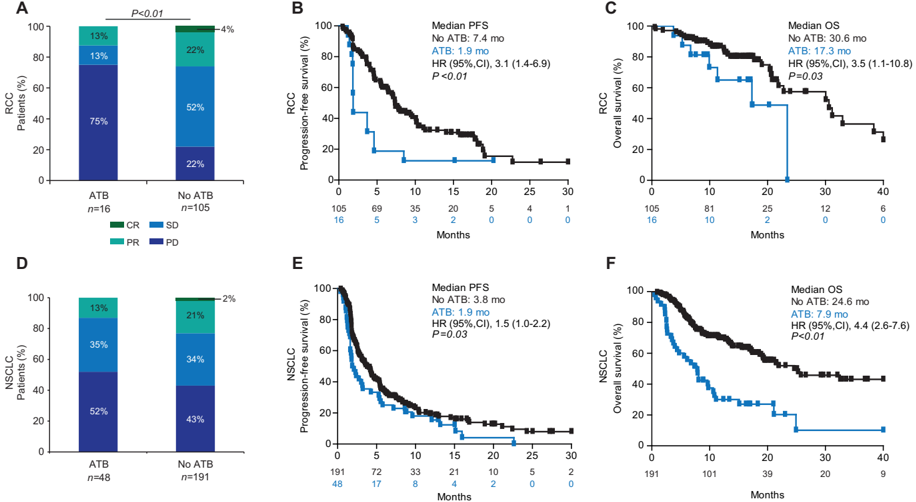
Background: The composition of gut microbiota affects antitumor immune responses, preclinical and clinical outcome following immune checkpoint inhibitors (ICI) in cancer. Antibiotics (ATB) alter gut microbiota diversity and composition leading to dysbiosis, which may affect effectiveness of ICI. Patients and methods: We examined patients with advanced renal cell carcinoma (RCC) and non-small-cell lung cancer (NSCLC) treated with anti-programmed cell death ligand-1 mAb monotherapy or combination at two academic institutions. Those receiving ATB within 30 days of beginning ICI were compared with those who did not. Objective response, progression-free survival (PFS) determined by RECIST1.1 and overall survival (OS) were assessed. Results: Sixteen of 121 (13%) RCC patients and 48 of 239 (20%) NSCLC patients received ATB. The most common ATB were β-lactam or quinolones for pneumonia or urinary tract infections. In RCC patients, ATB compared with no ATB was associated with increased risk of primary progressive disease (PD) (75% versus 22%, P < 0.01), shorter PFS [median 1.9 versus 7.4 months, hazard ratio (HR) 3.1, 95% confidence interval (CI) 1.4-6.9, P < 0.01], and shorter OS (median 17.3 versus 30.6 months, HR 3.5, 95% CI 1.1-10.8, P = 0.03). In NSCLC patients, ATB was associated with similar rates of primary PD (52% versus 43%, P = 0.26) but decreased PFS (median 1.9 versus 3.8 months, HR 1.5, 95% CI 1.0-2.2, P = 0.03) and OS (median 7.9 versus 24.6 months, HR 4.4, 95% CI 2.6-7.7, P < 0.01). In multivariate analyses, the impact of ATB remained significant for PFS in RCC and for OS in NSCLC. Conclusion: ATB were associated with reduced clinical benefit from ICI in RCC and NSCLC. Modulatation of ATB-related dysbiosis and gut microbiota composition may be a strategy to improve clinical outcomes with ICI.
Overview
CoChat Summary
TL;DR
In two independent cohorts of advanced RCC and NSCLC treated with immune checkpoint inhibitors, antibiotic use within 30 days before starting therapy was associated with worse clinical outcomes. The association remained significant for PFS in RCC and for OS in NSCLC in multivariate analyses.
Key findings
- Among 121 RCC patients, 16 (13%) received antibiotics within 30 days of starting ICI. Antibiotic use was associated with more primary progressive disease (75% versus 22%, P < 0.01), shorter median PFS (1.9 versus 7.4 months; HR 3.1, 95% CI 1.4–6.9, P < 0.01), and shorter median OS (17.3 versus 30.6 months; HR 3.5, 95% CI 1.1–10.8, P = 0.03).
- Among 239 NSCLC patients, 48 (20%) received antibiotics within 30 days. Antibiotic use was not associated with primary PD (52% versus 43%, P = 0.26) but was associated with shorter median PFS (1.9 versus 3.8 months; HR 1.5, 95% CI 1.0–2.2, P = 0.03) and shorter median OS (7.9 versus 24.6 months; HR 4.4, 95% CI 2.6–7.7, P < 0.01).
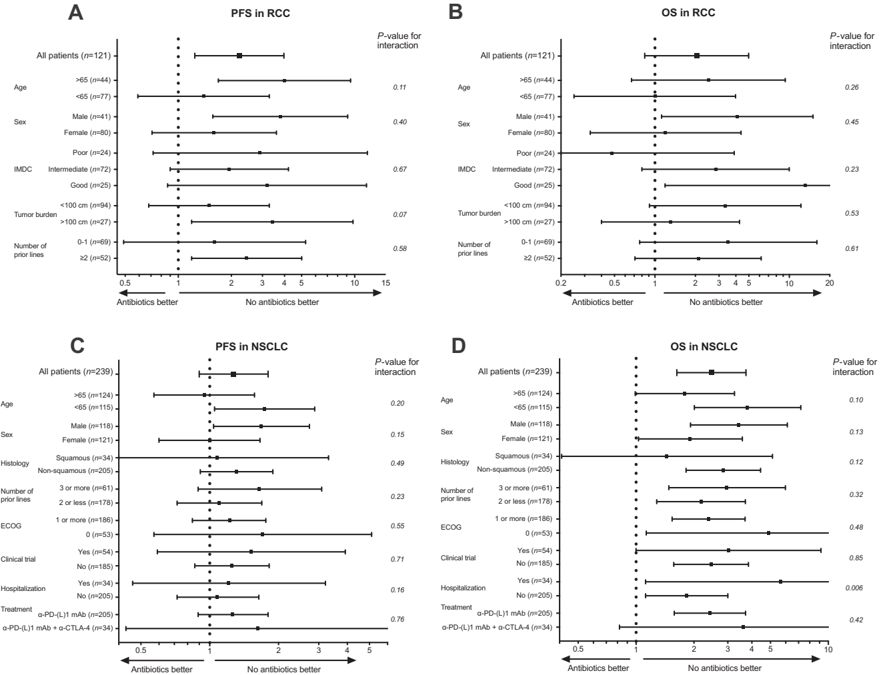
- In multivariate analysis, antibiotics remained associated with worse PFS in RCC (HR 2.0, P < 0.01) but not OS (HR 2.1, P = 0.11); in NSCLC, antibiotics were not significantly associated with PFS (HR 1.3, 95% CI 0.9–1.8, P = 0.17) but remained associated with worse OS (HR 2.5, 95% CI 1.6–3.7, P < 0.01).
- With a 60-day antibiotic window, RCC showed shorter PFS (median 3.1 versus 7.4 months; HR 2.3, 95% CI 1.2–4.4, P < 0.01) and a trend toward worse OS (median 23.4 versus 30 months; HR 1.9, 95% CI 0.8–4.7, P = 0.15); NSCLC showed no difference in objective response or PFS but shorter OS (median 9.8 versus 21.9 months; HR 2.0, 95% CI 1.3–3.2, P < 0.01).
Methods
- Retrospective review of patients with advanced RCC (n = 121) at Gustave Roussy and NSCLC (n = 239) at Memorial Sloan Kettering Cancer Center treated with anti-PD-(L)1 monoclonal antibody monotherapy or combination therapy.
- Antibiotic use was assessed within 30 days or up to 60 days before the first ICI injection; antibiotic class, indication, route, and duration were collected.
- Tumor response was determined by RECIST 1.1; PFS and OS were estimated by Kaplan–Meier and compared with log-rank tests, with multivariable Cox regression adjusting for clinicopathologic features.
Limitations
- The authors state the study is retrospective, with data entry from two institutions; although responses were reviewed with RECIST 1.1, scan timing was not prespecified.
- The authors note differences in patient characteristics between antibiotic and no-antibiotic groups, including higher recent hospitalization in NSCLC and differences in prior lines in RCC, and that analyses did not account for diet, country of origin, or other medications.
- The authors state they did not characterize the mechanism by which antibiotics affect outcomes, and PD-L1 status was lacking in most patients; the text also makes evident that antibiotic subgroups were small and immune-related adverse events were too few to evaluate.
Model-written summary. Check it against the paper before relying on it.
Integrity signals
Registry
Cites
Statistics
Figures




Verification
Claims the paper makes
2 Valid · 1 Not valid · 7 Not checked · 33 Own results and interpretations
At least one cited source doesn’t support this claim or points to a different paper, and none confirmed it — see the verdicts below.
In the paper
“16S ribosomal RNA sequencing of gene amplicons of patients' feces revealed that microbiota returns to its baseline within 1-3 months after ATB discontinuation.”
§ Negative association of antibiotics on clinical activity of immune checkpoint inhibitors in patients with advanced renal cell and non-small-cell lung cancer > Discussion
What the sources say
- Not checked yetcites [14] matched to “Effects of antibiotics on gut microbiota” (2016) source
- Disputedcites [20] matched to “Short-term antibiotic treatment has differing long-term impacts on the human throat and gut microbiome” (2010) sourceExperimental — accuracy not yet measured
The Results section ('Transient and persistent effects of antibiotic treatment'; page unavailable) says fecal microbial communities had only partially recovered at one and four years and remained distinct from their pretreatment compositions. The paper does not report a return to baseline within 1–3 months. (LLM, conf=0.87)
Checked by a reasoning model — may be wrong.
plainstates a cause- Asserted: passes — The authors put it forward as true.
- Checkable: passes — It can be checked against evidence.
- Load-bearing: passes — The paper’s conclusions depend on it.
- Based: passes — The paper gives a reason why it holds.
The sources with a verdict support this claim; the rest weren’t checked yet, have no full text we could read, or their verdicts aren’t rated yet.
In the paper
“However, some bacteria may take years to fully recover [14,20].”
§ Negative association of antibiotics on clinical activity of immune checkpoint inhibitors in patients with advanced renal cell and non-small-cell lung cancer > Discussion
What the sources say
- Not checked yetcites [14] matched to “Effects of antibiotics on gut microbiota” (2016) source
- Supportedcites [20] matched to “Short-term antibiotic treatment has differing long-term impacts on the human throat and gut microbiome” (2010) source
The Results section 'Transient and persistent effects of antibiotic treatment' states that 'One and four years after treatment, the fecal microbial communities had partially recovered to their pre-treatment compositions, however these were still separated along CA axis 2', i.e. full recovery had not occurred even four years after a one-week course. The 'Individuality in antibiotic response' section adds taxon-level persistence (e.g. the increase of unclassified Enterobacteriaceae in patient D persisted during the 4-year period), and the Abstract/Discussion report erm(B) still elevated four years post treatment. The hedged claim that some bacteria 'may take years to fully recover' is therefore within what this source shows; the only points it credits to others (two-year Bacteroides/erm persistence, a resistant clone persisting three years) are separate citations [8] and [10] and are not what the citing sentence attributes here. (LLM, conf=0.82)
hedgedstates a possible cause- Asserted: passes — The authors put it forward as true.
- Checkable: passes — It can be checked against evidence.
- Load-bearing: unclear — It is unclear whether the paper’s conclusions depend on it.
- Based: passes — The paper gives a reason why it holds.
The sources with a verdict support this claim; the rest weren’t checked yet, have no full text we could read, or their verdicts aren’t rated yet.
In the paper
“In oncology, converging findings demonstrate the negative impact of ATBinduced dysbiosis in mice.”
§ Negative association of antibiotics on clinical activity of immune checkpoint inhibitors in patients with advanced renal cell and non-small-cell lung cancer > Introduction
What the sources say
- Supportedcites [9] matched to “Anticancer immunotherapy by CTLA-4 blockade relies on the gut microbiota” (2015) source
The Results passage opening Fig. 1 states that broad-spectrum antibiotics (ampicillin+colistin+streptomycin, and imipenem alone but not colistin) 'compromised the antitumor effects of CTLA-4-specific Ab', confirmed across the Ret melanoma and MC38 colon cancer models and mirrored by germ-free housing — i.e. converging mouse evidence in oncology that antibiotic-induced microbiota disruption harms checkpoint-blockade efficacy. The Abstract states it outright: 'Tumors in antibiotic-treated or germ-free mice did not respond to CTLA blockade.' The only framing shift is minor: the paper attributes the loss of efficacy to depletion/recomposition of the microbiota (rescued by B. fragilis gavage) rather than using the word 'dysbiosis', and it hedges the mechanism ('suggest that the gut microbiota is required'), but the negative impact of antibiotic treatment itself is asserted as fact. (LLM, conf=0.90)
- Not checked yetcites [10]
boostedstates a cause- Asserted: passes — The authors put it forward as true.
- Checkable: passes — It can be checked against evidence.
- Load-bearing: passes — The paper’s conclusions depend on it.
- Based: passes — The paper gives a reason why it holds.
- Supported
A result the paper reports from its own data — it cites no other source for it, so there is none to check. The quote shows it is in the paper.
In the paper
“and shorter OS (median 17.3 versus 30.6 months, HR 3.5, 95% CI 1.1-10.8,P ¼ 0.03).”
- Also stated in: § Results · plain
“median OS, 17.3 months versus 30.6 months, HR 3.5, 95% CI 1.1-10.8,P ¼ 0.03”
§ Negative association of antibiotics on clinical activity of immune checkpoint inhibitors in patients with advanced renal cell and non-small-cell lung cancer > Abstract
plainstates an association- Asserted: passes — The authors put it forward as true.
- Checkable: passes — It can be checked against evidence.
- Load-bearing: passes — The paper’s conclusions depend on it.
- Based: passes — The paper gives a reason why it holds.
- Also stated in: § Results · plain
A result the paper reports from its own data — it cites no other source for it, so there is none to check. The quote shows it is in the paper.
In the paper
“In RCC, ATB-60 days remained associated with increased risk of primary progression (P < 0.01)”
§ Negative association of antibiotics on clinical activity of immune checkpoint inhibitors in patients with advanced renal cell and non-small-cell lung cancer > Results
plainstates an association- Asserted: passes — The authors put it forward as true.
- Checkable: passes — It can be checked against evidence.
- Load-bearing: passes — The paper’s conclusions depend on it.
- Based: passes — The paper gives a reason why it holds.
20 more claims
Create a free account to see all 43 claims and to verify the 15 references still open.
- It may state two separate claims as one. 11
- Probably not a substantial claim. 11
Claims other papers make about this one
Each is checked against this paper’s own text: does it say what the citing paper says it does?
The source backs part of the claim, not all of it — or backs it for a different population, condition or comparison.
In the citing paper
“Similarly, antibiotics (ATB) prior to ICI initiation drastically reduced the clinical benefit in several cohorts of patients across various cancer types (melanoma, advanced NSCLC, renal cell carcinoma (RCC), and urothelial cancer) 18,[20][21][22] .”
From Intestinal Akkermansia muciniphila predicts clinical response to PD-1 blockade in patients with advanced non-small-cell lung cancer (2022) · cites this paper as [20]
Experimental — accuracy not yet measuredThe source backs part of the claim, not all of it — or backs it for a different population, condition or comparison.
In the citing paper
“However, increasing clinical evidence suggests that systemic antibiotics abolish immune checkpoint blockade efficacy and decrease patient survival (133, 136, 137).”
From The microbiome and human cancer (2021) · cites this paper as [137]
Experimental — accuracy not yet measuredThe source backs part of the claim, not all of it — or backs it for a different population, condition or comparison.
In the citing paper
“However, the clinical value of this observation is limited by its derivation from selected oncological indications, including renal and non-small cell lung cancer (NSCLC), 2 for which external validation, especially outside clinical trials, is necessary.”
From Association of Prior Antibiotic Treatment With Survival and Response to Immune Checkpoint Inhibitor Therapy in Patients With Cancer (2019) · cites this paper as [2]
Experimental — accuracy not yet measuredThe source backs part of the claim, not all of it — or backs it for a different population, condition or comparison.
In the citing paper
“However, our results suggest that administration of these classes of antibiotics constitutes a likely surrogate for poor disease status and a state of increased systemic inflammation prior to initiation of CAR-T cell therapy, as was recently suggested in cancer patients treated with other ICBs28,35.”
From A non-antibiotic-disrupted gut microbiome is associated with clinical responses to CD19-CAR-T cell cancer immunotherapy (2023) · cites this paper as [28]
Experimental — accuracy not yet measuredThe cited source says what the claim attributes to it.
In the citing paper
“Supporting this contention, we and others reported that primary responses to anti-PD-1/ PD-L1 antibodies in patients with epithelial tumours and melanoma could, at least in part, be attributed to the taxonomic composition of the gut microbial ecosystem 18,20,25 .”
From Intestinal Akkermansia muciniphila predicts clinical response to PD-1 blockade in patients with advanced non-small-cell lung cancer (2022) · cites this paper as [20]
14 more claims about this paper
Create a free account to see every claim other papers make about this one.
Self-check
Percentages, sums and reported differences re-computed from the paper’s own numbers.
Each contradiction between two passages listed here was confirmed by an independent check.
Rated major: it would touch a result — a value a result rests on, reported and recomputed p-values on opposite sides of the significance level, two passages that conflict with no sign which is right, or a cited work retracted before this paper was published.
In the paper
§ Negative association of antibiotics on clinical activity of immune checkpoint inhibitors in patients with advanced renal cell and non-small-cell lung cancer > Results
“median PFS, 1.9 months versus 3.8 months, HR 1.5, 95% CI 1.0-2.2,P ¼ 0.03”
§ Negative association of antibiotics on clinical activity of immune checkpoint inhibitors in patients with advanced renal cell and non-small-cell lung cancer > Discussion
“ATB 30-0/No ATB 1.4 (1.0-2.0)0.04 1.3 (0.9-1.8) 0.17”
Rated major: it would touch a result — a value a result rests on, reported and recomputed p-values on opposite sides of the significance level, two passages that conflict with no sign which is right, or a cited work retracted before this paper was published.
In the paper
§ Negative association of antibiotics on clinical activity of immune checkpoint inhibitors in patients with advanced renal cell and non-small-cell lung cancer > Results
“median OS, 7.9 months versus 24.6 months, HR 4.4, 95% CI 2.6-7.7,P < 0.01”
§ Negative association of antibiotics on clinical activity of immune checkpoint inhibitors in patients with advanced renal cell and non-small-cell lung cancer > Discussion
“ATB 30-0/No ATB 2.9 (1.9-4.4)<0.01 2.5 (1.6-3.7)<0.01”
Rated major: it would touch a result — a value a result rests on, reported and recomputed p-values on opposite sides of the significance level, two passages that conflict with no sign which is right, or a cited work retracted before this paper was published.
In the paper
§ Negative association of antibiotics on clinical activity of immune checkpoint inhibitors in patients with advanced renal cell and non-small-cell lung cancer > Results
“median PFS, 1.9 months versus 7.4 months, HR 3.1, 95% CI 1.4-6.9,P < 0.01”
§ Negative association of antibiotics on clinical activity of immune checkpoint inhibitors in patients with advanced renal cell and non-small-cell lung cancer > Discussion
“ATB 30-0/No ATB 2.3 (1.3-4.0)<0.01 2.2 (1.3-3.3)<0.01”
Rated minor: it would not touch a result — a value no result rests on, a p-value that stays on the same side of the significance level, or a conflict that is clerical, resolved elsewhere in the paper, or outside its own findings.
In the paper
§ Negative association of antibiotics on clinical activity of immune checkpoint inhibitors in patients with advanced renal cell and non-small-cell lung cancer > Results
“Range 28-83 29-83 30-82”
§ Negative association of antibiotics on clinical activity of immune checkpoint inhibitors in patients with advanced renal cell and non-small-cell lung cancer > Results
“ATB 30-0 (n 5 16) No ATB (n 5 105)”
Rated minor: it would not touch a result — a value no result rests on, a p-value that stays on the same side of the significance level, or a conflict that is clerical, resolved elsewhere in the paper, or outside its own findings.
In the paper
§ Negative association of antibiotics on clinical activity of immune checkpoint inhibitors in patients with advanced renal cell and non-small-cell lung cancer > Discussion
“Female (n=80) Male (n=41)”
§ Negative association of antibiotics on clinical activity of immune checkpoint inhibitors in patients with advanced renal cell and non-small-cell lung cancer > Results
“Gender, n (%) Male 80 (66) 9 (56) 71 (68) 0.37 Female 41 (34) 7 (44) 34 (32)”
4 more findings
Create a free account to see every finding of this check.
Citations
Cites
New response evaluation criteria in solid tumours: revised RECIST guideline (version 1.1)
Eisenhauer, E. A., Therasse, P., Bogaerts, J., Schwartz, L. H., Sargent, D., Ford, R., Dancey, J., Arbuck, S., Gwyther, S., Mooney, M., et al. (2009) · European Journal of Cancer · doi:10.1016/j.ejca.2008.10.026 · Cited by 29,534
Adverse Renal Effects of Immune Checkpoint Inhibitors: A Narrative Review
Wanchoo, R., Karam, S., Uppal, N. N., Barta, V. S., Deray, G., Devoe, C., Launay-Vacher, V., Jhaveri, K. D., & on behalf of Cancer and Kidney International Network Workgroup on Immune Checkpoint Inhibitors (2017) · American Journal of Nephrology · doi:10.1159/000455014 · Cited by 15,256
Pembrolizumab versus Chemotherapy for PD-L1-Positive Non-Small-Cell Lung Cancer
Reck, M., Rodríguez-Abreu, D., Robinson, A. G., Hui, R., Csőszi, T., Fülöp, A., Gottfried, M., Peled, N., Tafreshi, A., Cuffe, S., et al. (2016) · New England Journal of Medicine · doi:10.1056/nejmoa1606774 · Cited by 10,089
Nivolumab versus docetaxel in advanced nonsquamous non-small-cell lung cancer
Borghaei, H., Paz-Ares, L., Horn, L., Spigel, D. R., Steins, M., Ready, N. E., Chow, L. Q., Vokes, E. E., Felip, E., Holgado, E., et al. (2015) · New England Journal of Medicine · doi:10.1056/nejmoa1507643 · Cited by 9,335
Nivolumab versus Everolimus in Advanced Renal-Cell Carcinoma
Motzer, R. J., Escudier, B., McDermott, D. F., George, S., Hammers, H. J., Srinivas, S., Tykodi, S. S., Sosman, J. A., Procopio, G., Plimack, E. R., et al. (2015) · New England Journal of Medicine · doi:10.1056/nejmoa1510665 · Cited by 5,807
Self-citationGut microbiome influences efficacy of PD-1-based immunotherapy against epithelial tumors
Routy, B., Le Chatelier, E., Derosa, L., Duong, C. P. M., Alou, M. T., Daillère, R., Fluckiger, A., Messaoudene, M., Rauber, C., Roberti, M. P., et al. (2018) · Science · doi:10.1126/science.aan3706 · Cited by 5,671
Self-citationDiversity, stability and resilience of the human gut microbiota
Lozupone, C. A., Stombaugh, J. I., Gordon, J. I., Jansson, J. K., & Knight, R. (2012) · Nature · doi:10.1038/nature11550 · Cited by 5,533
Gut microbiome modulates response to anti-PD-1 immunotherapy in melanoma patients
Gopalakrishnan, V., Spencer, C. N., Nezi, L., Reuben, A., Andrews, M. C., Karpinets, T. V., Prieto, P. A., Vicente, D., Hoffman, K., Wei, S. C., et al. (2018) · Science · doi:10.1126/science.aan4236 · Cited by 4,812
Self-citationIFN-γ–related mRNA profile predicts clinical response to PD-1 blockade
Ayers, M., Lunceford, J., Nebozhyn, M., Murphy, E., Loboda, A., Kaufman, D. R., Albright, A., Cheng, J. D., Kang, S. P., Shankaran, V., et al. (2017) · Journal of Clinical Investigation · doi:10.1172/jci91190 · Cited by 3,788
Anticancer immunotherapy by CTLA-4 blockade relies on the gut microbiota
Vétizou, M., Pitt, J. M., Daillère, R., Lepage, P., Waldschmitt, N., Flament, C., Rusakiewicz, S., Routy, B., Roberti, M. P., Duong, C. P. M., et al. (2015) · Science · doi:10.1126/science.aad1329 · Cited by 3,488
Self-citation
Cited by
Items 501–600 of 909
Sun, S., Liu, C., Duan, C., Yu, S., Zhang, Q., Xu, N., Yu, B., Wu, X., Wang, J., Hu, X., et al. (2022) · Journal of Cancer Research and Clinical Oncology · doi:10.1007/s00432-022-04176-x · Cited by 12
Diet Influences Immunotherapy Outcomes in Cancer Patients: A Literature Review
Kian, N., Behrouzieh, S., Razi, S., & Rezaei, N. (2022) · Nutrition and Cancer · doi:10.1080/01635581.2022.2133151 · Cited by 14
“which demonstrated reduced clinical benefit from ICI in cancer patients who received antibiotics within 30 day from ICI therapy onset, compared to those who did not (112).”
BackgroundBacteria and macrophages in the tumor microenvironment
Xu, S. S., Xiong, Y., Fu, B., Guo, D. L., Sha, Z., Lin, X., & Wu, H. (2023) · Frontiers in Microbiology · doi:10.3389/fmicb.2023.1115556 · Cited by 14
“(2020) Prostate cancer Verrucomicrobia Akkermansiaceae Daisley et al.”
BackgroundInfluentialSamnani, S., Sachedina, F., Gupta, M., Guo, E., & Navani, V. (2023) · Cancer Drug Resistance · doi:10.20517/cdr.2023.02 · Cited by 12
Integrative Oncology Approaches to Supporting Immune Checkpoint Inhibitor Treatment of Solid Tumours
Fuller-Shavel, N., & Krell, J. (2024) · Current Oncology Reports · doi:10.1007/s11912-023-01492-4 · Cited by 15
“1 include a Mediterranean-style diet with over 20 g of fibre [12 •• , 50 •• ], regular exercise [14], the use of live biotherapeutics [82–84], ensuring vitamin D repletion [13, 97], and minimising PPI and antibiotic use [67, 74–76], with many other integrative oncology approaches under study.”
BackgroundAlotaibi, F., Albalawi, I. A. S., Anis, A. M., Alotaibi, H., KHASHWAYN, S. A., Alshammari, K. M., & Al‐Tawfiq, J. A. (2024) · Frontiers in Medicine · doi:10.3389/fmed.2024.1415093 · Cited by 16
Song, Y., Peng, Y., Qin, C., Jiang, S., Lin, J., Lai, S., Wu, J., Ding, M., Du, Y., Yu, L., et al. (2024) · International Journal of Surgery · doi:10.1097/js9.0000000000001901 · Cited by 15
Zhang, W., Zhang, H., Gao, Y., Lei, J., & Suo, C. (2025) · Frontiers in Cellular and Infection Microbiology · doi:10.3389/fcimb.2025.1596688 · Cited by 17
The impact of modulating the gastrointestinal microbiota in cancer patients
Morkūnas, E., Skiecevičienė, J., & Kupčinskas, J. (2020) · Best Practice & Research Clinical Gastroenterology · doi:10.1016/j.bpg.2020.101700 · Cited by 14
Utilizing Gut Microbiota to Improve Hepatobiliary Tumor Treatments: Recent Advances
Qin, H., Yuan, B., Huang, W., & Wang, Y. (2022) · Frontiers in Oncology · doi:10.3389/fonc.2022.924696 · Cited by 13
The Role of Tumor and Host Microbiome on Immunotherapy Response in Urologic Cancers
Drobner, J. C., Doppalapudi, K., Saraiya, B., Packiam, V. T., & Ghodoussipour, S. B. (2024) · Journal of Cancer Immunology · doi:10.33696/cancerimmunol.6.078 · Cited by 15
“It is possible that there are innate immunogenic bacteria that are required for the activation of these cancer drugs, and that antibiotic administration results in their elimination [81].”
BackgroundAmadei, S. S., & Notario, V. (2020) · Antibiotics · doi:10.3390/antibiotics9090580 · Cited by 13
“Since then, most studies have reported negative effects of antibiotic exposure leading to diminished levels of efficacy of ICIs in immunotherapy protocols for the treatment of a variety of tumors, including lung tumors/NSCLC [137–144], advanced or metastatic renal cell carcinoma [137,141,142,144], urothelial carcinoma…”
BackgroundFrom mucosal infection to successful cancer immunotherapy
Goubet, A.-G., Rouanne, M., Derosa, L., Kroemer, G., & Zitvogel, L. (2023) · Nature Reviews Urology · doi:10.1038/s41585-023-00784-5 · Cited by 11
“The detrimental effects of antibiotics on the efficacy of cancer therapy have been broadly reported across cancer types 113 , including RCC and bladder cancer at early and advanced stages (NMIBC, MIBC, metastatic urothelial carcinoma and mRCC 152–155 ).”
BackgroundSelf-citationMonteiro, J., Fernandes, A., Tato, D. G., Moreira, E., Ribeiro, R. J. T., Reguengo, H., Gonçalves, J., & Fresco, P. (2025) · Cancers · doi:10.3390/cancers17193262 · Cited by 16
Xu, C., Chen, Q., Zhou, C., Wu, L., Li, W., Zhang, H., Li, Y., Xu, F., Xiong, J., Wang, Q., et al. (2023) · Translational Lung Cancer Research · doi:10.21037/tlcr-22-852 · Cited by 11
Dóra, D., Weiss, G. J., Megyesfalvi, Z., Gálffy, G., Dulka, E., Kerpel-Fronius, A., Berta, J., Moldvay, J., Döme, B., & Lohinai, Z. (2023) · Cancers · doi:10.3390/cancers15205091 · Cited by 15
“This is in contrast with the studies of Derosa et al. [47] and Pinato et al. [48], but in line with other studies, where multivariate analysis could not underpin the significant negative effect of antibiotic usage on response or OS [23,49–51].”
ResultModulating the gut microbiome in non-small cell lung cancer: Challenges and opportunities
Lee, J. B., Huang, Y., Oya, Y., Nützinger, J., Ang, Y. L. E., Sooi, K. W. X., Cho, B. C., & Soo, R. A. (2024) · Lung Cancer · doi:10.1016/j.lungcan.2024.107862 · Cited by 13
Immune approaches beyond traditional immune checkpoint inhibitors for advanced renal cell carcinoma
Jang, A., Lichterman, J. N., Zhong, J. Y., Shoag, J. E., Garcia, J. A., Zhang, T., & Barata, P. C. (2023) · Human Vaccines & Immunotherapeutics · doi:10.1080/21645515.2023.2276629 · Cited by 13
“32 Specific bacteria have been demonstrated to be potential biomarkers of response to ICIs.”
BackgroundRassy, E., Mezquita, L., Remón, J., & Besse, B. (2019) · Immunotherapy · doi:10.2217/imt-2019-0071 · Cited by 11
Kapoor, A., Noronha, V., Patil, V., Joshi, A., Menon, N. S., Mahajan, A., Janu, A., & Prabhash, K. (2020) · ecancermedicalscience · doi:10.3332/ecancer.2020.1038 · Cited by 14
“In a study by Derosa et al [3], a negative association of antibiotics was observed on the clinical activity of ICI in patients with advanced renal and non-small-cell lung cancer both in terms of progression free survival (PFS) and overall survival (OS) [3].”
BackgroundSafety of current immune checkpoint inhibitors in non-small cell lung cancer
Abdayem, P., & Planchard, D. (2021) · Expert Opinion on Drug Safety · doi:10.1080/14740338.2021.1867100 · Cited by 13
Rühle, A., Zou, J., Glaser, M., Halle, L., Gkika, E., Schäfer, H. S., Knopf, A., Becker, C., Grosu, A., Popp, I., et al. (2023) · European Archives of Oto-Rhino-Laryngology · doi:10.1007/s00405-023-07868-3 · Cited by 16
“Another study with 360 non-small cell lung cancer (NSCLC) and renal cell carcinoma patients could show that the negative influence of antibiotics given 60 days prior to immune checkpoint inhibitors was not as strong as within the first 30 days before immune checkpoint inhibitor therapy [31].”
BackgroundInoue, S., Sassa, N., Kato, T., Yamauchi, Y., Hirabayashi, T., Yuguchi, Y., Maeda, M., Soeda, Y., Hattori, R., & Gotoh, M. (2020) · International Journal of Urology · doi:10.1111/iju.14367 · Cited by 11
Gut microbiome metabolites in lung cancer: The emerging importance of short-chain fatty acids
Bishoyi, A. K., Al-Hasnaawei, S., Salem, K. H., Ganesan, S., Shankhyan, A., Nanda, A., Sinha, A., Ray, S., Nathiya, D., & Hammady, F. J. (2025) · International Immunopharmacology · doi:10.1016/j.intimp.2025.115821 · Cited by 13
Tamiya, A. (2023) · Respiratory Investigation · doi:10.1016/j.resinv.2023.10.004 · Cited by 10
Zhong, J., Xiong, D., Liu, Y., & Yuan, S. (2023) · Thoracic Cancer · doi:10.1111/1759-7714.15172 · Cited by 12
Guerrero, P., Albarrán, V., González-Merino, C., de Quevedo, C. G., Sotoca, P., Chamorro, J. V., Rosero, D. I., Barrill, A. M., Alía, V., Calvo, J. C., et al. (2024) · The Oncologist · doi:10.1093/oncolo/oyae284 · Cited by 10
“Subsequently, similar results have been found by several other studies, 9-11 reporting worse PFS and OS among patients exposed to Abx.”
Exploring micronutrients and microbiome synergy: pioneering new paths in cancer therapy
Bhatnagar, K., Jha, K., Dalal, N., Patki, N., Gupta, G., Kumar, A., Kumar, A., & Chaudhary, S. (2024) · Frontiers in Immunology · doi:10.3389/fimmu.2024.1442788 · Cited by 12
Owoicho, A. M., Ogenyi, D. O., Zhilenkova, A. V., Essogmo, F. E., Tchawe, Y. S. N., Uchendu, I. K., Pascal, A. M., Nikitina, N. M., Rusanov, A. S., Sanikovich, V. D., et al. (2024) · International Journal of Molecular Sciences · doi:10.3390/ijms26010265 · Cited by 15
Pu, X., Zhou, Y. L., Wang, J., & Wu, L. (2025) · Thoracic Cancer · doi:10.1111/1759-7714.70113 · Cited by 10
Gut bacteria affect the tumoral immune milieu: distorting the efficacy of immunotherapy or not?
Pu, X., Chao, G., Dong, L., & Chang, P. (2020) · Gut Microbes · doi:10.1080/19490976.2020.1739794 · Cited by 11
“Conversely, cancer patients who have used antibiotics long term have not only a poor response to ICI therapy but also an increased incidence of ICI-related toxicity.(24,25) It has been shown that antibiotics are able to reduce the total number and diversity of commensal bacteria in the gut.”
BackgroundWang, J.-R., Li, R.-N., Huang, C., Hong, C., Li, Q., Zeng, L., He, J.-Z., Hu, C., Cui, H., Liu, L., et al. (2022) · Liver Research · doi:10.1016/j.livres.2022.05.004 · Cited by 10
A Profile of Avelumab Plus Axitinib in the Treatment of Renal Cell Carcinoma
Meyo, M. T., Chen, J., Goldwasser, F., Hirsch, L., & Huillard, O. (2022) · Therapeutics and Clinical Risk Management · doi:10.2147/tcrm.s263832 · Cited by 13
“of antibiotic consumption on ICI efficacy is now thoroughly documented.(116,117) Its deleterious effect results from excessive bacterial depletion, as specific commensal germs such as Akkermansia muciniphila, Alistipes indistinctus and Enterococcus hirae seem to be critical for T-cell activation.”
BackgroundGonugunta, A. S., von Itzstein, M. S., Hsiehchen, D., Le, T., Rashdan, S., Yang, H., Selby, C., Alvarez, C., & Gerber, D. E. (2022) · Clinical Lung Cancer · doi:10.1016/j.cllc.2022.09.005 · Cited by 13
Castelo-Branco, L., Morgan, G., Prelaj, A., Scheffler, M., Canhão, H. M., van Meerbeeck, J. P., & Awada, A. H. (2023) · ESMO Open · doi:10.1016/j.esmoop.2022.100764 · Cited by 11
Aminu, M., Daver, N. G., Godoy, M. C. B., Shroff, G. S., Wu, C. C., Torre-Sada, L. F., Goizueta, A. A., Shannon, V. R., Faiz, S. A., Altan, M., et al. (2023) · Frontiers in Immunology · doi:10.3389/fimmu.2023.1249511 · Cited by 10
“If validated, our approach holds great promise to improve the clinical care of cancer patients treated with ICIs by improving our ability to differentiate pneumonitis from other lung diseases in a prompt fashion.”
BackgroundInfluentialRole of gut microbiome in the outcome of cancer immunotherapy
Ma, J., Zhu, W., & Liu, B. (2021) · International Journal of Cancer · doi:10.1002/ijc.33524 · Cited by 11
“In patients with advanced renal cell cancer and NSCLC, administration of antibiotics affects PFS and overall survival (OS).(57,58) Cancer patients undergoing antibiotic treatment were associated with decreased PFS and OS.”
BackgroundRoberto, M., Carconi, C., Cerreti, M., Schipilliti, F. M., Botticelli, A., Mazzuca, F., & Marchetti, P. (2021) · Frontiers in Immunology · doi:10.3389/fimmu.2021.704942 · Cited by 10
Barbosa, C. M.-M., Lletí, A. C. C., Sánchez, R. P., Román, C. D., Alonso, P. T., & González, B. F. (2022) · Revista Española de Quimioterapia · doi:10.37201/req/040.2022 · Cited by 13
“The prevalence of antibiotic use was around 30%, similar to that previously reported in the literature [9; 16]; although it could range between 14 and 44% depending on the selected cohort [23-24].”
ResultA New Treatment Landscape for RCC: Association of the Human Microbiome with Improved Outcomes in RCC
Piao, X., Byun, Y. J., Zheng, C.-M., Song, S. J., Kang, H. W., Kim, W. T., & Yun, S. J. (2023) · Cancers · doi:10.3390/cancers15030935 · Cited by 12
“[61] 2020 67 Whole genome sequencing Increased • Akkermansia muciniphila • Bacteroides salyersiae • Eubacterium siraeum • Clostridium Clostridioforme • Clostridium hathewayi • Erysipelotrichaceae bacterium”
BackgroundInfluentialFunayama, E., Hosonuma, M., Tajima, K., Isobe, J., Baba, Y., Murayama, M., Narikawa, Y., Toyoda, H., Tsurui, T., Maruyama, Y., et al. (2025) · Biomedicine & Pharmacotherapy · doi:10.1016/j.biopha.2024.117749 · Cited by 9
Nelli, F., Virtuoso, A., Giannarelli, D., Fabbri, A., Berrìos, J. R. G., Marrucci, E., Fiore, C., & Ruggeri, E. M. (2023) · Current Oncology · doi:10.3390/curroncol30090589 · Cited by 10
“In this regard, concomitant therapies with corticosteroids [10,11], antibiotics [12,13], proton pump inhibitors (PPIs) [14–16], oral opioids [14], and metformin [15] have been shown to impair the efficacy of agents targeting the PD-1/PD-L1 checkpointin advanced NSCLC.”
BackgroundCutting‐Edge Advancements in the Antibiotics‐Gut Microbiota‐Urinary Tumour Axis
Wang, J., Li, D., Wu, R., & Feng, D. (2025) · Cell Proliferation · doi:10.1111/cpr.70023 · Cited by 9
Li, Y., Feng, Z., Liang, C., Lu, S., Wang, G., & Meng, G. (2025) · BMC Gastroenterology · doi:10.1186/s12876-025-03819-w · Cited by 9
Re, M. D., Roncato, R., Argentiero, A., Berrino, L., Botticelli, A., Capuano, A., Donato, S. D., Fogli, S., Marino, D., Rodriquenz, G., et al. (2025) · ESMO Open · doi:10.1016/j.esmoop.2025.105119 · Cited by 19
“34 Reduced ef fi cacy of immune checkpoint inhibitors (ICIs) can occur when co-administered with antibiotics, 35 corticosteroids, or proton pump inhibitors (PPIs).”
Komatsu, H., Sugimoto, T., Ogata, Y., Miura, T., Aida, M., Nishiyama, H., Kawai, M., Yano, Y., Mori, M., & Shishido, Y. (2025) · Scientific Reports · doi:10.1038/s41598-025-08049-4 · Cited by 14
“The emergence of immune checkpoint inhibitors (ICIs), such as those targeting programmed cell death 1 (PD-1) or its ligand (PD-L1), has transformed the treatment and management of advanced non-small cell lung cancer (NSCLC), which constitutes most lung cancers 1 .”
InfluentialBlanco, J. R., del Campo, R., Ortiz, J. A., Olmos, M. L., & Carnero, A. (2025) · Cells · doi:10.3390/cells14221813 · Cited by 14
Wang, D., He, H., Li, X., & Wang, Z. (2020) · Annals of Translational Medicine · doi:10.21037/atm-20-4535 · Cited by 9
“(25) found that PD-1/PD-L1 had a greater effect in patients who did not receive antibiotics than in those who did in NSCLC and kidney cancer.”
BackgroundCina, M. L., Venegas, J., & Young, A. (2023) · Immunological Reviews · doi:10.1111/imr.13250 · Cited by 12
The Impact of the Fecal Microbiome on Cancer Immunotherapy
Osman, A. E. G., & Luke, J. J. (2019) · BioDrugs · doi:10.1007/s40259-018-0328-8 · Cited by 9
Mining the Gut Microbiota for Microbial-Based Therapeutic Strategies in Cancer Immunotherapy
Li, B., Gong, T., Hao, Y., Zhou, X., & Cheng, L. (2021) · Frontiers in Oncology · doi:10.3389/fonc.2021.721249 · Cited by 9
Hu, D., Wong, W.-C., Zhou, J., Luo, J., Cai, S., Zhou, H. K., & Tang, H. (2022) · Journal of Oncology · doi:10.1155/2022/1001796 · Cited by 8
Severe infections in recipients of cancer immunotherapy: what intensivists need to know
Joseph, A., Lafarge, A., Mabrouki, A., Abdel-Nabey, M., Binois, Y., Younan, R., & Azoulay, É. (2022) · Current Opinion in Critical Care · doi:10.1097/mcc.0000000000000978 · Cited by 12
Prospect of bacteria for tumor diagnosis and treatment
Xu, Y., Zhao, C., Ma, X., & Zhang, H. (2022) · Life Sciences · doi:10.1016/j.lfs.2022.121215 · Cited by 9
Vihinen, H., Jokinen, A., Laajala, T. D., Wahid, N., Peltola, L., Kettunen, T., Rönkä, A., Tiainen, L., Skyttä, T., Kohtamäki, L. M., et al. (2023) · Clinical Lung Cancer · doi:10.1016/j.cllc.2023.01.004 · Cited by 11
Checkpoint Inhibitors: Conquering Cancer with a Little (T)-Help from Our Microbial Friends
Asmar, N. E., Ibrahim, T., & Rey, J. (2018) · Digestive Diseases and Sciences · doi:10.1007/s10620-018-5188-z · Cited by 9
Inflammatory Biomarkers as Predictors of Response to Immunotherapy in Urological Tumors
Schepisi, G., Brighi, N., Cursano, M. C., Gurioli, G., Ravaglia, G., Altavilla, A., Burgio, S. L., Testoni, S., Menna, C., Farolfi, A., et al. (2019) · Journal of Oncology · doi:10.1155/2019/7317964 · Cited by 9
“In particular, 2 recent studies [17, 18] showed that the use of beta-lactams, quinolones, and macrolides during ICIs therapy also led to shorter progression-free survival (PFS) and poorer RR in RCC patients.”
Result[Therapeutic Relevance of Human Microbiota and Lung Cancer].
Zhou, H., Suo, J., & Zhu, J. (2019) · PubMed Central · doi:10.3779/j.issn.1009-3419.2019.07.09 · Cited by 11
Microbiome and cancer treatment: Are we ready to apply in clinics?
Chan, S. L. (2020) · Progress in molecular biology and translational science · doi:10.1016/bs.pmbts.2020.04.004 · Cited by 11
Antibiotics impair immunotherapy for urothelial cancer
Derosa, L., & Zitvogel, L. (2020) · Nature Reviews Urology · doi:10.1038/s41585-020-0373-1 · Cited by 9
Self-citationCruellas, M., Yubero, A., Zapata, M., Galvez, E. M., Ruiz, M. G., Isla, D., Lastra, R., Martínez‐Lostao, L., Ocariz, M., Pardo, J., et al. (2021) · Infection and Immunity · doi:10.1128/iai.00665-20 · Cited by 12
Further evidence to support judicious use of antibiotics in patients with cancer
Luke, J. J., & Pal, S. K. (2018) · Annals of Oncology · doi:10.1093/annonc/mdy153 · Cited by 9
Established and Emerging Biomarkers of Immunotherapy in Renal Cell Carcinoma
Jani, Y. C., Jansen, C. S., Gerke, M. B., & Bilen, M. A. (2024) · Immunotherapy · doi:10.2217/imt-2023-0267 · Cited by 8
Diet and the microbiome as mediators of prostate cancer risk, progression, and therapy response
Cruz-Lebrón, A., Faiez, T. S., Hess, M. M., & Sfanos, K. S. (2025) · Urologic Oncology Seminars and Original Investigations · doi:10.1016/j.urolonc.2024.12.001 · Cited by 10
Makkar, S. K., & Bishnupuri, K. S. (2025) · Frontiers in Physiology · doi:10.3389/fphys.2025.1676796 · Cited by 11
The tumor ecosystem: Rewiring an open, systemically integrated network for therapeutic gain
Chiodelli, P., Papait, A., Agoni, L., Quaglia, F., Silini, A. R., & Parolini, O. (2026) · Biomedicine & Pharmacotherapy · doi:10.1016/j.biopha.2026.119047 · Cited by 12
Brunetti, L., Santo, V., Pinato, D. J., Citarella, F., Orlando, S., Acker, F., Colella, V., Ricciuti, B., Naidoo, J., Nassar, A., et al. (2026) · The Lancet Oncology · doi:10.1016/s1470-2045(26)00191-9 · Cited by 10
Self-citationIida, K., Naiki, T., Etani, T., Nagai, T., Sugiyama, Y., Isobe, T., Aoki, M., Nozaki, S., Noda, Y., Shimizu, N., et al. (2024) · Scientific Reports · doi:10.1038/s41598-024-53158-1 · Cited by 10
Garza, R. G., Gutiérrez‐González, A., Salinas-Carmona, M. C., & Mejia-Torres, M. G. (2024) · Oncology Reports · doi:10.3892/or.2024.8823 · Cited by 9
Could β-Lactam Antibiotics Block Humoral Immunity?
Melenotte, C., Pontarotti, P., Pinault, L., Mège, J., Devaux, C. A., & Raoult, D. (2021) · Frontiers in Immunology · doi:10.3389/fimmu.2021.680146 · Cited by 19
Nakatsu, G. (2021) · Journal of Gastroenterology and Hepatology · doi:10.1111/jgh.15715 · Cited by 10
Pasello, G., Lorenzi, M., Calvetti, L., Oliani, C., Pavan, A., Favaretto, A. G., Palazzolo, G., Giovanis, P., Zustovich, F., Bonetti, A. V., et al. (2022) · The Oncologist · doi:10.1093/oncolo/oyac051 · Cited by 8
Tian, X., Mei, T., Yu, M., Li, Y., Ao, R., & Gong, Y. (2022) · Cancer Medicine · doi:10.1002/cam4.4815 · Cited by 8
Advanced non-small-cell lung cancer: how to manage non-oncogene disease
Giglio, A. D., Federico, A. D., Deiana, C., Ricciuti, B., Brambilla, M., & Metro, G. (2022) · Drugs in Context · doi:10.7573/dic.2022-2-4 · Cited by 8
Sex-Biased Immune Responses to Antibiotics during Anti-PD-L1 Treatment in Mice with Colon Cancer
Jing, N., Wang, L., Zhuang, H., Ai, C., Jiang, G., & Liu, Z. (2022) · Journal of Immunology Research · doi:10.1155/2022/9202491 · Cited by 8
“found that application of broad-spectrum antibiotics (quinolones+macrolides+sulfonamides+tetracyclines) led to undesirable changes to the intestinal microbiota [16, 17] and thus had an adverse influence on ICI therapy.”
BackgroundYu, J., Yin, Y., Yu, Y., Cheng, M., Zhang, S., Jiang, S., & Dong, M. (2022) · Immunopharmacology and Immunotoxicology · doi:10.1080/08923973.2022.2145966 · Cited by 9
Targeting microbiome, drug metabolism, and drug delivery in oncology
Sumiyoshi, A., Fujii, H., & Okuma, Y. (2023) · Advanced Drug Delivery Reviews · doi:10.1016/j.addr.2023.114902 · Cited by 9
Transcription factor Six2 induces a stem cell‐like phenotype in renal cell carcinoma cells
Cheng, N., Li, H., Han, Y., & Sun, S. (2019) · FEBS Open Bio · doi:10.1002/2211-5463.12721 · Cited by 8
Ferrara, R., Signorelli, D., Proto, C., Prelaj, A., Garassino, M. C., & Russo, G. L. (2021) · Translational Lung Cancer Research · doi:10.21037/tlcr-20-636 · Cited by 9
“Mechanisms beyond the impairment of immunotherapy efficacy induced by poor ECOG PS remain unclear but may be related to the negative effects of protein catabolism (including rapid clearance of monoclonal antibodies) or to the use of concomitant medications, such as steroids (72,73) or antibiotics (65,74) in poor PS pa…”
BackgroundGelsomino, F., Facchinetti, F., Sisi, M., Zielli, T., Tiseo, M., & Ardizzoni, A. (2021) · Immunotherapy · doi:10.2217/imt-2020-0280 · Cited by 9
Angrish, M. D., & Pezo, R. C. (2021) · Advances in Cancer Biology - Metastasis · doi:10.1016/j.adcanc.2021.100020 · Cited by 8
Antibiotic Therapy: The Cornerstone of Iatrogenic Resistance to Immune Checkpoint Inhibitors
Pinato, D. J., & Cortellini, A. (2023) · Journal of Clinical Oncology · doi:10.1200/jco.23.00049 · Cited by 8
Masson, C., Thouvenin, J., Boudier, P., Maillet, D., Kuchler‐Bopp, S., Barthélémy, P., & Massfelder, T. (2023) · Cancers · doi:10.3390/cancers15123159 · Cited by 8
Zhi, X., Zhang, Z., Li, W., Dong, Z., Wu, X., Ge, X., Zhai, J., Lu, D., Xiang, Y., & Wang, J. (2024) · Holistic Integrative Oncology · doi:10.1007/s44178-023-00067-4 · Cited by 8
“Consequently, several studies have further identified an association between antibiotic usage and decreased efficacy of immunotherapy [30, 31].”
Zeng, J., Yi, B., Chang, R., Li, J., Zhu, J., Yu, Z., Li, X., & Gao, Y. (2024) · Journal of Personalized Medicine · doi:10.3390/jpm14050453 · Cited by 10
“Derosa et al. suggested that GM might mediate the negative association between antibiotics and ICIs activity in patients with advanced NSCLC and renal cell cancer [12].”
BackgroundDeng, Y., Liu, D., Dissanayake, I., Jaye, K. M., Bhuyan, D. J., Low, M., & Li, C. G. (2025) · Food Research International · doi:10.1016/j.foodres.2025.116836 · Cited by 11
Harnessing Next‐Generation 3D Cancer Models to Elucidate Tumor‐Microbiome Crosstalk
Buzhor, M. G., Longobardi, G., Kandli, O., Krinsky, A., Avramoff, O., Katyal, A., Salomon, K., Miari, A., Venkert, D., Barnatan, T. T., et al. (2025) · Advanced Healthcare Materials · doi:10.1002/adhm.202503198 · Cited by 12
The Microbiome and Genitourinary Cancers: A New Frontier
Winslow, T. B., Gupta, S., Vaddaraju, V., Guercio, B. J., & Sahasrabudhe, D. M. (2025) · Cancers · doi:10.3390/cancers17223606 · Cited by 7
“It is well established that antibiotics can disrupt the normal gut flora, and multiple studies have reported associations between antibiotic exposure and poor outcomes on ICI, including among patients with RCC and UC [20,96].”
Zhou, H., Sun, R., Nie, X., Xia, L., Dong, H., Liu, Y., Hou, S., Dong, W., Zhu, X., Yao, Y., et al. (2026) · Nature Microbiology · doi:10.1038/s41564-026-02279-6 · Cited by 14
“The detected species-specific peptides are shown in Supplementary Table 11.”
Potential role of gut microbes in the efficacy and toxicity of immune checkpoints inhibitors
Ma, J., Wei, Q., Cheng, X. M., Zhang, J., Zhang, Z., & Su, J. (2023) · Frontiers in Pharmacology · doi:10.3389/fphar.2023.1170591 · Cited by 9
“For example, patients with renal cell carcinoma (RCC), non-small-cell lung cancer (NSCLC), hepatocellular carcinoma (HCC) and so on often obtained lower OS and PFS if they were given antibiotics prior to anti-programmed cell death ligand-1 mAb monotherapy or combination therapy (Derosa et al., 2018; Schett et al., 202…”
BackgroundIsolated Neutropenia Due to Immune Checkpoint Inhibitors
Jalil, A., Zaffar, J., Waqas, A., & Butt, S. (2023) · Cureus · doi:10.7759/cureus.45674 · Cited by 7
“However, it is important to note here that a study performed by Derosa et al. [25] showed that the application of antibiotics can disturb the distribution of gut microbes, leading to the development of resistance to ICIs, especially anti-PD-1 inhibitors.”
BackgroundNoel, J., Jouinot, A., Alexandre, J., Ulmann, G., Bretagne, M., Ajgal, Z. C., Percin, S. D., Villeminey, C., Revel, M., Peyromaure, M., et al. (2022) · Cancers · doi:10.3390/cancers14133214 · Cited by 7
“Concomitant medication that could impact the immune response was recorded [20,21].”
BackgroundEmerging Immune-Monitoring System for Immune Checkpoint Inhibitors
Hamada, K., Tsunoda, T., & Yoshimura, K. (2022) · Life · doi:10.3390/life12081229 · Cited by 8
Lee, H. Y., Jung, S. I., Lim, D. G., Chung, H. S., Hwang, E. C., & Kwon, D. D. (2022) · Korean journal of urology · doi:10.4111/icu.20220179 · Cited by 7
“Several studies have shown that the use of antibiotics disrupts the balance of the gut microbiota, thereby reducing the effectiveness of immune checkpoint inhibitors [13,14].”
BackgroundThe Crosstalk between Microbiome and Immunotherapeutics: Myth or Reality
Tojjari, A., Abushukair, H. M., & Saeed, A. (2022) · Cancers · doi:10.3390/cancers14194641 · Cited by 9
“In a different study, antibiotic treatment at 30 days prior to initiating ICIs negatively impacted the response rate and survival outcome, while the concurrent use of both antibiotics and ICI was not associated with an inferior response rate or decreased OS [77].”
Interaction of microbiome and immunity in tumorigenesis and clinical treatment
Yu, Y., & Zhong, W. (2022) · Biomedicine & Pharmacotherapy · doi:10.1016/j.biopha.2022.113894 · Cited by 10
Tan, Q., Liu, L., Huang, Y., Dong, X., & Chen, L. (2022) · Frontiers in Oncology · doi:10.3389/fonc.2022.973421 · Cited by 7
“The application of antibiotics can affect the distribution of gut microbiota, leading to resistance to anti-PD-1 inhibitors (14).”
BackgroundRole of the Microbiome in Immunotherapy of Melanoma
Jiminez, V. S., & Yusuf, N. (2023) · The Cancer Journal · doi:10.1097/ppo.0000000000000648 · Cited by 8
“Although these results were not statistically significant because of a small sample size, these data aligns with prior literature supporting the negative association between recent antibiotic usage and immunotherapy outcomes for both melanoma and other advanced cancers.(29,32,33)Aligningwith previous studies, 6 genera…”
ResultGarrido-Martin, E. M., & Paz-Ares, L. G. (2019) · Archivos de Bronconeumología · doi:10.1016/j.arbres.2019.04.012 · Cited by 8
Ueta, R., Imai, H., Saijo, K., Kawamura, Y., Kodera, S., Komine, K., Ouchi, K., Kasahara, Y., Taniguchi, S. H., Yoshida, Y., et al. (2023) · Oncology · doi:10.1159/000533860 · Cited by 7
“The negative impact of antibiotic treatment on the ef fi cacy of ICIs has been extensively reported in several types of cancers [12, 15, 18 – 20].”
Background
Metadata
- Authors
- Derosa, L., Hellmann, M. D., Spaziano, M., Halpenny, D., Fidelle, M., Rizvi, H., Long, N., Plodkowski, A. J., Arbour, K. C., Chaft, J. E., Rouche, J. A., Zitvogel, L., Zalcman, G., Albiges, L., Escudier, B., & Routy, B.
- Affiliations
- Université Paris-Sud (FR)
- Memorial Sloan Kettering Cancer Center (US)
- McGill University (CA)
- Institut Gustave Roussy (FR)
- Assistance Publique – Hôpitaux de Paris (FR)
- Corresponding author
- Routy, B.
- ORCID
- Venue
- Annals of Oncology
- Publisher
- Elsevier BV
- Published
- 2018-06
- Volume
- 29
- Issue
- 6
- Pages
- 1437-1444
- ISSN
- 0923-7534 (ISSN-L)
- PMC
- PMC6354674
- OpenAlex
- W2795186863
- Cited by
- 908
- References
- 39
- Citations by year
- 2026: 94 · 2025: 94 · 2024: 86 · 2023: 119 · 2022: 133 · 2021: 143 · 2020: 126 · 2019: 93 · 2018: 19
- FWCI
- 35.80
- Type
- journal article
- Language
- en
- Open access
- hybrid
- doi.org
- Licence
- cc-by-nc-nd
- www.elsevier.com/tdm/userlicense/1.0/ (tdm)
- www.elsevier.com/open-access/userlicense/1.0/ (vor, 515 d)
- Locations
- Annals of Oncology (publishedVersion, cc-by-nc-nd)
- PubMed Central (publishedVersion)
- PubMed (publishedVersion)
- Funders
- Gustave Roussy Fondation Philanthropia
- RK Smiley Canadian Hematology Society
- Topics
- Health Sciences › Medicine › Oncology › Cancer Immunotherapy and Biomarkers
- Life Sciences › Biochemistry, Genetics and Molecular Biology › Molecular Biology › Gut microbiota and health
- Life Sciences › Biochemistry, Genetics and Molecular Biology › Cancer Research › Ferroptosis and cancer prognosis
- Keywords
- antibiotics, immune checkpoint inhibitors, PD-1/PD-L1 blockade, renal cell carcinoma, non-small cell lung cancer, gut microbiota, dysbiosis, progression-free survival, overall survival, antitumor immunity, beta-lactam antibiotics, quinolones, immunotherapy response
- MeSH terms
- Antineoplastic Agents, Immunological, Nivolumab, Aged, Anti-Bacterial Agents, Carcinoma, Non-Small-Cell Lung, Carcinoma, Renal Cell, Female, Follow-Up Studies, Humans, Immunotherapy, Kidney Neoplasms, Lung Neoplasms, Male, Prognosis, Survival Rate, Cell Cycle Checkpoints, Dysbiosis
About these checks
Registry, retraction, Cites and statistics results are computed, not judged, with one exception: a printed reference that no index lists is read once by a model before it counts as a citation error. Claims are extracted by a model and kept only when their quote appears verbatim in the text; each cited source is then checked, with a model’s help, for whether it says what the claim relies on. Those verdicts can be wrong — read the claim’s quote and the cited source before relying on one.
The claim verdicts this report counts are experimental: their accuracy is not yet measured.
A language model drew the claims from the paper on 2026-10-07, under version 3 of the claim definition (model deepseek-v4.1-flash, prompt extract-v3).
A second model labelled each claim on 2026-10-07 (model jev-1.13-20260917, definition revision gold-guideline-v0.2).
Cited sources are checked with a language model’s help (gpt-6-sol and qwen3.8-omni-flash).
Statistics and arithmetic are recomputed, not judged.
Confidence bands are shown only for fields calibrated on our annotated test set. None is calibrated yet, so no band is shown.
What counts as a claim ›How we measure confidence ›How we check this ›
Are you an author, or do you see a problem with this page? Request a review
Data sources
Bibliographic data: Semantic Scholar, OpenAlex, Crossref.
Contains information from the Semantic Scholar Academic Graph Datasets, made available under the ODC Attribution License (ODC-BY 1.0).
Semantic Scholar’s data is described in: Kinney, R., et al. (2023). The Semantic Scholar Open Data Platform. arXiv:2301.10140.
