

Negative association of antibiotics on clinical activity of immune checkpoint inhibitors in patients with advanced renal cell and non-small-cell lung cancer
Open accessThe DOI matches its Crossref record; 36 of the 39 references it cites were found in a registry or an index; 3 of the 18 sources its claims cite were checked for support.
Abstract
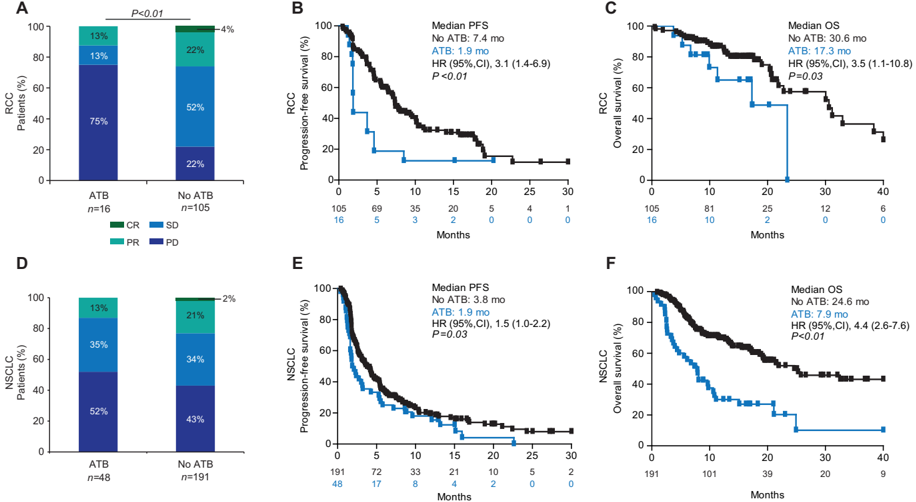
Background: The composition of gut microbiota affects antitumor immune responses, preclinical and clinical outcome following immune checkpoint inhibitors (ICI) in cancer. Antibiotics (ATB) alter gut microbiota diversity and composition leading to dysbiosis, which may affect effectiveness of ICI. Patients and methods: We examined patients with advanced renal cell carcinoma (RCC) and non-small-cell lung cancer (NSCLC) treated with anti-programmed cell death ligand-1 mAb monotherapy or combination at two academic institutions. Those receiving ATB within 30 days of beginning ICI were compared with those who did not. Objective response, progression-free survival (PFS) determined by RECIST1.1 and overall survival (OS) were assessed. Results: Sixteen of 121 (13%) RCC patients and 48 of 239 (20%) NSCLC patients received ATB. The most common ATB were β-lactam or quinolones for pneumonia or urinary tract infections. In RCC patients, ATB compared with no ATB was associated with increased risk of primary progressive disease (PD) (75% versus 22%, P < 0.01), shorter PFS [median 1.9 versus 7.4 months, hazard ratio (HR) 3.1, 95% confidence interval (CI) 1.4-6.9, P < 0.01], and shorter OS (median 17.3 versus 30.6 months, HR 3.5, 95% CI 1.1-10.8, P = 0.03). In NSCLC patients, ATB was associated with similar rates of primary PD (52% versus 43%, P = 0.26) but decreased PFS (median 1.9 versus 3.8 months, HR 1.5, 95% CI 1.0-2.2, P = 0.03) and OS (median 7.9 versus 24.6 months, HR 4.4, 95% CI 2.6-7.7, P < 0.01). In multivariate analyses, the impact of ATB remained significant for PFS in RCC and for OS in NSCLC. Conclusion: ATB were associated with reduced clinical benefit from ICI in RCC and NSCLC. Modulatation of ATB-related dysbiosis and gut microbiota composition may be a strategy to improve clinical outcomes with ICI.
Overview
CoChat Summary
TL;DR
In two independent cohorts of advanced RCC and NSCLC treated with immune checkpoint inhibitors, antibiotic use within 30 days before starting therapy was associated with worse clinical outcomes. The association remained significant for PFS in RCC and for OS in NSCLC in multivariate analyses.
Key findings
- Among 121 RCC patients, 16 (13%) received antibiotics within 30 days of starting ICI. Antibiotic use was associated with more primary progressive disease (75% versus 22%, P < 0.01), shorter median PFS (1.9 versus 7.4 months; HR 3.1, 95% CI 1.4–6.9, P < 0.01), and shorter median OS (17.3 versus 30.6 months; HR 3.5, 95% CI 1.1–10.8, P = 0.03).
- Among 239 NSCLC patients, 48 (20%) received antibiotics within 30 days. Antibiotic use was not associated with primary PD (52% versus 43%, P = 0.26) but was associated with shorter median PFS (1.9 versus 3.8 months; HR 1.5, 95% CI 1.0–2.2, P = 0.03) and shorter median OS (7.9 versus 24.6 months; HR 4.4, 95% CI 2.6–7.7, P < 0.01).
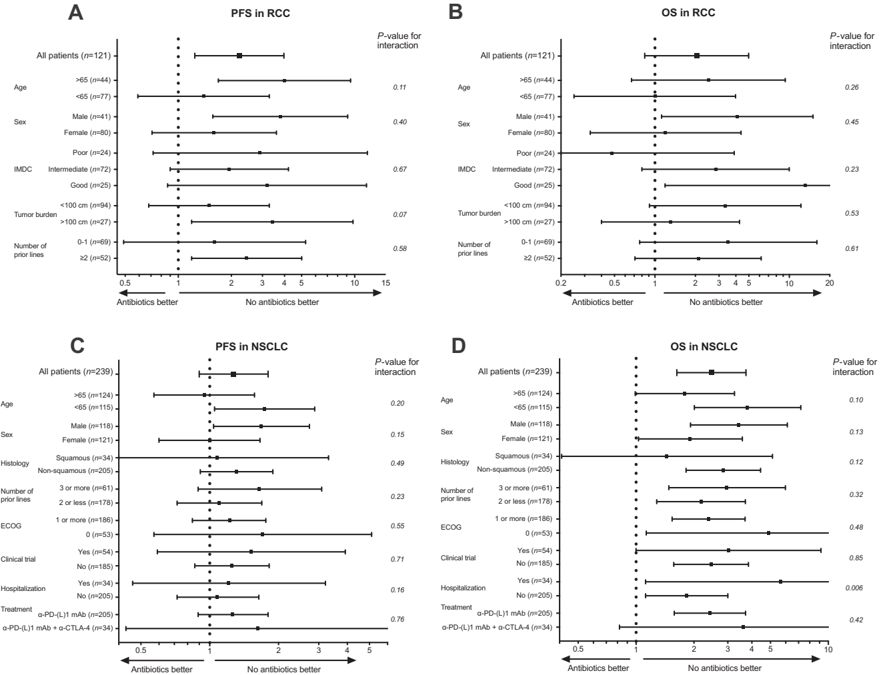
- In multivariate analysis, antibiotics remained associated with worse PFS in RCC (HR 2.0, P < 0.01) but not OS (HR 2.1, P = 0.11); in NSCLC, antibiotics were not significantly associated with PFS (HR 1.3, 95% CI 0.9–1.8, P = 0.17) but remained associated with worse OS (HR 2.5, 95% CI 1.6–3.7, P < 0.01).
- With a 60-day antibiotic window, RCC showed shorter PFS (median 3.1 versus 7.4 months; HR 2.3, 95% CI 1.2–4.4, P < 0.01) and a trend toward worse OS (median 23.4 versus 30 months; HR 1.9, 95% CI 0.8–4.7, P = 0.15); NSCLC showed no difference in objective response or PFS but shorter OS (median 9.8 versus 21.9 months; HR 2.0, 95% CI 1.3–3.2, P < 0.01).
Methods
- Retrospective review of patients with advanced RCC (n = 121) at Gustave Roussy and NSCLC (n = 239) at Memorial Sloan Kettering Cancer Center treated with anti-PD-(L)1 monoclonal antibody monotherapy or combination therapy.
- Antibiotic use was assessed within 30 days or up to 60 days before the first ICI injection; antibiotic class, indication, route, and duration were collected.
- Tumor response was determined by RECIST 1.1; PFS and OS were estimated by Kaplan–Meier and compared with log-rank tests, with multivariable Cox regression adjusting for clinicopathologic features.
Limitations
- The authors state the study is retrospective, with data entry from two institutions; although responses were reviewed with RECIST 1.1, scan timing was not prespecified.
- The authors note differences in patient characteristics between antibiotic and no-antibiotic groups, including higher recent hospitalization in NSCLC and differences in prior lines in RCC, and that analyses did not account for diet, country of origin, or other medications.
- The authors state they did not characterize the mechanism by which antibiotics affect outcomes, and PD-L1 status was lacking in most patients; the text also makes evident that antibiotic subgroups were small and immune-related adverse events were too few to evaluate.
Model-written summary. Check it against the paper before relying on it.
Integrity signals
Registry
Cites
Statistics
Figures




Verification
Claims the paper makes
2 Valid · 1 Not valid · 7 Not checked · 33 Own results and interpretations
At least one cited source doesn’t support this claim or points to a different paper, and none confirmed it — see the verdicts below.
In the paper
“16S ribosomal RNA sequencing of gene amplicons of patients' feces revealed that microbiota returns to its baseline within 1-3 months after ATB discontinuation.”
§ Negative association of antibiotics on clinical activity of immune checkpoint inhibitors in patients with advanced renal cell and non-small-cell lung cancer > Discussion
What the sources say
- Not checked yetcites [14] matched to “Effects of antibiotics on gut microbiota” (2016) source
- Disputedcites [20] matched to “Short-term antibiotic treatment has differing long-term impacts on the human throat and gut microbiome” (2010) sourceExperimental — accuracy not yet measured
The Results section ('Transient and persistent effects of antibiotic treatment'; page unavailable) says fecal microbial communities had only partially recovered at one and four years and remained distinct from their pretreatment compositions. The paper does not report a return to baseline within 1–3 months. (LLM, conf=0.87)
Checked by a reasoning model — may be wrong.
plainstates a cause- Asserted: passes — The authors put it forward as true.
- Checkable: passes — It can be checked against evidence.
- Load-bearing: passes — The paper’s conclusions depend on it.
- Based: passes — The paper gives a reason why it holds.
The sources with a verdict support this claim; the rest weren’t checked yet, have no full text we could read, or their verdicts aren’t rated yet.
In the paper
“However, some bacteria may take years to fully recover [14,20].”
§ Negative association of antibiotics on clinical activity of immune checkpoint inhibitors in patients with advanced renal cell and non-small-cell lung cancer > Discussion
What the sources say
- Not checked yetcites [14] matched to “Effects of antibiotics on gut microbiota” (2016) source
- Supportedcites [20] matched to “Short-term antibiotic treatment has differing long-term impacts on the human throat and gut microbiome” (2010) source
The Results section 'Transient and persistent effects of antibiotic treatment' states that 'One and four years after treatment, the fecal microbial communities had partially recovered to their pre-treatment compositions, however these were still separated along CA axis 2', i.e. full recovery had not occurred even four years after a one-week course. The 'Individuality in antibiotic response' section adds taxon-level persistence (e.g. the increase of unclassified Enterobacteriaceae in patient D persisted during the 4-year period), and the Abstract/Discussion report erm(B) still elevated four years post treatment. The hedged claim that some bacteria 'may take years to fully recover' is therefore within what this source shows; the only points it credits to others (two-year Bacteroides/erm persistence, a resistant clone persisting three years) are separate citations [8] and [10] and are not what the citing sentence attributes here. (LLM, conf=0.82)
hedgedstates a possible cause- Asserted: passes — The authors put it forward as true.
- Checkable: passes — It can be checked against evidence.
- Load-bearing: unclear — It is unclear whether the paper’s conclusions depend on it.
- Based: passes — The paper gives a reason why it holds.
The sources with a verdict support this claim; the rest weren’t checked yet, have no full text we could read, or their verdicts aren’t rated yet.
In the paper
“In oncology, converging findings demonstrate the negative impact of ATBinduced dysbiosis in mice.”
§ Negative association of antibiotics on clinical activity of immune checkpoint inhibitors in patients with advanced renal cell and non-small-cell lung cancer > Introduction
What the sources say
- Supportedcites [9] matched to “Anticancer immunotherapy by CTLA-4 blockade relies on the gut microbiota” (2015) source
The Results passage opening Fig. 1 states that broad-spectrum antibiotics (ampicillin+colistin+streptomycin, and imipenem alone but not colistin) 'compromised the antitumor effects of CTLA-4-specific Ab', confirmed across the Ret melanoma and MC38 colon cancer models and mirrored by germ-free housing — i.e. converging mouse evidence in oncology that antibiotic-induced microbiota disruption harms checkpoint-blockade efficacy. The Abstract states it outright: 'Tumors in antibiotic-treated or germ-free mice did not respond to CTLA blockade.' The only framing shift is minor: the paper attributes the loss of efficacy to depletion/recomposition of the microbiota (rescued by B. fragilis gavage) rather than using the word 'dysbiosis', and it hedges the mechanism ('suggest that the gut microbiota is required'), but the negative impact of antibiotic treatment itself is asserted as fact. (LLM, conf=0.90)
- Not checked yetcites [10]
boostedstates a cause- Asserted: passes — The authors put it forward as true.
- Checkable: passes — It can be checked against evidence.
- Load-bearing: passes — The paper’s conclusions depend on it.
- Based: passes — The paper gives a reason why it holds.
- Supported
A result the paper reports from its own data — it cites no other source for it, so there is none to check. The quote shows it is in the paper.
In the paper
“and shorter OS (median 17.3 versus 30.6 months, HR 3.5, 95% CI 1.1-10.8,P ¼ 0.03).”
- Also stated in: § Results · plain
“median OS, 17.3 months versus 30.6 months, HR 3.5, 95% CI 1.1-10.8,P ¼ 0.03”
§ Negative association of antibiotics on clinical activity of immune checkpoint inhibitors in patients with advanced renal cell and non-small-cell lung cancer > Abstract
plainstates an association- Asserted: passes — The authors put it forward as true.
- Checkable: passes — It can be checked against evidence.
- Load-bearing: passes — The paper’s conclusions depend on it.
- Based: passes — The paper gives a reason why it holds.
- Also stated in: § Results · plain
A result the paper reports from its own data — it cites no other source for it, so there is none to check. The quote shows it is in the paper.
In the paper
“In RCC, ATB-60 days remained associated with increased risk of primary progression (P < 0.01)”
§ Negative association of antibiotics on clinical activity of immune checkpoint inhibitors in patients with advanced renal cell and non-small-cell lung cancer > Results
plainstates an association- Asserted: passes — The authors put it forward as true.
- Checkable: passes — It can be checked against evidence.
- Load-bearing: passes — The paper’s conclusions depend on it.
- Based: passes — The paper gives a reason why it holds.
20 more claims
Create a free account to see all 43 claims and to verify the 15 references still open.
- It may state two separate claims as one. 11
- Probably not a substantial claim. 11
Claims other papers make about this one
Each is checked against this paper’s own text: does it say what the citing paper says it does?
The source backs part of the claim, not all of it — or backs it for a different population, condition or comparison.
In the citing paper
“Similarly, antibiotics (ATB) prior to ICI initiation drastically reduced the clinical benefit in several cohorts of patients across various cancer types (melanoma, advanced NSCLC, renal cell carcinoma (RCC), and urothelial cancer) 18,[20][21][22] .”
From Intestinal Akkermansia muciniphila predicts clinical response to PD-1 blockade in patients with advanced non-small-cell lung cancer (2022) · cites this paper as [20]
Experimental — accuracy not yet measuredThe source backs part of the claim, not all of it — or backs it for a different population, condition or comparison.
In the citing paper
“However, increasing clinical evidence suggests that systemic antibiotics abolish immune checkpoint blockade efficacy and decrease patient survival (133, 136, 137).”
From The microbiome and human cancer (2021) · cites this paper as [137]
Experimental — accuracy not yet measuredThe source backs part of the claim, not all of it — or backs it for a different population, condition or comparison.
In the citing paper
“However, the clinical value of this observation is limited by its derivation from selected oncological indications, including renal and non-small cell lung cancer (NSCLC), 2 for which external validation, especially outside clinical trials, is necessary.”
From Association of Prior Antibiotic Treatment With Survival and Response to Immune Checkpoint Inhibitor Therapy in Patients With Cancer (2019) · cites this paper as [2]
Experimental — accuracy not yet measuredThe source backs part of the claim, not all of it — or backs it for a different population, condition or comparison.
In the citing paper
“However, our results suggest that administration of these classes of antibiotics constitutes a likely surrogate for poor disease status and a state of increased systemic inflammation prior to initiation of CAR-T cell therapy, as was recently suggested in cancer patients treated with other ICBs28,35.”
From A non-antibiotic-disrupted gut microbiome is associated with clinical responses to CD19-CAR-T cell cancer immunotherapy (2023) · cites this paper as [28]
Experimental — accuracy not yet measuredThe cited source says what the claim attributes to it.
In the citing paper
“Supporting this contention, we and others reported that primary responses to anti-PD-1/ PD-L1 antibodies in patients with epithelial tumours and melanoma could, at least in part, be attributed to the taxonomic composition of the gut microbial ecosystem 18,20,25 .”
From Intestinal Akkermansia muciniphila predicts clinical response to PD-1 blockade in patients with advanced non-small-cell lung cancer (2022) · cites this paper as [20]
14 more claims about this paper
Create a free account to see every claim other papers make about this one.
Self-check
Percentages, sums and reported differences re-computed from the paper’s own numbers.
Each contradiction between two passages listed here was confirmed by an independent check.
Rated major: it would touch a result — a value a result rests on, reported and recomputed p-values on opposite sides of the significance level, two passages that conflict with no sign which is right, or a cited work retracted before this paper was published.
In the paper
§ Negative association of antibiotics on clinical activity of immune checkpoint inhibitors in patients with advanced renal cell and non-small-cell lung cancer > Results
“median PFS, 1.9 months versus 3.8 months, HR 1.5, 95% CI 1.0-2.2,P ¼ 0.03”
§ Negative association of antibiotics on clinical activity of immune checkpoint inhibitors in patients with advanced renal cell and non-small-cell lung cancer > Discussion
“ATB 30-0/No ATB 1.4 (1.0-2.0)0.04 1.3 (0.9-1.8) 0.17”
Rated major: it would touch a result — a value a result rests on, reported and recomputed p-values on opposite sides of the significance level, two passages that conflict with no sign which is right, or a cited work retracted before this paper was published.
In the paper
§ Negative association of antibiotics on clinical activity of immune checkpoint inhibitors in patients with advanced renal cell and non-small-cell lung cancer > Results
“median OS, 7.9 months versus 24.6 months, HR 4.4, 95% CI 2.6-7.7,P < 0.01”
§ Negative association of antibiotics on clinical activity of immune checkpoint inhibitors in patients with advanced renal cell and non-small-cell lung cancer > Discussion
“ATB 30-0/No ATB 2.9 (1.9-4.4)<0.01 2.5 (1.6-3.7)<0.01”
Rated major: it would touch a result — a value a result rests on, reported and recomputed p-values on opposite sides of the significance level, two passages that conflict with no sign which is right, or a cited work retracted before this paper was published.
In the paper
§ Negative association of antibiotics on clinical activity of immune checkpoint inhibitors in patients with advanced renal cell and non-small-cell lung cancer > Results
“median PFS, 1.9 months versus 7.4 months, HR 3.1, 95% CI 1.4-6.9,P < 0.01”
§ Negative association of antibiotics on clinical activity of immune checkpoint inhibitors in patients with advanced renal cell and non-small-cell lung cancer > Discussion
“ATB 30-0/No ATB 2.3 (1.3-4.0)<0.01 2.2 (1.3-3.3)<0.01”
Rated minor: it would not touch a result — a value no result rests on, a p-value that stays on the same side of the significance level, or a conflict that is clerical, resolved elsewhere in the paper, or outside its own findings.
In the paper
§ Negative association of antibiotics on clinical activity of immune checkpoint inhibitors in patients with advanced renal cell and non-small-cell lung cancer > Results
“Range 28-83 29-83 30-82”
§ Negative association of antibiotics on clinical activity of immune checkpoint inhibitors in patients with advanced renal cell and non-small-cell lung cancer > Results
“ATB 30-0 (n 5 16) No ATB (n 5 105)”
Rated minor: it would not touch a result — a value no result rests on, a p-value that stays on the same side of the significance level, or a conflict that is clerical, resolved elsewhere in the paper, or outside its own findings.
In the paper
§ Negative association of antibiotics on clinical activity of immune checkpoint inhibitors in patients with advanced renal cell and non-small-cell lung cancer > Discussion
“Female (n=80) Male (n=41)”
§ Negative association of antibiotics on clinical activity of immune checkpoint inhibitors in patients with advanced renal cell and non-small-cell lung cancer > Results
“Gender, n (%) Male 80 (66) 9 (56) 71 (68) 0.37 Female 41 (34) 7 (44) 34 (32)”
4 more findings
Create a free account to see every finding of this check.
Citations
Cites
New response evaluation criteria in solid tumours: revised RECIST guideline (version 1.1)
Eisenhauer, E. A., Therasse, P., Bogaerts, J., Schwartz, L. H., Sargent, D., Ford, R., Dancey, J., Arbuck, S., Gwyther, S., Mooney, M., et al. (2009) · European Journal of Cancer · doi:10.1016/j.ejca.2008.10.026 · Cited by 29,534
Adverse Renal Effects of Immune Checkpoint Inhibitors: A Narrative Review
Wanchoo, R., Karam, S., Uppal, N. N., Barta, V. S., Deray, G., Devoe, C., Launay-Vacher, V., Jhaveri, K. D., & on behalf of Cancer and Kidney International Network Workgroup on Immune Checkpoint Inhibitors (2017) · American Journal of Nephrology · doi:10.1159/000455014 · Cited by 15,256
Pembrolizumab versus Chemotherapy for PD-L1-Positive Non-Small-Cell Lung Cancer
Reck, M., Rodríguez-Abreu, D., Robinson, A. G., Hui, R., Csőszi, T., Fülöp, A., Gottfried, M., Peled, N., Tafreshi, A., Cuffe, S., et al. (2016) · New England Journal of Medicine · doi:10.1056/nejmoa1606774 · Cited by 10,089
Nivolumab versus docetaxel in advanced nonsquamous non-small-cell lung cancer
Borghaei, H., Paz-Ares, L., Horn, L., Spigel, D. R., Steins, M., Ready, N. E., Chow, L. Q., Vokes, E. E., Felip, E., Holgado, E., et al. (2015) · New England Journal of Medicine · doi:10.1056/nejmoa1507643 · Cited by 9,335
Nivolumab versus Everolimus in Advanced Renal-Cell Carcinoma
Motzer, R. J., Escudier, B., McDermott, D. F., George, S., Hammers, H. J., Srinivas, S., Tykodi, S. S., Sosman, J. A., Procopio, G., Plimack, E. R., et al. (2015) · New England Journal of Medicine · doi:10.1056/nejmoa1510665 · Cited by 5,807
Self-citationGut microbiome influences efficacy of PD-1-based immunotherapy against epithelial tumors
Routy, B., Le Chatelier, E., Derosa, L., Duong, C. P. M., Alou, M. T., Daillère, R., Fluckiger, A., Messaoudene, M., Rauber, C., Roberti, M. P., et al. (2018) · Science · doi:10.1126/science.aan3706 · Cited by 5,671
Self-citationDiversity, stability and resilience of the human gut microbiota
Lozupone, C. A., Stombaugh, J. I., Gordon, J. I., Jansson, J. K., & Knight, R. (2012) · Nature · doi:10.1038/nature11550 · Cited by 5,533
Gut microbiome modulates response to anti-PD-1 immunotherapy in melanoma patients
Gopalakrishnan, V., Spencer, C. N., Nezi, L., Reuben, A., Andrews, M. C., Karpinets, T. V., Prieto, P. A., Vicente, D., Hoffman, K., Wei, S. C., et al. (2018) · Science · doi:10.1126/science.aan4236 · Cited by 4,812
Self-citationIFN-γ–related mRNA profile predicts clinical response to PD-1 blockade
Ayers, M., Lunceford, J., Nebozhyn, M., Murphy, E., Loboda, A., Kaufman, D. R., Albright, A., Cheng, J. D., Kang, S. P., Shankaran, V., et al. (2017) · Journal of Clinical Investigation · doi:10.1172/jci91190 · Cited by 3,788
Anticancer immunotherapy by CTLA-4 blockade relies on the gut microbiota
Vétizou, M., Pitt, J. M., Daillère, R., Lepage, P., Waldschmitt, N., Flament, C., Rusakiewicz, S., Routy, B., Roberti, M. P., Duong, C. P. M., et al. (2015) · Science · doi:10.1126/science.aad1329 · Cited by 3,488
Self-citation
Cited by
Items 601–700 of 909
Resident Microbiome of Kidney Tumors
Kovaleva, O. V., Алексеевна, П. П., & Gratchev, A. N. (2024) · Oncology Reviews · doi:10.3389/or.2024.1393664 · Cited by 6
“Similar results were reported by Derosa et al. in 2020, showing reduced overall and progression-free survival of RCC patients who received antibiotic treatment [29].”
ResultClinical Applications of the Gut Microbiome in Genitourinary Cancers
Nguyen, C. B., & Vaishampayan, U. N. (2024) · American Society of Clinical Oncology Educational Book · doi:10.1200/edbk_100041 · Cited by 8
Effects of antibiotics on immunotherapy in patients with metastatic nonsmall cell lung cancer
Hu, T., Li, L., Cui, J., Song, X., Zhu, H., Hou, Z. W., & Yuan, S. (2024) · European Journal of Cancer Prevention · doi:10.1097/cej.0000000000000912 · Cited by 7
“0074, Derosa et al. , 2018; Pinato et al. , 2019; Zhao et al. , 2019; Lurienne et al. , 2020) Zhao et al. (Zhao et al. , 2019) retrospectively analyzed 109 patients with advanced NSCLC treated with ICIs and found that the group treated with antibiotics during immunotherapy was significantly related…”
InfluentialDeng, F., Du, X., Zhang, P., Xu, J., Li, Y., & Yang, Z. (2024) · Thoracic Cancer · doi:10.1111/1759-7714.15490 · Cited by 8
Ng, K. Y. Y., Teo, A. E., Tan, S. H., Tan, J. J. E., Tay, D. S. H., Lee, A. W. X., Ang, A. J. S., Wong, L. W. J., Choo, S. P., Toh, H. C., et al. (2024) · Asia-Pacific Journal of Clinical Oncology · doi:10.1111/ajco.14139 · Cited by 7
“This interval was chosen in accordance with previous studies [20, 21].”
Bonnefin, C., Schneider, S., Gerard, É., Dutriaux, C., Ferté, T., Prey, S., Guicheney, M., Ducharme, O., Pédeboscq, S., Beylot-Barry, M., et al. (2025) · European Journal of Cancer · doi:10.1016/j.ejca.2025.115223 · Cited by 6
Hamza, M., Wang, S., Liu, Y., Li, K., Zhu, M., & Chen, L. (2025) · Microbiological Research · doi:10.1016/j.micres.2025.128156 · Cited by 6
Takahashi, M., Nakatsukasa, H., Shibano, M., Ishigami, Y., Oka, T., Tani, Y., Kawaguchi, T., Nakamura, Y., & Kaneda, H. (2025) · International Journal of Clinical Oncology · doi:10.1007/s10147-025-02805-2 · Cited by 7
“The treatment durations for concomitant drugs such as antibiotics, PPIs, vonoprazan, and probiotics were defined based on previous studies [19–21] and were also adopted in our previous study [22].”
Xu, J., Chen, H., Yu, Y.-Y., Chen, T., Wang, Y., Xue, W., Zheng, J., Liu, J., & Zhai, W. (2025) · Cell Reports Medicine · doi:10.1016/j.xcrm.2025.102410 · Cited by 14
Unveiling the interplay between microbiota and PD1/PD-L1 axis in tumor immunity and immunotherapy
Lu, Q., Wu, J., Yu, X., Qian, J., & Song, Z. (2025) · Frontiers in Immunology · doi:10.3389/fimmu.2025.1690374 · Cited by 6
Yi, J., Xu, J., Zeng, J., Song, Y., Zhang, Y.-N., Huang, C., Li, L., Ding, K., Zhu, Z., Yuan, D.-Z., et al. (2025) · Frontiers in Immunology · doi:10.3389/fimmu.2025.1680015 · Cited by 6
“Concomitant medication exposure was de fi ned as use within 30 days before or after the ICI initiation, consistent with criteria used in previous literature (30, 34).”
Haight, P. J., Kistenfeger, Q., Riedinger, C. J., Khadraoui, W. K., Backes, F. J., Bixel, K. L., Copeland, L. J., Cohn, D. E., Cosgrove, C. M., O’Malley, D. M., et al. (2023) · Gynecologic Oncology · doi:10.1016/j.ygyno.2023.09.005 · Cited by 7
Lactobacillus paracasei R3 Alleviates Tumor Progression in Mice with Colorectal Cancer
Chen, T., Li, B., Zheng, K., Liu, Y., Zhang, Z., Hu, H., Qian, G., & Jiang, J. (2023) · Current Microbiology · doi:10.1007/s00284-023-03525-4 · Cited by 8
“Gut microbes mediate body immunity to improve cancer treatment and patient prognosis [11], and the use of antibiotics to inhibit cancer-related bacteria also reduces the clinical therapeutic effects [12, 13].”
Katsurayama, N., Ishihara, H., Ishiyama, R., Nemoto, Y., Ikeda, T., Mizoguchi, S., Nakayama, T., Fukuda, H., Yoshida, K., Iizuka, J., et al. (2024) · Cancer Diagnosis & Prognosis · doi:10.21873/cdp.10354 · Cited by 6
Radoš, L., Golčić, M., & Mikolašević, I. (2025) · Biomedicines · doi:10.3390/biomedicines13010096 · Cited by 7
“Both RCC and NSCLC patients showed shorter progression-free survival (PFS) and overall survival (OS) versus patients who did not receive AB [24]. demonstrated that OS in patients with different cancer types compared to beta-lactams survival if they were used during immunotherapy [25].”
Liu, Y., Yang, B., Qi, Q., Liu, S., Du, Y., Ye, L., & Zhou, Q. (2025) · Frontiers in Cellular and Infection Microbiology · doi:10.3389/fcimb.2024.1518199 · Cited by 6
“Routy and Derosa et al. demonstrated reduced ef fi cacy of immune checkpoint inhibitors (ICIs) therapy in patients with advanced epithelial cancers, including lung cancer, who received antibiotics (Derosa et al., 2018; Routy et al., 2018).”
Association of the gut microbiome with cancer immunotherapy
Nomura, M. (2022) · International Journal of Clinical Oncology · doi:10.1007/s10147-022-02180-2 · Cited by 6
“Antibiotic-related dysbiosis can eliminate the bacteria required for the response to ICIs [45].”
BackgroundHuman microbiota colonization and pancreatic ductal carcinoma
Yuan, F., Yang, G., Yang, J., Ren, J., You, L., & Zhao, Y. (2022) · Critical Reviews in Microbiology · doi:10.1080/1040841x.2022.2080526 · Cited by 6
“…immunotherapy in patients with advanced renal cell cancer, ovarian cancer, and non-small-cell lung cancer (Viaud et al. 2013; Daillere et al. 2016; Derosa et al. 2018), whereas antibiotic consumption is associated with a significantly longer overall survival of patients with PDAC (Mohindroo et…”
BackgroundSustained partial remission of a metastatic NEN using off-label immunotherapy with pembrolizumab
Stüven, A. K., & Wiedenmann, B. (2019) · Oncotarget · doi:10.18632/oncotarget.26906 · Cited by 6
“As shown for treatment with antibiotics, pretreatment might influence the composition of intestinal microbiota and therefore the outcome of patients treated with pembrolizumab [51, 52].”
BackgroundEmergency management of immune-related toxicity
Cooksley, T., Stutman, R. E., & Klotz, A. (2020) · Current Opinion in Oncology · doi:10.1097/cco.0000000000000635 · Cited by 7
Inhibiteurs de la pompe à protons (IPP) et cancers : une association à risques ?
Raoul, J., Edeline, J., Gilabert, M., Senellart, H., & Frenel, J. (2020) · Bulletin du Cancer · doi:10.1016/j.bulcan.2019.12.009 · Cited by 9
Giglio, A. D., Nuvola, G., & Baldini, C. (2020) · Future Oncology · doi:10.2217/fon-2020-0183 · Cited by 6
Early palliative care of non‑small cell lung cancer in the context of immunotherapy (Review)
Pieniążek, M., Pawlak, P., & Radecka, B. S. (2020) · Oncology Letters · doi:10.3892/ol.2020.12259 · Cited by 9
“reduce the diversity of intestinal microflora, which promotes chronic inflammatory conditions (43,44).”
BackgroundA béltartalom és a vizelet mikrobiom-összetételének onkológiai vonatkozásai
Oláh, C., Váradi, M., Horváth, O. N., Nyírády, P., & Szarvas, T. (2021) · Orvosi Hetilap · doi:10.1556/650.2021.32052 · Cited by 6
Almonte, A. A., Cavic, G., Neeman, T. M., Enders, A., & Fahrer, A. M. (2022) · Journal for ImmunoTherapy of Cancer · doi:10.1136/jitc-2022-005575 · Cited by 8
Mechanisms of Anti-PD Therapy Resistance in Digestive System Neoplasms
Wu, Y., Jiang, X., Yu, Z., Xing, Z., Ma, Y., & Qing, H. (2024) · Recent Patents on Anti-Cancer Drug Discovery · doi:10.2174/0115748928269276231120103256 · Cited by 6
Nakatsukasa, H., Takahashi, M., Shibano, M., Ishigami, Y., Kawaguchi, T., Nakamura, Y., & Kaneda, H. (2024) · International Journal of Clinical Oncology · doi:10.1007/s10147-024-02622-z · Cited by 6
“…for their possible negative effects on the clinical outcomes of ICIs; several concomitant baseline medications, such as corticosteroids, systemic antibiotics, and proton pump inhibitors (PPIs), are associated with poorer outcomes in patients with NSCLC who are treated with ICI monotherapy [7–9].”
Gong, E. W., Fulop, D. J., Serebrenik, J., Labiner, A. J., Cohen, D. J., Sigel, K. M., & Lucas, A. L. (2025) · JNCI Cancer Spectrum · doi:10.1093/jncics/pkaf024 · Cited by 5
Silva, C. A. C., Almonte, A. A., & Zitvogel, L. (2025) · Biomolecules · doi:10.3390/biom15040504 · Cited by 6
“ATB [4,5,117–119] and proton pump inhibitors (PPIs) [120,121] are associated with reduced efficacy of ICI treatments.”
Self-citationLung cancer and the Gut-microbiota-lung Axis: emerging evidence and potential clinical implications
Liu, L., Li, Y., Zhang, H., Li, H., Shang, T., & Liu, L. (2025) · Frontiers in Medicine · doi:10.3389/fmed.2025.1655780 · Cited by 8
Zhao, Z., Xu, K., Hu, B., Jiang, Y., Xu, X., & Liu, Y. (2025) · Frontiers in Immunology · doi:10.3389/fimmu.2024.1519498 · Cited by 7
Personalisierte Medizin bei Nierenzelltumoren
Junker, K., & Zeuschner, P. (2019) · Aktuelle Urologie · doi:10.1055/a-0895-9201 · Cited by 6
“Aus diesen Ergebnissen folgt aber auch, dass der Antibiotikaeinsatz zu einem schlechteren Ansprechen führen kann, da dadurch das Mikrobiom entscheidend verändert wird, wie für das NZK gezeigt [42].”
BackgroundOgiwara, T., Kawazoe, H., Egami, S., Hashimoto, H., Saito, Y., Sakiyama, N., Ohe, Y., Yamaguchi, M., Furukawa, T., Hara, A., et al. (2021) · Frontiers in Oncology · doi:10.3389/fonc.2021.770268 · Cited by 5
“2 study showed that the use of antibiotics prior to ICIs reduced treatment efficacy in patients with advanced NSCLC, renal cell carcinoma, and urothelial carcinoma (11, 12).”
BackgroundWen, X., Ye, X., Yang, X., RuJin, J., Qian, C., & Wang, X. (2022) · Clinical & Translational Oncology · doi:10.1007/s12094-022-02995-5 · Cited by 5
“gallolyticus in the colonic cancer milieu, where arginase -1 (Arg1) and nitric oxide synthase 2 (NOS2) can suppress T cells and enable the creation of an immune-suppressive microenvironment, compared to normal colons and adenomas [95].”
BackgroundFaoro, L., Brusegan, A., Russi, A., Calderone, V., Martelli, A., Marranconi, E., Carpanese, D., Berti, E., & Coppola, M. (2023) · BMC Pharmacology and Toxicology · doi:10.1186/s40360-023-00663-0 · Cited by 5
“Concomitant exposure to broad-spectrum antibiotic therapy may adversely influence clinical outcomes [20] due to the alteration of intestinal microbiota [21].”
BackgroundLee, S. L., Al‐Shamkhani, A., & Mirnezami, A. H. (2019) · British journal of surgery · doi:10.1002/bjs.11224 · Cited by 6
Mirabile, A., Rivoltini, L., Daveri, E., Vernieri, C., Mele, R., Porcu, L., Lazzari, C., Bulotta, A., Viganò, M. G., Cascinu, S., et al. (2020) · Cancers · doi:10.3390/cancers12051153 · Cited by 6
“[29] NSCLC and RCC 64 Microbiome Observational Outcome (OS and PFS) ATB vs.”
BackgroundDie Rolle des Mikrobioms in der Urologie
Magistro, G., Marcon, J., Eismann, L., Volz, Y., & Stief, C. G. (2020) · Der Urologe · doi:10.1007/s00120-020-01368-6 · Cited by 8
Prognostic Factors of Platinum-Refractory Advanced Urothelial Carcinoma Treated with Pembrolizumab
Akashi, Y., Yamamoto, Y., Hashimoto, M., Adomi, S., Fujita, K., Kiba, K., Minami, T., Yoshimura, K., Hirayama, A., & Uemura, H. (2023) · Cancers · doi:10.3390/cancers15245780 · Cited by 5
First-line immunotherapy in non-small cell lung cancer: how to select and where to go
Mogavero, A., Cantale, O., Mollica, V., Anpalakhan, S., Addeo, A., Mountzios, G., Friedlaender, A., Kanesvaran, R., Novello, S., & Banna, G. L. (2023) · Expert Review of Respiratory Medicine · doi:10.1080/17476348.2024.2302356 · Cited by 7
“In multivariate analyses, the impact of ATB was confirmed significant for OS [75].”
BackgroundOchi, N., Ichihara, E., Yokoyama, T., Inoue, K., Tamura, T., Watanabe, H., Takata, I., Kano, H., Nakamura, K., Kawai, H., et al. (2025) · International Journal of Clinical Oncology · doi:10.1007/s10147-025-02860-9 · Cited by 5
“Although a definitive rationale for defining the antibiotic exposure period is lacking, we adopted the observation window commonly used in previous studies [4, 6, 7, 9, 16, 17].”
Khilwani, R., & Singh, S. (2025) · Frontiers in Immunology · doi:10.3389/fimmu.2025.1649517 · Cited by 6
“As an effect of antibiotic intake, the expansion of varied bacterial populations has been shown to diminish the effect of immune checkpoint inhibitors in NSCLC patients, altogether resulting in reduced clinical ef fi cacy and shorter overall survival rates (7).”
Respiratory microbiome-host interaction on lung carcinogenesis, immunity, and immunotherapy
Wang, P., Ge, C., Jing, X., Han, Q., Wang, M., Huang, M., & Xiang, Z. (2025) · Frontiers in Immunology · doi:10.3389/fimmu.2025.1676302 · Cited by 7
“Notably, Derosa et al. (78) documented a 5.5-month reduction in median PFS and 14.3-month decrease in OS among NSCLC patients receiving b -lactams or quinolones versus controls ( P < 0.05).”
InfluentialMicrobiotoxicity: an under-recognised player in drug efficacy, toxicity, and health outcomes
Nascimento, S. S., Theodosiou, A. A., & Sergaki, C. (2025) · npj Antimicrobials and Resistance · doi:10.1038/s44259-025-00165-5 · Cited by 4
Microbiome-modulated immunotherapy in oncology: Current applications and future prospects
Liu, Y., Miao, K., & Yang, X. (2026) · Seminars in Cancer Biology · doi:10.1016/j.semcancer.2026.01.001 · Cited by 4
Tsuboi, I., Matsukawa, A., Parizi, M. K., Miszczyk, M., Fazekas, T., Schulz, R. J., Laukhtina, E., Kawada, T., Katayama, S., Iwata, T., et al. (2025) · BMC Urology · doi:10.1186/s12894-025-01754-2 · Cited by 4
“Recently, some studies revealed that the use of ABx negatively affects the oncological outcomes of ICI treatment in patients with different types of cancer, such as renal cell carcinoma, non-small cell lung cancer, and esophageal squamous cell carcinoma [42–44].”
Hata, T., Yamada, T., Gotô, Y., Amano, A., Negi, Y., Watanabe, S., Furuya, N., Oba, T., Ikoma, T., Nakao, A., et al. (2025) · Cancer Research Communications · doi:10.1158/2767-9764.crc-25-0157 · Cited by 5
“The effect of concomitant medications on the efficacy of immuno-therapy alone has been reported with ATB, PPIs, and probiotic therapy (19, 20, 27–30).”
Antibiotics, the microbiome and gastrointestinal cancers: A causal interference?
Ramai, D., Salati, M., Pomati, G., Amoroso, C., Facciorusso, A., Botticelli, A., & Ghidini, M. (2022) · Current Opinion in Pharmacology · doi:10.1016/j.coph.2022.102315 · Cited by 4
Zerdan, M. B., Kumar, P. A., M.S, D. M. B., Glidden, A., Nasr, D., Niforatos, S., Ghelani, G. H., Leibovitch, J. N., Nasr, S., Binod, K. C., et al. (2023) · Frontiers in Oncology · doi:10.3389/fonc.2023.1134824 · Cited by 4
Aubert, C., Culty, T., Zidane-Marinnes, M., Bigot, P., & Lebdai, S. (2024) · Frontiers in Oncology · doi:10.3389/fonc.2023.1240378 · Cited by 4
Effects of antibiotics on the anti-tumor efficacy of immune checkpoint inhibitor therapy
Nie, F., Guo, J., Pan, J., Guo, Z., Wang, C., Yan, J., & Ma, W. (2024) · Clinical and Translational Oncology · doi:10.1007/s12094-024-03615-0 · Cited by 4
“Derosa et al. [10] analyzed the effects of timing between ATB administration and the first ICI injection and compared the outcomes at 30-day or 60-day intervals.”
Tsuboi, I., Matsukawa, A., Parizi, M. K., Miszczyk, M., Fazekas, T., Schulz, R. J., Mancon, S., Litterio, G., Laukhtina, E., Kawada, T., et al. (2024) · Clinical Genitourinary Cancer · doi:10.1016/j.clgc.2024.102237 · Cited by 4
Lukac, S., Fink, V., Dayan, D., Rack, B. K., Janni, W., Látó, K., Veselinovic, K., Heublein, S., Friedl, T. W. P., & Leinert, E. (2025) · Cancers · doi:10.3390/cancers17091498 · Cited by 4
“Antibiotics have been shown to inhibit the clinical benefit of ICIs [37], but fecal microbiota transplant can overcome this resistance to ICIs in cancer patients [38].”
Immunotherapy in Renal Cell Carcinoma
Zugman, M., Jaime‐Casas, S., Zang, P. D., Shah, K. U., & Nguyen, C. B. (2025) · Cancer treatment and research · doi:10.1007/978-3-031-97242-3_13 · Cited by 6
Cai, Q., Ji, R., Mu, M., Pang, C., Gao, X., Yu, X., Han, Z., Cheng, Z., Liang, P., & Yu, J. (2026) · International Journal of Surgery · doi:10.1097/js9.0000000000002952 · Cited by 5
Intestinal microbiom modulates the response to antitumor immunotherapy
Olekhnovich, E. I., Manolov, A. I., Pavlenko, A. V., Konanov, D. N., Fedorov, D. E., Tikhonova, P., Glushchenko, O. E., & Ilina, E. N. (2020) · Biomeditsinskaya Khimiya · doi:10.18097/pbmc20206601054 · Cited by 4
Un tour d’horizon du développement de biomarqueurs pour les anticorps PD-1 et PD-L1 en cancérologie
Chaput, L., & Jordheim, L. P. (2021) · Therapies · doi:10.1016/j.therap.2021.06.005 · Cited by 4
Brown, Z. J., Gregory, S., Hewitt, D. B., Iacono, S. A., Choe, J. K., Labiner, H. E., & Pawlik, T. M. (2022) · Surgical Oncology · doi:10.1016/j.suronc.2022.101748 · Cited by 4
Wu, B., Sun, C. M., Sun, X., & Li, X. (2022) · Medicine · doi:10.1097/md.0000000000030532 · Cited by 5
“Some concomitant drugs may enhance or discount the efficacy of immunotherapy,[4] such as antibiotics[5] and corticosteroids.”
BackgroundValsecchi, A. A., Ferrari, G., Paratore, C., Dionisio, R., Vignani, F., Sperone, P., Vellani, G., Novello, S., & Maïo, M. D. (2024) · Critical Reviews in Oncology/Hematology · doi:10.1016/j.critrevonc.2024.104328 · Cited by 4
Xu, D., Chen, X., Wu, M., Bi, J., Xue, H., & Chen, H. (2024) · Heliyon · doi:10.1016/j.heliyon.2024.e28278 · Cited by 6
“However, the efficacy of immunotherapy is affected by tumor mutation load (PD-L1 expression) [7], infection [8], drugs [9 – 13], gender [14], diet [15] and other factors.”
BackgroundNeumann, S., Peyroux, E. M., Woodall, M. J., Shields, N. J., Young, S. L., & Pattison, S. T. (2020) · IntechOpen eBooks · doi:10.5772/intechopen.88137 · Cited by 6
Immune-checkpoint inhibitors and the importance of concomitant medications: focus on antibiotics
Casadei, C., Lolli, C., & Farolfi, A. (2019) · Annals of Translational Medicine · doi:10.21037/atm.2019.09.99 · Cited by 4
“Collectively, these studies suggest that ATB use has a negative impact on outcomes in patients receiving ICI in terms of ORR (10,13,20), PFS (9,10,13,16,19-21), and OS (9,13,16,17,19,21).”
BackgroundThe progress on the relationship between gut microbiota and immune checkpoint blockade in tumors
Jiang, H., Ye, Y., Wang, M., Sun, X., Sun, T., Chen, Y., Li, P., Zhang, M., & Wang, T. (2023) · Biotechnology and Genetic Engineering Reviews · doi:10.1080/02648725.2023.2212526 · Cited by 5
“For example, when vancomycin was administered to mice, the effect of CTLA-4 blockade was enhanced (Derosa et al., 2018).”
Russi, A., Saran, C., Zanchetta, G., Zorzetto, G., Crivellaro, G., Maruzzo, M., Pasello, G., Fabozzi, A., Toni, C. D., Cenzi, C., et al. (2025) · Journal of Clinical Pharmacy and Therapeutics · doi:10.1155/jcpt/5572209 · Cited by 3
Honcharyuk, I., Caridi, B., Pinco, P., Ferri, S., Giani, A. D., Baeri, A., Amoroso, C., Massironi, S., & Facciotti, F. (2025) · Expert Review of Clinical Immunology · doi:10.1080/1744666x.2025.2602537 · Cited by 3
“Indeed, different classes of antibiotics have a deleterious role on the efficacy of immune checkpoint inhibitors in metastatic lung, kidney, and bladder cancer patients [90].”
Elsheikh, M., Ibrahim, M. A., Fares, S., Bhongade, M., Adhem, K., Ramirez-Morales, X. I., Kaseb, A. O., Petrosino, J. F., Hassan, M. M., & Jalal, P. K. (2026) · Cancer Medicine · doi:10.1002/cam4.71738 · Cited by 4
“Specifically, the concurrent use of antibiotics and ICIs has been associated with poor prognosis, including reduced progression-free and overall survival, across various malignancies such as advanced renal cell carcinoma, non-small cell lung cancer, melanoma, and urothelial carcinoma [102–105].”
Sun, Q., Li, X., Wu, J., Zhang, J., Zhu, Y., & Dong, Y. (2026) · Critical Reviews in Oncology/Hematology · doi:10.1016/j.critrevonc.2026.105382 · Cited by 5
Gut microbiota and metabolic control of immune checkpoint blockade in cancer
Gladstone, J. L., & Sonnenberg, G. F. (2026) · Cell Metabolism · doi:10.1016/j.cmet.2026.04.018 · Cited by 4
Efficacy and regulatory strategies of gut microbiota in immunotherapy: a narrative review
Sang, Y., Zheng, K., Zhao, Y., Liu, Y., Zhu, S., Xie, X., Shang, L., Liu, J., & Li, L. (2024) · Translational Cancer Research · doi:10.21037/tcr-24-316 · Cited by 4
“Several studies of different tumor types have shown that the efficacy of ICIs is inversely correlated with antibiotic use; that is, antibiotic use reduces the efficacy of ICIs in tumor treatments (93,94) .”
Götz, L., Ansafi, T., Gerken, M., Klinkhammer‐Schalke, M., Fischl, A., Riemenschneider, M. J., Proescholdt, M. A., Bumes, E., Kölbl, O., Schmidt, N. O., et al. (2024) · Neuro-Oncology Advances · doi:10.1093/noajnl/vdae170 · Cited by 3
Smibert, O. C., Vogrin, S., Sinclair, M. J., Majumdar, A., Nasra, M., Pandey, D., Jahanabadi, H., Trubiano, J. A., Markey, K. A., Slavin, M. A., et al. (2025) · Transplant Infectious Disease · doi:10.1111/tid.70026 · Cited by 4
Ebrahimi, R., Nejad, S. S., Fekri, M., & Nejadghaderi, S. A. (2025) · Current Research in Microbial Sciences · doi:10.1016/j.crmicr.2025.100420 · Cited by 12
Yamaguchi, M., Kawazoe, H., Kasai, Y., Hirata, K., & Ohtani, H. (2025) · Journal of Gastrointestinal Cancer · doi:10.1007/s12029-025-01354-1 · Cited by 3
“For example, the concomitant use of proton pump inhibitors (PPIs) and antibiotics has been associated with impaired survival outcomes in patients with advanced non-small cell lung cancer (NSCLC) or metastatic renal cell carcinoma treated with ICIs [9–11 ].”
Crespin, A., Bandinelli, P.-A., Bescop, C. L., Buffet, R., de Gunzburg, J., Vitry, F., Zalcman, G., & Cervesi, J. (2021) · Journal for ImmunoTherapy of Cancer · doi:10.1136/jitc-2021-sitc2021.278 · Cited by 4
Self-citationFlippot, R., Gorgeu, V., Pujalte, M., Colomba, É., Alves, C., Cerbone, L., Carril, L., Derosa, L., Escudier, B. J., & Albiges, L. K. (2022) · Bulletin du Cancer · doi:10.1016/s0007-4551(22)00236-3 · Cited by 4
Self-citationHuman microbiota: role in cancer progression and therapy
Rais, A., Chand, P., Malik, M., & Prasad, T. (2022) · Elsevier eBooks · doi:10.1016/b978-0-323-96128-8.00006-7 · Cited by 3
Kou, W., Lin, Y., Su, F., Xiang, Y., Qiao, H., Wu, X., & Hou, X. (2022) · Frontiers in Pharmacology · doi:10.3389/fphar.2022.910722 · Cited by 5
“However, several studies have indicated that antibiotic treatment is associated with a worsening of the clinical outcomes of PD-1 in cancer treatment, including lung cancer (Derosa et al., 2018; Huemer et al., 2018; Zhao et al., 2019).”
ResultMei, T., Yang, X., Yu, M., Tian, X., Deng, Q., Chen, X., & Gong, Y. (2022) · Strahlentherapie und Onkologie · doi:10.1007/s00066-022-02027-9 · Cited by 4
“A study of 247 NSCLC and 121 renal carcinoma patients observed worse outcomes after antibiotic use in the month before immunotherapy, although the effect was reduced if the interval was extended to 2 months [31].”
ResultZielonka, K., Jasiński, M., & Jamroziak, K. (2022) · Acta Haematologica Polonica · doi:10.5603/ahp.a2022.0053 · Cited by 3
Uğraklı, M., Koçak, M. Z., Dinç, G., Genç, T. B., Çağlayan, M., Uğraklı, S., Hendem, E., Er, M. M., Çağlayan, D., Eryılmaz, M. K., et al. (2023) · Journal of Cancer Research and Clinical Oncology · doi:10.1007/s00432-023-04844-6 · Cited by 4
“In addition, retrospective and prospective studies have indicated that antibiotic therapy may impact ICI efficacy by altering the normal bacterial microenvironment and immune system activity (Derosa et al. 2018; Pinato et al. 2019; Routy et al. 2018).”
BackgroundKashyap, S., & Das, A. (2023) · Acta Microbiologica et Immunologica Hungarica · doi:10.1556/030.2023.02054 · Cited by 5
Milano, G. A. (2019) · Cancer Chemotherapy and Pharmacology · doi:10.1007/s00280-019-03833-2 · Cited by 3
Castro‐Balado, A., Lores, M. T., Sánchez, R. Á., Ferrán, B. B., Montero, E. L., Torre, A. M., Molino, B. M. P. D., & Ferro, I. Z. (2021) · Section 4: Clinical pharmacy services · doi:10.1136/ejhpharm-2021-eahpconf.133 · Cited by 3
Biomarkers Predicting for Response and Relapse with Melanoma Systemic Therapy
Welsh, S. J., & Corrie, P. G. (2020) · Acta Dermato Venereologica · doi:10.2340/00015555-3497 · Cited by 3
“Even so, the significance of the microbiome is further implicated by preliminary studies suggesting that antibiotic (53, 54), probiotic and prebiotic (ie.”
BackgroundBasse, C., Swalduz, A., Levra, M. G., Girard, N., Remón, J., & Moro‐Sibilot, D. (2020) · Bulletin du Cancer · doi:10.1016/j.bulcan.2020.04.018 · Cited by 3
Messengers from the microbiota
Shaikh, F. Y., & Sears, C. L. (2020) · Science · doi:10.1126/science.abe0709 · Cited by 3
[Progress of Research on the Relationship between Lung Microbiome and Lung Cancer].
Su, Z., Jia, X., Fan, Y., Zhao, F., & Qiao, Y. (2022) · PubMed Central · doi:10.3779/j.issn.1009-3419.2021.102.53 · Cited by 4
Dehkordi, A. N., Maddahi, M., Vafa, P., Ebrahimi, N., & Aref, A. R. (2024) · Clinical & Translational Oncology · doi:10.1007/s12094-024-03742-8 · Cited by 6
“Patients who have just completed a course of antibiotics are at a higher risk of experiencing rapid disease progression in cases of lung cancer [288].”
Guiding treatment decisions in renal cell carcinoma: the role of biomarkers and clinical factors
Huebner-Resch, I., & Schmidinger, M. (2024) · Current Opinion in Urology · doi:10.1097/mou.0000000000001235 · Cited by 3
The role of microbiome in immunotherapy: Insights and perspectives
Ye, M., Ju, H., Ren, G., & Hu, J. (2025) · Seminars in Cancer Biology · doi:10.1016/j.semcancer.2025.11.001 · Cited by 4
In vitro anticancer studies of new derivatives based on the furanocoumarin scaffold
Olejarz, W., AUGUSTYNOWICZ-KOPEĆ, E. M., Głogowska, A., Napiórkowska, M., Szostek, T., Filipek, A., & Szulczyk, D. (2025) · Scientific Reports · doi:10.1038/s41598-025-30998-z · Cited by 3
Opportunities and challenges in applying microbiota to clinical cancer immunotherapy
Jia, D., & Wang, L. (2025) · Trends in Microbiology · doi:10.1016/j.tim.2025.11.011 · Cited by 5
Su, P., Tao, Y., Wang, A., & Xiao, Y. (2025) · International Journal of Surgery · doi:10.1097/js9.0000000000004476 · Cited by 4
Gavi, F., Bracco, M., Testori, N., Rossi, F., Fettucciari, D., Panio, E., Assumma, S., Russo, P., Gandi, C., Foschi, N., et al. (2026) · World Journal of Urology · doi:10.1007/s00345-026-06386-1 · Cited by 3
“ATB-induced dysbiosis disrupts these processes by depleting SCFA-producing commensals and facilitating pathobiont expansion, leading to a tolerogenic immune milieu [15 , 16].”
Urinary microbiota diversity and composition in patients with advanced renal cell cancer
Leal, F., Filho, R. K., Inoue, L. T., Heidrich, V., dos Santos, E. X., Bastos, D. A., Camargo, A. A., & Jardim, D. L. F. (2026) · BJUI Compass · doi:10.1002/bco2.70186 · Cited by 3
“6 Finally, clinical trials have reported that interventions in gut microbiota may improve outcomes.”
Integration of donor microbiota following FMT correlates with anti-PD-1 response in melanoma
Fessler, J. L., Olm, M. R., Engleman, E. G., & Sonnenburg, J. L. (2026) · Nature Communications · doi:10.1038/s41467-026-73465-7 · Cited by 7
“In melanoma, several studies have reported higher baseline alpha diversity associated with response to ICIs, although fi ndings have been inconsistent 7,10,36 .”
InfluentialNagasaka, M., Al-Share, B. A., Shao, Y. F., Sexton, R. E., Hallak, M. N. A., Azmi, A. S., & Sukari, A. W. (2021) · Elsevier eBooks · doi:10.1016/b978-0-12-819265-8.00047-4 · Cited by 3
Messages from the seventh international conference on clinical metagenomics (ICCMg7)
de Lorenzi-Tognon, M., Ruppé, É., & Schrenzel, J. (2023) · Microbes and Infection · doi:10.1016/j.micinf.2023.105105 · Cited by 2
Association of microbiota with cancer treatment
Yoshimura, K. (2023) · International Journal of Clinical Oncology · doi:10.1007/s10147-023-02302-4 · Cited by 2
“Interestingly, a growing body of data suggests that antibiotic administration has a strong negative impact on the therapeutic effect of ICI on the gut microbiota [19].”
Background
Metadata
- Authors
- Derosa, L., Hellmann, M. D., Spaziano, M., Halpenny, D., Fidelle, M., Rizvi, H., Long, N., Plodkowski, A. J., Arbour, K. C., Chaft, J. E., Rouche, J. A., Zitvogel, L., Zalcman, G., Albiges, L., Escudier, B., & Routy, B.
- Affiliations
- Université Paris-Sud (FR)
- Memorial Sloan Kettering Cancer Center (US)
- McGill University (CA)
- Institut Gustave Roussy (FR)
- Assistance Publique – Hôpitaux de Paris (FR)
- Corresponding author
- Routy, B.
- ORCID
- Venue
- Annals of Oncology
- Publisher
- Elsevier BV
- Published
- 2018-06
- Volume
- 29
- Issue
- 6
- Pages
- 1437-1444
- ISSN
- 0923-7534 (ISSN-L)
- PMC
- PMC6354674
- OpenAlex
- W2795186863
- Cited by
- 908
- References
- 39
- Citations by year
- 2026: 94 · 2025: 94 · 2024: 86 · 2023: 119 · 2022: 133 · 2021: 143 · 2020: 126 · 2019: 93 · 2018: 19
- FWCI
- 35.80
- Type
- journal article
- Language
- en
- Open access
- hybrid
- doi.org
- Licence
- cc-by-nc-nd
- www.elsevier.com/tdm/userlicense/1.0/ (tdm)
- www.elsevier.com/open-access/userlicense/1.0/ (vor, 515 d)
- Locations
- Annals of Oncology (publishedVersion, cc-by-nc-nd)
- PubMed Central (publishedVersion)
- PubMed (publishedVersion)
- Funders
- Gustave Roussy Fondation Philanthropia
- RK Smiley Canadian Hematology Society
- Topics
- Health Sciences › Medicine › Oncology › Cancer Immunotherapy and Biomarkers
- Life Sciences › Biochemistry, Genetics and Molecular Biology › Molecular Biology › Gut microbiota and health
- Life Sciences › Biochemistry, Genetics and Molecular Biology › Cancer Research › Ferroptosis and cancer prognosis
- Keywords
- antibiotics, immune checkpoint inhibitors, PD-1/PD-L1 blockade, renal cell carcinoma, non-small cell lung cancer, gut microbiota, dysbiosis, progression-free survival, overall survival, antitumor immunity, beta-lactam antibiotics, quinolones, immunotherapy response
- MeSH terms
- Antineoplastic Agents, Immunological, Nivolumab, Aged, Anti-Bacterial Agents, Carcinoma, Non-Small-Cell Lung, Carcinoma, Renal Cell, Female, Follow-Up Studies, Humans, Immunotherapy, Kidney Neoplasms, Lung Neoplasms, Male, Prognosis, Survival Rate, Cell Cycle Checkpoints, Dysbiosis
About these checks
Registry, retraction, Cites and statistics results are computed, not judged, with one exception: a printed reference that no index lists is read once by a model before it counts as a citation error. Claims are extracted by a model and kept only when their quote appears verbatim in the text; each cited source is then checked, with a model’s help, for whether it says what the claim relies on. Those verdicts can be wrong — read the claim’s quote and the cited source before relying on one.
The claim verdicts this report counts are experimental: their accuracy is not yet measured.
A language model drew the claims from the paper on 2026-10-07, under version 3 of the claim definition (model deepseek-v4.1-flash, prompt extract-v3).
A second model labelled each claim on 2026-10-07 (model jev-1.13-20260917, definition revision gold-guideline-v0.2).
Cited sources are checked with a language model’s help (gpt-6-sol and qwen3.8-omni-flash).
Statistics and arithmetic are recomputed, not judged.
Confidence bands are shown only for fields calibrated on our annotated test set. None is calibrated yet, so no band is shown.
What counts as a claim ›How we measure confidence ›How we check this ›
Are you an author, or do you see a problem with this page? Request a review
Data sources
Bibliographic data: Semantic Scholar, OpenAlex, Crossref.
Contains information from the Semantic Scholar Academic Graph Datasets, made available under the ODC Attribution License (ODC-BY 1.0).
Semantic Scholar’s data is described in: Kinney, R., et al. (2023). The Semantic Scholar Open Data Platform. arXiv:2301.10140.
