

Cardiovascular and kidney outcomes with finerenone in patients with type 2 diabetes and chronic kidney disease: the FIDELITY pooled analysis
Open accessThe DOI matches its Crossref record; 30 of the 31 references it cites were found in a registry or an index; 26 of the 33 sources its claims cite were checked for support.
Abstract
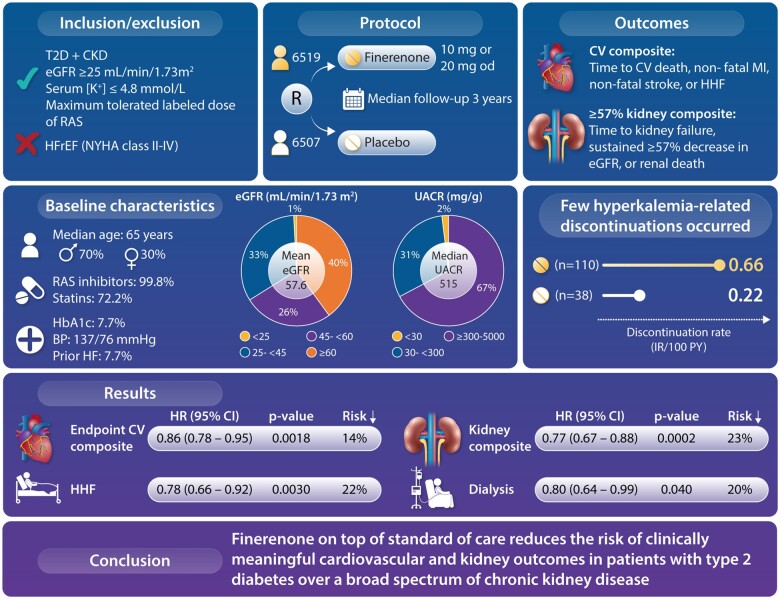
Aims: The complementary studies FIDELIO-DKD and FIGARO-DKD in patients with type 2 diabetes and chronic kidney disease (CKD) examined cardiovascular and kidney outcomes in different, overlapping stages of CKD. The purpose of the FIDELITY analysis was to perform an individual patient-level prespecified pooled efficacy and safety analysis across a broad spectrum of CKD to provide more robust estimates of safety and efficacy of finerenone compared with placebo. Methods and results: For this prespecified analysis, two phase III, multicentre, double-blind trials involving patients with CKD and type 2 diabetes, randomized 1:1 to finerenone or placebo, were combined. Main time-to-event efficacy outcomes were a composite of cardiovascular death, non-fatal myocardial infarction, non-fatal stroke, or hospitalization for heart failure, and a composite of kidney failure, a sustained ≥57% decrease in estimated glomerular filtration rate from baseline over ≥4 weeks, or renal death. Among 13 026 patients with a median follow-up of 3.0 years (interquartile range 2.3–3.8 years), the composite cardiovascular outcome occurred in 825 (12.7%) patients receiving finerenone and 939 (14.4%) receiving placebo [hazard ratio (HR), 0.86; 95% confidence interval (CI), 0.78–0.95; P = 0.0018]. The composite kidney outcome occurred in 360 (5.5%) patients receiving finerenone and 465 (7.1%) receiving placebo (HR, 0.77; 95% CI, 0.67–0.88; P = 0.0002). Overall safety outcomes were generally similar between treatment arms. Hyperkalaemia leading to permanent treatment discontinuation occurred more frequently in patients receiving finerenone (1.7%) than placebo (0.6%). Conclusion: Finerenone reduced the risk of clinically important cardiovascular and kidney outcomes vs. placebo across the spectrum of CKD in patients with type 2 diabetes. Key Question: Does finerenone, a novel selective, nonsteroidal mineralocorticoid receptor antagonist, added to maximum tolerated renin–angiotensin system inhibition reduce cardiovascular disease and kidney disease progression over a broad range of chronic kidney disease in patients with type 2 diabetes? Key Finding: In a prespecified, pooled individual-level analysis from two randomized trials, we found reductions both in cardiovascular events and kidney failure outcomes with finerenone. Because 40% of the patients had an estimated glomerular filtration rate of >60 mL/min/1.73m2 they were identified solely on the basis of albuminuria. Take Home Message: Finerenone reduces the risk of clinical cardiovascular outcomes and kidney disease progression in a broad range of patients with chronic kidney disease and type 2 diabetes. Screening for albuminuria to identify at-risk patients among patients with type 2 diabetes facilitates reduction of both cardiovascular and kidney disease burden.
Overview
CoChat Summary
TL;DR
In a prespecified pooled analysis of FIDELIO-DKD and FIGARO-DKD (13,026 patients with type 2 diabetes and CKD), finerenone reduced composite cardiovascular and kidney outcomes versus placebo. Hyperkalaemia was more frequent with finerenone but rarely led to permanent discontinuation, and no fatal hyperkalaemia occurred.
Key findings
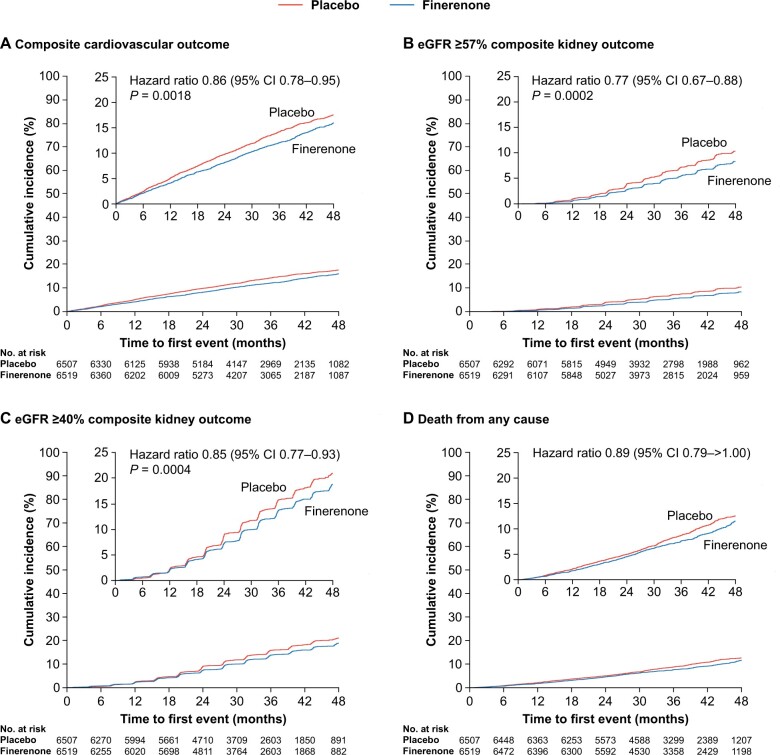
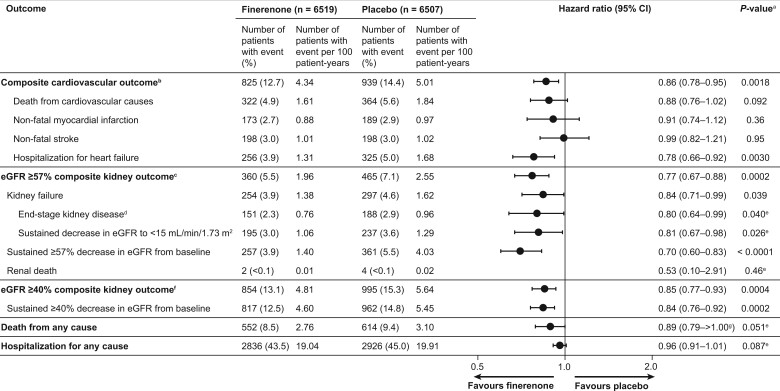
- The composite cardiovascular outcome (cardiovascular death, non-fatal MI, non-fatal stroke, or hospitalization for heart failure) occurred in 825 (12.7%) finerenone patients vs 939 (14.4%) placebo patients (HR 0.86; 95% CI 0.78–0.95; P=0.0018).
- The composite kidney outcome (kidney failure, sustained ≥57% eGFR decrease over ≥4 weeks, or renal death) occurred in 360 (5.5%) finerenone patients vs 465 (7.1%) placebo patients (HR 0.77; 95% CI 0.67–0.88; P=0.0002).
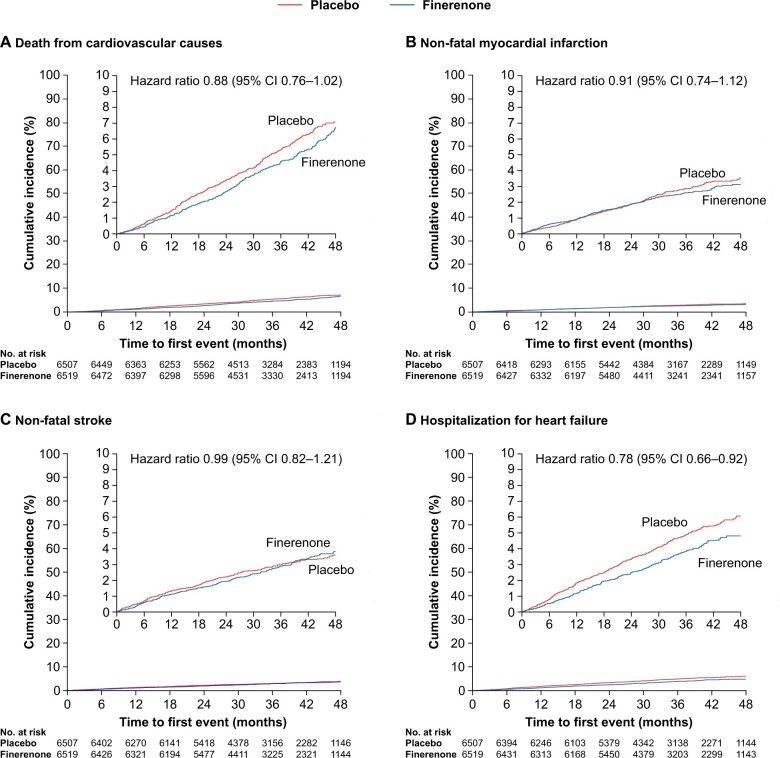
- Hospitalization for heart failure was lower with finerenone (HR 0.78; 95% CI 0.66–0.92; P=0.0030); sustained ≥57% eGFR decrease had HR 0.70 (95% CI 0.60–0.83; P<0.0001) and ESKD had HR 0.80 (95% CI 0.64–0.99; P=0.040).
- Hyperkalaemia leading to permanent treatment discontinuation occurred in 1.7% of finerenone patients vs 0.6% of placebo patients; hyperkalaemia-related adverse events occurred in 14.0% vs 6.9%, with no fatal hyperkalaemia.
Methods
- Prespecified pooled individual patient-level analysis of two phase III, multicentre, double-blind, placebo-controlled trials (FIDELIO-DKD and FIGARO-DKD) in adults with type 2 diabetes and CKD on maximum tolerated ACEi or ARB, randomized 1:1 to finerenone or placebo.
- The full analysis set included 13,026 patients after prospective exclusion of 145 patients with critical Good Clinical Practice violations; median follow-up was 3.0 years (IQR 2.3–3.8), mean eGFR was 57.6 mL/min/1.73 m², and median UACR was 515 mg/g.
- Outcomes were analyzed with stratified Cox proportional hazards models using stratification factors including study, region, eGFR category, albuminuria category, and history of cardiovascular disease; P-values came from stratified log-rank tests, and analyses were prespecified exploratory without multiplicity adjustment.
Limitations
- Stated in the paper: the analysis did not include patients with non-albuminuric CKD, and only a small proportion of Black patients were included.
- Stated in the paper: SGLT-2 inhibitors emerged as therapeutic options after the trials were designed; some patients received these agents at baseline, and combination efficacy/safety was not tested in a randomized combination trial.
- Evident from the text: statistical tests were exploratory rather than hypothesis-confirming and no multiplicity adjustment was performed; patients with chronic symptomatic heart failure with reduced ejection fraction were excluded, limiting generalizability to that population.
Model-written summary. Check it against the paper before relying on it.
Integrity signals
Registry
Cites
Statistics
Figures
Verification
Claims the paper makes
14 Valid · 2 Not valid · 2 Not checked · 76 Own results and interpretations
The cited sources that could be checked couldn’t confirm or dispute this claim.
In the paper
“Patient characteristics, medications, and demographics at baseline were balanced between patients randomized to finerenone and placebo (Table 2 and Supplementary material online, Table S1; published previously3).”
§ Cardiovascular and kidney outcomes with finerenone in patients with type 2 diabetes and chronic kidney disease: the FIDELITY pooled analysis > Results
What the sources say
- Could not verifycites [3] Agarwal R, Anker SD, Bakris G et al; FIDELIO-DKD and FIGARO-DKD Investigators. Investigating new treatment opportunities for patients with chronic kidney disease in type 2 diabetes: the role of finerenone. Nephrol Dial Transplant 2020. doi:10.1093/ndt/gfaa294. PMC9130026 33280027 sourceExperimental — accuracy not yet measured
Table 1 in the FINERENONE PHASE II PROGRAM section reports baseline demographics, clinical characteristics, and medications by trial and in combination, not by finerenone versus placebo assignment. The FINERENONE PHASE III PROGRAM section identifies the trials as randomized and placebo-controlled, but the passages found do not establish that baseline characteristics were balanced between treatment arms (searched for baseline balance and finerenone–placebo group comparisons). (LLM, conf=0.76)
plain- Asserted: passes — The authors put it forward as true.
- Checkable: passes — It can be checked against evidence.
- Load-bearing: passes — The paper’s conclusions depend on it.
- Based: passes — The paper gives a reason why it holds.
- Could not verify
The cited sources that could be checked couldn’t confirm or dispute this claim.
In the paper
“Compared with patients with advanced kidney disease, who are more likely to progress to dialysis, patients with better preserved estimated glomerular filtration rate (eGFR) have a greater lifetime risk of cardiovascular morbidity such as heart failure, myocardial infarction (MI), stroke, or dying from cardiovascular causes.7”
§ Cardiovascular and kidney outcomes with finerenone in patients with type 2 diabetes and chronic kidney disease: the FIDELITY pooled analysis > Introduction
What the sources say
- Could not verifycites [7] Bakris GL, Agarwal R, Anker SD et al; FIDELIO-DKD Investigators. Effect of finerenone on chronic kidney disease outcomes in type 2 diabetes. N Engl J Med 2020; 383: 2219– 2229. 33264825 sourceExperimental — accuracy not yet measured
The Outcomes section defines kidney failure to include long-term dialysis, and the Discussion describes cardiovascular events in a trial whose participants mostly had advanced CKD. Neither passage compares lifetime cardiovascular risk in patients with better-preserved eGFR against those with advanced kidney disease. Searches for that comparison and for preserved eGFR found no supporting passage in our copy; page numbers were not provided. (LLM, conf=0.76)
plainstates an association- Asserted: passes — The authors put it forward as true.
- Checkable: passes — It can be checked against evidence.
- Load-bearing: unclear — It is unclear whether the paper’s conclusions depend on it.
- Based: passes — The paper gives a reason why it holds.
- Could not verify
The cited sources support only part of this claim — read each source’s verdict below.
In the paper
“In FIGARO-DKD, finerenone significantly reduced the primary cardiovascular composite outcome risk in a broader patient population than studied in FIDELIO-DKD (patients with stage 2–4 CKD and moderately increased albuminuria, or stage 1–2 CKD with severely increased albuminuria).7 , 10”
§ Cardiovascular and kidney outcomes with finerenone in patients with type 2 diabetes and chronic kidney disease: the FIDELITY pooled analysis > Introduction
What the sources say
- Partly supportedcites [7] Bakris GL, Agarwal R, Anker SD et al; FIDELIO-DKD Investigators. Effect of finerenone on chronic kidney disease outcomes in type 2 diabetes. N Engl J Med 2020; 383: 2219– 2229. 33264825 sourceExperimental — accuracy not yet measured
Split into 2 atoms — 0 confirmed, 2 partially supported, 0 disputed, 0 misattributed, 0 unverifiable. Expand the claim to see per-atom verdicts.
- Supportedcites [10] Pitt B, Filippatos G, Agarwal R et al; FIGARO-DKD Investigators. Cardiovascular events with finerenone in kidney disease and type 2 diabetes. N Engl J Med 2021. doi:10.1056/NEJMoa2110956. 34449181 source
Split into 2 atoms — 2 confirmed, 0 partially supported, 0 disputed, 0 misattributed, 0 unverifiable. Expand the claim to see per-atom verdicts.
plainstates a cause- Asserted: passes — The authors put it forward as true.
- Checkable: passes — It can be checked against evidence.
- Load-bearing: passes — The paper’s conclusions depend on it.
- Based: passes — The paper gives a reason why it holds.
- Partly supported
The cited sources support only part of this claim — read each source’s verdict below.
In the paper
“Patients with chronic kidney disease (CKD) and type 2 diabetes have high residual cardiorenal morbidity and mortality, despite current therapies,1–5”
§ Cardiovascular and kidney outcomes with finerenone in patients with type 2 diabetes and chronic kidney disease: the FIDELITY pooled analysis > Introduction
What the sources say
- Supportedcites [1] Alicic RZ, Rooney MT, Tuttle KR. Diabetic kidney disease: challenges, progress, and possibilities. Clin J Am Soc Nephrol 2017; 12: 2032– 2045. 28522654 PMC5718284 source
The Abstract states that diabetic kidney disease carries substantial cardiovascular mortality and that a large risk of kidney disease onset and progression remains despite current therapies. The Treatment of DKD passage specifically discusses patients with type 2 diabetes and CKD, noting persistent cardiovascular and kidney risks under treatment. (LLM, conf=0.90)
- Supportedcites [2] Perkovic V, Jardine MJ, Neal B et al; CREDENCE Trial Investigators. Canagliflozin and renal outcomes in type 2 diabetes and nephropathy. N Engl J Med 2019; 380: 2295– 2306. 30990260 source
The Patients section states that participants with type 2 diabetes and chronic kidney disease were required to receive ACE-inhibitor or angiotensin-receptor-blocker therapy. The Secondary and Exploratory Outcomes table reports substantial kidney and cardiovascular event rates, including deaths, in the placebo group despite that background treatment. Page numbers were not supplied for these passages. (LLM, conf=0.88)
- Supportedcites [3] Agarwal R, Anker SD, Bakris G et al; FIDELIO-DKD and FIGARO-DKD Investigators. Investigating new treatment opportunities for patients with chronic kidney disease in type 2 diabetes: the role of finerenone. Nephrol Dial Transplant 2020. doi:10.1093/ndt/gfaa294. PMC9130026 33280027 source
The Introduction states that, despite ACE inhibitor or ARB treatment and concomitant SGLT2 inhibitor use, patients with CKD and type 2 diabetes retain a risk of progression to end-stage kidney disease and cardiovascular morbidity and mortality. The Conclusions also describe patients at high cardiorenal risk despite standard care. (LLM, conf=0.94)
- Partly supportedcites [4] Neuen BL, Young T, Heerspink HJL et al SGLT2 inhibitors for the prevention of kidney failure in patients with type 2 diabetes: a systematic review and meta-analysis. Lancet Diabetes Endocrinol 2019; 7: 845– 854. 31495651 sourceExperimental — accuracy not yet measured
The Introduction says that residual kidney risk remains high despite recommended ACE inhibitor or ARB treatment for people with type 2 diabetes who have, or are at risk of, kidney disease. The Results include cardiovascular or kidney death in a composite outcome, but the paper does not establish the claimed high residual cardiovascular morbidity and mortality in patients with both CKD and type 2 diabetes. (LLM, conf=0.83)
- Not checked — no full text of the sourcecites [5] Zelniker TA, Wiviott SD, Raz I et al Comparison of the effects of glucagon-like peptide receptor agonists and sodium-glucose cotransporter 2 inhibitors for prevention of major adverse cardiovascular and renal outcomes in type 2 diabetes mellitus. Circulation 2019; 139: 2022– 2031. 30786725 source
plain- Asserted: passes — The authors put it forward as true.
- Checkable: passes — It can be checked against evidence.
- Load-bearing: passes — The paper’s conclusions depend on it.
- Based: passes — The paper gives a reason why it holds.
- Supported
Every source the paper cites for this claim was checked and supports it.
In the paper
“They investigated the efficacy and safety of finerenone, on top of maximum tolerated renin–angiotensin system inhibition, on kidney and cardiovascular outcomes in patients with mild-to-severe CKD in type 2 diabetes (Supplementary material online, Figure S1).3”
§ Cardiovascular and kidney outcomes with finerenone in patients with type 2 diabetes and chronic kidney disease: the FIDELITY pooled analysis > Introduction
What the sources say
- Supportedcites [3] Agarwal R, Anker SD, Bakris G et al; FIDELIO-DKD and FIGARO-DKD Investigators. Investigating new treatment opportunities for patients with chronic kidney disease in type 2 diabetes: the role of finerenone. Nephrol Dial Transplant 2020. doi:10.1093/ndt/gfaa294. PMC9130026 33280027 source
The FINERENONE PHASE III PROGRAM section describes FIDELIO-DKD and FIGARO-DKD as trials of finerenone’s efficacy and safety for kidney and cardiovascular outcomes in patients with CKD and type 2 diabetes. Its comparison-of-populations subsection says participants received maximum tolerated labeled doses of an ACE inhibitor or ARB, and describes the trials’ inclusion of patients with preserved kidney function as well as those at high cardiorenal risk. Page numbers are not available in our copy. (LLM, conf=0.94)
plainstates a cause- Asserted: passes — The authors put it forward as true.
- Checkable: passes — It can be checked against evidence.
- Load-bearing: passes — The paper’s conclusions depend on it.
- Based: passes — The paper gives a reason why it holds.
- Supported
55 more claims · 5 with their cited sources checked
Create a free account to see all 94 claims and every source verdict.
- It may state two separate claims as one. 17
- Probably not a substantial claim. 23
Claims other papers make about this one
Each is checked against this paper’s own text: does it say what the citing paper says it does?
The source backs part of the claim, not all of it — or backs it for a different population, condition or comparison.
In the citing paper
“Sub-group analyses considering those co-prescribed MRA and SGLT2 inhibitors suggest their combined use does not modify safety findings from the key trials.150,189,[722][723][724][725][726]”
From 2023 ESC guidelines for the management of cardiovascular disease in patients with diabetes. (2023) · cites this paper as [722]
Experimental — accuracy not yet measuredThe source backs part of the claim, not all of it — or backs it for a different population, condition or comparison.
In the citing paper
“The pooled FIDELITY trial analysis confirms and strengthens the positive cardiovascular and kidney outcomes with finerenone across the spectrum of CKD, irrespective of baseline ASCVD history (with the exclusion of those with heart failure with reduced ejection fraction).”
From 11. Chronic Kidney Disease and Risk Management: Standards of Care in Diabetes—2025 (2025) · cites this paper as [127]
Experimental — accuracy not yet measuredThe source backs part of the claim, not all of it — or backs it for a different population, condition or comparison.
In the citing paper
“It also demonstrated a 23% reduction in the composite kidney outcome, consisting of sustained $57% decrease in eGFR from baseline over $4 weeks, or renal death, for finerenone vs. placebo (5.5% vs. 7.1%; HR 0.77 [95% CI 0.670.88];P = 0.0002).”
From 11. Chronic Kidney Disease and Risk Management: Standards of Care in Diabetes—2025 (2025) · cites this paper as [127]
Experimental — accuracy not yet measuredThe source backs part of the claim, not all of it — or backs it for a different population, condition or comparison.
In the citing paper
“and a lower incidence of kidney failure, de fi ned as initiation of chronic dialysis or kidney transplantation (HR: 0.80; 95% CI: 0.64 -0.99).”
From KDIGO 2022 Clinical Practice Guideline for Diabetes Management in Chronic Kidney Disease (2022) · cites this paper as [165]
Experimental — accuracy not yet measuredThe source backs part of the claim, not all of it — or backs it for a different population, condition or comparison.
In the citing paper
“HR: 0.79; 95% CI: 0.52 -1.11 among 944 participants using a GLP-1 RA”
From KDIGO 2022 Clinical Practice Guideline for Diabetes Management in Chronic Kidney Disease (2022) · cites this paper as [165]
Experimental — accuracy not yet measured
23 more claims about this paper
Create a free account to see every claim other papers make about this one.
Self-check
Percentages, sums and reported differences re-computed from the paper’s own numbers.
Rated minor: it would not touch a result — a value no result rests on, a p-value that stays on the same side of the significance level, or a conflict that is clerical, resolved elsewhere in the paper, or outside its own findings.
In the paper
“| Others | 385 (5.9) | 356 (5.4) | 741 (5.8) |”
§ Cardiovascular and kidney outcomes with finerenone in patients with type 2 diabetes and chronic kidney disease: the FIDELITY pooled analysis > Results
Reported 5.8 · recomputed 5.688623
Citations
Cites
McDonagh, T. A., Metra, M., Adamo, M., Gardner, R. S., Baumbach, A., Böhm, M., Burri, H., Butler, J., Čelutkienė, J., Chioncel, O., et al. (2021) · European Heart Journal · doi:10.1093/eurheartj/ehab670 · Cited by 19,442
2013 ACCF/AHA Guideline for the Management of Heart Failure
Yancy, C. W., Jessup, M., Bozkurt, B., Butler, J., Casey, D. E., Drazner, M. H., Fonarow, G. C., Geraci, S. A., Horwich, T., Januzzi, J. L., et al. (2013) · Journal of the American College of Cardiology · doi:10.1016/j.jacc.2013.05.019 · Cited by 12,536
Ahmed, A., Jorna, T., & Bhandari, S. (2016) · Nephron · doi:10.1159/000447068 · Cited by 11,717
2016 ESC Guidelines for the diagnosis and treatment of acute and chronic heart failure
Ponikowski, P., Voors, A. A., Anker, S. D., Bueno, H., Cleland, J. G. F., Coats, A. J. S., Falk, V., González-Juanatey, J. R., Harjola, V.-P., Jankowska, E. A., et al. (2016) · European Heart Journal · doi:10.1093/eurheartj/ehw128 · Cited by 11,429
Self-citationBrenner, B. M., Cooper, M. E., de Zeeuw, D., Keane, W. F., Mitch, W. E., Parving, H.-H., Remuzzi, G., Snapinn, S. M., Zhang, Z., & Shahinfar, S. (2001) · New England Journal of Medicine · doi:10.1056/nejmoa011161 · Cited by 7,493
Canagliflozin and Renal Outcomes in Type 2 Diabetes and Nephropathy
Perkovic, V., Jardine, M. J., Neal, B., Bompoint, S., Heerspink, H. J. L., Charytan, D. M., Edwards, R., Agarwal, R., Bakris, G., Bull, S., et al. (2019) · New England Journal of Medicine · doi:10.1056/nejmoa1811744 · Cited by 6,189
Self-citationLewis, E. J., Hunsicker, L. G., Clarke, W. R., Berl, T., Pohl, M. A., Lewis, J. B., Ritz, E., Atkins, R. C., Rohde, R., & Raz, I. (2001) · New England Journal of Medicine · doi:10.1056/nejmoa011303 · Cited by 5,987
Dapagliflozin in Patients with Chronic Kidney Disease
Heerspink, H. J. L., Stefánsson, B. V., Correa-Rotter, R., Chertow, G. M., Greene, T., Hou, F.-F., Mann, J. F. E., McMurray, J. J. V., Lindberg, M., Rossing, P., et al. (2020) · New England Journal of Medicine · doi:10.1056/nejmoa2024816 · Cited by 5,618
Self-citationEffect of finerenone on chronic kidney disease outcomes in type 2 diabetes
Bakris, G. L., Agarwal, R., Anker, S. D., Pitt, B., Ruilope, L. M., Rossing, P., Kolkhof, P., Nowack, C., Schloemer, P., Joseph, A., et al. (2020) · New England Journal of Medicine · doi:10.1056/nejmoa2025845 · Cited by 2,935 · cited 10×
“In FIDELIO-DKD, finerenone significantly reduced the risk of the primary kidney composite outcome and the key secondary cardiovascular composite outcome in patients with predominantly stage 3–4 CKD with severely increased albuminuria and type 2 diabetes.(7) In FIGARO-DKD, finerenone significantly reduced the primary c…”
BackgroundMethodInfluentialSelf-citationDiabetic Kidney Disease: Challenges, Progress, and Possibilities
Alicic, R. Z., Rooney, M. T., & Tuttle, K. R. (2017) · Clinical Journal of the American Society of Nephrology · doi:10.2215/cjn.11491116 · Cited by 2,898
Research works printed but not linked: 2
- United States Renal Data System. Cardiovascular disease in patients with CKD. In: USRDS Annual Data Report. Volume 1: Chronic Kidney Disease. Bethesda, MD: National Institutes of Health, National Institute of Diabetes and Digestive and Kidney Diseases; 2020, Chapter 4. https://adr.usrds.org/2020/chronic-kidney-disease/4-cardiovascular-disease-in-patients-with-ckd (1 June 2021).
- United States Renal Data System. Healthcare expenditures for persons with CKD. In: USRDS Annual Data Report. Volume 1: Chronic Kidney Disease. Bethesda, MD: National Institutes of Health, National Institute of Diabetes and Digestive and Kidney Diseases; 2020 (Chapter 6). https://adr.usrds.org/2020/chronic-kidney-disease/6-healthcare-expenditures-for-persons-with-ckd. (1 July 2021).
Cited by
Items 1,101–1,200 of 1,294
Beavers, C. J., & Greene, S. J. (2026) · Heart Failure Reviews · doi:10.1007/s10741-026-10597-4
Iwamoto, T., Hidaka, S., Iwamoto, M., & Shibata, H. (2026) · Journal of Diabetes and its Complications · doi:10.1016/j.jdiacomp.2026.109308
Kovesdy, C. P., Coleman, C. I., Johannes, C. B., et al. (2026) · Journal of Clinical & Translational Endocrinology · doi:10.1016/j.jcte.2026.100435
Doku, A., EL‐HARARI, M. B., Badr, A., Bennis, A., Ogola, E. N., AlHabeeb, W., Abdelhamid, M., & Mbakwem, A. C. (2026) · Journal of the American Heart Association · doi:10.1161/jaha.125.043650 · Cited by 1
van Boemmel-Wegmann, S., Bauer, C., Zerck, A., Hartenstein, A., Schuchhardt, J., Knapp, R., Edfors, R., Farjat, A. E., & Walsh, M. (2026) · Kidney International Reports · doi:10.1016/j.ekir.2026.106409 · Cited by 1
Sirivongrangson, P., Pakdeewongse, S., Kumnuch, P., Punjachaipornpol, T., & Srisawat, N. (2026) · BMC Nephrology · doi:10.1186/s12882-026-04882-5
“Hyperkalemia was defined as a serum potassium level ≥ 5.0 mmol/L, and severe hyperkalemia was defined as a serum potassium level > 6.0 mmol/L [6].”
InfluentialCombination Therapy with Finerenone and Sodium-Glucose Cotransporter Inhibitors: Who, When, How?
Morales, A., & Rosas, S. E. (2026) · Journal of the American Society of Nephrology · doi:10.1681/asn.0000001049
Herrington, W. G., & Haynes, R. (2026) · Elsevier eBooks · doi:10.1016/b978-0-323-87862-3.00025-2
An integrative framework for drug target discovery bridging clinical trial and genetic data insights
Mielke, J., Strunz, T., Lee, J., Schloemer, P., Gckd study investigators, & Gallone, G. (2026) · Journal of Translational Medicine · doi:10.1186/s12967-026-07806-x
Lin, W., Huang, T.-S., Chang, H.-H., Chao, J.-Y., Chang, Y.-H., Yang, C., Ou, H., & Lin, W. (2026) · Clinical and Translational Science · doi:10.1111/cts.70509
Parati, G., Ogedegbe, G. G., Agiro, A., Luan, S., Davis, H., Daniel, I., McKendrick, J., Huang, J. Y., & Townsend, R. R. (2026) · Advances in Therapy · doi:10.1007/s12325-026-03530-6
Medenica, S., Prelević, V., Zanković, N., Maggio, V., & Rizzo, M. (2026) · Expert Opinion on Drug Safety · doi:10.1080/14740338.2026.2648248 · Cited by 1
Endothelial triple-pathway vasorelaxation as an adjunctive strategy in resistant hypertension
Madeddu, P., Cattaneo, M., Giuffre, M., & Laffin, L. J. (2026) · Journal of Hypertension · doi:10.1097/hjh.0000000000004286
Merker, L., Ebert, T., Schleicher, E. D., Isermann, B. H., & Guthoff, M. (2026) · Die Diabetologie · doi:10.1007/s11428-026-01461-y
Better cardiorenal protection for patients with CKD and type 1 diabetes
Georgianos, P. I., Roumeliotis, A. K., & Liakopoulos, V. (2026) · Nephrology Dialysis Transplantation · doi:10.1093/ndt/gfag076
Randomized Trials Meet Real-World Evidence in the Era of Combination CKD Therapies
Pecoits-Filho, R., & Bauer, A. C. (2026) · Kidney International Reports · doi:10.1016/j.ekir.2026.106519
Anupama, Y. J. (2026) · APIK Journal of Internal Medicine · doi:10.4103/ajim.ajim_3_26
Finerenone in heart failure with ejection fraction ≥40%: state of the art and future perspectives
Llàcer, P., Marcos, M. C., Núñez, J. E., Perez-Belmonte, L. M., Pérez-Silvestre, J., Martéles, M. S., & Colet, J. C. (2026) · Revista Clínica Española (English Edition) · doi:10.1016/j.rceng.2026.502520
Nonsteroidal mineralocorticoid receptor antagonists: prospects in heart failure
Ageev, F. T., Ovchinnikov, A. G., & Ageeva, S. F. (2026) · Russian Cardiology Bulletin · doi:10.17116/cardiobulletin20262101113
The Role of Finerenone in Cardiorenal Protection and Urine Albumin-to-Creatinine Ratio Modulation
Singh, A. K., & Khan, M. S. (2026) · Kidney International Reports · doi:10.1016/j.ekir.2026.106532
Wang, Q., Li, X., Ye, W., Wang, Q., & Bi, X. (2026) · Journal of Diabetes Research · doi:10.1155/jdr/3768039
Management Strategies for Congestive Heart Failure in Chronic Kidney Disease: Narrative Review
Soto-Santillán, P., Jacobo-Ruvalcaba, A., de Lay, M. W., & Orihuela-Rodríguez, Ó. (2026) · Biomedicines · doi:10.3390/biomedicines14040841
Zhao, C., Sun, B., Xu, H., Yao, Y., Huang, F., & Liu, X. (2026) · Frontiers in Cardiovascular Medicine · doi:10.21203/rs.3.rs-9027680/v1
Nikolov, G., Nikolov, D., Vaysilova, M., et al. (2026) · Pharmacia · doi:10.3897/pharmacia.73.e188831
VII. Therapeutic Strategies for Diabetic Kidney Disease
Kawanami, D. (2025) · Nihon Naika Gakkai Zasshi · doi:10.2169/naika.114.656
Ostrominski, J. W., Neuen, B. L., Claggett, B. L., Agarwal, R., Filippatos, G. S., Rossing, P. R., Ruilope, L. M., Pitt, B., BRINKER, M. D., Lage, A. Z., et al. (2026) · European Heart Journal · doi:10.1093/eurheartj/ehag126
Self-citationLlàcer, P., Marcos, M. C., Nuñez, J., Perez-Belmonte, L. M., Pérez-Silvestre, J., Marteles, M. S., & Colet, J. C. (2026) · Revista Clínica Española · doi:10.1016/j.rce.2026.502520
Stage A Heart Failure: Identification and Management of Heart Failure Risk Factors
Elezaby, A., Nayor, M. G., & Alexander, K. M. (2026) · Elsevier eBooks · doi:10.1016/b978-0-443-15734-9.00096-0
Tanaka, A., Imai, T., Vaduganathan, M., Okada, Y., Sonoda, S., Torimoto, K., Suwa, S., Teragawa, H., Miyazono, M., Fukuda, M., et al. (2026) · Kidney International Reports · doi:10.1016/j.ekir.2026.106546 · Cited by 1
Lopatin, Y. M., Tereshchenko, S. N., Arutyunov, G. P., Вадимовна, В. С., Galyavich, A. S., Duplyakov, D. V., Жиров, И. В., Звартау, Н. Э., Irtyuga, O. B., Koziolova, N. A., et al. (2026) · Russian Journal of Cardiology · doi:10.15829/1560-4071-2026-6850
Wu, P., Huang, Z., Zhu, B., Ma, A., Wang, X., Hai, X., Jia, S., Yan, N., & Ma, X. (2026) · Nutrition Metabolism and Cardiovascular Diseases · doi:10.1016/j.numecd.2026.104761
Zhang, W., Yu, J.-T., Lin, B., Shen, X., Chen, M., Zhou, Y., Zhang, Y.-J., Zhuo, C.-C., Jiang, Z.-L., & Zhu, B. (2026) · Renal Failure · doi:10.1080/0886022x.2026.2644719 · Cited by 1
RAAS blockade in the kidney life-cycle–treatment standard
Moriconi, D., García-Carro, C., Núñez, J. E., Correa‐Rotter, R., Tuttle, K., & Soler, M. J. (2026) · Nephrology Dialysis Transplantation · doi:10.1093/ndt/gfag090 · Cited by 1
Salt and chronic kidney disease
Murray, J., Marsman, R. F. J., Engberink, R. O., & Vogt, L. (2026) · Nature Reviews Nephrology · doi:10.1038/s41581-026-01076-y · Cited by 5
Hyperaldosteronism in the Pathophysiology and Management of Cardiovascular‐Kidney‐Metabolic Syndrome
Zeitler, E. M., Klein, K. R., Lingvay, I., Pick, A., & Billings, L. K. (2026) · Diabetes Obesity and Metabolism · doi:10.1111/dom.70781 · Cited by 2
Neves, J. S., Leite, A. R., Vasques‐Nóvoa, F., Pitt, B., Filippatos, G. S., Ruilope, L. M., Rossing, P. R., Anker, S. D., Savarese, G., Scott, C. A. B., et al. (2026) · Diabetes Obesity and Metabolism · doi:10.1111/dom.70750
Self-citationPrevalence of Hyperkalemia in a Contemporary European Cohort According to EKFC eGFR Categories
Villalvazo, P., Molinero, L.-M., Sánchez-Niño, M. D., & Ortíz, A. (2026) · Diagnostics · doi:10.3390/diagnostics16091309 · Cited by 1
“Since finerenone was commercialized in Spain in June 2024, the present study has not captured any potential impact of this medication, which may increase hyperkalemia risk [55].”
Spanish Registry of Dialysis and Transplantation: 2023 Report and evolutive analysis
Quiroga, B., Mahíllo, B., Mazuecos, A., Ortiz, A., Troya, M. I., Hernández-Marrero, D., Alemán, S. T., Santiuste, C., Arévalo, O. L. R., Marqués-Vidas, M., et al. (2026) · Nefrología (English Edition) · doi:10.1016/j.nefroe.2026.501510 · Cited by 2
Kendrick, J., & Dixon, A. M. (2026) · Cardiorenal Medicine · doi:10.1159/000552030
Nouvelles cibles thérapeutiques dans l’hypertension artérielle
Kantor, B. (2026) · Archives des Maladies du Coeur et des Vaisseaux - Pratique · doi:10.1016/j.amcp.2026.04.002
Levy, B. I. (2026) · Archives des Maladies du Coeur et des Vaisseaux - Pratique · doi:10.1016/j.amcp.2026.04.008
Jeong, G.-H. (2026) · Diabetology · doi:10.3390/diabetology7050084 · Cited by 1
Aledan, H., & Abbood, A. S. (2026) · Frontiers in Nephrology · doi:10.3389/fneph.2026.1716452 · Cited by 1
Finerenone and Empagliflozin in Type 2 Diabetes
Abdullah, M., Khalid, N., Frishman, W. H., & Aronow, W. S. (2026) · Cardiology in Review · doi:10.1097/crd.0000000000001308
Tan, Z., Zhang, X., Yang, R., Liu, L., Zhao, Y., & Yang, X. (2026) · Foods · doi:10.3390/foods15101632 · Cited by 1
Xu, Y., Zeng, S., Xi, Y., Chen, C., Zou, G., Zhang, Y., & Liu, J. (2026) · BMC Nephrology · doi:10.1186/s12882-026-05035-4 · Cited by 1
张, 一. (2026) · Asian Case Reports in Emergency Medicine · doi:10.12677/acrem.2026.142032
Emerging Cardiorenal Protective Therapies in Lupus Nephritis
Capón, I. M., Sandino, J., Galindo, M., & Morales, E. (2026) · Drugs · doi:10.1007/s40265-026-02337-7 · Cited by 2
Ahmed, F., Khan, S., Gohar, N., Kotadiya, F., Hassan, M., Khalid, N., Hussain, M., Mirza, T. R., Haider, F., Abdullah, M., et al. (2026) · Biomedicines · doi:10.3390/biomedicines14051108
Impact of air pollution exposure on chronic kidney disease and type 2 diabetes: A FIDELITY analysis
Al-Kindi, S. G., Chen, Z., Dazard, J.-E., Farag, Y. M. K., Filippatos, G. S., Rossing, P. R., Rohwedder, K., Salerno, P. R. V. D. O., Scott, C. A. B., Zheng, Z., et al. (2026) · American Journal of Preventive Cardiology · doi:10.1016/j.ajpc.2026.101670 · Cited by 1
“The study design, investigators, procedures, and outcomes of the FIDELITY analysis were published previously [12 – 14].”
Self-citationLeite, A. R., Vale, C., Marques, P. S., Mendonça, L., Ferreira, J. P., & Neves, J. S. (2026) · Journal of Nephrology · doi:10.1093/joneph/aajag001
Hsieh, W. C., Henry, B. M., & Édes, I. (2026) · Diabetes Obesity and Metabolism · doi:10.1111/dom.70907 · Cited by 1
Cardiovascular Implications of Diabetes Mellitus: A Systematic Literature Review
Gupta, P. K., Anand Sekar, G., Diwakar, R., Panchal, N. A., Kumar, A., & Bhaumik, A. (2026) · Cureus · doi:10.7759/cureus.109607 · Cited by 1
Bershtein, L. L., Zbyshevskaya, E. V., & Gumerova, V. E. (2026) · HERALD of North-Western State Medical University named after I I Mechnikov · doi:10.17816/mechnikov690537
Al‐Horani, R. A., & Goyal, N. (2026) · Drugs and Drug Candidates · doi:10.3390/ddc5020033
Umanath, K., Dwyer, J. P., & Mentz, R. J. (2026) · Frontiers in Cardiovascular Medicine · doi:10.3389/fcvm.2026.1845339
“…the risk reduction of adverse cardiorenal outcomes in adults with CKD associated with T2D, with data from subsequent pivotal randomized clinical trials further demonstrating efficacy in CKD in T2D (15, 79 – 81), as well as in HFmrEF and HFpEF (across a range of higher ejection fractions) (16, 60).”
Zhao, D., Xia, J., Yang, Z., Yong, Y., Wang, L., & Liu, J. (2026) · Frontiers in Pharmacology · doi:10.3389/fphar.2026.1754115 · Cited by 1
Diabetes Mellitus and the Heart
Marx-Schütt, K., Forst, T. M., Birkenfeld, A. L., Zirlik, A., Müller‐Wieland, D., & Marx, N. (2026) · Experimental and Clinical Endocrinology & Diabetes · doi:10.1055/a-2766-3079
Yadigar, S., Akgür, S., Güvenç, T. S., Sezen, M., Özcan, B., Yıldırım, E., Doğantekin, B., Atay, İ., Değer, S. M., Demir, M., et al. (2026) · Cardiovascular Drugs and Therapy · doi:10.1007/s10557-026-07944-w · Cited by 1
Zhou, T., Liu, Q., Li, Z., Feng, H., Zhang, Q., Wang, N., Jiao, Q., & Fan, Y. (2026) · Kidney Diseases · doi:10.1159/000552662
Sambola, A., & Freire, J. L. (2026) · European Heart Journal · doi:10.1093/eurheartj/ehag212
Hyperkalemia risk and potassium trajectory after finerenone initiation: a real-world cohort study
Hashimoto, N., Sakaguchi, Y., Naito, M., Makino, S., Takashima, A., Miyakawa, H., Okushima, H., Asai, M., & Hayashi, T. (2026) · Clinical and Experimental Nephrology · doi:10.1007/s10157-026-02898-7 · Cited by 2
Mechanism-driven therapy for diabetic cardiovascular disease
Sanchis‐Gomar, F., Lavie, C. J., Carbone, S., & Neeland, I. J. (2026) · Metabolism and Target Organ Damage · doi:10.20517/mtod.2026.84
Atif, K., Atif, E., Ali, M., Hassan, M. A., Das, V., Ahmad, A., Fatima, K., Mukhlis, M., Ahmad, D., Zahid, M., et al. (2026) · Research Square · doi:10.21203/rs.3.rs-9817293/v1
Hughes, M. S., & Pasquel, F. J. (2026) · Endocrinology and Metabolism Clinics of North America · doi:10.1016/j.ecl.2026.04.015
The (Mis)interpretation of Hazard Ratios in Clinical Trials
Marthi, A., Mottl, A. K., & Zivich, P. N. (2026) · Journal of the American Society of Nephrology · doi:10.1681/asn.0000001182
Zhang, M., Lu, K.-R., Han, J.-H., & Gong, G.-H. (2026) · World Journal of Diabetes · doi:10.4239/wjd.117887
Kim, H. (2026) · Electrolytes & Blood Pressure · doi:10.5049/ebp.2026.24.e6
McGill, J. B., Green, J., Heerspink, H. J. L., Mann, J. F. E., Mottl, A. K., Rosenstock, J., Rossing, P. R., Vaduganathan, M., Nangaku, M., BRINKER, M. D., et al. (2026) · Diabetes Obesity and Metabolism · doi:10.1111/dom.70949
Self-citationLin, H.-H., Cui, W.-H., Xu, F., He, J., Li, L., Xu, J.-J., Jiang, X., & Mao, K. (2026) · Frontiers in Medicine · doi:10.3389/fmed.2026.1797331
“Since these reactions may be life-threatening or affect disease progression, it is crucial to recognize them early (19).”
Cooper, J. T., Schneider, J. E., McLain, T., Coca, S. G., & Prashar, R. (2026) · Cost Effectiveness and Resource Allocation · doi:10.1186/s12962-026-00775-4
“%) as baseline values, assuming that these event rates occur in our base population before SGLT2i use [40].”
Finerenone Beyond Diabetic Kidney Disease: Emerging Evidence and Potential Systemic Implications
Almaimani, M. K., & Alamri, S. A. (2026) · Journal of Clinical Medicine · doi:10.3390/jcm15134852 · Cited by 1
Inflammation in atherosclerosis: Drivers, mechanisms and therapies
Su, Z., & Xu, S. (2026) · Acta Pharmaceutica Sinica B · doi:10.1016/j.apsb.2026.06.047 · Cited by 2
Zhang, H., Li, M., & Deng, W. (2026) · Biochemical Pharmacology · doi:10.1016/j.bcp.2026.118201 · Cited by 2
Jiang, L., Li, T., Zhang, H., Wu, X., & Zhao, T. (2026) · Frontiers in Nephrology · doi:10.3389/fneph.2026.1862772
“…transplantation, or sustained eGFR below 15 mL/ min/1.73m²; (3) substantial eGFR decline, de fi ned as ≥ 40% decrease from baseline sustained for at least 28 days; and (4) albuminuria progression, operationalized as ≥ 30% increase in UACR from baseline sustained for at least two years (19, 20).”
Finerenone and Cardiorenal Outcomes: A Narrative Review
Fernandes, W., Tasneem, S., Latif, F., Soussi, Y. E., Saji, A., Jani, A., Fuqaha, F., MOHAMMED, R. U. H., Leiva, D. M., Iliasov, M., et al. (2026) · Cardiology in Review · doi:10.1097/crd.0000000000001377
Kylies, J., Kylies, D., Weisel, K. C., Wenzel, U. O., Huber, T. B., Viezens, L., & Leonhardt, L.-G. (2026) · Brain and Spine · doi:10.1016/j.bas.2026.106153
“…have proven beneficial in other kidney disease settings (Zinman et al., 2015; Heerspink et al., 2020; Perkovic et al., 2024; Bakris et al., 2020; Agarwal et al., 2022; Pitt et al., 2021) their applicability in patients with MM remains uncertain, given the distinct pathophysiology of MM-related…”
Refaie, M. M. M., Hasan, A. A., Muhammed, A. A., Ibrahim, R. A., Hassan, E. A., Fathy, E., Soliman, A. M., Sherkawy, H. S., Beshay, O. N., Ahmed, A. A.-E., et al. (2026) · Molecular Biology Reports · doi:10.1007/s11033-026-12163-5
Sudden Death in Cardio-Kidney-Metabolic Patients
Ameri, P., Cannata, A. N., & Pontremoli, R. (2026) · Journal of the American College of Cardiology · doi:10.1016/j.jacc.2026.05.031
Real-world outcomes of Finerenone in patients with diabetic kidney disease in Saudi Arabia
Albekery, M. A., Alhomoud, I. S., Alamer, K. A., Alanazi, A. A., Mulhem, A. E. A., Alnaim, A. E., Almulhim, F. M., Al‐Mulhim, A. S., Makhaytah, S. A., Aldawsari, R. A., et al. (2026) · PLoS ONE · doi:10.1371/journal.pone.0352861
Würfel, M. (2026) · Die Diabetologie · doi:10.1007/s11428-026-01494-3
Progressionshemmung bei chronischer Nierenkrankheit
Weinmann-Menke, J., & Galle, J. (2026) · Die Innere Medizin · doi:10.1007/s00108-026-02145-x
Diagnostic Tests for Stage B Heart Failure
Dang, H. N. N., Luong, T. V., Huynh, Q. L., & Marwick, T. H. (2026) · Current Cardiology Reports · doi:10.1007/s11886-026-02389-x
Gao, R., Wang, J., Liu, Q. F., & Li, M. (2026) · Frontiers in Medicine · doi:10.3389/fmed.2026.1852929
Chuang, W.-L., Chou, R., Wang, Y., Tsai, I., Lin, C., Cho, D., & Chang, K. (2026) · Clinical Medicine · doi:10.1016/j.clinme.2026.100617 · Cited by 1
How Diabetes Mellitus Leads to Dialysis: A Narrative Review
Dar, M., Dui, D. R., & Gurung, S. (2026) · International Journal of Research and Review · doi:10.52403/ijrr.20260648
Cardiovascular Drug Access in Australia and New Zealand: New PBS and PHARMAC Listings, 2023–2025
Ciofani, J. L., Puranik, R., Ekmejian, A. A., Allahwala, U. K., Sinhal, S., James-Smith, J., Pepe, S., Lund, M., & Bhindi, R. (2026) · Heart Lung and Circulation · doi:10.1016/j.hlc.2026.06.001 · Cited by 3
Updates in management of cardiorenal syndrome
Chung, I., Chen, M., Anderson, L., & Banerjee, D. (2026) · Current Opinion in Nephrology & Hypertension · doi:10.1097/mnh.0000000000001209
The ‘Chloride Theory’ for Heart Failure Pathophysiology: An Updated Narrative Review 2025
Kataoka, H. (2026) · Cardiology and Therapy · doi:10.1007/s40119-026-00460-w
Tong, M., Chen, C., & Pan, Y. (2026) · Medicine · doi:10.1097/md.0000000000049631
Labate, A. M., Cimino, E., Giacomelli, L., Ettori, S., Oladeji, O. A., & Agosti, B. (2026) · International Journal of Molecular Sciences · doi:10.3390/ijms27146170 · Cited by 2
Zhang, H., Xiao, M., Ye, W., et al. (2026) · Experimental and Clinical Endocrinology & Diabetes · doi:10.1055/a-2911-9625
Kattamuri, L. P. V., Sharma, K., & Mukherjee, D. (2026) · International Journal of Angiology · doi:10.1055/a-2904-8847
A New Era in the Management of Patients with Diabetic Kidney Disease using Four Pillars of Therapy
Kourtidou, C., Georgianos, P. I., Liakopoulos, V., Savvopoulos, C., & Τζιόμαλος, Κ. (2026) · Journal of Atherosclerosis Prevention and Treatment · doi:10.4103/aptj.aptj_27_26
Liu, X., Zhang, N., Wu, S., Zhang, M., Sun, B., & Chen, L. (2026) · Frontiers in Pharmacology · doi:10.3389/fphar.2026.1865172 · Cited by 1
Álvarez, A. L., Martínez, M. R., Botero, S. R., Álvarez, A. L., Molinero, A. M., Rubio, L. F., Lamigueiro, C. G., Ávila, E. E. R., Rodríguez, J. M. F., Granell, S. B., et al. (2026) · BMC Cardiovascular Disorders · doi:10.1186/s12872-026-06267-w
“Additionally, finerenone has been shown to reduce the risk of cardio-vascular and renal outcomes in patients with chronic kidney disease and albuminuria who have type 2 diabetes [10], as well as in the cardiovascular-kidney-metabolic syndrome [11].”
Valente, V., Benson, L., Cabrera, C. C., Scorza, R., Lindberg, F., Löfman, I. H., Melin, M., Lund, L. H., Ferrannini, G., & Savarese, G. (2026) · ESC Heart Failure · doi:10.1093/eschf/xvag196
Tian, X., Ma, X., Song, E., Li, X., Fu, W., He, H., Gao, Z., & Gao, B. (2026) · Translational research · doi:10.1016/j.trsl.2026.07.008
Fasolo, B. P., Andrade, V. S. S., Coelho, E. S., & Alves, N. V. (2026) · South American Sciences · doi:10.63330/sasciencesv6n2-095
Metadata
- Authors
- Agarwal, R., Filippatos, G., Pitt, B., Anker, S. D., Rossing, P., Joseph, A., Kolkhof, P., Nowack, C., Gebel, M., Ruilope, L. M., Bakris, G. L., & FIDELIO-DKD and FIGARO-DKD investigators
- Affiliations
- Richard L. Roudebush VA Medical Center (US)
- University General Hospital Attikon (GR)
- University of Michigan (US)
- German Centre for Cardiovascular Research (DE)
- University of Copenhagen (DK)
- Bayer (Germany) (DE)
- Research Institute Hospital 12 de Octubre (ES)
- University of Chicago (US)
- Corresponding author
- Agarwal, Rajiv
- Filippatos, Gerasimos
- ORCID
- Venue
- European Heart Journal
- Publisher
- Oxford University Press (OUP)
- Published
- 2021-11-22
- Volume
- 43
- Issue
- 6
- Pages
- 474-484
- ISSN
- 0195-668X (ISSN-L)
- 1522-9645
- PMC
- PMC8830527
- OpenAlex
- W4206077470
- Semantic Scholar
- 2dad20aa0edb43b1fed3b45b3b6ddda14f0e4b5f
- Cited by
- 1,317
- References
- 31
- Citations by year
- 2026: 340 · 2025: 348 · 2024: 265 · 2023: 243 · 2022: 115 · 2021: 4
- FWCI
- 107.33
- Type
- journal article
- Language
- en
- Open access
- hybrid
- doi.org
- Licence
- Locations
- European Heart Journal (publishedVersion, cc-by-nc)
- PubMed Central (publishedVersion, cc-by-nc)
- PubMed (publishedVersion)
- Research at the University of Copenhagen (University of Copenhagen) (publishedVersion, cc-by)
- Purdue University Indianapolis (Indiana University) (submittedVersion, cc-by-nc)
- ABACUS. Repositorio de Producción Científica (Universidad Europea) (submittedVersion, cc-by-nc)
- Adelaide Research & Scholarship (AR&S) (University of Adelaide) (submittedVersion, cc-by-nc)
- IUScholarWorks (Indiana University) (submittedVersion, cc-by-nc)
- Funders
- Bayer AG,
- Topics
- Health Sciences › Medicine › Nephrology › Chronic Kidney Disease and Diabetes
- Health Sciences › Medicine › Endocrinology, Diabetes and Metabolism › Diabetes Treatment and Management
- Health Sciences › Medicine › Nephrology › Acute Kidney Injury Research
- Keywords
- finerenone, type 2 diabetes, chronic kidney disease, mineralocorticoid receptor antagonists, cardiovascular outcomes, renal outcomes, hyperkalemia, renin-angiotensin system blockade, FIDELIO-DKD, FIGARO-DKD, heart failure hospitalization, renal failure, estimated glomerular filtration rate decline, renal safety
- MeSH terms
- Cardiovascular Diseases, Diabetes Mellitus, Type 2, Double-Blind Method, Humans, Kidney, Naphthyridines, Renal Insufficiency, Chronic
About these checks
Registry, retraction, Cites and statistics results are computed, not judged, with one exception: a printed reference that no index lists is read once by a model before it counts as a citation error. Claims are extracted by a model and kept only when their quote appears verbatim in the text; each cited source is then checked, with a model’s help, for whether it says what the claim relies on. Those verdicts can be wrong — read the claim’s quote and the cited source before relying on one.
The claim verdicts this report counts are experimental: their accuracy is not yet measured.
A language model drew the claims from the paper on 2026-10-16, under version 3 of the claim definition (model deepseek-v4.1-flash, prompt extract-v3).
A second model labelled each claim on 2026-10-16 (model jev-1.13-20260917, definition revision gold-guideline-v0.2).
Cited sources are checked with a language model’s help (gpt-6-sol).
Statistics and arithmetic are recomputed, not judged.
Confidence bands are shown only for fields calibrated on our annotated test set. None is calibrated yet, so no band is shown.
What counts as a claim ›How we measure confidence ›How we check this ›
Are you an author, or do you see a problem with this page? Request a review
Data sources
Bibliographic data: Semantic Scholar, OpenAlex, Crossref.
Contains information from the Semantic Scholar Academic Graph Datasets, made available under the ODC Attribution License (ODC-BY 1.0).
Semantic Scholar’s data is described in: Kinney, R., et al. (2023). The Semantic Scholar Open Data Platform. arXiv:2301.10140.
