

The DOI matches its Crossref record; 21 of the 22 references it cites were found in a registry or an index; none of the 22 sources its claims cite is checked for support yet.
Antiadrenergic autoimmunity in postural tachycardia syndrome
Open accessAbstract
AIMS: Postural tachycardia syndrome (POTS), a common and debilitating cardiovascular disorder, is characterized by an exaggerated heart rate increase during orthostasis and a wide spectrum of adrenergic-related symptoms. To determine the aetiology of POTS, we examined a possible pathophysiological role for autoantibodies against α1-adrenergic (α1AR) and β1/2-adrenergic receptors (β1/2AR). METHODS AND RESULTS: Immunoglobulin G (IgG) derived from 17 POTS patients, 7 with recurrent vasovagal syncope (VVS), and 11 normal controls was analysed for its ability to modulate activity and ligand responsiveness of α1AR and β1/2AR in transfected cells and to alter contractility of isolated rat cremaster arterioles in vitro. Immunoglobulin G activation of α1AR and β1/2AR was significantly higher in POTS compared with VVS and controls in cell-based assays. Eight, 11, and 12 of the 17 POTS patients possessed autoantibodies that activated α1AR, β1AR and β2AR, respectively. Pharmacological blockade suppressed IgG-induced activation of α1AR and β1/2AR. Eight of 17 POTS IgG decreased the α1AR responsiveness to phenylephrine and 13 of 17 POTS IgG increased the β1AR responsiveness to isoproterenol irrespective of their ability to directly activate their receptors. Postural tachycardia syndrome IgG contracted rat cremaster arterioles, which was reversed by α1AR blockade. The upright heart rate correlated with IgG-mediated β1AR and α1AR activity but not with β2AR activity. CONCLUSION: These data confirm a strong relationship between adrenergic autoantibodies and POTS. They support the concept that allosteric-mediated shifts in the α1AR and β1AR responsiveness are important in the pathophysiology of postural tachycardia.
Overview
AI snapshot
Written from the paper’s full text.
TL;DR
IgG from patients with postural tachycardia syndrome (POTS) showed higher direct activation of α1-adrenergic and β1/2-adrenergic receptors than IgG from recurrent vasovagal syncope (VVS) patients or healthy controls, and also altered receptor responsiveness to phenylephrine and isoproterenol. These antiadrenergic autoantibody effects correlated with upright heart rate and support an autoimmune contribution to POTS pathophysiology.
Key findings
- Among 17 POTS patients, direct receptor activation was found in 8/17 for α1AR (47%), 11/17 for β1AR (65%), and 12/17 for β2AR (71%); none of these autoantibodies were found in VVS patients or healthy controls.
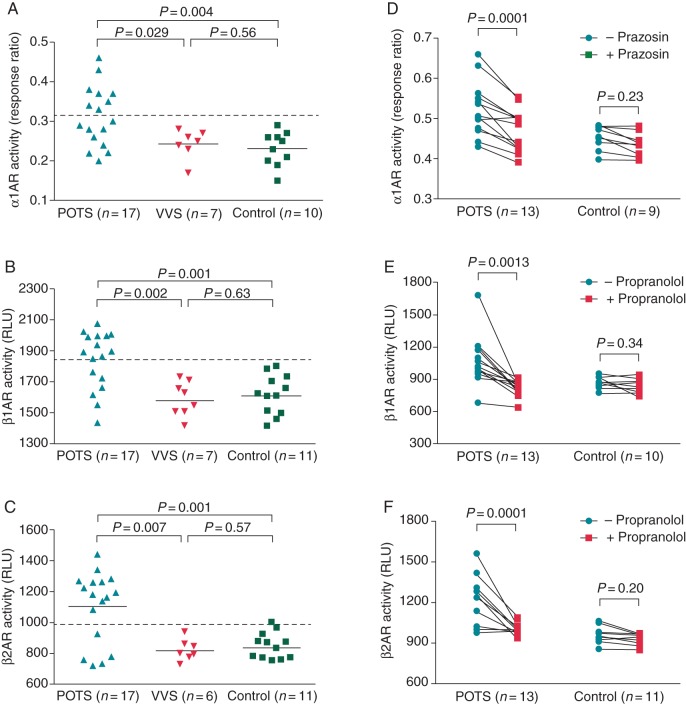
- Mean autoantibody activity was significantly higher in POTS than in VVS and controls for α1AR (0.31 ± 0.07 vs. 0.24 ± 0.04 and 0.23 ± 0.04; P=0.029 and 0.004), β1AR (1840 ± 186 vs. 1578 ± 117 and 1608 ± 127; P=0.002 and 0.001), and β2AR (1104 ± 230 vs. 816 ± 73 and 837 ± 72; P=0.007 and 0.001).
- POTS IgG decreased phenylephrine-induced α1AR activation in 8/17 patients and increased isoproterenol-induced β1AR activation in 13/17 patients; 13/17 POTS IgG also increased contractility in isolated rat cremaster arterioles, which was reversed by α1AR blockade with phentolamine.
- Upright heart rate correlated with IgG-mediated β1AR activity (3 min P=0.0009; maximal P=0.0006) and α1AR activity (maximal P=0.039), but not with β2AR activity (P=0.11).
Methods
- Case-control functional study using serum IgG from 17 POTS patients (16 females; age 26 ± 9 years), 7 recurrent VVS patients (5 females; age 31 ± 9 years), and 11 healthy controls (10 females; age 31 ± 6 years) recruited from the SYSTEMA cohort in Malmö, Sweden.
- IgG was tested in cell-based assays for α1AR activation (FRET β-lactamase reporter in α1AR-NFAT-bla CHO-K1 cells) and β1AR/β2AR activation (cAMP Hunter eXpress GPCR assay in transfected CHO cells), with blockade by prazosin or propranolol, and in an isolated rat cremaster arteriole contractility assay with phentolamine.
- Group comparisons used Student’s t-test, one-way ANOVA with Tukey post hoc, Pearson’s χ2, and linear regression; autoantibody positivity was defined as above mean + 2SD or below mean − 2SD of controls.
Limitations
- The paper states that parasympathetic tonus was not assessed during head-up tilt and that possible autoantibodies against muscarinic receptors and/or the acetylcholine system were not investigated.
- The paper states that study groups were not strictly age matched, although the age difference was not significant.
- Evident from the text: the study has small group sizes (17 POTS, 7 VVS, 11 controls), and the authors note that the cremaster arteriolar bioassay is not suitable for large numbers of samples.
Model-written summary. Check it against the paper before relying on it.
Integrity signals
Registry
Cites
Statistics
Figures
Verification
Claims the paper makes
54 Own result · 17 Own interpretation · 16 Own method · 15 Not checked yet · 2 No basis given
A result the paper reports from its own data — it cites no other source for it, so there is none to check. The quote shows it is in the paper.
In the paper
“Eight, 11, and 12 of the 17 POTS patients possessed autoantibodies that activated α1AR, β1AR and β2AR, respectively.”
- Also stated in: § Autoantibody activity · plain
“Among the 17 patients with POTS, 8, 11, and 12 showed direct activation of α1AR (47%), β1AR (65%), and β2AR (71%), respectively”
§ Antiadrenergic autoimmunity in postural tachycardia syndrome > Abstract > Methods and results
plainn = 17- Asserted: passes — The authors put it forward as true.
- Checkable: passes — It can be checked against evidence.
- Load-bearing: passes — The paper’s conclusions depend on it.
- Based: passes — The paper gives a reason why it holds.
- Also stated in: § Autoantibody activity · plain
A result the paper reports from its own data — it cites no other source for it, so there is none to check. The quote shows it is in the paper.
In the paper
“β2AR: POTS 1104 ± 230 vs. VVS 816 ± 73 and control 837 ± 72, P= 0.007 and 0.001, respectively”
§ Antiadrenergic autoimmunity in postural tachycardia syndrome > Results > Autoantibody activity
plaincorrelationaln = 17- Asserted: passes — The authors put it forward as true.
- Checkable: passes — It can be checked against evidence.
- Load-bearing: passes — The paper’s conclusions depend on it.
- Based: passes — The paper gives a reason why it holds.
A result the paper reports from its own data — it cites no other source for it, so there is none to check. The quote shows it is in the paper.
In the paper
“β1AR: POTS 1840 ± 186 vs. VVS 1578 ± 117 and control 1608 ± 127, P= 0.002 and 0.001, respectively”
§ Antiadrenergic autoimmunity in postural tachycardia syndrome > Results > Autoantibody activity
plaincorrelationaln = 17- Asserted: passes — The authors put it forward as true.
- Checkable: passes — It can be checked against evidence.
- Load-bearing: passes — The paper’s conclusions depend on it.
- Based: passes — The paper gives a reason why it holds.
A result the paper reports from its own data — it cites no other source for it, so there is none to check. The quote shows it is in the paper.
In the paper
“Eight, 11, and 12 of the 17 POTS patients possessed autoantibodies that activated α1AR, β1AR and β2AR, respectively.”
- Also stated in: § Autoantibody activity · plain
“Among the 17 patients with POTS, 8, 11, and 12 showed direct activation of α1AR (47%), β1AR (65%), and β2AR (71%), respectively”
§ Antiadrenergic autoimmunity in postural tachycardia syndrome > Abstract > Methods and results
plainn = 17- Asserted: passes — The authors put it forward as true.
- Checkable: passes — It can be checked against evidence.
- Load-bearing: passes — The paper’s conclusions depend on it.
- Based: passes — The paper gives a reason why it holds.
- Also stated in: § Autoantibody activity · plain
A result the paper reports from its own data — it cites no other source for it, so there is none to check. The quote shows it is in the paper.
In the paper
“α1AR: POTS 0.31 ± 0.07(SD) vs. VVS 0.24 ± 0.04 and control 0.23 ± 0.04, P= 0.029 and 0.004, respectively”
§ Antiadrenergic autoimmunity in postural tachycardia syndrome > Results > Autoantibody activity
plaincorrelationaln = 17- Asserted: passes — The authors put it forward as true.
- Checkable: passes — It can be checked against evidence.
- Load-bearing: passes — The paper’s conclusions depend on it.
- Based: passes — The paper gives a reason why it holds.
A result the paper reports from its own data — it cites no other source for it, so there is none to check. The quote shows it is in the paper.
In the paper
“None of these autoantibodies were found in the patients with VVS or healthy controls.”
§ Antiadrenergic autoimmunity in postural tachycardia syndrome > Results > Autoantibody activity
plain- Asserted: passes — The authors put it forward as true.
- Checkable: passes — It can be checked against evidence.
- Load-bearing: passes — The paper’s conclusions depend on it.
- Based: passes — The paper gives a reason why it holds.
A result the paper reports from its own data — it cites no other source for it, so there is none to check. The quote shows it is in the paper.
In the paper
“Based on these direct assays, 6 of these 17 POTS patients (35%) harboured both α1AR- and β1AR-AAb (Table 2).”
§ Antiadrenergic autoimmunity in postural tachycardia syndrome > Results > Autoantibody activity
plainn = 17- Asserted: passes — The authors put it forward as true.
- Checkable: passes — It can be checked against evidence.
- Load-bearing: passes — The paper’s conclusions depend on it.
- Based: passes — The paper gives a reason why it holds.
A result the paper reports from its own data — it cites no other source for it, so there is none to check. The quote shows it is in the paper.
In the paper
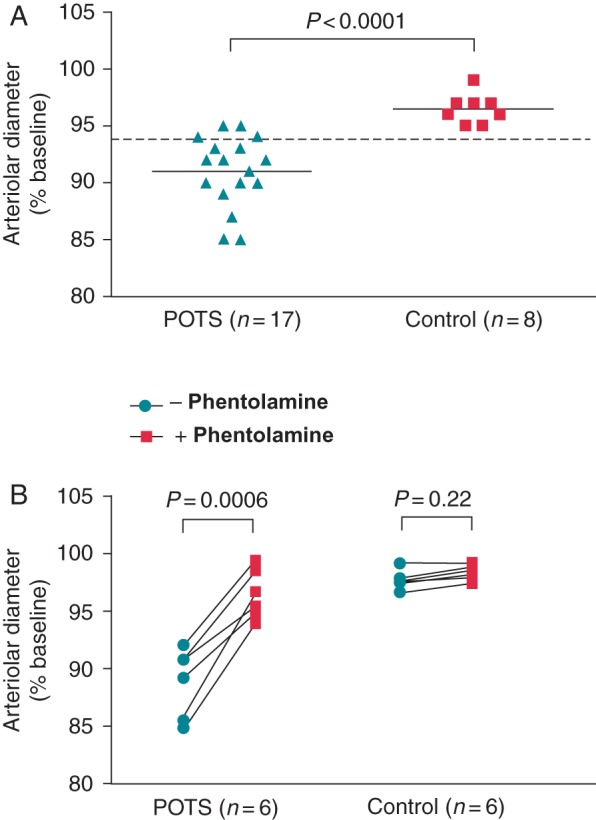
“As shown in Figure 3B, POTS IgG-induced contractility was largely returned to baseline level by addition of the α1AR blocker phentolamine (10 µM, from 88.9 ± 3.0% to 96.5 ± 2.1%, P= 0.0006).”
§ Antiadrenergic autoimmunity in postural tachycardia syndrome > Results > Autoantibody activity
plaindirectn = 6- Asserted: passes — The authors put it forward as true.
- Checkable: passes — It can be checked against evidence.
- Load-bearing: passes — The paper’s conclusions depend on it.
- Based: passes — The paper gives a reason why it holds.
- Rests on an assumption: The isolated rat cremaster arteriole assay is a valid measure of α1AR autoantibody-mediated contractile activity in POTS.
A result the paper reports from its own data — it cites no other source for it, so there is none to check. The quote shows it is in the paper.
In the paper
“Postural tachycardia syndrome IgG contracted rat cremaster arterioles, which was reversed by α1AR blockade.”
§ Antiadrenergic autoimmunity in postural tachycardia syndrome > Abstract > Methods and results
plaindirect- Asserted: passes — The authors put it forward as true.
- Checkable: passes — It can be checked against evidence.
- Load-bearing: passes — The paper’s conclusions depend on it.
- Based: passes — The paper gives a reason why it holds.
- It may state two separate claims as one. 28
- Probably not a substantial claim. 18
A result the paper reports from its own data — it cites no other source for it, so there is none to check. The quote shows it is in the paper.
In the paper
“β1/2AR autoantibody activity was increased in POTS but not in VVS.”
§ Antiadrenergic autoimmunity in postural tachycardia syndrome > Discussion
plaincorrelational- Asserted: passes — The authors put it forward as true.
- Checkable: passes — It can be checked against evidence.
- Load-bearing: passes — The paper’s conclusions depend on it.
- Based: passes — The paper gives a reason why it holds.
It may state two separate claims as one.
A result the paper reports from its own data — it cites no other source for it, so there is none to check. The quote shows it is in the paper.
In the paper
“In the linear regression analysis, IgG-mediated β1AR activity was strongly correlated with both 3 min (P= 0.0009) and maximal upright heart rate (P= 0.0006), whereas the latter was also correlated with α1AR activity (P= 0.039) but not with β2AR activity (P= 0.11).”
§ Antiadrenergic autoimmunity in postural tachycardia syndrome > Results > Autoantibody activity
boostedcorrelational- Asserted: passes — The authors put it forward as true.
- Checkable: passes — It can be checked against evidence.
- Load-bearing: passes — The paper’s conclusions depend on it.
- Based: passes — The paper gives a reason why it holds.
It may state two separate claims as one.
A result the paper reports from its own data — it cites no other source for it, so there is none to check. The quote shows it is in the paper.
In the paper
“Neither shift was observed using control IgG.”
§ Antiadrenergic autoimmunity in postural tachycardia syndrome > Results > Autoantibody activity
plain- Asserted: passes — The authors put it forward as true.
- Checkable: passes — It can be checked against evidence.
- Load-bearing: passes — The paper’s conclusions depend on it.
- Based: passes — The paper gives a reason why it holds.
It may state two separate claims as one.
A result the paper reports from its own data — it cites no other source for it, so there is none to check. The quote shows it is in the paper.
In the paper
“We have demonstrated that serum from subjects with POTS contains circulating autoantibodies, some with a direct stimulatory effect on adrenergic receptors.”
§ Antiadrenergic autoimmunity in postural tachycardia syndrome > Discussion
boosteddirect- Asserted: passes — The authors put it forward as true.
- Checkable: passes — It can be checked against evidence.
- Load-bearing: passes — The paper’s conclusions depend on it.
- Based: passes — The paper gives a reason why it holds.
It may state two separate claims as one.
A result the paper reports from its own data — it cites no other source for it, so there is none to check. The quote shows it is in the paper.
In the paper
“There was no significant difference between the latter two groups.”
§ Antiadrenergic autoimmunity in postural tachycardia syndrome > Results > Autoantibody activity
plain- Asserted: passes — The authors put it forward as true.
- Checkable: passes — It can be checked against evidence.
- Load-bearing: unclear — It is unclear whether the paper’s conclusions depend on it.
- Based: passes — The paper gives a reason why it holds.
It may state two separate claims as one.
A result the paper reports from its own data — it cites no other source for it, so there is none to check. The quote shows it is in the paper.
In the paper
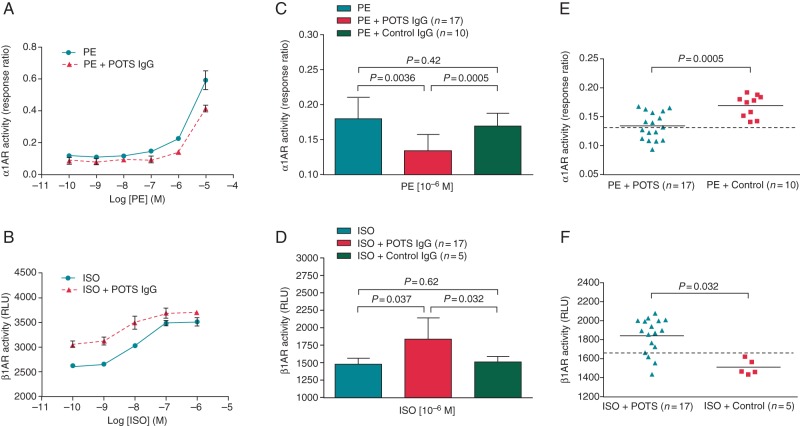
“There was a significant decrease in phenylephrine-induced α1AR activation with POTS IgG (0.13 ± 0.02) compared with phenylephrine alone (0.18 ± 0.03, P< 0.0036) or IgG from normal controls (0.17 ± 0.02, P< 0.0005) (Figure 2C).”
§ Antiadrenergic autoimmunity in postural tachycardia syndrome > Results > Autoantibody activity
plaindirectn = 17- Asserted: passes — The authors put it forward as true.
- Checkable: passes — It can be checked against evidence.
- Load-bearing: passes — The paper’s conclusions depend on it.
- Based: passes — The paper gives a reason why it holds.
It may state two separate claims as one.
A result the paper reports from its own data — it cites no other source for it, so there is none to check. The quote shows it is in the paper.
In the paper
“Neither SBP nor DBP were correlated with adrenergic receptor stimulation.”
§ Antiadrenergic autoimmunity in postural tachycardia syndrome > Results > Autoantibody activity
plain- Asserted: passes — The authors put it forward as true.
- Checkable: passes — It can be checked against evidence.
- Load-bearing: unclear — It is unclear whether the paper’s conclusions depend on it.
- Based: passes — The paper gives a reason why it holds.
It may state two separate claims as one.
A result the paper reports from its own data — it cites no other source for it, so there is none to check. The quote shows it is in the paper.
In the paper
“The VVS group reported a longer history of syncopal symptoms (P= 0.017), but the number of syncope episodes, proportions of characteristic precipitating symptoms, and self-reported dizziness on standing did not differ between POTS and VVS patients.”
§ Antiadrenergic autoimmunity in postural tachycardia syndrome > Results > Clinical characteristics
plain- Asserted: passes — The authors put it forward as true.
- Checkable: passes — It can be checked against evidence.
- Load-bearing: fails — The paper’s conclusions may not depend on it.
- Based: passes — The paper gives a reason why it holds.
Probably not a substantial claim. The paper’s conclusions may not depend on it.
A result the paper reports from its own data — it cites no other source for it, so there is none to check. The quote shows it is in the paper.
In the paper
“The isoproterenol-stimulated β1AR activation, on the other hand, was significantly increased with POTS IgG (1835 ± 309) compared with isoproterenol alone (1479 ± 86, P< 0.037) or IgG from normal controls (1508 ± 80, P< 0.032) (Figure 2D).”
§ Antiadrenergic autoimmunity in postural tachycardia syndrome > Results > Autoantibody activity
plaindirectn = 17- Asserted: passes — The authors put it forward as true.
- Checkable: passes — It can be checked against evidence.
- Load-bearing: passes — The paper’s conclusions depend on it.
- Based: passes — The paper gives a reason why it holds.
It may state two separate claims as one.
A result the paper reports from its own data — it cites no other source for it, so there is none to check. The quote shows it is in the paper.
In the paper
“There was some overlap for the α1AR and considerable overlap for the β1AR with the other tests (Table 2).”
§ Antiadrenergic autoimmunity in postural tachycardia syndrome > Results > Autoantibody activity
plaincorrelational- Asserted: passes — The authors put it forward as true.
- Checkable: passes — It can be checked against evidence.
- Load-bearing: unclear — It is unclear whether the paper’s conclusions depend on it.
- Based: passes — The paper gives a reason why it holds.
It may state two separate claims as one.
A result the paper reports from its own data — it cites no other source for it, so there is none to check. The quote shows it is in the paper.
In the paper
“For the primary objective, we found that antiadrenergic α1AR autoantibody activity was evident in POTS, while the VVS subjects were not different from normal subjects.”
§ Antiadrenergic autoimmunity in postural tachycardia syndrome > Discussion
plain- Asserted: passes — The authors put it forward as true.
- Checkable: passes — It can be checked against evidence.
- Load-bearing: passes — The paper’s conclusions depend on it.
- Based: passes — The paper gives a reason why it holds.
It may state two separate claims as one.
A result the paper reports from its own data — it cites no other source for it, so there is none to check. The quote shows it is in the paper.
In the paper
“In the presence of POTS IgG, the phenylephrine response curve was shifted to the right, demonstrating a decreased α1AR response (Figure 2A).”
§ Antiadrenergic autoimmunity in postural tachycardia syndrome > Results > Autoantibody activity
boosteddirectn = 3- Asserted: passes — The authors put it forward as true.
- Checkable: passes — It can be checked against evidence.
- Load-bearing: passes — The paper’s conclusions depend on it.
- Based: passes — The paper gives a reason why it holds.
It may state two separate claims as one.
A result the paper reports from its own data — it cites no other source for it, so there is none to check. The quote shows it is in the paper.
In the paper
“A majority also exerted an allosterically mediated positive modulatory effect upon β1AR and a negative modulatory effect on α1AR activity.”
§ Antiadrenergic autoimmunity in postural tachycardia syndrome > Discussion
plaindirect- Asserted: passes — The authors put it forward as true.
- Checkable: passes — It can be checked against evidence.
- Load-bearing: passes — The paper’s conclusions depend on it.
- Based: passes — The paper gives a reason why it holds.
It may state two separate claims as one.
In the paper
“As previously reported,8 these data confirmed the active α1AR autoantibodies inhibited the phenylephrine response and shifted the phenylephrine dosage response curve to the right.”
§ Antiadrenergic autoimmunity in postural tachycardia syndrome > Discussion
What the sources say
- Not checked yetcites [8] Li, 2014, Autoimmune basis for postural tachycardia syndrome, J Am Heart Assoc source
boosteddirect- Asserted: passes — The authors put it forward as true.
- Checkable: passes — It can be checked against evidence.
- Load-bearing: passes — The paper’s conclusions depend on it.
- Based: passes — The paper gives a reason why it holds.
It may state two separate claims as one.
In the paper
“Moreover, β1AR autoantibodies enhanced the isoproterenol response and most importantly shifted the isoproterenol dosage response curves to the left, confirming our previous observations.8”
§ Antiadrenergic autoimmunity in postural tachycardia syndrome > Discussion
What the sources say
- Not checked yetcites [8] Li, 2014, Autoimmune basis for postural tachycardia syndrome, J Am Heart Assoc source
boosteddirect- Asserted: passes — The authors put it forward as true.
- Checkable: passes — It can be checked against evidence.
- Load-bearing: passes — The paper’s conclusions depend on it.
- Based: passes — The paper gives a reason why it holds.
It may state two separate claims as one.
A result the paper reports from its own data — it cites no other source for it, so there is none to check. The quote shows it is in the paper.
In the paper
“In contrast, the β1AR effect was just the opposite and shifted the β1AR agonist dosage response curve to the left.”
§ Antiadrenergic autoimmunity in postural tachycardia syndrome > Discussion
plaindirect- Asserted: passes — The authors put it forward as true.
- Checkable: passes — It can be checked against evidence.
- Load-bearing: passes — The paper’s conclusions depend on it.
- Based: passes — The paper gives a reason why it holds.
It may state two separate claims as one.
The paper states this without a source or data behind it here, so there is nothing to check it against. The quote shows it is in the paper.
In the paper
“Since the pathophysiological basis for POTS is unclear, therapeutic interventions are empirical.”
§ Antiadrenergic autoimmunity in postural tachycardia syndrome > Introduction
plaindirect- Asserted: passes — The authors put it forward as true.
- Checkable: passes — It can be checked against evidence.
- Load-bearing: fails — The paper’s conclusions may not depend on it.
- Based: passes — The paper gives a reason why it holds.
Probably not a substantial claim. The paper’s conclusions may not depend on it. It may state two separate claims as one.
What the paper did — it cites no source for this, so there is none to check. The quote shows it is in the paper.
In the paper
“This procedure was approved by the Oklahoma University Health Sciences Center Institutional Animal Care and Use Committee.”
§ Antiadrenergic autoimmunity in postural tachycardia syndrome > Methods > Isolated cremaster arteriole assay
plain- Asserted: passes — The authors put it forward as true.
- Checkable: passes — It can be checked against evidence.
- Load-bearing: fails — The paper’s conclusions may not depend on it.
- Based: passes — The paper gives a reason why it holds.
Probably not a substantial claim. The paper’s conclusions may not depend on it.
None of the sources cited for this claim have been checked yet.
In the paper
“A number of treatment options have been proposed in POTS but their efficacy in the more severe forms is limited and often questioned.2,7”
§ Antiadrenergic autoimmunity in postural tachycardia syndrome > Introduction
What the sources say
- Not checked yetcites [2] Sheldon, 2015, 2015 Heart Rhythm Society Expert Consensus Statement on the diagnosis and treatment of postural tachycardia syndrome, inappropriate sinus tachycardia, and vasovagal syncope, Heart Rhythm source
- Not checked yetcites [7] Fedorowski, 2013, Syndromes of orthostatic intolerance: a hidden danger, J Intern Med source
plain- Asserted: passes — The authors put it forward as true.
- Checkable: passes — It can be checked against evidence.
- Load-bearing: fails — The paper’s conclusions may not depend on it.
- Based: passes — The paper gives a reason why it holds.
Probably not a substantial claim. The paper’s conclusions may not depend on it. It may state two separate claims as one.
What the paper did — it cites no source for this, so there is none to check. The quote shows it is in the paper.
In the paper
“All samples were assayed in triplicate.”
§ Antiadrenergic autoimmunity in postural tachycardia syndrome > Methods > Cell-based α1AR assay
plain- Asserted: passes — The authors put it forward as true.
- Checkable: passes — It can be checked against evidence.
- Load-bearing: fails — The paper’s conclusions may not depend on it.
- Based: passes — The paper gives a reason why it holds.
Probably not a substantial claim. The paper’s conclusions may not depend on it.
What the paper did — it cites no source for this, so there is none to check. The quote shows it is in the paper.
In the paper
“Receipt and assay of these de-identified samples was approved by the University of Oklahoma Health Sciences Center Institutional Review Board.”
§ Antiadrenergic autoimmunity in postural tachycardia syndrome > Methods > Sample preparation
plain- Asserted: passes — The authors put it forward as true.
- Checkable: passes — It can be checked against evidence.
- Load-bearing: fails — The paper’s conclusions may not depend on it.
- Based: passes — The paper gives a reason why it holds.
Probably not a substantial claim. The paper’s conclusions may not depend on it.
What the paper did — it cites no source for this, so there is none to check. The quote shows it is in the paper.
In the paper
“The mean age for the POTS patients was not significantly different from those with VVS and control subjects.”
§ Antiadrenergic autoimmunity in postural tachycardia syndrome > Results > Clinical characteristics
plain- Asserted: passes — The authors put it forward as true.
- Checkable: passes — It can be checked against evidence.
- Load-bearing: fails — The paper’s conclusions may not depend on it.
- Based: passes — The paper gives a reason why it holds.
Probably not a substantial claim. The paper’s conclusions may not depend on it.
What the paper did — it cites no source for this, so there is none to check. The quote shows it is in the paper.
In the paper
“In order to ascertain the accuracy of diagnoses, the digital test records were subsequently inspected off-line using Nexfin@PC (BMEYE, Amsterdam, the Netherlands), dedicated software provided by the manufacturer.”
§ Antiadrenergic autoimmunity in postural tachycardia syndrome > Methods > Diagnostic criteria of postural tachycardia syndrome and classic vasovagal syncope
plain- Asserted: passes — The authors put it forward as true.
- Checkable: passes — It can be checked against evidence.
- Load-bearing: fails — The paper’s conclusions may not depend on it.
- Based: passes — The paper gives a reason why it holds.
Probably not a substantial claim. The paper’s conclusions may not depend on it.
In the paper
“Li et al. recently reported that activating autoantibodies (AAb) to the α1-adrenergic (α1AR) and β1/2-adrenergic receptors (β1/2AR) might play a pathophysiological role in POTS.8”
§ Antiadrenergic autoimmunity in postural tachycardia syndrome > Introduction
What the sources say
- Not checked yetcites [8] Li, 2014, Autoimmune basis for postural tachycardia syndrome, J Am Heart Assoc source
hedgedconditionaln = 7- Asserted: passes — The authors put it forward as true.
- Checkable: passes — It can be checked against evidence.
- Load-bearing: passes — The paper’s conclusions depend on it.
- Based: passes — The paper gives a reason why it holds.
Probably not a substantial claim.
What the paper did — it cites no source for this, so there is none to check. The quote shows it is in the paper.
In the paper
“Negative (buffer) and positive (phenylephrine) controls were included in each assay.”
§ Antiadrenergic autoimmunity in postural tachycardia syndrome > Methods > Cell-based α1AR assay
plain- Asserted: passes — The authors put it forward as true.
- Checkable: passes — It can be checked against evidence.
- Load-bearing: fails — The paper’s conclusions may not depend on it.
- Based: passes — The paper gives a reason why it holds.
Probably not a substantial claim. The paper’s conclusions may not depend on it.
None of the sources cited for this claim have been checked yet.
In the paper
“Its onset may follow an acute infection or vaccination but more commonly appears without antecedent causative events.2,6”
§ Antiadrenergic autoimmunity in postural tachycardia syndrome > Introduction
What the sources say
- Not checked yetcites [2] Sheldon, 2015, 2015 Heart Rhythm Society Expert Consensus Statement on the diagnosis and treatment of postural tachycardia syndrome, inappropriate sinus tachycardia, and vasovagal syncope, Heart Rhythm source
- Not checked yetcites [6] Brinth, 2015, Orthostatic intolerance and postural tachycardia syndrome as suspected adverse effects of vaccination against human papilloma virus, Vaccine source
hedgedconditional- Asserted: passes — The authors put it forward as true.
- Checkable: passes — It can be checked against evidence.
- Load-bearing: fails — The paper’s conclusions may not depend on it.
- Based: passes — The paper gives a reason why it holds.
Probably not a substantial claim. The paper’s conclusions may not depend on it. It may state two separate claims as one.
What the paper did — it cites no source for this, so there is none to check. The quote shows it is in the paper.
In the paper
“Within the SYSTEMA cohort, we randomly selected 17 patients with a confirmed diagnosis, by clinical history and tilt testing, of POTS (16 females; age, 26 ± 9 years), and 7 with recurrent VVS (5 females; age: 31 ± 9 years).”
§ Antiadrenergic autoimmunity in postural tachycardia syndrome > Methods > Study patients
plainn = 17- Asserted: passes — The authors put it forward as true.
- Checkable: passes — It can be checked against evidence.
- Load-bearing: passes — The paper’s conclusions depend on it.
- Based: passes — The paper gives a reason why it holds.
It may state two separate claims as one.
What the paper did — it cites no source for this, so there is none to check. The quote shows it is in the paper.
In the paper
“The Regional Ethical Review Board in Lund, Sweden approved the study protocol (ref no 82/2008), and all study participants gave their written informed consent including serum analyses.”
§ Antiadrenergic autoimmunity in postural tachycardia syndrome > Methods > Examination protocol
plain- Asserted: passes — The authors put it forward as true.
- Checkable: passes — It can be checked against evidence.
- Load-bearing: fails — The paper’s conclusions may not depend on it.
- Based: passes — The paper gives a reason why it holds.
Probably not a substantial claim. The paper’s conclusions may not depend on it. It may state two separate claims as one.
A conclusion the paper draws from its own results — it cites no other source for it, so there is none to check. The quote shows it is in the paper.
In the paper
“These and possibly other yet-to-be identified immunoglobulins with different target epitopes may exert varying biological effects in particular patients, which may explain different constellations of symptoms in POTS.”
§ Antiadrenergic autoimmunity in postural tachycardia syndrome > Discussion
hedgedconditional- Asserted: passes — The authors put it forward as true.
- Checkable: fails — It may be too vague to check against evidence.
- Load-bearing: fails — The paper’s conclusions may not depend on it.
- Based: passes — The paper gives a reason why it holds.
Probably not a substantial claim. It may be too vague to check against evidence. The paper’s conclusions may not depend on it. It may state two separate claims as one.
What the paper did — it cites no source for this, so there is none to check. The quote shows it is in the paper.
In the paper
“Within the SYSTEMA cohort, we randomly selected 17 patients with a confirmed diagnosis, by clinical history and tilt testing, of POTS (16 females; age, 26 ± 9 years), and 7 with recurrent VVS (5 females; age: 31 ± 9 years).”
§ Antiadrenergic autoimmunity in postural tachycardia syndrome > Methods > Study patients
plainn = 17- Asserted: passes — The authors put it forward as true.
- Checkable: passes — It can be checked against evidence.
- Load-bearing: fails — The paper’s conclusions may not depend on it.
- Based: passes — The paper gives a reason why it holds.
Probably not a substantial claim. The paper’s conclusions may not depend on it.
What the paper did — it cites no source for this, so there is none to check. The quote shows it is in the paper.
In the paper
“Finally, the study groups were not strictly age matched, although the age difference was not significant.”
§ Antiadrenergic autoimmunity in postural tachycardia syndrome > Discussion > Strengths and limitations
plain- Asserted: passes — The authors put it forward as true.
- Checkable: passes — It can be checked against evidence.
- Load-bearing: fails — The paper’s conclusions may not depend on it.
- Based: passes — The paper gives a reason why it holds.
Probably not a substantial claim. The paper’s conclusions may not depend on it. It may state two separate claims as one.
A conclusion the paper draws from its own results — it cites no other source for it, so there is none to check. The quote shows it is in the paper.
In the paper
“The catecholamine surge may be seen as a compensatory mechanism to override the α1AR malfunction associated with the proposed autoimmune blockade as present in POTS patients but this explanation is unlikely in those with recurrent VVS.”
§ Antiadrenergic autoimmunity in postural tachycardia syndrome > Discussion
hedgedconditional- Asserted: passes — The authors put it forward as true.
- Checkable: passes — It can be checked against evidence.
- Load-bearing: passes — The paper’s conclusions depend on it.
- Based: passes — The paper gives a reason why it holds.
It may state two separate claims as one.
What the paper did — it cites no source for this, so there is none to check. The quote shows it is in the paper.
In the paper
“This report more than doubles the number of our previous observations, and focuses on a tightly characterized group of patients and controls.”
§ Antiadrenergic autoimmunity in postural tachycardia syndrome > Discussion > Strengths and limitations
plain- Asserted: passes — The authors put it forward as true.
- Checkable: passes — It can be checked against evidence.
- Load-bearing: fails — The paper’s conclusions may not depend on it.
- Based: passes — The paper gives a reason why it holds.
Probably not a substantial claim. The paper’s conclusions may not depend on it. It may state two separate claims as one.
A conclusion the paper draws from its own results — it cites no other source for it, so there is none to check. The quote shows it is in the paper.
In the paper
“Diagnostic criteria based on measuring the autoantibodies' impact on an allosteric-mediated receptor response to the natural ligand may provide a more favourable estimate of autoantibody involvement in the complex pathophysiology of POTS.”
§ Antiadrenergic autoimmunity in postural tachycardia syndrome > Discussion > Strengths and limitations
hedgedconditional- Asserted: passes — The authors put it forward as true.
- Checkable: fails — It may be too vague to check against evidence.
- Load-bearing: fails — The paper’s conclusions may not depend on it.
- Based: passes — The paper gives a reason why it holds.
Probably not a substantial claim. It may be too vague to check against evidence. The paper’s conclusions may not depend on it.
What the paper did — it cites no source for this, so there is none to check. The quote shows it is in the paper.
In the paper
“This cremaster arteriolar bioassay is not suitable for use in large numbers of samples and the specific cell-based assays are an improvement with regard to numbers.”
§ Antiadrenergic autoimmunity in postural tachycardia syndrome > Discussion > Strengths and limitations
plain- Asserted: passes — The authors put it forward as true.
- Checkable: passes — It can be checked against evidence.
- Load-bearing: passes — The paper’s conclusions depend on it.
- Based: passes — The paper gives a reason why it holds.
It may state two separate claims as one.
A conclusion the paper draws from its own results — it cites no other source for it, so there is none to check. The quote shows it is in the paper.
In the paper
“It seems apparent that the high percentage of POTS subjects examined by our group present with an apparent autoimmune diathesis that supports the concept that these autoantibodies play important role in the pathophysiology of this entity.”
§ Antiadrenergic autoimmunity in postural tachycardia syndrome > Discussion
hedgeddirect- Asserted: passes — The authors put it forward as true.
- Checkable: passes — It can be checked against evidence.
- Load-bearing: passes — The paper’s conclusions depend on it.
- Based: passes — The paper gives a reason why it holds.
It may state two separate claims as one.
- Rests on an assumption: There is a paucity of concrete evidence for other pathophysiological bases for POTS for the vast majority of patients.
In the paper
“The vagal drive may have an important implication in related POTS symptomatology.20”
§ Antiadrenergic autoimmunity in postural tachycardia syndrome > Discussion > Strengths and limitations
What the sources say
- Not checked yetcites [20] Yoshida, 2014, Variant cardiovascular regulation in children with postural tachycardia syndrome, Pediatr Int source
hedgedconditional- Asserted: passes — The authors put it forward as true.
- Checkable: passes — It can be checked against evidence.
- Load-bearing: fails — The paper’s conclusions may not depend on it.
- Based: passes — The paper gives a reason why it holds.
Probably not a substantial claim. The paper’s conclusions may not depend on it.
In the paper
“Both POTS and IST share abnormal sinus tachycardia tendency, and differ in regard to resting heart rate control that is usually preserved in POTS but not in IST.2”
§ Antiadrenergic autoimmunity in postural tachycardia syndrome > Discussion
What the sources say
- Not checked yetcites [2] Sheldon, 2015, 2015 Heart Rhythm Society Expert Consensus Statement on the diagnosis and treatment of postural tachycardia syndrome, inappropriate sinus tachycardia, and vasovagal syncope, Heart Rhythm source
plaincorrelational- Asserted: passes — The authors put it forward as true.
- Checkable: passes — It can be checked against evidence.
- Load-bearing: unclear — It is unclear whether the paper’s conclusions depend on it.
- Based: passes — The paper gives a reason why it holds.
It may state two separate claims as one.
In the paper
“This spectrum would certainly range from subclinical to overt expressions that may overlap with other entities such as inappropriate sinus tachycardia (IST), where circulating antibodies against cardiac β-receptors have been previously reported.18”
§ Antiadrenergic autoimmunity in postural tachycardia syndrome > Discussion
What the sources say
- Not checked yetcites [18] Chiale, 2006, Inappropriate sinus tachycardia may be related to an immunologic disorder involving cardiac beta andrenergic receptors, Heart Rhythm source
hedgedcorrelational- Asserted: passes — The authors put it forward as true.
- Checkable: passes — It can be checked against evidence.
- Load-bearing: unclear — It is unclear whether the paper’s conclusions depend on it.
- Based: passes — The paper gives a reason why it holds.
It may state two separate claims as one.
The paper relies on this without support.
The POTS patients selected from the SYSTEMA cohort are representative of POTS patients generally.
“we planned to examine the AAb profile of a larger, well-characterized, and representative cohort of patients with POTS from an independent European institution whose selection was completely separate from the originating laboratory.”
The paper relies on this without support.
There is a paucity of concrete evidence for other pathophysiological bases for POTS for the vast majority of patients.
“Although it is likely that POTS has multiple causes, there has been a paucity of concrete evidence for other pathophysiological bases for an underlying pathophysiology to date for the vast majority of patients.”
The paper relies on this without support.
The isolated rat cremaster arteriole assay is a valid measure of α1AR autoantibody-mediated contractile activity in POTS.
“Immunoglobulin G (0.05 mg/mL) from each subject with POTS and 8 controls were tested for α1AR autoantibody-mediated contractile activity using an isolated rat cremaster arteriole assay.”
Claims other papers make about this one
Each is checked against this paper’s own text: does it say what the citing paper says it does?
The cited source says what the claim attributes to it.
In the citing paper
“Although altered GPCR activity in people with POTS has been observed (Fedorowski et al., 2017”
From Self-reported symptom burden in postural orthostatic tachycardia syndrome (POTS): A narrative review of observational and interventional studies (2023) · cites this paper as Fedorowski et al., 2017
In the citing paper
“Serum immunoglobulins isolated from POTS patients have been reported to act as partial agonists to both α- and β-adrenergic receptors in vitro (Fedorowski et al., 2017; Li et al., 2014), a finding independently confirmed by several other groups (Vernino and Stiles, 2018) and expanded to include a wider range of G-protein coupled receptors (GPCRs) as targets (Kharraziha et al., 2020).”
From Postural orthostatic tachycardia syndrome (POTS): State of the science and clinical care from a 2019 National Institutes of Health Expert Consensus Meeting - Part 1 (2021) · cites this paper as Fedorowski et al., 2017
In the citing paper
“Higher levels of autoantibodies against beta-1 and beta-2 adrenoreceptors have been detected in POTS patients versus healthy controls in serologic studies (32, 44).”
From Postural orthostatic tachycardia syndrome: mechanisms and new therapies (2020) · cites this paper as [44]
In the citing paper
“This group also demonstrated that autoantibody affinity toward beta-receptors positively correlated with a greater degree of orthostatic tachycardia (44).”
From Postural orthostatic tachycardia syndrome: mechanisms and new therapies (2020) · cites this paper as [44]
In the citing paper
“Fedorowski et al. (44) demonstrated that these autoantibodies, in addition to acting like a direct beta-agonist, can also upregulate sympathetic nervous activity through allosteric interactions with the beta-receptors.”
From Postural orthostatic tachycardia syndrome: mechanisms and new therapies (2020) · cites this paper as [44]
In the citing paper
“Circulating antibodies to α1-and β-adrenergic receptors and cardiac lipid raft-associated proteins have also been discovered in POTS (Fedorowski et al., 2017;Wang et al., 2013;Li et al., 2014).”
From Postural tachycardia syndrome – Diagnosis, physiology, and prognosis (2018) · cites this paper as Fedorowski et al., 2017
In the citing paper
“A specific focus was given cardiovascular G-protein-coupled membrane complexes, such as adrenergic, muscarinic and angiotensin II type-1 receptors The symptoms of POTS, especially [43,45] (Fig. 1).”
From Postural orthostatic tachycardia syndrome: clinical presentation, aetiology and management (2019) · cites this paper as [45]
Self-check
Percentages, sums and reported differences re-computed from the paper’s own numbers.
Each contradiction between two passages listed here was confirmed by an independent check.
Rated minor: it would not touch a result — a value no result rests on, a p-value that stays on the same side of the significance level, or a conflict that is clerical, resolved elsewhere in the paper, or outside its own findings.
In the paper
§ Antiadrenergic autoimmunity in postural tachycardia syndrome > Methods > Study patients
“17 patients with a confirmed diagnosis, by clinical history and tilt testing, of POTS (16 females; age, 26 ± 9 years)”
§ Antiadrenergic autoimmunity in postural tachycardia syndrome > Results > Clinical characteristics
“| Sex M/F | 2/15 | 2/5 | 1/10 | 0.55/0.98 |”
Rated minor: it would not touch a result — a value no result rests on, a p-value that stays on the same side of the significance level, or a conflict that is clerical, resolved elsewhere in the paper, or outside its own findings.
In the paper
§ Antiadrenergic autoimmunity in postural tachycardia syndrome > Discussion
“A majority also exerted an allosterically mediated positive modulatory effect upon β1AR and a negative modulatory effect on α1AR activity.”
§ Antiadrenergic autoimmunity in postural tachycardia syndrome > Results > Autoantibody activity
“| Total | 8/17 | 8/17 | 11/17 | 13/17 | 12/17 |”
Rated minor: it would not touch a result — a value no result rests on, a p-value that stays on the same side of the significance level, or a conflict that is clerical, resolved elsewhere in the paper, or outside its own findings.
In the paper
§ Antiadrenergic autoimmunity in postural tachycardia syndrome > Methods > Study patients
“POTS (16 females; age, 26 ± 9 years)”
§ Antiadrenergic autoimmunity in postural tachycardia syndrome > Results > Clinical characteristics
“| Age | 25 ± 7 | 31 ± 9 | 31 ± 6 | 0.17/0.063 |”
Citations
Cites
Developed in collaboration with, European Heart Rhythm Association (EHRA), Heart Failure Association (HFA), and Heart Rhythm Society (HRS), societies, E. B. T. F., European Society of Emergency Medicine (EuSEM), European Federation of Internal Medicine (EFIM), European Union Geriatric Medicine Society (EUGMS), American Geriatrics Society (AGS), European Neurological Society (ENS), et al. (2009) · European Heart Journal · doi:10.1093/eurheartj/ehp298 · Cited by 2,040
Self-citationFreeman, R., Wieling, W., Axelrod, F. B., Benditt, D. G., Benarroch, E., Biaggioni, I., Cheshire, W. P., Chelimsky, T., Cortelli, P., Gibbons, C. H., et al. (2011) · Autonomic Neuroscience · doi:10.1016/j.autneu.2011.02.004 · Cited by 1,243
Sheldon, R. S., Grubb, B. P., Olshansky, B., Shen, W.-K., Calkins, H., Brignole, M., Raj, S. R., Krahn, A. D., Morillo, C. A., Stewart, J. M., et al. (2015) · Heart Rhythm · doi:10.1016/j.hrthm.2015.03.029 · Cited by 1,013
Self-citationPostural tachycardia syndrome: a heterogeneous and multifactorial disorder
Benarroch, E. E. (2012) · Mayo Clinic Proceedings · doi:10.1016/j.mayocp.2012.08.013 · Cited by 370 · cited 4×
“It often leads to debilitating symptoms and uncertain long-term prognosis.(1) A number of treatment options have been proposed in POTS but their efficacy in the more severe forms is limited and often questioned.”
BackgroundInfluentialHemodynamic Response to the Upright Posture
Smith, J. J., Porth, C. M., & Erickson, M. (1994) · The Journal of Clinical Pharmacology · doi:10.1002/j.1552-4604.1994.tb04977.x · Cited by 320 · cited 1×
“pulse increase ,30 bpm and absence of orthostatic hypotension).(10,11) All the patients and controls were recruited from the same community of Malmö or neighbouring municipalities in Skåne Region, Southern Sweden.”
BackgroundBartoletti, A. (2000) · Europace · doi:10.1053/eupc.2000.0125 · Cited by 315 · cited 1×
“The head-up tilt (HUT) test for SYSTEMA patients was performed according to the Italian protocol.(12) The tilt table was raised at constant speed to 708 in 18 s, and had the same lowering time.”
MethodPostural tachycardia syndrome (POTS)
Lamotte, G., & Low, P. A. (2023) · Elsevier eBooks · doi:10.1016/b978-0-323-85492-4.00118-6 · Cited by 301
Guía de práctica clínica para el diagnóstico y manejo del síncope (versión 2009)
Moya‐Mitjans, À., Sutton, R., Ammirati, F., Blanc, J., Brignole, M., Dahm, J. B., Deharo, J., Gajek, J. J., Gjesdal, K., Krahn, A. D., et al. (2009) · Revista Española de Cardiología (English Edition) · doi:10.1016/s1885-5857(09)73541-8 · Cited by 277
Self-citationAutoimmune Basis for Postural Tachycardia Syndrome
Li, H., Yu, X., Liles, C., Khan, M., Vanderlinde‐Wood, M., Galloway, A., Zillner, C., Benbrook, A., Reim, S., Collier, D., et al. (2014) · Journal of the American Heart Association · doi:10.1161/jaha.113.000755 · Cited by 255 · cited 12×
“Immunoglobulin G-mediated b1AR and b2AR activation of cAMP production in transfected CHO cells (with either b1AR or b2AR stimulation) was measured using the cAMP Hunter eXpress GPCR Assay kit (DiscoveRx) as described.(8,15) Briefly, b1AR- or b2AR-CHO cells were dispensed into 96-well plates and incubated overnight.”
BackgroundMethodResultInfluentialSelf-citation
Cited by
Sorted by citations
2018 ESC Guidelines for the diagnosis and management of syncope
Brignole, M., Moya, A., de Lange, F. J., Deharo, J.-C., Elliott, P. M., Fanciulli, A., Fedorowski, A., Furlan, R., Kenny, R. A., Martín, A., et al. (2018) · European Heart Journal · doi:10.1093/eurheartj/ehy037 · Cited by 1,951
Self-citationAutonomic dysfunction in ‘long COVID’: rationale, physiology and management strategies
Dani, M., Dirksen, A., Taraborrelli, P., Torocastro, M., Panagopoulos, D., Sutton, R., & Lim, P. B. (2020) · Clinical Medicine · doi:10.7861/clinmed.2020-0896 · Cited by 769
Self-citation2018 ESC Guidelines for the diagnosis and management of syncope
Brignole, M., Moya‐Mitjans, À., de Lange, F. J., Deharo, J., Elliot, P. M., Fanciulli, A., Fedorowski, A., Furlan, R., Kenny, R. A., Martiın, A., et al. (2018) · Kardiologia Polska · doi:10.5603/kp.2018.0161 · Cited by 475
Self-citationPostural orthostatic tachycardia syndrome: clinical presentation, aetiology and management
Fedorowski, A. (2019) · Journal of Internal Medicine · doi:10.1111/joim.12852 · Cited by 352
Self-citationVernino, S., Bourne, K. M., Stiles, L. E., Grubb, B. P., Fedorowski, A., Stewart, J. M., Arnold, A. C., Pace, L. A., Axelsson, J., Boris, J. R., et al. (2021) · Autonomic Neuroscience · doi:10.1016/j.autneu.2021.102828 · Cited by 304
Self-citationLong COVID: pathophysiological factors and abnormalities of coagulation
Turner, S., Khan, A., Putrino, D. F., Woodcock, A. A., Kell, D. B., & Pretorius, E. (2023) · Trends in Endocrinology and Metabolism · doi:10.1016/j.tem.2023.03.002 · Cited by 247
Practical Instructions for the 2018 ESC Guidelines for the diagnosis and management of syncope
Brignole, M., Moya‐Mitjans, À., de Lange, F. J., Deharo, J., Elliot, P. M., Fanciulli, A., Fedorowski, A., Furlan, R., Kenny, R. A., Martín, A., et al. (2018) · European Heart Journal · doi:10.1093/eurheartj/ehy071 · Cited by 247
“The pathophysiology is debated and likely heterogeneous: deconditioning, immune-mediated processes, excessive venous pooling, and a hyperadrenergic state have been proposed.(28,29)”
BackgroundSelf-citationPostural tachycardia syndrome – Diagnosis, physiology, and prognosis
Arnold, A. C., Ng, J., & Raj, S. R. (2018) · Autonomic Neuroscience · doi:10.1016/j.autneu.2018.02.005 · Cited by 186
A review of cytokine-based pathophysiology of Long COVID symptoms
Low, R. N., Low, R. J., & Akrami, A. (2023) · Frontiers in Medicine · doi:10.3389/fmed.2023.1011936 · Cited by 205
Cardiovascular autonomic dysfunction in Ehlers–Danlos syndrome—Hypermobile type
Hakim, A., O'Callaghan, C., De Wandele, I., Stiles, L., Pocinki, A., & Rowe, P. (2017) · American Journal of Medical Genetics Part C: Seminars in Medical Genetics · doi:10.1002/ajmg.c.31543 · Cited by 163
“Also in the general literature, research has identified potentially pathogenic adrenergic [Fedorowski et al., 2016], muscarinic [Yu et al., 2012; Dubey et al., 2016], and other neural autoantibodies [Thieben et al., 2007; Li et al., 2014; Singer et al., 2016] in a significant percentage of cases…”
BackgroundCardiovascular autonomic dysfunction in post-COVID-19 syndrome: a major health-care burden
Fedorowski, A., Fanciulli, A., Raj, S. R., Sheldon, R. S., Shibao, C. A., & Sutton, R. (2024) · Nature Reviews Cardiology · doi:10.1038/s41569-023-00962-3 · Cited by 143
“The presence of circulating autoantibodies that interfere with cardiovascular signalling via G protein-coupled membrane receptors, such as adrenergic, muscarinic or angiotensin II type 1 receptors has also been postulated 85–87 .”
Self-citationPostural orthostatic tachycardia syndrome: mechanisms and new therapies
Mar, P. L., & Raj, S. R. (2020) · Annual Review of Medicine · doi:10.1146/annurev-med-041818-011630 · Cited by 122
“Higher levels of autoantibodies against beta-1 and beta-2 adrenoreceptors have been detected in POTS patients versus healthy controls in serologic studies (32, 44).”
BackgroundGunning, W. T., Kvale, H. M., Kramer, P. M., Karabin, B. L., & Grubb, B. P. (2019) · Journal of the American Heart Association · doi:10.1161/jaha.119.013602 · Cited by 124
Autoimmunity in postural orthostatic tachycardia syndrome: Current understanding
Vernino, S., & Stiles, L. E. (2018) · Autonomic Neuroscience · doi:10.1016/j.autneu.2018.04.005 · Cited by 107
Postural Orthostatic Tachycardia Syndrome (POTS): A critical assessment
Olshansky, B., Cannom, D. S., Fedorowski, A., Stewart, J. M., Gibbons, C. H., Sutton, R., Shen, W.-K., Muldowney, J. A. S., Chung, T., Feigofsky, S., et al. (2020) · Progress in Cardiovascular Diseases · doi:10.1016/j.pcad.2020.03.010 · Cited by 106
Self-citationDemographics of a large paediatric Postural Orthostatic Tachycardia Syndrome Program
Boris, J. R., & Bernadzikowski, T. (2018) · Cardiology in the Young · doi:10.1017/s1047951117002888 · Cited by 100
Preparing for the long-haul: Autonomic complications of COVID-19
Larsen, N. W., Stiles, L. E., & Miglis, M. G. (2021) · Autonomic Neuroscience · doi:10.1016/j.autneu.2021.102841 · Cited by 94
Postural Orthostatic Tachycardia Syndrome: Prevalence, Pathophysiology, and Management
Zadourian, A., Doherty, T. A., Swiatkiewicz, I., & Taub, P. R. (2018) · Drugs · doi:10.1007/s40265-018-0931-5 · Cited by 90
“Moreover, acute stressors such as pregnancy, surgery, viral infection, vaccinations, and traumatic events have been reported to cause symptom onset [3, 19, 48].”
BackgroundShoenfeld, Y., Ryabkova, V., Scheibenbogen, C., Brinth, L., Martínez-Lavín, M., Ikeda, S., Heidecke, H., Watad, A., Bragazzi, N. L., Chapman, J., et al. (2020) · Clinical Immunology · doi:10.1016/j.clim.2020.108384 · Cited by 74
Angiotensin II Type 1 Receptor Autoantibodies in Postural Tachycardia Syndrome
Yu, X., Li, H., Murphy, T. A., Nuss, Z. J., Liles, J. T., Liles, C., Aston, C. E., Raj, S. R., Fedorowski, A., & Kem, D. C. (2018) · Journal of the American Heart Association · doi:10.1161/jaha.117.008351 · Cited by 85
“was present but at a lower level of significance than for the b1AR-AAb activity.(7) The absence of any apparent a1AR-AAb”
BackgroundMethodResultInfluentialSelf-citationFibromyalgia and small fiber neuropathy: the plot thickens!
Martínez‐Lavín, M. (2018) · Clinical Rheumatology · doi:10.1007/s10067-018-4300-2 · Cited by 79
Evaluation of postural tachycardia syndrome (POTS)
Goodman, B. P. (2018) · Autonomic Neuroscience · doi:10.1016/j.autneu.2018.04.004 · Cited by 77
The role of autoantibodies in the syndromes of orthostatic intolerance: a systematic review
Ruzieh, M., Batizy, L. H., Dasa, O., Oostra, C., & Grubb, B. P. (2017) · Scandinavian Cardiovascular Journal · doi:10.1080/14017431.2017.1355068 · Cited by 74
“IgG contracted rat cremaster arteriole, which was reversed by a1AR blockade [25].”
Adolescent and Young Adult ME/CFS After Confirmed or Probable COVID-19
Petracek, L. S., Suskauer, S. J., Vickers, R. F., Patel, N., Violand, R. L., Swope, R. L., & Rowe, P. C. (2021) · Frontiers in Medicine · doi:10.3389/fmed.2021.668944 · Cited by 71
Carmona-Torre, F., Mínguez‐Olaondo, A., López-Bravo, A., Tijero, B., Grozeva, V., Walcker, M., Azkune-Galparsoro, H., de Munaín, A. L., Alcaide, A. B., Quiroga, J. A., et al. (2022) · Frontiers in Neurology · doi:10.3389/fneur.2022.886609 · Cited by 71
Fluge, Ø., Tronstad, K. J., & Mella, O. (2021) · Journal of Clinical Investigation · doi:10.1172/jci150377 · Cited by 69
Raj, S. R., Bourne, K. M., Stiles, L. E., Miglis, M. G., Cortez, M. M., Miller, A. J., Freeman, R. L., Biaggioni, I., Rowe, P. C., Sheldon, R. S., et al. (2021) · Autonomic Neuroscience · doi:10.1016/j.autneu.2021.102836 · Cited by 63
“These include autoantibodies that modulate the function of adrenergic and muscarinic receptors relevant to autonomic function (Fedorowski et al., 2017; Gunning et al., 2019; Li et al., 2019).”
Self-citationObjective Hemodynamic Cardiovascular Autonomic Abnormalities in Post-Acute Sequelae of COVID-19
Hira, R., Baker, J. R., Siddiqui, T., Ranada, S. I., Soroush, A., Karalasingham, K., Ahmad, H., Mavai, V., Valani, L. M. A., Ambreen, S., et al. (2022) · Canadian Journal of Cardiology · doi:10.1016/j.cjca.2022.12.002 · Cited by 61
“The POTSHR criterion was met in 21 (30%) patients with PASC (40 years [35,45]) with a median DHR of þ41 bpm (þ34, þ59) from supine to standing.”
Noninvasive Vagus Nerve Stimulation in Postural Tachycardia Syndrome
Stavrakis, S., Chakraborty, P., Farhat, K., Whyte, S., Morris, L. M., Asad, Z. U. A., Karfonta, B., Anjum, J., Matlock, H. G., Cai, X., et al. (2023) · JACC. Clinical electrophysiology · doi:10.1016/j.jacep.2023.10.015 · Cited by 68
Self-citationSinus Tachycardia: a Multidisciplinary Expert Focused Review
Mayuga, K. A., Fedorowski, A., Ricci, F., Gopinathannair, R., Dukes, J. W., Gibbons, C., Hanna, P., Sorajja, D., Chung, M., Benditt, D., et al. (2022) · Circulation: Arrhythmia and Electrophysiology · doi:10.1161/circep.121.007960 · Cited by 59
Self-citationKharraziha, I., Axelsson, J., Ricci, F., Di Martino, G., Persson, M., Sutton, R., Fedorowski, A., & Hamrefors, V. (2020) · Journal of the American Heart Association · doi:10.1161/jaha.120.015989 · Cited by 54
Self-citationMalkova, A. M., & Shoenfeld, Y. (2022) · Autoimmunity Reviews · doi:10.1016/j.autrev.2022.103230 · Cited by 53
Autoimmunity in Long Covid and POTS
El-Rhermoul, F.-Z., Fedorowski, A., Eardley, P., Taraborrelli, P., Panagopoulos, D., Sutton, R., Lim, P., & Dani, M. (2023) · Oxford Open Immunology · doi:10.1093/oxfimm/iqad002 · Cited by 48
Self-citationLiao, Y., & Du, J. (2020) · Neuroscience Bulletin · doi:10.1007/s12264-020-00497-4 · Cited by 46
Long COVID: Pathophysiology, current concepts, and future directions
Skevaki, C. L., Moschopoulos, C. D., Fragkou, P. C., Grote, K., Schieffer, E., & Schieffer, B. (2024) · Journal of Allergy and Clinical Immunology · doi:10.1016/j.jaci.2024.12.1074 · Cited by 50
Gunning, W. T., Stepkowski, S. M., Kramer, P. M., Karabin, B. L., & Grubb, B. P. (2021) · Journal of Clinical Medicine · doi:10.3390/jcm10040623 · Cited by 40
Postural orthostatic tachycardia syndrome and the potential role of mast cell activation
Doherty, T. A., & White, A. A. (2018) · Autonomic Neuroscience · doi:10.1016/j.autneu.2018.05.001 · Cited by 37
Adrenergic Autoantibody‐Induced Postural Tachycardia Syndrome in Rabbits
Li, H., Zhang, G.-G., Zhou, L.-P., Nuss, Z., Beel, M., Hines, B., Murphy, T., Liles, J., Zhang, L., Kem, D., et al. (2019) · Journal of the American Heart Association : Cardiovascular and Cerebrovascular Disease · doi:10.1161/jaha.119.013006 · Cited by 31
“Rabbit serum-induced activation of a1AR and b1AR was assessed in a1AR-NFAT-bla CHO-K1 and b1AR-NFAT-bla CHO-K1 cells, respectively, using the GeneBLAzer FRET-based b-lactamase reporter assay (Invitrogen; Thermo Fisher Scientific, Waltham, MA) as described.(15) Briefly, cells were plated in 384-well plates and incubate…”
BackgroundMethodSelf-citationIs post-COVID syndrome an autoimmune disease?
Anaya, J., Herrán, M., Beltrán, S., & Rojas, M. (2022) · Expert Review of Clinical Immunology · doi:10.1080/1744666x.2022.2085561 · Cited by 38
Hall, J., Bourne, K. M., Vernino, S., Hamrefors, V., Kharraziha, I., Nilsson, J., Sheldon, R. S., Fedorowski, A., & Raj, S. R. (2022) · Circulation · doi:10.1161/circulationaha.122.059971 · Cited by 35
Self-citationAutoimmune autonomic ganglionopathy: an update on diagnosis and treatment
Nakane, S., Mukaino, A., Higuchi, O., Watari, M., Maeda, Y., Yamakawa, M., Nakahara, K., Takamatsu, K., Matsuo, H., & Ando, Y. (2018) · Expert Review of Neurotherapeutics · doi:10.1080/14737175.2018.1540304 · Cited by 34
Wang, Y., Zhang, C., Chen, S. Y., Liu, P., Wang, Y., Tang, C., Jin, H., & Du, J. (2019) · Frontiers in Neuroscience · doi:10.3389/fnins.2019.01214 · Cited by 33
Neuroimmune pathophysiology of long COVID
Moen, J. K., Baker, C. A., & Iwasaki, A. (2025) · Psychiatry and Clinical Neurosciences · doi:10.1111/pcn.13855 · Cited by 38
Defining Cardiac Dysautonomia – Different Types, Overlap Syndromes; Case-based Presentations
Lakkireddy, D. (2020) · Journal of Atrial Fibrillation · doi:10.4022/jafib.2403 · Cited by 33
Hassani, M., Jouzdani, A. F., Motarjem, S., Ranjbar, A., & Khansari, N. (2021) · Neurology and Clinical Neuroscience · doi:10.1111/ncn3.12548 · Cited by 32
Immunomodulatory treatment in postural tachycardia syndrome: A case series
Rodriguez, B., Hoepner, R., Salmen, A., Kamber, N., & Z'Graggen, W. J. (2020) · European Journal of Neurology · doi:10.1111/ene.14711 · Cited by 29
Cardiorespiratory dysautonomia in post‐COVID‐19 condition: Manifestations, mechanisms and management
Fedorowski, A., Olsén, M. F., Nikesjö, F., Janson, C., Bruchfeld, J., Lerm, M., & Hedman, K. (2023) · Journal of Internal Medicine · doi:10.1111/joim.13652 · Cited by 32
“In recent years, a focus in POTS research has been on autoantibodies to cardiovascular G-protein coupled membrane receptors, such as adrenergic, muscarinic, angiotensin-and endothelin-related, although only cell-based functional assays have demonstrated positivity [74–76].”
Self-citationVernino, S. A., Hopkins, S., Bryarly, M. A., Hernandez, R. S., & Salter, A. R. (2024) · Clinical Autonomic Research · doi:10.1007/s10286-024-01020-9 · Cited by 28
“The latter includes antinuclear antibodies, Sjögren antibodies (SSA/SSB), antiphosholipid antibodies, and autoantibodies against G-protein coupled receptors (GPCRs), including adrenergic and muscarinic acetylcholine receptors, although the significance of these autoantibodies remains unclear [6,7].”
Postural orthostatic tachycardia syndrome: New concepts in pathophysiology and management
Grubb, A. F., & Grubb, B. P. (2021) · Trends in Cardiovascular Medicine · doi:10.1016/j.tcm.2021.10.007 · Cited by 26
Postural Tachycardia Syndrome in Children and Adolescents: Pathophysiology and Clinical Management
Chen, G., Du, J., Jin, H., & Huang, Y. (2020) · Frontiers in Pediatrics · doi:10.3389/fped.2020.00474 · Cited by 27
Syndromes of orthostatic intolerance and syncope in young adults
Hamrefors, V., Spahic, J. M., Nilsson, D., Senneby, M., Sutton, R., Melander, O., & Fedorowski, A. (2017) · Open Heart · doi:10.1136/openhrt-2016-000585 · Cited by 23
Self-citationThe risks of POTS after COVID-19 vaccination and SARS-CoV-2 infection: more studies are needed
Blitshteyn, S., & Fedorowski, A. (2022) · Nature Cardiovascular Research · doi:10.1038/s44161-022-00180-z · Cited by 24
Self-citationAutonomic Manifestations of Long-COVID Syndrome
Hira, R., Karalasingham, K., Baker, J. R., & Raj, S. R. (2023) · Current Neurology and Neuroscience Reports · doi:10.1007/s11910-023-01320-z · Cited by 23
Knoop, I., Picariello, F., Jenkinson, E., Gall, N., Chisari, C., & Moss-Morris, R. (2023) · Autonomic Neuroscience · doi:10.1016/j.autneu.2022.103052 · Cited by 21
Postural Orthostatic Tachycardia Syndrome: A State-of-the-Art Review
Lau, D. H., Fedorowski, A., Raj, S. R., Schild, C., Pace, L., Blitshteyn, S., Raj, V., Boris, J. R., Kavi, L., Seeley, M., et al. (2026) · Heart Lung and Circulation · doi:10.1016/j.hlc.2025.09.004 · Cited by 22
Self-citationBoris, J. R., McClain, Z., & Bernadzikowski, T. (2019) · Transgender Health · doi:10.1089/trgh.2019.0041 · Cited by 23
Mahdi, A., Zhao, A. Z., Fredengren, E., Fedorowski, A., Braunschweig, F., Nygren‐Bonnier, M., Runold, M., Bruchfeld, J., Nickander, J., Deng, Q., et al. (2023) · Scientific Reports · doi:10.1038/s41598-023-47539-1 · Cited by 22
“We speculate that since acute COVID-19 is known to trigger a profound autoimmune response 37,38 and there is evidence of autoimmunity being a potential disease mechanism in classical POTS 39,40 , autoimmune factors may be decisive for POTS development in PACS.”
BackgroundSelf-citationZhang, Q., Xu, B., & Du, J. (2020) · Frontiers in Neurology · doi:10.3389/fneur.2020.00525 · Cited by 20
“Other autoimmune antibodies in POTS, such as alpha 1 and/or beta adrenergic-receptor autoimmune antibodies, and angiotensin II Type 1-receptor autoimmune antibodies, were also observed (32, 33).”
BackgroundKesterson, K., Schofield, J. R., & Blitshteyn, S. (2022) · Journal of Neurology · doi:10.1007/s00415-022-11344-z · Cited by 18
Autoimmune Autonomic Neuropathy: From Pathogenesis to Diagnosis
Nakane, S., Koike, H., Hayashi, T., & Nakatsuji, Y. (2024) · International Journal of Molecular Sciences · doi:10.3390/ijms25042296 · Cited by 18
“This discussion was inspired by a report at the time, in the same research field, of the presence of autoantibodies that activate receptors in patients with POTS [21,22].”
BackgroundStewart, J. M., Warsy, I. A., Visintainer, P., Terilli, C., & Medow, M. S. (2021) · Hypertension · doi:10.1161/hypertensionaha.120.16113 · Cited by 16
Wenzel, K., Schulze-Rothe, S., Haberland, A., Müller, J., Wallukat, G., & Davideit, H. (2017) · Heliyon · doi:10.1016/j.heliyon.2017.e00362 · Cited by 15
“With respect to bioassays, several tests have been developed [8, 9, 10, 11, 12] of which the “classical bioassay” of spontaneously beating neonatal rat cardiomyocytes, developed by Wallukat and Wollenberger as early [3_TD$DIFF]as 1987 [9], is one of the pioneering tests of the detection of a variety of agonistic actin…”
MethodResultPlasma Exchange Therapy in Postural Tachycardia Syndrome: A Novel Long-term Approach?
Wells, R., Hissaria, P., Elliott, A., Sanders, P., Page, A., Baumert, M., & Lau, D. H. (2019) · American Journal of Medicine · doi:10.1016/j.amjmed.2019.10.016 · Cited by 15
Ghazal, M., Akkawi, A. R., Fancher, A. J., Oundo, E., Tanzeem, H., Sajjad, L., & Briasoulis, Α. (2024) · Current Problems in Cardiology · doi:10.1016/j.cpcardiol.2024.102977 · Cited by 17
Deng, J., Li, H., Guo, Y., Zhang, G., Fischer, H., Stavrakis, S., & Yu, X. (2022) · Journal of Interventional Cardiac Electrophysiology · doi:10.1007/s10840-022-01144-w · Cited by 14
Self-citationBadiudeen, T., Forsythe, E. A., Bennett, G., Li, H., Yu, X., Beel, M., Nuss, Z., Blick, K. E., Okamoto, L. E., Arnold, A. C., et al. (2019) · Journal of Translational Autoimmunity · doi:10.1016/j.jtauto.2019.100006 · Cited by 13
“Our group has previously examined two relatively small cohorts of POTS patients; we showed that a significant number of patients presented with adrenergic AAb activity [7,8].”
BackgroundMethodResultInfluentialSelf-citationCai, H., Wang, S., Zou, R., Li, F., Zhang, J., Wang, Y., Xu, Y., & Wang, C. (2021) · Frontiers in Pediatrics · doi:10.3389/fped.2021.644461 · Cited by 13
“Several studies have investigated the presence of autoantibodies in POTS patients, and these autoantibodies induced an allosterically mediated positive modulatory effect on β1 AR and negative modulatory effect on α1 AR activity (23, 24).”
BackgroundPostural orthostatic tachycardia syndrome and post-acute COVID-19
Amekran, Y., Damoun, N., & Hangouche, A. J. E. (2022) · Global Cardiology Science and Practice · doi:10.21542/gcsp.2022.13 · Cited by 16
Brinth, L. S., Pors, K., Spahic, J. M., Sutton, R., Fedorowski, A., & Mehlsen, J. (2018) · Autonomic Neuroscience · doi:10.1016/j.autneu.2018.03.001 · Cited by 13
Self-citationSpahic, J. M., Ricci, F., Aung, N., Hallengren, E., Axelsson, J., Hamrefors, V., Melander, O., Sutton, R., & Fedorowski, A. (2020) · BMC Cardiovascular Disorders · doi:10.1186/s12872-020-01465-6 · Cited by 13
“sequences for coexisting antibodies that might be directed toward candidate G-protein coupled receptors considered relevant to POTS [3, 45] and related conditions such as chronic fatigue syndrome.”
BackgroundSelf-citationFamily history of associated disorders in patients with postural tachycardia syndrome
Boris, J. R., Huang, J., Shuey, T., & Bernadzikowski, T. (2020) · Cardiology in the Young · doi:10.1017/s1047951120000165 · Cited by 12
Afrin, L. B., Dempsey, T. T., & Weinstock, L. B. (2022) · Vaccines · doi:10.3390/vaccines10010127 · Cited by 14
“Furthermore, with cohorts of POTS patients recently being found to have adrenergic or muscarinic autoantibodies [36,77,78], and given known MC surface expression of adrenergic and muscarinic receptors which are active in the regulation of MC function [36], it even becomes possible, at least in theory, to drive MC acti…”
BackgroundRodriguez, B., Hochstrasser, A., Eugster, P. J., Grouzmann, E., Müri, R., & Z'Graggen, W. (2022) · Frontiers in Neuroscience · doi:10.3389/fnins.2022.968725 · Cited by 10
“In recent years, an increasing number of studies reported the presence of autoantibodies against G-coupled protein receptors in patients with neuropathic POTS, suggesting an immune-mediated pathogenesis in a subset of these patients (Li et al., 2014; Fedorowski et al., 2017; Ruzieh et al., 2017; Watari et al., 2018; G…”
BackgroundPostural orthostatic tachycardia syndrome: pathophysiology, management, and experimental therapies
Narasimhan, B., Aggarwal, D., Satish, P., Kantharia, B. K., & Aronow, W. S. (2022) · Expert Opinion on Investigational Drugs · doi:10.1080/13543784.2022.2121697 · Cited by 12
Autoimmunity and postural orthostatic tachycardia syndrome: Implications in diagnosis and management
Aboseif, A., Bireley, J. D., Li, Y., Polston, D. W., & Abbatemarco, J. (2023) · Cleveland Clinic Journal of Medicine · doi:10.3949/ccjm.90a.22093 · Cited by 12
“34 Angiotensin II T1 receptor antibodies have similarly been detected in patients with POTS and may act by disrupting systemic vasoconstriction in response to upright posture.”
BackgroundInfluentialAutoimmunity in Syndromes of Orthostatic Intolerance: An Updated Review
Pena, C., Moustafa, A., Mohamed, A.-R., & Grubb, B. P. (2024) · Journal of Personalized Medicine · doi:10.3390/jpm14040435 · Cited by 14
“In a case study of a patient with OH, the initial presentation was a syncopal event.”
BackgroundResultInfluentialNon-invasive Vagus Nerve Simulation in Postural Orthostatic Tachycardia Syndrome
Chakraborty, P., Farhat, K., Morris, L. M., Whyte, S., Yu, X., & Stavrakis, S. (2023) · Arrhythmia & Electrophysiology Review · doi:10.15420/aer.2023.20 · Cited by 11
“Similarly, a higher increase in LF/HF ratio following standing in POTS patients suggests significant sympathovagal imbalance.”
BackgroundResultSelf-citationTuuminen, T. (2020) · Antibodies · doi:10.3390/antib9020026 · Cited by 11
“Neuronal autoantibodies are not just silent bystanders but may have stimulating or inhibiting functions [53].”
BackgroundPasricha, P. J., McKnight, M., Villatoro, L. G., Barahona, G. A., Brinker, J., Hui, K. Y., Polydefkis, M. J., Burns, R., McMahan, Z. H., Gould, N. F., et al. (2024) · The American Journal of Gastroenterology · doi:10.14309/ajg.0000000000002910 · Cited by 10
Sunami, Y., Sugaya, K., Miyakoshi, N., Iwazaki, O., & Takahashi, K. (2022) · Immunologic research · doi:10.1007/s12026-021-09256-7 · Cited by 9
“Various G-protein-coupled receptors (GPCRs), including adrenergic receptors α1 and 2; β1 and 2; mAChRs M1, 2, 3, 4, and 5; AT1R; and ETAR, were targeted, and their serum concentration was measured by CellTrend GmbH (Luckenwalde, Germany) using a solid-phase sandwich enzymelinked immunosorbent assay [11].”
BackgroundInfluentialHuman leukocyte antigen associations in postural tachycardia syndrome
Shin, Y., Moon, J., Kim, T., Kim, D., Chang, H., Jun, J., Lee, S., Jung, K., Park, K., Jung, K., et al. (2019) · Annals of Clinical and Translational Neurology · doi:10.1002/acn3.766 · Cited by 10
“Among the autoantibodies reported in POTS, approximately half of the patients had autoantibodies to b2AR in previous studies.(2,3) All patients had antibodies to b2AR in the current study.”
ResultCutaneous Pathology of COVID-19 as a Window into Immunologic Mechanisms of Disease
Gallman, A. E., & Fassett, M. S. (2021) · Dermatologic Clinics · doi:10.1016/j.det.2021.05.008 · Cited by 11
Cardiovascular dysautonomia in postacute sequelae of SARS‐CoV‐2 infection
Ståhlberg, M., Mahdi, A., Johansson, M., Fedorowski, A., & Olshansky, B. (2023) · Cardiovascular Electrophysiology · doi:10.1111/jce.16117 · Cited by 7
“35,39 40 – 45 Alternatively, no explanation yet exists how these autoantibodies can lead to postural tachycardia or symptoms and why or if these specific autoantibodies are created, if they are.”
BackgroundSelf-citationPozzi, A. T. D., Enechukwu, M., & Blitshteyn, S. (2019) · BMJ Case Reports · doi:10.1136/bcr-2019-229824 · Cited by 9
Postural Tachycardia Syndrome: Nutrition Implications
Ganesh, R., Bonnes, S. L. R., & DiBaise, J. K. (2020) · Nutrition in Clinical Practice · doi:10.1002/ncp.10564 · Cited by 9
Unclear etiology and current hypotheses of the pathogenesis of fibromyalgia
Drozd, M., Marzęda, M., Blicharz, A., Czarnota, J., & Piecewicz‐Szczęsna, H. (2020) · Journal of Education Health and Sport · doi:10.12775/jehs.2020.10.09.038 · Cited by 9
“Adrenergic autoantibodies are associated with young women with an overlap between fibromyalgia and postural orthostatic tachycardia syndrome[11,33].”
BackgroundGuo, Y., Li, H., Deng, J., Zhang, G., Fischer, H., Stavrakis, S., & Yu, X. (2022) · Heart Rhythm O2 · doi:10.1016/j.hroo.2022.12.001 · Cited by 9
“We have demonstrated that autoantibodies to the a1-adrenergic receptor (a1AR) and b1-adrenergic receptor (b1AR) from POTS patients exerted an inhibitory and facilitatory allosteric effect respectively on the orthosteric ligand responses in vitro.(6,7) Induction of these antibodies with similar functional properties pr…”
BackgroundSelf-citationβ1 Adrenergic Receptor Autoantibodies and IgG Subclasses: Current Status and Unsolved Issues
Kawai, A., Nagatomo, Y., Iwashita, M., Nakazawa, R., Taruoka, A., Yumita, Y., Takefuji, A., Yasuda, R., Toya, T., Ikegami, Y., et al. (2023) · Journal of Cardiovascular Development and Disease · doi:10.3390/jcdd10090390 · Cited by 8
“…ischemic cardiomyopathy [26,27], and ST-elevated myocardial infraction (STEMI) with 39% positivity [28]. β 1 AR-AAbs were also detected in cardiovascular diseases other than cardiomyopathies such as idiopathic cardiac arrhythmias [29], and postural orthostatic tachycardia syndrome (POTS) [30,31].”
Evidence for Impaired Renin Activity in Postural Orthostatic Tachycardia Syndrome
Spahic, J. M., Mattisson, I. Y., Hamrefors, V., Johansson, M., Ricci, F., Nilsson, J. Å., Melander, O., Sutton, R., & Fedorowski, A. (2023) · Journal of Clinical Medicine · doi:10.3390/jcm12144660 · Cited by 8
Self-citationMoyano, E. G., Rodríguez‐Capitán, J., Román, D. G., Bueno, J. A. R., Sánchez, A. V., Hernández, F. E., Angulo, G. E. G., Mora, M. J. M., Thurnhofer‐Hemsi, K., Molina-Ramos, A. I., et al. (2023) · Frontiers in Neurology · doi:10.3389/fneur.2023.1221518 · Cited by 7
Postural Tachycardia Syndrome: Diagnosis and Management in Adolescents and Young Adults
Heyer, G. L. (2017) · Pediatric Annals · doi:10.3928/19382359-20170322-01 · Cited by 10
Proconvertase Furin Is Downregulated in Postural Orthostatic Tachycardia Syndrome
Spahic, J., Ricci, F., Aung, N., Axelsson, J., Melander, O., Sutton, R., Hamrefors, V., & Fedorowski, A. (2019) · Frontiers in Neuroscience · doi:10.3389/fnins.2019.00301 · Cited by 10
“It has already been established that activating autoantibodies (AAb) to the α1-adrenergic (α1AR), β1/2-adrenergic receptors (β1/2AR), and angiotensin-receptor type 1 can be found in serum from POTS patients but not in controls (Fedorowski et al., 2017; Yu et al., 2018).”
BackgroundSelf-citationGirnita, L., Janssen, J. A. M. J. L., & Smith, T. J. (2025) · Endocrine Reviews · doi:10.1210/endrev/bnaf019 · Cited by 8
Milovanović, B., Markovic, N., Petrovic, M. G., Žugić, V., Ostojic, M., Ranković-Ničić, L., & Bojić, M. (2025) · Journal of Clinical Medicine · doi:10.3390/jcm14030811 · Cited by 6
Orthostatic Intolerance and Chiari I Malformation
Petracek, L. S., & Rowe, P. C. (2022) · Neurosurgery Clinics of North America · doi:10.1016/j.nec.2022.09.002 · Cited by 6
G protein-coupled receptors related to autoimmunity in postural orthostatic tachycardia syndrome
Sunami, Y., Sugaya, K., & Takahashi, K. (2024) · Immunological Medicine · doi:10.1080/25785826.2024.2370079 · Cited by 6
“The same research group examined the activities of autoantibodies against the α1 and β1 adrenergic receptors using cell-based bioassays of sera from 17 patients with POTS, seven patients with recurrent vasovagal syncope, and 11 normal control subjects [24].”
Distinct Hemodynamic Responses That Culminate With Postural Orthostatic Tachycardia Syndrome
de Oliveira, M. D. C. S., Távora‐Mehta, M. Z. P., Mehta, N., Magajevski, A. S., Concato, L., Ortiz, M. R., Doubrawa, E., & Lofrano‐Alves, M. S. (2023) · The American Journal of Cardiology · doi:10.1016/j.amjcard.2023.03.027 · Cited by 7
Autonomic Dysfunction as a Consequence of COVID-19 Infection
Grubb, B. P. (2022) · Journal of the American College of Cardiology · doi:10.1016/j.jacc.2022.04.007 · Cited by 6
“Further investigations have suggested that there may be an auto-inflammatory response to a viral infection, which may trigger a subsequent autoimmune response.(4-9) In December 2019 the first reports appeared of patients experiencing severe pneumonia of unknown cause.”
BackgroundTattoo as a Possible Trigger for Autoimmune Syndrome Induced by Adjuvants
David, P. (2024) · doi:10.1002/9781119858430.ch14 · Cited by 6
Fudim, M., Novák, P., Taub, P. R., Chung, T., Zimmerman, K. O., Moy, O. V., Fissler, H. Z., Wen, J., Freeman, N. L. B., O'Brien, S., et al. (2026) · American Heart Journal · doi:10.1016/j.ahj.2026.107384 · Cited by 5
Metadata
- Authors
- Fedorowski, A., Li, H., Yu, X., Koelsch, K. A., Harris, V. M., Liles, C., Murphy, T. A., Quadri, S. M. S., Scofield, R. H., Sutton, R., Melander, O., & Kem, D. C.
- Affiliations
- Lund University (SE)
- University of Oklahoma Health Sciences Center (US)
- Oklahoma Medical Research Foundation (US)
- Imperial College London (GB)
- Corresponding author
- Fedorowski, Artur
- ORCID
- Venue
- EP Europace
- Publisher
- Oxford University Press (OUP)
- Published
- 2016-10-04
- Volume
- 19
- Issue
- 7
- Pages
- 1211-1219
- ISSN
- 1099-5129 (ISSN-L)
- 1532-2092
- PMC
- PMC5834103
- OpenAlex
- W2528071726
- Semantic Scholar
- 31fdba9a6b101b72fdc3c4780b2b82249e111255
- Cited by
- 151
- References
- 22
- Citations by year
- 2026: 7 · 2025: 8 · 2024: 16 · 2023: 23 · 2022: 24 · 2021: 18 · 2020: 21 · 2019: 11 · 2018: 14 · 2017: 8
- FWCI
- 12.18
- Type
- journal article
- Language
- en
- Open access
- hybrid
- doi.org
- Licence
- cc-by-nc
- Locations
- EP Europace (publishedVersion, cc-by-nc)
- Europe PMC (PubMed Central) (publishedVersion, cc-by-nc)
- PubMed Central (publishedVersion, cc-by-nc)
- PubMed (publishedVersion)
- Lund University Publications (Lund University) (submittedVersion)
- Spiral (Imperial College London) (submittedVersion, other-oa)
- Funders
- U.S. Department of Veterans Affairs
- American Heart Association
- European Society of Cardiology
- Lunds Universitet
- Medical Research Council
- National Heart, Lung, and Blood Institute (R01HL128393, R56HL128393)
- National Institute of General Medical Sciences (U54GM104938)
- Topics
- Health Sciences › Medicine › Cardiology and Cardiovascular Medicine › Cardiovascular Syncope and Autonomic Disorders
- Health Sciences › Medicine › Cardiology and Cardiovascular Medicine › Heart Rate Variability and Autonomic Control
- Health Sciences › Medicine › Clinical Neurology › Autoimmune Neurological Disorders and Treatments
- Keywords
- postural orthostatic tachycardia syndrome, autoantibodies, adrenergic receptors, alpha1-adrenoceptors, beta1-adrenergic receptor, beta2-adrenergic receptor, vasovagal syncope, orthostatic intolerance, autonomic dysfunction
- MeSH terms
- Abdominal Muscles, Adolescent, Adult, Animals, Arterioles, Autoantibodies, Cricetulus, Dose-Response Relationship, Drug, Female, Humans, Immunoglobulin G, Male, Transfection, Vasoconstriction, Autoimmunity, Case-Control Studies, CHO Cells, Receptors, Adrenergic, alpha-1, Receptors, Adrenergic, beta-1, Receptors, Adrenergic, beta-2, Rats, Postural Orthostatic Tachycardia Syndrome, Young Adult, Adrenergic alpha-1 Receptor Agonists, Adrenergic beta-1 Receptor Agonists, Adrenergic beta-2 Receptor Agonists, In Vitro Techniques
About these checks
Registry, retraction, Cites and statistics results are computed, not judged, with one exception: a printed reference that no index lists is read once by a model before it counts as a citation error. Claims are extracted by a model and kept only when their quote appears verbatim in the text; each cited source is then checked, with a model’s help, for whether it says what the claim relies on. Those verdicts can be wrong — read the claim’s quote and the cited source before relying on one.
A language model drew the claims from the paper on 2026-10-06, under version 3 of the claim definition (model deepseek-v4.1-flash, prompt extract-v3).
A second model labelled each claim on 2026-10-06 (model jev-1.13-20260917, definition revision gold-guideline-v0.2).
Statistics and arithmetic are recomputed, not judged.
Confidence bands are shown only for fields calibrated on our annotated test set. None is calibrated yet, so no band is shown.
What counts as a claim ›How we measure confidence ›How we check this ›
Are you an author, or do you see a problem with this page? Request a review
