

Training Older Adults to Use Tablet Computers: Does It Enhance Cognitive Function?
Open accessThe DOI matches its Crossref record, with a small difference in title or year; 27 of the 31 references it cites were found in a registry or an index; 3 of the 23 sources its claims cite were checked for support.
Abstract
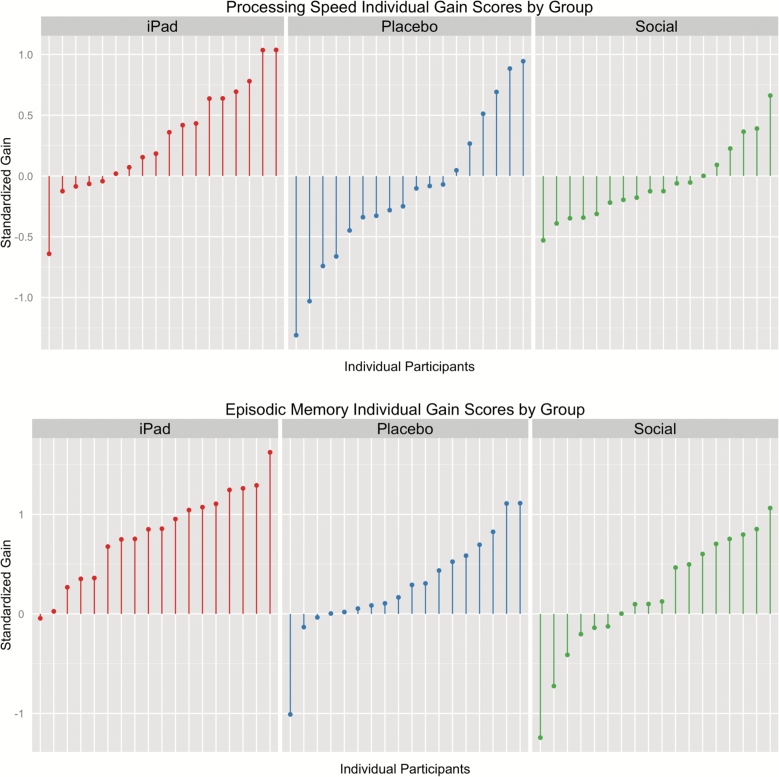
PURPOSE OF THE STUDY: Recent evidence shows that engaging in learning new skills improves episodic memory in older adults. In this study, older adults who were computer novices were trained to use a tablet computer and associated software applications. We hypothesize that sustained engagement in this mentally challenging training would yield a dual benefit of improved cognition and enhancement of everyday function by introducing useful skills. DESIGN AND METHODS: A total of 54 older adults (age 60-90) committed 15 hr/week for 3 months. Eighteen participants received extensive iPad training, learning a broad range of practical applications. The iPad group was compared with 2 separate controls: a Placebo group that engaged in passive tasks requiring little new learning; and a Social group that had regular social interaction, but no active skill acquisition. All participants completed the same cognitive battery pre- and post-engagement. RESULTS: Compared with both controls, the iPad group showed greater improvements in episodic memory and processing speed but did not differ in mental control or visuospatial processing. IMPLICATIONS: iPad training improved cognition relative to engaging in social or nonchallenging activities. Mastering relevant technological devices have the added advantage of providing older adults with technological skills useful in facilitating everyday activities (e.g., banking). This work informs the selection of targeted activities for future interventions and community programs.
Overview
CoChat Summary
## TL;DR
This randomized intervention found that training computer novices aged 60–90 to use an iPad for sustained, structured activity improved episodic memory and processing speed more than two receptive control conditions. The study supports the paper’s “productive engagement” idea, but it did not find benefits for mental control or visuospatial processing.
## Key findings
- The sample included 54 older adults total; 18 were in the iPad intervention, 18 in a Placebo control, and 18 in a Social control.
- Compared with both controls, the iPad group improved more in processing speed: overall Group × Time interaction F(2,51) = 4.35, p = .018; follow-ups vs Placebo F(1,34) = 5.80, p = .022, and vs Social F(1,34) = 8.35, p = .007.
- Compared with both controls, the iPad group improved more in episodic memory: overall Group × Time interaction F(2,51) = 7.31, p = .002; follow-ups vs Placebo F(1,34) = 10.44, p = .003, and vs Social F(1,34) = 12.22, p = .001.
- No significant effects were observed for mental control or visuospatial processing; the paper also notes that all effects except processing speed between iPad and Placebo remained significant after Bonferroni correction.
## Methods
- Design: three-group intervention with pretest/posttest cognitive testing; the iPad group was compared with a passive Placebo group and a Social group with interaction but no active skill acquisition.
- Sample: 54 community-dwelling older adults aged 60–90, with high school education or greater, limited computer experience, no tablet experience, MMSE ≥ 26, and no major psychiatric or neurologic disorders; groups were matched on age, education, and gender.
- Analysis: cognitive outcomes were grouped into four constructs and analyzed with mixed ANOVAs (Group × Time), followed by pairwise follow-ups and ANCOVAs controlling for pretest scores; net effect sizes were also calculated.
## Limitations
- The paper states that “although this study does not include brain imaging,” so it cannot test the neural scaffolding mechanism directly.
- The paper indicates no long-term follow-up was conducted and says future research should use longitudinal follow-up testing to assess retention of benefits.
- Evident from the text: attrition occurred, especially in the iPad recruitment phase (7 of 25 original recruits did not complete the full intervention and posttesting) and in the Social condition (12 dropped out), which may limit generalizability even though dropouts were not statistically different in age or education.
Model-written summary. Check it against the paper before relying on it.
Integrity signals
Registry
Cites
Statistics
Figures

Verification
Claims the paper makes
3 Valid · 0 Not valid · 16 Not checked · 45 Own results and interpretations
Every source the paper cites for this claim was checked and supports it.
In the paper
“recent evidence demonstrated that older adults who experienced cognitive gains after video game training also showed more efficient neural function through enhancement of electroencephalography (EEG) signal in regions associated with cognitive control (Anguera et al., 2013).”
§ Training Older Adults to Use Tablet Computers: Does It Enhance Cognitive Function? > Discussion
What the sources say
- Supportedcites Anguera et al., 2013 source
The paper’s opening summary (page not specified in our copy) reports that older adults gained cognitive-control benefits after NeuroRacer training. It also reports enhanced EEG measures associated with cognitive control, including midline frontal theta power and frontal–posterior theta coherence. (LLM, conf=0.92)
boostedstates an association- Asserted: passes — The authors put it forward as true.
- Checkable: passes — It can be checked against evidence.
- Load-bearing: unclear — It is unclear whether the paper’s conclusions depend on it.
- Based: passes — The paper gives a reason why it holds.
- Supported
A result the paper reports from its own data — it cites no other source for it, so there is none to check. The quote shows it is in the paper.
In the paper
“Compared with both controls, the iPad group showed greater improvements in episodic memory and processing speed but did not differ in mental control or visuospatial processing.”
§ Training Older Adults to Use Tablet Computers: Does It Enhance Cognitive Function? > Abstract > Results:
plainstates a cause- Asserted: passes — The authors put it forward as true.
- Checkable: passes — It can be checked against evidence.
- Load-bearing: passes — The paper’s conclusions depend on it.
- Based: passes — The paper gives a reason why it holds.
A result the paper reports from its own data — it cites no other source for it, so there is none to check. The quote shows it is in the paper.
In the paper
“Compared with both controls, the iPad group showed greater improvements in episodic memory and processing speed but did not differ in mental control or visuospatial processing.”
§ Training Older Adults to Use Tablet Computers: Does It Enhance Cognitive Function? > Abstract > Results:
plain- Asserted: passes — The authors put it forward as true.
- Checkable: passes — It can be checked against evidence.
- Load-bearing: unclear — It is unclear whether the paper’s conclusions depend on it.
- Based: passes — The paper gives a reason why it holds.
A result the paper reports from its own data — it cites no other source for it, so there is none to check. The quote shows it is in the paper.
In the paper
“Compared with both controls, the iPad group showed greater improvements in episodic memory and processing speed but did not differ in mental control or visuospatial processing.”
§ Training Older Adults to Use Tablet Computers: Does It Enhance Cognitive Function? > Abstract > Results:
plainstates a cause- Asserted: passes — The authors put it forward as true.
- Checkable: passes — It can be checked against evidence.
- Load-bearing: passes — The paper’s conclusions depend on it.
- Based: passes — The paper gives a reason why it holds.
A result the paper reports from its own data — it cites no other source for it, so there is none to check. The quote shows it is in the paper.
In the paper
“Compared with both controls, the iPad group showed greater improvements in episodic memory and processing speed but did not differ in mental control or visuospatial processing.”
§ Training Older Adults to Use Tablet Computers: Does It Enhance Cognitive Function? > Abstract > Results:
plain- Asserted: passes — The authors put it forward as true.
- Checkable: passes — It can be checked against evidence.
- Load-bearing: passes — The paper’s conclusions depend on it.
- Based: passes — The paper gives a reason why it holds.
24 more claims
Create a free account to see all 64 claims and to verify the 1 reference still open.
- Probably not a substantial claim. 21
- It may state two separate claims as one. 21
Claims other papers make about this one
Each is checked against this paper’s own text: does it say what the citing paper says it does?
The source backs part of the claim, not all of it — or backs it for a different population, condition or comparison.
In the citing paper
“Older adults may prefer tablet technology due to the portability and usability they provide vs. computer technology (e.g., adjustable font or icon size), especially to those who have a wide range of motor and visual abilities (Chan et al., 2016).”
From Older Adults Perceptions of Technology and Barriers to Interacting with Tablet Computers: A Focus Group Study (2017) · cites this paper as Chan et al., 2016
Experimental — accuracy not yet measuredThe source backs part of the claim, not all of it — or backs it for a different population, condition or comparison.
In the citing paper
“This attempt to seek engagement in the intellectually challenging and enriched lifestyle could also lead to long-term cognitive resilience and socioemotional well-being during our late lifespan (e.g., [2,16,64,86,92,97,103]).”
From OK Google, Let's Learn: Using Voice User Interfaces for Informal Self-Regulated Learning of Health Topics among Younger and Older Adults (2023) · cites this paper as [16]
Experimental — accuracy not yet measuredThe cited source says what the claim attributes to it.
In the citing paper
“Focus group outcomes confirmed that these protocols used previously with a sample of healthy older adults in the USA were appropriate for a UK sample.”
From Older Adults Perceptions of Technology and Barriers to Interacting with Tablet Computers: A Focus Group Study (2017) · cites this paper as Chan et al., 2016
Statistics recomputed
Every reported test result, recomputed from its test statistic and degrees of freedom. A result shows as not adding up only once an independent check has confirmed it.
- ConsistentF(1, 51) = 7.43reported p = .009 · recomputed p = .009
“F(1,51) = 7.43, p = .009”
- ConsistentF(2, 51) = 4.35reported p = .018 · recomputed p = .018
“F(2,51) = 4.35, p = .018”
- ConsistentF(1, 34) = 5.8reported p = .022 · recomputed p = .022
“F(1,34) = 5.80, p = .022”
- ConsistentF(1, 34) = 8.35reported p = .007 · recomputed p = .007
“F(1,34) = 8.35, p = .007”
- ConsistentF(1, 51) = 42.23reported p < .001 · recomputed p < .001
“F(1,51) = 42.23, p < .001”
5 more recomputed tests
Create a free account to see every test the Stats check recomputed.
Self-check
Percentages, sums and reported differences re-computed from the paper’s own numbers.
Self-check results appear here once an independent check has confirmed them.
Citations
Cites
Folstein, M. F., Folstein, S. E., & McHugh, P. R. (1975) · Journal of Psychiatric Research · doi:10.1016/0022-3956(75)90026-6 · Cited by 88,282
Effects of noise letters upon the identification of a target letter in a nonsearch task
Eriksen, B. A., & Eriksen, C. W. (1974) · Perception & Psychophysics · doi:10.3758/bf03203267 · Cited by 7,230 · cited 2×
“Cognitive construct Measure Dependent variable Composite reliability Processing speed Digit Comparison Total correct on trials with three items .86 Total correct on trials with six items Total correct on trials with nine items Mental control Cogstate Identification Log RT to a 2-forced choice decision .81 Flanker Cent…”
MethodThe processing-speed theory of adult age differences in cognition
Salthouse, T. A. (1996) · Psychological Review · doi:10.1037/0033-295x.103.3.403 · Cited by 5,902 · cited 2×
“…of evidence that even healthy older adults experience age-related declines across multiple facets of cognition (Park & Shaw, 1992; Park et al., 1996; Salthouse, 1996; Salthouse & Babcock, 1991), one major goal of interventions is to improve or maintain cognition in order to promote independence…”
Background(1998) · Cited by 4,172
The adaptive brain: aging and neurocognitive scaffolding
Park, D. C., & Reuter-Lorenz, P. (2009) · Annual Review of Psychology · doi:10.1146/annurev.psych.59.103006.093656 · Cited by 2,790 · cited 1×
“Park and Reuter-Lorenz (2009) have proposed that engagement in such active mental challenge for a sustained period promotes the formation of “neural scaffolds,” that is, supportive neural circuitry that provides a source of additional neural resource compensating for age-related brain shrinkage and…”
BackgroundSelf-citationEffects of Cognitive Training Interventions With Older Adults: A Randomized Controlled Trial
Ball, K., Berch, D. B., Helmers, K. F., Jobe, J. B., Leveck, M. D., Marsiske, M., Morris, J. N., Rebok, G. W., Smith, D. M., Tennstedt, S. L., et al. (2002) · JAMA · doi:10.1001/jama.288.18.2271 · Cited by 2,049
Video game training enhances cognitive control in older adults
Anguera, J. A., Boccanfuso, J., Rintoul, J. L., Al-Hashimi, O., Faraji, F., Janowich, J., Kong, E., Larraburo, Y., Rolle, C., Johnston, E., et al. (2013) · Nature · doi:10.1038/nature12486 · Cited by 1,666
Decomposing adult age differences in working memory
Salthouse, T. A., & Babcock, R. L. (1991) · Developmental Psychology · doi:10.1037/0012-1649.27.5.763 · Cited by 1,373 · cited 2×
“…even healthy older adults experience age-related declines across multiple facets of cognition (Park & Shaw, 1992; Park et al., 1996; Salthouse, 1996; Salthouse & Babcock, 1991), one major goal of interventions is to improve or maintain cognition in order to promote independence and quality of life.”
BackgroundMethodThe hopkins verbal learning test: Development of a new memory test with six equivalent forms
Brandt, J. (1991) · Clinical Neuropsychologist · doi:10.1080/13854049108403297 · Cited by 1,317 · cited 2×
“Episodic memory was measured using the Modified Hopkins Verbal Learning Task (HVLT; Brandt, 1991) and the Cambridge Neuropsychological Test Automated Battery (CANTAB) Verbal Recognition Memory (Robbins et al.”
MethodStatistical Estimates and Transformed Beta-Variables.
Minton, P. D., & Blom, G. (1960) · The American Mathematical Monthly · doi:10.2307/2308690 · Cited by 1,166
Research works printed but not linked: 1
- 10.1037/0882-7974.11.4.621 · DOI · Paper page
Cited by
Items 101–200 of 219
Bali, C., Feher, Z., Arató, N., Kiss, B. L., Lábadi, B., & Zsido, A. N. (2024) · Scientific Reports · doi:10.1038/s41598-024-63120-w · Cited by 22
Schaham, N. G., Buckman, Z., & Rand, D. (2022) · International Journal of Environmental Research and Public Health · doi:10.3390/ijerph192315454 · Cited by 14
Meeuwsen, K. D., Groeneveld, K. M., Walker, L. A., Mennenga, A. M., Tittle, R. K., & White, E. K. (2020) · Restorative Neurology and Neuroscience · doi:10.3233/rnn-201053 · Cited by 15
Predictors of Technology Use: Evidence from Elite Older Adults
Wan, X., Lighthall, N. R., & Roque, N. A. (2023) · Activities Adaptation & Aging · doi:10.1080/01924788.2023.2282276 · Cited by 11
“…use is supported by various kinds of studies, including large-scale surveys (Czaja et al., 2006; Macdonald & Hülür, 2020), intervention studies (Chan et al., 2016; Slegers et al., 2009), cognitive impairment studies (Malinowsky et al., 2010; Wu et al., 2019), longitudinal analysis (Hartanto et…”
Miranda, F. D. P. R., Segura, R. I., Garrido, Y. C., & Infante-Moro, J. C. (2025) · Frontiers in Education · doi:10.3389/feduc.2025.1520929 · Cited by 12
Computer use and cognitive decline among Japanese older adults: A prospective cohort study
Kurita, S., Doi, T., Tsutsumimoto, K., Nakakubo, S., Ishii, H. H., & Shimada, H. (2021) · Archives of Gerontology and Geriatrics · doi:10.1016/j.archger.2021.104488 · Cited by 10
Busyness, mental engagement, and stress: Relationships to neurocognitive aging and behavior
Festini, S. B. (2022) · Frontiers in Aging Neuroscience · doi:10.3389/fnagi.2022.980599 · Cited by 11
Development of the Broad Learning Adult Questionnaire
Leanos, S., Coons, J. V., Rebok, G. W., Ozer, D. J., & Wu, R. (2018) · The International Journal of Aging and Human Development · doi:10.1177/0091415018784695 · Cited by 10
Yamazaki, A. K., & Eto, K. (2015) · Procedia Computer Science · doi:10.1016/j.procs.2015.08.299 · Cited by 9
Kuan, Y., Jhang, K.-M., Wang, W.-F., Yeh, Y., Chen, C., Yang, C., & Hu, C. (2025) · Journal of the Formosan Medical Association · doi:10.1016/j.jfma.2025.02.025 · Cited by 8
Izhak, S. B., & Lavidor, M. (2023) · Journal of Cognition and Development · doi:10.1080/15248372.2023.2172413 · Cited by 13
Executive Functioning of Older Adults Correlates with Performance of Touchscreen App-Based Puzzles
Givon-Schaham, N., Sternberg, S., & Rand, D. (2018) · Games for Health Journal · doi:10.1089/g4h.2017.0118 · Cited by 8
“20 In addition, recent review showed that iPad interventions for stroke rehabilitation are feasible and have a potential to improve rehabilitation outcomes.”
Technology-based mental health assessment and intervention
Gould, C. E., Ma, F., Loup, J. R., Juang, C., Sakai, E. Y., & Pepin, R. L. (2020) · Elsevier eBooks · doi:10.1016/b978-0-12-800136-3.00024-7 · Cited by 15
Calatayud, E., Oliván‐Blázquez, B., Aguilar‐Latorre, A., Cuenca‐Zaldívar, J. N., Botaya, R. M., & Gómez‐Soria, I. (2024) · Experimental Gerontology · doi:10.1016/j.exger.2024.112568 · Cited by 8
“…specifically, in verbal and nonverbal memory, working memory, processing speed and visuospatial skills; however, no significant effects have been found in attention and EF (Chan et al., 2016; Cheng et al., 2012; Grotz et al., 2018; Lampit et al., 2014; Laver et al., 2015; Vaportzis et al., 2018).”
Du, Y., Niu, Q., Tan, G., Chao, J., Jin, S., & Wang, L. Y. (2025) · Journal of Medical Internet Research · doi:10.2196/83955 · Cited by 8
“Engagement in cognitively challenging activities, such as learning new digital skills or knowledge, plays a protective role against age-related cognitive decline [11,12].”
Valla, L. G., Rossi, M., Gaia, A., Guaita, A., & Rolandi, E. (2024) · Journal of Medical Internet Research · doi:10.2196/62824 · Cited by 10
“Research on cognitive function shows that nondaily users of digital tools have overall lower cognitive performance than daily users [23], highlighting the beneficial effects of the use of digital tools on memory processes [24].”
People’s views on preserving thinking skills in old age
Niechcial, M. A., Vaportzis, E., & Gow, A. J. (2019) · Educational Gerontology · doi:10.1080/03601277.2019.1627054 · Cited by 12
Μηλιώνης, Α., & Maidonis, S. (2020) · International Conference on PErvasive Technologies Related to Assistive Environments (PETRA) · doi:10.1145/3389189.3397972 · Cited by 8
Sánchez-Nieto, J. M., Martínez-Maldonado, M. D. L. L., Lena, M. M.-L., & Mendoza-Núñez, V. M. (2019) · Brain Sciences · doi:10.3390/brainsci9070151 · Cited by 8
“are consistent with what has been reported in other studies, which showed that learning to use a tablet or digital photograph had a positive effect on episodic memory, butnot in attention [11,26].”
BackgroundResultInfluentialCompuabuelitos/Technogrands: An intergenerational experience based on Pierre Faure’s pedagogy
Aldaco-Arias, S. M., & Casillas, J. C. S. (2021) · International Review of Education · doi:10.1007/s11159-021-09906-w · Cited by 6
Li, K. S.-W., Nagallo, N., McDonald, E. J., Whaley, C., Grindrod, K., & Boluk, K. A. (2022) · JMIR Aging · doi:10.2196/34997 · Cited by 8
Evaluation of an App to Support Healthy Living by Older Adults
Haslinda, Z., Sani, A., & Petrie, H. (2017) · Electronic workshops in computing · doi:10.14236/ewic/hci2017.42 · Cited by 7
“The use of mobile technology has also shown to improve cognitive abilities among older adults (Chan et al., 2016).”
BackgroundVirtual cognitive training in healthy aging and mild cognitive impairment
Basak, C., & Qin, S. (2018) · Elsevier eBooks · doi:10.1016/b978-0-12-811272-4.00009-9 · Cited by 8
Corsten, S., & Lauer, N. (2020) · International Journal of Health Professions · doi:10.2478/ijhp-2020-0002 · Cited by 7
Patton, A., & Davidsen, J. (2025) · PLoS Computational Biology · doi:10.1371/journal.pcbi.1013093 · Cited by 5
Videogame and Computer Intervention Effects on Older Adults' Mental Rotation Performance
Taylor, B., Yam, A., Belchior, P. D. C., & Marsiske, M. (2021) · Games for Health Journal · doi:10.1089/g4h.2020.0128 · Cited by 10
“After other intervention trials, 22,25,29 and to increase conformity with parametric assumptions, reaction time and rotation rate were normalized through Blom transformation.”
SmartCards as Analogous Tools to Operate Tablet Computers for Elderly—A Feasibility Study
Mueller, S. M., Göttke-Krogmann, B., Kortus, J., Wiechmann, M., Weber, M., Mozek, S., Mau, W., Golla, A., & Huebner, G. (2021) · Healthcare · doi:10.3390/healthcare9091198 · Cited by 8
Padua Rehabilitation Tool: A Pilot Study on Patients with Dementia
Cardullo, S., Valeria, P. M., Ilaria, T., Ambra, P., Gamberini, L., & Mapelli, D. (2016) · Lecture notes in computer science · doi:10.1007/978-3-319-40216-1_31 · Cited by 5
Anuardi, M. N. A. M., Yamazaki, A. K., & Eto, K. (2018) · Procedia Computer Science · doi:10.1016/j.procs.2018.08.092 · Cited by 5
Viel, C. C., Rodrigues, K. R. D. H., Cunha, B. C. R., & Pimentel, M. G. (2019) · Brazilian Symposium on Multimedia and the Web · doi:10.1145/3323503.3360303 · Cited by 9
“O processo de envelhecimento traz consigo aspectos inerentes como a diminuição da mobilidade, visão, audição, destreza e cognição [5].”
Zhong, T., Tian, H., Wen, X., Ma, D., Cui, H., Zhang, L., Zhu, X., Wang, Y., & Chen, L. (2025) · Geriatric Nursing · doi:10.1016/j.gerinurse.2024.12.009 · Cited by 5
Computer use: a protective factor for cognition in aging and HIV disease?
Woods, S. P., Thompson, J. L., & Benge, J. F. (2023) · Aging Clinical and Experimental Research · doi:10.1007/s40520-023-02449-0 · Cited by 4
Lee, A. R., Dong, L., & Yue, Y. (2025) · Educational Gerontology · doi:10.1080/03601277.2025.2481923 · Cited by 8
“This finding is consistent with other research that explores similar connections, albeit through different methods and contexts (Bochkova & Liin, 2024; Chan et al., 2016; H. K. Choi & Lee, 2021; Hasan & Linger, 2016).”
Rodrigues, C., & Morgado, L. (2017) · International Symposium on Computers in Education · doi:10.1109/siie.2017.8259674 · Cited by 4
Maximizing the Impact of Cognitive Engagement Interventions for Older Adults
Wu, R., & Rebok, G. W. (2020) · Cambridge University Press eBooks · doi:10.1017/9781108552684.042 · Cited by 6
Jingar, M., Lindgren, H., & Blusi, M. (2021) · Studies in health technology and informatics · doi:10.3233/shti210315 · Cited by 7
“In terms of interaction design, these technologies should be designed so that regardless of age, cognitive and physical impairments, a person should be able to use and interact with them effortlessly [1].”
BackgroundThe Impact of Age on User Performance: A Field Experiment
Liberatore, M. J., & Wagner, W. P. (2022) · Journal of Computer Information Systems · doi:10.1080/08874417.2022.2065552 · Cited by 6
“spatial processing.(7,43,44,46) Future research should explore whether the findings presented here hold for other IT tasks and should also investigate the effect of training for older workers on IT performance.”
BackgroundSaukkonen, P., Kainiemi, E., Virtanen, L., Kaihlanen, A., Koskinen, S. V. P., Sainio, P., Koponen, P., Kehusmaa, S., & Heponiemi, T. (2022) · Lecture notes in computer science · doi:10.1007/978-3-031-05581-2_41 · Cited by 10
The impact of users’ cognitive function on evaluator perceptions of usability
Martins, A. I., Silva, A. G., Pais, J., Cruz, V. T., & Rocha, N. P. (2022) · Scientific Reports · doi:10.1038/s41598-022-17441-3 · Cited by 7
“Studies have suggested that using digital solutions, such as personal computers 29 or tablets 30 help maintain or enhance cognitive functions, such as memory, processing speed and attention.”
BackgroundMethodLifestyle Factors and Successful Cognitive Aging in Older Adults
O’Connor, M. K., Kraft, M. L., & Randolph, J. J. (2022) · Springer eBooks · doi:10.1007/978-3-031-11389-5_3 · Cited by 5
Martinez, P. D., Tancredi, D. J., Pavel, M., García, L., & Young, H. M. (2024) · JMIR Formative Research · doi:10.2196/57009 · Cited by 5
A Pre-study of Background Color Effects on the Working Memory Area of the Brain
Anuardi, M. N. A. M., Shinohara, H., & Yamazaki, A. K. (2016) · Procedia Computer Science · doi:10.1016/j.procs.2016.08.160 · Cited by 4
EasiSocial: Recommendations in the Development and Training of Social Media Tools for Older People
Boyd, K., Bond, R., Nugent, C., & Donnelly, M. P. (2018) · Electronic workshops in computing · doi:10.14236/ewic/hci2018.112 · Cited by 4
“Reasons are attributed to lower levels of education and a lack of formal training provision for older people [13], [14].”
BackgroundWhatley, M. C., Murphy, D. H., Silaj, K. M., & Castel, A. D. (2021) · Oxford University Press eBooks · doi:10.1093/oso/9780197528976.003.0003 · Cited by 11
Do Loneliness and Social Connectedness Improve in Older Adults Through Mobile Technology?
McWhorter, R. R., Delello, J. A., Gipson, C. S., Mastel‐Smith, B., & Caruso, K. (2020) · Advances in business strategy and competitive advantage book series · doi:10.4018/978-1-7998-2914-0.ch009 · Cited by 5
Obiekwe, S. J., Akobundu, U. N., Emuka, O. P., Akosile, C. O., Chukwuemeka, U. M., Mgbeojedo, U. G., & Okonkwo, U. P. (2025) · Cogent Gerontology · doi:10.1080/28324897.2025.2450341 · Cited by 3
Festini, S. B., & McDonough, I. M. (2024) · Cognitive Affective & Behavioral Neuroscience · doi:10.3758/s13415-024-01246-0 · Cited by 3
“…based on existing correlational busyness research (Festini et al., 2016) and experimental manipulations of new learning (Carlson et al., 2009; Chan et al., 2014; McDonough et al., 2015; Park et al., 2014), those older adults who maintain a busy lifestyle may experience cognitive benefits,…”
Wang, J., Zhang, N., Huang, C., Wu, Q., & Tong, J. (2025) · Frontiers in Aging Neuroscience · doi:10.3389/fnagi.2025.1579874 · Cited by 4
Towards Age-Inclusive Conversational interfaces: Understanding Requirements Across Age Groups
Boostani, R., Munteanu, C., & Kuzminykh, A. (2025) · ACM Conference on Conversational User Interfaces (CUI) · doi:10.1145/3719160.3736619 · Cited by 4
“In terms of information exchange, older adults and children expect CUI to be flexible and adaptable to their changing needs and preferences [3, 9, 10, 23, 25, 59].”
User Evaluation of an App for Liquid Monitoring by Older Adults
Sani, Z. H. A., & Petrie, H. (2017) · Lecture notes in computer science · doi:10.1007/978-3-319-58700-4_8 · Cited by 3
A pre-NIRS study of background colour effects on the functions of the frontal lobe
Anuardi, M. N. A. M., Yamazaki, A. K., & Eto, K. (2017) · Procedia Computer Science · doi:10.1016/j.procs.2017.08.149 · Cited by 3
Turconi, M. M., Vella, F., & Mosetti, F. (2019) · AboutOpen · doi:10.33393/abtpn.2019.282 · Cited by 4
“A well-designed recent study in 54 older adults (aged 60-90 years), who were computer novices, investigated whether receiving extensive iPad training and learning practical applications could be associated with improved cognition and better everyday function (2).”
BackgroundNiechcial, M. A., Dickson, A., Potter, L. M., & Gow, A. J. (2025) · Educational Gerontology · doi:10.1080/03601277.2025.2500725 · Cited by 4
“Taking part in leisure activities (e.g., physical activity), and novel, cognitively demanding activities (e.g., learning a new skill) led to improvements in healthy older adults’ cognition (Chan et al., 2014; Vaportzis et al., 2019) and wellbeing (Ryu & Heo, 2018).”
Reply to: Comment on: Using smartphone technology to improve prospective memory functioning
Benge, J. F., & Scullin, M. K. (2022) · Journal of the American Geriatrics Society · doi:10.1111/jgs.17691 · Cited by 3
The impact of behavioral patterns on accelerated aging in the UK biobank
Zhou, J., Xin, M., Wang, F., Zhong, Y., Zhang, T.-T., Mao, R., & Hu, Z. (2025) · Aging Clinical and Experimental Research · doi:10.1007/s40520-025-03074-9 · Cited by 5
Privitera, A. J., Ng, S. H. S., & Chen, S. A. (2025) · Neuroscience & Biobehavioral Reviews · doi:10.1016/j.neubiorev.2025.106281 · Cited by 4
Cognitive and artificial intelligence evaluation framework
Putnoki, A. M., & Orosz, T. (2026) · Artificial Intelligence Review · doi:10.1007/s10462-026-11493-x · Cited by 4
Effective Learning Environment Design for Aging Well: A Review
Yamada, M., Oi, M., & Konomi, S. (2018) · Lecture notes in computer science · doi:10.1007/978-3-319-91131-1_20 · Cited by 3
Feasibility of a Home-Based Task-Switching Training in Middle-Aged Caregivers
Lanfer, S. S. L., Enge, S., Melzer, M., Wegge, J., & Kliegel, M. (2022) · Journal of Cognitive Enhancement · doi:10.1007/s41465-021-00237-0 · Cited by 2
Do Old People in Rural Areas Go Online, and Should They Do that?
Bochkova, M., & Liin, T. (2024) · Communications in computer and information science · doi:10.1007/978-3-031-61947-2_15 · Cited by 3
Bruni, F., Mancuso, V., Panigada, J., Stramba‐Badiale, M., Cipresso, P., & Pedroli, E. (2024) · JMIR Aging · doi:10.2196/56796 · Cited by 2
“The examination of the challenges that older adults encounter when using technology is crucial to identifying the most efficacious approaches for introducing technology within the clinical domain, given its significant benefits and necessity in this context [20].”
Chen, L., & Shi, L. (2024) · Educational Gerontology · doi:10.1080/03601277.2024.2396643 · Cited by 5
“For example, studies have shown that engaging with social media can enhance episodic memory, which involves the ability to remember specific events and experiences (Chan et al., 2016; Slegers et al., 2009).”
Enhancing memory performance in older adults through socially engaging cognitive training
Izhak, S. B., Yemini, A., & Lavidor, M. (2025) · Educational Gerontology · doi:10.1080/03601277.2025.2458142 · Cited by 3
“However, when coupled with mental stimulation that demands cognitive effort, the potential for such improvements becomes more apparent (Chan et al., 2016; Iizuka et al., 2019; Myhre et al., 2017).”
La realidad de la memoria en mayores saludables y envejeciendo. Memoria, envejecimiento y longevidad
Castro, F. V., Briegas, J. J. M., Ballester, S. G., & Iglesias, A. I. S. (2018) · International Journal of Developmental and Educational Psychology Revista INFAD de psicología · doi:10.17060/ijodaep.2018.n2.v1.1355 · Cited by 2
A Qualitative Usability Evaluation of Tablets and Accessibility Settings by Older Adults
Dasgupta, D., Chaudhry, B. M., & Chawla, N. V. (2021) · Lecture notes in computer science · doi:10.1007/978-3-030-90328-2_12 · Cited by 3
Mastel‐Smith, B., Duke, G., & He, Z. (2018) · Journal of Holistic Nursing · doi:10.1177/0898010118792961 · Cited by 2
Technology Adherence and Incorporation to Daily Life Activities of Highly Educated Older AdultsPreprint
Brazil, C. K., & Rys, M. J. (2022) · SSRN Electronic Journal · doi:10.2139/ssrn.4167279 · Cited by 3
Cognitive neuroscience of aging: present research status and future prospect
Liu, H., & Li, H. (2021) · Scientia Sinica Vitae · doi:10.1360/ssv-2020-0256 · Cited by 2
Depauw, T., Boasen, J., Léger, P., & Sénécal, S. (2024) · JMIR Human Factors · doi:10.2196/49992 · Cited by 2
“Based on research conducted to understand the impact of cognitive functions on the use of technology by older people [23,24], and on existing models of cognitive architecture in human-computer interaction [25], we identified 5 key cognitive functions important for IT use: visual perception, motor…”
BackgroundTakakura, Y., Otsuki, M., Takagi, R., & Houkin, K. (2025) · Cognitive Processing · doi:10.1007/s10339-025-01264-x · Cited by 1
“In contrast, tablet devices (e.g. iPads), with their portability and usability (adjustable font or icon sizes), may be helpful for older people with a wide range of visual and motor capabilities (Chan et al. 2016).”
Rodríguez, T. M., Neri, X., & Wu, R. (2025) · Journal of Aging and Health · doi:10.1177/08982643241309135 · Cited by 3
“…income Whites) have demonstrated that learning new skills can increase a range of cognitive abilities (e.g., executive functioning) as well as functional abilities related to the learned skills (Bugos et al., 2007; Bugos & Wang, 2022; Chan et al., 2016; Leanos et al., 2023; Park et al., 2014).”
Imamura, K., Kawai, H., Ejiri, M., Sasai, H., Ihara, K., Nakada, H., Araki, A., Hirano, H., Fujiwara, Y., Suzuki, T., et al. (2025) · The Journal of Prevention of Alzheimer s Disease · doi:10.1016/j.tjpad.2025.100138 · Cited by 5
“Such educational support has been shown not only to lead to successful ICT adoption [ 40 ] but also to have additional benefits for cognitive functioning, such as improved memory and processing speed [ 41–43 ].”
Fong, K. N. K., So, A. W. K., Cheung, K. C. H., Cheung, J. Y. L., Lee, A. M. H., Wong, R. C. Y., Lau, J. S. Y., González, P. C., Wong, W. W. S., Li, D., et al. (2025) · Digital Health · doi:10.1177/20552076251362117 · Cited by 2
Screen Use Measurement Tools: A Mapping of Instruments, Gaps, and Future Directions
Shaleha, R. R. A., Roque, N. A., Andrews, H. J., Calfee, K., & Lee, S. (2026) · Cyberpsychology Behavior and Social Networking · doi:10.1177/21522715261417288 · Cited by 3
“12 These fi ndings underscore that screen use can also support learning, social connection, and cognitive engagement.”
Moreno, M. P. S., Nicotra, M. G., Rotta, A. M. M., Sarmiento, E. A. R., Roumec, B., Vivas, J. R., & Vivas, L. (2023) · Revista de Psicología · doi:10.46553/rpsi.19.38.2023.p7-24 · Cited by 3
Geragogische Begleitung bei Statuspassagen im Alter
Kricheldorff, C., & Doll, J. (2024) · Zeitschrift für Gerontologie und Geriatrie · doi:10.1007/s00391-024-02327-y · Cited by 1
Kognitive Reserve: Lernen im Alter
Mayorova, E., & Meyer, M. E. (2014) · Cited by 1
Ibáñez-Casas, I., Leonard, B. C., Perez-Garacia, M., & Puente, A. E. (2023) · Bethlehem University Journal · doi:10.13169/bethunivj.39.1-2022.01 · Cited by 2
Desempenho em tarefa de realidade virtual entre mulheres na pós-menopausa
Raimundo, J. Z. (2022) · Digital Library of Theses and Dissertations (Universidade de São Paulo) · doi:10.11606/t.5.2022.tde-20072022-101404 · Cited by 1
Uno, A., Browne, R., Shinada, T., Soga, K., Du, Y., Takahashi, M., Abiko, F., & Taki, Y. (2024) · Research Square · doi:10.21203/rs.3.rs-4836281/v1 · Cited by 1
Uno, A., Browne, R., Shinada, T., Takahashi, M., Soga, K., Du, Y., Abiko, F., & Taki, Y. (2025) · Research Square · doi:10.21203/rs.3.rs-4836281/v2 · Cited by 1
Foloppe, D. A. (2017) · theses.fr (ABES) · doi:10.70675/ea5c564azcf19z4d1dzacdezb265118ff3a8 · Cited by 4
Nonpharmacologic Activity Interventions to Prevent Alzheimer’s Disease
Carlson, M. C. (2016) · Elsevier eBooks · doi:10.1016/b978-0-12-802173-6.00022-8 · Cited by 1
The Relationship between Well-Being and Technology among Senior Citizens in Indiana
Hopkins, T. (2018) · Digital Commons (Liberty University)
Cognitive training through DVD: Working memory task as a tool for rehabilitation in elders
Marques, V. D. S., Soutinho, L. A. R., Marins, M., Marinho, V., Teixeira, S. S., Bastos, V. H., & Orsini, M. A. (2018) · Clinical Practice · doi:10.4172/clinical-practice.1000431
Zhang, J. (2019) · Digital Repository Service (Northeastern University) · doi:10.17760/d20319826
Associations between Activity Participation across the Life Course and Cognitive Aging
Gow, A. J. (2020) · Cambridge University Press eBooks · doi:10.1017/9781108552684.028 · Cited by 1
Viel, C. C. (2020) · Digital Library of Theses and Dissertations (Universidade de São Paulo) · doi:10.11606/t.55.2020.tde-10092020-152954
Compuabuelitos: aprendizajes en una experiencia intergeneracional
Aldaco-Arias, S. M., & Casillas, J. C. S. (2020) · Sinéctica Revista Electrónica de Educación · doi:10.31391/s2007-7033(2020)0055-002 · Cited by 1
認知機能の低下した高齢者に対するタブレット版「いきいきリハビリ」の有効性の検討
水野, 純., 西浦, 裕., 齊藤, 千., 小長谷, 陽., & 井上, 剛. (2021) · 作業療法 · doi:10.32178/jotr.40.3_311
Park, J. (2021) · Journal of Mechanics in Medicine and Biology · doi:10.1142/s0219519421400443
Dasgupta, D., Chaudhry, B. M., Greeves, K., Long, J. F., Duarte, M., & Chawla, N. V. (2020) · JMIR Aging · doi:10.2196/26686
Li, K. S.-W., Nagallo, N., McDonald, E. J., et al. (2021) · doi:10.2196/preprints.34997
Speh, K., & von Humboldt, S. (2021) · Springer eBooks · doi:10.1007/978-3-030-22009-9_78
Rincón, A. G., Arango, G., Márquez, I., Campos, J. F., Borda, M. G., Osuna, M. M., Ailshire, J., Chavarro, D., García, E., & Cano, C. A. (2021) · doi:10.2196/preprints.31872 · Cited by 1
Do Loneliness and Social Connectedness Improve in Older Adults Through Mobile Technology?
McWhorter, R. R., Delello, J. A., Gipson, C. S., Mastel‐Smith, B., & Caruso, K. (2022) · IGI Global eBooks · doi:10.4018/978-1-6684-5295-0.ch088
Speh, K., & von Humboldt, S. (2019) · Springer eBooks · doi:10.1007/978-3-319-69892-2_78-1
Non-pharmacologic behavioural activity interventions to prevent dementia
Carlson, M. C., & Varma, V. R. (2017) · Oxford University Press eBooks · doi:10.1093/med/9780198701590.003.0129
An Investigation into the Relationship Between Perceptions of Aging and Cognitive Engagement
(2023) · Journal of Educational & Psychological Research · doi:10.33140/jepr.05.01.02
Metadata
- Authors
- Chan, M. Y., Haber, S., Drew, L. M., & Park, D. C.
- Affiliations
- The University of Texas at Dallas (US)
- Corresponding author
- Chan, Micaela Y.
- Venue
- The Gerontologist
- Publisher
- Oxford University Press (OUP)
- Published
- 2014-06-13
- Volume
- 56
- Issue
- 3
- Pages
- 475-484
- ISSN
- 0016-9013 (ISSN-L)
- 1758-5341
- PMC
- PMC4873760
- OpenAlex
- W2111816181
- Cited by
- 218
- References
- 31
- Citations by year
- 2026: 13 · 2025: 26 · 2024: 19 · 2023: 14 · 2022: 23 · 2021: 22 · 2020: 21 · 2019: 21 · 2018: 21 · 2017: 15 · 2016: 16 · 2015: 5 · 2014: 2
- FWCI
- 34.89
- Type
- journal article
- Language
- en
- Open access
- hybrid
- doi.org
- Licence
- cc-by-nc
- Locations
- The Gerontologist (publishedVersion, cc-by-nc)
- Europe PMC (PubMed Central) (publishedVersion, cc-by-nc)
- PubMed Central (publishedVersion, cc-by-nc)
- PubMed (publishedVersion)
- HighWire Press Open Archive (submittedVersion)
- Funders
- National Institute on Aging (5R01AG026589-02)
- Topics
- Health Sciences › Medicine › Geriatrics and Gerontology › Technology Use by Older Adults
- Social Sciences › Psychology › Developmental and Educational Psychology › Aging and Gerontology Research
- Social Sciences › Psychology › Experimental and Cognitive Psychology › Cognitive Functions and Memory
- Keywords
- older adults, tablet computers, cognitive function, episodic memory, processing speed, skill acquisition, technology training, social interaction, cognitive aging
- MeSH terms
- Activities of Daily Living, Aged, Aged, 80 and over, Aging, Cognition, Cognition Disorders, Computer User Training, Female, Humans, Learning, Male, Computers, Handheld
About these checks
Registry, retraction, Cites and statistics results are computed, not judged, with one exception: a printed reference that no index lists is read once by a model before it counts as a citation error. Claims are extracted by a model and kept only when their quote appears verbatim in the text; each cited source is then checked, with a model’s help, for whether it says what the claim relies on. Those verdicts can be wrong — read the claim’s quote and the cited source before relying on one.
A language model drew the claims from the paper on 2026-09-30, under version 3 of the claim definition (model deepseek-v4.1-flash, prompt extract-v3).
A second model labelled each claim on 2026-09-30 (model jev-1.13-20260917, definition revision gold-guideline-v0.2).
Cited sources are checked with a language model’s help (gpt-6-sol).
Statistics and arithmetic are recomputed, not judged.
Confidence bands are shown only for fields calibrated on our annotated test set. None is calibrated yet, so no band is shown.
What counts as a claim ›How we measure confidence ›How we check this ›
Are you an author, or do you see a problem with this page? Request a review
Data sources
Bibliographic data: Semantic Scholar, OpenAlex, Crossref.
Contains information from the Semantic Scholar Academic Graph Datasets, made available under the ODC Attribution License (ODC-BY 1.0).
Semantic Scholar’s data is described in: Kinney, R., et al. (2023). The Semantic Scholar Open Data Platform. arXiv:2301.10140.
