

Training Older Adults to Use Tablet Computers: Does It Enhance Cognitive Function?
Open accessThe DOI matches its Crossref record, with a small difference in title or year; 27 of the 31 references it cites were found in a registry or an index; 3 of the 23 sources its claims cite were checked for support.
Abstract
PURPOSE OF THE STUDY: Recent evidence shows that engaging in learning new skills improves episodic memory in older adults. In this study, older adults who were computer novices were trained to use a tablet computer and associated software applications. We hypothesize that sustained engagement in this mentally challenging training would yield a dual benefit of improved cognition and enhancement of everyday function by introducing useful skills. DESIGN AND METHODS: A total of 54 older adults (age 60-90) committed 15 hr/week for 3 months. Eighteen participants received extensive iPad training, learning a broad range of practical applications. The iPad group was compared with 2 separate controls: a Placebo group that engaged in passive tasks requiring little new learning; and a Social group that had regular social interaction, but no active skill acquisition. All participants completed the same cognitive battery pre- and post-engagement. RESULTS: Compared with both controls, the iPad group showed greater improvements in episodic memory and processing speed but did not differ in mental control or visuospatial processing. IMPLICATIONS: iPad training improved cognition relative to engaging in social or nonchallenging activities. Mastering relevant technological devices have the added advantage of providing older adults with technological skills useful in facilitating everyday activities (e.g., banking). This work informs the selection of targeted activities for future interventions and community programs.
Overview
CoChat Summary
## TL;DR
This randomized intervention found that training computer novices aged 60–90 to use an iPad for sustained, structured activity improved episodic memory and processing speed more than two receptive control conditions. The study supports the paper’s “productive engagement” idea, but it did not find benefits for mental control or visuospatial processing.
## Key findings
- The sample included 54 older adults total; 18 were in the iPad intervention, 18 in a Placebo control, and 18 in a Social control.
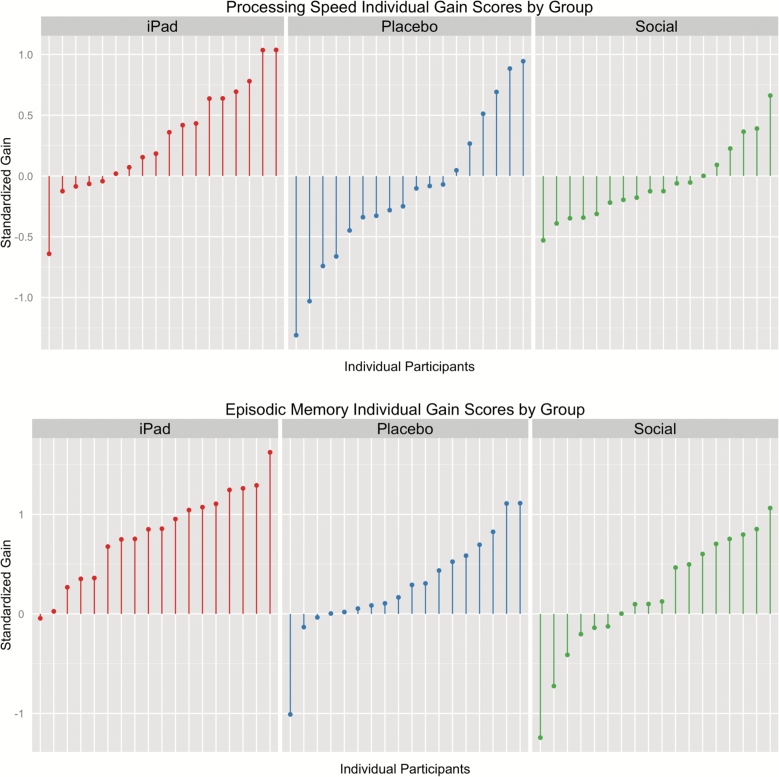
- Compared with both controls, the iPad group improved more in processing speed: overall Group × Time interaction F(2,51) = 4.35, p = .018; follow-ups vs Placebo F(1,34) = 5.80, p = .022, and vs Social F(1,34) = 8.35, p = .007.
- Compared with both controls, the iPad group improved more in episodic memory: overall Group × Time interaction F(2,51) = 7.31, p = .002; follow-ups vs Placebo F(1,34) = 10.44, p = .003, and vs Social F(1,34) = 12.22, p = .001.
- No significant effects were observed for mental control or visuospatial processing; the paper also notes that all effects except processing speed between iPad and Placebo remained significant after Bonferroni correction.
## Methods
- Design: three-group intervention with pretest/posttest cognitive testing; the iPad group was compared with a passive Placebo group and a Social group with interaction but no active skill acquisition.
- Sample: 54 community-dwelling older adults aged 60–90, with high school education or greater, limited computer experience, no tablet experience, MMSE ≥ 26, and no major psychiatric or neurologic disorders; groups were matched on age, education, and gender.
- Analysis: cognitive outcomes were grouped into four constructs and analyzed with mixed ANOVAs (Group × Time), followed by pairwise follow-ups and ANCOVAs controlling for pretest scores; net effect sizes were also calculated.
## Limitations
- The paper states that “although this study does not include brain imaging,” so it cannot test the neural scaffolding mechanism directly.
- The paper indicates no long-term follow-up was conducted and says future research should use longitudinal follow-up testing to assess retention of benefits.
- Evident from the text: attrition occurred, especially in the iPad recruitment phase (7 of 25 original recruits did not complete the full intervention and posttesting) and in the Social condition (12 dropped out), which may limit generalizability even though dropouts were not statistically different in age or education.
Model-written summary. Check it against the paper before relying on it.
Integrity signals
Registry
Cites
Statistics
Figures

Verification
Claims the paper makes
3 Valid · 0 Not valid · 16 Not checked · 45 Own results and interpretations
Every source the paper cites for this claim was checked and supports it.
In the paper
“recent evidence demonstrated that older adults who experienced cognitive gains after video game training also showed more efficient neural function through enhancement of electroencephalography (EEG) signal in regions associated with cognitive control (Anguera et al., 2013).”
§ Training Older Adults to Use Tablet Computers: Does It Enhance Cognitive Function? > Discussion
What the sources say
- Supportedcites Anguera et al., 2013 source
The paper’s opening summary (page not specified in our copy) reports that older adults gained cognitive-control benefits after NeuroRacer training. It also reports enhanced EEG measures associated with cognitive control, including midline frontal theta power and frontal–posterior theta coherence. (LLM, conf=0.92)
boostedstates an association- Asserted: passes — The authors put it forward as true.
- Checkable: passes — It can be checked against evidence.
- Load-bearing: unclear — It is unclear whether the paper’s conclusions depend on it.
- Based: passes — The paper gives a reason why it holds.
- Supported
A result the paper reports from its own data — it cites no other source for it, so there is none to check. The quote shows it is in the paper.
In the paper
“Compared with both controls, the iPad group showed greater improvements in episodic memory and processing speed but did not differ in mental control or visuospatial processing.”
§ Training Older Adults to Use Tablet Computers: Does It Enhance Cognitive Function? > Abstract > Results:
plainstates a cause- Asserted: passes — The authors put it forward as true.
- Checkable: passes — It can be checked against evidence.
- Load-bearing: passes — The paper’s conclusions depend on it.
- Based: passes — The paper gives a reason why it holds.
A result the paper reports from its own data — it cites no other source for it, so there is none to check. The quote shows it is in the paper.
In the paper
“Compared with both controls, the iPad group showed greater improvements in episodic memory and processing speed but did not differ in mental control or visuospatial processing.”
§ Training Older Adults to Use Tablet Computers: Does It Enhance Cognitive Function? > Abstract > Results:
plain- Asserted: passes — The authors put it forward as true.
- Checkable: passes — It can be checked against evidence.
- Load-bearing: unclear — It is unclear whether the paper’s conclusions depend on it.
- Based: passes — The paper gives a reason why it holds.
A result the paper reports from its own data — it cites no other source for it, so there is none to check. The quote shows it is in the paper.
In the paper
“Compared with both controls, the iPad group showed greater improvements in episodic memory and processing speed but did not differ in mental control or visuospatial processing.”
§ Training Older Adults to Use Tablet Computers: Does It Enhance Cognitive Function? > Abstract > Results:
plainstates a cause- Asserted: passes — The authors put it forward as true.
- Checkable: passes — It can be checked against evidence.
- Load-bearing: passes — The paper’s conclusions depend on it.
- Based: passes — The paper gives a reason why it holds.
A result the paper reports from its own data — it cites no other source for it, so there is none to check. The quote shows it is in the paper.
In the paper
“Compared with both controls, the iPad group showed greater improvements in episodic memory and processing speed but did not differ in mental control or visuospatial processing.”
§ Training Older Adults to Use Tablet Computers: Does It Enhance Cognitive Function? > Abstract > Results:
plain- Asserted: passes — The authors put it forward as true.
- Checkable: passes — It can be checked against evidence.
- Load-bearing: passes — The paper’s conclusions depend on it.
- Based: passes — The paper gives a reason why it holds.
24 more claims
Create a free account to see all 64 claims and to verify the 1 reference still open.
- Probably not a substantial claim. 21
- It may state two separate claims as one. 21
Claims other papers make about this one
Each is checked against this paper’s own text: does it say what the citing paper says it does?
The source backs part of the claim, not all of it — or backs it for a different population, condition or comparison.
In the citing paper
“Older adults may prefer tablet technology due to the portability and usability they provide vs. computer technology (e.g., adjustable font or icon size), especially to those who have a wide range of motor and visual abilities (Chan et al., 2016).”
From Older Adults Perceptions of Technology and Barriers to Interacting with Tablet Computers: A Focus Group Study (2017) · cites this paper as Chan et al., 2016
Experimental — accuracy not yet measuredThe source backs part of the claim, not all of it — or backs it for a different population, condition or comparison.
In the citing paper
“This attempt to seek engagement in the intellectually challenging and enriched lifestyle could also lead to long-term cognitive resilience and socioemotional well-being during our late lifespan (e.g., [2,16,64,86,92,97,103]).”
From OK Google, Let's Learn: Using Voice User Interfaces for Informal Self-Regulated Learning of Health Topics among Younger and Older Adults (2023) · cites this paper as [16]
Experimental — accuracy not yet measuredThe cited source says what the claim attributes to it.
In the citing paper
“Focus group outcomes confirmed that these protocols used previously with a sample of healthy older adults in the USA were appropriate for a UK sample.”
From Older Adults Perceptions of Technology and Barriers to Interacting with Tablet Computers: A Focus Group Study (2017) · cites this paper as Chan et al., 2016
Statistics recomputed
Every reported test result, recomputed from its test statistic and degrees of freedom. A result shows as not adding up only once an independent check has confirmed it.
- ConsistentF(1, 51) = 7.43reported p = .009 · recomputed p = .009
“F(1,51) = 7.43, p = .009”
- ConsistentF(2, 51) = 4.35reported p = .018 · recomputed p = .018
“F(2,51) = 4.35, p = .018”
- ConsistentF(1, 34) = 5.8reported p = .022 · recomputed p = .022
“F(1,34) = 5.80, p = .022”
- ConsistentF(1, 34) = 8.35reported p = .007 · recomputed p = .007
“F(1,34) = 8.35, p = .007”
- ConsistentF(1, 51) = 42.23reported p < .001 · recomputed p < .001
“F(1,51) = 42.23, p < .001”
5 more recomputed tests
Create a free account to see every test the Stats check recomputed.
Self-check
Percentages, sums and reported differences re-computed from the paper’s own numbers.
Self-check results appear here once an independent check has confirmed them.
Citations
Cites
Folstein, M. F., Folstein, S. E., & McHugh, P. R. (1975) · Journal of Psychiatric Research · doi:10.1016/0022-3956(75)90026-6 · Cited by 88,282
Effects of noise letters upon the identification of a target letter in a nonsearch task
Eriksen, B. A., & Eriksen, C. W. (1974) · Perception & Psychophysics · doi:10.3758/bf03203267 · Cited by 7,230 · cited 2×
“Cognitive construct Measure Dependent variable Composite reliability Processing speed Digit Comparison Total correct on trials with three items .86 Total correct on trials with six items Total correct on trials with nine items Mental control Cogstate Identification Log RT to a 2-forced choice decision .81 Flanker Cent…”
MethodThe processing-speed theory of adult age differences in cognition
Salthouse, T. A. (1996) · Psychological Review · doi:10.1037/0033-295x.103.3.403 · Cited by 5,902 · cited 2×
“…of evidence that even healthy older adults experience age-related declines across multiple facets of cognition (Park & Shaw, 1992; Park et al., 1996; Salthouse, 1996; Salthouse & Babcock, 1991), one major goal of interventions is to improve or maintain cognition in order to promote independence…”
Background(1998) · Cited by 4,172
The adaptive brain: aging and neurocognitive scaffolding
Park, D. C., & Reuter-Lorenz, P. (2009) · Annual Review of Psychology · doi:10.1146/annurev.psych.59.103006.093656 · Cited by 2,790 · cited 1×
“Park and Reuter-Lorenz (2009) have proposed that engagement in such active mental challenge for a sustained period promotes the formation of “neural scaffolds,” that is, supportive neural circuitry that provides a source of additional neural resource compensating for age-related brain shrinkage and…”
BackgroundSelf-citationEffects of Cognitive Training Interventions With Older Adults: A Randomized Controlled Trial
Ball, K., Berch, D. B., Helmers, K. F., Jobe, J. B., Leveck, M. D., Marsiske, M., Morris, J. N., Rebok, G. W., Smith, D. M., Tennstedt, S. L., et al. (2002) · JAMA · doi:10.1001/jama.288.18.2271 · Cited by 2,049
Video game training enhances cognitive control in older adults
Anguera, J. A., Boccanfuso, J., Rintoul, J. L., Al-Hashimi, O., Faraji, F., Janowich, J., Kong, E., Larraburo, Y., Rolle, C., Johnston, E., et al. (2013) · Nature · doi:10.1038/nature12486 · Cited by 1,666
Decomposing adult age differences in working memory
Salthouse, T. A., & Babcock, R. L. (1991) · Developmental Psychology · doi:10.1037/0012-1649.27.5.763 · Cited by 1,373 · cited 2×
“…even healthy older adults experience age-related declines across multiple facets of cognition (Park & Shaw, 1992; Park et al., 1996; Salthouse, 1996; Salthouse & Babcock, 1991), one major goal of interventions is to improve or maintain cognition in order to promote independence and quality of life.”
BackgroundMethodThe hopkins verbal learning test: Development of a new memory test with six equivalent forms
Brandt, J. (1991) · Clinical Neuropsychologist · doi:10.1080/13854049108403297 · Cited by 1,317 · cited 2×
“Episodic memory was measured using the Modified Hopkins Verbal Learning Task (HVLT; Brandt, 1991) and the Cambridge Neuropsychological Test Automated Battery (CANTAB) Verbal Recognition Memory (Robbins et al.”
MethodStatistical Estimates and Transformed Beta-Variables.
Minton, P. D., & Blom, G. (1960) · The American Mathematical Monthly · doi:10.2307/2308690 · Cited by 1,166
Research works printed but not linked: 1
- 10.1037/0882-7974.11.4.621 · DOI · Paper page
Cited by
Vaportzis, E., Giatsi Clausen, M., & Gow, A. J. (2017) · Frontiers in Psychology · doi:10.3389/fpsyg.2017.01687 · Cited by 916
“Older adults may prefer tablet technology due to the portability and usability they provide vs. computer technology (e.g., adjustable font or icon size), especially to those who have a wide range of motor and visual abilities (Chan et al., 2016).”
BackgroundMethodInfluentialCzaja, S. J., Boot, W. R., Charness, N., Rogers, W. A., & Sharit, J. (2018) · The Gerontologist · doi:10.1093/geront/gnw249 · Cited by 466
Theories of Memory and Aging: A Look at the Past and a Glimpse of the Future
Park, D. C., & Festini, S. B. (2017) · The Journals of Gerontology Series B: Psychological Sciences and Social Sciences · doi:10.1093/geronb/gbw066 · Cited by 221
Self-citationInformation and Communication Technology Use Is Related to Higher Well-Being Among the Oldest-Old
Sims, T., Reed, A. E., & Carr, D. C. (2016) · The Journals of Gerontology Series B: Psychological Sciences and Social Sciences · doi:10.1093/geronb/gbw130 · Cited by 221
“, processing speed and episodic memory) after 10 weeks (Chan et al., 2016).”
BackgroundDigital neuropsychology: challenges and opportunities at the intersection of science and software
Germine, L., Reinecke, K., & Chaytor, N. S. (2019) · The Clinical Neuropsychologist · doi:10.1080/13854046.2018.1535662 · Cited by 171
“Take for example the observation that tablet computers are easier to learn to use for older adults than traditional desktop computers (Chan, Haber, Drew, & Park, 2016): the motor demands of touchscreens are more intuitive and lower than mouse and key-board input, and easy-to-use pinch and zoom…”
BackgroundGamification for Older Adults: A Systematic Literature Review
Koivisto, J., & Malik, A. (2021) · The Gerontologist · doi:10.1093/geront/gnaa047 · Cited by 169
Cognitive Benefits of Online Social Networking for Healthy Older Adults
Myhre, J. W., Mehl, M. R., & Glisky, E. L. (2016) · The Journals of Gerontology Series B · doi:10.1093/geronb/gbw025 · Cited by 191
Wilson, S. A., Byrne, P., Rodgers, S. E., & Maden, M. (2022) · Innovation in Aging · doi:10.1093/geroni/igac002 · Cited by 124
Cognitive effects of social media use: A case of older adults
Quinn, K. (2018) · Social Media + Society · doi:10.1177/2056305118787203 · Cited by 120
Kobayashi, L. C., Wardle, J., & von Wagner, C. (2015) · Journal of Epidemiology and Community Health · doi:10.1136/jech-2014-204733 · Cited by 123
Promoting brain health through exercise and diet in older adults: a physiological perspective
Jackson, P. A., Pialoux, V., Corbett, D., Drogos, L. L., Erickson, K. I., Eskes, G. A., & Poulin, M. J. (2015) · The Journal of Physiology · doi:10.1113/jp271270 · Cited by 127
“A follow-up to this study found that engaging older adults in a similar intervention learning how to operate a tablet computer also improved memory and processing speed (Chan et al. 2015).”
BackgroundDjabelkhir, L., Wu, Y.-H., Vidal, J., Cristancho‐Lacroix, V., Marlats, F., Lenoir, H., Carno, A., & Rigaud, A. (2017) · Clinical Interventions in Aging · doi:10.2147/cia.s145769 · Cited by 127
“Our findings concur with those of two recent studies training healthy older adults to use a tablet-PC, showing a positive intervention effect on processing speed(27,28) and episodic memory.(28) Regarding the psychosocial intervention effects of the CCE, significant improvement on technology acceptance scores suggests…”
BackgroundResultKamin, S. T., & Lang, F. R. (2018) · The Journals of Gerontology Series B · doi:10.1093/geronb/gby123 · Cited by 141
Health literacy and the internet: An exploratory study on the 2013 HINTS survey
Jiang, S., & Beaudoin, C. E. (2016) · Computers in Human Behavior · doi:10.1016/j.chb.2016.01.007 · Cited by 117
Vaportzis, E., Martin, M., & Gow, A. J. (2016) · American Journal of Geriatric Psychiatry · doi:10.1016/j.jagp.2016.11.015 · Cited by 116
“Finally, some elements of the cognitive test battery in Chan et al.(15) were completed using touchscreen devices (e.”
InfluentialThe impact of serious games with humanoid robots on mild cognitive impairment older adults
Manca, M., Paternò, F., Santoro, C., Zedda, E., Braschi, C., Franco, R., & Sale, A. (2020) · International Journal of Human-Computer Studies · doi:10.1016/j.ijhcs.2020.102509 · Cited by 120
Social networking sites and the experience of older adult users: a systematic review
Newman, L., Stoner, C., & Spector, A. (2021) · Ageing and Society · doi:10.1017/s0144686x19001144 · Cited by 91
“Notably, this is at odds with two studies showing that beneficial effects on cognition following a learning task were not due to the social component of the intervention (Chan et al. , 2014; Park et al. , 2014).”
ResultIdentifying Features that Enhance Older Adults’ Acceptance of Robots: A Mixed Methods Study
Chu, L., Chen, H.-W., Cheng, P.-Y., Ho, P., Weng, I. C., Yang, P.-L., Chien, S.-E., Tu, Y., Yang, C.-C., Wang, T., et al. (2019) · Gerontology · doi:10.1159/000494881 · Cited by 102
“Moreover, learning how to use new technologies seemed to have cognitive benefits for older adults [7].”
BackgroundGatti, F. M., Brivio, E., & Galimberti, C. (2017) · Educational Gerontology · doi:10.1080/03601277.2017.1279952 · Cited by 93
Miller, L. M. S., Callegari, R. A., Abah, T., & Fann, H. (2024) · JMIR Aging · doi:10.2196/51675 · Cited by 146
Living With Ambiguity: A Metasynthesis of Qualitative Research on Mild Cognitive Impairment
Gomersall, T., Astell, A., Nygård, L., Sixsmith, A., Mihailidis, A., & Hwang, A. (2015) · The Gerontologist · doi:10.1093/geront/gnv067 · Cited by 73
“Corner and Bond (2006), for instance, described the difficulties involved in recruiting people with MCI, and so opted to include people with early-stage dementia.”
BackgroundLanguage Training Leads to Global Cognitive Improvement in Older Adults: A Preliminary Study
Wong, P. C. M., Ou, J., Pang, C. W. Y., Zhang, L., Tse, C., Lam, L. C. W., & Antoniou, M. (2019) · Journal of Speech Language and Hearing Research · doi:10.1044/2019_jslhr-l-18-0321 · Cited by 88
Cognitive Function and Digital Device Use in Older Adults Attending a Memory Clinic
Wu, Y.-H., Lewis, M., & Rigaud, A. (2019) · Gerontology and Geriatric Medicine · doi:10.1177/2333721419844886 · Cited by 81
“Intervention studies in which older adults were trained to use a tablet computer show that learning to use a new form of technology improves a number of cognitive capacities, such as processing speed and episodic memory (Chan et al., 2016; Vaportzis, Martin, & Gow, 2017).”
BackgroundA meta-analysis of technology use and cognitive aging
Benge, J. F., & Scullin, M. K. (2025) · Nature Human Behaviour · doi:10.1038/s41562-025-02159-9 · Cited by 114
“Such additional layers of cognitive complexity may explain why older adults who were randomized to learn to use computers, tablets, social media, or apps (known as digital inclusion interventions) showed gains in episodic memory, processing speed, or global cognition relative to controls 212–226 .”
Han, J. W., Son, K., Byun, H. J., Ko, J. W., Kim, K., Hong, J. W., Kim, K. W., & Kim, K. W. (2017) · Alzheimer s Research & Therapy · doi:10.1186/s13195-017-0264-8 · Cited by 67
Yu, D., & Fiebig, D. G. (2020) · The Journal of the Economics of Ageing · doi:10.1016/j.jeoa.2020.100262 · Cited by 72
Finkelstein, R., Wu, Y., & Brennan‐Ing, M. (2023) · Frontiers in Psychology · doi:10.3389/fpsyg.2023.1129512 · Cited by 76
“Regarding device preferences, some older adults find it easier to use tablets than mobile phones or laptops, as tablets provide larger screens than regular phones but allow more flexibility than computers (Chan et al., 2016).”
BackgroundChoi, E. Y., Wisniewski, K. M., & Zelinski, E. M. (2021) · Computers in Human Behavior · doi:10.1016/j.chb.2021.106813 · Cited by 69
A research on the effects of successful aging on the acceptance and use of technology of the elderly
Özsungur, F. (2019) · Assistive Technology · doi:10.1080/10400435.2019.1691085 · Cited by 62
Sheffler, P., Rodríguez, T. M., Cheung, C. S.-S., & Wu, R. (2021) · Wiley Interdisciplinary Reviews Cognitive Science · doi:10.1002/wcs.1585 · Cited by 73
Iizuka, A., Suzuki, H., Ogawa, S., Kobayashi‐Cuya, K. E., Kobayashi, M., Inagaki, H., Sugiyama, M., Awata, S., Takebayashi, T., & Fujiwara, Y. (2018) · International Journal of Geriatric Psychiatry · doi:10.1002/gps.5024 · Cited by 51
The Busier the Better: Greater Busyness Is Associated with Better Cognition
Festini, S. B., McDonough, I. M., & Park, D. C. (2016) · Frontiers in Aging Neuroscience · doi:10.3389/fnagi.2016.00098 · Cited by 54
Self-citationYang, H., Chu, H., Kao, C., Chiu, H., Tseng, I.-J., Tseng, P. H., & Chou, K. (2019) · Age and Ageing · doi:10.1093/ageing/afz029 · Cited by 47
Rikard, R. V., Berkowsky, R. W., & Cotten, S. R. (2017) · Gerontology · doi:10.1159/000482017 · Cited by 52
Nguyen, C., Leanos, S., Natsuaki, M. N., Rebok, G. W., & Wu, R. (2018) · The Gerontologist · doi:10.1093/geront/gny128 · Cited by 52
Pereira‐Morales, A. J., Cruz-Salinas, A. F., Aponte, J., & Pereira-Manrique, F. (2017) · International Journal of Neuroscience · doi:10.1080/00207454.2017.1308930 · Cited by 49
“tional factor to continue training [11,50].”
BackgroundInfluentialLi, Y., Bai, X., & Chen, H. (2022) · Frontiers in Public Health · doi:10.3389/fpubh.2022.809713 · Cited by 56
Technology use and subjective cognitive concerns in older adults
Benge, J. F., Kiselica, A. M., Aguirre, A., Hilsabeck, R. C., Douglas, M., Paydarfar, D., & Scullin, M. K. (2022) · Archives of Gerontology and Geriatrics · doi:10.1016/j.archger.2022.104877 · Cited by 53
Cognitively Engaging Activity Is Associated with Greater Cortical and Subcortical Volumes
Seider, T. R., Fieo, R. A., O’Shea, A. M., Porges, E. C., Woods, A. J., & Cohen, R. A. (2016) · Frontiers in Aging Neuroscience · doi:10.3389/fnagi.2016.00094 · Cited by 45
Ramprasad, C., Tamariz, L. J., Garcia-Barcena, J., Németh, Z., & Palacio, A. (2017) · Clinical Gerontologist · doi:10.1080/07317115.2017.1322162 · Cited by 52
Older Adults Experiences of Learning to Use Tablet Computers: A Mixed Methods Study
Vaportzis, E., Clausen, M. G., & Gow, A. J. (2018) · Frontiers in Psychology · doi:10.3389/fpsyg.2018.01631 · Cited by 43
“Our intervention followed from Chan et al. (2016) who trained 18 older computer novices (60–90 years) to use tablets.”
BackgroundMethodInfluentialBinder, J. C., Zöllig, J., Eschen, A., Mérillat, S., Röcke, C., Schoch, S. F., Jäncke, L., & Martin, M. (2015) · Frontiers in Aging Neuroscience · doi:10.3389/fnagi.2015.00137 · Cited by 46
Desai, S., & Chin, J. (2023) · Proceedings of the 2023 CHI Conference on Human Factors in Computing Systems · doi:10.1145/3544548.3581507 · Cited by 38
Innovations in Geroscience to enhance mobility in older adults
Anton, S. D., Cruz‐Almeida, Y., Singh, A., Alpert, J. M., Bensadon, B. A., Cabrera, M., Clark, D. J., Ebner, N. C., Esser, K. A., Fillingim, R. B., et al. (2020) · Experimental Gerontology · doi:10.1016/j.exger.2020.111123 · Cited by 46
Chen, K., LOU, V. W. Q., & Lo, S. S. C. (2021) · Applied Ergonomics · doi:10.1016/j.apergo.2021.103381 · Cited by 40
Czaja, S. J., Kallestrup, P., & Harvey, P. D. (2020) · Innovation in Aging · doi:10.1093/geroni/igaa052 · Cited by 33
Mendes, L., Oliveira, J., Barbosa, F., & Castelo-Branco, M. S. (2022) · Frontiers in Aging · doi:10.3389/fragi.2022.844725 · Cited by 35
“Chan et al. (2016) and Binder et al. (2016) also used a tablet to train cognitive functions of older adults, such as processing speed, visuospatial processing, attentional and mental control, episodic and working memory, and executive functions, and achieved an improvement in processing speed and…”
A Survey of Tablet Applications for Promoting Successful Aging in Older Adults
Dasgupta, D., Chaudhry, B. M., Koh, E., & Chawla, N. V. (2016) · IEEE Access · doi:10.1109/access.2016.2632818 · Cited by 34
“studied the effects of learning tablet skills in older adults by comparing three conditions [77].”
BackgroundTo Switch or Not to Switch: Role of Cognitive Control in Working Memory Training in Older Adults
Basak, C., & O’Connell, M. A. (2016) · Frontiers in Psychology · doi:10.3389/fpsyg.2016.00230 · Cited by 37
Leanos, S., Kürüm, E., Strickland-Hughes, C. M., Ditta, A. S., Nguyen, G., Felix, M., Yum, H., Rebok, G. W., & Wu, R. (2019) · The Journals of Gerontology Series B · doi:10.1093/geronb/gbz084 · Cited by 32
RetractedHeponiemi, T., Virtanen, L., Kaihlanen, A., Kainiemi, E., & Koskinen, S. V. P. (2022) · New Media & Society · doi:10.1177/14614448221097000 · Cited by 44
“However, there is little and partly contradictory knowledge as to whether the direction of the association could also work the other way around, that is, whether the use of the Internet would help to maintain good cognitive functioning (Chan et al., 2016; Choi et al., 2021; Slegers et al., 2009).”
BackgroundKuo, C., Huang, Y.-M., & Yeh, Y. (2018) · Frontiers in Psychology · doi:10.3389/fpsyg.2018.02482 · Cited by 38
Technikbasiertes Spiel von Tagespflegebesuchern mit und ohne Demenz
Ehret, S., Putze, F., Miller-Teynor, H., et al. (2016) · Zeitschrift für Gerontologie und Geriatrie · doi:10.1007/s00391-016-1093-2 · Cited by 29
“Wenn Konstrukte wie episodisches Gedächtnis thematisiert werden [12, 13], erfolgt dies dennoch im Kontext schematisierter Trainings des semantischen Abrufs.”
BackgroundOnline engagement and cognitive function among older adults
Amini, R., Chee, K. H., Mendieta, M., & Parker, S. (2019) · Geriatrics and gerontology international/Geriatrics & gerontology international · doi:10.1111/ggi.13749 · Cited by 32
Carrasco, C., Vera‐Calzaretta, A., Landa, S. U., Oyanedel, J. C., & Gorriti, V. D. (2024) · Frontiers in Psychology · doi:10.3389/fpsyg.2024.1305569 · Cited by 36
“…2021; Sriwisathiyakun and Dhamanitayakul, 2022), favors active aging, finding that highly digital seniors have a better healthy life (Mizrachi et al., 2020), along with decreasing the negative effects of aging on health such as memory decline (Chan et al., 2016; ChePa et al., 2023) for example.”
Leanos, S., Kürüm, E., Strickland-Hughes, C. M., Ditta, A. S., Nguyen, G., Felix, M., Yum, H., Rebok, G. W., & Wu, R. (2023) · The Journals of Gerontology Series B · doi:10.1093/geronb/gbad053 · Cited by 29
“These three skills all include the use of cognitive control, episodic memory, and working memory (e.g., Adesope, Lavin, Thompson, & Ungerleider, 2010; Bak, Long, VegaMendoza, & Sorace, 2016; Chamberlain, 2018; Chan et al., 2016; Service & Craik, 1993).”
BackgroundFissler, P., Kolassa, I., & Schrader, C. (2015) · Frontiers in Psychology · doi:10.3389/fpsyg.2015.01056 · Cited by 39
“A tablet course improved speed and episodic memory ( Chan et al., 2014) and extensive training of a foreign language enhanced associative memory (Mårtensson and Lövdén, 2011).”
BackgroundWhat makes us busy? Predictors of perceived busyness across the adult lifespan
Festini, S. B., Hertzog, C. K., McDonough, I. M., & Park, D. C. (2019) · The Journal of General Psychology · doi:10.1080/00221309.2018.1540396 · Cited by 31
“Notably, participation in novel activities and a high need for cognition remained significant independent predictors, supporting the framing of busyness as a proxy of effortful cognitive engagement (cf. Chan et al., 2014; Park et al., 2014).”
BackgroundSelf-citationThe temperature of internet: Internet use and depression of the elderly in China
Guo, H., Feng, S., & Liu, Z. (2022) · Frontiers in Public Health · doi:10.3389/fpubh.2022.1076007 · Cited by 28
Vaportzis, E., & Gow, A. J. (2018) · American Journal of Geriatric Psychiatry · doi:10.1016/j.jagp.2018.03.016 · Cited by 25
Cognitive Reserve and Digital Confidence among Older Adults as New Paradigm for Resilient Aging
Ranieri, J., Guerra, F., Angione, A. L., Giacomo, D. D., & Passafiume, D. (2021) · Gerontology and Geriatric Medicine · doi:10.1177/2333721421993747 · Cited by 32
PENGARUH PELATIHAN DAN MOTIVASI KERJA TERHADAP KINERJA KARYAWAN
Putri, R. W., & Astuti, P. (2022) · Jurnal Fokus Manajemen Bisnis · doi:10.12928/fokus.v12i1.5713 · Cited by 23
Xu, L., Ng, D. T. K., Lee, C. S. Y., Peng, P., & Chu, S. K. W. (2025) · Educational Technology Research and Development · doi:10.1007/s11423-025-10530-w · Cited by 47
“Chan et al. (2016) and Myhre et al. (2017) confirmed that interacting with digital technologies may enhance episodic memory, attention, and overall mental sharpness.”
Aging, neurocognitive reserve, and the healthy brain
Huang, C., & Huang, H.-W. (2019) · The Psychology of learning and motivation/The psychology of learning and motivation · doi:10.1016/bs.plm.2019.07.006 · Cited by 23
Masurovsky, A. (2020) · JMIR Serious Games · doi:10.2196/14030 · Cited by 24
Harvey, P. D., Zayas-Bazan, M., Tibiriçá, L., Kallestrup, P., & Czaja, S. J. (2021) · American Journal of Geriatric Psychiatry · doi:10.1016/j.jagp.2021.11.008 · Cited by 23
“Chan et al. 27 found that older adults who learned how to use a computer to perform adaptive tasks manifested cognitive gains without cognitive training.”
BackgroundAdoption and Use of a Mobile Health Application in Older Adults for Cognitive Stimulation
Yasini, M., & Guillaume, M. (2016) · Studies in health technology and informatics · doi:10.3233/978-1-61499-633-0-13 · Cited by 22
Jayasinghe, N., Moallem, B. I., Kakoullis, M., Ojie, M.-J., Sar-Graycar, L., Wyka, K., Reid, M. C., & Leonard, J. P. (2018) · The Gerontologist · doi:10.1093/geront/gny045 · Cited by 23
Martínez-Alcalá, C. I., Rosales-Lagarde, A., Hernández-Alonso, E., Melchor-Agustin, R., Rodríguez‐Torres, E. E., & Itzá‐Ortiz, B. A. (2018) · JMIR Research Protocols · doi:10.2196/resprot.9603 · Cited by 23
“They also save time, minimize the examiner's biases, can provide an early diagnosis enabling patients to stay independent on their tasks of daily living, they may cut hospitalization and treatment costs, they can improve the overall quality of life of the elderly, and they are ecological [27-35].”
BackgroundResultInfluentialAguiñaga, S., Marques, I. G., Kitsiou, S., Balbim, G. M., Gerber, B. S., Buchholz, S. W., Bustamante, E. E., & Márquez, D. X. (2021) · Health Education & Behavior · doi:10.1177/10901981211027517 · Cited by 23
“, 2006), and/or the learning component affiliated with mastering new technology (Chan et al., 2016).”
BackgroundAsiri, H. M., Asiri, A. M., Alruwaili, H. F., & Almazan, J. U. (2023) · Frontiers in Public Health · doi:10.3389/fpubh.2023.1144636 · Cited by 21
“(28)/USA Training with the use of tablet computers The findings of the study indicated that there was a significant increase in cognitive performance and episodic memory among participants who underwent iPad training compared to the other groups An experimental design comprised different groups.”
BackgroundMethodResultInfluentialMaggio, M. G., Luca, A., Calabrò, R. S., Drago, F., & Nicoletti, A. (2023) · Neurological Sciences · doi:10.1007/s10072-023-07045-8 · Cited by 21
“Indeed, in studies performing a training section before proposing the use of devices for cognitive support-rehabilitation, a good acceptance and usability of smart-phones, and even more tablets, were reported [24, 27–31].”
BackgroundThe Well-Being of the Elderly: Memory and Aging
Briegas, J. J. M., Iglesias, A. I. S., Ballester, S. G., & Castro, F. V. (2020) · Frontiers in Psychology · doi:10.3389/fpsyg.2020.00778 · Cited by 21
“Likewise, participating in learning new skills improves episodic memory in older adults, improves cognition in relation to participation in social or challenging activities, and helps to live longer (Chan et al., 2016).”
BackgroundKaur, H., Griffiths, R., Yates, L., Schneider, J. M., & Orrell, M. W. (2020) · Aging & Mental Health · doi:10.1080/13607863.2020.1783515 · Cited by 23
“Technology can potentially have mentally stimulating effects in older people (Chan et al., 2016; Tyack & Camic, 2017; Xavier et al., 2014), and a systematic review concluded that computer-”
BackgroundYuan, M., Chen, J., Zhou, Z., Yin, J., Wu, J., Luo, M., Wang, L., & Fang, Y. (2019) · BMC Geriatrics · doi:10.1186/s12877-019-1151-x · Cited by 18
Kaur, H., Schneider, J. M., & Orrell, M. W. (2020) · JMIR Aging · doi:10.2196/17105 · Cited by 31
Zhang, S., Boot, W. R., & Charness, N. H. (2021) · The Gerontologist · doi:10.1093/geront/gnab188 · Cited by 21
The Effects of Sustained Literacy Engagement on Cognition and Sentence Processing Among Older Adults
Stine‐Morrow, E. A. L., McCall, G. S., Manavbasi, I. E., Ng, S., Llano, D. A., & Barbey, A. K. (2022) · Frontiers in Psychology · doi:10.3389/fpsyg.2022.923795 · Cited by 24
“Given earlier work showing the effect of iPad use on episodic memory (Chan et al., 2016), it is quite plausible that new memory demands associated with navigating the iPad interface contributed to memory improvement.”
BackgroundRodríguez, T. M., Sheffler, P., Ferguson, L., Rebok, G. W., & Wu, R. (2022) · Prevention Science · doi:10.1007/s11121-022-01413-0 · Cited by 18
Morán, J. F. O., Pagador, J. B., Preciado, V. G., Moyano-Cuevas, J. L., Rodríguez-Domínguez, M. T., Muñoz, M. S., & Sanchez-Margallo, F. M. (2023) · JMIR Aging · doi:10.2196/41437 · Cited by 28
“Previous studies have described the benefits of using tablets for cognitive stimulation [32], but at the same time, rejection and barriers for older people in the use of these technologies have also been described [33].”
BackgroundO’Shea, D. M., Fieo, R. A., Woods, A. J., Williamson, J. B., Porges, E. C., & Cohen, R. A. (2018) · Journal of Clinical and Experimental Neuropsychology · doi:10.1080/13803395.2018.1452195 · Cited by 18
Tablets for deeply disadvantaged older adults: Challenges in long-term care facilities
Cid, A., Sotelo, R., Leguisamo, M., & Ramírez-Michelena, M. (2020) · International Journal of Human-Computer Studies · doi:10.1016/j.ijhcs.2020.102504 · Cited by 18
Technology, Physical Activity, Loneliness, and Cognitive Functioning in Old Age
Pauly, T., Lay, J. C., Kozik, P., Graf, P., Mahmood, A. N., & Hoppmann, C. A. (2019) · GeroPsych · doi:10.1024/1662-9647/a000208 · Cited by 20
Synthesizing guidelines for facilitating elderly-smartphone interaction
Cunha, B. C. R., Rodrigues, K. R. D. H., & Pimentel, M. D. G. C. (2019) · Brazilian Symposium on Multimedia and the Web · doi:10.1145/3323503.3349563 · Cited by 16
“3349563 na visão, audição, mobilidade e destreza [4].”
One-year cognitive outcomes from a multiple real-world skill learning intervention with older adults
Ferguson, L., Sain, D., Kürüm, E., Strickland-Hughes, C. M., Rebok, G. W., & Wu, R. (2023) · Aging & Mental Health · doi:10.1080/13607863.2023.2197847 · Cited by 15
“Real-world skill-learning interventions with older adults typically include learning only one skill at a time (Bugos et al., 2007; Chan et al., 2016; Park et al., 2014), but studies that include some of the six factors have provided promising evidence to support the novel theory, although mostly in terms of short-term…”
BackgroundHalloway, S., Schoeny, M. E., Barnes, L. L., Arvanitakis, Z., Pressler, S. J., Braun, L. T., Volgman, A. S., Gamboa, C. J., & Wilbur, J. (2020) · Contemporary Clinical Trials · doi:10.1016/j.cct.2020.106254 · Cited by 15
Older Adults’ Engagement in Senior University Lectures and the Effect of Individual Motivations
Ackermann, T., & Seifert, A. (2021) · Frontiers in Education · doi:10.3389/feduc.2021.591481 · Cited by 23
Jia, Z., Gao, Y., Zhao, L., & Han, S. (2022) · International Journal of Environmental Research and Public Health · doi:10.3390/ijerph191912400 · Cited by 15
Postmenopausal women’s cognitive function and performance of virtual reality tasks
Zangirolami-Raimundo, J., Raimundo, R. D., Noll, P. R. E. S., Santos, W., Leone, C., Baracat, E. C., Sorpreso, I. C. E., & Soares, J. M. (2023) · Climacteric · doi:10.1080/13697137.2023.2190511 · Cited by 15
Mois, G., Lydon, E. A., Mathias, V. F., Jones, S. E., Mudar, R. A., & Rogers, W. A. (2024) · Archives of Gerontology and Geriatrics · doi:10.1016/j.archger.2024.105373 · Cited by 14
Yan, Y., & Xing, H. (2025) · SSM - Population Health · doi:10.1016/j.ssmph.2025.101751 · Cited by 28
Successful Aging for Community-Dwelling Older Adults: An Experimental Study with a Tablet App
Chaudry, B., Dasgupta, D., & Chawla, N. V. (2022) · International Journal of Environmental Research and Public Health · doi:10.3390/ijerph192013148 · Cited by 18
“Moreover, research indicates that the ability to perform activities of daily living (IADL) can significantly improve older adults’ quality of life [73], and that the ability to perform IADL is directly related to one’s cognitive functioning [74,75].”
BackgroundSchaham, N. G., Buckman, Z., & Rand, D. (2024) · Aging Clinical and Experimental Research · doi:10.1007/s40520-023-02659-6 · Cited by 17
“The effectiveness of cognitive training using tablets was assessed in two randomized controlled trials, resulting in improvements in processing speed [13, 14] and episodic memory [13] in healthy older adults.”
MethodWenzel, K. C., Puymbroeck, M. V., Gagnon, R. J., Lewis, S. T., McGuire, F. A., & Vidotto, J. (2024) · Journal of Cognitive Enhancement · doi:10.1007/s41465-024-00286-1 · Cited by 19
“The subjects included dementia-free, community-dwelling older adults (Boyke et al., 2008; Bugos et al., 2007; M. Y. Chan et al., 2016; Leanos et al., 2020), older adults with MCI at baseline (Sachdev et al., 2013), and older adults with AD (Fritsch et al., 2005).”
Potential mediators of the relationship between internet usage and cognition
Moxley, J. H., & Czaja, S. J. (2019) · International Psychogeriatrics · doi:10.1017/s1041610219001054 · Cited by 11
“An intervention by Chan et al. (2014) gave iPad training to 18 older adults and found that group improved more on their processing speed and episodic memory than placebo or social interaction control groups.”
MethodProtocol for a randomized controlled trial of piano training on cognitive and psychosocial outcomes
Bugos, J. A. (2018) · Annals of the New York Academy of Sciences · doi:10.1111/nyas.13663 · Cited by 12
Impact of community-based technology training with low-income older adults
Ferguson, L., Kürüm, E., Rodríguez, T. M., Nguyen, A., de Queiroz, I. F. L., Lee, J., & Wu, R. (2023) · Aging & Mental Health · doi:10.1080/13607863.2023.2256271 · Cited by 16
“We predicted that all outcome measures would increase from pre-test to post-test, following other skill learning interventions conducted with older adults (e.g. Chan et al. 2016; Leanos et al., 2020).”
BackgroundMethodInfluentialLifestyle and Interventions for Improving Cognitive Performance in Older Adults
Gajewski, P. D., & Falkenstein, M. (2016) · Elsevier eBooks · doi:10.1016/b978-0-12-803377-7.00012-0 · Cited by 11
Technology Enhanced Health and Social Care for Vulnerable People During the COVID-19 Outbreak
Romanopoulou, E. D., Zilidou, V. I., Gilou, S. C., Dratsiou, I., Varella, A., Petronikolou, V., Katsouli, A., Karagianni, M. A., & Bamidis, P. D. (2021) · Frontiers in Human Neuroscience · doi:10.3389/fnhum.2021.721065 · Cited by 15
“…Lizana, 2013; Boots et al., 2014; Lampit A. et al., 2014; Lampit A.H. et al., 2014; Xavier et al., 2014; Kauppi et al., 2015; Chan et al., 2016; Chen, 2016; World Health Organization (WHO), 2016; Herrero et al., 2020); and technologies and interventions aiming to enhance older people’s social…”
BackgroundThe impact of lifestyle factors on trajectories of cognitive subtypes in the older adult population
Rodrigues, E. A., Mahamadou, A. J. D., & Moreno, S. (2025) · Scientific Reports · doi:10.1038/s41598-025-91171-0 · Cited by 13
“In fact, the authors highlight that interventions that rely on sustained cognitive challenges (and novelty) will be more facilitative of improved cognitive performance when compared to non-cognitively challenging activities 74 .”
Metadata
- Authors
- Chan, M. Y., Haber, S., Drew, L. M., & Park, D. C.
- Affiliations
- The University of Texas at Dallas (US)
- Corresponding author
- Chan, Micaela Y.
- Venue
- The Gerontologist
- Publisher
- Oxford University Press (OUP)
- Published
- 2014-06-13
- Volume
- 56
- Issue
- 3
- Pages
- 475-484
- ISSN
- 0016-9013 (ISSN-L)
- 1758-5341
- PMC
- PMC4873760
- OpenAlex
- W2111816181
- Cited by
- 218
- References
- 31
- Citations by year
- 2026: 13 · 2025: 26 · 2024: 19 · 2023: 14 · 2022: 23 · 2021: 22 · 2020: 21 · 2019: 21 · 2018: 21 · 2017: 15 · 2016: 16 · 2015: 5 · 2014: 2
- FWCI
- 34.89
- Type
- journal article
- Language
- en
- Open access
- hybrid
- doi.org
- Licence
- cc-by-nc
- Locations
- The Gerontologist (publishedVersion, cc-by-nc)
- Europe PMC (PubMed Central) (publishedVersion, cc-by-nc)
- PubMed Central (publishedVersion, cc-by-nc)
- PubMed (publishedVersion)
- HighWire Press Open Archive (submittedVersion)
- Funders
- National Institute on Aging (5R01AG026589-02)
- Topics
- Health Sciences › Medicine › Geriatrics and Gerontology › Technology Use by Older Adults
- Social Sciences › Psychology › Developmental and Educational Psychology › Aging and Gerontology Research
- Social Sciences › Psychology › Experimental and Cognitive Psychology › Cognitive Functions and Memory
- Keywords
- older adults, tablet computers, cognitive function, episodic memory, processing speed, skill acquisition, technology training, social interaction, cognitive aging
- MeSH terms
- Activities of Daily Living, Aged, Aged, 80 and over, Aging, Cognition, Cognition Disorders, Computer User Training, Female, Humans, Learning, Male, Computers, Handheld
About these checks
Registry, retraction, Cites and statistics results are computed, not judged, with one exception: a printed reference that no index lists is read once by a model before it counts as a citation error. Claims are extracted by a model and kept only when their quote appears verbatim in the text; each cited source is then checked, with a model’s help, for whether it says what the claim relies on. Those verdicts can be wrong — read the claim’s quote and the cited source before relying on one.
A language model drew the claims from the paper on 2026-09-30, under version 3 of the claim definition (model deepseek-v4.1-flash, prompt extract-v3).
A second model labelled each claim on 2026-09-30 (model jev-1.13-20260917, definition revision gold-guideline-v0.2).
Cited sources are checked with a language model’s help (gpt-6-sol).
Statistics and arithmetic are recomputed, not judged.
Confidence bands are shown only for fields calibrated on our annotated test set. None is calibrated yet, so no band is shown.
What counts as a claim ›How we measure confidence ›How we check this ›
Are you an author, or do you see a problem with this page? Request a review
Data sources
Bibliographic data: Semantic Scholar, OpenAlex, Crossref.
Contains information from the Semantic Scholar Academic Graph Datasets, made available under the ODC Attribution License (ODC-BY 1.0).
Semantic Scholar’s data is described in: Kinney, R., et al. (2023). The Semantic Scholar Open Data Platform. arXiv:2301.10140.
