

Training Older Adults to Use Tablet Computers: Does It Enhance Cognitive Function?
Open accessThe DOI matches its Crossref record, with a small difference in title or year; 27 of the 31 references it cites were found in a registry or an index; 3 of the 23 sources its claims cite were checked for support.
Abstract
PURPOSE OF THE STUDY: Recent evidence shows that engaging in learning new skills improves episodic memory in older adults. In this study, older adults who were computer novices were trained to use a tablet computer and associated software applications. We hypothesize that sustained engagement in this mentally challenging training would yield a dual benefit of improved cognition and enhancement of everyday function by introducing useful skills. DESIGN AND METHODS: A total of 54 older adults (age 60-90) committed 15 hr/week for 3 months. Eighteen participants received extensive iPad training, learning a broad range of practical applications. The iPad group was compared with 2 separate controls: a Placebo group that engaged in passive tasks requiring little new learning; and a Social group that had regular social interaction, but no active skill acquisition. All participants completed the same cognitive battery pre- and post-engagement. RESULTS: Compared with both controls, the iPad group showed greater improvements in episodic memory and processing speed but did not differ in mental control or visuospatial processing. IMPLICATIONS: iPad training improved cognition relative to engaging in social or nonchallenging activities. Mastering relevant technological devices have the added advantage of providing older adults with technological skills useful in facilitating everyday activities (e.g., banking). This work informs the selection of targeted activities for future interventions and community programs.
Overview
CoChat Summary
## TL;DR
This randomized intervention found that training computer novices aged 60–90 to use an iPad for sustained, structured activity improved episodic memory and processing speed more than two receptive control conditions. The study supports the paper’s “productive engagement” idea, but it did not find benefits for mental control or visuospatial processing.
## Key findings
- The sample included 54 older adults total; 18 were in the iPad intervention, 18 in a Placebo control, and 18 in a Social control.
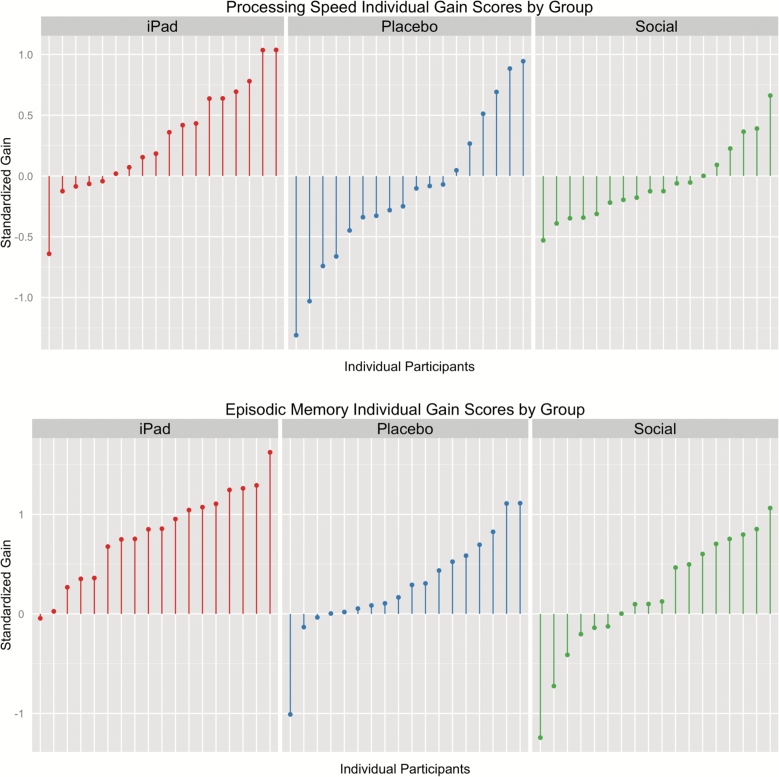
- Compared with both controls, the iPad group improved more in processing speed: overall Group × Time interaction F(2,51) = 4.35, p = .018; follow-ups vs Placebo F(1,34) = 5.80, p = .022, and vs Social F(1,34) = 8.35, p = .007.
- Compared with both controls, the iPad group improved more in episodic memory: overall Group × Time interaction F(2,51) = 7.31, p = .002; follow-ups vs Placebo F(1,34) = 10.44, p = .003, and vs Social F(1,34) = 12.22, p = .001.
- No significant effects were observed for mental control or visuospatial processing; the paper also notes that all effects except processing speed between iPad and Placebo remained significant after Bonferroni correction.
## Methods
- Design: three-group intervention with pretest/posttest cognitive testing; the iPad group was compared with a passive Placebo group and a Social group with interaction but no active skill acquisition.
- Sample: 54 community-dwelling older adults aged 60–90, with high school education or greater, limited computer experience, no tablet experience, MMSE ≥ 26, and no major psychiatric or neurologic disorders; groups were matched on age, education, and gender.
- Analysis: cognitive outcomes were grouped into four constructs and analyzed with mixed ANOVAs (Group × Time), followed by pairwise follow-ups and ANCOVAs controlling for pretest scores; net effect sizes were also calculated.
## Limitations
- The paper states that “although this study does not include brain imaging,” so it cannot test the neural scaffolding mechanism directly.
- The paper indicates no long-term follow-up was conducted and says future research should use longitudinal follow-up testing to assess retention of benefits.
- Evident from the text: attrition occurred, especially in the iPad recruitment phase (7 of 25 original recruits did not complete the full intervention and posttesting) and in the Social condition (12 dropped out), which may limit generalizability even though dropouts were not statistically different in age or education.
Model-written summary. Check it against the paper before relying on it.
Integrity signals
Registry
Cites
Statistics
Figures

Verification
Claims the paper makes
3 Valid · 0 Not valid · 16 Not checked · 45 Own results and interpretations
Every source the paper cites for this claim was checked and supports it.
In the paper
“recent evidence demonstrated that older adults who experienced cognitive gains after video game training also showed more efficient neural function through enhancement of electroencephalography (EEG) signal in regions associated with cognitive control (Anguera et al., 2013).”
§ Training Older Adults to Use Tablet Computers: Does It Enhance Cognitive Function? > Discussion
What the sources say
- Supportedcites Anguera et al., 2013 source
The paper’s opening summary (page not specified in our copy) reports that older adults gained cognitive-control benefits after NeuroRacer training. It also reports enhanced EEG measures associated with cognitive control, including midline frontal theta power and frontal–posterior theta coherence. (LLM, conf=0.92)
boostedstates an association- Asserted: passes — The authors put it forward as true.
- Checkable: passes — It can be checked against evidence.
- Load-bearing: unclear — It is unclear whether the paper’s conclusions depend on it.
- Based: passes — The paper gives a reason why it holds.
- Supported
A result the paper reports from its own data — it cites no other source for it, so there is none to check. The quote shows it is in the paper.
In the paper
“Compared with both controls, the iPad group showed greater improvements in episodic memory and processing speed but did not differ in mental control or visuospatial processing.”
§ Training Older Adults to Use Tablet Computers: Does It Enhance Cognitive Function? > Abstract > Results:
plainstates a cause- Asserted: passes — The authors put it forward as true.
- Checkable: passes — It can be checked against evidence.
- Load-bearing: passes — The paper’s conclusions depend on it.
- Based: passes — The paper gives a reason why it holds.
A result the paper reports from its own data — it cites no other source for it, so there is none to check. The quote shows it is in the paper.
In the paper
“Compared with both controls, the iPad group showed greater improvements in episodic memory and processing speed but did not differ in mental control or visuospatial processing.”
§ Training Older Adults to Use Tablet Computers: Does It Enhance Cognitive Function? > Abstract > Results:
plain- Asserted: passes — The authors put it forward as true.
- Checkable: passes — It can be checked against evidence.
- Load-bearing: unclear — It is unclear whether the paper’s conclusions depend on it.
- Based: passes — The paper gives a reason why it holds.
A result the paper reports from its own data — it cites no other source for it, so there is none to check. The quote shows it is in the paper.
In the paper
“Compared with both controls, the iPad group showed greater improvements in episodic memory and processing speed but did not differ in mental control or visuospatial processing.”
§ Training Older Adults to Use Tablet Computers: Does It Enhance Cognitive Function? > Abstract > Results:
plainstates a cause- Asserted: passes — The authors put it forward as true.
- Checkable: passes — It can be checked against evidence.
- Load-bearing: passes — The paper’s conclusions depend on it.
- Based: passes — The paper gives a reason why it holds.
A result the paper reports from its own data — it cites no other source for it, so there is none to check. The quote shows it is in the paper.
In the paper
“Compared with both controls, the iPad group showed greater improvements in episodic memory and processing speed but did not differ in mental control or visuospatial processing.”
§ Training Older Adults to Use Tablet Computers: Does It Enhance Cognitive Function? > Abstract > Results:
plain- Asserted: passes — The authors put it forward as true.
- Checkable: passes — It can be checked against evidence.
- Load-bearing: passes — The paper’s conclusions depend on it.
- Based: passes — The paper gives a reason why it holds.
24 more claims
Create a free account to see all 64 claims and to verify the 1 reference still open.
- Probably not a substantial claim. 21
- It may state two separate claims as one. 21
Claims other papers make about this one
Each is checked against this paper’s own text: does it say what the citing paper says it does?
The source backs part of the claim, not all of it — or backs it for a different population, condition or comparison.
In the citing paper
“Older adults may prefer tablet technology due to the portability and usability they provide vs. computer technology (e.g., adjustable font or icon size), especially to those who have a wide range of motor and visual abilities (Chan et al., 2016).”
From Older Adults Perceptions of Technology and Barriers to Interacting with Tablet Computers: A Focus Group Study (2017) · cites this paper as Chan et al., 2016
Experimental — accuracy not yet measuredThe source backs part of the claim, not all of it — or backs it for a different population, condition or comparison.
In the citing paper
“This attempt to seek engagement in the intellectually challenging and enriched lifestyle could also lead to long-term cognitive resilience and socioemotional well-being during our late lifespan (e.g., [2,16,64,86,92,97,103]).”
From OK Google, Let's Learn: Using Voice User Interfaces for Informal Self-Regulated Learning of Health Topics among Younger and Older Adults (2023) · cites this paper as [16]
Experimental — accuracy not yet measuredThe cited source says what the claim attributes to it.
In the citing paper
“Focus group outcomes confirmed that these protocols used previously with a sample of healthy older adults in the USA were appropriate for a UK sample.”
From Older Adults Perceptions of Technology and Barriers to Interacting with Tablet Computers: A Focus Group Study (2017) · cites this paper as Chan et al., 2016
Statistics recomputed
Every reported test result, recomputed from its test statistic and degrees of freedom. A result shows as not adding up only once an independent check has confirmed it.
- ConsistentF(1, 51) = 7.43reported p = .009 · recomputed p = .009
“F(1,51) = 7.43, p = .009”
- ConsistentF(2, 51) = 4.35reported p = .018 · recomputed p = .018
“F(2,51) = 4.35, p = .018”
- ConsistentF(1, 34) = 5.8reported p = .022 · recomputed p = .022
“F(1,34) = 5.80, p = .022”
- ConsistentF(1, 34) = 8.35reported p = .007 · recomputed p = .007
“F(1,34) = 8.35, p = .007”
- ConsistentF(1, 51) = 42.23reported p < .001 · recomputed p < .001
“F(1,51) = 42.23, p < .001”
5 more recomputed tests
Create a free account to see every test the Stats check recomputed.
Self-check
Percentages, sums and reported differences re-computed from the paper’s own numbers.
Self-check results appear here once an independent check has confirmed them.
Citations
Cites
Folstein, M. F., Folstein, S. E., & McHugh, P. R. (1975) · Journal of Psychiatric Research · doi:10.1016/0022-3956(75)90026-6 · Cited by 88,282
Effects of noise letters upon the identification of a target letter in a nonsearch task
Eriksen, B. A., & Eriksen, C. W. (1974) · Perception & Psychophysics · doi:10.3758/bf03203267 · Cited by 7,230 · cited 2×
“Cognitive construct Measure Dependent variable Composite reliability Processing speed Digit Comparison Total correct on trials with three items .86 Total correct on trials with six items Total correct on trials with nine items Mental control Cogstate Identification Log RT to a 2-forced choice decision .81 Flanker Cent…”
MethodThe processing-speed theory of adult age differences in cognition
Salthouse, T. A. (1996) · Psychological Review · doi:10.1037/0033-295x.103.3.403 · Cited by 5,902 · cited 2×
“…of evidence that even healthy older adults experience age-related declines across multiple facets of cognition (Park & Shaw, 1992; Park et al., 1996; Salthouse, 1996; Salthouse & Babcock, 1991), one major goal of interventions is to improve or maintain cognition in order to promote independence…”
Background(1998) · Cited by 4,172
The adaptive brain: aging and neurocognitive scaffolding
Park, D. C., & Reuter-Lorenz, P. (2009) · Annual Review of Psychology · doi:10.1146/annurev.psych.59.103006.093656 · Cited by 2,790 · cited 1×
“Park and Reuter-Lorenz (2009) have proposed that engagement in such active mental challenge for a sustained period promotes the formation of “neural scaffolds,” that is, supportive neural circuitry that provides a source of additional neural resource compensating for age-related brain shrinkage and…”
BackgroundSelf-citationEffects of Cognitive Training Interventions With Older Adults: A Randomized Controlled Trial
Ball, K., Berch, D. B., Helmers, K. F., Jobe, J. B., Leveck, M. D., Marsiske, M., Morris, J. N., Rebok, G. W., Smith, D. M., Tennstedt, S. L., et al. (2002) · JAMA · doi:10.1001/jama.288.18.2271 · Cited by 2,049
Video game training enhances cognitive control in older adults
Anguera, J. A., Boccanfuso, J., Rintoul, J. L., Al-Hashimi, O., Faraji, F., Janowich, J., Kong, E., Larraburo, Y., Rolle, C., Johnston, E., et al. (2013) · Nature · doi:10.1038/nature12486 · Cited by 1,666
Decomposing adult age differences in working memory
Salthouse, T. A., & Babcock, R. L. (1991) · Developmental Psychology · doi:10.1037/0012-1649.27.5.763 · Cited by 1,373 · cited 2×
“…even healthy older adults experience age-related declines across multiple facets of cognition (Park & Shaw, 1992; Park et al., 1996; Salthouse, 1996; Salthouse & Babcock, 1991), one major goal of interventions is to improve or maintain cognition in order to promote independence and quality of life.”
BackgroundMethodThe hopkins verbal learning test: Development of a new memory test with six equivalent forms
Brandt, J. (1991) · Clinical Neuropsychologist · doi:10.1080/13854049108403297 · Cited by 1,317 · cited 2×
“Episodic memory was measured using the Modified Hopkins Verbal Learning Task (HVLT; Brandt, 1991) and the Cambridge Neuropsychological Test Automated Battery (CANTAB) Verbal Recognition Memory (Robbins et al.”
MethodStatistical Estimates and Transformed Beta-Variables.
Minton, P. D., & Blom, G. (1960) · The American Mathematical Monthly · doi:10.2307/2308690 · Cited by 1,166
Robbins, T. W., James, M., Owen, A. M., Sahakian, B. J., McInnes, L., & Rabbitt, P. (1994) · Dementia and Geriatric Cognitive Disorders · doi:10.1159/000106735 · Cited by 1,078 · cited 4×
“Cognitive construct Measure Dependent variable Composite reliability Processing speed Digit Comparison Total correct on trials with three items .86 Total correct on trials with six items Total correct on trials with nine items Mental control Cogstate Identification Log RT to a 2-forced choice decision .81 Flanker Cent…”
MethodInfluentialCan training in a real-time strategy video game attenuate cognitive decline in older adults?
Basak, C., Boot, W. R., Voss, M. W., & Kramer, A. F. (2008) · Psychology and Aging · doi:10.1037/a0013494 · Cited by 855
Mediators of long-term memory performance across the life span.
Park, D. C., Smith, A. D., Lautenschlager, G., & Earles, J. L. (1996) · Psychology and Aging · doi:10.1037//0882-7974.11.4.621 · Cited by 624
Self-citationSchmiedek (2010) · Frontiers in Aging Neuroscience · doi:10.3389/fnagi.2010.00027 · Cited by 605
Gutchess, A. H., Welsh, R. C., Hedden, T., Bangert, A., Minear, M., Liu, L. L., & Park, D. C. (2005) · Journal of Cognitive Neuroscience · doi:10.1162/0898929052880048 · Cited by 463 · cited 1×
“There is a large literature suggesting that older adults indeed show such compensatory neural activity compared with young, particularly in frontal cortex (e.g., Gutchess et al., 2005).”
BackgroundSelf-citationThe Impact of Sustained Engagement on Cognitive Function in Older Adults: The Synapse Project
Park, D. C., Lodi-Smith, J., Drew, L., Haber, S., Hebrank, A., Bischof, G. N., & Aamodt, W. (2014) · Psychological Science · doi:10.1177/0956797613499592 · Cited by 404 · cited 7×
“To equate the numbers for the three groups, the 18 participants from the iPad intervention who completed the program were matched on age, education, and gender to 18 participants from the Social and Placebo control conditions in the Synapse Project (Park et al., 2013).”
BackgroundMethodInfluentialSelf-citationRelation of cognitive activity to risk of developing Alzheimer disease
Wilson, R. S., Scherr, P. A., Schneider, J. A., Tang, Y., & Bennett, D. A. (2007) · Neurology · doi:10.1212/01.wnl.0000271087.67782.cb · Cited by 400
Early and late life cognitive activity and cognitive systems in old age
WILSON, R. S., BARNES, L. L., KRUEGER, K. R., HOGANSON, G., BIENIAS, J. L., & BENNETT, D. A. (2005) · Journal of the International Neuropsychological Society · doi:10.1017/s1355617705050459 · Cited by 355 · cited 1×
“…that individuals who report high participation in mentally stimulating activities (e.g., reading, chess) show less agerelated cognitive decline (Wilson et al., 2003, 2005) and have a decreased risk of Alzheimer’s disease than those who participate less (Wilson, Scherr, Schneider, Tang, &…”
BackgroundCarlson, M. C., Saczynski, J. S., Rebok, G. W., Seeman, T., Glass, T. A., McGill, S., Tielsch, J., Frick, K. D., Hill, J., & Fried, L. P. (2008) · The Gerontologist · doi:10.1093/geront/48.6.793 · Cited by 296 · cited 1×
“…et al., 2013; Basak, Boot, Voss, & Kramer, 2008; Schmiedek, Lovden, & Lindenberger, 2010) and engaging in cognitively challenging activities (e.g., Carlson et al., 2008; Stine-Morrow, Parisi, Morrow, & Park, 2008; Tranter & Koutstaal, 2008) have been linked to cognitive improvement, most of the…”
Cognitive activity and cognitive decline in a biracial community population
Wilson, R. S., Bennett, D. A., Bienias, J. L., Mendes de Leon, C. F., Morris, M. C., & Evans, D. A. (2003) · Neurology · doi:10.1212/01.wnl.0000083989.44027.05 · Cited by 199 · cited 1×
“…that individuals who report high participation in mentally stimulating activities (e.g., reading, chess) show less agerelated cognitive decline (Wilson et al., 2003, 2005) and have a decreased risk of Alzheimer’s disease than those who participate less (Wilson, Scherr, Schneider, Tang, &…”
BackgroundThe effects of an engaged lifestyle on cognitive vitality: A field experiment.
Stine-Morrow, E. A. L., Parisi, J. M., Morrow, D. G., & Park, D. C. (2008) · Psychology and Aging · doi:10.1037/a0014341 · Cited by 186
Self-citationDeveloping technology to support the functional independence of older adults
Mynatt, E. D., & Rogers, W. A. (2001) · Ageing International · doi:10.1007/s12126-001-1014-5 · Cited by 169 · cited 2×
“475”
BackgroundImproving Cognitive Function in Older Adults: Nontraditional Approaches
Park, D. C., Gutchess, A. H., Meade, M. L., & Stine-Morrow, E. A. L. (2007) · The Journals of Gerontology Series B: Psychological Sciences and Social Sciences · doi:10.1093/geronb/62.special_issue_1.45 · Cited by 159 · cited 2×
“The study (referred to later in this article as the “Synapse Project”) was based on a theoretical distinction between “productive” and “receptive” engagement (Park et al., 2007).”
BackgroundSelf-citationComputer communication as an aid to independence for older adults
CZAJA, S. J., GUERRIER, J. H., NAIR, S. N., & LANDAUER, T. K. (1993) · Behaviour & Information Technology · doi:10.1080/01449299308924382 · Cited by 141
Tranter, L. J., & Koutstaal, W. (2008) · Aging Neuropsychology and Cognition · doi:10.1080/13825580701322163 · Cited by 130 · cited 2×
“…Schmiedek, Lovden, & Lindenberger, 2010) and engaging in cognitively challenging activities (e.g., Carlson et al., 2008; Stine-Morrow, Parisi, Morrow, & Park, 2008; Tranter & Koutstaal, 2008) have been linked to cognitive improvement, most of the research to date has focused on cognitive training.”
BackgroundEffect of environmental support on implicit and explicit memory in younger and older adults.
Park, D. C., & Shaw, R. J. (1992) · Psychology and Aging · doi:10.1037/0882-7974.7.4.632 · Cited by 93 · cited 1×
“In light of the large body of evidence that even healthy older adults experience age-related declines across multiple facets of cognition (Park & Shaw, 1992; Park et al., 1996; Salthouse, 1996; Salthouse & Babcock, 1991), one major goal of interventions is to improve or maintain cognition in order…”
BackgroundSelf-citationOASIS Connections: Results From an Evaluation Study
Czaja, S. J., Lee, C. C., Branham, J., & Remis, P. (2012) · The Gerontologist · doi:10.1093/geront/gns004 · Cited by 29
Research works printed but not linked: 1
- 10.1037/0882-7974.11.4.621 · DOI · Paper page
Cited by
Vaportzis, E., Giatsi Clausen, M., & Gow, A. J. (2017) · Frontiers in Psychology · doi:10.3389/fpsyg.2017.01687 · Cited by 916
“Older adults may prefer tablet technology due to the portability and usability they provide vs. computer technology (e.g., adjustable font or icon size), especially to those who have a wide range of motor and visual abilities (Chan et al., 2016).”
BackgroundMethodInfluentialCzaja, S. J., Boot, W. R., Charness, N., Rogers, W. A., & Sharit, J. (2018) · The Gerontologist · doi:10.1093/geront/gnw249 · Cited by 466
Theories of Memory and Aging: A Look at the Past and a Glimpse of the Future
Park, D. C., & Festini, S. B. (2017) · The Journals of Gerontology Series B: Psychological Sciences and Social Sciences · doi:10.1093/geronb/gbw066 · Cited by 221
Self-citationInformation and Communication Technology Use Is Related to Higher Well-Being Among the Oldest-Old
Sims, T., Reed, A. E., & Carr, D. C. (2016) · The Journals of Gerontology Series B: Psychological Sciences and Social Sciences · doi:10.1093/geronb/gbw130 · Cited by 221
“, processing speed and episodic memory) after 10 weeks (Chan et al., 2016).”
BackgroundDigital neuropsychology: challenges and opportunities at the intersection of science and software
Germine, L., Reinecke, K., & Chaytor, N. S. (2019) · The Clinical Neuropsychologist · doi:10.1080/13854046.2018.1535662 · Cited by 171
“Take for example the observation that tablet computers are easier to learn to use for older adults than traditional desktop computers (Chan, Haber, Drew, & Park, 2016): the motor demands of touchscreens are more intuitive and lower than mouse and key-board input, and easy-to-use pinch and zoom…”
Background
Metadata
- Authors
- Chan, M. Y., Haber, S., Drew, L. M., & Park, D. C.
- Affiliations
- The University of Texas at Dallas (US)
- Corresponding author
- Chan, Micaela Y.
- Venue
- The Gerontologist
- Publisher
- Oxford University Press (OUP)
- Published
- 2014-06-13
- Volume
- 56
- Issue
- 3
- Pages
- 475-484
- ISSN
- 0016-9013 (ISSN-L)
- 1758-5341
- PMC
- PMC4873760
- OpenAlex
- W2111816181
- Cited by
- 218
- References
- 31
- Citations by year
- 2026: 13 · 2025: 26 · 2024: 19 · 2023: 14 · 2022: 23 · 2021: 22 · 2020: 21 · 2019: 21 · 2018: 21 · 2017: 15 · 2016: 16 · 2015: 5 · 2014: 2
- FWCI
- 34.89
- Type
- journal article
- Language
- en
- Open access
- hybrid
- doi.org
- Licence
- cc-by-nc
- Locations
- The Gerontologist (publishedVersion, cc-by-nc)
- Europe PMC (PubMed Central) (publishedVersion, cc-by-nc)
- PubMed Central (publishedVersion, cc-by-nc)
- PubMed (publishedVersion)
- HighWire Press Open Archive (submittedVersion)
- Funders
- National Institute on Aging (5R01AG026589-02)
- Topics
- Health Sciences › Medicine › Geriatrics and Gerontology › Technology Use by Older Adults
- Social Sciences › Psychology › Developmental and Educational Psychology › Aging and Gerontology Research
- Social Sciences › Psychology › Experimental and Cognitive Psychology › Cognitive Functions and Memory
- Keywords
- older adults, tablet computers, cognitive function, episodic memory, processing speed, skill acquisition, technology training, social interaction, cognitive aging
- MeSH terms
- Activities of Daily Living, Aged, Aged, 80 and over, Aging, Cognition, Cognition Disorders, Computer User Training, Female, Humans, Learning, Male, Computers, Handheld
About these checks
Registry, retraction, Cites and statistics results are computed, not judged, with one exception: a printed reference that no index lists is read once by a model before it counts as a citation error. Claims are extracted by a model and kept only when their quote appears verbatim in the text; each cited source is then checked, with a model’s help, for whether it says what the claim relies on. Those verdicts can be wrong — read the claim’s quote and the cited source before relying on one.
A language model drew the claims from the paper on 2026-09-30, under version 3 of the claim definition (model deepseek-v4.1-flash, prompt extract-v3).
A second model labelled each claim on 2026-09-30 (model jev-1.13-20260917, definition revision gold-guideline-v0.2).
Cited sources are checked with a language model’s help (gpt-6-sol).
Statistics and arithmetic are recomputed, not judged.
Confidence bands are shown only for fields calibrated on our annotated test set. None is calibrated yet, so no band is shown.
What counts as a claim ›How we measure confidence ›How we check this ›
Are you an author, or do you see a problem with this page? Request a review
Data sources
Bibliographic data: Semantic Scholar, OpenAlex, Crossref.
Contains information from the Semantic Scholar Academic Graph Datasets, made available under the ODC Attribution License (ODC-BY 1.0).
Semantic Scholar’s data is described in: Kinney, R., et al. (2023). The Semantic Scholar Open Data Platform. arXiv:2301.10140.
