

ESHRE guideline: endometriosis
Open accessThe DOI matches its Crossref record; 231 of the 250 references it cites were found in a registry or an index; 42 of the 130 sources its claims cite were checked for support.
Abstract
European Society of Human Reproduction and Embryology (ESHRE) clinical guideline on diagnosis and management of endometriosis. Focuses on recommendations for surgical and medical management of pain and infertility. Provides guidance on when to perform surgery for deep infiltrating endometriosis.
Overview
CoChat Summary
TL;DR
This 2022 ESHRE guideline provides 109 recommendations on the diagnosis and management of endometriosis, covering pain, infertility, recurrence, adolescents, menopause, extrapelvic and asymptomatic disease, prevention, and cancer. It updates prior ESHRE guidelines, with five topics where significant changes in clinical practice are expected.
Key findings
- The guideline contains 109 recommendations: 79 supported by research data and 30 good practice points (GPPs), plus 30 research recommendations.
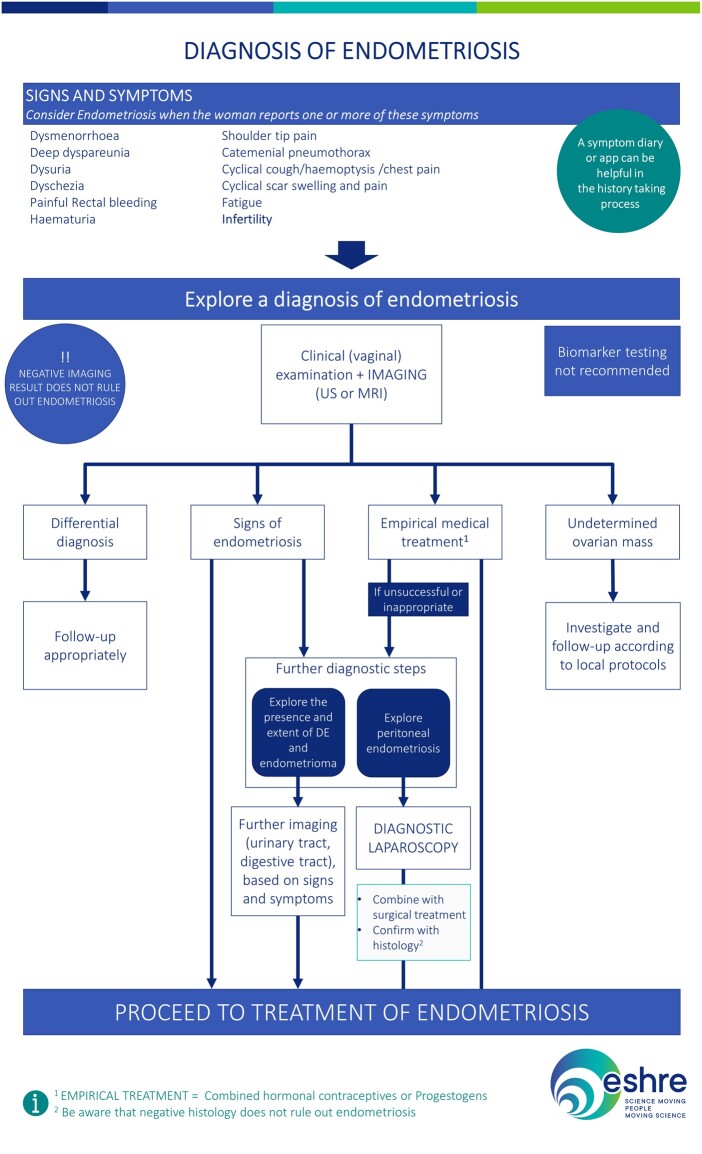
- The diagnostic process challenges laparoscopy and histology as gold standard tests; it recommends imaging (ultrasound or MRI) in the diagnostic work-up, advises against biomarkers for diagnosis, and reserves laparoscopy for patients with negative imaging or unsuccessful/inappropriate empirical treatment.
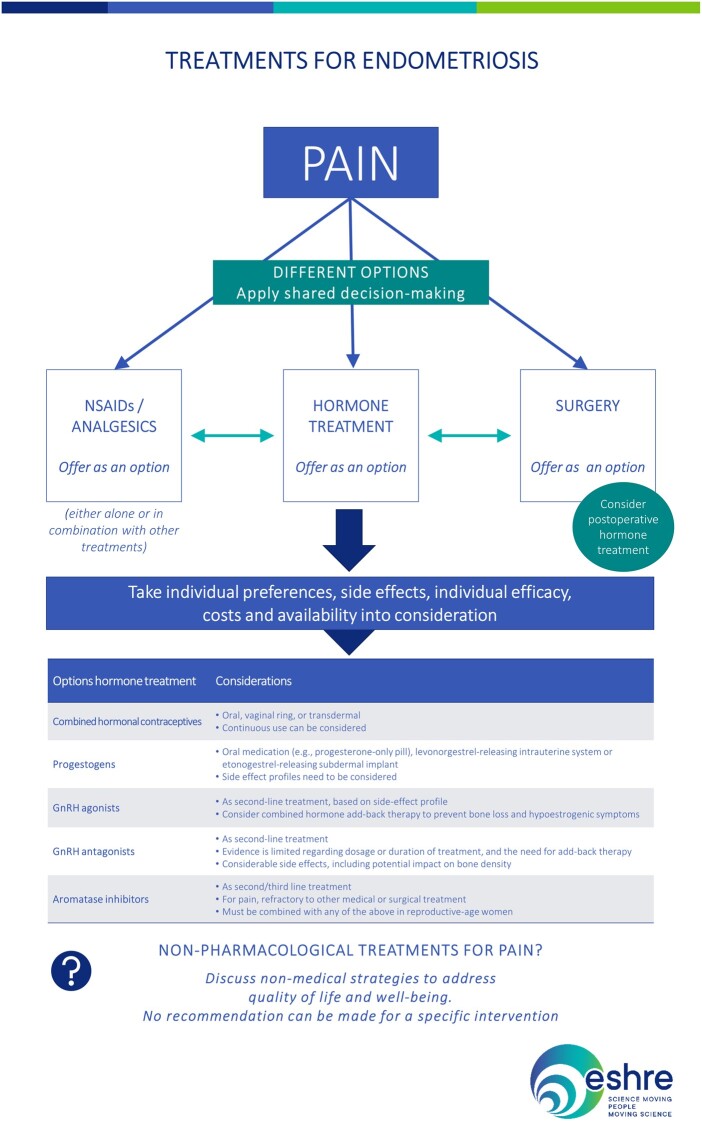
- Treatment options for endometriosis-associated pain include analgesics/NSAIDs, hormonal treatments (combined hormonal contraceptives, progestogens, GnRH agonists or antagonists, aromatase inhibitors), and surgery; five topics with significant changes include the diagnostic process, GnRH antagonists as second-line, postoperative medical treatment for pain, no extended GnRH agonist before ART, and use of the endometriosis fertility index (EFI).
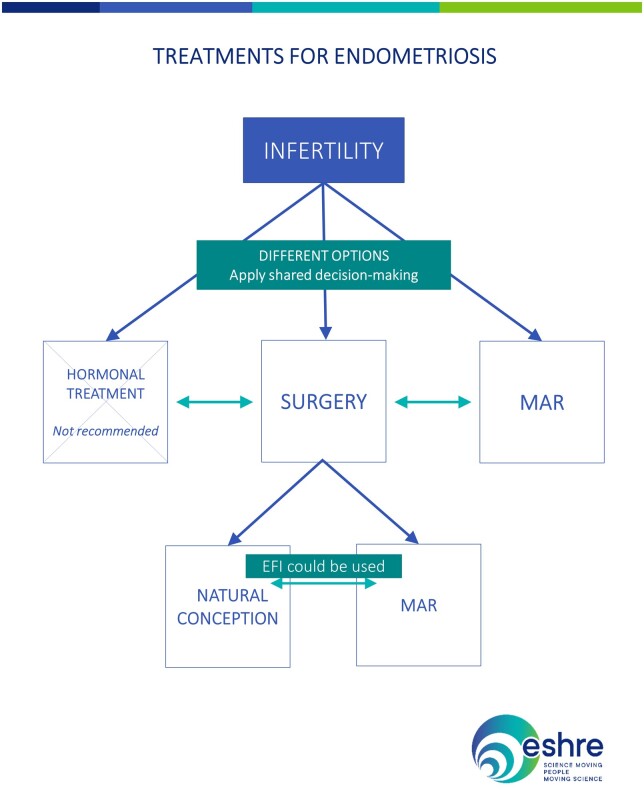
- For endometriosis-associated infertility, surgery and/or medically assisted reproduction are feasible; ovarian suppression, pentoxifylline/anti-inflammatory drugs/letrozole outside ovulation induction, and routine surgery before ART for rASRM stage I/II or endometrioma are not recommended.
Methods
- The guideline was developed according to ESHRE’s structured methodology; 42 key questions were formulated (7 narrative, 35 PICO), with PubMed/MEDLINE and Cochrane searches from inception to 1 December 2020, limited to English-language studies.
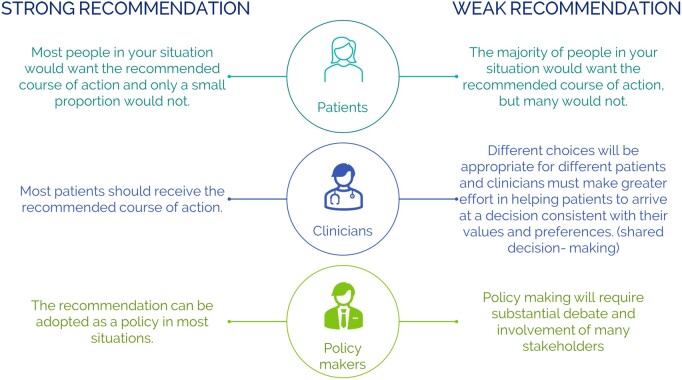
- Evidence was assessed and summarized in evidence tables; recommendations were drafted by specialist subgroups, discussed in core guideline development group meetings until consensus, labelled strong or weak, and graded High, Moderate, Low, or Very low; GPPs were added where relevant.
- A stakeholder review ran from 24 June to 15 August 2021; 56.5% of the 253 comments resulted in an adaptation or correction. The guideline will be considered for update 4 years after publication, with an intermediate assessment at 2 years.
Limitations
- Stated: the guideline describes different management options but, based on existing evidence, no firm recommendations could be formulated on the most appropriate treatments; for specific clinical issues such as asymptomatic endometriosis or extrapelvic endometriosis, evidence is too scarce to make evidence-based recommendations.
- Stated: there is an urgent need for more research on the most appropriate diagnostic and treatment options and on the natural course of the disease.
- Evident from the text: many recommendations are weak or based on low/very low-quality evidence or GPPs; no prognostic markers exist to select patients who would benefit from surgery; no specific non-medical intervention can be recommended; and heterogeneity prevented conclusions on surgical techniques for deep endometriosis-associated pain.
Model-written summary. Check it against the paper before relying on it.
Integrity signals
Registry
Cites
Statistics
Figures
Verification
Claims the paper makes
30 Valid · 5 Not valid · 26 Not checked · 25 Own results and interpretations
At least one cited source doesn’t support this claim or points to a different paper, and none confirmed it — see the verdicts below.
In the paper
“Clinicians may consider operative laparoscopy for the treatment of endometrioma-associated infertility as it may increase their chance of natural pregnancy, although no data from comparative studies exist (Dan and Limin, 2013; Alborzi et al., 2019; Candiani et al., 2020).”
§ ESHRE guideline: endometriosis† > Results > Treatment of endometriosis-associated infertility
What the sources say
- Not checked — no full text of the sourcecites Dan and Limin, 2013 matched to “Laparoscopic ovarian cystectomy versus fenestration/coagulation or laser vaporization for the treatment of endometriomas: a meta-analysis of randomized controlled trials” (2013) source
- Disputedcites Alborzi et al., 2019 matched to “The success of various endometrioma treatments in infertility: a systematic review and meta-analysis of prospective studies” (2019) sourceExperimental — accuracy not yet measured
The Results describe a prospective randomized trial comparing two laparoscopic treatments for endometriomas and reporting pregnancy rates after treatment without medication. That contradicts the categorical claim that no comparative-study data exist for operative laparoscopy and natural pregnancy. The trial compares two operations, however, not surgery against no surgery. (LLM, conf=0.83)
Checked by a reasoning model — may be wrong.
- Not checked — no full text of the sourcecites Candiani et al., 2020 matched to “Recurrence Rate after “One-Step” CO2 Fiber Laser Vaporization versus Cystectomy for Ovarian Endometrioma: A 3-Year Follow-up Study” (2020) source
hedged- Asserted: passes — The authors put it forward as true.
- Checkable: passes — It can be checked against evidence.
- Load-bearing: passes — The paper’s conclusions depend on it.
- Based: passes — The paper gives a reason why it holds.
The cited sources support only part of this claim — read each source’s verdict below.
In the paper
“Both GnRH antagonist and agonist protocols can be offered based on patients’ and physicians’ preferences as no difference in pregnancy or live birth rate has been demonstrated (Pabuccu et al., 2007; Rodriguez-Purata et al., 2013; Bastu et al., 2014; Kolanska et al., 2017; Drakopoulos et al., 2018).”
§ ESHRE guideline: endometriosis† > Results > Treatment of endometriosis-associated infertility
What the sources say
- Not checked — no full text of the sourcecites Pabuccu et al., 2007 matched to “GnRH agonist and antagonist protocols for stage I-II endometriosis and endometrioma in in vitro fertilization/intracytoplasmic sperm injection cycles” (2007) source
- Not checked — no full text of the sourcecites Rodriguez-Purata et al., 2013 matched to “Endometriosis and IVF: are agonists really better? Analysis of 1180 cycles with the propensity score matching” (2013) source
- Partly supportedcites Bastu et al., 2014 matched to “Comparison of ovulation induction protocols after endometrioma resection” (2014) sourceExperimental — accuracy not yet measured
The Results (Table 2; page not provided) show no significant difference in pregnancy or ongoing-pregnancy rates between protocols among IVF patients who had undergone endometrioma resection. The Conclusions (page not provided) call for further studies evaluating live birth rates, so this paper does not establish that live birth rates are similar. Its study population is also narrower than women with endometriosis generally. (LLM, conf=0.91)
boosted- Asserted: passes — The authors put it forward as true.
- Checkable: passes — It can be checked against evidence.
- Load-bearing: passes — The paper’s conclusions depend on it.
- Based: passes — The paper gives a reason why it holds.
The cited sources support only part of this claim — read each source’s verdict below.
In the paper
“Women with endometriosis can be reassured regarding the safety of ART since the recurrence rates are not increased compared to those women not undergoing ART (Benaglia et al., 2008; Somigliana et al., 2019).”
§ ESHRE guideline: endometriosis† > Results > Treatment of endometriosis-associated infertility
What the sources say
- Could not verifycites Benaglia et al., 2008 matched to “Endometrioma and oocyte retrieval-induced pelvic abscess: a clinical concern or an exceptional complication?” (2008) sourceExperimental — accuracy not yet measured
The Abstract (page unavailable) says the study estimated pelvic-abscess frequency after oocyte retrieval in women with endometriomas. Searches for endometriosis recurrence after IVF and a comparison with women not undergoing IVF found no passage addressing either point. (LLM, conf=0.76)
- Partly supportedcites Somigliana et al., 2019 matched to “Ovarian stimulation and endometriosis progression or recurrence: a systematic review” (2019) sourceExperimental — accuracy not yet measured
The Discussion (page unavailable) describes moderately supported, reassuring evidence that IVF has a limited impact on endometriosis recurrence. But the claim extends that reassurance to ART generally: the review's discussion of IUI (page unavailable) identifies a possible increased recurrence risk, and the Discussion says the evidence is incomplete. (LLM, conf=0.88)
plain- Asserted: passes — The authors put it forward as true.
- Checkable: passes — It can be checked against evidence.
- Load-bearing: passes — The paper’s conclusions depend on it.
- Based: passes — The paper gives a reason why it holds.
- Could not verify
The cited sources support only part of this claim — read each source’s verdict below.
In the paper
“The extended administration of GnRH agonist prior to ART treatment to improve live birth rate in infertile women with endometriosis is not recommended, as the benefit is uncertain (Georgiou et al., 2019; Cao et al., 2020; Kaponis et al., 2020).”
§ ESHRE guideline: endometriosis† > Results > Treatment of endometriosis-associated infertility
What the sources say
- Not checked — no full text of the sourcecites Georgiou et al., 2019 matched to “Long-term GnRH agonist therapy before in vitro fertilisation (IVF) for improving fertility outcomes in women with endometriosis” (2019) source
- Partly supportedcites Cao et al., 2020 matched to “The effectiveness of different down-regulating protocols on in vitro fertilization-embryo transfer in endometriosis: a meta-analysis” (2020) sourceExperimental — accuracy not yet measured
The Discussion reports that a Cochrane review found uncertain effects of long-term GnRH agonist therapy on pregnancy outcomes in infertile patients with endometriosis. Cao et al. do not establish uncertainty specifically for live birth rate or recommend against extended treatment; their own analysis reports improved clinical pregnancy rates in some groups. (LLM, conf=0.82)
- Not checked — no full text of the sourcecites Kaponis et al., 2020 matched to “Ultralong administration of gonadotropin-releasing hormone agonists before in vitro fertilization improves fertilization rate but not clinical pregnancy rate in women with mild endometriosis: a prospective, randomized, controlled trial” (2020) source
plain- Asserted: passes — The authors put it forward as true.
- Checkable: passes — It can be checked against evidence.
- Load-bearing: passes — The paper’s conclusions depend on it.
- Based: passes — The paper gives a reason why it holds.
The cited sources support only part of this claim — read each source’s verdict below.
In the paper
“Presacral neurectomy (PSN) is beneficial for treatment of endometriosis-associated midline pain as an adjunct to conventional laparoscopic surgery, but it should be stressed that PSN requires a high degree of skill and is associated with an increased risk of adverse effects such as intraoperative bleeding, and postoperative constipation, urinary urgency and painless first stage of labour (Miller e”
§ ESHRE guideline: endometriosis† > Results > Treatment of endometriosis-associated pain
What the sources say
- Partly supportedcites Miller et al., 2020 matched to “Clinical utility of presacral neurectomy as an adjunct to conservative endometriosis surgery: systematic review and meta-analysis of controlled studies” (2020) sourceExperimental — accuracy not yet measured
The Discussion reports that adjunctive presacral neurectomy reduced treatment failure for endometriosis-related midline pain. However, the Conclusion limits the finding to well-selected patients and says it *may* provide greater relief; the Results include both laparoscopic and open surgery, rather than establishing the benefit specifically for conventional laparoscopic surgery. (LLM, conf=0.84)
plainstates a cause- Asserted: passes — The authors put it forward as true.
- Checkable: passes — It can be checked against evidence.
- Load-bearing: passes — The paper’s conclusions depend on it.
- Based: passes — The paper gives a reason why it holds.
- Partly supported
54 more claims · 22 with their cited sources checked
Create a free account to see all 86 claims and every source verdict.
- Probably not a substantial claim. 26
- It may state two separate claims as one. 3
Claims other papers make about this one
Each is checked against this paper’s own text: does it say what the citing paper says it does?
The source backs part of the claim, not all of it — or backs it for a different population, condition or comparison.
In the citing paper
“although the major associations have difficulty siding sharply in favour of one treatment over another”
From IVF/ICSI or surgery as first approach for the treatment of infertility associated with ovarian and deep infiltrating endometriosis? A systematic review and meta-analysis. (2026) · cites this paper as Becker et al., 2022
Experimental — accuracy not yet measuredThe source backs part of the claim, not all of it — or backs it for a different population, condition or comparison.
In the citing paper
“it appears that, for some of them, patients with ovarian endometriomas (OMA) should not be referred for surgery, except in cases of pelvic pain”
From IVF/ICSI or surgery as first approach for the treatment of infertility associated with ovarian and deep infiltrating endometriosis? A systematic review and meta-analysis. (2026) · cites this paper as Becker et al., 2022
Experimental — accuracy not yet measuredThe source backs part of the claim, not all of it — or backs it for a different population, condition or comparison.
In the citing paper
“Therefore, optimal HRT in young women who have undergone pelvic clearance for endometriosis remains uncertain.”
From HRT in Women Undergoing Pelvic Clearance for Endometriosis—A Case Report and a National Survey (2023) · cites this paper as [10]
Experimental — accuracy not yet measuredThe source backs part of the claim, not all of it — or backs it for a different population, condition or comparison.
In the citing paper
“This has led the British Menopause Society (BMS) and European Society of Human Reproduction and Embryology (ESHRE) to recommend continuous C-HRT and avoidance of EO-HRT in this group of women at least until age of natural menopause [9,10].”
From HRT in Women Undergoing Pelvic Clearance for Endometriosis—A Case Report and a National Survey (2023) · cites this paper as [10]
Experimental — accuracy not yet measuredThe source backs part of the claim, not all of it — or backs it for a different population, condition or comparison.
In the citing paper
“Danazol is no longer recommended as a first-line therapy due to its bothersome side effect profile, such as acne, edema, vaginal spotting, weight gain, muscle cramps, deepening of voice, and increase in facial hair [ 79 ].”
From Thoracic Endometriosis Syndrome: A Comprehensive Review and Multidisciplinary Approach to Management (2024) · cites this paper as [79]
Experimental — accuracy not yet measured
3 more claims about this paper
Create a free account to see every claim other papers make about this one.
Citations
Cites
Zondervan, K. T., Becker, C. M., & Missmer, S. A. (2020) · New England Journal of Medicine · doi:10.1056/nejmra1810764 · Cited by 2,249
Self-citationESHRE guideline: management of women with endometriosis
Dunselman, G. A. J., Vermeulen, N., Becker, C., Calhaz-Jorge, C., D'Hooghe, T., De Bie, B., Heikinheimo, O., Horne, A. W., Kiesel, L., Nap, A., et al. (2014) · Human Reproduction · doi:10.1093/humrep/det457 · Cited by 2,211 · cited 2×
“The current guideline and recommendations are an update of the ESHRE endometriosis guidelines published in 2013 and 2005 (Kennedy et al. , 2005; Dunselman et al. , 2014).”
Self-citationEskenazi, B., & Warner, M. L. (1997) · Obstetrics and Gynecology Clinics of North America · doi:10.1016/s0889-8545(05)70302-8 · Cited by 1,617
ESHRE guideline for the diagnosis and treatment of endometriosis
Kennedy, S., Bergqvist, A., Chapron, C., D’Hooghe, T., Dunselman, G., Greb, R., Hummelshoj, L., Prentice, A., & Saridogan, E. (2005) · Human Reproduction · doi:10.1093/humrep/dei135 · Cited by 1,584
Pearce, C. L., Templeman, C., Rossing, M. A., Lee, A., Near, A. M., Webb, P. M., Nagle, C. M., Doherty, J. A., Cushing-Haugen, K. L., Wicklund, K. G., et al. (2012) · The Lancet Oncology · doi:10.1016/s1470-2045(11)70404-1 · Cited by 939 · cited 1×
“Routine US monitoring of asymptomatic endometriosis can be considered (Maouris, 1991; Alca´zar et al. , 2005; Pearce et al. , 2012; Serati et al. , 2013).”
High prevalence of endometriosis in infertile women with normal ovulation and normospermic partners
Meuleman, C., Vandenabeele, B., Fieuws, S., Spiessens, C., Timmerman, D., & D'Hooghe, T. (2009) · Fertility and Sterility · doi:10.1016/j.fertnstert.2008.04.056 · Cited by 606
Cervical cancer and use of hormonal contraceptives: a systematic review
Smith, J. S., Green, J., de Gonzalez, A. B., Appleby, P., Peto, J., Plummer, M., Franceschi, S., & Beral, V. (2003) · The Lancet · doi:10.1016/s0140-6736(03)12949-2 · Cited by 544
Imaging modalities for the non-invasive diagnosis of endometriosis
Nisenblat, V., Bossuyt, P. M., Farquhar, C., Johnson, N., & Hull, M. L. (2016) · Cochrane Database of Systematic Reviews · doi:10.1002/14651858.cd009591.pub2 · Cited by 538 · cited 2×
“…in endometrial tissue, blood, menstrual or uterine fluids to diagnose endometriosis (Mol et al. , 1998; May et al. , 2010; May et al. , 2011; Liu et al. , 2015; Cosar et al. , 2016; Gupta et al. , 2016; Hirsch et al. , 2016; Nisenblat et al. , 2016a; Vanhie et al. , 2019; Moustafa et al. , 2020).”
Sutton, C. J. G., Ewen, S. P., Whitelaw, N., & Haines, P. (1994) · Fertility and Sterility · doi:10.1016/s0015-0282(16)56990-8 · Cited by 525
Wentzensen, N., Poole, E. M., Trabert, B., White, E., Arslan, A. A., Patel, A. V., Setiawan, V. W., Visvanathan, K., Weiderpass, E., Adami, H.-O., et al. (2016) · Journal of Clinical Oncology · doi:10.1200/jco.2016.66.8178 · Cited by 514 · cited 1×
“…about the risk of malignancy associated with the use of hormonal contraceptives (Smith et al. , 2003; Zucchetto et al. , 2009; Gierisch et al. , 2013; Havrilesky et al. , 2013; Braganza et al. , 2014; Berlanda et al. , 2016; Wentzensen et al. , 2016; Butt et al. , 2018; Michels et al. , 2018).”
Cited by
Items 1,201–1,300 of 1,654
Is the reported benefit of the Endo-App truly sustained?
Küçük, Z. (2026) · Archives of Gynecology and Obstetrics · doi:10.1007/s00404-026-08582-1
Appendiceal intussusception due to endometriosis: a case report
Holloway, C., Butera, C., Bronson, T., & Spatar, J. (2026) · Journal of Surgical Case Reports · doi:10.1093/jscr/rjag267
“Endometriosis is a condition of transplantation of endometrial tissues outside of the uterine cavity affecting 2%–10% of females [6].”
Wu, E., Nassar, D., Ginn, D. N., & Romeroso, B. D. (2026) · Menopause The Journal of The North American Menopause Society · doi:10.1097/gme.0000000000002832
Emegoakor, A. C., Igwilo, K. C., Obi, P. N., et al. (2026) · Research Square · doi:10.21203/rs.3.rs-9953277/v1
Wang, S. Y., Li, B., Ye, X., Tai, Q., Cheng, H., 祝洪澜, Liu, H., Wei, X., Gong, J., Zhou, X., et al. (2026) · Journal of Clinical Medicine · doi:10.3390/jcm15083021
“Consequently, the 2022 ESHRE guidelines no longer consider laparoscopy the sole diagnostic standard, but instead advocate an integrated approach based on clinical presentation and imaging findings [10].”
Endometriosis: Pathogenesis, Diagnosis and Treatment, volume II
(2024) · Frontiers research topics · doi:10.3389/978-2-8325-4894-3
Russo, C., Pisante, A., Fabrizi, F., Selntigia, A., Monaco, G., Nocita, E., Yacoub, V., Soreca, G., Ercoli, A., & Exacoustós, C. (2026) · Journal of Clinical Ultrasound · doi:10.1002/jcu.70266
“In addition, the rate of malignant transformation in ovarian endometriomas is approximately 2.5%, compared with a 1.3% lifetime risk of ovarian cancer in the general population (Becker et al. 2022; Kvaskoff et al. 2021).”
InfluentialZhuang, Y., Zan, Y., Ma, T., Huang, X., Li, J., Xia, L., Sa, Y., & Xia, Y. (2026) · Animal Models and Experimental Medicine · doi:10.1002/ame2.70205
Laparoscopic Use of Ethanol Sclerotherapy in the Treatment of Endometriomas: A Narrative Review
Geraerts, A., Bafort, C., Vanhie, A., & Tomassetti, C. (2026) · Journal of Minimally Invasive Gynecology · doi:10.1016/j.jmig.2026.06.029
Self-citationWang, S. Y., Hou, C., Li, B., Cheng, H.-Y., Ye, X. J., 祝洪澜, Li, Y., Chen, R., Dong, S., Li, Y., et al. (2026) · Advanced Science · doi:10.1002/advs.76327
Özturan, A., Aydın, G., Aslan, S., Kuloğlu, E., İşsever, K., & Dülger, A. C. (2026) · Reproductive Sciences · doi:10.1007/s43032-026-02098-4
“Up to 90% of women with endometriosis report gastrointestinal (GI) symptoms such as bloating, nausea, constipation, diarrhoea, and vomiting [3–5].”
Nuclear imaging for endometriosis: a promising advance
Canto, I., & Young, S. L. (2026) · The Lancet Obstetrics Gynaecology & Women s Health · doi:10.1016/s3050-5038(26)00143-3
Diagnóstico e manejo da infertilidade associada à endometriose Número 4 – 2026
da Silva, A. L., Lamaita, R. M., Podgaec, S., Quintáiros, R. D. A., Navarro, P. A., & Ferriani, R. A. (2026) · Femina · doi:10.61622/0100-7254543202606
Muteshi, C., Mwaka, G., Duncan, A., Gitau, S. N., Kathiresan, P., Bwika, J., Yousef, A., & Wandera, E. (2025) · Journal of Endometriosis and Pelvic Pain Disorders · doi:10.1177/22840265241312538
“12,22,23 It is a unique model that is adapted for a low resource setting which also integrates a patient advocacy group in the overall care in a supportive manner, however, there is no access to individual patient records.”
InfluentialSelf-citationPredictive markers of endometriosis: a future perspective
Vallée, A., & Ayoubi, J.-M. (2026) · Archives of Gynecology and Obstetrics · doi:10.1007/s00404-026-08499-9
Gomez‐Llerena, A., Shekawat, P., Pradeep, A., Clifton, V. L., El‐Nashar, S. A., & Carrubba, A. R. (2025) · Journal of Minimally Invasive Gynecology · doi:10.1016/j.jmig.2025.07.020 · Cited by 5
Bogdanova, A. M., Glushkova, V. S., Kvashnina, E. V., Мамин, Э. Л., & Urakov, A. V. (2025) · Ural Medical Journal · doi:10.52420/umj.24.3.157
de Leeuw, R. A., & Mijatovic, V. (2024) · doi:10.1007/978-90-368-3035-5_6
Self-citationAktualisierung der Endometriose-Leitlinie: Empfehlungen für Fertilität und Reproduktionsmedizin
von Versen‐Höynck, F. (2024) · Die Gynäkologie · doi:10.1007/s00129-024-05282-2
Murshid, R. M., Nori, W., Obeid, R. Z., & Akram, W. (2024) · Al-Rafidain Journal of Medical Sciences · doi:10.54133/ajms.v7i1.1016
Ochoa, L. R. V., Vázquez, A. A., & Chavez, M. (2025) · Estudios y Perspectivas Revista Científica y Académica · doi:10.61384/r.c.a..v5i4.1591
Wise, E., Cornish, A., Franklin, M., García, M. D. P. M., Mills, Z., & Beales, D. J. (2026) · Australian and New Zealand Journal of Obstetrics and Gynaecology · doi:10.1111/ajo.70182
Cirkel, C., Göbel, H., Göbel, C., Alkatout, İ., Brüggemann, N., Kaiser, A. K., Minnerup, J., Rody, A., & Cirkel, A. (2025) · Geburtshilfe und Frauenheilkunde · doi:10.1055/a-2715-0626 · Cited by 1
Maldonado, G., Espinoza, C., Arias, A., Munoz, A., Cabrera, G., Johnson, M. C., Espinoza, J. P., Gutiérrez, I., González, P., Owen, G., et al. (2026) · Cells and Development · doi:10.1016/j.cdev.2026.204096
Diagnosis and management of endometriosis-associated infertility Number 4 – 2026
Filho, A. L. D. S., Lamaita, R. M., Podgaec, S., Quintáiros, R. D. A., Navarro, P. A., & Ferriani, R. A. (2026) · Revista Brasileira Ginecologia e Obstetrícia · doi:10.61622/rbgo/2026fps4 · Cited by 2
“(2,3,5,17) Although hormonal therapies are effective for pain con-trol, their mechanism of action is based on suppression of ovulation and estrogen production, which inherently precludes conception during treatment and may delay time to pregnancy.”
InfluentialNandi, M., & Mondal, R. (2026) · Cureus · doi:10.7759/cureus.112350
Medikamentöse Therapie der Endometriose – ein Update
Römer, T. (2023) · Wiener klinisches Magazin · doi:10.1007/s00740-023-00494-z
Prost, P., Pierre, M., Allègre, L., Bottero, C., Letouzey, V., & Huberlant, S. (2026) · Journal of Gynecology Obstetrics and Human Reproduction · doi:10.1016/j.jogoh.2026.103272 · Cited by 1
Endometriosis and early pregnancy outcomes: a registry-based cohort study in Finland
Gurney, J. M., Tuominen, A., Saavalainen, J., Gissler, M., Niinimäki, M. J., Heikinheimo, O., & Saavalainen, L. (2026) · American Journal of Obstetrics and Gynecology · doi:10.1016/j.ajog.2026.01.027 · Cited by 3
Self-citationIs the EMpressin Injection in ENDOmetrioma eXcision Surgery Useful? The EMENDOX Study
Pagano, F., Dedes, I., Vaineau, C., Siegenthaler, F., Imboden, S., & Mueller, M. D. (2025) · Journal of Clinical Medicine · doi:10.3390/jcm14217716 · Cited by 1
“Postoperative hormonal therapy can suppress residual microscopic disease and further reduce the risk of recurrence [4,9,21,26,27].”
Panhipopituitarismo post parto (Sindrome de Sheehan). Estudio de once casos
Velasco, R. C., & García, R. C. (2015) · Revista Peruana de Ginecología y Obstetricia · doi:10.31403/rpgo.v7i722
Chen, S. (2026) · Frontiers in Medicine · doi:10.3389/fmed.2026.1916744
“Current evidence does not justify universal thyroid screening solely on the basis of an endometriosis diagnosis (10, 19) infertility care, and hormonal or surgical treatment, but they do not recommend thyroid testing as a routine endometriosis-specific intervention (2).”
InfluentialTam, T., Mabini, C., Fernandez, C. M., & Levine, E. M. (2026) · Gynecology and Minimally Invasive Therapy · doi:10.4103/gmit.gmit-d-25-00217
Dysmenorrhea in Patients with Adenomyosis: Clinical Manifestations and Pathophysiological Mechanisms
Mandziy, I. (2025) · Lviv clinical bulletin · doi:10.25040/lkv2025.03.052
Differential expression of microRNAs after induction of endometriosis in baboons
Mamillapalli, R., Surmann, H., Joshi, N., Burns, G. W., Fazleabas, A. T., & Taylor, H. S. (2026) · Biology of Reproduction · doi:10.1093/biolre/ioag140 · Cited by 1
Filho, A. L. D. S., Podgaec, S., Quintáiros, R. D. A., & Silva, J. C. R. E. (2026) · Revista Brasileira Ginecologia e Obstetrícia · doi:10.61622/rbgo/2026fps10
“(8,10,12,13) Postoperative hormonal therapy is recommended for most women not seeking immediate pregnancy, as it may reduce recurrence and prolongs symptom-free intervals, regardless of disease phenotype.”
InfluentialSevere Iliopsoas Muscle Endometriosis Managed by a Multidisciplinary Team
Bray, H., Delaloye, N., Kirkpatrick, I. D. C., Baker, P., Shariff, F., & Evans, D. L. (2025) · O&G Open · doi:10.1097/og9.0000000000000064 · Cited by 1
“9 10 – 12 However, this may not be possible, particularly when anatomical planes are obliterated between major nerves and vessels or skeletal muscle is replaced by endometriosis.”
Coexistence of Ovarian Mature Cystic Teratomas and Endometriosis: An Update
Lin, C., & Chae, H. (2026) · International Journal of Women s Health · doi:10.2147/ijwh.s554168
Donnez, J., Becker, C. M., Taylor, H. S., Herrera, F. C., Petraglia, F., Renner, S. P., & Dolmans, M. (2024) · Human Reproduction · doi:10.1093/humrep/deae223
Self-citationEpidemiology of endometriosis based on real-world data in Japan
Ohashi, M., Matsubayashi, J., Sugeta, K., Yano, Y., Kitaoka, K., Murakami, T., & Tsuji, S. (2025) · Reproductive BioMedicine Online · doi:10.1016/j.rbmo.2025.105379 · Cited by 1
Identification of Key miRNAs in Endometriosis
Blandino, F., Barbati, S. A., Forlani, L., Coppola, G., Meschino, N., Cecchinelli, I., Mazzuca, A. C., Veltri, V., Giannico, R., & Calugi, G. (2024) · MicroRNA · doi:10.2174/0122115366333556241014115206
The problem of recurrence of ovarian endometriomas
Tskhay, V. B., Гребенникова, Э. К., & Skuratova, J. N. (2025) · Medical Herald of the South of Russia · doi:10.21886/2219-8075-2025-16-1-5-13
Modern management of endometriosis with various manifestations: Dienogest. A prospective study
Евгеньевна, Ч. Г., Алексеевна, П. В., & Solopova, A. E. (2026) · GYNECOLOGY · doi:10.26442/20795696.2026.1.203570 · Cited by 1
Begovich, E., Baigalmaa, B., Solopova, A. E., Bitsadze, V. O., Son, E. A., & Константинович, Б. Г. (2024) · Vrach · doi:10.29296/25877305-2023-04-07
França, A. R., de Souza, C. F. F., FRANÇA, J. R., & ASSUNÇÃO, K. V. F. (2023) · doi:10.59290/978-65-81549-94-7.10
Endometriosis: surgical management for fertility enhancement
Aase, D. A., & Khan, Z. (2026) · Frontiers in Endocrinology · doi:10.3389/fendo.2026.1861188 · Cited by 1
Shang, K., Xing, H., Zhang, S., Zhang, Y., & Zhang, H. (2025) · Frontiers in Oncology · doi:10.3389/fonc.2025.1732665
The use of combined oral contraceptives in patients with endometriosis
Kuznetsova, I. V. (2023) · Medical alphabet · doi:10.33667/2078-5631-2023-3-14-20
Hypertension Along Women’s Life Course
Kringeland, E. A., & Gerdts, E. (2024) · Springer eBooks · doi:10.1007/978-3-031-65952-2_7
Is surgery necessary for my endometriosis or ‘suspected’ endo?
Avery, J., & Deslandes, A. (2026) · The Conversation · doi:10.64628/aa.pqpsgk7ah
Hà, N. T. T., Hải, Đ. H., & Ánh, N. D. (2025) · Tạp chí Y học lâm sàng Bệnh viện Trung Ương Huế · doi:10.38103/jcmhch.17.3.1
Lemos, M. J., Servidoni, A. C. P., de Mattos, I. L. L., Nakayama, C. M. A., Molisani, J. T., YoussefYoussef, & Abrão, M. S. (2026) · Journal of Minimally Invasive Gynecology · doi:10.1016/j.jmig.2026.07.018 · Cited by 1
Salivary microRNA testing for endometriosis: clinical evaluation in an endometriosis center
Ormos, M., Schneider, M., Heimer, J., Dobosi, A., Höhl, M., & Heubner, M. L. (2026) · European Journal of Obstetrics & Gynecology and Reproductive Biology · doi:10.1016/j.ejogrb.2026.115341 · Cited by 2
The impact of videolaparoscopic surgery in the treatment of endometriosis on depression levels
Neto, J. N., Melo, V. G., Lima, L. C. S., Mendes, A. B. C., Barreto, F. N., Gomes, L. M. R. D. S., & Leal, P. D. C. (2024) · Revista da Associação Médica Brasileira · doi:10.1590/1806-9282.20231651 · Cited by 2
“Surgical treatment also proceeds in cases of suspected ovarian cancer and intestinal or urinary tract obstructions 1,2 .”
BackgroundResultInfluentialYu, J., Yu, F., Zhang, L., Zhang, X., Zhang, J., Zhang, Y., Xiong, L., Li, X., & Chen, W. (2025) · Journal of Ethnopharmacology · doi:10.1016/j.jep.2025.120685
Velho, R. V., Pradier, B., Werner, F., Pogatzki-Zahn, E. M., & Mechsner, S. (2026) · Der Schmerz · doi:10.1007/s00482-026-00958-1
Nyzova, O. A. (2025) · Reports of Vinnytsia National Medical University · doi:10.31393/reports-vnmedical-2025-29(2)-07 · Cited by 1
Coxon, L., Evans, E., Toyé, F., Cox, E., & Vincent, K. (2026) · BJOG An International Journal of Obstetrics & Gynaecology · doi:10.1111/1471-0528.70211 · Cited by 1
Tian, Z. F., Zhang, G., Xie, Y., et al. (2025) · Asian Journal of Surgery · doi:10.1016/j.asjsur.2025.12.047
Intraoperative Proctosigmoidoscopy Following Bowel Endometriosis Surgery: A Retrospective Evaluation
Kulkarni, A. S., Khanna, D. R., Konda, K. R., et al. (2026) · Journal of Minimally Invasive Gynecology · doi:10.1016/j.jmig.2026.03.006
Yu, C., 孙丹邈, & Li, A. (2026) · Frontiers in Immunology · doi:10.3389/fimmu.2026.1925057
Маркін, Л. Б., Isayeva, K., Беседін, О. В., & Kunynets, H. (2026) · Lviv clinical bulletin · doi:10.25040/lkv2026.02.051
Conservative treatment od endometriosis
Trhlík, M. (2025) · Klinická farmakologie a farmacie · doi:10.36290/far.2025.040
Surgeon Subspecialty and Ovarian Preservation in Endometrioma Surgery: A Retrospective Cohort Study
Billow, M. R., Clay, J., Newark, A. C., Yao, M., AlHilli, M. M., & Kho, R. M. (2026) · Journal of Minimally Invasive Gynecology · doi:10.1016/j.jmig.2026.01.036
Verguts, J., & Daniels, T. (2026) · Reproduction and Fertility · doi:10.1530/raf-26-0127
Griffiths, M. J., Brown, M. E., Gibson, D. A., Collins, F., Dunlop, C. E., Saunders, P. T. K., & Horne, A. W. (2025) · medRxiv · doi:10.1101/2025.08.25.25334349
“In international guidelines for endometriosis, it is recommended women with SPE consider surgery to remove SPE lesions based on evidence that this may improve spontaneous pregnancy rates within the first 12 months post-surgery (NICE 2017, Becker, Bokor et al. 2022).”
Self-citationPrediction of MBS Item Codes for Endometriosis Surgery Using Transvaginal Ultrasound
McClenahan, P., Mak, J., Uzuner, C., Gil, A., Eathorne, A., Espada, M., Reid, S., & Condous, G. S. (2025) · Australian and New Zealand Journal of Obstetrics and Gynaecology · doi:10.1111/ajo.70080
Advances in Ultrasound for the Diagnosis of Endometriosis
Li, D., Naftalin, J., & Jurkovic, D. (2026) · The Obstetrician & Gynaecologist · doi:10.1111/tog.70054
Liu, C., & Wang, P. (2024) · Journal of the Chinese Medical Association · doi:10.1097/jcma.0000000000001130
Göklü, Y., Göklü, M. R., İleri, A., Özer, M., Özdemir, Ö., Oğlak, S. C., Tunç, Ş., & Taner, C. E. (2022) · Aegean Journal of Obstetrics and Gynecology · doi:10.46328/aejog.v4i2.120
Miklós, D., Bokor, A., Beretzky, Z., Brodszky, V., Lakat, T., Hudelist, G., Balpataki, L., & Balogh, D. B. (2026) · Preventive Medicine Reports · doi:10.1016/j.pmedr.2026.103501
Self-citationMrugała, M., Fiutowski, M., Dąbrowska, A., Nowak, K., & Milnerowicz-Nabzdyk, E. (2026) · Journal of Clinical Medicine · doi:10.3390/jcm15051995 · Cited by 1
“Endometriosis is a chronic, estrogen-dependent inflammatory disease characterized by the presence of endometrial-like tissue outside the uterus, affecting approximately 10% of women of reproductive age [1,2].”
Inpatient Endometriosis Care in Germany: Hospital Caseloads and their Spatial Distribution
Brauer, L., Ji, L., & Geraedts, M. (2025) · Das Gesundheitswesen · doi:10.1055/a-2683-9705
“Although the ESHRE Endometriosis Guideline [11] no longer re-commends laparoscopy as the diagnostic gold standard, laparoscopy is still the standard procedure to surgical therapy [6].”
Robotic high intensity focused ultrasound treatment of rectal endometriosis
Mazard, A., Dubernard, G., Collinet, P., Dennis, T., Chauveau, B., Basso, M., Estrade, J.-P., Legendre, G., Merlot, B., Warembourg, S., et al. (2026) · European Journal of Obstetrics & Gynecology and Reproductive Biology · doi:10.1016/j.ejogrb.2026.115400
Milane, T., Herbach, U., Jean, M.-A., & Boulley, G. E. (2025) · Women s Reproductive Health · doi:10.1080/23293691.2025.2582496
Anzhel, S., & Kovachev, E. G. (2026) · Journal of Endometriosis and Pelvic Pain Disorders · doi:10.1177/22840265261486499
Dunning, J., Burrows, A., Wynn‐Williams, M., Edmonds, S., Harlow, K., Rowland, W., & Sadler, L. C. (2025) · Australian and New Zealand Journal of Obstetrics and Gynaecology · doi:10.1111/ajo.13942 · Cited by 3
Regarding “Equity and Data Gaps in Real-World Endometriosis Management”
Liu, Z., Li, H., & Tian, L. (2025) · Journal of Minimally Invasive Gynecology · doi:10.1016/j.jmig.2025.09.528
Yuan, G., Lin, B., Xu, G., et al. (2023) · Research Square · doi:10.21203/rs.3.rs-3790360/v1
Kajtezovic, S., Humphries, L. A., & Haber, H. R. (2026) · Current Opinion in Obstetrics & Gynecology · doi:10.1097/gco.0000000000001125
Beyond the Mass Effect: Decoupling Endometrioma Size and Bilaterality from Ovarian Reserve Depletion
Younis, J. S., & Somigliana, E. (2026) · Journal of Minimally Invasive Gynecology · doi:10.1016/j.jmig.2026.08.003
Cecil, A., Vouk, K., Pušić, M. N., Vogler, A., Wenzl, R. J., Prehn, C. P., Adamski, J., & Rižner, T. L. (2026) · bioRxiv (Cold Spring Harbor Laboratory) · doi:10.64898/2026.07.05.736551
“The gold standard for the diagnosis of peritoneal endometriosis is invasive laparoscopy in conjunction with histological examination [17].”
A Rare Mimicker: Renal Endometriosis and Its Diagnostic Pitfalls—Review of Reported Cases
Zečević, N., Tomic, A. M., Rovčanin, M., Mladenović-Marković, A., & Janković, S. (2026) · Diagnostics · doi:10.3390/diagnostics16162535
“…ought to adopt a multidisciplinary approach to decision-making, taking into account individual preferences, side effects, efficacy, costs, and availability when choosing between hormone therapies and surgical interventions for endometriosis-related pain, as per ESHRE Endometriosis Guidelines [65].”
InfluentialVillegas‐Echeverri, J. D., & Carrillo, J. F. (2025) · International Journal of Gynecology & Obstetrics · doi:10.1002/ijgo.70102
Koivurova, S., Mäkelä‐Kaikkonen, J., Laru, J., Ohtonen, P. P., Uimari, O., Niinimäki, M. J., Rautio, T., & Terho, A. (2026) · BMC Women s Health · doi:10.1186/s12905-026-04558-0
“Women with endometriosis are recommended to be offered hormonal treatment to reduce pain and perhaps to prevent or postpone surgery [7].”
Acceptability of a physical activity program using a digital tool in the management of endometriosis
Pavic, T., Terrade, F., & Cabagno, G. (2025) · Disability and Rehabilitation Assistive Technology · doi:10.1080/17483107.2025.2569791 · Cited by 1
Yang, J., Wu, S., Pu, A., Xie, S., & Hu, M. (2026) · Translational Oncology · doi:10.1016/j.tranon.2026.103034 · Cited by 1
da Silva, A. L., Podgaec, S., Quintáiros, R. D. A., & Silva, J. C. R. E. (2026) · Revista Brasileira Ginecologia e Obstetrícia · doi:10.61622/rbgo/2026fps6 · Cited by 2
“(2,21,27-30) Magnetic resonance imaging offers superior sensitivity for deep infiltrating disease and allows pan-oramic pelvic and extrapelvic assessment with lower operator dependency.”
InfluentialNursing care for patients with endometriosis in Aotearoa New Zealand: a survey study
Ellis, K. B., Meador, A., Ponnampalam, A. P., & Wood, R. (2026) · Journal of research in nursing · doi:10.1177/17449871261430232 · Cited by 1
“…dysuria (painful urination), haematuria (bleeding with urination), painful rectal bleeding, particularly when catamenial (occurring with the menstrual cycle) and unexplained infertility, as symptoms individually requiring consideration of endometriosis in the differential (Becker et al., 2022).”
Quere, D. L., Verroul, M., Thierry, A., Bouvard, M., Brault-Galland, E., Dubernard, G., Philip, C., Haesebaert, J., & Brulport, A. (2026) · Patient Education and Counseling · doi:10.1016/j.pec.2026.110310
Zhang, Y., Luo, L., Liu, L., Hu, S., Niu, R., Xi, Y., Liu, Q., Wu, S., Sun, Y., Zhao, J., et al. (2026) · Journal of Ethnopharmacology · doi:10.1016/j.jep.2026.121392
Jacobsen, L., Viana, D. P. D. C., Folador, G. M., Schor, E., & Invitti, A. L. (2026) · International Journal of Molecular Sciences · doi:10.3390/ijms27135678
“…current therapeutic strategies remain predominantly centered on sequential hormonal suppression—including combined oral contraceptives, continuous progestins, and gonadotropin-releasing hormone (GnRH) analogues—and on surgical excision, in accordance with current ESHRE management guidelines [4].”
Morau, G. B. A., de Oliveira, R. Z., Meola, J., Michelazzo, D., Perussi-e-Silva, R., Silva, J. C. R. E., Becker, C. M., Rahmioğlu, N., Hummelshøj, L., Missmer, S. A., et al. (2025) · Revista Brasileira Ginecologia e Obstetrícia · doi:10.61622/rbgo/2025rbgo40
“(15) 16-19) One of the developed tools was the EPHect Clinical Questionnaire (EPQ), which guides the recording of clinical characteristics of participants, especially those relevant to endometriosis diagnosis, and more.”
Self-citationGe, Y., Lin, B., Xu, G., et al. (2025) · Clinical and Experimental Obstetrics & Gynecology · doi:10.31083/ceog39275
Wang, Y., Cai, X., Xu, Y., & Ma, X. (2026) · Computational Biology and Chemistry · doi:10.1016/j.compbiolchem.2026.109349
Cozzolino, M., Kohls, G., & García-Velasco, J. A. (2024) · Elsevier eBooks · doi:10.1016/b978-0-443-21477-6.00281-9
Arriaga, S. E., Hernandez, N. C. T., Hernández, K. L. M., Machore, M. A. A., & Jiménez, F. A. (2026) · Estudios y Perspectivas Revista Científica y Académica · doi:10.61384/r.c.a..v6i1.1949
Raees, S., Bidinger, E., Collier, C., & Marasigan, L. (2026) · Case Reports in Obstetrics and Gynecology · doi:10.1155/crog/4611384
“Treatment options include active surveillance, hormonal therapy, or surgical treatment and are determined by patient preference and symptoms [3].”
Metadata
- Authors
- Becker, C. M., Bokor, A., Heikinheimo, O., Horne, A., Jansen, F., Kiesel, L., King, K., Kvaskoff, M., Nap, A., Petersen, K., Saridogan, E., Tomassetti, C., van Hanegem, N., Vulliemoz, N., Vermeulen, N., ESHRE Endometriosis Guideline Group, Altmäe, S., Ata, B., Ball, E., Barra, F., Bastu, E., Bianco-Anil, A., Knudsen, U. B., Brubel, R., Cambitzi, J., Cantineau, A., Cheong, Y., Daniilidis, A., De Bie, B., Exacoustos, C., Ferrero, S., Gelbaya, T., Goetz-Collinet, J., Hudelist, G., Hussain, M., Indrielle-Kelly, T., Khazali, S., Kumar, S. L., Leone Roberti Maggiore, U., Maas, J. W. M., McLaughlin, H., Metello, J., Mijatovic, V., Miremadi, Y., Muteshi, C., Nisolle, M., Oral, E., Pados, G., Parades, D., Pluchino, N., Supramaniam, P. R., Schick, M., Seeber, B., Seracchioli, R., Laganà, A. S., Stavroulis, A., Tebache, L., Uncu, G., Van den Broeck, U., van Peperstraten, A., Vereczkey, A., Wolthuis, A., Bahat, P. Y., & Yazbeck, C.
- Affiliations
- University of Oxford (GB)
- Semmelweis University (HU)
- University of Helsinki (FI)
- MRC Centre for Reproductive Health (GB)
- EndoHome—Endometriosis Association Belgium , Belgium
- University Hospital Münster (DE)
- Individual Endometriosis Advocate , Ireland
- Inserm (FR)
- Radboud University Nijmegen (NL)
- University College London Hospitals NHS Foundation Trust (GB)
- Department of Obstetrics and Gynaecology, University College London Hospital , London, UK
- Universitair Ziekenhuis Leuven (BE)
- Department of Reproductive Medicine and Gynecology, University Medical Center Utrecht , Utrecht, The Netherlands
- Department of Woman Mother Child, Fertility Medicine and Gynaecological Endocrinology, Lausanne University Hospital , Lausanne, Switzerland
- European Society of Human Reproduction and Embryology (BE)
- Aarhus University (DK)
- Centre Hospitalier Universitaire Vaudois (CH)
- Bursa Uludağ Üni̇versi̇tesi̇ (TR)
- Corresponding author
- Becker, Christian M
- ORCID
- Becker, Christian M
- Bokor, Attila
- Heikinheimo, Oskari
- Horne, Andrew
- Kiesel, Ludwig
- King, Kathleen
- Kvaskoff, Marina
- Nap, Annemiek
- Tomassetti, Carla
- Vermeulen, Nathalie
- Altmäe, Signe
- Ball, Elizabeth
- Barra, Fabio
- Knudsen, Ulla Breth
- Cantineau, Astrid
- Cheong, Ying
- Daniilidis, Angelos
- Hudelist, Gernot
- Indrielle-Kelly, Tereza
- Khazali, Shaheen
- Maas, Jacques W M
- Metello, José
- Mijatovic, Velja
- Muteshi, Charles
- Nisolle, Michelle
- Oral, Engin
- Pados, George
- Pluchino, Nicola
- Supramaniam, Prasanna Raj
- Schick, Maren
- Seeber, Beata
- Seracchioli, Renato
- Laganà, Antonio Simone
- Uncu, Gürkan
- Wolthuis, Albert
- Bahat, Pınar Yalçın
- Yazbeck, Chadi
- Venue
- Human Reproduction Open
- Publisher
- Oxford University Press (OUP)
- Published
- 2022-01-01
- Volume
- 2022
- Issue
- 2
- Pages
- hoac009-hoac009
- ISSN
- 2399-3529 (ISSN-L)
- PMC
- PMC8951218
- OpenAlex
- W4214754424
- Semantic Scholar
- 9b3b56ba47277eeae136f9c369e90b91f4b39fc2
- Cited by
- 1,712
- References
- 250
- Citations by year
- 2026: 482 · 2025: 452 · 2024: 401 · 2023: 278 · 2022: 97
- FWCI
- 258.47
- Type
- journal article
- Language
- en
- Open access
- gold
- doi.org
- Licence
- Locations
- Human Reproduction Open (publishedVersion, cc-by-nc)
- PubMed Central (publishedVersion, cc-by-nc)
- PubMed (publishedVersion)
- Cineca Institutional Research Information System (Tor Vergata University) (publishedVersion, other-oa)
- Research Publications (Maastricht University) (publishedVersion, cc-by-nc)
- Pure Amsterdam UMC (publishedVersion, cc-by)
- SERVAL (Université de Lausanne) (publishedVersion, cc-by-nc)
- Repository of the Academy's Library (Library of the Hungarian Academy of Sciences) (acceptedVersion)
- ePrints Soton (University of Southampton) (acceptedVersion)
- IRIS (submittedVersion, cc-by-nc)
- Lirias (submittedVersion, cc-by)
- Archivio istituzionale della ricerca (Alma Mater Studiorum Università di Bologna) (submittedVersion, cc-by-nc)
- Työväentutkimus Vuosikirja (submittedVersion)
- ORBi (University of Liège) (submittedVersion, other-oa)
- Edinburgh Research Explorer (University of Edinburgh) (submittedVersion, cc-by-nc)
- Radboud Repository (Radboud University) (submittedVersion)
- Radboud Repository (Radboud University) (submittedVersion, other-oa)
- Funders
- ESHRE
- Topics
- Health Sciences › Medicine › Reproductive Medicine › Endometriosis Research and Treatment
- Health Sciences › Medicine › Obstetrics and Gynecology › Gynecological conditions and treatments
- Health Sciences › Medicine › Obstetrics and Gynecology › Ectopic Pregnancy Diagnosis and Management
- Keywords
- endometriosis, endometriosis diagnosis, endometriosis-associated pain, endometriosis-associated infertility, asymptomatic endometriosis, extrapelvic endometriosis, endometriosis prevention, medical treatment
About these checks
Registry, retraction, Cites and statistics results are computed, not judged, with one exception: a printed reference that no index lists is read once by a model before it counts as a citation error. Claims are extracted by a model and kept only when their quote appears verbatim in the text; each cited source is then checked, with a model’s help, for whether it says what the claim relies on. Those verdicts can be wrong — read the claim’s quote and the cited source before relying on one.
The claim verdicts this report counts are experimental: their accuracy is not yet measured.
A language model drew the claims from the paper on 2026-10-12, under version 3 of the claim definition (model deepseek-v4.1-flash, prompt extract-v3).
A second model labelled each claim on 2026-10-12 (model jev-1.13-20260917, definition revision gold-guideline-v0.2).
Cited sources are checked with a language model’s help (gpt-6-sol).
Statistics and arithmetic are recomputed, not judged.
Confidence bands are shown only for fields calibrated on our annotated test set. None is calibrated yet, so no band is shown.
What counts as a claim ›How we measure confidence ›How we check this ›
Are you an author, or do you see a problem with this page? Request a review
Data sources
Bibliographic data: Semantic Scholar, OpenAlex, Crossref.
Contains information from the Semantic Scholar Academic Graph Datasets, made available under the ODC Attribution License (ODC-BY 1.0).
Semantic Scholar’s data is described in: Kinney, R., et al. (2023). The Semantic Scholar Open Data Platform. arXiv:2301.10140.
