

ESHRE guideline: endometriosis
Open accessThe DOI matches its Crossref record; 231 of the 250 references it cites were found in a registry or an index; 42 of the 130 sources its claims cite were checked for support.
Abstract
European Society of Human Reproduction and Embryology (ESHRE) clinical guideline on diagnosis and management of endometriosis. Focuses on recommendations for surgical and medical management of pain and infertility. Provides guidance on when to perform surgery for deep infiltrating endometriosis.
Overview
CoChat Summary
TL;DR
This 2022 ESHRE guideline provides 109 recommendations on the diagnosis and management of endometriosis, covering pain, infertility, recurrence, adolescents, menopause, extrapelvic and asymptomatic disease, prevention, and cancer. It updates prior ESHRE guidelines, with five topics where significant changes in clinical practice are expected.
Key findings
- The guideline contains 109 recommendations: 79 supported by research data and 30 good practice points (GPPs), plus 30 research recommendations.
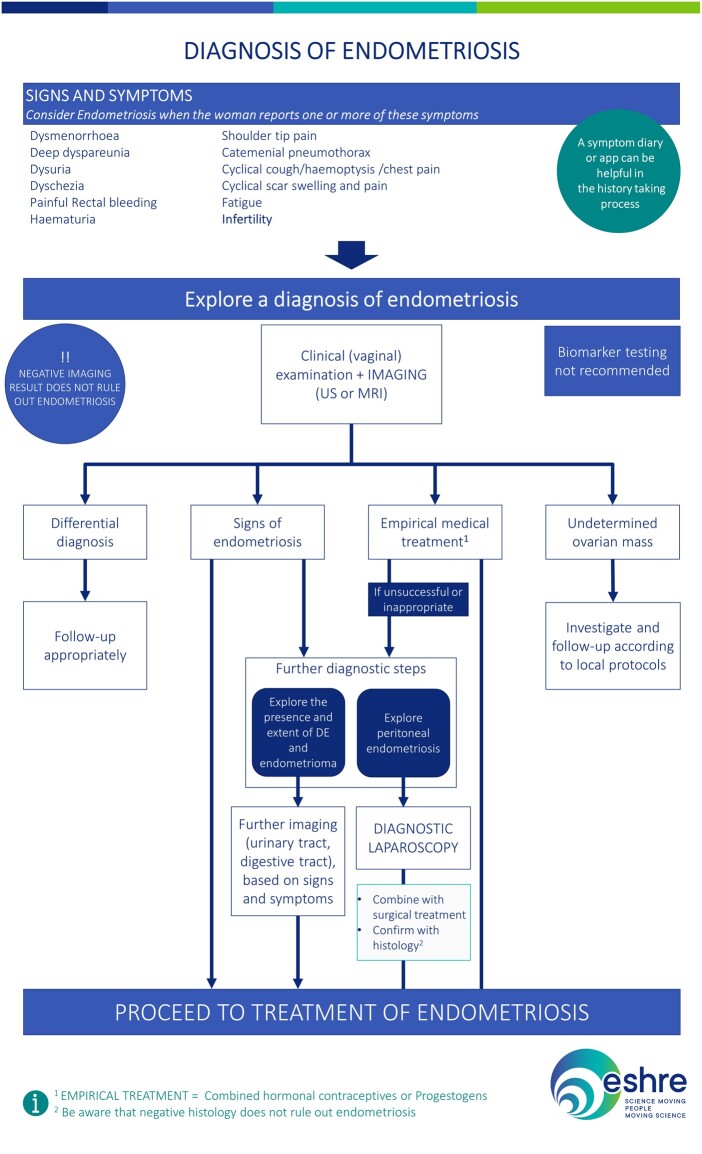
- The diagnostic process challenges laparoscopy and histology as gold standard tests; it recommends imaging (ultrasound or MRI) in the diagnostic work-up, advises against biomarkers for diagnosis, and reserves laparoscopy for patients with negative imaging or unsuccessful/inappropriate empirical treatment.
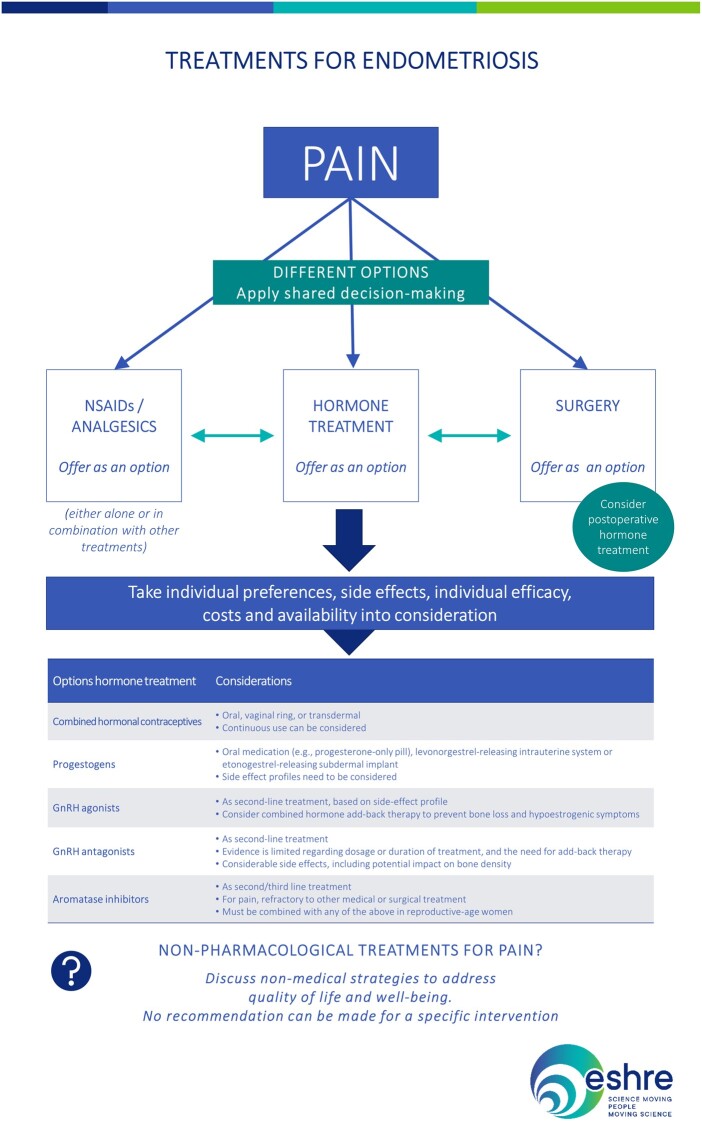
- Treatment options for endometriosis-associated pain include analgesics/NSAIDs, hormonal treatments (combined hormonal contraceptives, progestogens, GnRH agonists or antagonists, aromatase inhibitors), and surgery; five topics with significant changes include the diagnostic process, GnRH antagonists as second-line, postoperative medical treatment for pain, no extended GnRH agonist before ART, and use of the endometriosis fertility index (EFI).
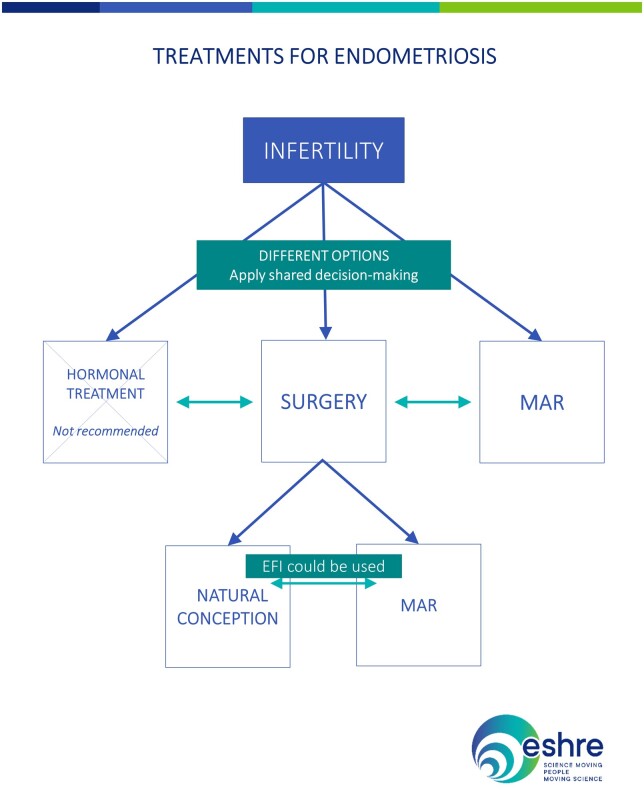
- For endometriosis-associated infertility, surgery and/or medically assisted reproduction are feasible; ovarian suppression, pentoxifylline/anti-inflammatory drugs/letrozole outside ovulation induction, and routine surgery before ART for rASRM stage I/II or endometrioma are not recommended.
Methods
- The guideline was developed according to ESHRE’s structured methodology; 42 key questions were formulated (7 narrative, 35 PICO), with PubMed/MEDLINE and Cochrane searches from inception to 1 December 2020, limited to English-language studies.
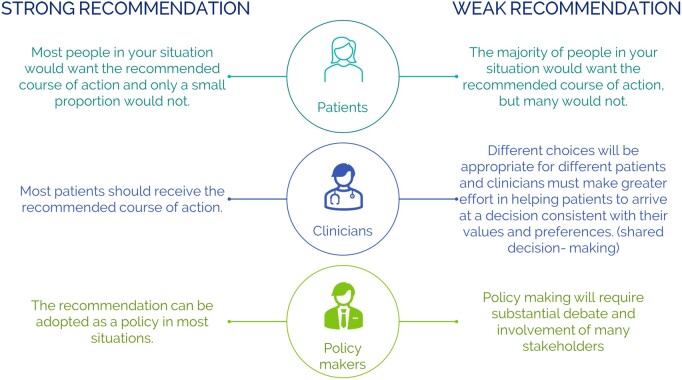
- Evidence was assessed and summarized in evidence tables; recommendations were drafted by specialist subgroups, discussed in core guideline development group meetings until consensus, labelled strong or weak, and graded High, Moderate, Low, or Very low; GPPs were added where relevant.
- A stakeholder review ran from 24 June to 15 August 2021; 56.5% of the 253 comments resulted in an adaptation or correction. The guideline will be considered for update 4 years after publication, with an intermediate assessment at 2 years.
Limitations
- Stated: the guideline describes different management options but, based on existing evidence, no firm recommendations could be formulated on the most appropriate treatments; for specific clinical issues such as asymptomatic endometriosis or extrapelvic endometriosis, evidence is too scarce to make evidence-based recommendations.
- Stated: there is an urgent need for more research on the most appropriate diagnostic and treatment options and on the natural course of the disease.
- Evident from the text: many recommendations are weak or based on low/very low-quality evidence or GPPs; no prognostic markers exist to select patients who would benefit from surgery; no specific non-medical intervention can be recommended; and heterogeneity prevented conclusions on surgical techniques for deep endometriosis-associated pain.
Model-written summary. Check it against the paper before relying on it.
Integrity signals
Registry
Cites
Statistics
Figures
Verification
Claims the paper makes
30 Valid · 5 Not valid · 26 Not checked · 25 Own results and interpretations
At least one cited source doesn’t support this claim or points to a different paper, and none confirmed it — see the verdicts below.
In the paper
“Clinicians may consider operative laparoscopy for the treatment of endometrioma-associated infertility as it may increase their chance of natural pregnancy, although no data from comparative studies exist (Dan and Limin, 2013; Alborzi et al., 2019; Candiani et al., 2020).”
§ ESHRE guideline: endometriosis† > Results > Treatment of endometriosis-associated infertility
What the sources say
- Not checked — no full text of the sourcecites Dan and Limin, 2013 matched to “Laparoscopic ovarian cystectomy versus fenestration/coagulation or laser vaporization for the treatment of endometriomas: a meta-analysis of randomized controlled trials” (2013) source
- Disputedcites Alborzi et al., 2019 matched to “The success of various endometrioma treatments in infertility: a systematic review and meta-analysis of prospective studies” (2019) sourceExperimental — accuracy not yet measured
The Results describe a prospective randomized trial comparing two laparoscopic treatments for endometriomas and reporting pregnancy rates after treatment without medication. That contradicts the categorical claim that no comparative-study data exist for operative laparoscopy and natural pregnancy. The trial compares two operations, however, not surgery against no surgery. (LLM, conf=0.83)
Checked by a reasoning model — may be wrong.
- Not checked — no full text of the sourcecites Candiani et al., 2020 matched to “Recurrence Rate after “One-Step” CO2 Fiber Laser Vaporization versus Cystectomy for Ovarian Endometrioma: A 3-Year Follow-up Study” (2020) source
hedged- Asserted: passes — The authors put it forward as true.
- Checkable: passes — It can be checked against evidence.
- Load-bearing: passes — The paper’s conclusions depend on it.
- Based: passes — The paper gives a reason why it holds.
The cited sources support only part of this claim — read each source’s verdict below.
In the paper
“Both GnRH antagonist and agonist protocols can be offered based on patients’ and physicians’ preferences as no difference in pregnancy or live birth rate has been demonstrated (Pabuccu et al., 2007; Rodriguez-Purata et al., 2013; Bastu et al., 2014; Kolanska et al., 2017; Drakopoulos et al., 2018).”
§ ESHRE guideline: endometriosis† > Results > Treatment of endometriosis-associated infertility
What the sources say
- Not checked — no full text of the sourcecites Pabuccu et al., 2007 matched to “GnRH agonist and antagonist protocols for stage I-II endometriosis and endometrioma in in vitro fertilization/intracytoplasmic sperm injection cycles” (2007) source
- Not checked — no full text of the sourcecites Rodriguez-Purata et al., 2013 matched to “Endometriosis and IVF: are agonists really better? Analysis of 1180 cycles with the propensity score matching” (2013) source
- Partly supportedcites Bastu et al., 2014 matched to “Comparison of ovulation induction protocols after endometrioma resection” (2014) sourceExperimental — accuracy not yet measured
The Results (Table 2; page not provided) show no significant difference in pregnancy or ongoing-pregnancy rates between protocols among IVF patients who had undergone endometrioma resection. The Conclusions (page not provided) call for further studies evaluating live birth rates, so this paper does not establish that live birth rates are similar. Its study population is also narrower than women with endometriosis generally. (LLM, conf=0.91)
boosted- Asserted: passes — The authors put it forward as true.
- Checkable: passes — It can be checked against evidence.
- Load-bearing: passes — The paper’s conclusions depend on it.
- Based: passes — The paper gives a reason why it holds.
The cited sources support only part of this claim — read each source’s verdict below.
In the paper
“Women with endometriosis can be reassured regarding the safety of ART since the recurrence rates are not increased compared to those women not undergoing ART (Benaglia et al., 2008; Somigliana et al., 2019).”
§ ESHRE guideline: endometriosis† > Results > Treatment of endometriosis-associated infertility
What the sources say
- Could not verifycites Benaglia et al., 2008 matched to “Endometrioma and oocyte retrieval-induced pelvic abscess: a clinical concern or an exceptional complication?” (2008) sourceExperimental — accuracy not yet measured
The Abstract (page unavailable) says the study estimated pelvic-abscess frequency after oocyte retrieval in women with endometriomas. Searches for endometriosis recurrence after IVF and a comparison with women not undergoing IVF found no passage addressing either point. (LLM, conf=0.76)
- Partly supportedcites Somigliana et al., 2019 matched to “Ovarian stimulation and endometriosis progression or recurrence: a systematic review” (2019) sourceExperimental — accuracy not yet measured
The Discussion (page unavailable) describes moderately supported, reassuring evidence that IVF has a limited impact on endometriosis recurrence. But the claim extends that reassurance to ART generally: the review's discussion of IUI (page unavailable) identifies a possible increased recurrence risk, and the Discussion says the evidence is incomplete. (LLM, conf=0.88)
plain- Asserted: passes — The authors put it forward as true.
- Checkable: passes — It can be checked against evidence.
- Load-bearing: passes — The paper’s conclusions depend on it.
- Based: passes — The paper gives a reason why it holds.
- Could not verify
The cited sources support only part of this claim — read each source’s verdict below.
In the paper
“The extended administration of GnRH agonist prior to ART treatment to improve live birth rate in infertile women with endometriosis is not recommended, as the benefit is uncertain (Georgiou et al., 2019; Cao et al., 2020; Kaponis et al., 2020).”
§ ESHRE guideline: endometriosis† > Results > Treatment of endometriosis-associated infertility
What the sources say
- Not checked — no full text of the sourcecites Georgiou et al., 2019 matched to “Long-term GnRH agonist therapy before in vitro fertilisation (IVF) for improving fertility outcomes in women with endometriosis” (2019) source
- Partly supportedcites Cao et al., 2020 matched to “The effectiveness of different down-regulating protocols on in vitro fertilization-embryo transfer in endometriosis: a meta-analysis” (2020) sourceExperimental — accuracy not yet measured
The Discussion reports that a Cochrane review found uncertain effects of long-term GnRH agonist therapy on pregnancy outcomes in infertile patients with endometriosis. Cao et al. do not establish uncertainty specifically for live birth rate or recommend against extended treatment; their own analysis reports improved clinical pregnancy rates in some groups. (LLM, conf=0.82)
- Not checked — no full text of the sourcecites Kaponis et al., 2020 matched to “Ultralong administration of gonadotropin-releasing hormone agonists before in vitro fertilization improves fertilization rate but not clinical pregnancy rate in women with mild endometriosis: a prospective, randomized, controlled trial” (2020) source
plain- Asserted: passes — The authors put it forward as true.
- Checkable: passes — It can be checked against evidence.
- Load-bearing: passes — The paper’s conclusions depend on it.
- Based: passes — The paper gives a reason why it holds.
The cited sources support only part of this claim — read each source’s verdict below.
In the paper
“Presacral neurectomy (PSN) is beneficial for treatment of endometriosis-associated midline pain as an adjunct to conventional laparoscopic surgery, but it should be stressed that PSN requires a high degree of skill and is associated with an increased risk of adverse effects such as intraoperative bleeding, and postoperative constipation, urinary urgency and painless first stage of labour (Miller e”
§ ESHRE guideline: endometriosis† > Results > Treatment of endometriosis-associated pain
What the sources say
- Partly supportedcites Miller et al., 2020 matched to “Clinical utility of presacral neurectomy as an adjunct to conservative endometriosis surgery: systematic review and meta-analysis of controlled studies” (2020) sourceExperimental — accuracy not yet measured
The Discussion reports that adjunctive presacral neurectomy reduced treatment failure for endometriosis-related midline pain. However, the Conclusion limits the finding to well-selected patients and says it *may* provide greater relief; the Results include both laparoscopic and open surgery, rather than establishing the benefit specifically for conventional laparoscopic surgery. (LLM, conf=0.84)
plainstates a cause- Asserted: passes — The authors put it forward as true.
- Checkable: passes — It can be checked against evidence.
- Load-bearing: passes — The paper’s conclusions depend on it.
- Based: passes — The paper gives a reason why it holds.
- Partly supported
54 more claims · 22 with their cited sources checked
Create a free account to see all 86 claims and every source verdict.
- Probably not a substantial claim. 26
- It may state two separate claims as one. 3
Claims other papers make about this one
Each is checked against this paper’s own text: does it say what the citing paper says it does?
The source backs part of the claim, not all of it — or backs it for a different population, condition or comparison.
In the citing paper
“although the major associations have difficulty siding sharply in favour of one treatment over another”
From IVF/ICSI or surgery as first approach for the treatment of infertility associated with ovarian and deep infiltrating endometriosis? A systematic review and meta-analysis. (2026) · cites this paper as Becker et al., 2022
Experimental — accuracy not yet measuredThe source backs part of the claim, not all of it — or backs it for a different population, condition or comparison.
In the citing paper
“it appears that, for some of them, patients with ovarian endometriomas (OMA) should not be referred for surgery, except in cases of pelvic pain”
From IVF/ICSI or surgery as first approach for the treatment of infertility associated with ovarian and deep infiltrating endometriosis? A systematic review and meta-analysis. (2026) · cites this paper as Becker et al., 2022
Experimental — accuracy not yet measuredThe source backs part of the claim, not all of it — or backs it for a different population, condition or comparison.
In the citing paper
“Therefore, optimal HRT in young women who have undergone pelvic clearance for endometriosis remains uncertain.”
From HRT in Women Undergoing Pelvic Clearance for Endometriosis—A Case Report and a National Survey (2023) · cites this paper as [10]
Experimental — accuracy not yet measuredThe source backs part of the claim, not all of it — or backs it for a different population, condition or comparison.
In the citing paper
“This has led the British Menopause Society (BMS) and European Society of Human Reproduction and Embryology (ESHRE) to recommend continuous C-HRT and avoidance of EO-HRT in this group of women at least until age of natural menopause [9,10].”
From HRT in Women Undergoing Pelvic Clearance for Endometriosis—A Case Report and a National Survey (2023) · cites this paper as [10]
Experimental — accuracy not yet measuredThe source backs part of the claim, not all of it — or backs it for a different population, condition or comparison.
In the citing paper
“Danazol is no longer recommended as a first-line therapy due to its bothersome side effect profile, such as acne, edema, vaginal spotting, weight gain, muscle cramps, deepening of voice, and increase in facial hair [ 79 ].”
From Thoracic Endometriosis Syndrome: A Comprehensive Review and Multidisciplinary Approach to Management (2024) · cites this paper as [79]
Experimental — accuracy not yet measured
3 more claims about this paper
Create a free account to see every claim other papers make about this one.
Citations
Cites
Zondervan, K. T., Becker, C. M., & Missmer, S. A. (2020) · New England Journal of Medicine · doi:10.1056/nejmra1810764 · Cited by 2,249
Self-citationESHRE guideline: management of women with endometriosis
Dunselman, G. A. J., Vermeulen, N., Becker, C., Calhaz-Jorge, C., D'Hooghe, T., De Bie, B., Heikinheimo, O., Horne, A. W., Kiesel, L., Nap, A., et al. (2014) · Human Reproduction · doi:10.1093/humrep/det457 · Cited by 2,211 · cited 2×
“The current guideline and recommendations are an update of the ESHRE endometriosis guidelines published in 2013 and 2005 (Kennedy et al. , 2005; Dunselman et al. , 2014).”
Self-citationEskenazi, B., & Warner, M. L. (1997) · Obstetrics and Gynecology Clinics of North America · doi:10.1016/s0889-8545(05)70302-8 · Cited by 1,617
ESHRE guideline for the diagnosis and treatment of endometriosis
Kennedy, S., Bergqvist, A., Chapron, C., D’Hooghe, T., Dunselman, G., Greb, R., Hummelshoj, L., Prentice, A., & Saridogan, E. (2005) · Human Reproduction · doi:10.1093/humrep/dei135 · Cited by 1,584
Pearce, C. L., Templeman, C., Rossing, M. A., Lee, A., Near, A. M., Webb, P. M., Nagle, C. M., Doherty, J. A., Cushing-Haugen, K. L., Wicklund, K. G., et al. (2012) · The Lancet Oncology · doi:10.1016/s1470-2045(11)70404-1 · Cited by 939 · cited 1×
“Routine US monitoring of asymptomatic endometriosis can be considered (Maouris, 1991; Alca´zar et al. , 2005; Pearce et al. , 2012; Serati et al. , 2013).”
High prevalence of endometriosis in infertile women with normal ovulation and normospermic partners
Meuleman, C., Vandenabeele, B., Fieuws, S., Spiessens, C., Timmerman, D., & D'Hooghe, T. (2009) · Fertility and Sterility · doi:10.1016/j.fertnstert.2008.04.056 · Cited by 606
Cervical cancer and use of hormonal contraceptives: a systematic review
Smith, J. S., Green, J., de Gonzalez, A. B., Appleby, P., Peto, J., Plummer, M., Franceschi, S., & Beral, V. (2003) · The Lancet · doi:10.1016/s0140-6736(03)12949-2 · Cited by 544
Imaging modalities for the non-invasive diagnosis of endometriosis
Nisenblat, V., Bossuyt, P. M., Farquhar, C., Johnson, N., & Hull, M. L. (2016) · Cochrane Database of Systematic Reviews · doi:10.1002/14651858.cd009591.pub2 · Cited by 538 · cited 2×
“…in endometrial tissue, blood, menstrual or uterine fluids to diagnose endometriosis (Mol et al. , 1998; May et al. , 2010; May et al. , 2011; Liu et al. , 2015; Cosar et al. , 2016; Gupta et al. , 2016; Hirsch et al. , 2016; Nisenblat et al. , 2016a; Vanhie et al. , 2019; Moustafa et al. , 2020).”
Sutton, C. J. G., Ewen, S. P., Whitelaw, N., & Haines, P. (1994) · Fertility and Sterility · doi:10.1016/s0015-0282(16)56990-8 · Cited by 525
Wentzensen, N., Poole, E. M., Trabert, B., White, E., Arslan, A. A., Patel, A. V., Setiawan, V. W., Visvanathan, K., Weiderpass, E., Adami, H.-O., et al. (2016) · Journal of Clinical Oncology · doi:10.1200/jco.2016.66.8178 · Cited by 514 · cited 1×
“…about the risk of malignancy associated with the use of hormonal contraceptives (Smith et al. , 2003; Zucchetto et al. , 2009; Gierisch et al. , 2013; Havrilesky et al. , 2013; Braganza et al. , 2014; Berlanda et al. , 2016; Wentzensen et al. , 2016; Butt et al. , 2018; Michels et al. , 2018).”
Cited by
Items 1,101–1,200 of 1,654
Atypical Sites of Endometriosis: Primary Inguinal Cutaneous Endometriosis
Culej, D., Bursać, D., Perković, P., Duić, Ž., & Gašparov, S. (2023) · Obstetrics and Gynaecology Cases - Reviews · doi:10.23937/2377-9004/1410243
“If it presents without it, it is known as primary spontaneous cutaneous endometriosis [1-6].”
InfluentialEndométriose : le regard du gynécologue sur la prise en charge et les défis actuels
Cathelain, A., Devemy, C., Marx-Deseure, A., Kraus, F., Kerbage, Y., Lallemant, M., & Rubod, C. (2026) · Douleurs Évaluation - Diagnostic - Traitement · doi:10.1016/j.douler.2025.11.003
Does surgeon expertise influence long-term outcomes in ovarian endometrioma rupture cases?
Lyu, S., Wu, Y., Dai, Y., et al. (2026) · BMC Women s Health · doi:10.1186/s12905-026-04606-9
“Laparoscopic cystectomy is advocated as a treatment for endometriosis-associated symptoms [4], but recurrence remains common after primary surgery (30.0– 50.0% at five years) [5].”
InfluentialAĞAR, M., GÜRKAN, N., & GÜRBÜZ, T. (2022) · Anatolian Current Medical Journal · doi:10.38053/acmj.1153597
Feng, Y., Yang, X., Chen, H., Zhang, L., Cui, C., Wang, L., He, Q., & Liang, L. (2026) · Frontiers in Endocrinology · doi:10.3389/fendo.2026.1851907
Gacto‐Sánchez, M., Montilla‐Herrador, J., Lozano-Meca, J. A., Martínez-González, M., Sánchez, M. P. M., Meca, L. N., & Medina‐Mirapeix, F. (2026) · Journal of Gynecology Obstetrics and Human Reproduction · doi:10.1016/j.jogoh.2026.103249 · Cited by 1
Park, Y., Shin, E., Bae, J., Cho, S., Choi, Y. S., & Park, J. H. (2026) · Journal of Robotic Surgery · doi:10.1007/s11701-026-03415-4
Compromised concept: Link between endometriosis, pregnancy complications and infertility
Feduniw, S., Żeber‐Lubecka, N., Włodarczyk, M., Abramiuk, M., Kacperczyk-Bartnik, J. P., Bartnik, P., & Ciebiera, M. (2025) · Journal of Endometriosis and Pelvic Pain Disorders · doi:10.1177/22840265251386969 · Cited by 2
“12 Research findings indicated that couples who effectively managed mild endometriosis had a monthly likelihood of conceiving naturally ranging from 2% to 4.5%, in contrast to the 15%–20% likelihood observed in couples who did not have such a problem.”
InfluentialSurgery versus ART for endometriosis-associated infertility: Lessons from the EFFORT trial
Brunes, M., Marklund, A., Nordborg, J. W., Wennmo-Zuk, K., Jokubkiene, L., Elenis, E., Francis, J., Asciutto, K. C., & Forslund, M. (2026) · European Journal of Obstetrics & Gynecology and Reproductive Biology · doi:10.1016/j.ejogrb.2026.115438
Warren, A., Andreou, D., Warren, D., Wieland, J., & Mantzouratou, A. (2025) · medRxiv · doi:10.1101/2025.04.15.25324328
Hellier, J. L. (2026) · Elsevier eBooks · doi:10.1016/b978-0-443-44037-3.00275-x
ВПЛИВ ЕНДОМЕТРІОЗУ НА ГОРМОНАЛЬНУ СИСТЕМУ ЖІНОК: КЛІНІЧНІ НАСЛІДКИ ТА ПЕРСПЕКТИВИ ЛІКУВАННЯ
Візняк, Т. Б. (2024) · Вісник соціальної гігієни та організації охорони здоров я України · doi:10.11603/1681-2786.2024.2.14796 · Cited by 1
Invited Commentary: Postoperative Imaging of Endometriosis: A Challenging but Prevalent Circumstance
VanBuren, W. M. (2024) · Radiographics · doi:10.1148/rg.230241
Sánchez-Gómez, R., Soler-Gabaldon, S., Gomez-Meseguer, C., Lorente-Gea, L., Torroba, A., Marín‐Sánchez, P., & Machado‐Linde, F. (2026) · Research Square · doi:10.21203/rs.3.rs-9723381/v1
Zhu, X., Zhong, L., Xu, Y., Zou, Y., Liu, M., & Tong, X. (2026) · Human Mutation · doi:10.1155/humu/9501547 · Cited by 1
Consensus-based management of endometriosis-associated pelvic pain: Results of a French Delphi study
Levesque, A., Fauconnier, A., Brillac, T., Bailleul, A., Acapo, S., Bautrant, É., Calvarin, E., Canis, M. J., Morin, C. C.-N., Cornillet-Bernard, M., et al. (2026) · Journal of Gynecology Obstetrics and Human Reproduction · doi:10.1016/j.jogoh.2026.103167
Endométriose : un nouveau paradigme pour le diagnostic et le traitement
Chapron, C., Marcellin, L., Bourdon, M., Parpex, G., Maitrot‐Mantelet, L., Maignien, C., Plu‐Bureau, G., & Santulli, P. (2025) · Bulletin de l Académie Nationale de Médecine · doi:10.1016/j.banm.2024.11.027
The Good, the Bad, and the Ugly of Endometriosis Guidelines
Abbott, J. A. (2023) · Journal of Minimally Invasive Gynecology · doi:10.1016/j.jmig.2023.03.003
The Effect of Ovarian Endometriosis on Pregnancy Outcomes in Spontaneous Pregnancies
Özkan, H. D., Özkan, M. A., Filiz, A. A., Karakaya, M. E., & Üstün, Y. E. (2025) · Journal of Clinical Medicine · doi:10.3390/jcm14103468 · Cited by 3
“According to the guidelines of the European Society of Human Reproduction and Embryology (ESHRE), although there is currently no recommendation for increased follow-up care for pregnant women with endometriosis, clinicians should remain aware of the potential for complications during pregnancy [14].”
Yacoub, V., Russo, C., Selntigia, A., Monaco, G., Nocita, E., Valeriani, S., Soreca, G., Ercoli, A., & Exacoustós, C. (2026) · Reproductive BioMedicine Online · doi:10.1016/j.rbmo.2026.105917
van Keizerswaard, J., Jeremiasse, B., Mijatovic, V., & de Leeuw, R. A. (2025) · Minerva Obstetrics and Gynecology · doi:10.23736/s2724-606x.25.05804-x · Cited by 1
Self-citationDigital Patient Decision Aids for Endometriosis Management: A Scoping Review
Pittet, O., Delvallée, M., Pluchino, N., Selby, K. J., Elwyn, G. J., & Durand, M. (2026) · Health Expectations · doi:10.1111/hex.70881
Self-citationGuevara-Peralta, R., Martínez, J. M., Ortega, C., Plà, M. J., Yeste, C., Peñafiel, J., Guevara-Figueras, J., Ponce, J., & García‐Tejedor, A. (2026) · Frontiers in Reproductive Health · doi:10.3389/frph.2026.1911200
Szczepańska, N., Miłosz, P., Pęksa, R., Ciarka, A., Folwarski, M., Niedzielska, J., Szymański, M., Wilczyński, M., & Marjański, T. (2026) · Frontiers in Medicine · doi:10.3389/fmed.2026.1835516
Bogusz, A., Szewczyk, K., Włodarek, D., & Górnicka, M. (2026) · Nutrients · doi:10.3390/nu18132184 · Cited by 3
“Current clinical management relies primarily on pharmacologic and surgical interventions, with hormonal therapies remaining central for symptom control [17].”
Endometriosis: papel del láser de CO2 en el abordaje quirúrgico
Rius, M., & Carmona, F. (2023) · Clínica e Investigación en Ginecología y Obstetricia · doi:10.1016/j.gine.2023.100855 · Cited by 1
Olórtegui, R. A., Llancarí, P., Chacón‐Byrne, S., Castañeda-Apolinario, J. E., Rojas‐Apaza, E., Villanueva-Colina, C., & Novoa, R. H. (2026) · International Journal of Gynecology & Obstetrics · doi:10.1002/ijgo.71340
Liu, X., Zhang, X., Hua, K., & Xie, M. (2025) · Journal of Gynecology Obstetrics and Human Reproduction · doi:10.1016/j.jogoh.2025.102982 · Cited by 1
Privitera, A., Nagy, C., Al‐Jefout, M., Harikrishnan, S., Jenitha, C. A., & GUO, S. W. (2026) · Journal of Endometriosis and Uterine Disorders · doi:10.1016/j.jeud.2026.100173
Mahajan, R. A., Khan, S. A., Krishnamurthy, A., Magdum, H., & Chawla, S. (2026) · Medical Journal Armed Forces India · doi:10.1016/j.mjafi.2026.04.016
Mid-Cycle Pain in Endometriosis: Clinical Correlations and Potential Etiological Factors
Rojas, H. E., Prior, J. C., Noga, H. L., Williams, C., Bedaiwy, M. A., Lee, C. E., Allaire, C., & Yong, P. J. (2026) · Journal of Women s Health · doi:10.1177/15409996261443813 · Cited by 1
Unpaired multi-modal multi-label learning for detecting endometriosis signs
Zhang, Y., Wang, H., Xie, Y., To, M., Knox, S., Leonardi, M., Condous, G. S., Avery, J., Hull, M. L., & Carneiro, G. (2026) · Artificial Intelligence in Medicine · doi:10.1016/j.artmed.2026.103503
Gaskins, A. J., & Mínguez‐Alarcón, L. (2024) · Seminars in Reproductive Medicine · doi:10.1055/s-0044-1800828
Prevention of heart failure in women: an expert consensus statement on sex-specific risk factors
Rakisheva, A., Disabato, G., Abreu, A., Attanasio, A., Bauersachs, J. K., Becker, M., Callewaert, B., Castelo‐Branco, C., Castelvecchio, S., Backer, J. F. A. D., et al. (2026) · European Journal of Heart Failure · doi:10.1093/ejhf/xuag215 · Cited by 1
Freger, S., Kalani, N., Cornea, M., Cavalier, S., & Leonardi, M. (2025) · Acta Obstetricia Et Gynecologica Scandinavica · doi:10.1111/aogs.70096 · Cited by 5
Seyidova, C. I., & Yarmolinskaya, M. I. (2023) · Journal of obstetrics and women s diseases · doi:10.17816/jowd622745
Lei, L., Cui, Q., Ji, X., Gao, H., Zhang, Y., Zhang, J., Gao, Y., Zhang, F., & Li, Y. (2025) · Research Square · doi:10.21203/rs.3.rs-6763472/v1
Urbanek, O., Osial, M. E., Zaszczyńska, A., Lustyk, Ł., & Pavone, M. (2026) · Biomedicine & Pharmacotherapy · doi:10.1016/j.biopha.2026.119734 · Cited by 1
Chernyak, M. M. (2026) · Theoretical and Practical Aspects of Modern Scientific Research · doi:10.36074/logos-14.08.2026.019
Akashi, K., Shahi, M., Çolak, C., Burnett, T. L., Bartlett, D. J., Packard, A. T., VanBuren, W. M., & Takahashi, H. (2026) · European Journal of Nuclear Medicine and Molecular Imaging · doi:10.1007/s00259-026-08189-3 · Cited by 1
Chen, S., Lu, Y., Wang, L., Weng, A., Miao, Y., Feng, L., Wang, Z., Xu, M., Liang, X., & Wang, Y. (2026) · Pharmacological Research · doi:10.1016/j.phrs.2026.108453
Quere, D. L., Verroul, M., Thierry, A., Bouvard, M., Brault-Galland, E., Dubernard, G., Philip, C., Haesebaert, J., & Brulport, A. (2026) · medRxiv · doi:10.64898/2026.03.31.26349847
Brancalion, M. F., Russo, E., Fidecicchi, T., Guevara, M. M. M., Misasi, G., Baroni, C., Zito, C., Pisacreta, E., Gorini, S., Caretto, M., et al. (2026) · International Urogynecology Journal · doi:10.1007/s00192-026-06867-2
Djokovic, D., de Mattos, L. A., Keckstein, J., Kotlarz, A., Pinto, P., Reis, I. S., Linnamägi, A., Su, N., Gong, X., Laganà, A. S., et al. (2026) · European Journal of Obstetrics & Gynecology and Reproductive Biology · doi:10.1016/j.ejogrb.2026.115267
Self-citationChemali, R., & Grech, G. (2026) · Advances in predictive, preventive and personalised medicine · doi:10.1007/978-3-032-32838-0_7
Clinical Guidance Paper VVOG: Pharmacological treatment of endometriosis-related pain
Remans, E., Bafort, C., Blank, C., Bongima, A., Geysenbergh, B., Hamerlynck, T. W. O., Page, G., Verguts, J., & Tomassetti, C. (2025) · European Journal of Obstetrics & Gynecology and Reproductive Biology X · doi:10.1016/j.eurox.2025.100403 · Cited by 1
“The exact prevalence is unknown but is estimated to range from 2 % to 10 % in the general population, increasing to 50 % in infertile women and women with chronic lower abdominal pain [1,2].”
InfluentialSelf-citationXiaoyu, M. (2024) · Psychology Research and Behavior Management · doi:10.2147/prbm.s476057 · Cited by 2
“42,43 This study also focuses on the interaction of participants’ personal perceptions and thoughts in social Settings and provides insights into their relevant lived experiences based on their behaviors related to PRMD. Bandura 44 argued that individuals can take control of their lives by…”
Şimşek, G. Ö., Uzunlar, Ö., Özen, S., Çandar, T., Sancı, M., & Duman, E. D. (2026) · BMC Women s Health · doi:10.1186/s12905-026-04586-w
“Endometriosis is a chronic, systemic, and inflammatory disorder that affects approximately 10% of women of reproductive age and represents one of the leading causes of infertility [1–3].”
prats, J. A., Córdova-García, D., Rodríguez, M., Vallejos, A. N. R., Hugo Sovino, S., & Campaña, G. (2024) · Revista de Cirugía · doi:10.35687/s2452-454920240032016 · Cited by 1
Tian, Z., Du, Z., Fu, L., Wang, X., & Sun, Z. (2025) · Archives of Gynecology and Obstetrics · doi:10.1007/s00404-024-07927-y · Cited by 1
Donati, A., Giola, F., Privitera, G., Barbàra, G., Dridi, D., Ottolini, F. L., Buggio, L., Biciuffi, R., Parazzini, F., & Chiaffarino, F. (2026) · European Journal of Obstetrics & Gynecology and Reproductive Biology · doi:10.1016/j.ejogrb.2026.115381
Przyśliwski, K., Siekierski, B. P., Pliszkiewicz, M., Jacko, J., Bogaczyk, A., Kluz, W., & Kluz, T. (2026) · Journal of Clinical Medicine · doi:10.3390/jcm15197526
Bokhua, D., Kather, A., Kaufmann, A., Polychronaki, E., Auletta, V., & Runnebaum, I. B. (2025) · Archives of Gynecology and Obstetrics · doi:10.1007/s00404-025-07996-7
“Thus, guidelines recommend the least invasive option [26, 28].”
Xu, M., Ye, J., Liu, Z., & Geng, Q.-L. (2026) · BMC Women s Health · doi:10.1186/s12905-026-04590-0
“According to the European Society of Human Reproduction and Embryology guideline, DIE typically involves vital pelvic structures—including the uterosacral ligaments, rectovaginal septum, bowel, and urinary tract—often resulting in severe pain, distorted pelvic anatomy, and functional impairment [3].”
Potential Changes in the Eutopic Endometrium in Endometriosis: A Narrative Review
Makrygiannakis, F., Vrekoussis, T., Berdiaki, A., & Makrigiannakis, A. (2025) · Cureus · doi:10.7759/cureus.92932 · Cited by 2
“Recent consensus statements have been published, aiming to provide guidelines for contemporary practice, clarifying issues regarding both diagnosis and treatment [11].”
Almendra, R., Araújo, E. E., Sousa, D. N., & Nogueira‐Silva, C. (2026) · Journal of Psychosomatic Obstetrics & Gynecology · doi:10.1080/0167482x.2026.2643521 · Cited by 1
Codreanu, N., & Ivanova, E. (2024) · Moldovan Journal of Health Sciences · doi:10.52645/mjhs.2024.3.03
Palumbo, M., D’Angelo, G., Colacurci, D., Baldini, G. M., Verde, M. L., Watrowski, R., Carone, V., Bifulco, G., Giampaolino, P., & Corte, L. D. (2026) · Medicina · doi:10.3390/medicina62081488 · Cited by 2
“Nevertheless, the evaluation of superficial peritoneal endometriosis remains a significant diagnostic challenge, largely due to the limited direct visualization of superficial peritoneal lesions [12].”
Pregnancy and Female Reproductive Disorders
Esterhuizen, M., & Pheiffer, Y. (2026) · Springer eBooks · doi:10.1007/978-3-031-90919-1_42-1 · Cited by 1
Li, M., Wang, S., Tan, A., Yang, C., & Xie, Q. (2025) · Medicine · doi:10.1097/md.0000000000045703 · Cited by 2
“[16] Although conservative surgery can improve patients’ clinical symptoms and fertility, it has a high recurrence rate, which may be due to the fact that hidden EMT lesions cannot be completely removed, and the residual lesions continue to infiltrate under the action of hormones, immunity and…”
Gomez-Quiroga, P., Ramírez, S. C., Herrera, S. F., Ballesteros, I., Rangel, V. S., Lara, L. M. A., & Polania, L. G. (2026) · Journal of Endometriosis and Uterine Disorders · doi:10.1016/j.jeud.2026.100177
Higuchi, N., Kanno, K., Sasamori, C., Kashiwabara, T., Iwata, T., 澤井, 雄., Onji, H., Masuda, S., Taniguchi, R., Ochi, Y., et al. (2026) · Journal of Robotic Surgery · doi:10.1007/s11701-026-03299-4
The characteristics of the hemostatic system in patients with external genital endometriosis
Baigalmaa, B., Bitsadze, V. O., Солопова, А. Г., Blinov, D. V., & Константинович, Б. Г. (2023) · Vrach · doi:10.29296/25877305-2023-05-03
Kaj vemo o vplivu prehrane na endometriozo in njene simptome
Šmid, E. B., Frangež, H. B., & Šalamun, V. (2023) · Slovenian Medical Journal · doi:10.6016/zdravvestn.3440
N-Acetylcysteine in Endometriosis: A Systematic Review of Biological Rationale and Clinical Evidence
Watrowski, R., Kostov, S. G., Tozzi, R., Kupec, T., Schäfer, S. D., Chieppa, P., Yordanov, A. D., Sparić, R., Juhasz‐Böss, I., Vitale, S. G., et al. (2026) · Antioxidants · doi:10.3390/antiox15070880 · Cited by 3
“Surgery may improve pain, lesion burden, and, in selected settings, fertility-related outcomes, yet it is invasive, technically demanding, operator dependent, and not capable of addressing the entire complexity of endometriosis-associated fertility impairment [7,27].”
Yuan, W., Huang, J., He, T., Li, H., & Wu, X. (2026) · Molecular Biology Reports · doi:10.1007/s11033-026-12457-8
Hurni, Y., Barbany‐Freixa, N., Manosalvas-Escobar, L., Castellví-Ibáñez, I., Pascual, M. A., García-Martínez, S., Prats, P., Cabrera, S., & Barri, P. N. (2026) · Journal of Minimally Invasive Gynecology · doi:10.1016/j.jmig.2026.06.006
Navigating endometriosis diagnostic delay in 2040: Future directions in noninvasive diagnosis
Acar, B., Kocan, D., Vorawandthanachai, T., Antoun, M. E. A., Zahra, O., Karam, J., Paruchuri, T., Pace, L. A., Zhang, A., Combs, A. L., et al. (2026) · Journal of Endometriosis and Pelvic Pain Disorders · doi:10.1177/22840265261470266
Mise au point sur l’endométriose
Crestani, A., Goualard, P., Dennis, T., et al. (2023) · L Aide-Soignante · doi:10.1016/j.aidsoi.2023.07.003
Gabrielsen, R., Tellum, T., Bø, K., Engh, M. E., & Tennfjord, M. K. (2026) · Acta Obstetricia Et Gynecologica Scandinavica · doi:10.1111/aogs.70318 · Cited by 4
Smargiassi, N. F. (2023) · Digital Library of Theses and Dissertations (Universidade de São Paulo) · doi:10.11606/d.17.2023.tde-15022024-101917
Adamyan, L. V., Krechetova, K. L. V., Menzhinskaya, M. I. V., Inviyaeva, E. V., Khaidukov, S. V., Antonova, A. A., Pivazyan, L. G., Avetisyan, J. S., & Seregina, V. Y. (2026) · Russian Journal of Human Reproduction · doi:10.17116/repro20263204160
Ivanova, E. G., & Codreanu, N. (2025) · Russian Journal of Human Reproduction · doi:10.17116/repro20253104196
Ferla, S., Mabrouk, M., Seracchioli, R., & Raimondo, D. (2026) · Journal of Minimally Invasive Gynecology · doi:10.1016/j.jmig.2026.04.018
Self-citationInci, A., Andress, J., Kraemer, B., Schimunek, L., Metzler, J. M., Witzel, I., Krentel, H., & Burla, L. (2026) · Journal of Minimally Invasive Gynecology · doi:10.1016/j.jmig.2026.03.002 · Cited by 2
Berlinska, L. I. (2026) · Reports of Vinnytsia National Medical University · doi:10.31393/reports-vnmedical-2026-30(2)-29
Zahiri, Z., Ghayur, S., Alborzi, S., Ghasemi, M., Miri, M. S., Taftian, A., Khonsarian, Z. S., Bahrampour, A., Goodarzi, V., & Etezadi, A. (2026) · International Immunopharmacology · doi:10.1016/j.intimp.2026.117437
Marneri, A. G., Pavlidis, E. T., Stavrati, K. E., Mouratidou, C., Kofinas, A., Konstantopoulou, I., & Pavlidis, T. E. (2026) · World Journal of Clinical Oncology · doi:10.5306/wjco.v17.i4.118631
Neri, B., Fiorillo, M., Iacobini, F., Mancone, R., Balice, R., Laluci, E., Fabrizi, F., Lucarelli, M., Russo, C., Exacoustós, C., et al. (2026) · Digestive and Liver Disease · doi:10.1016/j.dld.2026.07.086
Transcriptome profiling to identify blood biomarkers for peritoneal endometriosisPreprint
Pušić, M. N., Vižintin, A., Režen, T., Frangež, H. B., Wenzl, R. J., & Rižner, T. L. (2025) · medRxiv · doi:10.64898/2025.12.23.25342915
Bai, M., Shen, S., & Chen, J.-Y. (2026) · Frontiers in Pharmacology · doi:10.3389/fphar.2026.1860816 · Cited by 1
“Because the disease often affects women during their reproductive years and tends to recur, long-term medical management is frequently required (Becker et al., 2022).”
Dysmenorrhea in Adolescents: How to approach: A Review Article
Zeba, D., Benarjee, S., Biswas, R., Akter, S., & Rahman, R. M. (2024) · Bangabandhu Sheikh Mujib Medical College Journal · doi:10.3329/bsmmcj.v3i1.72065 · Cited by 1
Efficacy and acceptability of dienogest among patients with endometriosis in Thailand
Suwan, A., Rungruxsirivorn, T., Panyakhamlerd, K., Apirakviriya, C., Chavaengkiat, S., & Regidor, P. (2026) · BMC Women s Health · doi:10.1186/s12905-026-04287-4
“Progestins and COCs are considered as the first-line treatment for endo-metriosis, while second-line treatments include GnRH agonist and antagonist due to their side effects profile [11].”
Diagnosis of Endometriosis: Dual-Amplification Strategy Driven by Copper Nanoclusters
Wu, Y. H., Yen, H.-C., Torng, P., & Ho, J. A. (2026) · Analytical Chemistry · doi:10.1021/acs.analchem.6c00532 · Cited by 1
Riccò, M., Bottazzoli, M., Scilli, S., & Magnavita, N. (2026) · Healthcare · doi:10.3390/healthcare14152299
Endometriosis leading to frequent emergency department visits – women’s experiences and perspectivesPreprint
Emanuel, C. R., Holter, H., Hansson, I. N., et al. (2023) · Research Square · doi:10.21203/rs.3.rs-3498890/v1
Riemma, G., Caniglia, F. M., Casolari, C., Maiorana, A., Cozzolino, M., Agrifoglio, V., FRANCISCIS, P. D., Cobellis, L., Carotenuto, R. M., & Etrusco, A. (2026) · Human Reproduction · doi:10.1093/humrep/deag116 · Cited by 1
Neutrophil-to-lymphocyte ratio and endometriosis: systematic review and meta-analysis
Dominoni, M., Pano, M. R., Lovotti, A., Ferretti, V. V., SILVESTRI, A. D., & Gardella, B. (2026) · Frontiers in Medicine · doi:10.3389/fmed.2026.1813357
Xie, C., & Liu, Y. (2026) · Frontiers in Immunology · doi:10.3389/fimmu.2026.1735221
Netter, A., Duchateau, F., Abrão, H. M., Canis, M. J., Martin, D. C., Bartoli, A., Bourdel, N., & the FEMaLe Project Work Group (2026) · Acta Obstetricia Et Gynecologica Scandinavica · doi:10.1111/aogs.70293 · Cited by 1
Ruiz, J. C. R., Salazar–Cuba, X., & Guzmán-Pérez, S. B. (2023) · Revista Peruana de Ginecología y Obstetricia · doi:10.31403/rpgo.v69i2483
Place de la sage-femme dans la prise en charge de l’endométriose
Poudou, A. (2023) · Sages-Femmes · doi:10.1016/j.sagf.2023.09.010
Katta, M. A., Maged, A. M., Ogila, A. I., & Ragab, W. S. (2024) · Middle East Fertility Society Journal · doi:10.1186/s43043-024-00189-3 · Cited by 1
Laparoscopic discoid resection in rectal endometriosis: When less is more
Caram, L. J., Vaccaro, A., Vietri, G. O., Rosas, P., Viglierchio, V. T., & Salazar, E. G. (2026) · Colorectal Disease · doi:10.1111/codi.70501
Liu, J., Wu, D., & Sun, J. (2026) · Medicine · doi:10.1097/md.0000000000047624
Tramontano, L., Wenger, J., & Marci, R. (2026) · Medicina · doi:10.3390/medicina62101899
Alterations in Cellular Immunity in Patients With Endometriosis: Systematic Review and Meta‐Analysis
Adamyan, L. V., Pivazyan, L. G., Kurbatova, K. S., Barsegyan, S., Grigoryan, B., & Stepanian, A. (2026) · American Journal of Reproductive Immunology · doi:10.1111/aji.70296
Metadata
- Authors
- Becker, C. M., Bokor, A., Heikinheimo, O., Horne, A., Jansen, F., Kiesel, L., King, K., Kvaskoff, M., Nap, A., Petersen, K., Saridogan, E., Tomassetti, C., van Hanegem, N., Vulliemoz, N., Vermeulen, N., ESHRE Endometriosis Guideline Group, Altmäe, S., Ata, B., Ball, E., Barra, F., Bastu, E., Bianco-Anil, A., Knudsen, U. B., Brubel, R., Cambitzi, J., Cantineau, A., Cheong, Y., Daniilidis, A., De Bie, B., Exacoustos, C., Ferrero, S., Gelbaya, T., Goetz-Collinet, J., Hudelist, G., Hussain, M., Indrielle-Kelly, T., Khazali, S., Kumar, S. L., Leone Roberti Maggiore, U., Maas, J. W. M., McLaughlin, H., Metello, J., Mijatovic, V., Miremadi, Y., Muteshi, C., Nisolle, M., Oral, E., Pados, G., Parades, D., Pluchino, N., Supramaniam, P. R., Schick, M., Seeber, B., Seracchioli, R., Laganà, A. S., Stavroulis, A., Tebache, L., Uncu, G., Van den Broeck, U., van Peperstraten, A., Vereczkey, A., Wolthuis, A., Bahat, P. Y., & Yazbeck, C.
- Affiliations
- University of Oxford (GB)
- Semmelweis University (HU)
- University of Helsinki (FI)
- MRC Centre for Reproductive Health (GB)
- EndoHome—Endometriosis Association Belgium , Belgium
- University Hospital Münster (DE)
- Individual Endometriosis Advocate , Ireland
- Inserm (FR)
- Radboud University Nijmegen (NL)
- University College London Hospitals NHS Foundation Trust (GB)
- Department of Obstetrics and Gynaecology, University College London Hospital , London, UK
- Universitair Ziekenhuis Leuven (BE)
- Department of Reproductive Medicine and Gynecology, University Medical Center Utrecht , Utrecht, The Netherlands
- Department of Woman Mother Child, Fertility Medicine and Gynaecological Endocrinology, Lausanne University Hospital , Lausanne, Switzerland
- European Society of Human Reproduction and Embryology (BE)
- Aarhus University (DK)
- Centre Hospitalier Universitaire Vaudois (CH)
- Bursa Uludağ Üni̇versi̇tesi̇ (TR)
- Corresponding author
- Becker, Christian M
- ORCID
- Becker, Christian M
- Bokor, Attila
- Heikinheimo, Oskari
- Horne, Andrew
- Kiesel, Ludwig
- King, Kathleen
- Kvaskoff, Marina
- Nap, Annemiek
- Tomassetti, Carla
- Vermeulen, Nathalie
- Altmäe, Signe
- Ball, Elizabeth
- Barra, Fabio
- Knudsen, Ulla Breth
- Cantineau, Astrid
- Cheong, Ying
- Daniilidis, Angelos
- Hudelist, Gernot
- Indrielle-Kelly, Tereza
- Khazali, Shaheen
- Maas, Jacques W M
- Metello, José
- Mijatovic, Velja
- Muteshi, Charles
- Nisolle, Michelle
- Oral, Engin
- Pados, George
- Pluchino, Nicola
- Supramaniam, Prasanna Raj
- Schick, Maren
- Seeber, Beata
- Seracchioli, Renato
- Laganà, Antonio Simone
- Uncu, Gürkan
- Wolthuis, Albert
- Bahat, Pınar Yalçın
- Yazbeck, Chadi
- Venue
- Human Reproduction Open
- Publisher
- Oxford University Press (OUP)
- Published
- 2022-01-01
- Volume
- 2022
- Issue
- 2
- Pages
- hoac009-hoac009
- ISSN
- 2399-3529 (ISSN-L)
- PMC
- PMC8951218
- OpenAlex
- W4214754424
- Semantic Scholar
- 9b3b56ba47277eeae136f9c369e90b91f4b39fc2
- Cited by
- 1,712
- References
- 250
- Citations by year
- 2026: 482 · 2025: 452 · 2024: 401 · 2023: 278 · 2022: 97
- FWCI
- 258.47
- Type
- journal article
- Language
- en
- Open access
- gold
- doi.org
- Licence
- Locations
- Human Reproduction Open (publishedVersion, cc-by-nc)
- PubMed Central (publishedVersion, cc-by-nc)
- PubMed (publishedVersion)
- Cineca Institutional Research Information System (Tor Vergata University) (publishedVersion, other-oa)
- Research Publications (Maastricht University) (publishedVersion, cc-by-nc)
- Pure Amsterdam UMC (publishedVersion, cc-by)
- SERVAL (Université de Lausanne) (publishedVersion, cc-by-nc)
- Repository of the Academy's Library (Library of the Hungarian Academy of Sciences) (acceptedVersion)
- ePrints Soton (University of Southampton) (acceptedVersion)
- IRIS (submittedVersion, cc-by-nc)
- Lirias (submittedVersion, cc-by)
- Archivio istituzionale della ricerca (Alma Mater Studiorum Università di Bologna) (submittedVersion, cc-by-nc)
- Työväentutkimus Vuosikirja (submittedVersion)
- ORBi (University of Liège) (submittedVersion, other-oa)
- Edinburgh Research Explorer (University of Edinburgh) (submittedVersion, cc-by-nc)
- Radboud Repository (Radboud University) (submittedVersion)
- Radboud Repository (Radboud University) (submittedVersion, other-oa)
- Funders
- ESHRE
- Topics
- Health Sciences › Medicine › Reproductive Medicine › Endometriosis Research and Treatment
- Health Sciences › Medicine › Obstetrics and Gynecology › Gynecological conditions and treatments
- Health Sciences › Medicine › Obstetrics and Gynecology › Ectopic Pregnancy Diagnosis and Management
- Keywords
- endometriosis, endometriosis diagnosis, endometriosis-associated pain, endometriosis-associated infertility, asymptomatic endometriosis, extrapelvic endometriosis, endometriosis prevention, medical treatment
About these checks
Registry, retraction, Cites and statistics results are computed, not judged, with one exception: a printed reference that no index lists is read once by a model before it counts as a citation error. Claims are extracted by a model and kept only when their quote appears verbatim in the text; each cited source is then checked, with a model’s help, for whether it says what the claim relies on. Those verdicts can be wrong — read the claim’s quote and the cited source before relying on one.
The claim verdicts this report counts are experimental: their accuracy is not yet measured.
A language model drew the claims from the paper on 2026-10-12, under version 3 of the claim definition (model deepseek-v4.1-flash, prompt extract-v3).
A second model labelled each claim on 2026-10-12 (model jev-1.13-20260917, definition revision gold-guideline-v0.2).
Cited sources are checked with a language model’s help (gpt-6-sol).
Statistics and arithmetic are recomputed, not judged.
Confidence bands are shown only for fields calibrated on our annotated test set. None is calibrated yet, so no band is shown.
What counts as a claim ›How we measure confidence ›How we check this ›
Are you an author, or do you see a problem with this page? Request a review
Data sources
Bibliographic data: Semantic Scholar, OpenAlex, Crossref.
Contains information from the Semantic Scholar Academic Graph Datasets, made available under the ODC Attribution License (ODC-BY 1.0).
Semantic Scholar’s data is described in: Kinney, R., et al. (2023). The Semantic Scholar Open Data Platform. arXiv:2301.10140.
