

Using AI-generated suggestions from ChatGPT to optimize clinical decision support
Open accessThe DOI matches its Crossref record; 39 of the 39 references it cites were found in a registry or an index.
Abstract
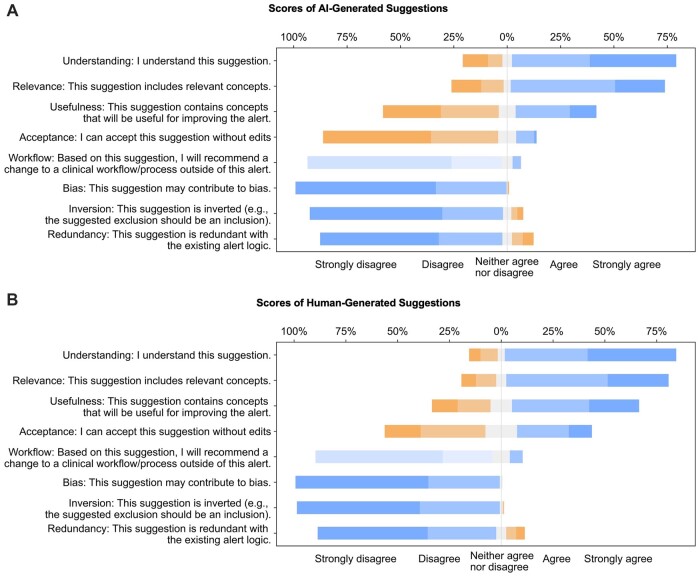
Objective: To determine if ChatGPT can generate useful suggestions for improving clinical decision support (CDS) logic and to assess noninferiority compared to human-generated suggestions. Methods: We supplied summaries of CDS logic to ChatGPT, an artificial intelligence (AI) tool for question answering that uses a large language model, and asked it to generate suggestions. We asked human clinician reviewers to review the AI-generated suggestions as well as human-generated suggestions for improving the same CDS alerts, and rate the suggestions for their usefulness, acceptance, relevance, understanding, workflow, bias, inversion, and redundancy. Results: Five clinicians analyzed 36 AI-generated suggestions and 29 human-generated suggestions for 7 alerts. Of the 20 suggestions that scored highest in the survey, 9 were generated by ChatGPT. The suggestions generated by AI were found to offer unique perspectives and were evaluated as highly understandable and relevant, with moderate usefulness, low acceptance, bias, inversion, redundancy. Conclusion: AI-generated suggestions could be an important complementary part of optimizing CDS alerts, can identify potential improvements to alert logic and support their implementation, and may even be able to assist experts in formulating their own suggestions for CDS improvement. ChatGPT shows great potential for using large language models and reinforcement learning from human feedback to improve CDS alert logic and potentially other medical areas involving complex, clinical logic, a key step in the development of an advanced learning health system.
Overview
The claims and statistics of this paper haven’t been checked yet.
Free: it reads the open-access text and checks the first 5 claims that cite a source we can check. Create a free account to check every claim.
Integrity signals
Registry
Cites
Statistics
Figures


Verification
Claims the paper makes
The claims and statistics of this paper haven’t been checked yet.
Free: it reads the open-access text and checks the first 5 claims that cite a source we can check. Create a free account to check every claim.
Claims other papers make about this one
Each is checked against this paper’s own text: does it say what the citing paper says it does?
In the citing paper
“The integration of AI-powered tools into clinical pharmacy practices could bolster efficiency, decision-making, and patient outcomes.9”
From ChatGPT and Clinical Training: Perception, Concerns, and Practice of Pharm-D Students (2023) · cites this paper as [9]
Self-check
Percentages, sums and reported differences re-computed from the paper’s own numbers.
The self-check needs the paper’s full text.
Citations
Cites
A guideline of selecting and reporting intraclass correlation coefficients for reliability research
Koo, T. K., & Li, M. Y. (2016) · Journal of Chiropractic Medicine · doi:10.1016/j.jcm.2016.02.012 · Cited by 31,709
Language Models are Few-Shot Learners
Brown, T. B., Mann, B., Ryder, N., Subbiah, M., Kaplan, J., Dhariwal, P., Neelakantan, A., Shyam, P., Sastry, G., Askell, A., et al. (2020) · arXiv · doi:10.48550/arxiv.2005.14165 · Cited by 23,372
A General Inductive Approach for Analyzing Qualitative Evaluation Data
Thomas, D. R. (2006) · American Journal of Evaluation · doi:10.1177/1098214005283748 · Cited by 10,858
Training language models to follow instructions with human feedback
Ouyang, L., Wu, J., Jiang, X., Almeida, D., Wainwright, C. L., Mishkin, P., Zhang, C., Agarwal, S., Slama, K., Ray, A., et al. (2022) · arXiv · doi:10.48550/arxiv.2203.02155 · Cited by 4,208
Kung, T. H., Cheatham, M., ChatGPT, Medenilla, A., Sillos, C., De Leon, L., Elepaño, C., Madriaga, M., Aggabao, R., Diaz-Candido, G., et al. (2022) · doi:10.1101/2022.12.19.22283643 · Cited by 4,115
Kung, T. H., Cheatham, M., Medenilla, A., Sillos, C., De Leon, L., Elepaño, C., Madriaga, M., Aggabao, R., Diaz-Candido, G., Maningo, J., et al. (2023) · PLOS Digital Health · doi:10.1371/journal.pdig.0000198 · Cited by 4,115
Kawamoto, K., Houlihan, C. A., Balas, E. A., & Lobach, D. F. (2005) · BMJ · doi:10.1136/bmj.38398.500764.8f · Cited by 2,703
Effect of Clinical Decision-Support Systems: A Systematic Review
Bright, T. J., Wong, A., Dhurjati, R., Bristow, E., Bastian, L., Coeytaux, R. R., Samsa, G., Hasselblad, V., Williams, J. W., Musty, M. D., et al. (2012) · Annals of Internal Medicine · doi:10.7326/0003-4819-157-1-201207030-00450 · Cited by 1,200
On Faithfulness and Factuality in Abstractive Summarization
Maynez, J., Narayan, S., Bohnet, B., & McDonald, R. (2020) · Proceedings of the 58th Annual Meeting of the Association for Computational Linguistics · doi:10.18653/v1/2020.acl-main.173 · Cited by 1,185
On Faithfulness and Factuality in Abstractive Summarization
Maynez, J., Narayan, S., Bohnet, B., & McDonald, R. (2020) · arXiv · doi:10.48550/arxiv.2005.00661 · Cited by 1,185
Research works printed but not linked: 1
- de Winter, 2010, Five-point Likert items: t test versus Mann-Whitney-Wilcoxon, Pract Assess Res Eval, 15, 11
Cited by
Items 101–200 of 542
Yin, M., Han, B., Ryu, S., & Hua, M. (2023) · Lecture notes in computer science · doi:10.1007/978-3-031-48057-7_18 · Cited by 49
Wang, Z., Zhang, Z., Traverso, A., Dekker, A., Qian, L., & Sun, P. (2024) · Quantitative Imaging in Medicine and Surgery · doi:10.21037/qims-23-1180 · Cited by 46
A Survey of Clinicians' Views of the Utility of Large Language Models
Spotnitz, M., Idnay, B., Gordon, E. R., Shyu, R., Zhang, G., Liu, C., Cimino, J. J., & Weng, C. (2024) · Applied Clinical Informatics · doi:10.1055/a-2281-7092 · Cited by 45
Franc, J. M., Hertelendy, A. J., Cheng, L. T. W., Hata, R., & Verde, M. (2024) · Journal of Medical Internet Research · doi:10.2196/55648 · Cited by 45
The performance of large language models in dentomaxillofacial radiology: a systematic review
Liu, Z., Nalley, A., Hao, J., Ai, Q. Y. H., Yeung, A. W. K., Tanaka, R., & Hung, K. F. (2025) · Dentomaxillofacial Radiology · doi:10.1093/dmfr/twaf060 · Cited by 45
Liu, S., Wright, A. P., McCoy, A. B., Huang, S. S., Steitz, B., & Wright, A. (2025) · Journal of the American Medical Informatics Association · doi:10.1093/jamia/ocaf059 · Cited by 44
Self-citationA descriptive study based on the comparison of ChatGPT and evidence-based neurosurgeons
Liu, J., Zheng, J., Cai, X., Wu, D., & Yin, C. (2023) · iScience · doi:10.1016/j.isci.2023.107590 · Cited by 44
Leveraging Large Language Models for Generating Responses to Patient Messages
Liu, S., McCoy, A. B., Wright, A. P., Carew, B., Genkins, J. Z., Huang, S. S., Peterson, J. F., Steitz, B., & Wright, A. (2023) · doi:10.1101/2023.07.14.23292669 · Cited by 43
Self-citationLevartovsky, A., Ben-Horin, S., Kopylov, U., Klang, E., & Barash, Y. (2023) · American Journal of Gastroenterology · doi:10.14309/ajg.0000000000002483 · Cited by 43
Alkalbani, A. M., Alrawahi, A. S., Salah, A., Haghighi, V., Zhang, Y., Alkindi, S. S. A., & Sheng, Q. Z. (2025) · Information · doi:10.3390/info16060489 · Cited by 43
Leveraging explainable artificial intelligence to optimize clinical decision support
Liu, S., McCoy, A. B., Peterson, J. F., Lasko, T. A., Sittig, D. F., Nelson, S. D., Andrews, J., Patterson, L., Cobb, C. M., Mulherin, D., et al. (2024) · Journal of the American Medical Informatics Association · doi:10.1093/jamia/ocae019 · Cited by 42
Self-citationRevolutionary Potential of ChatGPT in Constructing Intelligent Clinical Decision Support Systems
Liao, Z., Wang, J., Shi, Z., Lu, L., & Tabata, H. (2023) · Annals of Biomedical Engineering · doi:10.1007/s10439-023-03288-w · Cited by 42
Data Privacy and Security Safeguarding Customer Information in ChatGPT Systems
Shafik, W. (2024) · Advances in hospitality, tourism and the services industry (AHTSI) book series · doi:10.4018/979-8-3693-1239-1.ch003 · Cited by 42
Wu, J., Liu, X., Li, M., Li, W., Su, Z., Lin, S., Garay, L., Zhang, Z., Zhang, Y., Zeng, Q., et al. (2024) · NEJM AI · doi:10.1056/aira2400012 · Cited by 41
Wu, J., Wu, X., Qiu, Z., Li, M., Lin, S., Zhang, Y., Zheng, Y., Yuan, C., & Yang, J. (2024) · Journal of the American Medical Informatics Association · doi:10.1093/jamia/ocae079 · Cited by 41
Ho, C., Tian, T., Ayers, A. T., Aaron, R. E., Phillips, V., Wolf, R. M., Mathioudakis, N. N., Dai, T., & Klonoff, D. C. (2024) · BMC Medical Informatics and Decision Making · doi:10.1186/s12911-024-02757-z · Cited by 41
Breeding, T., Martinez, B., Patel, H. S., Nasef, H., Arif, H., Nakayama, D. K., & Elkbuli, A. (2023) · The American Surgeon · doi:10.1177/00031348231180950 · Cited by 40
Teixeira-Marques, F., Medeiros, N., Nazaré, F., Alves, S., Lima, N. B., Ribeiro, L., Gama, R., & Oliveira, P. (2024) · European Archives of Oto-Rhino-Laryngology · doi:10.1007/s00405-024-08498-z · Cited by 40
Liao, X., Zheng, Y.-H., Shi, G. J., & Bu, H. (2024) · Technological Forecasting and Social Change · doi:10.1016/j.techfore.2024.123377 · Cited by 40
Artificial Intelligent Agent Architecture and Clinical Decision-Making in the Healthcare Sector
Huang, K. A., Choudhary, H. K., & Kuo, P. C. (2024) · Cureus · doi:10.7759/cureus.64115 · Cited by 40
Peer perceptions of clinicians using generative AI in medical decision-making
Yang, H., Dai, T., Mathioudakis, N. N., Knight, A. M., Nakayasu, Y., & Wolf, R. M. (2025) · npj Digital Medicine · doi:10.1038/s41746-025-01901-x · Cited by 40
Natural Language Processing for Digital Health in the Era of Large Language Models
Sarker, A., Zhang, R., Wang, Y., Xiao, Y., Das, S., Schutte, D., Oniani, D., Xie, Q., & Xu, H. (2024) · Yearbook of Medical Informatics · doi:10.1055/s-0044-1800750 · Cited by 39
Saibene, A. M., Allevi, F., Calvo‐Henríquez, C., Maniaci, A., Mayo‐Yáñez, M., Paderno, A., Vaira, L. A., Felisati, G., & Craig, J. R. (2024) · European Archives of Oto-Rhino-Laryngology · doi:10.1007/s00405-023-08372-4 · Cited by 39
Zhao, Y., Tang, S., Zhang, H., & Lyu, L. (2025) · Journal of Retailing and Consumer Services · doi:10.1016/j.jretconser.2025.104400 · Cited by 38
Guo, S., Song, Y., Chen, G., Han, H., Wu, H. Y., & Ma, J. (2025) · Digital Health · doi:10.1177/20552076251374121 · Cited by 39
ChatGPT versus NASS clinical guidelines for degenerative spondylolisthesis: a comparative analysis.
Ahmed, W., Saturno, M., Rajjoub, R., Duey, A. H., Zaidat, B., Hoang, T., Restrepo Mejia, M., Gallate, Z. S., Shrestha, N., Tang, J., et al. (2024) · European Spine Journal · doi:10.1007/s00586-024-08198-6 · Cited by 37
Pan, G., & Ni, J. (2024) · BMC Medical Education · doi:10.1186/s12909-024-05871-8 · Cited by 37
Leveraging AI-Enabled Information Systems for Healthcare Management
Amiri, Z. (2024) · Journal of Computer Information Systems · doi:10.1080/08874417.2024.2414216 · Cited by 37
A bibliometric analysis of the advance of artificial intelligence in medicine
Lin, M., Lin, L., Lin, L., Lin, Z., & Yan, X. (2025) · Frontiers in Medicine · doi:10.3389/fmed.2025.1504428 · Cited by 36
Innovating Personalized Nephrology Care: Exploring the Potential Utilization of ChatGPT
Miao, J., Thongprayoon, C., Suppadungsuk, S., Garcia Valencia, O. A., Qureshi, F., & Cheungpasitporn, W. (2023) · Journal of Personalized Medicine · doi:10.3390/jpm13121681 · Cited by 36
The effects of generative AI’s human-like competencies on clinical decision-making
Spatscheck, N., Schaschek, M., & Winkelmann, A. (2024) · Journal of Decision System · doi:10.1080/12460125.2024.2430731 · Cited by 36
Yan, Z., Liu, J., Fan, Y., Lu, S., Xu, D., Yang, Y., Wang, H., Mao, J., Tseng, H.-C., Chang, T.-H., et al. (2025) · Journal of Medical Internet Research · doi:10.2196/62857 · Cited by 36
ChatGPT: A Conceptual Review of Applications and Utility in the Field of Medicine
Rao, S. J., Isath, A., Krishnan, P., Tangsrivimol, J. A., Virk, H. U. H., Wang, Z., Glicksberg, B. S., & Krittanawong, C. (2024) · Journal of Medical Systems · doi:10.1007/s10916-024-02075-x · Cited by 35
A Bibliometric Analysis of Research on ChatGPT in Education
Polat, H., Topuz, A. C., Yıldız, M., Taşlıbeyaz, E., & Kurşun, E. (2024) · International Journal of Technology in Education · doi:10.46328/ijte.606 · Cited by 35
Liu, S., McCoy, A. B., Wright, A. P., Nelson, S. D., Huang, S. S., Ahmad, H. B., Carro, S. E., Franklin, J., Brogan, J., & Wright, A. (2024) · Journal of the American Medical Informatics Association · doi:10.1093/jamia/ocae041 · Cited by 35
Self-citationHarnessing the benefits of ChatGPT for radiography education: A discussion paper
Amedu, C., & Botwe, B. O. (2023) · Radiography · doi:10.1016/j.radi.2023.11.009 · Cited by 35
Wong, M., Lim, Z. W., Pushpanathan, K., Cheung, C. Y.-L., Wang, Y. X., Chen, D. Z., & Tham, Y. C. (2023) · British Journal of Ophthalmology · doi:10.1136/bjo-2023-324734 · Cited by 35
Marshan, A., Almutairi, A. N., Ioannou, A., Bell, D., Monaghan, A., & Arzoky, M. (2024) · Frontiers in Big Data · doi:10.3389/fdata.2024.1371680 · Cited by 34
ChatGPT’s Impact Across Sectors: A Systematic Review of Key Themes and Challenges
Hussein, H., Gordon, M., Hodgkinson, C., Foreman, R., & Wagad, S. (2025) · Big Data and Cognitive Computing · doi:10.3390/bdcc9030056 · Cited by 34
Automating Responses to Patient Portal Messages Using Generative AI
Kaur, A., Budko, A., Liu, K. Y., Eaton, E., Steitz, B. D., & Johnson, K. B. (2025) · Applied Clinical Informatics · doi:10.1055/a-2565-9155 · Cited by 33
Dual-process theory and decision-making in large language models
Brady, O., Nulty, P., Zhang, L., Ward, T. E., & McGovern, D. P. (2025) · Nature Reviews Psychology · doi:10.1038/s44159-025-00506-1 · Cited by 33
Stengel, F. C., Stienen, M. N., Ivanov, M., Gandía-González, M. L., Raffa, G., Ganau, M., Whitfield, P. C., & Motov, S. (2024) · Brain and Spine · doi:10.1016/j.bas.2024.102765 · Cited by 33
Dos Santos, F. C., Johnson, L. G., Madandola, O. O., Priola, K. J. B., Yao, Y., Macieira, T. G. R., & Keenan, G. M. (2024) · Journal of the American Medical Informatics Association · doi:10.1093/jamia/ocae116 · Cited by 32
The utility of ChatGPT as a generative medical translator
Grimm, D. R., Lee, Y.-J., Hu, K., Liu, L., Garcia, O. S., Balakrishnan, K., & Ayoub, N. (2024) · European Archives of Oto-Rhino-Laryngology · doi:10.1007/s00405-024-08708-8 · Cited by 32
Timilsina, M., Buosi, S., Razzaq, M. A., Haque, R., Judge, C. S., & Curry, E. (2025) · Computers in Biology and Medicine · doi:10.1016/j.compbiomed.2025.109925 · Cited by 32
The Comparative Diagnostic Capability of Large Language Models in Otolaryngology
Warrier, A. K., Singh, R., Haleem, A., Zaki, H., & Eloy, J. A. (2024) · The Laryngoscope · doi:10.1002/lary.31434 · Cited by 32
Exploring the Potential of Large Language Models in Personalized Diabetes Treatment StrategiesPreprint
Yang, H., Li, J., Liu, S., Du, L., Liu, X., Huang, Y., Shi, Q., & Liu, J. (2023) · Research Square · doi:10.1101/2023.06.30.23292034 · Cited by 32
Self-citationChatGPT in Occupational Medicine: A Comparative Study with Human Experts
Padovan, M., Cosci, B., Petillo, A., Nerli, G., Porciatti, F., Scarinci, S., Carlucci, F., Dell’Amico, L., Meliani, N., Necciari, G., et al. (2024) · Bioengineering · doi:10.3390/bioengineering11010057 · Cited by 31
Transforming clinical reasoning—the role of AI in supporting human cognitive limitations
Greengrass, C. J. (2026) · Frontiers in Digital Health · doi:10.3389/fdgth.2025.1715440 · Cited by 30
Bužančić, I., Belec, D., Držaić, M., Kummer, I., Brkić, J., Fialová, D., & Hadžiabdić, M. O. (2023) · British Journal of Clinical Pharmacology · doi:10.1111/bcp.15963 · Cited by 30
Moglia, A., Georgiou, K. E., Cerveri, P., Mainardi, L. T., Satava, R. M., & Cuschieri, A. (2024) · Artificial Intelligence Review · doi:10.1007/s10462-024-10849-5 · Cited by 30
Draschl, A., Hauer, G., Fischerauer, S. F., Kogler, A., Leitner, L., Andreou, D., Leithner, A., & Sadoghi, P. (2023) · Journal of Clinical Medicine · doi:10.3390/jcm12206655 · Cited by 29
Utilizing large language models for gastroenterology research: a conceptual framework
Berry, P., Dhanakshirur, R. R., & Khanna, S. (2025) · Therapeutic Advances in Gastroenterology · doi:10.1177/17562848251328577 · Cited by 29
Hassoulas, A., Powell, N., Roberts, L., Umla-Runge, K., Gray, L., & Coffey, M. J. (2023) · Journal of Applied Learning and Teaching · doi:10.37074/jalt.2023.6.2.13 · Cited by 28
Prompting Frameworks for Large Language Models: A Survey
Liu, X., Wang, J., Sun, J., Yuan, X., Dong, G., Di, P., Wang, W., & Wang, D. (2023) · arXiv · doi:10.48550/arxiv.2311.12785 · Cited by 28
Zhang, X., Shah, J., & Han, M. (2023) · Buildings · doi:10.3390/buildings13061392 · Cited by 28
The Potential Application of Large Language Models in Pharmaceutical Supply Chain Management
Aguero, D., & Nelson, S. D. (2024) · The Journal of Pediatric Pharmacology and Therapeutics · doi:10.5863/1551-6776-29.2.200 · Cited by 28
Self-citationKnowledge-prompted ChatGPT: Enhancing drug trafficking detection on social media
Hu, C., Liu, B., Li, X., Ye, Y., & Yin, M. (2024) · Information & Management · doi:10.1016/j.im.2024.104010 · Cited by 28
Large Language Models in peri-implant disease: How well do they perform?
Koidou, V. P., Chatzopoulos, G. S., Tsalikis, L., & Kaklamanos, E. G. (2025) · Journal of Prosthetic Dentistry · doi:10.1016/j.prosdent.2025.02.008 · Cited by 27
Exploring the role of large language models in radiation emergency response
Chandra, A., & Chakraborty, A. (2024) · Journal of Radiological Protection · doi:10.1088/1361-6498/ad270c · Cited by 27
Wang, X., Ye, H., Zhang, S., Yang, M., & Wang, X. (2025) · Journal of Medical Systems · doi:10.1007/s10916-025-02152-9 · Cited by 27
Comparing Large Language Model AI and Human-Generated Coaching Messages for Behavioral Weight Loss
Huang, Z., Berry, M. P., Chwyl, C., Hsieh, G., Wei, J., & Forman, E. M. (2025) · Journal of Technology in Behavioral Science · doi:10.1007/s41347-025-00491-5 · Cited by 26
Advantages and Limitations of ChatGPT in Healthcare: A Scoping Review
Ghasemi, S. F., Amiri, P., & Galavi, Z. (2025) · Health Science Reports · doi:10.1002/hsr2.71219 · Cited by 26
Waters, M. R., Aneja, S., & Hong, J. C. (2023) · Practical Radiation Oncology · doi:10.1016/j.prro.2023.06.011 · Cited by 26
Quantitative evaluation of ChatGPT versus Bard responses to anaesthesia-related queries
Patnaik, S. S., & Hoffmann, U. (2023) · British Journal of Anaesthesia · doi:10.1016/j.bja.2023.09.030 · Cited by 26
AI algorithm for personalized resource allocation and treatment of hemorrhage casualties
Jin, X., Frock, A., Nagaraja, S., Wallqvist, A., & Reifman, J. (2024) · Frontiers in Physiology · doi:10.3389/fphys.2024.1327948 · Cited by 25
Performance of ChatGPT and Dental Students on Concepts of Periodontal Surgery
Li, C., Zhang, J., Abdul‐Masih, J., Zhang, S., & Yang, J. (2024) · European Journal Of Dental Education · doi:10.1111/eje.13047 · Cited by 25
Large language models in physical therapy: time to adapt and adept
Naqvi, W. M., Shaikh, S. Z., & Mishra, G. V. (2024) · Frontiers in Public Health · doi:10.3389/fpubh.2024.1364660 · Cited by 24
Comparing ChatGPT's and Surgeon's Responses to Thyroid-related Questions From Patients
Guo, S., Li, R., Li, G., Chen, W., Huang, J., He, L., Ma, Y., Wang, L., Zheng, H., Tian, C., et al. (2024) · The Journal of Clinical Endocrinology & Metabolism · doi:10.1210/clinem/dgae235 · Cited by 24
Dobbins, N. J. (2025) · Research Synthesis Methods · doi:10.1017/rsm.2025.9 · Cited by 24
Iqbal, U., Lee, L. T., Rahmanti, A. R., Celi, L. A., & Li, Y. (2024) · Journal of the American Medical Informatics Association · doi:10.1093/jamia/ocae067 · Cited by 24
Tong, W., Zhang, X., Zeng, H., Pan, J., Gong, C., & Zhang, H. (2024) · JMIR Medical Education · doi:10.2196/48594 · Cited by 24
Sawamura, S., Bito, T., Ando, T., Masuda, K., Kameyama, S., & Ishida, H. (2024) · Journal of Physical Therapy Science · doi:10.1589/jpts.36.234 · Cited by 23
Accuracy of a chatbot in answering questions that patients should ask before taking a new medication
Cornelison, B. R., Erstad, B. L., & Edwards, C. J. (2024) · Journal of the American Pharmacists Association · doi:10.1016/j.japh.2024.102110 · Cited by 23
Yang, J., Walker, K. C., Bekar-Cesaretli, A. A., Hao, B., Bhadelia, N., Joseph‐McCarthy, D., & Paschalidis, I. C. (2024) · International Journal of Medical Informatics · doi:10.1016/j.ijmedinf.2024.105500 · Cited by 23
Graph-Augmented LLMs for Personalized Health Insights: A Case Study in Sleep Analysis
Subramanian, A., Yang, Z., Azimi, I., & Rahmani, A. M. (2024) · Wearable and Implantable Body Sensor Networks · doi:10.1109/bsn63547.2024.10780466 · Cited by 23
Applications and Future Prospects of Medical LLMs: A Survey Based on the M-KAT Conceptual Framework
Chang, Y., Yin, J., Li, J., Liu, C., Cao, L., & Lin, S. (2024) · Journal of Medical Systems · doi:10.1007/s10916-024-02132-5 · Cited by 23
Using Large Language Models to Retrieve Critical Data from Clinical Processes and Business Rules
Yu, Y., Gomez-Cabello, C. A., Makarova, S., Parte, Y., Borna, S., Haider, S. A., Genovese, A., Prabha, S., & Forte, A. J. (2024) · Bioengineering · doi:10.3390/bioengineering12010017 · Cited by 23
Li, L., Li, J., Islam, N., Zhang, Z., & Behl, A. (2025) · IEEE Transactions on Engineering Management · doi:10.1109/tem.2025.3552142 · Cited by 23
Comprehensive Review of Generative artificial Intelligence: Mechanisms, Models, and Applications
Pahuja, S., Kukreja, S., & Singh, A. (2025) · Procedia Computer Science · doi:10.1016/j.procs.2025.04.628 · Cited by 23
Ahmed, A., Hou, M., Xi, R., Zeng, X., & Shah, S. A. (2024) · Companion Proceedings of the ACM Web Conference 2024 · doi:10.1145/3589335.3651904 · Cited by 22
Wu, W., Guo, Y., Li, Q., & Jia, C. (2024) · Liver International · doi:10.1111/liv.16112 · Cited by 22
Perception of AI Use in Youth Mental Health Services: Qualitative Study
Ding, X., & Barbic, S. P. (2025) · Journal of Participatory Medicine · doi:10.2196/69449 · Cited by 22
Optimizing Order Sets With a Large Language Model–Powered Multiagent System
Liu, S., Huang, S. S., McCoy, A. B., Wright, A. P., Horst, S., & Wright, A. T. (2025) · JAMA Network Open · doi:10.1001/jamanetworkopen.2025.33277 · Cited by 22
Self-citationRaja, K. V., Siddharth, R., Yuvaraj, S., & Kumar, K. A. (2023) · Journal of Engineering Research · doi:10.1016/j.jer.2023.09.019 · Cited by 22
Pham, C., Govender, R., Tehami, S., Chavez, S., Adepoju, O. E., & Liaw, W. R. (2024) · Journal of Medical Internet Research · doi:10.2196/55037 · Cited by 22
Addressing ethical issues in healthcare artificial intelligence using a lifecycle-informed process
Collins, B. X., Bélisle-Pipon, J.-C., Evans, B. J., Ferryman, K., Jiang, X., Nebeker, C., Novak, L., Roberts, K., Were, M., Yin, Z., et al. (2024) · JAMIA Open · doi:10.1093/jamiaopen/ooae108 · Cited by 21
“As a whole, CDS generated by AI has been judged to be of better quality than those developed by humans, 40 which would also lead to more effective, personalized care for patients.”
Radiology Workflow Assistance With Artificial Intelligence: Establishing the Link to Outcomes
Gu, Z., Dogra, S., Siriruchatanon, M., Kneifati-Hayek, J. Z., & Kang, S. K. (2025) · Journal of the American College of Radiology · doi:10.1016/j.jacr.2025.10.018 · Cited by 21
Ge, J., Fontil, V., Ackerman, S., Pletcher, M. J., & Lai, J. C. (2023) · Hepatology · doi:10.1097/hep.0000000000000583 · Cited by 21
Kharitonova, K., Pérez‐Fernández, D., Gutiérrez-Hernando, J., Gutiérrez-Fandiño, A., Callejas, Z., & Griol, D. (2024) · Behaviour and Information Technology · doi:10.1080/0144929x.2024.2321959 · Cited by 21
Dronkers, E. A. C., Geneid, A., al Yaghchi, C., & Lechien, J. R. (2025) · Journal of Voice · doi:10.1016/j.jvoice.2024.02.020 · Cited by 20
Reading Turchioe, M., Kisselev, S., Van Bulck, L., & Bakken, S. (2024) · Applied Clinical Informatics · doi:10.1055/a-2373-3151 · Cited by 20
AI to Train AI: Using ChatGPT to Improve the Accuracy of a Therapeutic Dialogue System
Gabor-Siatkowska, K., Sowański, M., Rzatkiewicz, R., Stefaniak, I., Kozłowski, M., & Janicki, A. (2023) · Electronics · doi:10.3390/electronics12224694 · Cited by 20
Artificial intelligence in clinical practice: A look at ChatGPT
Deng, J., Heybati, K., Park, Y., Zhou, F., & Bozzo, A. (2024) · Cleveland Clinic Journal of Medicine · doi:10.3949/ccjm.91a.23070 · Cited by 20
Thongsri, N., Tripak, O., & Bao, Y. (2024) · Interactive Technology and Smart Education · doi:10.1108/itse-01-2024-0001 · Cited by 20
Shin, M., Song, J., Kim, M.-G., Yu, H. W., Choe, E. K., & Chai, Y. J. (2025) · Journal of Clinical Medicine · doi:10.3390/jcm14072450 · Cited by 20
Lee, J., Shang, T., Baik, J. Y., Duong-Tran, D., Yang, S., Li, L., & Shen, L. (2026) · IEEE International Conference on Healthcare Informatics (ICHI) · doi:10.1007/s41666-026-00241-z · Cited by 20
Rane, N. L., Choudhary, S., & Rane, J. (2024) · SSRN Electronic Journal · doi:10.2139/ssrn.4681733 · Cited by 20
Wan, Z., Guo, Y., Bao, S., Wang, Q., & Malin, B. (2025) · Health Data Science · doi:10.34133/hds.0256 · Cited by 19
Ajlouni, A. O., Abu‐Shawish, R. K., Silim, D. M., & Ibrahim, A. H. (2024) · International Journal of Engineering Pedagogy (iJEP) · doi:10.3991/ijep.v14i8.50339 · Cited by 18
Metadata
- Authors
- Liu, S., Wright, A. P., Patterson, B. L., Wanderer, J. P., Turer, R. W., Nelson, S. D., McCoy, A. B., Sittig, D. F., & Wright, A.
- Affiliations
- Vanderbilt University Medical Center (US)
- The University of Texas Southwestern Medical Center (US)
- The University of Texas Health Science Center at Houston (US)
- Corresponding author
- Liu, Siru
- ORCID
- Venue
- Journal of the American Medical Informatics Association
- Publisher
- Oxford University Press (OUP)
- Published
- 2023-04-22
- Volume
- 30
- Issue
- 7
- Pages
- 1237-1245
- ISSN
- 1067-5027 (ISSN-L)
- 1527-974X
- PMC
- PMC10280357
- OpenAlex
- W4366769280
- Cited by
- 397
- References
- 34
- Citations by year
- 2026: 64 · 2025: 126 · 2024: 144 · 2023: 61
- FWCI
- 15.73
- Type
- journal article
- Language
- en
- Open access
- hybrid
- doi.org
- Licence
- Locations
- Journal of the American Medical Informatics Association (publishedVersion, cc-by)
- PubMed Central (publishedVersion, cc-by)
- PubMed (publishedVersion)
- Digital Commons-TMC (Texas Medical Center) (submittedVersion)
- Funders
- NIH (K99LM014097-01, R01AG062499-01, R01LM013995-01)
- Topics
- Health Sciences › Medicine › Health Informatics › Artificial Intelligence in Healthcare and Education
- Health Sciences › Health Professions › Health Information Management › Electronic Health Records Systems
- Physical Sciences › Computer Science › Artificial Intelligence › Machine Learning in Healthcare
- Keywords
- ChatGPT, clinical decision support, large language models, non-inferiority, reinforcement learning from human feedback, learning health systems
- MeSH terms
- Learning Health System, Artificial Intelligence, Humans, Language, Decision Support Systems, Clinical, Workflow
About these checks
Registry, retraction, Cites and statistics results are computed, not judged, with one exception: a printed reference that no index lists is read once by a model before it counts as a citation error. Claims are extracted by a model and kept only when their quote appears verbatim in the text; each cited source is then checked, with a model’s help, for whether it says what the claim relies on. Those verdicts can be wrong — read the claim’s quote and the cited source before relying on one.
Statistics and arithmetic are recomputed, not judged.
Confidence bands are shown only for fields calibrated on our annotated test set. None is calibrated yet, so no band is shown.
What counts as a claim ›How we measure confidence ›How we check this ›
Are you an author, or do you see a problem with this page? Request a review
Data sources
Bibliographic data: Semantic Scholar, OpenAlex, Crossref.
Contains information from the Semantic Scholar Academic Graph Datasets, made available under the ODC Attribution License (ODC-BY 1.0).
Semantic Scholar’s data is described in: Kinney, R., et al. (2023). The Semantic Scholar Open Data Platform. arXiv:2301.10140.
