

The DOI matches its Crossref record; 161 of the 161 references it cites were found in a registry or an index.
Screening for Emotional Distress in Cancer Patients: A Systematic Review of Assessment Instruments
Open accessAbstract
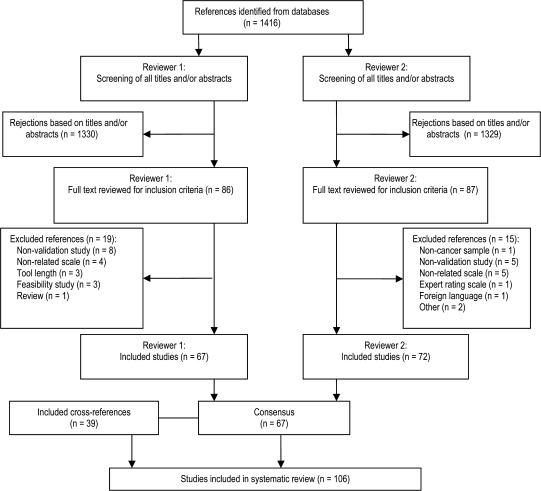
Screening for emotional distress is becoming increasingly common in cancer care. This systematic review examines the psychometric properties of the existing tools used to screen patients for emotional distress, with the goal of encouraging screening programs to use standardized tools that have strong psychometrics. Systematic searches of MEDLINE and PsycINFO databases for English-language studies in cancer patients were performed using a uniform set of key words (eg, depression, anxiety, screening, validation, and scale), and the retrieved studies were independently evaluated by two reviewers. Evaluation criteria included the number of validation studies, the number of participants, generalizability, reliability, the quality of the criterion measure, sensitivity, and specificity. The literature search yielded 106 validation studies that described a total of 33 screening measures. Many generic and cancer-specific scales satisfied a fairly high threshold of quality in terms of their psychometric properties and generalizability. Among the ultrashort measures (ie, those containing one to four items), the Combined Depression Questions performed best in patients receiving palliative care. Among the short measures (ie, those containing five to 20 items), the Center for Epidemiologic Studies-Depression Scale and the Hospital Anxiety and Depression Scale demonstrated adequate psychometric properties. Among the long measures (ie, those containing 21-50 items), the Beck Depression Inventory and the General Health Questionaire-28 met all evaluation criteria. The PsychoSocial Screen for Cancer, the Questionnaire on Stress in Cancer Patients-Revised, and the Rotterdam Symptom Checklist are long measures that can also be recommended for routine screening. In addition, other measures may be considered for specific indications or disease types. Some measures, particularly newly developed cancer-specific scales, require further validation against structured clinical interviews (the criterion standard for validation measures) before they can be recommended.
Overview
The claims and statistics of this paper haven’t been checked yet.
Run the check — free, no account needed. It reads the open-access text and checks the sources it cites.
Integrity signals
Registry
Cites
Statistics
Figures
Verification
Claims the paper makes
The claims and statistics of this paper haven’t been checked yet.
Run the check — free, no account needed. It reads the open-access text and checks the sources it cites.
Claims other papers make about this one
Each is checked against this paper’s own text: does it say what the citing paper says it does?
The cited source says what the claim attributes to it.
In the citing paper
“The HADS is validated and extensively used in the measurement of distress among cancer survivors (Vodermaier et al., 2009; Mitchell et al., 2010).”
From A randomised controlled trial comparing internet-delivered cognitive behavioural therapy (iCBT) with and without main carer access versus treatment-as-usual for depression and anxiety among breast cancer survivors: Study protocol (2021) · cites this paper as Vodermaier et al., 2009
Self-check
Percentages, sums and reported differences re-computed from the paper’s own numbers.
The self-check needs the paper’s full text.
Citations
Cites
Diagnostic and Statistical Manual of Mental Disorders
Williams, J. B. W., & First, M. B. (2013) · Oxford University Press eBooks · doi:10.1093/acrefore/9780199975839.013.104 · Cited by 109,845
The CES-D Scale: A Self-Report Depression Scale for Research in the General Population
Radloff, L. S. (1977) · Applied Psychological Measurement · doi:10.1177/014662167700100306 · Cited by 53,267
The Hospital Anxiety and Depression Scale
Zigmond, A. S., & Snaith, R. P. (1983) · Acta Psychiatrica Scandinavica · doi:10.1111/j.1600-0447.1983.tb09716.x · Cited by 47,139
The PHQ-9: Validity of a brief depression severity measure
Kroenke, K., Spitzer, R. L., & Williams, J. B. W. (2001) · Journal of General Internal Medicine · doi:10.1046/j.1525-1497.2001.016009606.x · Cited by 44,910
An inventory for measuring depression
BECK, A. T. (1961) · Archives of General Psychiatry · doi:10.1001/archpsyc.1961.01710120031004 · Cited by 38,032
Detection of Postnatal Depression: Development of the 10-item Edinburgh Postnatal Depression Scale
Cox, J. L., Holden, J. M., & Sagovsky, R. (1987) · British Journal of Psychiatry · doi:10.1192/bjp.150.6.782 · Cited by 14,183
A self-rating depression scale
ZUNG, W. W. K. (1965) · Archives of General Psychiatry · doi:10.1001/archpsyc.1965.01720310065008 · Cited by 9,813
Impact of Event Scale: A Measure of Subjective Stress
Horowitz, M., Wilner, N., & Alvarez, W. (1979) · Psychosomatic Medicine · doi:10.1097/00006842-197905000-00004 · Cited by 7,813
Psychometric properties of the PTSD checklist (PCL)
Blanchard, E. B., Jones-Alexander, J., Buckley, T. C., & Forneris, C. A. (1996) · Behaviour Research and Therapy · doi:10.1016/0005-7967(96)00033-2 · Cited by 3,997
The Validity of Two Versions of the GHQ in the WHO Study of Mental Illness in General Health Care
GOLDBERG, D. P., GATER, R., SARTORIUS, N., USTUN, T. B., PICCINELLI, M., GUREJE, O., & RUTTER, C. (1997) · Psychological Medicine · doi:10.1017/s0033291796004242 · Cited by 3,657
Research works printed but not linked: 11
- 2008, ONCOL EXCH, 7, 37
- 1997, American Journal of Psychiatry, 1, 674
- 1999, 40, 64
- 2001, 42, 241
- 2007, Psycho-oncology, 16, 1046, 10.1002/pon.1212 · DOI
- Miklavcic, 2008, 20, 148
- 2006, 47, 340
- 1989, 7, 31
- 2000, 41, 121
- 2003, 12, 1
- 2002, EUR J CANCER CARE, 11, 245
Cited by
Sorted by citations
Items 201–300 of 540
Merluzzi, T. V., Philip, E. J., Gomer, B., Heitzmann, C. A., & Kim, D. (2021) · Annals of Behavioral Medicine · doi:10.1093/abm/kaaa122 · Cited by 21
Lima, M. P., Longatto‐Filho, A., & Osório, F. D. L. (2016) · PLoS ONE · doi:10.1371/journal.pone.0149421 · Cited by 21
“The values of sensitivity and specificity are good, and in according with others short instruments available in literature [18].”
BackgroundReliability and Validity of the PHQ-9 in Portuguese Women with Breast Cancer
Torres, A., Monteiro, S., Pereira, A., & Albuquerque, E. (2016) · European Proceedings of Social & Behavioural Sciences · doi:10.15405/epsbs.2016.07.02.39 · Cited by 23
Valderrama-Ríos, M. C., & Pedraza, R. S. (2017) · Revista Colombiana de Psiquiatría · doi:10.1016/j.rcp.2017.04.003 · Cited by 21
“…desde el diagnóstico y la impacto del diagnóstico luego de los primeros 6 meses 39 y el tratamiento 40 ; b) la diferencia en las escalas empleadas 41 35,42 ansiosos o depresivos de significación clínica; otros autores también han reportado este hallazgo y no encuentran que la edad sea un factor…”
Hoffmann, K., Kamp, M. A., Steiger, H., Sabel, M., & Rapp, M. (2017) · Oncotarget · doi:10.18632/oncotarget.22802 · Cited by 21
“com/oncotarget But although diagnosis of distress can be improved by screening with self-report questionnaires [6], routine screening assessments during hospitalization is not often implemented, especially not in the daily routineneurosurgical setting mostly due to time consuming instruments and missing qualified staf…”
BackgroundHudson, P., Collins, A., Bostanci, A., Willenberg, L., Stephanov, N., & Phillip, J. (2015) · Palliative & Supportive Care · doi:10.1017/s1478951515000565 · Cited by 21
“, 2010), psychological/emotional needs (Thekkumpurath et al., 2008; Vodermaier et al., 2009), quality of life (Albers et al.”
BackgroundKim, Y. S., Do, H., Lee, J. W., Jeong, J.-S., Shin, Y., Yi, K., Kim, J., Lee, S. B., Sohn, G., Yang, N., et al. (2015) · Psycho-Oncology · doi:10.1002/pon.3919 · Cited by 21
“Each item ranges from 0 (seldom or never) to 3 (almost always), with the total scores from 0 to 60 [12].”
BackgroundRecognition of Depression and Methods of Depression Screening in People with Cancer
Passik, S. D., & Lowery, A. E. (2010) · doi:10.1002/9780470972533.ch4 · Cited by 21
Fischbeck, S., Weyer‐Elberich, V., Zeißig, S. R., Imruck, B. H., Blettner, M., Binder, H., & Beutel, M. E. (2018) · BMC Public Health · doi:10.1186/s12889-018-5401-1 · Cited by 20
High prevalence of persistent emotional distress in desmoid tumor
Ingley, K. M., Klein, R., Theobalds, N. C., Burtenshaw, S. M., Razak, A. R. A., Chen, B., Xu, W., Gladdy, R. A., Li, M., & Gupta, A. A. (2019) · Psycho-Oncology · doi:10.1002/pon.5250 · Cited by 20
“Screening for symptom distress in cancer patients is becoming increasingly integrated into patient care.(20,21) The Distress Assessment and Response Tool (DART) is a patient reported outcome (PRO) distress screening program established as a standard of care in all clinics at our institution.”
BackgroundDistress Screening in Head and Neck Cancer Patients Planned for Cancer‐Directed Radiotherapy
Lewis, S. C., Pandey, S., Salins, N. S., Deodhar, J. K., Patil, V., Gupta, T., Laskar, S. G., Budrukkar, A. N., Murthy, V., Joshi, A., et al. (2021) · The Laryngoscope · doi:10.1002/lary.29491 · Cited by 22
“used for screening psychosocial distress are the Hospital Anxiety and Depression Scale (HADS), Brief Symptom Inventory, Functional Assessment of Chronic Illness Therapy, Zung Self-Rating Depression Scale, etc.(14) The NCCN distress management panel introduced the Distress Thermometer (DT) and problem list.”
MethodBirkhoff, S. D., Waddington, C., Williams, J. W., Verucci, L., Dominelli, M., & Caplan, R. J. (2021) · Oncology nursing forum · doi:10.1188/21.onf.431-439 · Cited by 20
Weary, D. M. (2014) · CABI eBooks · doi:10.1079/9781780642161.0188 · Cited by 20
“One survey (Vodermaier et al., 2009, p1482) reported 1416 studies testing the efficacy of questionnaires in assessing emotional distress in cancer patients.”
BackgroundPerspectives on Psychosocial and Spiritual Cancer Support Services in New Zealand
Egan, R., McKechnie, R., Jobson, J., Herbison, P., & Richards, R. (2013) · Journal of Psychosocial Oncology · doi:10.1080/07347332.2013.835017 · Cited by 20
Boulos, D. N. K., Ghali, R., Ibrahim, E., Boulos, M. N. K., & Abdelmalik, P. (2011) · Medical Oncology · doi:10.1007/s12032-010-9607-z · Cited by 23
“The study is important as there is paucity of literature addressing the stress that cancer patients face despite its high prevalence [106, 107]”
BackgroundMilbury, K., Kavanagh, A., Meng, Z., Chen, Z., Chandwani, K. D., Garcia, K., Perkins, G. H., McQuade, J. L., Raghuram, N. V., Nagarathna, R., et al. (2017) · Supportive Care in Cancer · doi:10.1007/s00520-017-3612-0 · Cited by 20
“Because previous studies focused entirely on healthy, community samples, the current study seeks to examine if the noted positive affect response pattern (or potential affect suppression) generalizes to women with breast cancer, who are more vulnerable to depressive symptoms than the general population [6, 7, 12].”
BackgroundMethodMelissant, H. C., Jansen, F., Schutte, L. E. R., Lissenberg-Witte, B. I., Buter, J., Leemans, C. R., Sprangers, M. A. G., Vergeer, M. R., Laan, E. T. M., & Leeuw, I. M. V. (2018) · Oral Oncology · doi:10.1016/j.oraloncology.2018.06.016 · Cited by 20
Mattsson, S., Olsson, E. M. G., Carlsson, M. E., & Johansson, B. (2019) · Journal of Medical Internet Research · doi:10.2196/11387 · Cited by 24
“Long questionnaires generally have a higher specificity, but as the clinical acceptance is low because of the higher demand on patients and staff, they are not always useful in routine cancer care [18].”
Bergerot, C. D., Razavi, M., Clark, K. L., Philip, E. J., Pal, S. K., Loscalzo, M. J., & Dale, W. (2021) · Psycho-Oncology · doi:10.1002/pon.5685 · Cited by 20
“Notably, this may be due to the questionnaire used, and also to the way patients were asked, as previous studies have noted that patients tend to more accurately report their emotional symptoms when using electronic devices.(31,32)”
Assessing Somatic, Psychosocial, and Spiritual Distress of Patients with Advanced Cancer
Fischbeck, S., Maier, B.-O., Reinholz, U., Nehring, C., Schwab, R., Beutel, M. E., & Weber, M. (2012) · American Journal of Hospice and Palliative Medicine® · doi:10.1177/1049909112453640 · Cited by 23
“Yet it is well known that the concerns of the patients shift during the course of the illness and other questions and burdens can come to the fore.(28) The purpose of our study, therefore, was to develop a questionnaire which identifies specific burdens of oncological palliative care patients in an advanced illness co…”
BackgroundVarela-Moreno, E., Rivas-Ruíz, F., Padilla-Ruíz, M., Alcaide-García, J., Zarcos-Pedrinaci, I., Téllez, T., Larrea-Baz, N. F.-D., Baré, M., Bilbao, A., Sarasqueta, C., et al. (2022) · Psycho-Oncology · doi:10.1002/pon.6018 · Cited by 18
Jeppesen, M. M., Ezendam, N. P. M., Pijnenborg, J. M. A., Vos, M. C., Boll, D., Kruitwagen, R. F. P. M., Jensen, P. T., & van de Poll-Franse, L. V. (2017) · Journal of Cancer Survivorship · doi:10.1007/s11764-017-0639-7 · Cited by 21
“The HADS has been widely used in cancer settings [22, 23] and has proved psychometrically robust [24, 25].”
MethodMotivation in the return to work process: a self-determination cluster approach
Vanovenberghe, C., den Broeck, A. V., Lauwerier, E., Goorts, K., & Bois, M. D. (2020) · Disability and Rehabilitation · doi:10.1080/09638288.2020.1826584 · Cited by 24
“Due to the perceived advantages in efficiency and feasibility, there is growing interest in short (5 – 20 item) or ultra-short (1 – 4 item) measures [42].”
Jensen, C. G., Elsass, P., Neustrup, L., Bihal, T., Flyger, H., Kay, S. M., Khan, S., Jensen, S. S., Pedersen, A., & Würtzen, H. (2014) · Patient Education and Counseling · doi:10.1016/j.pec.2014.07.020 · Cited by 18
“The CES-D was recommended in a large review of the psychometric properties of 33 scales used to assess psychological distress in cancer patients [37].”
MethodAre we accurately evaluating depression in patients with cancer?
Saracino, R. M., Aytürk, E., Cham, H., Rosenfeld, B. D., Feuerstahler, L. M., & Nelson, C. J. (2019) · Psychological Assessment · doi:10.1037/pas0000765 · Cited by 18
“Past research indicates acceptable psychometric properties and has supported a four-factor structure: depressed affect, positive affect, somatic complaints, and interpersonal problems (Nelson, Cho, Berk, Holland, & Roth, 2010; Saracino, Cham, Rosenfeld, & Nelson, 2018; Vodermaier et al., 2009).”
BackgroundRossi, A. A., Marconi, M., Taccini, F., Verusio, C., & Mannarini, S. (2022) · Frontiers in Psychology · doi:10.3389/fpsyg.2022.859478 · Cited by 18
Duarte, V., Araújo, N., Lopes, C., Costa, A., Ferreira, A., Carneiro, F., Oliveira, J., Braga, I. C., Morais, S., Pacheco‐Figueiredo, L., et al. (2022) · International Journal of Environmental Research and Public Health · doi:10.3390/ijerph19159122 · Cited by 18
“This self-administered questionnaire is one of the most frequently used in cancer patients [28] and has been validated in the Portuguese population, showing adequate reliability for the anxiety and depression subscales (Cronbach’s α of 0.”
MethodDarvishi, N., Ghasemi, H., Rahbaralam, Z., Shahrjerdi, P., Akbari, H., & Mohammadi, M. (2022) · Supportive Care in Cancer · doi:10.1007/s00520-022-07371-1 · Cited by 19
Screening Instruments for Depression in Advanced Cancer Patients: What Do We Actually Measure?
Warmenhoven, F. C., van Weel, C., Vissers, K. C. P., & Prins, J. B. (2012) · Pain Practice · doi:10.1111/papr.12012 · Cited by 18
“The Beck Depression Inventory (BDI-II), Beck Depression Inventory Primary Care (BDI-PC), and the Hospital Anxiety and Depression Scale (HADS) are validated screening tools in patients with cancer, and these screening tools are available in the Dutch language.(16) Furthermore, HADS is suggested as a screening tool in D…”
MethodPsychological Symptoms Among Patients With BCR-ABL-Negative Myeloproliferative Neoplasms.
McFarland, D., Polizzi, H., Mascarenhas, J., Kremyanskaya, M., Holland, J., & Hoffman, R. (2016) · The Journal of the National Comprehensive Cancer Network · doi:10.6004/jnccn.2016.0168 · Cited by 20
Liu, S.-W., Li, X.-Y., Ma, R., Cao, H.-X., Jing, C.-W., Wang, Z., Chen, D., Zhang, J.-Y., Zhang, Y., Feng, J.-F., et al. (2020) · Translational Lung Cancer Research · doi:10.21037/tlcr-20-273 · Cited by 14
“Cancer patients often experience depression and anxiety, which have negative effects on the quality of life and medical treatment of patients (5-11).”
BackgroundKayser, K., Acquati, C., & Tran, T. V. (2012) · Journal of Psychosocial Oncology · doi:10.1080/07347332.2012.721489 · Cited by 18
“( 2009 ) in their recent systematic review of assessment instruments for screening emotional distress in cancer patients.”
BackgroundMethodRohan, E. A. (2012) · Journal of Psychosocial Oncology · doi:10.1080/07347332.2012.721487 · Cited by 18
“These instruments are characterized as ultrashort, short, and long or standard, based on number of items (questions) contained in or time needed to administer the instrument (Mitchell, Kaar, Coggan, & Herdman, 2008; Vodermaier et al., 2009).”
InfluentialBlackmon, J. E., Liptak, C. C., & Recklitis, C. J. (2016) · Journal of Adolescent and Young Adult Oncology · doi:10.1089/jayao.2016.0052 · Cited by 17
“Several brief scales ( 10 items) for depression have been evaluated in adult survivors, 8 but similar brief measures have not been widely evaluated for adolescent survivors of childhood cancer.”
Fogh, M., Højgaard, A. D., Rotbøl, C., & Jensen, A. B. (2020) · Acta Oncologica · doi:10.1080/0284186x.2020.1813326 · Cited by 18
Education for cancer-related fatigue: could talking about it make people more likely to report it?
O’Brien, L., Loughnan, A., Purcell, A., & Haines, T. P. (2013) · Supportive Care in Cancer · doi:10.1007/s00520-013-1964-7 · Cited by 19
“It has been validated in various cancer patient populations, including mixed diagnoses and disease stages, breast cancer patients, and patients awaiting bone marrow transplantation [25, 26].”
BackgroundScreening for distress: a role for oncology nursing
Fitch, M. I. (2011) · Current Opinion in Oncology · doi:10.1097/cco.0b013e32834791a1 · Cited by 19
Cockle‐Hearne, J., Barnett, D., Hicks, J. A., Simpson, M. F., White, I. D., & Faithfull, S. (2018) · JMIR Cancer · doi:10.2196/cancer.8918 · Cited by 17
Holistic needs assessment in brain cancer patients: A systematic review of available tools
Afseth, J., Neubeck, L., Karatzias, T., & Grant, R. (2018) · European Journal of Cancer Care · doi:10.1111/ecc.12931 · Cited by 17
Saracino, R. M., Cham, H., Rosenfeld, B. D., & Nelson, C. J. (2018) · European Journal of Psychological Assessment · doi:10.1027/1015-5759/a000510 · Cited by 18
“Past research has demonstrated acceptable psychometric properties (Hann et al., 1999; Lewinsohn, Seeley, Roberts, & Allen, 1997; Nelson et al., 2009; Saracino et al., 2017; Vodermaier et al., 2009).”
MethodJansen, F., Lissenberg-Witte, B. I., Krebber, A. M. H., Cuijpers, P. J., de Bree, R., Becker‐Commissaris, A., Smit, E. F., van Straten, A., Eeckhout, G. M., Beekman, A. T. F., et al. (2019) · Supportive Care in Cancer · doi:10.1007/s00520-019-04714-3 · Cited by 17
Landa-Ramírez, É., Greer, J. A., Sánchez-Román, S., Manolov, R., Salado-Avila, M. M., Esteban, L. A. T., & Riveros-Rosas, A. (2019) · Journal of Clinical Psychology in Medical Settings · doi:10.1007/s10880-019-09620-8 · Cited by 17
Williams, H., Jajja, M. R., Baer, W. M., Balch, G. C., Maithel, S. K., Patel, A. D., Patel, D., Patel, S. G., Stetler, J. L., Winer, J. H., et al. (2019) · Journal of Surgical Oncology · doi:10.1002/jso.25584 · Cited by 17
“Many of these have not been validated for use in cancer patients, do not correlate with the DSM criteria for mood disorders or cannot differentiate between subclinical and clinical symptoms.(1,12) Using the ASCO recommended thresholds for the PHQ‐9 and GAD‐7, our study found that 19.”
BackgroundBreast cancer survivorship symptom management: current perspective and future development
Londen, G. J. V., Beckjord, E. B., Dew, M., Cuijpers, P. J., Tadic, S. D., & Brufsky, A. (2012) · Breast Cancer Management · doi:10.2217/bmt.12.63 · Cited by 18
Emotional distress in cancer: screening policy, clinical limitations and educational needs
Grassi, L. G., Nanni, M. G., & Caruso, R. (2010) · Journal of Medicine and the Person · doi:10.1007/s12682-010-0047-5 · Cited by 17
La atención psicológica a pacientes con cáncer: de la evaluación al tratamiento
Hernández, M., & Cruzado, J. A. (2013) · Clínica y Salud · doi:10.5093/cl2013a1 · Cited by 27
“This practical aspect might explain the current widespread use of DT (Vodermaier et al., 2009)) despite both its reliability and validity being just moderate (Mitchell, 2010).”
BackgroundAddington-Hall, J. M., Hunt, K. J., Rowsell, A., Heal, R., Hansford, P., Monroe, B., & Sykes, N. P. (2013) · BMJ Supportive & Palliative Care · doi:10.1136/bmjspcare-2012-000352 · Cited by 17
Garssen, B., & van der Lee, M. L. (2010) · JNCI Journal of the National Cancer Institute · doi:10.1093/jnci/djq047 · Cited by 16
Muzzatti, B., Agostinelli, G., Bomben, F., Busato, S., Flaiban, C., Gipponi, K. M., Mariutti, G., Mella, S., Piccinin, M., & Annunziata, M. A. (2022) · Frontiers in Psychology · doi:10.3389/fpsyg.2022.875410 · Cited by 16
Kautz‐Freimuth, S., Redaèlli, M., Isselhard, A., Shukri, A., Vodermaier, A., Rhiem, K., Schmutzler, R. K., & Stock, S. (2022) · Trials · doi:10.1186/s13063-022-06081-7 · Cited by 16
“It has been shown to be well suited for measuring emotional stress in cancer patients [62].”
BackgroundMarten‐Mittag, B., Book, K., Buchhold, B., Dinkel, A., Gründobler, B., Henrich, G., Huber, B., Pirker, C., Regenberg, A., Schickel, S., et al. (2014) · Psycho-Oncology · doi:10.1002/pon.3708 · Cited by 17
“Systematic reviews on screening instruments for psychosocial distress in cancer patients did not include interviewbased screening tools [2,14].”
BackgroundQuality of life in palliative care: principles and practice
Kaasa, S., & Loge, J. H. (2015) · doi:10.1093/med/9780199656097.003.0197 · Cited by 16
Mateo-Ortega, D., Limonero, J. T., Maté-Méndez, J., Beas, E., González‐Barboteo, J., Barbero, E., Ela, S., & Gómez‐Batiste, X. (2018) · Palliative & Supportive Care · doi:10.1017/s1478951518000652 · Cited by 15
“We thus must first detect the presence of distress using reliable validated instruments (Vodermaier et al., 2009) to ensure the best methods are used (Evidence-Based Medicine Working Group, 1992).”
BackgroundMethodNübling, G., Allmendinger, S., & Lorenzl, S. (2012) · Der Schmerz · doi:10.1007/s00482-012-1241-6 · Cited by 12
Nerdal, V., Gjestad, E., Saltvedt, I. T., Munthe‐Kaas, R., Ihle‐Hansen, H., Ryum, T., Lydersen, S., & Grambaitė, R. (2022) · BMC Neurology · doi:10.1186/s12883-022-02756-5 · Cited by 19
“However, adjusting HADS cut-off scores to the specific clinical sample can provide a higher specificity and sensitivity [52, 53].”
BackgroundMartínez, P., Peiró, A. C., Vaíllo, Y. A., & Garrido, M. J. G. (2019) · Revista Latinoamericana de Psicología · doi:10.14349/rlp.2019.v51.n1.1 · Cited by 17
“The BSI-18 is considered a “short-tool” because it consists of only 18 items (Vodermaier et al., 2009).”
BackgroundDistress do paciente oncológico: prevalência e fatores associados na opinião de familiares
de Albuquerque, K. F., & Pimenta, C. A. D. M. (2014) · Revista Brasileira de Enfermagem · doi:10.1590/0034-7167.2014670511 · Cited by 14
“Na perspectiva de atenção à díade paciente-família foi feita uma meta-análise com 29 estudos(16) que indicou intervenções que podem ser utilizadas para redução do distress de pacientes e de seus cuidadores familiares como ações educacionais, treinamento de habilidades e aconselhamento terapêutico, incluindo incentivo…”
BackgroundMcCarter, K. L., Britton, B., Baker, A., Halpin, S. A., Beck, A. K., Carter, G. L., WRATTEN, C. R., Bauer, J. D., Booth, D., Forbes, E., et al. (2015) · BMJ Open · doi:10.1136/bmjopen-2015-008277 · Cited by 14
“Data analysis Summary measures There are a variety of commonly used screening instruments and scoring thresholds for psychosocial distress.(34) As such, it is anticipated that there will be a range of dif-”
MethodFoulkes, S., Howden, E. J., Antill, Y. C., Loi, S., Salim, A., Haykowsky, M. J., Daly, R. M., Fraser, S. F., & Gerche, A. L. (2020) · BMC Cancer · doi:10.1186/s12885-020-07123-6 · Cited by 14
Biracyaza, E., Habimana, S., & Rusengamihigo, D. (2021) · Psychology Research and Behavior Management · doi:10.2147/prbm.s306530 · Cited by 14
Miller, M. F., Mullins, C. D., Onukwugha, E., Golant, M., & Buzaglo, J. S. (2014) · Quality of Life Research · doi:10.1007/s11136-014-0742-4 · Cited by 14
Ilić, I., Babic, G. M., Dimitrijević, A., Ilić, M., & Grujičić, S. Š. (2019) · International Journal of Gynecological Cancer · doi:10.1136/ijgc-2019-000219 · Cited by 14
“Based on a systematic literature review that examined the existing tools used to screen for emotional distress in cancer patients, the CES-D scale demonstrated adequate psychometric properties.(16) Besides being used as a screening tool in samples of cancer patients, the CES-D scale was established”
MethodDistress, the 6th vital sign in cancer care
Watson, M., & Bultz, B. D. (2010) · Psycho-Oncologie · doi:10.1007/s11839-010-0269-z · Cited by 14
“Researches by Fallowfield [12], Pirl [25], Vodermaier [29] and Mitchell [18] clearly suggest that cancer care providers rely on clinical acumen rather that standardized screening to better understand the patient experience.”
BackgroundPorche, K., Reymond, L., Callaghan, J. O., & Charles, M. A. (2013) · Australian Health Review · doi:10.1071/ah13041 · Cited by 14
Curran, L., Mahoney, A., & Hastings, B. J. (2024) · Journal of Clinical Psychology in Medical Settings · doi:10.1007/s10880-024-10011-x · Cited by 17
“While the most frequently used self-report measure was the HADS, there has been debate regarding optimal cut-off values (Annunziata et al., 2020; Vodermaier et al., 2009), and concern over its use as a case-finding instrument (Mitchell, 2010).”
Park, H., Kim, K.-E., Moon, E., & Kang, T. (2023) · Psychiatry Investigation · doi:10.30773/pi.2022.0316 · Cited by 16
Cancer and Stress: Understanding the Connections and Interventions
D’Andre, S. D., Ellsworth, L. L., Kirsch, J. L., Montane, H. N., Kruger, M. B., Donovan, K. A., Bronars, C. A., Markovic, S. N., & Ehlers, S. L. (2024) · American Journal of Lifestyle Medicine · doi:10.1177/15598276241304373 · Cited by 14
“Sensitivity, speci fi city, and content validity are higher in longer, psychometrically well-constructed questionnaires, 14 while brief questionnaires (1-4 questions) can be adequate for ruling out distress.”
Loquai, C., Scheurich, V., Syring, N., Schmidtmann, I. M., Müller-Brenne, T., Werner, A., Grabbe, S., & Beutel, M. E. (2014) · Journal of the European Academy of Dermatology and Venereology · doi:10.1111/jdv.12361 · Cited by 13
Validation of a biopsychosocial distress screening tool, “You, Your Family and COH Are a Team”
Wong, F. L., Stiller, T., Obenchain, R. A., David, C., Patel, S. K., Xie, B., Loscalzo, M. J., & Clark, K. L. (2019) · Psycho-Oncology · doi:10.1002/pon.5266 · Cited by 13
“Although not required, validated instruments are recommended for use.(6,7) Biopsychosocial distress screening in the outpatient setting is routinely performed at City of Hope and a number of other cancer centers using the “You, Your Family and City of Hope are a Team” (YYF) questionnaire via the SupportScreen(8) touch…”
BackgroundTranslating Research on the Distress Thermometer Into Practice
Tavernier, S. S. (2014) · Clinical journal of oncology nursing · doi:10.1188/14.cjon.s1.26-30 · Cited by 13
Screening for distress in survivorship
Girgis, A., Smith, A. B., & Durcinoska, I. (2017) · Current Opinion in Supportive and Palliative Care · doi:10.1097/spc.0000000000000328 · Cited by 13
Jiménez‐Fonseca, P., Calderón, C., Carmona‐Bayonas, A., Muñoz-Mateu, M., Hernández, R., Lloret, M. M., Ghanem, I., Beato, C., Lavín, D. C., Rubio, A. I., et al. (2018) · Clinical & Translational Oncology · doi:10.1007/s12094-018-1870-z · Cited by 13
“Emotional distress was appraised by the Brief Symptom Inventory (BSI), one of the most widely used instruments to rate emotional distress in clinical patients [18] consisting of 18 items.”
MethodReinert, C. D. A., Ribas, M., & Zimmermann, P. R. (2015) · Trends in Psychiatry and Psychotherapy · doi:10.1590/2237-6089-2015-0003 · Cited by 10
Brenne, E., Loge, J. H., Lie, H. C., Hjermstad, M. J., Fayers, P. M., & Kaasa, S. (2016) · Palliative Medicine · doi:10.1177/0269216315620082 · Cited by 13
Bastian, T., & Burhansstipanov, L. (2020) · JCO Global Oncology · doi:10.1200/jgo.19.00215 · Cited by 12
Halámek, F., Světlák, M., Malatincová, T., Halámková, J., Slezáčková, A., Barešová, Z., & Lekárová, M. (2024) · Frontiers in Psychology · doi:10.3389/fpsyg.2024.1392397 · Cited by 12
“These results only underline the importance of stress screening in cancer patients (Vodermaier et al., 2009).”
Gascon, B., Elman, J., Macedo, A., Leung, Y. W., Rodin, G., & Li, M. (2024) · Current Oncology · doi:10.3390/curroncol31110481 · Cited by 12
Annunziata, M. A., Muzzatti, B., Bidoli, E., & Veronesi, A. (2012) · Tumori Journal · doi:10.1177/030089161209800117 · Cited by 12
Depresión y cáncer: una revisión orientada a la práctica clínica
Rodríguez, V. P., Amboage, A. M., Blázquez, M. H., Torres, M. Á. G., & Gaviria, M. (2015) · Revista Colombiana de Cancerología · doi:10.1016/j.rccan.2015.04.005 · Cited by 16
“…de agentes antineoplásicos a través del CYP450 3A4, lo que produce una disminución de su eficacia o mayor toxicidad de los mismos 35 Otros fármacos como el citalopram, el escitalopram, la venlafaxina y la mirtazapina son inhibidores débiles, lo que los convierte en una elección más segura 35”
BackgroundRoutine depression screening and diagnosing strategy for cancer inpatients
Tu, C., Hsu, M., Chi, S., Lin, H., & Yen, Y. (2014) · Psycho-Oncology · doi:10.1002/pon.3547 · Cited by 12
“Nevertheless, there is still controversy in the selection of depression screening tools [19,20].”
BackgroundRammant, E., Bultijnck, R., Sundahl, N., Ost, P., Pauwels, N., Deforche, B. I., Pieters, R., Decaestecker, K., & Fonteyne, V. (2017) · BMJ Open · doi:10.1136/bmjopen-2017-016054 · Cited by 12
Rae, C. S., Klassen, A. F., Tsangaris, E., Breakey, V. R., & D’Agostino, N. M. (2019) · Journal of Adolescent and Young Adult Oncology · doi:10.1089/jayao.2019.0032 · Cited by 12
“22 The HADS was also found to have high variability in the sensitivity and speci-ficity of cutoff values.”
InfluentialS3-Leitlinie Diagnostik und Therapie der Plattenepithelkarzinome und Adenokarzinome des Ösophagus
Ebert, M. P. A., Fischbach, W., Hollerbach, S. H., Höppner, J., Lorenz, D., Stahl, M., Stuschke, M., Pech, O., Vanhoefer, U. J., Porschen, R., et al. (2024) · Zeitschrift für Gastroenterologie · doi:10.1055/a-2239-9802 · Cited by 12
Wang, G., & Pan, S. (2025) · Clinical & Translational Oncology · doi:10.1007/s12094-025-04101-x · Cited by 12
Mitchell, K., Delfont, S., Bracey, M., & Endacott, R. (2018) · European Journal of Oncology Nursing · doi:10.1016/j.ejon.2018.02.004 · Cited by 11
Abbott, Y., Shah, N. R., Ward, K. K., McHale, M. T., Alvarez, E. A., Saenz, C. C., & Plaxe, S. C. (2013) · Health & Social Work · doi:10.1093/hsw/hlt006 · Cited by 11
Quality of life during early radiotherapy in patients with head and neck cancer and pain
Schaller, A., Dragioti, E., Liedberg, G., & Larsson, B. K. (2017) · Journal of Pain Research · doi:10.2147/jpr.s138113 · Cited by 11
“40 An advantage of the EQ5D is that it addresses only a few items and provides a few alternative answers, but this instrument fails to address the issues of a specific disease.”
Tobias, K., Lehrfeld, J., Rosenfeld, B., Pessin, H., & Breitbart, W. (2017) · Palliative & Supportive Care · doi:10.1017/s1478951517000724 · Cited by 11
“Research using the BDI–II in cancer samples has typically focused on its utility as a screening instrument (Vodermaier et al., 2009) or indicator of treatment response (Brothers et al.”
MethodPépin, A.-J., Lippé, S., Krajinović, M., Laverdière, C., Michon, B., Sinnett, D., & Sultan, S. (2017) · Pediatric Hematology and Oncology · doi:10.1080/08880018.2017.1338805 · Cited by 11
“However, very few studies have sought to highlight the psychological domains and symptoms associated with DT ratings, particularly following treatments of pediatric cancer [10].”
BackgroundHo, P. J., Hartman, M., Young‐Afat, D. A., Gernaat, S. A. M., Lee, S. C., & Verkooijen, H. M. (2018) · PLoS ONE · doi:10.1371/journal.pone.0193099 · Cited by 11
Patel, R. S., Wen, K., & Aggarwal, R. (2018) · Medical Sciences · doi:10.3390/medsci6040093 · Cited by 11
“To mention a few of the multitude of contributory factors that have resulted in this varied rate includes the use of different instruments to assess depression, utilization of several different diagnostic criteria to evaluate depression, and the variability of the cancer type and stage in the patient population [6,7].”
BackgroundFradgley, E. A., Boltong, A. G., O'Brien, L., Boyes, A., Lane, K., Beattie, A., Clinton‐McHarg, T., Jacobsen, P. B., Doran, C. M., Barker, D., et al. (2019) · JMIR Research Protocols · doi:10.2196/12473 · Cited by 11
“The GHQ-28 has excellent internal consistency, diagnostic accuracy, and test-retest reliability [32,33].”
Gaiger, A., Lubowitzki, S., Krammer, K., Zeilinger, E. L., Acel, A., Cenic, O., Schrott, A., Unseld, M., Rassoulian, A., Skrabs, C., et al. (2022) · Cancer Medicine · doi:10.1002/cam4.4697 · Cited by 11
Now What? Toward an Integrated Research and Practice Agenda in Distress Screening
Parry, C., Padgett, L. S., & Zebrack, B. (2012) · Journal of Psychosocial Oncology · doi:10.1080/07347332.2012.721486 · Cited by 11
“their lack of specificity may contribute to high levels of false-positives, and ultrashort measures often demonstrate low concordance with clinical assessments for individuals who score highly on longer screening instruments (Vodermaier et al., 2009).”
BackgroundInfluentialPetridis, P. D., Grinband, J., Agin-Liebes, G., Kinslow, C. J., Zeifman, R. J., Bogenschutz, M. P., Griffiths, R. R., & Ross, S. (2024) · Nature Mental Health · doi:10.1038/s44220-024-00331-0 · Cited by 10
“The BSI and its shorter variant, the BSI-18, have good psychometric properties 52 and are frequently used in psycho-oncology to quantify various dimensions of cancer-related distress 53 .”
Greeley, K. M., Rash, J. A., Tulk, J., Savard, J., Seal, M., Urquhart, R., Thoms, J., Laing, K. E., Fawcett, E. J., & Garland, S. N. (2025) · SLEEP · doi:10.1093/sleep/zsaf014 · Cited by 14
“The Hospital Anxiety and Depression Scale (HADS) is a 14-item self-report measure for depression and anxiety symptoms in medical outpatients and is widely used in cancer populations [56, 57].”
Bindu Menon, K., & Gadiraju, P. (2025) · Journal of Psychosexual Health · doi:10.1177/26318318241312317 · Cited by 10
Miller, J., Szalacha, L. A., Hartranft, S. R., & Rodriguez, C. S. (2021) · Clinical journal of oncology nursing · doi:10.1188/21.cjon.305-313 · Cited by 10
Chevalier, L., Michaud, A. L., Zhou, E. S., Chang, G., & Recklitis, C. J. (2022) · Journal of Adolescent and Young Adult Oncology · doi:10.1089/jayao.2021.0175 · Cited by 10
“Brief measures, particularly ‘‘ultrashort’’ measures ( p 4 items) 21 such as the ISI-3, may be critical in effective screening of YACS.”
Hallford, D. J., McCabe, M. P., Mellor, D. J., Davison, T. E., & Goldhammer, D. L. (2011) · Nurse Education Today · doi:10.1016/j.nedt.2011.07.011 · Cited by 11
“A short, easy to administer twoquestion screening tool ; “are you depressed?” and “have you lost interest or pleasure?” has shown particularly good psychometric properties in palliative care settings (Mitchell, 2008; Vodermaier et al., 2009).”
BackgroundMethod
Metadata
- Authors
- Vodermaier, A., Linden, W., & Siu, C.
- Affiliations
- BC Cancer Agency (CA)
- Corresponding author
- Vodermaier, A.
- Venue
- JNCI Journal of the National Cancer Institute
- Publisher
- Oxford University Press (OUP)
- Published
- 2009-10-13
- Volume
- 101
- Issue
- 21
- Pages
- 1464-1488
- ISSN
- 0027-8874 (ISSN-L)
- 1460-2105
- PMC
- PMC3298956
- OpenAlex
- W1996766132
- Cited by
- 541
- References
- 160
- Citations by year
- 2026: 12 · 2025: 16 · 2024: 30 · 2023: 20 · 2022: 27 · 2021: 34 · 2020: 24 · 2019: 32 · 2018: 49 · 2017: 28 · 2016: 32 · 2015: 42 · 2014: 38 · 2013: 52 · 2012: 48
- FWCI
- 2.98
- Type
- journal article
- Language
- en
- Open access
- bronze
- doi.org
- Locations
- JNCI Journal of the National Cancer Institute (publishedVersion)
- PubMed Central (publishedVersion, cc-by-nc)
- PubMed (publishedVersion)
- HighWire Press Open Archive (submittedVersion)
- Funders
- Canadian Institutes of Health Research (#AQC83559)
- Topics
- Health Sciences › Medicine › Oncology › Cancer survivorship and care
- Social Sciences › Psychology › Experimental and Cognitive Psychology › Anxiety, Depression, Psychometrics, Treatment, Cognitive Processes
- Health Sciences › Medicine › Pediatrics, Perinatology and Child Health › Childhood Cancer Survivors' Quality of Life
- Keywords
- emotional distress screening, cancer patients, psychometric properties, depression screening, anxiety screening, screening tool, scale validation, CES-D, Hospital Anxiety and Depression Scale, Beck Depression Inventory, Rotterdam Symptom Checklist, palliative care, sensitivity and specificity
- MeSH terms
- Adjustment Disorders, Anxiety Disorders, Depression, Depressive Disorder, Major, Major Depressive Disorder, Humans, Mass Screening, Neoplasms, Psychometrics, Surveys and Questionnaires, Stress, Psychological, Reproducibility of Results, Dysthymic Disorder
About these checks
Registry, retraction, Cites and statistics results are computed, not judged, with one exception: a printed reference that no index lists is read once by a model before it counts as a citation error. Claims are extracted by a model and kept only when their quote appears verbatim in the text; each cited source is then checked, with a model’s help, for whether it says what the claim relies on. Those verdicts can be wrong — read the claim’s quote and the cited source before relying on one.
Statistics and arithmetic are recomputed, not judged.
Confidence bands are shown only for fields calibrated on our annotated test set. None is calibrated yet, so no band is shown.
What counts as a claim ›How we measure confidence ›How we check this ›
Are you an author, or do you see a problem with this page? Request a review
