

The DOI matches its Crossref record; 161 of the 161 references it cites were found in a registry or an index.
Screening for Emotional Distress in Cancer Patients: A Systematic Review of Assessment Instruments
Open accessAbstract
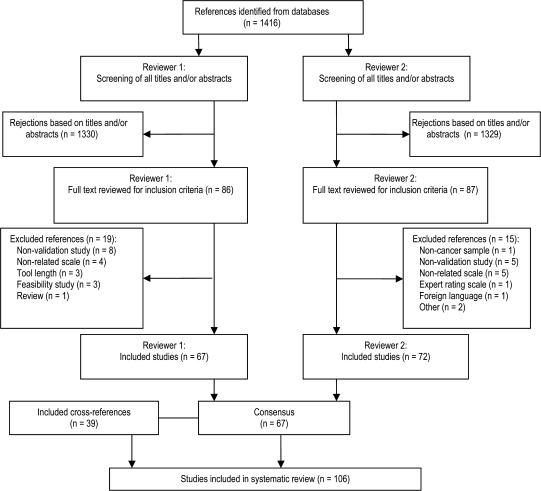
Screening for emotional distress is becoming increasingly common in cancer care. This systematic review examines the psychometric properties of the existing tools used to screen patients for emotional distress, with the goal of encouraging screening programs to use standardized tools that have strong psychometrics. Systematic searches of MEDLINE and PsycINFO databases for English-language studies in cancer patients were performed using a uniform set of key words (eg, depression, anxiety, screening, validation, and scale), and the retrieved studies were independently evaluated by two reviewers. Evaluation criteria included the number of validation studies, the number of participants, generalizability, reliability, the quality of the criterion measure, sensitivity, and specificity. The literature search yielded 106 validation studies that described a total of 33 screening measures. Many generic and cancer-specific scales satisfied a fairly high threshold of quality in terms of their psychometric properties and generalizability. Among the ultrashort measures (ie, those containing one to four items), the Combined Depression Questions performed best in patients receiving palliative care. Among the short measures (ie, those containing five to 20 items), the Center for Epidemiologic Studies-Depression Scale and the Hospital Anxiety and Depression Scale demonstrated adequate psychometric properties. Among the long measures (ie, those containing 21-50 items), the Beck Depression Inventory and the General Health Questionaire-28 met all evaluation criteria. The PsychoSocial Screen for Cancer, the Questionnaire on Stress in Cancer Patients-Revised, and the Rotterdam Symptom Checklist are long measures that can also be recommended for routine screening. In addition, other measures may be considered for specific indications or disease types. Some measures, particularly newly developed cancer-specific scales, require further validation against structured clinical interviews (the criterion standard for validation measures) before they can be recommended.
Overview
The claims and statistics of this paper haven’t been checked yet.
Run the check — free, no account needed. It reads the open-access text and checks the sources it cites.
Integrity signals
Registry
Cites
Statistics
Figures
Verification
Claims the paper makes
The claims and statistics of this paper haven’t been checked yet.
Run the check — free, no account needed. It reads the open-access text and checks the sources it cites.
Claims other papers make about this one
Each is checked against this paper’s own text: does it say what the citing paper says it does?
The cited source says what the claim attributes to it.
In the citing paper
“The HADS is validated and extensively used in the measurement of distress among cancer survivors (Vodermaier et al., 2009; Mitchell et al., 2010).”
From A randomised controlled trial comparing internet-delivered cognitive behavioural therapy (iCBT) with and without main carer access versus treatment-as-usual for depression and anxiety among breast cancer survivors: Study protocol (2021) · cites this paper as Vodermaier et al., 2009
Self-check
Percentages, sums and reported differences re-computed from the paper’s own numbers.
The self-check needs the paper’s full text.
Citations
Cites
Diagnostic and Statistical Manual of Mental Disorders
Williams, J. B. W., & First, M. B. (2013) · Oxford University Press eBooks · doi:10.1093/acrefore/9780199975839.013.104 · Cited by 109,845
The CES-D Scale: A Self-Report Depression Scale for Research in the General Population
Radloff, L. S. (1977) · Applied Psychological Measurement · doi:10.1177/014662167700100306 · Cited by 53,267
The Hospital Anxiety and Depression Scale
Zigmond, A. S., & Snaith, R. P. (1983) · Acta Psychiatrica Scandinavica · doi:10.1111/j.1600-0447.1983.tb09716.x · Cited by 47,139
The PHQ-9: Validity of a brief depression severity measure
Kroenke, K., Spitzer, R. L., & Williams, J. B. W. (2001) · Journal of General Internal Medicine · doi:10.1046/j.1525-1497.2001.016009606.x · Cited by 44,910
An inventory for measuring depression
BECK, A. T. (1961) · Archives of General Psychiatry · doi:10.1001/archpsyc.1961.01710120031004 · Cited by 38,032
Detection of Postnatal Depression: Development of the 10-item Edinburgh Postnatal Depression Scale
Cox, J. L., Holden, J. M., & Sagovsky, R. (1987) · British Journal of Psychiatry · doi:10.1192/bjp.150.6.782 · Cited by 14,183
A self-rating depression scale
ZUNG, W. W. K. (1965) · Archives of General Psychiatry · doi:10.1001/archpsyc.1965.01720310065008 · Cited by 9,813
Impact of Event Scale: A Measure of Subjective Stress
Horowitz, M., Wilner, N., & Alvarez, W. (1979) · Psychosomatic Medicine · doi:10.1097/00006842-197905000-00004 · Cited by 7,813
Psychometric properties of the PTSD checklist (PCL)
Blanchard, E. B., Jones-Alexander, J., Buckley, T. C., & Forneris, C. A. (1996) · Behaviour Research and Therapy · doi:10.1016/0005-7967(96)00033-2 · Cited by 3,997
The Validity of Two Versions of the GHQ in the WHO Study of Mental Illness in General Health Care
GOLDBERG, D. P., GATER, R., SARTORIUS, N., USTUN, T. B., PICCINELLI, M., GUREJE, O., & RUTTER, C. (1997) · Psychological Medicine · doi:10.1017/s0033291796004242 · Cited by 3,657
Research works printed but not linked: 11
- 2008, ONCOL EXCH, 7, 37
- 1997, American Journal of Psychiatry, 1, 674
- 1999, 40, 64
- 2001, 42, 241
- 2007, Psycho-oncology, 16, 1046, 10.1002/pon.1212 · DOI
- Miklavcic, 2008, 20, 148
- 2006, 47, 340
- 1989, 7, 31
- 2000, 41, 121
- 2003, 12, 1
- 2002, EUR J CANCER CARE, 11, 245
Cited by
Sorted by citations
Anxiety and depression after cancer diagnosis: Prevalence rates by cancer type, gender, and age
Linden, W., Vodermaier, A., MacKenzie, R., & Greig, D. (2012) · Journal of Affective Disorders · doi:10.1016/j.jad.2012.03.025 · Cited by 1,245
Krebber, A. M. H., Buffart, L. M., Kleijn, G., Riepma, I. C., de Bree, R., Leemans, C. R., Becker, A., Brug, J., van Straten, A., Cuijpers, P., et al. (2014) · Psycho-Oncology · doi:10.1002/pon.3409 · Cited by 908
“[8] previously recommended implementing routine self-report for symptoms of depression in cancer patients using valid and reliable self-report instruments, such as the HADS-D, the CES-D or the BDI.”
BackgroundMethodInfluentialScreening for Distress and Unmet Needs in Patients With Cancer: Review and Recommendations
Carlson, L. E., Waller, A., & Mitchell, A. J. (2012) · Journal of Clinical Oncology · doi:10.1200/jco.2011.39.5509 · Cited by 550
Clinical validity of PROMIS depression, anxiety, and anger across diverse clinical samples
Schalet, B. D., Pilkonis, P. A., Yu, L., Dodds, N., Johnston, K. L., Yount, S., Riley, W., & Cella, D. (2016) · Journal of Clinical Epidemiology · doi:10.1016/j.jclinepi.2015.08.036 · Cited by 507
“Not all the available instruments meet high levels of instrument development standards for reliability, validity, appropriate reading level, and minimal respondent burden[4, 5].”
BackgroundMitchell, A. J., Meader, N., & Symonds, P. (2010) · Journal of Affective Disorders · doi:10.1016/j.jad.2010.01.067 · Cited by 394
“Studies that have used structured psychiatric interviews suggest that the prevalence of major depressive disorder is approximately 15% in advanced cancer (Vodermaier et al., 2009).”
BackgroundVodermaier, A., & Millman, R. D. (2011) · Supportive Care in Cancer · doi:10.1007/s00520-011-1251-4 · Cited by 332
“The necessity of this meta-analysis on the diagnostic accuracy of the HADS stemmed from the fact that the reported thresholds in the individual studies differ widely [2].”
BackgroundHospital Anxiety and Depression Scale (HADS) accuracy in cancer patients
Annunziata, M. A., Muzzatti, B., Bidoli, E., Flaiban, C., Bomben, F., Piccinin, M., Gipponi, K. M., Mariutti, G., Busato, S., & Mella, S. (2019) · Supportive Care in Cancer · doi:10.1007/s00520-019-05244-8 · Cited by 310
Nicholas, M. K., McGuire, B. E., & Asghari, A. (2015) · The Journal of Pain · doi:10.1016/j.jpain.2014.11.002 · Cited by 241
Chirico, A., Maiorano, P., Indovina, P., Milanese, C., Giordano, G. G., Alivernini, F., Iodice, G., Gallo, L., Pietro, G. D., Lucidi, F., et al. (2020) · Journal of Cellular Physiology · doi:10.1002/jcp.29422 · Cited by 260
Comparing CESD-10, PHQ-9, and PROMIS depression instruments in individuals with multiple sclerosis.
Amtmann, D., Kim, J., Chung, H., Bamer, A. M., Askew, R. L., Wu, S., Cook, K. F., & Johnson, K. L. (2014) · Rehabilitation Psychology · doi:10.1037/a0035919 · Cited by 259
Pirl, W. F., Fann, J. R., Greer, J. A., Braun, I. M., Deshields, T. L., Fulcher, C. D., Harvey, E., Holland, J. C., Kennedy, V., Lazenby, M., et al. (2014) · Cancer · doi:10.1002/cncr.28750 · Cited by 238
“These have been reviewed in detail elsewhere.(34,41-43) These tools vary in length, comprehensiveness, cultural equivalence, and sensitivity=specificity for identifying patients who need further evaluation.”
BackgroundAdvancing psychosocial care in cancer patients
Grassi, L. G., Spiegel, D., & Riba, M. (2017) · F1000Research · doi:10.12688/f1000research.11902.1 · Cited by 220
“However, the literature also suggests that they cannot be used alone to diagnose depression, anxiety, or distress in cancer patients 31–33 .”
BackgroundButow, P., Price, M., Shaw, J., Turner, J., Clayton, J., Grimison, P., Rankin, N., & Kirsten, L. (2015) · Psycho-Oncology · doi:10.1002/pon.3920 · Cited by 178
The Distress Thermometer: Cutoff Points and Clinical Use
Cutillo, A., O’Hea, E., Person, S. D., Lessard, D., Harralson, T. L., & Boudreaux, E. D. (2017) · Oncology nursing forum · doi:10.1188/17.onf.329-336 · Cited by 208
Mitchell, A. J. (2013) · Acta Oncologica · doi:10.3109/0284186x.2012.745949 · Cited by 198
Screening for major depression in cancer outpatients
Thekkumpurath, P., Walker, J., Butcher, I., Hodges, L. J., Kleiboer, A. M., O’Connor, M. J., Wall, L. R., Murray, G. D., Kroenke, K., & Sharpe, M. (2010) · Cancer · doi:10.1002/cncr.25514 · Cited by 186
“A recent major review of screening questionnaires for psychological distress in cancer patients commented specifically on the lack of information on this scale’s psychometric properties when used in cancer patients.(13) Therefore, the objective of the current study was to determine the diagnostic accuracy of the PHQ-9…”
BackgroundMethodWikman, A., Wardle, J., & Steptoe, A. (2011) · PLoS ONE · doi:10.1371/journal.pone.0018952 · Cited by 198
“The relatively modest impact of cancer on psychological distress and general QOL is notable, given the attention that has been focused on these issues in cancer patients [39].”
BackgroundPrevalence and prognostic implications of psychological distress in patients with gastric cancer
Kim, G. M., Kim, S. J., Song, S. K., Kim, H. R., Kang, B. D., Noh, S. H., Chung, H. C., Kim, K. R., & Rha, S. Y. (2017) · BMC Cancer · doi:10.1186/s12885-017-3260-2 · Cited by 150
No further research needed: abandoning the Hospital and Anxiety Depression Scale (HADS)
Coyne, J. C., & van Sonderen, E. (2012) · Journal of Psychosomatic Research · doi:10.1016/j.jpsychores.2011.12.003 · Cited by 145
“They inevitably continue to recommend the HADS as a screening instrument or major depression and anxiety, although sometimes with the suggestion that the HADS needs to be recalibrated in new samples [7], which is no small task because such re-calibrations need replication that is rarely done.”
BackgroundJimenez, Y. A., Cumming, S., Wang, W., Stuart, K. E., Thwaites, D., & Lewis, S. J. (2018) · Supportive Care in Cancer · doi:10.1007/s00520-018-4114-4 · Cited by 145
Gao, W., Bennett, M., Stark, D., Murray, S. A., & Higginson, I. J. (2010) · European Journal of Cancer · doi:10.1016/j.ejca.2010.03.033 · Cited by 134
Does screening for distress efficiently uncover meetable unmet needs in cancer patients?
van Scheppingen, C., Schroevers, M. J., Smink, A., van der Linden, Y. M., Mul, V. E. M., Langendijk, J. A., Coyne, J. C., & Sanderman, R. (2011) · Psycho-Oncology · doi:10.1002/pon.1939 · Cited by 132
“The HSCL25 is closely related to the Brief Symptom Inventory-18, which is a widely used screening instrument among cancer patients [4,33,34].”
BackgroundAnnunziata, M. A., Muzzatti, B., & Altoè, G. (2011) · Annals of Oncology · doi:10.1093/annonc/mdq750 · Cited by 129
“[5, 6, 14]) have repeatedly highlighted a HADS structure inconsistency throughout literature and, consequently, in the measured psychological constructs, only few research papers address the question in a methodologically appropriate way.”
BackgroundScreening for psychosocial risk in pediatric cancer
Kazak, A. E., Brier, M. J., Alderfer, M. A., Reilly, A. T., Fooks‐Parker, S., Rogerwick, S., DiTaranto, S., & Barakat, L. P. (2012) · Pediatric Blood & Cancer · doi:10.1002/pbc.24166 · Cited by 126
“Rather than relying on less systematic providerdetermined referral patterns, this type of screening helps assure equal access to psychological services [11] by reducing the potential for disparities in care and facilitating more cost-effective and appropriate allocation of scarce resources [12].”
BackgroundThe validity of the distress thermometer in prostate cancer populations
Chambers, S. K., Zajdlewicz, L., Youlden, D. R., Holland, J. C., & Dunn, J. C. (2013) · Psycho-Oncology · doi:10.1002/pon.3391 · Cited by 119
“Screening cancer populations to detect heightened psychological distress is nowwell accepted as a desired component of good cancer care [1].”
BackgroundBarry, V., Stout, M. E., Lynch, M. E., Mattis, S., Tran, D., Antun, A., Ribeiro, M., Stein, S. F., & Kempton, C. (2020) · Journal of Health Psychology · doi:10.1177/1359105319842931 · Cited by 111
“Questionnaires that measure distress have been developed over the past 20 years but vary by the specific wording, number of questions, time frames addressed, scoring systems, and intended audiences (Kessler et al., 2003; Polonsky et al., 2005; Seelert et al., 1999; Vodermaier et al., 2009; Welch et al., 1997).”
BackgroundGreer, J. A., Traeger, L., Bemis, H., Solis, J., Hendriksen, E. S., Park, E. R., Pirl, W. F., Temel, J. S., Prigerson, H. G., & Safren, S. A. (2012) · The Oncologist · doi:10.1634/theoncologist.2012-0041 · Cited by 111
“Designed for medical patients, the HADS demonstrates adequate psychometric properties for use in samples of individuals with cancer [29].”
BackgroundPsychological Impact of Prostate Biopsy: Physical Symptoms, Anxiety, and Depression
Wade, J., Rosario, D. J., Macefield, R. C., AVERY, K. N. L., Salter, C. E., Goodwin, M., Blazeby, J. M., Lane, J. A., Metcalfe, C. D., Neal, D. E., et al. (2013) · Journal of Clinical Oncology · doi:10.1200/jco.2012.45.4801 · Cited by 110
Mitchell, A. J., Meader, N., Davies, E., Clover, K., Carter, G. L., Loscalzo, M. J., Linden, W., Grassi, L., Johansen, C., Carlson, L. E., et al. (2012) · Journal of Affective Disorders · doi:10.1016/j.jad.2011.12.043 · Cited by 107
“This was also the finding of a recent narrative review (Vodermaier et al., 2009).”
BackgroundMethodInfluentialStanton, A. L., Petrie, K. J., & Partridge, A. H. (2014) · Breast Cancer Research and Treatment · doi:10.1007/s10549-014-2961-3 · Cited by 109
“Anxiety and depressive symptoms were assessed with the 14-item Hospital Anxiety and Depression Scale (HADS) [21], which has evidence of validity in cancer patients [22].”
MethodProvision of integrated psychosocial services for cancer survivors post-treatment
Recklitis, C. J., & Syrjala, K. L. (2016) · The Lancet Oncology · doi:10.1016/s1470-2045(16)30659-3 · Cited by 107
Distress, concerns and unmet needs in survivors of head and neck cancer: a cross-sectional survey
Wells, M., Cunningham, M., Lang, H., Swartzman, S., Philp, J., Taylor, L., & Thomson, J. (2015) · European Journal of Cancer Care · doi:10.1111/ecc.12370 · Cited by 106
“It has been widely used and its psychometric properties have been extensively studied (Vodermaier et al. 2009).”
MethodAyubi, E., Bashirian, S., & Khazaei, S. (2021) · Journal of Gastrointestinal Cancer · doi:10.1007/s12029-021-00643-9 · Cited by 114
Bruggeman-Everts, F. Z., Wolvers, M. D. J., van de Schoot, R., Vollenbroek-Hutten, M. M. R., & van der Lee, M. L. (2017) · Journal of Medical Internet Research · doi:10.2196/jmir.7180 · Cited by 108
“…and Negative Affect Schedule [27,28] was used to measure Positive Affect (PA; range 10-50, Cronbach alpha = 0.90) and Negative Affect (NA; range 10-50, Cronbach alpha = 0.89); and the Hospital Anxiety and Depression Scale (HADS; range 0-42, Cronbach alpha=0.88) [29-31] was used to measure distress.”
InfluentialAtkin, N. L., Vickerstaff, V., & Candy, B. (2017) · BMC Palliative Care · doi:10.1186/s12904-017-0245-5 · Cited by 110
Absolom, K. L., Holch, P., Pini, S. A., Hill, K. M., Liu, A., Sharpe, M., Richardson, A., & Velikova, G. (2011) · Psycho-Oncology · doi:10.1002/pon.1916 · Cited by 105
“Stumbling blocks to routine implementation include practical considerations namely timing, cost and applying technology, alongside ongoing discussions about the suitability and validity of different instruments [4,20–23].”
BackgroundWarmenhoven, F. C., van Rijswijk, E., Engels, Y., Kan, C. C., Prins, J. B., van Weel, C., & Vissers, K. C. P. (2011) · Supportive Care in Cancer · doi:10.1007/s00520-010-1082-8 · Cited by 101
“The Beck Depression inventory (BDI-II) is one of the most widely used screening tools for depression and it may provide a useful method for screening for depression in palliative care [24–26].”
MethodBuffart, L. M., Thong, M. S. Y., Schep, G., Chinapaw, M. J. M., Brug, J., & van de Poll-Franse, L. V. (2012) · PLoS ONE · doi:10.1371/journal.pone.0036164 · Cited by 101
“The HADS has been validated for the Dutch population [38], and demonstrated adequate psychometric properties for cancer patients [39].”
MethodRe‐validation and screening capacity of the 6‐item version of the Cancer Worry Scale
Custers, J. A. E., Kwakkenbos, L., van de Wal, M., Prins, J. B., & Thewes, B. (2018) · Psycho-Oncology · doi:10.1002/pon.4782 · Cited by 88
“The HADS was validated for cancer survivors.(24) Cronbach's α = 0.”
MethodGiese‐Davis, J., Waller, A. E., Carlson, L. E., Groff, S. L., Zhong, L., Neri, E., Bachor, S. M., Adamyk-Simpson, J., Rancourt, K. M., Dunlop, B., et al. (2012) · BMC Cancer · doi:10.1186/1471-2407-12-441 · Cited by 94
“The Distress Thermometer has been validated against the HADS, BSI, CES-D and clinical diagnosis in patients with mixed diagnoses and stages of disease [47].”
Methodvan Roekel, E. H., WINKLER, E. A. H., Bours, M. J. L., Lynch, B. M., Willems, P. J. B., Meijer, K., Kant, I., Beets, G. L., Sanduleanu, S., Healy, G. N., et al. (2016) · Preventive Medicine Reports · doi:10.1016/j.pmedr.2016.06.022 · Cited by 92
“The 14-itemHospital Anxiety andDepression Scale (HADS) was used to determine levels of distress (anxiety and/ or depression) (Zigmond & Snaith, 1983), which has adequate psychometric properties in cancer patients (Vodermaier et al., 2009).”
BackgroundMethodBook, K., Marten‐Mittag, B., Henrich, G., Dinkel, A., Scheddel, P., Sehlen, S., Haimerl, W., Schulte, T., Britzelmeir, I., & Herschbach, P. (2010) · Psycho-Oncology · doi:10.1002/pon.1821 · Cited by 93
“Another cancer-specific distress tool is the Questionnaire on Stress in Cancer Patients (QSCR23) that assesses psychosocial distress in cancer patients in areas of every day life [23,25,26].”
Turon, H., Carey, M. L., Boyes, A., Hobden, B., Dilworth, S., & Sanson‐Fisher, R. (2019) · PLoS ONE · doi:10.1371/journal.pone.0210111 · Cited by 91
Brunet, J., Gunnell, K. E., Gaudreau, P., & Sabiston, C. M. (2015) · Personality and Individual Differences · doi:10.1016/j.paid.2015.02.034 · Cited by 112
Porschen, R., Buck, A. K., Fischbach, W., Gockel, I., Görling, U., Grenacher, L., Hollerbach, S., Hölscher, A. H., Körber, J., Messmann, H., et al. (2015) · Zeitschrift für Gastroenterologie · doi:10.1055/s-0041-107381 · Cited by 90
Li, M., Macedo, A., Crawford, S. A., Bagha, S., Leung, Y. W., Zimmermann, C., Fitzgerald, B., Wyatt, M., Stuart-McEwan, T., & Rodin, G. (2016) · Journal of Oncology Practice · doi:10.1200/jop.2015.010066 · Cited by 90
Ziegler, L. E., Hill, K. M., Neilly, E., Bennett, M., Higginson, I. J., Murray, S. A., & Stark, D. (2011) · Journal of Pain and Symptom Management · doi:10.1016/j.jpainsymman.2010.06.024 · Cited by 87
Ehlers, S. L., Davis, K., Bluethmann, S. M., Quintiliani, L. M., Kendall, J., Ratwani, R. M., Diefenbach, M. A., & Graves, K. D. (2019) · Translational Behavioral Medicine · doi:10.1093/tbm/iby123 · Cited by 96
“In terms of effectiveness, a systematic review of cancer distress screening measures found that the sensitivity and specificity of the DT was lower than 80% compared to gold-standard criterion measures, most of which focused on depression [15,27].”
BackgroundMethodResultInfluentialJohnson, J. A., Garland, S. N., Carlson, L. E., Savard, J., Simpson, J. S., Ancoli‐Israel, S., & Campbell, T. S. (2017) · Journal of Cancer Survivorship · doi:10.1007/s11764-017-0659-3 · Cited by 85
“This scale has been validated in cancer populations [23], and has a reported internal consistency of 0.”
MethodMatis, J., Svetlak, M., Slezackova, A., Svoboda, M., & Šumec, R. (2020) · doi:10.2196/preprints.20709 · Cited by 81
“The prevalence of major depressive disorders is approximately 15% in patients with advanced cancer [3], and 30% to 40% of patients in various stages of cancer development report significant psychosocial distress symptoms, such as anxiety, depression, nervousness, and insomnia [4-6].”
Screening for psychological distress in cancer: renewing the research agenda
Salmon, P., Clark, L., McGrath, E., & Fisher, P. (2014) · Psycho-Oncology · doi:10.1002/pon.3640 · Cited by 80
“screening instrument, further inflating uncertainty surrounding the results of screening[46, 54, 55].”
BackgroundHolwerda, N., Sanderman, R., Pool, G., Hinnen, C., Langendijk, J. A., Bemelman, W. A., Hagedoorn, M., & Sprangers, M. A. G. (2012) · Acta Oncologica · doi:10.3109/0284186x.2012.689856 · Cited by 79
Stafford, L., Judd, F. K., Gibson, P., Komiti, A., Mann, G. B., & Quinn, M. A. (2013) · Psycho-Oncology · doi:10.1002/pon.3253 · Cited by 81
“The HADS is the most widely used measure in cancer settings [39,40] with well-established psychometric properties [32,41].”
MethodVodermaier, A., Linden, W., Rnic, K., Young, S., Ng, A., Ditsch, N. C., & Olson, R. A. (2013) · Breast Cancer Research and Treatment · doi:10.1007/s10549-013-2795-4 · Cited by 73
Mayer, J., RUSSELL, R. E., Bates, M. W., & Dickie, M. M. (1953) · PubMed · Cited by 74
Physical Symptom Burden and Its Association With Distress, Anxiety, and Depression in Breast Cancer
McFarland, D. C., Shaffer, K. M., Tiersten, A., & Holland, J. C. (2018) · Psychosomatics · doi:10.1016/j.psym.2018.01.005 · Cited by 73
Global, regional, and national prevalence of depression among cancer patients
Mejareh, Z. N., Abdollahi, B., Hoseinipalangi, Z., Jeze, M. S., Hosseinifard, H., Rafiei, S., Aghajani, F., Dehnad, A., Ardakani, M. F., Ahmadi, S., et al. (2021) · Indian Journal of Psychiatry · doi:10.4103/indianjpsychiatry.indianjpsychiatry_77_21 · Cited by 77
“[24] Despite the multitude of studies carried out on this topic, there are still a number of gaps in the existing literature.”
Mitchell, A. J., Lord, K., & Symonds, P. R. (2012) · Journal of Affective Disorders · doi:10.1016/j.jad.2011.11.009 · Cited by 72
Cillessen, L., Schellekens, M. P. J., Van de Ven, M. O. M., Donders, A. R. T., Compen, F. R., Bisseling, E. M., Van der Lee, M. L., & Speckens, A. E. M. (2018) · Acta Oncologica · doi:10.1080/0284186x.2018.1479071 · Cited by 66
“The HADS has adequate psychometric properties to detect distress in cancer patients and is a suitable screening instrument for psychiatric disorders in this group [37,38].”
MethodSlatore, C. G., Golden, S. E., Ganzini, L. K., Wiener, R. S., & Au, D. H. (2014) · Annals of the American Thoracic Society · doi:10.1513/annalsats.201406-283oc · Cited by 71
Mediators of physical exercise for improvement in cancer survivors' quality of life
Buffart, L. M., Ros, W. J. G., Chinapaw, M. J. M., Brug, J., Knol, D. L., Korstjens, I., van Weert, E., Mesters, I., van den Borne, B. H. P., Hoekstra‐Weebers, J. E. H. M., et al. (2013) · Psycho-Oncology · doi:10.1002/pon.3428 · Cited by 70
“Emotional distress was assessed with the 14-item Hospital Anxiety and Depression Scale [28], validated for the Dutch population [29] and cancer patients [30].”
MethodMaters, G. A., Sanderman, R., Kim, A. Y., & Coyne, J. C. (2013) · PLoS ONE · doi:10.1371/journal.pone.0070975 · Cited by 72
“Issues Raised in the Recent Literature Concerning the HADS Vodermaier et al’s [8] review noted a troublingly broad, inconsistent range of optimal cutoffs obtained across studies, ranging from 8–22 for total score and 5–11 for depression and anxiety subscales.”
BackgroundResultInfluentialRooney, A. G., McNamara, S., Mackinnon, M., Fraser, M., Rampling, R., Carson, A. J., & Grant, R. (2012) · Neuro-Oncology · doi:10.1093/neuonc/nos282 · Cited by 72
“It is known that the identification of depression can be improved by screening cancer patients with self-report questionnaires.(3,4) Indeed, the practice of screening for depression is supported by national and international health, cancer, and palliative care organizations.”
BackgroundMcCarter, K. L., Britton, B., Baker, A., Halpin, S. A., Beck, A. K., Carter, G. L., WRATTEN, C. R., Bauer, J. D., Forbes, E., Booth, D., et al. (2018) · BMJ Open · doi:10.1136/bmjopen-2017-017959 · Cited by 69
School students with chronic illness have unmet academic, social, and emotional school needs.
Lum, A., Wakefield, C. E., Donnan, B., Burns, M. A., Fardell, J. E., Jaffe, A., Kasparian, N. A., Kennedy, S. E., Leach, S. T., Lemberg, D. A., et al. (2019) · School Psychology · doi:10.1037/spq0000311 · Cited by 69
Nekolaichuk, C., Cumming, C. E., Turner, J., Yushchyshyn, A., & Sela, R. A. (2010) · Psycho-Oncology · doi:10.1002/pon.1765 · Cited by 68
Patient-reported depression measures in cancer: a meta-review
Wakefield, C. E., Butow, P. N., Aaronson, N. K., Hack, T. F., Hulbert-Williams, N., & Jacobsen, P. B. (2015) · The Lancet Psychiatry · doi:10.1016/s2215-0366(15)00168-6 · Cited by 66
“Inventory (BDI), and/or its variations (the BDI-II and the BDI-short form, BDISF).(1,4,5,7,8,15,22,42,43) In each case, the BDI’s performance was considered in”
BackgroundMethodInfluentialPsychosocial predictors of health outcomes in colorectal cancer: A comprehensive review
Sales, P. M. G., Carvalho, A. F., McIntyre, R. S., Pavlidis, N. A., & Hyphantis, T. N. (2014) · Cancer Treatment Reviews · doi:10.1016/j.ctrv.2014.03.001 · Cited by 66
Hess, C. B., & Chen, A. M. (2014) · Psycho-Oncology · doi:10.1002/pon.3521 · Cited by 63
“Efforts to identify quick reliable surrogates to the psychiatric interview have resulted in lengthy questionnaires aimed at identifying single aspects of the psyche and in rapid questionnaires aimed at identifying a zoomed-out and broadened view of a patient’s global psychosocial function [63,64].”
BackgroundJiménez-Labaig, P., Aymerich, C., Braña, I., Rullan, A., Cacicedo, J., Torres, M. Á. G., Harrington, K. J., & Catalán, A. (2024) · JNCI Cancer Spectrum · doi:10.1093/jncics/pkae031 · Cited by 72
“…screening for emotional distress in patients with some cancer types, in addition to present evidence in the early detection of mental disorders (100), promotes equal access to psychological services, in contrast with a referral system solely reliant on the initiative of doctors or patients (101).”
BackgroundRyan, D. A., Gallagher, P., Wright, S., & Cassidy, E. M. (2012) · Psycho-Oncology · doi:10.1002/pon.2042 · Cited by 62
“This finding is consistent with the literature among early-stage and mixed-stage cancer patients [12,23].”
BackgroundResultPsychological Adjustment in Breast Cancer Survivors
Stanton, A. L., & Bower, J. E. (2015) · Advances in experimental medicine and biology · doi:10.1007/978-3-319-16366-6_15 · Cited by 63
Clinton‐McHarg, T., Carey, M. L., Sanson‐Fisher, R., Tzelepis, F., Bryant, J., & Williamson, A. (2014) · Journal of Affective Disorders · doi:10.1016/j.jad.2014.04.072 · Cited by 62
“The HADS meets psychometric criteria for high internal consistency and discriminant validity (Vodermaier et al., 2009), and has been validated for use with many cancer patient groups including those diagnosed with haematological cancers (Smith et al.”
BackgroundGiannousi, Z., Gioulbasanis, I., Pallis, A. G., Xyrafas, A., Daliani, D., Kalbakis, K., Papadopoulos, V. G., Mavroudis, D., Georgoulias, V., & Papandreou, C. N. (2011) · Supportive Care in Cancer · doi:10.1007/s00520-011-1282-x · Cited by 62
Do cancer and treatment type affect distress?
Admiraal, J. M., Reyners, A. K. L., & Hoekstra‐Weebers, J. E. H. M. (2012) · Psycho-Oncology · doi:10.1002/pon.3211 · Cited by 63
Jiménez‐Fonseca, P., Calderón, C., Hernández, R., y Cajal, T. R., Mut, M., Ramchandani, A., Donnay, O., & Carmona‐Bayonas, A. (2018) · Clinical & Translational Oncology · doi:10.1007/s12094-018-1873-9 · Cited by 69
“Brief Symptom Inventory (BSI) is one of the most widely used instruments to assess anxiety and depression in clinical cases and was used in this study [13].”
MethodMeasuring Preoperative Anxiety in Patients With Intracranial Tumors
Goebel, S., Kaup, L., & Mehdorn, H. M. (2011) · Journal of Neurosurgical Anesthesiology · doi:10.1097/ana.0b013e318222b787 · Cited by 61
“The HADS is a widely used questionnaire to assess symptoms of anxiety and depression in patients with somatic complaints with good reliability and validity.(22,23) It consists of 14 items, with 7 per subscale.”
MethodCircadian disruption and cancer- and treatment-related symptoms
Amidi, A., & Wu, L. M. (2022) · Frontiers in Oncology · doi:10.3389/fonc.2022.1009064 · Cited by 66
“Examples of these include the Hospital Anxiety and Depression Scale (HADS) (87) and the Center for Epidemiologic Studies Depression Scale (CES-D) (88), but many more exist (89).”
Fox, R. S., Lillis, T. A., Gerhart, J. I., Hoerger, M. P., & Duberstein, P. R. (2017) · Psychological Reports · doi:10.1177/0033294117727747 · Cited by 63
“Accordingly, accurately and appropriately assessing distress in cancer patients has garnered a great deal of research attention (Vodermaier, Linden, & Siu, 2009).”
BackgroundAssessment of the Hospital Anxiety and Depression Scale for cancer patients
Villoria, E., & Lara, L. (2018) · Revista médica de Chile · doi:10.4067/s0034-98872018000300300 · Cited by 61
Heath-related quality of life in Spanish breast cancer patients: a systematic review
Delgado‐Sanz, C., García-Mendizábal, M. J., Pollán, M., Forjaz, M. J., López‐Abente, G., Aragonés, N., & Pérez‐Gómez, B. (2011) · Health and Quality of Life Outcomes · doi:10.1186/1477-7525-9-3 · Cited by 59
“These three ratings were condensed into a five-level overall judgment (excellent, good, moderate, fair, or poor) using the same decision rules as Vodermaier et al.[16].”
MethodAarstad, A. K. H., Beisland, E., Osthus, A. A., & Aarstad, H. J. (2011) · Acta Oncologica · doi:10.3109/0284186x.2010.504227 · Cited by 58
Girgis, A., Stojanovski, E., Boyes, A., King, M. T., & Lecathelinais, C. (2011) · Psycho-Oncology · doi:10.1002/pon.1973 · Cited by 58
“A recent review [10] concluded that short screening tools consisting of 5–20 items had a moderate chance of adoption in busy clinics, high sensitivity and specificity, were able to assess multiple domains, and could minimise scoring costs by automation.”
BackgroundRoutine screening for suicidal intention in patients with cancer
Leung, Y. W., Li, M., Devins, G. M., Zimmermann, C., Rydall, A. C., Lo, C., & Rodin, G. (2013) · Psycho-Oncology · doi:10.1002/pon.3319 · Cited by 58
Factors associated with emotional distress in newly diagnosed prostate cancer patients
Orom, H., Nelson, C. J., Underwood, W., Homish, D. L., & Kapoor, D. A. (2015) · Psycho-Oncology · doi:10.1002/pon.3751 · Cited by 57
“However, even though effective screening tools for emotional distress, anxiety, or depression are available to identify those who could benefit from additional support [6,7], less is known about the kinds of intervention components that are needed [8].”
BackgroundHead, B. A., Schapmire, T. J., Keeney, C. E., Deck, S. M., Studts, J. L., Hermann, C. P., Scharfenberger, J. A., & Pfeifer, M. (2011) · Quality of Life Research · doi:10.1007/s11136-011-9934-3 · Cited by 57
“Specifically, ultra-short measures lack specificity in identifying particular problems such as depression; problems with determining the face-validity of single-item measures and patient’s difficulty scaling themselves on single-item measures further complicate their use [40].”
BackgroundCoping Strategies of Southern Italian Women Predict Distress Following Breast Cancer Surgery
Feudis, R. L. D., Lanciano, T., & Rinaldi, S. (2015) · Europe’s Journal of Psychology · doi:10.5964/ejop.v11i2.908 · Cited by 56
S3-Leitlinie – Diagnostik und Therapie der Plattenepithelkarzinome und Adenokarzinome des Ösophagus
Porschen, R., Fischbach, W., Gockel, I., Hollerbach, S. H., Hölscher, A. H., Jansen, P., Miehlke, S., Pech, O., Stahl, M., Thuss-Patience, P. C., et al. (2019) · Zeitschrift für Gastroenterologie · doi:10.1055/a-0833-5712 · Cited by 57
Psychosocial Distress in Patients with Thyroid Cancer
Buchmann, L. O., Ashby, S., Cannon, R. B., & Hunt, J. P. (2015) · Otolaryngology · doi:10.1177/0194599814565761 · Cited by 56
“The DT has been validated and accepted as a psychometric instrument and subjected to the most validation studies on the largest patient samples of any assessment tool.(6-8)”
MethodUnmet needs and distress in people with inoperable lung cancer at the commencement of treatment
Ugalde, A., Aranda, S. K., Krishnasamy, M., Ball, D., & Schofield, P. E. (2011) · Supportive Care in Cancer · doi:10.1007/s00520-011-1296-4 · Cited by 56
On behalf of the Spanish Neuroendocrine Tumor Group (GETNE), Jiménez‐Fonseca, P., Carmona‐Bayonas, A., Martín‐Pérez, E., Crespo, G., Serrano, R., Llanos, M., Villabona, C., García‐Carbonero, R., Aller, J., et al. (2015) · Cancer and Metastasis Reviews · doi:10.1007/s10555-015-9573-1 · Cited by 56
“Despite their validation for use in the cancer population [95], none of them are cancer specific and, hence, may not be able to provide comprehensive information.”
BackgroundThe utility of the Edmonton Symptom Assessment System in screening for anxiety and depression
Bagha, S., MACEDO, A., Jacks, L. M., Lo, C., Zimmermann, C., Rodin, G., & Li, M. (2012) · European Journal of Cancer Care · doi:10.1111/j.1365-2354.2012.01369.x · Cited by 57
“Ultra-brief screening tools have the potential to minimise patient and clinic burden, but may lack specificity (Vodermaier et al. 2009).”
BackgroundCarey, M. L., Noble, N., Sanson‐Fisher, R., & Mackenzie, L. (2011) · Psycho-Oncology · doi:10.1002/pon.2057 · Cited by 52
Krebber, A.-M. H., Leemans, C. R., de Bree, R., van Straten, A., Smit, F., Smit, E. F., Becker‐Commissaris, A., Eeckhout, G. M., Beekman, A. T. F., Cuijpers, P. J., et al. (2012) · BMC Cancer · doi:10.1186/1471-2407-12-173 · Cited by 53
“This scale has been proven to have adequate psychometrical properties and the total HADS score has been recommended for routine monitoring of psychological distress in cancer patients [29-32].”
Grassi, L. G., Caruso, R., Mitchell, A. J., Sabato, S., & Nanni, M. G. (2018) · Cancer · doi:10.1002/cncr.31340 · Cited by 53
“6 [22-70] Education: Mean 6 SD [range], y 9.”
Tsianakas, V., Robert, G., Richardson, A., Verity, R., Oakley, C. M., Murrells, T., Flynn, M., & Ream, E. (2015) · Supportive Care in Cancer · doi:10.1007/s00520-015-2677-x · Cited by 50
“Although well validated, the GHQ-12 performs less well than other short tools including the Hospital Anxiety and Depression Scale [39] and was developed to detect psychiatric disorders rather than emotional distress.”
MethodSaboonchi, F., Petersson, L., Wennman‐Larsen, A., Alexanderson, K. A. E., Bränström, R., & Vaez, M. (2014) · European Journal of Oncology Nursing · doi:10.1016/j.ejon.2014.06.007 · Cited by 58
Boyes, A., D’Este, C. A., Carey, M. L., Lecathelinais, C., & Girgis, A. (2012) · Supportive Care in Cancer · doi:10.1007/s00520-012-1499-3 · Cited by 51
“Although one of the most commonly used short screening measures, recent reviews [21, 30, 33] have revealed a lack of consistency in HADS cut-off scores compared with clinical assessments to identify cases.”
Quality of life in cancer rehabilitation: the role of life goal adjustment
von Blanckenburg, P., Seifart, U., Conrad, N., Exner, C., Rief, W., & Nestoriuc, Y. (2014) · Psycho-Oncology · doi:10.1002/pon.3538 · Cited by 51
“The questionnaire is reliable, well validated, and recommended for the use in cancer populations [34].”
BackgroundLongitudinal Assessment of Distress among Veterans with Incidental Pulmonary Nodules
Slatore, C. G., Wiener, R. S., Golden, S. E., Au, D. H., & Ganzini, L. K. (2016) · Annals of the American Thoracic Society · doi:10.1513/annalsats.201607-555oc · Cited by 49
Metadata
- Authors
- Vodermaier, A., Linden, W., & Siu, C.
- Affiliations
- BC Cancer Agency (CA)
- Corresponding author
- Vodermaier, A.
- Venue
- JNCI Journal of the National Cancer Institute
- Publisher
- Oxford University Press (OUP)
- Published
- 2009-10-13
- Volume
- 101
- Issue
- 21
- Pages
- 1464-1488
- ISSN
- 0027-8874 (ISSN-L)
- 1460-2105
- PMC
- PMC3298956
- OpenAlex
- W1996766132
- Cited by
- 541
- References
- 160
- Citations by year
- 2026: 12 · 2025: 16 · 2024: 30 · 2023: 20 · 2022: 27 · 2021: 34 · 2020: 24 · 2019: 32 · 2018: 49 · 2017: 28 · 2016: 32 · 2015: 42 · 2014: 38 · 2013: 52 · 2012: 48
- FWCI
- 2.98
- Type
- journal article
- Language
- en
- Open access
- bronze
- doi.org
- Locations
- JNCI Journal of the National Cancer Institute (publishedVersion)
- PubMed Central (publishedVersion, cc-by-nc)
- PubMed (publishedVersion)
- HighWire Press Open Archive (submittedVersion)
- Funders
- Canadian Institutes of Health Research (#AQC83559)
- Topics
- Health Sciences › Medicine › Oncology › Cancer survivorship and care
- Social Sciences › Psychology › Experimental and Cognitive Psychology › Anxiety, Depression, Psychometrics, Treatment, Cognitive Processes
- Health Sciences › Medicine › Pediatrics, Perinatology and Child Health › Childhood Cancer Survivors' Quality of Life
- Keywords
- emotional distress screening, cancer patients, psychometric properties, depression screening, anxiety screening, screening tool, scale validation, CES-D, Hospital Anxiety and Depression Scale, Beck Depression Inventory, Rotterdam Symptom Checklist, palliative care, sensitivity and specificity
- MeSH terms
- Adjustment Disorders, Anxiety Disorders, Depression, Depressive Disorder, Major, Major Depressive Disorder, Humans, Mass Screening, Neoplasms, Psychometrics, Surveys and Questionnaires, Stress, Psychological, Reproducibility of Results, Dysthymic Disorder
About these checks
Registry, retraction, Cites and statistics results are computed, not judged, with one exception: a printed reference that no index lists is read once by a model before it counts as a citation error. Claims are extracted by a model and kept only when their quote appears verbatim in the text; each cited source is then checked, with a model’s help, for whether it says what the claim relies on. Those verdicts can be wrong — read the claim’s quote and the cited source before relying on one.
Statistics and arithmetic are recomputed, not judged.
Confidence bands are shown only for fields calibrated on our annotated test set. None is calibrated yet, so no band is shown.
What counts as a claim ›How we measure confidence ›How we check this ›
Are you an author, or do you see a problem with this page? Request a review
