

The DOI matches its Crossref record; 161 of the 161 references it cites were found in a registry or an index.
Screening for Emotional Distress in Cancer Patients: A Systematic Review of Assessment Instruments
Open accessAbstract
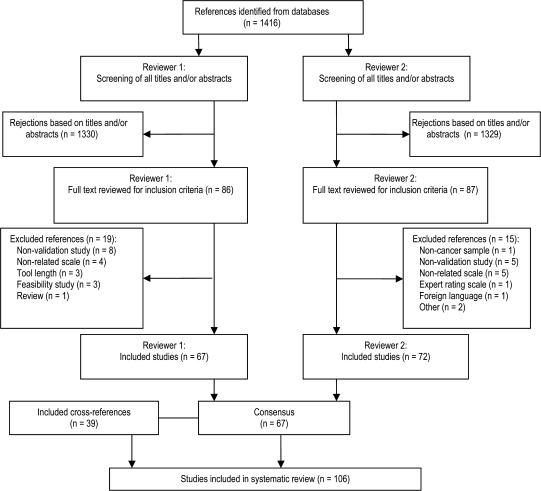
Screening for emotional distress is becoming increasingly common in cancer care. This systematic review examines the psychometric properties of the existing tools used to screen patients for emotional distress, with the goal of encouraging screening programs to use standardized tools that have strong psychometrics. Systematic searches of MEDLINE and PsycINFO databases for English-language studies in cancer patients were performed using a uniform set of key words (eg, depression, anxiety, screening, validation, and scale), and the retrieved studies were independently evaluated by two reviewers. Evaluation criteria included the number of validation studies, the number of participants, generalizability, reliability, the quality of the criterion measure, sensitivity, and specificity. The literature search yielded 106 validation studies that described a total of 33 screening measures. Many generic and cancer-specific scales satisfied a fairly high threshold of quality in terms of their psychometric properties and generalizability. Among the ultrashort measures (ie, those containing one to four items), the Combined Depression Questions performed best in patients receiving palliative care. Among the short measures (ie, those containing five to 20 items), the Center for Epidemiologic Studies-Depression Scale and the Hospital Anxiety and Depression Scale demonstrated adequate psychometric properties. Among the long measures (ie, those containing 21-50 items), the Beck Depression Inventory and the General Health Questionaire-28 met all evaluation criteria. The PsychoSocial Screen for Cancer, the Questionnaire on Stress in Cancer Patients-Revised, and the Rotterdam Symptom Checklist are long measures that can also be recommended for routine screening. In addition, other measures may be considered for specific indications or disease types. Some measures, particularly newly developed cancer-specific scales, require further validation against structured clinical interviews (the criterion standard for validation measures) before they can be recommended.
Overview
The claims and statistics of this paper haven’t been checked yet.
Run the check — free, no account needed. It reads the open-access text and checks the sources it cites.
Integrity signals
Registry
Cites
Statistics
Figures
Verification
Claims the paper makes
The claims and statistics of this paper haven’t been checked yet.
Run the check — free, no account needed. It reads the open-access text and checks the sources it cites.
Claims other papers make about this one
Each is checked against this paper’s own text: does it say what the citing paper says it does?
The cited source says what the claim attributes to it.
In the citing paper
“The HADS is validated and extensively used in the measurement of distress among cancer survivors (Vodermaier et al., 2009; Mitchell et al., 2010).”
From A randomised controlled trial comparing internet-delivered cognitive behavioural therapy (iCBT) with and without main carer access versus treatment-as-usual for depression and anxiety among breast cancer survivors: Study protocol (2021) · cites this paper as Vodermaier et al., 2009
Self-check
Percentages, sums and reported differences re-computed from the paper’s own numbers.
The self-check needs the paper’s full text.
Citations
Cites
Diagnostic and Statistical Manual of Mental Disorders
Williams, J. B. W., & First, M. B. (2013) · Oxford University Press eBooks · doi:10.1093/acrefore/9780199975839.013.104 · Cited by 109,845
The CES-D Scale: A Self-Report Depression Scale for Research in the General Population
Radloff, L. S. (1977) · Applied Psychological Measurement · doi:10.1177/014662167700100306 · Cited by 53,267
The Hospital Anxiety and Depression Scale
Zigmond, A. S., & Snaith, R. P. (1983) · Acta Psychiatrica Scandinavica · doi:10.1111/j.1600-0447.1983.tb09716.x · Cited by 47,139
The PHQ-9: Validity of a brief depression severity measure
Kroenke, K., Spitzer, R. L., & Williams, J. B. W. (2001) · Journal of General Internal Medicine · doi:10.1046/j.1525-1497.2001.016009606.x · Cited by 44,910
An inventory for measuring depression
BECK, A. T. (1961) · Archives of General Psychiatry · doi:10.1001/archpsyc.1961.01710120031004 · Cited by 38,032
Detection of Postnatal Depression: Development of the 10-item Edinburgh Postnatal Depression Scale
Cox, J. L., Holden, J. M., & Sagovsky, R. (1987) · British Journal of Psychiatry · doi:10.1192/bjp.150.6.782 · Cited by 14,183
A self-rating depression scale
ZUNG, W. W. K. (1965) · Archives of General Psychiatry · doi:10.1001/archpsyc.1965.01720310065008 · Cited by 9,813
Impact of Event Scale: A Measure of Subjective Stress
Horowitz, M., Wilner, N., & Alvarez, W. (1979) · Psychosomatic Medicine · doi:10.1097/00006842-197905000-00004 · Cited by 7,813
Psychometric properties of the PTSD checklist (PCL)
Blanchard, E. B., Jones-Alexander, J., Buckley, T. C., & Forneris, C. A. (1996) · Behaviour Research and Therapy · doi:10.1016/0005-7967(96)00033-2 · Cited by 3,997
The Validity of Two Versions of the GHQ in the WHO Study of Mental Illness in General Health Care
GOLDBERG, D. P., GATER, R., SARTORIUS, N., USTUN, T. B., PICCINELLI, M., GUREJE, O., & RUTTER, C. (1997) · Psychological Medicine · doi:10.1017/s0033291796004242 · Cited by 3,657
Research works printed but not linked: 11
- 2008, ONCOL EXCH, 7, 37
- 1997, American Journal of Psychiatry, 1, 674
- 1999, 40, 64
- 2001, 42, 241
- 2007, Psycho-oncology, 16, 1046, 10.1002/pon.1212 · DOI
- Miklavcic, 2008, 20, 148
- 2006, 47, 340
- 1989, 7, 31
- 2000, 41, 121
- 2003, 12, 1
- 2002, EUR J CANCER CARE, 11, 245
Cited by
Sorted by citations
Items 101–200 of 540
Recklitis, C. J., Blackmon, J. E., & Chang, G. (2015) · Cancer · doi:10.1002/cncr.29736 · Cited by 48
“Although “ultra-brief” screening measures such as the DT may be appealing because of their brevity, the limited information they provide also may limit their accuracy.(13,24) Ultimately, longer instruments with more items may be more accurate for identifying serious symptoms of anxiety and depression, and studies of t…”
BackgroundCivilotti, C., Maran, D. A., Santagata, F., Varetto, A., & Stanizzo, M. R. (2020) · Supportive Care in Cancer · doi:10.1007/s00520-020-05343-x · Cited by 48
Feldstain, A., Lebel, S., & Chasen, M. R. (2015) · Supportive Care in Cancer · doi:10.1007/s00520-015-2751-4 · Cited by 48
“A systematic review of measures of emotional distress found the two HADS’ subscales to be stable across samples, internally consistent, and sensitive to change for patients with cancer [40].”
Backgroundon behalf of the Australian National Endometrial Cancer Study Group, Rowlands, I. J., Janda, M., McKinnon, L., Webb, P. M., & Beesley, V. L. (2014) · Supportive Care in Cancer · doi:10.1007/s00520-014-2456-0 · Cited by 45
“Symptoms of anxiety and depression were assessed using the Hospital Anxiety and Depression Scale (HADS) [42], a 14item measure of psychological distress that is widely used among people with cancer [38].”
MethodNonmelanoma Skin Cancer: Disease-Specific Quality-of-Life Concerns and Distress
Radiotis, G., Roberts, N., Czajkowska, Z., Khanna, M., & Körner, A. (2013) · Oncology nursing forum · doi:10.1188/14.onf.57-65 · Cited by 45
“This 14-item self-report measure is well established in nonpsychiatric hospital populations and has been extensively used in patients with and without cancer (Vodermaier, Linden, & Siu, 2009).”
Methodde Mol, M., Visser, S., Aerts, J. G. J. V., Lodder, P., van Walree, N., Belderbos, H. N. A., & Oudsten, B. L. D. (2020) · BMC Cancer · doi:10.1186/s12885-020-06823-3 · Cited by 45
“The CES-D has good psychometric properties in cancer patients [31, 33, 34].”
BackgroundGao, J., Liu, S., Zhang, S., Wang, Y., Liang, Z., Feng, Q., Hu, M., & Zhang, Q. (2020) · Journal of Cancer Education · doi:10.1007/s13187-020-01848-5 · Cited by 45
Johannsen, L. M., Brandt, M., Frerichs, W., Inhestern, L., & Bergelt, C. (2022) · Psycho-Oncology · doi:10.1002/pon.5912 · Cited by 44
“, CES‐D, BDI) psychometric properties.(61) By contrast, rarely applied instruments tend to comprise more items (e.”
BackgroundGrassi, L. G., Rossi, E. G., Caruso, R., Nanni, M. G., Pedrazzi, S., Sofritti, S., & Sabato, S. (2011) · Psycho-Oncology · doi:10.1002/pon.1944 · Cited by 44
“The NCCN screening tool, the Distress Thermometer (DT) and the Problem Checklist (PL) have also been translated, adapted, used and validated in many different languages [11,12].”
Methodvan Roekel, E. H., Bours, M. J. L., Breedveld-Peters, J. J. L., Willems, P. J. B., Meijer, K., Kant, I., van den Brandt, P. A., Beets, G. L., Sanduleanu, S., & Weijenberg, M. P. (2016) · Cancer Causes & Control · doi:10.1007/s10552-016-0725-6 · Cited by 44
“has adequate psychometric properties in cancer patients [36].”
BackgroundPsychosocial Distress and Distress Screening in Multidisciplinary Head and Neck Cancer Treatment
Williams, C. L. (2017) · Otolaryngologic Clinics of North America · doi:10.1016/j.otc.2017.04.002 · Cited by 48
Light Physical Activity Is Associated with Quality of Life after Colorectal Cancer
van Roekel, E. H., Bours, M. J. L., Breedveld-Peters, J. J. L., Meijer, K., Kant, I., van den Brandt, P. A., Sanduleanu, S., Beets, G. L., & Weijenberg, M. P. (2015) · Medicine & Science in Sports & Exercise · doi:10.1249/mss.0000000000000698 · Cited by 44
“equate psychometric properties in patients with cancer (41).”
BackgroundCillessen, L., van de Ven, M. O., Compen, F. R., Bisseling, E. M., van der Lee, M. L., & Speckens, A. E. (2020) · Journal of Medical Internet Research · doi:10.2196/17526 · Cited by 43
“The HADS has adequate psychometric properties to detect distress in cancer patients [41,42].”
BackgroundAltschuler, A., Rosenbaum, E., Gordon, P., Canales, S., & Avins, A. L. (2012) · Supportive Care in Cancer · doi:10.1007/s00520-011-1216-7 · Cited by 42
“The HADS is a 14-item self-report measurement tool designed for use in medical outpatient settings to assess depression and anxiety, and its reliability and validity have been confirmed [37, 38 ].”
MethodLeedo, E., Gade, J., Granov, S., Mellemgaard, A., Klausen, T. W., Rask, K., & Astrup, A. (2017) · Nutrition and Cancer · doi:10.1080/01635581.2017.1283421 · Cited by 47
Predicting general and cancer-related distress in women with newly diagnosed breast cancer
Gibbons, A., Groarke, A., & Sweeney, K. (2016) · BMC Cancer · doi:10.1186/s12885-016-2964-z · Cited by 48
Almeida, S., Camacho, M., Barahona-Corrêa, J. B., Oliveira, J., Lemos, R., da Silva, D. R., da Silva, J. A., Baptista, T., Grácio, J., & Oliveira-Maia, A. (2022) · International Journal of Clinical and Health Psychology · doi:10.1016/j.ijchp.2022.100350 · Cited by 38
Longitudinal Comparison of Three Depression Measures in Adult Cancer Patients
Johns, S. A., Kroenke, K., Krebs, E. E., Theobald, D., Wu, J., & Tu, W. (2012) · Journal of Pain and Symptom Management · doi:10.1016/j.jpainsymman.2011.12.284 · Cited by 44
Measuring symptoms in localized prostate cancer: a systematic review of assessment instruments
Rnic, K., Linden, W., Tudor, I., Pullmer, R., & Vodermaier, A. (2013) · Prostate Cancer and Prostatic Diseases · doi:10.1038/pcan.2013.1 · Cited by 42
Brocken, P., van der Heijden, E. H. F. M., Oud, K. T. M., Bootsma, G. P., Groen, H. J. M., Donders, A. R. T., Dekhuijzen, P. N. R., & Prins, J. B. (2014) · Psycho-Oncology · doi:10.1002/pon.3660 · Cited by 42
“This observational study shows that in patients in the diagnostic phase of suspected lung cancer, pre-diagnostic distress levels are very high, not only at baseline but also during the first weeks of diagnostic evaluation when almost two-thirds of suspected lung cancer patients reach substantial distress levels [14,18…”
BackgroundDolbeault, S., Boistard, B., Meuric, J., Copel, L., & Brédart, A. (2011) · Psycho-Oncology · doi:10.1002/pon.1946 · Cited by 41
“A recent systematic review of instruments used to screen for emotional distress in cancer patients makes it clear that many of these scales reach a fairly high-quality threshold in terms of their psychometric properties and generality [13].”
BackgroundMethodInfluentialAlmeida, S. S., Zizzi, F., Cattaneo, A., Comandini, A., Dato, G. D., Lubrano, E., Pellicano, C., Spallone, V., Tongiani, S., & Torta, R. (2020) · Frontiers in Psychology · doi:10.3389/fpsyg.2020.542444 · Cited by 42
Maintaining the Will to Live of Patients With Advanced Cancer
Khan, L., Wong, R. K. S., Li, M., Zimmermann, C., Lo, C., Gagliese, L., & Rodin, G. (2010) · The Cancer Journal · doi:10.1097/ppo.0b013e3181f45b90 · Cited by 40
“A large number of instruments to screen for emotional distress have been validated in cancer populations.(47) Some of these measures may be used as routine clinical screening tools (Table 1), whereas others may be used for more specialized clinical or research interests (Table 2).”
van Roekel, E. H., Bours, M. J. L., Molder, M. E. M. T., Breedveld-Peters, J. J. L., Damink, S. W. M. O., Schouten, L. J., Sanduleanu, S., Beets, G. L., & Weijenberg, M. P. (2017) · Quality of Life Research · doi:10.1007/s11136-017-1539-z · Cited by 42
“Composite scores for disability (0–100) [57], fatigue (20–140), and distress (0–42) [64] were calculated, with higher scores indicating higher levels of disability, fatigue, and distress, respectively.”
BackgroundScreening for depression and diabetes‐related distress in a diabetes outpatient clinic
Fleer, J., Tovote, K. A., Keers, J. C., Links, T. P., Sanderman, R., Coyne, J. C., & Schroevers, M. J. (2012) · Diabetic Medicine · doi:10.1111/dme.12001 · Cited by 39
Linden, W., & Vodermaier, A. (2011) · Supportive Care in Cancer · doi:10.1007/s00520-011-1228-3 · Cited by 38
“The subscale total is the sum of the items with values ranging from 5 to 25. Comparisons of the PSSCAN anxiety and depression subscales against the extensively validated HADS scale [2] by means of receiver operating characteristic curves demonstrated very good sensitivity (92% and 100%) and specificity (98% and 86%) t…”
Psychological distress in cancer patients undergoing radiation therapy treatment
Mackenzie, L., Carey, M., Sanson-Fisher, R., & D'Este, C. (2013) · Supportive Care in Cancer · doi:10.1007/s00520-012-1624-3 · Cited by 38
“Debate remains about whether it is most appropriate to use the HADS total score or the subscale scores, which allow bi-dimensional assessment of anxiety and depression [36, 37].”
BackgroundLambert, S., Clover, K. A., Pallant, J., Britton, B., King, M. T., Mitchell, A. J., & Carter, G. L. (2015) · Journal of the National Comprehensive Cancer Network · doi:10.6004/jnccn.2015.0149 · Cited by 37
Bender, J. L., Hueniken, K., Eng, L., Brown, M. C., Kassirian, S., Geist, I., Balaratnam, K., Liang, M., Paulo, C. B., Geist, A., et al. (2021) · Supportive Care in Cancer · doi:10.1007/s00520-021-06077-0 · Cited by 39
Thalén-Lindström, A., Larsson, G., Glimelius, B. L. G., & Johansson, B. (2012) · Acta Oncologica · doi:10.3109/0284186x.2012.707785 · Cited by 37
Hinnen, C., Pool, G., Holwerda, N., Sprangers, M. A. G., Sanderman, R., & Hagedoorn, M. (2014) · General Hospital Psychiatry · doi:10.1016/j.genhosppsych.2014.03.005 · Cited by 37
“Participants completed the Hospital Anxiety and Depression Scale [29], a validated 14-item self-report scale assessing feelings of anxiety and depressive symptoms over the last week on a 4-point scale (0 – 3, a higher score representing more distress) [30,31].”
MethodPhilip, E. J., & Merluzzi, T. V. (2016) · Journal of Psychosocial Oncology · doi:10.1080/07347332.2016.1157716 · Cited by 36
A closer lens: Cancer survivors' supportive intervention preferences and interventions received
Arch, J. J., Vanderkruik, R. C., Kirk, A., & Carr, A. L. (2017) · Psycho-Oncology · doi:10.1002/pon.4526 · Cited by 38
“Future studies could combine this approach with employment of one of the standardized instruments designed to assess various domains of unmet psychological needs more generally.(36,37) The items related to counseling/ support group need were limited by a reliance on categorical response profiles (yes/no or yes/ maybe/…”
Schofield, P. E., Ugalde, A., Gough, K., Reece, J., Krishnasamy, M., Carey, M. L., Ball, D., & Aranda, S. K. (2013) · Psycho-Oncology · doi:10.1002/pon.3306 · Cited by 36
“The HADS total score has demonstrated reliability and validity in various cancer populations [25,26].”
BackgroundQuality of Life in Stroke Survivors after Local Intra-Arterial Thrombolysis
Fischer, U., Anca, D., Arnold, M., Nedeltchev, K., Kappeler, L., Ballinari, P., Schroth, G., & Mattle, H. P. (2008) · Cerebrovascular Diseases · doi:10.1159/000126917 · Cited by 36
Ho, P. J., Hartman, M., Gernaat, S. A. M., Cook, A. R., Lee, S. C., Hupkens, L., & Verkooijen, H. M. (2018) · Supportive Care in Cancer · doi:10.1007/s00520-018-4132-2 · Cited by 36
Leeners, B., Hengartner, M. P., Rössler, W., Ajdacic-Gross, V., & Angst, J. (2014) · The Journal of Sexual Medicine · doi:10.1111/jsm.12709 · Cited by 46
The link between psychological distress and survival in solid tumor patients: A systematic review
Roche, K. N., Cooper, D., Armstrong, T. S., & King, A. L. (2023) · Cancer Medicine · doi:10.1002/cam4.5200 · Cited by 34
Saboonchi, F., Wennman‐Larsen, A., Alexanderson, K. A. E., & Petersson, L. (2013) · Quality of Life Research · doi:10.1007/s11136-013-0407-8 · Cited by 35
“The Hospital Anxiety and Depression Scale (HAD) [23] is one of the most frequently used self-report measures in a wide range of diseases and conditions in nonpsychiatric hospital clinics [24, 25] and specifically in oncological populations [26, 27].”
Kotronoulas, G., Wengström, Y., & Kearney, N. (2012) · Journal of Pain and Symptom Management · doi:10.1016/j.jpainsymman.2012.03.013 · Cited by 37
Limonero, J. T., Mateo-Ortega, D., Maté-Méndez, J., González‐Barboteo, J., Bayés, R., Bernaus, M., Casas, C., López, M., Sirgo, A., & Sirito, S. V. (2011) · Gaceta Sanitaria · doi:10.1016/j.gaceta.2011.07.016 · Cited by 34
A systematic review on the use of the emotion thermometer in individuals diagnosed with cancer
Harju, E., Michel, G., & Roser, K. (2019) · Psycho-Oncology · doi:10.1002/pon.5172 · Cited by 33
“It has increasingly been accompanied by the Problem List (PL), including 39 items.(5,20,21) The DT has been thoroughly investigated and compared with other screening instruments.”
Shunmugasundaram, C., Rutherford, C., Butow, P. N., Sundaresan, P., & Dhillon, H. M. (2020) · Journal of Patient-Reported Outcomes · doi:10.1186/s41687-020-00189-7 · Cited by 35
Sutton, T., Koprowski, M. A., Grossblatt-Wait, A., Brown, S. Z., McCarthy, G. A., Liu, B., Gross, A. H., Macuiba, C., Hedlund, S. C., Brody, J. R., et al. (2022) · Supportive Care in Cancer · doi:10.1007/s00520-022-06814-z · Cited by 31
“[18] Importantly, however, no guidelines specify the duration or frequency of psychosocial distress in cancer survivors.”
BackgroundModest, A. M., Bober, S. L., Grose, A., & Recklitis, C. J. (2011) · Supportive Care in Cancer · doi:10.1007/s00520-011-1269-7 · Cited by 36
The Distress Thermometer in Spanish cancer patients: convergent validity and diagnostic accuracy
Martínez, P., Garrido, M. J. G., Andreu, Y., & Ibáñez, E. (2013) · Supportive Care in Cancer · doi:10.1007/s00520-013-1883-7 · Cited by 32
“, HADS or BSI-18) as criterion measures [10, 11, 13].”
BackgroundMethodAarstad, A. K. H., Beisland, E. G., & Aarstad, H. J. (2011) · European Archives of Oto-Rhino-Laryngology · doi:10.1007/s00405-011-1884-4 · Cited by 32
Tsai, W., Kuo, S., Wen, F., Prigerson, H. G., & Tang, S. T. (2018) · Psycho-Oncology · doi:10.1002/pon.4629 · Cited by 32
“Total scores range from 0 to 60; scores ≥16 suggest clinical depression pending a clinician's diagnosis.(29)”
BackgroundThe psychometric properties of the Icelandic version of the Distress Thermometer and Problem List
Gunnarsdóttir, S., Þorvaldsdóttir, G. H., Fridriksdóttir, N., Bjarnason, B., Sigurðsson, F., Skulason, B., & Smári, J. (2011) · Psycho-Oncology · doi:10.1002/pon.1950 · Cited by 33
Depression and anxiety in supportive oncology
Li, M., Boquiren, V., Lo, C., & Rodin, G. (2011) · Supportive Oncology · doi:10.1016/b978-1-4377-1015-1.00052-7 · Cited by 32
Mattsson, S., Alfonsson, S., Carlsson, M. E., Nygren, P., Olsson, E. M. G., & Johansson, B. (2013) · BMC Cancer · doi:10.1186/1471-2407-13-414 · Cited by 34
“General screening of patients may identify patients who have an increased need for psychosocial support and psychological treatment [14].”
BackgroundŁuszczyńska, A., Durawa, A. B., Dudzinska, M., Kwiatkowska, M., Knysz, B., & Knoll, N. (2012) · Psychology and Health · doi:10.1080/08870446.2012.665055 · Cited by 31
“The study controlled for depression which constitutes a typical mental health problem accompanying life-threatening illness (Vodermaier, Linden, & Siu, 2009 ).”
BackgroundScreening for Distress in Patients with Cancer: Methodologic Considerations
Feldstain, A., Tomei, C., Bélanger, M., & Lebel, S. (2014) · Current Oncology · doi:10.3747/co.21.1794 · Cited by 31
Stafford, L., Judd, F. K., Gibson, P., Komiti, A., Quinn, M. A., & Mann, G. B. (2013) · General Hospital Psychiatry · doi:10.1016/j.genhosppsych.2013.08.010 · Cited by 31
“Cutoff scores designating clinically significant depressive symptoms are typically recommended for each instrument, yet there is lack of consensus regarding the validity, optimal thresholds and relative merits of these measures [14–16].”
BackgroundMackenzie, L., Carey, M. L., Sanson‐Fisher, R., D’Este, C. A., Paul, C. L., & Yoong, S. L. (2014) · Annals of Oncology · doi:10.1093/annonc/mdu023 · Cited by 31
“We aimed to assess agreement between single-item measures asking patients to indicate their perceived level of (i) anxiety and (ii) depression, and similar categories recommended for the Hospital Anxiety and Depression Scale (HADS) [4, 8, 9].”
BackgroundMethodBisseling, E., Cillessen, L., Spinhoven, P., Schellekens, M. P. J., Compen, F. R., van der Lee, M. L., & Speckens, A. E. M. (2019) · Journal of Medical Internet Research · doi:10.2196/14065 · Cited by 31
“It has been validated in medical populations, including cancer patients [48], and has adequate psychometric properties to detect distress and to screen for psychiatric disorders in cancer patients [49,50].”
BackgroundCancer-Related Psychological Distress: A Concept Analysis
Gundelach, A. C., & Henry, B. (2016) · Clinical journal of oncology nursing · doi:10.1188/16.cjon.630-634 · Cited by 30
Elsman, E. B. M., Flens, G., de Beurs, E., Roorda, L. D., & Terwee, C. B. (2022) · PLoS ONE · doi:10.1371/journal.pone.0273287 · Cited by 31
Todd, B. L., Feuerstein, M., Gehrke, A. K., Hydeman, J. A., & Beaupin, L. K. (2015) · Journal of Cancer Survivorship · doi:10.1007/s11764-015-0428-0 · Cited by 30
“As a measure of affective depression, the CES-D has been used in cancer populations [18] and demonstrates internal consistency (∝=0.”
MethodRole of Biopsychosocial Screening in Cancer Care
Loscalzo, M. J., Clark, K. L., Pal, S. K., & Pirl, W. F. (2013) · The Cancer Journal · doi:10.1097/ppo.0b013e3182a5bce2 · Cited by 30
“A variety of valid instruments exists that have been reviewed elsewhere.(17,39) These instruments vary in terms of length and comprehensiveness, but brief instruments such as the Distress Thermometer have shown utility in screening patients for distress.”
BackgroundIntegrating Psychosocial Care into Neuro-Oncology: Challenges and Strategies
Chambers, S. K., Grassi, L. G., Hyde, M. K., Holland, J. C., & Dunn, J. C. (2015) · Frontiers in Oncology · doi:10.3389/fonc.2015.00041 · Cited by 30
Thalén-Lindström, A., Larsson, G., Hellbom, M., Glimelius, B., & Johansson, B. (2013) · European Journal of Oncology Nursing · doi:10.1016/j.ejon.2012.12.005 · Cited by 29
Geerse, O. P., Stegmann, M., Kerstjens, H. A. M., Hiltermann, T. J. N., Bakitas, M. A., Zimmermann, C., Deal, A. M., Brandenbarg, D., Berger, M. Y., & Berendsen, A. J. (2018) · Journal of Pain and Symptom Management · doi:10.1016/j.jpainsymman.2018.08.011 · Cited by 29
Kuhlman, K. R., Irwin, M. R., Ganz, P. A., Crespi, C. M., Petersen, L., Asher, A., & Bower, J. E. (2017) · Psychosomatic Medicine · doi:10.1097/psy.0000000000000499 · Cited by 29
“The CES-D has been identified as useful in measuring psychosocial functioning in patients with cancer (39), has demonstrated good sensitivity and specificity for major depressive episodes determined via semistructured clinical interview (40,41), and is recommended as a valid assessment of emotional distress in patient…”
Hyland, K. A., Hoogland, A. I., Gonzalez, B. D., Nelson, A. M., Lechner, S. C., Tyson, D. M., Barata, A., Gómez, M. F. L., Antoni, M. H., Small, B. J., et al. (2019) · Journal of Pain and Symptom Management · doi:10.1016/j.jpainsymman.2019.05.003 · Cited by 28
“The English version of the HADS has demonstrated sound psychometric properties in English-speaking cancer patients (11,13,17).”
BackgroundMethodHabimana, S., Biracyaza, E., Mpunga, T., Nsabimana, E., Kayitesi, F., Nzamwita, P., & Jansen, S. (2023) · Frontiers in Public Health · doi:10.3389/fpubh.2023.972360 · Cited by 28
Goebel, S., Kaup, L., Wiesner, C. D., & Mehdorn, H. M. (2012) · Psycho-Oncology · doi:10.1002/pon.3142 · Cited by 28
“The HADS is a widely used questionnaire to assess symptoms of anxiety and depression in patients with somatic complaints with good reliability and validity [31].”
MethodPsychosocial Care Needs of Melanoma Survivors: Are They Being Met?
Fischbeck, S., Imruck, B. H., Blettner, M., Weyer, V., Binder, H., Zeißig, S. R., Emrich, K., Friedrich-Mai, P., & Beutel, M. E. (2015) · PLoS ONE · doi:10.1371/journal.pone.0132754 · Cited by 27
“87 in the MeLa data set) has been developed for skin cancer patients and has shown good validity [25, 26].”
BackgroundEvidence-based Palliative Care Approaches to Non-pain Physical Symptom Management in Cancer Patients
Hagmann, C. H., Cramer, A., Kestenbaum, A. R., Durazo, C., Downey, A., Russell, M., Geluz, J., JOSEPH, D. R., & Roeland, E. J. (2018) · Seminars in Oncology Nursing · doi:10.1016/j.soncn.2018.06.004 · Cited by 27
Livingston, P. M., Salmon, J., Courneya, K. S., Gaskin, C. J., Craike, M. J., Botti, M., Broadbent, S., & Kent, B. (2011) · BMC Cancer · doi:10.1186/1471-2407-11-237 · Cited by 28
“The authors of two recent reviews of depression and emotional distress measures for use with cancer patients strongly recommend the use of the CES-D as a measure of depression [41,42].”
BackgroundSabiston, C. M., Brunet, J., & Burke, S. M. (2012) · Clinical Journal of Pain · doi:10.1097/ajp.0b013e31823853ac · Cited by 28
“The CES-D is a valid and reliable measure that has been used in cancer populations.(48,49)”
MethodPalliative care research: Lessons learned by our team over the last 25 years
Bruera, E. D., & Hui, D. (2013) · Palliative Medicine · doi:10.1177/0269216313477177 · Cited by 28
“Mini-Mental State Examination 18 (10) 21 (9) 0.”
Palmer, S. C., Taggi, A., DeMichele, A. M., & Coyne, J. C. (2011) · Cancer · doi:10.1002/cncr.26603 · Cited by 28
“DISCUSSION When evaluated against a diagnostic interview with no adjustment for prior identification, the HSCL-25 performed comparably to other instruments.(10) A negative”
BackgroundMethodAllen, J. O., Zebrack, B., Wittmann, D. A., Hammelef, K., & Morris, A. M. (2014) · The Journal of Community and Supportive Oncology · doi:10.12788/jcso.0064 · Cited by 27
“Te screening tool requires patients to quantify their distress on an analog scale and has been validated among diverse patient samples.(4,11,16,17) Te NCCN recommends pairing use of the Distress Termometer with use of the Problem List, which is a brief tool for identifying unmet patient needs.”
MethodMella, S., Muzzatti, B., Dolcetti, R., & Annunziata, M. A. (2017) · Hereditary Cancer in Clinical Practice · doi:10.1186/s13053-017-0077-6 · Cited by 27
Screening for Psychosocial Distress: A Brief Review with Implications for Oncology Nursing
Fitch, M. I., Nicoll, I., & Burlein‐Hall, S. (2024) · Healthcare · doi:10.3390/healthcare12212167 · Cited by 26
“Tools such as the Distress Thermometer [22], the Edmonton Symptom Assessment System [23], the Canadian Problem Checklist [21], and the Hospital Anxiety and Depression Scale [24] were recommended as tools that could be easily applied and interpreted in busy clinical settings [25,26].”
MethodSalud mental y malestar emocional en pacientes con cáncer
Hernández, M., Cruzado, J. A., Prado, C., Rodríguez, E., Hernández, C., González, M. Á., & Martín, J. C. (2012) · Psicooncología · doi:10.5209/rev_psic.2013.v9.n2-3.40895 · Cited by 37
“Este aspecto práctico es, quizás, la razón del amplio uso actual del DT, como destaca la revisión de Andrea Vodermaier(145), aunque, como se ha señalado, tanto su fiabilidad como validez sea sólo moderada (tabla 3)(146).”
BackgroundStarreveld, D. E. J., Daniels, L. A., Valdimarsdottir, H. B., Redd, W. H., de Geus, J., Ancoli‐Israel, S., Lutgendorf, S. K., Korse, C. M., Kieffer, J. M., van Leeuwen, F. E., et al. (2018) · BMC Cancer · doi:10.1186/s12885-018-4746-2 · Cited by 27
“Secondary outcome measures include: Pittsburg Sleep Quality Index (PSQI) [44], wrist actigraphy [45], Center for Epidemiological Studies – Depression scale (CES-D) [46], State-Trait Anxiety Inventory-6 items (STAI-6) [47], Medical outcome studies short form (SF-36) [48], Medical Outcomes Studies Cognitive function sca…”
BackgroundInfluentialIdentifying Primary Concerns in Patients Newly Diagnosed With Lung Cancer
Lehto, R. H. (2011) · Oncology nursing forum · doi:10.1188/11.onf.440-447 · Cited by 26
Nnate, D. A., Anyachukwu, C. C., Igwe, S. E., & Abaraogu, U. O. (2021) · Psycho-Oncology · doi:10.1002/pon.5749 · Cited by 24
Moderators of the effects of group-based physical exercise on cancer survivors’ quality of life
Kalter, J., Buffart, L. M., Korstjens, I., van Weert, E., Brug, J., Leeuw, I. M. V., Mesters, I., van den Borne, B. H. P., Hoekstra‐Weebers, J. E. H. M., Ros, W. J. G., et al. (2015) · Supportive Care in Cancer · doi:10.1007/s00520-015-2622-z · Cited by 25
“Anxiety and depression Anxiety and depression were assessed at baseline with the 14-item Hospital Anxiety and Depression Scale (HADS) [25], validated for the Dutch population [26] and cancer survivors [27].”
MethodNock, N. L., Dimitropoulos, A., Zanotti, K. M., Waggoner, S. E., Nagel, C. I., Golubić, M., Michener, C. M., Kirwan, J. P., & Alberts, J. L. (2019) · Supportive Care in Cancer · doi:10.1007/s00520-019-05051-1 · Cited by 25
The management of psychological issues in oncology.
McFarland, D. C., & Holland, J. C. (2016) · PubMed · Cited by 26
López, P. M., Ferrandis, E. D., Vaíllo, Y. A., Garrido, M. J. G., Murgui, S., & Guerra, E. I. (2012) · DOAJ (DOAJ: Directory of Open Access Journals) · Cited by 25
van Scheppingen, C., Schroevers, M. J., Pool, G., Smink, A., Mul, V. E., Coyne, J. C., & Sanderman, R. (2014) · Psycho-Oncology · doi:10.1002/pon.3447 · Cited by 24
“A convenience sample is relatively easy to recruit but has been criticized for the risk of selection bias, by overlooking distressed patients who do not come forward to volunteer [9].”
BackgroundYap, A. U., Sultana, R., & Natu, V. P. (2021) · Psychology Health & Medicine · doi:10.1080/13548506.2021.1908571 · Cited by 24
“screening emotional distress (Vodermaier et al., 2009), the Depression, Anxiety, and Stress Scales (DASS) is the only one that offers the concurrent appraisal of depression, anxiety, and stress (Lovibond & Lovibond, 1995).”
BackgroundSantoso, A. M. M., Jansen, F., Peeters, C. F. W., de Jong, R. J. B., Brakenhoff, R. H., Langendijk, J. A., Leemans, C. R., Takes, R. P., Terhaard, C. H. J., van Straten, A., et al. (2022) · Current Oncology · doi:10.3390/curroncol29100559 · Cited by 24
“The HADS was demonstrated to have good psychometric properties in measuring anxiety and depression among cancer patients [30].”
Leeners, B., Hengartner, M. P., Ajdacic‐Gross, V., Wulf Rössler, A., & Angst, J. (2015) · Archives of Sexual Behavior · doi:10.1007/s10508-014-0395-y · Cited by 24
Lambert, S., Yoon, H., Ellis, K. R., & Northouse, L. (2015) · Patient Education and Counseling · doi:10.1016/j.pec.2015.01.009 · Cited by 27
“The CES-D has established reliability and validity among individuals with cancer [19, 20], and in this study the Cronbach’s alpha was 0.”
Predictors of sexual well-being after endometrial cancer: results of a national self-report survey
Chenevix‐Trench, G., Rowlands, I. J., Lee, C., Beesley, V. L., & Webb, P. M. (2014) · Supportive Care in Cancer · doi:10.1007/s00520-014-2263-7 · Cited by 23
“The HADS is a 14-item measure specifically designed for assessing depression and anxiety among people who are ill or undergoing medical or surgical procedures and is widely used among people with cancer [35].”
BackgroundChan, C. M. H., Azman, W., Yusof, M. M., Ho, G. F., & Krupat, E. (2012) · BMJ Open · doi:10.1136/bmjopen-2012-001799 · Cited by 23
“logical distress using the ECOG replace comprehensive psychiatric evaluation.(5) Systematic screening using the ECOG can nonetheless increase case recognition and allow for referral of distressed patients for consultationliaison or ideally psycho-oncology services.”
BackgroundMethodInfluentialLatent Profile Analyses of Depressive Symptoms in Younger and Older Oncology Patients
Saracino, R. M., Cham, H., Rosenfeld, B. D., & Nelson, C. J. (2018) · Assessment · doi:10.1177/1073191118784653 · Cited by 23
Dai, Y.-L., Yang, C., Chen, K., & Tang, S. T. (2016) · Journal of Nursing Research · doi:10.1097/jnr.0000000000000148 · Cited by 22
Physical comorbidities as a marker for high risk of psychological distress in cancer patients
Petrova, D., Redondo‐Sánchez, D., Rodríguez‐Barranco, M., Ruiz, A. R., Catena, A., García‐Retamero, R., & Sánchez, M. (2021) · Psycho-Oncology · doi:10.1002/pon.5632 · Cited by 22
“Psychological distress was analyzed using both the original GHQ‐12 score (square‐root‐transformed for analysis) and categorized as a function of the presence of significant psychological distress (based on GHQ‐12 ≥ 5, 0 1⁄4 no, 1 1⁄4 yes).(23,24) We conducted multiple regressions in which the effects of main interest…”
MethodSleep quality trajectories from head and neck cancer diagnosis to six months after treatment
Santoso, A. M. M., Jansen, F., Lissenberg-Witte, B. I., de Jong, R. J. B., Langendijk, J. A., Leemans, C. R., Smit, J. H., Takes, R. P., Terhaard, C. H. J., van Straten, A., et al. (2021) · Oral Oncology · doi:10.1016/j.oraloncology.2021.105211 · Cited by 22
Depressive Symptoms in Newly Diagnosed Lung Carcinoma: Prevalence and Associated Risk Factors
Shahedah, K., How, S., Jamalludin, A., Faiz, M. T. M., Kuan, Y., & Ong, C. (2018) · Tuberculosis and Respiratory Diseases · doi:10.4046/trd.2018.0048 · Cited by 16
Parpa, E., Tsilika, E., Galanos, A., Nikoloudi, M., & Mystakidou, K. (2019) · Supportive Care in Cancer · doi:10.1007/s00520-019-04715-2 · Cited by 22
Øvlisen, A., Jakobsen, L., Kragholm, K., Nielsen, R., Hutchings, M., Dahl-Sørensen, R., Frederiksen, H., Stoltenberg, D., Bøgsted, M., Østgård, L. S., et al. (2020) · Cancer Medicine · doi:10.1002/cam4.2981 · Cited by 20
Blackmon, J. E., Liptak, C. C., & Recklitis, C. J. (2014) · Journal of Cancer Survivorship · doi:10.1007/s11764-014-0394-y · Cited by 21
“At the same time, both psychometric theory [41] and previous research [42] suggest that very brief scales often have poor reliability, leading us to expect that a short form would require five items or more to have a substantial likelihood of having acceptable reliability and concordance with the full BDI-Y measure.”
BackgroundMcCusker, J., Jones, J. M., Li, M., Faria, R., Yaffe⃰, M. J., Lambert, S., Ciampi, A., Belzile, É., & de Raad, M. (2021) · Journal of Clinical Oncology · doi:10.1200/jco.20.01802 · Cited by 22
Metadata
- Authors
- Vodermaier, A., Linden, W., & Siu, C.
- Affiliations
- BC Cancer Agency (CA)
- Corresponding author
- Vodermaier, A.
- Venue
- JNCI Journal of the National Cancer Institute
- Publisher
- Oxford University Press (OUP)
- Published
- 2009-10-13
- Volume
- 101
- Issue
- 21
- Pages
- 1464-1488
- ISSN
- 0027-8874 (ISSN-L)
- 1460-2105
- PMC
- PMC3298956
- OpenAlex
- W1996766132
- Cited by
- 541
- References
- 160
- Citations by year
- 2026: 12 · 2025: 16 · 2024: 30 · 2023: 20 · 2022: 27 · 2021: 34 · 2020: 24 · 2019: 32 · 2018: 49 · 2017: 28 · 2016: 32 · 2015: 42 · 2014: 38 · 2013: 52 · 2012: 48
- FWCI
- 2.98
- Type
- journal article
- Language
- en
- Open access
- bronze
- doi.org
- Locations
- JNCI Journal of the National Cancer Institute (publishedVersion)
- PubMed Central (publishedVersion, cc-by-nc)
- PubMed (publishedVersion)
- HighWire Press Open Archive (submittedVersion)
- Funders
- Canadian Institutes of Health Research (#AQC83559)
- Topics
- Health Sciences › Medicine › Oncology › Cancer survivorship and care
- Social Sciences › Psychology › Experimental and Cognitive Psychology › Anxiety, Depression, Psychometrics, Treatment, Cognitive Processes
- Health Sciences › Medicine › Pediatrics, Perinatology and Child Health › Childhood Cancer Survivors' Quality of Life
- Keywords
- emotional distress screening, cancer patients, psychometric properties, depression screening, anxiety screening, screening tool, scale validation, CES-D, Hospital Anxiety and Depression Scale, Beck Depression Inventory, Rotterdam Symptom Checklist, palliative care, sensitivity and specificity
- MeSH terms
- Adjustment Disorders, Anxiety Disorders, Depression, Depressive Disorder, Major, Major Depressive Disorder, Humans, Mass Screening, Neoplasms, Psychometrics, Surveys and Questionnaires, Stress, Psychological, Reproducibility of Results, Dysthymic Disorder
About these checks
Registry, retraction, Cites and statistics results are computed, not judged, with one exception: a printed reference that no index lists is read once by a model before it counts as a citation error. Claims are extracted by a model and kept only when their quote appears verbatim in the text; each cited source is then checked, with a model’s help, for whether it says what the claim relies on. Those verdicts can be wrong — read the claim’s quote and the cited source before relying on one.
Statistics and arithmetic are recomputed, not judged.
Confidence bands are shown only for fields calibrated on our annotated test set. None is calibrated yet, so no band is shown.
What counts as a claim ›How we measure confidence ›How we check this ›
Are you an author, or do you see a problem with this page? Request a review
