

The DOI matches its Crossref record; 161 of the 161 references it cites were found in a registry or an index.
Screening for Emotional Distress in Cancer Patients: A Systematic Review of Assessment Instruments
Open accessAbstract
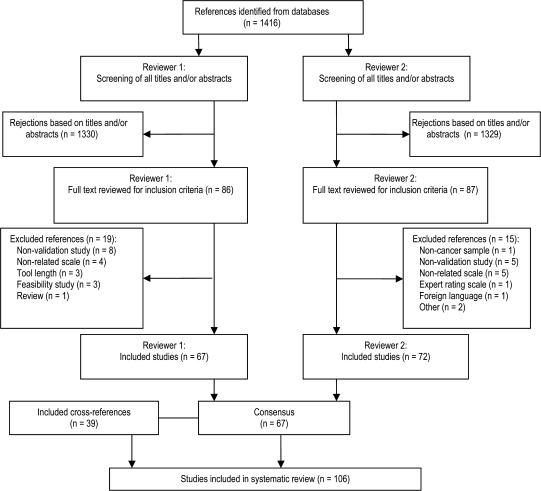
Screening for emotional distress is becoming increasingly common in cancer care. This systematic review examines the psychometric properties of the existing tools used to screen patients for emotional distress, with the goal of encouraging screening programs to use standardized tools that have strong psychometrics. Systematic searches of MEDLINE and PsycINFO databases for English-language studies in cancer patients were performed using a uniform set of key words (eg, depression, anxiety, screening, validation, and scale), and the retrieved studies were independently evaluated by two reviewers. Evaluation criteria included the number of validation studies, the number of participants, generalizability, reliability, the quality of the criterion measure, sensitivity, and specificity. The literature search yielded 106 validation studies that described a total of 33 screening measures. Many generic and cancer-specific scales satisfied a fairly high threshold of quality in terms of their psychometric properties and generalizability. Among the ultrashort measures (ie, those containing one to four items), the Combined Depression Questions performed best in patients receiving palliative care. Among the short measures (ie, those containing five to 20 items), the Center for Epidemiologic Studies-Depression Scale and the Hospital Anxiety and Depression Scale demonstrated adequate psychometric properties. Among the long measures (ie, those containing 21-50 items), the Beck Depression Inventory and the General Health Questionaire-28 met all evaluation criteria. The PsychoSocial Screen for Cancer, the Questionnaire on Stress in Cancer Patients-Revised, and the Rotterdam Symptom Checklist are long measures that can also be recommended for routine screening. In addition, other measures may be considered for specific indications or disease types. Some measures, particularly newly developed cancer-specific scales, require further validation against structured clinical interviews (the criterion standard for validation measures) before they can be recommended.
Overview
The claims and statistics of this paper haven’t been checked yet.
Run the check — free, no account needed. It reads the open-access text and checks the sources it cites.
Integrity signals
Registry
Cites
Statistics
Figures
Verification
Claims the paper makes
The claims and statistics of this paper haven’t been checked yet.
Run the check — free, no account needed. It reads the open-access text and checks the sources it cites.
Claims other papers make about this one
Each is checked against this paper’s own text: does it say what the citing paper says it does?
The cited source says what the claim attributes to it.
In the citing paper
“The HADS is validated and extensively used in the measurement of distress among cancer survivors (Vodermaier et al., 2009; Mitchell et al., 2010).”
From A randomised controlled trial comparing internet-delivered cognitive behavioural therapy (iCBT) with and without main carer access versus treatment-as-usual for depression and anxiety among breast cancer survivors: Study protocol (2021) · cites this paper as Vodermaier et al., 2009
Self-check
Percentages, sums and reported differences re-computed from the paper’s own numbers.
The self-check needs the paper’s full text.
Citations
Cites
Diagnostic and Statistical Manual of Mental Disorders
Williams, J. B. W., & First, M. B. (2013) · Oxford University Press eBooks · doi:10.1093/acrefore/9780199975839.013.104 · Cited by 109,845
The CES-D Scale: A Self-Report Depression Scale for Research in the General Population
Radloff, L. S. (1977) · Applied Psychological Measurement · doi:10.1177/014662167700100306 · Cited by 53,267
The Hospital Anxiety and Depression Scale
Zigmond, A. S., & Snaith, R. P. (1983) · Acta Psychiatrica Scandinavica · doi:10.1111/j.1600-0447.1983.tb09716.x · Cited by 47,139
The PHQ-9: Validity of a brief depression severity measure
Kroenke, K., Spitzer, R. L., & Williams, J. B. W. (2001) · Journal of General Internal Medicine · doi:10.1046/j.1525-1497.2001.016009606.x · Cited by 44,910
An inventory for measuring depression
BECK, A. T. (1961) · Archives of General Psychiatry · doi:10.1001/archpsyc.1961.01710120031004 · Cited by 38,032
Detection of Postnatal Depression: Development of the 10-item Edinburgh Postnatal Depression Scale
Cox, J. L., Holden, J. M., & Sagovsky, R. (1987) · British Journal of Psychiatry · doi:10.1192/bjp.150.6.782 · Cited by 14,183
A self-rating depression scale
ZUNG, W. W. K. (1965) · Archives of General Psychiatry · doi:10.1001/archpsyc.1965.01720310065008 · Cited by 9,813
Impact of Event Scale: A Measure of Subjective Stress
Horowitz, M., Wilner, N., & Alvarez, W. (1979) · Psychosomatic Medicine · doi:10.1097/00006842-197905000-00004 · Cited by 7,813
Psychometric properties of the PTSD checklist (PCL)
Blanchard, E. B., Jones-Alexander, J., Buckley, T. C., & Forneris, C. A. (1996) · Behaviour Research and Therapy · doi:10.1016/0005-7967(96)00033-2 · Cited by 3,997
The Validity of Two Versions of the GHQ in the WHO Study of Mental Illness in General Health Care
GOLDBERG, D. P., GATER, R., SARTORIUS, N., USTUN, T. B., PICCINELLI, M., GUREJE, O., & RUTTER, C. (1997) · Psychological Medicine · doi:10.1017/s0033291796004242 · Cited by 3,657
Research works printed but not linked: 11
- 2008, ONCOL EXCH, 7, 37
- 1997, American Journal of Psychiatry, 1, 674
- 1999, 40, 64
- 2001, 42, 241
- 2007, Psycho-oncology, 16, 1046, 10.1002/pon.1212 · DOI
- Miklavcic, 2008, 20, 148
- 2006, 47, 340
- 1989, 7, 31
- 2000, 41, 121
- 2003, 12, 1
- 2002, EUR J CANCER CARE, 11, 245
Cited by
Sorted by citations
Items 301–400 of 540
Brunet, J., O’Loughlin, J. L., Gunnell, K. E., & Sabiston, C. M. (2017) · Health Psychology · doi:10.1037/hea0000557 · Cited by 10
Everolimus induced mood changes in breast cancer patients: a case-control study
Mir, O., Salvador, A., Dauchy, S., Ropert, S., Lemogne, C., & Raphaël Gaillard, B. (2017) · Investigational New Drugs · doi:10.1007/s10637-017-0554-9 · Cited by 10
“The BDI has demonstrated excellent sensitivity and specificity to detect depressive symptoms among patients with cancer [18].”
BackgroundDistress thermometer for preoperative screening of patients with oral squamous cell carcinoma
Schell, J.-T., Petermann‐Meyer, A., Kloss‐Brandstätter, A., Bartella, A. K.-H., Kamal, M., Hölzle, F., Lethaus, B., & Teichmann, J. (2018) · Journal of Cranio-Maxillofacial Surgery · doi:10.1016/j.jcms.2018.04.022 · Cited by 10
Affronti, M. L., Randazzo, D. M., Lipp, E., Peters, K. B., Herndon, S. C., Woodring, S., Healy, P. N., Cone, C., Herndon, J. E., & Schneider, S. M. (2018) · Seminars in Oncology Nursing · doi:10.1016/j.soncn.2018.10.006 · Cited by 10
Sutton, T. L., Koprowski, M. A., Gold, J. A., Liu, B., Grossblatt-Wait, A., Macuiba, C., Lehman, A., Hedlund, S. C., Rocha, F. G., Brody, J. R., et al. (2022) · Journal of the National Comprehensive Cancer Network · doi:10.6004/jnccn.2022.7015 · Cited by 10
The Validity of the Distress Thermometer in Greek Colon Cancer Patients
Antoniadis, D., Lavrentiadis, G., Papadopoulos, V. N., lerodiakonoui, I., & Garyfallos, G. (2015) · Acta chirurgica Belgica · doi:10.1080/00015458.2015.11681138 · Cited by 10
“items and, thus, scores for each subscale (anxiety and depression) can range from 0-21 with scores categorized as follows : normal (0-7), mild (8-10), moderate (11-14), severe (15-21).”
BackgroundIntensity and prevalence of depressive states in cancer inpatients: a large sample descriptive study
Muzzatti, B., Mella, S., Bomben, F., Flaiban, C., Gipponi, K., Piccinin, M., Busato, S., & Annunziata, M. (2018) · European Journal of Cancer Care · doi:10.1111/ecc.12542 · Cited by 11
Identification of Distress in Oncology Patients
Thalén-Lindström, A., Glimelius, B. L. G., & Johansson, B. (2015) · Cancer Nursing · doi:10.1097/ncc.0000000000000267 · Cited by 10
“Life and death 50 (37) 47 (35) 27 (20) 6 (4) My financial situation 53 (39) 48 (35) 22 (16) 9 (7) Practical problems 61 (45) 49 (36) 17 (13) 6 (4)”
Depression and anxiety during the year before death from cancer
Magill, N., Walker, J., Symeonides, S., Gourley, C., Hobbs, H., Rosenstein, D., Frost, C., & Sharpe, M. (2022) · Journal of Psychosomatic Research · doi:10.1016/j.jpsychores.2022.110922 · Cited by 9
Normen, M., Sahaya, F. E., Kulkarni, K., Vidhubala, E., Shewade, H. D., & Kathiresan, J. (2021) · Indian Journal of Palliative Care · doi:10.25259/ijpc_142_21 · Cited by 9
“[7,8] 9-12] Routine distress screening in larger centres in India is a challenge due to the sheer volume of patients, lack of trained workforce, financial constraints and the absence of standard distress screening guidelines.”
Emotional distress and future healthcare utilization in oncology populations: A systematic review
Kirsch, J. L., Roche, A. I., Bronars, C. A., Donovan, K. A., Hassett, L. C., & Ehlers, S. L. (2024) · Psycho-Oncology · doi:10.1002/pon.6322 · Cited by 9
“In fact, content validity may be higher in questionnaires with multiple questions 57 while brief surveys (1–4 questions) are optimal for ruling out depression, anxiety, or distress rather than confidently ruling in these diagnoses.”
BackgroundVilela-Estrada, A. L., Villarreal‐Zegarra, D., Copez-Lonzoy, A. J. E., Valencia, L. E., Sanchez‐Ramirez, J. C., Delgado, F. L., Ambrosio-Melgarejo, J. I., Reátegui-Rivera, C. M., & Finkelstein, J. (2025) · Frontiers in Psychology · doi:10.3389/fpsyg.2024.1497946 · Cited by 9
“As for the general factor, this would be called emotional distress, which is defined as a state of negative affect, suggesting the presence of affective disorders (Vodermaier et al., 2009).”
Martínez, P., Andreu, Y., Garrido, M. J. G., & Ibáñez, E. (2015) · Journal of Pain and Symptom Management · doi:10.1016/j.jpainsymman.2015.02.004 · Cited by 9
“Regarding the selection of a suitable tool, several psychological instruments have been applied in the cancer setting.(10,11) Among the ultra-short tools,”
MethodUnmet mental health needs in patients with advanced B-cell lymphomas
Marte, C., George, L. S., Rutherford, S. C., Ouyang, D. J., Martin, P., Leonard, J. P., & Trevino, K. M. (2021) · Palliative & Supportive Care · doi:10.1017/s1478951521001164 · Cited by 9
“The HADS is a 14-item self-report measure commonly used with cancer patients that consists of seven-item anxiety and depression subscales (Hopwood et al., 1991; Moorey et al., 1991; Walker et al., 2007; Vodermaier et al., 2009; Hinz et al., 2010; Mitchell, 2010).”
MethodYutrirak, K., Ratta‐apha, W., Dankulchai, P., & Pukrittayakamee, P. (2021) · Siriraj Medical Journal/San Sirirat · doi:10.33192/smj.2021.103 · Cited by 9
Priede, A., Ruiz-Torres, M., Hoyuela, F., Herrán, A., & González‐Blanch, C. (2014) · Psicooncología · doi:10.5209/rev_psic.2014.v11.n1.44915 · Cited by 9
Muzzatti, B., & Annunziata, M. A. (2012) · Tumori Journal · doi:10.1177/030089161209800416 · Cited by 9
Psychological Screening of Onco-Hematologic Inpatients: Distress Thermometer Administration
Bellé, M., Muzzatti, B., Tomas, M., & Gherlinzoni, F. (2015) · Tumori Journal · doi:10.5301/tj.5000440 · Cited by 9
“Other questionnaires for the detection of psychological distress were elaborated; for instance, Vodermaier et al (6), Luckett et al (7), Mitchell (8), and Muzzatti and Annunziata (3) provided descriptions of the more common screening tools for distress in oncology.”
MethodOn chronic cancer-related fatigue and physical behavior
Wolvers, M. D. J. (2017) · doi:10.3990/1.9789036542999 · Cited by 10
Akkol-Solakoglu, S., Hevey, D., & Richards, D. (2021) · Internet Interventions · doi:10.1016/j.invent.2021.100367 · Cited by 8
Bernardes, C. M., Langbecker, D., Beesley, V. L., Garvey, G., & Valery, P. C. (2019) · Cancer Reports · doi:10.1002/cnr2.1178 · Cited by 8
“The DT scale used to measure psychological distress has been tested in populations of cancer patients with mixed diagnoses and different stages of the disease but not specifically with Indigenous people with cancer.(49) Therefore, due to cultural differences, caution should be taken when interpreting results, as the D…”
MethodUnmet needs in people with high-grade glioma: defining criteria for stepped care intervention
Faris, M. M., Dhillon, H. M., Campbell, R., Halkett, G. K. B., Miller, A., Chan, R. J., Haydon, H. M., Sansom‐Daly, U. M., Koh, E., Ownsworth, T., et al. (2024) · JNCI Cancer Spectrum · doi:10.1093/jncics/pkae034 · Cited by 8
“The program aims to facilitate assessment and management of unmet needs in PwBT and to increase uptake of screening in routine practice (15).”
BackgroundDiagnostic Criteria for Major Depressive Disorder in Cancer Patients: A Review
Ng, C. G., Sulaiman, A. H., Zainal, N. Z., Boks, M. P., & de Wit, N. J. (2013) · The International Journal of Psychiatry in Medicine · doi:10.2190/pm.45.1.f · Cited by 9
Stegmann, M., Schuling, J., Hiltermann, T. J. N., Reyners, A. K. L., Burger, H., Berger, M. Y., & Berendsen, A. J. (2016) · Maturitas · doi:10.1016/j.maturitas.2016.11.014 · Cited by 8
Valderrama-Ríos, M. C., & Pedraza, R. S. (2018) · Revista Colombiana de Psiquiatría (English ed ) · doi:10.1016/j.rcpeng.2018.10.001 · Cited by 8
Campbell, R., Faris, M. M., Shaw, J., Halkett, G. K. B., Legge, D. M., Koh, E., Nowak, A. K., Agar, M. R., Ownsworth, T., Pike, K. E., et al. (2023) · Neuro-Oncology Practice · doi:10.1093/nop/npad035 · Cited by 8
Detecting and managing psychological distress in women with cancer: an update of recent evidence
Mitchell, A. J. (2011) · The Obstetrician & Gynaecologist · doi:10.1576/toag.13.1.22.27637 · Cited by 8
Mann, R., & Gilbody, S. M. (2012) · Systematic Reviews · doi:10.1186/2046-4053-1-9 · Cited by 8
“DTA reviews of psychometric measures for depression have been undertaken, however none of the search strategies explicitly described following methodological guidelines [13-16].”
MethodWarmenhoven, F. C., van Rijswijk, E., van Weel, C., Prins, J. B., & Vissers, K. C. P. (2011) · Journal of Affective Disorders · doi:10.1016/j.jad.2011.11.017 · Cited by 8
What Is Quality Health Care for Cancer Survivors?
Malin, J. L., Sayers, E., & Jefford, M. (2011) · Springer eBooks · doi:10.1007/978-1-4419-1348-7_2 · Cited by 8
“While little is known about how or when to screen for distress [68] nor how best to intervene – currently available guidelines for the psychosocial care of patients with cancer do not address the posttreatment period [69] – this clearly is an area where attention to improving the process of care is needed in parallel…”
Oswald, A., McBride, K. E., Seif, S., Koh, C., Ansari, N., & Steffens, D. (2022) · Journal of Clinical Psychology in Medical Settings · doi:10.1007/s10880-022-09918-0 · Cited by 7
“The tool has shown to present reasonably psychometric properties within cancer patients (Moretz, 2002; Vodermaier et al., 2009).”
MethodS3-Leitlinie Diagnostik und Therapie der Plattenepithelkarzinome und Adenokarzinome des Ösophagus
Porschen, R., Fischbach, W., Gockel, I., Hollerbach, S. H., Hölscher, A. H., Jansen, P. L., Miehlke, S., Pech, O., Stahl, M., Vanhoefer, U. J., et al. (2023) · Zeitschrift für Gastroenterologie · doi:10.1055/a-1771-7087 · Cited by 7
Pini, S. A., Buck, C., Lally, P. J., Beeken, R. J., & Fisher, A. (2024) · BMC Psychology · doi:10.1186/s40359-023-01471-1 · Cited by 38
“…to help them accurately assess their vulnerability e.g., through mental health instruments such as the highly validated Hospital Anxiety and Depression Scale (HADS) [34], and make practical adjustments accordingly, such as consider the need for pharmacological or psychological interventions.”
BackgroundHu, W., Bao, J., Yang, X., & Ye, M. (2024) · BMC Public Health · doi:10.1186/s12889-024-18000-3 · Cited by 8
“However, its use is limited to German-speaking patients because to our knowledge, no psychometric information exists on its translation into English [26].”
BackgroundAl-Hussaini, M. A., Abdel‐Razeq, H., Shamieh, O. M., Al-Ani, A. T., Hammouri, M., & Mansour, A. H. (2024) · The Oncologist · doi:10.1093/oncolo/oyae193 · Cited by 10
“84-87 This is mostly due to the fact that the tool is associated with better compliance by patients, shorter time to completion, good correlations with clinical features, and appropriate psychometric settings.”
Calderón, C., Carmona-Bayonas, A., Jara, C., Beato, C., Mediano, M., Cajal, T. R. Y., Soriano, M. C., & Jiménez-Fonseca, P. (2019) · European Journal of Cancer Care · doi:10.1111/ecc.13005 · Cited by 6
Taylor, J. A. T., Fradgley, E. A., Clinton‐McHarg, T., Roach, D., & Paul, C. L. (2019) · Supportive Care in Cancer · doi:10.1007/s00520-019-05252-8 · Cited by 7
Kuhlman, K. R., Irwin, M. R., Ganz, P. A., Cole, S. W., Manigault, A. W., Crespi, C. M., & Bower, J. E. (2022) · Journal of Affective Disorders · doi:10.1016/j.jad.2022.05.019 · Cited by 8
Association of anxiety and depression with oral mucositis: A systematic review
de Arruda, J. A. A., Heimlich, F. V., Drumond, V. Z., Schuch, L. F., Martins, M. D., Abreu, L. G., Teixeira, A. L., Mesquita, R. A., & Silva, T. A. (2022) · Oral Diseases · doi:10.1111/odi.14355 · Cited by 8
Second thoughts about implementing routine screening of cancer patients for distress
Coyne, J. C. (2013) · Psycho-Oncologie · doi:10.1007/s11839-013-0437-z · Cited by 7
“A number of reviews have evaluated the Hospital Anxiety and Depression Scale (HADS) as providing measures of anxiety and depression symptoms, as a means of screening for anxiety depressive disorders, and as a means of validating the DT as a short measure of distress against the longer one [34,35].”
BackgroundMoving forward by moving back: Re-assessing guidelines for cancer distress screening
Thombs, B. D., & Coyne, J. C. (2013) · Journal of Psychosomatic Research · doi:10.1016/j.jpsychores.2013.05.002 · Cited by 7
“In still other cases [13,14], cutoff scores on these tools have been based on identifying patients with a score above a cutoff on a longer psychological symptom measure, such as the Hospital Anxiety and Depression Scale (HADS).”
BackgroundQualliotine, J., Califano, J., Li, R. J., Gold, D. R., Messing, B., Lee, G., Ha, P. K., & Fakhry, C. (2017) · The Journal of Laryngology & Otology · doi:10.1017/s0022215117001098 · Cited by 7
Oncology patient preferences for depression care: A discrete choice experiment
Hobden, B., Turon, H., Bryant, J., Wall, L., Brown, S. D., & Sanson‐Fisher, R. (2019) · Psycho-Oncology · doi:10.1002/pon.5024 · Cited by 7
“Several screening tools have been developed and tested in oncology settings to assist clinical staff in assessing and monitoring depression among patients.(16) Commonly used tools include the Hospital Anxiety Depression Scale (HADS),(17) the Center for Epidemiological Studies‐ Depression Scale (CES‐D),(18) and the Bri…”
MethodRae, C. S., Tsangaris, E., Klassen, A. F., Breakey, V. R., & D’Agostino, N. M. (2019) · Journal of Adolescent and Young Adult Oncology · doi:10.1089/jayao.2019.0033 · Cited by 7
Huang, M., Wu, Y., Wen, X., & Song, W. (2023) · Health Science Reports · doi:10.1002/hsr2.1018 · Cited by 7
Tratamiento farmacológico de la depresión en cáncer
García, P. B., & Algar, M. J. M. (1970) · Psicooncología · doi:10.5209/psic.54435 · Cited by 7
Psychometric Properties of the Patient Health Questionnaire-9 in Patients With Breast Cancer
Park, H., Kim, K., Moon, E., Lim, H. J., Suh, H., & Kang, T. (2024) · Psychiatry Investigation · doi:10.30773/pi.2023.0285 · Cited by 6
“13,14 The 14-item Hospital Anxiety and Depression Scale (HADS) was developed to measure anxiety and depression levels in general hospital patients.”
MethodPredicting psychological distress in advanced ovarian cancer patients during the COVID-19 pandemic
Rennoldson, M., Baliousis, M., Potter, A., Ashraf, E., & Gajjar, K. B. (2024) · Supportive Care in Cancer · doi:10.1007/s00520-024-08675-0 · Cited by 6
“The psychometric properties of the HADS has been assessed extensively in cancer populations and been found to have good internal and test re-test reliability, validity, and sensitivity to change [28].”
BackgroundMethodRe-rethinking the article by Thombs and colleagues: Figure 1:
Thombs, B. D., Coyne, J. C., Cuijpers, P. J., de Jonge, P., Gilbody, S. M., Ioannidis, J. P. A., Johnson, B. T., Patten, S. B., Turner, E. H., & Ziegelstein, R. C. (2012) · Canadian Medical Association Journal · doi:10.1503/cmaj.112-2024 · Cited by 6
Dental fear and anxiety in Asian youths: response components and inducing stimuli
Yap, A. U., & Lee, D. Z. R. (2022) · Clinical Oral Investigations · doi:10.1007/s00784-022-04555-1 · Cited by 6
“More elaborate instruments for identifying depression and anxiety, like the Hospital Anxiety and Depression Scale (HADS), Depression, Anxiety, Stress Scales-21 (DASS-21), Beck Depression/Anxiety Inventory (BDI/BAI), and General Health Questionnaire (GHQ), can be considered for subsequent studies [40, 41].”
BackgroundYap, A. U., & Lee, D. Z. R. (2023) · CRANIO® · doi:10.1080/08869634.2022.2158259 · Cited by 6
“Validated screening tools for identifying depression and anxiety include the Hospital Anxiety and Depression Scale (HADS), Beck Depression/Anxiety Inventory (BDI/BAI), General Health Questionnaire (GHQ), and Depression Anxiety Stress Scale (DASS) [6,7].”
(2013) · American Psychiatric Association Publishing eBooks · doi:10.1176/appi.books.9781615378258 · Cited by 6
Psychosocial cancer care There is more to cancer care than medical management.
Manicom, C. (2010) · Cited by 6
The validity of the Distress Thermometer in female partners of men with prostate cancer
Hyde, M. K., Zajdlewicz, L., Lazenby, M., Dunn, J. C., Laurie, K., Lowe, A., & Chambers, S. K. (2018) · European Journal of Cancer Care · doi:10.1111/ecc.12924 · Cited by 6
Hansen, C. H., Walker, J., Thekkumpurath, P., Kleiboer, A. M., Beale, C., Sawhney, A., Murray, G. D., & Sharpe, M. (2013) · Psychological Medicine · doi:10.1017/s0033291712002930 · Cited by 6
“The HADS is the most extensively studied distress scale in cancer patients and is very widely used as a first stage in screening medical patients for depression (Vodermaier et al. 2009).”
BackgroundLifestyle in Multiple Myeloma - a longitudinal cohort study protocol
Heinrich, M., Fisher, A., Paton, B. M., McCourt, O., Beeken, R. J., Hackshaw, A. K., Wardle, J., & Yong, K. (2016) · BMC Cancer · doi:10.1186/s12885-016-2407-x · Cited by 5
“Patients also complete the Hospital and Anxiety and Depressions scale (HADS, [22], widely used to measure emotional distress in cancer patients [23] and report on their sleep patterns using Pittsburgh Sleep Quality Index (PSQI, [24].”
MethodScreening for Distress in Patients With Cancer
Schilli, S. M. (2014) · Clinical journal of oncology nursing · doi:10.1188/14.cjon.e103-e106 · Cited by 6
Long-Term Psychological Well-Being: Strategies for Assessment and Intervention
Coscarelli, A., Recklitis, C. J., & Ahmed, K. (2011) · Springer eBooks · doi:10.1007/978-1-4419-1348-7_6 · Cited by 6
“Using the published literature on screening for psychological distress in cancer patients [ 49 , 55] can help identify candidate screening measures, though caution should be exercised in generalizing the application of these same measures to cancer survivors.”
BackgroundMethodInfluentialRe-rethinking the article by Thombs and colleagues
Linden, W., & Vodermaier, A. (2012) · Canadian Medical Association Journal · doi:10.1503/cmaj.112-2023 · Cited by 5
“reviews reveal the existence of quality tools with greater than 80% sensitivity and greater than 80% specificity where the false-positive rates are in a very acceptable 10%–20% range.(2) Second, screening absorbs valuable resources better spent elsewhere.”
BackgroundAhmad, F. M., & Sajit, D. M. (2024) · Frontiers in Public Health · doi:10.3389/fpubh.2024.1398238 · Cited by 5
“While using the four assessments, the Beck’s Depression Inventory-II (BDI-II) was utilized as a screening tool for depression and psychosocial factors, known for its wide usage and effectiveness (40).”
Kang, X., Ge, Y., Zhang, X., Yang, T., Xia, Y., Wang, Y., Li, J., Chen, W., Zhang, K., Xiao, Z., et al. (2024) · Neurosurgical Review · doi:10.1007/s10143-024-03169-3 · Cited by 5
Cunningham, S. C., Aizvera, J., Wakim, P., & Felber, L. (2018) · Social Work in Health Care · doi:10.1080/00981389.2018.1437499 · Cited by 5
“…screening instruments among cancer patients results in reductions in emotional distress, increased quality of life, and improved patient–provider communication (Gentilello, Ebel, Wickizer, & Salkever, 2005; Mystakidou et al., 2007; van Scheppingen et al., 2011; Vodermaier et al., 2009).”
BackgroundStafford, L., Flehr, A., Judd, F. K., Lindeman, G. J., Gibson, P., Komiti, A., Mann, G. B., & Kentwell, M. (2019) · Journal of Community Genetics · doi:10.1007/s12687-019-00415-w · Cited by 5
Depression and Cancer (literature review)
Блинков, А. Н. (2020) · V M BEKHTEREV REVIEW OF PSYCHIATRY AND MEDICAL PSYCHOLOGY · doi:10.31363/2313-7053-2020-2-16-25 · Cited by 6
Maheu, C., Singh, M. D., Tock, W. L., Robert, J., Vodermaier, A., Parkinson, M., & Dolgoy, N. D. (2025) · Current Oncology · doi:10.3390/curroncol32030166 · Cited by 5
“While this scale is not specific to cancer-related anxiety and depression, it has been extensively validated for use in cancer populations, and has been used to detect clinical levels of anxiety and depression and to validate new scales [37].”
Implementing a screening programme for distress in cancer settings: Science and practice
Mitchell, A. J., Waller, A. E., & Carlson, L. E. (2012) · Psicooncología · doi:10.5209/rev_psic.2013.v9.n2-3.40896 · Cited by 5
“As If the Cancer Wasn’t Enough …”
Knopf, K., & Head, B. A. (2012) · Journal of Hospice and Palliative Nursing · doi:10.1097/njh.0b013e3182560da7 · Cited by 5
Mackenzie, L., Carey, M. L., Suzuki, E., Yoshimura, M., Toi, M., D’Este, C. A., & Sanson‐Fisher, R. (2018) · Psycho-Oncology · doi:10.1002/pon.4736 · Cited by 5
“Ultrashort patient‐report measures are increasingly being examined as an alternative approach for identifying psychological distress, while other settings may rely on clinician judgement alone.(12,13) Akizuki and colleagues assessed the sensitivity and specificity of a single‐item interview, the HADS, and the distress…”
MethodTransforming End-of-Life Care by Implementing a Patient-Centered Care Model
Dobrina, R., Tenze, M., & Palese, A. (2018) · Journal of Hospice and Palliative Nursing · doi:10.1097/njh.0000000000000468 · Cited by 5
Kyranou, M., Varvara, C., Papathanasiou, M., Diakogiannis, I., Zafeiropoulos, K., Apostolidis, M., Papandreou, C., & Syngelakis, M. (2020) · BMC Psychiatry · doi:10.1186/s12888-020-02926-0 · Cited by 5
Eisen, T., Kooijstra, E. M., Groeneweg, R., Verseveld, M., & Hidding, J. T. (2021) · Frontiers in Pain Research · doi:10.3389/fpain.2021.675302 · Cited by 7
Deodhar, J. K., Goswami, S. S., & Sonkusare, L. N. (2022) · Indian Journal of Cancer · doi:10.4103/ijc.ijc_1321_20 · Cited by 7
Chapter 3. Communicating With Cancer Patients and Their Families
Baile, W. F., & Costantini, A. (2013) · American Psychiatric Association Publishing eBooks · doi:10.1176/appi.books.9781615378258.lg03 · Cited by 5
Grassi, L. G. (2013) · American Psychiatric Association Publishing eBooks · doi:10.1176/appi.books.9781615378258.lg12 · Cited by 5
Park, H., Kim, K., Moon, E., Lim, H. J., Suh, H., Kim, K.-E., & Kang, T. (2024) · Clinical Psychopharmacology and Neuroscience · doi:10.9758/cpn.23.1147 · Cited by 4
“Although the BDI could be helpful in detecting depresion for breast cancer patients [6,13], a brief assessment tool could be useful when considering medical condition in patients with breast cancer [14,15].”
MethodThe integration of the cancer experience into identity: Perspectives from young adults
Marín‐Chollom, A. M., Beaucant, P., King, C., Pervil, I. Z., Rubin, L. R., & Revenson, T. A. (2024) · Journal of Health Psychology · doi:10.1177/13591053241240932 · Cited by 4
“0.8, for cancer populations (Vodermaier et al., 2009).”
InfluentialMoore, M. R., Davis, C., Cadet, T. J., Harralson, T. L., & Dietzen, L. L. (2021) · International Journal of Environmental Research and Public Health · doi:10.3390/ijerph18147600 · Cited by 4
“Similar values have been found in other studies as well [26].”
ResultScreening for Distress in Breast Cancer
Mitchell, A. J. (2014) · Current Breast Cancer Reports · doi:10.1007/s12609-014-0157-9 · Cited by 4
Landa-Ramírez, É., Cárdenas‐López, G., Greer, J. A., Sánchez-Román, S., & Riveros-Rosas, A. (2014) · Salud Mental · doi:10.17711/sm.0185-3325.2014.049 · Cited by 4
Integrated psychosocial and supportive care needed for patients with pancreatic cancer
Gooden, H. M., Tiller, K., Mumford, J., & White, K. (2016) · Cancer Forum · Cited by 4
The Role of Emotions in Palliative Care
Limonero, J. T., Reverte, M. A. L., Gómez-Romero, M. J., & Gil, F. (2018) · Palliative Medicine and Hospice Care - Open Journal · doi:10.17140/pmhcoj-4-127 · Cited by 4
Papanikolaou, E., McKinney, C. H., & Hannibal, N. (2020) · Music and Medicine · doi:10.47513/mmd.v12i3.670 · Cited by 4
van den Berg, J. P. (2012) · Bijblijven · doi:10.1007/s12414-012-0047-x · Cited by 4
Chou, Y.-H., Yeh, M., Huang, T., & Hsu, H. (2021) · Asia-Pacific Journal of Oncology Nursing · doi:10.1016/j.apjon.2021.11.002 · Cited by 4
Huizinga, F., Westerink, N.-D. L., Berendsen, A. J., Walenkamp, A., Greef, M. H. G. D., de Bock, G. H., Berger, M. Y., & Brandenbarg, D. (2022) · BMJ Open · doi:10.1136/bmjopen-2021-060098 · Cited by 4
Holthuijsen, D. D. B., van Roekel, E. H., Bours, M. J. L., Ueland, P. M., Breukink, S. O., Janssen-Heijnen, M. L. G., Keulen, E. T. P., Gigic, B., Gsur, A., Meyer, K., et al. (2024) · Psychoneuroendocrinology · doi:10.1016/j.psyneuen.2024.106981 · Cited by 4
“The HADS has been demonstrated to have adequate psychometric properties in cancer patients (Vodermaier, Linden and Siu, 2009).”
Deza, E. G. (2024) · Springer eBooks · doi:10.1007/978-3-031-62446-9_6 · Cited by 4
Ledesma, D. A., Takahashi, M., & Kai, I. (2010) · Psycho-Oncology · doi:10.1002/pon.1804 · Cited by 4
“The CES-D scale is known to have adequate psychometric properties as a screening tool for cancer patients [19], and the use of the MSPSS and BSSS in samples of cancer patients has been validated [17,20].”
MethodDemoralisation in Cancer Patients: The Association with Distress, Depression and Positive Emotion
Thong, K. S. (2021) · Medicine & health · doi:10.17576/mh.2021.1601.10 · Cited by 4
Jordan, A. E., Malhotra, S., Maree, R. D., Schenker, Y., Arnold, R. M., & Reynolds, C. F. (2015) · Harvard Review of Psychiatry · doi:10.1097/hrp.0000000000000069 · Cited by 4
Borean, M., Shani, K., Brown, M. C., Chen, J., Liang, M., Karkada, J., Kooner, S., Doherty, M. K., O'Kane, G. M., Jang, R. W.-J., et al. (2018) · Health Science Reports · doi:10.1002/hsr2.48 · Cited by 4
“One method is to implement short symptom screener tools, followed by more comprehensive questions if the patient elicits a positive screen result; this may maximize symptom reporting while reducing clinic burden on both patients and clinicians.(19-21) Symptom screening may also have merits in the context of prospectiv…”
MethodCalderón, J., Cristóbal Camplá, C., D'aguzan, N., Barraza, S., Padilla, O., Sanchez, C. G., Palma, S., & González, M. (2016) · ecancermedicalscience · doi:10.3332/ecancer.2014.437 · Cited by 4
“In a recent systematic review of screening instruments for ED [25], the cut-off point to identify ED in a clinically relevant manner was of 4 or 5, depending on the validation measures used.”
MethodBlunt, J., & Trigg, J. L. (2023) · medRxiv · doi:10.1101/2023.08.06.23293728 · Cited by 4
Egeler, M., Klobuch, S., Tak, W. S., Rohaan, M. W., Borch, T. H., Noringriis, I. M., Tissier, R., Lucas, M. W., van Houdt, W. J., van Akkooi, A. C. J., et al. (2025) · European Journal of Cancer · doi:10.1016/j.ejca.2025.115640 · Cited by 3
Ku, M., Gates, P., & Renehan, S. (2021) · Internal Medicine Journal · doi:10.1111/imj.15204 · Cited by 3
Jensen, O. J., Øvlisen, A., Jakobsen, L., Roug, A., Nielsen, R., Marcher, C., Ebbesen, L., Theilgaard-Mönch, K., Møller, P., Schöllkopf, C., et al. (2022) · Clinical Epidemiology · doi:10.2147/clep.s336115 · Cited by 2
“Further research is required to identify the true incidence of depression and anxiety in AML and MDS patients using validated screening tools, such as the Hospital Anxiety and Depression Scale, Patient Health Questionnaire (PHQ-9), and Generalized Anxiety Disorder (GAD-7) by which also mild depression and anxiety may…”
MethodS3-Leitlinie Diagnostik und Therapie der Plattenepithelkarzinome und Adenokarzinome des Ösophagus
Porschen, R., Fischbach, W., Gockel, I., Hollerbach, S. H., Hölscher, A. H., Jansen, P. L., Miehlke, S., Pech, O., Stahl, M., Vanhoefer, U. J., et al. (2023) · Zeitschrift für Gastroenterologie · doi:10.1055/a-1771-6953 · Cited by 4
Psychological impact of the COVID-19 pandemic on breast cancer patients
Farewell, J. T., Perez, K., Henderson, S. P., Crook, J. L., Hunter, M., & Zhang, A. Y. (2023) · Journal of Plastic Reconstructive & Aesthetic Surgery · doi:10.1016/j.bjps.2023.06.025 · Cited by 3
Zhong, J., Zhang, Z., Zhao, Z., Peng, L., Zhang, Y., Zhang, B., Zhai, X., & Wu, Y. (2024) · Pediatric Blood & Cancer · doi:10.1002/pbc.31198 · Cited by 3
Barriers to cancer rehabilitation: healthcare professionals’ perspective in Saudi Arabia
AlJohi, A. A., AlKathiri, F. M., Ajaj, K. F., Buragadda, S., & Madi, S. (2019) · Physikalische Medizin Rehabilitationsmedizin Kurortmedizin · doi:10.1055/a-0901-1252 · Cited by 3
“The evidence in favour of cancer rehabilitation is growing and studies in general cancer populations have demonstrated that it is beneficial in the management of cancer-related fatigue [11], psychological distress [12], and pain [13, 14].”
Background
Metadata
- Authors
- Vodermaier, A., Linden, W., & Siu, C.
- Affiliations
- BC Cancer Agency (CA)
- Corresponding author
- Vodermaier, A.
- Venue
- JNCI Journal of the National Cancer Institute
- Publisher
- Oxford University Press (OUP)
- Published
- 2009-10-13
- Volume
- 101
- Issue
- 21
- Pages
- 1464-1488
- ISSN
- 0027-8874 (ISSN-L)
- 1460-2105
- PMC
- PMC3298956
- OpenAlex
- W1996766132
- Cited by
- 541
- References
- 160
- Citations by year
- 2026: 12 · 2025: 16 · 2024: 30 · 2023: 20 · 2022: 27 · 2021: 34 · 2020: 24 · 2019: 32 · 2018: 49 · 2017: 28 · 2016: 32 · 2015: 42 · 2014: 38 · 2013: 52 · 2012: 48
- FWCI
- 2.98
- Type
- journal article
- Language
- en
- Open access
- bronze
- doi.org
- Locations
- JNCI Journal of the National Cancer Institute (publishedVersion)
- PubMed Central (publishedVersion, cc-by-nc)
- PubMed (publishedVersion)
- HighWire Press Open Archive (submittedVersion)
- Funders
- Canadian Institutes of Health Research (#AQC83559)
- Topics
- Health Sciences › Medicine › Oncology › Cancer survivorship and care
- Social Sciences › Psychology › Experimental and Cognitive Psychology › Anxiety, Depression, Psychometrics, Treatment, Cognitive Processes
- Health Sciences › Medicine › Pediatrics, Perinatology and Child Health › Childhood Cancer Survivors' Quality of Life
- Keywords
- emotional distress screening, cancer patients, psychometric properties, depression screening, anxiety screening, screening tool, scale validation, CES-D, Hospital Anxiety and Depression Scale, Beck Depression Inventory, Rotterdam Symptom Checklist, palliative care, sensitivity and specificity
- MeSH terms
- Adjustment Disorders, Anxiety Disorders, Depression, Depressive Disorder, Major, Major Depressive Disorder, Humans, Mass Screening, Neoplasms, Psychometrics, Surveys and Questionnaires, Stress, Psychological, Reproducibility of Results, Dysthymic Disorder
About these checks
Registry, retraction, Cites and statistics results are computed, not judged, with one exception: a printed reference that no index lists is read once by a model before it counts as a citation error. Claims are extracted by a model and kept only when their quote appears verbatim in the text; each cited source is then checked, with a model’s help, for whether it says what the claim relies on. Those verdicts can be wrong — read the claim’s quote and the cited source before relying on one.
Statistics and arithmetic are recomputed, not judged.
Confidence bands are shown only for fields calibrated on our annotated test set. None is calibrated yet, so no band is shown.
What counts as a claim ›How we measure confidence ›How we check this ›
Are you an author, or do you see a problem with this page? Request a review
