

The DOI matches its Crossref record; 161 of the 161 references it cites were found in a registry or an index.
Screening for Emotional Distress in Cancer Patients: A Systematic Review of Assessment Instruments
Open accessAbstract
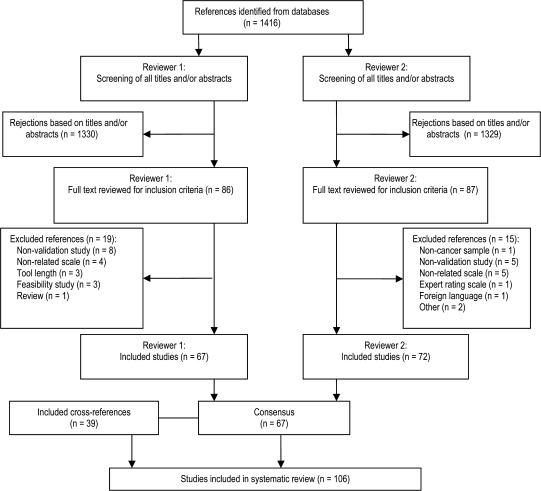
Screening for emotional distress is becoming increasingly common in cancer care. This systematic review examines the psychometric properties of the existing tools used to screen patients for emotional distress, with the goal of encouraging screening programs to use standardized tools that have strong psychometrics. Systematic searches of MEDLINE and PsycINFO databases for English-language studies in cancer patients were performed using a uniform set of key words (eg, depression, anxiety, screening, validation, and scale), and the retrieved studies were independently evaluated by two reviewers. Evaluation criteria included the number of validation studies, the number of participants, generalizability, reliability, the quality of the criterion measure, sensitivity, and specificity. The literature search yielded 106 validation studies that described a total of 33 screening measures. Many generic and cancer-specific scales satisfied a fairly high threshold of quality in terms of their psychometric properties and generalizability. Among the ultrashort measures (ie, those containing one to four items), the Combined Depression Questions performed best in patients receiving palliative care. Among the short measures (ie, those containing five to 20 items), the Center for Epidemiologic Studies-Depression Scale and the Hospital Anxiety and Depression Scale demonstrated adequate psychometric properties. Among the long measures (ie, those containing 21-50 items), the Beck Depression Inventory and the General Health Questionaire-28 met all evaluation criteria. The PsychoSocial Screen for Cancer, the Questionnaire on Stress in Cancer Patients-Revised, and the Rotterdam Symptom Checklist are long measures that can also be recommended for routine screening. In addition, other measures may be considered for specific indications or disease types. Some measures, particularly newly developed cancer-specific scales, require further validation against structured clinical interviews (the criterion standard for validation measures) before they can be recommended.
Overview
The claims and statistics of this paper haven’t been checked yet.
Run the check — free, no account needed. It reads the open-access text and checks the sources it cites.
Integrity signals
Registry
Cites
Statistics
Figures
Verification
Claims the paper makes
The claims and statistics of this paper haven’t been checked yet.
Run the check — free, no account needed. It reads the open-access text and checks the sources it cites.
Claims other papers make about this one
Each is checked against this paper’s own text: does it say what the citing paper says it does?
The cited source says what the claim attributes to it.
In the citing paper
“The HADS is validated and extensively used in the measurement of distress among cancer survivors (Vodermaier et al., 2009; Mitchell et al., 2010).”
From A randomised controlled trial comparing internet-delivered cognitive behavioural therapy (iCBT) with and without main carer access versus treatment-as-usual for depression and anxiety among breast cancer survivors: Study protocol (2021) · cites this paper as Vodermaier et al., 2009
Self-check
Percentages, sums and reported differences re-computed from the paper’s own numbers.
The self-check needs the paper’s full text.
Citations
Cites
Diagnostic and Statistical Manual of Mental Disorders
Williams, J. B. W., & First, M. B. (2013) · Oxford University Press eBooks · doi:10.1093/acrefore/9780199975839.013.104 · Cited by 109,845
The CES-D Scale: A Self-Report Depression Scale for Research in the General Population
Radloff, L. S. (1977) · Applied Psychological Measurement · doi:10.1177/014662167700100306 · Cited by 53,267
The Hospital Anxiety and Depression Scale
Zigmond, A. S., & Snaith, R. P. (1983) · Acta Psychiatrica Scandinavica · doi:10.1111/j.1600-0447.1983.tb09716.x · Cited by 47,139
The PHQ-9: Validity of a brief depression severity measure
Kroenke, K., Spitzer, R. L., & Williams, J. B. W. (2001) · Journal of General Internal Medicine · doi:10.1046/j.1525-1497.2001.016009606.x · Cited by 44,910
An inventory for measuring depression
BECK, A. T. (1961) · Archives of General Psychiatry · doi:10.1001/archpsyc.1961.01710120031004 · Cited by 38,032
Detection of Postnatal Depression: Development of the 10-item Edinburgh Postnatal Depression Scale
Cox, J. L., Holden, J. M., & Sagovsky, R. (1987) · British Journal of Psychiatry · doi:10.1192/bjp.150.6.782 · Cited by 14,183
A self-rating depression scale
ZUNG, W. W. K. (1965) · Archives of General Psychiatry · doi:10.1001/archpsyc.1965.01720310065008 · Cited by 9,813
Impact of Event Scale: A Measure of Subjective Stress
Horowitz, M., Wilner, N., & Alvarez, W. (1979) · Psychosomatic Medicine · doi:10.1097/00006842-197905000-00004 · Cited by 7,813
Psychometric properties of the PTSD checklist (PCL)
Blanchard, E. B., Jones-Alexander, J., Buckley, T. C., & Forneris, C. A. (1996) · Behaviour Research and Therapy · doi:10.1016/0005-7967(96)00033-2 · Cited by 3,997
The Validity of Two Versions of the GHQ in the WHO Study of Mental Illness in General Health Care
GOLDBERG, D. P., GATER, R., SARTORIUS, N., USTUN, T. B., PICCINELLI, M., GUREJE, O., & RUTTER, C. (1997) · Psychological Medicine · doi:10.1017/s0033291796004242 · Cited by 3,657
Research works printed but not linked: 11
- 2008, ONCOL EXCH, 7, 37
- 1997, American Journal of Psychiatry, 1, 674
- 1999, 40, 64
- 2001, 42, 241
- 2007, Psycho-oncology, 16, 1046, 10.1002/pon.1212 · DOI
- Miklavcic, 2008, 20, 148
- 2006, 47, 340
- 1989, 7, 31
- 2000, 41, 121
- 2003, 12, 1
- 2002, EUR J CANCER CARE, 11, 245
Cited by
Sorted by citations
Items 501–540 of 540
Validated assessment tools for psychological, spiritual, and family issues
Li, M., Balboni, T. A., Nissim, R. S., & Rodin, G. (2021) · doi:10.1093/med/9780198821328.003.0115
Scale Validation of the Mandarin-Language Supportive Care Needs Survey–Adolescent Form
Wu, W., Tang, C., Jou, S., & Hung, G. (2023) · Seminars in Oncology Nursing · doi:10.1016/j.soncn.2023.151442
Srividya, A., & Chaudhry, A. (2023) · Indian Journal of Palliative Care · doi:10.25259/ijpc_47_2023 · Cited by 1
“categorised the tools into long (21–50), short (5–20), and ultrashort tools (1–5).[24] It also helps manage the patient’s distress and improve their QoL.”
BackgroundBor, P. (2023) · Utrecht University Repository (Utrecht University) · doi:10.33540/2027
Bor, P., Valkenet, K., Bloem, S., van Hillegersberg, R., & Veenhof, C. (2024) · Archives of Rehabilitation Research and Clinical Translation · doi:10.1016/j.arrct.2024.100350
“28 The minimal clinically important difference was 1.7 points.”
BackgroundInfluentialPsychosocial Considerations for Patients with Metastatic Bone Disease
Horyna, A., & Inkster, A. (2024) · Springer eBooks · doi:10.1007/978-3-031-52001-3_15
Pranckevičienė, A., Salciunaite-Nikonove, L., Burkauskas, J., & Bunevičius, A. (2024) · Elsevier eBooks · doi:10.1016/b978-0-443-15663-2.00019-5
(2013) · Psycho-Oncology · doi:10.1176/appi.books.9781615378258.fm01
Chapter 1. The Crisis of Discovery: Psychological and Psychopathological Reaction to the Disease
Costantini, A., Levenson, J. A., & Bersani, F. S. (2013) · American Psychiatric Association Publishing eBooks · doi:10.1176/appi.books.9781615378258.lg01
Chapter 6. Genetic Counseling and Testing for Hereditary Cancers: Psychosocial Considerations
Burton-Chase, A. M., Gritz, E. R., & Peterson, S. K. (2013) · American Psychiatric Association Publishing eBooks · doi:10.1176/appi.books.9781615378258.lg06
Chapter 4. Demoralization and Depression in Cancer
Kissane, D. W., & Doolittle, M. N. (2013) · American Psychiatric Association Publishing eBooks · doi:10.1176/appi.books.9781615378258.lg04
(2013) · Psycho-Oncology · doi:10.1176/appi.books.9781615378258.index
Chapter 9. Rapid Psychometric Assessment of Distress and Depression
Mitchell, A. J. (2013) · American Psychiatric Association Publishing eBooks · doi:10.1176/appi.books.9781615378258.lg09
Chapter 11. Support of the Dying Patient: Psychological Issues and Communication
Stiefel, F. (2013) · American Psychiatric Association Publishing eBooks · doi:10.1176/appi.books.9781615378258.lg11
Chen, J., Shaw, J., Dhillon, H. M., Halkett, G. K. B., McDougall, E., Nowak, A. K., Campbell, R., & for the BRAINs Program Investigators (2025) · Journal of Patient-Reported Outcomes · doi:10.1186/s41687-024-00835-4
Dávid, H., Sonntag, B., Stock, S., Hellmich, M., Langewitz, W. A., Henning, M., Hamm, I., Haupt, N., Söllner, W., Wuensch, A., et al. (2025) · Oncology Research and Treatment · doi:10.1159/000545681
Ma, H.-L., Pan, L., Lin, A.-Q., Liu, Y., & Ai, M.-G. (2025) · Complementary Therapies in Clinical Practice · doi:10.1016/j.ctcp.2025.102025
Msherghi, A. A. A., Wong, F. C., Xu, G., Mawlawi, O. R., Elhadi, M., Alsharedi, M. F., Salim, H. A., Alizada, S., Ray, W. J., Puduvalli, V. K., et al. (2025) · Journal of Nuclear Medicine · doi:10.2967/jnumed.125.270661
“However, it remains unclear whether a direct impact on the brain contributes to emotional imbalances ( 10 , 11 ).”
Primary Care Provider Management of Anxiety and Depression in Palliative Patients
Zunk, C. (2012) · UST Research Online (University of St. Thomas - Minnesota)
Shunmugasundaram, C., Rutherford, C., Butow, P. N., Sundaresan, P., & Dhillon, H. M. (2020) · Figshare · doi:10.6084/m9.figshare.12186138
Nerdal, V., Gjestad, E., Saltvedt, I. T., Munthe‐Kaas, R., Ihle-Hansen, H., Ryum, T., Lydersen, S., & Grambaitė, R. (2022) · Figshare · doi:10.6084/m9.figshare.20167835
de Mol, M., Visser, S., Aerts, J., Lodder, P., van Walree, N., Belderbos, H. N. A., & den Oudsten, B. (2020) · Figshare · doi:10.6084/m9.figshare.12324467
Pini, S. A., Buck, C., Lally, P. J., Beeken, R. J., & Fisher, A. (2024) · Figshare · doi:10.6084/m9.figshare.26668116
Kreca, S., Musters, S. C. W., van Dieren, S., van der Wal‐Huisman, H., Romijn, J. A., van Dijkum, E. J. M. N., & Eskes, A. M. (2026) · Psycho-Oncology · doi:10.1002/pon.70373
Ligorio, L. E., Rossi, A. A., Sala, R., Pesavento, F., Musco, F., Mannarini, S., & Bollina, R. (2026) · Frontiers in Psychology · doi:10.3389/fpsyg.2025.1759849
“…varies considerably across cancer types, with breast cancer patients reporting among the highest levels (Kaasa et al., 1993; Portenoy et al., 1994; Vodermaier et al., 2009; Holland and Alici, 2010; Mehnert et al., 2018) — nearly 41% experience significant distress, with anxiety, depression, and…”
Pan, S.-J., & Wang, G. (2026) · Surgical Endoscopy · doi:10.1007/s00464-026-12717-5
Association between frailty and depressive symptoms in patients with cancer: A meta-analysis
Gao, L., Yang, J., Song, M., Xu, K.-S., Ren, L.-Y., Zhang, L.-F., & Li, D. (2026) · Journal of Geriatric Oncology · doi:10.1016/j.jgo.2026.102961
Benfer, J., Chihuri, T., King‐Kallimanis, B. L., & Tripp, K. (2026) · Supportive Care in Cancer · doi:10.1007/s00520-026-10750-7
“It has also been validated against established measures such as the Hospital Anxiety and Depression Scale and the Brief Symptom Inventory [2, 24–26].”
Yar, S., Aijaz, A., Sana, K., & Nag, I. S. (2026) · Journal of General and Family Medicine · doi:10.1002/jgf2.70125
“Before attributing this to absent prognostic value, the two-item composition of the ESS warrants scrutiny [4].”
Petrova, D., Redondo‐Sánchez, D., Pérez-Esparza, B. M., Fernández‐Navarro, P., Blakoe, M., Luque, R., & Sánchez, M.-J. (2026) · Psychosocial Intervention · doi:10.5093/pi2026a9 · Cited by 1
“…was the GHQ-12 score, which was analyzed as a continuous variable (log-transformed due to high skewness) and categorized into high (≥ 5) vs. low (< 5) psychological distress according to a cut-off identified for persons with history of cancer (Carlson et al., 2012; Vodermaier et al., 2009).”
A comprehensive study of cancer survivor syndrome in adult patients with hematologic neoplasms
Khaled, S. A. A., Sayed, Z. E. A. A., Elbeh, K., Elbadry, M. I., & Saleh, R. M. M. (2026) · The Egyptian Journal of Haematology · doi:10.4103/ejh.ejh_13_26
When zero isn't nothing: excess zero scores in repeated distress screening of cancer patients
Rynar, L. Z., Battalio, S. L., Gerhart, J. I., Rogers, A. H., & Deshields, T. L. (2026) · Supportive Care in Cancer · doi:10.1007/s00520-026-11326-1
“Although PHQ-2 and distress thermometer scores have identified mood disorders with adequate sensitivity and specificity in other oncology samples [19, 20], the number of patients from our sample scoring zero distress was sus-piciously high.”
Distress in Women with Ovarian Cancer
DellaRipa, J. A. (2014) · VCU Scholars Compass (Virginia Commonwealth University) · doi:10.25772/gdba-8203
“In the general cancer population, Vodermaier, Linden, and Siu (2009) examined screening instruments for emotional distress.”
Background
Metadata
- Authors
- Vodermaier, A., Linden, W., & Siu, C.
- Affiliations
- BC Cancer Agency (CA)
- Corresponding author
- Vodermaier, A.
- Venue
- JNCI Journal of the National Cancer Institute
- Publisher
- Oxford University Press (OUP)
- Published
- 2009-10-13
- Volume
- 101
- Issue
- 21
- Pages
- 1464-1488
- ISSN
- 0027-8874 (ISSN-L)
- 1460-2105
- PMC
- PMC3298956
- OpenAlex
- W1996766132
- Cited by
- 541
- References
- 160
- Citations by year
- 2026: 12 · 2025: 16 · 2024: 30 · 2023: 20 · 2022: 27 · 2021: 34 · 2020: 24 · 2019: 32 · 2018: 49 · 2017: 28 · 2016: 32 · 2015: 42 · 2014: 38 · 2013: 52 · 2012: 48
- FWCI
- 2.98
- Type
- journal article
- Language
- en
- Open access
- bronze
- doi.org
- Locations
- JNCI Journal of the National Cancer Institute (publishedVersion)
- PubMed Central (publishedVersion, cc-by-nc)
- PubMed (publishedVersion)
- HighWire Press Open Archive (submittedVersion)
- Funders
- Canadian Institutes of Health Research (#AQC83559)
- Topics
- Health Sciences › Medicine › Oncology › Cancer survivorship and care
- Social Sciences › Psychology › Experimental and Cognitive Psychology › Anxiety, Depression, Psychometrics, Treatment, Cognitive Processes
- Health Sciences › Medicine › Pediatrics, Perinatology and Child Health › Childhood Cancer Survivors' Quality of Life
- Keywords
- emotional distress screening, cancer patients, psychometric properties, depression screening, anxiety screening, screening tool, scale validation, CES-D, Hospital Anxiety and Depression Scale, Beck Depression Inventory, Rotterdam Symptom Checklist, palliative care, sensitivity and specificity
- MeSH terms
- Adjustment Disorders, Anxiety Disorders, Depression, Depressive Disorder, Major, Major Depressive Disorder, Humans, Mass Screening, Neoplasms, Psychometrics, Surveys and Questionnaires, Stress, Psychological, Reproducibility of Results, Dysthymic Disorder
About these checks
Registry, retraction, Cites and statistics results are computed, not judged, with one exception: a printed reference that no index lists is read once by a model before it counts as a citation error. Claims are extracted by a model and kept only when their quote appears verbatim in the text; each cited source is then checked, with a model’s help, for whether it says what the claim relies on. Those verdicts can be wrong — read the claim’s quote and the cited source before relying on one.
Statistics and arithmetic are recomputed, not judged.
Confidence bands are shown only for fields calibrated on our annotated test set. None is calibrated yet, so no band is shown.
What counts as a claim ›How we measure confidence ›How we check this ›
Are you an author, or do you see a problem with this page? Request a review
