

The DOI matches its Crossref record; 161 of the 161 references it cites were found in a registry or an index.
Screening for Emotional Distress in Cancer Patients: A Systematic Review of Assessment Instruments
Open accessAbstract
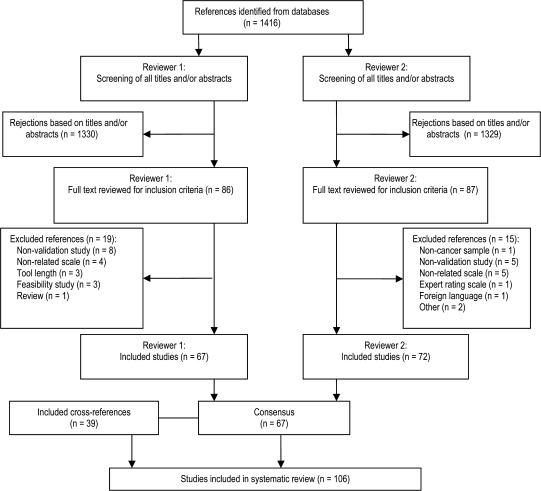
Screening for emotional distress is becoming increasingly common in cancer care. This systematic review examines the psychometric properties of the existing tools used to screen patients for emotional distress, with the goal of encouraging screening programs to use standardized tools that have strong psychometrics. Systematic searches of MEDLINE and PsycINFO databases for English-language studies in cancer patients were performed using a uniform set of key words (eg, depression, anxiety, screening, validation, and scale), and the retrieved studies were independently evaluated by two reviewers. Evaluation criteria included the number of validation studies, the number of participants, generalizability, reliability, the quality of the criterion measure, sensitivity, and specificity. The literature search yielded 106 validation studies that described a total of 33 screening measures. Many generic and cancer-specific scales satisfied a fairly high threshold of quality in terms of their psychometric properties and generalizability. Among the ultrashort measures (ie, those containing one to four items), the Combined Depression Questions performed best in patients receiving palliative care. Among the short measures (ie, those containing five to 20 items), the Center for Epidemiologic Studies-Depression Scale and the Hospital Anxiety and Depression Scale demonstrated adequate psychometric properties. Among the long measures (ie, those containing 21-50 items), the Beck Depression Inventory and the General Health Questionaire-28 met all evaluation criteria. The PsychoSocial Screen for Cancer, the Questionnaire on Stress in Cancer Patients-Revised, and the Rotterdam Symptom Checklist are long measures that can also be recommended for routine screening. In addition, other measures may be considered for specific indications or disease types. Some measures, particularly newly developed cancer-specific scales, require further validation against structured clinical interviews (the criterion standard for validation measures) before they can be recommended.
Overview
The claims and statistics of this paper haven’t been checked yet.
Run the check — free, no account needed. It reads the open-access text and checks the sources it cites.
Integrity signals
Registry
Cites
Statistics
Figures
Verification
Claims the paper makes
The claims and statistics of this paper haven’t been checked yet.
Run the check — free, no account needed. It reads the open-access text and checks the sources it cites.
Claims other papers make about this one
Each is checked against this paper’s own text: does it say what the citing paper says it does?
The cited source says what the claim attributes to it.
In the citing paper
“The HADS is validated and extensively used in the measurement of distress among cancer survivors (Vodermaier et al., 2009; Mitchell et al., 2010).”
From A randomised controlled trial comparing internet-delivered cognitive behavioural therapy (iCBT) with and without main carer access versus treatment-as-usual for depression and anxiety among breast cancer survivors: Study protocol (2021) · cites this paper as Vodermaier et al., 2009
Self-check
Percentages, sums and reported differences re-computed from the paper’s own numbers.
The self-check needs the paper’s full text.
Citations
Cites
Diagnostic and Statistical Manual of Mental Disorders
Williams, J. B. W., & First, M. B. (2013) · Oxford University Press eBooks · doi:10.1093/acrefore/9780199975839.013.104 · Cited by 109,845
The CES-D Scale: A Self-Report Depression Scale for Research in the General Population
Radloff, L. S. (1977) · Applied Psychological Measurement · doi:10.1177/014662167700100306 · Cited by 53,267
The Hospital Anxiety and Depression Scale
Zigmond, A. S., & Snaith, R. P. (1983) · Acta Psychiatrica Scandinavica · doi:10.1111/j.1600-0447.1983.tb09716.x · Cited by 47,139
The PHQ-9: Validity of a brief depression severity measure
Kroenke, K., Spitzer, R. L., & Williams, J. B. W. (2001) · Journal of General Internal Medicine · doi:10.1046/j.1525-1497.2001.016009606.x · Cited by 44,910
An inventory for measuring depression
BECK, A. T. (1961) · Archives of General Psychiatry · doi:10.1001/archpsyc.1961.01710120031004 · Cited by 38,032
Detection of Postnatal Depression: Development of the 10-item Edinburgh Postnatal Depression Scale
Cox, J. L., Holden, J. M., & Sagovsky, R. (1987) · British Journal of Psychiatry · doi:10.1192/bjp.150.6.782 · Cited by 14,183
A self-rating depression scale
ZUNG, W. W. K. (1965) · Archives of General Psychiatry · doi:10.1001/archpsyc.1965.01720310065008 · Cited by 9,813
Impact of Event Scale: A Measure of Subjective Stress
Horowitz, M., Wilner, N., & Alvarez, W. (1979) · Psychosomatic Medicine · doi:10.1097/00006842-197905000-00004 · Cited by 7,813
Psychometric properties of the PTSD checklist (PCL)
Blanchard, E. B., Jones-Alexander, J., Buckley, T. C., & Forneris, C. A. (1996) · Behaviour Research and Therapy · doi:10.1016/0005-7967(96)00033-2 · Cited by 3,997
The Validity of Two Versions of the GHQ in the WHO Study of Mental Illness in General Health Care
GOLDBERG, D. P., GATER, R., SARTORIUS, N., USTUN, T. B., PICCINELLI, M., GUREJE, O., & RUTTER, C. (1997) · Psychological Medicine · doi:10.1017/s0033291796004242 · Cited by 3,657
Research works printed but not linked: 11
- 2008, ONCOL EXCH, 7, 37
- 1997, American Journal of Psychiatry, 1, 674
- 1999, 40, 64
- 2001, 42, 241
- 2007, Psycho-oncology, 16, 1046, 10.1002/pon.1212 · DOI
- Miklavcic, 2008, 20, 148
- 2006, 47, 340
- 1989, 7, 31
- 2000, 41, 121
- 2003, 12, 1
- 2002, EUR J CANCER CARE, 11, 245
Cited by
Sorted by citations
Items 401–500 of 540
Precisión diagnóstica del termómetro de distrés en neoplasias hematológicas
Vaíllo, Y. A., Garrido, M. J. G., Martínez, P., & Arroyo, O. (2015) · Psicooncología · doi:10.5209/rev_psic.2015.v12.n2-3.51006 · Cited by 3
Itani, Y., Arakawa, A., Tsubamoto, H., Ito, K., Nishikawa, R., Inoue, K., Yamamoto, S. S., Miyagi, Y., Hori, K., & Furukawa, N. (2016) · Archives of Gynecology and Obstetrics · doi:10.1007/s00404-016-4166-y · Cited by 3
“A HADS-T score of C11 is considered to be indicative of positivity for psychological distress at a severity level of adjustment disorder or major depression, as is validated in Japan, [8] and is also recommended to screen mental disorder [12].”
BackgroundMethodPépin, A.-J., Lippé, S., Drouin, S., Krajinović, M., Laverdière, C., Michon, B., Robaey, P., Rondeau, É., Sinnett, D., & Sultan, S. (2021) · Journal of Psychosocial Oncology · doi:10.1080/07347332.2021.1906377 · Cited by 3
“In contrast, ultra-short screening tools have been recognized for their high abilities to discard true negatives.(28,30,35,45,64) In that regard, when using a low cut-point, the performances of the DT were almost perfect, but when used alone it was at the expense of a very high rate of false positives (False Discovery…”
BackgroundUltra-short PROMs: clever or not?
Zimmermann, C. (2010) · British Journal of Cancer · doi:10.1038/sj.bjc.6605951 · Cited by 3
“Because of the perceived advantages in efficiency and feasibility, there is growing interest in short (5–20 item) or ultra-short (1–4 item) measures (Vodermaier et al, 2009).”
BackgroundPsychological Assessment in Medical Settings
Maloney, K. A., & Schmidt, A. (2020) · The Wiley Encyclopedia of Health Psychology · doi:10.1002/9781119057840.ch157 · Cited by 3
Sleep quality in head and neck cancer patients
Santoso, A. M. M. (2023) · doi:10.5463/thesis.226 · Cited by 3
Wang, G., & Pan, S. (2025) · Journal of Cancer Survivorship · doi:10.1007/s11764-025-01922-1 · Cited by 3
“Instead, it advances a model of survivorship wherein resilience, immune regulation, and psychological restoration are essential dimensions of postoperative recovery [39–41].”
Bornbaum, C. C. (2013) · Scholarship@Western (Western University) · Cited by 2
Psychosocial Considerations for Patients with Metastatic Bone Disease
Horyna, A. (2015) · Springer eBooks · doi:10.1007/978-1-4614-5662-9_14 · Cited by 2
A Systematic Review of the Psychosocial Measures Used in Teenage and Young Adult Cancer
Hughes, K., Blackett, L., Jacobson, C. E. H., Henley, S. M. D., & Carr, E. (2023) · Journal of Adolescent and Young Adult Oncology · doi:10.1089/jayao.2023.0051 · Cited by 2
“Previous research into adult and pediatric cancer has also highlighted poor reporting of psychometric properties, 49,50 suggesting that something has been over-looked more broadly across the cancer field.”
Ho, S., Palka, J. M., Mersch, J. A., Martin, W. B., & Howe‐Martin, L. (2024) · Journal of Cancer Survivorship · doi:10.1007/s11764-023-01479-x · Cited by 3
“The 10-item version (i.e., CES-D-10) has also demonstrated adequate reliability and validity for screening depressive symptoms in patients with cancer [31, 32].”
Evidence-Based Practice in Clinical Behavioral Oncology
Studts, J. L., Mejia, M. G., Kilkus, J. L., & Brothers, B. M. (2014) · Springer eBooks · doi:10.1007/978-0-387-09817-3_23 · Cited by 2
Schultheis, K., Hofheinz, R., Gencer, D., Blunk, J. A., & Benrath, J. (2013) · Oncology Research and Treatment · doi:10.1159/000346670 · Cited by 2
[Advances in the quantitative analytical methods of drug polymorphism].
Ma, L.-W., Du, W., & Zhao, C. (2011) · PubMed · Cited by 2
Personality Traits on Persistent Depressive Disorder
Torres, A., Martins, A., Santos, T., & Pereira, A. T. (2016) · The European Proceedings of Social & Behavioural Sciences · doi:10.15405/epsbs.2016.07.02.38 · Cited by 4
Improving Documentation of Distress in Veteran Patients for Hematology/Oncology Clinics
Bodner, S., Patel, A., & Gopalan, P. K. (2019) · Journal of Oncology Practice · doi:10.1200/jop.18.00696 · Cited by 2
Depression, demoralization, and suicidality
Kissane, D. W. (2021) · doi:10.1093/med/9780198821328.003.0072 · Cited by 2
Chevalier, L., Blackmon, J. E., Roman, A., Chang, G., & Recklitis, C. J. (2023) · Psycho-Oncology · doi:10.1002/pon.6166 · Cited by 2
“and even fewer validated using diagnostic interview measures considered “gold standard” in psychiatric assessment research.(6,7) One potential screening tool for depression and anxiety in YACS is the Primary Care Evaluation of Mental Disorders (PRIME‐MD).”
MethodPoppito, S. R., & Tait, G. R. (2013) · American Psychiatric Association Publishing eBooks · doi:10.1176/appi.books.9781615378258.lg08 · Cited by 3
Stafford, L., & Miller, B. E. (2013) · Springer eBooks · doi:10.1007/978-0-85729-910-9_27 · Cited by 2
“A discussion of the merits and psychometric properties of the various measures is beyond the scope of this chapter, but the interested reader is referred to two recent systematic reviews detailing the diagnostic accuracy of instruments for detecting both distress [ 48 ] and depression [ 49 ] in cancer settings.”
BackgroundMethodYoon, S. J., Chung, K., Han, J. W., Hahn, S. M., Kim, S. H., & Lyu, C. J. (2019) · Supportive Care in Cancer · doi:10.1007/s00520-019-04708-1 · Cited by 2
Controversies in Psycho-Oncology
Rajesh, A., & Stefanek, M. E. (2022) · Springer eBooks · doi:10.1007/978-3-030-85702-8_15 · Cited by 2
Baider, L., & Balducci, L. (2011) · Wiley eBooks · doi:10.1002/9780470975176.ch20 · Cited by 2
Psychosocial Assessment and Screening in Psycho‐oncology
Jacobsen, P. B., & Donovan, K. A. (2012) · Wiley eBooks · doi:10.1002/9781119941101.ch3 · Cited by 2
Impact of Pain and Evaluation of Education and Self-Care in Patients with Head and Neck Cancer
Schaller, A. S. (2018) · doi:10.3384/diss.diva-147288 · Cited by 2
“Earlier studies have shown that both EQ-5D and EQ VAS have good content validity and reliability in cancer patients [237], and this also applies to BPI, HAD and PCS, which were used in Papers III and IV [139-141, 238, 239].”
MethodScreening and Assessment of Distress, Anxiety, and Depression in Cancer Patients
Thalén-Lindström, A. (2014) · KTH Publication Database DiVA (KTH Royal Institute of Technology) · Cited by 2
Role of physical exercise in reducing depression and improving mental health in cancer survivors
Levin, G. (2014) · Australasian Journal of Paramedicine · Cited by 2
[Assessing depression in oncology: relevance, issues, modalities].
Annunziata, M., & Muzzatti, B. (2011) · Recenti progressi in medicina · doi:10.1701/975.10610 · Cited by 2
Psychosocial and Quality of Life Issues in Dysphagia
Daniel, S. M. (2018) · Springer eBooks · doi:10.1007/978-981-10-8282-5_18 · Cited by 1
Medina, S. E. M., Sánchez, R., & Toro, L. E. D. (2021) · Biomédica · doi:10.7705/biomedica.6131 · Cited by 1
Thyroid Cancer Survivorship: Contemporary Themes
Kendell, K., & Armstrong, N. J. (2023) · Springer eBooks · doi:10.1007/978-3-031-38605-3_23 · Cited by 1
Vezhavendhan, N., Achuthan, A., Muthanandam, S., & Rajaram, S. (2025) · BMJ Case Reports · doi:10.1136/bcr-2024-262597 · Cited by 1
“12 In this case, the K10 was used to assess the psychological discomfort of the patient.”
Hoefert, S., Emmler, A., Naros, A., Häfner, J., & Schoenhof, R. (2026) · International Journal of Oral and Maxillofacial Surgery · doi:10.1016/j.ijom.2026.06.012 · Cited by 1
Bertin, C., Dupouy, J., Authier, N., Michenot, N., Verdier, S., Chappuy, M., & Trouvin, A. (2026) · Pain and Therapy · doi:10.1007/s40122-026-00853-8 · Cited by 2
“Systematic screening for anxiety, depression, and cognitive disorders is recommended, nota‑ bly using the Hospital Anxiety and Depression Scale (HADS), which has been validated in can‑ cer patients [144, 145].”
Psychopharmacologic Treatment of Depression in Patients With Cancer: A 2013 Update
Strouse, T. B. (2013) · FOCUS The Journal of Lifelong Learning in Psychiatry · doi:10.1176/appi.focus.11.4.450 · Cited by 1
Screening for Distress in Cancer Patients: Performed by Whom?
Din, M. E. E. (2015) · African Journal of Psychiatry · doi:10.4172/psychiatry.1000186 · Cited by 1
“Furthermore, systematic screening allows mental health staff to forecast their workload [7].”
BackgroundBreathlessness, Thirst and Anxiety in the end Stages of Heart Failure
Young, C. (2013) · End of Life Journal · doi:10.1136/eoljnl-03-02.5 · Cited by 1
Mental Health Prior to Hematopoietic Cell Transplantation
Lahijani, S. (2018) · Springer eBooks · doi:10.1007/978-3-319-94914-7_38 · Cited by 1
Früherkennung seelischer Belastung in der onkologischen Versorgungspraxis
Labouvie, H., Dietz, T., Schiewer, V., & Kusch, M. (2023) · Diagnostica · doi:10.1026/0012-1924/a000311 · Cited by 1
Validity and reliability of an Emotional Thermometer tool: an exploratory cross-sectional study
Cheng, C., Yang, C.-Y., Zhou, M., Bai, J., Inder, K., & Chan, S. (2023) · Contemporary Nurse: health care across the lifespan · doi:10.1080/10376178.2023.2217952 · Cited by 1
“…psychological symptoms among people with MCCs. Screening for psychological symptoms with an appropriate instrument in the chronically ill population at risk of an unfavourable health outcome is vital for their future diagnosis, treatment, and continuous care (Pouwer, 2009; Vodermaier et al., 2009).”
BackgroundPsycho-Oncological Counselling for Mental Health in South Australians with Cancer
Blunt, J., & Trigg, J. L. (2024) · Advances in Public Health · doi:10.1155/2024/2131827 · Cited by 1
“The HADS is a 14-item self-report screening tool for assessing emotional distress, state anxiety, and depression in clinical and nonclinical populations, with sound psychometric properties in detecting anxiety and depression [17, 18].”
MethodChapter 7. Dimensional Psychopharmacology of the Cancer Patient
Biondi, M., & Pasquini, M. (2013) · American Psychiatric Association Publishing eBooks · doi:10.1176/appi.books.9781615378258.lg07 · Cited by 1
Chapter 2. Cancer: A Family Affair
Baider, L. (2013) · American Psychiatric Association Publishing eBooks · doi:10.1176/appi.books.9781615378258.lg02 · Cited by 1
Chapter 10. The Value of Quality of Life Assessment in Cancer Patients
Holzner, B., Giesinger, J. M., & Efficace, F. (2013) · American Psychiatric Association Publishing eBooks · doi:10.1176/appi.books.9781615378258.lg10 · Cited by 1
Chapter 5. Counseling and Specific Psychological Treatments in Common Clinical Settings: An Overview
Pitceathly, C., Watson, M., & Cawthorn, A. (2013) · American Psychiatric Association Publishing eBooks · doi:10.1176/appi.books.9781615378258.lg05 · Cited by 1
Depression and Distress Screening in Oncology Patients: A Descriptive Analysis.
Ali, C. R., Litvintchouk, A., Moeller, P., Davis, R., Hannan, E., Maio, V., & Csik, V. (2025) · American Journal of Medical Quality · doi:10.1097/jmq.0000000000000212 · Cited by 1
Lai, K. P., Chong, S. C., & Lin, B. (2025) · Journal of International Food & Agribusiness Marketing · doi:10.1080/08974438.2025.2465291 · Cited by 1
“…concerns can be used to understand different distress orientations, such as emotional (a concern about mental health and mental disorders) (Vodermaier et al., 2009), health (a concern about physical health symptoms) (Fan et al., 2020), and moral distresses (a concern of disequilibrium)…”
Greeley, K. M., Rash, J. A., Tulk, J., Savard, J., Seal, M., Urquhart, R., Thoms, J., Laing, K. E., Fawcett, E. J., & Garland, S. N. (2025) · Supportive Care in Cancer · doi:10.1007/s00520-025-09482-x · Cited by 1
“The Hospital Anxiety and Depression Scale (HADS) is a widely used 14-item self-report measure of depression and anxiety symptoms in medical outpatients [38, 39].”
Contu, S., Hébert, C., Ferrero, J.-., Creisson, A., Mari, V., Kaluzinski, L., Hoch, B., Largillier, R., Borchiellini, D., Viellard, T., et al. (2025) · JCO Oncology Practice · doi:10.1200/op-24-00857 · Cited by 1
Controversies in Psycho-Oncology
Stefanek, M. E. (2012) · Springer eBooks · doi:10.1007/978-1-4614-4866-2_10 · Cited by 1
McGahee, A. (2016) · Research and theory for nursing practice · doi:10.1891/1541-6577.30.1.4 · Cited by 1
Baek, H., Kang, E., Lee, A. S., Hwang, E., Chae, S., Kim, E., & Kim, S. (2017) · Journal of Breast Disease · doi:10.14449/jbd.2017.5.1.8 · Cited by 1
“We used both the DT and CES-D for evaluating distress, as it is believed that using a combination of highly reliable tools results in better psychometric properties [16].”
MethodDepression, demoralization, and suicidality
Kissane, D. W., & Doolittle, M. N. (2015) · doi:10.1093/med/9780199656097.003.0173 · Cited by 1
Screening for Psychosocial Distress and Psychiatric Disorders in Medicine: From Concepts to Evidence
Mitchell, A. J. (2018) · Integrating psychiatry and primary care · doi:10.1007/978-3-319-74736-1_4 · Cited by 2
Farahani, N. S., Bastami, M., Alemrajabi, M., Alasty, H., & Rajabi, M. (2019) · International Journal of Cancer Management · doi:10.5812/ijcm.90504 · Cited by 1
“Therefore, short self-reports are simple to perform and, if correctly validated, it can help to detect patients who need more professional mental healthcare (18).”
BackgroundInfluentialLaranja, W. W., Pereira, T. A., Guimaraes, P. V. B., Tobias‐Machado, M., Leandro‐Merhi, V. A., de Aquino, J. L. B., & Reis, L. O. (2020) · International Urology and Nephrology · doi:10.1007/s11255-020-02399-w · Cited by 1
Epidemiology and management of depression in cancer patients
Ng, C. (2012) · Utrecht University Repository (Utrecht University) · Cited by 1
Charles, C. (2014) · theses.fr (ABES) · doi:10.70675/1e2fe698z08daz49baz9503z8b099a14be77 · Cited by 1
de Albuquerque, K. F. (2016) · doi:10.11606/t.7.2016.tde-24112015-125910 · Cited by 1
Evaluation of the Phase Training Model of cancer rehabilitation
Brown, J. M. (2016) · Scholarship & Creative Works - Digital UNC a service of University Libraries (University of Northern Colorado) · Cited by 1
ANALYSIS OF THE DISTRESS THERMOMETER’S PSYCHOMETRIC PROPERTIES AND APPLICABILITY TO SUBGROUPS
Black, L. L. (2016) · KU ScholarWorks (The University of Kansas) · Cited by 1
Development of the Cancer Survivor Profile
Todd, B. L. (2014) · Defense Technical Information Center (DTIC) · doi:10.21236/ad1012868 · Cited by 1
The Experience of Cancer in Women
Stanton, A. L., & Yanez, B. R. (2013) · Wiley eBooks · doi:10.1002/9781394260454.ch20 · Cited by 1
Uchitomi, Y. (2010) · Okayama Igakkai Zasshi (Journal of Okayama Medical Association) · doi:10.4044/joma.122.119
Assessing depression in cancer patients - a longitudinal comparison of three questionnaires.
Pössel, P., & Knopf, K. (2013) · PubMed · doi:10.3978/j.issn.2224-5820.2013.01.07
“Considering that the HADS is one of the most often utilized instruments to measure depression in cancer patients (8) and the fact that recent reviews of depression instruments come to the conclusion that the HADS is one of the best instrument for assessing depression in cancer patients (6-8), the inclusion of the HADS…”
BackgroundMethodAhmad, W. A. W., Azman, W., & Fuang, G. (2012)
Patient-Reported Outcomes Screening for Improved Patient Wellness: A Cancer Center Initiative
Morris, A. (2015) · USF Scholarship Repository (University of San Francisco)
Emotional Distress in Patients with Advanced Heart Failure
Ramsenthaler, C. (2011) · End of Life Journal · doi:10.1136/eoljnl-01-02.1
Quality of Life Among Esophageal Cancer Survivors: Medical and Psychosocial Support
Petrangelo, A., Leimanis, M. L., Ferri, L. E., & Fitzpatrick, T. R. (2016) · Springer eBooks · doi:10.1007/978-3-319-32364-0_9
George, K. (2015) · Lu Zone Ul (Laurentian University)
Stepped care targeting psychological distress in head and neck and lung cancer patients
Krebber, A. M. H. (2016) · Digital Academic REpository of VU University Amsterdam (Vrije Universiteit Amsterdam)
Takeuchi, E. E. (2016) · White Rose eTheses Online (University of Leeds, The University of Sheffield, University of York)
Identification of Areas of Patient Need Using the Cancer Support Source Program
Ross, E. J. (2017) · Journal of International Crisis and Risk Communication Research
Reinert, C. D. A., Ribas, M. R., & Zimmermann, P. R. (2015)
Udvikling af et samtaleark om hverdagslivetmed hjertesygdom
Mercebach, C. P. (2018) · Klinisk Sygepleje · doi:10.18261/issn.1903-2285-2018-02-06
Girard, M., Delanghe, M., Domingo, L., & Zamith‐Chavant, M. (2018) · Psycho-Oncologie · doi:10.3166/pson-2018-0028
Kendell, K., & Armstrong, N. J. (2018) · Springer eBooks · doi:10.1007/978-3-319-91725-2_27
Optimizing Community and Hospital Services Using the Cancer Support Source Program
Ross, E. J., Wiener, C. H., Robinson, D. C., & Cassisi, J. E. (2018) · Journal of Patient Experience · doi:10.1177/2374373518808309
“Emotional Distress/ Patient and Family Counselor Referral (2) Feeling irritable, (6) Changes or disruptions in work, school, or home life, (7) Feeling sad or depressed, (10) Body image and feelings about how you look, (11) Feeling nervous or afraid, (12) Worrying about the future and what lies ahead, (15) Feeling lone…”
BackgroundQuality of life among Native American cancer survivors: Approaching harmony and balance after cancer
Bastian, T. (2019) · University of Minnesota Digital Conservancy (University of Minnesota)
Mood Disorders in Patients with CNS Metastases
Chilcote, K. (2020) · Springer eBooks · doi:10.1007/978-3-030-42958-4_11
Adegun, P. T., Usman, D. M., Idowu, A. A., Emmanuel, O. A., Oluwole, L. O., & Obadeji, A. (2021) · International Neuropsychiatric Disease Journal · doi:10.9734/indj/2021/v15i130146
“A score of 7-10 is a mild case, score of 11-14 is moderate while score of 15-21 is a severe case [25,26].”
BackgroundPsychological considerations in oncodermatology: a patient cohort with unique challenges
Chawla, S., & Heelan, K. (2021) · International Journal of Dermatology · doi:10.1111/ijd.15433
Validity and reliability of Hospital Anxiety and Depression Scale in cancer patients in PeruPreprint
Vilela-Estrada, A. L., Ambrosio-Melgarejo, J. I., Valencia, L. E., Sanchez‐Ramirez, J. C., Delgado, F. L., & Villarreal‐Zegarra, D. (2021) · Research Square · doi:10.21203/rs.3.rs-166573/v1
“As for the general factor, this would be called emotional distress, which is de ned as a state of negative affect suggesting the presence of affective disorders (Vodermaier et al., 2009).”
BackgroundFeatures of Mental Disorders in Patients with Cancer of the Oropharyngeal Region
Khasanova, K., Kim, D. P., Alimov, U., & Gafur-Akhunov, M. A. (2021) · American Journal of Medicine and Medical Sciences
Le-Berre, R. (2020) · Dunod eBooks · doi:10.3917/dunod.centr.2020.01.0411
Bruggeman-Everts, F. Z., Wolvers, M. D. J., van de Schoot, R., Vollenbroek-Hutten, M. M. R., & van der Lee, M. L. (2016) · doi:10.2196/preprints.7180
(2018) · Elsevier eBooks · doi:10.1016/b978-3-437-21161-4.00001-8
(2018) · Elsevier eBooks · doi:10.1016/b978-3-437-21152-2.00001-3
(2016) · Elsevier eBooks · doi:10.1016/b978-3-437-21131-7.00001-1
Η επίδραση της συμβουλευτικής και της άσκησης στην ποιότητα ζωής των καρκινοπαθών
Papastergiou, D. (2021) · doi:10.12681/eadd/50901
The Mental Health, Psychological and Quality of Life Related Impact of Renal Cancers
Fernando, A., Suleman, S., Butler, J., & Nagasinghe, P. (2022) · Springer eBooks · doi:10.1007/978-3-030-84756-2_21
Metadata
- Authors
- Vodermaier, A., Linden, W., & Siu, C.
- Affiliations
- BC Cancer Agency (CA)
- Corresponding author
- Vodermaier, A.
- Venue
- JNCI Journal of the National Cancer Institute
- Publisher
- Oxford University Press (OUP)
- Published
- 2009-10-13
- Volume
- 101
- Issue
- 21
- Pages
- 1464-1488
- ISSN
- 0027-8874 (ISSN-L)
- 1460-2105
- PMC
- PMC3298956
- OpenAlex
- W1996766132
- Cited by
- 541
- References
- 160
- Citations by year
- 2026: 12 · 2025: 16 · 2024: 30 · 2023: 20 · 2022: 27 · 2021: 34 · 2020: 24 · 2019: 32 · 2018: 49 · 2017: 28 · 2016: 32 · 2015: 42 · 2014: 38 · 2013: 52 · 2012: 48
- FWCI
- 2.98
- Type
- journal article
- Language
- en
- Open access
- bronze
- doi.org
- Locations
- JNCI Journal of the National Cancer Institute (publishedVersion)
- PubMed Central (publishedVersion, cc-by-nc)
- PubMed (publishedVersion)
- HighWire Press Open Archive (submittedVersion)
- Funders
- Canadian Institutes of Health Research (#AQC83559)
- Topics
- Health Sciences › Medicine › Oncology › Cancer survivorship and care
- Social Sciences › Psychology › Experimental and Cognitive Psychology › Anxiety, Depression, Psychometrics, Treatment, Cognitive Processes
- Health Sciences › Medicine › Pediatrics, Perinatology and Child Health › Childhood Cancer Survivors' Quality of Life
- Keywords
- emotional distress screening, cancer patients, psychometric properties, depression screening, anxiety screening, screening tool, scale validation, CES-D, Hospital Anxiety and Depression Scale, Beck Depression Inventory, Rotterdam Symptom Checklist, palliative care, sensitivity and specificity
- MeSH terms
- Adjustment Disorders, Anxiety Disorders, Depression, Depressive Disorder, Major, Major Depressive Disorder, Humans, Mass Screening, Neoplasms, Psychometrics, Surveys and Questionnaires, Stress, Psychological, Reproducibility of Results, Dysthymic Disorder
About these checks
Registry, retraction, Cites and statistics results are computed, not judged, with one exception: a printed reference that no index lists is read once by a model before it counts as a citation error. Claims are extracted by a model and kept only when their quote appears verbatim in the text; each cited source is then checked, with a model’s help, for whether it says what the claim relies on. Those verdicts can be wrong — read the claim’s quote and the cited source before relying on one.
Statistics and arithmetic are recomputed, not judged.
Confidence bands are shown only for fields calibrated on our annotated test set. None is calibrated yet, so no band is shown.
What counts as a claim ›How we measure confidence ›How we check this ›
Are you an author, or do you see a problem with this page? Request a review
