

ConsensusPathDB--a database for integrating human functional interaction networks
Open accessThe DOI matches its Crossref record; 34 of the 34 references it cites were found in a registry or an index.
Abstract
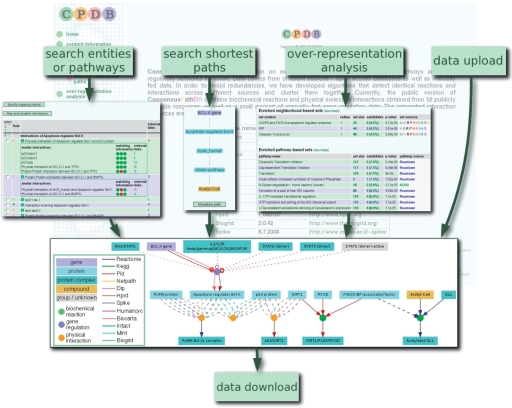
ConsensusPathDB is a database system for the integration of human functional interactions. Current knowledge of these interactions is dispersed in more than 200 databases, each having a specific focus and data format. ConsensusPathDB currently integrates the content of 12 different interaction databases with heterogeneous foci comprising a total of 26,133 distinct physical entities and 74,289 distinct functional interactions (protein-protein interactions, biochemical reactions, gene regulatory interactions), and covering 1738 pathways. We describe the database schema and the methods used for data integration. Furthermore, we describe the functionality of the ConsensusPathDB web interface, where users can search and visualize interaction networks, upload, modify and expand networks in BioPAX, SBML or PSI-MI format, or carry out over-representation analysis with uploaded identifier lists with respect to substructures derived from the integrated interaction network. The ConsensusPathDB database is available at: http://cpdb.molgen.mpg.de.
Overview
The claims and statistics of this paper haven’t been checked yet.
Free: it reads the open-access text and checks the first 5 claims that cite a source we can check. Create a free account to check every claim.
Integrity signals
Registry
Cites
Statistics
Figures
Verification
Claims the paper makes
The claims and statistics of this paper haven’t been checked yet.
Free: it reads the open-access text and checks the first 5 claims that cite a source we can check. Create a free account to check every claim.
Claims other papers make about this one
Each is checked against this paper’s own text: does it say what the citing paper says it does?
The check wasn’t confident either way, so it gives no verdict — never disputed.
In the citing paper
“Among the main gene ontology (GO) pathways [19, 20] showing altered in senescent cells, “chromatin organization,” “DNA repair,” “membrane trafficking,” and “activation of NF-kappaB” were notable for their known links to senescence and aging (Figure 1C) (Figure 1C) [1, 10, 21, 22].”
From Unmasking Transcriptional Heterogeneity in Senescent Cells (2017) · cites this paper as [19]
Experimental — accuracy not yet measured
Self-check
Percentages, sums and reported differences re-computed from the paper’s own numbers.
The self-check needs the paper’s full text.
Citations
Cites
KEGG: Kyoto Encyclopedia of Genes and Genomes
Kanehisa, M. (2000) · Nucleic Acids Research · doi:10.1093/nar/28.1.27 · Cited by 37,077
KEGG: Kyoto Encyclopedia of Genes and Genomes
Ogata, H., Goto, S., Sato, K., Fujibuchi, W., Bono, H., & Kanehisa, M. (1999) · Nucleic Acids Research · doi:10.1093/nar/27.1.29 · Cited by 31,232
A novel genetic system to detect protein–protein interactions
Fields, S., & Song, O.-K. (1989) · Nature · doi:10.1038/340245a0 · Cited by 6,114
A comprehensive analysis of protein–protein interactions in Saccharomyces cerevisiae
Uetz, P., Giot, L., Cagney, G., Mansfield, T. A., Judson, R. S., Knight, J. R., Lockshon, D., Narayan, V., Srinivasan, M., Pochart, P., et al. (2000) · Nature · doi:10.1038/35001009 · Cited by 4,706
The Universal Protein Resource (UniProt)
Bairoch, A. (2004) · Nucleic Acids Research · doi:10.1093/nar/gki070 · Cited by 3,774
Hucka, M., Finney, A., Sauro, H. M., Bolouri, H., Doyle, J. C., Kitano, H., Arkin, A. P., Bornstein, B. J., Bray, D., Cornish-Bowden, A., et al. (2003) · Bioinformatics · doi:10.1093/bioinformatics/btg015 · Cited by 3,060
Integration of biological networks and gene expression data using Cytoscape
Cline, M. S., Smoot, M., Cerami, E., Kuchinsky, A., Landys, N., Workman, C., Christmas, R., Avila-Campilo, I., Creech, M., Gross, B., et al. (2007) · Nature Protocols · doi:10.1038/nprot.2007.324 · Cited by 2,507
The Database of Interacting Proteins: 2004 update
Salwinski, L. (2004) · Nucleic Acids Research · doi:10.1093/nar/gkh086 · Cited by 2,271
TRANSFAC(R) and its module TRANSCompel(R): transcriptional gene regulation in eukaryotes
Matys, V. (2006) · Nucleic Acids Research · doi:10.1093/nar/gkj143 · Cited by 2,166
Entrez Gene: gene-centered information at NCBI
Maglott, D., Ostell, J., Pruitt, K. D., & Tatusova, T. (2011) · Nucleic Acids Research · doi:10.1093/nar/gkq1237 · Cited by 2,094
A Map of the Interactome Network of the Metazoan C. elegans
Li, S., Armstrong, C. M., Bertin, N., Ge, H., Milstein, S., Boxem, M., Vidalain, P.-O., Han, J.-D. J., Chesneau, A., Hao, T., et al. (2004) · Science · doi:10.1126/science.1091403 · Cited by 1,628
ChEBI: a database and ontology for chemical entities of biological interest
Degtyarenko, K., de Matos, P., Ennis, M., Hastings, J., Zbinden, M., McNaught, A., Alcantara, R., Darsow, M., Guedj, M., & Ashburner, M. (2007) · Nucleic Acids Research · doi:10.1093/nar/gkm791 · Cited by 1,126
MINT: the Molecular INTeraction database
Chatr-aryamontri, A., Ceol, A., Palazzi, L. M., Nardelli, G., Schneider, M. V., Castagnoli, L., & Cesareni, G. (2007) · Nucleic Acids Research · doi:10.1093/nar/gkl950 · Cited by 1,026
The Universal Protein Resource (UniProt)
The UniProt Consortium (2007) · Nucleic Acids Research · doi:10.1093/nar/gkm895 · Cited by 823
IntAct--open source resource for molecular interaction data
Kerrien, S., Alam-Faruque, Y., Aranda, B., Bancarz, I., Bridge, A., Derow, C., Dimmer, E., Feuermann, M., Friedrichsen, A., Huntley, R., et al. (2007) · Nucleic Acids Research · doi:10.1093/nar/gkl958 · Cited by 800
The BioGRID Interaction Database: 2008 update
Breitkreutz, B.-J., Stark, C., Reguly, T., Boucher, L., Breitkreutz, A., Livstone, M., Oughtred, R., Lackner, D. H., Bahler, J., Wood, V., et al. (2007) · Nucleic Acids Research · doi:10.1093/nar/gkm1001 · Cited by 698
STRING 7--recent developments in the integration and prediction of protein interactions
von Mering, C., Jensen, L. J., Kuhn, M., Chaffron, S., Doerks, T., Kruger, B., Snel, B., & Bork, P. (2007) · Nucleic Acids Research · doi:10.1093/nar/gkl825 · Cited by 665
Reactome: a knowledge base of biologic pathways and processes
Vastrik, I., D'Eustachio, P., Schmidt, E., Joshi-Tope, G., Gopinath, G., Croft, D., de Bono, B., Gillespie, M., Jassal, B., Lewis, S., et al. (2007) · Genome Biology · doi:10.1186/gb-2007-8-3-r39 · Cited by 654
Entrez Gene: gene-centered information at NCBI
Maglott, D., Ostell, J., Pruitt, K. D., & Tatusova, T. (2007) · Nucleic Acids Research · doi:10.1093/nar/gkl993 · Cited by 633
Hermjakob, H., Montecchi-Palazzi, L., Bader, G., Wojcik, J., Salwinski, L., Ceol, A., Moore, S., Orchard, S., Sarkans, U., von Mering, C., et al. (2004) · Nature Biotechnology · doi:10.1038/nbt926 · Cited by 630
Human protein reference database--2006 update
Mishra, G. R. (2006) · Nucleic Acids Research · doi:10.1093/nar/gkj141 · Cited by 601
Computational prediction of human metabolic pathways from the complete human genome
Romero, P., Wagg, J., Green, M. L., Kaiser, D., Krummenacker, M., & Karp, P. D. (2004) · Genome Biology · doi:10.1186/gb-2004-6-1-r2 · Cited by 517
Pathguide: a Pathway Resource List
Bader, G. D. (2006) · Nucleic Acids Research · doi:10.1093/nar/gkj126 · Cited by 435 · cited 1×
“Even worse, the existing knowledge on human functional interactions is dispersed in over 200 interaction databases, each of which has a specific data format, focus and bias (8).”
BackgroundHow complete are current yeast and human protein-interaction networks?
Hart, T., Ramani, A. K., & Marcotte, E. M. (2006) · Genome biology · doi:10.1186/gb-2006-7-11-120 · Cited by 408
Flicek, P., Aken, B. L., Beal, K., Ballester, B., Caccamo, M., Chen, Y., Clarke, L., Coates, G., Cunningham, F., Cutts, T., et al. (2007) · Nucleic Acids Research · doi:10.1093/nar/gkm988 · Cited by 349
TRED: a transcriptional regulatory element database, new entries and other development
Jiang, C., Xuan, Z., Zhao, F., & Zhang, M. Q. (2007) · Nucleic Acids Research · doi:10.1093/nar/gkl1041 · Cited by 329
Human Protein Reference Database
Wilson, N. (2004) · Nature Reviews Molecular Cell Biology · doi:10.1038/nrm1305 · Cited by 250
APID: Agile Protein Interaction DataAnalyzer
Prieto, C., & De Las Rivas, J. (2006) · Nucleic Acids Research · doi:10.1093/nar/gkl128 · Cited by 224
UniHI: an entry gate to the human protein interactome
Chaurasia, G., Iqbal, Y. W., Hänig, C., Herzel, H., Wanker, E. E., & Futschik, M. E. (2006) · Nucleic Acids Research · doi:10.1093/nar/gkl817 · Cited by 137
Chop it, ChIP it, check it: the current status of chromatin immunoprecipitation
Collas, P., & Dahl, J. A. (2007) · Frontiers in bioscience · doi:10.2741/2733 · Cited by 133
Michigan Molecular Interactions (MiMI): putting the jigsaw puzzle together
Jayapandian, M., Chapman, A. P., Tarcea, V. G., Yu, C., Elkiss, A., Ianni, A. M., Liu, B., Nandi, A., Santos, C., Andrews, P., et al. (2006) · Nucleic Acids Research · doi:10.1093/nar/gkl859 · Cited by 125
PAX of mind for pathway researchers
Luciano, J. (2005) · Drug Discovery Today · doi:10.1016/s1359-6446(05)03501-4 · Cited by 113
Maraziotis, I. A., Dimitrakopoulou, K., & Bezerianos, A. (2007) · BMC Bioinformatics · doi:10.1186/1471-2105-8-408 · Cited by 88
SPIKE – a database, visualization and analysis tool of cellular signaling pathways
Elkon, R., Vesterman, R., Amit, N., Ulitsky, I., Zohar, I., Weisz, M., Mass, G., Orlev, N., Sternberg, G., Blekhman, R., et al. (2008) · BMC Bioinformatics · doi:10.1186/1471-2105-9-110 · Cited by 74
Cited by
Szklarczyk, D., Franceschini, A., Kuhn, M., Simonovic, M., Roth, A., Minguez, P., Doerks, T., Stark, M., Muller, J., Bork, P., et al. (2011) · Nucleic Acids Research · doi:10.1093/nar/gkq973 · Cited by 3,460
Unmasking Transcriptional Heterogeneity in Senescent Cells
Hernandez-Segura, A., de Jong, T. V., Melov, S., Guryev, V., Campisi, J., & Demaria, M. (2017) · Current Biology · doi:10.1016/j.cub.2017.07.033 · Cited by 972
“Among the main gene ontology (GO) pathways [19, 20] showing altered in senescent cells, “chromatin organization,” “DNA repair,” “membrane trafficking,” and “activation of NF-kappaB” were notable for their known links to senescence and aging (Figure 1C) (Figure 1C) [1, 10, 21, 22].”
BackgroundThe ConsensusPathDB interaction database: 2013 update
Kamburov, A., Stelzl, U., Lehrach, H., & Herwig, R. (2013) · Nucleic Acids Research · doi:10.1093/nar/gks1055 · Cited by 807
Self-citationConsensusPathDB: toward a more complete picture of cell biology
Kamburov, A., Pentchev, K., Galicka, H., Wierling, C., Lehrach, H., & Herwig, R. (2011) · Nucleic Acids Research · doi:10.1093/nar/gkq1156 · Cited by 671
Self-citationExome Sequencing Links Corticospinal Motor Neuron Disease to Common Neurodegenerative Disorders
Novarino, G., Fenstermaker, A. G., Zaki, M. S., Hofree, M., Silhavy, J. L., Heiberg, A. D., Abdellateef, M., Rosti, B., Scott, E., Mansour, L., et al. (2014) · Science · doi:10.1126/science.1247363 · Cited by 536
Metadata
- Authors
- Kamburov, A., Wierling, C., Lehrach, H., & Herwig, R.
- Affiliations
- Max Planck Institute for Molecular Genetics (DE)
- Corresponding author
- Kamburov, Atanas
- Venue
- Nucleic Acids Research
- Publisher
- Oxford University Press (OUP)
- Published
- 2008-10-21
- Volume
- 37
- Issue
- suppl_1
- Pages
- D623-D628
- ISSN
- 0305-1048 (ISSN-L)
- 1362-4962
- PMC
- PMC2686562
- OpenAlex
- W2151014102
- Cited by
- 565
- References
- 34
- Citations by year
- 2026: 14 · 2025: 26 · 2024: 43 · 2023: 50 · 2022: 54 · 2021: 48 · 2020: 41 · 2019: 48 · 2018: 51 · 2017: 33 · 2016: 32 · 2015: 32 · 2014: 18 · 2013: 16 · 2012: 16
- FWCI
- 5.90
- Type
- journal article
- Language
- en
- Open access
- gold
- doi.org
- Licence
- Locations
- Nucleic Acids Research (publishedVersion, cc-by-nc)
- PubMed Central (publishedVersion, cc-by-nc)
- PubMed (publishedVersion)
- Max Planck Institute for Plasma Physics (submittedVersion)
- Funders
- European Commission (LSHB-CT-2006-037712, 200767)
- Bundesministerium für Bildung und Forschung
- Max-Planck-Gesellschaft
- International Max Planck Research School for Advanced Methods in Process and Systems Engineering
- Topics
- Life Sciences › Biochemistry, Genetics and Molecular Biology › Molecular Biology › Bioinformatics and Genomic Networks
- Health Sciences › Medicine › Health Informatics › Biomedical Text Mining and Ontologies
- Life Sciences › Biochemistry, Genetics and Molecular Biology › Molecular Biology › Gene Regulatory Network Analysis
- Keywords
- functional interaction networks, protein-protein interaction, biochemical reactions, gene regulatory interactions, pathway integration, over-representation analysis, BioPAX, SBML, data integration, human interactome
- MeSH terms
- Gene Expression Regulation, Humans, User-Computer Interface, Signal Transduction, Systems Integration, Internet, Protein Interaction Mapping, Databases, Genetic, Metabolic Networks and Pathways
About these checks
Registry, retraction, Cites and statistics results are computed, not judged, with one exception: a printed reference that no index lists is read once by a model before it counts as a citation error. Claims are extracted by a model and kept only when their quote appears verbatim in the text; each cited source is then checked, with a model’s help, for whether it says what the claim relies on. Those verdicts can be wrong — read the claim’s quote and the cited source before relying on one.
Statistics and arithmetic are recomputed, not judged.
Confidence bands are shown only for fields calibrated on our annotated test set. None is calibrated yet, so no band is shown.
What counts as a claim ›How we measure confidence ›How we check this ›
Are you an author, or do you see a problem with this page? Request a review
Data sources
Bibliographic data: Semantic Scholar, OpenAlex, Crossref.
Contains information from the Semantic Scholar Academic Graph Datasets, made available under the ODC Attribution License (ODC-BY 1.0).
Semantic Scholar’s data is described in: Kinney, R., et al. (2023). The Semantic Scholar Open Data Platform. arXiv:2301.10140.
