

The DOI matches its Crossref record; 45 of the 45 references it cites were found in a registry or an index.
The Candida Genome Database (CGD): incorporation of Assembly 22, systematic identifiers and visualization of high throughput sequencing data
Open accessAbstract
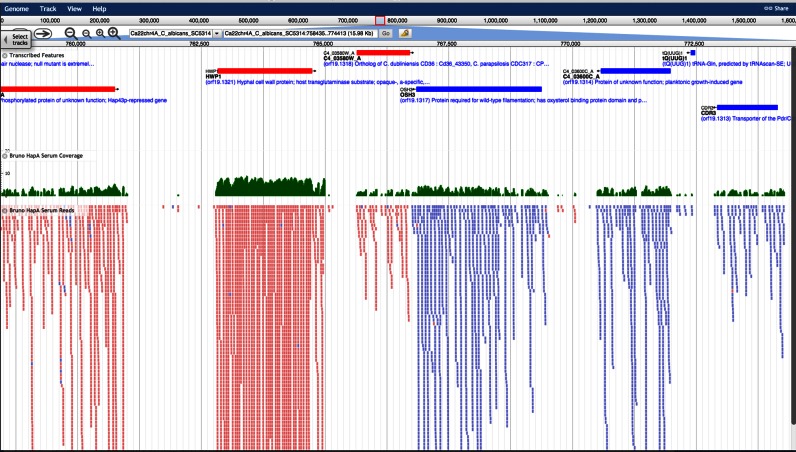
The Candida Genome Database (CGD, http://www.candidagenome.org/) is a freely available online resource that provides gene, protein and sequence information for multiple Candida species, along with web-based tools for accessing, analyzing and exploring these data. The mission of CGD is to facilitate and accelerate research into Candida pathogenesis and biology, by curating the scientific literature in real time, and connecting literature-derived annotations to the latest version of the genomic sequence and its annotations. Here, we report the incorporation into CGD of Assembly 22, the first chromosome-level, phased diploid assembly of the C. albicans genome, coupled with improvements that we have made to the assembly using additional available sequence data. We also report the creation of systematic identifiers for C. albicans genes and sequence features using a system similar to that adopted by the yeast community over two decades ago. Finally, we describe the incorporation of JBrowse into CGD, which allows online browsing of mapped high throughput sequencing data, and its implementation for several RNA-Seq data sets, as well as the whole genome sequencing data that was used in the construction of Assembly 22.
Overview
The claims and statistics of this paper haven’t been checked yet.
Run the check — free, no account needed. It reads the open-access text and checks the sources it cites.
Integrity signals
Registry
Cites
Statistics
Figures
Verification
Claims the paper makes
The claims and statistics of this paper haven’t been checked yet.
Run the check — free, no account needed. It reads the open-access text and checks the sources it cites.
Claims other papers make about this one
Each is checked against this paper’s own text: does it say what the citing paper says it does?
The check wasn’t confident either way, so it gives no verdict — never disputed.
In the citing paper
“C. glabrata harbors five PIR paralogs (PIR1–PIR5) [47], all annotated as orthologs of Neurospora crassa NCU04033—a protein shown to function as a cell wall stabilizer with significant functional redundancy among family members [48].”
From Calcineurin‐Dependent Stress Adaptation Enables Caspofungin Heteroresistance Leading to Stable Resistance in Candida Glabrata (2026) · cites this paper as [47]
Experimental — accuracy not yet measuredThe check wasn’t confident either way, so it gives no verdict — never disputed.
In the citing paper
“Since skin microbial communities can restrict bacterial pathogens through metabolic competition and immune modulation [69–72]”
From Host–Candida auris interactions in the skin (2026) · cites this paper as [71]
Experimental — accuracy not yet measuredThe check wasn’t confident either way, so it gives no verdict — never disputed.
In the citing paper
“Although fewer than 1% of C. auris open reading frames have been functionally characterized [71]”
From Host–Candida auris interactions in the skin (2026) · cites this paper as [71]
Experimental — accuracy not yet measured
Self-check
Percentages, sums and reported differences re-computed from the paper’s own numbers.
The self-check needs the paper’s full text.
Citations
Cites
Epidemiology of Invasive Candidiasis: a Persistent Public Health Problem
Pfaller, M. A., & Diekema, D. J. (2007) · Clinical Microbiology Reviews · doi:10.1128/cmr.00029-06 · Cited by 4,174 · cited 2×
“The frequency of fungal infections has risen dramatically over the past few decades, with the current annual incidence of invasive Candida infections recently estimated to range between 72 and 228 infections per million (3,4).”
BackgroundCandida albicans pathogenicity mechanisms
Mayer, F. L., Wilson, D., & Hube, B. (2013) · Virulence · doi:10.4161/viru.22913 · Cited by 1,848
Evolution of pathogenicity and sexual reproduction in eight Candida genomes
Butler, G., Rasmussen, M. D., Lin, M. F., Santos, M. A. S., Sakthikumar, S., Munro, C. A., Rheinbay, E., Grabherr, M., Forche, A., Reedy, J. L., et al. (2009) · Nature · doi:10.1038/nature08064 · Cited by 1,065
Self-citationAntifungal drug resistance: mechanisms, epidemiology, and consequences for treatment
Pfaller, M. A. (2012) · The American Journal of Medicine · doi:10.1016/j.amjmed.2011.11.001 · Cited by 903
The diploid genome sequence of Candida albicans
Jones, T., Federspiel, N. A., Chibana, H., Dungan, J. M., Kalman, S., Magee, B. B., Newport, G., Thorstenson, Y. R., Agabian, N. M., Magee, P. T., et al. (2004) · Proceedings of the National Academy of Sciences · doi:10.1073/pnas.0401648101 · Cited by 784
JBrowse: a dynamic web platform for genome visualization and analysis
Buels, R., Yao, E., Diesh, C. M., Hayes, R. D., Muñoz-Torres, M. C., Helt, G. A., Goodstein, D. M., Elsik, C. G., Lewis, S., Stein, L. D., et al. (2016) · Genome biology · doi:10.1186/s13059-016-0924-1 · Cited by 742
JBrowse: A next-generation genome browserPreprint
Skinner, M. E., Uzilov, A. V., Stein, L. D., Mungall, C., & Holmes, I. H. (2009) · Genome Research · doi:10.1101/gr.094607.109 · Cited by 718
Candida albicans: A molecular revolution built on lessons from budding yeast
Berman, J., & Sudbery, P. E. (2002) · Nature Reviews Genetics · doi:10.1038/nrg948 · Cited by 578
Kett, D. H., Azoulay, E., Echeverria, P. M., & Vincent, J.-L. (2011) · Critical Care Medicine · doi:10.1097/ccm.0b013e318206c1ca · Cited by 389
The direct cost and incidence of systemic fungal infections
Wilson, L. S., Reyes, C. M., Stolpman, M., Speckman, J., Allen, K., & Beney, J. (2002) · Value in Health · doi:10.1046/j.1524-4733.2002.51108.x · Cited by 374
Cited by
Sorted by citations
The Gene Ontology knowledgebase in 2023
Aleksander, S., Balhoff, J. P., Carbon, S., Cherry, J. M., Drabkin, H., Ebert, D., Feuermann, M., Gaudet, P., Harris, N. L., Hill, D. P., et al. (2023) · Genetics · doi:10.1093/genetics/iyad031 · Cited by 2,873
Self-citationThe BioGRID interaction database: 2019 update
Oughtred, R., Stark, C., Breitkreutz, B., Rust, J., Boucher, L., Chang, C., Kolas, N. K., O’Donnell, L., Leung, G. C., McAdam, R. F., et al. (2018) · Nucleic Acids Research · doi:10.1093/nar/gky1079 · Cited by 1,474
The BioGRID interaction database: 2017 update
Chatr‐aryamontri, A., Oughtred, R., Boucher, L., Rust, J., Chang, C., Kolas, N. K., O’Donnell, L., Oster, S. K., Theesfeld, C. L., Sellam, A., et al. (2016) · Nucleic Acids Research · doi:10.1093/nar/gkw1102 · Cited by 985
VEuPathDB: the eukaryotic pathogen, vector and host bioinformatics resource center
Amos, B., Aurrecoechea, C., Barba, M., Barreto, A., Basenko, E. Y., Bażant, W., Belnap, R., Blevins, A. S., Böhme, U., Brestelli, J. E., et al. (2021) · Nucleic Acids Research · doi:10.1093/nar/gkab929 · Cited by 460
Zhou, N., Jiang, Y., Bergquist, T. R., Lee, A. J., Kacsoh, B. Z., Crocker, A. W., Lewis, K. A., Georghiou, G., Nguyen, H. N., Hamid, M. N., et al. (2019) · Genome Biology · doi:10.1186/s13059-019-1835-8 · Cited by 452
Metadata
- Authors
- Skrzypek, M. S., Binkley, J., Binkley, G., Miyasato, S. R., Simison, M., & Sherlock, G.
- Affiliations
- Stanford Medicine (US)
- Corresponding author
- Sherlock, Gavin
- Venue
- Nucleic Acids Research
- Publisher
- Oxford University Press (OUP)
- Published
- 2016-10-13
- Volume
- 45
- Issue
- D1
- Pages
- D592-D596
- ISSN
- 0305-1048 (ISSN-L)
- 1362-4962
- PMC
- PMC5210628
- OpenAlex
- W2530772399
- Cited by
- 455
- References
- 45
- Citations by year
- 2026: 35 · 2025: 61 · 2024: 68 · 2023: 44 · 2022: 45 · 2021: 69 · 2020: 38 · 2019: 45 · 2018: 39 · 2017: 10 · 2016: 1
- FWCI
- 16.64
- Type
- journal article
- Language
- en
- Open access
- gold
- doi.org
- Licence
- Locations
- Nucleic Acids Research (publishedVersion, cc-by-nc)
- PubMed Central (publishedVersion, cc-by-nc)
- PubMed (publishedVersion)
- HighWire Press Open Archive (submittedVersion)
- Funders
- National Institute of Dental and Craniofacial Research (R01DE015873)
- Topics
- Life Sciences › Biochemistry, Genetics and Molecular Biology › Molecular Biology › Fungal and yeast genetics research
- Life Sciences › Biochemistry, Genetics and Molecular Biology › Molecular Biology › Genomics and Phylogenetic Studies
- Life Sciences › Immunology and Microbiology › Microbiology › Yeasts and Rust Fungi Studies
- Keywords
- Candida albicans, genome assembly, JBrowse, RNA-seq, genome annotation, fungal genomics
- MeSH terms
- Candida, Fungal Proteins, Software, Open Reading Frames, Genome, Fungal, Computational Biology, Genomics, Databases, Nucleic Acid, Molecular Sequence Annotation, High-Throughput Nucleotide Sequencing, Web Browser
About these checks
Registry, retraction, Cites and statistics results are computed, not judged, with one exception: a printed reference that no index lists is read once by a model before it counts as a citation error. Claims are extracted by a model and kept only when their quote appears verbatim in the text; each cited source is then checked, with a model’s help, for whether it says what the claim relies on. Those verdicts can be wrong — read the claim’s quote and the cited source before relying on one.
Statistics and arithmetic are recomputed, not judged.
Confidence bands are shown only for fields calibrated on our annotated test set. None is calibrated yet, so no band is shown.
What counts as a claim ›How we measure confidence ›How we check this ›
Are you an author, or do you see a problem with this page? Request a review
