

Falsification and consciousness
Open accessThe DOI matches its Crossref record, with a small difference in title or year; 95 of the 99 references it cites were found in a registry or an index; 14 of the 39 sources its claims cite were checked for support.
Abstract
The search for a scientific theory of consciousness should result in theories that are falsifiable. However, here we show that falsification is especially problematic for theories of consciousness. We formally describe the standard experimental setup for testing these theories. Based on a theory's application to some physical system, such as the brain, testing requires comparing a theory's predicted experience (given some internal observables of the system like brain imaging data) with an inferred experience (using report or behavior). If there is a mismatch between inference and prediction, a theory is falsified. We show that if inference and prediction are independent, it follows that any minimally informative theory of consciousness is automatically falsified. This is deeply problematic since the field's reliance on report or behavior to infer conscious experiences implies such independence, so this fragility affects many contemporary theories of consciousness. Furthermore, we show that if inference and prediction are strictly dependent, it follows that a theory is unfalsifiable. This affects theories which claim consciousness to be determined by report or behavior. Finally, we explore possible ways out of this dilemma.
Overview
CoChat Summary
TL;DR
The paper argues that standard tests of theories of consciousness face a dilemma: if inference data (often report/behavior) and prediction data are independent, then minimally informative theories are automatically falsified; if they are strictly dependent, the theories become empirically unfalsifiable. The authors formalize this with a substitution argument and conclude that many contemporary theories, including IIT and GNW in their usual testing setups, are caught between these two problems.
Key findings
- If inference and prediction data are independent, the authors prove that universal substitutions exist, and Theorem 3.10 states that “either every single inference operation is wrong or the theory under consideration is already falsified.”
- They define a minimal-information assumption for theories and show that, under independence, for every possible inference content there is an or-falsification; this applies broadly to contemporary consciousness theories that use internal observables for prediction and report/behavior for inference.
- If inference and prediction data are strictly dependent, Theorem 4.3 shows the theory is “either already falsified or empirically unfalsifiable”; the paper gives examples including behaviorist theories and theories where prediction data are a subset of inference data (e.g. \(oi \subseteq or\)).
- The paper argues that these results apply not just to IIT but also to GNW and related theories, and notes that no current theory or testing paradigm known to the authors satisfies their “lenient dependency” condition.
Methods
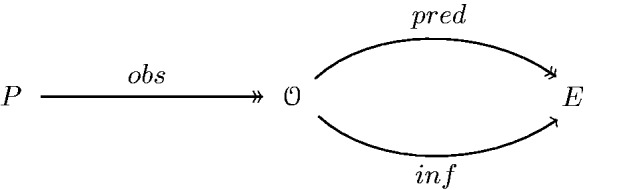
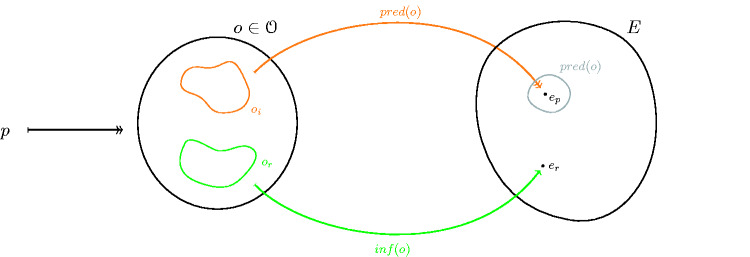
- The paper is a formal theoretical analysis of the experimental testing setup for consciousness theories, defining physical systems \(P\), datasets \(O\), prediction correspondences \(pred: O \to E\), and inference functions \(inf: O \to E\).
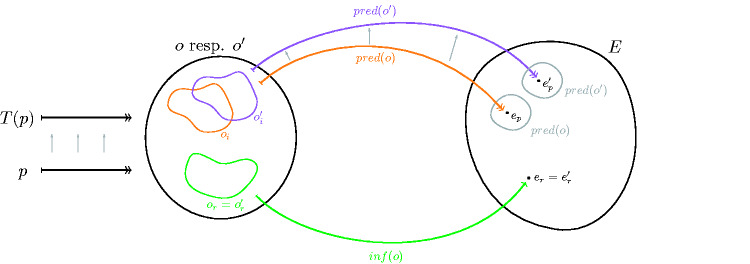
- It models falsification as a mismatch between inferred and predicted experience, then proves results using a substitution argument, lemmas, propositions, and two main theorems (one for independence, one for strict dependence).
- The argument is illustrated with examples drawn from IIT, GNW, artificial neural networks, Turing machines, universal intelligence, and standard neuroscience reporting paradigms.
Limitations
- The paper states that some contemporary theories may lack the specificity needed to make precise predictions in their current form, so the formalism may describe a more advanced version of a theory rather than its present version.
- It explicitly notes that “no current theory or testing paradigm that we know of” satisfies the proposed lenient dependency case; this is a limitation of the paper’s survey of existing approaches, not a proof of impossibility.
- Evident from the text: the results are formal and depend on assumptions such as the minimal-information condition and the way the inference/prediction split is modeled; the paper discusses “possible ways out” but does not empirically test any alternative framework.
Model-written summary. Check it against the paper before relying on it.
Integrity signals
Registry
Cites
Statistics
Figures

Verification
Claims the paper makes
11 Valid · 11 Not valid · 15 Not checked · 80 Own results and interpretations
The cited sources support only part of this claim — read each source’s verdict below.
In the paper
“It was the first (and arguably may still be the lone) theory that makes precise quantitative predictions about both the contents and level of consciousness (Tononi 2004).”
§ Falsification and consciousness > Introduction
What the sources say
- Partly supportedcites Tononi 2004 matched to “An information integration theory of consciousness” (2004) sourceExperimental — accuracy not yet measured
The Abstract’s ‘Presentation of the hypothesis’ defines Φ as a measure of the quantity of consciousness and describes an effective-information matrix and variable values for its quality and particular experiences. The ‘second problem’ section develops predictions about differences in experience. Our copy does not establish that IIT was the first—or remains the only—theory to make such predictions, and it cautions that further work is needed to map phenomenological differences onto the proposed informational structure. No page numbers were supplied. (LLM, conf=0.85)
hedged- Asserted: passes — The authors put it forward as true.
- Checkable: passes — It can be checked against evidence.
- Load-bearing: unclear — It is unclear whether the paper’s conclusions depend on it.
- Based: passes — The paper gives a reason why it holds.
- Partly supported
The cited sources that could be checked couldn’t confirm or dispute this claim.
In the paper
“The arguments in this article constitute a proof of the fact that for ANNs, inference and prediction data are independent (Definition 3.8).”
§ Falsification and consciousness > The Substitution Argument > When does a universal substitution exist?
What the sources say
- Could not verifycites Doerig et al. (2019) matched to “The unfolding argument: Why IIT and other causal structure theories cannot explain consciousness” (2019) sourceExperimental — accuracy not yet measured
The available Abstract discusses brain functions, causal structure, and consciousness, but does not address whether inference and prediction data are independent for ANNs. Searches for that phrase and for a paraphrase about artificial neural networks and predictive performance found no passage addressing the claim. (LLM, conf=0.70)
boosted- Asserted: passes — The authors put it forward as true.
- Checkable: passes — It can be checked against evidence.
- Load-bearing: passes — The paper’s conclusions depend on it.
- Based: passes — The paper gives a reason why it holds.
- Could not verify
Every source the paper cites for this claim was checked and supports it.
In the paper
“One consequence is that the “unfolding argument” concerning IIT (Doerig et al. 2019) is merely a small subset of a much larger issue that affects all contemporary theories which seek to make predictions about experience off of internal observables.”
§ Falsification and consciousness > Introduction
What the sources say
- Supportedcites Doerig et al. 2019 matched to “The unfolding argument: Why IIT and other causal structure theories cannot explain consciousness” (2019) source
The paper’s title identifies it as the unfolding argument about IIT and other causal-structure theories. The sentence cites Doerig et al. (2019) for that identification; it presents the broader claim about all contemporary theories as the citing authors’ own consequence, not as a conclusion attributed to Doerig et al. (LLM, conf=0.87)
plain- Asserted: passes — The authors put it forward as true.
- Checkable: passes — It can be checked against evidence.
- Load-bearing: passes — The paper’s conclusions depend on it.
- Based: passes — The paper gives a reason why it holds.
- Supported
The sources with a verdict support this claim; the rest weren’t checked yet, have no full text we could read, or their verdicts aren’t rated yet.
In the paper
“This arguably applies to global workspace theory (Baars 2005), the “attention schema” theory of consciousness (Graziano and Webb 2015) or “fame in the brain” (Dennett 1991) proposals.”
§ Falsification and consciousness > Inference and Prediction Data Are Strictly Dependent
What the sources say
- Not checked — no full text of the sourcecites Baars 2005 matched to “Global workspace theory of consciousness: toward a cognitive neuroscience of human experience” (2005) source
- Supportedcites Graziano and Webb 2015 matched to “The attention schema theory: a mechanistic account of subjective awareness” (2015) source
The Introduction (page not provided) describes awareness as attached to a represented item and says this requires integrating information into a larger brain-spanning representation. The Conclusion (page not provided) likewise describes an attended stimulus as first encoded as a representation, with a further step needed for subjective awareness. These passages support the citing sentence’s qualified suggestion that the subset condition applies to attention schema theory; they do not assess the other theories cited separately. (LLM, conf=0.84)
- Not matchedcites Dennett 1991
An author–year citation the paper’s reference list doesn’t settle. We don’t search these by name.
hedged- Asserted: passes — The authors put it forward as true.
- Checkable: passes — It can be checked against evidence.
- Load-bearing: unclear — It is unclear whether the paper’s conclusions depend on it.
- Based: passes — The paper gives a reason why it holds.
The cited sources support only part of this claim — read each source’s verdict below.
In the paper
“it has already been proven that systems with different internal structures and hence different predicted experiences, can have identical input/output (and therefore identical reports or inferences about report) (Albantakis and Tononi 2019).”
§ Falsification and consciousness > The Substitution Argument > When does a universal substitution exist?
What the sources say
- Partly supportedcites Albantakis and Tononi 2019 matched to “Causal composition: Structural differences among dynamically equivalent systems” (2019) sourceExperimental — accuracy not yet measured
The Introduction and Results §3.1 show that systems with equivalent global dynamics can have different causal compositions; Discussion §4.3 links causal composition to predicted phenomenal experience in IIT. But Discussion §4.2 cautions that replacing a subsystem with a dynamically equivalent one can change its input/output behavior in the same environment. The paper does not establish identical reports or inferences about reports. (LLM, conf=0.86)
boosted- Asserted: passes — The authors put it forward as true.
- Checkable: passes — It can be checked against evidence.
- Load-bearing: passes — The paper’s conclusions depend on it.
- Based: passes — The paper gives a reason why it holds.
- Partly supported
63 more claims · 1 with their cited sources checked
Create a free account to see all 117 claims and to verify the 2 references still open.
- Probably not a substantial claim. 33
- It may state two separate claims as one. 18
- Borderline: one of the tests for a substantial claim is unclear. 1
Claims other papers make about this one
Each is checked against this paper’s own text: does it say what the citing paper says it does?
In the citing paper
“Kleiner (2020) and Kleiner & Hoel (2021), using a reductio ad absurdum type of argument, argue that a generalization of the UA rules out most theories of consciousness, not only causal structure theories.”
From First-person experience cannot rescue causal structure theories from the unfolding argument (2022) · cites this paper as Kleiner & Hoel (2021)
In the citing paper
“Hence, the UA holds: any function, and even every process can be implemented with many different causal structures (see also Kleiner & Hoel, 2021;and DR5 for further discussion).”
From First-person experience cannot rescue causal structure theories from the unfolding argument (2022) · cites this paper as Kleiner & Hoel, 2021
Citations
Cites
LeCun, Y., Bengio, Y., & Hinton, G. (2015) · Nature · doi:10.1038/nature14539 · Cited by 84,126
Multilayer feedforward networks are universal approximators
Hornik, K., Stinchcombe, M., & White, H. (1989) · Neural Networks · doi:10.1016/0893-6080(89)90020-8 · Cited by 21,728
Multilayer feedforward networks are universal approximators
HornikK., StinchcombeM., & WhiteH. (1989) · Neural Networks · doi:10.5555/70405.70408 · Cited by 9,081
On computable numbers, with an application to the entscheidungsproblem
Turing, A. M. (1937) · Proceedings of the London Mathematical Society · doi:10.1112/plms/s2-42.1.230 · Cited by 8,283
The Logic of Scientific Discovery
(2013) · A Realist Theory of Science · doi:10.4324/9780203090732-9 · Cited by 7,731
The Logic of Scientific Discovery.
Hutchison, T. W., & Popper, K. R. (1959) · Economica · doi:10.2307/2550489 · Cited by 7,499
Computing Machinery and Intelligence (1950)
Turing, A. (2004) · The Essential Turing · doi:10.1093/oso/9780198250791.003.0017 · Cited by 6,118
The Behavior of Organisms: An Experimental Analysis
Jones, F. N., & Skinner, B. F. (1939) · The American Journal of Psychology · doi:10.2307/1416495 · Cited by 4,398 · cited 1×
“This is, for example, the case for behaviourist theories (Skinner, 1938) of consciousness, where consciousness is equated directly with report or behavior.”
BackgroundEnd to End Learning for Self-Driving Cars
Bojarski, M., Del Testa, D., Dworakowski, D., Firner, B., Flepp, B., Goyal, P., Jackel, L. D., Monfort, M., Muller, U., Zhang, J., et al. (2016) · arXiv · doi:10.48550/arxiv.1604.07316 · Cited by 3,198
Experimental and theoretical approaches to conscious processing
Dehaene, S., & Changeux, J.-P. (2011) · Neuron · doi:10.1016/j.neuron.2011.03.018 · Cited by 2,573
Research works printed but not linked: 2
- Aaronson S. Why I am not an integrated information theorist (or, the unconscious expander). In: Shtetl-Optimized: The Blog of Scott Aaronson. eds. Radin D., Richard D., & Karim T., 2014.
- Ball P. Neuroscience readies for a showdown over consciousness ideas. Quanta Mag 2019; 6.
Cited by
Hard criteria for empirical theories of consciousness
Doerig, A., Schurger, A., & Herzog, M. H. (2021) · Cognitive Neuroscience · doi:10.1080/17588928.2020.1772214 · Cited by 194
“The unfolding argument does not apply, because predictive processing can be unfolded (Doerig, Schurger, et al. (2019); but see Kleiner (2019) and Kleiner and Hoel (2020)).”
BackgroundInfluentialAre we really unconscious in “unconscious” states? Common assumptions revisited
Sevenius Nilsen, A., Juel, B. E., Thürer, B., Aamodt, A., & Storm, J. F. (2022) · Frontiers in Human Neuroscience · doi:10.3389/fnhum.2022.987051 · Cited by 49
“However, this method has been criticized for being tautological or unfalsifiable (Doerig et al., 2019; Kleiner and Hoel, 2021), but see (Negro, 2020) for a defense.”
BackgroundMethodROSE: A neurocomputational architecture for syntax
Murphy, E. (2023) · Journal of Neurolinguistics · doi:10.1016/j.jneuroling.2023.101180 · Cited by 69
The Mathematical Structure of Integrated Information Theory
Kleiner, J., & Tull, S. (2021) · Frontiers in Applied Mathematics and Statistics · doi:10.3389/fams.2020.602973 · Cited by 46
“As such it is part of a number of recent contributions which seek to explore the role and prospects of mathematical theories of consciousness [11, 15, 18, 30, 49], to help overcome problems of existing models [17, 18, 34] and to eventually develop new proposals [6, 13, 16, 20, 22, 29, 39].”
BackgroundSelf-citationMathematical Models of Consciousness
Kleiner, J. (2020) · Entropy · doi:10.3390/e22060609 · Cited by 77
Self-citationBrain states matter. A reply to the unfolding argument
Kleiner, J. (2020) · Consciousness and Cognition · doi:10.1016/j.concog.2020.102981 · Cited by 37
Self-citationSelf-organized criticality as a framework for consciousness: A review study
Walter, N., & Hinterberger, T. (2022) · Frontiers in Psychology · doi:10.3389/fpsyg.2022.911620 · Cited by 35
“Therefore, it has been revised continuously over the years (Oizumi et al., 2014; Cerullo, 2015; Barrett and Mediano, 2019; Kleiner and Hoel, 2021; Kleiner and Tull, 2021).”
BackgroundTowards a structural turn in consciousness science
Kleiner, J. (2024) · Consciousness and Cognition · doi:10.1016/j.concog.2024.103653 · Cited by 62
Self-citationAccelerating scientific progress through Bayesian adversarial collaboration
Corcoran, A. W., Hohwy, J., & Friston, K. J. (2023) · Neuron · doi:10.1016/j.neuron.2023.08.027 · Cited by 26
A measure centrality index for systematic empirical comparison of consciousness theories
Chis-Ciure, R., Melloni, L., & Northoff, G. (2024) · Neuroscience & Biobehavioral Reviews · doi:10.1016/j.neubiorev.2024.105670 · Cited by 22
“Revealingly, the falsifiability and empirical character of some (Doerig et al., 2019) or most (Kleiner and Hoel, 2021) consciousness theories recently came under fire because objectively explaining a subjective phenomenon remains an unresolved methodological problem in consciousness science.”
BackgroundThe Constrained Disorder Principle May Account for Consciousness
Sigawi, T., Hamtzany, O., Shakargy, J. D., & Ilan, Y. (2024) · Brain Sciences · doi:10.3390/brainsci14030209 · Cited by 23
“The brain’s consciousness involves the hierarchical processing of sensory inputs and memories [231–233].”
BackgroundA systematic approach to brain dynamics: cognitive evolution theory of consciousness
Yurchenko, S. B. (2022) · Cognitive Neurodynamics · doi:10.1007/s11571-022-09863-6 · Cited by 20
“Of course, it makes its falsification problematic (Kleiner and Hoel 2021), and explains why there are now a bewildering number of very different theories, each suggesting its own account of conscious presence in brains and other systems (Doerig et al. 2020).”
BackgroundFirst-person experience cannot rescue causal structure theories from the unfolding argument
Herzog, M. H., Schurger, A., & Doerig, A. (2022) · Consciousness and Cognition · doi:10.1016/j.concog.2021.103261 · Cited by 14
Functional recovery of the adult murine hippocampus after cryopreservation by vitrification
German, A., Akdaş, E. Y., Flügel‐Koch, C., Erterek, E., Frischknecht, R., Fejtová, A., Winkler, J., Alzheimer, C., & Zheng, F. (2026) · Proceedings of the National Academy of Sciences · doi:10.1073/pnas.2516848123 · Cited by 10
Toward a universal theory of consciousness
Kanai, R., & Fujisawa, I. (2024) · Neuroscience of Consciousness · doi:10.1093/nc/niae022 · Cited by 31
Chis-Ciure, R. (2022) · Synthese · doi:10.1007/s11229-022-03704-z · Cited by 9
“(Kleiner & Hoel, 2021, p. 11) I have three lines of reply to this criticism.11 Firstly, what Kleiner and Hoel (2021) miss, besides the common root of axioms and postulates in the same categorial lexicon evidenced in this contribution, is the important distinction between the conceptual postulates…”
BackgroundInfluentialFormalizing falsification for theories of consciousness across computational hierarchies
Hanson, J. R., & Walker, S. I. (2021) · Neuroscience of Consciousness · doi:10.1093/nc/niab014 · Cited by 16
When philosophical nuance matters: safeguarding consciousness research from restrictive assumptions
Usher, M., Negro, N., Jacobson, H., & Tsuchiya, N. (2023) · Frontiers in Psychology · doi:10.3389/fpsyg.2023.1306023 · Cited by 11
“Here, we follow Kleiner (2020) and Kleiner and Hoel (2021) in arguing that using neural markers of consciousness does not require endorsing the theory we aim to test.”
BackgroundMethodInfluentialWhat is a mathematical structure of conscious experience?
Kleiner, J., & Ludwig, T. (2024) · Synthese · doi:10.1007/s11229-024-04503-4 · Cited by 19
“…et al., 2013) and are known under various different names, including quality spaces (Clark, 1993), qualia spaces (Stanley, 1999), experience spaces (Kleiner & Hoel, 2021; Kleiner & Tull, 2021), Q-spaces (Chalmers & McQueen, in press), Q-structure (Lyre, 2022), (cid:2) -structures (Tononi, 2015),…”
Self-citationMultilayer networks as embodied consciousness interactions. A formal model approach
Signorelli, C. M., & Boïls, J. D. (2024) · Phenomenology and the Cognitive Sciences · doi:10.1007/s11097-024-09967-w · Cited by 12
Brain states matter. A reply to the unfolding argument.
Kleiner, J. (2019) · doi:10.31234/osf.io/jdcfh · Cited by 37
Self-citationWhat is a Mathematical Structure of Conscious Experience?Preprint
Kleiner, J., & Ludwig, T. (2023) · PsyArXiv (OSF Preprints) · doi:10.31234/osf.io/yhn8q · Cited by 9
Self-citationRemorini, P. (2023) · Brumal Revista de Investigación sobre lo Fantástico · doi:10.5565/rev/brumal.903 · Cited by 9
The case for neurons: a no-go theorem for consciousness on a chip
Kleiner, J., & Ludwig, T. (2024) · Neuroscience of Consciousness · doi:10.1093/nc/niae037 · Cited by 20
“…foundation of the theory, and the exact same formal properties which speak against dynamical relevance are the source of other issues, most notably issues with falsifying the theory, cf. Kleiner and Hoel (2021), and issues related to the unfolding argument, more generally (Doerig et al. (2019)).”
Self-citationMathematized phenomenology and the science of consciousness
Prentner, R. (2025) · Phenomenology and the Cognitive Sciences · doi:10.1007/s11097-025-10060-z · Cited by 19
Category theory in consciousness science: going beyond the correlational project
Prentner, R. (2024) · Synthese · doi:10.1007/s11229-024-04718-5 · Cited by 13
Can the Integrated Information Theory Explain Consciousness from Consciousness Itself?
Negro, N. (2022) · Review of Philosophy and Psychology · doi:10.1007/s13164-022-00653-x · Cited by 8
“…1995 , 2011 ; Lamme 2018), whereas others hold that studying consciousness independently of any behavioural outcome or report is simply outside the scope of science (Cohen and Dennett 2011; Doerig et al. 2019; Naccache and Dehaene 2007; for a comprehensive discussion, see (Kleiner and Hoel 2021)).”
Algorithmic structure of experience and the unfolding argumentPreprint
Ruffini, G., Lopez-Sola, E., & Vohryzek, J. (2022) · PsyArXiv (OSF Preprints) · doi:10.31234/osf.io/7nbsw · Cited by 5
Towards a Universal Theory of ConsciousnessPreprint
Ryota Kanai, C., & Fujisawa, I. (2023) · doi:10.31234/osf.io/r5t2n · Cited by 2
Mathematized Phenomenology and the Science of ConsciousnessPreprint
Prentner, R. (2024) · doi:10.31234/osf.io/8d2mf · Cited by 3
The maturing science of consciousness
Lambert, A. J. (2022) · Journal of the Royal Society of New Zealand · doi:10.1080/03036758.2022.2090391 · Cited by 2
“…have celebrated recent progress in consciousness science and expressed optimism concerning future developments, it is also worth noting that concerns have been expressed by some authors with respect to methodological and conceptual hurdles that have yet to be overcome (Kleiner and Hoel 2021).”
BackgroundCoffey, R. J., & Caroff, S. N. (2024) · Surgical Neurology International · doi:10.25259/sni_819_2024 · Cited by 2
“[9,15,135,136,168,314,348,349,366] In this view, activity within and among interconnected neuronal clusters or nodes determines what a person perceives, thinks, feels, and does – including moods, attractions, and intimate attachments.”
Fast Falsification of Neural Networks using Property Directed TestingPreprint
Das, M., Ray, R., Mohalik, S. K., & Banerjee, A. (2021) · arXiv (Cornell University) · doi:10.48550/arxiv.2104.12418 · Cited by 8
“This kind of a procedure is an archetype of the falsificationmethod of testing a system, which has been heavily used in system verification as an alternative to exhaustive and costly verification algorithms that rather attempt to prove the safety of the system at hand [17][26].”
BackgroundScientifically-Flawed Bypass of the Hard Problem Doesn’t Make It ‘Easier’!Preprint
Rosseinsky, N. M. (2021) · PsyArXiv (OSF Preprints) · doi:10.31234/osf.io/mfkz4 · Cited by 2
True Consciousness Science Requires Strongly Dynamically-Unorthodox PhysicsPreprint
Rosseinsky, N. M. (2021) · PsyArXiv (OSF Preprints) · doi:10.31234/osf.io/v9yrp · Cited by 2
What biology can and cannot tell us about conscious AI
Klatzmann, U., & Doerig, A. (2026) · Trends Open · doi:10.1016/j.treopn.2026.07.012 · Cited by 3
“But Type A BN claims that none of this matters, because biology is absent - an empirically untestable claim (see 11,21,25–28 for related discussions).”
Chis-Ciure, R. (2025) · Philosophical Explorations · doi:10.1080/13869795.2025.2550245 · Cited by 3
“1 In particular, it aims to clarify and potentially strengthen IIT’s theoretical foundations that have been recently challenged (Doerig et al. 2019; Hanson and Walker 2021; Kleiner and Hoel 2021; Merker, Williford, and Rudrauf 2022; Pautz 2019).”
The 'Real Problem' of Consciousness Requires New PhysicsPreprint
Rosseinsky, N. M. (2022) · PsyArXiv (OSF Preprints) · doi:10.31234/osf.io/c67x9
Applying category theory to the study of consciousness?Preprint
Prentner, R. (2022) · PsyArXiv (OSF Preprints) · doi:10.31234/osf.io/3vhg9 · Cited by 2
Content: A Possible Key to ConsciousnessPreprint
Clark, T. W. (2023) · PsyArXiv (OSF Preprints) · doi:10.31234/osf.io/79xg8
Three Comments in Case of a Structural Turn in Consciousness SciencePreprint
Kleiner, J. (2023) · SSRN Electronic Journal · doi:10.31234/osf.io/qmyv5
Self-citationRosseinsky, N. M. (2024) · Synthese Library/Synthese library · doi:10.1007/978-3-031-57353-8_18 · Cited by 1
Schmid, G. B. (2025) · Springer eBooks · doi:10.1007/978-3-662-70831-6_2
A Caveat Regarding the Unfolding Argument: Implications of PlasticityPreprint
O’Reilly-Shah, V. N., Selvitella, A., & Schurger, A. (2025) · bioRxiv (Cold Spring Harbor Laboratory) · doi:10.1101/2025.11.04.686457
Functionalist theories of mind: unfolding, substitution and the indeterminacy of functionPreprint
Basri, J., BarAvi, P., & Hemmo, M. (2025) · SSRN Electronic Journal · doi:10.2139/ssrn.5867565
A Caveat Regarding the Unfolding Argument: Implications of Plasticity
O'Reilly-Shah, V., Selvitella, A., & Schurger, A. (n.d.) · PhilPapers (PhilPapers Foundation)
A caveat regarding the unfolding argument: implications of plasticity
O’Reilly-Shah, V. N., Selvitella, A., & Schurger, A. (2026) · Neuroscience of Consciousness · doi:10.1093/nc/niag027 · Cited by 3
“This generalization has prompted further debate, with critics arguing that certain classes of functionalist theories are immune to such substitutions [7,8].”
Loops all the way up: Recurrency as an implementation-first primitive for consciousness
Zheng, Z., Chis-Ciure, R., Waade, P. T., Eiserbeck, A., Aru, J., Andrillon, T., Jarraya, B., Melloni, L., Northoff, G., Rosas, F. E., et al. (2026) · Physics of Life Reviews · doi:10.1016/j.plrev.2026.07.006 · Cited by 2
Basri, J., BarAvi, P., & Hemmo, M. (2026) · Consciousness and Cognition · doi:10.1016/j.concog.2026.104121
Metadata
- Authors
- Kleiner, J., & Hoel, E.
- Affiliations
- Ludwig-Maximilians-Universität München (DE)
- Tufts University (US)
- Corresponding author
- Hoel, Erik
- Venue
- Neuroscience of Consciousness
- Publisher
- Oxford University Press (OUP)
- Published
- 2021-01-01
- Volume
- 2021
- Issue
- 1
- Pages
- niab001-niab001
- ISSN
- 2057-2107 (ISSN-L)
- PMC
- PMC8052953
- OpenAlex
- W3015208662
- Semantic Scholar
- 697586e9404b69bebbad312836ba200fde79d21d
- Cited by
- 46
- References
- 99
- Citations by year
- 2026: 6 · 2025: 6 · 2024: 10 · 2023: 8 · 2022: 10 · 2021: 4
- FWCI
- 7.73
- Type
- journal article
- Language
- en
- Open access
- gold
- doi.org
- Locations
- Neuroscience of Consciousness (publishedVersion, cc-by)
- PubMed Central (publishedVersion, cc-by)
- PubMed (publishedVersion)
- arXiv (Cornell University) (submittedVersion)
- arXiv (Cornell University)
- Topics
- Social Sciences › Arts and Humanities › Philosophy › Philosophy and Theoretical Science
- Social Sciences › Arts and Humanities › History and Philosophy of Science › Philosophy of Biology and Scientific Explanation
- Social Sciences › Arts and Humanities › Philosophy › Free Will and Agency
- Keywords
- falsifiability, theory of consciousness, subjective experience, neuroimaging, philosophy of science
About these checks
Registry, retraction, Cites and statistics results are computed, not judged, with one exception: a printed reference that no index lists is read once by a model before it counts as a citation error. Claims are extracted by a model and kept only when their quote appears verbatim in the text; each cited source is then checked, with a model’s help, for whether it says what the claim relies on. Those verdicts can be wrong — read the claim’s quote and the cited source before relying on one.
The claim verdicts this report counts are experimental: their accuracy is not yet measured.
A language model drew the claims from the paper on 2026-10-10, under version 3 of the claim definition (model deepseek-v4.1-flash, prompt extract-v3).
A second model labelled each claim on 2026-10-10 (model jev-1.13-20260917, definition revision gold-guideline-v0.2).
Cited sources are checked with a language model’s help (gpt-6-sol).
Statistics and arithmetic are recomputed, not judged.
Confidence bands are shown only for fields calibrated on our annotated test set. None is calibrated yet, so no band is shown.
What counts as a claim ›How we measure confidence ›How we check this ›
Are you an author, or do you see a problem with this page? Request a review
Data sources
Bibliographic data: Semantic Scholar, OpenAlex, Crossref.
Contains information from the Semantic Scholar Academic Graph Datasets, made available under the ODC Attribution License (ODC-BY 1.0).
Semantic Scholar’s data is described in: Kinney, R., et al. (2023). The Semantic Scholar Open Data Platform. arXiv:2301.10140.
