

Falsification and consciousness
Open accessThe DOI matches its Crossref record, with a small difference in title or year; 95 of the 99 references it cites were found in a registry or an index; 14 of the 39 sources its claims cite were checked for support.
Abstract
The search for a scientific theory of consciousness should result in theories that are falsifiable. However, here we show that falsification is especially problematic for theories of consciousness. We formally describe the standard experimental setup for testing these theories. Based on a theory's application to some physical system, such as the brain, testing requires comparing a theory's predicted experience (given some internal observables of the system like brain imaging data) with an inferred experience (using report or behavior). If there is a mismatch between inference and prediction, a theory is falsified. We show that if inference and prediction are independent, it follows that any minimally informative theory of consciousness is automatically falsified. This is deeply problematic since the field's reliance on report or behavior to infer conscious experiences implies such independence, so this fragility affects many contemporary theories of consciousness. Furthermore, we show that if inference and prediction are strictly dependent, it follows that a theory is unfalsifiable. This affects theories which claim consciousness to be determined by report or behavior. Finally, we explore possible ways out of this dilemma.
Overview
CoChat Summary
TL;DR
The paper argues that standard tests of theories of consciousness face a dilemma: if inference data (often report/behavior) and prediction data are independent, then minimally informative theories are automatically falsified; if they are strictly dependent, the theories become empirically unfalsifiable. The authors formalize this with a substitution argument and conclude that many contemporary theories, including IIT and GNW in their usual testing setups, are caught between these two problems.
Key findings
- If inference and prediction data are independent, the authors prove that universal substitutions exist, and Theorem 3.10 states that “either every single inference operation is wrong or the theory under consideration is already falsified.”
- They define a minimal-information assumption for theories and show that, under independence, for every possible inference content there is an or-falsification; this applies broadly to contemporary consciousness theories that use internal observables for prediction and report/behavior for inference.
- If inference and prediction data are strictly dependent, Theorem 4.3 shows the theory is “either already falsified or empirically unfalsifiable”; the paper gives examples including behaviorist theories and theories where prediction data are a subset of inference data (e.g. \(oi \subseteq or\)).
- The paper argues that these results apply not just to IIT but also to GNW and related theories, and notes that no current theory or testing paradigm known to the authors satisfies their “lenient dependency” condition.
Methods
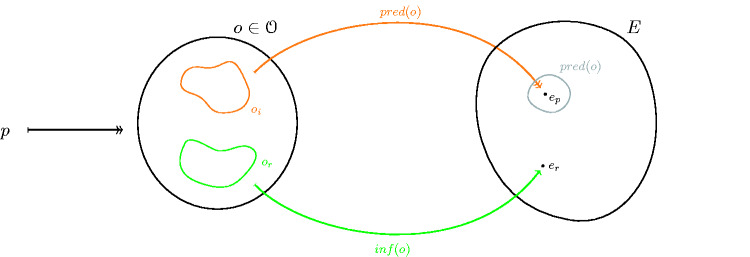
- The paper is a formal theoretical analysis of the experimental testing setup for consciousness theories, defining physical systems \(P\), datasets \(O\), prediction correspondences \(pred: O \to E\), and inference functions \(inf: O \to E\).
- It models falsification as a mismatch between inferred and predicted experience, then proves results using a substitution argument, lemmas, propositions, and two main theorems (one for independence, one for strict dependence).
- The argument is illustrated with examples drawn from IIT, GNW, artificial neural networks, Turing machines, universal intelligence, and standard neuroscience reporting paradigms.
Limitations
- The paper states that some contemporary theories may lack the specificity needed to make precise predictions in their current form, so the formalism may describe a more advanced version of a theory rather than its present version.
- It explicitly notes that “no current theory or testing paradigm that we know of” satisfies the proposed lenient dependency case; this is a limitation of the paper’s survey of existing approaches, not a proof of impossibility.
- Evident from the text: the results are formal and depend on assumptions such as the minimal-information condition and the way the inference/prediction split is modeled; the paper discusses “possible ways out” but does not empirically test any alternative framework.
Model-written summary. Check it against the paper before relying on it.
Integrity signals
Registry
Cites
Statistics
Figures




Verification
Claims the paper makes
11 Valid · 11 Not valid · 15 Not checked · 80 Own results and interpretations
The cited sources support only part of this claim — read each source’s verdict below.
In the paper
“It was the first (and arguably may still be the lone) theory that makes precise quantitative predictions about both the contents and level of consciousness (Tononi 2004).”
§ Falsification and consciousness > Introduction
What the sources say
- Partly supportedcites Tononi 2004 matched to “An information integration theory of consciousness” (2004) sourceExperimental — accuracy not yet measured
The Abstract’s ‘Presentation of the hypothesis’ defines Φ as a measure of the quantity of consciousness and describes an effective-information matrix and variable values for its quality and particular experiences. The ‘second problem’ section develops predictions about differences in experience. Our copy does not establish that IIT was the first—or remains the only—theory to make such predictions, and it cautions that further work is needed to map phenomenological differences onto the proposed informational structure. No page numbers were supplied. (LLM, conf=0.85)
hedged- Asserted: passes — The authors put it forward as true.
- Checkable: passes — It can be checked against evidence.
- Load-bearing: unclear — It is unclear whether the paper’s conclusions depend on it.
- Based: passes — The paper gives a reason why it holds.
- Partly supported
The cited sources that could be checked couldn’t confirm or dispute this claim.
In the paper
“The arguments in this article constitute a proof of the fact that for ANNs, inference and prediction data are independent (Definition 3.8).”
§ Falsification and consciousness > The Substitution Argument > When does a universal substitution exist?
What the sources say
- Could not verifycites Doerig et al. (2019) matched to “The unfolding argument: Why IIT and other causal structure theories cannot explain consciousness” (2019) sourceExperimental — accuracy not yet measured
The available Abstract discusses brain functions, causal structure, and consciousness, but does not address whether inference and prediction data are independent for ANNs. Searches for that phrase and for a paraphrase about artificial neural networks and predictive performance found no passage addressing the claim. (LLM, conf=0.70)
boosted- Asserted: passes — The authors put it forward as true.
- Checkable: passes — It can be checked against evidence.
- Load-bearing: passes — The paper’s conclusions depend on it.
- Based: passes — The paper gives a reason why it holds.
- Could not verify
Every source the paper cites for this claim was checked and supports it.
In the paper
“One consequence is that the “unfolding argument” concerning IIT (Doerig et al. 2019) is merely a small subset of a much larger issue that affects all contemporary theories which seek to make predictions about experience off of internal observables.”
§ Falsification and consciousness > Introduction
What the sources say
- Supportedcites Doerig et al. 2019 matched to “The unfolding argument: Why IIT and other causal structure theories cannot explain consciousness” (2019) source
The paper’s title identifies it as the unfolding argument about IIT and other causal-structure theories. The sentence cites Doerig et al. (2019) for that identification; it presents the broader claim about all contemporary theories as the citing authors’ own consequence, not as a conclusion attributed to Doerig et al. (LLM, conf=0.87)
plain- Asserted: passes — The authors put it forward as true.
- Checkable: passes — It can be checked against evidence.
- Load-bearing: passes — The paper’s conclusions depend on it.
- Based: passes — The paper gives a reason why it holds.
- Supported
The sources with a verdict support this claim; the rest weren’t checked yet, have no full text we could read, or their verdicts aren’t rated yet.
In the paper
“This arguably applies to global workspace theory (Baars 2005), the “attention schema” theory of consciousness (Graziano and Webb 2015) or “fame in the brain” (Dennett 1991) proposals.”
§ Falsification and consciousness > Inference and Prediction Data Are Strictly Dependent
What the sources say
- Not checked — no full text of the sourcecites Baars 2005 matched to “Global workspace theory of consciousness: toward a cognitive neuroscience of human experience” (2005) source
- Supportedcites Graziano and Webb 2015 matched to “The attention schema theory: a mechanistic account of subjective awareness” (2015) source
The Introduction (page not provided) describes awareness as attached to a represented item and says this requires integrating information into a larger brain-spanning representation. The Conclusion (page not provided) likewise describes an attended stimulus as first encoded as a representation, with a further step needed for subjective awareness. These passages support the citing sentence’s qualified suggestion that the subset condition applies to attention schema theory; they do not assess the other theories cited separately. (LLM, conf=0.84)
- Not matchedcites Dennett 1991
An author–year citation the paper’s reference list doesn’t settle. We don’t search these by name.
hedged- Asserted: passes — The authors put it forward as true.
- Checkable: passes — It can be checked against evidence.
- Load-bearing: unclear — It is unclear whether the paper’s conclusions depend on it.
- Based: passes — The paper gives a reason why it holds.
The cited sources support only part of this claim — read each source’s verdict below.
In the paper
“it has already been proven that systems with different internal structures and hence different predicted experiences, can have identical input/output (and therefore identical reports or inferences about report) (Albantakis and Tononi 2019).”
§ Falsification and consciousness > The Substitution Argument > When does a universal substitution exist?
What the sources say
- Partly supportedcites Albantakis and Tononi 2019 matched to “Causal composition: Structural differences among dynamically equivalent systems” (2019) sourceExperimental — accuracy not yet measured
The Introduction and Results §3.1 show that systems with equivalent global dynamics can have different causal compositions; Discussion §4.3 links causal composition to predicted phenomenal experience in IIT. But Discussion §4.2 cautions that replacing a subsystem with a dynamically equivalent one can change its input/output behavior in the same environment. The paper does not establish identical reports or inferences about reports. (LLM, conf=0.86)
boosted- Asserted: passes — The authors put it forward as true.
- Checkable: passes — It can be checked against evidence.
- Load-bearing: passes — The paper’s conclusions depend on it.
- Based: passes — The paper gives a reason why it holds.
- Partly supported
63 more claims · 1 with their cited sources checked
Create a free account to see all 117 claims and every source verdict.
- Probably not a substantial claim. 33
- It may state two separate claims as one. 18
- Borderline: one of the tests for a substantial claim is unclear. 1
Citations
Cites
LeCun, Y., Bengio, Y., & Hinton, G. (2015) · Nature · doi:10.1038/nature14539 · Cited by 84,126
Multilayer feedforward networks are universal approximators
Hornik, K., Stinchcombe, M., & White, H. (1989) · Neural Networks · doi:10.1016/0893-6080(89)90020-8 · Cited by 21,728
Multilayer feedforward networks are universal approximators
HornikK., StinchcombeM., & WhiteH. (1989) · Neural Networks · doi:10.5555/70405.70408 · Cited by 9,081
On computable numbers, with an application to the entscheidungsproblem
Turing, A. M. (1937) · Proceedings of the London Mathematical Society · doi:10.1112/plms/s2-42.1.230 · Cited by 8,283
The Logic of Scientific Discovery
(2013) · A Realist Theory of Science · doi:10.4324/9780203090732-9 · Cited by 7,731
The Logic of Scientific Discovery.
Hutchison, T. W., & Popper, K. R. (1959) · Economica · doi:10.2307/2550489 · Cited by 7,499
Computing Machinery and Intelligence (1950)
Turing, A. (2004) · The Essential Turing · doi:10.1093/oso/9780198250791.003.0017 · Cited by 6,118
The Behavior of Organisms: An Experimental Analysis
Jones, F. N., & Skinner, B. F. (1939) · The American Journal of Psychology · doi:10.2307/1416495 · Cited by 4,398 · cited 1×
“This is, for example, the case for behaviourist theories (Skinner, 1938) of consciousness, where consciousness is equated directly with report or behavior.”
BackgroundEnd to End Learning for Self-Driving Cars
Bojarski, M., Del Testa, D., Dworakowski, D., Firner, B., Flepp, B., Goyal, P., Jackel, L. D., Monfort, M., Muller, U., Zhang, J., et al. (2016) · arXiv · doi:10.48550/arxiv.1604.07316 · Cited by 3,198
Experimental and theoretical approaches to conscious processing
Dehaene, S., & Changeux, J.-P. (2011) · Neuron · doi:10.1016/j.neuron.2011.03.018 · Cited by 2,573
An information integration theory of consciousness
Tononi, G. (2004) · BMC Neuroscience · doi:10.1186/1471-2202-5-42 · Cited by 1,958 · cited 2×
“It was the first (and arguably may still be the lone) theory that makes precise quantitative predictions about both the contents and level of consciousness (Tononi 2004).”
BackgroundMethodology of Scientific Research Programmes
(1998) · The Handbook of Economic Methodology · doi:10.4337/9781781954249.00075 · Cited by 1,815
A formal theory of inductive inference. Part II
Solomonoff, R. J. (1964) · Information and Control · doi:10.1016/s0019-9958(64)90131-7 · Cited by 1,758 · cited 1×
“For instance, consider the AIXI model, the gold-standard for universal intelligence, which operates via Solomonoff induction (Solomonoff 1964; Hutter 2004).”
Background(1990) · CaltechAUTHORS (California Institute of Technology) · Cited by 1,661
Neural correlates of consciousness: progress and problems
Koch, C., Massimini, M., Boly, M., & Tononi, G. (2016) · Nature Reviews Neuroscience · doi:10.1038/nrn.2016.22 · Cited by 1,600 · cited 1×
“Within neuroscience, the attempt to understand consciousness has moved out of the exploratory stage and there are now a number of theories of consciousness capable of predictions that have been advanced by various authors (Koch et al. 2016).”
BackgroundBreakdown of cortical effective connectivity during sleep
Massimini, M., Ferrarelli, F., Huber, R., Esser, S. K., Singh, H., & Tononi, G. (2005) · Science · doi:10.1126/science.1117256 · Cited by 1,534 · cited 1×
“Both GNW and IIT have gained widespread popularity, sparked a general interest in consciousness, and have led to dozens if not hundreds of new empirical studies (Massimini et al. 2005; Del Cul et al. 2007; Dehaene and Changeux 2011; Gosseries et al. 2014; Wenzel et al. 2019).”
BackgroundConsciousness as integrated information: a provisional manifesto
Tononi, G. (2008) · The Biological Bulletin · doi:10.2307/25470707 · Cited by 1,529 · cited 2×
“The most promising example thereof is Integrated Information Theory (IIT) (Tononi 2004, 2008; Oizumi et al. 2014).”
BackgroundCellular automata as models of complexity
Wolfram, S. (1984) · Nature · doi:10.1038/311419a0 · Cited by 1,507 · cited 3×
“Examples of such substitutions may involve substituting a brain with a Turing machine or a cellular automaton since both types of systems are capable of universal computation (Turing 1937; Wolfram 1984) and hence may emulate the brain’s responses, or replacing a deep neural network with a single-layer neural network,…”
BackgroundMethodInfluentialMind in a Physical World: An Essay on the Mind-Body Problem and Mental Causation
Kim, J. (1998) · doi:10.7551/mitpress/4629.001.0001 · Cited by 1,241 · cited 1×
“Another way to avoid our conclusion is to only consider theories of consciousness which do not describe the physical as causally closed (Kim 1998).”
BackgroundA formal theory of inductive inference. Part I
Solomonoff, R. J. (1964) · Information and Control · doi:10.1016/s0019-9958(64)90223-2 · Cited by 1,192 · cited 2×
“For instance, consider the AIXI model, the gold-standard for universal intelligence, which operates via Solomonoff induction (Solomonoff, 1964; Hutter, 2004).”
Towards a true neural stance on consciousness
Lamme, V. A. F. (2006) · Trends in Cognitive Sciences · doi:10.1016/j.tics.2006.09.001 · Cited by 1,149 · cited 1×
“Other theories have focused more on the dynamics of neural processing, such as the degree of recurrent neural connectivity (Lamme 2006).”
BackgroundThe Logic of Scientific Discovery
Popper, K. (2005) · Routledge eBooks · doi:10.4324/9780203994627 · Cited by 1,142
From the phenomenology to the mechanisms of consciousness: integrated information theory 3.0
Oizumi, M., Albantakis, L., & Tononi, G. (2014) · PLoS Computational Biology · doi:10.1371/journal.pcbi.1003588 · Cited by 1,128 · cited 3×
“The most promising example thereof is Integrated Information Theory (IIT) (Tononi 2004, 2008; Oizumi et al. 2014).”
BackgroundThe astonishing hypothesis: The scientific search for the soul
(1994) · Ethology and Sociobiology · doi:10.1016/0162-3095(94)90016-7 · Cited by 1,054
A deep learning framework for neuroscience
Richards, B. A., Lillicrap, T. P., Beaudoin, P., Bengio, Y., Bogacz, R., Christensen, A., Clopath, C., Costa, R. P., de Berker, A., Ganguli, S., et al. (2019) · Nature Neuroscience · doi:10.1038/s41593-019-0520-2 · Cited by 1,027 · cited 1×
“and visual illusions, and many others (Richards et al. 2019).”
Global workspace theory of consciousness: toward a cognitive neuroscience of human experience
Baars, B. J. (2005) · Progress in Brain Research · doi:10.1016/s0079-6123(05)50004-9 · Cited by 888
Empirical support for higher-order theories of conscious awareness
Lau, H., & Rosenthal, D. (2011) · Trends in Cognitive Sciences · doi:10.1016/j.tics.2011.05.009 · Cited by 869 · cited 1×
“(Lau and Rosenthal 2011; Chang et al. 2019), particularly in their ideal forms.”
Brain Dynamics Underlying the Nonlinear Threshold for Access to Consciousness
Del Cul, A., Baillet, S., & Dehaene, S. (2007) · PLoS Biology · doi:10.1371/journal.pbio.0050260 · Cited by 753
What is the function of the claustrum?
Crick, F. C., & Koch, C. (2005) · Philosophical Transactions of the Royal Society B: Biological Sciences · doi:10.1098/rstb.2005.1661 · Cited by 742
COMPUTING MACHINERY AND INTELLIGENCE
TURING, A. M. (1988) · Readings in Cognitive Science · doi:10.1016/b978-1-4832-1446-7.50006-6 · Cited by 678
Consciousness and Fundamental Reality
Goff, P. (2017) · Oxford Scholarship Online · doi:10.1093/oso/9780190677015.001.0001 · Cited by 657 · cited 1×
“For example, it may actually be parsimonious to assume that many physical systems have consciousness (Goff 2017).”
BackgroundMind in a physical world: an essay on the mind-body problem and mental causation
(1999) · Choice Reviews Online · doi:10.5860/choice.36-6223 · Cited by 593
No-Report Paradigms: Extracting the True Neural Correlates of Consciousness
Tsuchiya, N., Wilke, M., Frässle, S., & Lamme, V. A. F. (2015) · Trends in Cognitive Sciences · doi:10.1016/j.tics.2015.10.002 · Cited by 551 · cited 1×
“It has been pointed out that report in a trial may interfere with the actual isolation of consciousness, and there has recently been the introduction of so-called “no-report paradigms” (Tsuchiya et al. 2015).”
BackgroundUniversal Artificial Intellegence
Hutter, M. (2005) · Texts in Theoretical Computer Science An EATCS Series · doi:10.1007/b138233 · Cited by 523
Rubovits-Seitz, P. (1993) · The Journal of Nervous and Mental Disease · doi:10.1097/00005053-199310000-00017 · Cited by 411
Rounis, E., Maniscalco, B., Rothwell, J. C., Passingham, R. E., & Lau, H. (2010) · Cognitive Neuroscience · doi:10.1080/17588921003632529 · Cited by 407 · cited 1×
“This is particularly true once one allows for interventions on the human brain by experimenters, such as perturbations like transcranial magnetic stimulation, which is already used in consciousness research (Rounis et al. 2010; Napolitani et al. 2014).”
BackgroundAttention and conscious perception in the hypothesis testing brain
Hohwy, J. (2012) · Frontiers in Psychology · doi:10.3389/fpsyg.2012.00096 · Cited by 396
Seth, A. K. (2014) · Cognitive Neuroscience · doi:10.1080/17588928.2013.877880 · Cited by 346 · cited 2×
“…leading theories such as IIT (Oizumi et al. 2014), GNW Theory (Dehaene and Changeux 2004), Predictive Processing [when applied to account for conscious experience (Hohwy 2012; Hobson et al. 2014; Seth 2014; Clark 2019; Dolega and Dewhurst 2020)], or Higher Order Thought Theory (Rosenthal 2002).”
Background(1997) · Journal of Consciousness Studies · Cited by 340
Recurrent Neural Networks Are Universal Approximators
Schäfer, A. M., & Zimmermann, H. G. (2006) · Lecture Notes in Computer Science · doi:10.1007/11840817_66 · Cited by 297 · cited 3×
“…are capable of universal computation (Turing 1937; Wolfram 1984) and hence may emulate the brain’s responses, or replacing a deep neural network with a single-layer neural network, since both types of networks can approximate any given function (Hornik et al. 1989; Schäfer and Zimmermann 2006).”
BackgroundMethodInfluentialConsciousness in humans and non-human animals: recent advances and future directions
Boly, M., Seth, A. K., Wilke, M., Ingmundson, P., Baars, B., Laureys, S., Edelman, D. B., & Tsuchiya, N. (2013) · Frontiers in Psychology · doi:10.3389/fpsyg.2013.00625 · Cited by 291 · cited 1×
“This is highly problematic for consciousness research which often uses non-human animal models (Boly et al., 2013).”
BackgroundKaminsky, J., & Hook, S. (1961) · Philosophy and Phenomenological Research · doi:10.2307/2105032 · Cited by 290
The Information Integration Theory of Consciousness
Tononi, G. (2007) · The Blackwell Companion to Consciousness · doi:10.1002/9780470751466.ch23 · Cited by 283
The neural correlates of conscious experience: an experimental framework
Frith, C., Perry, R., & Lumer, E. (1999) · Trends in Cognitive Sciences · doi:10.1016/s1364-6613(99)01281-4 · Cited by 250 · cited 1×
“For example, it may actually be parsimonious to assume that many physical systems have consciousness (Goff 2017).”
BackgroundCephalopod consciousness: Behavioural evidence
Mather, J. A. (2008) · Consciousness and Cognition · doi:10.1016/j.concog.2006.11.006 · Cited by 228 · cited 2×
“For instance, cephalopods are among the most intelligent animals yet are quite distant on the tree of life from humans and have a distinct neuroanatomy, and still are used for consciousness research (Mather 2008).”
BackgroundThe attention schema theory: a mechanistic account of subjective awareness
Graziano, M. S. A., & Webb, T. W. (2015) · Frontiers in Psychology · doi:10.3389/fpsyg.2015.00500 · Cited by 224
The Feeling of Life Itself: Why Consciousness Is Widespread but Can't Be Computed
Koch, C. (2019) · doi:10.7551/mitpress/11705.001.0001 · Cited by 208 · cited 1×
“To take another case: within IIT it has already been acknowledged that a Turing machine may have a wildly different predicted contents of consciousness for the same behavior or reports (Koch 2019).”
BackgroundRECURRENT NEURAL NETWORKS ARE UNIVERSAL APPROXIMATORS
SCHÄFER, A. M., & ZIMMERMANN, H.-G. (2007) · International Journal of Neural Systems · doi:10.1142/s0129065707001111 · Cited by 196
The methodology of scientific research programmes
(1981) · Problems of Empiricism · doi:10.1017/cbo9781139171588.011 · Cited by 174
(2004) · Cited by 168
Visual sensitivity underlying changes in visual consciousness
Alais, D., Cass, J., O'Shea, R. P., & Blake, R. (2010) · Current Biology · doi:10.1016/j.cub.2010.06.015 · Cited by 166 · cited 1×
“unseen images in masking paradigms (Alais et al. 2010).”
Loewer, B., & Kim, J. (2001) · The Journal of Philosophy · doi:10.2307/2678434 · Cited by 159
Measuring Consciousness in Severely Damaged Brains
Gosseries, O., Di, H., Laureys, S., & Boly, M. (2014) · Annual Review of Neuroscience · doi:10.1146/annurev-neuro-062012-170339 · Cited by 152 · cited 1×
“Both GNW and IIT have gained widespread popularity, sparked a general interest in consciousness, and have led to dozens if not hundreds of new empirical studies (Massimini et al. 2005; Del Cul et al. 2007; Dehaene and Changeux 2011; Gosseries et al. 2014; Wenzel et al. 2019).”
BackgroundMeasuring integrated information: comparison of candidate measures in theory and simulation
Mediano, P., Seth, A., & Barrett, A. (2018) · Entropy · doi:10.3390/e21010017 · Cited by 145
The unfolding argument: Why IIT and other causal structure theories cannot explain consciousness
Doerig, A., Schurger, A., Hess, K., & Herzog, M. H. (2019) · Consciousness and Cognition · doi:10.1016/j.concog.2019.04.002 · Cited by 140 · cited 4×
“Crucially, in contrast to other similar results (Doerig et al. 2019), we do not put the blame on individual theories of consciousness, but rather show that a key assumption that is usually being made is responsible for the problems: an experimenter’s inference about consciousness and a theory’s predictions are general…”
BackgroundResultInfluentialSergent, C., & Dehaene, S. (2004) · Journal of Physiology-Paris · doi:10.1016/j.jphysparis.2005.09.006 · Cited by 139
On the axiomatic foundations of the integrated information theory of consciousness
Bayne, T. (2018) · Neuroscience of Consciousness · doi:10.1093/nc/niy007 · Cited by 132 · cited 2×
“However, to date, no such derivation exists, as phenomenology seems to generally underdetermine the postulates of IIT (Bayne 2018; Barrett and Mediano 2019), and because it is unknown what the scope and nature of nonhuman experience is.”
BackgroundThe Astonishing Hypothesis: The Scientific Search for the Soul
Schulman, S. (1994) · JAMA: The Journal of the American Medical Association · doi:10.1001/jama.1994.03520070087050 · Cited by 117 · cited 1×
“Contemporary neuroscientific theories of consciousness first began to be proposed in the early 1990s (Crick 1994).”
BackgroundHow many kinds of consciousness?
Rosenthal, D. M. (2002) · Consciousness and Cognition · doi:10.1016/s1053-8100(02)00017-x · Cited by 117 · cited 4×
“, 2014; Hohwy, 2012)) or Higher Order Thought Theory, HOT (Rosenthal, 2002).”
BackgroundInfluential(1996) · Trends in Neurosciences · doi:10.1016/s0166-2236(96)20049-9 · Cited by 117
The Problem with Phi: A Critique of Integrated Information Theory
Cerullo, M. A. (2015) · PLOS Computational Biology · doi:10.1371/journal.pcbi.1004286 · Cited by 114 · cited 2×
“Due to IIT’s level of formalization as a theory, it has triggered the most in-depth responses, expansions, and criticisms (Cerullo 2015; Bayne 2018; Mediano et al. 2019; Kleiner and Tull 2020) since well-formalized theories are much easier to criticize than nonformalized theories.”
BackgroundMeasuring integrated information: comparison of \ncandidate measures in theory and simulation
Mediano, P. A. M., Seth, A. K., & Barrett, A. B. (2018) · Figshare · Cited by 114
Can binocular rivalry reveal neural correlates of consciousness?
Blake, R., Brascamp, J., & Heeger, D. J. (2014) · Philosophical Transactions of the Royal Society B: Biological Sciences · doi:10.1098/rstb.2013.0211 · Cited by 112
Toward an artificial intelligence physicist for unsupervised learning
Wu, T., & Tegmark, M. (2019) · Physical Review E · doi:10.1103/physreve.100.033311 · Cited by 99 · cited 1×
“The AIXI model generates an optimal decision making over some class of problems, and methods linked to it have already been applied to a range of behaviors, such as creating “AI physicists” (Wu and Tegmark 2019).”
MethodProgress toward openness, transparency, and reproducibility in cognitive neuroscience
Gilmore, R. O., Diaz, M. T., Wyble, B. A., & Yarkoni, T. (2017) · Annals of the New York Academy of Sciences · doi:10.1111/nyas.13325 · Cited by 95 · cited 1×
“In the real world, data obtained from experiments may be incomplete or noisy, or neuroscientific findings difficult to reproduce (Gilmore et al. 2017).”
Background(2019) · Cited by 81
Seth, A. (2007) · Scholarpedia · doi:10.4249/scholarpedia.1328 · Cited by 76 · cited 1×
“Note that we refer to both “theories” of consciousness and also “models” of consciousness, and use these interchangeably (Seth 2007).”
Method(2014) · UCL Discovery (University College London) · Cited by 75
Tsuchiya, N., Taguchi, S., & Saigo, H. (2016) · Neuroscience Research · doi:10.1016/j.neures.2015.12.007 · Cited by 71
The Methodology of Scientific Research Programmes: Volume 1: Philosophical Papers
WORRALL, J. L., & Currie, G. (1980) · Cited by 69
Information Closure Theory of Consciousness
Chang, A. Y. C., Biehl, M., Yu, Y., & Kanai, R. (2020) · Frontiers in Psychology · doi:10.3389/fpsyg.2020.01504 · Cited by 64
Wenzel, M., Han, S., Smith, E. H., Hoel, E., Greger, B., House, P. A., & Yuste, R. (2019) · Cell Systems · doi:10.1016/j.cels.2019.03.007 · Cited by 63
Self-citationInformation Closure Theory of Consciousness
Chang, A. Y. C., Biehl, M., Yu, Y., & Kanai, R. (2019) · arXiv · doi:10.48550/arxiv.1909.13045 · Cited by 63
Tsuchiya, N., Andrillon, T., & Haun, A. (2020) · Consciousness and Cognition · doi:10.1016/j.concog.2020.102877 · Cited by 58 · cited 4×
“Examples that pursue this fit with phenomenology are IIT (Tononi, 2008) and the isomorphism view (Tsuchiya et al., 2019).”
BackgroundInfluentialThe Phi measure of integrated information is not well-defined for general physical systems
Barrett, A. B., & Mediano, P. A. M. (2019) · arXiv · doi:10.48550/arxiv.1902.04321 · Cited by 53
Consciousness as Generative Entanglement
Clark, A., & Journal of Philosophy Inc. (2019) · The Journal of Philosophy · doi:10.5840/jphil20191161241 · Cited by 50 · cited 2×
“Changeux 2004), Predictive Processing [when applied to account for conscious experience (Hohwy 2012; Hobson et al. 2014; Seth 2014; Clark 2019; Dolega and Dewhurst 2020)], or Higher Order Thought Theory (Rosenthal 2002).”
BackgroundMethodThe Mathematical Structure of Integrated Information Theory
Kleiner, J., & Tull, S. (2021) · Frontiers in Applied Mathematics and Statistics · doi:10.3389/fams.2020.602973 · Cited by 46 · cited 5×
“Due to IIT’s level of formalization as a theory, it has triggered the most in-depth responses, expansions, and criticisms (Cerullo 2015; Bayne 2018; Mediano et al. 2019; Kleiner and Tull 2020) since well-formalized theories are much easier to criticize than nonformalized theories.”
BackgroundInfluentialSelf-citationManiscalco, B., Rounis, E., Rothwell, J. C., Passingham, R. E., & Lau, H. (2010) · Journal of Vision · doi:10.1167/9.8.764 · Cited by 42
Transcranial magnetic stimulation combined with high-density EEG in altered states of consciousness
Napolitani, M., Bodart, O., Canali, P., Seregni, F., Casali, A., Laureys, S., Rosanova, M., Massimini, M., & Gosseries, O. (2014) · Brain Injury · doi:10.3109/02699052.2014.920524 · Cited by 41
Dołęga, K., & Dewhurst, J. (2020) · Synthese · doi:10.1007/s11229-020-02548-9 · Cited by 41
Brain dynamics underlying the non-linear threshold for access to consciousness: (512682013-058)
Dehaene, S., & Delcul, A. (2007) · PsycEXTRA Dataset · doi:10.1037/e512682013-058 · Cited by 39
Brain states matter. A reply to the unfolding argument
Kleiner, J. (2020) · Consciousness and Cognition · doi:10.1016/j.concog.2020.102981 · Cited by 37 · cited 2×
“A similar result (using a different characterization of theories of consciousness than minimally informative) has been shown in Kleiner (2020).”
BackgroundMethodSelf-citationBrain states matter. A reply to the unfolding argument.
Kleiner, J. (2019) · doi:10.31234/osf.io/jdcfh · Cited by 37
Self-citationBeyond Falsifiability: Normal Science in a Multiverse
Dardashti, R., Dawid, R., & Thébault, K. P. Y. (2019) · Cambridge University Press eBooks · doi:10.1017/9781108671224.020 · Cited by 32
Causal composition: Structural differences among dynamically equivalent systems
Albantakis, L., & Tononi, G. (2019) · Entropy · doi:10.3390/e21100989 · Cited by 30 · cited 1×
“” In this case, it has already been proven that systems with different internal structures and hence different predicted experiences, can have identical input/ output (and therefore identical reports or inferences about report) (Albantakis and Tononi 2019).”
BackgroundNegro, N. (2020) · Phenomenology and the Cognitive Sciences · doi:10.1007/s11097-020-09681-3 · Cited by 25 · cited 1×
“It might be suggested that phenomenological theories might be immune to aspects of the issues we outline in our results (Negro 2020).”
BackgroundRival theories face off over brain’s source of consciousness
Reardon, S. (2019) · Science · doi:10.1126/science.366.6463.293 · Cited by 23 · cited 2×
“Indeed, there are already significant resources being spent attempting to falsify either GNW or IIT in the form of a global effort that is pre-registering predictions from the two theories so that testing can be conducted in controlled circumstances by researchers across the world (Reardon, 2019).”
BackgroundFormalizing falsification for theories of consciousness across computational hierarchies
Hanson, J. R., & Walker, S. I. (2021) · Neuroscience of Consciousness · doi:10.1093/nc/niab014 · Cited by 16
(2003) · doi:10.71910/supsi.7059 · Cited by 11
Progress toward openness, transparency, and reproducibility in cognitive neurosciencePreprint
Gilmore, R. O., Diaz, M. T., Wyble, B., & Yarkoni, T. (2017) · OSF Preprints (OSF Preprints) · doi:10.31219/osf.io/5veew · Cited by 11
Tsuchiya, N., Andrillon, T., & Haun, A. (2019) · doi:10.31234/osf.io/a2ms9 · Cited by 9
Wenzel, M., Han, S., Smith, E. H., et al. (2018) · bioRxiv (Cold Spring Harbor Laboratory) · doi:10.1101/358168 · Cited by 6 · cited 1×
“Both GNW and IIT have gained widespread popularity, sparked a general interest in consciousness, and have led to dozens if not hundreds of new empirical studies (Massimini et al. 2005; Del Cul et al. 2007; Dehaene and Changeux 2011; Gosseries et al. 2014; Wenzel et al. 2019).”
BackgroundRefined Falsificationism Meets the Challenge from the Relativist Philosophy of Science
RADNITZKY, G. (1991) · The British Journal for the Philosophy of Science · doi:10.1093/bjps/42.2.273 · Cited by 2 · cited 1×
“This is why Lakatos description of science is often called “refined falsificationism” in philosophy of science (Radnitzky 1991).”
Background(2020) · arXiv (Cornell University) · Cited by 2
The Mathematical Structure of Integrated Information Theory
Kleiner, J., & Tull, S. (2020) · arXiv · doi:10.48550/arxiv.2002.07655
Self-citation
Research works printed but not linked: 2
- Aaronson S. Why I am not an integrated information theorist (or, the unconscious expander). In: Shtetl-Optimized: The Blog of Scott Aaronson. eds. Radin D., Richard D., & Karim T., 2014.
- Ball P. Neuroscience readies for a showdown over consciousness ideas. Quanta Mag 2019; 6.
Cited by
Hard criteria for empirical theories of consciousness
Doerig, A., Schurger, A., & Herzog, M. H. (2021) · Cognitive Neuroscience · doi:10.1080/17588928.2020.1772214 · Cited by 194
“The unfolding argument does not apply, because predictive processing can be unfolded (Doerig, Schurger, et al. (2019); but see Kleiner (2019) and Kleiner and Hoel (2020)).”
BackgroundInfluentialAre we really unconscious in “unconscious” states? Common assumptions revisited
Sevenius Nilsen, A., Juel, B. E., Thürer, B., Aamodt, A., & Storm, J. F. (2022) · Frontiers in Human Neuroscience · doi:10.3389/fnhum.2022.987051 · Cited by 49
“However, this method has been criticized for being tautological or unfalsifiable (Doerig et al., 2019; Kleiner and Hoel, 2021), but see (Negro, 2020) for a defense.”
BackgroundMethodROSE: A neurocomputational architecture for syntax
Murphy, E. (2023) · Journal of Neurolinguistics · doi:10.1016/j.jneuroling.2023.101180 · Cited by 68
The Mathematical Structure of Integrated Information Theory
Kleiner, J., & Tull, S. (2021) · Frontiers in Applied Mathematics and Statistics · doi:10.3389/fams.2020.602973 · Cited by 46
“As such it is part of a number of recent contributions which seek to explore the role and prospects of mathematical theories of consciousness [11, 15, 18, 30, 49], to help overcome problems of existing models [17, 18, 34] and to eventually develop new proposals [6, 13, 16, 20, 22, 29, 39].”
BackgroundSelf-citationMathematical Models of Consciousness
Kleiner, J. (2020) · Entropy · doi:10.3390/e22060609 · Cited by 77
Self-citation
Metadata
- Authors
- Kleiner, J., & Hoel, E.
- Affiliations
- Ludwig-Maximilians-Universität München (DE)
- Tufts University (US)
- Corresponding author
- Hoel, Erik
- Venue
- Neuroscience of Consciousness
- Publisher
- Oxford University Press (OUP)
- Published
- 2021-01-01
- Volume
- 2021
- Issue
- 1
- Pages
- niab001-niab001
- ISSN
- 2057-2107 (ISSN-L)
- PMC
- PMC8052953
- OpenAlex
- W3015208662
- Semantic Scholar
- 697586e9404b69bebbad312836ba200fde79d21d
- Cited by
- 46
- References
- 99
- Citations by year
- 2026: 6 · 2025: 6 · 2024: 10 · 2023: 8 · 2022: 10 · 2021: 4
- FWCI
- 7.73
- Type
- journal article
- Language
- en
- Open access
- gold
- doi.org
- Locations
- Neuroscience of Consciousness (publishedVersion, cc-by)
- PubMed Central (publishedVersion, cc-by)
- PubMed (publishedVersion)
- arXiv (Cornell University) (submittedVersion)
- arXiv (Cornell University)
- Topics
- Social Sciences › Arts and Humanities › Philosophy › Philosophy and Theoretical Science
- Social Sciences › Arts and Humanities › History and Philosophy of Science › Philosophy of Biology and Scientific Explanation
- Social Sciences › Arts and Humanities › Philosophy › Free Will and Agency
- Keywords
- falsifiability, theory of consciousness, subjective experience, neuroimaging, philosophy of science
About these checks
Registry, retraction, Cites and statistics results are computed, not judged, with one exception: a printed reference that no index lists is read once by a model before it counts as a citation error. Claims are extracted by a model and kept only when their quote appears verbatim in the text; each cited source is then checked, with a model’s help, for whether it says what the claim relies on. Those verdicts can be wrong — read the claim’s quote and the cited source before relying on one.
The claim verdicts this report counts are experimental: their accuracy is not yet measured.
A language model drew the claims from the paper on 2026-10-10, under version 3 of the claim definition (model deepseek-v4.1-flash, prompt extract-v3).
A second model labelled each claim on 2026-10-10 (model jev-1.13-20260917, definition revision gold-guideline-v0.2).
Cited sources are checked with a language model’s help (gpt-6-sol).
Statistics and arithmetic are recomputed, not judged.
Confidence bands are shown only for fields calibrated on our annotated test set. None is calibrated yet, so no band is shown.
What counts as a claim ›How we measure confidence ›How we check this ›
Are you an author, or do you see a problem with this page? Request a review
Data sources
Bibliographic data: Semantic Scholar, OpenAlex, Crossref.
Contains information from the Semantic Scholar Academic Graph Datasets, made available under the ODC Attribution License (ODC-BY 1.0).
Semantic Scholar’s data is described in: Kinney, R., et al. (2023). The Semantic Scholar Open Data Platform. arXiv:2301.10140.
