

The DOI matches its Crossref record; 89 of the 90 references it cites were found in a registry or an index; 5 of the 85 sources its claims cite were checked for support.
Effect of Fluoride on Gut Microbiota: A Systematic Review
Open accessAbstract
Context: Fluoride can prevent dental caries by inhibiting demineralization and promoting remineralization of teeth while affecting the physiology of oral microbiota, thus inhibiting cellular enzymes. However, the effect of systemic fluoride on gut microbiota is unknown. Objective: To explore the impacts of systemic fluoride on gut microbiota composition and abundance and associated functions such as gene and metabolic regulation. Data Sources: A systematic database search was conducted of MEDLINE, Web of Science, Scopus, PubMed, CINAHL, and Embase to find articles on studies reporting the effects of fluoride on gut microbiota. Data Extraction: Forty-nine studies were included (n = 42 in animals, 4 of humans, 3 in vitro studies) after screening for title, abstract, and full text using Covidence to check against eligibility criteria. Data were extracted using Covidence and study quality was assessed using the Mixed Method Appraisal Tool by 2 reviewers independently. Data Analysis: Two human studies of dental fluorosis and 1 of patients with breast cancer (intestinal fluorine-18 fluorodeoxyglucose uptake) showed significant differences in gut microbial composition, with increased relative abundance of Acidobacteria and Proteobacteria, and decreased abundance of Firmicutes and Bacteroidetes. An ex vivo study of human feces indicated that ≤ 2 mg L–1 NaF might boost “health-associated” taxa, but concentrations (≥ 10 mg L–1 NaF) could increase the ratio of some unhealthy microbes after 24 hours. The animal studies examined the effects of high fluoride doses in water and diet (50-1200 mg L–1 NaF) for long-term (1-6 months) and short-term (6 hours to 7 days) exposure, with all showing a significant disturbance in the Firmicutes to Bacteroidota ratio. Conclusion: In humans, high doses potentially may be detrimental to the microbiome, whereas ≤ 2 mg L–1 NaF had positive effects. Similarly, in animals, ≥ 50 mg L–1 NaF was unsafe, whereas ≤ 25 mg L–1 NaF had harmless effects. Systematic Review Registration: PROSPERO registration No. CRD42022347357.
Overview
AI snapshot
Written from the paper’s full text.
TL;DR
This systematic review of 49 studies found that fluoride exposure can alter gut microbiota composition and function, with low doses (≤2 mg/L NaF in humans, ≤25 mg/L in animals) appearing harmless or potentially beneficial and higher doses (≥10 mg/L in humans, ≥50 mg/L in animals) associated with detrimental shifts. However, evidence is dominated by animal and in vitro studies, and heterogeneity prevented meta-analysis.
Key findings
- Forty-nine studies were included: 42 animal, 4 human, and 3 in vitro; animal studies totaled 3249 animals and human studies totaled 217 participants. Human studies of dental fluorosis and breast cancer 18F-FDG uptake showed significant gut microbial composition differences, with increased relative abundance of Acidobacteria and Proteobacteria and decreased Firmicutes and Bacteroidetes.
- An ex vivo human feces study indicated ≤2 mg/L NaF might boost “health-associated” taxa such as Faecalibacterium and Lactobacillus, while ≥10 mg/L NaF increased Proteobacteria after 24 hours. In vitro studies using 0.1–100 mM NaF showed a biphasic response: 0.1 mM promoted bacterial growth, whereas 10–100 mM inhibited lactobacilli.
- Animal studies examined high fluoride doses in water and diet (50–1200 mg/L NaF) for long-term (1–6 months) and short-term (6 hours to 7 days) exposure, with all showing a significant disturbance in the Firmicutes to Bacteroidota ratio. The most consistent findings at high doses were lower Firmicutes and Verrucomicrobia and increased Bacteroidetes, Actinobacteria, Streptococcus, Staphylococcus, Desulfobacterota, and Proteobacteria.
- The review concluded that in humans high doses may be detrimental to the microbiome, whereas ≤2 mg/L NaF had positive effects; in animals, ≥50 mg/L NaF was unsafe, whereas ≤25 mg/L NaF had harmless effects. Quality assessment rated 79% of included studies as high quality by the Mixed Methods Appraisal Tool.
Methods
- Systematic review conducted per PRISMA and Cochrane Handbook, registered in PROSPERO (CRD42022347357). Searches were run in MEDLINE, Web of Science, Scopus, PubMed, CINAHL, and Embase in July 2022, with reruns in July 2023 and 2024, plus reference-list and citation tracking; only English-language publications were included.
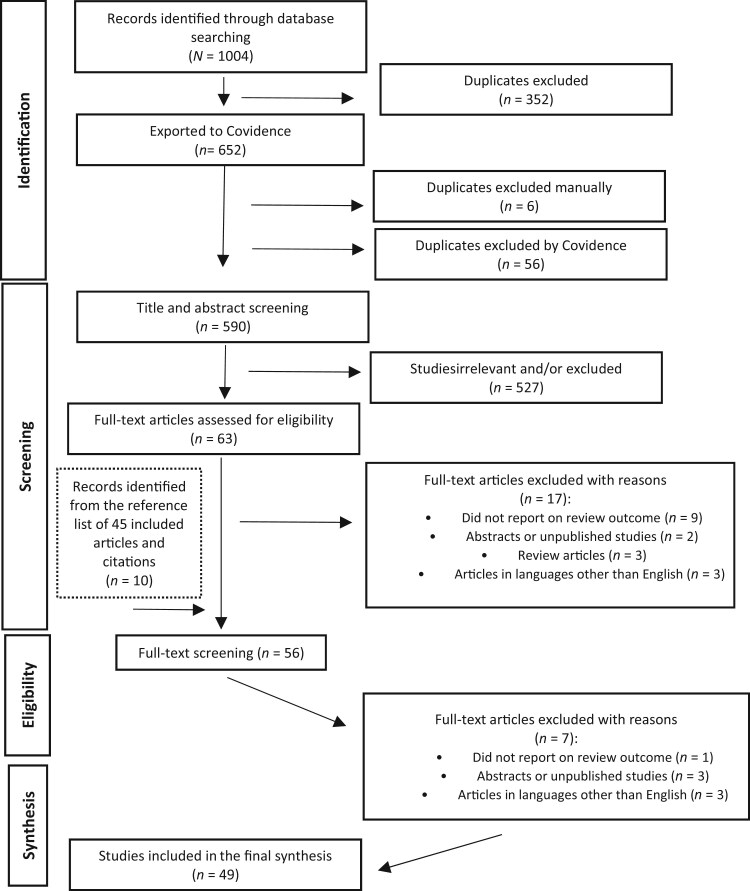
- Eligible studies included humans, animals, and in vitro models exposed to any fluoride source, with gut microbiome DNA/sequencing outcomes. From 1004 identified records, 590 were screened at title/abstract, 73 underwent full-text screening, and 49 were included. Data were extracted in Covidence, and quality was assessed with the Mixed Methods Appraisal Tool by 2 reviewers independently.
- Data were synthesized narratively using figures and tables, with subgroup analysis by fluoride dose and duration. Results could not be statistically pooled because of heterogeneity.
Limitations
- Stated: limited human studies make conclusions difficult; most included studies were animal-based and used very high fluoride doses (25 mg/L NaF in water) compared with the WHO safe intake for humans (0.8–1.7 mg/L NaF in water). Extrapolating to humans is difficult due to differences in fluoride sensitivity, intestinal barrier functions, and metabolic rates.
- Stated: high inconsistency among reported outcomes prevented pooling; mechanisms linking bacterial composition changes to metabolic dysfunction remain unconfirmed; population studies did not mention the dose responsible for fluorosis; more low-dose long-term human studies and in vitro MIC/MBC/time-kill analyses are needed.
- Evident from the text: substantial heterogeneity in animal models, biomarkers, sequencing workflows, and outcome reporting; some studies involved co-exposures (e.g., arsenic, PFOA, exercise, probiotics), and some alpha/beta diversity numeric data were unavailable for tables.
Model-written summary. Check it against the paper before relying on it.
Integrity signals
Registry
Cites
Statistics
Figures
Verification
Claims the paper makes
51 Not checked yet · 23 No full text of the sources · 22 Own result · 19 No basis given · 17 Own interpretation · 16 Own method · 2 Sources not found · 1 Supported so far · 1 Partly supported · 1 Couldn’t confirm · accuracy not yet measured
The sources with a verdict support this claim; the rest weren’t checked yet, have no full text we could read, or their verdicts aren’t rated yet.
In the paper
“exposure to fluoride resulted in a decrease in glutathione (GSH), follicle-stimulating hormone, and gastrotropin levels.34,40,46”
§ Effect of Fluoride on Gut Microbiota: A Systematic Review > RESULTS > Secondary Outcomes
What the sources say
- Supportedcites [34] Dionizio, 2021, Intestinal changes associated with fluoride exposure in rats: integrative morphological, proteomic and microbiome analyses, Chemosphere source
The Results section states that Western blotting confirmed a significant, dose-dependent reduction in Gastrotropin after fluoride exposure. The study measured this in the ileum of rats after subchronic exposure. (LLM, conf=0.94)
- Could not verifycites [40] Liu, 2021, Co-exposure to fluoride and arsenic disrupts intestinal flora balance and induces testicular autophagy in offspring rats, Ecotoxicol Environ Saf sourceExperimental — accuracy not yet measured
Section 2.5 lists the hormones measured as follicle-stimulating hormone, luteinizing hormone, and testosterone; section 3.3 reports their results. A search for gastrotropin and gastrointestinal hormones found no passage reporting that fluoride exposure decreased gastrotropin levels. (LLM, conf=0.75)
- Not checked — no full text of the sourcecites [46] Sun, 2020, Probiotic Lactobacillus johnsonii BS15 prevents memory dysfunction induced by chronic high-fluorine intake through modulating intestinal environment and improving gut development, Probiotics Antimicrob Proteins source
plaindirect- Asserted: passes — The authors put it forward as true.
- Checkable: passes — It can be checked against evidence.
- Load-bearing: unclear — It is unclear whether the paper’s conclusions depend on it.
- Based: passes — The paper gives a reason why it holds.
- Supported
The cited sources that could be checked couldn’t confirm or dispute this claim.
In the paper
“exposure to fluoride resulted in a decrease in glutathione (GSH), follicle-stimulating hormone, and gastrotropin levels.34,40,46”
§ Effect of Fluoride on Gut Microbiota: A Systematic Review > RESULTS > Secondary Outcomes
What the sources say
- Could not verifycites [34] Dionizio, 2021, Intestinal changes associated with fluoride exposure in rats: integrative morphological, proteomic and microbiome analyses, Chemosphere sourceExperimental — accuracy not yet measured
The Introduction says fluoride can affect redox balance, and the Results report reduced gastrotropin, but neither passage reports a decrease in glutathione. Searches for “glutathione,” “GSH,” and related terms found no such result in our copy; glutathione appears only in a cited work’s title. (LLM, conf=0.75)
- Could not verifycites [40] Liu, 2021, Co-exposure to fluoride and arsenic disrupts intestinal flora balance and induces testicular autophagy in offspring rats, Ecotoxicol Environ Saf sourceExperimental — accuracy not yet measured
The Abstract and Discussion report reduced reproductive hormone levels after fluoride exposure, but neither passage reports glutathione levels. A search of our copy for “glutathione” and “GSH” found no passage stating that fluoride decreased GSH. (LLM, conf=0.72)
- Not checked — no full text of the sourcecites [46] Sun, 2020, Probiotic Lactobacillus johnsonii BS15 prevents memory dysfunction induced by chronic high-fluorine intake through modulating intestinal environment and improving gut development, Probiotics Antimicrob Proteins source
plaindirect- Asserted: passes — The authors put it forward as true.
- Checkable: passes — It can be checked against evidence.
- Load-bearing: unclear — It is unclear whether the paper’s conclusions depend on it.
- Based: passes — The paper gives a reason why it holds.
- Could not verify
None of the sources cited for this claim have been checked yet.
In the paper
“Of these, 2 studies14,34 indicated no differences in beta diversity after the administration of fluoride compared with a control.”
§ Effect of Fluoride on Gut Microbiota: A Systematic Review > RESULTS > Effect of Fluoride on Gut Microbiota (Primary Outcome)
hedged- Asserted: passes — The authors put it forward as true.
- Checkable: passes — It can be checked against evidence.
- Load-bearing: unclear — It is unclear whether the paper’s conclusions depend on it.
- Based: passes — The paper gives a reason why it holds.
None of the sources cited for this claim have been checked yet.
In the paper
“In rodents, most studies (72%) reported a dramatic decrease in the abundance of Firmicutes at the phylum level and lactobacilli at the genus level upon exposure to a high dose of fluoride (25-100 mg L–1 NaF) compared with a control.”
§ Effect of Fluoride on Gut Microbiota: A Systematic Review > RESULTS > Effect of Fluoride on Gut Microbiota (Primary Outcome)
plaindirect- Asserted: passes — The authors put it forward as true.
- Checkable: passes — It can be checked against evidence.
- Load-bearing: passes — The paper’s conclusions depend on it.
- Based: passes — The paper gives a reason why it holds.
None of the sources cited for this claim have been checked yet.
In the paper
“Among the rat and mice studies, 10 reported an increase in Bacteroidetes level and a decrease in Parabacteroides and Bacteroidales at 100 mg L–1 NaF.”
§ Effect of Fluoride on Gut Microbiota: A Systematic Review > RESULTS > Effect of Fluoride on Gut Microbiota (Primary Outcome)
plaindirect- Asserted: passes — The authors put it forward as true.
- Checkable: passes — It can be checked against evidence.
- Load-bearing: unclear — It is unclear whether the paper’s conclusions depend on it.
- Based: passes — The paper gives a reason why it holds.
The paper states this without a source or data behind it here, so there is nothing to check it against. The quote shows it is in the paper.
In the paper
“However, the phyla or genera most affected differ between different animal types.”
§ Effect of Fluoride on Gut Microbiota: A Systematic Review > RESULTS > Effect of Fluoride on Gut Microbiota (Primary Outcome)
plaincorrelational- Asserted: passes — The authors put it forward as true.
- Checkable: passes — It can be checked against evidence.
- Load-bearing: unclear — It is unclear whether the paper’s conclusions depend on it.
- Based: passes — The paper gives a reason why it holds.
The paper states this without a source or data behind it here, so there is nothing to check it against. The quote shows it is in the paper.
In the paper
“An ex vivo study of human feces indicated that ≤ 2 mg L–1 NaF might boost “health-associated” taxa, but concentrations (≥ 10 mg L–1 NaF) could increase the ratio of some unhealthy microbes after 24 hours.”
§ Effect of Fluoride on Gut Microbiota: A Systematic Review > Abstract > Data Analysis
hedgedconditional- Asserted: passes — The authors put it forward as true.
- Checkable: passes — It can be checked against evidence.
- Load-bearing: unclear — It is unclear whether the paper’s conclusions depend on it.
- Based: passes — The paper gives a reason why it holds.
None of the sources cited for this claim have been checked yet.
In the paper
“However, the population studies did not mention the dose that was responsible for fluorosis.74–76”
§ Effect of Fluoride on Gut Microbiota: A Systematic Review > RESULTS > Effect of Fluoride on Gut Microbiota (Primary Outcome)
plain- Asserted: passes — The authors put it forward as true.
- Checkable: passes — It can be checked against evidence.
- Load-bearing: unclear — It is unclear whether the paper’s conclusions depend on it.
- Based: passes — The paper gives a reason why it holds.
A result the paper reports from its own data — it cites no other source for it, so there is none to check. The quote shows it is in the paper.
In the paper
“The animal studies examined the effects of high fluoride doses in water and diet (50-1200 mg L–1 NaF) for long-term (1-6 months) and short-term (6 hours to 7 days) exposure, with all showing a significant disturbance in the Firmicutes to Bacteroidota ratio.”
§ Effect of Fluoride on Gut Microbiota: A Systematic Review > Abstract > Data Analysis
plaindirect- Asserted: passes — The authors put it forward as true.
- Checkable: passes — It can be checked against evidence.
- Load-bearing: passes — The paper’s conclusions depend on it.
- Based: passes — The paper gives a reason why it holds.
None of the sources cited for this claim have been checked yet.
In the paper
“Four good-quality studies10,54,55,57 indicated large differences in beta diversity after fluoride exposure.”
§ Effect of Fluoride on Gut Microbiota: A Systematic Review > RESULTS > Effect of Fluoride on Gut Microbiota (Primary Outcome)
hedgeddirect- Asserted: passes — The authors put it forward as true.
- Checkable: passes — It can be checked against evidence.
- Load-bearing: passes — The paper’s conclusions depend on it.
- Based: passes — The paper gives a reason why it holds.
- Probably not a substantial claim. 37
- It may state two separate claims as one. 50
The cited sources support only part of this claim — read each source’s verdict below.
In the paper
“This systemic review was conducted according to the recommendations of the Preferred Reporting Items for Systematic Reviews and Meta-analysis (PRISMA) statement and the guidelines of the Cochrane Handbook for Systematic Reviews of Interventions.25,26”
§ Effect of Fluoride on Gut Microbiota: A Systematic Review > METHODS > Protocol and Registration
What the sources say
- Partly supportedcites [25] Page, 2021, The PRISMA 2020 statement: an updated guideline for reporting systematic reviews, Int J Surg sourceExperimental — accuracy not yet measured
The Scope of the guideline section identifies this paper as the PRISMA guidance relevant to systematic reviews and says it can be useful when planning them. But it explicitly says PRISMA 2020 is not intended to guide review conduct, so the citation supports identifying the PRISMA statement, not treating it as a conduct guideline. The Cochrane Handbook is separately cited in the citing sentence. (LLM, conf=0.83)
- Not checked — no full text of the sourcecites [26] Higgins, 2019 source
plain- Asserted: passes — The authors put it forward as true.
- Checkable: passes — It can be checked against evidence.
- Load-bearing: fails — The paper’s conclusions may not depend on it.
- Based: passes — The paper gives a reason why it holds.
Probably not a substantial claim. The paper’s conclusions may not depend on it. It may state two separate claims as one.
- Partly supported
None of the sources cited for this claim have been checked yet.
In the paper
“Three of the studies used doses of 25, 50, 100, and 150 mg L–1 NaF for 70 days10 and 12 weeks.54,65 Fluoride led to significantly lower levels of Actinobacteria, Bacteroidetes, and Verrucomicrobia and significantly higher levels of Firmicutes, whereas Turicibacter, Lachnospiraceae, Roseburia, and Clostridium sensu stricto were negatively associated with fluoride exposure.”
§ Effect of Fluoride on Gut Microbiota: A Systematic Review > RESULTS > Effect of Fluoride on Gut Microbiota (Primary Outcome)
plaindirect- Asserted: passes — The authors put it forward as true.
- Checkable: passes — It can be checked against evidence.
- Load-bearing: passes — The paper’s conclusions depend on it.
- Based: passes — The paper gives a reason why it holds.
It may state two separate claims as one.
A result the paper reports from its own data — it cites no other source for it, so there is none to check. The quote shows it is in the paper.
In the paper
“The sample size in the case of animal studies ranged from 6 to 900 animals.”
§ Effect of Fluoride on Gut Microbiota: A Systematic Review > RESULTS > Characteristics of Included Studies
plain- Asserted: passes — The authors put it forward as true.
- Checkable: passes — It can be checked against evidence.
- Load-bearing: fails — The paper’s conclusions may not depend on it.
- Based: passes — The paper gives a reason why it holds.
Probably not a substantial claim. The paper’s conclusions may not depend on it.
None of the sources cited for this claim have been checked yet.
In the paper
“On the contrary, 1 study used 15, 45, and 75 mg L–1 NaF for 3 months and found that low fluoride exposure upregulated the abundance of Lactobacillus and Lachnospiraceae; bacilli, Lactobacillus, and Lactobacillaceae were also dominant in the 45 mg L–1 NaF group; and Bifidobacteriales, Bacteroidetes, and Actinobacteria were dominant taxa in the 75 mg L–1 NaF group.62”
§ Effect of Fluoride on Gut Microbiota: A Systematic Review > RESULTS > Effect of Fluoride on Gut Microbiota (Primary Outcome)
plaindirect- Asserted: passes — The authors put it forward as true.
- Checkable: passes — It can be checked against evidence.
- Load-bearing: unclear — It is unclear whether the paper’s conclusions depend on it.
- Based: passes — The paper gives a reason why it holds.
It may state two separate claims as one.
A result the paper reports from its own data — it cites no other source for it, so there is none to check. The quote shows it is in the paper.
In the paper
“A total of 1004 articles were identified from the database search.”
§ Effect of Fluoride on Gut Microbiota: A Systematic Review > RESULTS > Identification and Selection of Studies
plain- Asserted: passes — The authors put it forward as true.
- Checkable: passes — It can be checked against evidence.
- Load-bearing: fails — The paper’s conclusions may not depend on it.
- Based: passes — The paper gives a reason why it holds.
Probably not a substantial claim. The paper’s conclusions may not depend on it.
None of the sources cited for this claim have been checked yet.
In the paper
“One of the ex vivo studies of human feces, which used a fermenter, indicated a low dose (1-2 mg L–1) of NaF did not show a significant difference in the abundance at phylum and genus levels but may promote taxa associated with health, including Faecalibacterium and Lactobacillus.”
§ Effect of Fluoride on Gut Microbiota: A Systematic Review > RESULTS > Effect of Fluoride on Gut Microbiota (Primary Outcome)
hedgedconditional- Asserted: passes — The authors put it forward as true.
- Checkable: passes — It can be checked against evidence.
- Load-bearing: unclear — It is unclear whether the paper’s conclusions depend on it.
- Based: passes — The paper gives a reason why it holds.
It may state two separate claims as one.
A result the paper reports from its own data — it cites no other source for it, so there is none to check. The quote shows it is in the paper.
In the paper
“All 49 articles reported on studies of the effect of different forms and doses of fluoride on the gut microbiome.”
§ Effect of Fluoride on Gut Microbiota: A Systematic Review > RESULTS > Identification and Selection of Studies
plain- Asserted: passes — The authors put it forward as true.
- Checkable: passes — It can be checked against evidence.
- Load-bearing: fails — The paper’s conclusions may not depend on it.
- Based: passes — The paper gives a reason why it holds.
Probably not a substantial claim. The paper’s conclusions may not depend on it.
A result the paper reports from its own data — it cites no other source for it, so there is none to check. The quote shows it is in the paper.
In the paper
“Amplicon 16S rRNA gene sequencing was used in 44 studies (92%), 2 studies41,46 also included quantitative polymerase chain reaction to validate 16S rRNA gene sequencing findings.”
§ Effect of Fluoride on Gut Microbiota: A Systematic Review > RESULTS > Characteristics of Included Studies
plain- Asserted: passes — The authors put it forward as true.
- Checkable: passes — It can be checked against evidence.
- Load-bearing: fails — The paper’s conclusions may not depend on it.
- Based: passes — The paper gives a reason why it holds.
Probably not a substantial claim. The paper’s conclusions may not depend on it.
A result the paper reports from its own data — it cites no other source for it, so there is none to check. The quote shows it is in the paper.
In the paper
“An additional 10 articles were identified from reference lists and citation chaining of included studies.”
§ Effect of Fluoride on Gut Microbiota: A Systematic Review > RESULTS > Identification and Selection of Studies
plain- Asserted: passes — The authors put it forward as true.
- Checkable: passes — It can be checked against evidence.
- Load-bearing: fails — The paper’s conclusions may not depend on it.
- Based: passes — The paper gives a reason why it holds.
Probably not a substantial claim. The paper’s conclusions may not depend on it.
A result the paper reports from its own data — it cites no other source for it, so there is none to check. The quote shows it is in the paper.
In the paper
“The majority (90%) of the studies were conducted in Asia (China, Turkey, India, and Japan),10,14,31–33,35–43,46–52,54–68,70–76 4% in the United States,45,53 4% in Australia,34,69 and 2% in Brazil (Table 2).44”
§ Effect of Fluoride on Gut Microbiota: A Systematic Review > RESULTS > Characteristics of Included Studies
plain- Asserted: passes — The authors put it forward as true.
- Checkable: passes — It can be checked against evidence.
- Load-bearing: fails — The paper’s conclusions may not depend on it.
- Based: passes — The paper gives a reason why it holds.
Probably not a substantial claim. The paper’s conclusions may not depend on it. It may state two separate claims as one.
A result the paper reports from its own data — it cites no other source for it, so there is none to check. The quote shows it is in the paper.
In the paper
“The included studies used different animal models, such as rodents, birds, and fish (Table 2).”
§ Effect of Fluoride on Gut Microbiota: A Systematic Review > RESULTS > Characteristics of Included Studies
plain- Asserted: passes — The authors put it forward as true.
- Checkable: passes — It can be checked against evidence.
- Load-bearing: fails — The paper’s conclusions may not depend on it.
- Based: passes — The paper gives a reason why it holds.
Probably not a substantial claim. The paper’s conclusions may not depend on it.
A result the paper reports from its own data — it cites no other source for it, so there is none to check. The quote shows it is in the paper.
In the paper
“These studies were 39 randomized controlled trials,10,31–67 1 nonrandomized controlled trial,68 6 laboratory-based or experimental studies,14,69–73 1 cohort study,74 and 2 case-control studies.75,76”
§ Effect of Fluoride on Gut Microbiota: A Systematic Review > RESULTS > Identification and Selection of Studies
plain- Asserted: passes — The authors put it forward as true.
- Checkable: passes — It can be checked against evidence.
- Load-bearing: unclear — It is unclear whether the paper’s conclusions depend on it.
- Based: passes — The paper gives a reason why it holds.
It may state two separate claims as one.
A result the paper reports from its own data — it cites no other source for it, so there is none to check. The quote shows it is in the paper.
In the paper
“After deduplication 590 records were screened at the title and abstract level, and 63 articles were included in the full-text screening based on the preset inclusion and exclusion criteria.”
§ Effect of Fluoride on Gut Microbiota: A Systematic Review > RESULTS > Identification and Selection of Studies
plain- Asserted: passes — The authors put it forward as true.
- Checkable: passes — It can be checked against evidence.
- Load-bearing: fails — The paper’s conclusions may not depend on it.
- Based: passes — The paper gives a reason why it holds.
Probably not a substantial claim. The paper’s conclusions may not depend on it.
The paper states this without a source or data behind it here, so there is nothing to check it against. The quote shows it is in the paper.
In the paper
“The remaining 26 animal studies used other tissues as biomarkers (Table 2).”
§ Effect of Fluoride on Gut Microbiota: A Systematic Review > RESULTS > Characteristics of Included Studies
plainn = 26- Asserted: passes — The authors put it forward as true.
- Checkable: passes — It can be checked against evidence.
- Load-bearing: fails — The paper’s conclusions may not depend on it.
- Based: passes — The paper gives a reason why it holds.
Probably not a substantial claim. The paper’s conclusions may not depend on it.
None of the sources cited for this claim have been checked yet.
In the paper
“Of the Actinobacteria, Bifidobacterium was also influenced by fluoride intervention, with an increased abundance indicated in 5 studies31,47,50,51,75 and a decrease in 3 studies when animals were exposed to 50-200 mg L–1 NaF.”
§ Effect of Fluoride on Gut Microbiota: A Systematic Review > RESULTS > Effect of Fluoride on Gut Microbiota (Primary Outcome)
hedgeddirectn = 3- Asserted: passes — The authors put it forward as true.
- Checkable: passes — It can be checked against evidence.
- Load-bearing: passes — The paper’s conclusions depend on it.
- Based: passes — The paper gives a reason why it holds.
It may state two separate claims as one.
A result the paper reports from its own data — it cites no other source for it, so there is none to check. The quote shows it is in the paper.
In the paper
“Forty-nine studies were included (n = 42 in animals, 4 of humans, 3 in vitro studies) after screening for title, abstract, and full text using Covidence to check against eligibility criteria.”
- Also stated in: § Characteristics of Included Studies · plain
“Forty-two10,31,33–70,76 studies (88%) were conducted with animals, 3 were in vitro (6%),71–73 and 4 studies (8%)14,74–76 included humans as the participants (Table 2).”
§ Effect of Fluoride on Gut Microbiota: A Systematic Review > Abstract > Data Extraction
plainn = 42- Asserted: passes — The authors put it forward as true.
- Checkable: passes — It can be checked against evidence.
- Load-bearing: unclear — It is unclear whether the paper’s conclusions depend on it.
- Based: passes — The paper gives a reason why it holds.
It may state two separate claims as one.
- Also stated in: § Characteristics of Included Studies · plain
A result the paper reports from its own data — it cites no other source for it, so there is none to check. The quote shows it is in the paper.
In the paper
“In the case of human studies, it ranged from 15 to 114 participants.”
§ Effect of Fluoride on Gut Microbiota: A Systematic Review > RESULTS > Characteristics of Included Studies
plainn = 114- Asserted: passes — The authors put it forward as true.
- Checkable: passes — It can be checked against evidence.
- Load-bearing: fails — The paper’s conclusions may not depend on it.
- Based: passes — The paper gives a reason why it holds.
Probably not a substantial claim. The paper’s conclusions may not depend on it.
None of the sources cited for this claim have been checked yet.
In the paper
“The patients had significant variations in microbiota composition and abundance compared with healthy participants. This was characterized by an increase in the relative abundance of Verrucomicrobiota, Desulfobacterota, Acidobacteriota, and Proteobacteria, and a significant decline in the relative abundance of Firmicutes and Bacteroidetes at the phylum level.”
§ Effect of Fluoride on Gut Microbiota: A Systematic Review > RESULTS > Effect of Fluoride on Gut Microbiota (Primary Outcome)
plaincorrelational- Asserted: passes — The authors put it forward as true.
- Checkable: passes — It can be checked against evidence.
- Load-bearing: passes — The paper’s conclusions depend on it.
- Based: passes — The paper gives a reason why it holds.
It may state two separate claims as one.
In the paper
“Zhou et al76 investigated the changes in the gut microbiome of children with dental fluorosis and compared them with a mouse model established by administering 100 mg L–1 NaF in water. This study, therefore, was considered both an animal and human study.”
§ Effect of Fluoride on Gut Microbiota: A Systematic Review > RESULTS > Characteristics of Included Studies
What the sources say
- Not matchedcites Zhou et al76
Couldn’t be matched to a paper in Crossref, so it can’t be checked.
plain- Asserted: passes — The authors put it forward as true.
- Checkable: passes — It can be checked against evidence.
- Load-bearing: unclear — It is unclear whether the paper’s conclusions depend on it.
- Based: passes — The paper gives a reason why it holds.
It may state two separate claims as one.
- Not matched
None of the sources cited for this claim have been checked yet.
In the paper
“Shi et al66 detected that exposure to perfluorooctanoic acid increased Bacteroidetes and decreased Firmicutes populations significantly.”
§ Effect of Fluoride on Gut Microbiota: A Systematic Review > RESULTS > Effect of Fluoride on Gut Microbiota (Primary Outcome)
plaindirect- Asserted: passes — The authors put it forward as true.
- Checkable: passes — It can be checked against evidence.
- Load-bearing: unclear — It is unclear whether the paper’s conclusions depend on it.
- Based: passes — The paper gives a reason why it holds.
It may state two separate claims as one.
None of the sources cited for this claim have been checked yet.
In the paper
“Rarer gut phyla, such as Proteroidetes,49 Cyanobacteria,50 Proteobacteria,31 Atoprostipes, Lachnospiraceae,61 Erysipelotrichaceae,63 and Tenericutes (synonym Tenericuteota)36 increased upon high fluoride (25-150 mg L–1 NaF) exposure, but populations of Saccharibacteria31,49 and Verrucomicrobia (synonym Verrucomicrobiota)36,49,56 decreased.”
§ Effect of Fluoride on Gut Microbiota: A Systematic Review > RESULTS > Effect of Fluoride on Gut Microbiota (Primary Outcome)
plaindirect- Asserted: passes — The authors put it forward as true.
- Checkable: passes — It can be checked against evidence.
- Load-bearing: passes — The paper’s conclusions depend on it.
- Based: passes — The paper gives a reason why it holds.
It may state two separate claims as one.
A result the paper reports from its own data — it cites no other source for it, so there is none to check. The quote shows it is in the paper.
In the paper
“Of the 73 remaining articles, 49 were eligible for and included in this review.”
§ Effect of Fluoride on Gut Microbiota: A Systematic Review > RESULTS > Identification and Selection of Studies
plain- Asserted: passes — The authors put it forward as true.
- Checkable: passes — It can be checked against evidence.
- Load-bearing: fails — The paper’s conclusions may not depend on it.
- Based: passes — The paper gives a reason why it holds.
Probably not a substantial claim. The paper’s conclusions may not depend on it.
None of the sources cited for this claim have been checked yet.
In the paper
“Feng et al67 found that 5.7 mg L–1 polyfluorinated ether sulphonate decreased the abundance of lactobacilli but increased that of Staphylococcus.67”
§ Effect of Fluoride on Gut Microbiota: A Systematic Review > RESULTS > Effect of Fluoride on Gut Microbiota (Primary Outcome)
plaindirect- Asserted: passes — The authors put it forward as true.
- Checkable: passes — It can be checked against evidence.
- Load-bearing: unclear — It is unclear whether the paper’s conclusions depend on it.
- Based: passes — The paper gives a reason why it holds.
It may state two separate claims as one.
A result the paper reports from its own data — it cites no other source for it, so there is none to check. The quote shows it is in the paper.
In the paper
“The animal studies examined the effects of high fluoride doses in water and diet (50-1200 mg L–1 NaF) for long-term (1-6 months) and short-term (6 hours to 7 days) exposure, with all showing a significant disturbance in the Firmicutes to Bacteroidota ratio.”
§ Effect of Fluoride on Gut Microbiota: A Systematic Review > Abstract > Data Analysis
plain- Asserted: passes — The authors put it forward as true.
- Checkable: passes — It can be checked against evidence.
- Load-bearing: passes — The paper’s conclusions depend on it.
- Based: passes — The paper gives a reason why it holds.
It may state two separate claims as one.
A result the paper reports from its own data — it cites no other source for it, so there is none to check. The quote shows it is in the paper.
In the paper
“After deduplication 590 records were screened at the title and abstract level, and 63 articles were included in the full-text screening based on the preset inclusion and exclusion criteria.”
§ Effect of Fluoride on Gut Microbiota: A Systematic Review > RESULTS > Identification and Selection of Studies
plain- Asserted: passes — The authors put it forward as true.
- Checkable: passes — It can be checked against evidence.
- Load-bearing: fails — The paper’s conclusions may not depend on it.
- Based: passes — The paper gives a reason why it holds.
Probably not a substantial claim. The paper’s conclusions may not depend on it.
None of the sources cited for this claim have been checked yet.
In the paper
“However, in 1 study of mice, by Yasuda et al,53 applicable fluoride concentrations of 4 mg L–1 and 4 mg L–1 plus gavage resulted in the treated groups having a reduction in acidogenic oral bacteria, but there was no impact on the gut microbiome.”
§ Effect of Fluoride on Gut Microbiota: A Systematic Review > RESULTS > Effect of Fluoride on Gut Microbiota (Primary Outcome)
plaindirectSingle case- Asserted: passes — The authors put it forward as true.
- Checkable: passes — It can be checked against evidence.
- Load-bearing: unclear — It is unclear whether the paper’s conclusions depend on it.
- Based: passes — The paper gives a reason why it holds.
It may state two separate claims as one.
A claim is checked only against the cited paper’s full text, never its abstract, and none is available for its sources.
In the paper
“Amplicon 16S rRNA gene sequencing was used in 44 studies (92%), 2 studies41,46 also included quantitative polymerase chain reaction to validate 16S rRNA gene sequencing findings.”
§ Effect of Fluoride on Gut Microbiota: A Systematic Review > RESULTS > Characteristics of Included Studies
What the sources say
- Not checked — no full text of the sourcecites [41] Luo, 2016, Dietary high fluorine alters intestinal microbiota in broiler chickens, Biol Trace Elem Res source
- Not checked — no full text of the sourcecites [46] Sun, 2020, Probiotic Lactobacillus johnsonii BS15 prevents memory dysfunction induced by chronic high-fluorine intake through modulating intestinal environment and improving gut development, Probiotics Antimicrob Proteins source
plain- Asserted: passes — The authors put it forward as true.
- Checkable: passes — It can be checked against evidence.
- Load-bearing: fails — The paper’s conclusions may not depend on it.
- Based: passes — The paper gives a reason why it holds.
Probably not a substantial claim. The paper’s conclusions may not depend on it.
A result the paper reports from its own data — it cites no other source for it, so there is none to check. The quote shows it is in the paper.
In the paper
“All human14,74–76 and 16 (40%)33,36,40,45–47,52–54,56,57,60,65–67,76 animal studies included an analysis of microbiota on fecal samples.”
§ Effect of Fluoride on Gut Microbiota: A Systematic Review > RESULTS > Characteristics of Included Studies
plain- Asserted: passes — The authors put it forward as true.
- Checkable: passes — It can be checked against evidence.
- Load-bearing: unclear — It is unclear whether the paper’s conclusions depend on it.
- Based: passes — The paper gives a reason why it holds.
It may state two separate claims as one.
None of the sources cited for this claim have been checked yet.
In the paper
“Six studies50,51,55,58,67,71 used real-time–quantitative polymerase chain reaction using 16S rRNA-specific primers to quantify bacterial species.”
§ Effect of Fluoride on Gut Microbiota: A Systematic Review > RESULTS > Characteristics of Included Studies
What the sources say
- Not checked yetcites [50] Xin, 2021, Preventive effects of Lactobacillus johnsonii on the renal injury of mice induced by high fluoride exposure: insights from colonic microbiota and co-occurrence network analysis, Ecotoxicol Environ Saf source
Checked before — its earlier verdict is held back until a new check runs.
- Not checked yetcites [51] Xin, 2021, Probiotic alleviate fluoride-induced memory impairment by reconstructing gut microbiota in mice, Ecotoxicol Environ Saf source
Checked before — its earlier verdict is held back until a new check runs.
- Not checked — no full text of the sourcecites [55] Yu, 2021, Effects of fluorine on intestinal structural integrity and microbiota composition of common carp, Biol Trace Elem Res source
- Not checked — no full text of the sourcecites [58] Huang, 2024, Fluoride exposure-induced gut microbiota alteration mediates colonic ferroptosis through N6-methyladenosine (m6A) mediated silencing of SLC7A11, Ecotoxicol Environ Saf source
- Not checked — no full text of the sourcecites [67] Feng, 2024, Maternal F-53B exposure during pregnancy and lactation induced glucolipid metabolism disorders and adverse pregnancy outcomes by disturbing gut microbiota in mice, Sci Total Environ source
- Not checked — no full text of the sourcecites [71] Ma, 2014, Effects of fluoride on bacterial growth and its gene/protein expression, Chemosphere source
plain- Asserted: passes — The authors put it forward as true.
- Checkable: passes — It can be checked against evidence.
- Load-bearing: fails — The paper’s conclusions may not depend on it.
- Based: passes — The paper gives a reason why it holds.
Probably not a substantial claim. The paper’s conclusions may not depend on it.
- Not checked yet
The paper states this without a source or data behind it here, so there is nothing to check it against. The quote shows it is in the paper.
In the paper
“Overall, all studies concluded that fluoride in suitable amounts (per the WHO recommendation for each species type) boosts gut microbial growth (probiotics) but, in excess, discourages microbial growth.”
§ Effect of Fluoride on Gut Microbiota: A Systematic Review > Discussion
boosteddirect- Asserted: passes — The authors put it forward as true.
- Checkable: passes — It can be checked against evidence.
- Load-bearing: passes — The paper’s conclusions depend on it.
- Based: passes — The paper gives a reason why it holds.
It may state two separate claims as one.
The paper states this without a source or data behind it here, so there is nothing to check it against. The quote shows it is in the paper.
In the paper
“Fluoride intervention increased the relative abundance of Firmicuteota and decreased the Bacteroidota population, leading to the elevated Firmicuteota to Bacteroidota ratio.”
§ Effect of Fluoride on Gut Microbiota: A Systematic Review > Discussion > Correlation between the metabolic changes and gut microbiota composition in response to Fluoride
plaindirect- Asserted: passes — The authors put it forward as true.
- Checkable: passes — It can be checked against evidence.
- Load-bearing: passes — The paper’s conclusions depend on it.
- Based: passes — The paper gives a reason why it holds.
It may state two separate claims as one.
None of the sources cited for this claim have been checked yet.
In the paper
“Some studies also showed an increase in the abundance of Firmicutes and a decrease in Bacteroidetes.10,32,37”
§ Effect of Fluoride on Gut Microbiota: A Systematic Review > RESULTS > Effect of Fluoride on Gut Microbiota (Primary Outcome)
plaincorrelational- Asserted: passes — The authors put it forward as true.
- Checkable: passes — It can be checked against evidence.
- Load-bearing: unclear — It is unclear whether the paper’s conclusions depend on it.
- Based: passes — The paper gives a reason why it holds.
It may state two separate claims as one.
None of the sources cited for this claim have been checked yet.
In the paper
“Overall, when comparing specific bacterial phyla and genera within the gut microbiota of animals treated with fluoride relative to the control, the most consistent findings were a lower abundance of Firmicutes and Verrucomicrobia31,35,42–44,46,47,49,50 followed by an increase in abundance of Bacteroidetes, Actinobacteria, Streptococcus, Staphylococcus, Desulfobacterota, and Proteobacteria31,36,42,”
§ Effect of Fluoride on Gut Microbiota: A Systematic Review > RESULTS > Effect of Fluoride on Gut Microbiota (Primary Outcome)
plaincorrelational- Asserted: passes — The authors put it forward as true.
- Checkable: passes — It can be checked against evidence.
- Load-bearing: passes — The paper’s conclusions depend on it.
- Based: passes — The paper gives a reason why it holds.
It may state two separate claims as one.
None of the sources cited for this claim have been checked yet.
In the paper
“This decrease was correlated with the decreased ratio of Firmicutes to Bacteroidetes and increased abundance of Proteobacteria, Acidobacteriota, and Verrucomicrobiota.75”
§ Effect of Fluoride on Gut Microbiota: A Systematic Review > RESULTS > Secondary Outcomes
plaincorrelational- Asserted: passes — The authors put it forward as true.
- Checkable: passes — It can be checked against evidence.
- Load-bearing: unclear — It is unclear whether the paper’s conclusions depend on it.
- Based: passes — The paper gives a reason why it holds.
It may state two separate claims as one.
None of the sources cited for this claim have been checked yet.
In the paper
“Many genera were implicated across the control and treated groups, including the lower abundance of lactobacilli, Faecalibacterium, and Bifidobacterium31,32,36,37,40,46,49,50,52 (important in maintaining intestinal function), as well as higher abundance of E coli.42”
§ Effect of Fluoride on Gut Microbiota: A Systematic Review > RESULTS > Effect of Fluoride on Gut Microbiota (Primary Outcome)
plaincorrelational- Asserted: passes — The authors put it forward as true.
- Checkable: passes — It can be checked against evidence.
- Load-bearing: passes — The paper’s conclusions depend on it.
- Based: passes — The paper gives a reason why it holds.
It may state two separate claims as one.
The paper states this without a source or data behind it here, so there is nothing to check it against. The quote shows it is in the paper.
In the paper
“Although effects at high doses are inconsistent, impacts could be seen in overall microbial diversity change, change in relative abundance of specific taxa, and changes in the metabolism of present microbiota.”
§ Effect of Fluoride on Gut Microbiota: A Systematic Review > CONCLUSIONS
hedgedconditional- Asserted: passes — The authors put it forward as true.
- Checkable: passes — It can be checked against evidence.
- Load-bearing: passes — The paper’s conclusions depend on it.
- Based: passes — The paper gives a reason why it holds.
It may state two separate claims as one.
The paper states this without a source or data behind it here, so there is nothing to check it against. The quote shows it is in the paper.
In the paper
“Most of the discussed studies also reported that fluoride may induce obesity and colitis along with IBD.”
§ Effect of Fluoride on Gut Microbiota: A Systematic Review > Discussion > Correlation between the metabolic changes and gut microbiota composition in response to Fluoride
hedgedconditional- Asserted: passes — The authors put it forward as true.
- Checkable: passes — It can be checked against evidence.
- Load-bearing: passes — The paper’s conclusions depend on it.
- Based: passes — The paper gives a reason why it holds.
It may state two separate claims as one.
The paper states this without a source or data behind it here, so there is nothing to check it against. The quote shows it is in the paper.
In the paper
“The mechanisms linking changes in bacterial composition to metabolic dysfunction have not been confirmed, meaning the exact process by which fluoride intervention modulates the gut microbiota and alters SCFAs remains unknown.”
§ Effect of Fluoride on Gut Microbiota: A Systematic Review > Discussion > Limitations and Knowledge Gaps
plain- Asserted: passes — The authors put it forward as true.
- Checkable: passes — It can be checked against evidence.
- Load-bearing: passes — The paper’s conclusions depend on it.
- Based: passes — The paper gives a reason why it holds.
Probably not a substantial claim. It may state two separate claims as one.
None of the sources cited for this claim have been checked yet.
In the paper
“On the contrary, in ducks, an increased richness was observed for Bacteroidetes and Firmicutes, but lower richness for Verrucomicrobia and Proteobacteria upon intake of 750 mg kg–1 NaF for 28 days.38”
§ Effect of Fluoride on Gut Microbiota: A Systematic Review > RESULTS > Effect of Fluoride on Gut Microbiota (Primary Outcome)
plaindirect- Asserted: passes — The authors put it forward as true.
- Checkable: passes — It can be checked against evidence.
- Load-bearing: unclear — It is unclear whether the paper’s conclusions depend on it.
- Based: passes — The paper gives a reason why it holds.
It may state two separate claims as one.
The paper states this without a source or data behind it here, so there is nothing to check it against. The quote shows it is in the paper.
In the paper
“This systematic review shows the possible relationship between fluoride and gut microbiota composition and its associated outcomes at a concentration of ≥ 50 mg L–1 NaF in animals for ≥ 1 month and ≥ 10 mg L–1 NaF in humans for 24 hours.”
§ Effect of Fluoride on Gut Microbiota: A Systematic Review > Discussion
hedgedcorrelational- Asserted: passes — The authors put it forward as true.
- Checkable: passes — It can be checked against evidence.
- Load-bearing: passes — The paper’s conclusions depend on it.
- Based: passes — The paper gives a reason why it holds.
It may state two separate claims as one.
None of the sources cited for this claim have been checked yet.
In the paper
“Findings showed that at high doses of fluoride (given as NaF, 1200 mg kg–1 and 800 mg kg–1 in diet) the abundance of Lactobacillus and Bifidobacterium was lower and that of Escherichia-Shigella, Gammaproteobacteria, Enterobacteriaceae, Streptococcus, and Staphylococcus was higher compared with controls after both short- (16 hours) and long-term (21-59 days) exposure.42,43”
§ Effect of Fluoride on Gut Microbiota: A Systematic Review > RESULTS > Effect of Fluoride on Gut Microbiota (Primary Outcome)
plaincorrelational- Asserted: passes — The authors put it forward as true.
- Checkable: passes — It can be checked against evidence.
- Load-bearing: passes — The paper’s conclusions depend on it.
- Based: passes — The paper gives a reason why it holds.
It may state two separate claims as one.
In the paper
“After exposure for 30 days, there was an increase in the levels of MDA, SOD, and catalase but a decrease in GSH.”
§ Effect of Fluoride on Gut Microbiota: A Systematic Review > RESULTS > Secondary Outcomes
What the sources say
- Not checked — no full text of the sourcecites [54] Zhong, 2022, Effect of fluoride in drinking water on fecal microbial community in rats, Biol Trace Elem Res source
plaindirect- Asserted: passes — The authors put it forward as true.
- Checkable: passes — It can be checked against evidence.
- Load-bearing: unclear — It is unclear whether the paper’s conclusions depend on it.
- Based: passes — The paper gives a reason why it holds.
It may state two separate claims as one.
In the paper
“After 60- and 90-day exposure, levels of reactive oxygen species, MDA, and myeloperoxidase were enhanced. However, the levels of catalase, GSH, acid phosphatase, and lysozyme were lowered and were associated with numbers of Firmicutes54”
§ Effect of Fluoride on Gut Microbiota: A Systematic Review > RESULTS > Secondary Outcomes
What the sources say
- Not checked — no full text of the sourcecites [54] Zhong, 2022, Effect of fluoride in drinking water on fecal microbial community in rats, Biol Trace Elem Res source
plaincorrelational- Asserted: passes — The authors put it forward as true.
- Checkable: passes — It can be checked against evidence.
- Load-bearing: unclear — It is unclear whether the paper’s conclusions depend on it.
- Based: passes — The paper gives a reason why it holds.
It may state two separate claims as one.
None of the sources cited for this claim have been checked yet.
In the paper
“In silkworm39,68,70 and Bufo gargarizans tadpole49 animal models, increased exposure to a high dose of fluoride (200 mg L–1 and 5-50 mg L–1 NaF, respectively) led to a decrease in Enterococcus and Bacillus in silkworms and Firmicutes, Synergistetes (synonym Synergistota), and Bacteroides in Bufo gargarizans but an increase in Staphylococcus in silkworm and in Deltaproteobacteria, Endomicrobia, and”
§ Effect of Fluoride on Gut Microbiota: A Systematic Review > RESULTS > Effect of Fluoride on Gut Microbiota (Primary Outcome)
plaindirect- Asserted: passes — The authors put it forward as true.
- Checkable: passes — It can be checked against evidence.
- Load-bearing: passes — The paper’s conclusions depend on it.
- Based: passes — The paper gives a reason why it holds.
It may state two separate claims as one.
A result the paper reports from its own data — it cites no other source for it, so there is none to check. The quote shows it is in the paper.
In the paper
“Most of the included studies were animal based and used very high doses of fluoride (25 mg L–1 NaF in water) compared with the safe intake recommended by WHO (0.8–1.7 mg L–1 NaF in water) in humans.”
§ Effect of Fluoride on Gut Microbiota: A Systematic Review > Discussion > Limitations and Knowledge Gaps
plain- Asserted: passes — The authors put it forward as true.
- Checkable: passes — It can be checked against evidence.
- Load-bearing: passes — The paper’s conclusions depend on it.
- Based: passes — The paper gives a reason why it holds.
It may state two separate claims as one.
None of the sources cited for this claim have been checked yet.
In the paper
“Findings indicated a biphasic response with fluoride-inducing bacterium growth at a low dose (0.1 mM NaF)71 and a dramatic increase in bacterium growth and enzyme production, especially of enolase.”
§ Effect of Fluoride on Gut Microbiota: A Systematic Review > RESULTS > Effect of Fluoride on Gut Microbiota (Primary Outcome)
hedgeddirect- Asserted: passes — The authors put it forward as true.
- Checkable: passes — It can be checked against evidence.
- Load-bearing: passes — The paper’s conclusions depend on it.
- Based: passes — The paper gives a reason why it holds.
It may state two separate claims as one.
The paper states this without a source or data behind it here, so there is nothing to check it against. The quote shows it is in the paper.
In the paper
“However, there are a limited number of human studies exploring the effects of fluoride on the gut microbiome, making it difficult to draw conclusions.”
§ Effect of Fluoride on Gut Microbiota: A Systematic Review > Discussion > Limitations and Knowledge Gaps
plain- Asserted: passes — The authors put it forward as true.
- Checkable: passes — It can be checked against evidence.
- Load-bearing: passes — The paper’s conclusions depend on it.
- Based: passes — The paper gives a reason why it holds.
It may state two separate claims as one.
None of the sources cited for this claim have been checked yet.
In the paper
“Specific bacteria shown to be more abundant in health compared with disease states include Bifidobacterium and Lactobacillus spp.12”
§ Effect of Fluoride on Gut Microbiota: A Systematic Review > INTRODUCTION
What the sources say
- Not checked yetcites [12] Mishra, 2014, Fluoride uptake and net primary productivity of selected crops, Oen J Soil Sci source
Checked before — its earlier verdict is held back until a new check runs.
plaincorrelational- Asserted: passes — The authors put it forward as true.
- Checkable: passes — It can be checked against evidence.
- Load-bearing: fails — The paper’s conclusions may not depend on it.
- Based: passes — The paper gives a reason why it holds.
Probably not a substantial claim. The paper’s conclusions may not depend on it.
- Not checked yet
None of the sources cited for this claim have been checked yet.
In the paper
“Fluoride is well recognized for its role in preventing and reversing dental caries.13”
§ Effect of Fluoride on Gut Microbiota: A Systematic Review > INTRODUCTION
What the sources say
- Not checked yetcites [13] Štepec, 2019, Fluoride in human health and nutrition, Acta Chim Slov source
Checked before — its earlier verdict is held back until a new check runs.
boosteddirect- Asserted: passes — The authors put it forward as true.
- Checkable: passes — It can be checked against evidence.
- Load-bearing: fails — The paper’s conclusions may not depend on it.
- Based: passes — The paper gives a reason why it holds.
Probably not a substantial claim. The paper’s conclusions may not depend on it.
- Not checked yet
What the paper did — it cites no source for this, so there is none to check. The quote shows it is in the paper.
In the paper
“A literature search was undertaken in July 2022 and a rerun of the search was conducted in July 2023 and then in 2024, using the following 6 electronic databases: MEDLINE, CINAHL, Embase, Scopus, PubMed, and Web of Science.”
§ Effect of Fluoride on Gut Microbiota: A Systematic Review > METHODS > Search Strategy
plain- Asserted: passes — The authors put it forward as true.
- Checkable: passes — It can be checked against evidence.
- Load-bearing: passes — The paper’s conclusions depend on it.
- Based: passes — The paper gives a reason why it holds.
Probably not a substantial claim. It may state two separate claims as one.
What the paper did — it cites no source for this, so there is none to check. The quote shows it is in the paper.
In the paper
“There were no restrictions based on the date of publication.”
§ Effect of Fluoride on Gut Microbiota: A Systematic Review > METHODS > Search Strategy
plain- Asserted: passes — The authors put it forward as true.
- Checkable: passes — It can be checked against evidence.
- Load-bearing: fails — The paper’s conclusions may not depend on it.
- Based: passes — The paper gives a reason why it holds.
Probably not a substantial claim. The paper’s conclusions may not depend on it.
What the paper did — it cites no source for this, so there is none to check. The quote shows it is in the paper.
In the paper
“The methodological quality of the included studies was assessed based on the Mixed Methods Appraisal Tool using criteria specific to observational studies (including cohort studies and case-control studies), quantitative studies (including randomized and nonrandomized controlled studies), and laboratory-based studies.”
§ Effect of Fluoride on Gut Microbiota: A Systematic Review > RESULTS > Quality Assessment
plain- Asserted: passes — The authors put it forward as true.
- Checkable: passes — It can be checked against evidence.
- Load-bearing: fails — The paper’s conclusions may not depend on it.
- Based: passes — The paper gives a reason why it holds.
Probably not a substantial claim. The paper’s conclusions may not depend on it.
What the paper did — it cites no source for this, so there is none to check. The quote shows it is in the paper.
In the paper
“The full details of the processes including the eligibility criteria, search strategy, extraction process, and data analysis were prespecified and documented in a protocol that was registered in the PROSPERO database (registration no. CRD42022347357).”
§ Effect of Fluoride on Gut Microbiota: A Systematic Review > METHODS > Protocol and Registration
plain- Asserted: passes — The authors put it forward as true.
- Checkable: passes — It can be checked against evidence.
- Load-bearing: fails — The paper’s conclusions may not depend on it.
- Based: passes — The paper gives a reason why it holds.
Probably not a substantial claim. The paper’s conclusions may not depend on it. It may state two separate claims as one.
What the paper did — it cites no source for this, so there is none to check. The quote shows it is in the paper.
In the paper
“A search of the reference lists of relevant articles was also performed to identify other potentially relevant sources.”
§ Effect of Fluoride on Gut Microbiota: A Systematic Review > METHODS > Search Strategy
plain- Asserted: passes — The authors put it forward as true.
- Checkable: passes — It can be checked against evidence.
- Load-bearing: fails — The paper’s conclusions may not depend on it.
- Based: passes — The paper gives a reason why it holds.
Probably not a substantial claim. The paper’s conclusions may not depend on it.
What the paper did — it cites no source for this, so there is none to check. The quote shows it is in the paper.
In the paper
“Results from all the 49 studies are presented narratively because they were unable to be statistically pooled.”
§ Effect of Fluoride on Gut Microbiota: A Systematic Review > RESULTS > Intervention Characteristics
plain- Asserted: passes — The authors put it forward as true.
- Checkable: passes — It can be checked against evidence.
- Load-bearing: passes — The paper’s conclusions depend on it.
- Based: passes — The paper gives a reason why it holds.
Probably not a substantial claim.
In the paper
“Although fluoride has been widely used as a preventive agent for dental caries, the effects of fluoride on the gut microbial communities still need to be understood.16”
§ Effect of Fluoride on Gut Microbiota: A Systematic Review > INTRODUCTION
What the sources say
- Not checked — no full text of the sourcecites [16] Jones, 2005, The effective use of fluorides in public health, Bull World Health Organ
plain- Asserted: passes — The authors put it forward as true.
- Checkable: passes — It can be checked against evidence.
- Load-bearing: passes — The paper’s conclusions depend on it.
- Based: passes — The paper gives a reason why it holds.
Probably not a substantial claim.
What the paper did — it cites no source for this, so there is none to check. The quote shows it is in the paper.
In the paper
“Full text of seemingly relevant articles was then screened by 2 reviewers independently (M.Y. and M.P.S.) to determine their eligibility for inclusion in the final review.”
§ Effect of Fluoride on Gut Microbiota: A Systematic Review > METHODS > Study Selection
plain- Asserted: passes — The authors put it forward as true.
- Checkable: passes — It can be checked against evidence.
- Load-bearing: fails — The paper’s conclusions may not depend on it.
- Based: passes — The paper gives a reason why it holds.
Probably not a substantial claim. The paper’s conclusions may not depend on it.
In the paper
“Fluoride can affect microbial community abundance, which may enhance its ability to prevent the growth of harmful bacteria and fungi or stimulate the growth of useful bacteria that reside in the gastrointestinal tract and vice versa, as summarized by Moran et al17”
§ Effect of Fluoride on Gut Microbiota: A Systematic Review > INTRODUCTION
What the sources say
- Not matchedcites Moran et al17
Couldn’t be matched to a paper in Crossref, so it can’t be checked.
hedgedconditional- Asserted: passes — The authors put it forward as true.
- Checkable: passes — It can be checked against evidence.
- Load-bearing: passes — The paper’s conclusions depend on it.
- Based: passes — The paper gives a reason why it holds.
It may state two separate claims as one.
- Not matched
A conclusion the paper draws from its own results — it cites no other source for it, so there is none to check. The quote shows it is in the paper.
In the paper
“This disturbance can lead to IBD, colitis, and even cancers, due to lack of microbial metabolites (eg, SCFAs) that control the metabolic pathways.”
§ Effect of Fluoride on Gut Microbiota: A Systematic Review > RESULTS > Effect of Fluoride on Gut Microbiota (Primary Outcome)
plaindirect- Asserted: passes — The authors put it forward as true.
- Checkable: passes — It can be checked against evidence.
- Load-bearing: passes — The paper’s conclusions depend on it.
- Based: fails — The paper may give no reason why it holds.
Probably not a substantial claim. The paper may give no reason why it holds. It may state two separate claims as one.
What the paper did — it cites no source for this, so there is none to check. The quote shows it is in the paper.
In the paper
“Data extraction was conducted by 1 reviewer (M.Y.) and cross-checked by another reviewer (E.A.K.).”
§ Effect of Fluoride on Gut Microbiota: A Systematic Review > METHODS > Data Extraction
plain- Asserted: passes — The authors put it forward as true.
- Checkable: passes — It can be checked against evidence.
- Load-bearing: fails — The paper’s conclusions may not depend on it.
- Based: passes — The paper gives a reason why it holds.
Probably not a substantial claim. The paper’s conclusions may not depend on it. It may state two separate claims as one.
What the paper did — it cites no source for this, so there is none to check. The quote shows it is in the paper.
In the paper
“Manual searching was also done to exhaust all possibilities and to reduce the risk of bias, as follows: (1) reference lists from the included studies were searched to identify any relevant study; (2) performing citation tracking in which all the articles that cited each of the included articles were tracked; and (3) related articles in Google Scholar and Science Direct were searched for to prevent”
§ Effect of Fluoride on Gut Microbiota: A Systematic Review > METHODS > Study Selection
plain- Asserted: passes — The authors put it forward as true.
- Checkable: passes — It can be checked against evidence.
- Load-bearing: fails — The paper’s conclusions may not depend on it.
- Based: passes — The paper gives a reason why it holds.
Probably not a substantial claim. The paper’s conclusions may not depend on it. It may state two separate claims as one.
What the paper did — it cites no source for this, so there is none to check. The quote shows it is in the paper.
In the paper
“The abstract and title of each paper were screened independently for eligibility by 2 individuals (M.Y. and M.P.S.) according to the eligibility requirements.”
§ Effect of Fluoride on Gut Microbiota: A Systematic Review > METHODS > Study Selection
plain- Asserted: passes — The authors put it forward as true.
- Checkable: passes — It can be checked against evidence.
- Load-bearing: fails — The paper’s conclusions may not depend on it.
- Based: passes — The paper gives a reason why it holds.
Probably not a substantial claim. The paper’s conclusions may not depend on it.
In the paper
“Nevertheless, it is mostly accepted that greater diversity, richness, and stability, and a higher relative abundance of species associated with the production of short-chain fatty acids (SCFAs) (eg, Faecalibacterium prausnitziii, Bacteroides spp, Roseburia spp, Bifidobacterium spp, and Lactobacillus spp) are hallmarks of a microbial community that is associated with better health outcomes.11”
§ Effect of Fluoride on Gut Microbiota: A Systematic Review > INTRODUCTION
What the sources say
- Not checked yetcites [11] So, 2018, Dietary fiber intervention on gut microbiota composition in healthy adults: a systematic review and meta-analysis, Am J Clin Nutr source
hedgedcorrelational- Asserted: passes — The authors put it forward as true.
- Checkable: passes — It can be checked against evidence.
- Load-bearing: fails — The paper’s conclusions may not depend on it.
- Based: passes — The paper gives a reason why it holds.
Probably not a substantial claim. The paper’s conclusions may not depend on it.
In the paper
“The Mixed Methods Appraisal Tool was used to assess the quality of the included studies.30”
§ Effect of Fluoride on Gut Microbiota: A Systematic Review > METHODS > Quality Assessment
What the sources say
- Not checked yetcites [30] Hong, 2018, The Mixed Methods Appraisal Tool (MMAT) version 2018 for information professionals and researchers, Educ Inf source
plain- Asserted: passes — The authors put it forward as true.
- Checkable: passes — It can be checked against evidence.
- Load-bearing: fails — The paper’s conclusions may not depend on it.
- Based: passes — The paper gives a reason why it holds.
Probably not a substantial claim. The paper’s conclusions may not depend on it.
A conclusion the paper draws from its own results — it cites no other source for it, so there is none to check. The quote shows it is in the paper.
In the paper
“The increased expression of proinflammatory cytokines and antimicrobial peptides followed by a decrease in antioxidative enzymes and tight junction proteins, for example, can be described by a lower abundance of lactobacilli, Bifidobacterium, Clostridium, and Faecalibacterium, which was responsible for decreased SCFAs levels—specifically, butyrate content that maintains balance in the production”
§ Effect of Fluoride on Gut Microbiota: A Systematic Review > Discussion > Correlation between the metabolic changes and gut microbiota composition in response to Fluoride
plaindirect- Asserted: passes — The authors put it forward as true.
- Checkable: passes — It can be checked against evidence.
- Load-bearing: passes — The paper’s conclusions depend on it.
- Based: passes — The paper gives a reason why it holds.
It may state two separate claims as one.
In the paper
“Tryptophan metabolites are important for regulating host physiology and an aberrant decrease in their production is associated with IBD and colorectal cancer.82”
§ Effect of Fluoride on Gut Microbiota: A Systematic Review > RESULTS > Secondary Outcomes
What the sources say
- Not checked yetcites [82] Agus, 2021, Gut microbiota-derived metabolites as central regulators in metabolic disorders, Gut source
plaincorrelational- Asserted: passes — The authors put it forward as true.
- Checkable: passes — It can be checked against evidence.
- Load-bearing: fails — The paper’s conclusions may not depend on it.
- Based: passes — The paper gives a reason why it holds.
Probably not a substantial claim. The paper’s conclusions may not depend on it. It may state two separate claims as one.
None of the sources cited for this claim have been checked yet.
In the paper
“An abnormal increase or decrease in the expression of these genes can result in several diseases, such as familial tumoral calcinosis.80,81”
§ Effect of Fluoride on Gut Microbiota: A Systematic Review > RESULTS > Secondary Outcomes
What the sources say
- Not checked yetcites [80] Kielak, 2016, The ecology of Acidobacteria: moving beyond genes and genomes, Front Microbiol source
Checked before — its earlier verdict is held back until a new check runs.
- Not checked yetcites [81] Sun, 2018, Functional metabolomics discover pentose and glucuronate interconversion pathways as promising targets for Yang Huang syndrome treatment with Yinchenhao Tang, RSC Adv source
Checked before — its earlier verdict is held back until a new check runs.
plaindirect- Asserted: passes — The authors put it forward as true.
- Checkable: passes — It can be checked against evidence.
- Load-bearing: fails — The paper’s conclusions may not depend on it.
- Based: passes — The paper gives a reason why it holds.
Probably not a substantial claim. The paper’s conclusions may not depend on it.
- Not checked yet
A claim is checked only against the cited paper’s full text, never its abstract, and none is available for its sources.
In the paper
“The changes also were associated with a reduction in levels of glycoproteins and antioxidant enzymes such as SOD, catalase, and GSH, which may cause colorectal cancer and is linked with impairment in the integrity of the intestinal barrier.10,37,49,54”
§ Effect of Fluoride on Gut Microbiota: A Systematic Review > Discussion > Correlation between the metabolic changes and gut microbiota composition in response to Fluoride
What the sources say
- Not checked — no full text of the sourcecites [10] Zhu, 2022, Fluoride exposure cause colon microbiota dysbiosis by destroyed microenvironment and disturbed antimicrobial peptides expression in colon, Environ Pollut source
- Not checked — no full text of the sourcecites [37] Fu, 2022, Exercise alleviated intestinal damage and microbial disturbances in mice exposed to fluoride, Chemosphere source
- Not checked — no full text of the sourcecites [49] Wang, 2019, The effect of fluorine exposure on morphological indicators and intestinal microbial community in Bufo gargarizans tadpoles, Ecol Indicat source
hedgedcorrelational- Asserted: passes — The authors put it forward as true.
- Checkable: passes — It can be checked against evidence.
- Load-bearing: passes — The paper’s conclusions depend on it.
- Based: passes — The paper gives a reason why it holds.
It may state two separate claims as one.
- Rests on an assumption: Changes in gut microbiota composition causally mediate the metabolic and health effects attributed to fluoride.
None of the sources cited for this claim have been checked yet.
In the paper
“These changes resulted in increased expression of proinflammatory cytokines, such as IL-17A and IL-22,10,37 and mucosal sIgA antibody,34,36 that further led to the production of antimicrobial peptides such as CRAMP, β-defensin-1, and β-defensin-3, consequently leading to inflammatory diseases like IBD.10”
§ Effect of Fluoride on Gut Microbiota: A Systematic Review > Discussion > Correlation between the metabolic changes and gut microbiota composition in response to Fluoride
What the sources say
- Not checked — no full text of the sourcecites [10] Zhu, 2022, Fluoride exposure cause colon microbiota dysbiosis by destroyed microenvironment and disturbed antimicrobial peptides expression in colon, Environ Pollut source
- Not checked — no full text of the sourcecites [37] Fu, 2022, Exercise alleviated intestinal damage and microbial disturbances in mice exposed to fluoride, Chemosphere source
- Not checked yetcites [34] Dionizio, 2021, Intestinal changes associated with fluoride exposure in rats: integrative morphological, proteomic and microbiome analyses, Chemosphere source
Checked before — its earlier verdict is held back until a new check runs.
plaindirect- Asserted: passes — The authors put it forward as true.
- Checkable: passes — It can be checked against evidence.
- Load-bearing: passes — The paper’s conclusions depend on it.
- Based: passes — The paper gives a reason why it holds.
It may state two separate claims as one.
- Rests on an assumption: Changes in gut microbiota composition causally mediate the metabolic and health effects attributed to fluoride.
What the paper did — it cites no source for this, so there is none to check. The quote shows it is in the paper.
In the paper
“This systematic review disentangles the effects of fluoride on gut microbiota and its associated functions with good reliability, due to high-quality assessment scores for most studies and specificity due to the focus on gut microbiota within the inclusion criteria.”
§ Effect of Fluoride on Gut Microbiota: A Systematic Review > Discussion > Limitations and Knowledge Gaps
boosted- Asserted: passes — The authors put it forward as true.
- Checkable: passes — It can be checked against evidence.
- Load-bearing: passes — The paper’s conclusions depend on it.
- Based: passes — The paper gives a reason why it holds.
Probably not a substantial claim. It may state two separate claims as one.
None of the sources cited for this claim have been checked yet.
In the paper
“Additionally, a decrease in the mRNA levels of BDNF, cAMP-responsive element, and stem cell factor were observed, which are an important modulators of neuroplasticity, thus leading to neurodevelopmental disorders.50”
§ Effect of Fluoride on Gut Microbiota: A Systematic Review > Discussion > Correlation between the metabolic changes and gut microbiota composition in response to Fluoride
What the sources say
- Not checked yetcites [50] Xin, 2021, Preventive effects of Lactobacillus johnsonii on the renal injury of mice induced by high fluoride exposure: insights from colonic microbiota and co-occurrence network analysis, Ecotoxicol Environ Saf source
Checked before — its earlier verdict is held back until a new check runs.
plaindirect- Asserted: passes — The authors put it forward as true.
- Checkable: passes — It can be checked against evidence.
- Load-bearing: unclear — It is unclear whether the paper’s conclusions depend on it.
- Based: passes — The paper gives a reason why it holds.
It may state two separate claims as one.
- Rests on an assumption: Changes in gut microbiota composition causally mediate the metabolic and health effects attributed to fluoride.
- Not checked yet
A conclusion the paper draws from its own results — it cites no other source for it, so there is none to check. The quote shows it is in the paper.
In the paper
“However, the effect patterns in different studies varied, which might be due to different exposure levels of fluoride, biomarkers used, and the use of diverse animal models with different genetic makeup, sensitivity, and other characteristics such as age, sex, and weight.”
§ Effect of Fluoride on Gut Microbiota: A Systematic Review > Discussion > Shifts in alpha and beta diversity in gut microbiota
hedgedconditional- Asserted: passes — The authors put it forward as true.
- Checkable: passes — It can be checked against evidence.
- Load-bearing: fails — The paper’s conclusions may not depend on it.
- Based: passes — The paper gives a reason why it holds.
Probably not a substantial claim. The paper’s conclusions may not depend on it. It may state two separate claims as one.
A conclusion the paper draws from its own results — it cites no other source for it, so there is none to check. The quote shows it is in the paper.
In the paper
“High doses of NaF (range, 25-200 mg L–1) with long-term exposure (1-6 months) most often were administered in studies using rat models, and these demonstrated that excessive fluoride exposure impacts gut microbiota composition, although variations in specific phyla and genera abundances were observed in different studies using the same dose and duration of fluoride.”
§ Effect of Fluoride on Gut Microbiota: A Systematic Review > RESULTS > Effect of Fluoride on Gut Microbiota (Primary Outcome)
boosteddirect- Asserted: passes — The authors put it forward as true.
- Checkable: passes — It can be checked against evidence.
- Load-bearing: passes — The paper’s conclusions depend on it.
- Based: passes — The paper gives a reason why it holds.
It may state two separate claims as one.
A conclusion the paper draws from its own results — it cites no other source for it, so there is none to check. The quote shows it is in the paper.
In the paper
“which could be due to the disturbance in the Firmicutes to Bacteroidetes ratio”
§ Effect of Fluoride on Gut Microbiota: A Systematic Review > RESULTS > Secondary Outcomes
hedgedconditional- Asserted: passes — The authors put it forward as true.
- Checkable: passes — It can be checked against evidence.
- Load-bearing: fails — The paper’s conclusions may not depend on it.
- Based: fails — The paper may give no reason why it holds.
Probably not a substantial claim. The paper’s conclusions may not depend on it. The paper may give no reason why it holds.
What the paper did — it cites no source for this, so there is none to check. The quote shows it is in the paper.
In the paper
“Additionally, including all eligible studies led to high inconsistency among the reported outcomes, thus preventing pooling of results.”
§ Effect of Fluoride on Gut Microbiota: A Systematic Review > Discussion > Limitations and Knowledge Gaps
plaindirect- Asserted: passes — The authors put it forward as true.
- Checkable: passes — It can be checked against evidence.
- Load-bearing: passes — The paper’s conclusions depend on it.
- Based: passes — The paper gives a reason why it holds.
It may state two separate claims as one.
A conclusion the paper draws from its own results — it cites no other source for it, so there is none to check. The quote shows it is in the paper.
In the paper
“Overall, doses of fluoride higher than 25 mg L–1 NaF in animals and 2 mg L–1 NaF in humans could disturb microbial homeostasis, which could lead to the upregulation of proinflammatory metabolites expression and downregulation of antioxidative enzymes and junction proteins, thus triggering immune responses and intestinal integrity.”
§ Effect of Fluoride on Gut Microbiota: A Systematic Review > Discussion > Factors Affecting Exposure Effects of Fluoride
hedgedconditional- Asserted: passes — The authors put it forward as true.
- Checkable: passes — It can be checked against evidence.
- Load-bearing: passes — The paper’s conclusions depend on it.
- Based: passes — The paper gives a reason why it holds.
It may state two separate claims as one.
- Rests on an assumption: Changes in gut microbiota composition causally mediate the metabolic and health effects attributed to fluoride.
The paper relies on this without support.
No previously published systematic reviews have highlighted the impacts of fluoride with a specific target on gut microbiota and its associated functions.
“To our knowledge, no previously published systematic reviews have highlighted the impacts of fluoride with a specific target on gut microbiota and its associated functions.”
The paper relies on this without support.
Doses effective for gut microbiota still need to be recognized, and human intervention trials are relatively limited.
“Doses effective for gut microbiota still need to be recognized; human intervention trials are relatively limited.”
The paper relies on this without support.
Changes in alpha diversity indices in fluoride-treated groups compared with controls indicate that fluoride is affecting the microbial community structure.
“An increase or decrease in alpha diversity indices,77 with Chao 1 used to estimate the number of species in a community and the Shannon and Simpson indices used to estimate the abundance of each species,28,78 in fluoride-treated groups when compared with control groups indicates fluoride is affecting the microbial community structure.”
The paper relies on this without support.
Acidobacteriota contain genes that can degrade polysaccharides and are involved in pentose and glucuronate interconversion.
“Acidobacteriota contain the genes that can degrade polysaccharides and are involved in pentose and glucuronate interconversion (carbohydrate metabolism).”
The paper relies on this without support.
Changes in gut microbiota composition causally mediate the metabolic and health effects attributed to fluoride.
“The mechanisms linking changes in bacterial composition to metabolic dysfunction have not been confirmed”
“Shifts in any of these aspects of the microbial community can lead to health implications.”
Self-check
Percentages, sums and reported differences re-computed from the paper’s own numbers.
Each contradiction between two passages listed here was confirmed by an independent check.
Rated minor: it would not touch a result — a value no result rests on, a p-value that stays on the same side of the significance level, or a conflict that is clerical, resolved elsewhere in the paper, or outside its own findings.
In the paper
“| Animal study | 42 (88) |”
§ Effect of Fluoride on Gut Microbiota: A Systematic Review > RESULTS > Identification and Selection of Studies
Reported 88 · recomputed 85.714286
Rated minor: it would not touch a result — a value no result rests on, a p-value that stays on the same side of the significance level, or a conflict that is clerical, resolved elsewhere in the paper, or outside its own findings.
In the paper
§ Effect of Fluoride on Gut Microbiota: A Systematic Review > RESULTS > Characteristics of Included Studies
“Luo, 201641; China | 0, 400, 800, 120 mg kg–1 F”
§ Effect of Fluoride on Gut Microbiota: A Systematic Review > RESULTS > Characteristics of Included Studies
“1200 mg F kg–1: Lactobacillus spp ↓ Bifidobacterium spp ↓ E coli ↑ Enterococcus spp ↑”
Rated minor: it would not touch a result — a value no result rests on, a p-value that stays on the same side of the significance level, or a conflict that is clerical, resolved elsewhere in the paper, or outside its own findings.
In the paper
§ Effect of Fluoride on Gut Microbiota: A Systematic Review > RESULTS > Quality Assessment
“39 studies (79%)10,14,31–43,45,46,49–51,54–56,58–67,70,71,74,76 met all the quality assessment criteria”
§ Effect of Fluoride on Gut Microbiota: A Systematic Review > RESULTS > Quality Assessment
“3 studies (6%) met 5 assessment criteria.58,69,75”
Rated minor: it would not touch a result — a value no result rests on, a p-value that stays on the same side of the significance level, or a conflict that is clerical, resolved elsewhere in the paper, or outside its own findings.
In the paper
“| Small intestine and cecal content | 3 (5) |”
§ Effect of Fluoride on Gut Microbiota: A Systematic Review > RESULTS > Identification and Selection of Studies
Reported 5 · recomputed 7.142857
Rated minor: it would not touch a result — a value no result rests on, a p-value that stays on the same side of the significance level, or a conflict that is clerical, resolved elsewhere in the paper, or outside its own findings.
In the paper
“| 2011-2020 | 21 (44) | | After 2020 | 28 (56) |”
§ Effect of Fluoride on Gut Microbiota: A Systematic Review > RESULTS > Identification and Selection of Studies
Reported 44 · recomputed 42.857143
Rated minor: it would not touch a result — a value no result rests on, a p-value that stays on the same side of the significance level, or a conflict that is clerical, resolved elsewhere in the paper, or outside its own findings.
In the paper
§ Effect of Fluoride on Gut Microbiota: A Systematic Review > Abstract > Data Extraction
“Forty-nine studies were included (n = 42 in animals, 4 of humans, 3 in vitro studies)”
§ Effect of Fluoride on Gut Microbiota: A Systematic Review > RESULTS > Characteristics of Included Studies
“This study, therefore, was considered both an animal and human study.”
Rated minor: it would not touch a result — a value no result rests on, a p-value that stays on the same side of the significance level, or a conflict that is clerical, resolved elsewhere in the paper, or outside its own findings.
In the paper
“16 (40%)33,36,40,45–47,52–54,56,57,60,65–67,76 animal studies included an analysis of microbiota on fecal samples.”
§ Effect of Fluoride on Gut Microbiota: A Systematic Review > RESULTS > Characteristics of Included Studies
Reported 40 · recomputed 38.095238
Rated minor: it would not touch a result — a value no result rests on, a p-value that stays on the same side of the significance level, or a conflict that is clerical, resolved elsewhere in the paper, or outside its own findings.
In the paper
§ Effect of Fluoride on Gut Microbiota: A Systematic Review > RESULTS > Effect of Fluoride on Gut Microbiota (Primary Outcome)
“In another case-control study, the effect of fluorine-18 fluorodeoxyglucose (18F-FDG) positron emission tomography on the gut microbiota of patients with breast cancer was investigated.”
§ Effect of Fluoride on Gut Microbiota: A Systematic Review > RESULTS > Characteristics of Included Studies
“N/A; this was a cohort study of patients with breast cancer.”
Citations
Cites
Cochrane Handbook for Systematic Reviews of Interventions
(2019) · doi:10.1002/9781119536604 · Cited by 14,828
The PRISMA 2020 Statement: An Updated Guideline for Reporting Systematic Reviews
Page, M. J., McKenzie, J. E., Bossuyt, P. M., Boutron, I., Hoffmann, T. C., Mulrow, C. D., Shamseer, L., Tetzlaff, J. M., Akl, E. A., Brennan, S. E., et al. (2021) · International Journal of Surgery · doi:10.1016/j.ijsu.2021.105906 · Cited by 11,748
Cani, P. D., Bibiloni, R., Knauf, C., Waget, A., Neyrinck, A. M., Delzenne, N. M., & Burcelin, R. (2008) · Diabetes · doi:10.2337/db07-1403 · Cited by 4,819
The Mixed Methods Appraisal Tool (MMAT) version 2018 for information professionals and researchers
Hong, Q. N., Fàbregues, S., Bartlett, G., Boardman, F., Cargo, M., Dagenais, P., Gagnon, M.-P., Griffiths, F., Nicolau, B., O’Cathain, A., et al. (2018) · Education for Information · doi:10.3233/efi-180221 · Cited by 4,737 · cited 1×
“30 The Mixed Methods Appraisal Tool contains 5 and 6 evaluation elements/questions each for the various study designs, with a judgement of “yes,” “no,” and “unclear” for each question.”
Role of the normal gut microbiota
Jandhyala, S. M. (2015) · World Journal of Gastroenterology · doi:10.3748/wjg.v21.i29.8787 · Cited by 3,001
Role of the gut microbiota in nutrition and health
Valdes, A. M., Walter, J., Segal, E., & Spector, T. D. (2018) · BMJ · doi:10.1136/bmj.k2179 · Cited by 2,375
Stojanov, S., Berlec, A., & Štrukelj, B. (2020) · Microorganisms · doi:10.3390/microorganisms8111715 · Cited by 1,967
Lloyd-Price, J., Abu-Ali, G., & Huttenhower, C. (2016) · Genome Medicine · doi:10.1186/s13073-016-0307-y · Cited by 1,891
Beta diversity as the variance of community data: dissimilarity coefficients and partitioning
Legendre, P., & Cáceres, M. D. (2013) · Ecology Letters · doi:10.1111/ele.12141 · Cited by 1,616
Gut microbiota-derived metabolites as central regulators in metabolic disorders
Agus, A., Clément, K., & Sokol, H. (2021) · Gut · doi:10.1136/gutjnl-2020-323071 · Cited by 1,347
Research works printed but not linked: 4
- Looi, 2020, The human microbiome: everything you need to know about the 39 trillion microbes that call our bodies home, Sci Focus
- European Commission, Directorate-General for Health and Consumers, 2010, Critical Review of Any New Evidence on the Hazard Profile, Health Effects, and Human Exposure to Fluoride and the Fluoridating Agents of Drinking Water
- Fawell, 2006, Fluoride in Drinking-Water
- Parthasaradh, 2018, Fluoride effect on minimum inhibitory concentration and growth dynamics of Lactobacillus acidophilus and Lactobacillus salivarius, World J Pharm Res, 7, 1024
Cited by
Sorted by citations
Short-chain fatty acids alleviated fluoride-induced neuroinflammation via the gut-brain axis in rats
Zhao, W., Zhu, S.-Q., Yin, Z.-H., Ommati, M. M., Zhang, Y.-W., Zhao, J., Zhou, B.-H., & Wang, H. (2025) · Environmental Pollution · doi:10.1016/j.envpol.2025.127503 · Cited by 7
Meng, H., Ommati, M. M., Li, J., Heidari, R., Zhao, W., Wang, H., & Zhou, B.-H. (2026) · Journal of Agricultural and Food Chemistry · doi:10.1021/acs.jafc.6c01386 · Cited by 2
From tooth to gut: Proteomic evidence of systemic dysregulation in fluorosis
Pongsapipatana, N., Gavila, P., Khieota, T., Jung, H.-S., Alinejad-Rokny, H., Cho, S.-D., Sriwattanapong, K., & Porntaveetus, T. (2026) · Ecotoxicology and Environmental Safety · doi:10.1016/j.ecoenv.2026.120310 · Cited by 1
Wright, J. T. (2025) · The Journal of the American Dental Association · doi:10.1016/j.adaj.2025.09.012
Zhang, J.-R., Li, Y.-W., Chen, H.-X., Luo, Y., Liu, R.-M., Wang, J.-B., Liu, N.-N., & Xiao, J.-H. (2026) · Biological Trace Element Research · doi:10.1007/s12011-026-05050-4
Metadata
- Authors
- Yasin, M., Zohoori, F. V., Kumah, E. A., Subramanian, M., Dean, P., & Orr, C. H.
- Affiliations
- Teesside University (GB)
- University of Liverpool (GB)
- Newcastle University (GB)
- Corresponding author
- Orr, Caroline Hayley
- ORCID
- Venue
- Nutrition Reviews
- Publisher
- Oxford University Press (OUP)
- Published
- 2025-03-10
- Volume
- 83
- Issue
- 7
- Pages
- e1853-e1880
- ISSN
- 0029-6643 (ISSN-L)
- 1753-4887
- PMC
- PMC12166178
- OpenAlex
- W4408301180
- Cited by
- 8
- References
- 90
- Citations by year
- 2026: 6 · 2025: 2
- FWCI
- 0.61
- Type
- journal article
- Language
- en
- Open access
- hybrid
- doi.org
- Licence
- Locations
- Nutrition Reviews (publishedVersion, cc-by)
- Europe PMC (PubMed Central) (publishedVersion, cc-by)
- PubMed Central (publishedVersion, cc-by)
- PubMed (publishedVersion)
- Teesside University Research Portal (Teesside University) (publishedVersion, cc-by)
- TeesRep (Teesside University) (publishedVersion, cc-by)
- LSTM Online Archive (Liverpool School of Tropical Medicine) (acceptedVersion)
- Funders
- Teesside University
- Topics
- Life Sciences › Biochemistry, Genetics and Molecular Biology › Molecular Biology › Gut microbiota and health
- Physical Sciences › Environmental Science › Water Science and Technology › Fluoride Effects and Removal
- Health Sciences › Dentistry › Periodontics › Oral microbiology and periodontitis research
- Keywords
- fluoride, gut microbiota, systemic fluoride, dental fluorosis, sodium fluoride, Acidobacteria, Proteobacteria, Bacteroidetes, dental caries, fluoride exposure, breast cancer, FDG uptake
- MeSH terms
- Gastrointestinal Microbiome, Animals, Dental Caries, Fluorides, Humans, Fluorosis, Dental
About these checks
Registry, retraction, Cites and statistics results are computed, not judged, with one exception: a printed reference that no index lists is read once by a model before it counts as a citation error. Claims are extracted by a model and kept only when their quote appears verbatim in the text; each cited source is then checked, with a model’s help, for whether it says what the claim relies on. Those verdicts can be wrong — read the claim’s quote and the cited source before relying on one.
A language model drew the claims from the paper on 2026-11-10, under version 3 of the claim definition (model deepseek-v4.1-flash, prompt extract-v3).
A second model labelled each claim on 2026-11-10 (model jev-1.13-20260917, definition revision gold-guideline-v0.2).
Cited sources are checked with a language model’s help (gpt-6-sol).
Statistics and arithmetic are recomputed, not judged.
Confidence bands are shown only for fields calibrated on our annotated test set. None is calibrated yet, so no band is shown.
What counts as a claim ›How we measure confidence ›How we check this ›
Are you an author, or do you see a problem with this page? Request a review
