

The DOI matches its Crossref record; 165 of the 165 references it cites were found in a registry or an index.
Relationship between the gut microbiome and brain function
Open accessAbstract
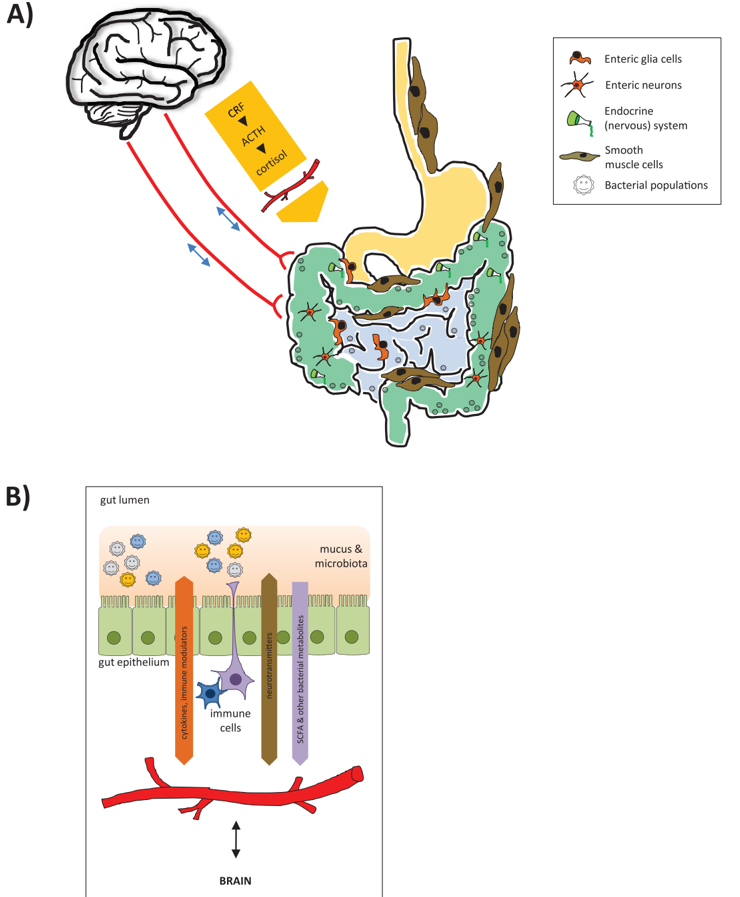
It has become increasingly evident in recent years that the gut microbiome and the brain communicate in a bidirectional manner, with each possibly affecting the other's functions. Substantial research has aimed to understand the mechanisms of this interaction and to outline strategies for preventing or treating nervous system-related disturbances. This review explores the evidence demonstrating how the gut microbiome may affect brain function in adults, thereby having an impact on stress, anxiety, depression, and cognition. In vitro, in vivo, and human studies reporting an association between a change in the gut microbiome and functional changes in the brain are highlighted, as are studies outlining the mechanisms by which the brain affects the microbiome and the gastrointestinal tract. Possible modes of action to explain how the gut microbiome and the brain functionally affect each other are proposed. Supplemental probiotics to combat brain-related dysfunction offer a promising approach, provided future research elucidates their mode of action and possible side effects. Further studies are warranted to establish how pre- and probiotic interventions may help to balance brain function in healthy and diseased individuals.
Overview
The claims and statistics of this paper haven’t been checked yet.
Free: it reads the open-access text and checks the first 5 claims that cite a source we can check. Create a free account to check every claim.
Integrity signals
Registry
Cites
Statistics
Figures
Verification
Claims the paper makes
The claims and statistics of this paper haven’t been checked yet.
Free: it reads the open-access text and checks the first 5 claims that cite a source we can check. Create a free account to check every claim.
Claims other papers make about this one
Each is checked against this paper’s own text: does it say what the citing paper says it does?
In the citing paper
“which are fermentation end products of non-digested carbohydrates, act both in the brain via free fatty acid receptors FFAR2 and FFAR3, and in the gut.In the brain, they have an impact on the production of neurotransmitters and catecholamines [280,282] and partially they affect the reward system, synaptic plasticity, and memory formation [286,287].In the intestine, they influence water and”
From The Role of Microbiota-Gut-Brain Axis in Neuropsychiatric and Neurological Disorders (2021) · cites this paper as [286]
Self-check
Percentages, sums and reported differences re-computed from the paper’s own numbers.
The self-check needs the paper’s full text.
Citations
Cites
1 retracted
Mohammadi, A. A., Jazayeri, S., Khosravi-Darani, K., Solati, Z., Mohammadpour, N., Asemi, Z., Adab, Z., Djalali, M., Tehrani-Doost, M., Hosseini, M., et al. (2016) · Nutritional Neuroscience · doi:10.1179/1476830515y.0000000023 · Cited by 239
RetractedAn obesity-associated gut microbiome with increased capacity for energy harvest
Turnbaugh, P. J., Ley, R. E., Mahowald, M. A., Magrini, V., Mardis, E. R., & Gordon, J. I. (2006) · Nature · doi:10.1038/nature05414 · Cited by 12,444
Diet rapidly and reproducibly alters the human gut microbiome
David, L. A., Maurice, C. F., Carmody, R. N., Gootenberg, D. B., Button, J. E., Wolfe, B. E., Ling, A. V., Devlin, A. S., Varma, Y., Fischbach, M. A., et al. (2014) · Nature · doi:10.1038/nature12820 · Cited by 10,100 · cited 1×
“For example, short-term consumption of diets composed entirely of animal or plant products rapidly changes structures of the microbial community, overwhelming interindividual differences in microbial gene expression.(14) Scientific evidence accumulated in recent years suggests that the gut microbiota affects some aspe…”
Human gut microbiome viewed across age and geography
Yatsunenko, T., Rey, F. E., Manary, M. J., Trehan, I., Dominguez-Bello, M. G., Contreras, M., Magris, M., Hidalgo, G., Baldassano, R. N., Anokhin, A. P., et al. (2012) · Nature · doi:10.1038/nature11053 · Cited by 7,815
Turnbaugh, P. J., Ley, R. E., Hamady, M., Fraser-Liggett, C. M., Knight, R., & Gordon, J. I. (2007) · Nature · doi:10.1038/nature06244 · Cited by 6,091 · cited 1×
“various microorganisms, whose collective genome is termed the gut microbiome.(10) Advances in DNA sequenc-”
Diversity, stability and resilience of the human gut microbiota
Lozupone, C. A., Stombaugh, J. I., Gordon, J. I., Jansson, J. K., & Knight, R. (2012) · Nature · doi:10.1038/nature11550 · Cited by 5,533 · cited 1×
“In healthy adults, the gut microbiota is dominated by only a few phyla, as noted above, and is characterized by a wide diversity of bacterial species.(17) The human microbiome changes with age, normally becoming less diverse in the elderly as a result of higher numbers of Bacteroides species and reduced numbers of Clo…”
Host-Bacterial Mutualism in the Human Intestine
Bäckhed, F., Ley, R. E., Sonnenburg, J. L., Peterson, D. A., & Gordon, J. I. (2005) · Science · doi:10.1126/science.1104816 · Cited by 5,277
Host-gut microbiota metabolic interactions
Nicholson, J. K., Holmes, E., Kinross, J., Burcelin, R., Gibson, G., Jia, W., & Pettersson, S. (2012) · Science · doi:10.1126/science.1223813 · Cited by 4,760 · cited 1×
“Furthermore, neuroactive metabolites of microbiota, such as short-chain fatty acids, constitute a route of information flow between the gut and the brain.(133) Despite the information provided by the above-mentioned research, the role of microorganisms in the regulation of neuronal activity is far from being fully und…”
Metagenomic Analysis of the Human Distal Gut Microbiome
Gill, S. R., Pop, M., DeBoy, R. T., Eckburg, P. B., Turnbaugh, P. J., Samuel, B. S., Gordon, J. I., Relman, D. A., Fraser-Liggett, C. M., & Nelson, K. E. (2006) · Science · doi:10.1126/science.1124234 · Cited by 4,699 · cited 1×
“reaches up to 50 different phyla, 1000 different bacterial species, and 10(14) viable bacteria per gram of luminal content.(11,12) The density of the human microbiome is highest”
Mind-altering microorganisms: the impact of the gut microbiota on brain and behaviour
Cryan, J. F., & Dinan, T. G. (2012) · Nature Reviews Neuroscience · doi:10.1038/nrn3346 · Cited by 4,572 · cited 6×
“nisms by which the human host responds to commensal and pathogenic bacteria.(16) Communication between the”
Influential
Research works printed but not linked: 2
- Jagmag, 2016, Exploring the relationship between gut microbiome and depression, Trends Gastroenterol, 1, 1
- Savidge, 2011, S-nitrosothiol signals in the enteric nervous system: lessons learnt from big brother, Front Neurosci, 5
Cited by
Human gut microbiota/microbiome in health and diseases: a review
Gomaa, E. Z. (2020) · Antonie van Leeuwenhoek · doi:10.1007/s10482-020-01474-7 · Cited by 1,294
“The increased BBB integrity limits entry of undesirable metabolites into brain tissue (Mohajeri et al. 2018).”
BackgroundThe Role of Microbiota-Gut-Brain Axis in Neuropsychiatric and Neurological Disorders
Socała, K., Doboszewska, U., Szopa, A., Serefko, A., Włodarczyk, M., Zielińska, A., Poleszak, E., Fichna, J., & Wlaź, P. (2021) · Pharmacological Research · doi:10.1016/j.phrs.2021.105840 · Cited by 857
Nutrition in adolescent growth and development
Norris, S. A., Frongillo, E. A., Black, M. M., Dong, Y., Fall, C., Lampl, M., Liese, A. D., Naguib, M., Prentice, A., Rochat, T., et al. (2022) · The Lancet · doi:10.1016/s0140-6736(21)01590-7 · Cited by 518
Steptoe, A. (2019) · Annual Review of Public Health · doi:10.1146/annurev-publhealth-040218-044150 · Cited by 474
The role of the microbiome for human health: From basic science to clinical applications
Mohajeri, M. H., Brummer, R. J. M., Rastall, R. A., Weersma, R. K., Harmsen, H. J. M., Faas, M., & Eggersdorfer, M. (2018) · European Journal of Nutrition · doi:10.1007/s00394-018-1703-4 · Cited by 440
Self-citation
Metadata
- Authors
- Mohajeri, M. H., La Fata, G., Steinert, R. E., & Weber, P.
- Affiliations
- Department of Human Nutrition, DSM Nutritional Products, Basel, Switzerland
- Corresponding author
- Mohajeri, M Hasan
- Venue
- Nutrition Reviews
- Publisher
- Oxford University Press (OUP)
- Published
- 2018-04-26
- Volume
- 76
- Issue
- 7
- Pages
- 481-496
- ISSN
- 0029-6643 (ISSN-L)
- 1753-4887
- OpenAlex
- W2801009528
- Cited by
- 376
- References
- 165
- Citations by year
- 2026: 24 · 2025: 48 · 2024: 51 · 2023: 52 · 2022: 74 · 2021: 54 · 2020: 37 · 2019: 22 · 2018: 14
- FWCI
- 3.12
- Type
- journal article
- Language
- en
- Open access
- hybrid
- doi.org
- Licence
- Locations
- Nutrition Reviews (publishedVersion, cc-by-nc-nd)
- PubMed (publishedVersion)
- Funders
- DSM Nutritional Products
- Topics
- Life Sciences › Biochemistry, Genetics and Molecular Biology › Molecular Biology › Gut microbiota and health
- Life Sciences › Agricultural and Biological Sciences › Food Science › Probiotics and Fermented Foods
- Health Sciences › Medicine › Gastroenterology › Gastrointestinal motility and disorders
- Keywords
- gut microbiota, gut-brain axis, brain function, stress, anxiety, depression, cognition, probiotics, prebiotics, neurodegeneration
- MeSH terms
- Gastrointestinal Microbiome, Adult, Anxiety, Brain, Depression, Female, Humans, Male, Nervous System Physiological Phenomena, Stress, Psychological, Probiotics, Gastrointestinal Tract
About these checks
Registry, retraction, Cites and statistics results are computed, not judged, with one exception: a printed reference that no index lists is read once by a model before it counts as a citation error. Claims are extracted by a model and kept only when their quote appears verbatim in the text; each cited source is then checked, with a model’s help, for whether it says what the claim relies on. Those verdicts can be wrong — read the claim’s quote and the cited source before relying on one.
Statistics and arithmetic are recomputed, not judged.
Confidence bands are shown only for fields calibrated on our annotated test set. None is calibrated yet, so no band is shown.
What counts as a claim ›How we measure confidence ›How we check this ›
Are you an author, or do you see a problem with this page? Request a review
How to cite
Cite CoChat for the checks on this page, and the paper for its own findings.
- This page
- CoChat. (2026). Citation check: Relationship between the gut microbiome and brain function. https://app.cochat.ai/papers/10.1093/nutrit/nuy009
- The paper
- Mohajeri, M. H., La Fata, G., Steinert, R. E., & Weber, P. (2018). Relationship between the gut microbiome and brain function. Nutrition Reviews. https://doi.org/10.1093/nutrit/nuy009
Data sources
Bibliographic data: Semantic Scholar, OpenAlex, Crossref.
Contains information from the Semantic Scholar Academic Graph Datasets, made available under the ODC Attribution License (ODC-BY 1.0).
Semantic Scholar’s data is described in: Kinney, R., et al. (2023). The Semantic Scholar Open Data Platform. arXiv:2301.10140.
